Market News August 9, 2021

Q2 2021 Montana Real Estate Market Update

The following analysis of select Montana real estate markets is provided by Windermere Real Estate Chief Economist Matthew Gardner. We hope that this information may assist you with making better-informed real estate decisions. For further information about the housing market in your area, please don’t hesitate to contact your Windermere Real Estate agent.


Regional Economic Overview

Along with the rest of the nation, Montana’s job market was significantly impacted by COVID-19, losing 63,300 jobs statewide. However, as of the end of the second quarter of this year, Montana has recovered all but 10,000 of them. Although this puts employment levels 2% lower than the pre-pandemic peak, the momentum of jobs returning has slowed. Employment levels dropped by 1,800 jobs in the second quarter. The June unemployment rate in the state was 3.7%, well below the national rate of 5.9%. Unemployment numbers ticked up one tenth of a percent between May and June. In the counties contained in this report, the lowest jobless rate was in Billings at 3.3%. Great Falls’ rate was 3.4% and Missoula came in at 3.5%. I am hopeful that the economy will pick up speed as we move through the balance of 2021, but I remain mindful of the uptick in new COVID-19 cases and their potential to undermine the state’s recovery.

montana Home Sales

❱ In the second quarter, a total of 1,169 homes sold in the markets contained in this report, representing an increase of 2% compared to the same period in 2020. Sales were up 4.3% compared to the first quarter of this year.

❱ Even with greater choice and an increased number of sales in five counties, sales were lower in four counties. Compared to the first quarter of this year, sales were higher in Missoula, Ravalli, Lake, Gallatin, and Park counties, but lower in the other areas covered in this report.

❱ It was pleasing to see sales pick back up after the drop in transactions in the first quarter. This can be attributed to the 156% increase in the number of homes for sale from the first quarter to the second. Clearly, supply was the limiting factor, not demand.

❱ The growth in sales is a good sign, and with pending sales up 34.3% compared to the first quarter, it is likely that third quarter numbers will be positive.
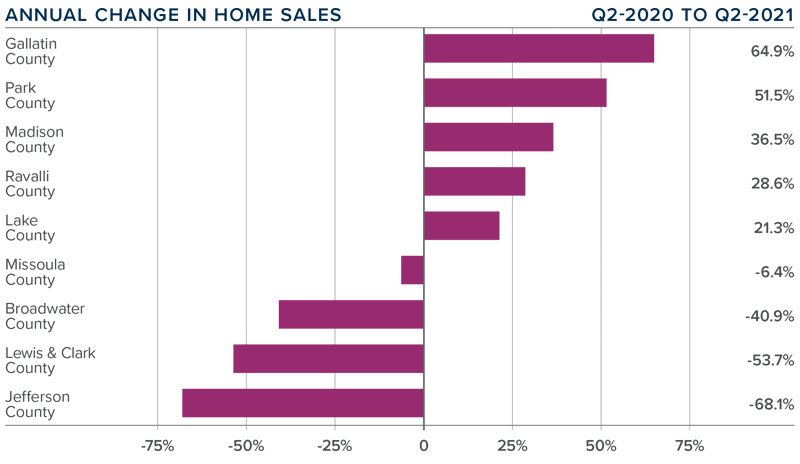
A bar graph showing the annual change in home sales for various counties in Montana.

montana Home Prices

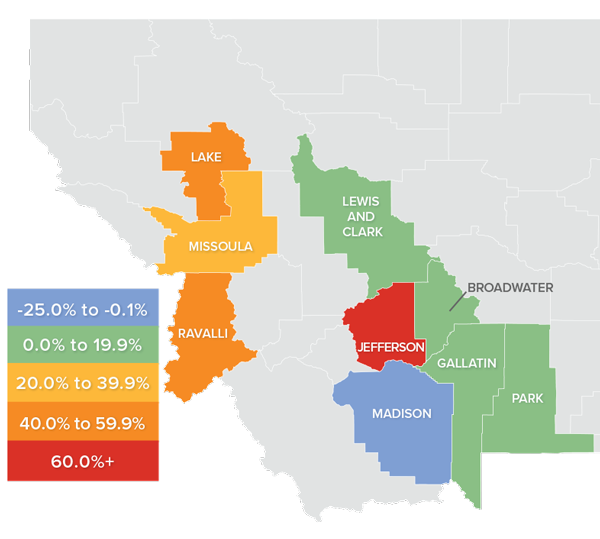
A map showing the real estate market percentage changes in various counties in Montana.

❱ Year-over-year, home prices rose 6.5% to an average of $473,959. However, they were 10.8% lower than in the first quarter of the year.

❱ Sale prices can be frenetic—especially because many of the counties contained in this report have low sales activity—so I am not overly concerned at the present time.

❱ Average sale prices rose in all but one county. The outlier—Madison County, where average sales price dropped from $1.33 million to $924,000—dragged the regional average price lower.

❱ Last quarter I said I wouldn’t be surprised if prices dropped further in the second quarter, and it appears I was right. What I said then was that after a significant period where price growth far exceeded the long-term trend, the market is trying to find balance—and this remains true.
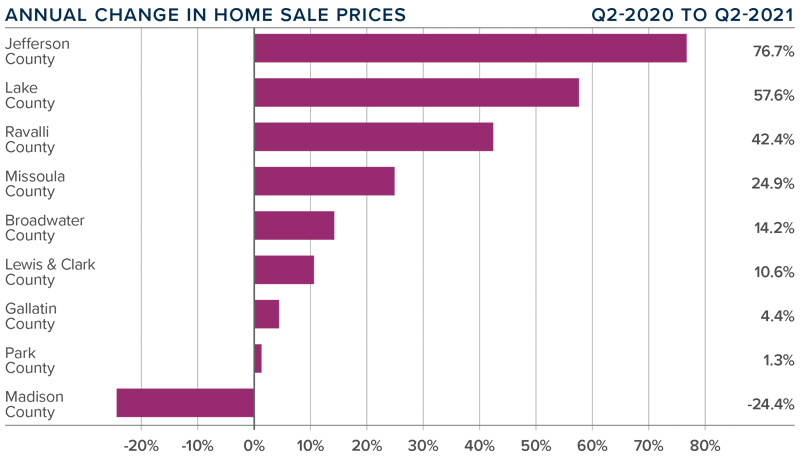
A bar graph showing the annual change in home sale prices for various counties in Montana.

Days on Market

❱ The average number of days it took to sell a home dropped 38 days compared to the second quarter of 2020.

❱ Homes sold fastest in Broadwater County and slowest in Ravalli County. All markets other than Ravalli (+19 days) and Lewis & Clark (+2 days) saw market time drop year over year.

❱ During the quarter, it took an average of 74 days to sell a home in the region.

❱ Relative to the first quarter of this year, market time dropped in Lake, Missoula, Broadwater, and Jefferson counties, but rose in the rest of the areas covered in this report.
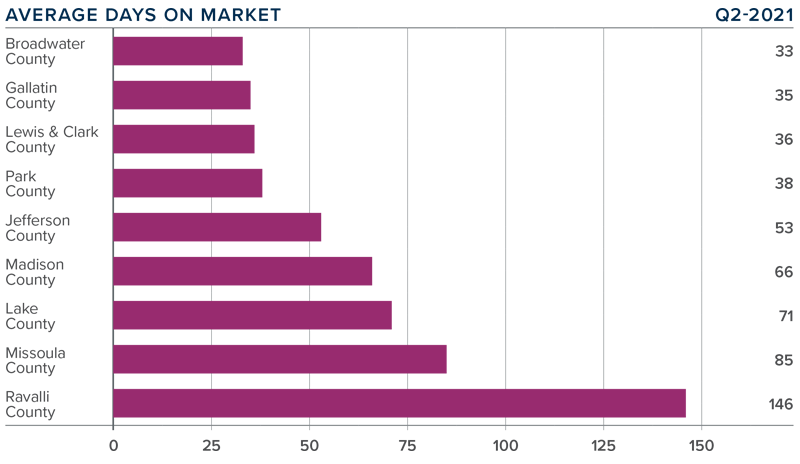
A bar graph showing the average days on market for homes in various counties in Montana.

Conclusions

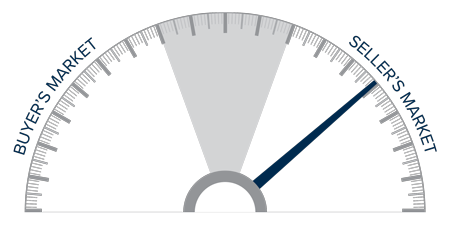
A speedometer graph indicating a seller's market in Montana.

This speedometer reflects the state of the region’s real estate market using housing inventory, price gains, home sales, interest rates, and larger economic factors.

Montana’s economy is performing better than a vast majority of the nation and does not yet appear to be suffering significantly from the rising COVID-19 infections that are hitting many other states.

With mortgage rates set to remain very competitive for the foreseeable future, I believe the housing market will come out of this unique period in the positive despite some of the numbers in this report. Price growth and sales should pick back up, but I think we are seeing the early signs of a more balanced market. That said, we’re not there yet.

Well-positioned and well-priced homes continue to attract buyers, but the slowdown in certain aspects of the market have led me to leave the needle in the same position as in the first quarter.

About Matthew Gardner

Matthew Gardner - Chief Economist for Windermere Real Estate

As Chief Economist for Windermere Real Estate, Matthew Gardner is responsible for analyzing and interpreting economic data and its impact on the real estate market on both a local and national level. Matthew has over 30 years of professional experience both in the U.S. and U.K.

In addition to his day-to-day responsibilities, Matthew sits on the Washington State Governors Council of Economic Advisors; chairs the Board of Trustees at the Washington Center for Real Estate Research at the University of Washington; and is an Advisory Board Member at the Runstad Center for Real Estate Studies at the University of Washington where he also lectures in real estate economics.

Market News August 6, 2021

Q2 2021 Big Island of Hawaii Real Estate Market Update

The following analysis of the Big Island real estate market is provided by Windermere Real Estate Chief Economist Matthew Gardner. We hope that this information may assist you with making better-informed real estate decisions. For further information about the housing market in your area, please don’t hesitate to contact your Windermere Real Estate agent.


Regional Economic Overview

The recovery in jobs on the Big Island has been, shall we say, frenetic. After the return of 7,000 jobs in the final quarter of 2020 and 1,000 jobs in the first quarter of 2021, total employment dropped by 650 jobs in the second quarter. The Island’s economy remains fragile. As of early July, travel restrictions have been relaxed for some fully vaccinated travelers. Hopefully this will bring more visitors, which will certainly help the labor market. As of the end of the second quarter, Hawaii County has recovered 12,100 of the 21,850 jobs lost due to COVID-19. There is a long way to go, and the pace of improvement may face additional headwinds with the rise of the Delta and Lambda variants of COVID-19. Only time will tell. Even with the slow return of jobs, the county’s unemployment rate in June was 7.9%, down from 8.5% in March and well below the 13.8% level of a year ago. The state unemployment rate was 7.7% in June, down from 9.1% in March.

big island of hawaii Home Sales

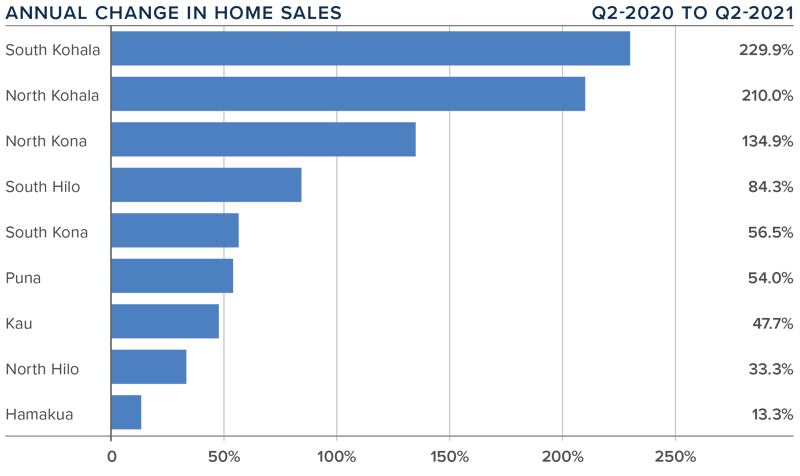
❱ In the second quarter, 1,189 homes were sold on the Big Island, more than doubling the number of sales that occurred a year ago, and 7.1% higher than in the first quarter of the year.

❱ Sales were higher across the board compared to a year ago, with the number of transactions more than doubling in three markets. Compared to the first quarter of 2021, sales rose in all areas other than Puna, North Kohala, and South Kona, but the drop in sales in these markets was minimal.

❱ The growth in sales came even though inventory levels were 32% lower than in the first quarter, suggesting that homes are selling very quickly.

❱ Pending home sales fell 7.7% compared to the first quarter of the year. This is likely a function of low supply levels and may lead total sales to drop modestly in the third quarter.

A bar graph showing the annual change in home sales for various counties on the Big Island of Hawaii.

big island of hawaii Home Prices

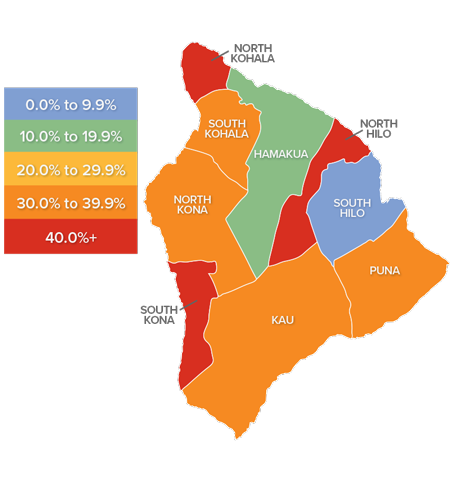
A map showing the real estate market percentage changes in various counties on the Big Island of Hawaii.

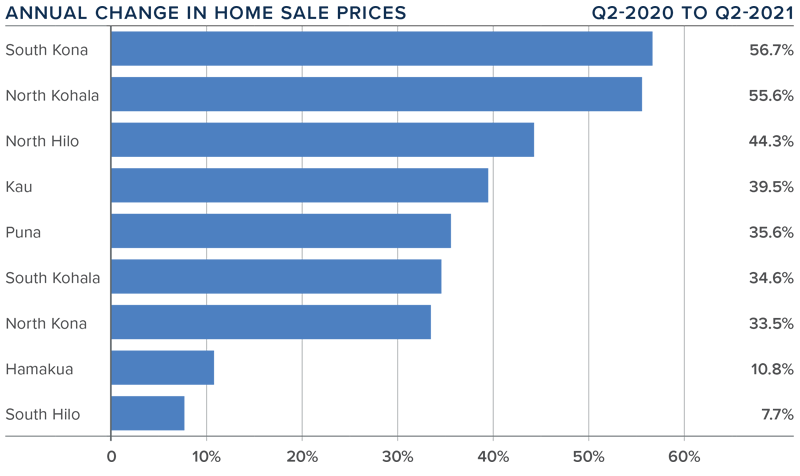
❱ The average home price on the Big Island rose by a very impressive 54.4% year over year to $884,759, but prices only managed to increase by a modest .7% from the first quarter.

❱ Home prices were up in five markets compared to the first quarter, but were lower in North and South Hilo, Hamakua, and North Kona.

❱ Year-over-year, prices rose by double-digits in all but one market, with significant growth in South Kona, North Kohala, and North Hilo.

❱ I would say that the housing market is performing as well as can be expected given current circumstances. The Big Island remains supply starved, but despite this, price growth appears to be strained.

A bar graph showing the annual change in home sale prices for various counties on the Big Island of Hawaii.

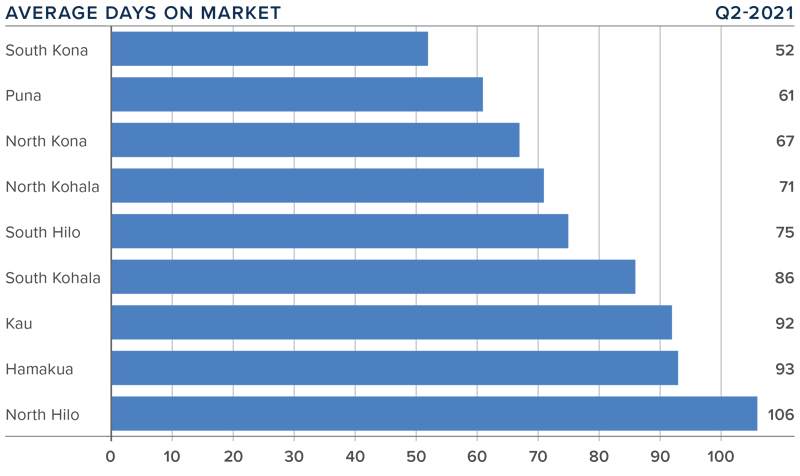
Days on Market

❱ The average time it took to sell a home on the Big Island dropped 14 days compared to the second quarter of 2020.

❱ The amount of time it took to sell a home dropped in all but two markets, with North Kohala remaining unchanged and Hamakua rising by 27 days.

❱ In the second quarter, it took an average of 78 days to sell a home, with the fastest sales occurring in South Kona and slowest in North Hilo.

❱ Due to the drop in available inventory, it took 58 fewer days to sell a home in the second quarter of 2021 than in the first.

A bar graph showing the average days on market for homes in various counties on the Big Island of Hawaii.

Conclusions

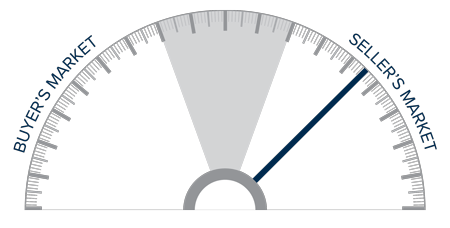
A speedometer graph indicating a seller's market on the Big Island of Hawaii.

This speedometer reflects the state of the region’s real estate market using housing inventory, price gains, home sales, interest rates, and larger economic factors.

Without a doubt, supply levels are not meeting the very strong demand. The modest uptick in mortgage rates in the first quarter was not maintained and rates have lowered again, which undoubtedly has influenced rising demand.

Even with the economic recovery stalling—and COVID-19 cases spiking again—the housing market is still on solid footing. I would be very surprised to see a significant uptick in the number of homes for sale in the coming months, which will clearly favor home sellers. Given these factors, I am moving the needle more in their favor.

About Matthew Gardner

Matthew Gardner - Chief Economist for Windermere Real Estate

As Chief Economist for Windermere Real Estate, Matthew Gardner is responsible for analyzing and interpreting economic data and its impact on the real estate market on both a local and national level. Matthew has over 30 years of professional experience both in the U.S. and U.K.

In addition to his day-to-day responsibilities, Matthew sits on the Washington State Governors Council of Economic Advisors; chairs the Board of Trustees at the Washington Center for Real Estate Research at the University of Washington; and is an Advisory Board Member at the Runstad Center for Real Estate Studies at the University of Washington where he also lectures in real estate economics.
Market News August 6, 2021

Q2 2021 Maui, Hawaii Real Estate Market Update

The following analysis of select Maui real estate markets is provided by Windermere Real Estate Chief Economist Matthew Gardner. We hope that this information may assist you with making better-informed real estate decisions. For further information about the housing market in your area, please don’t hesitate to contact your Windermere Real Estate agent.


Regional Economic Overview

I mentioned in the first quarter Gardner Report that Maui’s job recovery, which was doing well in the fall of 2020, had started to lose steam. I am afraid this trend continued through the second quarter. Maui added 1,050 jobs in the second quarter, down from 1,100 in the first quarter and significantly lower than the 11,000 jobs that returned in the final quarter of 2020. The Islands’ economic recovery remains fragile. As of early July, travel restrictions have been relaxed for some fully vaccinated travelers. Hopefully this will bring more visitors, which will certainly help the labor market. As of the end of the second quarter, Maui has recovered 13,600 of the 28,850 jobs lost due to COVID-19. There is a long way to go, and the pace of improvement may face additional headwinds with the rise of the Delta and Lambda variants of COVID-19. Only time will tell. Maui’s unemployment rate remains elevated at 10.9% in June, down from 12.7% in March. The state unemployment rate was 7.7% in June, down from 9.1% in March.

maui, hawaii Home Sales

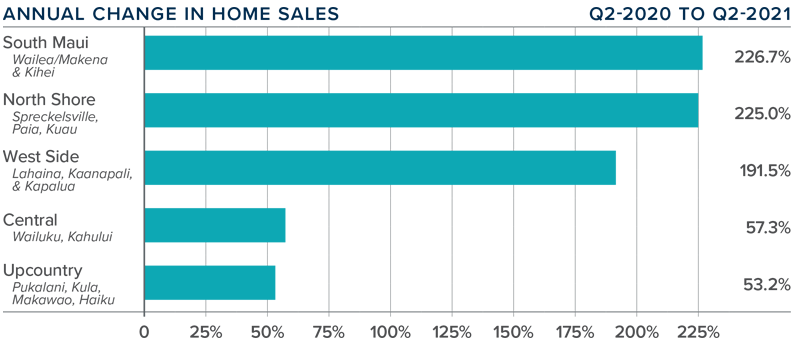
❱ In the second quarter, 879 homes were sold, a huge increase of 146.2% compared to a year ago when COVID-19 was in full force. Sales were up by a very solid 28.5% compared to the first quarter of this year.

❱ Closed home sales rose across the board, with very large increases in the South Maui, North Shore, and Westside neighborhoods. It’s also worth noting that closed sales were also higher across the board compared to the first quarter of this year.

❱ The number of homes for sale remains woefully inadequate to meet demand, with the average number of listings down 58.3% compared to a year ago and 39.1% lower than in the first quarter of 2021.

❱ Pending home sales dropped 19.7% compared to the first quarter, suggesting that closings in the third quarter may not be as impressive as this one.

A bar graph showing the annual change in home sales for various counties in Maui, Hawaii.

maui, hawaii Home Prices

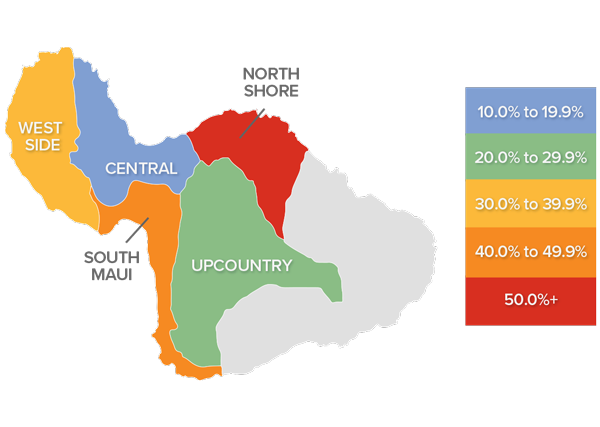
A map showing the real estate market percentage changes for various areas of Maui, Hawaii.

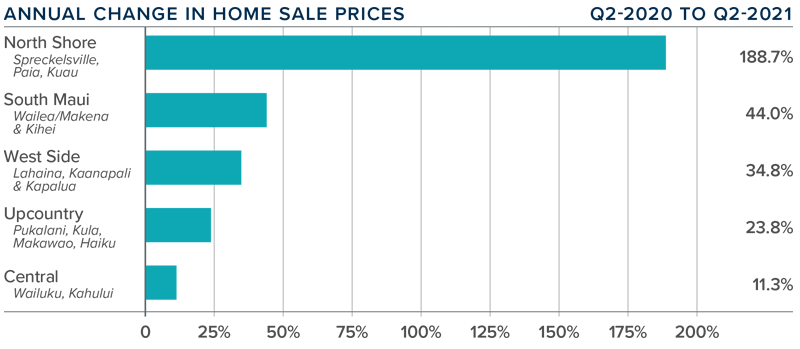
❱ The average home price on the island rose 41.6% year over year to $1.38 million and was 11% higher than in the first quarter of the year.

❱ Affordability issues persist, but with financing rates still remarkably favorable and persistently low levels of inventory, I still think prices will continue to rise at above-average rates as we move through the second half of 2021.

❱ All markets saw significant increases in year-over-year price growth, and all but one (North Shore) saw higher prices than in the first quarter.

❱ Limited inventory has created bullish sellers and rising prices, but the market is showing some signs of resistance. Clearly, the pace of price growth is unsustainable, and this will lead to a softening in appreciation—the question is when.

A bar graph showing the annual change in home sale prices for various counties in Maui, Hawaii.

Days on Market

❱ The average number of days it took to sell a home on Maui dropped 16 days compared to the second quarter of 2020.

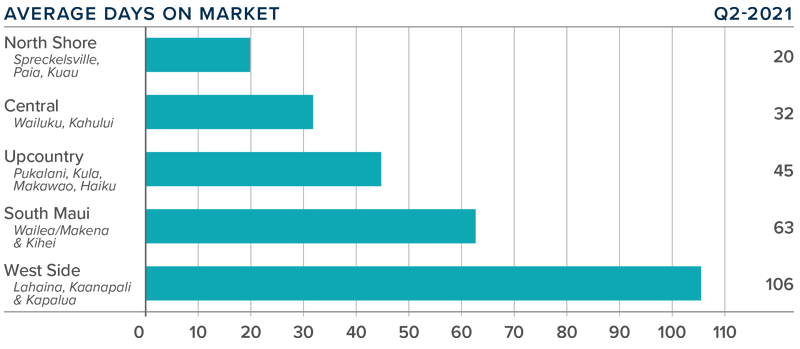
❱ The length of time it took to sell a home dropped in the Central, North Shore, and Upcountry market areas compared to a year ago, but rose in South Maui and the Westside.

❱ It took an average of 53 days to sell a home, with transactions occurring the fastest in the North Shore area and slowest on the Westside.

❱ When compared to the first quarter, market time dropped in all areas covered in this report.

A bar graph showing the average days on market for homes in various counties in Maui, Hawaii.

Conclusions

A speedometer graph indicating a seller's market in Maui, Hawaii.

This speedometer reflects the state of the region’s real estate market using housing inventory, price gains, home sales, interest rates, and larger economic factors.

Without a doubt, supply levels are not meeting the very strong demand. The modest uptick in mortgage rates in the first quarter was not maintained and rates have lowered again, which undoubtedly has influenced rising demand.

Even with the economic recovery stalling—and COVID-19 cases spiking again—the housing market is still on solid footing. I would be very surprised to see a significant uptick in the number of homes for sale in the coming months, which will clearly favor home sellers. Given these factors, I am moving the needle more in their favor.

About Matthew Gardner

Matthew Gardner - Chief Economist for Windermere Real Estate

As Chief Economist for Windermere Real Estate, Matthew Gardner is responsible for analyzing and interpreting economic data and its impact on the real estate market on both a local and national level. Matthew has over 30 years of professional experience both in the U.S. and U.K.

In addition to his day-to-day responsibilities, Matthew sits on the Washington State Governors Council of Economic Advisors; chairs the Board of Trustees at the Washington Center for Real Estate Research at the University of Washington; and is an Advisory Board Member at the Runstad Center for Real Estate Studies at the University of Washington where he also lectures in real estate economics.
Market News August 5, 2021

Q2 2021 Northern California Real Estate Market Update

The following analysis of the Northern California real estate market is provided by Windermere Real Estate Chief Economist Matthew Gardner. We hope that this information may assist you with making better-informed real estate decisions. For further information about the housing market in your area, please don’t hesitate to contact your Windermere Real Estate agent.


Regional Economic Overview

Regionwide, total employment rose 156,300 from a year ago. Northern California has recovered 258,000 of the jobs that were lost due to COVID-19, but there is still a ways to go. The pace of the job recovery has slowed, with a meager 1,600 jobs added in the second quarter. With the number of jobs recovered essentially stalling, the region’s unemployment rate rose from 6% in March to 6.1% in June. I should note that the current level is significantly lower than the 14% rate in April of last year as the pandemic was taking hold of the nation. The lowest jobless rate was in Santa Clara County (5.1%), and the highest rate was in Solano County, where 7.8% of the workforce remains unemployed. Rising COVID-19 infections appear to be having a significant impact on the job recovery in Northern California. Until we see the rate start to drop, a return to full employment will likely take quite some time.

northern california Home Sales

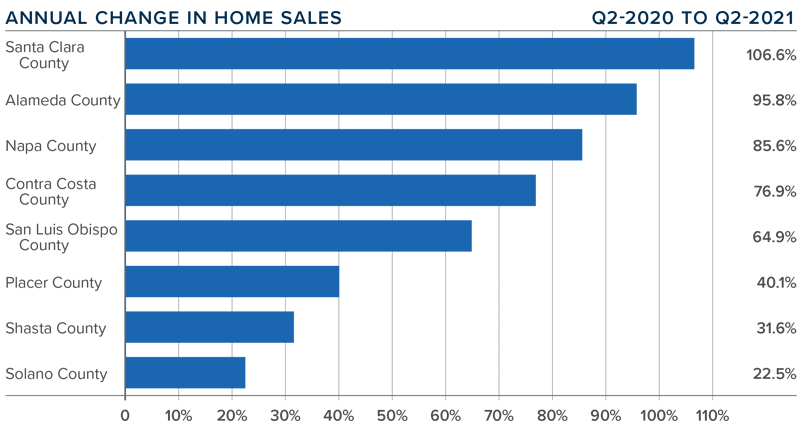
❱ In the second quarter, 16,607 homes sold, an increase of 79.8% compared to the same period a year ago. Although this sounds like a remarkable number, the pandemic slowed sales significantly a year ago. It was pleasing to see sales were also 52.7% higher than in the first quarter of the year.

❱ Year-over-year, home sales rose by double digits in all counties contained in this report. Sales rose the most in Santa Clara County (+67%) from the first quarter, but there were significant gains across the entire region.

❱ The number of homes for sale rose more than 45% from the first quarter of this year, which is sure to have contributed to the solid rise in sales in the quarter.

❱ Pending home sales were up 27.4% from the first quarter, demonstrating that demand remains solid. I expect to see further growth in the number of sales in the third quarter.

A bar graph showing the annual change in home sales for various counties in Northern California.

northern california Home Prices

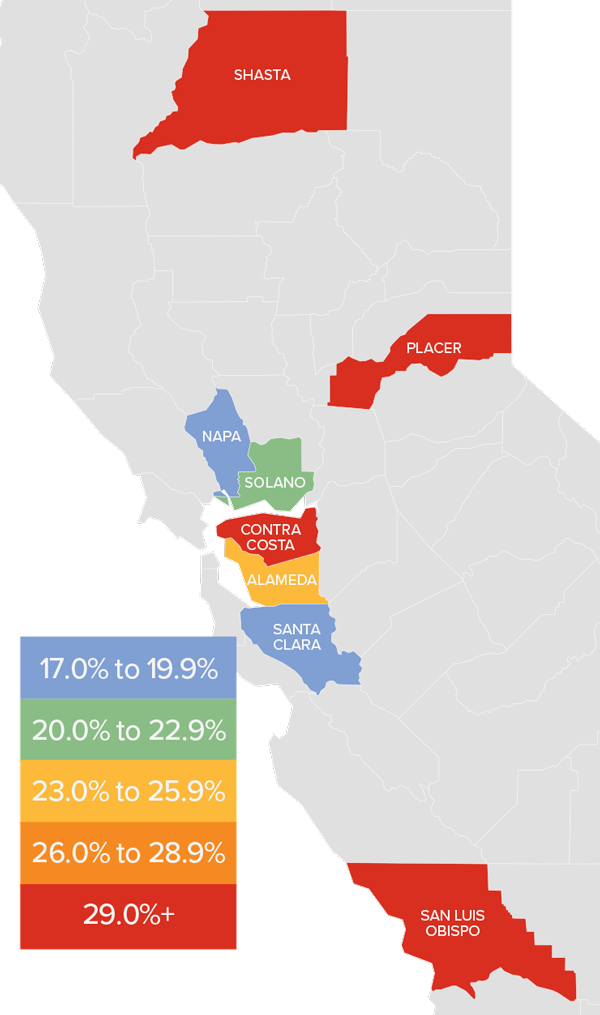
A map showing the real estate market percentage in various counties in Northern California.

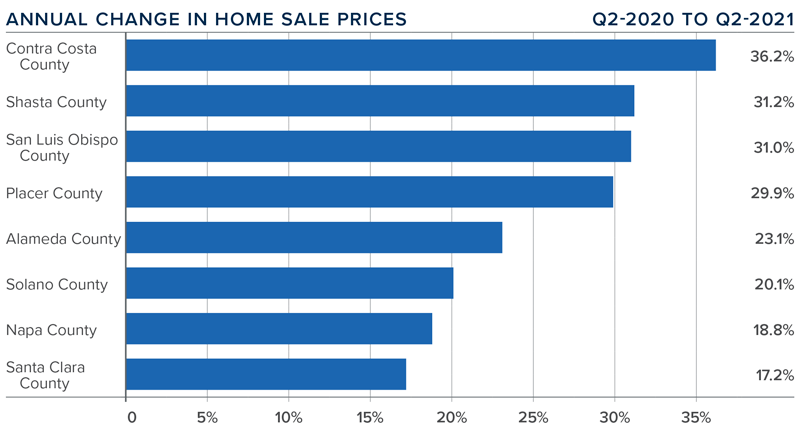
❱ The average home price in the Northern Californian counties contained in this report rose 29.4% year over year to $1.257 million.

❱ The most affordable counties—relative to average sale prices—continue to be Shasta and Solano. The most expensive county was Santa Clara. In addition to Santa Clara, average sale prices were above $1 million in Alameda, Contra Costa, and Napa counties.

❱ Average prices rose in all the counties contained in this report. Even more impressive is that all markets saw prices rise more than 10%.

❱ Although supply levels have improved, price growth continues to rise at very impressive rates. This is likely due to low mortgage rates and increasing demand.

A bar graph showing the annual change in home sale prices for various counties in Northern California.

Days on Market

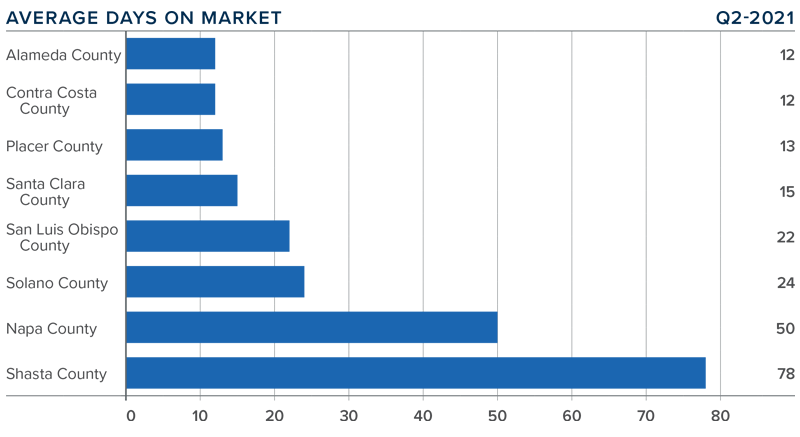
❱ The average time it took to sell a home in the Northern Californian counties covered by this report dropped 15 days compared to the second quarter of 2020.

❱ The amount of time it took to sell a home dropped in every county compared to a year ago. Market time was also lower across the board compared to the first quarter of this year.

❱ In the second quarter, it took an average of 28 days to sell a home, with homes selling fastest in Alameda County and slowest in Shasta County.

❱ The greatest drop in market time was in San Luis Obispo County, where it took 29 fewer days to sell a home than in the second quarter of 2020.

A bar graph showing the average days on market for homes in various counties in Northern California.

Conclusions

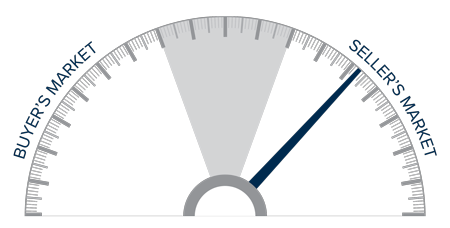
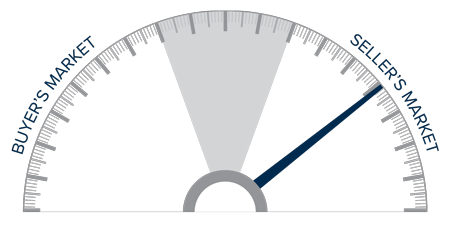
A speedometer graph indicating a seller's market in Northern California.

This speedometer reflects the state of the region’s real estate market using housing inventory, price gains, home sales, interest rates, and larger economic factors.

There is a dichotomy in the region as the housing market continues to flourish despite the stalled economic recovery. Although supply levels are increasing, home prices and market time suggest that demand remains remarkably robust.

As such, I believe that the market still favors home sellers, and I have moved the needle a little more in their favor.

About Matthew Gardner

Matthew Gardner - Chief Economist for Windermere Real Estate

As Chief Economist for Windermere Real Estate, Matthew Gardner is responsible for analyzing and interpreting economic data and its impact on the real estate market on both a local and national level. Matthew has over 30 years of professional experience both in the U.S. and U.K.

In addition to his day-to-day responsibilities, Matthew sits on the Washington State Governors Council of Economic Advisors; chairs the Board of Trustees at the Washington Center for Real Estate Research at the University of Washington; and is an Advisory Board Member at the Runstad Center for Real Estate Studies at the University of Washington where he also lectures in real estate economics.
Market News August 5, 2021

Q2 2021 Nevada Real Estate Market Update

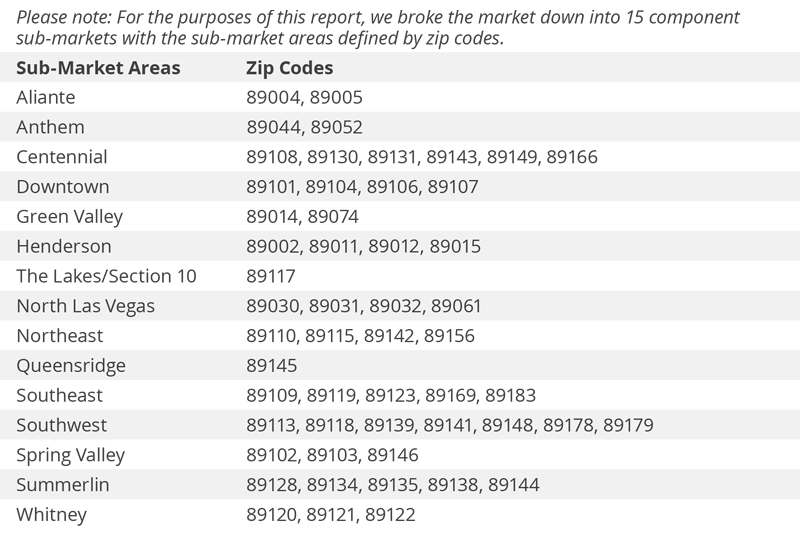
The following analysis of the greater Las Vegas real estate market is provided by Windermere Real Estate Chief Economist Matthew Gardner. We hope that this information may assist you with making better-informed real estate decisions. For further information about the housing market in your area, please don’t hesitate to contact your Windermere Real Estate agent.


Regional Economic Overview

The job market in Las Vegas continues to recover from the significant impacts of COVID-19, with the pace of jobs returning picking up a little steam in recent months. In the second quarter 30,100 jobs returned, which is up from 12,800 in the first quarter. That said, total employment in the area is still down by more than 105,000 jobs from its pre-pandemic peak. Even as jobs return, the unemployment level remains elevated at 8.9%. However, this is still significantly lower than the pandemic-induced peak of 33.3%. Although the region continues its job recovery, I am concerned that the rise in new COVID-19 cases, which started to trend higher in June, may slow the pace of recovery.

nevada Home Sales

❱ A total of 11,243 homes sold in the second quarter, a massive increase of more than 84% compared to the same period a year ago, and 15.8% higher than in the first quarter of this year.

❱ Pending sales—an indicator of future closings— rose 3.3% compared to the first quarter of the year. I would have liked to see a higher number, but I put the relatively low level down to supply-side constraints.

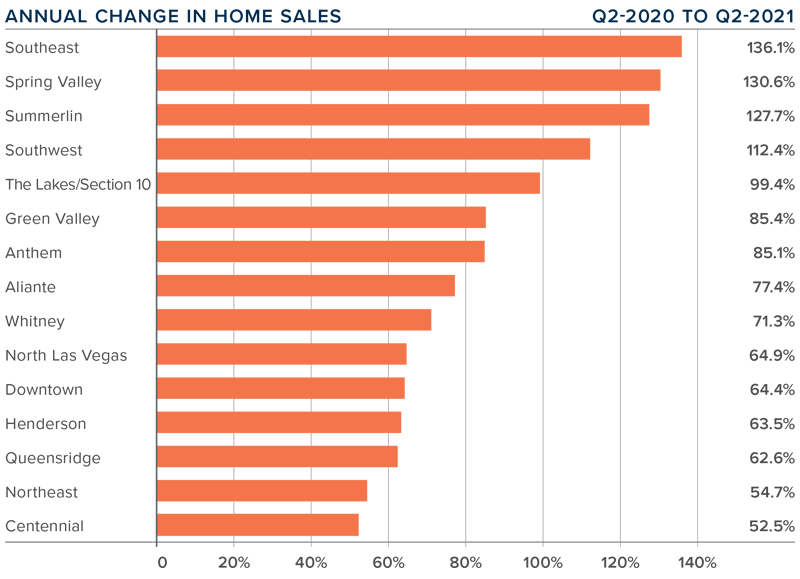
❱ Compared to second quarter of last year, sales rose over 50% in every market and more than doubled in four. Although these statistics sound amazing, we should not forget that the pandemic was in full swing a year ago, which had a significant impact on home sales.

❱ Lower pending sales can be attributed to the fact that the average number of homes on the market in the quarter was down 3.4% relative to the first quarter of the year, and down more than 60% from the same period a year ago. The market remains supply starved.

A bar graph showing the annual change in home sales in the Greater Las Vegas, Nevada area.

nevada Home Prices

A chart showing the sub-market areas and their corresponding zip codes in the Greater Las Vegas, Nevada area.

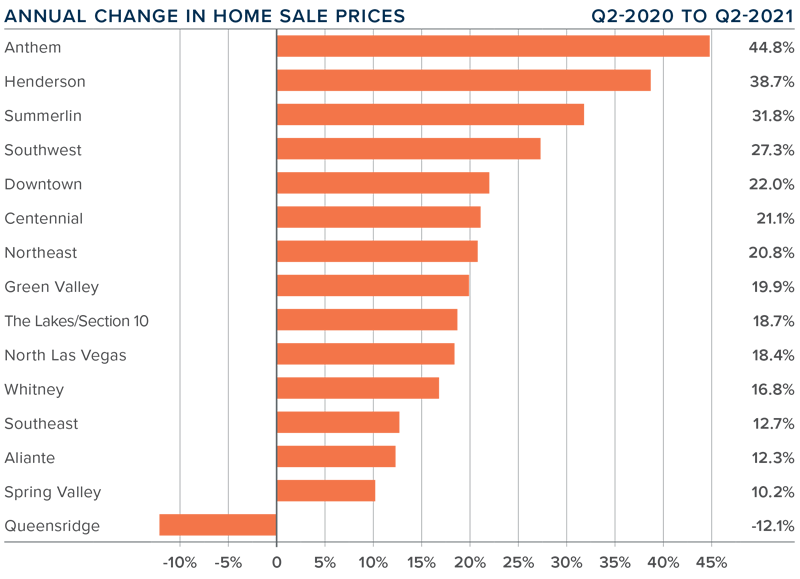
❱ With sales up and listings down, it should come as no surprise that home prices continued their upward trend. Year over year, average prices were up 27.1% to $429,049. Sale prices were also 8.3% higher than in the first quarter of this year.

❱ Mortgage rates rose in the first quarter but have again pulled back, which has increased interest from buyers and is pushing prices higher.

❱ Prices rose in every sub-market other than Queensridge compared to the same quarter last year, with double-digit gains in all neighborhoods. When compared to the first quarter of 2021, prices were also higher in every area other than Queensridge, with double-digit appreciation in Anthem, The Lakes/Section 10, Southwest, and Northeast Las Vegas.

❱ The takeaway is that demand still exceeds supply, and this is causing prices to continue to rise at a significant pace. That said, the rate of appreciation is unsustainable, and will start to slow; the question is when.

A bar graph showing the annual change in home sale prices in the Greater Las Vegas, Nevada area.

Days on Market

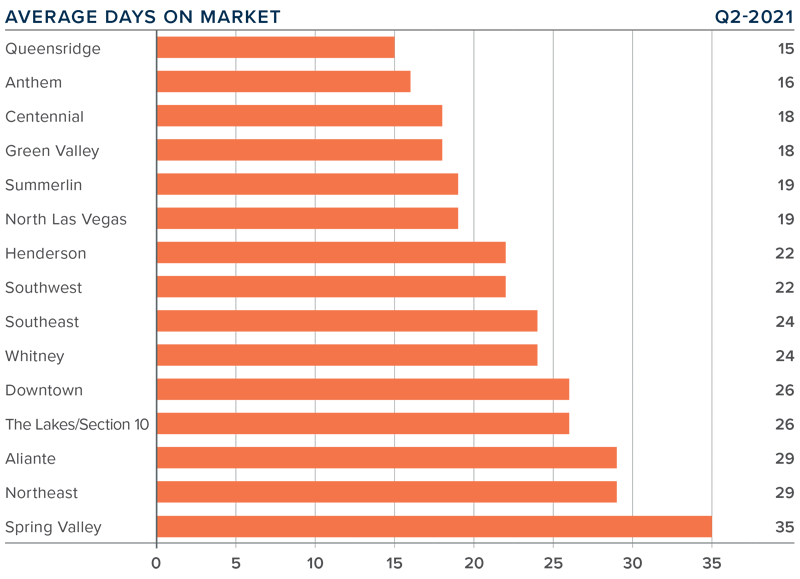
❱ The average time it took to sell a home in the region dropped 15 days compared to the second quarter of 2020.

❱ It took an average of 23 days to sell a home in the second quarter, which was 16 fewer days than in the first quarter of 2021.

❱ Days-on-market dropped across the board compared to a year ago, and all areas saw market time fall compared to the first quarter of this year.

❱ The greatest decline in market time was in the Aliante market, where the length of time it took to sell a home dropped 29 days compared to a year ago.

A bar graph showing the average days on market for homes in the Greater Las Vegas, Nevada area.

Conclusions

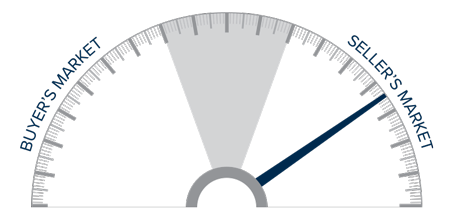
A speedometer graph indicating a seller's market in the Greater Las Vegas, Nevada area.

This speedometer reflects the state of the region’s real estate market using housing inventory, price gains, home sales, interest rates, and larger economic factors.

Even though jobs are returning, rising COVID-19 cases may slow the area’s economic recovery. I suspect that some home sellers will choose to wait to list their homes until infection rates start to drop. If this is the case, the supply-demand imbalance we see today will only be exacerbated. While this is bad news for home buyers, it will bode well for sellers. As such, I am moving the needle a little more in their favor.

About Matthew Gardner

Matthew Gardner - Chief Economist for Windermere Real Estate

As Chief Economist for Windermere Real Estate, Matthew Gardner is responsible for analyzing and interpreting economic data and its impact on the real estate market on both a local and national level. Matthew has over 30 years of professional experience both in the U.S. and U.K.

In addition to his day-to-day responsibilities, Matthew sits on the Washington State Governors Council of Economic Advisors; chairs the Board of Trustees at the Washington Center for Real Estate Research at the University of Washington; and is an Advisory Board Member at the Runstad Center for Real Estate Studies at the University of Washington where he also lectures in real estate economics.
Design August 4, 2021

Windermere Living: Board it Up

This article originally appeared in the Summer 2021 issue of Windermere Living

By Naomi Tomky | Photography by Carly Diaz | Food Styling By Anne Parker


For an intimate gathering or celebration, or just to change up a weeknight dinner, charcuterie boards are impressive crowd-pleasers.

Once an innocuous appetizer, charcuterie boards are stealing the show as stunning smorgasbords studded with salami roses and a rainbow of ripe vegetables, flamboyant fruits, and sweet and savory snacks. Traditionally, charcuterie boards are composed of meats and cheeses—the name even comes from the French for “cooked flesh.” A part of French culinary art since at least the 15th century, they were considered the food of the bourgeoisie for hundreds of years before catching on with higher-end cooks. Now, they return to accessibility as people find ways to customize their boards and feature all sorts of spreads. Trays and wood blocks can be artfully piled with everything needed for a build-your-own brunch buffet, a vegan midday meal, or an elegant soirée starter. Boards tap into a host’s creative side as an easy, fun way to put out an incredible spread that pleases every type of person. “I love making them for entertaining,” says Amy Holt of Peas Thank You in Venice, California, “because it’s a centerpiece for conversation.”


Photography by Carly Diza – Food Styling by Anne Parker


At cocktail parties, casual gatherings, or before a sit-down dinner, charcuterie board–style spreads allow people to create their own bites and discuss what they paired and how they ate it—functioning as both food and icebreaker. The chameleon of catering, boards fit in as easily at a small family picnic as they do at an upscale event, while also giving people more flexibility than a set menu: hungrier guests can make almost a full meal of the offerings, while lighter eaters can sparsely snack. But the ultimate asset of an attractive board to anchor an event is the freedom to indulge artistic whims in building a creative, edible assortment. Expert charcuterie board makers from around the West talk about how they design their signature creative boards with both classic snacks and unorthodox offerings in elegant arrangements for family, friends, and gatherings large and small.

Magnificent Morning

When a client for her charcuterie board business requested a bagel spread for a bar mitzvah, Sylvie Stulic, of the Bay Area’s On the Board Gourmet, saw it as the perfect opportunity to get creative. Now it’s part of her standard offerings, and she’s gained knowledge on the best way to build a bagel board.

Functional Design

The big size and flavor of caperberries always draws wows, says Stulic, while she adds extra brightness with red sweetie drop peppers. “I love to include a floral element,” she says, which may be actual (edible) flowers or cucumbers styled into roses. One standard bagel fixing not found on the bagel boards, though, are onions. “They contaminate the other flavors,” Stulic explains.

Tips of the Tray

Unless the board is enormous, Stulic slices and cuts the bagels in half so that they don’t visually overwhelm everything else. She uses the halves to create a line down the middle and creates symmetry with the colors around it. Aim to keep the bagels surrounded by dry ingredients so they don’t get soggy on the board. For serving a crowd or an event, bagels work well because they are traditionally eaten at room temperature. But at home, she branches out, creating similar breakfast spreads for her family out of crepes, waffles, and pancakes.


Photography by Carly Diza – Food Styling by Anne Parker

Creative Colors

The rainbow platters made by Amy Holt of Peas Thank You in Venice, California, stand out for their bold use of patterns, whether as a fun fruit display, a vegan snack selection, or a traditional meat and cheese board.

Shop Savvy

“Start at the farmers market,” says Holt. That’s the best place to find natural-looking fruits and vegetables, like radishes with their stems and broccolini with flowers. But even if limited to a grocery store, she can look for the same effect with tomatoes on the vine and celery with nice leaves to use as a garnish. Instead of buying pre-sliced meats or trying to slice them at home—especially for small boards that only need a few slices of each type of meat—Holt uses the deli counter at the grocery store, which will cut them to order. Holt uses honeycomb on cheeses and tops a chia seed pudding with toasted coconut to add special touches.

Tips of The Tray

Bring variety in shapes as well as color by cutting and stacking the food creatively: put berries on a skewer, clip the grape bunches into manageable sizes, and fold the meat in different ways. Start with the biggest things first by plating any dips or spreads. Holt uses a coconut chia seed pudding as the anchor to her fruit boards and hummus on her vegan spread. Arrange foods in groups of three, and always use odd numbers, as they are more naturally pleasing to people. Use triangle formations to direct the eye across platters, drawing attention to the whole board, rather than a single spot or line. Finish by tossing a small, attractive garnish all over the board—berries, little tomatoes, or cilantro flowers—to add a decorative touch.


Photography by Carly Diza – Food Styling by Anne Parker

Edible And Upscale  

When the fashion industry slowed down during the pandemic and the events Rona Argana once planned dried up, she used her sharp eye for design to craft grazing boxes as gifts to send to her friends. That turned into For Love and Graze, her North Hollywood, California business that spins casual snack platters into eye-catching displays.

Ingredients for Elegance

Use the green color of leaves to signify freshness, says Argana. She likes mint sprigs in the spring, rosemary and sage in the winter. (Keep them well hydrated ahead of time, so they last longer.) Fancy can still be fun, and she loves to use letter-shaped cookie cutters and slices from a log of mozzarella cheese to add celebratory messages. Savory needs a balance of sweet, so even her traditional snack boards always include a sugary nibble like chocolate-covered almonds or yogurt-covered pretzels.

Tips of the Tray

Start by setting out a neutral color palette of the crackers, meats, and cheeses. Then bring in a limited range of colors, sticking to greens, oranges, and reds. Balance each color with multiple tones and items: use both olives and grapes for green and offset the reds from berries with similar shades of citrus. Most of all, Argana says, don’t forget the purpose of the creation, and consider the flavors as much as the colors: “Make sure it tastes as good as it looks.”


Read the full issue here: Windermere Living – Summer 2021

Market News August 4, 2021

Q2 2021 Park City, Utah Real Estate Market Update

The following analysis of select neighborhoods in the Park City real estate market is provided by Windermere Real Estate Chief Economist Matthew Gardner. We hope that this information may assist you with making better-informed real estate decisions. For further information about the housing market in your area, please don’t hesitate to contact your Windermere Real Estate agent.


Regional Economic Overview

Utah’s impressive post-COVID job recovery continues unabated. In the first quarter Gardner Report, I reported that the state had not only recovered all the jobs that were lost due to the pandemic, but employment was continuing to rise. This trend has continued. With 96,400 jobs added over the past year and 14,500 over the past quarter, total employment is now 26,900 jobs higher than the pre-pandemic peak. The only other state in the country that has recovered all the jobs lost due to COVID is Idaho. With a full recovery in the job market, it’s no surprise the jobless rate dropped further to 2.7% in June—its lowest level since March 2020 and the second-lowest rate in the nation; only Nebraska is lower at 2.5%.

park city, utah Home Sales

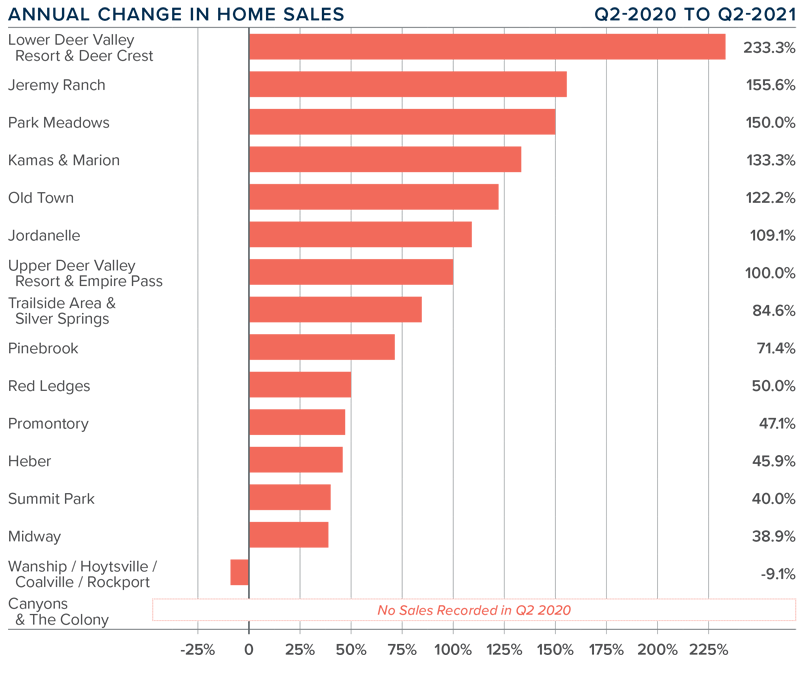
❱ In the second quarter of 2021, 76 homes were sold in Park City, more than doubling the total number of sales in the same quarter a year ago, but down 12.6% from the first quarter of this year.

❱ Sales rose in all but two markets and doubled in seven of them. However, I would note that the pandemic was gripping the nation last summer, which clearly impacted sales and skewed growth-rate data.

❱ Although the number of homes for sale rose 12.3% from the first quarter, inventory levels were 47% lower than a year ago, which is impacting sales. I would like to see more homes come to market in the second half of the year, but I am not sure that will be the case.

❱ Pending home sales were 22.6% higher than a year ago, but down 28.3% from the first quarter of 2021 due to persistent supply limitations.

A bar graph showing the annual change in home sales for various areas in Park City, Utah.

park city, utah Home Prices

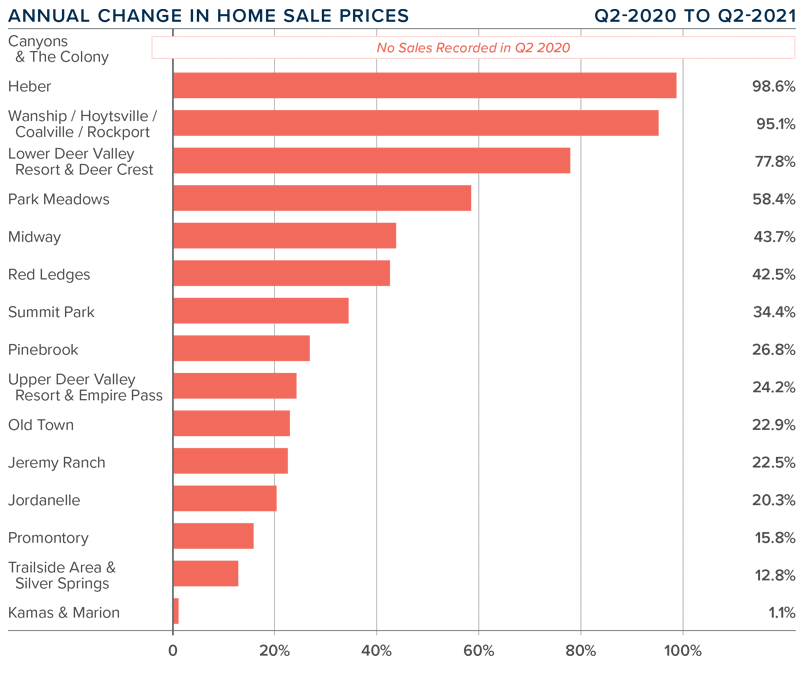
❱ The average home price in Park City rose 53.9% year over year to $2.347 million, but prices were 12.2% lower than in the previous quarter.

❱ Only one neighborhood—Kamas & Marion— saw average sale prices below $1 million. The most expensive home sales were again in the Canyons & The Colony, where the average price came in at $10.89 million.

❱ Prices rose in all neighborhoods other than Canyons & The Colony. Because there were no sales reported there a year ago, I cannot make a comparison. All other areas saw double-digit increases.

❱ Of note is that four neighborhoods saw average prices breach the $1 million mark in second quarter. These were Heber, Midway, Summit Park, and Wanship/Hoytsville/Coalville/Rockport.

A bar graph showing the annual change in home sale prices for various areas in Park City, Utah.

Days on Market

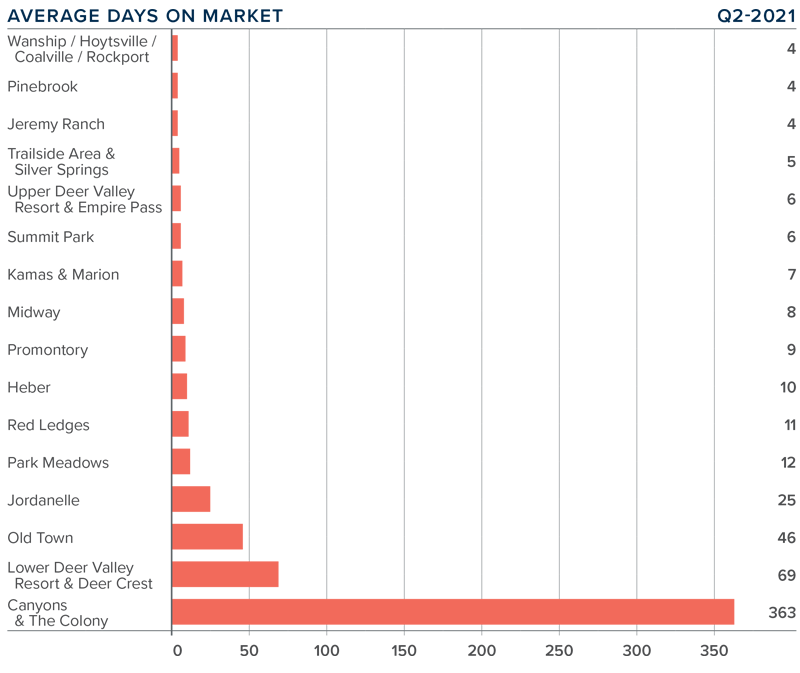
❱ The average time it took to sell a home in the Park City area dropped 46 days compared to the second quarter of 2020.

❱ The amount of time it took to sell a home dropped in ten neighborhoods relative to the second quarter of last year and was down in six areas compared to the previous quarter.

❱ In the second quarter, it took an average of only 13 days to sell a home. Homes sold fastest in the Wanship/Hoytsville/Coalville/Rockport, Pinebrook, and Jeremy Ranch neighborhoods, and slowest in the Canyons & The Colony neighborhoods.

❱ The significant drop in market time can again be attributed, at least in part, to the ongoing impact of the local listing service instituting a rule that new construction developments add sales “en-masse.”

A bar graph showing the average days on market for homes in various areas of Park City, Utah.

Conclusions

A speedometer graph indicating a seller's market in the Park City, Utah area.

This speedometer reflects the state of the region’s real estate market using housing inventory, price gains, home sales, interest rates, and larger economic factors.

Compared to most of the country, Utah’s economy is flourishing, and this is undoubtedly influencing expensive markets like Park City. Financing costs remain very competitive, which is driving demand as supply levels remain very low. I doubt there will be enough improvement to the number of homes for sale to meet buyer demand, which will continue to cause prices to rise at a very significant pace.

Given all these factors, sellers continue to control the market, and I am therefore moving the needle more in their favor.

About Matthew Gardner

Matthew Gardner - Chief Economist for Windermere Real Estate

As Chief Economist for Windermere Real Estate, Matthew Gardner is responsible for analyzing and interpreting economic data and its impact on the real estate market on both a local and national level. Matthew has over 30 years of professional experience both in the U.S. and U.K.

In addition to his day-to-day responsibilities, Matthew sits on the Washington State Governors Council of Economic Advisors; chairs the Board of Trustees at the Washington Center for Real Estate Research at the University of Washington; and is an Advisory Board Member at the Runstad Center for Real Estate Studies at the University of Washington where he also lectures in real estate economics.

Market News August 4, 2021

Q2 2021 Utah Real Estate Market Update

The following analysis of select counties of the Utah real estate market is provided by Windermere Real Estate Chief Economist Matthew Gardner. We hope that this information may assist you with making better-informed real estate decisions. For further information about the housing market in your area, please don’t hesitate to contact your Windermere Real Estate agent.


Regional Economic Overview

Utah’s impressive post-COVID job recovery continues unabated. In the first quarter Gardner Report, I reported that the state had not only recovered all the jobs that were lost due to the pandemic, but employment was continuing to rise. This trend has continued. With 96,400 jobs added over the past year and 14,500 over the past quarter, total employment is now 26,900 jobs higher than the pre-pandemic peak. The only other state in the country that has recovered all the jobs lost due to COVID is Idaho. With a full recovery in the job market, it’s no surprise the jobless rate dropped further to 2.7% in June—its lowest level since March 2020 and the second-lowest rate in the nation; only Nebraska is lower at 2.5%.

utah Home Sales

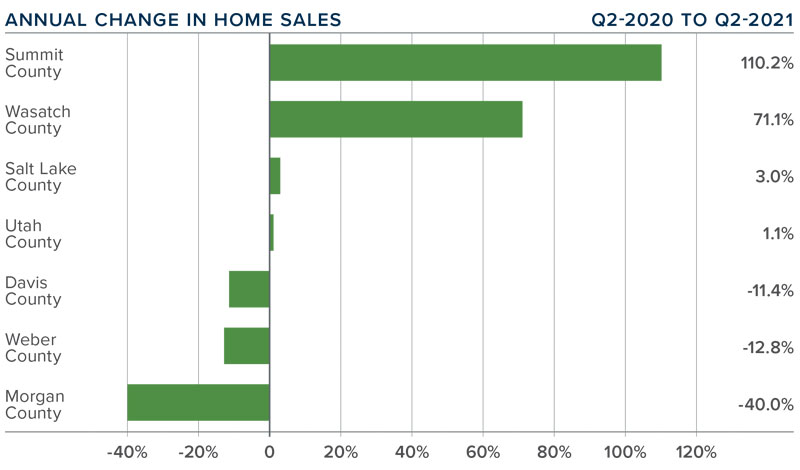
❱ In the second quarter of 2021, 9,689 homes sold, representing a modest 1.2% increase year over year, and a very significant 42% increase compared to the first quarter of the year.

❱ Sales activity rose in four counties but dropped in three. Summit County saw a massive increase in sales. Wasatch County also saw impressive gains. Sales dropped most in Morgan County, but because this is a very small market I’m not concerned.

❱ What aided the jump in sales from the first quarter was an increase in listing activity. Inventory of available homes rose more than 50% compared to the first quarter. Although this is good news, listing activity is still down more than 55% from this time a year ago.

❱ Pending sales rose across the board compared to the first quarter, with significant increases in Utah, Davis, Salt Lake, and Wasatch counties. With pending sales up more than 30% from the prior quarter, there will likely be solid growth in closed sales in the upcoming quarter.

A bar graph showing the annual change in home sales for various counties in Utah.

utah Home Prices

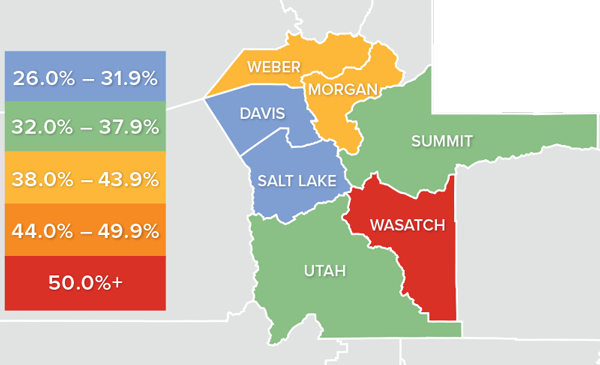
A map showing the real estate market percentage changes for various counties in Utah.

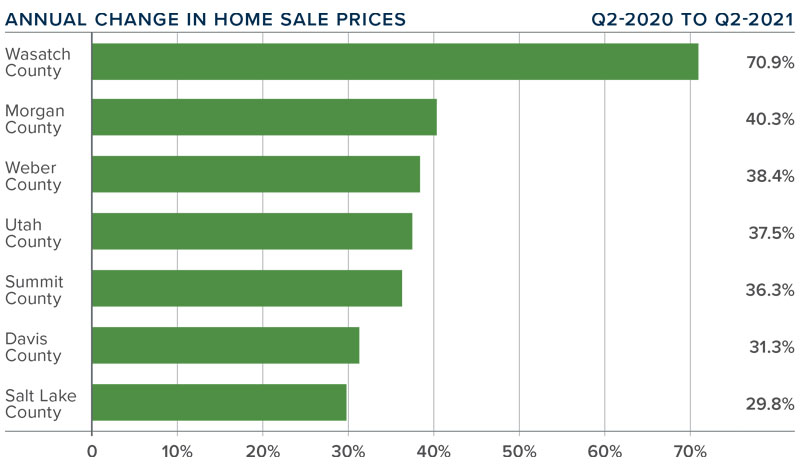
❱ A rock-solid economy and low mortgage rates had buyers out in force. That said, even with supply levels improving, demand is still outpacing supply, which has led to significant price gains. Year over year, the average home price in the region rose 41.8% to $578,648. Prices were 8% higher than in the first quarter of 2021.

❱ Although the data shows remarkable home price growth, the pandemic had a significant impact on housing during the second quarter of last year. As such, I anticipate the yearly change in prices will soften in the third quarter but remain well above the long-term average.

❱ Home price growth was led by Wasatch County, but rose by very significant rates across all the counties contained in this report. Of note is that Summit and Wasatch counties saw average sale prices above the $1 million level in the second quarter.

❱ The takeaway here is that, while the number of homes on the market did improve relative to the previous quarter, there continues to be a shortfall in inventory, which has led prices to rise at a significant pace.

A bar graph showing the annual change in home sale prices for various counties in Utah.

Days on Market

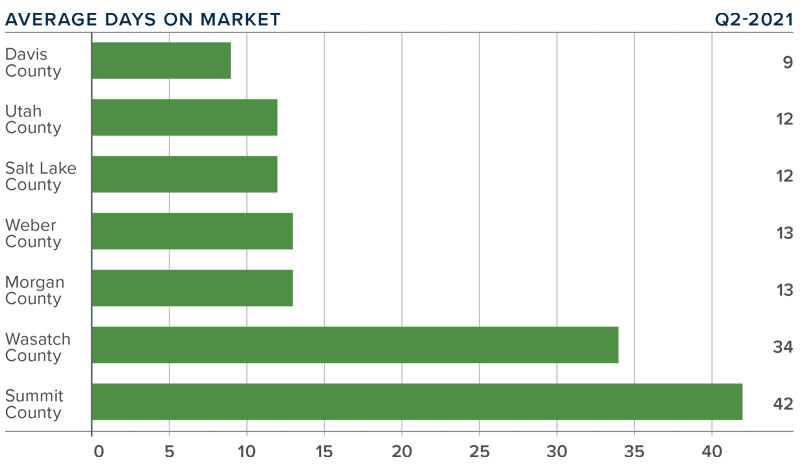
❱ The average number of days it took to sell a home in the counties covered by this report dropped 28 days compared to the second quarter of 2020.

❱ Homes sold fastest in Davis County, with sales occurring in less than two weeks in an additional four counties. The greatest drop in market time was in Summit County, where it took 63 fewer days to sell a home than it did a year ago.

❱ During the second quarter, it took an average of only 19 days to sell a home in the region, which is down 14 days compared to the first quarter of this year.

❱ Days-on-market data provided further proof of the supply/demand imbalance mentioned throughout this report. Unfortunately, I do not see any signs of supply levels rising enough to meet buyer demand.

A bar graph showing the average days on market for homes in various counties in Utah.

Conclusions

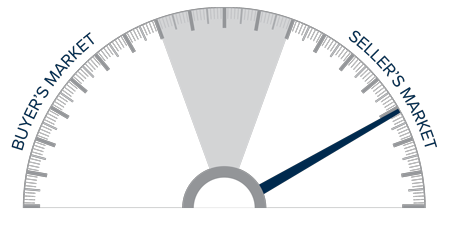
A speedometer graph indicating a seller's market in Utah.

This speedometer reflects the state of the region’s real estate market using housing inventory, price gains, home sales, interest rates, and larger economic factors.

Strong economic growth—in concert with persistently low mortgage rates—continues to drive housing demand. Even with the increase in listings in the second quarter, many buyers are frustrated by the level of competition for the homes that are for sale.

It remains, undeniably, a seller’s market, and I have therefore moved the needle a little more in their favor.

About Matthew Gardner

Matthew Gardner - Chief Economist for Windermere Real Estate

As Chief Economist for Windermere Real Estate, Matthew Gardner is responsible for analyzing and interpreting economic data and its impact on the real estate market on both a local and national level. Matthew has over 30 years of professional experience both in the U.S. and U.K.

In addition to his day-to-day responsibilities, Matthew sits on the Washington State Governors Council of Economic Advisors; chairs the Board of Trustees at the Washington Center for Real Estate Research at the University of Washington; and is an Advisory Board Member at the Runstad Center for Real Estate Studies at the University of Washington where he also lectures in real estate economics.
Market News August 3, 2021

Q2 2021 Idaho Real Estate Market Update

The following analysis of select counties of the Idaho real estate market is provided by Windermere Real Estate Chief Economist Matthew Gardner. We hope that this information may assist you with making better-informed real estate decisions. For further information about the housing market in your area, please don’t hesitate to contact your Windermere Real Estate agent.


Regional Economic Overview

The post-COVID job recovery continues at an impressive rate. As discussed in last quarter’s Gardner Report, the state has not only recovered all of the 79,600 jobs that were shed during the pandemic but has added 16,300 new positions. Utah remains the only other state that can make this claim. With such a strong recovery, and additional new hiring, it is no surprise to see the unemployment rate continuing to trend lower. It currently stands at only 3%—almost half the national rate of 5.9%. New COVID-19 cases have risen in recent weeks, but not to a level that is likely to slow down the state’s robust rate of economic growth. That said, if there are significant increases in infections, it may take some of the momentum away. I remain hopeful this will not be the case.

idaho Home Sales

❱ In the second quarter, 6,023 existing homes sold, representing a drop of 4.7% year over year. However, because the pandemic was in full swing a year ago, I think it’s more meaningful to consider the second quarter sales increase of 21.7% relative to the first quarter of this year.

❱ Due to the pandemic, comparing the current quarter to a year ago does not give an accurate picture, but compared to first-quarter data, home sales showed solid growth in all counties. Bonner and Kootenai led the way in the north, and Boise and Blaine in the south.

❱ Year-over-year sales showed significant growth in all of the Northern Idaho counties contained in this report. In the southern part of the state, sales soared in Blaine County, were modestly higher in Boise and Gem counties, but were lower in all other markets.

❱ Pending sales rose 3.4% from the first quarter of this year, suggesting that the third quarter will be positive. This may also be aided by higher levels of inventory, which were up almost 55% compared to the first quarter.

A bar graph showing the annual change in home sales for various counties in North and South Idaho.

idaho Home Prices

A map showing the real estate market percentage changes for various counties in Idaho.

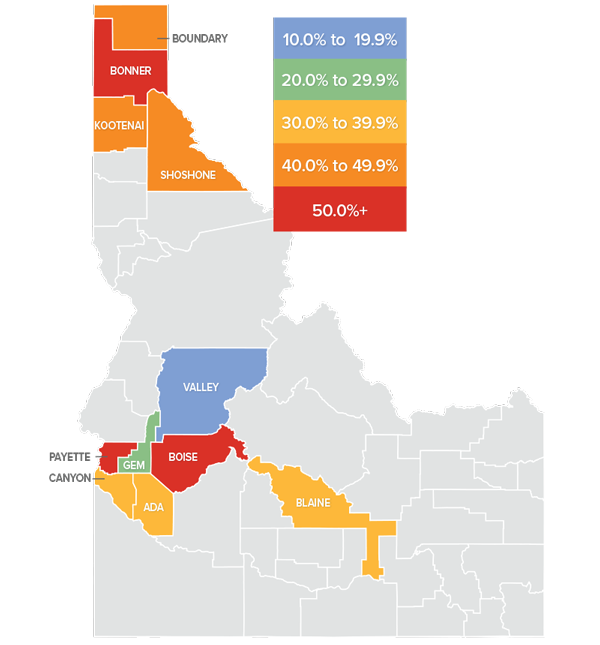
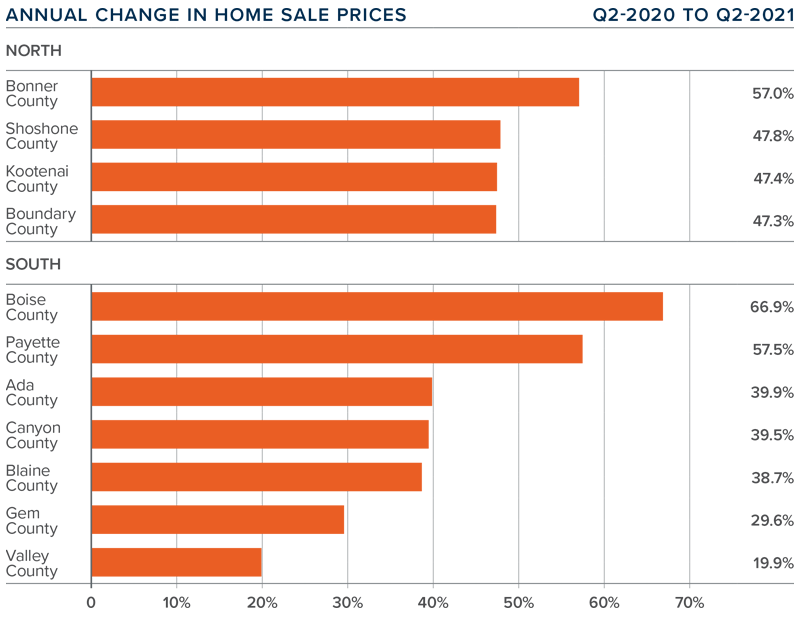
❱ Compared to a year ago, the average home price in the region rose 44.4% to $558,161. Prices were also up 8% compared to the prior quarter.

❱ Southern Idaho also saw significant year-over-year gains. Boise County jumped almost 67%. Of additional note was that prices were only .6% higher in Southern Idaho compared to the prior quarter.

❱ Prices rose year over year by at least 47% in all Northern Idaho counties covered by this report, and they were 9% higher than in the first quarter of this year. Some suspect that prices are being driven up by an increase in buyers from nearby Spokane, Washington moving to Northern Idaho where prices and supply are better, and it’s close enough to commute to Spokane for work.

❱ Buyers still outnumber sellers, which resulted in steep price increases. This may also be a function of mortgage rates rising in the first quarter, which nudged more buyers off the fence even as inventory levels remained very weak.

A bar graph showing the annual change in home sale prices for various counties in North and South Idaho.

Days on Market

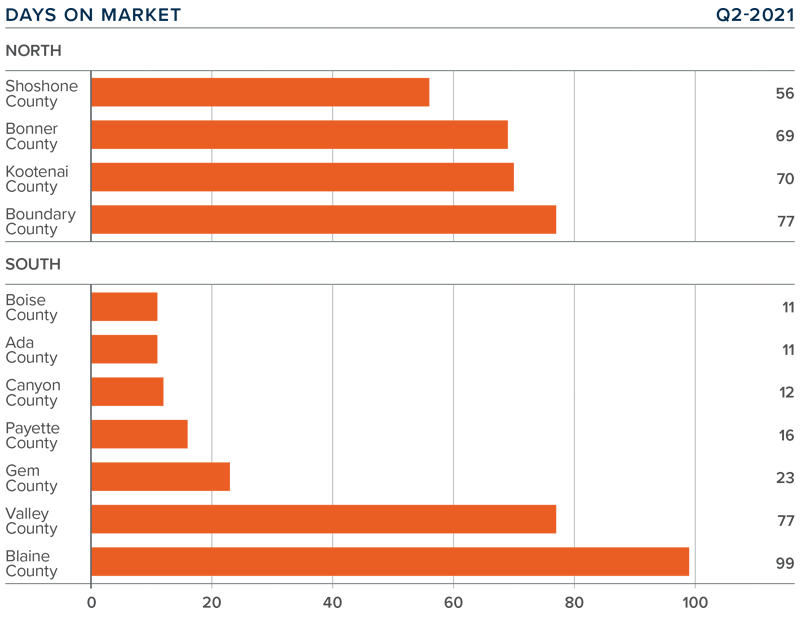
❱ It took an average of 68 days to sell a home in Northern Idaho, and 36 days in the southern part of the state covered by this report.

❱ The average number of days it took to sell a home in the region dropped 29 days compared to the second quarter of 2020 and was down 27 days compared to the first quarter of this year.

❱ In Northern Idaho, days-on-market dropped in all counties compared to a year ago, and market time was also lower than in the previous quarter. In Southern Idaho, market time dropped in all counties other than Valley, where it took five more days to sell a home than in the second quarter of 2020. Market time was down across the state compared to the first quarter of this year.

❱ Homes sold fastest in Boise and Ada counties in the southern part of the state, and in Shoshone County in the northern part of the state.

A bar graph showing the average days on market for homes in various counties in North and South Idaho.

Conclusions

A speedometer graph indicating a seller's market in Idaho.

This speedometer reflects the state of the region’s real estate market using housing inventory, price gains, home sales, interest rates, and larger economic factors.

The economy continues to perform very admirably, and this is allowing buyers to become even more confident in their decision to buy a home. Mortgage rates have pulled back, and while I expect them to tick higher as we move through the year, they will still be remarkably low from a historic standpoint. Inventory levels have risen, but demand is still outpacing supply. Therefore, I have moved the needle more in favor of home sellers.

About Matthew Gardner

Matthew Gardner - Chief Economist for Windermere Real Estate

As Chief Economist for Windermere Real Estate, Matthew Gardner is responsible for analyzing and interpreting economic data and its impact on the real estate market on both a local and national level. Matthew has over 30 years of professional experience both in the U.S. and U.K.

In addition to his day-to-day responsibilities, Matthew sits on the Washington State Governors Council of Economic Advisors; chairs the Board of Trustees at the Washington Center for Real Estate Research at the University of Washington; and is an Advisory Board Member at the Runstad Center for Real Estate Studies at the University of Washington where he also lectures in real estate economics.
Market News August 2, 2021

Q2 2021 Central Washington Real Estate Market Update

The following analysis of the Central Washington real estate market is provided by Windermere Real Estate Chief Economist Matthew Gardner. We hope that this information may assist you with making better-informed real estate decisions. For further information about the housing market in your area, please don’t hesitate to contact your Windermere Real Estate agent.
 

Regional Economic Overview

I am pleased to report that the Central Washington region has recovered all of the jobs that were lost due to the COVID-19 pandemic. Across the five counties that make up this report, total employment was 220,554, up more than 1,900 jobs from the pre-pandemic peak in March 2020. Given the recovery in the job market, it’s not surprising that the unemployment rate dropped to 6.1%, the lowest level since last October and well below the pandemic peak of 15.4%. The total labor force remains lower than a year ago but is starting to rise again, which may lead the contraction in the overall jobless rate to slow, but I do not anticipate it will rise again. I would add that the current jobless rate is actually lower now than it was before the pandemic appeared.

central washington Home Sales

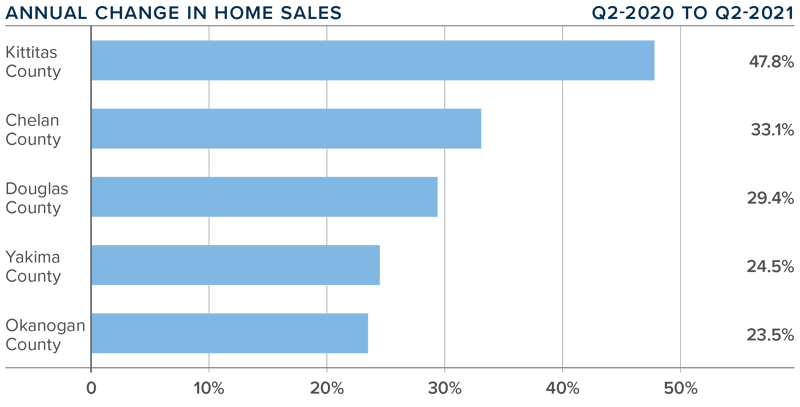
❱ Home sales in Central Washington were 30.9% higher than a year ago. Given that the pandemic was starting to grip the region at that time, this statistic is not very informative. However, when comparing sales with the first quarter of this year, it was impressive to see an increase of 56.9%, with a total of 1,473 homes sold.

❱ Pending sales were up 54.5% from the first quarter, suggesting that closings in the third quarter will show further growth.

❱ Sales activity rose across the board, with significant increases in Kittitas County and sales in all other markets rising by double-digits.

❱ Inventory levels were down more than 17% compared to the first quarter and were 30% lower than a year ago. This is disappointing, as many other counties across the state are actually seeing the number of homes for sale start to rise. The local market remains very tight, and this will continue to favor home sellers.

A bar graph showing the annual change in home sales for various counties in Central Washington.

central washington Home Prices

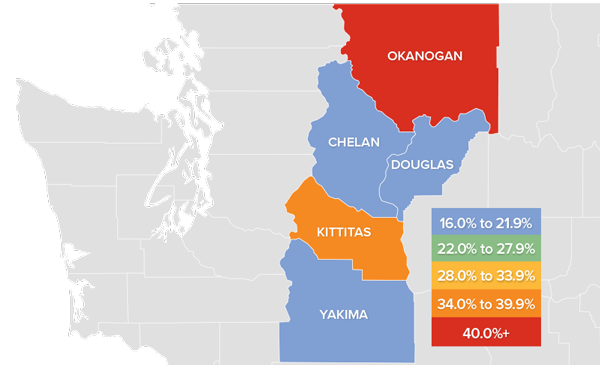
A map showing the real estate market percentage changes in various counties in Central Washington.

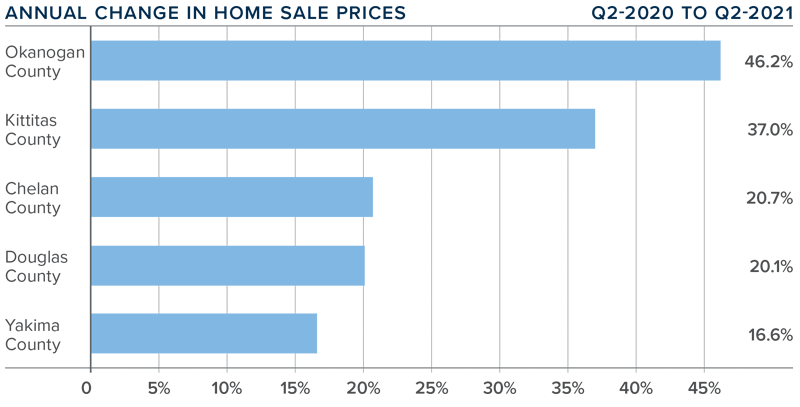
❱ With low levels of inventory and solid demand, the average home price in Central Washington continued to trend higher. Prices were up 26.8% year over year to $471,858 and were 14% higher than in the prior quarter.

❱ Mortgage rates rose modestly during the first quarter of this year before pulling back in second quarter. This likely nudged many buyers off the fence. Rising mortgage rates and low supply levels have driven prices up.

❱ All counties covered by this report experienced significant price increases, with double-digit gains across the board.

❱ Home-price growth in Central Washington remains well above the long-term average, but affordability is becoming an increasing concern. Douglas and Kittitas counties are now technically unaffordable. As we move through the balance of the year, I expect price growth to continue, but we should see a slowdown in the pace of appreciation.

A bar graph showing the annual change in home sale prices for various counties in Central Washington.

Days on Market

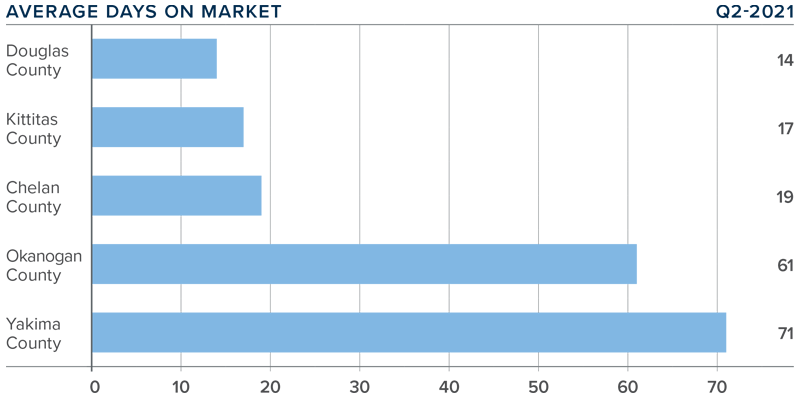
❱ The average time it took to sell a home in Central Washington in the second quarter of 2021 was 36 days.

❱ During the second quarter, it took 28 fewer days to sell a home in Central Washington than it did a year ago.

❱ All counties saw the length of time it took to sell a home drop compared to a year ago, with noticeable improvement everywhere other than Yakima County, though market time there dropped by only 8 days.

❱ It took 21 fewer days to sell a home in the second quarter than it did in the first quarter of this year.

A bar graph showing the average days on market for homes in various counties in Central Washington.

Conclusions

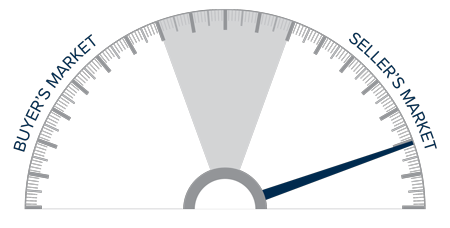
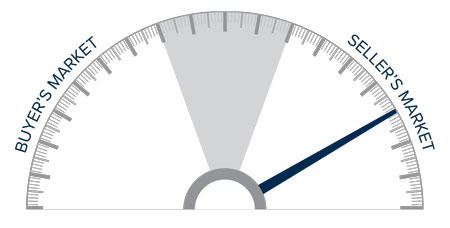
A speedometer graph indicating a seller's market in Central Washington.

This speedometer reflects the state of the region’s real estate market using housing inventory, price gains, home sales, interest rates, and larger economic factors.

Listing activity has not yet risen to a level that meets buyer demand, and this is impacting home prices, which certainly favors sellers. Assuming the number of homes for sale will not rise significantly in the coming months, prices will continue their upward trajectory. At some point though, affordability will start to act as more of a headwind than is currently being experienced. As such, I am moving the needle a little more in favor of sellers.

About Matthew Gardner

Matthew Gardner - Chief Economist for Windermere Real Estate

As Chief Economist for Windermere Real Estate, Matthew Gardner is responsible for analyzing and interpreting economic data and its impact on the real estate market on both a local and national level. Matthew has over 30 years of professional experience both in the U.S. and U.K.

In addition to his day-to-day responsibilities, Matthew sits on the Washington State Governors Council of Economic Advisors; chairs the Board of Trustees at the Washington Center for Real Estate Research at the University of Washington; and is an Advisory Board Member at the Runstad Center for Real Estate Studies at the University of Washington where he also lectures in real estate economics.