Buying November 7, 2022

House vs. Townhouse vs. Condo

Deciding between a house, townhouse, and condominium can be a difficult process. Understanding how the characteristics of each housing type aligns with your life goals and finances will help you work with your agent to identify which housing type is right for you.

How do you define a house?

Of the three housing options, detached single-family houses offer the most freedom and privacy, but they’re also typically more expensive than a condo or townhouse. They provide the opportunity to personalize your home and make renovations as desired, barring local zoning laws. Houses don’t share walls like townhouses and condos, and typically offer private outdoor spaces. Situated on their own lots, owning a house puts the responsibility of maintaining and improving the structure and accompanying land in the homeowner’s hands.


A single-family two-story house with a large front yard, a covered wraparound porch, and an attached garage/bonus space. There are several windows lining the first and second floors and a white fence lines the porch.

Example of a single-family detached house. Image Source: Getty Images – Image Credit: JamesBrey


What’s the difference between a townhouse and a condo?

Owners of townhouses can personalize and renovate their homes (within reason) since they bear the responsibility of the home’s exterior, outdoor areas, and yard. Having said that, changes to the home’s exterior and/or additions are not permitted. Here’s the tradeoff with condominiums: although you typically have less control over things like renovations and exterior spaces, they usually require less maintenance.

Townhouse: A townhouse building is a narrow, multileveled structure, usually with a small parcel of property in front of or behind the home. Whereas row houses share a common façade along a street, townhouses may be grouped throughout a development and may not share a consistent roofline with the other units. Somewhere between a house and a condominium, townhouses may offer the best of both worlds for some homeowners.

Like a house, townhouse owners are responsible for exterior (roof and siding) maintenance and repair. Most townhouses tend to have a small footprint and modern upgrades, and may have lower Homeowners Association (HOA) fees than condominiums due to a lesser focus on shared amenities.
Condominium: Condominiums are divided, individually owned units of a larger, unified structure. Due to their smaller size and lack of land ownership, condominiums can often be less expensive than a townhouse or a house. However, HOA fees on top of a monthly mortgage payment can increase the cost of condominium living, depending on the amenities offered in a building. A unique characteristic of condominiums is that the exterior of the units is considered a common area, with ownership shared amongst the building’s residents.

Unlike townhouses, as a condominium owner, you’re only responsible for the inside of your unit. Residents live in close proximity and typically share amenities like gym and pool access, laundry, and other facilities.


A row of white two-story townhouses with underneath garages on a sunny day. Each townhouse has a small balcony with metal fencing on the floor above the garage and multiple windows on each floor.

Example of townhouses. Image Source: Getty Images – Image Credit: AnthonyRosenberg


A three-story condominium housing development with gray siding and wood accents. Each condo unit has a small balcony with glass panes extending from the corners of the building. The units share a grassy yard surrounding the building.

Example of a condominium complex. Image Source: Getty Images – Image Credit: AlbertPego


Regardless of what your specific transaction looks like, saving for homeownership costs requires planning. Knowing your budget will help you work closely with your agent to find the right home. To get an idea of what’s affordable, use our free Home Monthly Payment Calculator by clicking the button below. With current rates based on national averages and customizable mortgage terms, you can get estimates of your monthly payment for any listing price.


How does your home align with your life?

House: For homeowners looking at their property as an investment in their financial future, houses are a strong choice. Houses allow homeowners to plan long-term with the knowledge that their home will build equity over time. If you are planning on putting down roots and starting a family, houses provide the best opportunity to grow into your future and are better suited for significant life changes.

Townhouse: Townhouses present a great steppingstone in the homeownership spectrum. Often located in residential neighborhoods, they are a fitting choice for those looking to graduate from rented dwellings. They’re also a great option for those wanting to downsize from a single-family home. With a townhouse, you’ll share the walls with your neighbors on either side, but not above and below. Townhouses fit into the category of “missing middle” housing types because they are considered dense housing, but fit nicely in neighborhoods with detached single-family houses.

Condominium: Condominiums appeal to homeowners looking for a low-maintenance residence, with access to shared amenities amongst a community. Condos are usually found in denser areas closer to downtown centers, shopping, and entertainment. Typically found in metropolitan environments, they are a great housing option for buyers looking to be located close to city centers and cut down on commute times to downtown areas.

After all the research, do what feels right. Whether it’s a house, townhouse, or a condo, work with your agent to find the best option for you and your future. To begin the decision process, connect with an experienced, local Windermere agent today:


­­­­­­Featured Image Source: Getty Images – Image Credit: benedek

Market News November 3, 2022

Q3 2022 Northern California Real Estate Market Update

The following analysis of select counties of the Northern California real estate market is provided by Windermere Real Estate Chief Economist Matthew Gardner. We hope that this information may assist you with making better-informed real estate decisions. For further information about the housing market in your area, please don’t hesitate to contact your Windermere Real Estate agent.


Regional Economic Overview

Over the past year, the Northern California markets covered by this report added 159,000 jobs. Given these solid job gains, it was no surprise that the unemployment rate fell from 5.6% to 2.9%. By county, the lowest jobless rate was in Santa Clara County (2.3%) and the highest rate was in Shasta County at 4.3%. The labor force continues to expand, which is a positive signal of the relative strength of the economy in Northern California. The region is only 17,000 jobs short of its pre-pandemic peak employment.

Northern California Home Sales

In the third quarter of this year, 11,454 homes sold, which is down 32.5% from a year ago and down 19.5% from the second quarter.

Year over year, sales fell across the board. Though the largest drop was in Santa Clara County, there were significant declines throughout the region.

The number of homes for sale continues to grow, with total average listings in the quarter up 29.2% from a year ago. There were 25.5% more homes for sale than in the second quarter.

Pending home sales fell 16.6% from the second quarter, suggesting that the market softened during the late summer months.

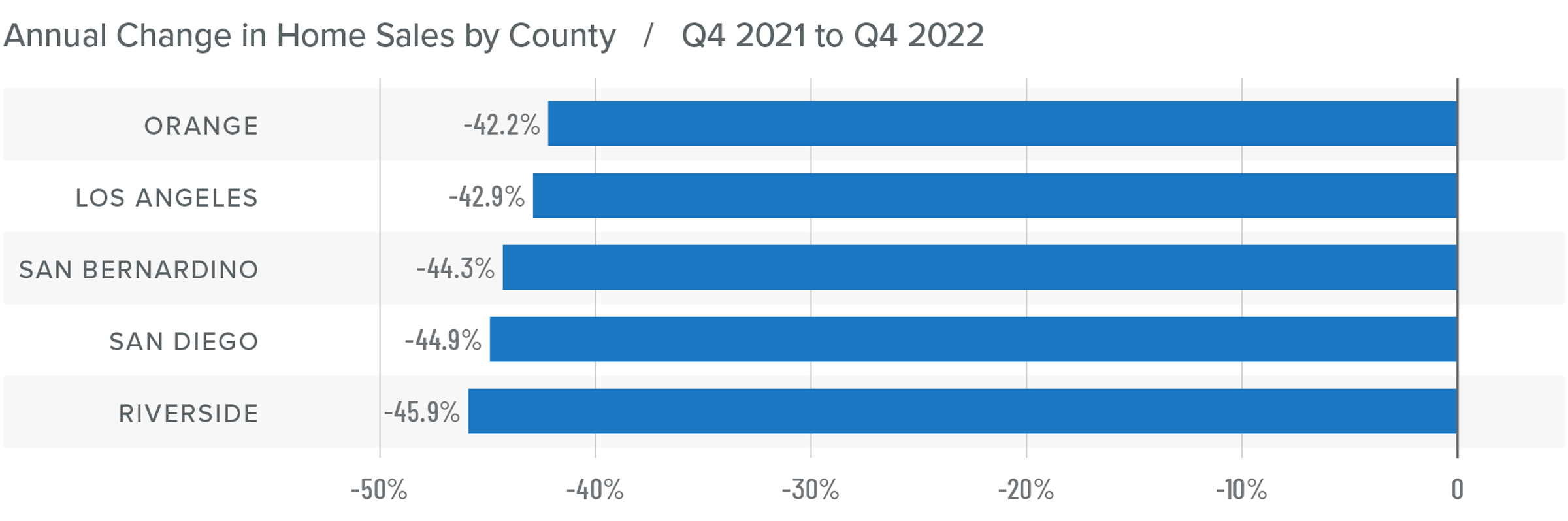
A bar graph showing the annual change in home sales for various counties in Northern California from Q3 2021 to Q3 2022. All counties have a negative percentage year-over-year change. Shasta County tops the list at -21.8%, followed by San Luis Obispo at -28.7%, Solano -30.1%, Placer -31.7%, Contra Costa -31.8%, Alameda -32%, Napa -32.9%, and Santa Clara at -35.7%.

Northern California Home Prices

The significant increase in mortgage rates has started to impact home prices. The average home sale price dropped .5% from a year ago and 12.6% from the second quarter of 2022.

Median listing prices rose 1.6% from the second quarter, but the increase was not widespread. Although asking prices jumped 18.8% in San Luis Obispo County and rose modestly in Napa and Shasta counties, this was offset by lower asking prices in the balance of the markets.

Prices rose in five of the counties contained in this report, while they fell in three. Compared to the second quarter of 2022, prices fell across the board, with double-digit drops in Alameda, Contra Costa, and Napa counties.

Financing costs are negatively impacting home prices, which I anticipate will continue through the balance of the year and into 2023.

A map showing the real estate home prices percentage changes for various counties in Northern California. Different colors correspond to different tiers of percentage change. Shasta, Contra Costa, and Alameda County are in the -1.5% to -0.9% range. Napa, Solano, and Santa Clara County have a percentage change in the 1% to 3.4% range, Placer is in the 3.5% to 5.9% range, and San Luis Obispo is in the 8.5%+ range.

A bar graph showing the annual change in home sale prices for various counties in Northern California from Q3 2021 to Q3 2022. San Luis Obispo County tops the list at 9.9%, followed by Placer at 3.9%, Napa at 2.7%, Santa Clara at 1.3%, Solano at 1%, Shasta at -0.4%, Alameda at -1%, and Contra Costa at -1.3%.

Mortgage Rates

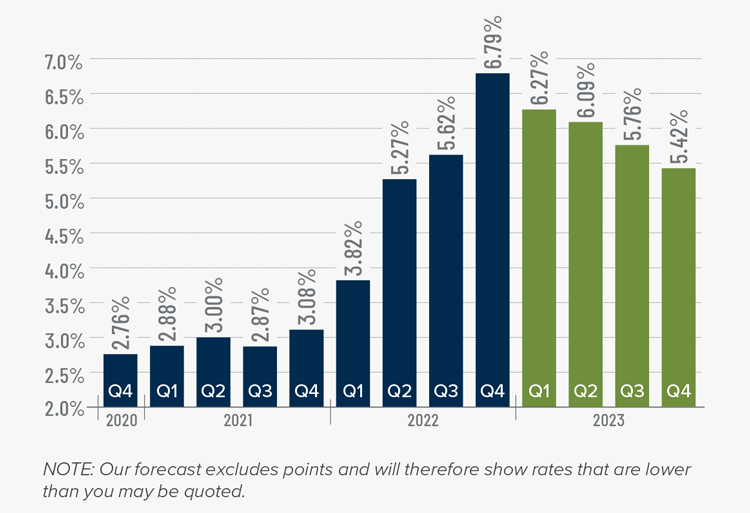
This remains an uncertain period for mortgage rates. When the Federal Reserve slowed bond purchases in 2013, investors were accused of having a “taper tantrum,” and we are seeing a similar reaction today. The Fed appears to be content to watch the housing market go through a period of pain as they throw all their tools at reducing inflation.

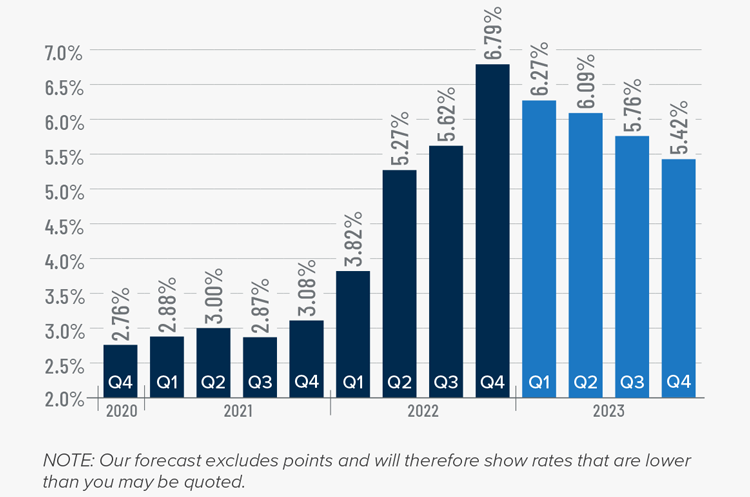
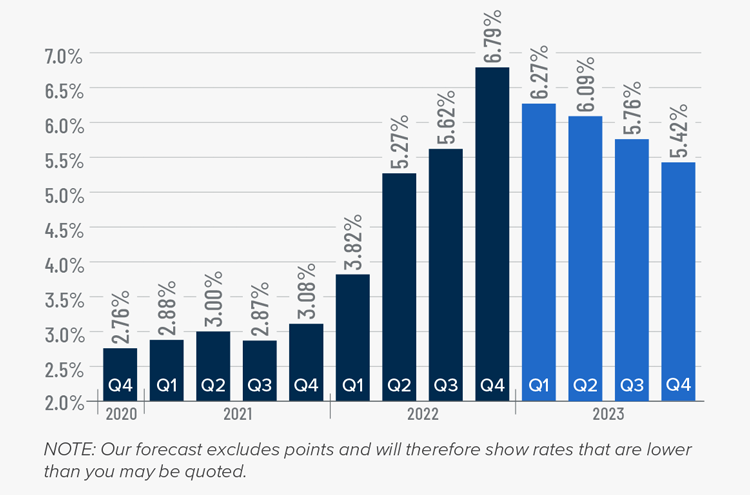
As a result, mortgage rates are out of sync with treasury yields, which not only continues to push rates much higher, but also creates violent swings in both directions. My current forecast calls for rates to peak in the fourth quarter of this year before starting to slowly pull back. That said, they will remain in the 6% range until the end of 2023.

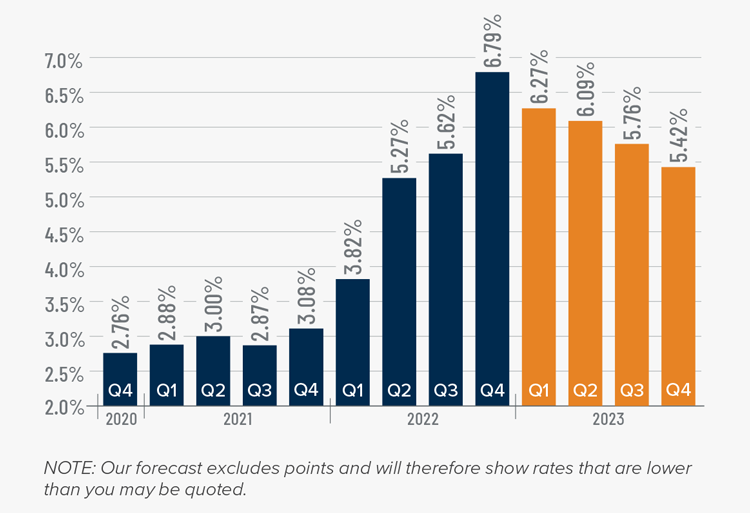
A bar graph showing the mortgage rates from 2020 to the present, as well as Matthew Gardner's forecasted mortgage rates through Q4 2023. After the 5.62% figure in Q3 2022, he forecasts mortgage rates continuing to climb to 6.7% in Q4 2022, 6.55% in Q1 2023, 6.35% in Q2 2023, 6.15% in Q3 2023, and 5.60% in Q4 2023.

Northern California Days on Market

The average time it took to sell a home in the Northern California counties in this report was seven days higher than it was in the third quarter of 2021.

The length of time it took to sell a home fell in Napa County but rose across the rest of the region. Compared to the second quarter of 2022, market time rose across all counties except Placer, where it fell four days.

During the third quarter, it took an average of 35 days to sell a home, which was 9 more days than in the second quarter of this year.

The combination of more choice and very cautious buyers has led market time to increase.

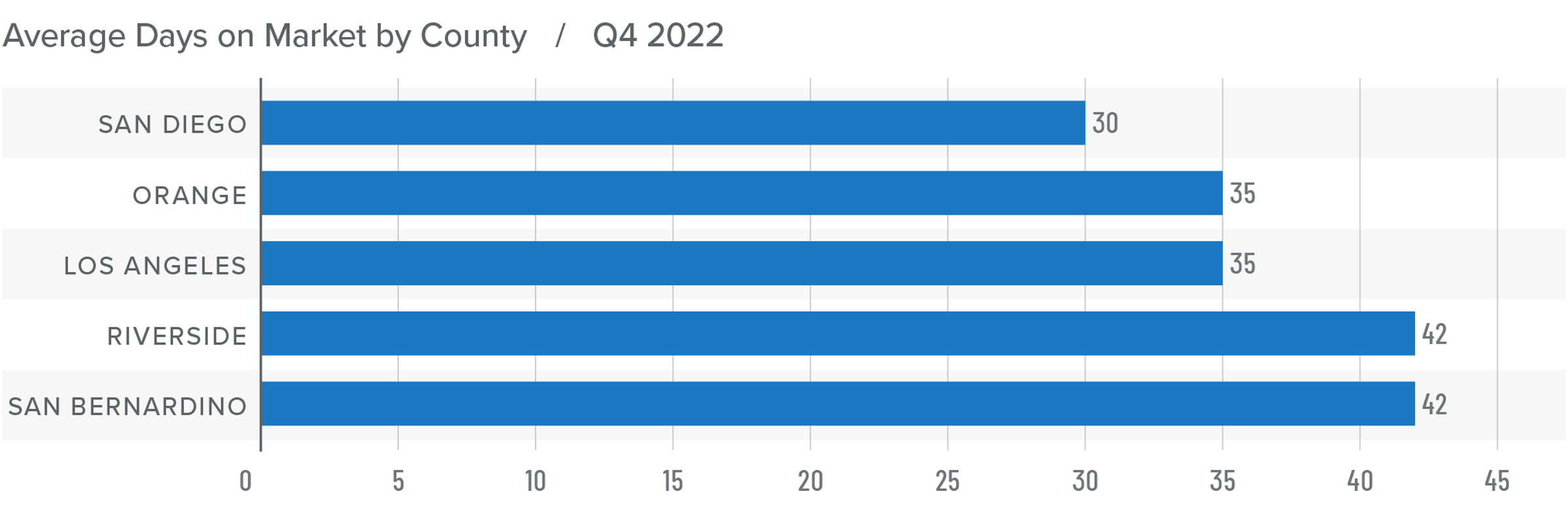
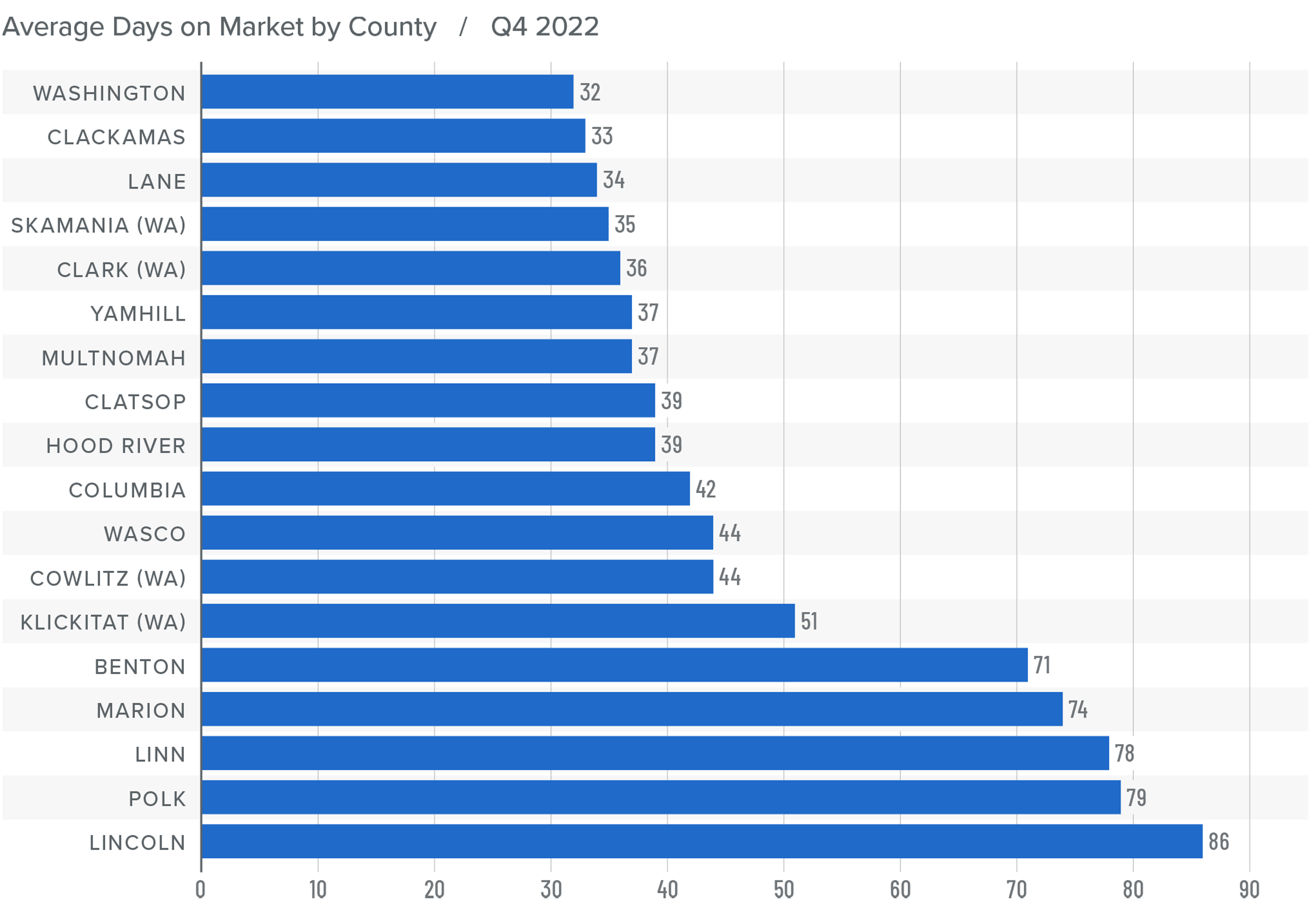
A bar graph showing the average days on market for homes in various counties in Northern California for Q3 2022. Alameda County has the lowest DOM at 23, followed by Santa Clara and Contra Costa at 24, San Luis Obispo at 26, Placer at 28, Solano at 36, Napa at 46, and Shasta at 79.

Conclusions

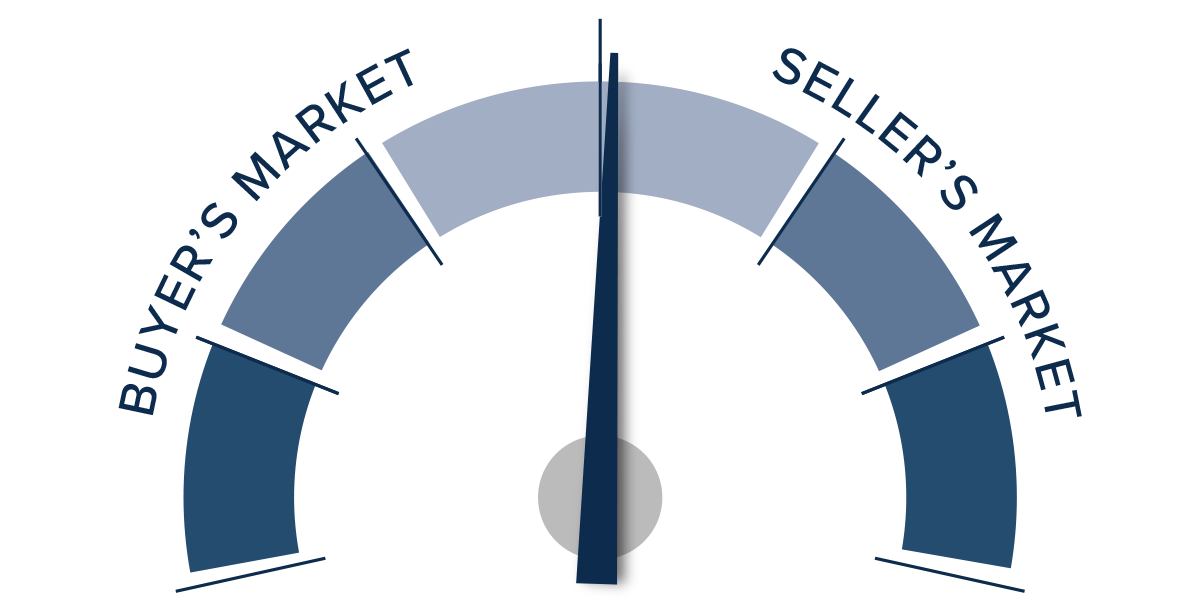
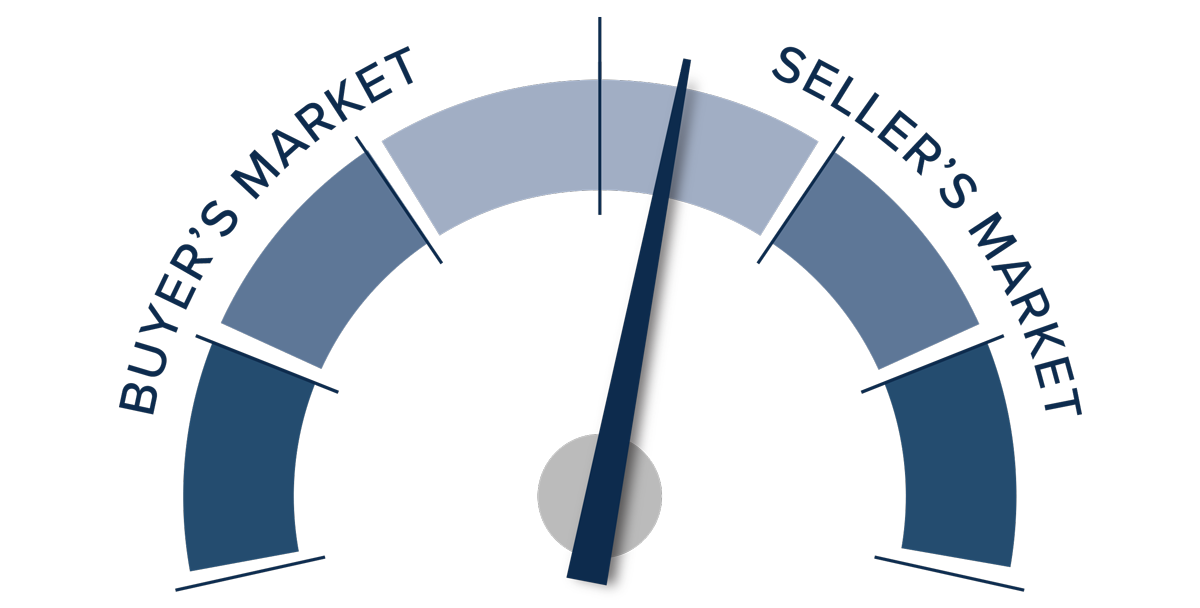
This speedometer reflects the state of the region’s real estate market using housing inventory, price gains, home sales, interest rates, and larger economic factors.

Far higher financing costs in concert with very low affordability levels are now impacting the region’s housing market. Although there may be some pain as the market continues to revert to a normal pace of price growth and sales activity, I am not overly concerned about the long-term outlook. Home values are correcting, but the adjustment will not be severe, and certainly nothing like the plummet we saw following the bursting of the housing bubble.

A speedometer graph indicating a balanced market, slightly headed toward a seller's market in Northern California in Q3 2022.

I think there are more buyers than most people might expect who are waiting for prices to correct and, more importantly, for mortgage rates to stabilize. While the market is firmly in a period of transition, it still is not a traditional buyer’s market. That said, it’s also not one that gives sellers all the control. As such, I am moving the needle more in favor of buyers, but not so far as to suggest that the tide has completely turned.

About Matthew Gardner

Matthew Gardner - Chief Economist for Windermere Real Estate

As Chief Economist for Windermere Real Estate, Matthew Gardner is responsible for analyzing and interpreting economic data and its impact on the real estate market on both a local and national level. Matthew has over 30 years of professional experience both in the U.S. and U.K.

In addition to his day-to-day responsibilities, Matthew sits on the Washington State Governors Council of Economic Advisors; chairs the Board of Trustees at the Washington Center for Real Estate Research at the University of Washington; and is an Advisory Board Member at the Runstad Center for Real Estate Studies at the University of Washington where he also lectures in real estate economics.

Living November 2, 2022

Simple Garage Makeover Ideas

For some homeowners, the garage is the focal point of their home. For others, it is simply a storage space or a place to park their vehicle. Regardless of how you use your garage, these simple garage makeover ideas can help keep you organized, boost your curb appeal, and increase your home’s value.

Simple Garage Makeover Ideas

Garage Exterior

The garage door is a natural starting point for your garage makeover. A garage door replacement is a surefire way to increase the value of your home and is a common tactic for drumming up buyer interest when preparing to hit the market. But even if you don’t have the budget for a full-scale replacement, a DIY garage door makeover can still make a big difference.

Repaint Garage Exterior

Begin by prepping your garage door for a fresh coat of paint. Clean and scrub the surface with warm soapy water. Scrape off any loose paint with a putty knife or wire brush. If scraping manually is too taxing for you, use a wire wheel brush tool. Rinse and clean the door, letting it dry completely before you begin painting.

Once you’ve covered your driveway with a tarp or plastic sheeting to protect it from paint spills, you’re ready to begin painting. Choose a complimentary color for your trim to tie together your home’s exterior color scheme. Check out different styles of garage door hardware options that match the style of your home, choose your layout, and install the pieces.


A luxury lodge-style home at sunset with timber wood framing and stone columns. The garage is attached to the home. The exterior is painted a mix of forest green and brown with deep red trim and an orange door.

Image Source: Getty Images – Image Credit: hikesterson


Garage Interior

As you turn your attention to your garage’s interior, consider refinishing the floor first. By starting with the floor, you won’t have to continually shuffle your garage items around as you continue your makeover. If you’re considering converting your garage into a home gym, factor that in as you work on the flooring.

Start by fixing any cracks or holes with a basic patch kit. Once the surface is flat, sweep and mop from end to end. If you are removing a previous layer of paint, use a buffer to jar the old paint loose before repainting. Finishing your garage floor off with epoxy will help protect it from stains and damage. Apply two coats of epoxy twenty-four hours apart, followed by a sealing topcoat.

Organize Your Garage

In just a few steps, you can turn your garage from a cluttered oversized closet into an organized storage space. Start by taking inventory of the items in your garage. Do you have lots of tools? Is the space filled with sports equipment? Grouping like items together will keep your storage orderly. Next, decide where you would like to store your items. Overhead storage racks, rollers, and ceiling storage can significantly cut down on clutter, but these storage options are best reserved for infrequently accessed or seasonal items like holiday decorations and camping gear.

Keep frequently used items within reach. Magnetic wall panels are a great resource for your everyday tools and gardening equipment. Install shelving and drawers near your workbench to keep smaller hand tools, screws, and nails tidy and organized and add labels so you can keep track of them. If space is limited, consider a wall-mounted foldable workbench.


A hardboard hanging panel in a garage full of common hand tools like screwdrivers, measuring tape, scissors, duct tape, vice grips, etc.

Image Source: Getty Images – Image Credit: Bluberries


Add Finishing Touches

Now it’s time to put the final touches on your garage makeover. Though installation may require the help of a professional, adding electrical outlets will pay dividends for the functionality of your garage. Installing bike hooks on the ceiling will help to save floor space and may provide just the clearance you need to park a vehicle inside. Lastly, consider upgrading your lighting. Newly installed lights will add value to your garage and make it safer.

For more simple design projects that can give your home a makeover, read the following:

5 Design Projects to Improve Your Backyard


­­­­­­Featured Image Source: Getty Images – Image Credit: JodiJacobson

Market News November 2, 2022

Q3 2022 Nevada Real Estate Market Update

The following analysis of the greater Las Vegas real estate market is provided by Windermere Real Estate Chief Economist Matthew Gardner. We hope that this information may assist you with making better-informed real estate decisions. For further information about the housing market in your area, please don’t hesitate to contact your Windermere Real Estate agent.


Regional Economic Overview

After two long years, I can now announce that all the jobs in the Las Vegas metro area that were lost because of the pandemic have returned. Employment levels are now 7,800 jobs above the pre-pandemic peak. With the job market continuing to strengthen, the number of people who have started to look for work has increased. This has led the unemployment rate to rise to 5.7%.

Nevada Home Sales

A total of 6,533 homes sold in the third quarter, which was a drop of 39.8% compared to the same period a year ago, and 30.2% lower than in the second quarter of this year.

Sales fell in every neighborhood covered by this report compared to a year ago, and all areas reported fewer sales than in the second quarter of 2022.

Listing activity continues to grow significantly, with the number of homes for sale up 130% year over year and up 97.2% from the second quarter.

Pending sales, which are an indicator of future closings, fell 27.6% compared to the second quarter, suggesting that the market may see sales fall further in the final quarter of this year.

A bar graph showing the annual change in home sales for various sub-market areas in Greater Las Vegas from Q3 2021 to Q3 2022. All sub-market areas listed showed a negative year-over-year percentage change. Downtown had a -23.8% change, followed by Northeast at -24.9%, Queensridge at -25%, Whitney at -36.1%, Henderson at -37.1%, Spring Valley at -37.4%, Centennial at -37.5%, Green Valley at -38.9%, North Las Vegas at -40.8%, Alliante at -41.4%, Southeast at -42.6%, Anthem at -43.2%, Summerlin at 45.3%, Southwest at -47.6%, andThe Lakes / Section 10 at -51.5%.

Nevada Home Prices

Even with slower sales, home prices still rose 9.4% from a year ago to an average of $479,046. They were 9% lower than in the second quarter of 2022.

The impact of higher mortgage rates has now started to affect both sales and prices. Median listing prices are down from the second quarter in all markets except Spring Valley (+0.3%) and Anthem (+1.4%).

Year over year, prices rose in every neighborhood other than Queens Ridge. They fell in every area compared to the second quarter of 2022.

The market has entered a period of reversion. The impact of mortgage rates rising 2.7% between the third quarter of 2021 and the current quarter has clearly started to have a dampening effect on the market.

A chart showing the sub-market areas and their corresponding zip codes in the Greater Las Vegas, Nevada area.

A bar graph showing the annual change in home sale prices for various sub-market areas in Greater Las Vegas from Q3 2021 to Q3 2022. Spring Valley tops the list with a 19.4% change, followed by Southwest at 19%, The Lakes / Section 10 at 16.5%, Northeast at 15.5%, North Las Vegas at 15.3%, Downtown at 14.3%, Anthem at 13.9%, Whitney at 13.4%, Aliante at 12.1%, Centennial at 11.6%, Southeast at 10.6%, Green Valley at 8.9%, Henderson at 4.2%, Summerlin at 3.3%, and finally Queensridge at -12.4%.

Mortgage Rates

This remains an uncertain period for mortgage rates. When the Federal Reserve slowed bond purchases in 2013, investors were accused of having a “taper tantrum,” and we are seeing a similar reaction today. The Fed appears to be content to watch the housing market go through a period of pain as they throw all their tools at reducing inflation.

As a result, mortgage rates are out of sync with treasury yields, which not only continues to push rates much higher, but also creates violent swings in both directions. My current forecast calls for rates to peak in the fourth quarter of this year before starting to slowly pull back. That said, they will remain in the 6% range until the end of 2023.

A bar graph showing the mortgage rates from 2020 to the present, as well as Matthew Gardner's forecasted mortgage rates through Q4 2023. After the 5.62% figure in Q3 2022, he forecasts mortgage rates continuing to climb to 6.7% in Q4 2022, 6.55% in Q1 2023, 6.35% in Q2 2023, 6.15% in Q3 2023, and 5.60% in Q4 2023.

Nevada Days on Market

The average time it took to sell a home in the region rose seven days compared to the third quarter of 2021.

It took an average of 25 days to sell a home in the quarter, which is nine days longer than it took in the second quarter of this year.

Days on market rose in all neighborhoods compared to the same period a year ago. Market time also rose in all neighborhoods compared to the second quarter of 2022.

Although these numbers may appear to be very bleak, it is worth remembering that the average days on market in the current quarter was 19 fewer than in the same quarter in 2019.

A bar graph showing the average days on market for homes in various sub-market areas of Greater Las Vegas from Q3 2021 to Q3 2022. Northeast the lowest DOM at 20, followed by Downtown at 21, North Las Vegas at 22, Whitney, Henderson, and Green Valley at 23, Southeast, and Spring Valley at 24, Queensridge, Centennial, and The Lakes / Section 10 at 25, Summerlin and Southwest at 27, Anthem at 29, and Aliante at 31.

Conclusions

This speedometer reflects the state of the region’s real estate market using housing inventory, price gains, home sales, interest rates, and larger economic factors.

The third quarter was one of transition as the market started to feel the impact of higher financing costs and more homes for sale. I expect the market to continue underperforming through the end of this year. However, as we enter 2023 mortgage rates should start stabilizing and moving modestly lower, leading to a more sustainable pace of sales and price growth. Although sellers may feel that the value of their homes is collapsing, that is not the case. Over 56% of Clark County homeowners with a mortgage have over 50% equity in their homes. Though any price correction might be painful to watch, it will not cause a major jump in foreclosure activity. Owners will see values return, but only after this period of reversion is complete, which will occur in 2023.

A speedometer graph indicating a balanced market, leaning toward a seller's market in Nevada in Q3 2022.

Given all the data discussed here, I have moved the needle more in favor of home buyers. However, they still do not have the upper hand.

About Matthew Gardner

Matthew Gardner - Chief Economist for Windermere Real Estate

As Chief Economist for Windermere Real Estate, Matthew Gardner is responsible for analyzing and interpreting economic data and its impact on the real estate market on both a local and national level. Matthew has over 30 years of professional experience both in the U.S. and U.K.

In addition to his day-to-day responsibilities, Matthew sits on the Washington State Governors Council of Economic Advisors; chairs the Board of Trustees at the Washington Center for Real Estate Research at the University of Washington; and is an Advisory Board Member at the Runstad Center for Real Estate Studies at the University of Washington where he also lectures in real estate economics.

Market News November 2, 2022

Q3 2022 Utah Real Estate Market Update

The following analysis of select counties of the Utah real estate market is provided by Windermere Real Estate Chief Economist Matthew Gardner. We hope that this information may assist you with making better-informed real estate decisions. For further information about the housing market in your area, please don’t hesitate to contact your Windermere Real Estate agent.


Regional Economic Overview

Utah’s economy continues to add jobs. The 53,600 jobs created statewide over the past year represent a growth rate of 3.3%. The counties covered by this report added more than 40,000 new jobs over the past year, which is a growth rate of 3%. The state’s unemployment rate in August was 2%, which is marginally above the all-time low of 1.9% reported in April of this year. The labor force continues to expand, suggesting that the region expects economic growth to remain strong. Even though the state has seen a modest decline in the pace of job growth, the numbers are still very impressive.

Utah Home Sales

In the third quarter, 7,134 homes sold. This was 31.6% fewer sales than a year ago and down 16.1% compared to the second quarter of this year.

Year over year, sales fell across the board. Sales in all markets covered by this report were lower than in the second quarter of 2022 as well.

Inventory levels continue to grow, with the average number of homes for sale in the quarter 149% higher than a year ago and up 79% from the second quarter of this year.

Buyers, who seemed to ignore rising mortgage rates in the second quarter, are now feeling the impact of higher financing costs and have taken a pause.

A bar graph showing the annual change in home sales for various counties in Utah from Q3 2021 to Q3 2022. All counties have a negative percentage year-over-year change. Morgan County tops the list at -4.8%, followed by Weber at -26.5%, Davis -30.1%, Salt Lake -30.9%, Utah -32.4%, Wasatch -40.5%, and Summit at -46.8%.

Utah Home Prices

The average home sale price in the third quarter was up 5.9% from a year ago to $627,503. However, prices fell 5.7% compared to the second quarter of this year.

Median listing prices in the third quarter were down across the board. Sellers appear to be coming to terms with the fact that the remarkably buoyant market we’ve experienced since the start of the pandemic has now ended.

All areas contained in this report except Morgan County had higher sale prices than a year ago. Compared to the second quarter of this year, only Wasatch County had higher sale prices.

Although the data suggests that a market correction has started, I don’t find this terribly troubling. Homeowners have seen a remarkable run-up in home values over the past couple of years. It was only a matter of time before the market reverted back to a more sustainable pace of price growth.

A map showing the real estate home prices percentage changes for various counties in Utah. Different colors correspond to different tiers of percentage change. Morgan County is in the -10.6% to -6.1% range. Weber, Davis, Salt Lake, and Wasatch County have a percentage change in the 3.2% to 7.7% range, and Utah and Summit are in the 7.8%+ range.

A bar graph showing the annual change in home sale prices for various counties in Utah from Q3 2021 to Q3 2022. Utah County tops the list at 12.3%, followed by Summit at 9.1%, Salt Lake at 7.5%, Weber at 6.7%, Davis at 5.8%, Wasatch at 4%, and Morgan at -10.3%.

Mortgage Rates

This remains an uncertain period for mortgage rates. When the Federal Reserve slowed bond purchases in 2013, investors were accused of having a “taper tantrum,” and we are seeing a similar reaction today. The Fed appears to be content to watch the housing market go through a period of pain as they throw all their tools at reducing inflation.

As a result, mortgage rates are out of sync with treasury yields, which not only continues to push rates much higher, but also creates violent swings in both directions. My current forecast calls for rates to peak in the fourth quarter of this year before starting to slowly pull back. That said, they will remain in the 6% range until the end of 2023.

A bar graph showing the mortgage rates from 2020 to the present, as well as Matthew Gardner's forecasted mortgage rates through Q4 2023. After the 5.62% figure in Q3 2022, he forecasts mortgage rates continuing to climb to 6.7% in Q4 2022, 6.55% in Q1 2023, 6.35% in Q2 2023, 6.15% in Q3 2023, and 5.60% in Q4 2023.

Utah Days on Market

The average number of days it took to sell a home in the counties covered by this report rose ten days compared to the same period a year ago.

Though homes sold fastest in Salt Lake County, average market time rose in all counties covered by this report year over year. Days on market was also higher in every county compared to the second quarter of this year.

During the quarter, it took an average of 33 days to sell a home in the region. Market time rose 15 days compared to the second quarter of 2022.

Rapidly rising inventory levels and mortgage rates have put the brakes on the Utah housing market.

A bar graph showing the average days on market for homes in various counties in Utah for Q3 2022. Salt Lake County has the lowest DOM at 27, followed by Davis at 28, Utah at 30, Weber at 31, Morgan at 34, Wasatch at 37, and Summit at 41.

Conclusions

This speedometer reflects the state of the region’s real estate market using housing inventory, price gains, home sales, interest rates, and larger economic factors.

Although Utah’s economy remains strong, the housing market is now feeling the effects of mortgage rates that were 2.7% higher than in the third quarter of 2021. With rates expected to rise even more in the fourth quarter before hopefully levelling off in early 2023, I anticipate that prices will decline further from their current levels. While this may seem like a dire situation to some, homeowners have seen their equity leap since the pandemic started. Though the expected drop in home values may be disconcerting for owners, it’s necessary for the market to return to more realistic conditions. I expect that some would-be sellers will decide to wait until the market stabilizes before listing their homes, while others will decide not to sell at all. This will limit how far inventory levels will rise. As such, I don’t see the market reaching saturation.

A speedometer graph indicating a balanced market, leaning toward a seller's market in Utah in Q3 2022.

The Utah housing market is in a period of reversion that will bring it back to balance, which is actually positive for the long-term health of the market. Buyers have more choice, but many will wait until financing costs and the market start to stabilize before they resume their search for a home. We still aren’t in a buyer’s market, but we are certainly getting closer to balance. As such, I have moved the needle far closer to the middle.

About Matthew Gardner

Matthew Gardner - Chief Economist for Windermere Real Estate

As Chief Economist for Windermere Real Estate, Matthew Gardner is responsible for analyzing and interpreting economic data and its impact on the real estate market on both a local and national level. Matthew has over 30 years of professional experience both in the U.S. and U.K.

In addition to his day-to-day responsibilities, Matthew sits on the Washington State Governors Council of Economic Advisors; chairs the Board of Trustees at the Washington Center for Real Estate Research at the University of Washington; and is an Advisory Board Member at the Runstad Center for Real Estate Studies at the University of Washington where he also lectures in real estate economics.

Market News November 1, 2022

Q3 2022 Montana Real Estate Market Update

The following analysis of select counties of the Montana real estate market is provided by Windermere Real Estate Chief Economist Matthew Gardner. We hope that this information may assist you with making better-informed real estate decisions. For further information about the housing market in your area, please don’t hesitate to contact your Windermere Real Estate agent.


Regional Economic Overview

Though employment growth in Montana continues to taper, the addition of 11,500 new jobs over the past year is solid. All metro areas in the region continue to add jobs. Missoula was the standout, having added 1,900 new jobs during the past quarter. The state unemployment rate in August was 2.8%; this is up from 2.6% at the end of the second quarter and is mainly due to the growing labor force. In the metro areas covered in this report, the lowest jobless rate was in Billings at 2.6%, followed by Missoula at 2.7%, and Great Falls at 2.9%. The labor force participation rate (which is the civilian population divided by the labor force) has risen marginally to 62.7%, which is still very close to the all-time low. This means businesses will still have a difficult time finding workers.

Montana Home Sales

In the third quarter of this year, 2,023 homes sold in the markets contained in this report, which is a 7.9% decline from a year ago. Sales activity fell 14.3% compared to the second quarter of this year.

The number of homes for sale was 17.5% higher than a year ago and a remarkable 75.7% higher than in the second quarter. Sellers appear to still be confident in the market.

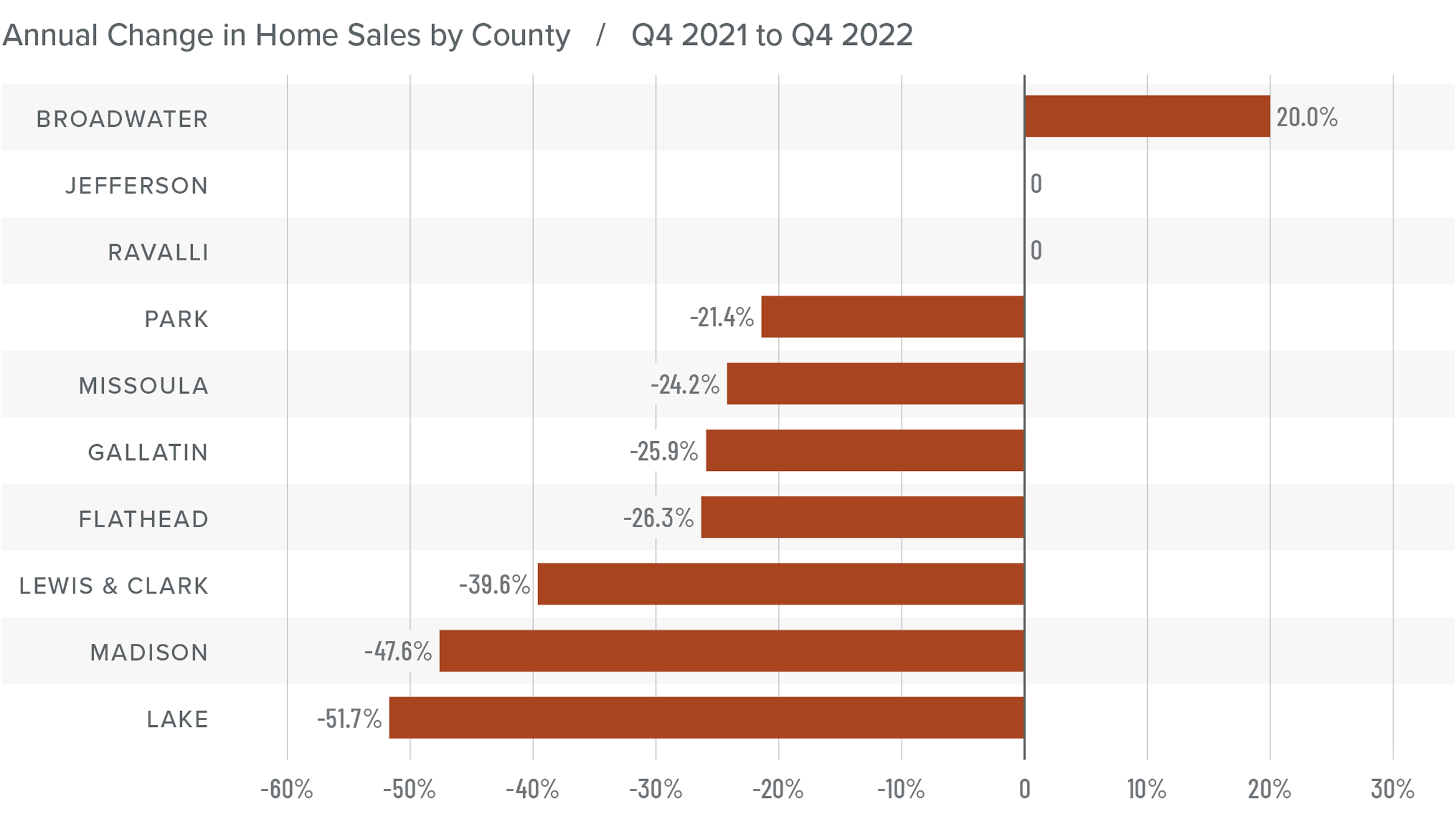
Year over year, sales grew in Ravalli County but fell in the balance of the markets included in this report. Sales grew in Missoula, Ravalli, and Lake counties from the second quarter but fell in all other markets.

Seller confidence was supported by the fact that pending sales rose 34.4% from the second quarter, which is a very significant improvement and is likely a result of there being considerably more choice in the market.

A bar graph showing the annual change in home sales for various counties in Montana from Q3 2021 to Q3 2022. All counties have a negative percentage year-over-year change except for Ravalli County at 28.8%. Flathead follows at -3.8%, then it's Gallatin at -7.2%, Park -7.6%, Lewis & Clark -10.8%, Madison -17.5%, Missoula -23%, Lake -23.4%, Jefferson -24.3%, and Broadwater at -40%.

Montana Home Prices

Home prices were flat year over year, with the average sale price coming in at $709,013. Prices were .2% lower than in the second quarter of 2021.

Price growth will likely remain flat for the balance of 2022 and into 2023 as buyers and sellers react to mortgage rates that are higher than they’ve seen in a long time. That said, even with more expensive financing costs and higher inventory levels, I do not expect home prices in Montana to turn negative in 2023.

With pending sales up significantly but home prices essentially flat, the numbers are somewhat unusual until you note that the median listing price fell .8% from the second quarter. Home sellers are reacting to a market with more competition and are now having to price their homes more competitively.

Sellers who price their homes realistically are still finding buyers—even with more competition than they’ve seen in several years.

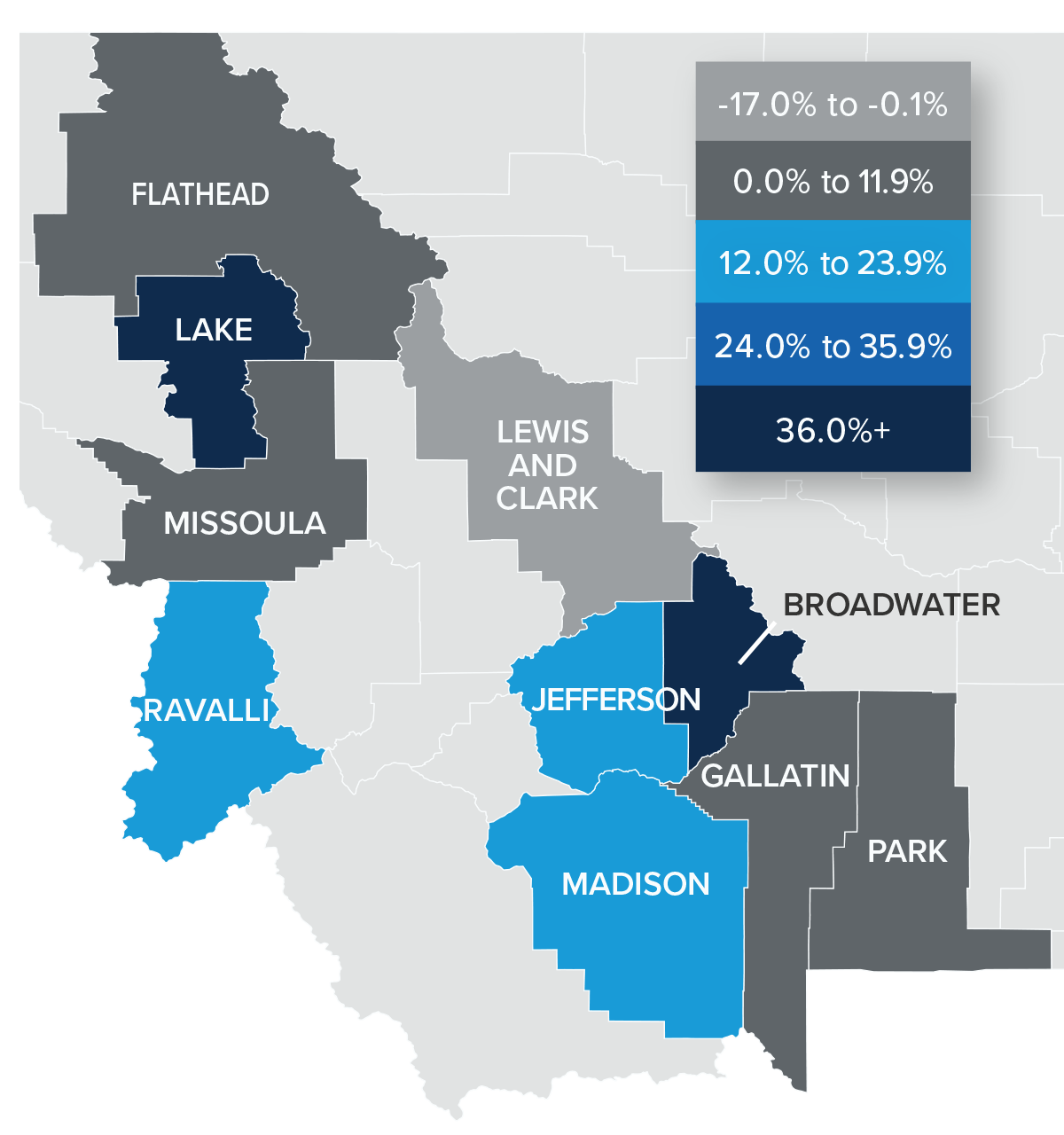
A map showing the real estate home prices percentage changes for various counties in Montana. Different colors correspond to different tiers of percentage change. Flathead, Broadwater, and Gallatin County have a percentage change in the -14% to 5.4% range. Lewis & Clark, Missoula, Ravalli, Madison, and Park are in the 5.5% to 24.9% change range, Lake is in the 35% to 44.4% range, and Jefferson is in the 64%+ range.

A bar graph showing the annual change in home sale prices for various counties in Montana from Q3 2021 to Q3 2022. Jefferson County tops the list at 91.9%, followed by Lake at 37.9%, Missoula at 16.4%, Lewis & Clark at 12.1%, Madison 11%, Ravalli 9.7%, Park 9.4%, Gallatin -5.3%, Flathead -13.3%, and Broadwater at -13.8%.

Mortgage Rates

This remains an uncertain period for mortgage rates. When the Federal Reserve slowed bond purchases in 2013, investors were accused of having a “taper tantrum,” and we are seeing a similar reaction today. The Fed appears to be content to watch the housing market go through a period of pain as they throw all their tools at reducing inflation.

As a result, mortgage rates are out of sync with treasury yields, which not only continues to push rates much higher, but also creates violent swings in both directions. My current forecast calls for rates to peak in the fourth quarter of this year before starting to slowly pull back. That said, they will remain in the 6% range until the end of 2023.

A bar graph showing the mortgage rates from 2020 to the present, as well as Matthew Gardner's forecasted mortgage rates through Q4 2023. After the 5.62% figure in Q3 2022, he forecasts mortgage rates continuing to climb to 6.7% in Q4 2022, 6.55% in Q1 2023, 6.35% in Q2 2023, 6.15% in Q3 2023, and 5.60% in Q4 2023.

Montana Days on Market

The average time it took to sell a home fell eight days compared to the same period a year ago.

Homes sold fastest in Broadwater County, while homes in Flathead County took the longest to sell. Jefferson, Gallatin, Park, and Madison counties saw market time rise compared to a year ago. Average market time in the rest of the region dropped.

During the third quarter, it took an average of 49 days to sell a home in the markets covered by this report.

In comparison to the second quarter of 2022, average market time fell in all counties other than Park (+17 days), Lake (+12 days), Gallatin (+11 days), and Madison (+6 days).

A bar graph showing the average days on market for homes in various counties in Montana for Q3 2022. Broadwater County has the lowest DOM at 25, followed by Gallatin at 26, Jefferson at 28, Park at 38, Madison 48, Lewis & Clark 50, Missoula 58, Lake and Ravalli 64, and Flathead at 86.

Conclusions

This speedometer reflects the state of the region’s real estate market using housing inventory, price gains, home sales, interest rates, and larger economic factors.

The Montana housing market has started to react to mortgage rates that have essentially doubled since the start of 2022. Sellers are having to adjust to higher inventory levels, more expensive financing costs, and increased competition by making sure their asking price is realistic. These adjustments should favor buyers—and they do. I see a trend back toward a more balanced market, but one that is still far from being a traditional buyer’s market.

A speedometer graph indicating a balanced market, leaning toward a seller's market in Montana in Q3 2022.

Therefore, I am moving the needle more toward the middle, but not so much as to suggest that buyers are now in the driver’s seat.

About Matthew Gardner

Matthew Gardner - Chief Economist for Windermere Real Estate

As Chief Economist for Windermere Real Estate, Matthew Gardner is responsible for analyzing and interpreting economic data and its impact on the real estate market on both a local and national level. Matthew has over 30 years of professional experience both in the U.S. and U.K.

In addition to his day-to-day responsibilities, Matthew sits on the Washington State Governors Council of Economic Advisors; chairs the Board of Trustees at the Washington Center for Real Estate Research at the University of Washington; and is an Advisory Board Member at the Runstad Center for Real Estate Studies at the University of Washington where he also lectures in real estate economics.

Market News November 1, 2022

Q3 2022 Idaho Real Estate Market Update

The following analysis of select counties of the Idaho real estate market is provided by Windermere Real Estate Chief Economist Matthew Gardner. We hope that this information may assist you with making better-informed real estate decisions. For further information about the housing market in your area, please don’t hesitate to contact your Windermere Real Estate agent.


Regional Economic Overview

Employment in Idaho continues to grow, but the pace has started to taper. The addition of 22,400 jobs over the past 12 months represents a growth rate of 2.8%. Idaho’s third-quarter unemployment rate was 2.7%, down from 3.5% a year ago. This is higher than the all-time low in May and June of this year, but very impressive all the same. Although jobs are being added at a slower pace, I am not concerned given the current unemployment rate and the growing labor force.

Idaho Home Sales

In the third quarter of 2022, 5,243 homes sold, which was 28.7% lower than a year ago and 18.1% lower than in the second quarter of the year.

Listing activity was up 53% compared to a year ago. The average number of homes on the market was 9.1% higher than in the second quarter of 2022.

Compared to the same period a year ago, sales fell in the northern part of the state and were lower in all areas of Southern Idaho except Valley County. Compared to the second quarter, sales also fell across Northern Idaho, but rose in Valley, Payette, and Boise counties in the southern part of the state.

Pending sales were 19% lower than in the second quarter of this year. With more listings and fewer sales, the market is certainly slowing, much of which can be attributed to rising mortgage rates, which hit a level we have not seen since 2008.

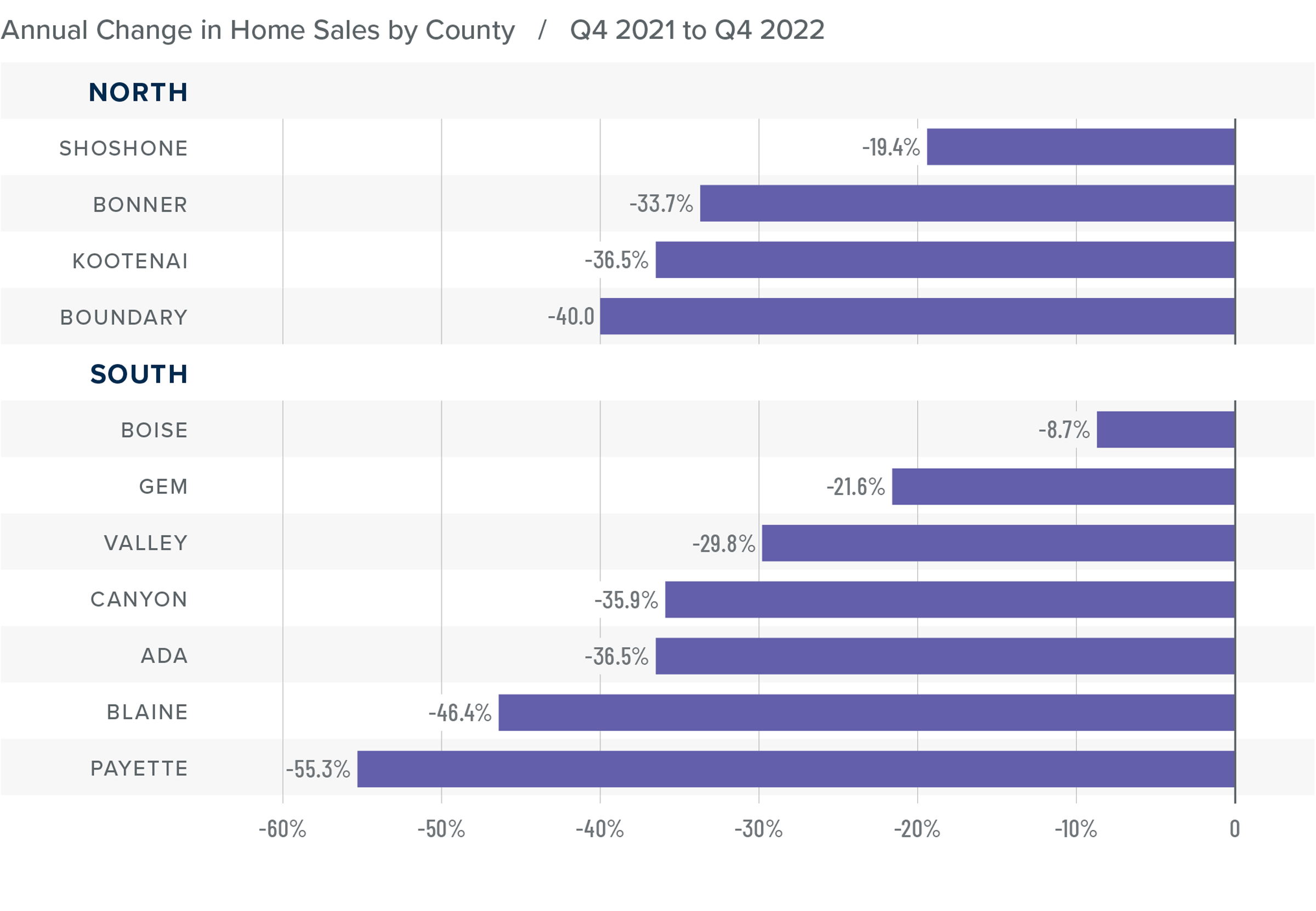
A bar graph showing the annual change in home sales for various counties in North and South Idaho from Q3 2021 to Q3 2022. All counties but one have a negative percentage year-over-year change. In North Idaho, Bonner County comes in at -15.3%, followed by Shoshone at -24.1%, Kootenai -25.8%, and Boundary -31%. In South Idaho, Valley comes in at 12%, followed by Payette -15.3%, Boise -21.5%, Ada -27.4%, Canyon -35.9%, Gem -37.6%, and Blaine at -48.9%.

Idaho Home Prices

The average home price in the region rose 4.3% year over year to $625,275 but was down 2.9% compared to the second quarter of the year.

Compared to the second quarter of 2022, prices rose in all Northern Idaho counties except Kootenai, where they were down 1.7%. In the southern part of the state, prices fell across the board.

Prices rose by double digits in Bonner and Boundary counties, while the balance of Northern Idaho counties saw single-digit growth. In the southern part of the state, prices rose in four of the counties, but fell in Boise, Valley, and Blaine counties.

Median listing prices in the second quarter were lower in all southern markets, but higher in all but Bonner County in the northern part of the state.

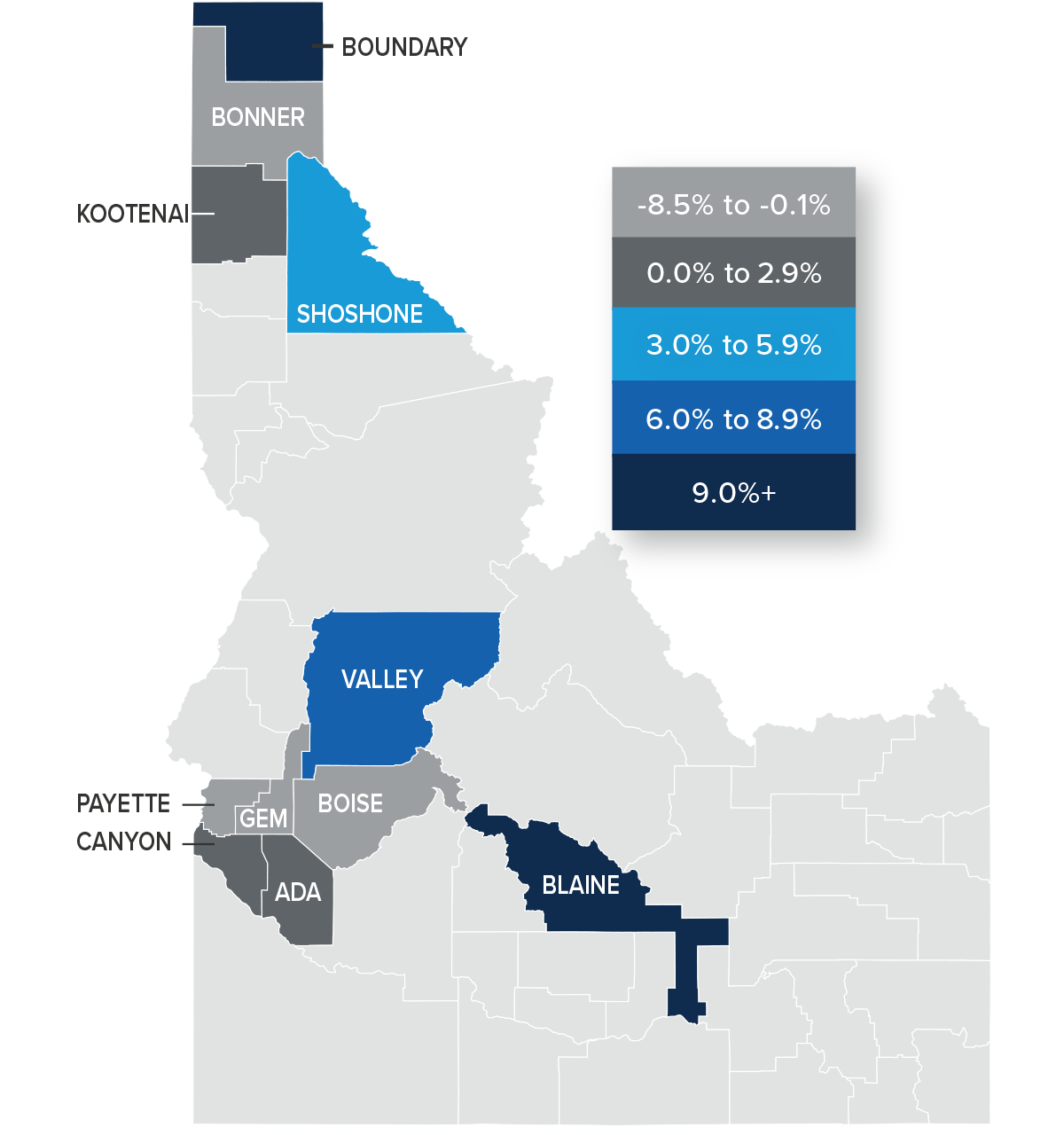
A map showing the real estate home prices percentage changes for various counties in Idaho. Different colors correspond to different tiers of percentage change. In the southern area of the state, Blaine, Boise, and Valley County have a percentage change in the -16% to -0.1% range. Ada is in the 0% to 5.9% change range, and Payette, Gem, and Canyon are in the 6% to 11.9% range. In the north, Kootenai is in the 0% to 5.9% range, while Shoshone is in the 6% to 11.9% rage and Bonner and Boundary are in the 18%+ range.

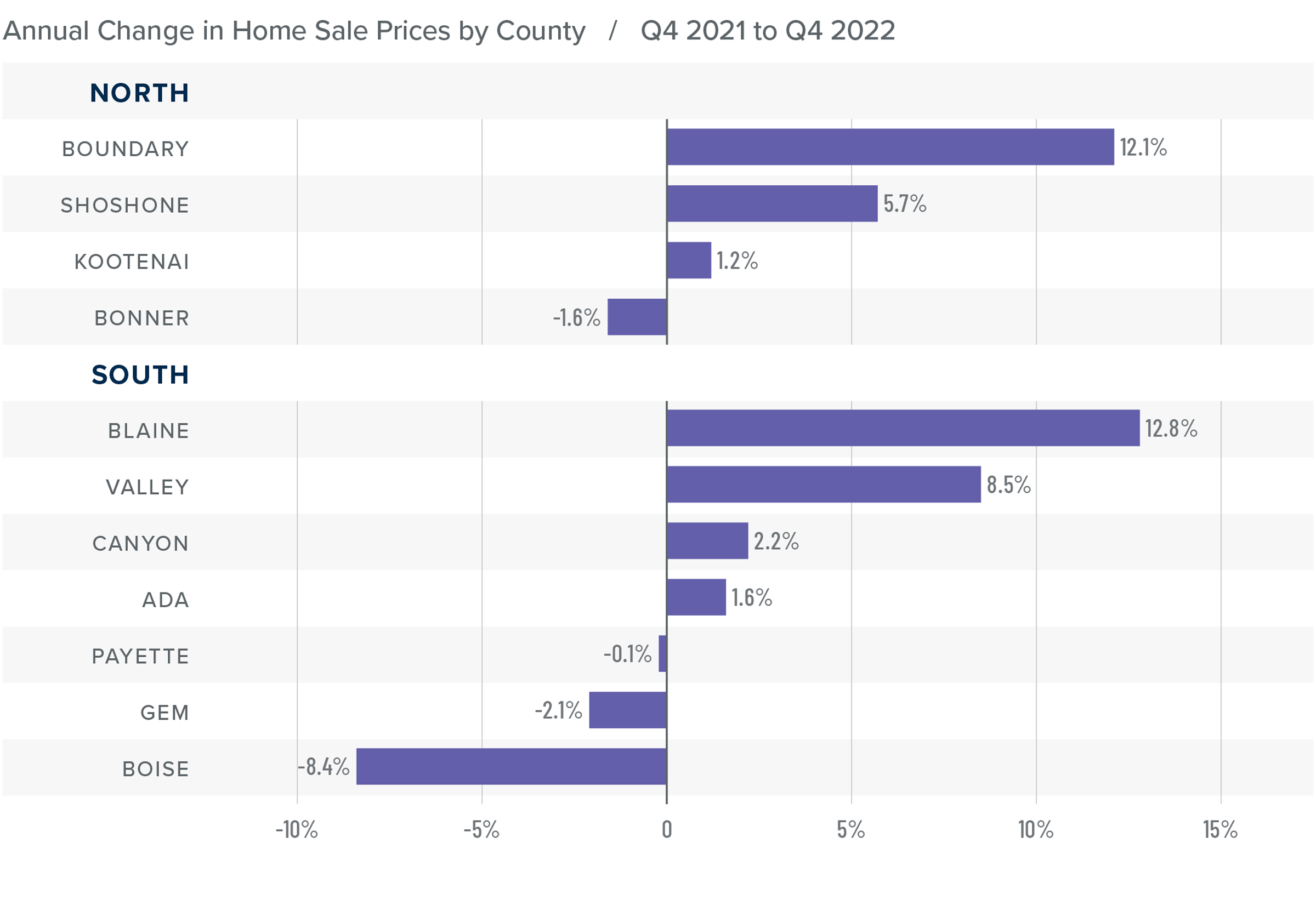
A bar graph showing the annual change in home sale prices for various counties in North and South Idaho from Q3 2021 to Q3 2022. In the north, Bonner County tops the list at 29.1%, followed by Boundary at 20.7%, Shoshone at 6.1%, and Kootenai at 1.1%. In the South, Payette leads off at 8.6%, followed by Gem at 7.8%, Canyon at 7.5%, Ada 5.5%, Boise -3.2%, Valley -12.4%, and Blaine at -15.3%.

Mortgage Rates

This remains an uncertain period for mortgage rates. When the Federal Reserve slowed bond purchases in 2013, investors were accused of having a “taper tantrum,” and we are seeing a similar reaction today. The Fed appears to be content to watch the housing market go through a period of pain as they throw all their tools at reducing inflation.

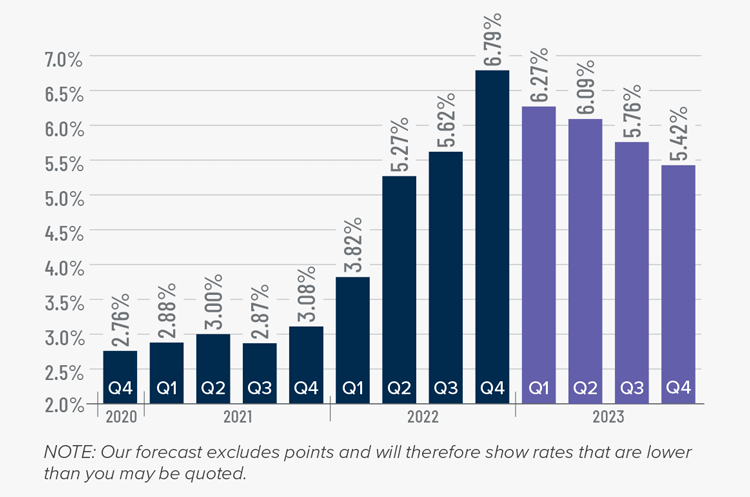
As a result, mortgage rates are out of sync with treasury yields, which not only continues to push rates much higher, but also creates violent swings in both directions. My current forecast calls for rates to peak in the fourth quarter of this year before starting to slowly pull back. That said, they will remain in the 6% range until the end of 2023.

A bar graph showing the mortgage rates from 2020 to the present, as well as Matthew Gardner's forecasted mortgage rates through Q4 2023. After the 5.62% figure in Q3 2022, he forecasts mortgage rates continuing to climb to 6.7% in Q4 2022, 6.55% in Q1 2023, 6.35% in Q2 2023, 6.15% in Q3 2023, and 5.60% in Q4 2023.

Idaho Days on Market

The average number of days it took to sell a home in the region rose five days compared to the same quarter of 2021 but fell six days compared to the second quarter of 2022.

In Northern Idaho, days on market rose in all counties other than Kootenai compared to a year ago. Market time rose in every county other than Blaine in Southern Idaho.

It took an average of 74 days to sell a home in Northern Idaho, and 37 days in the southern part of the state.

Homes sold the fastest in Ada County in the southern part of the state and in Shoshone County in Northern Idaho.

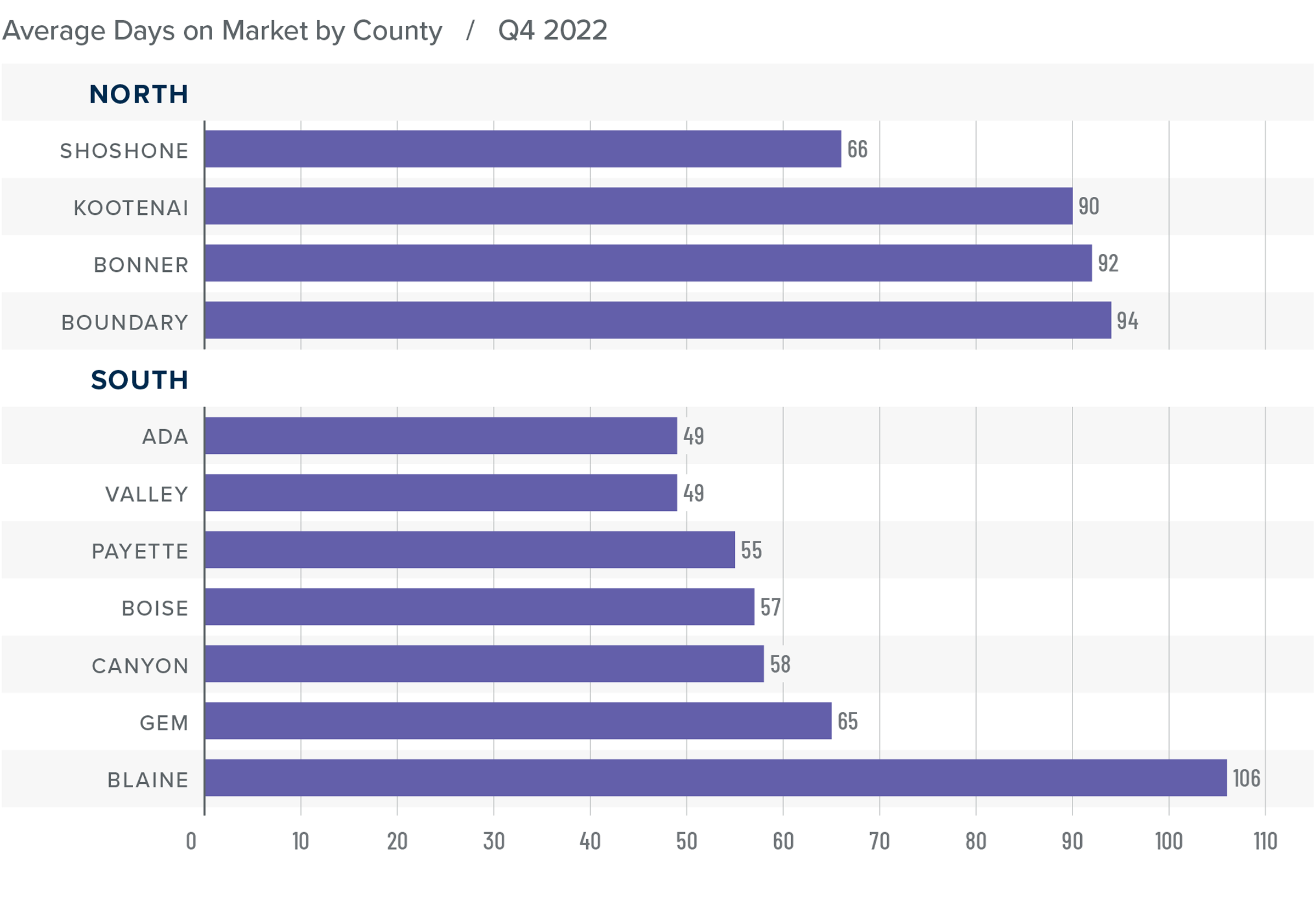
A bar graph showing the average days on market for homes in various counties in North and South Idaho for Q3 2022. In North Idaho, Shoshone County has the lowest DOM at 63, followed by Kootenai at 73, Bonner at 77, and Boundary at 81. In the South, Ada County has the lowest DOM at 30, then Gem at 31, Payette 33, Boise and Canyon 34, Valley 39, and Blaine at 59.

Conclusions

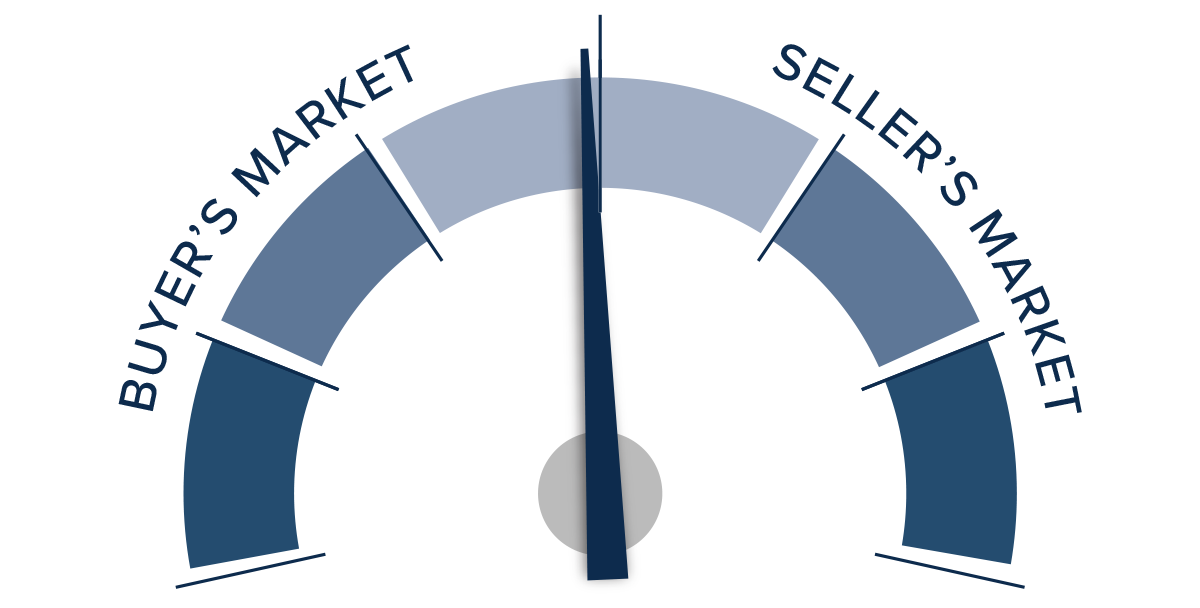
This speedometer reflects the state of the region’s real estate market using housing inventory, price gains, home sales, interest rates, and larger economic factors.

The third quarter appears to have been an inflection point: the impact of higher mortgage rates and lower affordability have now started to negatively affect home sales and prices. With mortgage rates likely to remain very high compared to recent years, the massive run-up in home values is at an end. Although the market will continue to be negatively impacted as we move through the winter and into the spring, I don’t see it falling in a manner similar to the Great Recession. Owners are sitting on significant equity. Even if prices fall in 2023, which I expect, the decline will be relatively modest.

A speedometer graph indicating a slight seller's market in Idaho in Q3 2022.

With a contracting market, I expect that many homeowners who were thinking about selling will decide to stay put and ride out the slowdown. This will mean the number of homes for sale is unlikely to grow significantly from current levels. Given all the data discussed here, I am moving the needle more toward balance, but we are still not in a typical buyer’s market at the present time.

About Matthew Gardner

Matthew Gardner - Chief Economist for Windermere Real Estate

As Chief Economist for Windermere Real Estate, Matthew Gardner is responsible for analyzing and interpreting economic data and its impact on the real estate market on both a local and national level. Matthew has over 30 years of professional experience both in the U.S. and U.K.

In addition to his day-to-day responsibilities, Matthew sits on the Washington State Governors Council of Economic Advisors; chairs the Board of Trustees at the Washington Center for Real Estate Research at the University of Washington; and is an Advisory Board Member at the Runstad Center for Real Estate Studies at the University of Washington where he also lectures in real estate economics.

Buying October 31, 2022

Buyer Beware: Is That House For Sale Haunted?

A trope as old as horror movies: a family moves into a beautiful house that they bought for well under market value. They’ve put all their savings into the move, and they’re looking for a fresh start. When they meet the neighbors and other townsfolk, they quickly learn that there’s a history to the home they weren’t aware of. 

At first, it’s easy to chalk these abnormal experiences up to common symptoms of buying a fixer-upper. The children hearing noises in the closet and the dad’s inexplicable sleepwalking spells are thought of as nothing more than stress and anxiety from the move. It’s only when things get out of hand that the family finally realizes the extent of the haunting.

Buyer Beware: Is That House for Sale Haunted?

While sharing a home with the supernatural can be a selling point for some buyers, it’s quite the opposite for others. In fact, a 2017 survey by realtor.com® found that 33% of people were open to living in a haunted house, 25% would consider it, but 42% said it was a dealbreaker. So, how do you make sure you’re fully informed about a home’s history? Knowing the right questions to ask is the first step.

Ask to See the Seller Disclosure Form

In the famous 1991 case Stambovsky v. Ackley, the new homeowner Jeffrey Stambovsky won a lawsuit against the previous owner for not disclosing the history of hauntings.

In this case, the previous owner had published stories about the family’s experiences in Reader’s Digest and their local newspaper. In her writings, she explained several interactions with ghostly beings in the home, including finding that her children had been given rings that would later disappear, bed shaking, and conversations with the floating specters.

The court took this evidence and ruled the “defendant is estopped to deny [the ghost’s] existence and, as a matter of law, the house is haunted.” This case set the standard for future seller disclosures. In this instance, they found that the history of the home and the seller’s experiences in it would have influenced the marketability. Therefore, omitting these facts was unfair to the buyer.

Thanks to Stambovsky v. Ackley, nowadays sellers in many states are obligated by law to disclose information that impacts a property’s marketability.


A dilapidated white house with boarded-up windows, dirty siding, and two chimneys

Image Source: Getty Images – Image Credit: shaunl


Research the History of the Home

In 1991 when Mr. Stambovsky bought his haunted house, the internet wasn’t what it is today. Now you can learn all about a home’s history before you make an offer. Search the address and town name to start. Keywords like “haunted,” “ghosts,” and “news report” will help you detect whether there’s been any paranormal activity associated with the property.

Ask Your Agent and the Neighbors 

This is where neighbors come in handy. When you find a home you want to pursue, contact the neighbors to see what they know about the home’s history. The same goes for your real estate agent; he or she can reach out to the listing agent to see if there is anything troubling you should know about prior to buying. While many states don’t require sellers to disclose paranormal activity or deaths in the home, if asked, all real estate agents must, by law, answer truthfully.

To learn more about how to protect yourself as a buyer, learn more about common real estate contingencies and the role they play in making an offer on a home:

Making a Contingent Offer: Common Real Estate Contingencies


­­­­­­Featured Image Source: Getty Images – Image Credit: ysbrandcosijn

Market News October 31, 2022

Q3 2022 Central Washington Real Estate Market Update

The following analysis of select counties of the Central Washington real estate market is provided by Windermere Real Estate Chief Economist Matthew Gardner. We hope that this information may assist you with making better-informed real estate decisions. For further information about the housing market in your area, please don’t hesitate to contact your Windermere Real Estate agent.


Regional Economic Overview

Central Washington has added 1,535 jobs over the past 12 months, which represents an annual growth rate of .7%. Total employment is now 11,522 jobs higher than the pre-pandemic peak. Although regional employment is higher than before the COVID-19-induced fall, Kittitas County is still lagging, with a shortfall of over 3,700 jobs. Adjusted for seasonality, the unemployment level in Central Washington in third quarter was 5.8%, which is down from 6.9% a year ago. The lowest unemployment rate was in Chelan County, where it was 4.4%. The area’s highest jobless rate was in Yakima County, where 6.3% of the labor force was still without work.

Central Washington Home Sales

Sales in Central Washington fell 7.8% from the same quarter a year ago, with a total of 1,422 homes changing hands. Compared to the second quarter, sales were down 4.4%.

Pending sales, which are an indicator of future closings, fell 1.9% compared to the second quarter of this year.

Year over year, sales rose in Okanogan County but fell in the balance of the region. However, compared to the second quarter, sales rose in all counties except Okanogan and Douglas counties.

Inventory levels rose more than 28% year over year and were up 23.6% from the second quarter.

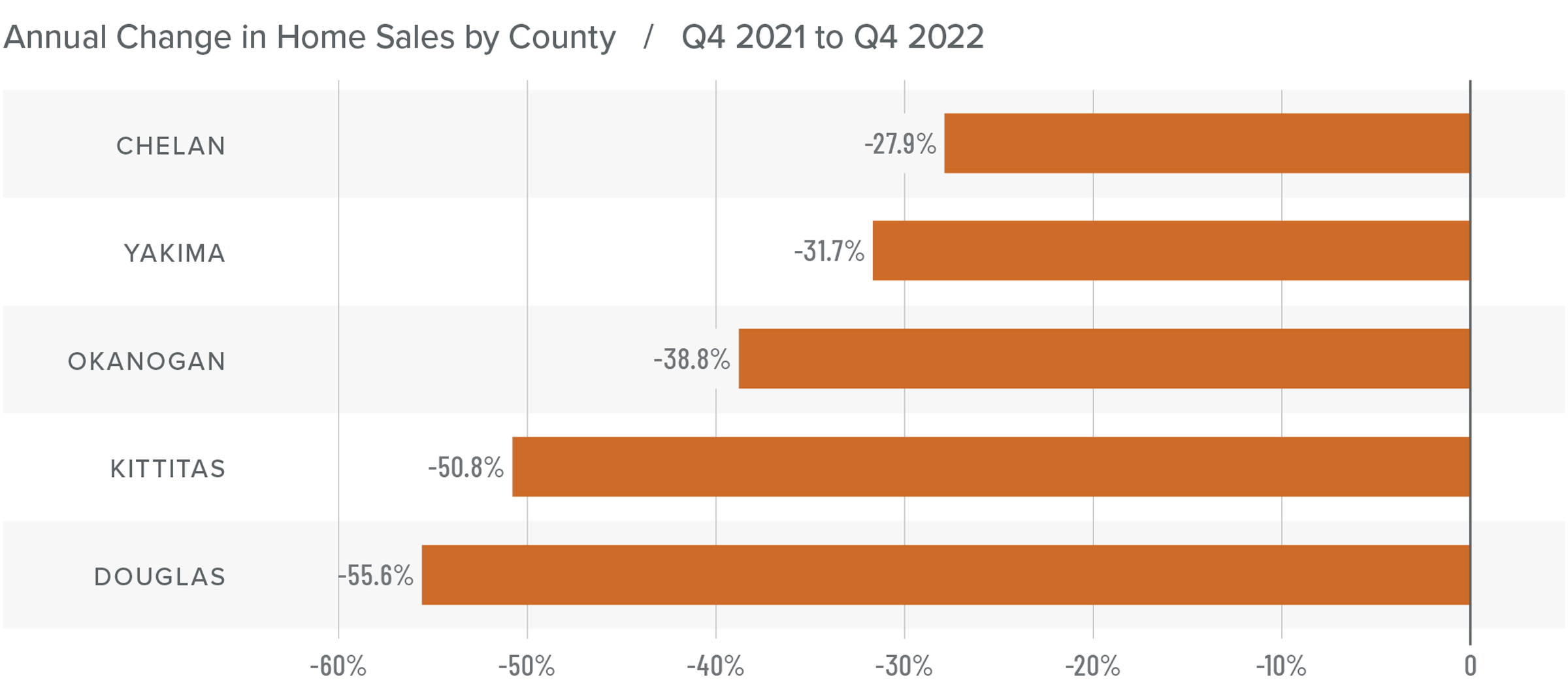
A bar graph showing the annual change in home sales for various counties in Central Washington from Q3 2021 to Q3 2022. All counties have a negative percentage year-over-year change except for Okanogan County at 19.7%. Chelan follows at -3.1%, then it's Yakima at -10.5%, Kittitas -11.4%, and Douglas at -21.1%.

Central Washington Home Prices

The average home price in Central Washington rose 8.1% year over year to $517,069. Prices were down .9% compared to the second quarter of 2022.

Median list prices fell in every county other than Yakima compared to the second quarter of this year. It would seem that sellers are starting to feel the impact that higher mortgage rates are having on home buyers.

Of the markets where prices rose year over year, only Yakima County saw prices rise less than 10%. Prices rose in Chelan and Douglas counties over the second quarter but fell in the rest of the markets.

The third quarter appears to be an inflection point in the market, with the impact of higher financing costs hitting demand and prices.

A map showing the real estate home prices percentage changes for various counties in Central Washington. Different colors correspond to different tiers of percentage change. Okanogan and Douglas County have a percentage change in the -3% to 1.4% range. Yakima is in the 1.5% to 6% change range, Chelan is in the 6.1% to 10.6% range, and Kittitas is in the 15.3%+ range.

A bar graph showing the annual change in home sale prices for various counties in Central Washington from Q3 2021 to Q3 2022. Kittitas County tops the list at 20.2%, followed by Chelan at 10.6%, Yakima at 4.1%, Okanogan at -1.6%, and Douglas at -3%.

Mortgage Rates

This remains an uncertain period for mortgage rates. When the Federal Reserve slowed bond purchases in 2013, investors were accused of having a “taper tantrum,” and we are seeing a similar reaction today. The Fed appears to be content to watch the housing market go through a period of pain as they throw all their tools at reducing inflation.

As a result, mortgage rates are out of sync with treasury yields, which not only continues to push rates much higher, but also creates violent swings in both directions. My current forecast calls for rates to peak in the fourth quarter of this year before starting to slowly pull back. That said, they will remain in the 6% range until the end of 2023.

A bar graph showing the mortgage rates from 2020 to the present, as well as Matthew Gardner's forecasted mortgage rates through Q4 2023. After the 5.62% figure in Q3 2022, he forecasts mortgage rates continuing to climb to 6.7% in Q4 2022, 6.55% in Q1 2023, 6.35% in Q2 2023, 6.15% in Q3 2023, and 5.60% in Q4 2023.

Central Washington Days on Market

The average time it took to sell a home in Central Washington in the third quarter was 37 days.

During third quarter, it took five more days to sell a home in Central Washington than it did a year ago.

Year over year, only Yakima County saw a decline in the average time it took for homes to sell. Although market time rose in the balance of the region, increases were not significant. Compared to the second quarter of 2022, market time also rose in all areas other than Yakima County.

On average, it took five more days to sell a home in the third quarter than it did in the second quarter of this year.

A bar graph showing the average days on market for homes in various counties in Central Washington for Q3 2022. Kittitas County has the lowest DOM at 25, followed by Douglas at 26, Chelan at 29, Okanogan at 42, and Yakima at 63.

Conclusions

This speedometer reflects the state of the region’s real estate market using housing inventory, price gains, home sales, interest rates, and larger economic factors.

With mortgage rates 2.7% higher than a year ago, buyers are no longer accepting the prices that many sellers are asking for. Although rates have been rising at a significant pace for the past several months, buyers hit the brakes in the third quarter. As we move through winter, I expect the market to enter its traditional downtime. I’m hopeful that mortgage rates will stabilize by spring, which should bring out more buyers. That said, mortgage rates are not expected to fall significantly, which will act as a reset when it comes to home values. This may concern some homeowners, but they have seen their home values rise significantly over the past few years, and most have more than enough equity to accept a modest price correction.

A speedometer graph indicating a balanced market, leaning toward a seller's market in Central Washington in Q3 2022.

With market dynamics shifting significantly, I am moving the needle more in favor of buyers. It is not a traditional buyer’s market, but the region is far closer to balance than it has been in quite some time.

About Matthew Gardner

Matthew Gardner - Chief Economist for Windermere Real Estate

As Chief Economist for Windermere Real Estate, Matthew Gardner is responsible for analyzing and interpreting economic data and its impact on the real estate market on both a local and national level. Matthew has over 30 years of professional experience both in the U.S. and U.K.

In addition to his day-to-day responsibilities, Matthew sits on the Washington State Governors Council of Economic Advisors; chairs the Board of Trustees at the Washington Center for Real Estate Research at the University of Washington; and is an Advisory Board Member at the Runstad Center for Real Estate Studies at the University of Washington where he also lectures in real estate economics.

Market News October 31, 2022

Q3 2022 Eastern Washington Real Estate Market Update

The following analysis of select counties of the Eastern Washington real estate market is provided by Windermere Real Estate Chief Economist Matthew Gardner. We hope that this information may assist you with making better-informed real estate decisions. For further information about the housing market in your area, please don’t hesitate to contact your Windermere Real Estate agent.


Regional Economic Overview

Year over year, total employment in Eastern Washington rose by just under 10,000 jobs, which is an annual growth rate of 2.1%. Benton County had the fastest pace of job growth at 3.8%. Also notable were Spokane and Franklin counties, where job growth rose 2.9%. Annually, employment shrank in Whitman and Lincoln counties. Unadjusted for seasonality, the regional unemployment rate was 4.6%; the seasonally adjusted rate was 5%. The highest jobless rate was in Franklin County at 5.3%. The lowest rate was in Walla Walla County at 4%.

Eastern Washington Home Sales

During third quarter, 3,305 homes sold, which was 21.8% lower than a year ago. Transactions fell 4.6% compared to the second quarter of this year.

Listing activity rose 97.2% compared to a year ago and was 74.9% higher than in the second quarter.

Year over year, sales fell across the region. Additionally, sales fell in all the markets covered by this report compared to the second quarter of 2022.

Even with more choice in the market, pending sales fell more than 14%, suggesting that significantly higher mortgage rates are now having an impact on the market.

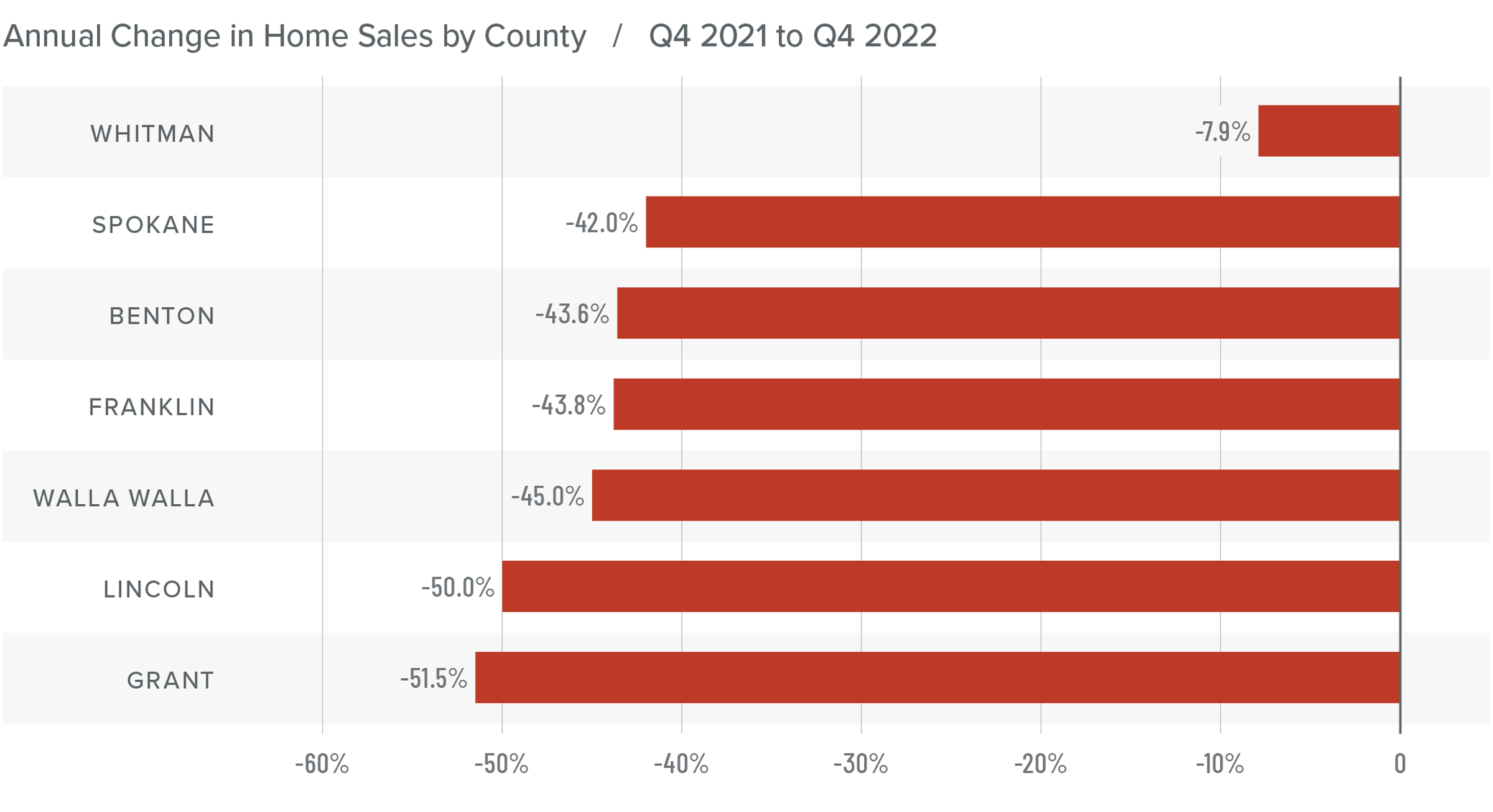
A bar graph showing the annual change in home sales for various counties in Eastern Washington from Q3 2021 to Q3 2022. All counties have a negative percentage year-over-year change. Walla Walla tops the list at -14%, followed by Whitman at -17.5%, Franklin -18.8%, Benton -19.2%, Grant -20.2%, Spokane -23.5%, and Lincoln at -56.1%.

Eastern Washington Home Prices

Year over year, the average home price in Eastern Washington rose 8.8% to $463,324, but average prices were down 2.7% compared to the second quarter.

Compared to the second quarter of 2022, prices fell in all counties except Benton, Lincoln, and Whitman.

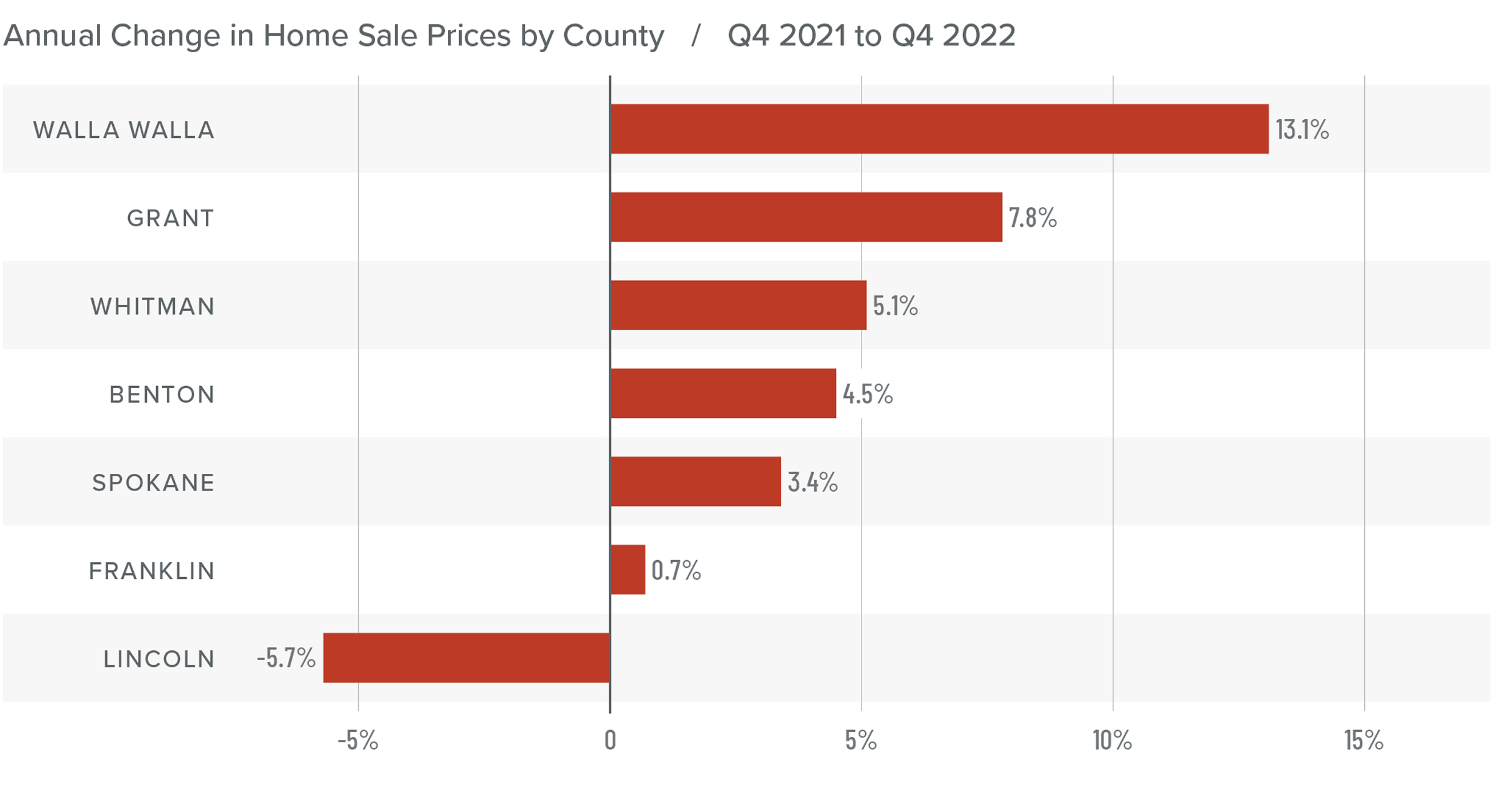
Every county saw average sale prices increase year over year, with significant gains in Whitman, Lincoln, Walla Walla, and Benton counties.

Significantly higher mortgage rates are starting to impact the market, which has led median list prices to drop in Spokane, Franklin, Whitman, and Grant counties compared to the previous quarter.

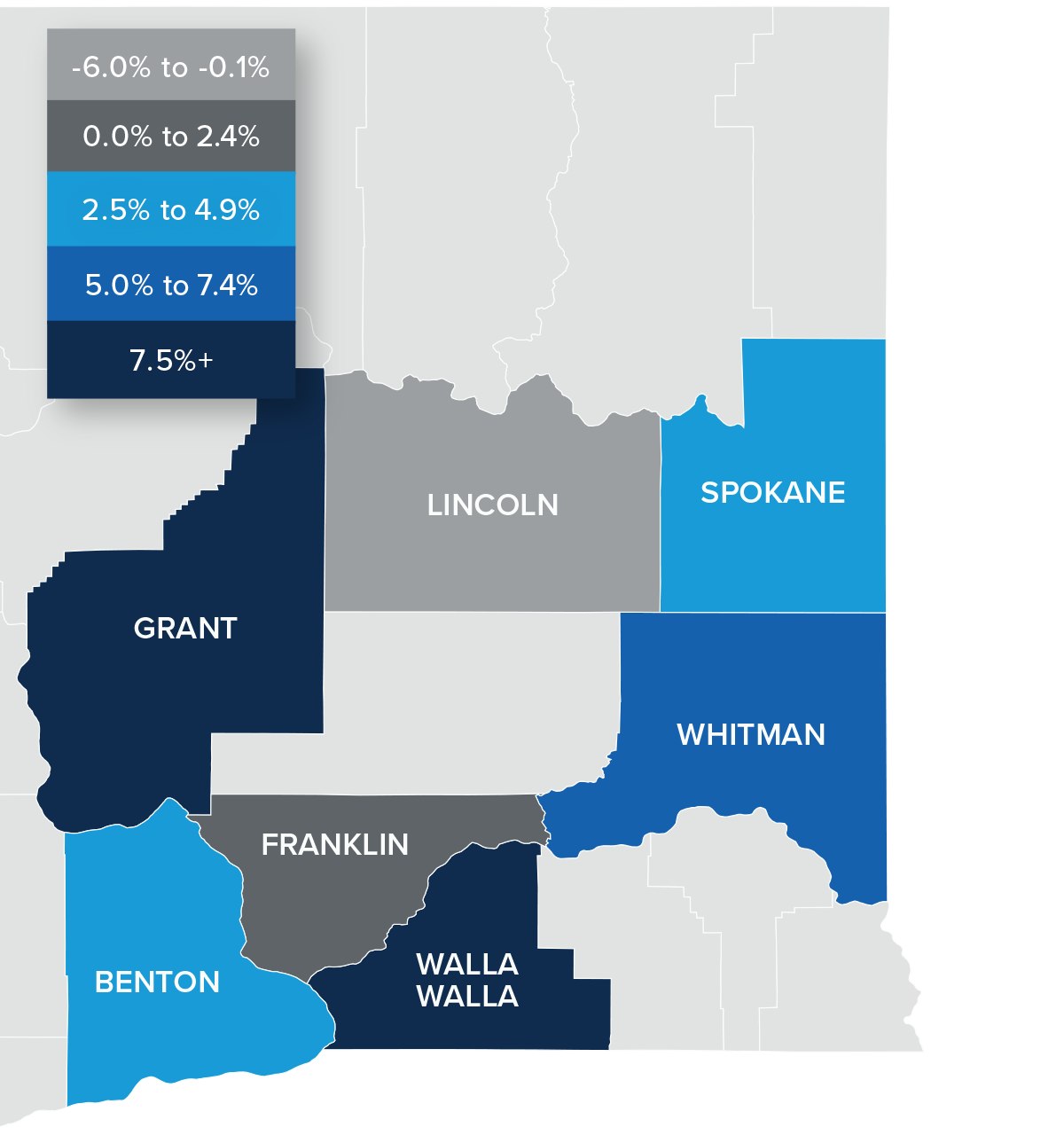
A map showing the real estate home prices percentage changes for various counties in Eastern Washington. Different colors correspond to different tiers of percentage change. Grant, Franklin, and Spokane County have a percentage change in the 7.5% to 9.9% range. Benton is in the 10% to 12.4% change range, Walla Walla is in the 12.5% to 14.9% range, Lincoln is in the 15% to 17.4% range, and Whitman is in the 17.5%+ range.

A bar graph showing the annual change in home sale prices for various counties in Eastern Washington from Q3 2021 to Q3 2022. Whitman County tops the list at 19.7%, followed by Lincoln at 15.4%, Walla Walla at 13.4%, Benton at 10.3%, Franklin at 9.2%, and Spokane and Grant at 7.5%.

Mortgage Rates

This remains an uncertain period for mortgage rates. When the Federal Reserve slowed bond purchases in 2013, investors were accused of having a “taper tantrum,” and we are seeing a similar reaction today. The Fed appears to be content to watch the housing market go through a period of pain as they throw all their tools at reducing inflation.

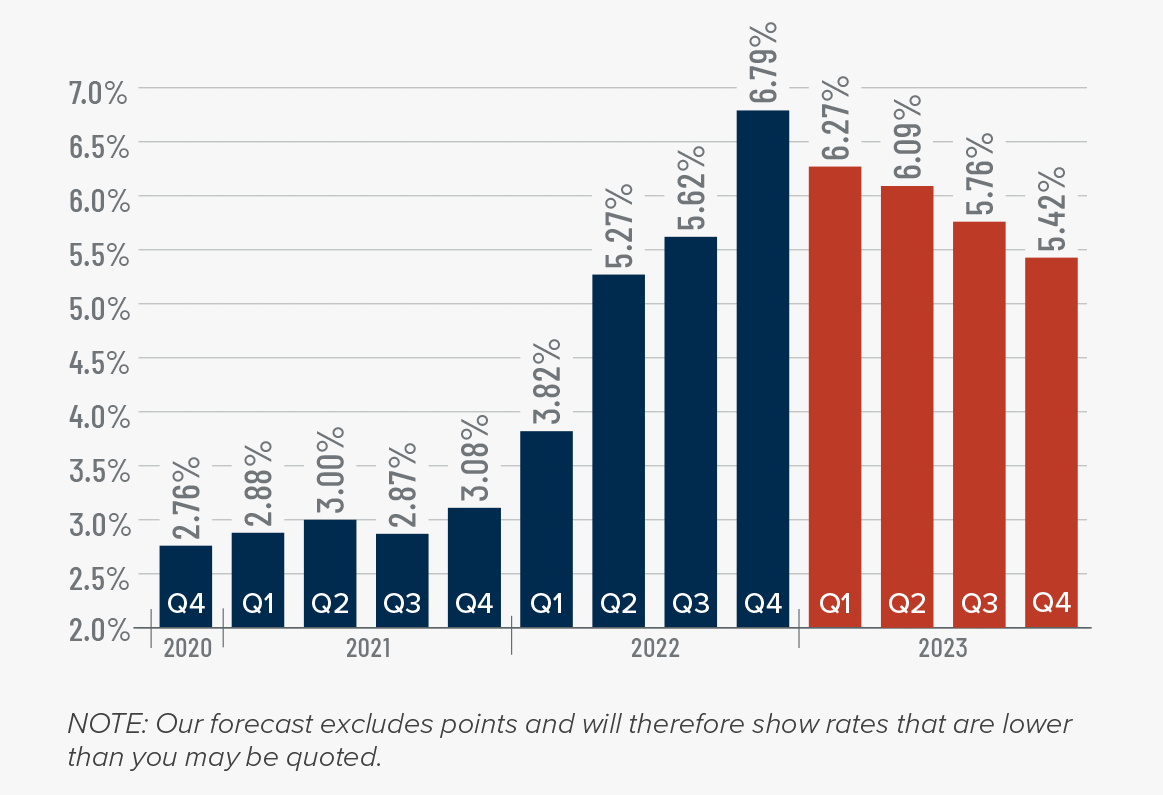
As a result, mortgage rates are out of sync with treasury yields, which not only continues to push rates much higher, but also creates violent swings in both directions. My current forecast calls for rates to peak in the fourth quarter of this year before starting to slowly pull back. That said, they will remain in the 6% range until the end of 2023.

A bar graph showing the mortgage rates from 2020 to the present, as well as Matthew Gardner's forecasted mortgage rates through Q4 2023. After the 5.62% figure in Q3 2022, he forecasts mortgage rates continuing to climb to 6.7% in Q4 2022, 6.55% in Q1 2023, 6.35% in Q2 2023, 6.15% in Q3 2023, and 5.60% in Q4 2023.

Eastern Washington Days on Market

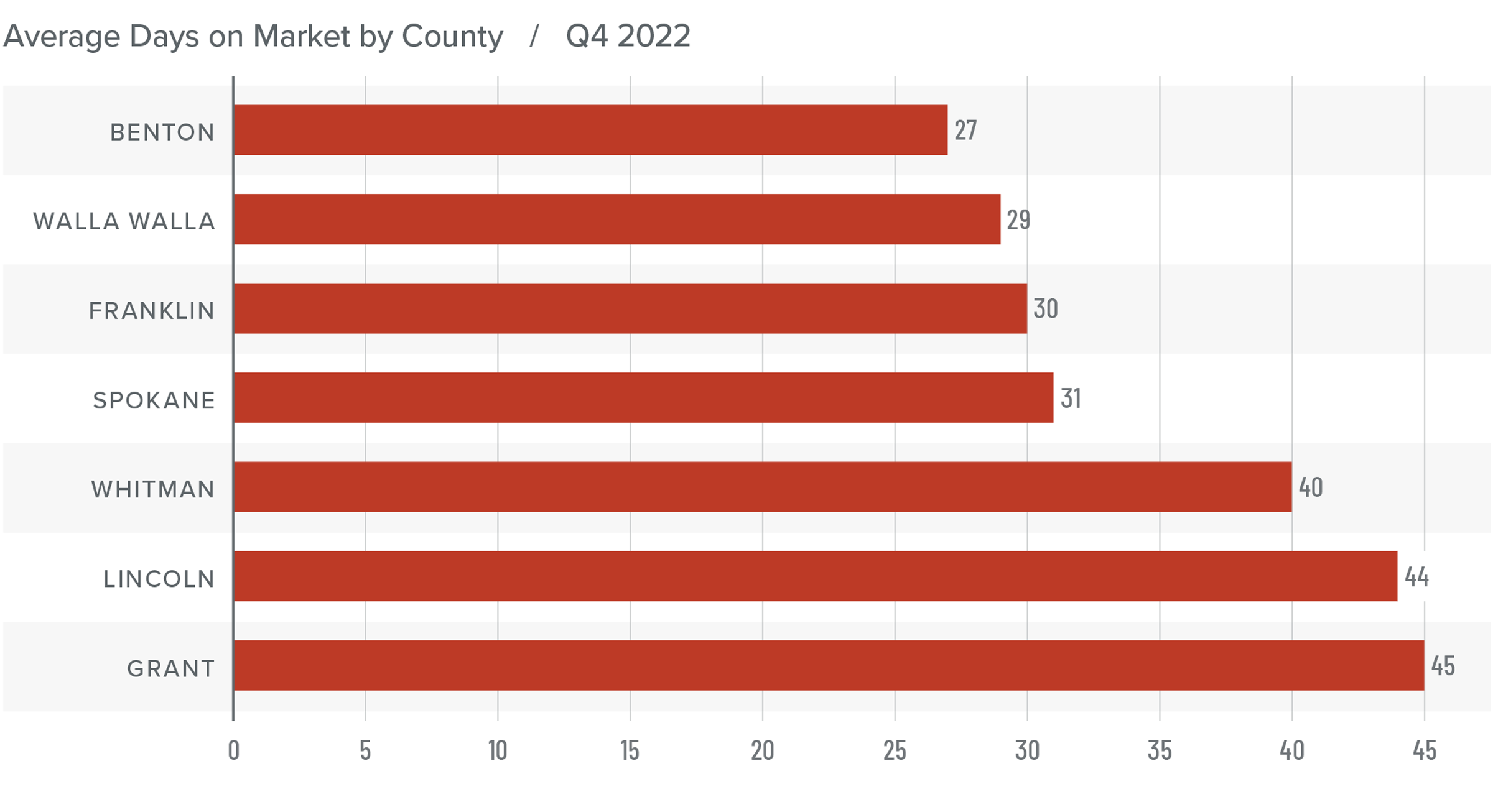
The average time it took to sell a home in Eastern Washington in the third quarter of 2022 was 24 days, which is 9 more days than during the same period a year ago.

Compared to the second quarter of this year, average days on market rose in every county. The regional average rose by 6 days to 24.

All counties saw the average number of days it took for a house to sell rise compared to the third quarter of 2021.

Longer market time can be attributed to more inventory combined with higher financing costs, which have led some buyers to wait for mortgage rates to stabilize and/or for prices to drop further.

A bar graph showing the average days on market for homes in various counties in Eastern Washington for Q3 2022. Spokane County has the lowest DOM at 17, followed by Franklin at 18, Benton at 19, Whitman at 23, Walla Walla at 24, Grant at 26, and Lincoln at 39.

Conclusions

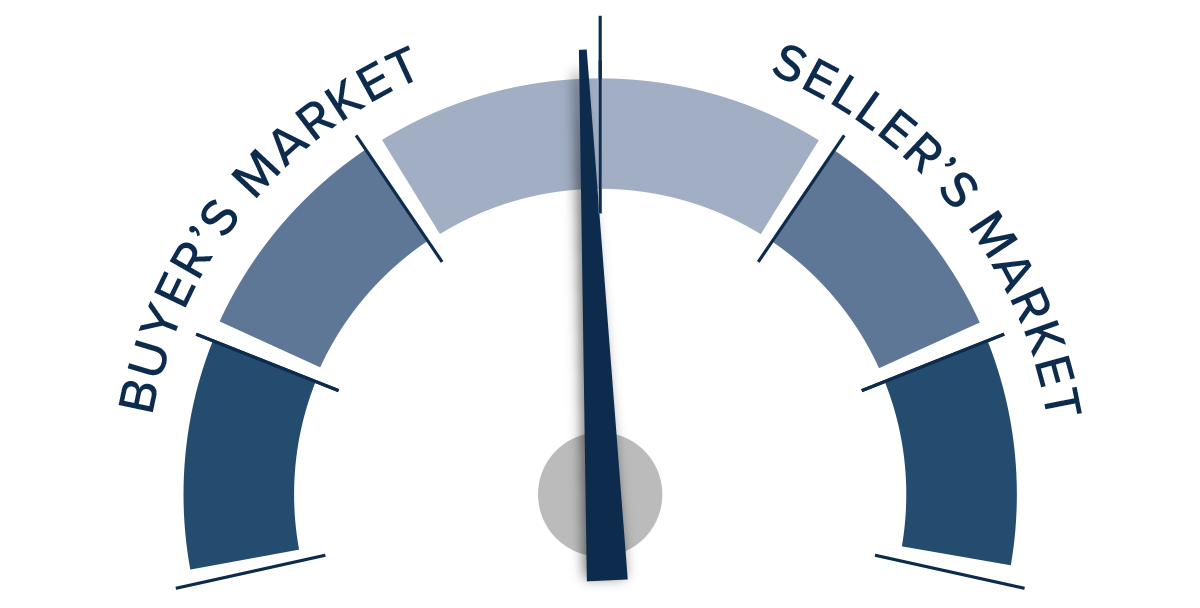
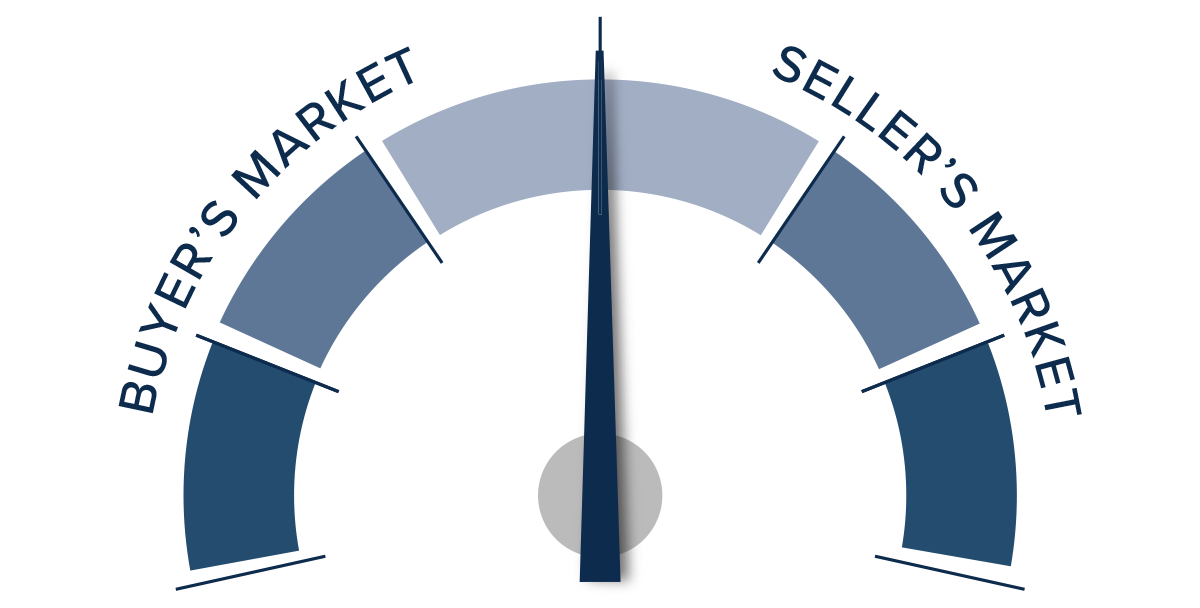
This speedometer reflects the state of the region’s real estate market using housing inventory, price gains, home sales, interest rates, and larger economic factors.

Regionally speaking, the job market continues to expand, which should be a benefit for the housing market. However, with mortgage rates rising more than 2.7% from a year ago, many buyers are now being priced out of the market. The third quarter was an inflection point in which higher financing costs are now acting as a significant headwind. I anticipate that the market will struggle until rates stabilize. Even then, affordability will remain a factor. Ultimately, prices are expected to pull back to account for higher mortgage rates, but I don’t believe there will be any systemic price correction. Rather it will be a reversion that will allow the market to move to a more sustainable pace of price growth.

A speedometer graph indicating a balanced market, verging on a slight seller's market in Eastern Washington in Q3 2022.

As such, I have decided to move the needle more in favor of home buyers as the region heads toward a more balanced market—one we have not seen in quite some time.

About Matthew Gardner

Matthew Gardner - Chief Economist for Windermere Real Estate

As Chief Economist for Windermere Real Estate, Matthew Gardner is responsible for analyzing and interpreting economic data and its impact on the real estate market on both a local and national level. Matthew has over 30 years of professional experience both in the U.S. and U.K.

In addition to his day-to-day responsibilities, Matthew sits on the Washington State Governors Council of Economic Advisors; chairs the Board of Trustees at the Washington Center for Real Estate Research at the University of Washington; and is an Advisory Board Member at the Runstad Center for Real Estate Studies at the University of Washington where he also lectures in real estate economics.