BuyingSelling November 8, 2021

A Quick Guide to Understanding Real Estate Designations

What do those letters and acronyms mean at the end of your real estate agent’s name? We’re here to answer that question and explain why it might matter to you. Like other professionals, real estate agents have the ability to specialize in certain areas of the business by earning designations. Those acronyms signify that they have achieved a specific designation through extensive training and education. In simple terms, designations enable agents to increase their skills, proficiency, and knowledge in various real estate sectors. They can also provide agents with access to members-only marketing tools and resources which can be an added benefit to their clients.  

So why should real estate designations matter to you? Depending on what your specific real estate needs are, certain designations might mean more to you than others. For example, if you are in need of a real estate agent who can help you or your loved ones transition to a senior living facility, you may want to work with a Senior Real Estate Specialist® (SRES®), because they are trained to understand the unique needs of seniors and their families in this type of situation.  Or, perhaps you’re selling your LEED-certified home and you want an agent who specializes in marketing these types of properties, then you may want to work with a Certified Green Real Estate Professional (CG-REP).

The National Association of REALTORS® offers the largest number of professional designations, which are designed to provide real estate agents with specialized training in a variety of areas. Here is a list of those designations and how they benefit real estate consumers.

Real Estate Designations

Accredited Staging Professional (ASP): By increasing a home’s appeal to a higher number of buyers, home staging is commonly considered one of the best ways to sell a property more swiftly and for more money. Agents with an ASP designation understand the art of home staging and use special marketing techniques to increase the market value of a home.   

Senior Real Estate Specialist® (SRES®): If you are considering retiring, downsizing or are trying to help an aging loved one transition to an assisted living facility, an SRES® trained REALTOR is qualified to help support clients over the age of fifty with lifestyle transitions and major financial decisions. This includes knowing what to look for if you prefer to age in place, finding the resources to support a move from movers to financial advisors, and more.

NAR Green Designation (GREEN): If you are looking to buy or sell a LEED Certified home, a GREEN REALTOR will have the expertise to help you. They are trained in sustainable and earth-friendly building trends, energy efficiency, and more.

Accredited Buyers Representative® (ABR®): If you are a first time homebuyer you may want to find an ABR® designated agent. They are specially trained to work with buyers through every step of the home-buyer process from mortgage to closing.  

Accredited Land Consultant (ALC): Land experts have expert knowledge and experience in land auctioning, leasing, development, farm management, land investment analysis, and tax deferment. This type of designation is not needed for a general home purchase, but if you are looking at investment, development, or farming properties, an ALC can help.

Certified Commercial Investment Member (CCIM): Purchasing or leasing space for your business is different than finding a home for yourself or investment property. If you need a commercial space, a certified commercial agent can help you locate this type of property and negotiate the intricacies of the contracts.

Certified International Property Specialists (CIPS):  International real estate can differ greatly from domestic transactions. If you are looking to purchase a home abroad, consider working with an agent who has their CIPS and specializes in international real estate. They can provide tools for understanding the international process, access to a global referral network, and additional international resources.

Certified Property Manager® (CPM®): Managing a rental property can be a complicated, time-consuming process. There are specific laws you have to follow, resident screenings, 24 hour maintenance issues, and more. A CPM® is specially trained to manage your residential or commercial property on your behalf.

Certified Real Estate Brokerage Manager (CRB): Managing a real estate business involves much more than overseeing an office with staff, marketing, and other resource needs. CRBs go through certification and extensive training for supervising a real estate brokerage, with essential business development and management requirements.  

Certified Residential Specialist (CRS): The prestigious CRS designation is awarded to experienced REALTORS who have completed advanced professional training and demonstrated outstanding professional achievement in residential real estate. This designation signifies one of the highest levels of success a REALTOR can achieve.

Seller Representative Specialist (SRS): Sometimes referred to as a “listing agent”, there are agents who specialize in working specifically with sellers. These agents have special training in all areas of the home selling process, providing increased professional standards and marketing expertise.

Real Estate Certifications

Military Relocation Professional Certificate (MRP): If you are a military service member or are relocating on behalf of the military, an MRP is specifically trained to address your relocation needs.  They can help you navigate through the financial process because they are aware of the benefits available to service members and can address the unique relocation needs of military clients.

Resort & Second-Home Property Specialist Certification (RSPS): If you have a destination property, consider working with a RSPS certified agent to manage the buying, selling, or management process. They have training specific to managing investment, retirement, resort, and vacation destination properties.

Short Sale & Foreclosure Resource® (SFR®): Short sales are different than typical home sales because they deal directly with financial institutions. SFR® certified agents are experienced at negotiating these types of transactions and are trained to work with finance, tax and legal professionals on behalf of distressed sellers.

Go here for a complete list of designations: Realtor® Designations and Certifications

To connect with an experienced Windermere agent today, click the button below to get started: 

Market News November 5, 2021

Q3 2021 Maui, Hawaii Real Estate Market Update

The following analysis of select Maui real estate markets is provided by Windermere Real Estate Chief Economist Matthew Gardner. We hope that this information may assist you with making better-informed real estate decisions. For further information about the housing market in your area, please don’t hesitate to contact your Windermere Real Estate agent.


Regional Economic Overview

Maui’s employment picture continued to improve in the third quarter, but the pace of the job recovery has slowed. This is likely due to the governor’s announcement discouraging tourists from visiting as COVID-19 cases in the state started to rise again. In total, Maui only grew by 600 jobs in the third quarter, down from 3,200 jobs that were added in the second quarter. At the end of the third quarter, Maui had recovered 12,400 of the 28,900 jobs that were lost due to COVID-19. With employment levels still down 16,500 jobs from the pre-pandemic peak, there is still work to be done. New cases have started to slow, which may lead to stronger job growth in the final quarter of this year, but we will not see a full job recovery until 2022. Maui’s unemployment rate remained elevated in September, with 8.1% of the workforce still without jobs. However, this is considerably better than the 32.9% rate of last April. The state unemployment rate was 6.6% in September, down from 7.7% at the end of the second quarter.

maui, hawaii Home Sales

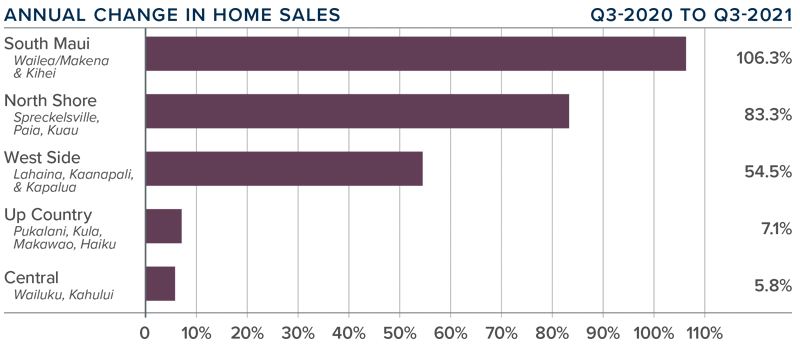
❱ In the third quarter of 2021, 729 homes sold, a significant increase of 49.7% compared to a year ago. However, as COVID-19 was taking hold at this time last year, this comparison is not informative. Compared to the second quarter of this year, sales fell 17.1%.

❱ Year-over-year, sales rose across the board, with significant growth in South Maui, North Shore, and the West Side. Sales fell in all areas other than the Central area compared to the second quarter of 2021.

❱ The average number of homes for sale in the quarter was down 19.5% compared to the second quarter of 2021. Fewer listings would explain the drop in sales between second and third quarter.

❱ Pending home sales dropped 14.4% compared to the previous quarter, suggesting that closings in the final quarter of the year may not show growth.

A bar graph showing the annual change in home sales for various areas of Maui, Hawaii during the third quarter of 2021.

maui, hawaii Home Prices

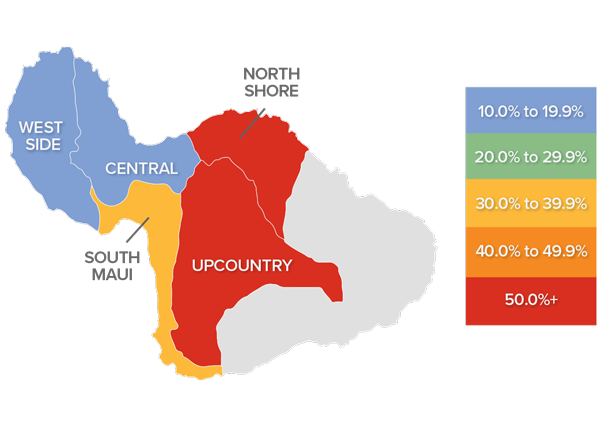
A map showing the real estate market percentage changes in various areas of Maui, Hawaii during the third quarter of 2021.

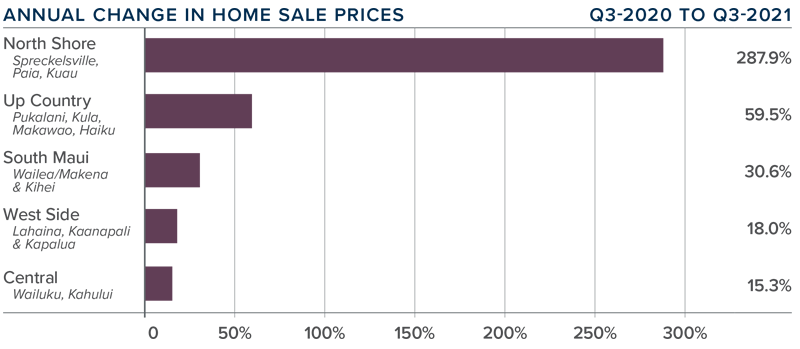
❱ Average home prices on Maui rose 37.8% year over year to $1.419 million. Prices were 2.9% higher than in the second quarter of 2021.

❱ Affordability issues persist and, thanks to favorable financing rates and persistently low levels of inventory, I still think the island will continue to see price appreciation. However, the rate of growth is steadily slowing.

❱ All markets saw sale prices rise, but the massive increase in the North Shore area is a little deceiving. With only ten sales in the entire quarter, the increase of 287% was an anomaly. Compared to the second quarter, prices rose in all markets other than the Central area, but the drop there was minimal (-.4%).

❱ Limited listing inventory and solid demand have continued to push prices higher but, as I suggested in last quarter’s Gardner Report, the pace of price growth is unsustainable. I said then I expected to see a modest slowing in price appreciation, which appears to be the case.

A bar graph showing the annual change in home sale prices for various areas of Maui, Hawaii during the third quarter of 2021.

Days on Market

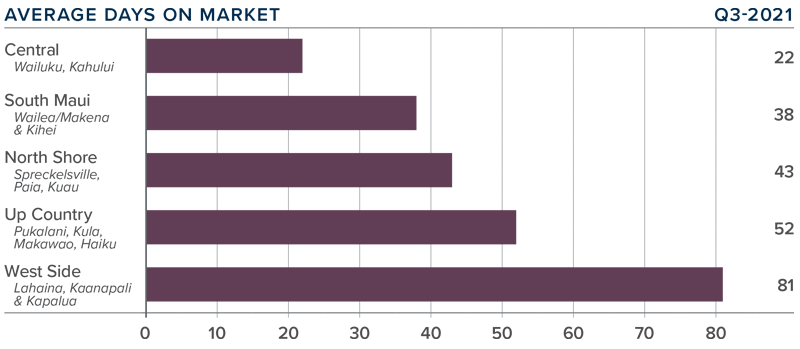
❱ The average number of days it took to sell a home on Maui dropped six days compared to the third quarter of 2020.

❱ The length of time it took to sell a home dropped year over year in the South Maui, Central, and Up Country market areas, but rose in West Side and the North Shore.

❱ In the third quarter, it took an average of 47 days to sell a home, with transactions occurring the fastest in the Central area and slowest on the West Side.

❱ Compared to the second quarter of 2021, market time dropped in the North Shore and Up Country areas but rose in the balance of the markets contained in this report.

A bar graph showing the average days on market for homes in various areas of Maui, Hawaii during the third quarter of 2021.

Conclusions

A speedometer graph indicating a seller's market in Maui, Hawaii during the third quarter of 2021.

This speedometer reflects the state of the region’s real estate market using housing inventory, price gains, home sales, interest rates, and larger economic factors.

The number of homes for sale on Maui remains low. This has driven prices up and days on market down—both of which favor homes sellers. In addition to this, low mortgage rates are a stimulant to buying, especially if buyers believe rates will rise (which they have started to do). On the other hand, lower sales may lead sellers to list their homes more competitively to attract buyers, and this, naturally, favors home buyers.

Inventory levels are unlikely to rise significantly anytime soon, and while I expect price growth to continue slowing, it remains a seller’s market. The pendulum may start to move more toward buyers, but not yet. As such, I have left the needle in the same spot as in the second quarter of the year.

About Matthew Gardner

Matthew Gardner - Chief Economist for Windermere Real Estate

As Chief Economist for Windermere Real Estate, Matthew Gardner is responsible for analyzing and interpreting economic data and its impact on the real estate market on both a local and national level. Matthew has over 30 years of professional experience both in the U.S. and U.K.

In addition to his day-to-day responsibilities, Matthew sits on the Washington State Governors Council of Economic Advisors; chairs the Board of Trustees at the Washington Center for Real Estate Research at the University of Washington; and is an Advisory Board Member at the Runstad Center for Real Estate Studies at the University of Washington where he also lectures in real estate economics.

Market News November 5, 2021

Q3 2021 Big Island of Hawaii Real Estate Market Update

The following analysis of the Big Island real estate market is provided by Windermere Real Estate Chief Economist Matthew Gardner. We hope that this information may assist you with making better-informed real estate decisions. For further information about the housing market in your area, please don’t hesitate to contact your Windermere Real Estate agent.


Regional Economic Overview

Job recovery on the Big Island remains stalled, with employment levels down 100 jobs from the end of the second quarter, but still up 4,823 versus a year ago. This is likely a function of the governor’s announcement discouraging tourists from visiting as COVID-19 cases in the state started to rise again. At the end of the third quarter, Hawaii County had recovered 6,574 of the more than 17,000 jobs that were lost due to COVID-19. With employment levels still down more than 10,600 from the pre-pandemic peak, there is much work to be done. New COVID-19 cases have started to slow, which may allow for more robust job growth in the final quarter of this year, but we likely will not see a full job recovery until 2022 at the earliest. The unemployment rate on the Big Island remained elevated in September, with 6.3% of the workforce still without jobs, but this is still considerably better than the 22% rate in April of last year. The state unemployment rate was 6.6% in September, down from 7.7% at the end of the second quarter.

big island of hawaii Home Sales

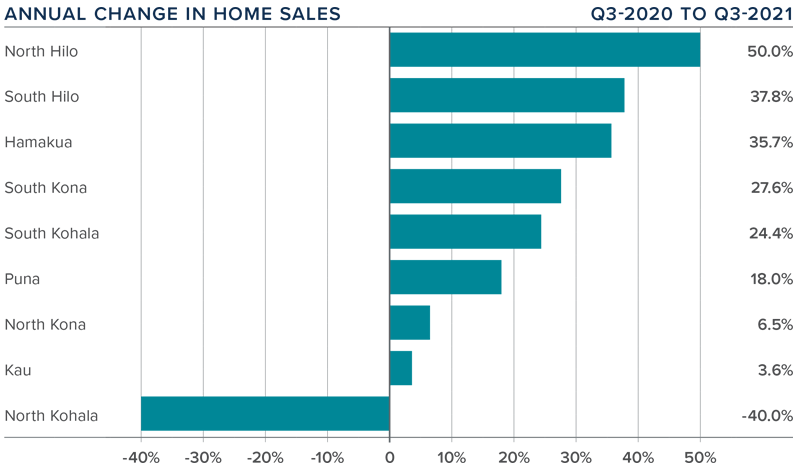
❱ In the third quarter, 1,037 homes were sold on the Big Island. This was an increase of 15.7% from the same quarter a year ago, but 12.8% lower than in the second quarter of this year.

❱ Year-over-year, sales rose in all areas other than North Kohala, but this is a very small area that can see significant swings. Also of note was that six of the remaining eight markets saw sales rise by double digits compared to a year ago. When comparing second and third quarters, sales rose in all areas other than North and South Kohala, North Kona, and Kau.

❱ It’s noteworthy that sales pulled back even as the number of homes rose. The average number of homes on the market in the third quarter was 3.2% higher than in the second quarter, suggesting that some of the heat may be coming off the market.

❱ Pending home sales fell 13.9% compared to the second quarter of the year, which may lead total sales to drop modestly in the final quarter of the year.

A bar graph showing the annual change in home sales for various counties on the Big Island of Hawaii during the third quarter of 2021.

big island of hawaii Home Prices

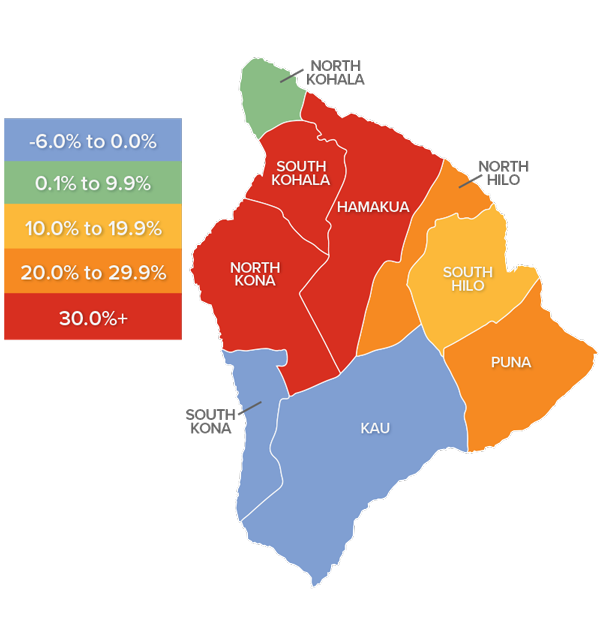
A map showing the real estate market percentage changes in various counties on the Big Island of Hawaii during the third quarter of 2021.

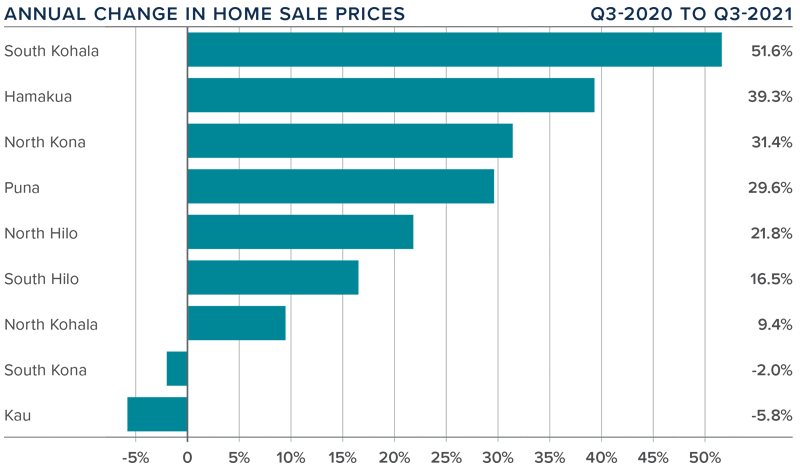
❱ The average home price on the Island rose a solid 29.1% year over year to $810,810, but prices fell 8.4% compared to the second quarter of 2021.

❱ Versus the second quarter, sale prices were up in Puna, South Hilo, Hamakua, and South Kohala but lower in all the other areas.

❱ Prices rose by double digits in six of the market areas covered by this report but fell in South Kona and Kau.

❱ I mentioned in the second quarter Gardner Report that I was seeing price growth showing some signs of strain, which appears to have been an accurate statement.

A bar graph showing the annual change in home sale prices for various counties on the Big Island of Hawaii during the third quarter of 2021.

Days on Market

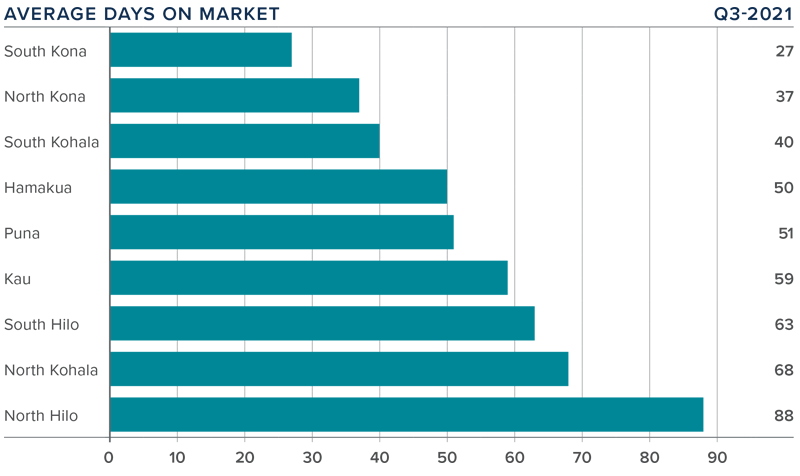
❱ The average time it took to sell a home on the Big Island dropped 52 days compared to the third quarter of 2020.

❱ The amount of time it took to sell a home dropped across the board compared to a year ago.

❱ It took an average of 54 days to sell a home, with the fastest sales occurring in South Kona and the slowest in North Hilo.

❱ It took 24 fewer days to sell a home in the third quarter of 2021 than it did in the second, with all markets showing market time dropping.

A bar graph showing the average days on market for home in various counties on the Big Island of Hawaii during the third quarter of 2021.

Conclusions

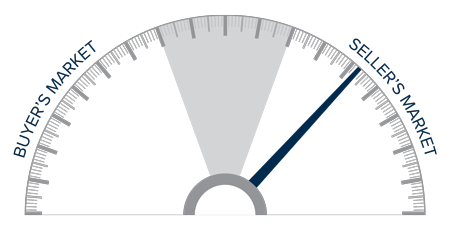
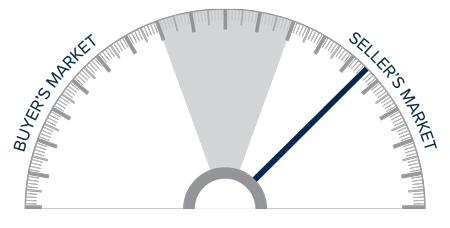
A speedometer graph indicating a seller's market on the Big Island of Hawaii during the third quarter of 2021.

This speedometer reflects the state of the region’s real estate market using housing inventory, price gains, home sales, interest rates, and larger economic factors.

The number of homes for sale ticked higher, while both sales and prices ticked lower—all of which favor home buyers. That said, market time dropped, and interest rates remain very low, which favors home sellers. If inventory levels continue to trend higher, this may further impact prices and make the market more competitive for sellers. As such, I have moved the needle a little more toward buyers but overall, it remains a seller’s market.

About Matthew Gardner

Matthew Gardner - Chief Economist for Windermere Real Estate

As Chief Economist for Windermere Real Estate, Matthew Gardner is responsible for analyzing and interpreting economic data and its impact on the real estate market on both a local and national level. Matthew has over 30 years of professional experience both in the U.S. and U.K.

In addition to his day-to-day responsibilities, Matthew sits on the Washington State Governors Council of Economic Advisors; chairs the Board of Trustees at the Washington Center for Real Estate Research at the University of Washington; and is an Advisory Board Member at the Runstad Center for Real Estate Studies at the University of Washington where he also lectures in real estate economics.

Market News November 4, 2021

Q3 2021 Nevada Real Estate Market Update

The following analysis of the greater Las Vegas real estate market is provided by Windermere Real Estate Chief Economist Matthew Gardner. We hope that this information may assist you with making better-informed real estate decisions. For further information about the housing market in your area, please don’t hesitate to contact your Windermere Real Estate agent.


Regional Economic Overview

The Las Vegas economy continues to recover following the major loss of jobs that resulted from the pandemic. Over the past three months, the area returned a respectable 23,300 jobs of which almost half were in the hard-hit Leisure and Hospitality industry. Although jobs are returning at a fairly decent pace, it is worth noting that the current employment level is still down 89,000 jobs from the peak prior to COVID-19. The unemployment level in Las Vegas has dropped to 8.2%, significantly lower than the pandemic peak of 33.3%, and I am optimistic the area will return to full employment by the end of next summer.

nevada Home Sales

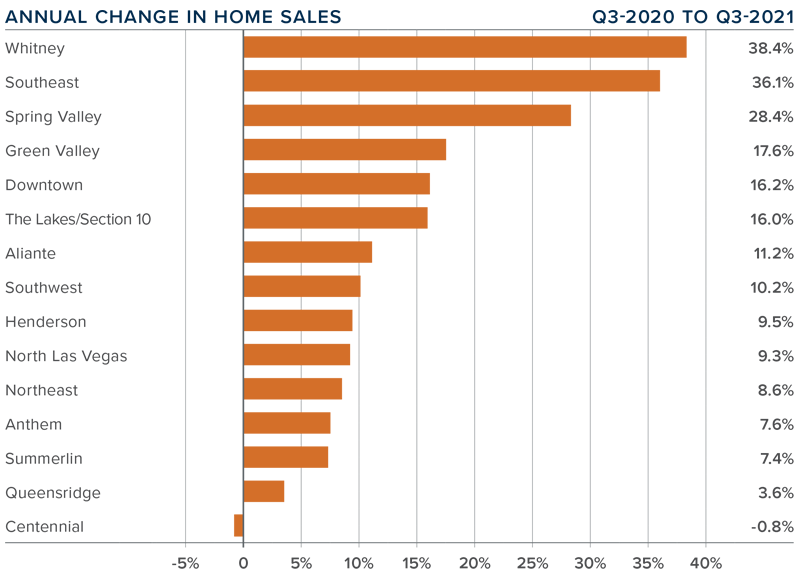
❱ A total of 10,690 homes sold in the third quarter, which was an increase of 12.3% compared to the same period a year ago. Sales were 4.9% lower than during the second quarter.

❱ Pending sales, which are an indicator of future closings, fell 4.5% compared to the second quarter of the year.

❱ Sales rose in every neighborhood other than Centennial, but the drop there was minor. Transactions rose the most in the Whitney and Southeast Las Vegas market areas, but six additional neighborhoods also experienced double-digit growth.

❱ The drop in pending sales may be a function of rising inventory levels which are giving buyers more choice and allowing them to take more time deciding which home they want to buy.

A bar graph showing the annual change in home sales in various sections of the Greater Las Vegas, Nevada area during the third quarter of 2021.

nevada Home Prices

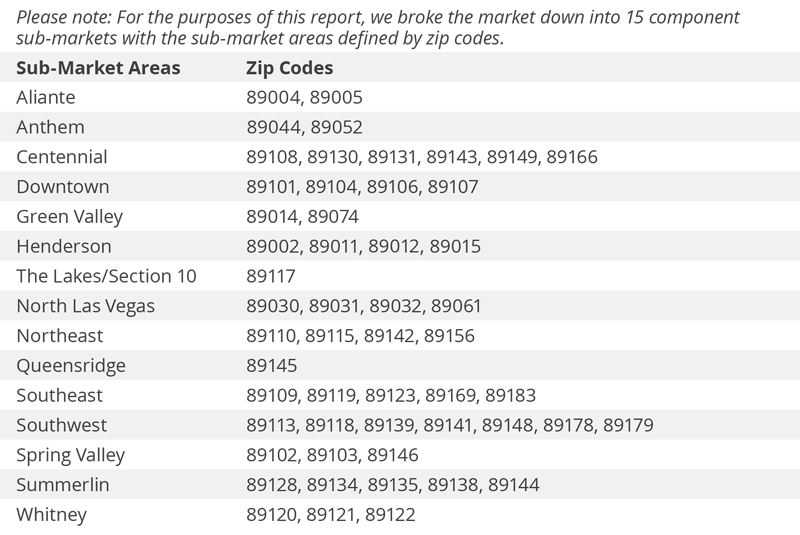
A chart showing the sub-market areas and their corresponding zip codes in the greater Las Vegas area.

❱ Home prices rose 20.7% from a year ago to an average of $438,994. Prices were also 2.3% higher than in the second quarter of this year. The rise of prices over the past few years is certainly impacting affordability, which is the lowest it has been since 2018.

❱ Mortgage rates remain competitive, which is causing prices to continue trending higher even as affordability constraints emerge.

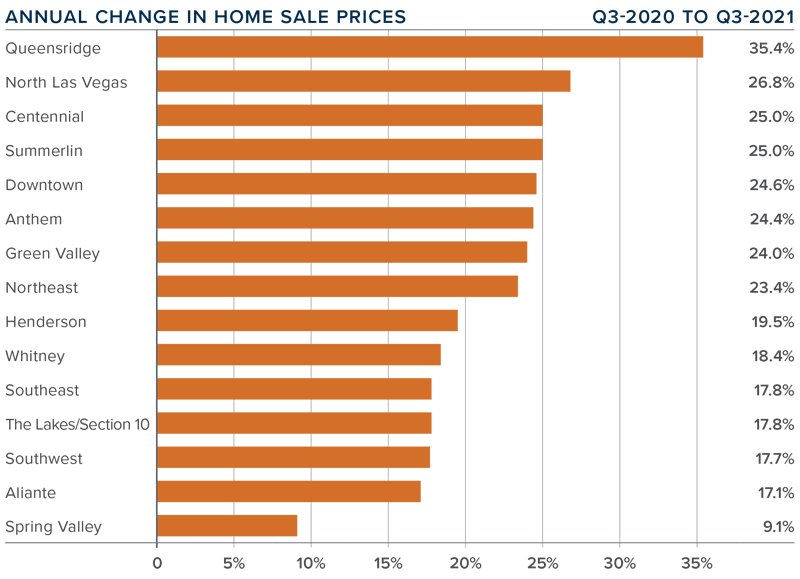
❱ Prices rose by double digits in every sub-market other than Spring Valley compared to the same quarter last year. Compared to the second quarter of this year, prices were also higher in every area other than Anthem and Henderson.

❱ Although the economy is improving, affordability will act as a headwind to significant price growth moving forward. When mortgage rates start to tick higher, this too will have a slowing effect on the pace of appreciation.

A bar graph showing the annual change in home sale prices in various sections of the Greater Las Vegas, Nevada area during the third quarter of 2021.

Days on Market

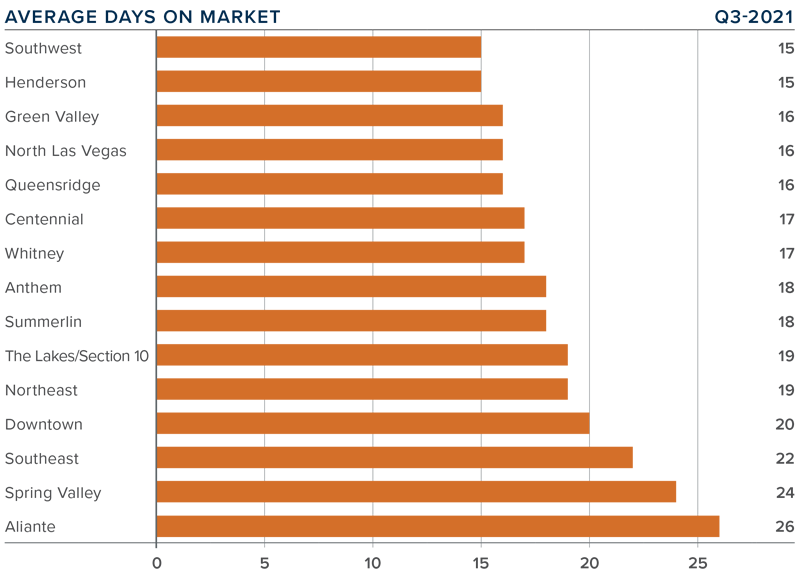
❱ The average time it took to sell a home in the region fell 24 days compared to the third quarter of 2020.

❱ It took an average of 18 days to sell a home in the third quarter, which was 4 fewer days than in the second quarter of 2021.

❱ Days on market dropped across the board compared to a year ago, and all areas other than Anthem and Queensridge saw market time fall compared to the second quarter of this year.

❱ The greatest drop in market time was in the Aliante market, where the length of time it took to sell a home fell 43 days compared to a year ago.

A bar graph showing the average days on market for homes in various sections of the Greater Las Vegas, Nevada area during the third quarter of 2021.

Conclusions

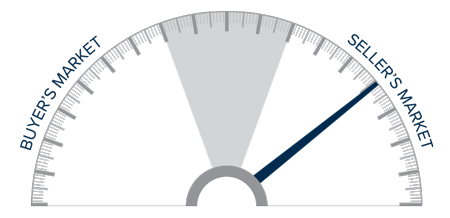
A speedometer graph indicating a seller's market in the Greater Las Vegas, Nevada area during the third quarter of 2021.

This speedometer reflects the state of the region’s real estate market using housing inventory, price gains, home sales, interest rates, and larger economic factors.

Jobs in Las Vegas continue to recover, and this should be a stimulant to the housing market. However, higher inventory levels combined with slower sales tells me that we need to look at the impact of rising home prices. Listing prices shot up earlier this year but levelled off and then dropped during the summer. This suggests that sellers realized there is a limit to what their homes are really worth.

As a result, the market may have lost some momentum, but it’s nothing more than a move back to a more realistic pace of home-price appreciation. All things considered, with rising inventory levels and slower price growth, I am moving the needle a little toward buyers. However, it remains a seller’s market.

About Matthew Gardner

Matthew Gardner - Chief Economist for Windermere Real Estate

As Chief Economist for Windermere Real Estate, Matthew Gardner is responsible for analyzing and interpreting economic data and its impact on the real estate market on both a local and national level. Matthew has over 30 years of professional experience both in the U.S. and U.K.

In addition to his day-to-day responsibilities, Matthew sits on the Washington State Governors Council of Economic Advisors; chairs the Board of Trustees at the Washington Center for Real Estate Research at the University of Washington; and is an Advisory Board Member at the Runstad Center for Real Estate Studies at the University of Washington where he also lectures in real estate economics.

Market News November 4, 2021

Q3 2021 Northern California Real Estate Market Update

The following analysis of the Northern California real estate market is provided by Windermere Real Estate Chief Economist Matthew Gardner. We hope that this information may assist you with making better-informed real estate decisions. For further information about the housing market in your area, please don’t hesitate to contact your Windermere Real Estate agent.


Regional Economic Overview

The job recovery in Northern California appears to have stalled out, which is likely because of rising COVID-19 cases. That said, total employment has grown by 144,100 jobs compared to a year ago, and 292,500 of the jobs that were lost during the height of the pandemic have now been recovered. Even with slower growth in employment, the region’s unemployment rate was 5.9% in August (the most recent data available). This is lower than in June and July, but still up from the May level of 5.5%. By county, the lowest jobless rate was in Santa Clara County (4.8%), and the highest rate was in Solano County, where 7.3% of the workforce remains unemployed. There tends to be a lag between decreases in COVID-19 infection rates and potential increases in employment. Given that new cases started to slow in late August—coupled with the expiration of enhanced unemployment benefits—I am optimistic that job recovery will pick back up as we move into the winter months.

northern california Home Sales

❱ In the third quarter of 2021, 16,579 homes sold, a modest increase of 1.6% year over year, but down .2% from the second quarter of 2021. I’m not surprised to see sales rising only negligibly when compared to last year’s pandemic-induced surge of demand, but I am a little concerned that they didn’t increase between second and third quarter.

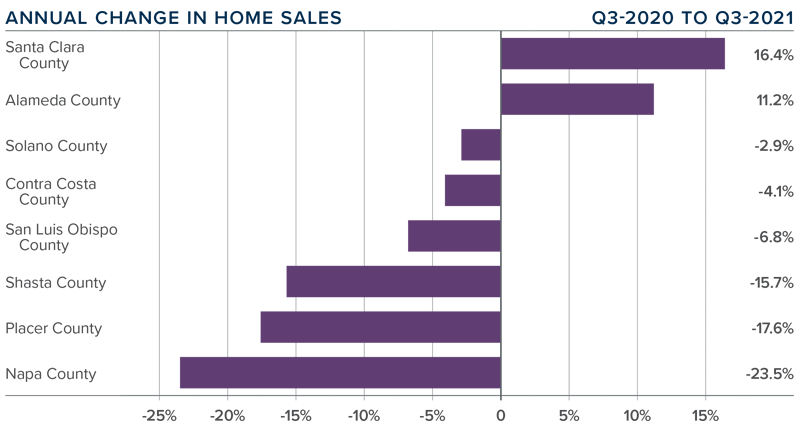
❱ Year-over-year, sales rose in Santa Clara and Alameda counties, but pulled back in the rest of the region. Compared to the second quarter, sales rose in Placer and Solano counties but were lower everywhere else.

❱ Listing activity rose more than 5.1% relative to the second quarter of this year, which made the contraction in sales all the more surprising.

❱ Pending home sales were also modestly lower, suggesting that the market may not see significant improvement in sales this winter.

A bar graph showing the annual change in home sales for various counties in Northern California during the third quarter of 2021.

northern california Home Prices

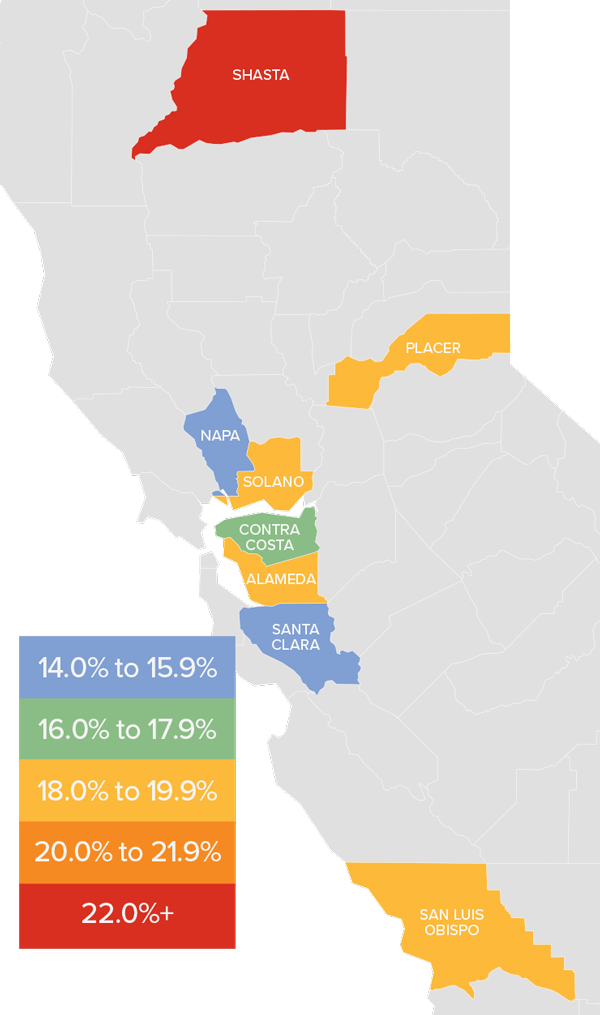
A map showing the real estate market percentage changes in various counties in Northern California during the third quarter of 2021.

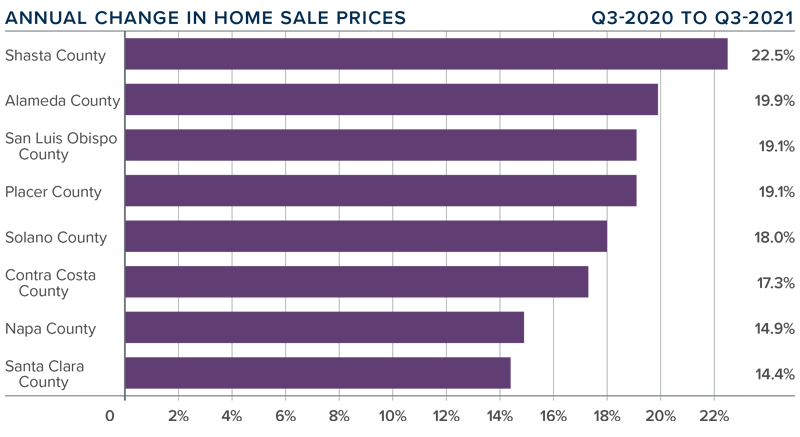
❱ The average home price in the Northern California counties contained in this report rose 20.7% year over year to $1.194 million.

❱ The most affordable counties relative to average sale prices continue to be Shasta and Solano. Santa Clara held its position as the most expensive market.

❱ Average prices in all counties rose by double digits compared to a year ago, but fell in Alameda, Contra Costa, Placer, and San Luis Obispo counties compared to the second quarter of this year.

❱ In terms of price growth, the regional housing market continues to cool and greater inventory levels will add to this slowing. Affordability is also a significant limiter when it comes to rising prices.

A bar graph showing the annual change in home sale prices for various counties in Northern California during the third quarter of 2021.

Days on Market

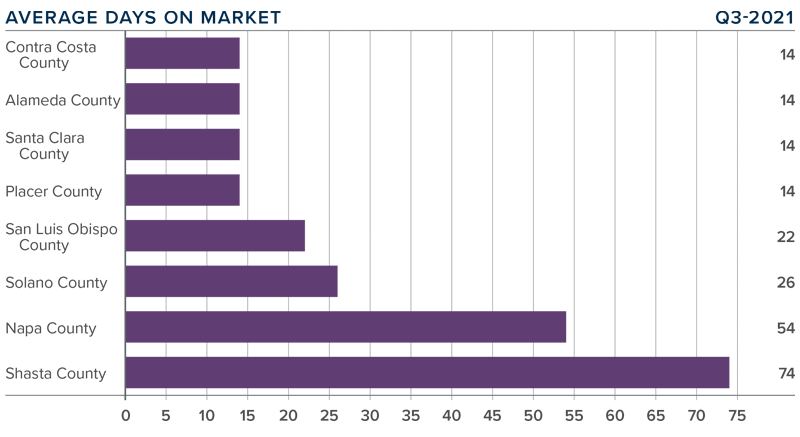
❱ The average time it took to sell a home in the Northern California counties in this report dropped 16 days compared to the third quarter of 2020.

❱ The amount of time it took to sell a home dropped in every county compared to last year. Market time was also lower in all counties other than Santa Clara (+1 day) and Shasta (+4 days) compared to the second quarter of this year.

❱ In the third quarter, it took an average of 29 days to sell a home, which was 1 day longer than it took during the prior quarter.

❱ The greatest drop in market time was in San Luis Obispo County, where it took 29 fewer days to sell a home than in the third quarter of 2020.

A bar graph showing the average days on market for homes in various counties in Northern California during the third quarter of 2021.

Conclusions

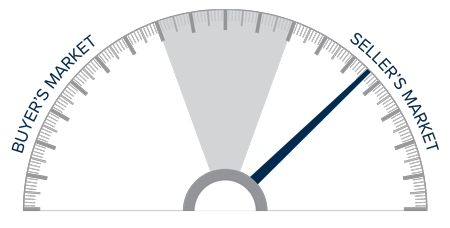
A speedometer graph indicating a seller's market in Northern California during the third quarter of 2021.

This speedometer reflects the state of the region’s real estate market using housing inventory, price gains, home sales, interest rates, and larger economic factors.

Inventory levels are rising, sales are slowing, and prices are pulling back. All of these factors, combined with low mortgage rates, should favor home buyers, but it’s a little premature to suggest the market is shifting in their favor. If COVID rates continue to drop, it will be interesting to see if more buyers resume their search for a new home. Given the factors above, I have moved the needle a little more towards buyers. That said, it remains a seller’s market.

About Matthew Gardner

Matthew Gardner - Chief Economist for Windermere Real Estate

As Chief Economist for Windermere Real Estate, Matthew Gardner is responsible for analyzing and interpreting economic data and its impact on the real estate market on both a local and national level. Matthew has over 30 years of professional experience both in the U.S. and U.K.

In addition to his day-to-day responsibilities, Matthew sits on the Washington State Governors Council of Economic Advisors; chairs the Board of Trustees at the Washington Center for Real Estate Research at the University of Washington; and is an Advisory Board Member at the Runstad Center for Real Estate Studies at the University of Washington where he also lectures in real estate economics.

Design November 3, 2021

What is a Cottage Home?

Cottages are not only one of the most recognizable and beloved home design styles in history, but they’ve also managed to become synonymous with all things cozy, comfortable, and peaceful in home life. When we think of cottages, we think of grassy knolls in the countryside, moss-covered rooftops, and a steady billow of smoke pouring out the chimney of a small dwelling. Known for their simple design and comfortable accommodations, they remain popular today.

History of the Cottage Home

Commonly found in rural or semi-rural areas, what we know today as ‘cottages’ housed English farmers—or ‘cotters’—as far back as the Middle Ages. Simple in design, their small, compact footprint made for intimate living conditions for the families that inhabited them. They became increasingly more common in the countryside, but as time went on and the style made its way to the United States, their popularity began to spread. They became so popular, in fact, that in the early 1900s, Sears and Roebuck sold ready-made kits to homebuyers in their mail order catalog. Nowadays, cottages are found around the world, both in city settings and the countryside.


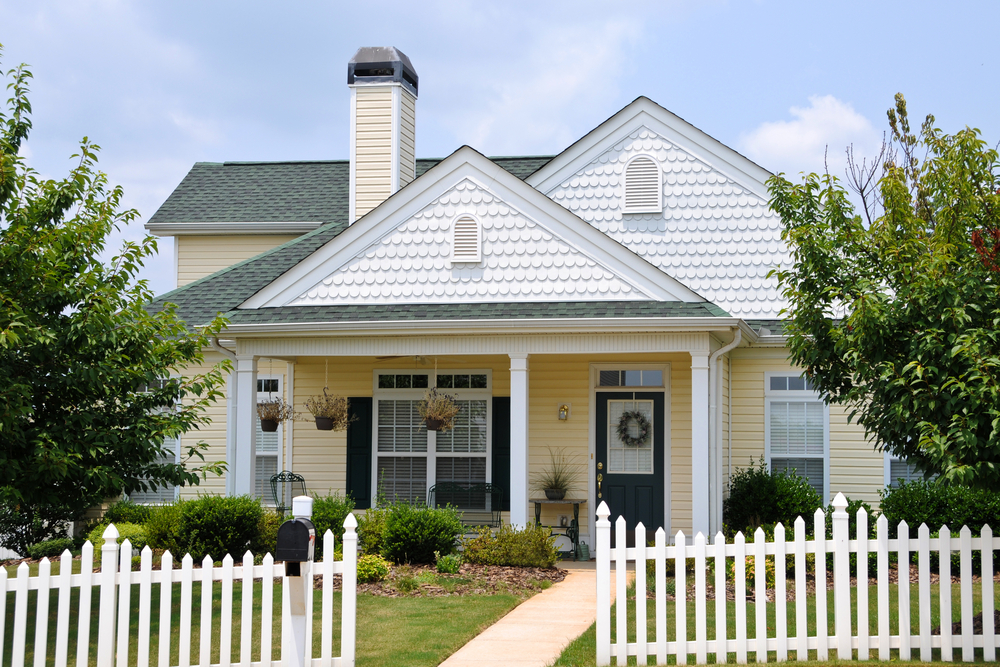
A yellow Cottage style house with a white picket fence in the front yard.

Image Source: Shutterstock – Image Credit: Mark Winfrey
What is a Cottage Home?

Cottages are known for their distinct architectural style. They are small homes, intended to house a single family. Cottages are typically asymmetrical, one to one-and-a-half story dwellings with low-pitched gable roofs and small covered porches. The chimney is often a central feature of the interior living space, a feature that greatly contributes to that cozy charm they are known for. The cottage represents an important evolution in home design, as they are often considered the precursor to the Craftsman home.

Head to our Architectural Styles page to learn more about the history and characteristics of various home designs, from A-Frame to Victorian.

Market News November 3, 2021

Q3 2021 Park City, Utah Real Estate Market Update

The following analysis of select neighborhoods in the Park City real estate market is provided by Windermere Real Estate Chief Economist Matthew Gardner. We hope that this information may assist you with making better-informed real estate decisions. For further information about the housing market in your area, please don’t hesitate to contact your Windermere Real Estate agent.


Regional Economic Overview

The summer months saw continued growth in Utah’s labor market, which had already recovered all of the jobs lost to COVID-19 earlier this spring. The latest data available (August 2021) showed non-agricultural employment 48,100 jobs higher than the pre-pandemic peak. With the healthy growth in jobs, the unemployment rate currently stands at 2.6%, a level that has not been seen since before the pandemic hit. As impressive as the current jobless rate is, it is also worth noting that unemployment continued to fall even as the labor force expanded to a point never seen in the state before. Utah’s economy is currently in great shape, and short of any unforeseeable events, I see no reason why anything would derail the impressive growth the area has experienced.

park city, utah Home Sales

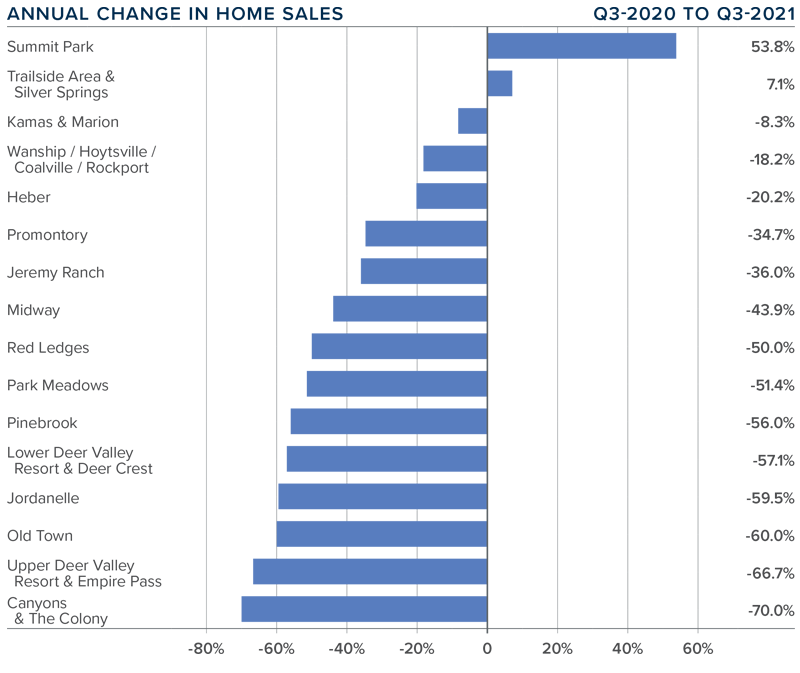
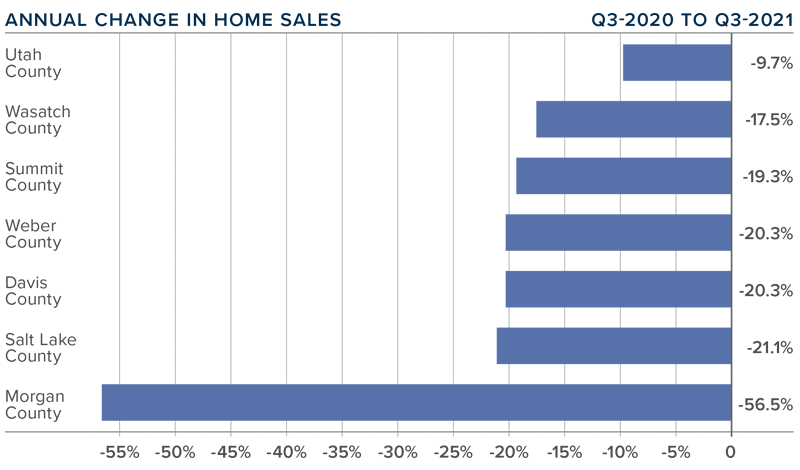
❱ In the third quarter of 2021, 73 homes sold, which is 47.9% lower than in the same quarter a year ago, and 3.9% lower than in the second quarter of this year.

❱ Year-over-year, sales rose in Summit Park and Trailside Area/Silver Springs but were lower in the balance of the neighborhoods contained in this report. Compared to the second quarter of 2021, sales were higher in six neighborhoods, static in one, and fell in the remaining eight.

❱ Lower home sales are primarily a function of the number of homes for sale. With 48% fewer homes on the market than a year ago and 3.9% fewer homes than in the second quarter of this year, it’s not surprising that sales slowed.

❱ Pending home sales were down 58.7% compared to last year and were 2.6% lower than in the second quarter of the year. This, combined with significant supply constraints, suggests that home sales in final quarter of the year may not be strong.

A bar graph showing the annual change in home sales for various areas of Park City, Utah during the third quarter of 2021.

park city, utah Home Prices

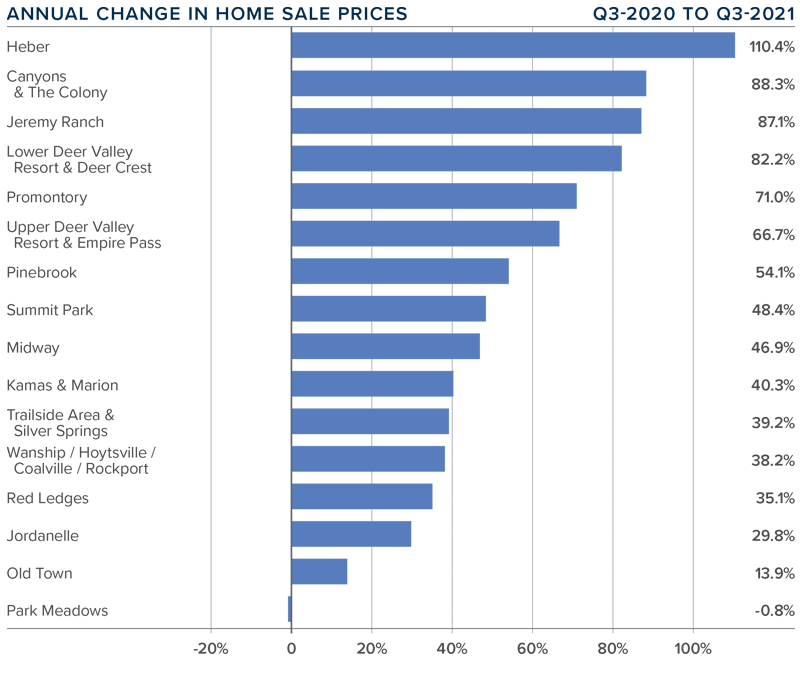
❱ The average home price in the Park City neighborhoods contained in this report rose 29.7% year over year to $2.26 million but was 3.6% lower than in the previous quarter.

❱ The Wanship, Hoytsville, Coalville, & Rockport market is the only one where prices were below $1 million in third quarter. The most expensive home sales were again in the Canyons/The Colony market, where the average price was $11.83 million.

❱ Prices rose in all neighborhoods other than Park Meadows, though the drop in prices there was marginal.

❱ Compared to the second quarter of the year, prices rose in all but four neighborhoods: Old Town, Park Meadows, Midway, and Wanship, Hoytsville, Coalville and Rockport.

A bar graph showing the annual change in home sale prices for various areas of Park City, Utah during the third quarter of 2021.

Days on Market

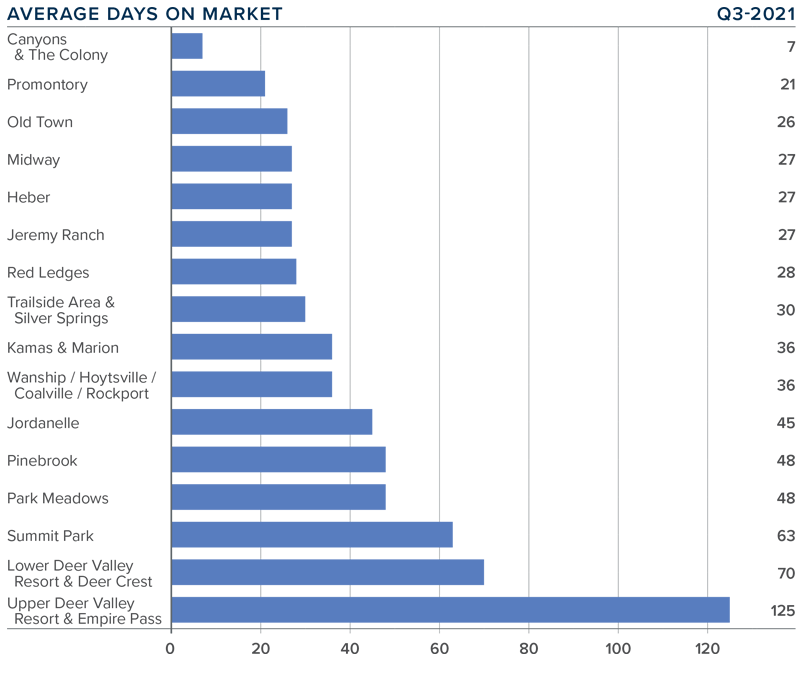
❱ The average time it took to sell a home in the Park City area fell 41 days compared to the same period a year ago.

❱ While days on market fell overall year-over-year, when you compare the third quarter to the second quarter, the amount of time it took to sell a home rose four days everywhere except Canyons/The Colony and Old Town.

❱ In the third quarter, it took an average of 41 days to sell a home, with homes selling fastest in the Canyons/The Colony neighborhood, and slowest in Upper Deer Valley Resort and Empire Pass.

❱ In small, expensive markets, such as those in Park City, it’s not surprising to see the speed at which homes sell swing wildly from one quarter to the next. There is clearly still buyer demand, but given high average prices, it’s taking a little longer for homes to sell.

A bar graph showing the average days on market for homes in various areas of Park City, Utah during the third quarter of 2021.

Conclusions

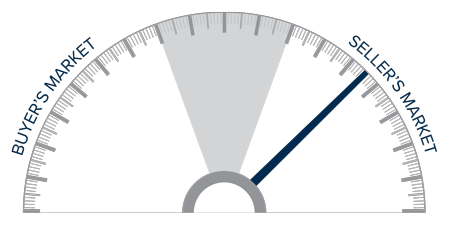
A speedometer graph indicating a seller's market in the Park City, Utah area during the third quarter of 2021.

This speedometer reflects the state of the region’s real estate market using housing inventory, price gains, home sales, interest rates, and larger economic factors.

Utah’s economy stands on very solid ground, which, when placed alongside historically low mortgage rates, leads to increased home buying activity. While the number of days it takes to sell a home has risen modestly compared to second quarter, home sellers still have the upper hand. As such, I have moved the needle a little more in their favor.

About Matthew Gardner

Matthew Gardner - Chief Economist for Windermere Real Estate

As Chief Economist for Windermere Real Estate, Matthew Gardner is responsible for analyzing and interpreting economic data and its impact on the real estate market on both a local and national level. Matthew has over 30 years of professional experience both in the U.S. and U.K.

In addition to his day-to-day responsibilities, Matthew sits on the Washington State Governors Council of Economic Advisors; chairs the Board of Trustees at the Washington Center for Real Estate Research at the University of Washington; and is an Advisory Board Member at the Runstad Center for Real Estate Studies at the University of Washington where he also lectures in real estate economics.

Market News November 3, 2021

Q3 2021 Utah Real Estate Market Update

The following analysis of select counties of the Utah real estate market is provided by Windermere Real Estate Chief Economist Matthew Gardner. We hope that this information may assist you with making better-informed real estate decisions. For further information about the housing market in your area, please don’t hesitate to contact your Windermere Real Estate agent.


Regional Economic Overview

The summer months saw continued growth in Utah’s labor market, which had already recovered all of the jobs lost to COVID-19 earlier this spring. The latest data available (August 2021) showed non-agricultural employment 48,100 jobs higher than the pre-pandemic peak. With the healthy growth in jobs, the unemployment rate currently stands at 2.6%, a level that has not been seen since before the pandemic hit. As impressive as the current jobless rate is, it is also worth noting that unemployment continued to fall even as the labor force expanded to a point never seen in the state before. Utah’s economy is currently in great shape, and short of any unforeseeable events, I see no reason why anything would derail the impressive growth the area has experienced.

utah Home Sales

❱ In the third quarter of 2021, 10,356 homes were sold, representing an 18.3% drop from a year ago. This is not really a concern given that during third quarter last year the area was in the midst of a COVID-induced housing boom, which is skewing the numbers. What is more informative was that sales rose 6.9% from the previous quarter.

❱ Year-over-year, sales dropped across the board. However, compared to the prior quarter they rose in all counties other than Salt Lake and Morgan—though the drop in both counties was only seven sales.

❱ The increase in sales compared to the previous quarter was aided by a significant increase in the number of listings in the counties contained in this report, which jumped more than 36% from the second quarter of this year.

❱ Pending sales, an indicator of future closings, were up in all markets other than Salt Lake. The 2.8% increase from the second quarter suggests that sales in the final quarter of the year may continue to show improvement.

A bar graph showing the annual change in home sales for various counties in Utah during the third quarter of 2021.

utah Home Prices

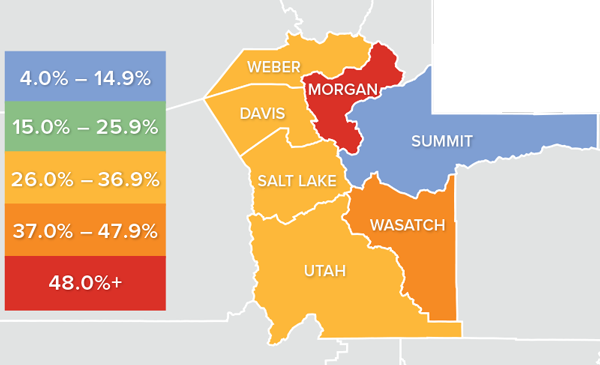
A map showing the real estate market percentage changes in various counties in Utah during the third quarter of 2021.

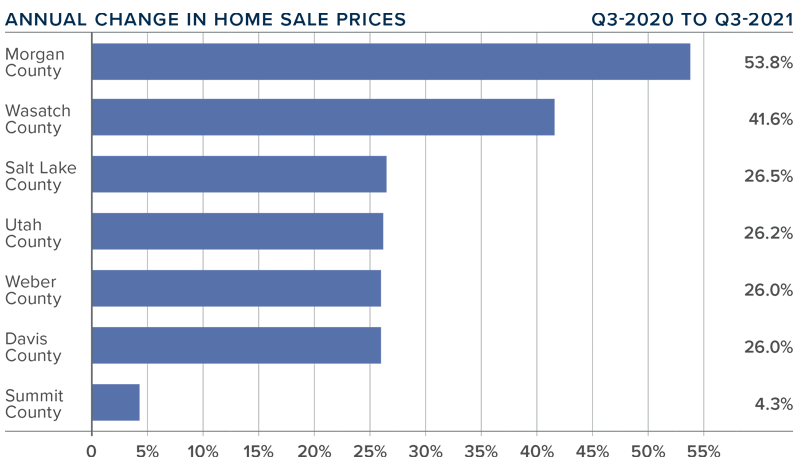
❱ With the economy performing extremely well, and mortgage rates holding close to their historic lows, it was not surprising to see sale prices continue to trend higher. Compared to a year ago, prices were up 23.8% to an average of $600,715. Prices also came in 3.8% higher than in the second quarter of this year.

❱ Although Summit County appears to be underperforming, it is worth noting that it is the most expensive county in this report, with an average price in the third quarter of $1.58 million. I am not particularly concerned at the decline since it is likely to be short-lived.

❱ All counties contained in the report except Summit saw prices increase by double-digits relative to a year ago. All counties but Summit also saw impressive gains compared to the previous quarter.

❱ In the second quarter Gardner Report, I suggested that the annual change in home prices was going to soften, which proved accurate. Although price growth remains well above the long-term average, I expect to see the pace of growth continue to slow as we close out the year.

A bar graph showing the annual change in home sale prices for various counties in Utah during the third quarter of 2021.

Days on Market

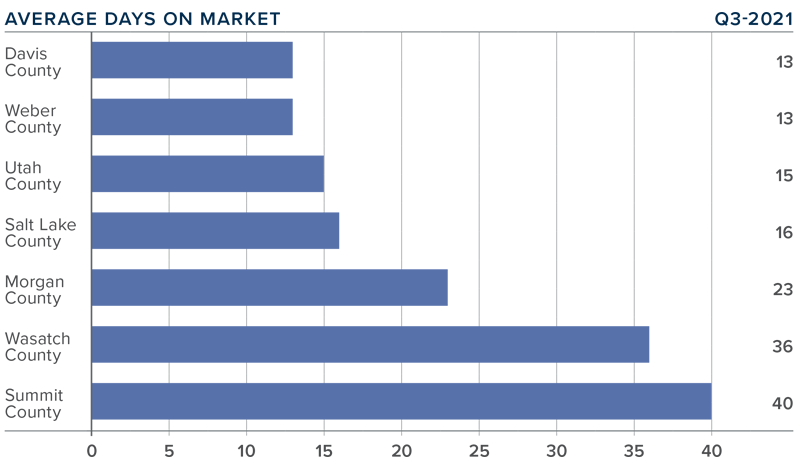
❱ The average number of days it took to sell a home in the counties covered by this report dropped 21 days compared to the third quarter of 2020.

❱ Homes again sold fastest in Davis County, which was one of only two counties with average sale time below two weeks. Relative to a year ago, the greatest drop in market time was in Summit County, where it took 41 fewer days to sell a home.

❱ During the quarter, it took an average of 22 days to sell a home in the region. Although this is lower than a year ago, it was up 3 days compared to the second quarter of this year.

❱ Rising inventory levels led to more choice in the market, which put slight upward pressure on market time. This is not a concern, and though it might please home buyers, we are still far from a balanced housing market.

A bar graph showing the average days on market for homes in various counties in Utah during the third quarter of 2021.

Conclusions

A speedometer graph indicating a seller's market in Utah during the third quarter of 2021.

This speedometer reflects the state of the region’s real estate market using housing inventory, price gains, home sales, interest rates, and larger economic factors.

Utah’s economy stands on very solid ground. A stable economy and historically low mortgage rates are very stimulative to home buyers. Even though we have seen inventory levels grow and market time rise modestly—both of which favor home buyers—the data in aggregate is still heavily in favor of home sellers. As such, I have moved the needle a little more in their favor.

About Matthew Gardner

Matthew Gardner - Chief Economist for Windermere Real Estate

As Chief Economist for Windermere Real Estate, Matthew Gardner is responsible for analyzing and interpreting economic data and its impact on the real estate market on both a local and national level. Matthew has over 30 years of professional experience both in the U.S. and U.K.

In addition to his day-to-day responsibilities, Matthew sits on the Washington State Governors Council of Economic Advisors; chairs the Board of Trustees at the Washington Center for Real Estate Research at the University of Washington; and is an Advisory Board Member at the Runstad Center for Real Estate Studies at the University of Washington where he also lectures in real estate economics.

Market News November 2, 2021

Q3 2021 Idaho Real Estate Market Update

The following analysis of select counties of the Idaho real estate market is provided by Windermere Real Estate Chief Economist Matthew Gardner. We hope that this information may assist you with making better-informed real estate decisions. For further information about the housing market in your area, please don’t hesitate to contact your Windermere Real Estate agent.


Regional Economic Overview

On top of having recovered all the jobs lost to COVID-19 by the end of 2020—a remarkable feat in itself—the Idaho economy continues to strengthen. Current employment levels are up by 15,400 jobs from the pre-pandemic peak. With the labor market continuing to expand, the unemployment rate was 2.9% in August (the most recent data available). Equally impressive was that the rate dropped even as the labor force grew—no easy task. New COVID-19 cases remain higher than I would like, but this does not appear to have impacted the state’s economy to any significant degree given the robust employment picture. As we move, hopefully, toward a time when the impacts of the pandemic wane further, I see nothing but an upward trajectory for the state’s economy.

idaho Home Sales

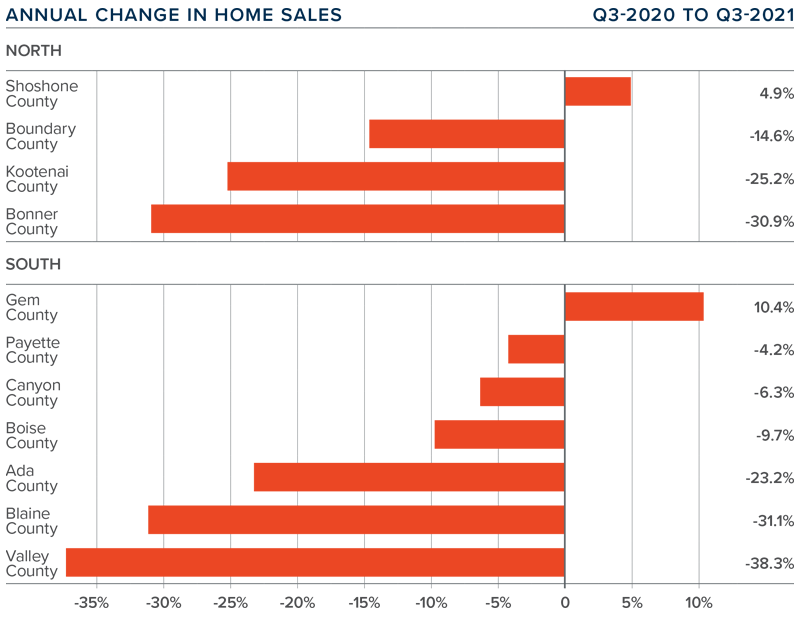
❱ In the third quarter, 7,354 existing homes sold, representing a drop of 19.9% from a year ago. However, given that the country was experiencing a massive housing rebound following the outbreak of COVID-19, any comparison with data from 12 months ago is not very informative. More useful is that sales rose 22.1% compared to the second quarter of 2021.

❱ As mentioned, comparing current data to a year ago does not provide an accurate picture, but comparing it with the second quarter data shows sales higher across the board. Sales were up by double digits in every county covered by this report.

❱ Year-over-year sales improved in Shoshone County in Northern Idaho. Sales also rose in Gem County in the southern part of the state.

❱ Pending sales rose 16.5% from the second quarter of 2021, suggesting that closed sales in the final quarter of the year are also likely to show improvement from current levels. This is also supported by the fact that listing inventory has risen almost 36%. I predict more listings will lead to more sales.

A bar graph showing the annual change in home sales in various counties in North and South Idaho during the third quarter of 2021.

idaho Home Prices

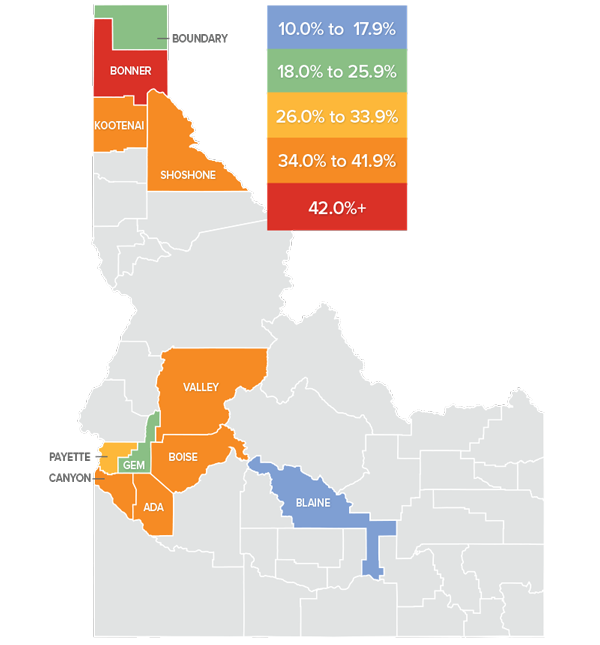
A map showing the real estate market percentage changes in various counties in Idaho during the third quarter of 2021.

❱ The average home price in the region rose 30.9% year over year to $603,066. Prices were also up 8% compared to the second quarter of this year.

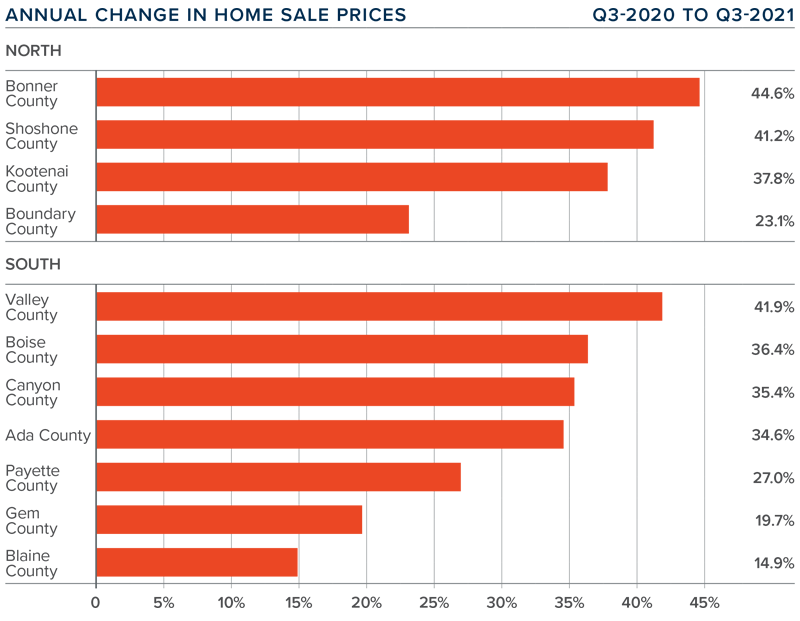
❱ Compared to the previous quarter, home prices were up 8.9% in both the northern and southern counties in this report. Sizable gains were seen in Shoshone County (+33.7%) and Bonner County (+22.7%) in the north, and Valley County (+22.6%) and Blaine County (+17.2%) in the south.

❱ Prices rose by double-digits across the board. Sale prices were up 37% in the North Idaho counties covered by this report, and up 27.7% in the southern counties.

❱ With far more buyers than sellers, home prices continue their upward march. As prices are rising at a far faster pace than wages, this cannot continue indefinitely. I expect to see the pace of appreciation start to slow, but probably not until next year.

A bar graph showing the annual change in home sale prices for various counties in North and South Idaho during the third quarter of 2021.

Days on Market

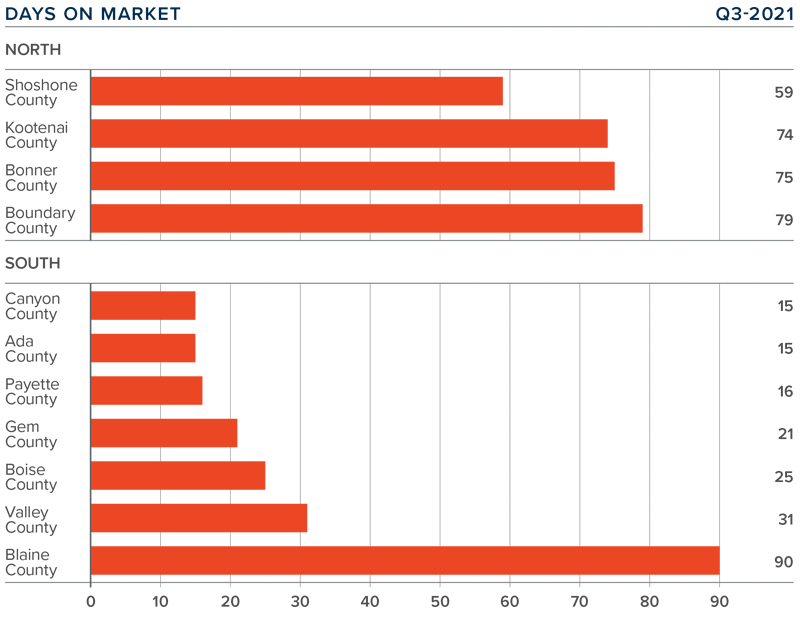
❱ It took an average of 72 days to sell a home in Northern Idaho, and 31 days in the southern part of the state.

❱ The average number of days it took to sell a home in the region dropped 23 days compared to the third quarter of 2020 but rose 2 days compared to the second quarter of this year.

❱ In Northern Idaho, days on market dropped in all counties versus a year ago but rose in all counties compared to the second quarter of this year. Market time in Southern Idaho was also lower than a year ago, but it was up from the prior quarter in Valley, Gem, and Blaine counties.

❱ Homes sold the fastest in Ada and Canyon counties in the southern part of the state. Sales were again fastest in Shoshone County in the northern part of the state.

A bar graph showing the average days on market for homes in various counties in North and South Idaho during the third quarter of 2021.

Conclusions

A speedometer graph indicating a seller's market in Idaho during the third quarter of 2021.

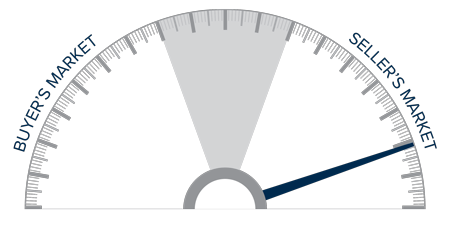
This speedometer reflects the state of the region’s real estate market using housing inventory, price gains, home sales, interest rates, and larger economic factors.

Idaho’s economy appears to be powering forward and job recovery is well ahead of almost every other state. The result is clearly an increasing number of buyers who feel comfortable buying a new home, even given the dramatic price growth of late.

That said, the only factors favoring buyers right now are that there are significantly more homes to choose from and mortgage rates remain very low by historic standards. All other factors support sellers more than buyers. As such, I am moving the needle a little more in their favor, even as affordability concerns continue to rise.

About Matthew Gardner

Matthew Gardner - Chief Economist for Windermere Real Estate

As Chief Economist for Windermere Real Estate, Matthew Gardner is responsible for analyzing and interpreting economic data and its impact on the real estate market on both a local and national level. Matthew has over 30 years of professional experience both in the U.S. and U.K.

In addition to his day-to-day responsibilities, Matthew sits on the Washington State Governors Council of Economic Advisors; chairs the Board of Trustees at the Washington Center for Real Estate Research at the University of Washington; and is an Advisory Board Member at the Runstad Center for Real Estate Studies at the University of Washington where he also lectures in real estate economics.

Market News November 2, 2021

Q3 2021 Montana Real Estate Market Update

The following analysis of select Montana real estate markets is provided by Windermere Real Estate Chief Economist Matthew Gardner. We hope that this information may assist you with making better-informed real estate decisions. For further information about the housing market in your area, please don’t hesitate to contact your Windermere Real Estate agent.


Regional Economic Overview

Following the loss of 63,300 jobs in the wake of the pandemic, Montana continues to recover, and current employment levels are only 7,400 jobs shy of their pre-pandemic peak. Although this is good news, the momentum of this recovery began to slow in second quarter and this trend continued into the third quarter. The latest data on unemployment indicated that 3.5% of the labor force is currently out of work, but that level is well below the national rate of 4.8%. In the counties contained in this report, the lowest jobless rate was in Billings at 3%. Missoula followed at 3.1%, and Great Falls at 3.2%. I anticipate the state will see a return of all the jobs that were lost due to COVID-19, but the recent slowdown in the job recovery suggests that we will not reach pre-pandemic employment levels until the end of this year.

montana Home Sales

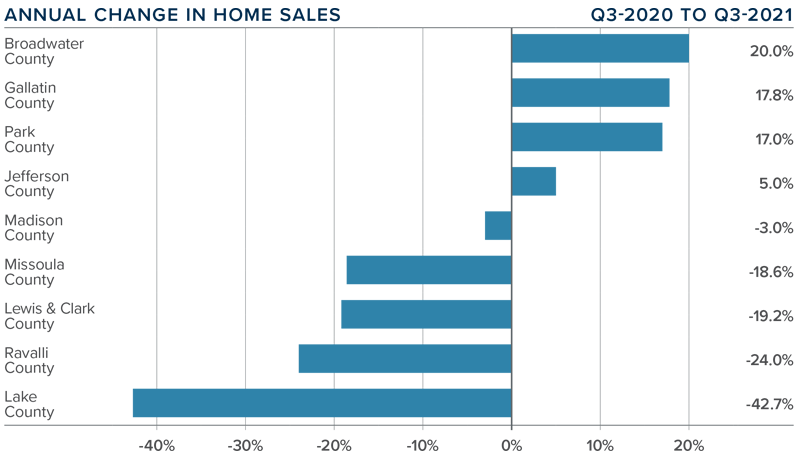
❱ In the third quarter, 1,722 homes sold in the markets contained in this report, representing a drop of 1.5% compared to the same period in 2020. Sales were 47.3% higher than in the second quarter of this year.

❱ Year-over-year, home sales still managed to rise in four of the nine counties contained in this report, with double-digit increases in Broadwater, Gallatin, and Park counties. Compared to the second quarter of this year, sales rose in every market other than Ravalli. Transactions more than doubled in Lewis and Clark, Broadwater, Jefferson, and Madison counties.

❱ I’m not concerned about the modest drop in sales compared to a year ago given that at that time the country was experiencing a massive housing rebound following the outbreak of COVID-19. On a more positive note, sales grew compared to the second quarter of 2021, even as inventory levels fell precipitously.

❱ Although we saw some very significant sales growth compared to the spring, pending sales managed to rise by only 3%, likely due to the lack of homes for sale. This suggests that closed sales in the final quarter of this year may be lower unless we see a large increase in listings.

A bar graph showing the annual change in home sales for various counties in Montana during the third quarter of 2021.

montana Home Prices

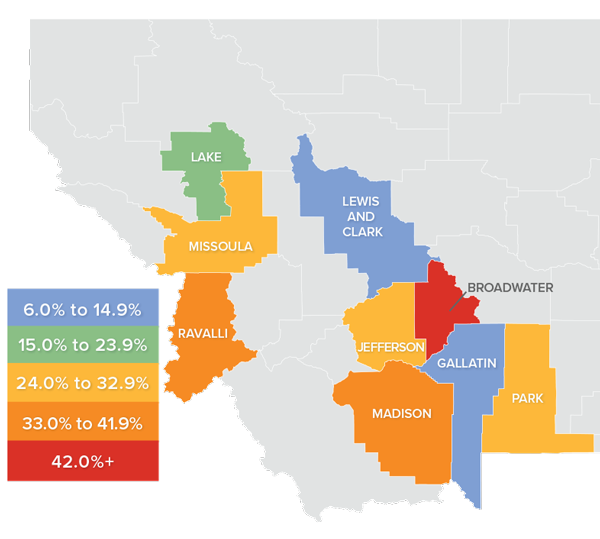
A map showing the real estate market percentage changes in various counties in Montana during the third quarter of 2021.

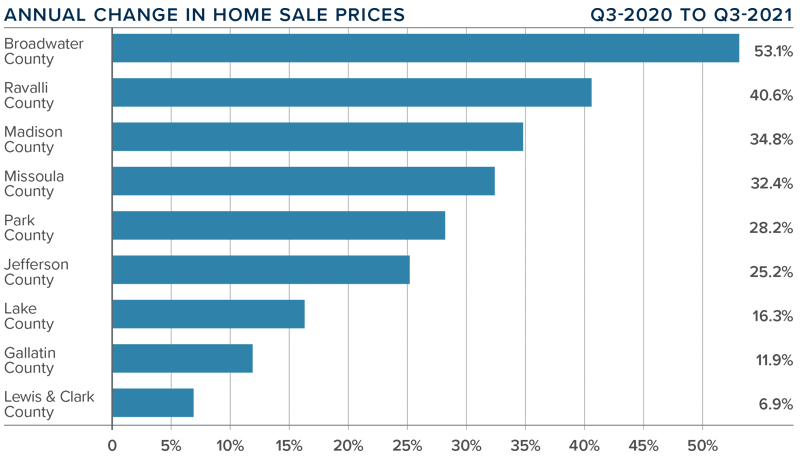
❱ Home prices averaged $666,391 in the third quarter, which is 22.5% higher than a year ago and 40.6% higher than the prior quarter.

❱  Year-over-year, all but Lewis and Clark County saw prices rise by double-digits. Broadwater County saw average prices rise more than 50%.

❱ Average sale prices rose in all counties contained in this report. It’s worth noting that following a significant drop in the second quarter, prices in Madison County rebounded and are now back above the $1 million mark.

❱ Mortgage rates moved modestly lower during the quarter, which could have contributed to rising prices, but not to the degree we saw. The bigger culprit is demand which far exceeds supply and continues to push up prices.

A bar graph showing the annual change in home sale prices for various counties in Montana during the third quarter of 2021.

Days on Market

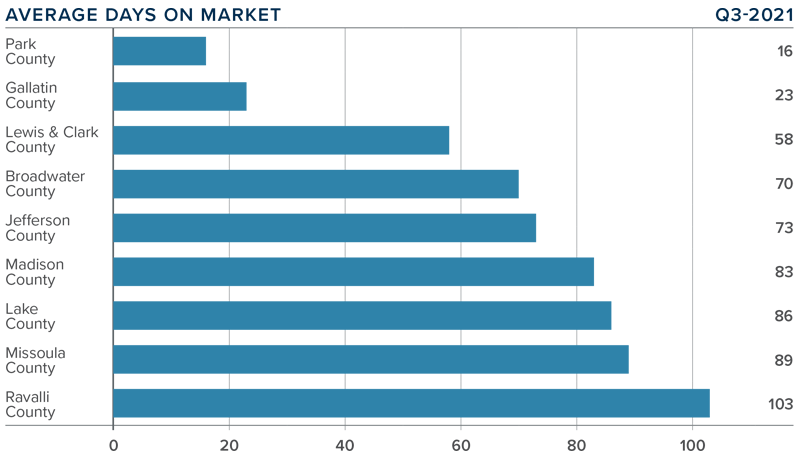
❱ The average time it took to sell a home dropped 19 days compared to the third quarter of 2020.

❱ Homes sold fastest in Park County and slowest in Ravalli County. All markets other than Madison (+17 days) saw market time drop compared to the same period a year ago.

❱ During third quarter, it took an average of 67 days to sell a home in the region.

❱ Relative to the second quarter of this year, market time dropped in Ravalli, Gallatin, Park, and Madison counties, but rose in the rest of the areas covered in this report.

A bar graph showing the average days on market for homes in various counties in Montana during the third quarter of 2021.

Conclusions

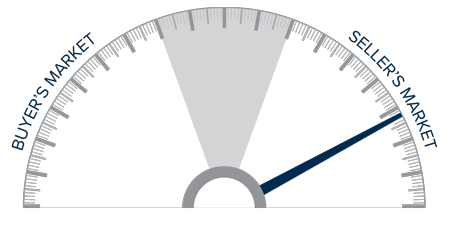
A speedometer graph indicating a seller's market in Montana during the third quarter of 2021.

This speedometer reflects the state of the region’s real estate market using housing inventory, price gains, home sales, interest rates, and larger economic factors.

The economy continues to recover, even though the pace of the return of jobs is slower than I would like to see. The unemployment rate remains very low compared to most other states, which suggests there are job openings out there; the biggest issue for businesses is finding qualified applicants.

Third-quarter homes sales are impressive—especially considering the lack of inventory—and with buyers clearly outnumbering sellers, the region has experienced very significant price growth. With all these factors in mind, I am moving the needle a little more in favor of sellers.

About Matthew Gardner

Matthew Gardner - Chief Economist for Windermere Real Estate

As Chief Economist for Windermere Real Estate, Matthew Gardner is responsible for analyzing and interpreting economic data and its impact on the real estate market on both a local and national level. Matthew has over 30 years of professional experience both in the U.S. and U.K.

In addition to his day-to-day responsibilities, Matthew sits on the Washington State Governors Council of Economic Advisors; chairs the Board of Trustees at the Washington Center for Real Estate Research at the University of Washington; and is an Advisory Board Member at the Runstad Center for Real Estate Studies at the University of Washington where he also lectures in real estate economics.