Facebook
 X
X
 Pinterest
 Copy Link
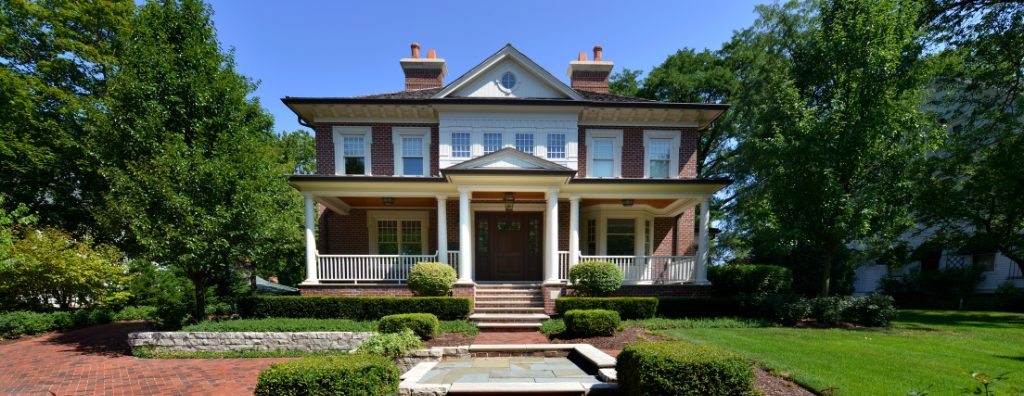
If you’ve ever walked through an older neighborhood and felt drawn to a home that looks balanced, practical, and quietly confident, you were likely looking at an American Foursquare. Sometimes called a Prairie Box or Prairie Cube, this architectural style is one of the most straightforward designs in the American architectural tradition, and one of the most enduring.
Popular from the late 1890s through the 1920s, the Foursquare emerged during a time when ornate Victorian homes dominated the landscape. In contrast, these homes favored simplicity, efficiency, and sold craftsmanship. Influenced by the Prairie and Arts and Crafts movements, the Foursquare prioritized thoughtful design over decoration, making it both practical and approachable.
A Shape That Works
True to its name, the Foursquare is defined by its box-style construction. The home’s nearly square footprint creates a symmetrical form, with rooms occupying each quadrant. Most Foursquares are two to two-and-a-half stories tall, with the half story tucked into a spacious attic. This efficient layout was intentionally designed to make the most of smaller lot sizes while still providing generous living space.
Rooflines, Porches, and Presence
A low-pitched hipped roof is one of the most recognizable features of a Foursquare home. The roof slopes evenly on all four sides, often forming a pyramid shape, and is frequently paired with a central dormer window that brings light and air into the attic level.
Many Foursquares also feature a covered front porch—sometimes spanning the full width of the home—supported by simple columns. These porches extend the living space outdoors and give a home a welcoming, grounded presence on the street.
Materials and Details
Building materials for Foursquare homes vary by region, with brick and wood being the most common. While the exterior design remains restrained, later models often incorporate Arts and Crafts details, especially inside the home. Built-in shelves, benches, bookcases, and window seats add warmth and function without excess ornamentation.
Inside the Foursquare
The interior layout reflects the same efficiency seen on the exterior. Traditionally, the main floor contains shared living spaces such as the living room, dining room, kitchen, and entryway, while bedrooms are located on the second floor. Hallways are minimal, and because each room typically sits at a corner of the home, natural light enters from multiple directions, a detail that homeowners still appreciate today.
Why Foursquare Homes Still Matter
More than a century later, American Foursquare homes remain highly desirable for their smart layouts, timeless proportions, and understated character. They’re homes designed to work well, on their lots, in their neighborhoods, and in everyday life. That kind of thoughtful simplicity never goes out of style.