Market News May 5, 2023

Q1 2023 Northern California Real Estate Market Update

The following analysis of select counties of the Northern California real estate market is provided by Windermere Real Estate Chief Economist Matthew Gardner. We hope that this information may assist you with making better-informed real estate decisions. For further information about the housing market in your area, please don’t hesitate to contact your Windermere Real Estate agent.


Regional Economic Overview

Total employment in the counties covered by this report continues to slow, as demonstrated by the addition of only 45,300 jobs over the past 12 months. Although the numbers are adjusted for seasonality every January, this is highly unlikely to be totally responsible for the poor pace of growth of only 1.5%. On a more positive note, the regional unemployment rate fell from 3.8% to 3.6% from the same period in 2022. The lowest jobless rate was in Santa Clara County (3.1%) and the highest rate was in Shasta County at 5.8%.

Northern California Home Sales

In the first quarter of the year, 5,106 homes sold, a significant drop from the more than 8,100 homes that sold in the first quarter of 2022. Closed sales were 21.6% lower than in the final quarter of 2022.

Year over year, sales fell across the board. The largest drop was in Santa Clara County, but the decline in sales activity was pronounced across the region.

Listing inventory in the first quarter was down 32.4% from the prior quarter, which certainly contributed to the poor sales numbers.

Pending home sales were up 9% compared to the fourth quarter of 2022, so it is possible that closed sales may pick up in the second quarter.

A bar graph showing the annual change in home sales for various counties in Northern California from Q1 2022 to Q1 2023. All counties have a negative percentage year-over-year change. Here are the totals: Placer at -29.7%, San Luis Obispo at -30.5%, Solano -33.1%, Shasta -36%, Napa -37.9%, Alameda -38.6%, Contra Costa -39.9%, and Santa Clara -54.8%.

Northern California Home Prices

Higher financing costs continue to impact prices, with the average price of a home sold in the region dropping 12.7% from the first quarter of 2022. Sale prices were 5.8% lower than in the final quarter of last year.

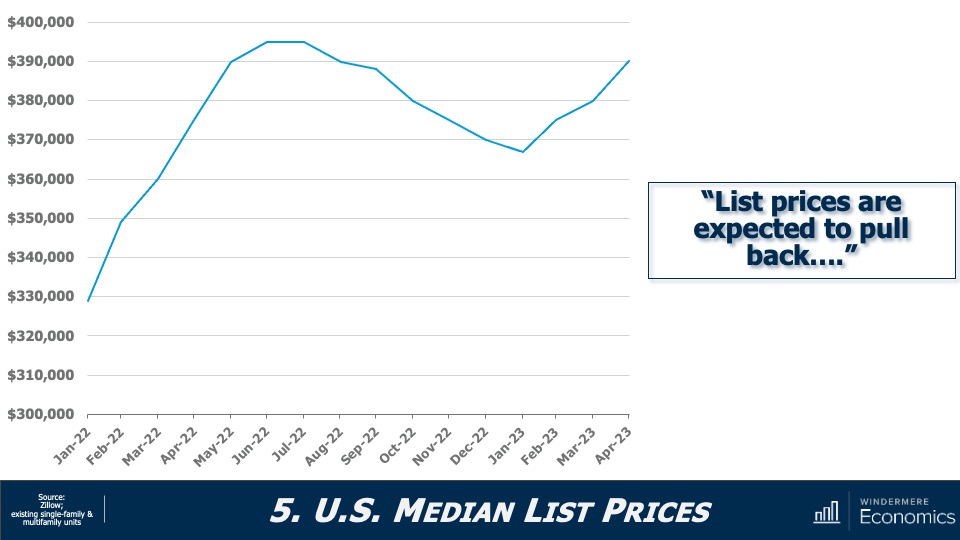
Median list prices in the region managed to rise just a little (+1.9%) compared to the previous quarter. Across the counties contained in this report, prices rose in Placer, Napa, San Luis Obispo, and Contra Costa counties but fell in the rest of the markets.

Prices fell across the board compared to the first quarter of 2022, with double-digit drops in Santa Clara, Alameda, and Contra Costa counties. Compared to the fourth quarter of 2022, prices were higher in Placer County, but fell in the rest of the market areas.

The numbers may look dire, but I believe that the worst of the price drops is behind us. While home prices likely have a little further to fall, I still predict that stability will return as we move into this summer.

A map showing the real estate home prices percentage changes for various counties in Northern California. Different colors correspond to different tiers of percentage change. Contra Costa has a percentage change in the -16% to -13.6% range, Alameda is in the -13.5% to -11.1% change range, Santa Clara is in the -11% to -8.6% change range, Shasta and Napa are in the -8.5% to -6.1% change range, and Placer, Solano, and San Luis Obispo are in the -6%+ change range.

A bar graph showing the annual change in home sale prices for various counties in Northern California from Q1 2022 to Q1 2023. Placer is at -5.3%, San Luis Obispo -5.4%, Solano -6%, Shasta -7.2%, Napa -7.7%, Santa Clara -11%, Alameda -12%, and Contra Costa -15.4%.

Mortgage Rates

Rates in the first quarter of 2023 were far less volatile than last year, even with the brief but significant impact of early March’s banking crisis. It appears that buyers are jumping in when rates dip, which was the case in mid-January and again in early February.

Even with the March Consumer Price Index report showing inflation slowing, I still expect the Federal Reserve to raise short-term rates one more time following their May meeting before pausing rate increases. This should be the catalyst that allows mortgage rates to start trending lower at a more consistent pace than we have seen so far this year. My current forecast is that rates will continue to move lower with occasional spikes, and that they will hold below 6% in the second half of this year.

A bar graph showing the mortgage rates from Q1 2021 to the present, as well as Matthew Gardner's forecasted mortgage rates through Q1 2024. After the 6.79% figure in Q4 2022 and 6.37% in Q1 2023, he forecasts mortgage rates dipping to 6.26% in Q2 2023, 5.78% in Q3 2023, 5.43% in Q4 2023, and 5.28% in Q1 2024.

Northern California Days on Market

The average time it took to sell a home in the Northern California counties in this report rose 17 days compared to the first quarter of 2022.

Compared to the first quarter of 2022, the length of time it took to sell a home rose across the region. Compared to the fourth quarter of 2022, market time rose across all counties except Alameda County, where it remained static, and Santa Clara County, where it fell by three days.

It took an average of 49 days to sell a home in the first quarter of 2023, which was 6 more days than in the fourth quarter of last year.

Even faced with fewer homes on the market, buyers are being wary. I expect they will continue to feel this way until either they believe that a floor in prices has been found, or mortgage rates drop to a point where it becomes compelling to make a buying decision again.

A bar graph showing the average days on market for homes in various counties in Northern California for Q1 2023. Santa Clara County has the lowest DOM at 19, followed by Alameda at 30, Contra Costa at 35, San Luis Obispo at 44, Placer at 49, Solano and Napa at 62, and Shasta at 93.

Conclusions

This speedometer reflects the state of the region’s real estate market using housing inventory, price gains, home sales, interest rates, and larger economic factors.

Growth in the job market continues to slow, which is likely a contributing factor to the slowing real estate market, especially in areas that may be shedding a significant number of tech jobs. That said, buyers are still out there but they are looking for deals and are clearly prepared to wait it out. Moving forward, I believe that the worst of the price drops may be over in some of the Northern California markets covered by this report, but the region as a whole has yet to find a firm foundation in respect to home values upon which it can build.

A speedometer graph indicating a balanced market in Northern California in Q1 2023, leaning toward a buyer's market.

That said, I expect the market to find its footing later this spring, at which point home prices will stabilize and then start to increase, though at a significantly slower pace than during the pandemic period. Given all that has been discussed here, I am moving the needle further in favor of buyers and into what can best be described as a neutral position.

About Matthew Gardner

Matthew Gardner - Chief Economist for Windermere Real Estate

As Chief Economist for Windermere Real Estate, Matthew Gardner is responsible for analyzing and interpreting economic data and its impact on the real estate market on both a local and national level. Matthew has over 30 years of professional experience both in the U.S. and U.K.

In addition to his day-to-day responsibilities, Matthew sits on the Washington State Governors Council of Economic Advisors; chairs the Board of Trustees at the Washington Center for Real Estate Research at the University of Washington; and is an Advisory Board Member at the Runstad Center for Real Estate Studies at the University of Washington where he also lectures in real estate economics.

Market News May 4, 2023

Q1 2023 Nevada Real Estate Market Update

The following analysis of select counties of the greater Las Vegas real estate market is provided by Windermere Real Estate Chief Economist Matthew Gardner. We hope that this information may assist you with making better-informed real estate decisions. For further information about the housing market in your area, please don’t hesitate to contact your Windermere Real Estate agent.


Regional Economic Overview

The Las Vegas area continues to add jobs and the pace of growth remains impressive. There are currently 1.118 million people working in the metro area, which is 58,000 more than during the same period in 2022 and represents an annual growth rate of 5.5%. Although the job market remains remarkably robust, the unemployment rate continues to tick modestly higher. Though this may seem unusual, it really isn’t. The number of jobs being added is substantial, which has led the labor force to grow significantly. When people start looking for work, they are counted as “unemployed,” which can raise the jobless rate. The non-seasonally adjusted unemployment rate in February was 6%, which was up from 5.3% in the first quarter of 2022. The seasonally adjusted rate was 6.2%, which was up from 5.5% during the same period in 2022.

Nevada Home Sales

A total of 5,537 homes sold in the first quarter of the year, which was a drop of 39.4% compared to the same period in 2022. Sales were up 12% from the fourth quarter of last year.

Year over year, sales fell significantly in every neighborhood covered by this report. Compared to the fourth quarter of 2022, sales rose in every neighborhood except Green Valley, where there was a very modest decline.

Particularly impressive was the fact that sales rose while the average number of homes for sale fell more than 32%. This can happen given the higher inventory levels we saw in the fourth quarter, but it is impressive all the same.

Pending sales, which are an indicator of future closings, rose 45.4% compared to the fourth quarter, suggesting that the market may see further growth in sales in the second quarter.

A bar graph showing the annual change in home sales for various sub-market areas in Nevada from Q1 2022 to Q1 2023. All areas have a negative percentage year-over-year change. Here are the totals: The Lakes/Section 10 at -25%, Aliante at -30.1%, Summerlin -35.5%, Southeast -36.6%, Queensridge -37.4%, Downtown -37.9%, North Las Vegas -38.1%, Centennial -38.8%, Whitney -38.9%, Northeast -39.8%, Henderson -41.5% Southwest -42.1%, Anthem -44%, Spring Valley -44.5%, and Green Valley -46.3%.

Nevada Home Prices

If the level of sales activity was a surprise, prices decreasing by 7.2% from the first quarter of 2022 and 3.9% from the fourth quarter should make things clear: buyers were making deals.

Listing prices, which are a leading indicator of the market, fell 3.9% from the final quarter of 2022. The market is clearly responding to higher financing costs. However, not all markets are the same. In Southwest Las Vegas, Summerlin, Anthem, Henderson, and The Lakes/Section 10, median listing prices rose quite significantly from the fourth quarter of 2022.

Year over year, prices fell across the board. Compared to the fourth quarter of 2022, six neighborhoods saw higher prices. These were Centennial, Green Valley, The Lakes/Section 10, Southeast Las Vegas, Spring Valley, and Whitney.

Nobody should be surprised to see prices fall given the rapid pace of appreciation through the pandemic period. It’s a necessary adjustment that will end later this year, at which point I expect prices to start rising again, though at a significantly slower pace.

A chart showing the sub-market areas and their corresponding zip codes in the Greater Las Vegas, Nevada area.

A bar graph showing the annual change in home sale prices for various sub-market areas in Nevada from Q1 2022 to Q1 2023. Aliante is at -0.1%, Henderson -0.8%, Green Valley -1.4%, Southwest -3%, The Lakes/Section 10 and Southeast -3.2%, Northeast -3.3%, Summerlin -4.5%, Centennial -4.6%, North Las Vegas -5.9%, Whitney -6.6%, Downtown -8.7%, Queensridge -11.9%, Spring Valley -13.3%, and Anthem -14.2%.

Mortgage Rates

Rates in the first quarter of 2023 were far less volatile than last year, even with the brief but significant impact of early March’s banking crisis. It appears that buyers are jumping in when rates dip, which was the case in mid-January and again in early February.

Even with the March Consumer Price Index report showing inflation slowing, I still expect the Federal Reserve to raise short-term rates one more time following their May meeting before pausing rate increases. This should be the catalyst that allows mortgage rates to start trending lower at a more consistent pace than we have seen so far this year. My current forecast is that rates will continue to move lower with occasional spikes, and that they will hold below 6% in the second half of this year.

A bar graph showing the mortgage rates from Q1 2021 to the present, as well as Matthew Gardner's forecasted mortgage rates through Q1 2024. After the 6.79% figure in Q4 2022 and 6.37% in Q1 2023, he forecasts mortgage rates dipping to 6.26% in Q2 2023, 5.78% in Q3 2023, 5.43% in Q4 2023, and 5.28% in Q1 2024.

Nevada Days on Market

The average time it took to sell a home in the region rose 32 days compared to the first quarter of 2022.

It took an average of 55 days to sell a home in the quarter, which was 12 days longer than it took in the final quarter of 2022.

Days on market rose in all neighborhoods compared to both the same period in 2022 and the fourth quarter.

Even with prices pulling back in many markets, buyers were still taking their time and, possibly, waiting to take advantage of the dips in mortgage rates that occurred in the quarter.

A bar graph showing the average days on market for homes in various sub-market areas in Nevada for Q1 2023. Spring Valley County has the lowest DOM at 43, followed by Northeast at 47, Green Valley and Downtown at 50, The Lakes/Section 10 and Southeast at 52, Queensridge at 53, Whitney at 54, North Las Vegas and Summerlin at 56, southwest and Centennial at 57, Henderson at 59, Anthem at 65, and Aliante at 70.

Conclusions

This speedometer reflects the state of the region’s real estate market using housing inventory, price gains, home sales, interest rates, and larger economic factors.

In last quarter’s Gardner Report, I suggested that a price ceiling had been reached in the Las Vegas market. That forecast appears to have been correct. Compared to the fourth quarter of 2022, lower sale prices, longer days on market, and lower listing prices have benefitted home buyers, and it appears they have been taking advantage of the situation. That said, they’re not having it all their own way. Lower inventory levels, higher pending and closed sales, and higher absorption rates of homes that are on the market indicate that home sellers are not completely defeated.

A speedometer graph indicating a balanced market in Nevada in Q1 2023, leaning toward a buyer's market.

The price correction the market is experiencing was necessary to return to some sense of balance. I expect home prices will pull back a bit further before they start to stabilize this summer. At that point, prices should trend higher again, but at a far more modest pace than during the pandemic period. Given all these factors, I am leaving the needle in neutral territory but leaning a bit toward buyers, who still have a modestly better hand.

About Matthew Gardner

Matthew Gardner - Chief Economist for Windermere Real Estate

As Chief Economist for Windermere Real Estate, Matthew Gardner is responsible for analyzing and interpreting economic data and its impact on the real estate market on both a local and national level. Matthew has over 30 years of professional experience both in the U.S. and U.K.

In addition to his day-to-day responsibilities, Matthew sits on the Washington State Governors Council of Economic Advisors; chairs the Board of Trustees at the Washington Center for Real Estate Research at the University of Washington; and is an Advisory Board Member at the Runstad Center for Real Estate Studies at the University of Washington where he also lectures in real estate economics.

Market News May 4, 2023

Q1 2023 Utah Real Estate Market Update

The following analysis of select counties of the Utah real estate market is provided by Windermere Real Estate Chief Economist Matthew Gardner. We hope that this information may assist you with making better-informed real estate decisions. For further information about the housing market in your area, please don’t hesitate to contact your Windermere Real Estate agent.


Regional Economic Overview

Continuing the trend that started last summer, employment growth in Utah continues to taper. Over the past 12 months, the state added 52,600 jobs. At an annual rate of 3.2%, this was the slowest percentage growth since Utah started recovering jobs post-COVID. Although this is an improvement over the rate in the last quarter, annual adjustments to the data gave early 2023 data a boost. The counties covered by this report added more than 38,600 new jobs over the past year, representing a growth rate of 2.8%. The fastest growing county was Summit, with a 4.8% increase in employment. The slowest was Morgan County, where the job level rose .7%. Utah’s unemployment rate in February was 2.4%, matching the level at the end of 2022. The labor force continues to grow but, so far, it has not caused the jobless rate to rise, which is very impressive.

Utah Home Sales

In the first quarter of the year, 5,251 homes sold. This was down 21% compared to the first quarter of 2022. Sales were .2% higher than in the fourth quarter of last year.

Year over year, sales fell across the board. Compared to the fourth quarter, sales rose in Utah and Weber counties but fell in the rest of the market areas covered by this report.

The number of homes for sale plummeted by one third when compared to the fourth quarter of 2022, making any increase in sales rather impressive.

Pending sales jumped 38.3% from the fourth quarter, suggesting that closings in the second quarter of this year may rise further.

A bar graph showing the annual change in home sales for various counties in Utah from Q1 2022 to Q1 2023. All counties have a negative percentage year-over-year change. Here are the totals: Davis at -10.3%, Weber at -18.2%, Utah -21.7%, Salt Lake -22.4%, Summit -32.2%, Wasatch -35.8%, and Morgan -42.1%.

Utah Home Prices

The average sale price in the first quarter of the year fell 5.3% compared to the first quarter of 2022 to $603,340. Prices were also .1% lower than in the fourth quarter of 2022.

Median listing prices in the first quarter were 3.7% higher than at the end of last year, suggesting that home sellers remain confident about the spring market. Of the counties covered by this report, only Wasatch and Morgan counties saw listing prices fall compared to the prior quarter.

Year over year, prices rose in Wasatch County but fell in the other markets. Compared to the fourth quarter of 2022, prices rose in Morgan, Summit, and Wasatch counties.

The market is correcting. Although this may not be something sellers want to see, it is important to return to some sense of normalcy following the frantic, low-mortgage-rate-induced market of the pandemic period. There will be a relatively modest decline in prices in the coming months, but I expect home values to rise again in the second half of this year.

A map showing the real estate home prices percentage changes for various counties in Utah. Different colors correspond to different tiers of percentage change. Morgan and Davis counties have a percentage change in the -7% to -4.9% range, Weber, Salt Lake, Summit, and Utah are in the -4.8% to -2.7% change range, and Wasatch is in the 1.8%+ change range.

A bar graph showing the annual change in home sale prices for various counties in Utah from Q1 2022 to Q1 2023. Wasatch is at 20.7%, Weber -3.5%, Utah -3.8%, Salt Lake -4.3%, Summit -4.4%, Morgan -5.3%, and Davis -6.4%.

Mortgage Rates

Rates in the first quarter of 2023 were far less volatile than last year, even with the brief but significant impact of early March’s banking crisis. It appears that buyers are jumping in when rates dip, which was the case in mid-January and again in early February.

Even with the March Consumer Price Index report showing inflation slowing, I still expect the Federal Reserve to raise short-term rates one more time following their May meeting before pausing rate increases. This should be the catalyst that allows mortgage rates to start trending lower at a more consistent pace than we have seen so far this year. My current forecast is that rates will continue to move lower with occasional spikes, and that they will hold below 6% in the second half of this year.

A bar graph showing the mortgage rates from Q1 2021 to the present, as well as Matthew Gardner's forecasted mortgage rates through Q1 2024. After the 6.79% figure in Q4 2022 and 6.37% in Q1 2023, he forecasts mortgage rates dipping to 6.26% in Q2 2023, 5.78% in Q3 2023, 5.43% in Q4 2023, and 5.28% in Q1 2024.

Utah Days on Market

The average time it took to sell a home in the counties covered by this report rose 42 days compared to the same period in 2022.

Homes again sold fastest in Salt Lake County and slowest in Summit County. All areas saw average market time rise compared to the prior quarter as well as the same quarter in 2022.

During the quarter, it took an average of 67 days to sell a home, which was an increase of 9 days compared to the final quarter of 2022.

Although average market time rose compared to the fourth quarter of last year, the increase was not significant. Lower inventory levels may lead to market time pulling back again as we get into the spring months, or at least levelling out.

A bar graph showing the average days on market for homes in various counties in Utah for Q1 2023. Salt Lake County has the lowest DOM at 60, followed by Davis at 63, Morgan and Utah at 64, Weber at 69, Wasatch at 72, and Summit at 77.

Conclusions

This speedometer reflects the state of the region’s real estate market using housing inventory, price gains, home sales, interest rates, and larger economic factors.

Higher financing costs and lower affordability rates are acting as headwinds in the housing market, which is offsetting the benefit that housing normally sees from a growing economy. I have stated previously that home prices in Utah would continue to moderate but that a major downward correction was unlikely. That prediction appears to have been accurate. I believe that the market is very close to bottoming out given low inventory levels, rising pending and closed sales, and higher listing prices—all of which benefit home sellers. That said, lower home prices and longer days on market tend to favor home buyers.

A speedometer graph indicating a balanced market in Utah in Q1 2023, leaning toward a seller's market.

Ultimately, I would describe the market as balanced, but I am tilting the needle just a little in favor of sellers. I expect that mortgage rates will start to stabilize as we move through the spring and then start to drop a little. If this occurs and inventory levels do not rise significantly, then we will certainly be back in a position that more firmly favors home sellers.

About Matthew Gardner

Matthew Gardner - Chief Economist for Windermere Real Estate

As Chief Economist for Windermere Real Estate, Matthew Gardner is responsible for analyzing and interpreting economic data and its impact on the real estate market on both a local and national level. Matthew has over 30 years of professional experience both in the U.S. and U.K.

In addition to his day-to-day responsibilities, Matthew sits on the Washington State Governors Council of Economic Advisors; chairs the Board of Trustees at the Washington Center for Real Estate Research at the University of Washington; and is an Advisory Board Member at the Runstad Center for Real Estate Studies at the University of Washington where he also lectures in real estate economics.

More May 3, 2023

37th Annual Windermere Cup: UW vs Australia

Windermere Cup 2023

One of the premier regattas in the world, Windermere Cup, returns to the Montlake Cut in Seattle, Washington on May 6, 2023. Hosted by Windermere Real Estate and the University of Washington, this year’s event marks the 37th installment in the Cup’s storied history.

The University of Washington men’s and women’s crews will battle the Australian National team in what will be a spectacle of first-class competition from two of the top rowing programs in the world. There will be several races throughout the morning, with the first event kicking off at 10:15 am PST and culminating in the Windermere Cup races at 11:30. The event is also a celebration of the opening day of boating season. After the Windermere Cup is presented to the winning men’s and women’s crews, a cannon will sound and the Montlake Bridge will open, heralding the beginning of boating season led by Seattle Yacht Club’s opening day boat parade.

Windermere Party on the Cut

The weekend kicks off with one of the area’s favorite parties. On May 5, the night before the races, Windermere will host the fifth annual Party on the Cut near the UW Waterfront Activity Center. This exclusive party will be filled with food vendors, drinks, and games, as live music fills the air. Tickets can be purchased for $30 here, with proceeds benefitting the Windermere Foundation and the Joe Rantz Rotary Youth Fund. You must be 21 or older to attend.

For more information and a schedule of events, visit windermerecup.com and follow Windermere Cup on Facebook and Twitter. Join in the fun on social media with the official hashtag of this year’s Windermere Cup: #WindermereCup2023


­­­­­­Featured Image Source: Windermere Real Estate

Market News May 3, 2023

Q1 2023 Montana Real Estate Market Update

The following analysis of select counties of the Montana real estate market is provided by Windermere Real Estate Chief Economist Matthew Gardner. We hope that this information may assist you with making better-informed real estate decisions. For further information about the housing market in your area, please don’t hesitate to contact your Windermere Real Estate agent.


Regional Economic Overview

Year over year, Montana added 12,600 jobs, representing a solid growth rate of 2.5%. The slowdown in employment gains in the fourth quarter of 2022 appears to have turned. The rest of the region had the same change in trajectory except Billings, which lost 400 jobs over the past 12 months. The state unemployment rate in February was 2.4%, which was down from 2.5% in the first quarter of 2022. In the metro areas covered in this report, the lowest jobless rate was in Billings at 2.2%. In Missoula and Great Falls, 2.4% of their respective labor force remains unemployed.

Montana Home Sales

In the first quarter of 2023, 1,273 homes sold, which was a 29.6% decline from the first quarter of 2022. Sales activity fell 23.4% compared to the final quarter of last year.

Listing activity was 66% higher than in the same period of 2022, but down 3.5% compared to the fourth quarter of 2022. The market has become tight again.

Sales fell across the board from the first quarter of 2022. Compared to the final quarter of last year, sales rose in Jefferson County but fell in the rest of the market areas.

Pending sales rose 14.1% quarter over quarter. This suggests that closings in the second quarter could be higher, but low levels of inventory may hold the market back.

A bar graph showing the annual change in home sales for various counties in Montana from Q1 2022 to Q1 2023. All counties have a negative percentage year-over-year change. Here are the totals: Jefferson at -11.1%, Lewis & Clark at -16.3%, Missoula -17.4%, Flathead -23.7%, Gallatin -29.7%, Ravalli -29.8%, Lake -47.1%, Madison -57%, Park -60.2%, and Broadwater -60.9%.

Montana Home Prices

Home prices were up .2% year over year to an average sale price of $747,158. The average sale price rose 3.1% compared to the fourth quarter of 2022.

The market has been more resilient than many had expected, given significantly higher financing costs. It was also interesting that the median listing price across the region was 1.4% higher than at the end of last year. The Montana market remains more confident than most of the country!

Year over year, prices rose in five counties, remained static in one, and fell in four. What was more interesting, however, was that over half of the counties surveyed saw prices rise quarter over quarter. The only counties that had price declines were Broadwater, Jefferson, Gallatin, and Park.

Ultimately, I expect prices to dip a little more before finding stability this summer and then starting to rise again as mortgage rates fall.

A map showing the real estate home prices percentage changes for various counties in Montana. Different colors correspond to different tiers of percentage change. Jefferson and Broadwater counties have a percentage change in the -22% to -12.6% range, Gallatin is in the -12.5% to -3.1% change range, Ravalli and Madison are in the -3% to 6.4% change range, Flathead, Lewis & Clark, and Missoula are in the 6.5% to 15.9% change range, and Park and Lake are in the 16%+ change range.

A bar graph showing the annual change in home sale prices for various counties in Montana from Q1 2022 to Q1 2023. Lake is at 74.8%, Park 57.5%, Lewis & Clark 10.6%, Missoula -6.8%, Flathead -6.5%, Madison 0%, Ravalli -1.5%, Gallatin -10.2%, Jefferson -17.5%, and Broadwater -21.1%.

Mortgage Rates

Rates in the first quarter of 2023 were far less volatile than last year, even with the brief but significant impact of early March’s banking crisis. It appears that buyers are jumping in when rates dip, which was the case in mid-January and again in early February.

Even with the March Consumer Price Index report showing inflation slowing, I still expect the Federal Reserve to raise short-term rates one more time following their May meeting before pausing rate increases. This should be the catalyst that allows mortgage rates to start trending lower at a more consistent pace than we have seen so far this year. My current forecast is that rates will continue to move lower with occasional spikes, and that they will hold below 6% in the second half of this year.

A bar graph showing the mortgage rates from Q1 2021 to the present, as well as Matthew Gardner's forecasted mortgage rates through Q1 2024. After the 6.79% figure in Q4 2022 and 6.37% in Q1 2023, he forecasts mortgage rates dipping to 6.26% in Q2 2023, 5.78% in Q3 2023, 5.43% in Q4 2023, and 5.28% in Q1 2024.

Montana Days on Market

The average time it took to sell a home rose 19 days compared to the same period in 2022.

Homes sold fastest in Missoula County while homes in Flathead County took the longest to sell. Broadwater and Madison counties saw days on market fall compared to the same period in 2022. Average market time rose in the rest of the region.

During the first quarter, it took an average of 93 days to sell a home in the markets covered by this report.

Compared to the final quarter of 2022, average market time rose in all counties other than Broadwater (-17 days) and Ravalli (-13 days).

A bar graph showing the average days on market for homes in various counties in Montana for Q1 2023. Missoula County has the lowest DOM at 57, followed by Ravalli at 69, Gallatin at 74, Broadwater at 81, Lewis & Clark at 83, Park at 97, Jefferson at 103, Lake at 113, Madison at 123, and Flathead at 133.

Conclusions

This speedometer reflects the state of the region’s real estate market using housing inventory, price gains, home sales, interest rates, and larger economic factors.

Even in the face of significantly higher mortgage rates, the market has been very reluctant to give up the remarkable gains that home values saw during the pandemic period. However, it appears as if the nationwide trend has started to slowly impact the Treasure State. There are markets that have given back some of the value gained over the past few years, but it’s certainly not a collapse by any stretch of the imagination. Lower sales, prices, and longer days on market favor home buyers. However, inventory limitations, solid absorption rates, and higher listing prices benefit home sellers.

A speedometer graph indicating a balanced market in Montana in Q1 2023, barely shading toward a seller's market.

Although further erosion of home values is likely, I anticipate a number of the counties contained in this report will experience price growth in 2023. It’s unlikely to be significant, but it is growth all the same. As such, I am leaving the needle in the balanced area but tilted slightly toward home sellers.

About Matthew Gardner

Matthew Gardner - Chief Economist for Windermere Real Estate

As Chief Economist for Windermere Real Estate, Matthew Gardner is responsible for analyzing and interpreting economic data and its impact on the real estate market on both a local and national level. Matthew has over 30 years of professional experience both in the U.S. and U.K.

In addition to his day-to-day responsibilities, Matthew sits on the Washington State Governors Council of Economic Advisors; chairs the Board of Trustees at the Washington Center for Real Estate Research at the University of Washington; and is an Advisory Board Member at the Runstad Center for Real Estate Studies at the University of Washington where he also lectures in real estate economics.

Market News May 3, 2023

Q1 2023 Idaho Real Estate Market Update

The following analysis of select counties of the Idaho real estate market is provided by Windermere Real Estate Chief Economist Matthew Gardner. We hope that this information may assist you with making better-informed real estate decisions. For further information about the housing market in your area, please don’t hesitate to contact your Windermere Real Estate agent.


Regional Economic Overview

Year over year, Idaho added 24,900 jobs, representing a solid growth rate of 3%. All of Idaho’s metropolitan areas saw year-over-year nonfarm job gains. Pocatello experienced the greatest increase at 5.5%, followed by Boise (3.7%), Idaho Falls (3.1%), Coeur d’Alene (2.9%), Twin Falls (.4%), and Lewiston (.3%). The state unemployment rate was 2.6%, matching the rate of the first quarter of 2022. The Boise metro area matched the state’s jobless rate of 2.6% and equaled the rate during the same period in 2022. This is rather impressive given that the labor force has grown by over 9,800 persons, or 2.4%. Clearly new jobs are being created at a very solid pace. My current forecast is that employment will rise by 17,000 jobs, which would represent a growth rate of 2 percent.

Idaho Home Sales

In the first quarter of 2023, 4,205 homes sold, which was down 19.5% from the first quarter of 2022 and 2.3% lower than in the fourth quarter of last year.

Although listing activity was significantly higher than the first quarter of 2022, it was down 27% from the fourth quarter of 2022. All counties had fewer homes on the market.

Compared to the same period in 2022, sales fell in all but two markets covered by this report. Compared to the fourth quarter of last year, sales fell in all the Northern Idaho markets, but rose in Canyon, Ada, and Blaine counties in the southern part of the state.

Even with fewer listings, pending sales in the quarter were up 36.9% from the fourth quarter of 2022, suggesting that sales growth may improve in the second quarter of this year.

A bar graph showing the annual change in home sales for various counties in North and South Idaho from Q1 2022 to Q1 2023. All counties have a negative percentage year-over-year change, except Shoshone at 2% and Boise at 4.2%. Here are the remaining numbers: Boundary at -17.1%, Kootenai at -28.2%, Bonner -29.9%, Valley -7.8%, Ada -16.7%, Canyon -16.9%, Gem -21%, Blaine -26.1%, and Payette -46.6%.

Idaho Home Prices

The average home price in the region fell 6% year over year to $576,130. Prices were 5.4% lower than in the fourth quarter of 2022.

Compared to the fourth quarter of 2022, prices only increased in Shoshone County. In the southern part of the state, prices rose in Valley, Payette, Gem, Boise, and Blaine counties.

Both the northern and southern market areas saw counties split, with prices rising in around half while contracting in the other half. Year over year, prices fell 6.4% in the south and 4% in the north.

Median listing prices in the first quarter were up by only .9% over the fourth quarter of last year. Interestingly, listing prices were up more than 10% in the populous Ada County, which many believed would see significant downward price pressure after the rapid growth over the past few years.

A map showing the real estate home prices percentage changes for various counties in Idaho. Different colors correspond to different tiers of percentage change. Gem and Canyon counties have a percentage change in the -15% to -8.6% range, Boundary, Kootenai, Boise, Ada, and Payette are in the -8.5% to -2.1% change range, Shoshone and Bonner are in the -2% to -4.4% change range, Blaine is in the 4.55 to 10.9% change range, and Valley is in the 11%+ change range.

A bar graph showing the annual change in home sale prices for various counties in North and South Idaho from Q1 2022 to Q1 2023. Most counties have a negative percentage year-over-year change. Here are the totals: Bonner at 3.4%, Shoshone at 2.1%, Kootenai -4.1%, Boundary -6.8%, Valley 17.5%, Blaine 10%, Boise -3.3%, Payette - 5.1%, Ada -7.5%, Canyon -9%, and Gem -14.1%.

Mortgage Rates

Rates in the first quarter of 2023 were far less volatile than last year, even with the brief but significant impact of early March’s banking crisis. It appears that buyers are jumping in when rates dip, which was the case in mid-January and again in early February.

Even with the March Consumer Price Index report showing inflation slowing, I still expect the Federal Reserve to raise short-term rates one more time following their May meeting before pausing rate increases. This should be the catalyst that allows mortgage rates to start trending lower at a more consistent pace than we have seen so far this year. My current forecast is that rates will continue to move lower with occasional spikes, and that they will hold below 6% in the second half of this year.

A bar graph showing the mortgage rates from Q1 2021 to the present, as well as Matthew Gardner's forecasted mortgage rates through Q1 2024. After the 6.79% figure in Q4 2022 and 6.37% in Q1 2023, he forecasts mortgage rates dipping to 6.26% in Q2 2023, 5.78% in Q3 2023, 5.43% in Q4 2023, and 5.28% in Q1 2024.

Idaho Days on Market

The average time it took to sell a home in the region rose 33 days compared to the same quarter of 2022 and was 22 days longer than in the final quarter of 2022.

In both Northern and Southern Idaho, days on market rose in all counties compared to the same period in 2022. Compared to the fourth quarter of 2022, market time rose in every county other than Gem County in Northern Idaho.

It took an average of 98 days to sell a home in Northern Idaho and 94 days in the southern counties covered by this report.

Homes sold fastest in Payette County in the southern part of the state and in Shoshone County in Northern Idaho.

A bar graph showing the average days on market for homes in various counties in North and South Idaho for Q1 2023. Shoshone County has the lowest DOM in North Idaho at 91, followed by Boundary at 95, Bonner at 102, and Kootenai at 104. Payette has the lowest DOM in South Idaho at 60, followed by Valley at 63, Ada at 72, Canyon at 83, Gem at 105, Boise at 111, and Blaine at 161.

Conclusions

This speedometer reflects the state of the region’s real estate market using housing inventory, price gains, home sales, interest rates, and larger economic factors.

The housing market has certainly slowed as it adjusts to higher mortgage rates and significantly lower affordability. Over the past few months, I have heard suggestions that the Idaho market was sure to crash after the rapid increase of prices through the pandemic period, especially as financing costs are more than double what they were in 2021. Although prices are adjusting in many markets, I do not expect to see any systemic declines for one simple reason: supply levels are still remarkably low and are not likely to rise to a level where any market is oversupplied. This will provide a floor for prices and stop them from falling much further than where they are today.

A speedometer graph indicating a balanced market in Idaho in Q1 2023, barely shading toward a buyer's market.

Slower sales activity, lower prices, and longer days on market favor home buyers. However, lower inventory levels, higher pending sales, higher absorption rates, and higher listing prices favor home sellers. As such, I am leaving the needle close to the midpoint of neutral territory. Although buyers are still able to find deals, sellers of well-positioned, appropriately priced homes will still see competition for them, given how few homes are available.

About Matthew Gardner

Matthew Gardner - Chief Economist for Windermere Real Estate

As Chief Economist for Windermere Real Estate, Matthew Gardner is responsible for analyzing and interpreting economic data and its impact on the real estate market on both a local and national level. Matthew has over 30 years of professional experience both in the U.S. and U.K.

In addition to his day-to-day responsibilities, Matthew sits on the Washington State Governors Council of Economic Advisors; chairs the Board of Trustees at the Washington Center for Real Estate Research at the University of Washington; and is an Advisory Board Member at the Runstad Center for Real Estate Studies at the University of Washington where he also lectures in real estate economics.

Market News May 2, 2023

Q1 2023 Central Washington Real Estate Market Update

The following analysis of select counties of the Central Washington real estate market is provided by Windermere Real Estate Chief Economist Matthew Gardner. We hope that this information may assist you with making better-informed real estate decisions. For further information about the housing market in your area, please don’t hesitate to contact your Windermere Real Estate agent.


Regional Economic Overview

Central Washington added 5,831 jobs over the past 12 months, representing a decent 2.3% growth rate and a pleasing turnaround from the jobs losses during the final quarter of 2022. Looking across the counties contained in this report, we saw solid gains in Douglas County (+3.3%) Kittitas County (+2.6%), Chelan County (+2.5%), and Yakima County (+2.4%). Okanogan County did add jobs, but only at an annual rate of .4%. The seasonally adjusted unemployment rate in Central Washington was 6.8%, which was up from 5.7% a year ago. The lowest unemployment rate was in Chelan County, where it was 5.5%. The area’s highest jobless rate was in Yakima County, where 7.4% of the labor force was without work.

Central Washington Home Sales

Central Washington had 611 home sales in the first quarter of 2023, representing a decline of 35% from the same quarter in 2022.

Pending sales, which are an indicator of future closings, rose 13.5% compared to the fourth quarter of last year, suggesting that the market may start to show some growth as we enter the spring market.

Year over year, sales fell significantly across the board. The number of homes sold was down 35.1% from the final quarter of 2022.

Inventory levels fell 45.4% quarter over quarter, which may be one of the reasons for such lackluster sales activity.

A bar graph showing the annual change in home sales for various counties in Central Washington from Q1 2022 to Q1 2023. All counties have a negative percentage year-over-year change. Here are the totals: Kittitas at -23.5%, Douglas at -30.1%, Chelan -35.1%, Yakima -35.6%, and Okanogan -50%.

Central Washington Home Prices

The average home price in Central Washington rose 1.5% year over year to $461,312. Prices were down 5.7% compared to the fourth quarter of 2022.

Median listing prices rose 5.8% compared to the fourth quarter of 2022, but all markets were not even. While listing prices rose in Yakima and Chelan counties, they fell in the rest of the market areas.

All counties except Kittitas saw prices fall from both the same period in 2022 and from the final quarter of last year.

The market appears to still be adjusting to higher financing costs. It’s likely that there will be further price declines as we move through the spring, but I don’t think it will continue much past that point. Look for prices to stabilize in the summer after which time they’ll start trending higher again.

A map showing the real estate home prices percentage changes for various counties in Central Washington. Different colors correspond to different tiers of percentage change. Okanogan County has a percentage change in the -26% to -18.1% range, Chelan and Douglas are in the -10% to -2.1% change range, Yakima is in the -2% to 5.9% change range, and Kittitas in the 6%+ change range.

A bar graph showing the annual change in home sale prices for various counties in Central Washington from Q1 2022 to Q1 2023. All counties have a negative percentage year-over-year change, except Kittitas at 18.2%. Here are the rest: Yakima at -0.4%, Douglas at -4%, Chelan -9%, and Okanogan -25.3%.

Mortgage Rates

Rates in the first quarter of 2023 were far less volatile than last year, even with the brief but significant impact of early March’s banking crisis. It appears that buyers are jumping in when rates dip, which was the case in mid-January and again in early February.

Even with the March Consumer Price Index report showing inflation slowing, I still expect the Federal Reserve to raise short-term rates one more time following their May meeting before pausing rate increases. This should be the catalyst that allows mortgage rates to start trending lower at a more consistent pace than we have seen so far this year. My current forecast is that rates will continue to move lower with occasional spikes, and that they will hold below 6% in the second half of this year.

A bar graph showing the mortgage rates from Q1 2021 to the present, as well as Matthew Gardner's forecasted mortgage rates through Q1 2024. After the 6.79% figure in Q4 2022 and 6.37% in Q1 2023, he forecasts mortgage rates dipping to 6.26% in Q2 2023, 5.78% in Q3 2023, 5.43% in Q4 2023, and 5.28% in Q1 2024.

Central Washington Days on Market

The average time it took to sell a home in Central Washington in the first quarter of 2023 was 71 days.

During the first quarter, it took 18 more days to sell a home in Central Washington than it did during the same period of 2022.

Year over year, all counties saw average market time rise. This was also the case compared to the fourth quarter of 2022.

On average, it took 17 more days to sell a home in the first quarter of 2023 than it did in the final quarter of last year.

A bar graph showing the average days on market for homes in various counties in Central Washington for Q1 2023. Chelan County has the lowest DOM at 58, followed by Douglas at 59, Kittitas at 63, Okanogan at 87, and Yakima at 90.

Conclusions

This speedometer reflects the state of the region’s real estate market using housing inventory, price gains, home sales, interest rates, and larger economic factors.

Employment growth has turned around and, although the jobless rate is higher than I would like it to be, I do not see the labor market being an impediment to home sales. Mortgage rates are firmly to blame for the decreased number of sales. The data suggests that home sellers should be benefitting from lower inventory levels, higher pending sales, and higher list prices. However, lower home sales and prices, as well as increased market time, tend to favor buyers.

A speedometer graph indicating a balanced market in Central Washington in Q1 2023, barely shading toward a buyer's market.

If the mortgage market stabilizes, I expect that rates will continue to trend lower. This and the pullback in home prices should further favor buyers. Ultimately, I do not see either buyers or sellers really having the upper hand. As such, I have left the needle in the area suggesting balance but tilted just a hair in favor of home buyers.

About Matthew Gardner

Matthew Gardner - Chief Economist for Windermere Real Estate

As Chief Economist for Windermere Real Estate, Matthew Gardner is responsible for analyzing and interpreting economic data and its impact on the real estate market on both a local and national level. Matthew has over 30 years of professional experience both in the U.S. and U.K.

In addition to his day-to-day responsibilities, Matthew sits on the Washington State Governors Council of Economic Advisors; chairs the Board of Trustees at the Washington Center for Real Estate Research at the University of Washington; and is an Advisory Board Member at the Runstad Center for Real Estate Studies at the University of Washington where he also lectures in real estate economics.

Market News May 2, 2023

Q1 2023 Eastern Washington Real Estate Market Update

The following analysis of select counties of the Eastern Washington real estate market is provided by Windermere Real Estate Chief Economist Matthew Gardner. We hope that this information may assist you with making better-informed real estate decisions. For further information about the housing market in your area, please don’t hesitate to contact your Windermere Real Estate agent.


Regional Economic Overview

Total employment in Eastern Washington rose 14,046 jobs year over year, with all markets seeing substantial gains. On a percentage basis, the fastest growing market was Benton County, where employment rose by 4%. The slowest growing market was Whitman, where the number of jobs rose 1.8%. In total, the region’s employment base rose 2.9% over the first quarter of 2022. Unadjusted for seasonality, the regional unemployment rate was 7.1%, which is up from 5.8% a year ago. When seasonally adjusted, however, the jobless rate was a more respectable 6%, which is up from 4.8% a year ago. Although the unemployment rate has risen, it is due to a growing labor force rather than a significant increase in the number of unemployed people. I still expect to see jobs added as we move through the year. However, the pace of growth is likely to slow if the U.S. economy starts to contract later this year, which is possible but not guaranteed.

Eastern Washington Home Sales

In the first quarter of 2023, 1,717 homes sold, which was 28.7% lower than in the same period in 2022 and 22.1% lower than in the final quarter of 2022.

Much of the decline in sales can be attributed to a significant slowdown in the number of homes for sale. Listing activity fell 36.5% compared to the final quarter of last year. A question remains as to whether the market will see its traditional spring bump, or if homeowners will stay put until interest rates get closer to the rate on their current mortgage.

Year over year, sales fell across the region. All counties saw sales fall compared to the fourth quarter of last year as well.

The good news is that pending sales rose 18.2% compared to the previous quarter, giving the market some hope that sales activity will rise in the second quarter of the year.

A bar graph showing the annual change in home sales for various counties in Eastern Washington from Q1 2022 to Q1 2023. All counties have a negative percentage year-over-year change. Here are the totals: Whitman at -6.6%, Franklin at -14%, Spokane -25.2%, Walla Walla -31.9%, Benton -35%, Grant -45.6%, and Lincoln -52.4%.

Eastern Washington Home Prices

Year over year, the average home price in Eastern Washington fell 5.7% to $410,234. Average prices were down 7% compared to the final quarter of 2022.

Prices also fell across the board compared to the final quarter of 2022. The market appears to be in the middle of a correction, with data showing that the median listing price was 2.8% lower than in the fourth quarter.

Every county except Whitman saw average sale prices fall compared to the first quarter of 2022, with a significant drop in Lincoln County.

Mortgage rates remain elevated, which is putting additional downward pressure on prices. While the market shift is painful to watch, it is necessary. I expect that the region will find a floor in the not-too-distant future, and that prices will start rising again later this summer.

A map showing the real estate home prices percentage changes for various counties in Eastern Washington. Different colors correspond to different tiers of percentage change. Lincoln County has a percentage change in the -29% to -23.1% range, Spokane, Franklin, and Benton are in the -11% to -5.1% change range, and Whitman, Walla Walla, and Grant are in the 5%+ change range.

A bar graph showing the annual change in home sale prices for various counties in Eastern Washington from Q1 2022 to Q1 2023. All counties have a negative percentage year-over-year change, except Whitman at 0.8%. Here are the rest: Walla Walla at -1.9%, Grant at -3.7%, Spokane -5.8%, Benton -7.6%, Franklin -8%, and Lincoln -28.4%.

Mortgage Rates

Rates in the first quarter of 2023 were far less volatile than last year, even with the brief but significant impact of early March’s banking crisis. It appears that buyers are jumping in when rates dip, which was the case in mid-January and again in early February.

Even with the March Consumer Price Index report showing inflation slowing, I still expect the Federal Reserve to raise short-term rates one more time following their May meeting before pausing rate increases. This should be the catalyst that allows mortgage rates to start trending lower at a more consistent pace than we have seen so far this year. My current forecast is that rates will continue to move lower with occasional spikes, and that they will hold below 6% in the second half of this year.

A bar graph showing the mortgage rates from Q1 2021 to the present, as well as Matthew Gardner's forecasted mortgage rates through Q1 2024. After the 6.79% figure in Q4 2022 and 6.37% in Q1 2023, he forecasts mortgage rates dipping to 6.26% in Q2 2023, 5.78% in Q3 2023, 5.43% in Q4 2023, and 5.28% in Q1 2024.

Eastern Washington Days on Market

The average time it took to sell a home in Eastern Washington in the first quarter of 2023 was 52 days, which was 27 more days than during the same period in 2022.

Average days on market also rose in every county compared to the fourth quarter of 2022, with the regional average rising 17 days.

All counties saw the average number of days it took for a house to go under contract rise compared to the same period a year ago.

Stubbornly higher mortgage rates, lower affordability, and some amount of economic uncertainty has caused days on market to rise. Increasing numbers of pending sales in the quarter suggest that there are buyers out there. I hope we will see greater activity in the region as we move through the spring months.

A bar graph showing the average days on market for homes in various counties in Eastern Washington for Q1 2023. Spokane County has the lowest DOM at 37, followed by Whitman at 42, Benton and Franklin at 44,, Walla Walla at 56, Grant at 65, and Lincoln at 78.

Conclusions

This speedometer reflects the state of the region’s real estate market using housing inventory, price gains, home sales, interest rates, and larger economic factors.

Higher financing costs continue to act as a significant headwind in the market. Although listing and sale prices have been falling, I see this as a needed correction, and one that will be over before the summer sets in. I am hopeful that mortgage rates will stabilize and head lower as we enter the summer, which should bring more buyers into the market.

A speedometer graph indicating a balanced market in Eastern Washington in Q1 2023, leaning heavily toward a buyer's market.

As it stands today, home buyers have the upper hand, but this could only be for a short time—the market can move swiftly when it wants to. For now, buyers should enjoy this likely brief period of dominance.

About Matthew Gardner

Matthew Gardner - Chief Economist for Windermere Real Estate

As Chief Economist for Windermere Real Estate, Matthew Gardner is responsible for analyzing and interpreting economic data and its impact on the real estate market on both a local and national level. Matthew has over 30 years of professional experience both in the U.S. and U.K.

In addition to his day-to-day responsibilities, Matthew sits on the Washington State Governors Council of Economic Advisors; chairs the Board of Trustees at the Washington Center for Real Estate Research at the University of Washington; and is an Advisory Board Member at the Runstad Center for Real Estate Studies at the University of Washington where he also lectures in real estate economics.

Living May 1, 2023

Your Guide to Going Solar

To reduce your carbon footprint, increase your household’s sustainability, and add value to your property, solar power may be right for you. Understanding how solar works and how to maximize its benefits are key first steps in your journey to becoming a solar energy-producing household.

How does solar power work?

The technology that turns your house into a solar energy-harnessing hub is called photovoltaics, more commonly known as PV. PV works by fielding direct sunlight and absorbing its photons into the solar panels’ cells, which then creates electricity that provides energy for your home. This energy reduces your home’s output of carbon and other pollutants, which translates to cleaner air and water.

With the sun as your power source, the majority of the power generation occurs during the middle of the day, making summer the highest producing season. Rooftop panels work best when they are exposed to sunlight, free of shade or shadow from nearby trees or structures. Given the sun’s east-to-west path, south-facing roofs are best-suited for maximizing your solar power. To see if your roof is set up for success, consult a mapping service or solar calculator to establish your roof’s suitability. If your roof isn’t up to standard, you can explore alternatives such as ground mount solar installations and community solar gardens.

Components of Solar Power

  • Solar Panels: Capture the sun’s energy
  • Inverter: Converts the sun’s energy to a form that powers devices
  • Racking: The foundation that holds your solar system in place
  • Batteries: Store the energy generated
  • Charge Controller: Controls how quickly the batteries charge


A brick home with solar panels covering its steep roof.

Image Source: Getty Images – Image Credit: hansenn


What are the benefits of solar power?

Sustainability: Having a renewable source of energy coursing through your home reduces your household’s carbon footprint by converting a significant portion of your home’s energy to solar power.

Save Money: How much money you save by going solar depends largely on how much energy your household consumes and the energy output of your solar panels. The cost of solar power has steadily decreased over time, so you are more likely to save as time goes on. For information on state incentives and tax breaks, explore what options apply to your home by visiting DSIRE (Database of State Incentives for Renewables & Efficiency®).

Utilities: Whether your utility company charges a flat rate for electricity or charges variable rates throughout the day based on electricity production—i.e., higher rates in the afternoon, lower rates at night—solar power offsets the price you are charged for electricity. It becomes even more valuable during those higher-rate periods or during seasonal fluctuations in utilities costs.

Sell Solar Power Back: Homeowners can sell their solar energy back to utilities through “Net-metering” plans. When your power generation rate is greater than your household’s consumption rate, the end result on your electric bill is a net energy consumption. Refer to DSIRE for region-specific regulations and policies. 

Home Value: Studies have shown that buyers are willing to pay more for homes with solar panels. The Appraisal Journal, published by the industry-leading appraisers association The Appraisal Institute, found that homes with solar PV systems increased their home value by $20 for every $1 saved on utility bills annually.

Although the right solar solution looks different for each household, what remains true across the board is that solar power creates more sustainable homes while increasing home value. Taking all this information into your solar power plans will help to improve your home’s renewable energy output and reduce your carbon footprint.

For more information on sustainable living, homeowner tips and more, visit the Living section of our blog:

Windermere Blog – Living


­­­­­­Featured Image Source: Getty Images – Image Credit: ArtistGNDphotography

Market News May 1, 2023

Q1 2023 Colorado Real Estate Market Update

The following analysis of select counties of the Colorado real estate market is provided by Windermere Real Estate Chief Economist Matthew Gardner. We hope that this information may assist you with making better-informed real estate decisions. For further information about the housing market in your area, please don’t hesitate to contact your Windermere Real Estate agent.


Regional Economic Overview

The pace of employment growth in Colorado continues to slow. Though this is not totally unexpected, I will be keeping an eye on it as annual job growth has now fallen below the long-term trend. Over the past year, the region added 46,700 jobs, which is the slowest annual pace since 2012. Part of the reason job growth has slowed so significantly is that the labor market remains extremely tight; the unemployment rate in February was only 2.9%. Regionally, jobless rates ranged from a low of 2.7% in Fort Collins and Boulder to a high of 3.4% in the Grand Junction metropolitan area.

Colorado Home Sales

In the first quarter of 2023, 6,545 homes sold, representing a fall of 23.9% from the same period in 2022. Sales were down 8.4% from the final quarter of 2022.

Year over year, sales fell across all the markets covered by this report except El Paso. Compared to the fourth quarter of 2022, sales fell in all markets except Douglas County, where they rose 2.7%.

The year-over-year decline in sales is not surprising given that mortgage rates started to rise in early 2022, causing a flood of buyers to lock in historically low rates while they could. The quarter-over-quarter sales decline was likely due to the 38.9% drop in active listings, as well as seasonal factors. The market remains tight.

Pending sales, which are an indicator of future closings, jumped 31.8% from the fourth quarter of 2022, suggesting that sales may improve in the second quarter.

A bar graph showing the annual change in home sales for various counties in Colorado from Q1 2022 to Q1 2023. All counties have a negative percentage year-over-year change, except El Paso County at 5.1%. Here are the totals: Larimer at -10%, Clear Creek at -13.3%, Adams -22%, Jefferson -22.8%, Park -23.8%, Douglas -26.7%, Arapahoe -27%, Boulder -27.2%, Weld -28.9%, Denver -33.9%, Gilpin -52.9%.

Colorado Home Prices

The average home price fell 1.8% from the same period in 2022 to $625,213. Prices were .4% lower than in the fourth quarter of 2022.

Compared to the final quarter of 2022, prices rose in Jefferson, Arapahoe, Boulder, Larimer, Gilpin, and Park counties, but fell in the other market areas.

Year over year, prices rose in four counties, but fell in the rest of the markets. Home prices in Gilpin County rose dramatically, but the small size of this market makes it prone to significant swings.

Median listing prices rose 3% compared to the fourth quarter of 2022, suggesting that sellers are not overly concerned by higher financing costs. The fact that both listing prices and sale prices are not falling tells me that the price correction that followed the jump in mortgage rates is likely coming to an end.

A map showing the real estate home prices percentage changes for various counties in Colorado. Different colors correspond to different tiers of percentage change. Clear Creek County has a percentage change in the -16.5% to -8.1% range, Adams, El Paso, Park, Douglas, and Jefferson are in the -8% to -3.1% change range, Denver, Weld, and Arapahoe are in the -3% to 1.9% change range, Larimer and Boulder are in the 2% to 6.9% change range, and Gilpin is in the 7%+ change range.

A bar graph showing the annual change in home sale prices for various counties in Colorado from Q1 2022 to Q1 2023. Most counties have a negative percentage year-over-year change. Here are the totals: Gilpin at 22.8%, Boulder at 6.6%, Larimer 3.9%, Arapahoe 0.8%, Weld -0.9%, Denver -1.1%, Adams -3.4%, Jefferson and Douglas - 5.5%, Park -5.6%, El Paso -7.6%, and Clear Creek -12.7%.

Mortgage Rates

Rates in the first quarter of 2023 were far less volatile than last year, even with the brief but significant impact of early March’s banking crisis. It appears that buyers are jumping in when rates dip, which was the case in mid-January and again in early February.

Even with the March Consumer Price Index report showing inflation slowing, I still expect the Federal Reserve to raise short-term rates one more time following their May meeting before pausing rate increases. This should be the catalyst that allows mortgage rates to start trending lower at a more consistent pace than we have seen so far this year. My current forecast is that rates will continue to move lower with occasional spikes, and that they will hold below 6% in the second half of this year.

A bar graph showing the mortgage rates from Q1 2021 to the present, as well as Matthew Gardner's forecasted mortgage rates through Q1 2024. After the 6.79% figure in Q4 2022 and 6.37% in Q1 2023, he forecasts mortgage rates dipping to 6.26% in Q2 2023, 5.78% in Q3 2023, 5.43% in Q4 2023, and 5.28% in Q1 2024.

Colorado Days on Market

The average time it took to sell a home in the markets contained in this report rose 27 days compared to the same period in 2022.

The length of time it took to sell a home rose across all markets compared to the fourth quarter of 2022 with the exception of Clear Creek County, where market time fell 13 days.

It took an average of 47 days to sell a home in the region, which is an increase of 9 days compared to the fourth quarter of 2022.

Even with limited choice in the market, buyers are being selective and taking their time. It will be interesting to see if the pace of sales picks up as we move further into the spring buying season.

A bar graph showing the average days on market for homes in various counties in Colorado for Q1 2023. Denver County has the lowest DOM at 39, followed by Gilpin at 40, Jefferson and Arapahoe at 41, Larimer, Weld, and Adams at 42, El Paso at 44, Douglas at 46, Clear Creek at 49, Boulder at 52, and Park at 87.

Conclusions

This speedometer reflects the state of the region’s real estate market using housing inventory, price gains, home sales, interest rates, and larger economic factors.

Slowing job growth, the potential for a mild recession this year, and higher financing costs are all impediments to the housing market. However, the market appears to be taking things in stride. Regular readers will be aware that I have been forecasting home prices to soften given all the above factors, which has proved to be accurate. There are signs we may be turning the corner, but we will need to see data from the spring market to confirm if this is the case.

A speedometer graph indicating a balanced market in Colorado in Q1 2023, just a shade toward a buyer's market.

As it stands today, inventory levels, listing prices, pending sales, modestly lower interest rates, and the absorption rate all favor home sellers. However, the number of closed sales, prices, and market time are favoring home buyers. Considering all the data, I do not see the market firmly in favor of either buyers or sellers. However, I see a slight bias in favor of home buyers, so I’ve tipped the needle very slightly in their direction.

About Matthew Gardner

Matthew Gardner - Chief Economist for Windermere Real Estate

As Chief Economist for Windermere Real Estate, Matthew Gardner is responsible for analyzing and interpreting economic data and its impact on the real estate market on both a local and national level. Matthew has over 30 years of professional experience both in the U.S. and U.K.

In addition to his day-to-day responsibilities, Matthew sits on the Washington State Governors Council of Economic Advisors; chairs the Board of Trustees at the Washington Center for Real Estate Research at the University of Washington; and is an Advisory Board Member at the Runstad Center for Real Estate Studies at the University of Washington where he also lectures in real estate economics.