Living May 9, 2022

Choosing the Right Fence and Gate for Your Home

Whether you are looking to improve your curb appeal, create more security or privacy, or cordon off a side garden, a fence or gate can be a practical and creative solution. With so many options to choose from, it can be difficult to decide which material is best for your home. By focusing on your budget and which materials best complement your home, you’ll eventually find your answer. Here are some options to get you started in your search. 

Different Types of Fencing

Consider your priorities before choosing materials. Perhaps your fencing will serve the exclusive purpose of providing a designated area for pets and/or children to play, or you’re more focused on matching the wood grain with that of your home, or maybe you’ve simply always dreamed of having a white picket fence. When compiling your budget, account for materials and labor if paying a professional. If you plan to install on your own, know that a fence installation can be a physically demanding project. If your fencing is going into soft soil, you’ll have an easier time with installation. But for those who will be post-hole digging into rocky dirt or gravel, you can expect a challenge. 

Natural Fences

Consider using a natural fence such as shrubbery, hedges, or trees to create a perimeter around your property. Natural fences create a barrier while bolstering your landscaping design and help to create a flow between your garden beds, yard, and the house itself. In comparison to other fencing solutions, natural fences may be a more affordable option, especially if you can plant them on your own. However, unless you’re buying full-grown shrubbery, natural fencing will take time to grow, whereas other types of hard-material fencing are functional as soon as they are constructed.

White Picket Fence

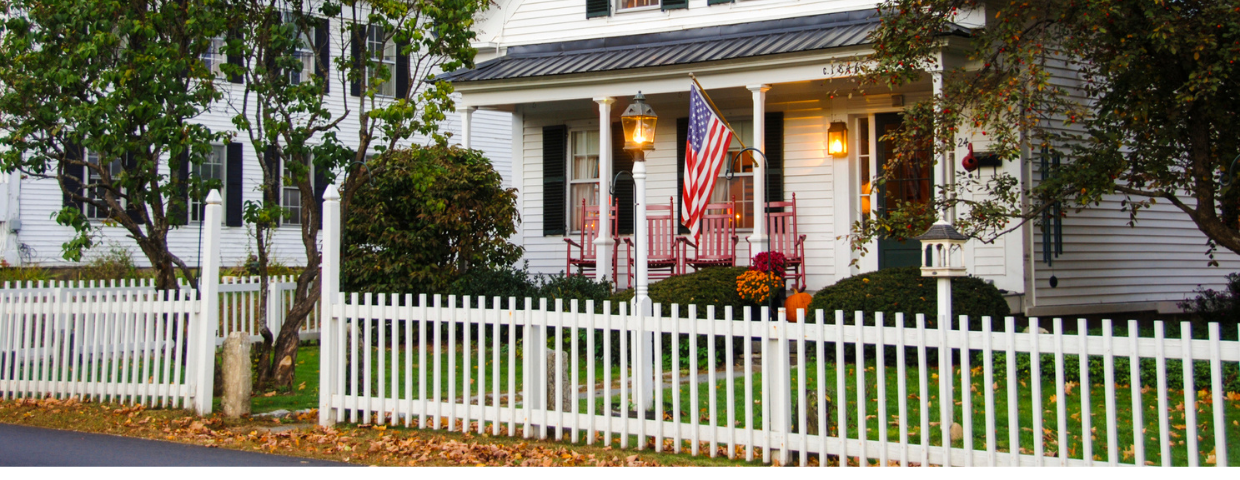
White picket fences, though traditional and simple in design, are effective. They are easy to maintain while complementing various home styles. Due to their sturdiness, they do well to keep pets in your yard and provide a safe designated area for them to roam. White picket fences reflect light and can make the colors in the shrubbery/plant life surrounding them pop. For the green thumbs that aspire to grow a flourishing garden, a white picket fence may be the perfect solution for magazine-quality grounds. However, with white picket fences, their strength is also their weakness. White is more prone to noticeable stains, meaning you can expect to set aside time for touch up painting at least once a year if you want to keep your fence purely white.

Wood Fences

There are many types of wood to pick from when choosing fencing. Local climate looms large in the decision-making process. It’s important to understand how the wood will hold up throughout the seasons and what kinds of treatments and/or stains are required to keep it from weathering. Wood fences work with many home styles. You’ll often see natural wood-colored fences used to reflect the aesthetic of Craftsman homes, while different paint colors and stains may be used to complement a more modern home style.

Different Types of Gates

Garden Gates

  • Ivy or Flower Archway: Use a simple wooden arch gate to allow flowers, ivy, or grape vines to grow along the gate creating a framed, lush entryway.
  • Vintage Gate: Use an old, wired gate to create a rustic vintage feel that leads to your personal garden.
  • Driftwood: Create your own gate by collecting wood or driftwood. You can then use twine, wire, or rope to create your own design.

 Driveway Gates

  • Security Gates: Using a security gate is one of the easiest ways to make your home safer and more secure.  There are many types of security gates, but steel provides protection without the need for much maintenance.  
  • Side Yard Gates: If you don’t have a driveway gate, consider getting a side yard gate for added security and privacy.
  • Ornate Gates: Ornate gates don’t always create privacy but can create a beautiful entryway while also offering more control over who has access to the property.

For more on home improvement, read our guide to home lighting: How to Find the Right Lighting for Your Home
Market News May 5, 2022

Q1 2022 Northern California Real Estate Market Update

The following analysis of select counties of the Northern California real estate market is provided by Windermere Real Estate Chief Economist Matthew Gardner. We hope that this information may assist you with making better-informed real estate decisions. For further information about the housing market in your area, please don’t hesitate to contact your Windermere Real Estate agent.


Regional Economic Overview

Northern California added 60,900 jobs in the first quarter of 2022, and 213,300 jobs have returned over the past year. With total employment now at 3.02 million, the markets covered by this report have recovered all but 24,800 of the 473,900 jobs lost during the pandemic. With solid growth in the region, the unemployment rate fell from 3.6% at the end of 2021 to 3.1% in March of this year. By county, the lowest jobless rate was in Santa Clara County (2.5%), and the highest rates were in Solano and Shasta counties, where 4.6% of the workforce remains unemployed. The region’s labor force grew in the quarter but remains below pre-pandemic levels. This is likely to mean that businesses will continue to find it hard to attract new employees, which could slow the pace of growth going forward. That said, I feel confident that all the jobs lost to COVID-19 will have been recovered by the spring.

Northern California Home Sales
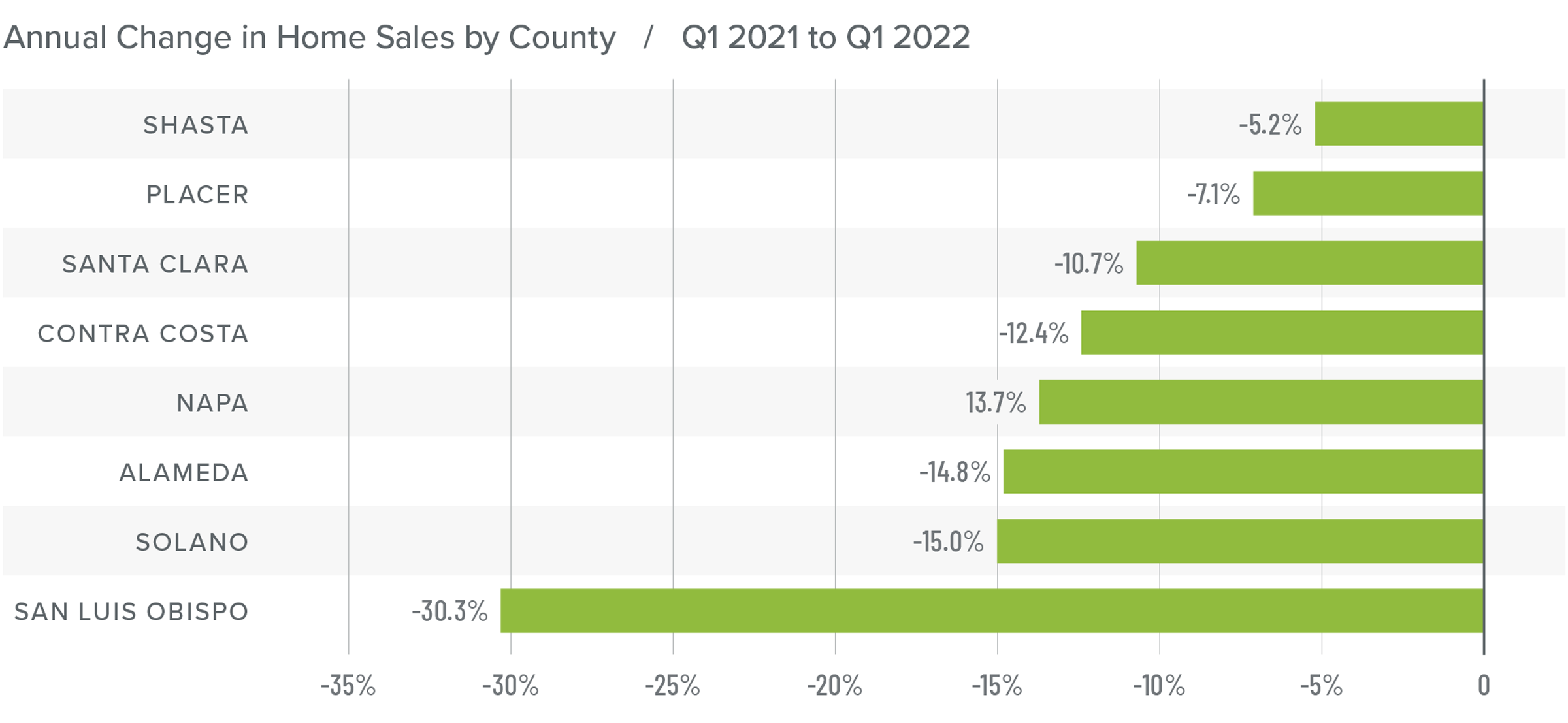
In the first quarter of the year, 10,347 homes sold, which is a drop of 12.4% compared to a year ago. Sales were 27.2% lower than in the fourth quarter of 2021.

Year over year, sales fell in all counties contained in this report. Solano County saw a modest drop, but there were fairly significant decreases across the rest of the region.

With listing activity rising 17% compared to the fourth quarter of 2021, the drop in sales was a little surprising.

Pending home sales ticked up from the final quarter of 2021, suggesting that we may see some growth in sales in the second quarter of this year.

A bar graph showing the annual change in home sales for various counties in Northern California between Q1 2021 and Q1 2022.

Northern California Home Prices
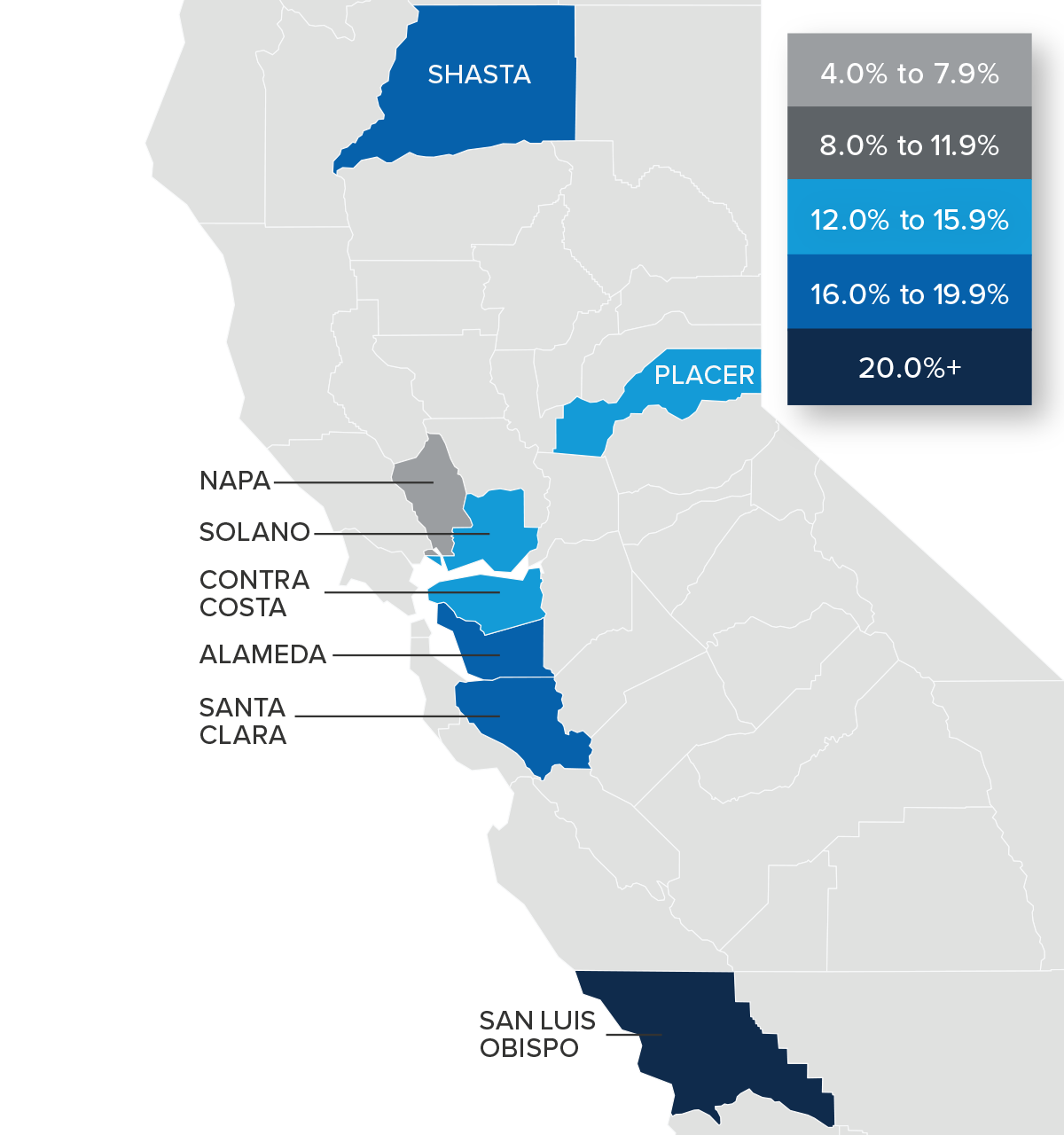
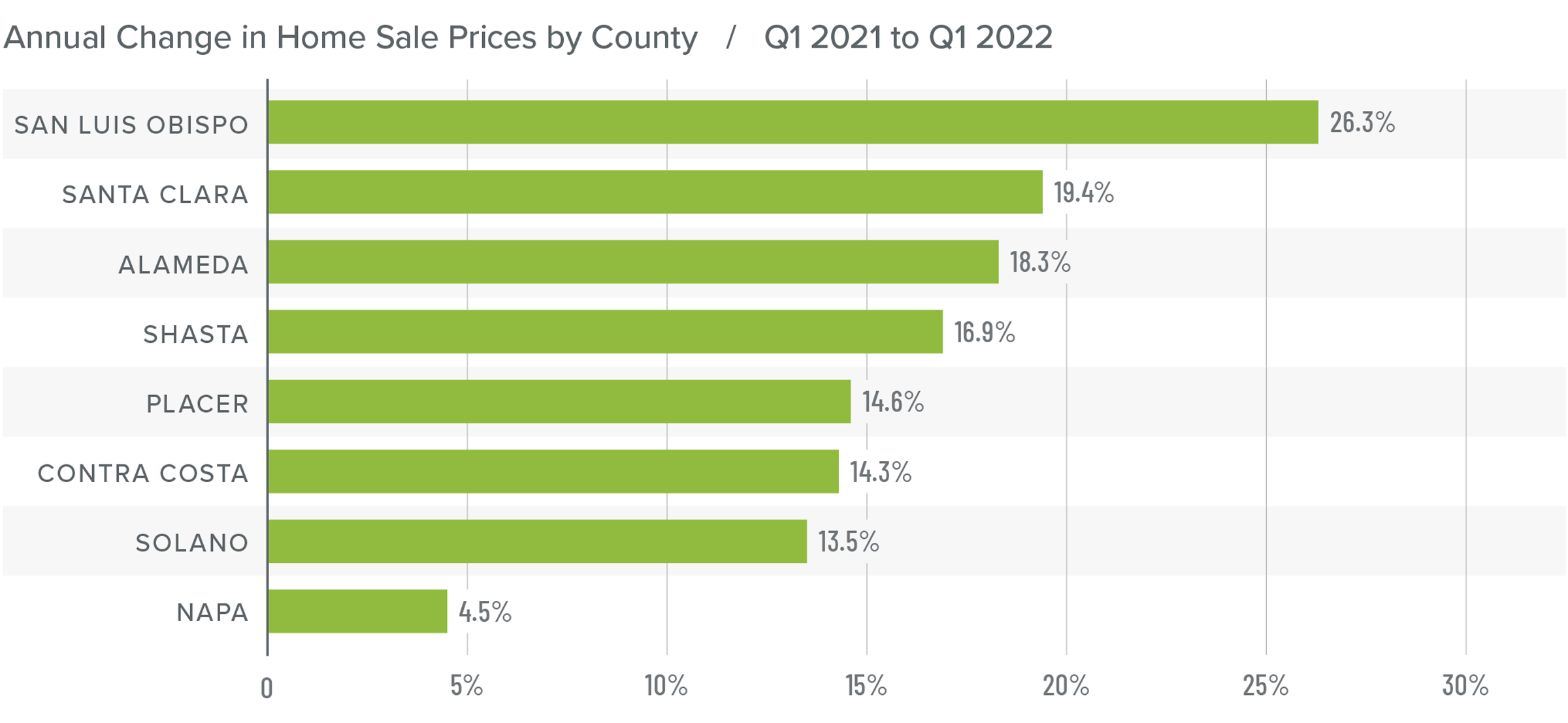
Even with sales pulling back, the average home price in the region rose an impressive 17.2% year over year to $1.215 million. Compared to the final quarter of 2021, home prices rose 4%.

The most affordable county relative to average prices continued to be Shasta. Santa Clara was again the most expensive market.

Prices rose by double digits in all counties other than Napa compared to a year ago. Prices were also higher everywhere but Napa County compared to the fourth quarter of 2021.

Rising prices continue to impact affordability in the region and the significant jump in mortgage rates in the first quarter will not help matters. Any effects of rising rates on prices were not evident in the first quarter, but the second quarter should be more telling.

A map showing the year-over-year real estate market percentage changes in various counties in Northern California for Q1 2022.

A bar graph showing the annual change in home sale prices for various counties in Northern California from Q1 2021 to Q1 2022.

Mortgage Rates

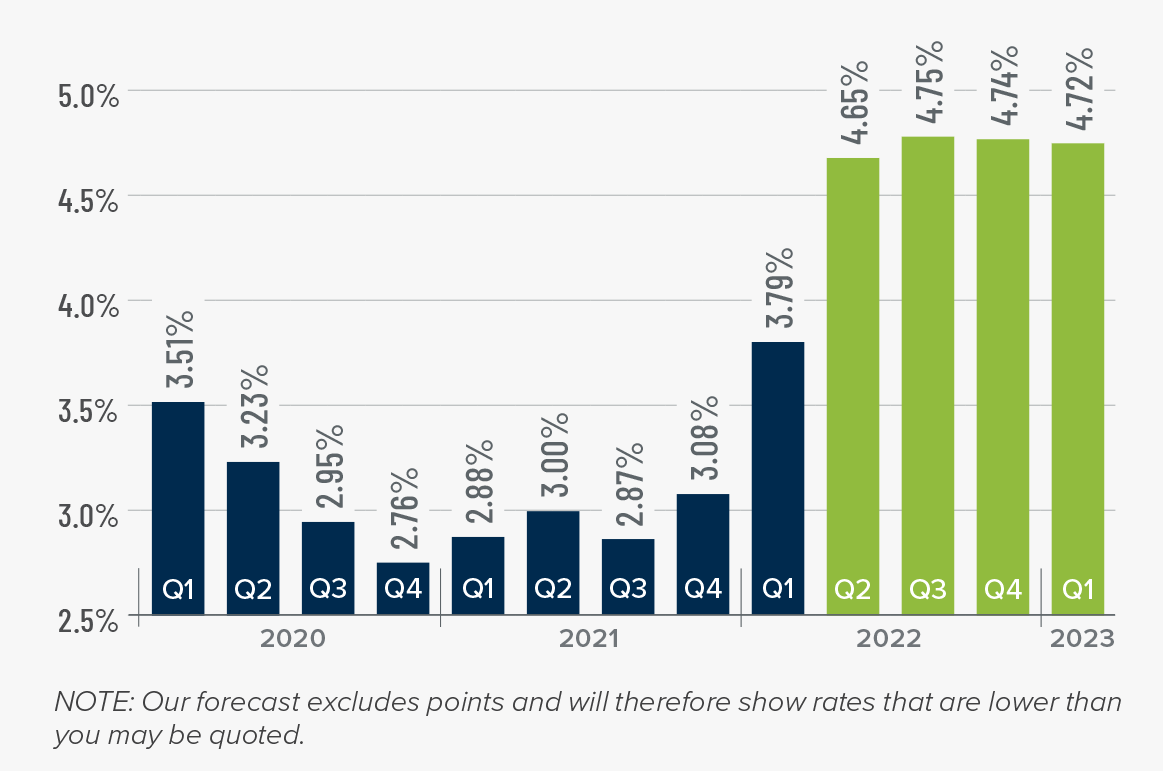
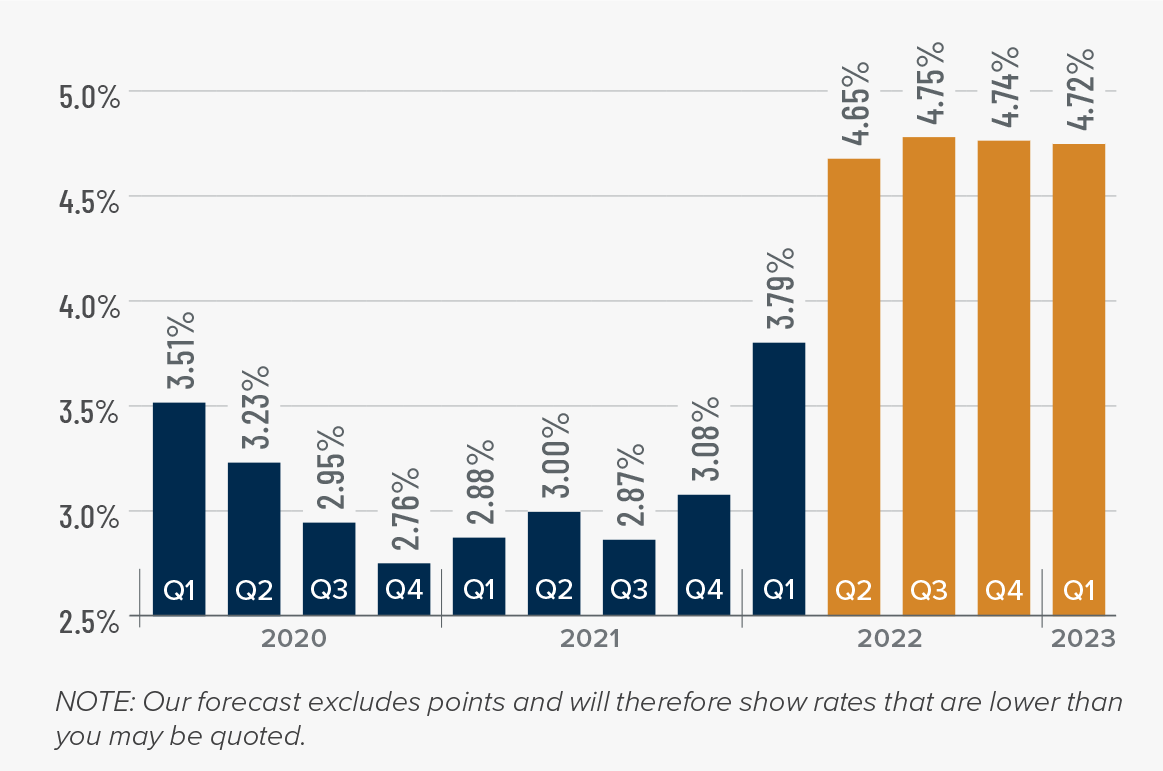
Average rates for a 30-year conforming mortgage were 3.11% at the end of 2021, but since then have jumped over 1.5%—the largest increase since 1987. The speed of the surge in rates is due to the market having quickly priced in the seven-to-eight rate increase that the Fed is expected to implement this year.

Because the mortgage market has priced this into the rates they are offering today, my forecast suggests that we are getting close to a ceiling in rates, and it is my belief that they will rise modestly in the second quarter before stabilizing for the balance of the year.

A bar graph showing the average rates for a 30-year conforming mortgage, plus Matthew Gardner's mortgage rate forecasts for Q2 2022 through Q1 2023.

Northern California Days on Market

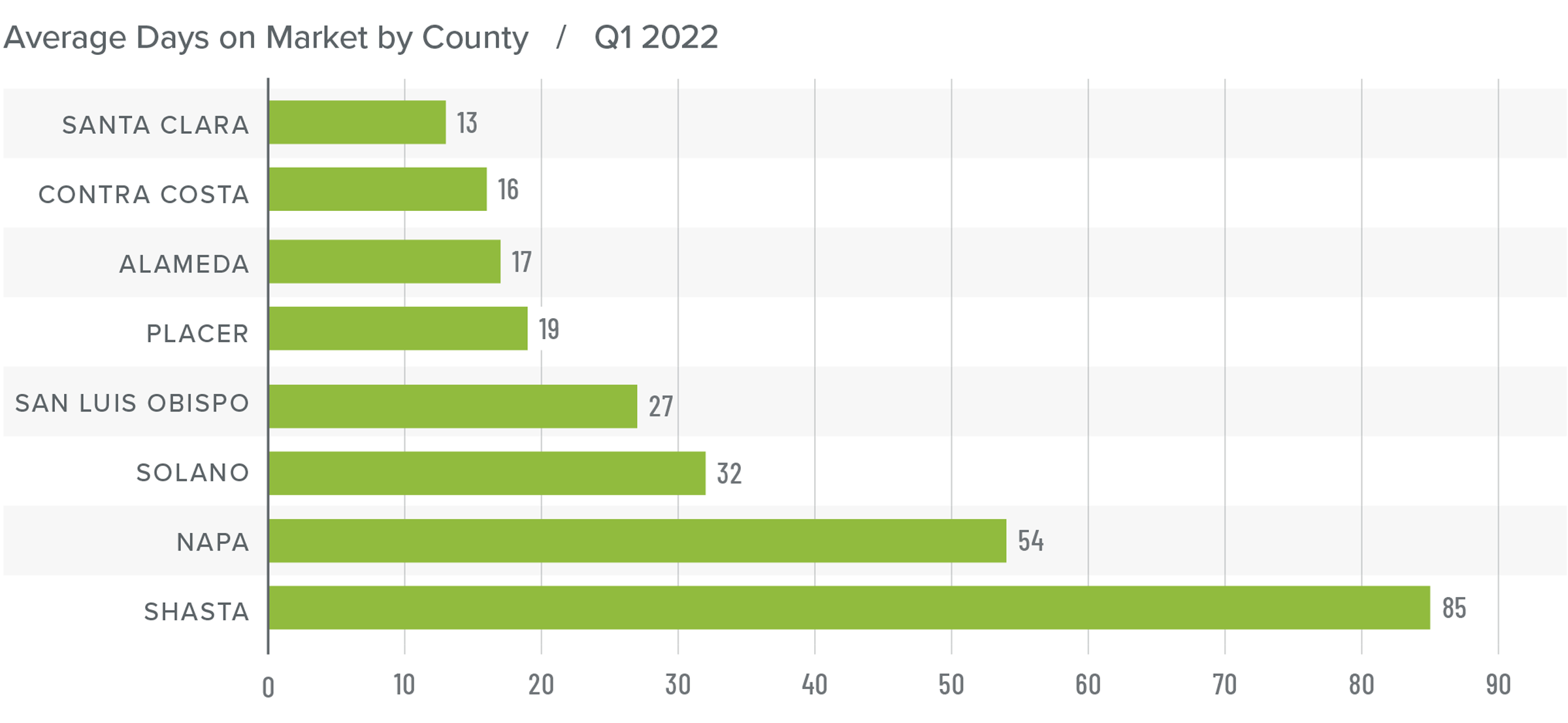
The average time it took to sell a home in the Northern California counties in this report dropped seven days compared to the first quarter of 2021.

The amount of time it took to sell a home dropped in every county other than Solano (+1 day) compared to a year ago. Days on market fell everywhere except Shasta, Placer, and San Luis Obispo compared to the fourth quarter of 2021.

In the first quarter, it took an average of 33 days to sell a home, which matched the fourth quarter of 2021.

The greatest drop in market time from a year ago was in Napa County, where it took 14 fewer days to sell a home.

A bar graph showing the average days on market for homes in various counties in Northern California during Q1 2022.

Conclusions

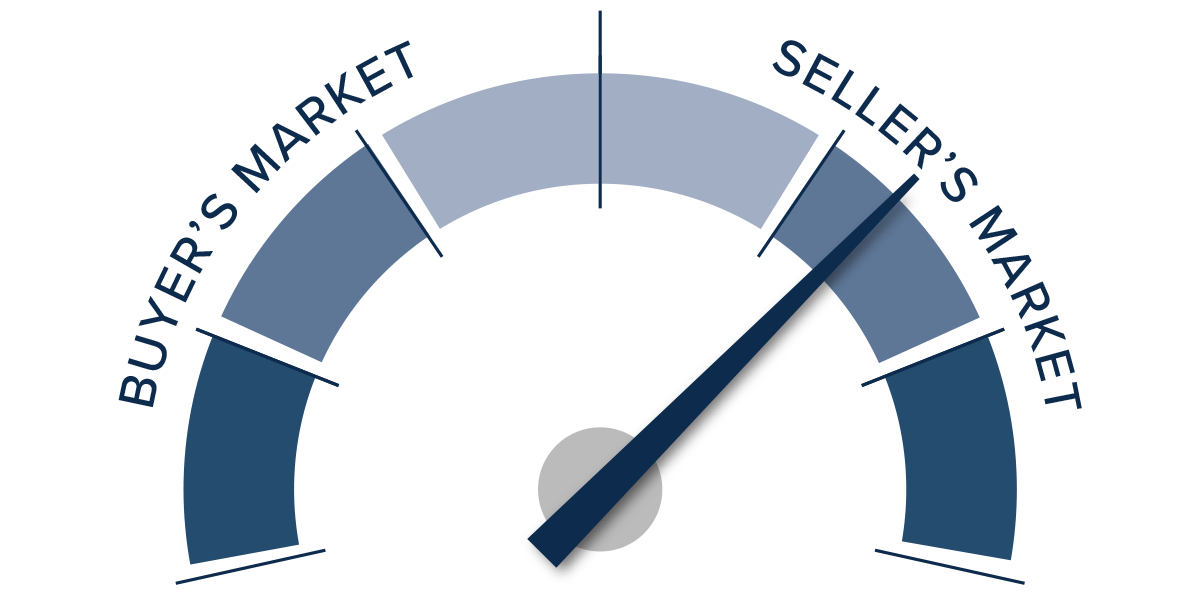
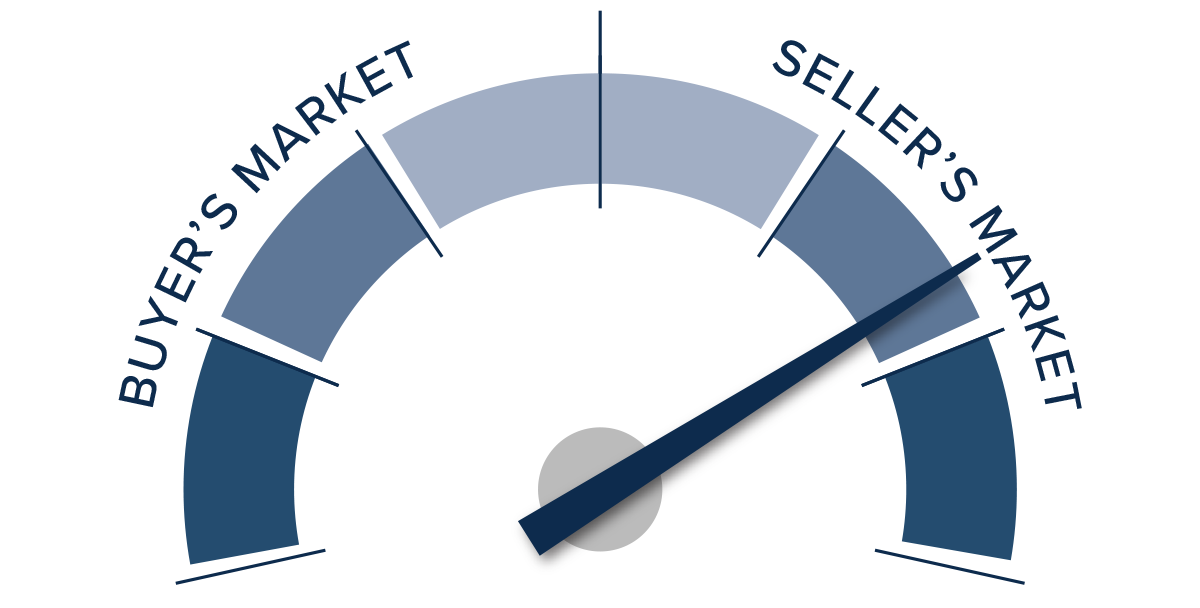
This speedometer reflects the state of the region’s real estate market using housing inventory, price gains, home sales, interest rates, and larger economic factors.

The jump in home prices compared to the prior quarter may be a surprise to some given the rapid increase in mortgage rates. However, when rates rise, there is typically a lag in time before we know the impact on the market. The increase in the number of homes for sale means there is more choice for buyers which, combined with higher financing costs, should start to taper the pace of price appreciation as we move into the spring buying season. Affordability continues to be a concern, but the market does not appear to be overly affected thus far. Average listing prices in most counties are increasing, which suggests that sellers remain confident for the time being.

A speedometer graph indicating a seller's market in Northern California during Q1 2022.

Although prices continue to increase at a significant pace, the growth in listing activity combined with lower sales may suggest that the market may be starting to slow from the frenetic pace of the past few years. With all the data here, I have moved the needle a little towards home buyers, although it clearly remains a seller’s market.

About Matthew Gardner

Matthew Gardner - Chief Economist for Windermere Real Estate

As Chief Economist for Windermere Real Estate, Matthew Gardner is responsible for analyzing and interpreting economic data and its impact on the real estate market on both a local and national level. Matthew has over 30 years of professional experience both in the U.S. and U.K.

In addition to his day-to-day responsibilities, Matthew sits on the Washington State Governors Council of Economic Advisors; chairs the Board of Trustees at the Washington Center for Real Estate Research at the University of Washington; and is an Advisory Board Member at the Runstad Center for Real Estate Studies at the University of Washington where he also lectures in real estate economics.

Living May 4, 2022

Tips For Emergency Preparedness

With homeownership comes the responsibility of having to plan ahead for life’s unknowns. Emergencies come in many forms, depending on your local climate. So whether its more likely that you and your household need to prepare for the potential of a wildfire, a flood, or a winter storm, it’s crucial to have resources on hand to limit the damage to your home and to protect your household.

Tips for Emergency Preparedness

A good place to start when putting together your emergency kit is to compile basic resources you and your household will need to support yourselves outside of your home. Keep all items together in an easily accessible location. The general rule is to have at least one gallon of water per person, per day. This is useful for drinking, food preparation, and general hygiene. The Red Cross suggests keeping a two week’s supply of water at your home and three days worth in the case of evacuation. The following information is based on the American Red Cross’s emergency preparedness website.

What to include in your home emergency kit

  • A two-week supply of non-perishable food that is easy to prepare
  • Flashlight and extra batteries
  • Battery-powered or hand-crank radio
  • 2 absorbent compress dressings (5 x 9 inches)
  • 25 adhesive bandages (assorted sizes)
  • 1 adhesive cloth tape (10 yards x 1 inch)
  • 5 antibiotic ointment packets (approximately 1 gram)
  • 5 antiseptic wipe packets
  • 2 packets of aspirin (81 mg each)
  • 1 blanket (space blanket)
  • 1 breathing barrier (with one-way valve)
  • 1 instant cold compress
  • 2 pair of non-latex gloves
  • 2 hydrocortisone ointment packets (approximately 1 gram each)
  • Scissors
  • 1 roller bandage (3 inches wide)
  • 1 roller bandage (4 inches wide)
  • 5 sterile gauze pads (3 x 3 inches)
  • 5 sterile gauze pads (4 x 4 inches)
  • Oral thermometer (non-mercury/non-glass)
  • 2 triangular bandages
  • Tweezers
  • First aid instruction booklet

To-Go Bag

Keep a to-go bag on hand to ensure that you and your household have easy access to essential items such as medication, toiletries, chargers, cash, and more. 

  • If you or family members have medications, make sure you have at least a seven day supply
  • Multi-purpose tool (Swiss army knife)
  • Sanitation and personal hygiene items
  • Hand sanitizer
  • Toothbrushes and toothpaste
  • Personal wipes       

Personal documents

  • Copies of personal documents (medication list and pertinent medical information, proof of address, deed/lease to home, passports, birth certificates, insurance policies)
  • Family and emergency contact information
  • Extra cash
  • Extra cell phone chargers
  • Emergency blanket(s)

Car Kit

In the case of an evacuation or car emergency you should have a supply kit that can last up to three days.

  • A three-day supply of water in the case of an evacuation (one gallon per person per day)
  • Three days’ worth of non-perishable food
  • First aid kit
  • Flashlight with extra batteries
  • Extra phone charger
  • Emergency blanket
  • Map of your area

Pets

If you have pets, you will want to pack additional supplies to ensure their safety in the event of an emergency. It’s a good idea to have a week’s worth of food for each pet, a gallon of water per day, medication on hand, an additional leash, a crate, and any relevant sanitation materials (pet bags, litter, etc.).

Keeping Your Sanity

If you have small children, you may want to include activities for them to stay occupied without the help of electricity. Small games, coloring books and supplies, and other items can be stashed in the emergency kit to keep the family occupied.

For more information on preparing for potential emergencies and disasters, read our blog post about preparing for a fire at home. 

How to Prepare for a Fire at Home

Market News May 4, 2022

Q1 2022 Nevada Real Estate Market Update

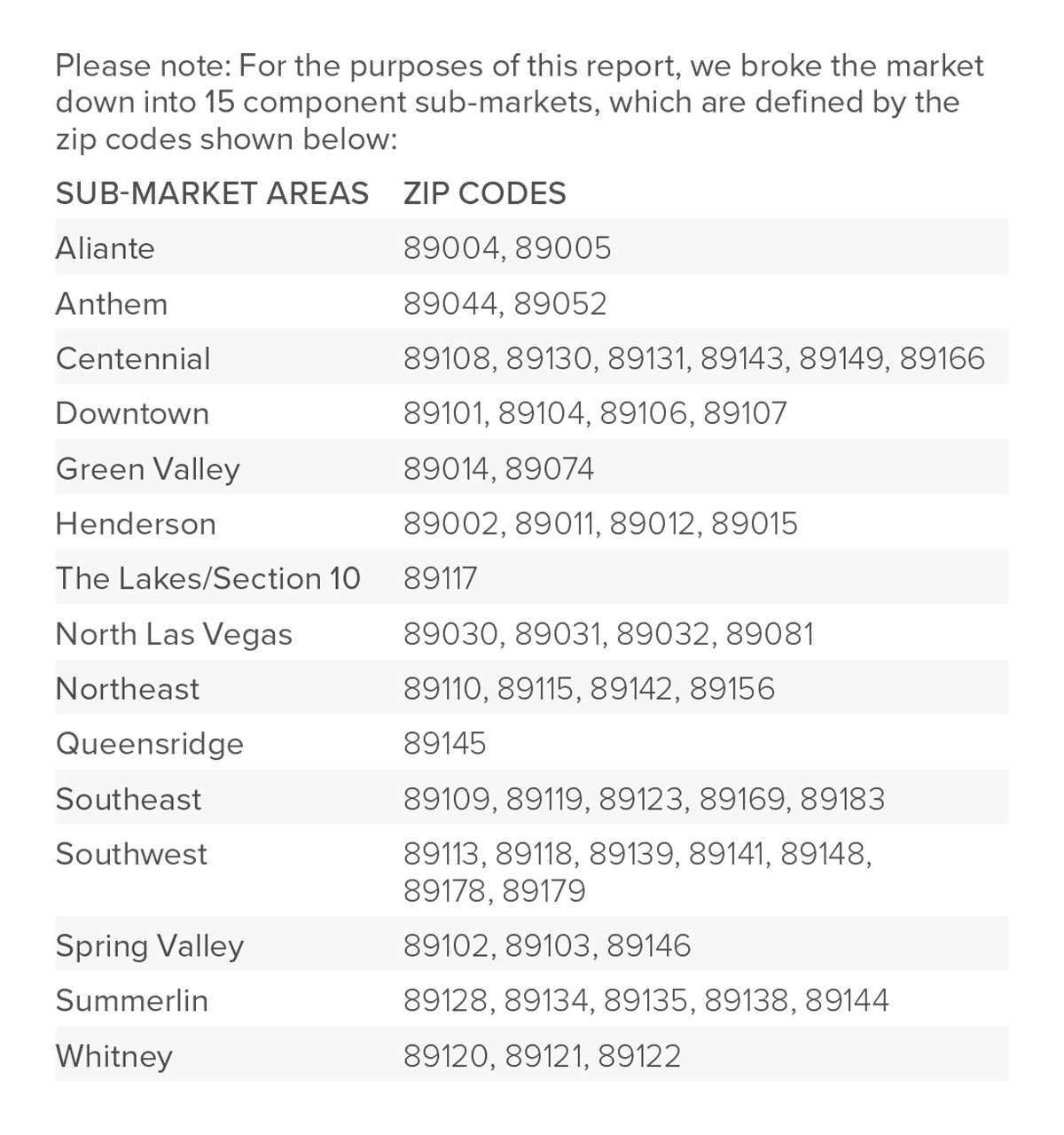
The following analysis of select counties of the greater Las Vegas real estate market is provided by Windermere Real Estate Chief Economist Matthew Gardner. We hope that this information may assist you with making better-informed real estate decisions. For further information about the housing market in your area, please don’t hesitate to contact your Windermere Real Estate agent.


Regional Economic Overview

Jobs continue to return to the Las Vegas market and the area has now recovered all but 13,100 of the 287,000 jobs that were lost during the pandemic. With almost 10,000 jobs added per month over the past year, I am hopeful that the area will return to preCOVID employment levels by spring. With rising employment, the jobless rate continues to drop. The latest data shows an unemployment rate of 5.3%, which is well below the pandemic-induced rate of 31.1%. If there is cause for concern, it is that the labor force remains at pre-pandemic levels. If employers are unable to find qualified workers, the pace of the job recovery may start to slow. As the country moves toward “post-COVID” life, I expect that leisure travel will continue to increase, which would be very good for a hospitality-driven market such as Las Vegas. This will certainly aid in the overall economic recovery in the region.

Nevada Home Sales

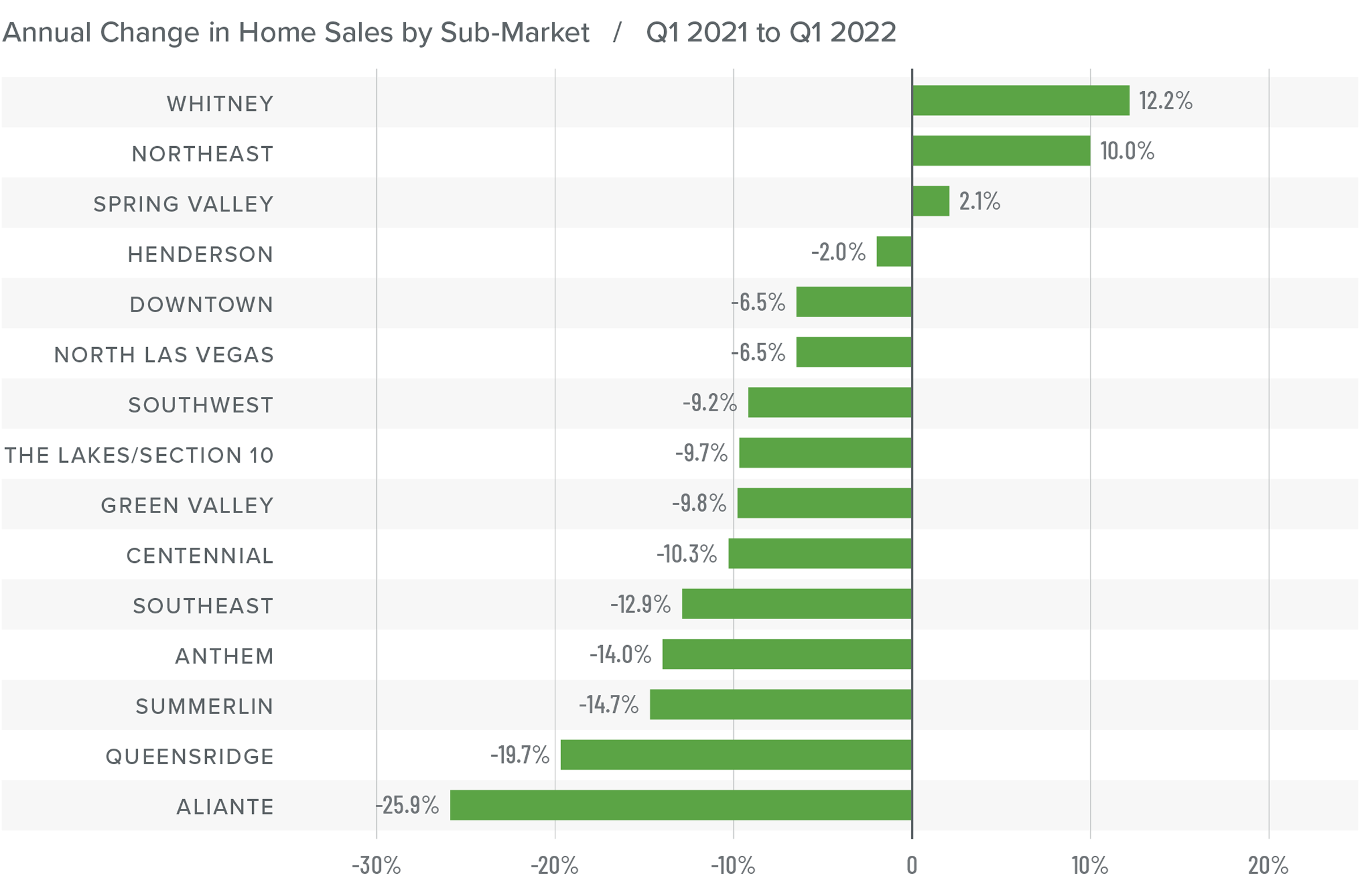
A total of 9,122 homes sold in the first quarter of the year—a drop of 7.3% compared to the same period a year ago. Sales were 10.8% lower than in the fourth quarter of 2021.

Sales rose in three of the neighborhoods contained in this report but dropped in all other areas compared to the first quarter of 2021. Compared to the previous quarter, all neighborhoods saw fewer sales.

Supply constraints persist, which is limiting sales. The average number of homes for sale was down 20% year over year and down an even more substantial 31% compared to the final quarter of 2021.

Pending sales, which are an indicator of future closings, increased 1.6% compared to the prior quarter, suggesting that closings in the second quarter of 2022 may show very slight improvement from the current numbers.

A bar graph showing the annual change in home sales for various areas in Greater Las Vegas, Nevada between Q1 2021 and Q1 2022.

Nevada Home Prices

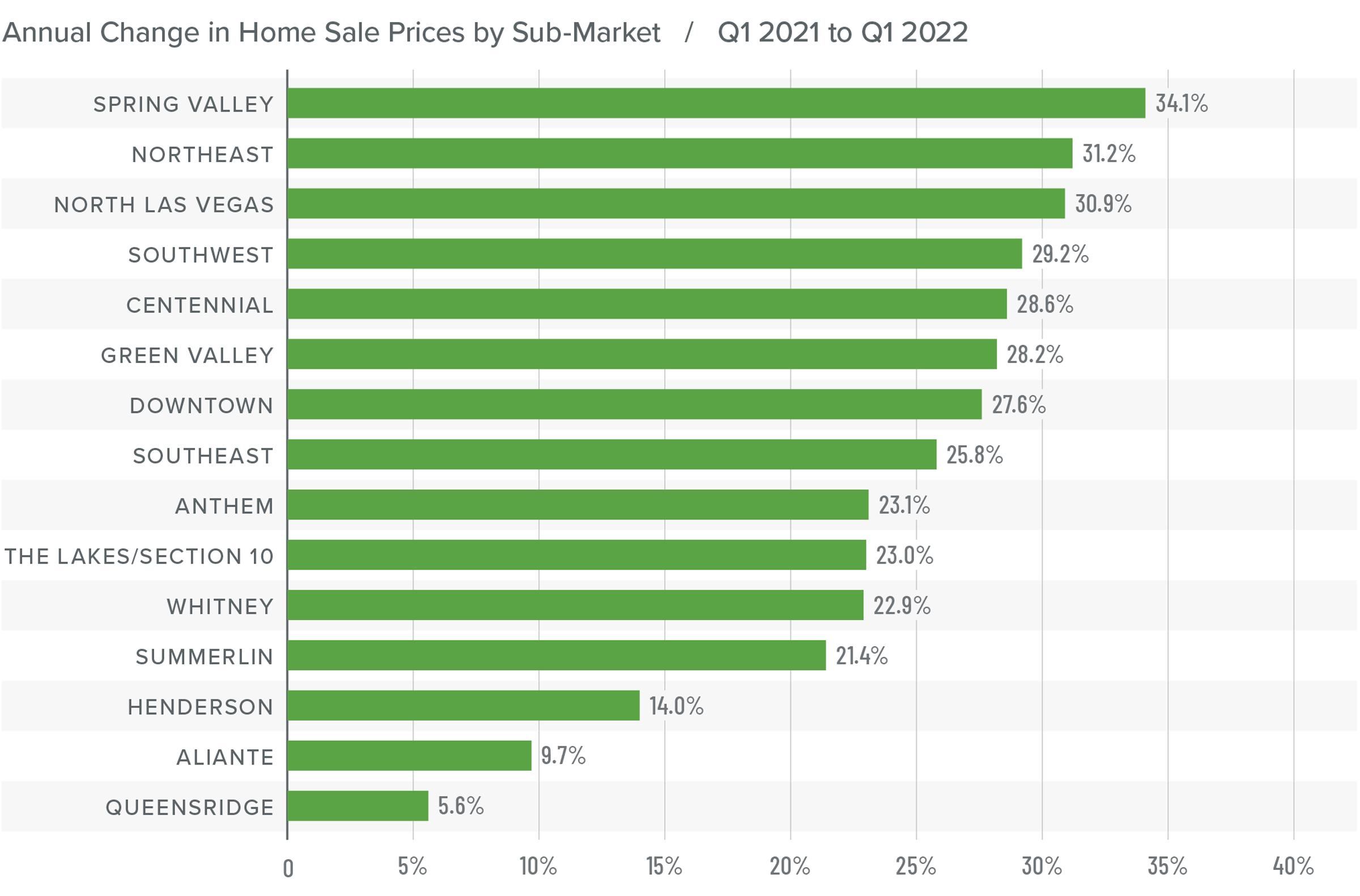
Home prices rose 23% from a year ago to an average of $485,820 and were 5.8% higher than in the fourth quarter of 2021.

I consider listing prices to be a leading indicator for shifts in the market. That they continue to trend higher suggests that sellers remain very confident that the market will be able to accommodate the higher financing costs buyers are facing.

Prices rose by double digits in all but two neighborhoods compared to the same quarter last year and rose in all markets other than Aliante compared to the fourth quarter of 2021.

The data suggests that rising mortgage rates have not impacted the market yet, but there is normally a lag between rising rates and any effect on prices or demand. The market clearly has more buyers than sellers, but it will be interesting to see if prices continue to rise at their current pace in the face of higher financing costs.

A map showing the year-over-year real estate market percentage changes in various areas of Greater Las Vegas, Nevada for Q1 2022.

A bar graph showing the annual change in home sale prices for various areas of Greater Las Vegas, Nevada from Q1 2021 to Q1 2022.

Mortgage Rates

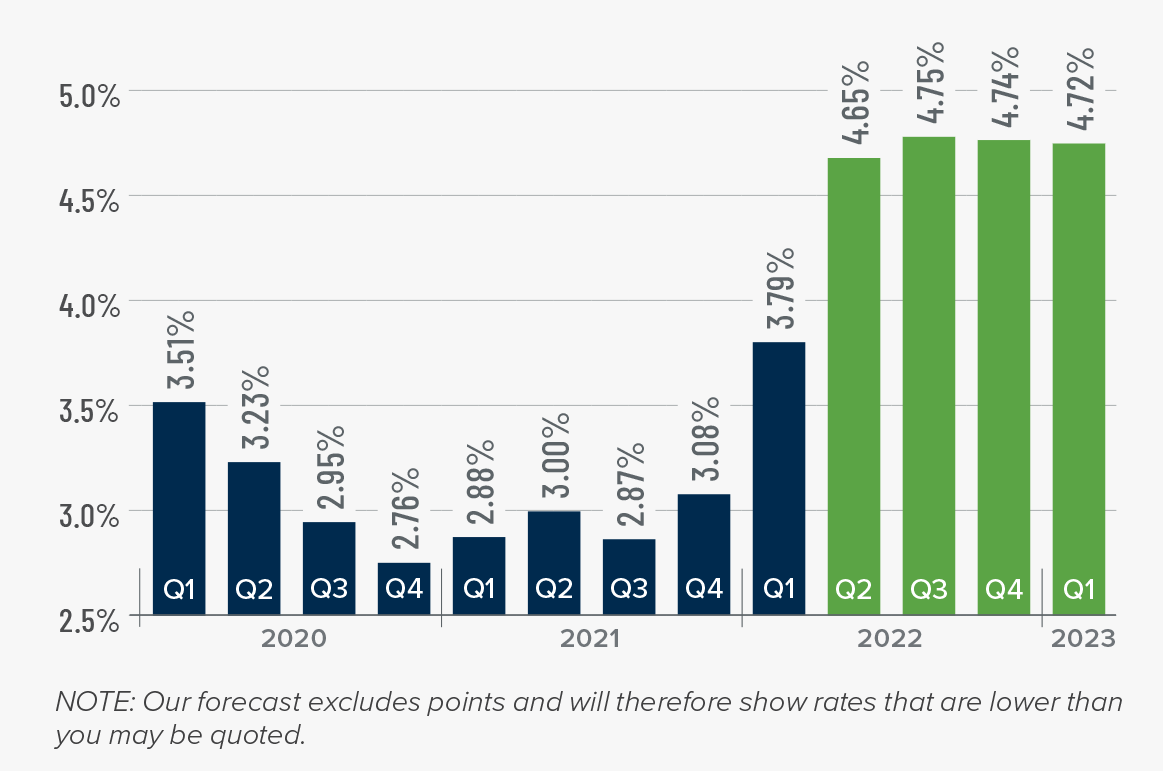
Average rates for a 30-year conforming mortgage were 3.11% at the end of 2021, but since then have jumped over 1.5%—the largest increase since 1987. The speed of the surge in rates is due to the market having quickly priced in the seven-to-eight rate increase that the Fed is expected to implement this year.

Because the mortgage market has priced this into the rates they are offering today, my forecast suggests that we are getting close to a ceiling in rates, and it is my belief that they will rise modestly in the second quarter before stabilizing for the balance of the year.

A bar graph showing the average rates for a 30-year conforming mortgage, plus Matthew Gardner's mortgage rate forecasts for Q2 2022 through Q1 2023.

Nevada Days on Market

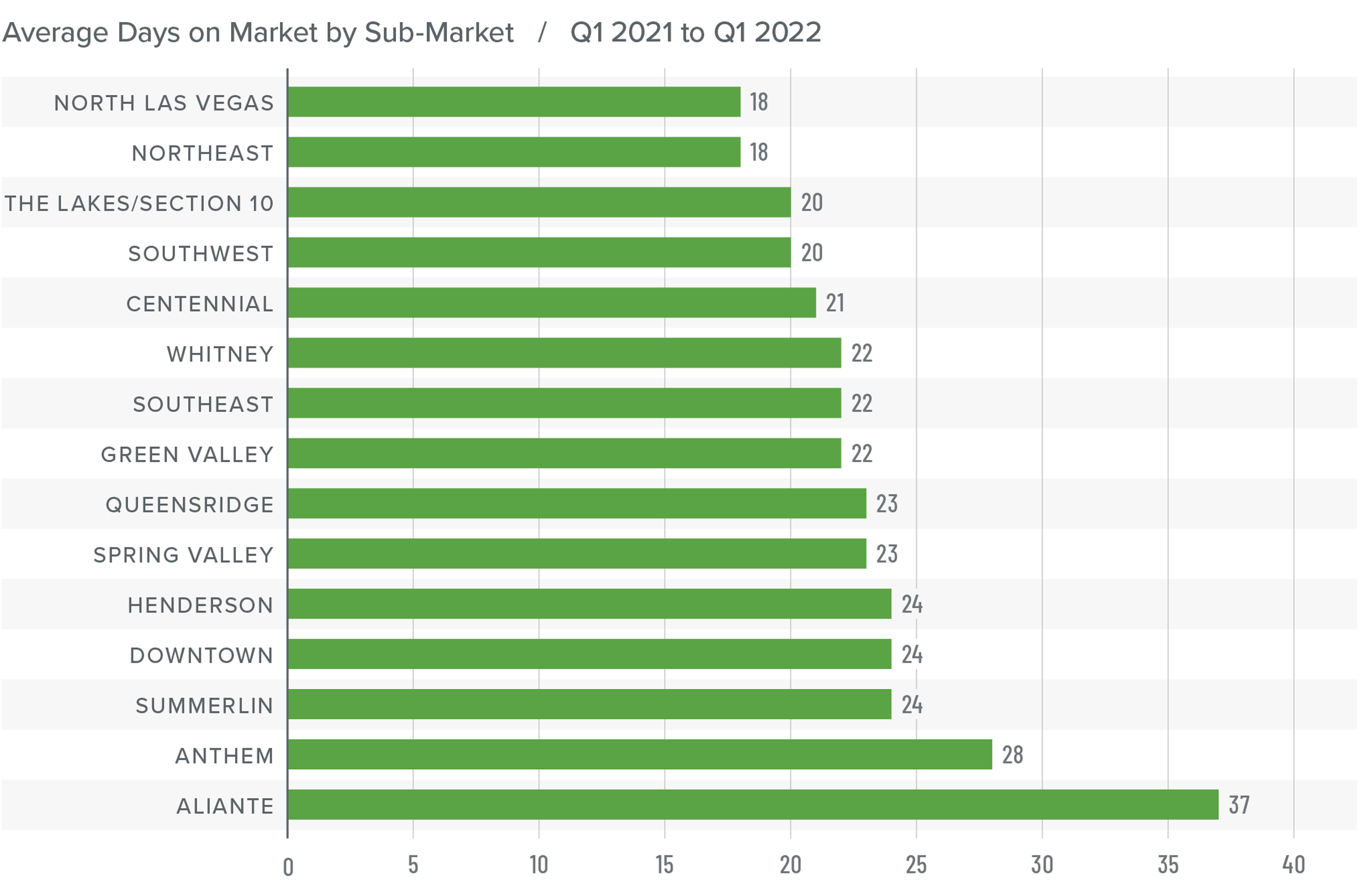
The average time it took to sell a home in the region dropped 16 days compared to the first quarter of 2021.

It took an average of 23 days to sell a home in the quarter, which matched the average market time in the fourth quarter of 2021.

Days-on-market dropped across the board compared to a year ago, but rose in Aliante, The Lakes/Section 10, Southeast and Southwest Las Vegas, Spring Valley, and Northeast Las Vegas compared to the prior quarter.

The greatest drop in market time was in The Lakes/ Section 10 neighborhood, where the length of time it took to sell a home fell 33 days compared to a year ago.

A bar graph showing the average days on market for homes in various areas of Greater Las Vegas, Nevada during Q1 2022.

Conclusions

This speedometer reflects the state of the region’s real estate market using housing inventory, price gains, home sales, interest rates, and larger economic factors.

The local economy appears to be picking up momentum, which typically translates into demand for housing. As mentioned earlier, if there are impacts to sales or prices from rising mortgage rates, we will likely see signs of this in the next two quarters. With supply levels as low as they are, rising financing costs may not slow the market significantly. Housing affordability continues to fall as price growth rises. This, combined with higher mortgage rates, should temper the market, though it hasn’t yet. It might seem intuitive to move the needle a little toward home buyers, but the numbers don’t justify it.

A speedometer graph indicating a seller's market in Greater Las Vegas, Nevada during Q1 2022.

All things considered, I have left the needle in the same position as the last quarter. There are too many uncertainties that preclude me from moving it one way or another. Hopefully the spring will provide more clarity.

About Matthew Gardner

Matthew Gardner - Chief Economist for Windermere Real Estate

As Chief Economist for Windermere Real Estate, Matthew Gardner is responsible for analyzing and interpreting economic data and its impact on the real estate market on both a local and national level. Matthew has over 30 years of professional experience both in the U.S. and U.K.

In addition to his day-to-day responsibilities, Matthew sits on the Washington State Governors Council of Economic Advisors; chairs the Board of Trustees at the Washington Center for Real Estate Research at the University of Washington; and is an Advisory Board Member at the Runstad Center for Real Estate Studies at the University of Washington where he also lectures in real estate economics.

Market News May 4, 2022

Q1 2022 Utah Real Estate Market Update

The following analysis of select counties of the Utah real estate market is provided by Windermere Real Estate Chief Economist Matthew Gardner. We hope that this information may assist you with making better-informed real estate decisions. For further information about the housing market in your area, please don’t hesitate to contact your Windermere Real Estate agent.


Regional Economic Overview

The Utah economy continues to impress, with total employment up 3.8% year over year. Of greater significance: current employment levels are now 78,600 higher than the pre-pandemic peak. The counties covered by this report added almost over 48,400 new jobs over the past year, representing a growth rate of 3.7%. Thanks to the state’s robust economy, the unemployment rate dropped to 2%, which is the lowest level recorded since the Labor Department started keeping records in 1976. Moreover, this remarkably low level of unemployment comes while the labor force rose above the 1.7 million mark—a level never before seen.

Utah Home Sales

In the first quarter of 2022, 6,493 homes were sold, which is a drop of 7.5% year over year. There were 29.1% fewer sales than in the fourth quarter of 2021.

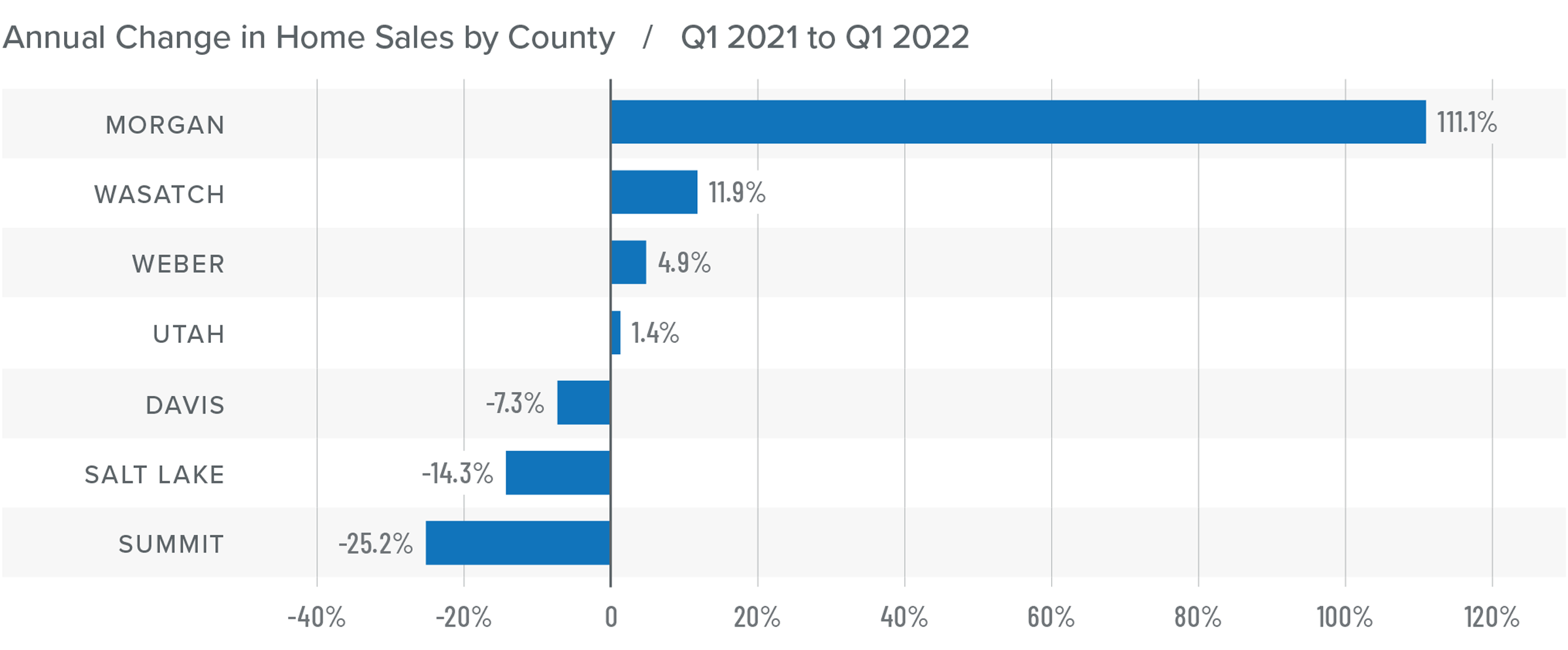
Year over year, sales rose in four of the seven counties contained in this report, but fell in the balance of the region.

Inventory levels remain well below the average, which is clearly limiting sales. The number of homes for sale was down 30.9% from the previous quarter, and down 5.6% from the same period a year ago.

Pending sales, which are an indicator of future closings, fell 9.2% from the final quarter of 2021, suggesting that second quarter closings may remain below average.

A bar graph showing the annual change in home sales for various counties in Utah between Q1 2021 and Q1 2022.

Utah Home Prices

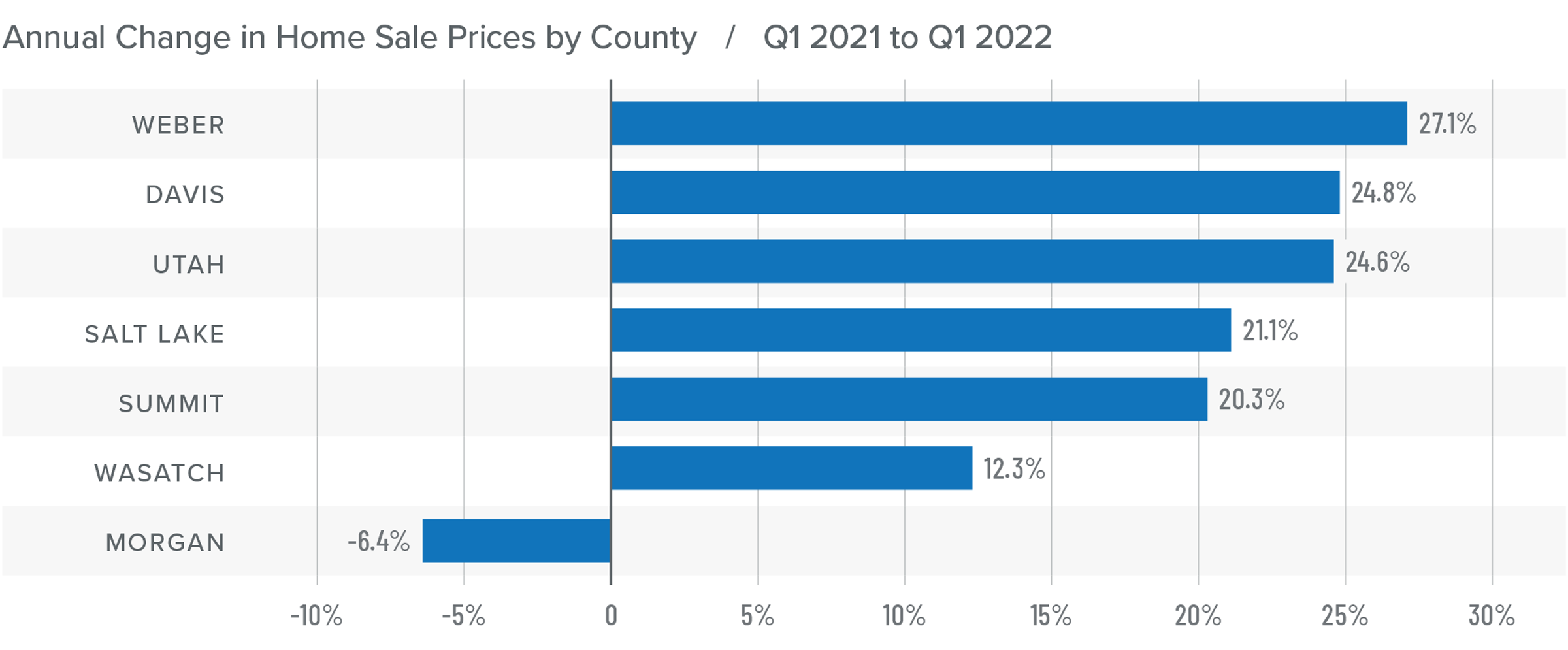
With more demand than supply, it wasn’t surprising that home prices picked up. Year over year, prices rose 19.5% to an average of $639,131. Prices were 6.1% higher than in the fourth quarter of 2021.

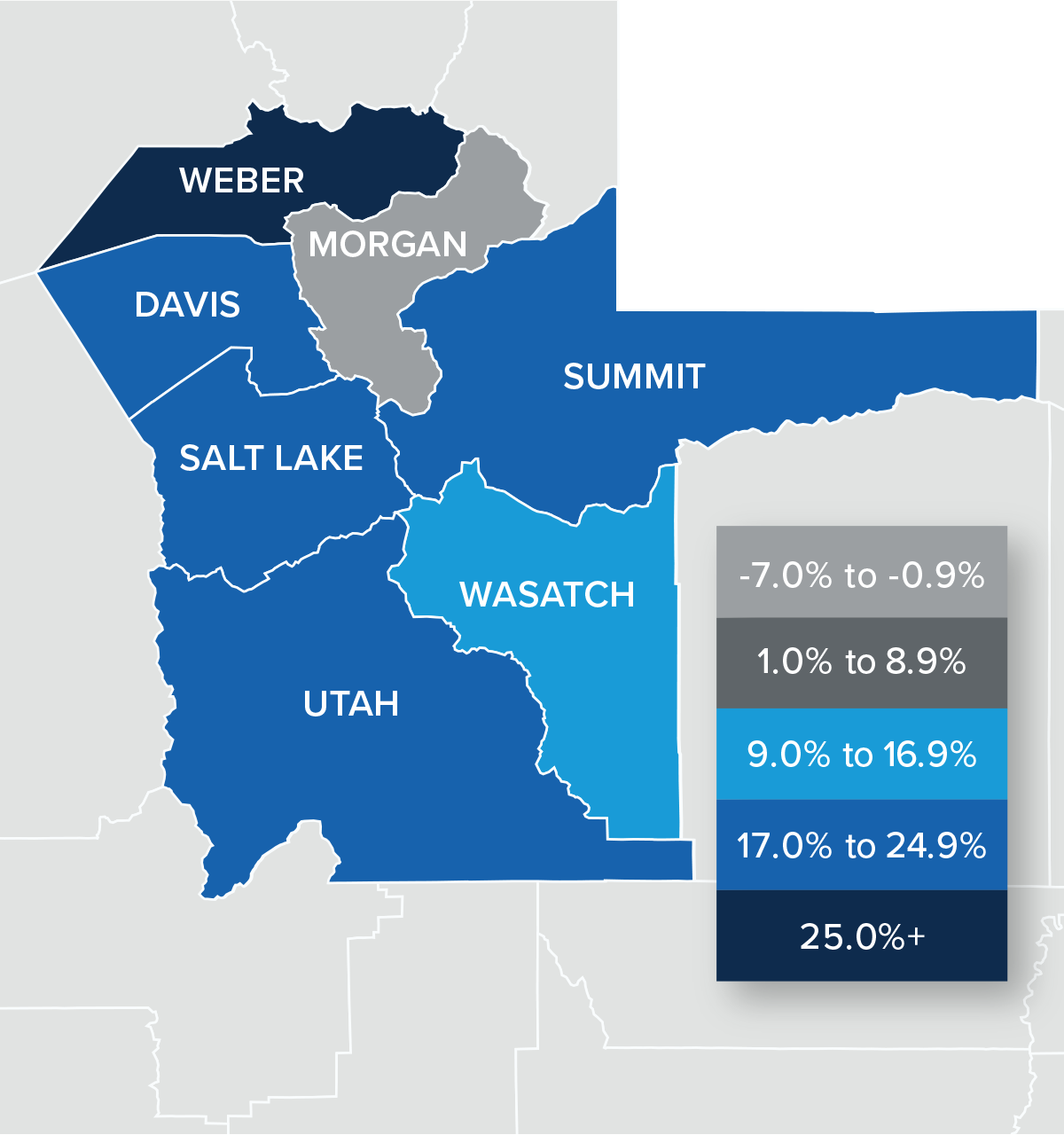
Compared to the final quarter of last year, prices rose in all counties other than Morgan, with Summit County jumping more than 20%.

All areas contained in the report except for Morgan County saw prices increase by double digits. The pullback in Morgan County is not a concern given that it is a very small market.

Mortgage rates increased in the first quarter but, as there is normally a lag between rising financing costs and their impact on sales or prices, it’s too early to tell if the market will experience any slowing. We will have a better idea in the second quarter report.

A map showing the year-over-year real estate market percentage changes in various counties in Utah for Q1 2022.

A bar graph showing the annual change in home sale prices for various counties in Utah from Q1 2021 to Q1 2022.

Mortgage Rates

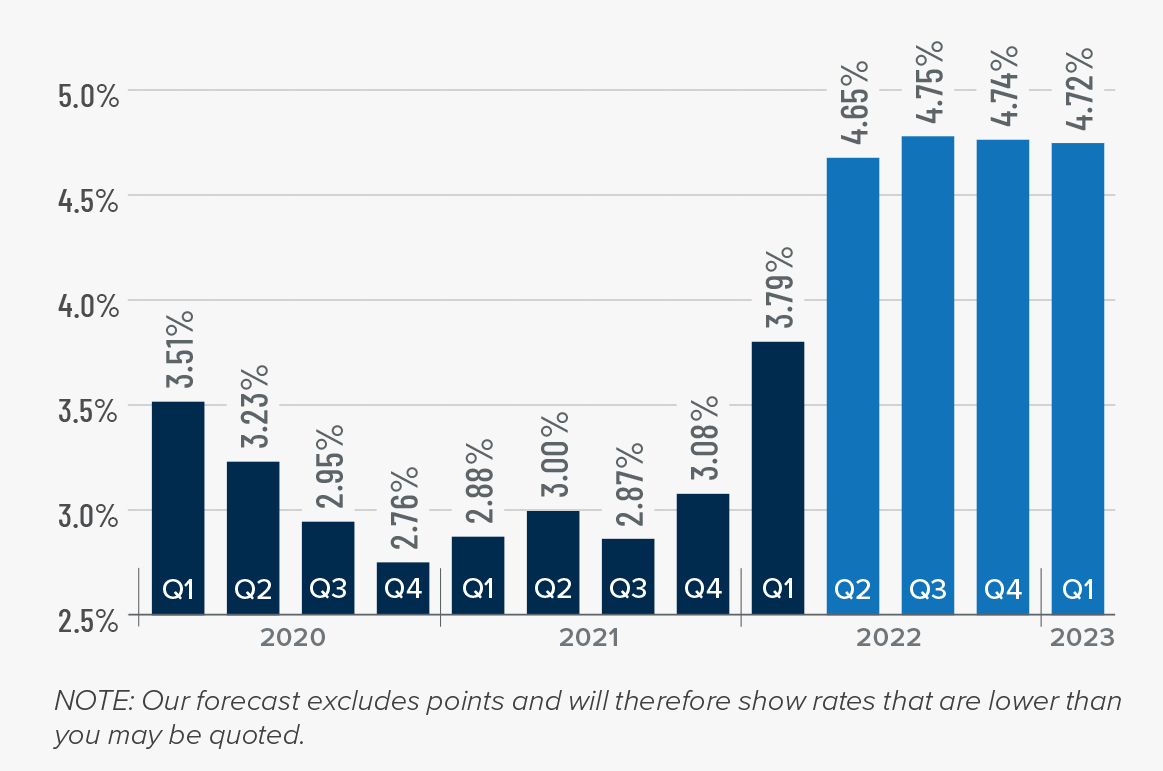
Average rates for a 30-year conforming mortgage were 3.11% at the end of 2021, but since then have jumped over 1.5%—the largest increase since 1987. The speed of the surge in rates is due to the market having quickly priced in the seven-to-eight rate increase that the Fed is expected to implement this year.

Because the mortgage market has priced this into the rates they are offering today, my forecast suggests that we are getting close to a ceiling in rates, and it is my belief that they will rise modestly in the second quarter before stabilizing for the balance of the year.

A bar graph showing the average rates for a 30-year conforming mortgage, plus Matthew Gardner's mortgage rate forecasts for Q2 2022 through Q1 2023.

Utah Days on Market

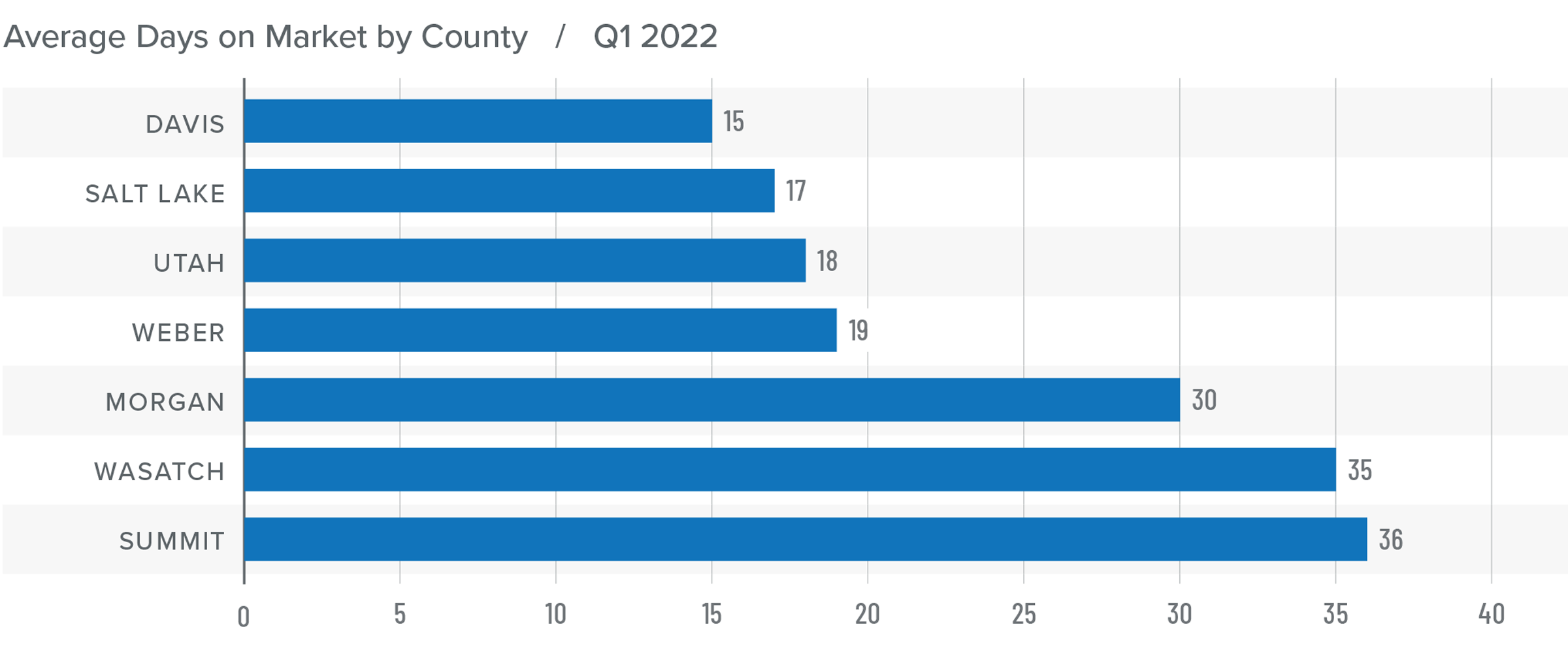
The average time it took to sell a home in the counties covered by this report dropped eight days compared to the first quarter of 2021.

Homes again sold fastest in Davis County, and market time dropped in all but three counties compared to a year ago. The greatest decline in market time was in Summit County, where it took 31 fewer days to sell a home.

During first quarter, it took an average of 24 days to sell a home in the region. Market time fell year over year. It also took 4 fewer days for a home to sell than in the final quarter of last year.

With days on market dropping across the board compared to the prior quarter, it’s clear that there is significant demand for the few homes that are available.

A bar graph showing the average days on market for homes in various counties in Utah during Q1 2022.

Conclusions

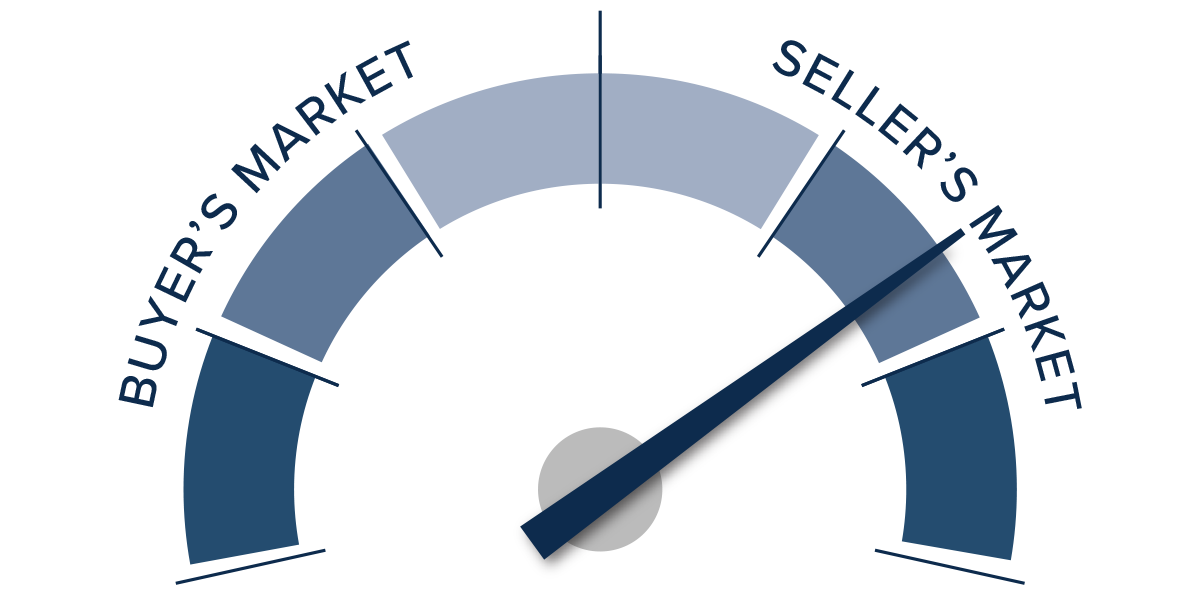
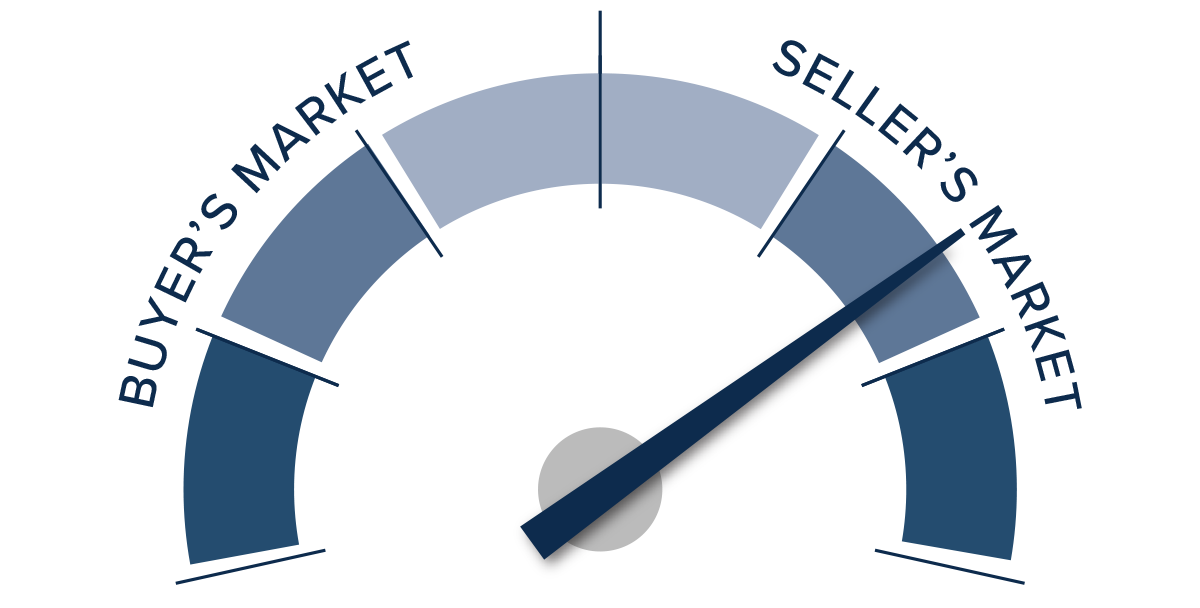
This speedometer reflects the state of the region’s real estate market using housing inventory, price gains, home sales, interest rates, and larger economic factors.

In last quarter’s Gardner Report, I suggested that home prices would continue to rise in 2022 but at a modestly slower pace than in 2021. Although it would be easy to assume that the jump in mortgage rates will cause price growth to slow more significantly, I am not sure whether that will be the case. As tight as the labor market is, rising incomes will likely offset most of the potential pain from higher mortgage payments. The region clearly heavily favors sellers, and I don’t expect this to change this year. While the full impact of rising mortgage rates has yet to be felt, I don’t believe it will be overly burdensome for buyers.

A speedometer graph indicating a seller's market in Utah during Q1 2022.

Given all of this, I have left the needle in the same position as last quarter. Though the data points to another very solid year for housing, I am waiting for the spring figures to determine if rising mortgage rates will cause any slowing to this supply-starved market.

About Matthew Gardner

Matthew Gardner - Chief Economist for Windermere Real Estate

As Chief Economist for Windermere Real Estate, Matthew Gardner is responsible for analyzing and interpreting economic data and its impact on the real estate market on both a local and national level. Matthew has over 30 years of professional experience both in the U.S. and U.K.

In addition to his day-to-day responsibilities, Matthew sits on the Washington State Governors Council of Economic Advisors; chairs the Board of Trustees at the Washington Center for Real Estate Research at the University of Washington; and is an Advisory Board Member at the Runstad Center for Real Estate Studies at the University of Washington where he also lectures in real estate economics.

Market News May 3, 2022

Q1 2022 Idaho Real Estate Market Update

The following analysis of select counties of the Idaho real estate market is provided by Windermere Real Estate Chief Economist Matthew Gardner. We hope that this information may assist you with making better-informed real estate decisions. For further information about the housing market in your area, please don’t hesitate to contact your Windermere Real Estate agent.


Regional Economic Overview

Employment in Idaho rose 3.2% over the past 12 months and the latest data shows the number of jobs is 38,300 higher than the pre-pandemic peak. This is particularly notable as there are only nine other states that have exceeded their pre-Covid employment levels. The state unemployment rate was only 2.7%, down from 3.1% at the end of 2021, and lower than the March 2021 rate of 3.9%. There was a very modest decline in total employment between February and March of this year, but I do not see this as being an issue. The labor force continues to grow, and my current forecast calls for employment to rise 3% in 2022.

Idaho Home Sales

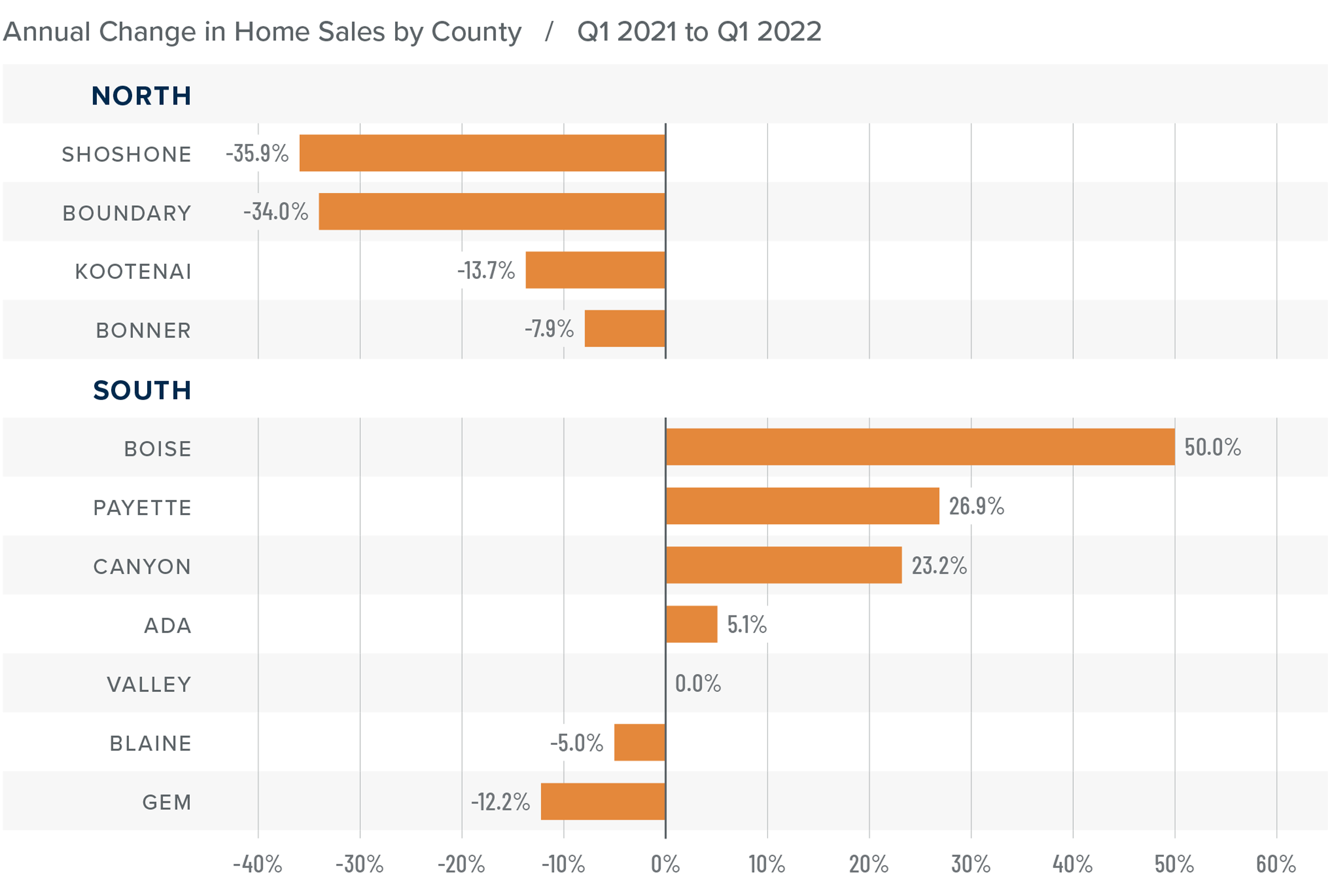
In the first quarter of 2022, 5,183 homes sold, representing an increase of 4.2% compared to a year ago but 24.7% lower than in the fourth quarter of 2021.

Quarter over quarter, sales fell in every county covered by this report.

Sales fell in all the northern counties contained in this report compared to a year ago, but this was offset by rising sales in more than half of the counties in Southern Idaho.

Pending sales were 2.7% lower than in the fourth quarter of 2021, but this is more than likely a function of inventory levels, which were down 28.4% from the last quarter. Supply is still very tight.

A bar graph showing the annual change in home sales for various counties in Idaho between Q1 2021 and Q1 2022.

Idaho Home Prices

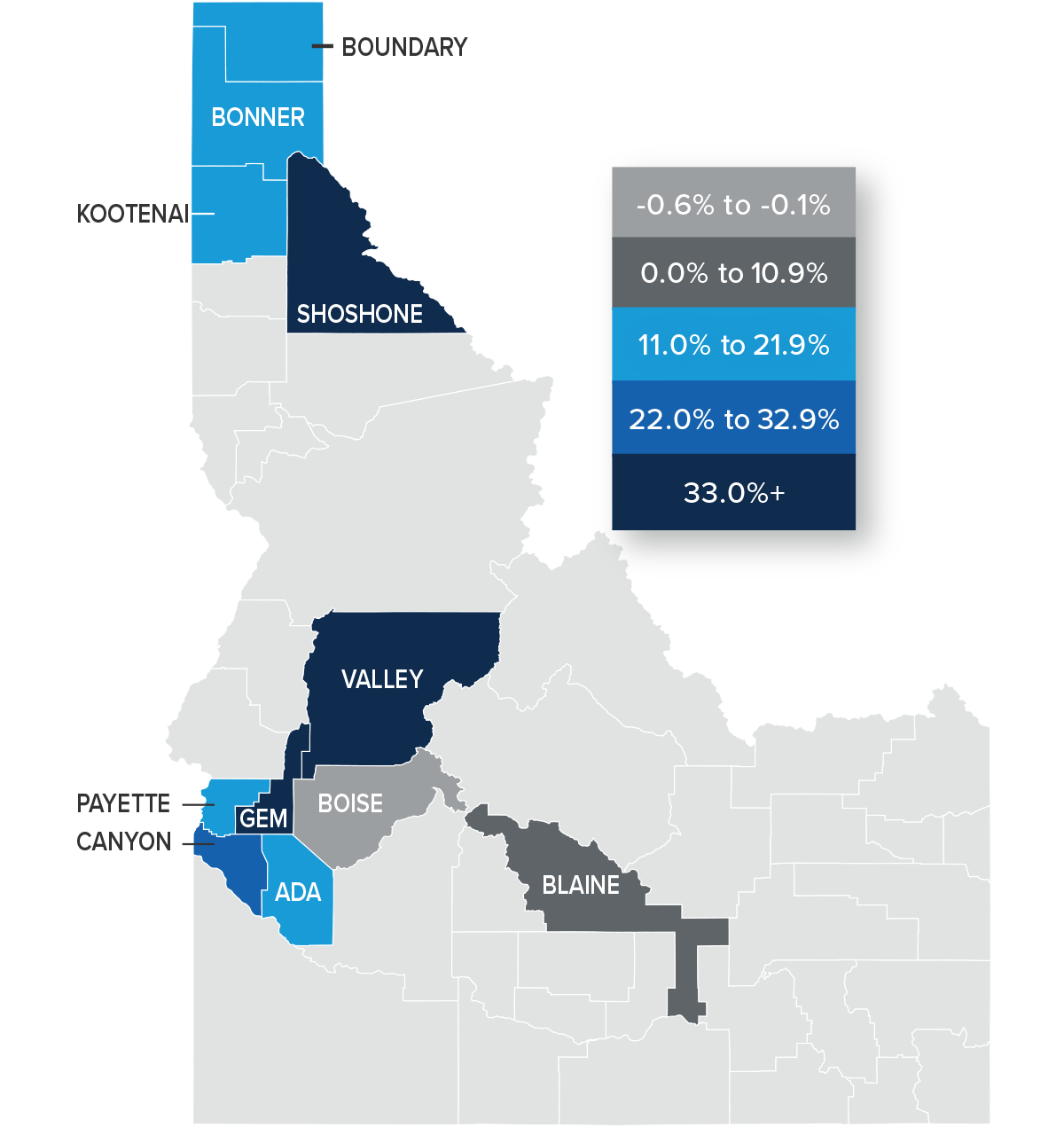
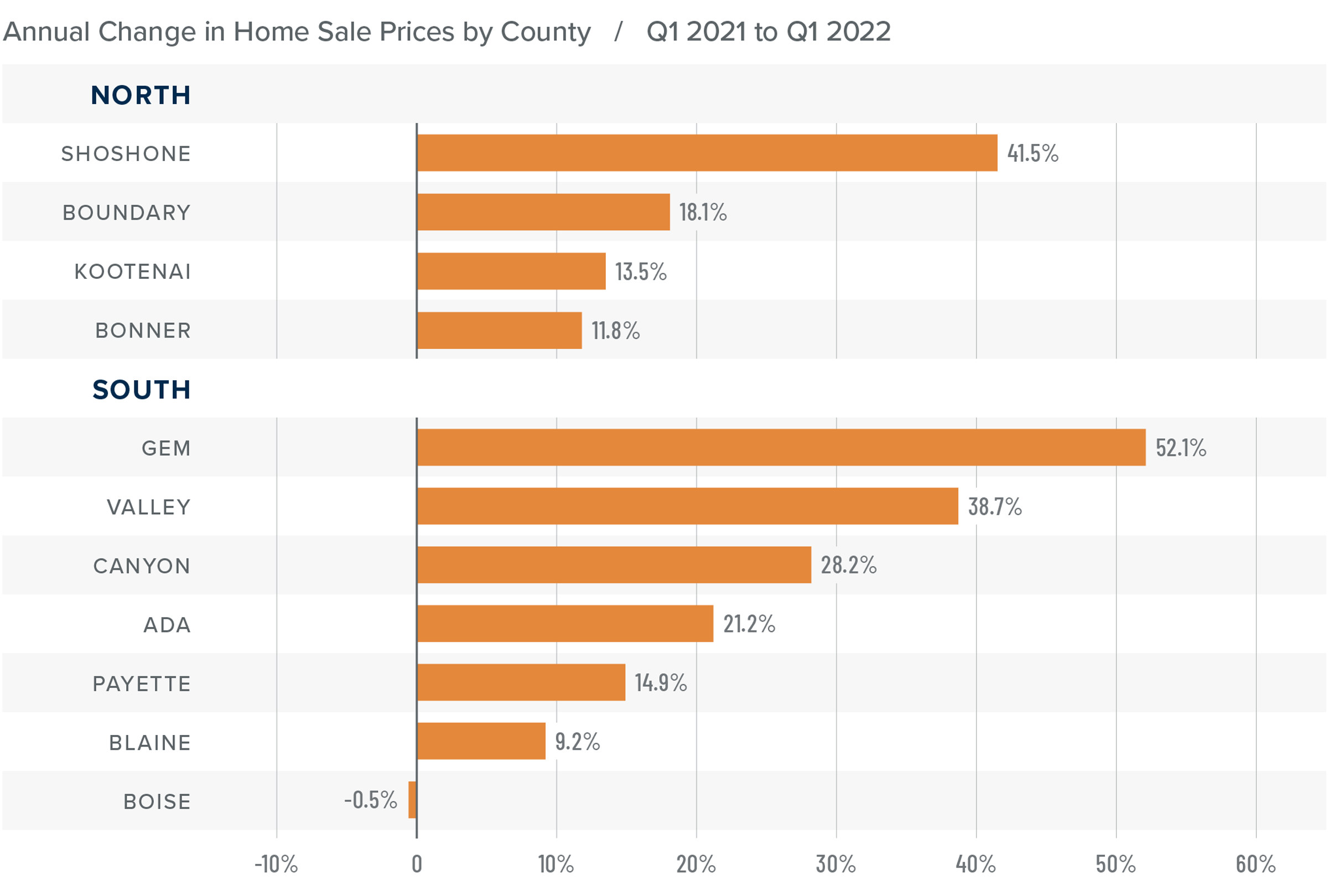
The average home price in the region rose 18.6% year over year to $612,558 and was 3.1% higher than in the fourth quarter of 2021.

Compared to the final quarter of 2021, prices were higher in Kootenai and Shoshone counties in the north. All counties in the southern part of the state saw sale prices increase from the prior quarter.

Prices rose by double digits in all the northern counties contained in this report, and all but Boise County saw similar robust price appreciation in the southern part of the state. In total, prices rose 17.2% in the Northern Idaho counties and 19.5% in the southern counties.

The market appears to have either shrugged off the significant increase in mortgage rates in the first quarter, or the impact has yet to be felt.

A map showing the year-over-year real estate market percentage changes in various counties in Idaho for Q1 2022.

A bar graph showing the annual change in home sale prices for various counties in Idaho from Q1 2021 to Q1 2022.

Mortgage Rates

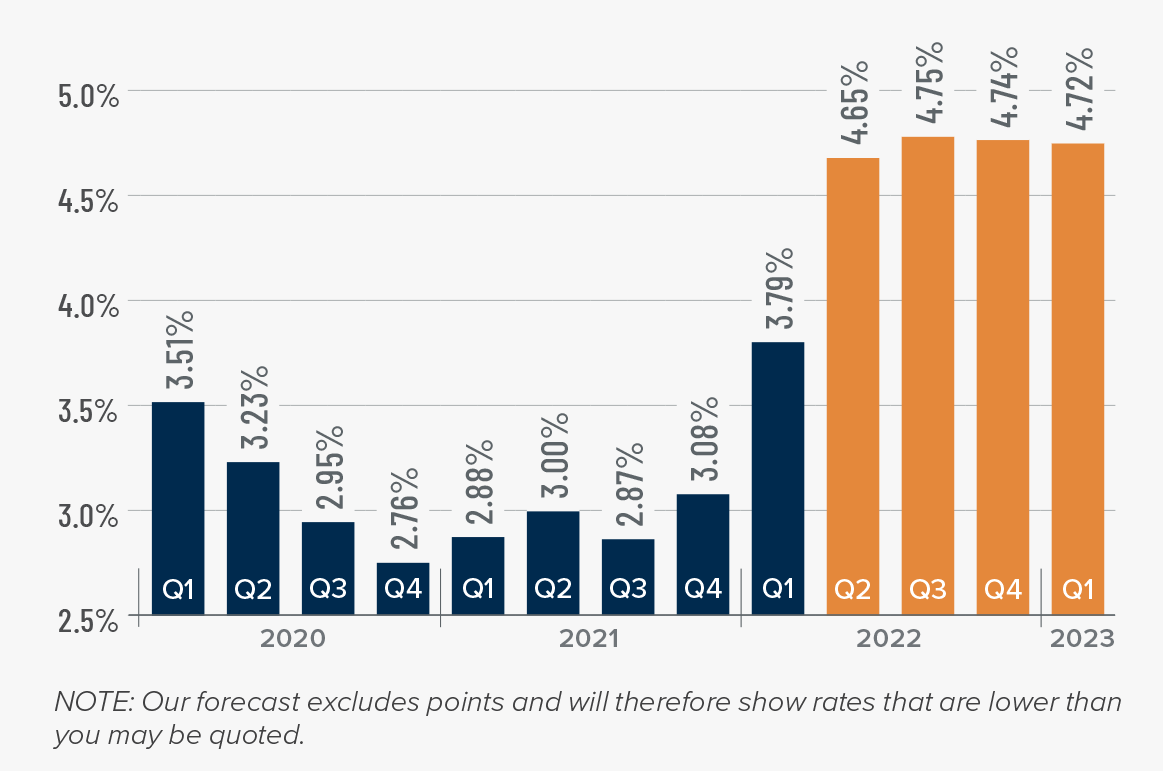
Average rates for a 30-year conforming mortgage were 3.11% at the end of 2021, but since then have jumped over 1.5%—the largest increase since 1987. The speed of the surge in rates is due to the market having quickly priced in the seven-to-eight rate increase that the Fed is expected to implement this year.

Because the mortgage market has priced this into the rates they are offering today, my forecast suggests that we are getting close to a ceiling in rates, and it is my belief that they will rise modestly in the second quarter before stabilizing for the balance of the year.

A bar graph showing the average rates for a 30-year conforming mortgage, plus Matthew Gardner's mortgage rate forecasts for Q2 2022 through Q1 2023.

Idaho Days on Market

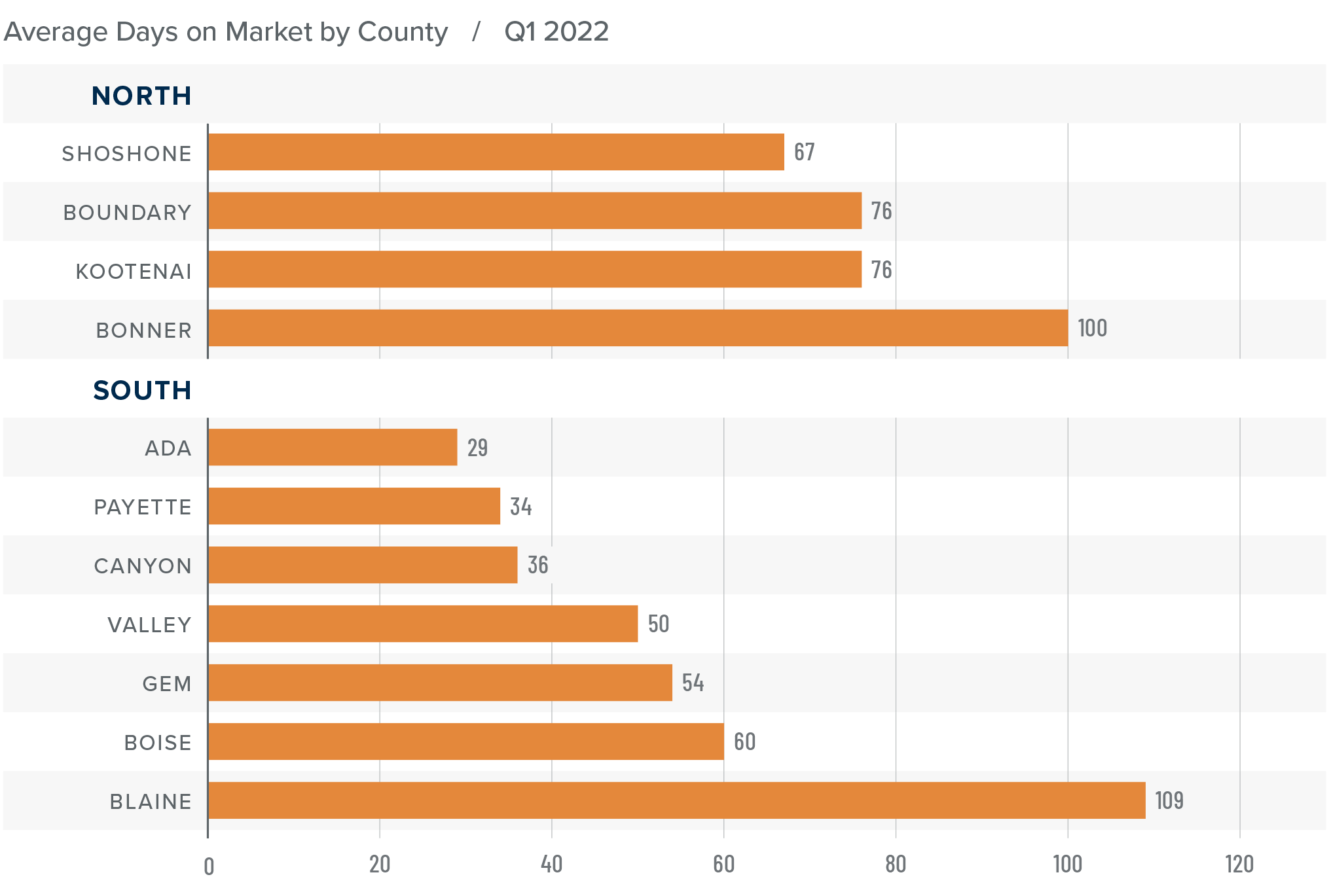
It took an average of 80 days to sell a home in Northern Idaho, and 53 days in the southern part of the state covered by this report.

The average number of days it took to sell a home in the region dropped ten days compared to a year ago but rose eight days compared to the fourth quarter of 2021.

In Northern Idaho, days-on-market dropped in all counties from a year ago, and market time dropped or remained static in every county other than Bonner compared to the previous quarter. In Southern Idaho, average market time fell in all counties other than Canyon, Gem, and Ada compared to a year ago but rose across the board compared to the prior quarter.

Homes sold the fastest in Ada County in the southern part of the state, and in Shoshone County in Northern Idaho.

A bar graph showing the average days on market for homes in various counties in Idaho during Q1 2022.

Conclusions

This speedometer reflects the state of the region’s real estate market using housing inventory, price gains, home sales, interest rates, and larger economic factors.

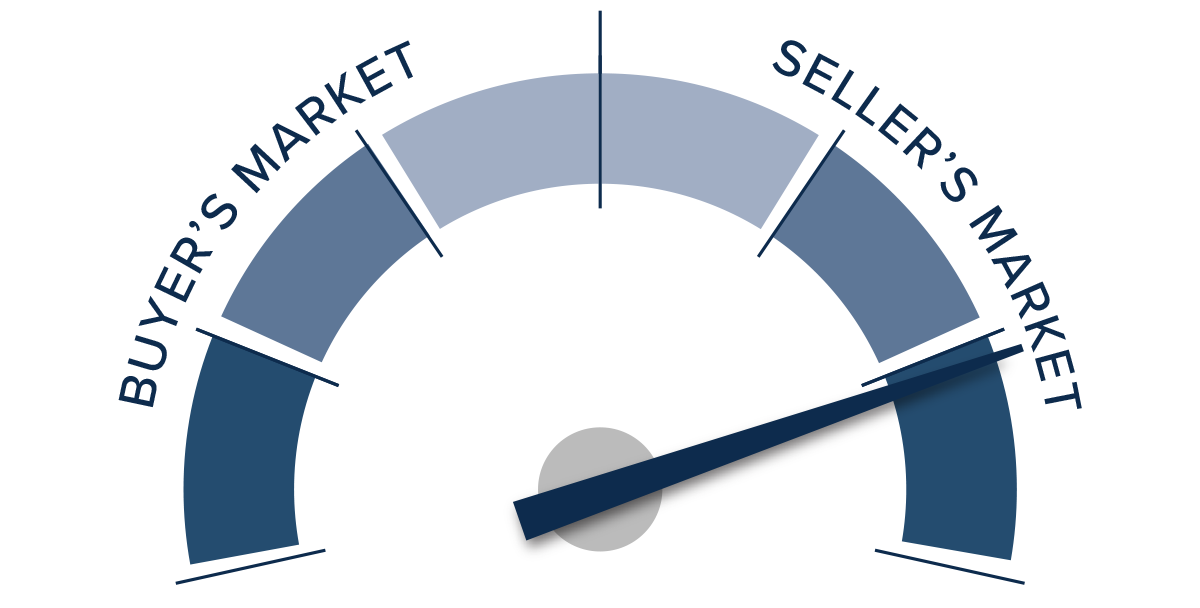
The strong Idaho economy has helped the housing market continue its upward trajectory. We should see more homes come on the market as we move into the spring selling season, but this is unlikely to be sufficient to meet demand. The question remains whether rising mortgage rates will impact the pace of appreciation that home prices have experienced in recent years. The data suggests that it has yet to be a factor, but we will have to wait and see what the spring market shows us.

A speedometer graph indicating a seller's market in Idaho during Q1 2022.

Given all these factors, I have decided to leave the needle in the same position as the previous quarter. It remains a strong seller’s market, but listing prices are softening somewhat in certain areas, which may be a pre-cursor to a slowdown in price appreciation.

About Matthew Gardner

Matthew Gardner - Chief Economist for Windermere Real Estate

As Chief Economist for Windermere Real Estate, Matthew Gardner is responsible for analyzing and interpreting economic data and its impact on the real estate market on both a local and national level. Matthew has over 30 years of professional experience both in the U.S. and U.K.

In addition to his day-to-day responsibilities, Matthew sits on the Washington State Governors Council of Economic Advisors; chairs the Board of Trustees at the Washington Center for Real Estate Research at the University of Washington; and is an Advisory Board Member at the Runstad Center for Real Estate Studies at the University of Washington where he also lectures in real estate economics.

Market News May 3, 2022

Q1 2022 Montana Real Estate Market Update

The following analysis of select counties of the Montana real estate market is provided by Windermere Real Estate Chief Economist Matthew Gardner. We hope that this information may assist you with making better-informed real estate decisions. For further information about the housing market in your area, please don’t hesitate to contact your Windermere Real Estate agent.


Regional Economic Overview

At the end of the first quarter, 505,200 people were employed in the state, which is up 17,400 from a year ago and 16,100 more than the pre-pandemic peak. Regionally, job levels in Billings and Missoula were also above pre-COVID-19 rates. Great Falls is only 200 jobs shy of matching its February 2020 level. Given the solid pace of job growth in the state, it’s not surprising that the unemployment rate is at a very low 2.3%. This is the lowest rate Montana has seen since the Labor Department started keeping records in 1976. In the metro areas contained in this report, the lowest jobless rate was in Billings at 2.4%, followed by Great Falls at 2.5%, and Missoula at 2.7%. Revisions by the labor department showed an economy that is doing better than originally thought. The only cause for concern is that the labor force has not been increasing at a pace that can keep up with the needs of employers, as demonstrated by the very low jobless rate. This will likely lead wages to rise significantly to attract more workers.

Montana Home Sales

In the first quarter of the year, 1,137 homes sold, which is a 35% drop from a year ago and 23.2% lower than in the final quarter of 2021.

The lower number of sales can be blamed on the lack of homes for sale: inventory was down 37.7% from a year ago and was 31.7% lower than the previous quarter.

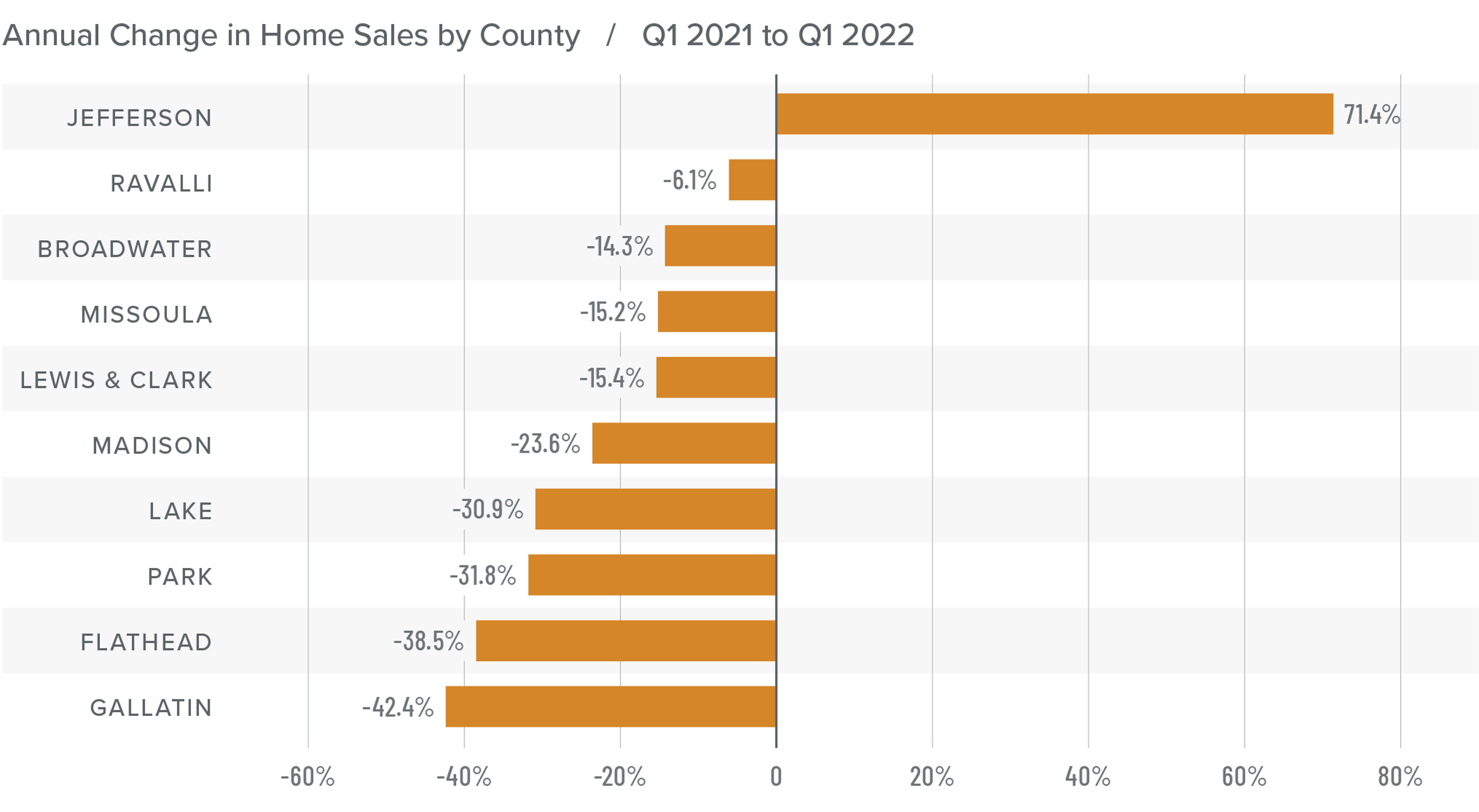
The small county of Jefferson saw sales increase from a year ago, but all other markets pulled back. Compared to the final quarter of 2021, sales were lower across the board.

Pending sales increased by a solid 18.8% quarter over quarter, suggesting that second quarter numbers should show growth.

A bar graph showing the annual change in home sales for various counties in Montana between Q1 2021 and Q1 2022.

Montana Home Prices

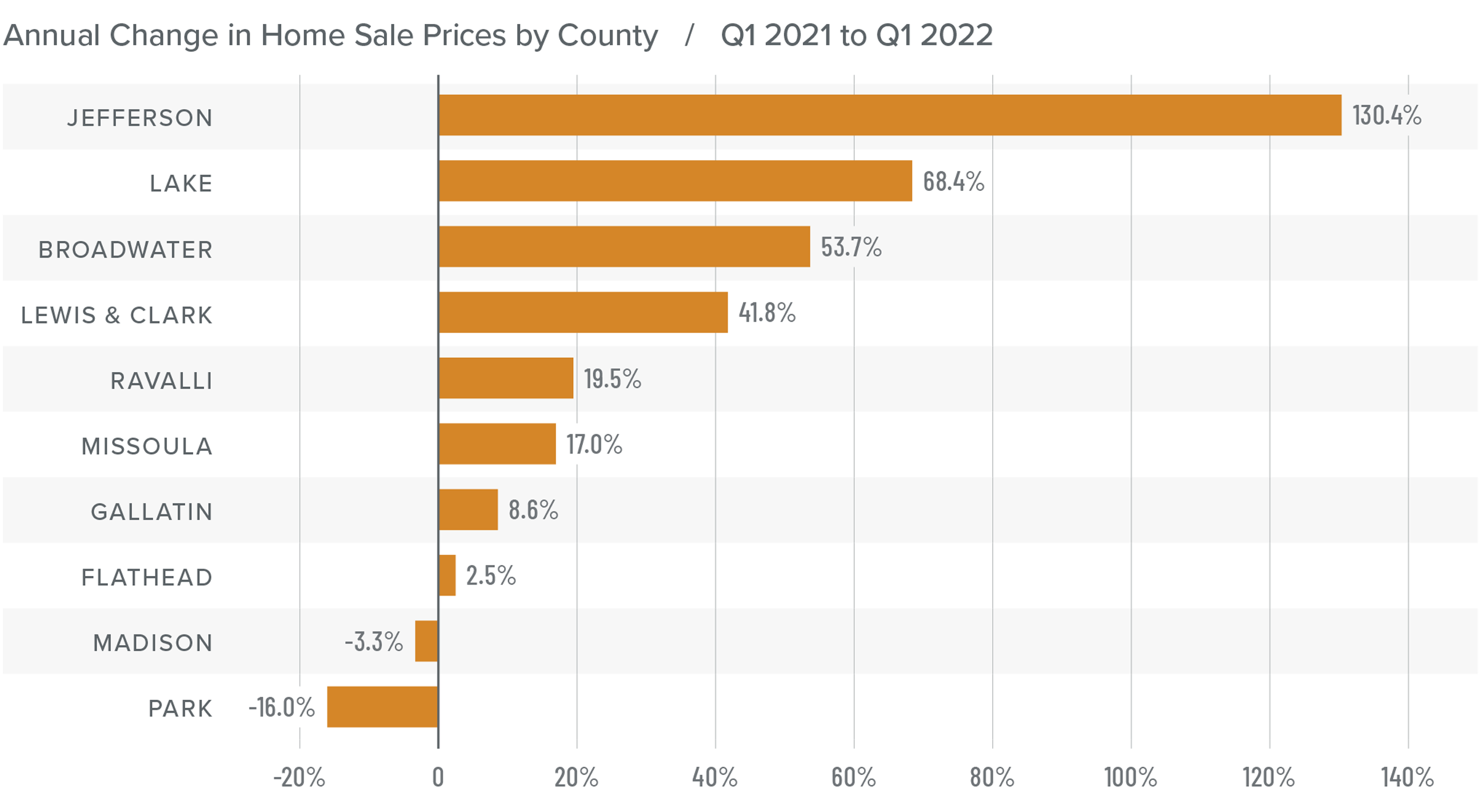
Home prices rose a modest 3.1% year over year to an average of $815,938 and were 13.1% higher than in the final quarter of 2021.

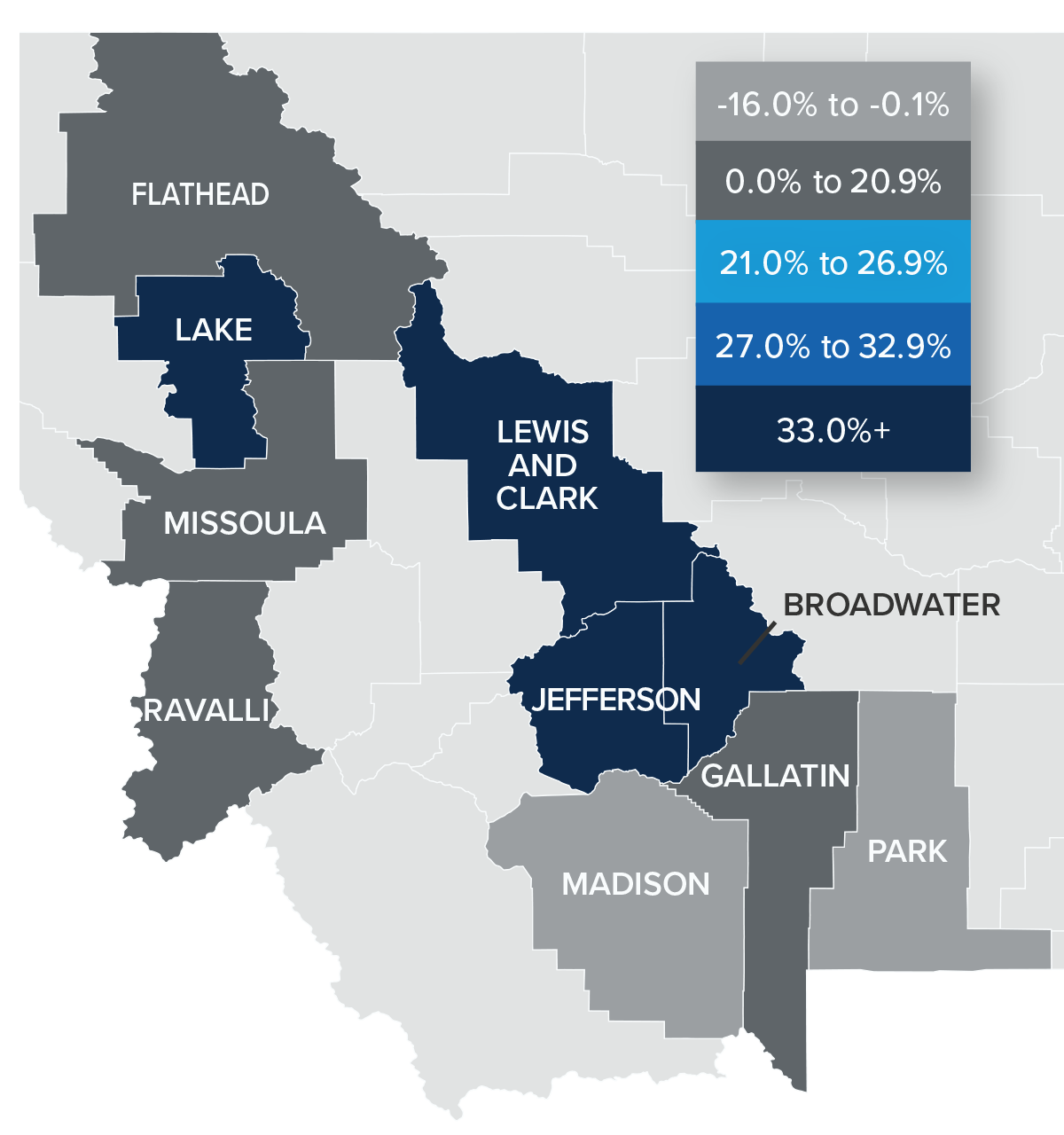
Compared to the fourth quarter of 2021, prices were split: there were increases in Ravalli, Lewis and Clark, Lake, Jefferson, and Gallatin counties, but prices fell in the remaining market areas.

Although the tepid increase in prices may surprise some readers, it uses weighted averages which account for market size. If we use simple averages, prices in the region rose by a more significant 14.5% year over year.

There is a lag between mortgage rates rising and any impact on home prices. Thus far, higher financing costs have not had much of an effect on the market, but data from the second quarter of this year should give us a better idea as to whether the increase in rates is enough to dampen the market significantly.

A map showing the year-over-year real estate market percentage changes in various counties in Montana for Q1 2022.

A bar graph showing the annual change in home sale prices for various counties in Montana from Q1 2021 to Q1 2022.

Mortgage Rates

Average rates for a 30-year conforming mortgage were 3.11% at the end of 2021, but since then have jumped over 1.5%—the largest increase since 1987. The speed of the surge in rates is due to the market having quickly priced in the seven-to-eight rate increase that the Fed is expected to implement this year.

Because the mortgage market has priced this into the rates they are offering today, my forecast suggests that we are getting close to a ceiling in rates, and it is my belief that they will rise modestly in the second quarter before stabilizing for the balance of the year.

A bar graph showing the average rates for a 30-year conforming mortgage, plus Matthew Gardner's mortgage rate forecasts for Q2 2022 through Q1 2023.

Montana Days on Market

The average time it took to sell a home dropped 15 days compared to the first quarter of 2021.

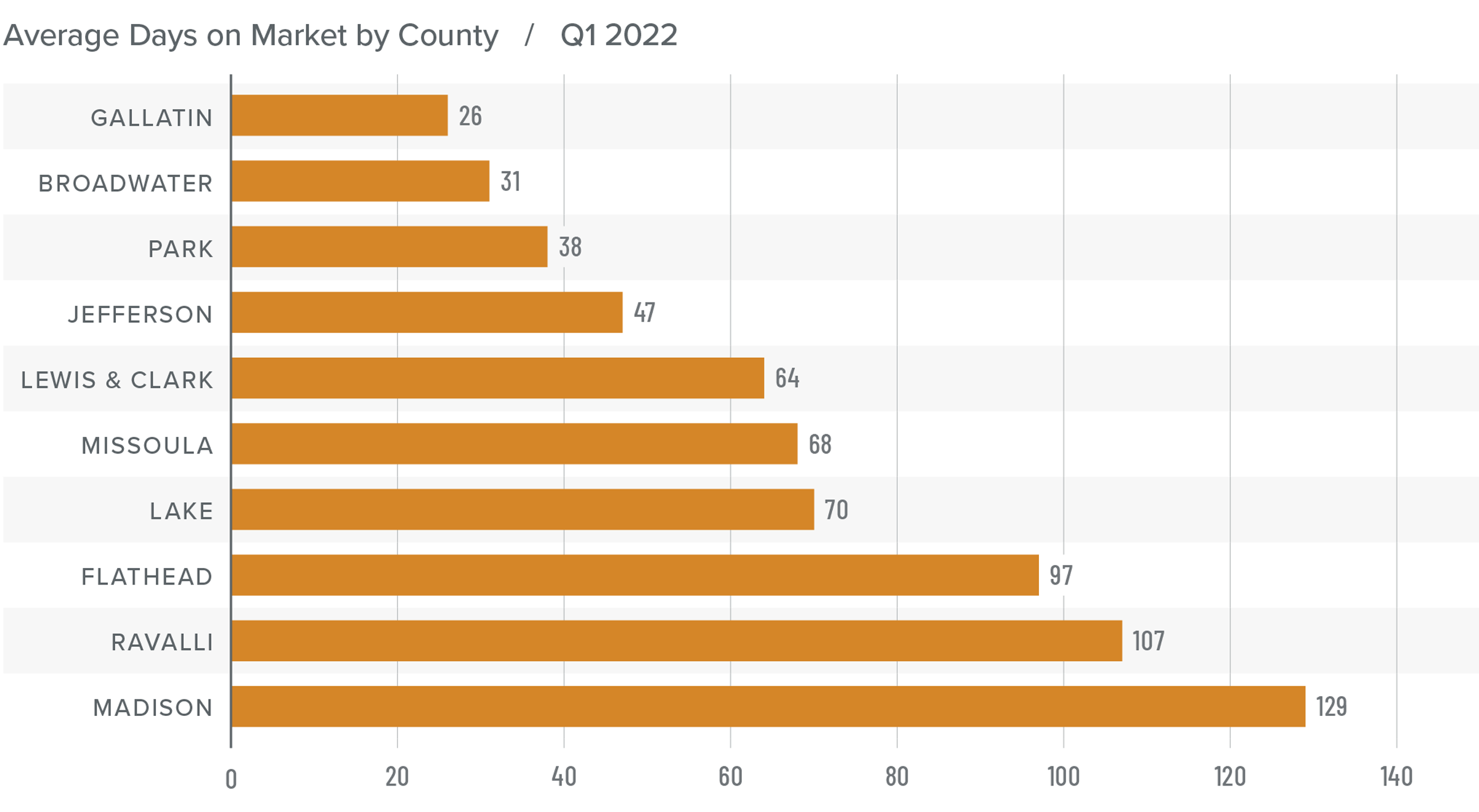
Homes sold fastest in Gallatin County and slowest in Madison County. Missoula, Ravalli, Lake, Lewis and Clark, Broadwater, and Gallatin counties saw market time drop. The length of time it took for homes to sell rose in the rest of the counties contained in this report.

During the first quarter, it took an average of 68 days to sell a home in the region.

Average market time across the region rose one day compared to the fourth quarter of 2021, but was lower in Missoula, Lake, Broadwater, and Jefferson counties.

A bar graph showing the average days on market for homes in various counties in Montana during Q1 2022.

Conclusions

This speedometer reflects the state of the region’s real estate market using housing inventory, price gains, home sales, interest rates, and larger economic factors.

Full employment and a growing economy tend to encourage home buyers, but rising financing costs are a cause for concern. Furthermore, we have yet to see whether the increase in mortgage rates will have a dampening effect on price growth, especially if more homes come on the market.

A speedometer graph indicating a seller's market in Montana during Q1 2022.

With this level of uncertainty, I have left the needle in the same position as the previous quarter. The data shows that an inflection point may have been reached, as indicated by slowing home-price growth and lower sales, but the impact of mortgage rates is not clear at this time. We should have a better picture of the market as we move through the spring. That said, it firmly remains a seller’s market.

About Matthew Gardner

Matthew Gardner - Chief Economist for Windermere Real Estate

As Chief Economist for Windermere Real Estate, Matthew Gardner is responsible for analyzing and interpreting economic data and its impact on the real estate market on both a local and national level. Matthew has over 30 years of professional experience both in the U.S. and U.K.

In addition to his day-to-day responsibilities, Matthew sits on the Washington State Governors Council of Economic Advisors; chairs the Board of Trustees at the Washington Center for Real Estate Research at the University of Washington; and is an Advisory Board Member at the Runstad Center for Real Estate Studies at the University of Washington where he also lectures in real estate economics.

More May 2, 2022

Windermere Cup Returns for 36th Annual Regatta

The 36th annual Windermere Cup will be held Saturday May 7th, 2022, in Seattle, Washington. The rowing regatta hosted by Windermere Real Estate and the University of Washington brings together the best rowing crews in the world for a weekend of festivities and races along Seattle’s scenic Montlake Cut. After a cancellation in 2020 due to the COVID-19 pandemic and a limited event in 2021, the Windermere Cup returns in full force in 2022.

The University of Washington men’s and women’s crews will face off against top international talent in a battle for Windermere Cup supremacy. Held annually on the first Saturday in May, the Windermere Cup is both an international sporting event and a celebration of boating season open day. Following the races, the Seattle Yacht Club hosts their annual Opening Day Boat Parade.

Windermere Cup 2022

Two storied programs make their way to Seattle this year to compete against the University of Washington: the Netherlands Men’s National Team and the Great Britain Women’s National Team. Last year, the Dutch men’s rowing team finished fourth at the Tokyo Olympic Games. At the Under 23 level, the Dutch men’s eight has rowed in the grand final in each of the last four world championships, winning bronze in 2019 and gold in 2017. The British women’s crew won silver at the 2016 Olympic Games in Rio de Janeiro and were one of only seven nations to qualify for the 2020 Tokyo Olympics. Great Britain’s women’s eight also won silver in the World Rowing Under 23 Championships in 2019 and gold in the women’s four in 2021.

These crews face a University of Washington rowing program whose long tradition of winning on both national and global stages shows no signs of slowing. The UW women have won twelve national championships, including two of the last four; while the men’s team has won nineteen national titles, including eight of the last fourteen. In May of last year, the UW men’s team swept all four grand finals at the 2021 Intercollegiate Rowing Association Championship Regatta.

Windermere Party on the Cut: Boats, Bites, Brews, & Bands

The night before the regatta we’ll be hosting this year’s Party on the Cut! The event will take place Friday, May 6th, from 6 pm to 10pm. Come join us on the northeast corner of the Cut for an evening of fun, games, live music, food, and drinks. Tickets are $25 in advance or $35 at the door. This year features live performances from Nite Wave and the Queen tribute band Queen Mother. Tickets can be purchased through Brown Paper Tickets here: Party on the Cut 2022.

For more information and a schedule of events, visit windermerecup.com and follow Windermere Cup on Facebook and Twitter. You can also join in the fun on social media with the official hashtag of this year’s Windermere Cup: #WindermereCup2022

Market News May 2, 2022

Q1 2022 Central Washington Real Estate Market Update

The following analysis of select counties of the Central Washington real estate market is provided by Windermere Real Estate Chief Economist Matthew Gardner. We hope that this information may assist you with making better-informed real estate decisions. For further information about the housing market in your area, please don’t hesitate to contact your Windermere Real Estate agent.


Regional Economic Overview

Central Washington employment rose 6% year over year. However, with the significant revisions to 2021 employment levels the state made, total employment is down 3,778 jobs from the pre-pandemic peak. The jobs shortfalls are primarily in Kittitas and Yakima counties, with far smaller shortfalls in Okanogan and Chelan counties. Douglas County is the only market where employment levels are higher than the pre-pandemic peak. Unadjusted unemployment levels in Central Washington were 7.6%. When adjusted for seasonality, they were 5.9%. The county with the lowest unemployment rate was Chelan at 4.8%; the highest was Yakima, where 6.5% of the labor force was still without work. I expect that the region will be back to pre-pandemic employment levels by this summer.

Central Washington Home Sales

Sales in Central Washington rose 6.8% compared to a year ago, with a total of 1,022 homes sold. Sales fell 36.1% compared to the final quarter of 2021, but it is likely that seasonal factors impacted the number.

The drop in sales compared to fourth quarter of 2021 suggests that closings in second quarter of this year will remain tepid.

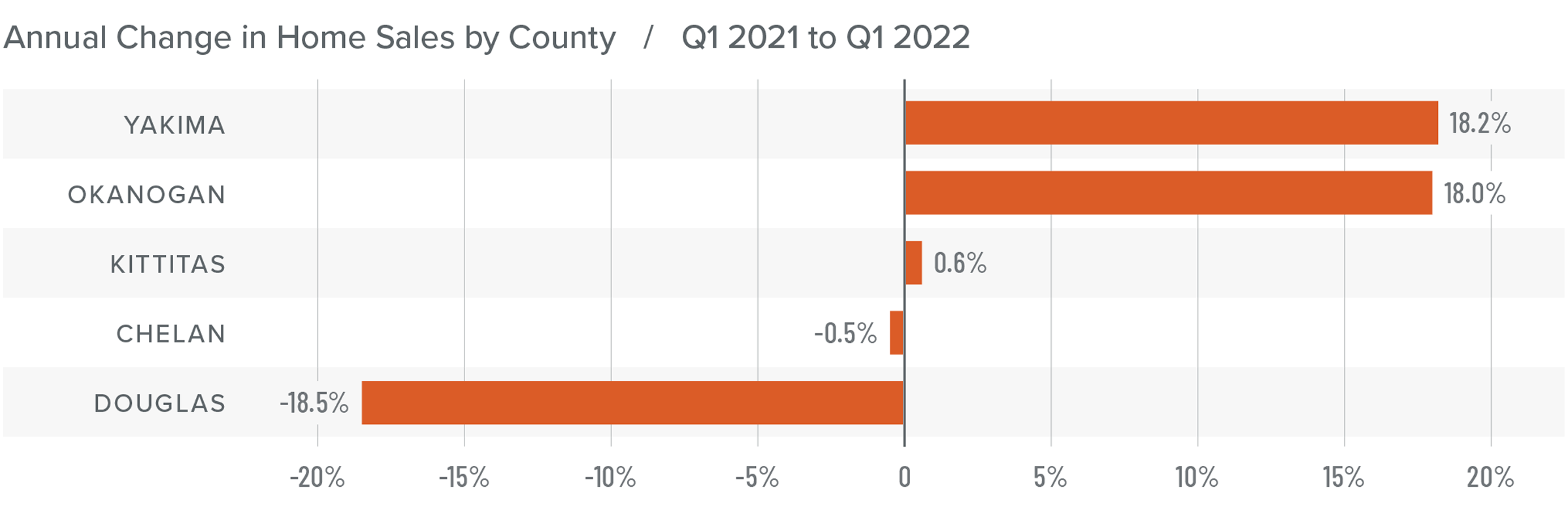
Compared to a year ago, sales rose in Okanogan, Yakima, and Kittitas counties, but fell in Chelan and Douglas counties. Sales fell across the board compared to the final quarter of last year.

Even though inventory levels rose 4% year over year, there were 33.5% fewer listings in the first quarter than in the prior quarter. This is creating frustrating conditions for buyers who have seen financing costs increase significantly in recent months. I hope more homes will come to market as spring gets underway, but the market is far from balanced.

A bar graph showing the annual change in home sales for various counties in Central Washington between Q1 2021 and Q1 2022.

Central Washington Home Prices

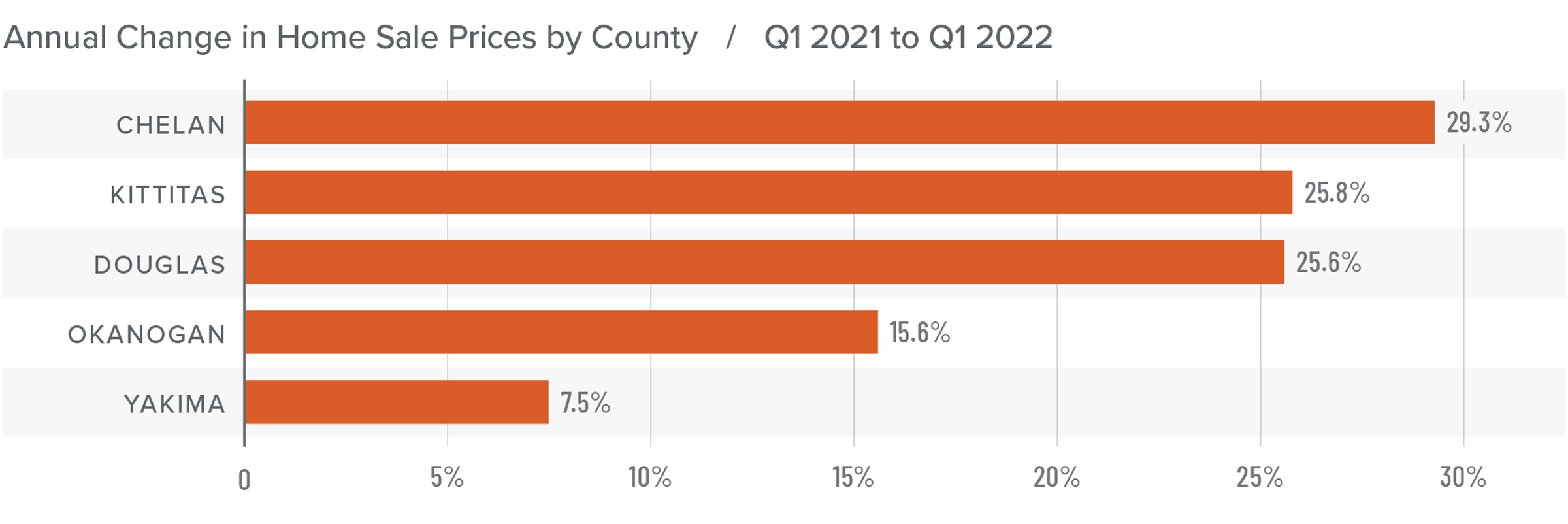
The average home price in Central Washington rose 17% year over year to $485,435 but was 0.8% lower than in the final quarter of 2021.

Lower quarter-over-quarter sale prices may be a function of rising mortgage rates, but it’s too soon to tell given that there’s usually a lag between rising financing costs and their impact on prices. Data from the second quarter of this year will give us a better indication.

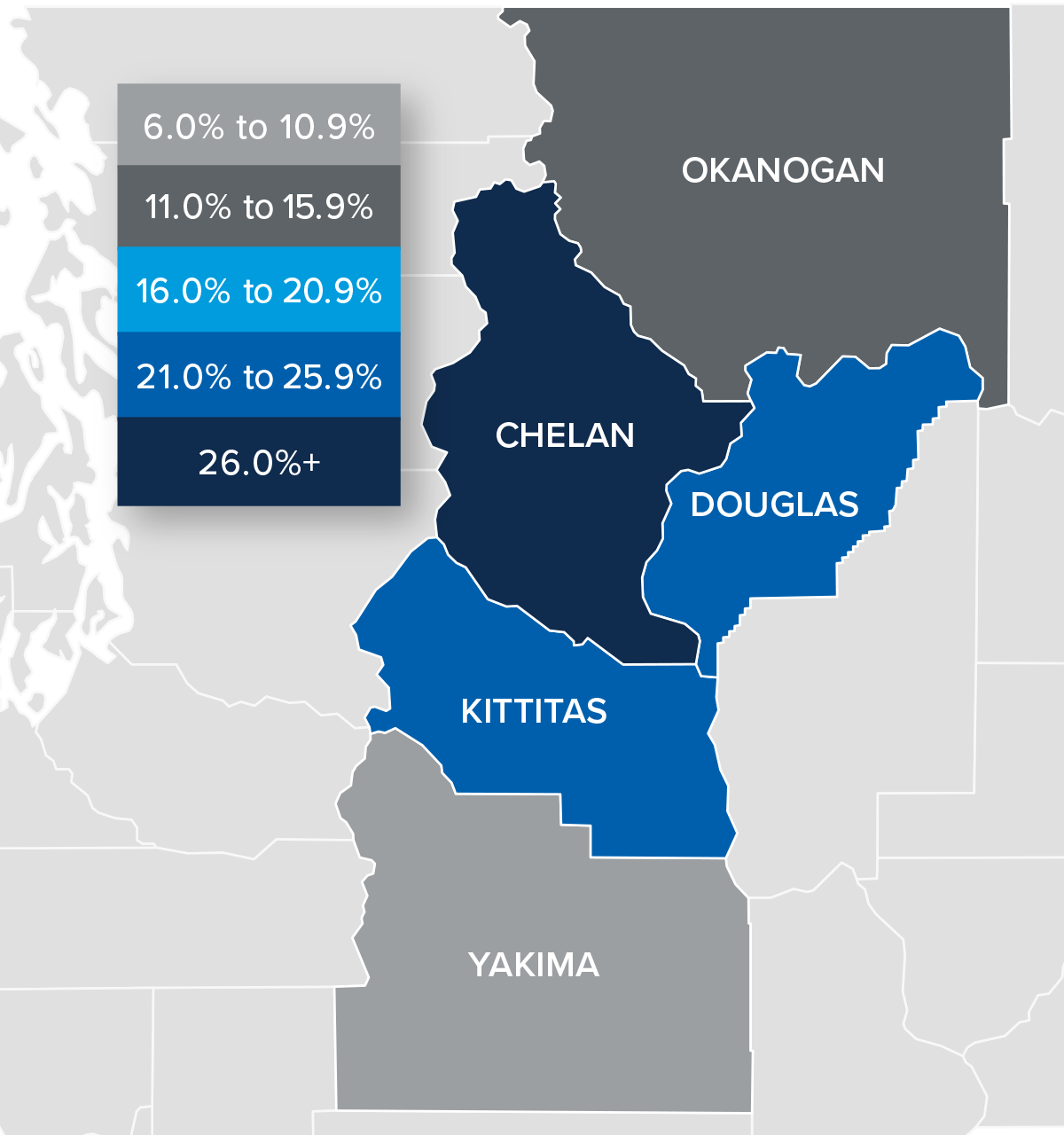
Every county except Yakima saw double-digit increases in sale prices compared to the first quarter of 2021. Prices were lower in Chelan and Yakima counties than in the previous quarter, but the other three counties saw higher sale prices.

Median list prices have slowed their ascent in many of the markets contained in this report, which could also indicate some softening in the region. That said, the extent to which this is impacting secondhome markets—which are more susceptible to rising mortgage rates—remains uncertain.

A map showing the year-over-year real estate market percentage changes in various counties in Central Washington for Q1 2022.

A bar graph showing the annual change in home sale prices for various counties in Central Washington from Q1 2021 to Q1 2022.

Mortgage Rates

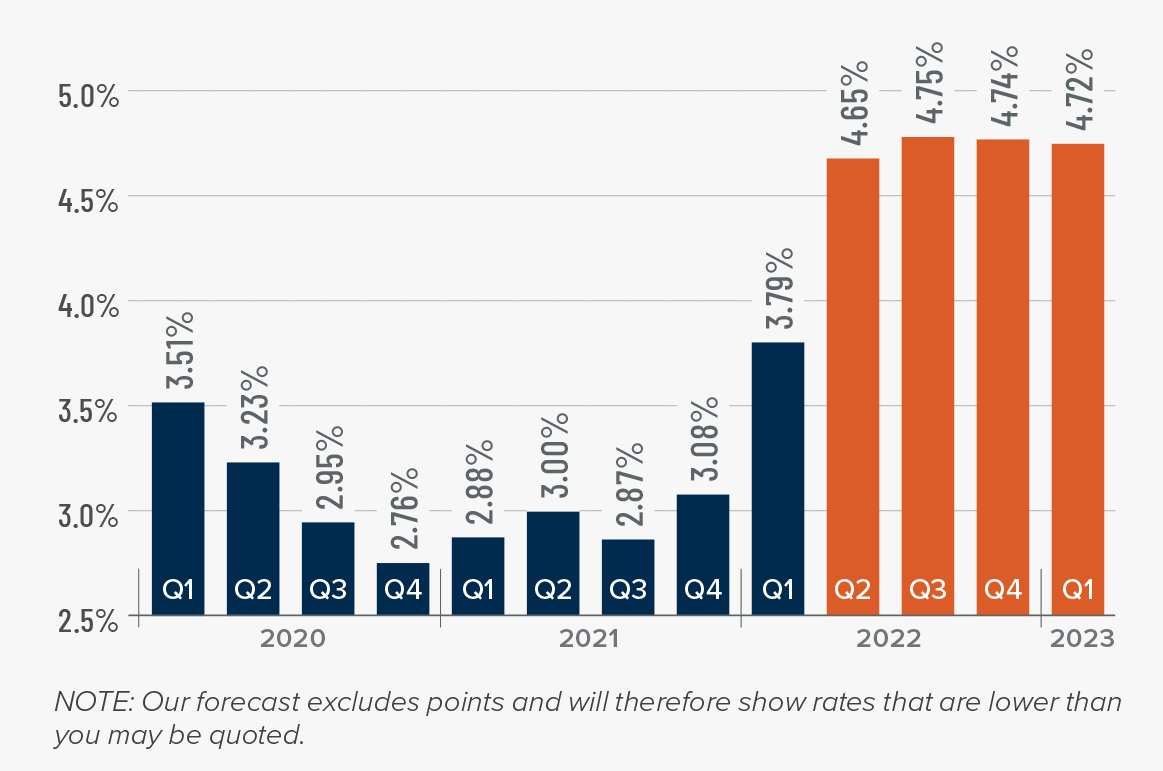
Average rates for a 30-year conforming mortgage were 3.11% at the end of 2021, but since then have jumped over 1.5%—the largest increase since 1987. The speed of the surge in rates is due to the market having quickly priced in the seven-to-eight rate increase that the Fed is expected to implement this year.

Because the mortgage market has priced this into the rates they are offering today, my forecast suggests that we are getting close to a ceiling in rates, and it is my belief that they will rise modestly in the second quarter before stabilizing for the balance of the year.

A bar graph showing the average rates for a 30-year conforming mortgage, plus Matthew Gardner's mortgage rate forecasts for Q2 2022 through Q1 2023.

Central Washington Days on Market

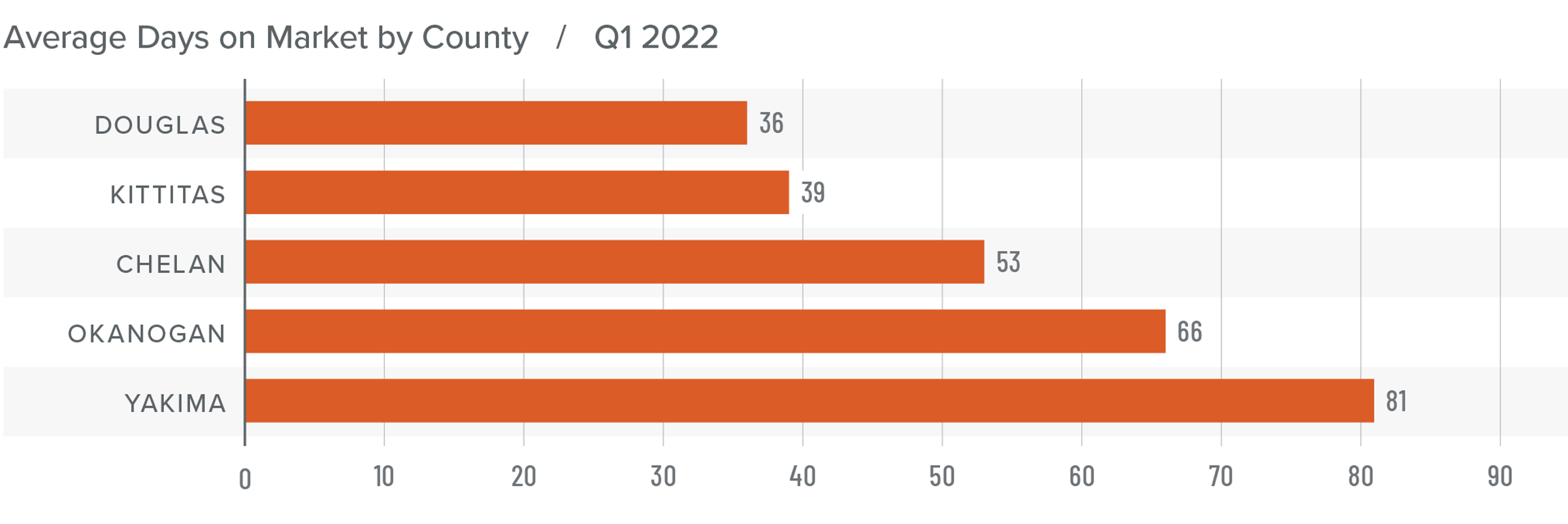
The average time it took to sell a home in Central Washington in the first quarter of 2022 was 55 days.

During the first quarter, it took three fewer days to sell a home in Central Washington than it did a year ago.

All counties other than Chelan and Kittitas saw the length of time it took to sell a home drop compared to a year ago, with noticeable improvement in Okanogan County. Compared to the final quarter of 2021, days on market rose in all counties.

It took 17 more days to sell a home in the first quarter than it did in the fourth quarter of last year.

A bar graph showing the average days on market for homes in various counties in Central Washington during Q1 2022.

Conclusions

This speedometer reflects the state of the region’s real estate market using housing inventory, price gains, home sales, interest rates, and larger economic factors.

The market remains in a state of imbalance. On one hand, the number of homes for sale increased as we moved into the year, but there were fewer pending sales. This is a little counterintuitive given that rising mortgage rates should have been a stimulant for home buyers. Even so, I believe home sellers remain in the driver’s seat, but the year has not started in the way some may have hoped for. Second quarter data should give us some more clarity as to the direction the market will take in 2022, but it is likely that higher mortgage costs combined with lower affordability may act as a headwind.

A speedometer graph indicating a seller's market in Central Washington during Q1 2022.

As such, I am moving the needle a little more towards buyers but, for the time being, sellers still have the upper hand.

About Matthew Gardner

Matthew Gardner - Chief Economist for Windermere Real Estate

As Chief Economist for Windermere Real Estate, Matthew Gardner is responsible for analyzing and interpreting economic data and its impact on the real estate market on both a local and national level. Matthew has over 30 years of professional experience both in the U.S. and U.K.

In addition to his day-to-day responsibilities, Matthew sits on the Washington State Governors Council of Economic Advisors; chairs the Board of Trustees at the Washington Center for Real Estate Research at the University of Washington; and is an Advisory Board Member at the Runstad Center for Real Estate Studies at the University of Washington where he also lectures in real estate economics.

Market News May 2, 2022

Q1 2022 Eastern Washington Real Estate Market Update

The following analysis of select counties of the Eastern Washington real estate market is provided by Windermere Real Estate Chief Economist Matthew Gardner. We hope that this information may assist you with making better-informed real estate decisions. For further information about the housing market in your area, please don’t hesitate to contact your Windermere Real Estate agent.


Regional Economic Overview

Even though Washington State revised the 2021 total employment level downward, the Eastern Washington job market is still in positive territory after its recovery from the pandemic. The region has recovered all of the jobs that were lost and added 13,000 new jobs. The job count in Whitman and Grant counties remains marginally below their pre-COVID peaks, but I expect that to be resolved by this summer. Unadjusted for seasonality, the regional unemployment rate was 5.9%. However, when adjusted for seasonal shifts, the rate was 4.9%. The highest jobless rate was in Grant County at 6.8%; the lowest rate was in Walla Walla County at 3.9%.

Eastern Washington Home Sales

In the first quarter, 2,353 homes sold, which was down 5.7% from the same period in 2021 and 36.6% lower than in the final quarter of last year.

While these numbers don’t appear positive at face value, the drop was due to the lack of homes for sale. Although listing activity was 2.2% higher than the same period in 2021, it was 40% lower than in the final quarter of last year. Limited choice is certainly impacting the market.

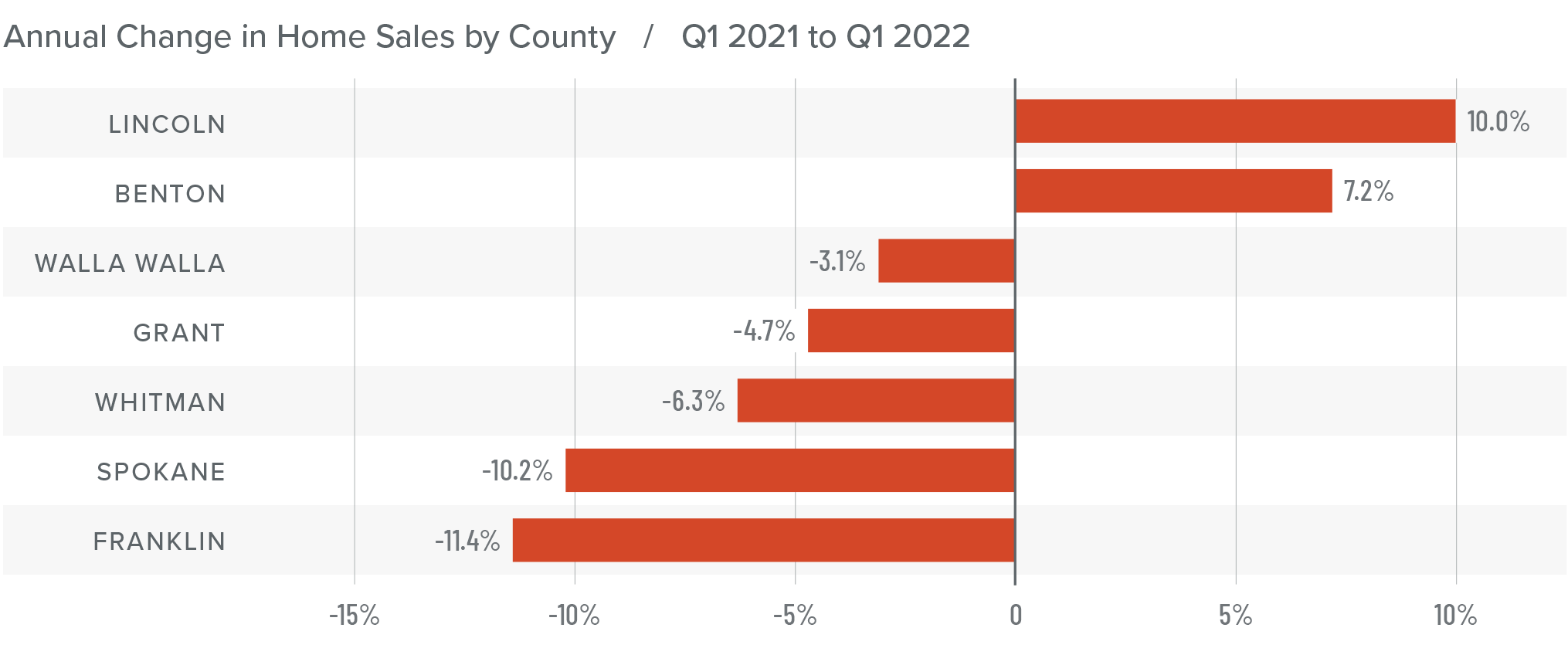
Year over year, sales increased in Benton and Lincoln counties, but fell in the rest of the market areas. Sales fell across the board compared to the fourth quarter.

Pending sales were down 12.6% from the final quarter of last year, suggesting that unless we see a surge in the number of homes coming to market, second quarter numbers may disappoint as well.

A bar graph showing the annual change in home sales for various counties in Eastern Washington between Q1 2021 and Q1 2022.

Eastern Washington Home Prices

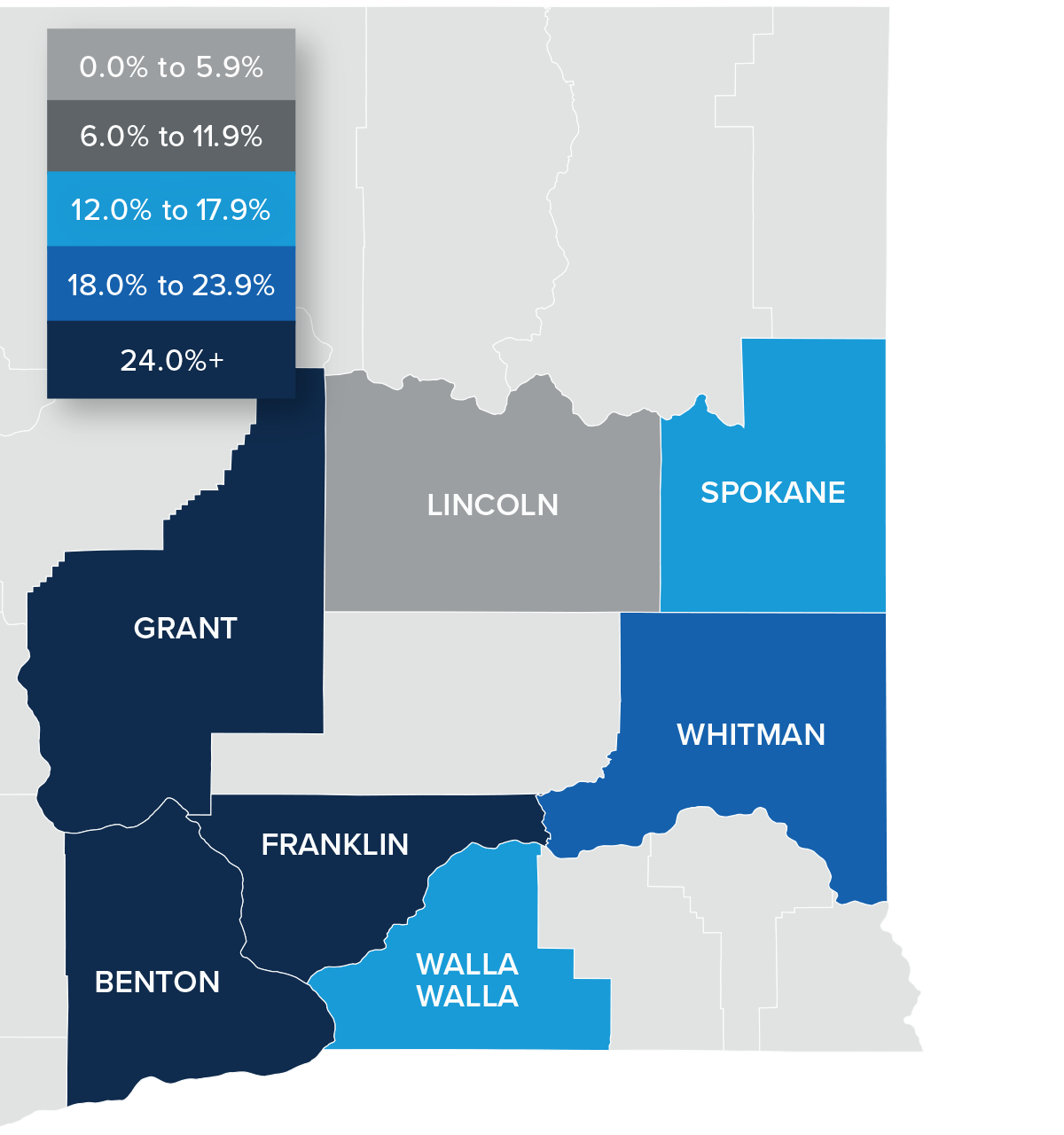
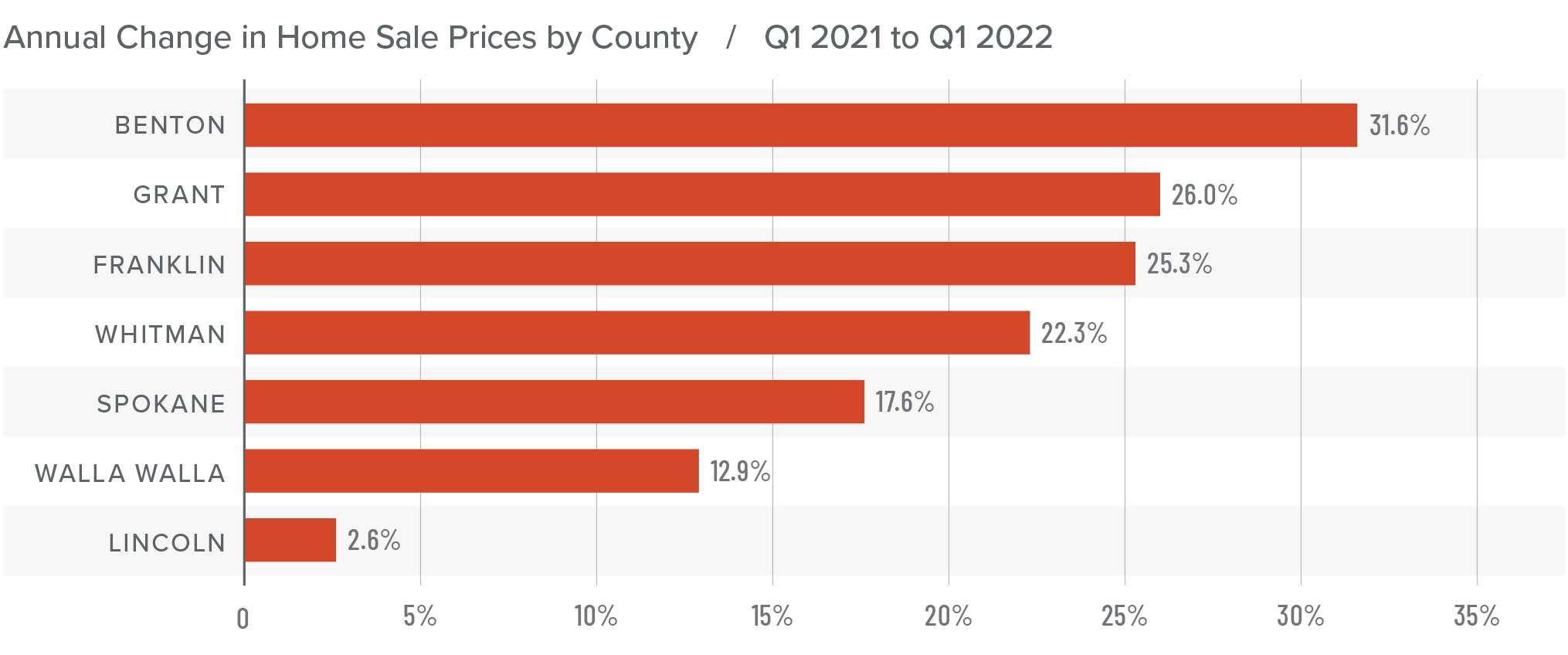
Year over year the average home price in Eastern Washington rose a very significant 21.4% to $434,921 and was 2.6% higher than the previous quarter.

When compared to the final quarter of last year, prices rose in all counties other than Lincoln and Walla Walla.

All counties contained in this report saw average sale prices rise; every county except Lincoln County had double-digit growth.

The market has yet to feel the impact of rising mortgage rates. Inventory issues persist, so it’s likely prices will continue to rise as buyers compete for what homes are available and seek to lock in a loan rate before they rise any further.

A map showing the year-over-year real estate market percentage changes in various counties in Eastern Washington for Q1 2022.

A bar graph showing the annual change in home sale prices for various counties in Eastern Washington from Q1 2021 to Q1 2022.

Mortgage Rates

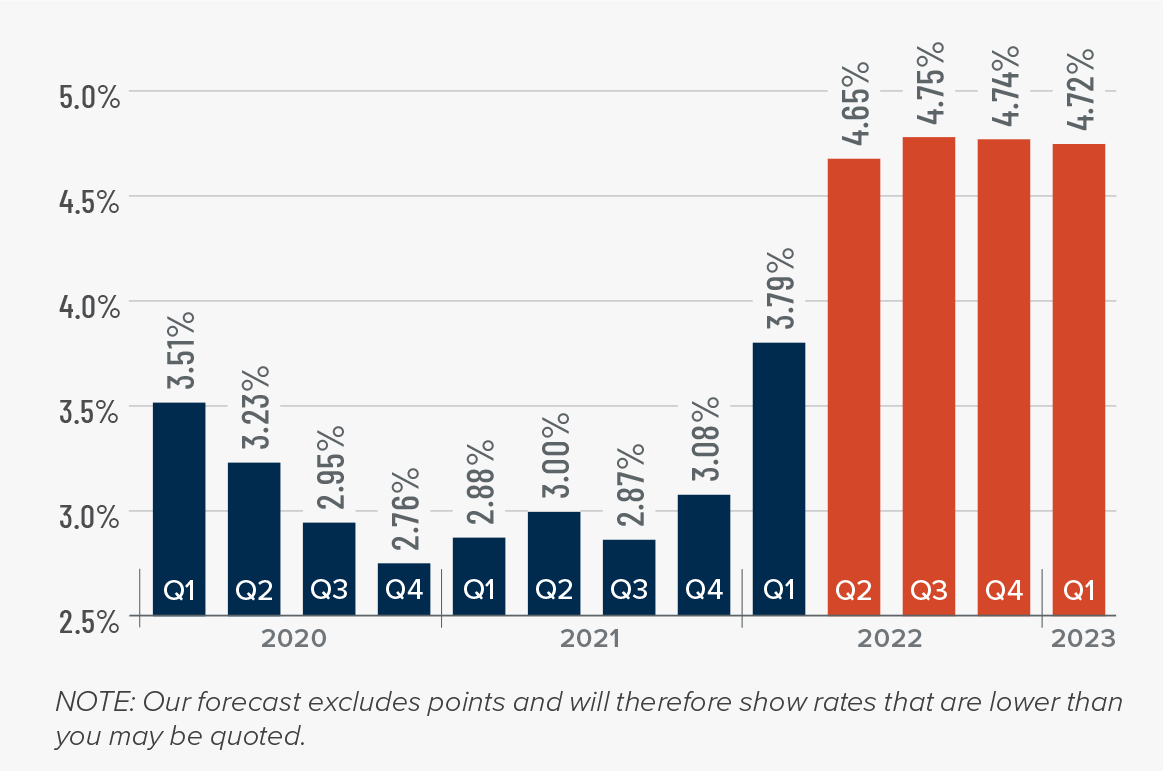
Average rates for a 30-year conforming mortgage were 3.11% at the end of 2021, but since then have jumped over 1.5%—the largest increase since 1987. The speed of the surge in rates is due to the market having quickly priced in the seven-to-eight rate increase that the Fed is expected to implement this year.

Because the mortgage market has priced this into the rates they are offering today, my forecast suggests that we are getting close to a ceiling in rates, and it is my belief that they will rise modestly in the second quarter before stabilizing for the balance of the year.

A bar graph showing the average rates for a 30-year conforming mortgage, plus Matthew Gardner's mortgage rate forecasts for Q2 2022 through Q1 2023.

Eastern Washington Days on Market

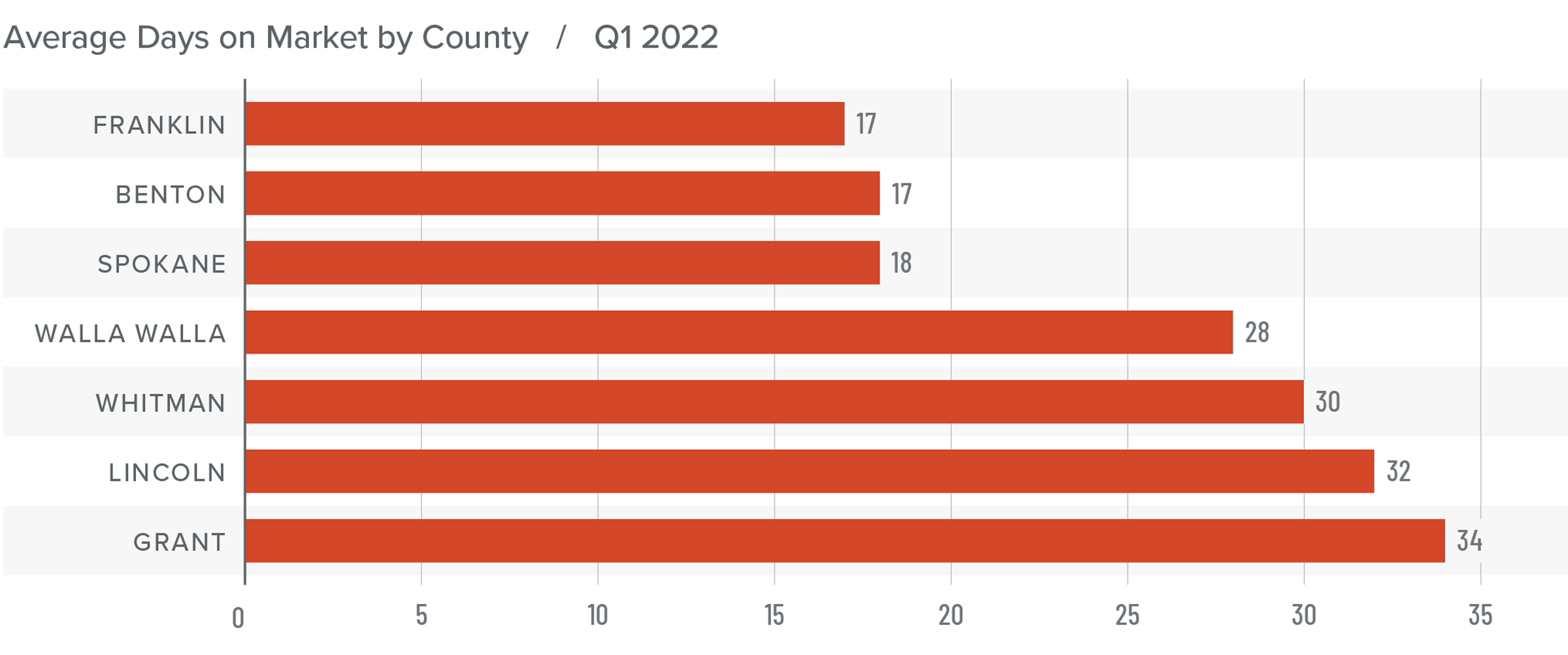
The average time it took to sell a home in Eastern Washington in the first quarter of 2022 was 25 days. This is 8 fewer days than in the first quarter of 2021.

Compared to the previous quarter, average days on market rose in every county other than Lincoln.

All counties other than Spokane and Franklin saw the average number of days-on-market drop compared to the same period in 2021. That said, the increased market time in Spokane and Franklin counties was modest.

During the first quarter it took an average of only one more day to sell a home than it did during the final quarter of last year.

A bar graph showing the average days on market for homes in various counties in Eastern Washington during Q1 2022.

Conclusions

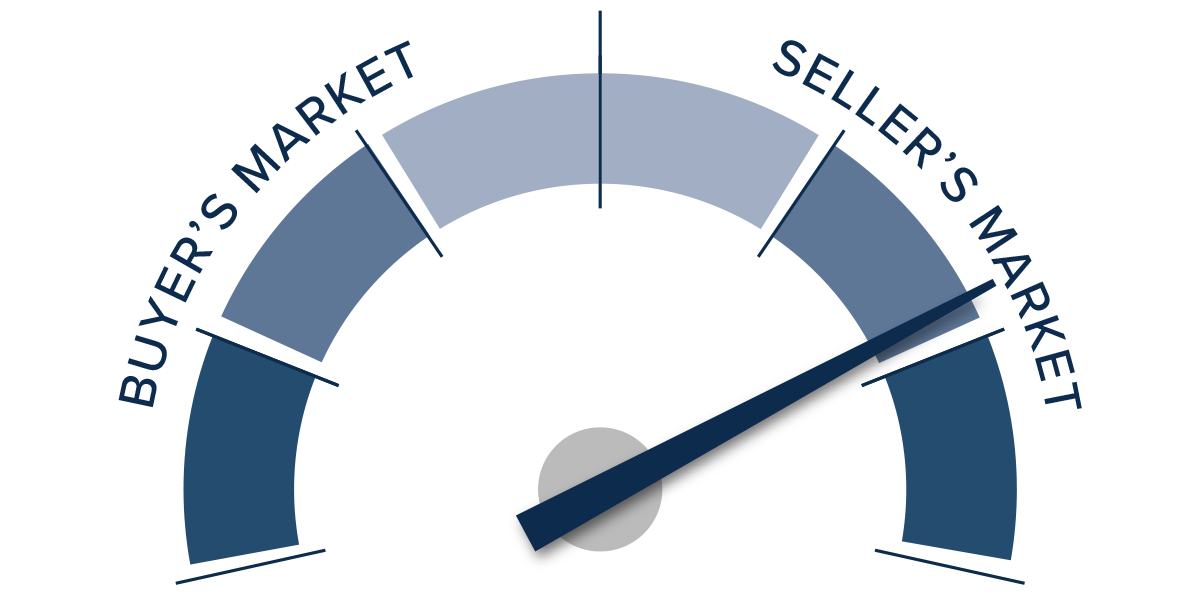
This speedometer reflects the state of the region’s real estate market using housing inventory, price gains, home sales, interest rates, and larger economic factors.

Employment levels continue to grow in Eastern Washington, but the housing market is still struggling to find its direction. A lack of homes for sale remains a major issue and the region appears to be headed toward a slower pace of sales. For now, though, price growth remains strong. The impact of rising mortgage rates on the housing market lags by about three months. It will be interesting to see how this affects the pace of price growth once the spring market is fully underway.

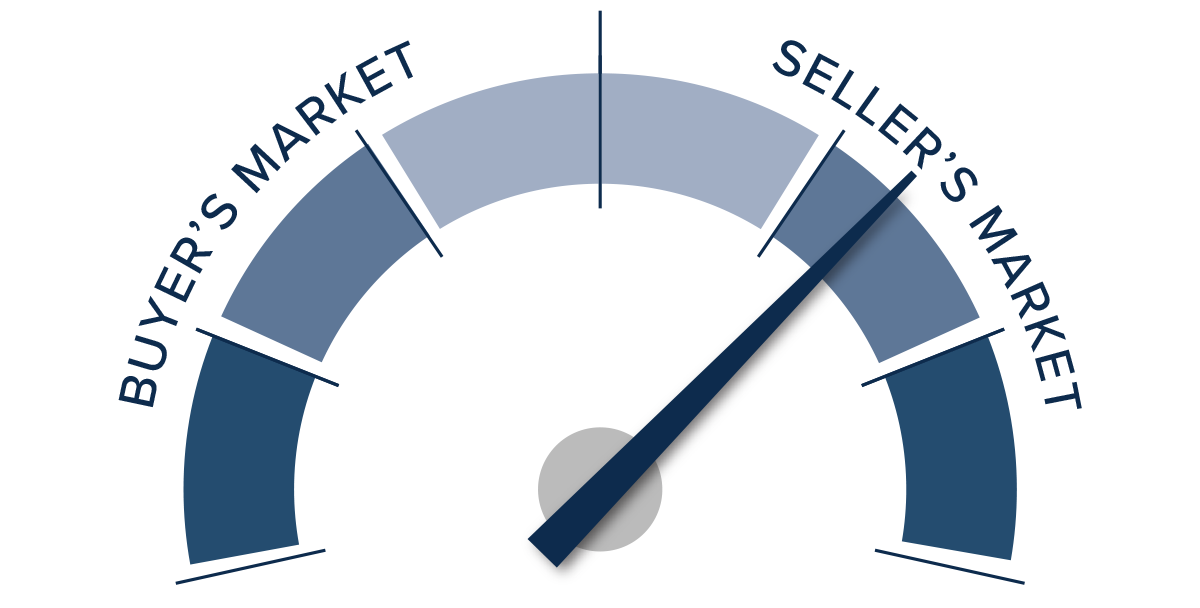
A speedometer graph indicating a seller's market in Eastern Washington during Q1 2022.

Given all the factors discussed here, I have chosen to leave the needle in the same position as the previous quarter. Sellers are still in the driver’s seat—as list prices continue to increase—but higher mortgage rates will further exacerbate affordability concerns in several markets, which may move the region toward a period of greater stability. We will have to wait and see.

About Matthew Gardner

Matthew Gardner - Chief Economist for Windermere Real Estate

As Chief Economist for Windermere Real Estate, Matthew Gardner is responsible for analyzing and interpreting economic data and its impact on the real estate market on both a local and national level. Matthew has over 30 years of professional experience both in the U.S. and U.K.

In addition to his day-to-day responsibilities, Matthew sits on the Washington State Governors Council of Economic Advisors; chairs the Board of Trustees at the Washington Center for Real Estate Research at the University of Washington; and is an Advisory Board Member at the Runstad Center for Real Estate Studies at the University of Washington where he also lectures in real estate economics.