Market News August 2, 2022

Q2 2022 Idaho Real Estate Market Update

The following analysis of select counties of the Idaho real estate market is provided by Windermere Real Estate Chief Economist Matthew Gardner. We hope that this information may assist you with making better-informed real estate decisions. For further information about the housing market in your area, please don’t hesitate to contact your Windermere Real Estate agent.


Regional Economic Overview

Employment in Idaho continues to rise, but the pace of growth has started to taper. The addition of 22,400 jobs over the past 12 months represents a growth rate of 2.8%. Idaho’s unemployment rate in June was 2.5%, which is down from 3.7% a year ago and the lowest it’s been since records started being kept in 1976. Although jobs are being added at a slower pace, I am not concerned given the current unemployment rate.

Idaho Home Sales

In the second quarter of 2022, 6,403 homes sold, representing an annual growth rate of .8%. Sales were 23.5% higher than in the first quarter of 2022.

Listing activity was up more than 90% compared to a year ago, and the average number of homes on the market was 164% higher than in the first quarter.

Compared to the same period a year ago, sales rose in Boundary, Bonner, and Shoshone counties in the northern part of the state and were higher in Ada, Gem, and Canyon counties in Southern Idaho. Sales rose from the first quarter of 2022 in all counties except Payette, though that market saw only three fewer transactions.

Pending sales were 4.4% higher than in the first quarter of the year. It appears that buyers are taking advantage of greater choice in the market.
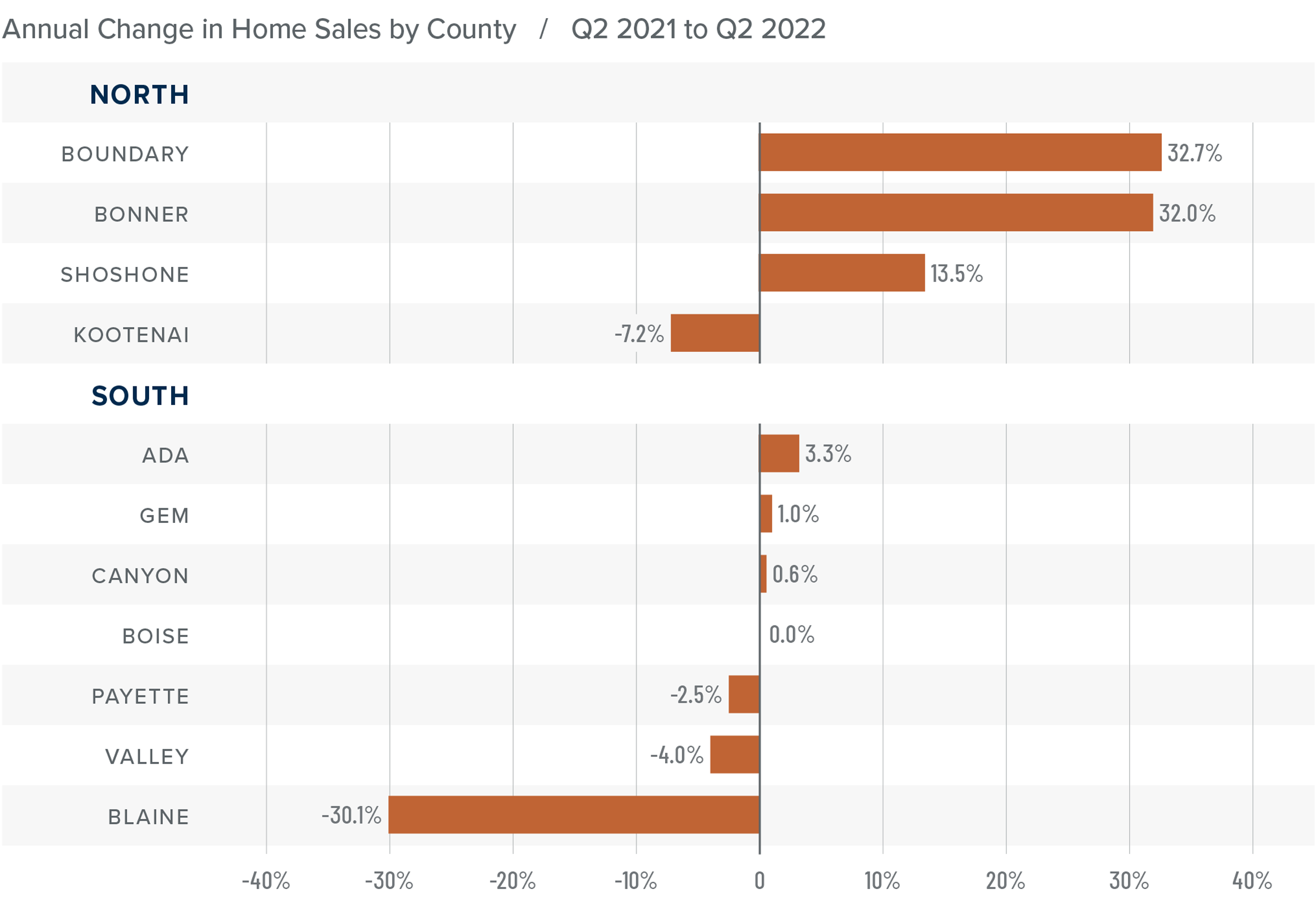
A bar graph showing the annual change in home sales for various counties in North and South Idaho from Q2 2021 to Q2 2022. In North Idaho, Boundary County came out on top with a 32.7% change, followed by Bonner at 32%, Shoshone at 13.5%, and Kootenai at -7.2%. In South Idaho, Ada County had a 3.3% change, followed by Gem at 1%, Canyon at 0.6%, Boise at 0%, Payette at -2.5%, Valley at -4%, and Blaine County at -30.1%.

Idaho Home Prices

The average home price in the region rose 15.6% year over year to $643,954. Sale prices were 5.1% higher than in first quarter of the year.

Compared to the first quarter of 2022, prices were higher in Kootenai and Shoshone counties in the north, and all but Gem and Blaine counties in the southern part of the state.

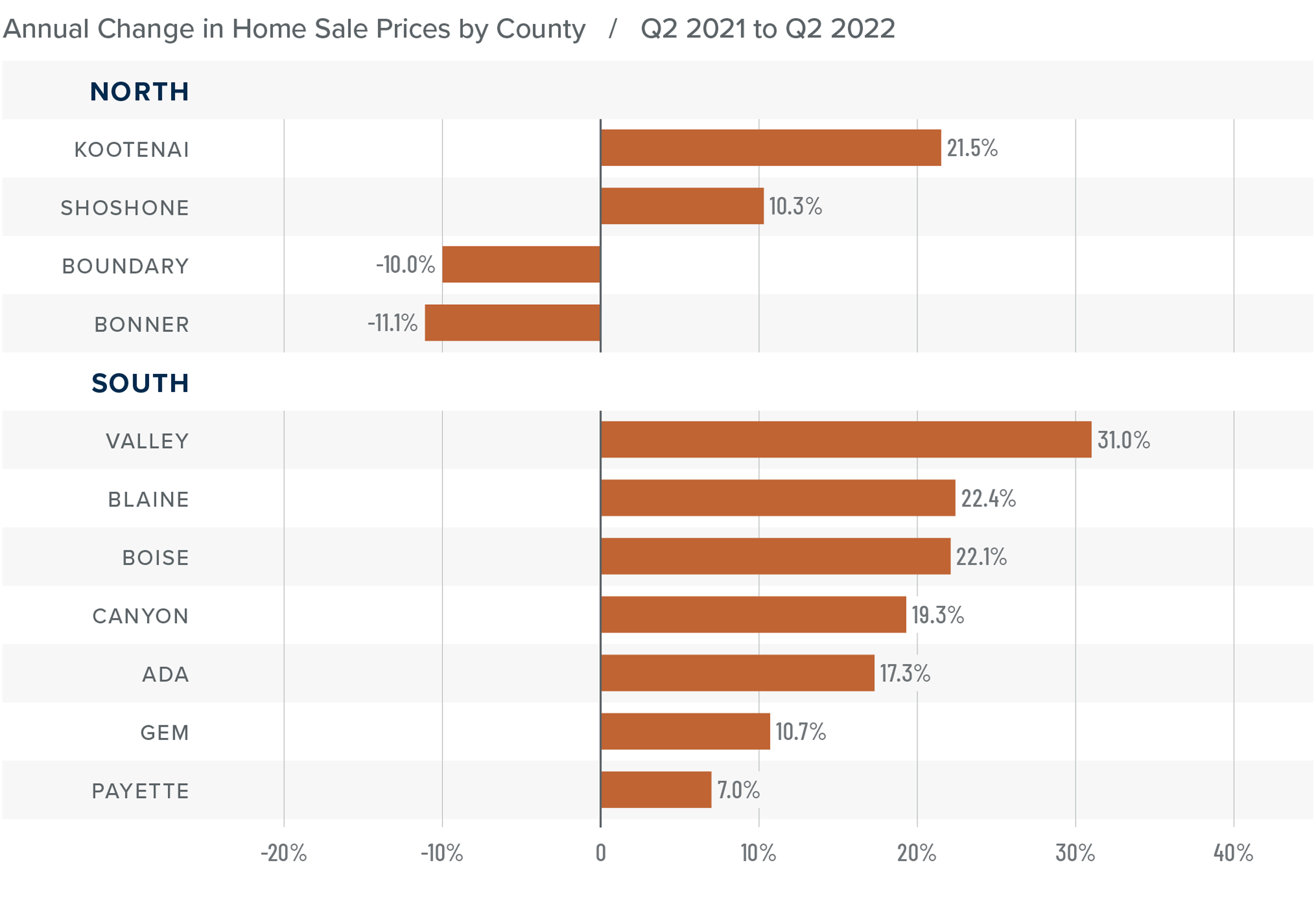
Prices rose by double digits in Kootenai and Shoshone counties but fell in Boundary and Bonner counties. Sale prices were higher than a year ago in all the southern counties contained in this report. In aggregate, home prices rose 2% in the Northern Idaho counties in this report and were 19.8% higher in the southern counties.

I have been watching list prices, as they are a leading indicator of the health of the housing market. In second quarter, they rose in every county other than Boundary in the Northern Idaho markets, but the southern counties of Valley, Ada, Boise, and Canyon all had lower median list prices than in the previous quarter. This suggests that the rapid pace of price growth in the area may be starting to slow.
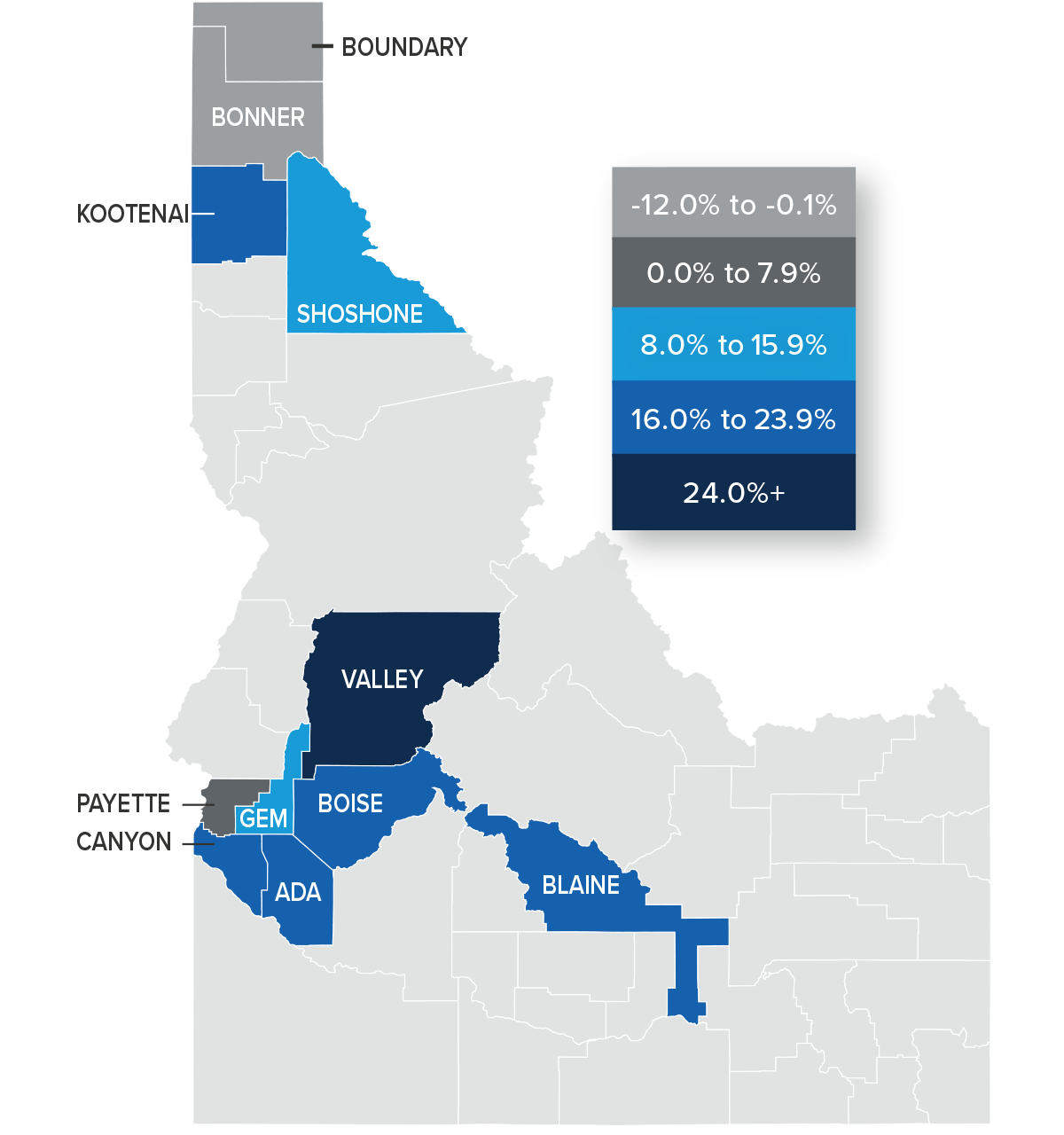
A map showing the real estate home prices percentage changes for various counties in Idaho. Different colors correspond to different tiers of percentage change. Bonner and Boundary Counties were in the -12% to -0.1% change range. Payette County was the only county with a percentage change in the 0% to 7.9% range, while Shoshone and Gem are in the 8% to 15.9% change range. Kootenai, Blaine, Boise, and Ada Counties are in the 16% to 23.9% change range, and Valley County is the only county in the 24%+ change range.

A bar graph showing the annual change in home sale prices for various counties in North and South Idaho from Q2 2021 to Q2 2022. In North Idaho, Kootenai County tops the list at 21.5%, followed by Shoshone at 10.3%, Boundary at -10%, and Bonner at -11.1%. In South Idaho, Valley showed the greatest positive change at 31%, followed by Blaine at 22.4%, Boise at 22.1%, Canyon at 19.3%, Ada at 17.3%, Gem at 10.7, and Payette County at 7%.

Mortgage Rates

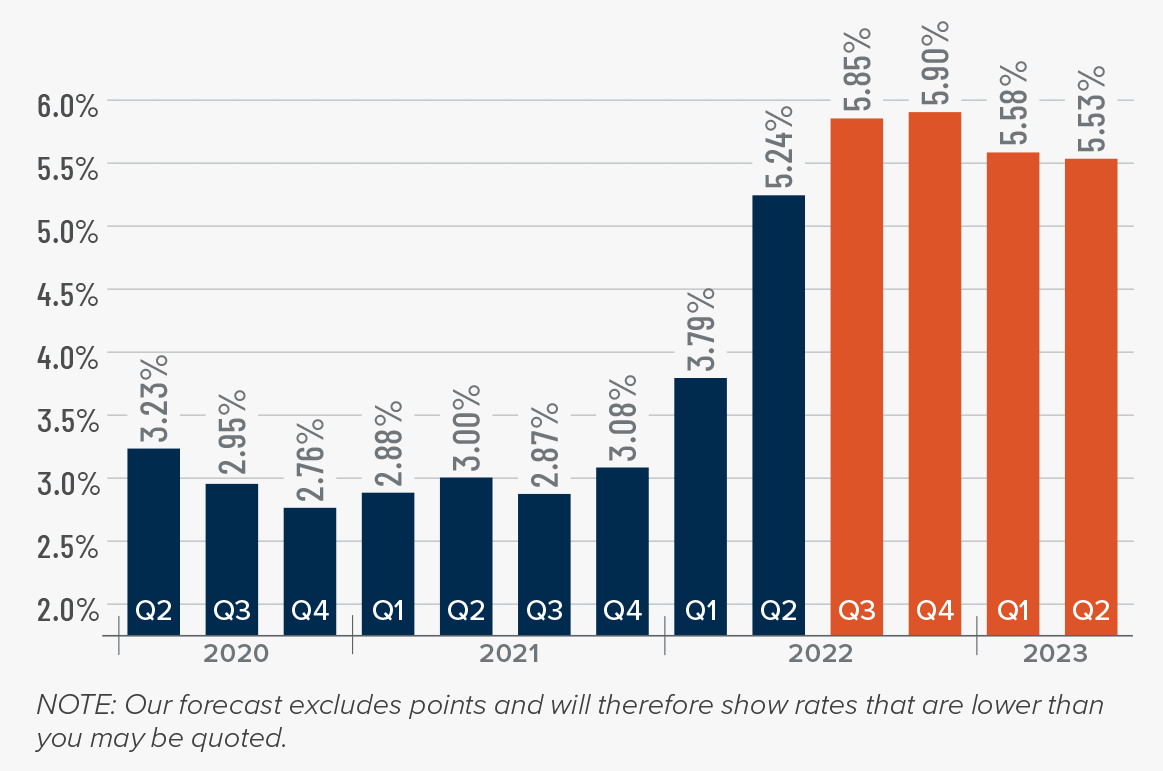
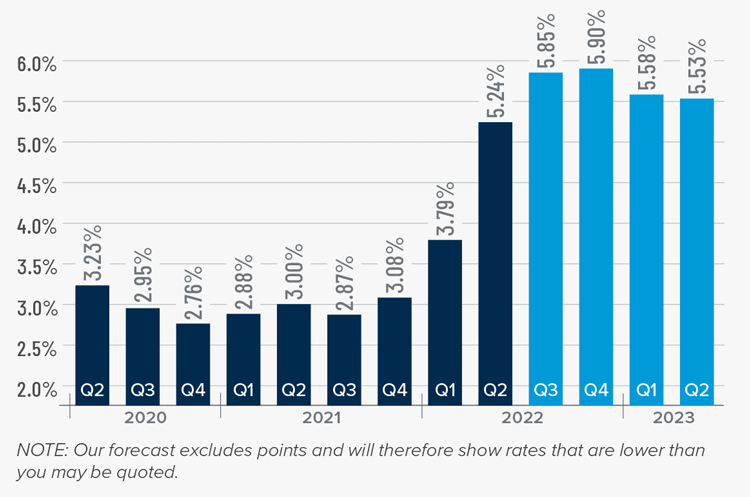
Although mortgage rates did drop in June, the quarterly trend was still moving higher. Inflation—the bane of bonds and, therefore, mortgage rates—has yet to slow, which is putting upward pressure on financing costs.

That said, there are some signs that inflation is starting to soften and if this starts to show in upcoming Consumer Price Index numbers then rates will likely find a ceiling. I am hopeful this will be the case at some point in the third quarter, which is reflected in my forecast.
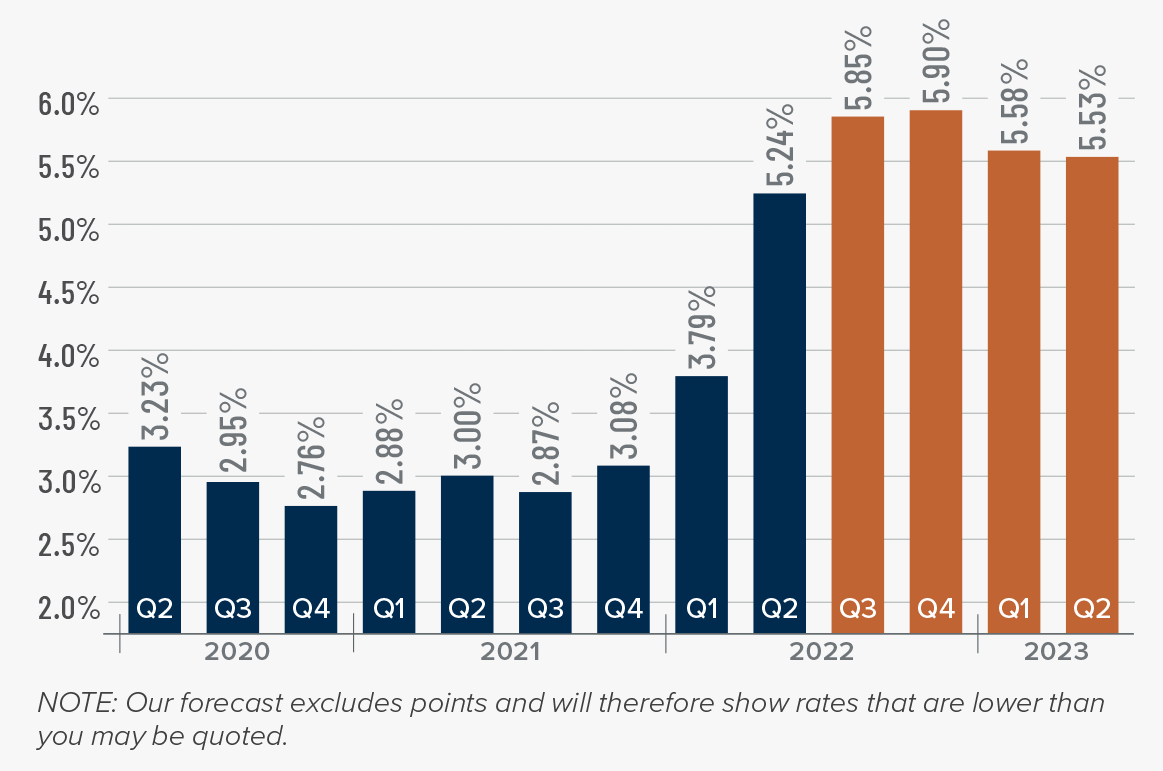
A bar graph showing the mortgage rates from 2020 to the present, as well as Matthew Gardner's forecasted mortgage rates through Q2 2023. He forecasts mortgage rates continuing to climb to 5.9% in Q4 2022, then tapering off to 5.58% in Q1 2023 and 5.53% in Q2 2023.

Idaho Days on Market

The average number of days it took to sell a home in the region matched the second quarter of 2021 but fell seven days compared to the first quarter of the year.

In Northern Idaho, days on market rose in all counties except Kootenai compared to a year ago. Market time rose in every county other than Valley and Blaine in Southern Idaho.

It took an average of 83 days to sell a home in Northern Idaho and 40 days in the southern part of the state covered by this report.

Homes again sold the fastest in Ada County in the southern part of the state and in Kootenai County in Northern Idaho.
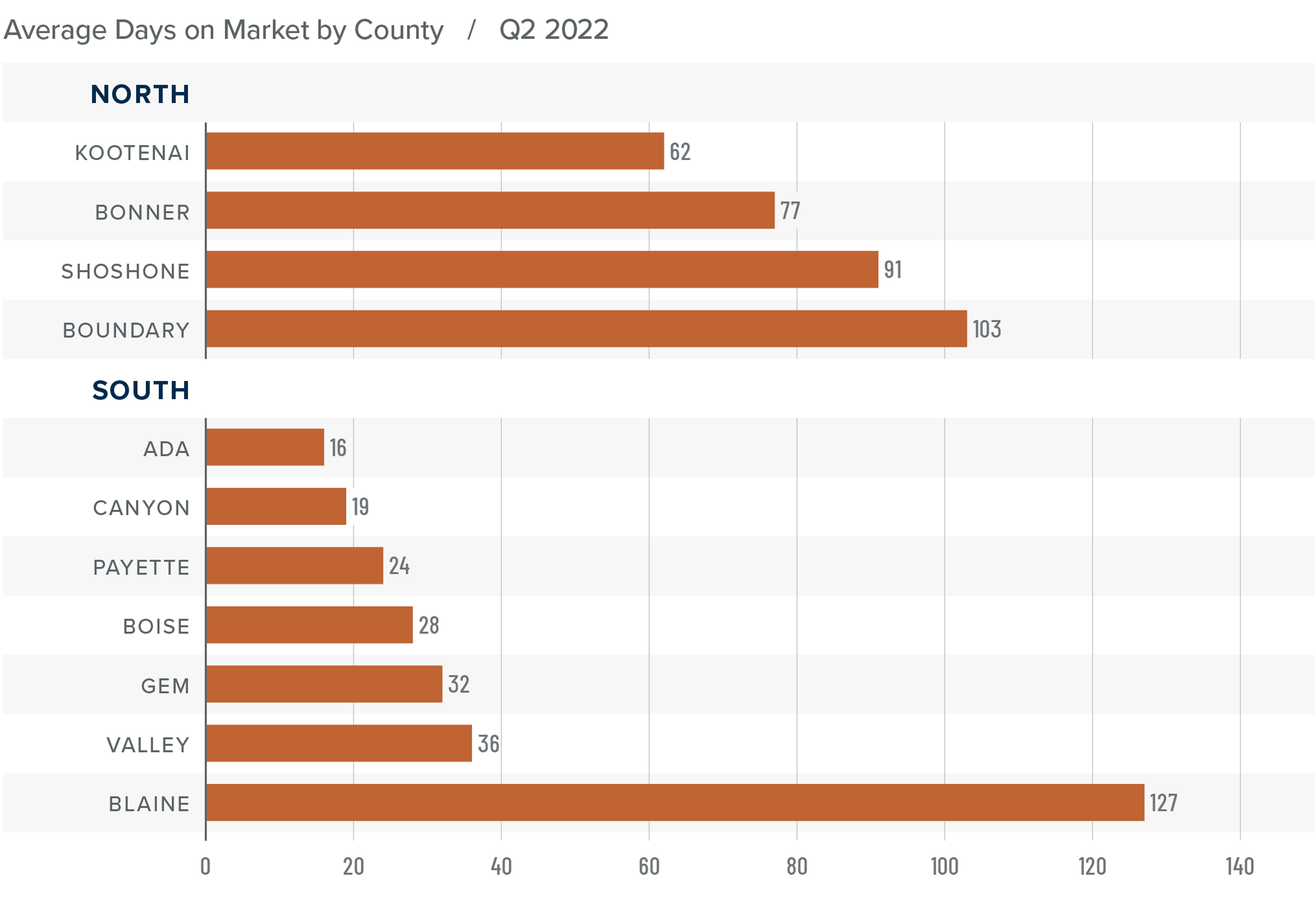
A bar graph showing the average days on market for homes in various counties in North and South Idaho for Q2 2022. In North Idaho, Kootenai County has the lowest DOM at 62, followed by Bonner at 77, Shoshone at 91, and Boundary at 103. in South Idaho, Ada County had the lowest DOM at 16, followed by Canyon at 19, Payette at 24, Boise at 28, Gem at 32, Valley at 36, and Blaine at 127.

Conclusions

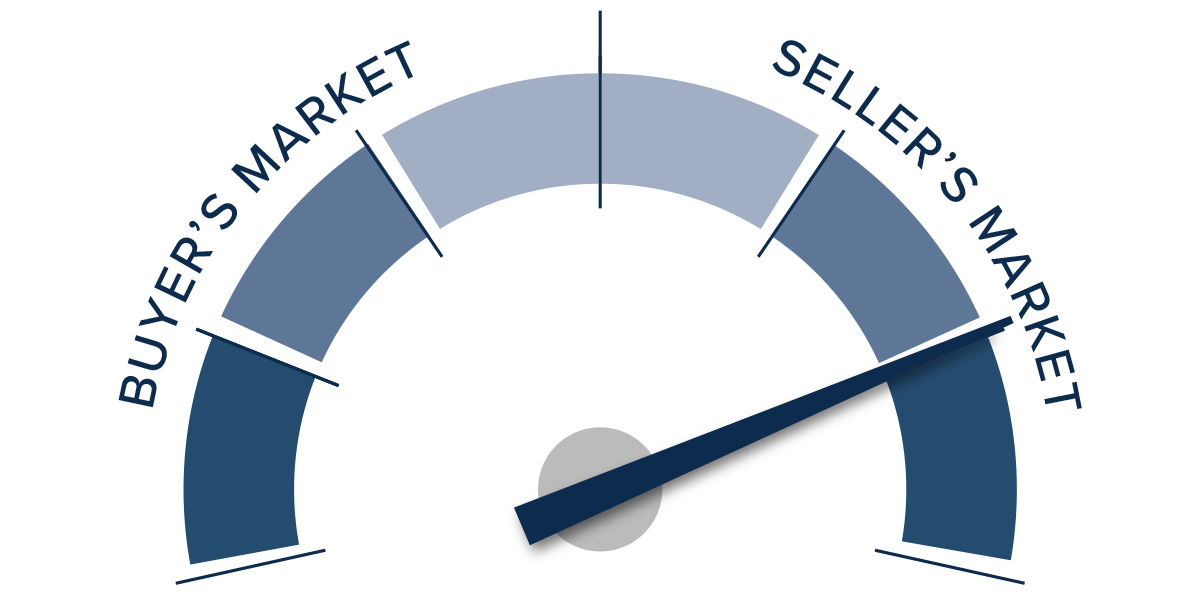
This speedometer reflects the state of the region’s real estate market using housing inventory, price gains, home sales, interest rates, and larger economic factors.

The economy continues to grow, albeit at a slower pace than over the past 18 months, and the labor market is still healthy. Even though the number of homes for sale has jumped significantly, which normally favors buyers, demand appears to still be robust. With list prices continuing to rise, sellers are clearly confident even as financing costs continue to increase. That said, the pace of price growth is slowing but overall sellers are still in control.
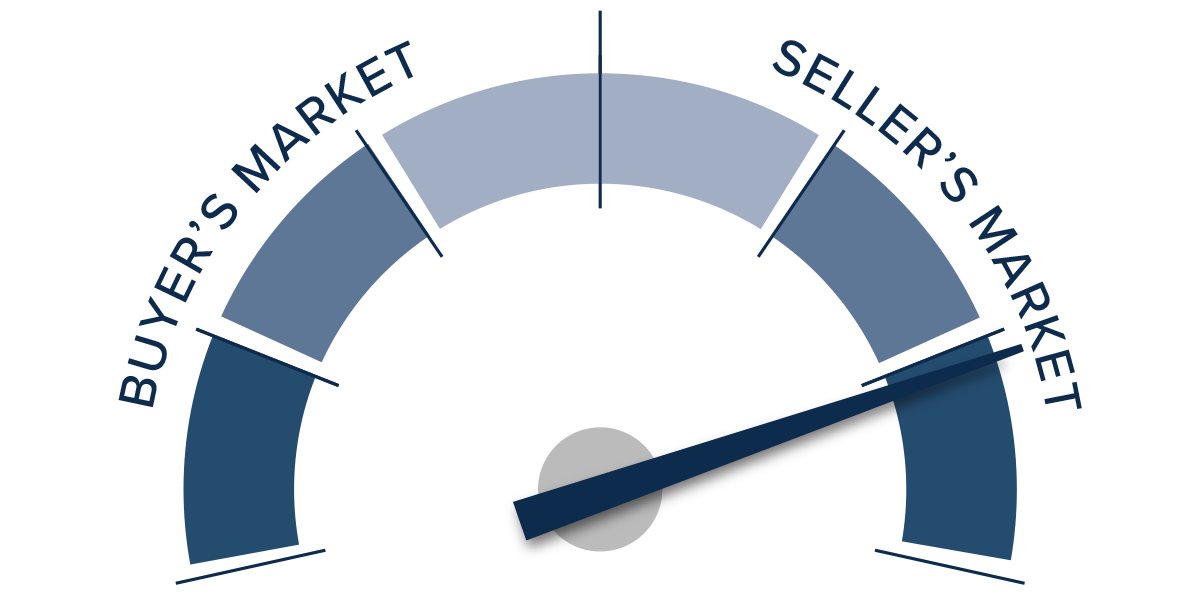
A speedometer graph indicating a strong seller's market in Idaho for Q2 2022.

Given all the aforementioned factors, I have left the needle in the same position as last quarter. Even though the market is doing well, slipping list prices in several Southern Idaho counties suggest that those markets may have found a price ceiling. Even so, sellers remain in the driver’s seat.

About Matthew Gardner

Matthew Gardner - Chief Economist for Windermere Real Estate

As Chief Economist for Windermere Real Estate, Matthew Gardner is responsible for analyzing and interpreting economic data and its impact on the real estate market on both a local and national level. Matthew has over 30 years of professional experience both in the U.S. and U.K.

In addition to his day-to-day responsibilities, Matthew sits on the Washington State Governors Council of Economic Advisors; chairs the Board of Trustees at the Washington Center for Real Estate Research at the University of Washington; and is an Advisory Board Member at the Runstad Center for Real Estate Studies at the University of Washington where he also lectures in real estate economics.


Design August 1, 2022

Setting Up Your Home Gym

With home gyms popping up left and right in recent years, many homeowners have realized the benefits of working out at home. Setting up a home gym is physically beneficial and gives purpose to empty space. In comparison to a gym membership, even with the upfront investment of purchasing equipment, a home gym can deliver savings in the long run. With far-ranging options for fitness gear and equipment online, you can tailor your home gym to your fitness needs.

Setting Up Your Home Gym

Before your first sets of lunges, pushups, and weightlifting can begin, you’ll need to decide where to build your home gym. You’ll want plenty of room for the activities and workouts you have in mind. Rooms with low ceilings or narrow walls are not well-suited for a gym. They will limit your ability to perform any kinds of jumping exercises or workouts with wide-ranging movements. This space is dedicated to physical activity and the environment should support that. If extra space is hard to come by in your home, consider taking your gym outdoors to a patio, multipurpose space, or other less commonly used area.

A space with level, solid flooring like wood, laminate, or tile is the best fit for your gym, especially if you plan on establishing a workout plan based around lifting or cardio. Having spatial awareness at all times is important while working out, so you’ll want plenty of light in your home gym. Mirrors are a common fixture in gyms. Consider adding one to your wall to sharpen your technique.


A young couple is doing lunges while watching a home workout video on a tablet. They are dressed in fashionable sportswear. They have matching dark exercise mats and exercising gear next to them. Large windows in the background bring light in their living room.

Image Source: Getty Images – Image Credit: AnVr

Home Gym Equipment

  • Strength training: Simple workout tools like kettlebells and dumbbells allow you to perform a variety of workouts without taking up much space. Kettlebells are a great tool for incorporating cardio workouts with added weight. Dumbbells at a lower weight are better for toning exercises, while those at heavier weights are better for low-repetition, bulk exercises.
  • Cardio training: Smaller workout tools such as jump ropes, wrist, and ankle weights will add intensity to your cardio workouts. Yoga mats provide proper support while performing core exercises or other bodyweight circuit workouts during your cardio sessions.
  • Large equipment: To get the most out of large workout equipment like treadmills, stair climbers, and bikes in your home gym, plan for them to be a significant part of your workouts.
  • Additional: Applying a layer of gym flooring will help prevent floor damage and provide added support while lifting and exercising. If you prefer music and/or video to accompany your workouts, add speakers and a TV to get the motivational juices flowing.

Establish a Routine

Your home gym is no good if it gets no use. With zero commute time to account for, arrange a workout routine that suits your daily schedule. Even if you only have 30 minutes, getting into a routine of working out is the key to building up your healthy lifestyle.

Once your home gym is set up, it can be either your individual fitness sanctuary or an opportunity to work out with others. Invite a friend to exercise via video chat and schedule times to feel the burn together. With more virtual fitness classes available now than ever, surf the web to find the classes that best fit your schedule and desired workout intensity.

For more on maximizing the functionality of the spaces in your home, read our guide to upgrading your home office: Upgrading Your Work From Home Space


­­­­­­Featured Image Source: Getty Images – Image Credit: Fly View Productions

Market News August 1, 2022

Q2 2022 Eastern Washington Real Estate Market Update

The following analysis of select counties of the Eastern Washington real estate market is provided by Windermere Real Estate Chief Economist Matthew Gardner. We hope that this information may assist you with making better-informed real estate decisions. For further information about the housing market in your area, please don’t hesitate to contact your Windermere Real Estate agent.


Regional Economic Overview

Year over year, total employment in Eastern Washington rose by more than 17,000 jobs, representing an annual growth rate of 3.5%. Spokane County saw the fastest pace of job growth, rising by 4.7%. All other counties except Lincoln added jobs over the past 12 months. Whitman and Lincoln counties are still marginally below their pre-pandemic employment levels. Unadjusted for seasonality, the regional unemployment rate was 4.4%; the seasonally adjusted rate was 4.6%. The highest jobless rate was in Franklin County at 6.2% and the lowest rate was in Whitman County at 4.1%.

Eastern Washington Home Sales

During second quarter, 3,464 homes sold, which was 6.9% lower than a year ago but more than 47% higher than the first quarter of 2022.

Sales growth this spring came as listing activity jumped. The average number of homes on the market was 131% higher than in the first quarter.

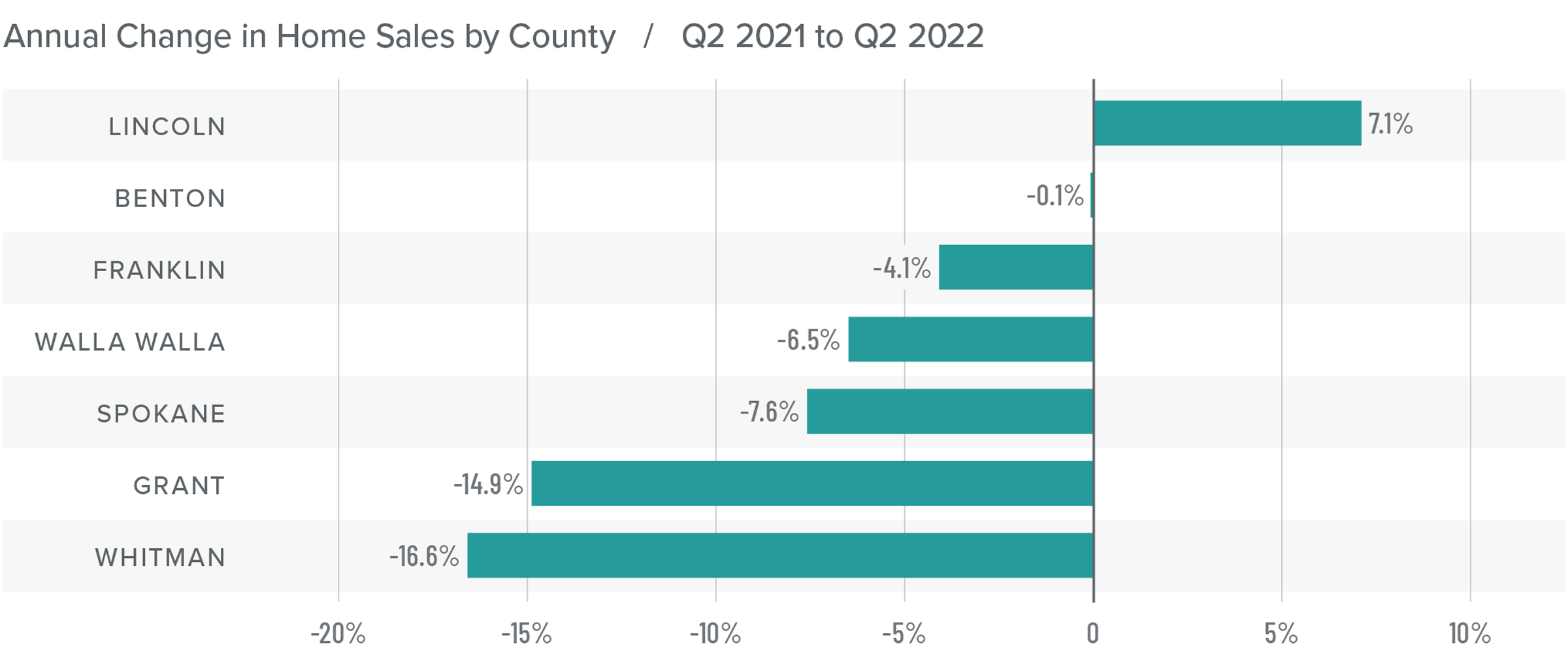
Year over year, sales increased in Lincoln County but fell across the balance of the region. However, compared to the first quarter, sales rose significantly across the board.

Higher inventory levels also allowed pending sales to rise by more than 34% from the first quarter. The spring market was clearly a good one, even as mortgage rates rose.

A bar graph showing the annual change in home sales for various counties in Eastern Washington from Q2 2021 to Q2 2022. Six out of the seven counties listed show negative percentage year-over-year changes: Lincoln at 7.1%, followed by Benton at -0.1%, Franklin at -4.1%, Walla Walla at -6.5%, Spokane at -7.6%, Grant at -14.6%, and Whitman at -16.6%.

Eastern Washington Home Prices

The average home price in Eastern Washington rose 16.3% from last year to $475,985. Average prices were 9.4% higher than in the first quarter.

Compared to the first quarter of 2022, prices rose in all counties except Benton, where they were down a modest .8%.

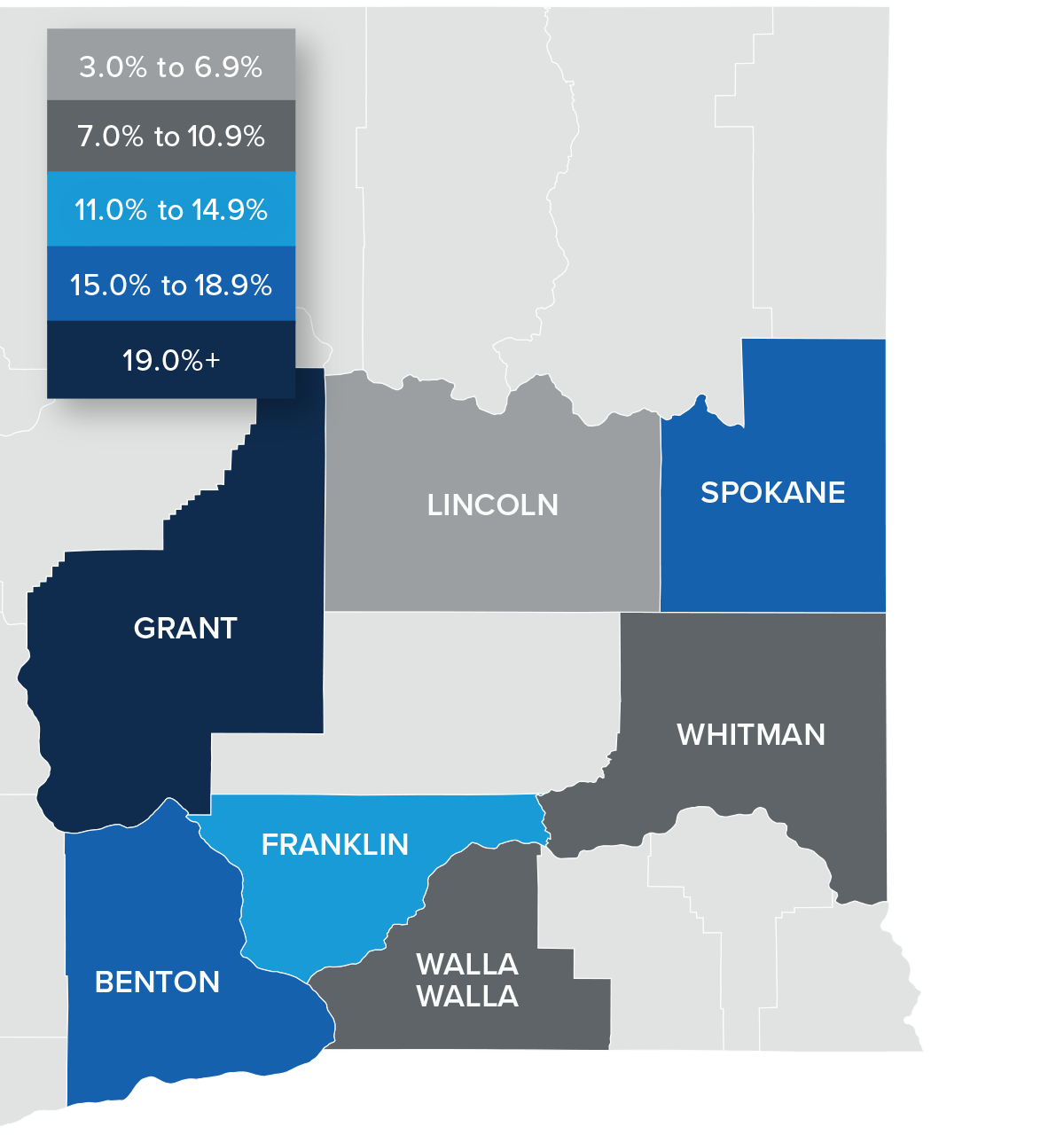
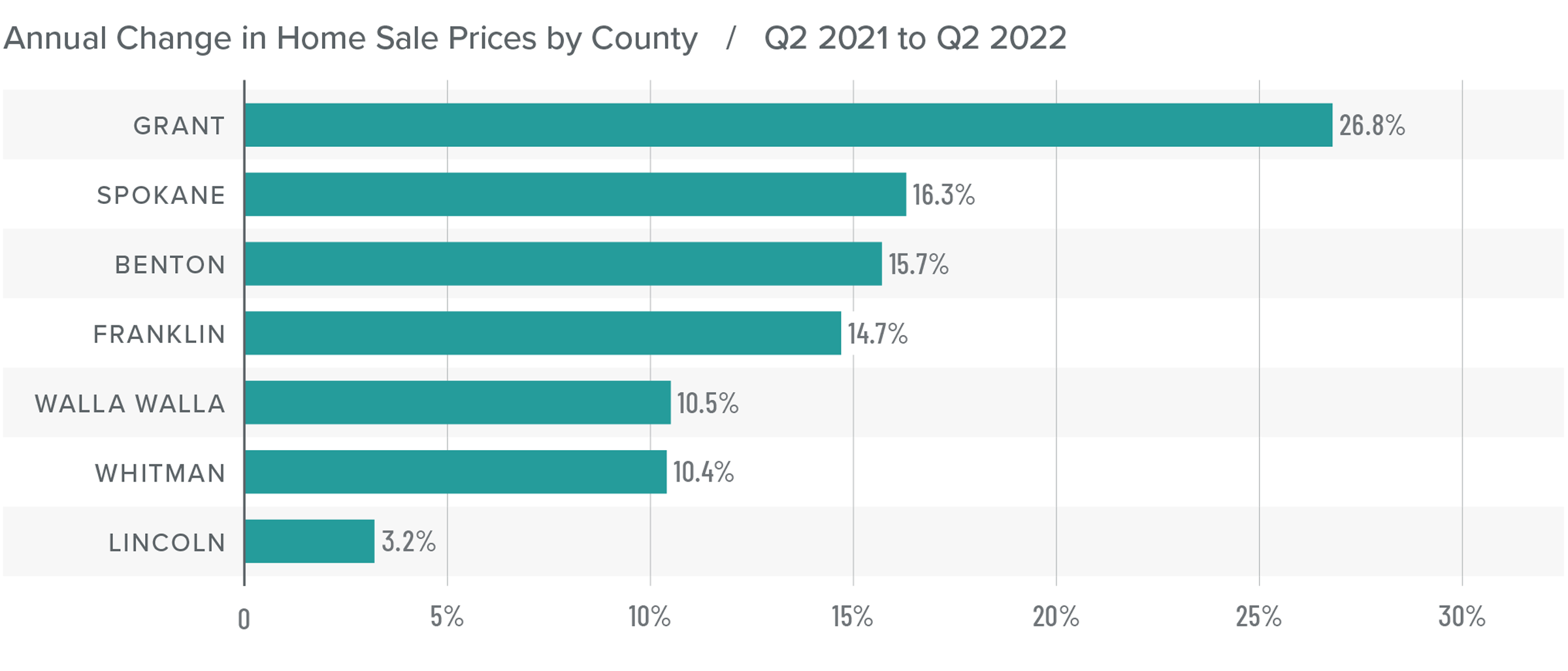
Every county other than Lincoln saw average prices rise by more than 10% compared to the same time last year. Grant County prices rose a very impressive 26.8%.

I have started tracking list prices, as they are a leading indicator of the direction of the housing market. Thus far, rising mortgage rates and growing inventory levels have yet to dampen seller confidence, with median list prices up an average of 9.9% from the first quarter.

A map showing the real estate home prices percentage changes for various counties in Eastern Washington. Different colors correspond to different tiers of percentage change. Lincoln County is the only county with a percentage change in the 3% to 6.9% range, while Whitman and Walla Walla are in the 7% to 10.9% change range. Franklin County is the only county in the 11% to 14.9 % change range, Benton and Spokane are in the 15% to 18.9% change range, and Grant County is the only county in the 19% + change range.

A bar graph showing the annual change in home sale prices for various counties in Eastern Washington from Q2 2021 to Q2 2022. Grant County tops the list at 26.8%, followed by Spokane at 16.3%, Benton at 15.7%, Franklin at 14.7%, Walla Walla at 10.5%, Whitman at 10.4%, and Lincoln County at 3.2%.

Mortgage Rates

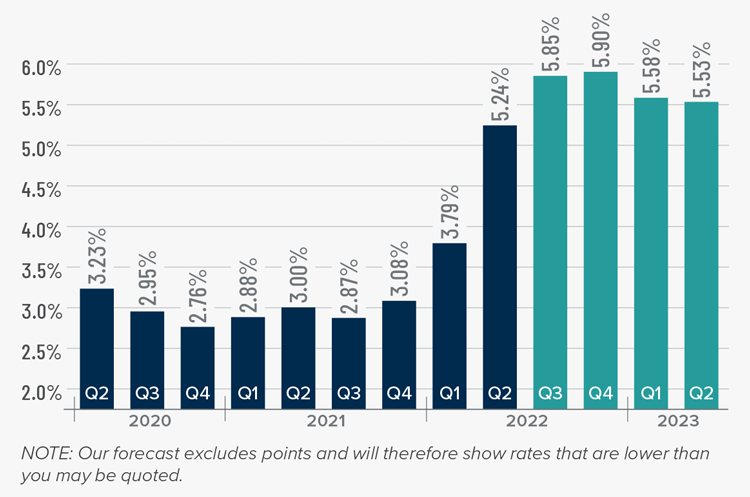
Although mortgage rates did drop in June, the quarterly trend was still moving higher. Inflation—the bane of bonds and, therefore, mortgage rates—has yet to slow, which is putting upward pressure on financing costs.

That said, there are some signs that inflation is starting to soften and if this starts to show in upcoming Consumer Price Index numbers then rates will likely find a ceiling. I am hopeful this will be the case at some point in the third quarter, which is reflected in my forecast.

A bar graph showing the mortgage rates from 2020 to the present, as well as Matthew Gardner's forecasted mortgage rates through Q2 2023. He forecasts mortgage rates continuing to climb to 5.9% in Q4 2022, then tapering off to 5.58% in Q1 2023 and 5.53% in Q2 2023.

Eastern Washington Days on Market

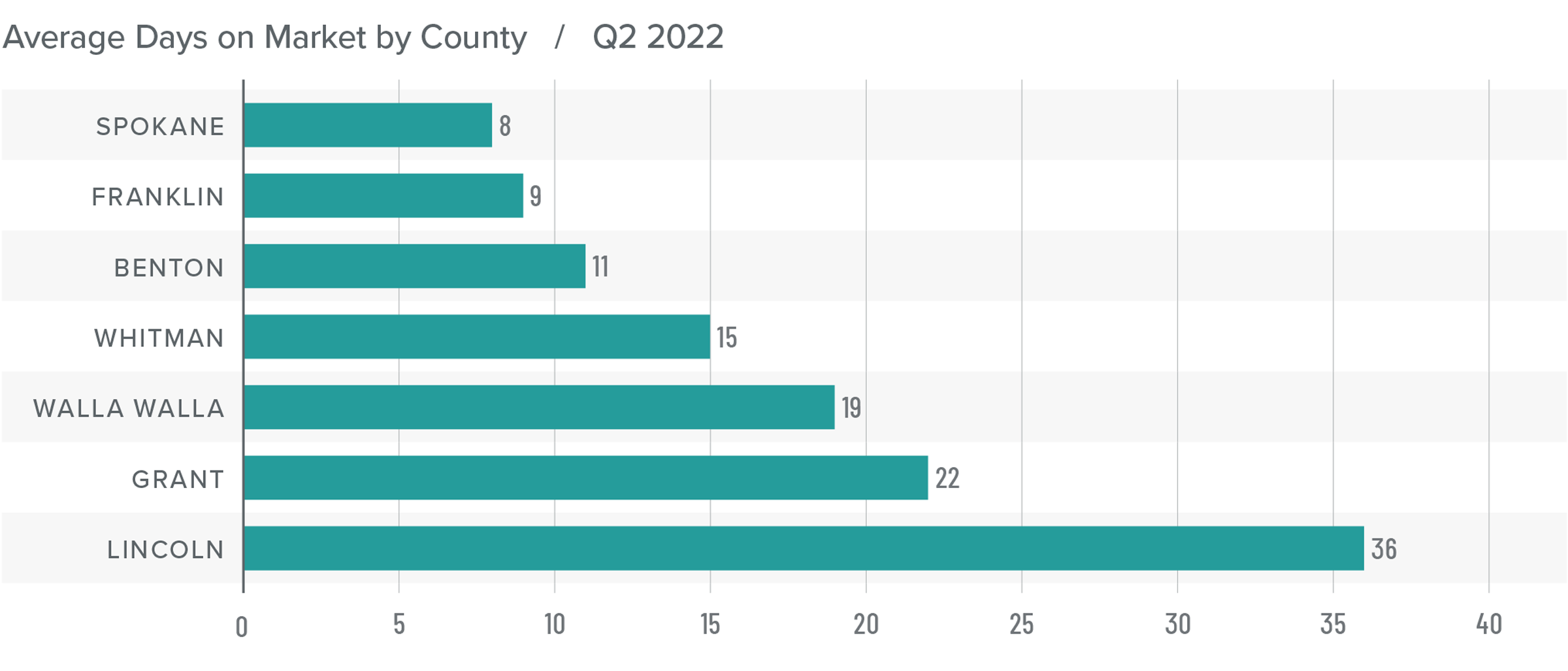
The average time it took to sell a home in Eastern Washington in the second quarter of 2022 was 17 days, which is 3 fewer days than the same period a year ago.

Compared to the first quarter of this year, average days on market fell in every county other than Lincoln, where it took an average of four more days to sell a home.

All counties other than Spokane (where market time was unchanged) saw the average number of days it took for a house to sell drop compared to a year ago.

It took an average of eight fewer days to sell a home in the quarter than it did during the first quarter of 2022.

A bar graph showing the average days on market for homes in various counties in Eastern Washington for Q2 2022. Spokane County has the lowest DOM at 8, followed by Franklin at 9, Benton at 11, Whitman at 15, Walla Walla at 19, Grant at 22, and Lincoln at 36.

Conclusions

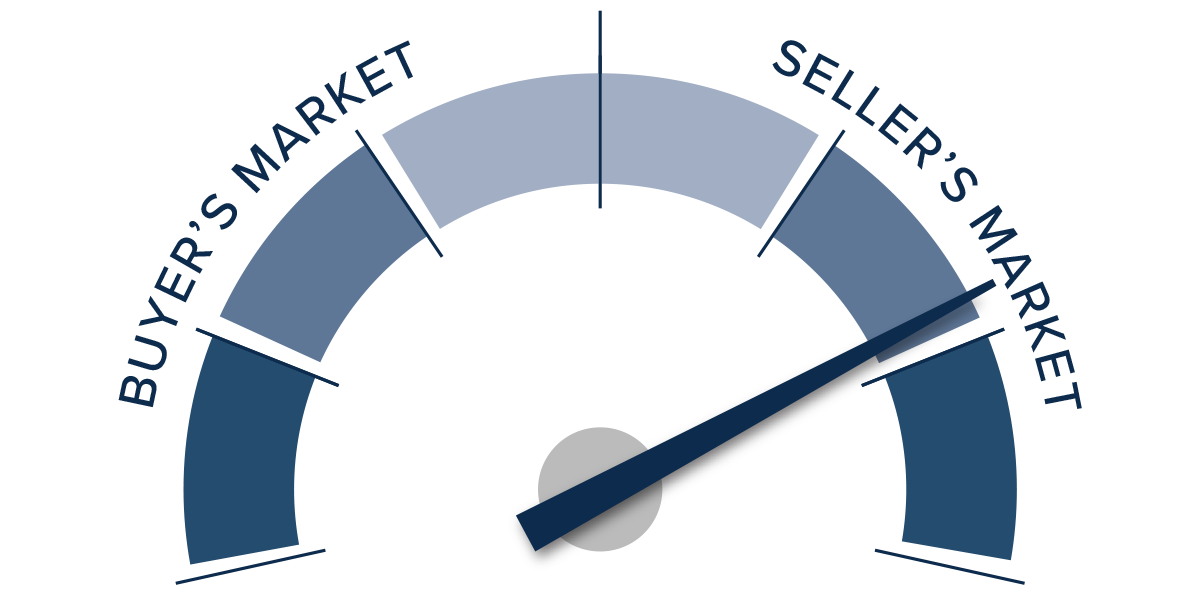
This speedometer reflects the state of the region’s real estate market using housing inventory, price gains, home sales, interest rates, and larger economic factors.

Employment in Eastern Washington continues to grow, which is a positive for the housing market. Although the number of homes for sale jumped significantly this spring, which typically favors home buyers, home sales and days on market suggest that demand remains strong, and the market is still competitive.

A speedometer graph indicating a medium-to-strong seller's market in Eastern Washington for Q2 2022.

With list prices continuing to rise, sellers are clearly confident even in the face of rising financing costs. Though the pace of price growth has slowed, sellers are still in the driver’s seat. As such, I have moved the needle a little more in the direction of sellers. Until listing price growth shows further slowing, we will not approach a balanced market.

About Matthew Gardner

Matthew Gardner - Chief Economist for Windermere Real Estate

As Chief Economist for Windermere Real Estate, Matthew Gardner is responsible for analyzing and interpreting economic data and its impact on the real estate market on both a local and national level. Matthew has over 30 years of professional experience both in the U.S. and U.K.

In addition to his day-to-day responsibilities, Matthew sits on the Washington State Governors Council of Economic Advisors; chairs the Board of Trustees at the Washington Center for Real Estate Research at the University of Washington; and is an Advisory Board Member at the Runstad Center for Real Estate Studies at the University of Washington where he also lectures in real estate economics.

Market News August 1, 2022

Q2 2022 Central Washington Real Estate Market Update

The following analysis of select counties of the Central Washington real estate market is provided by Windermere Real Estate Chief Economist Matthew Gardner. We hope that this information may assist you with making better-informed real estate decisions. For further information about the housing market in your area, please don’t hesitate to contact your Windermere Real Estate agent.


Regional Economic Overview

Central Washington has added 5,558 jobs over the past 12 months, which represents an annual growth rate of 2.5%. With the addition of these jobs, the area has now returned to its pre-pandemic employment levels. Although the Central Washington region has seen a full recovery, Kittitas County is still lagging with a shortfall of 2,600 jobs. Adjusted for seasonality, unemployment levels in Central Washington were 5.4%, down from 6.2% a year ago. The lowest unemployment rate was in Chelan County, where it was 3.9%. The area’s highest jobless rate was in Yakima County, where 6% of the labor force was still without work.

Central Washington Home Sales

Sales in Central Washington fell 2.2% from the second quarter of 2021. A total of 1,359 homes sold, which was lower than a year ago but 33% higher than the first quarter of 2022. The spring housing market was clearly a busy one.

Pending sales, which are an indicator of future closings, rose more than 70% compared to first quarter. This suggests that closings in the third quarter will likely be strong.

Year-over-year, sales rose in Douglas, Yakima, and Okanogan counties, but fell in Chelan and Kittitas counties. However, compared to the first quarter of 2022, sales rose significantly across the board.

Inventory levels rose more than 36% year over year and were up 82% from the first quarter. There are considerably more choices in the market, which is good news for buyers.

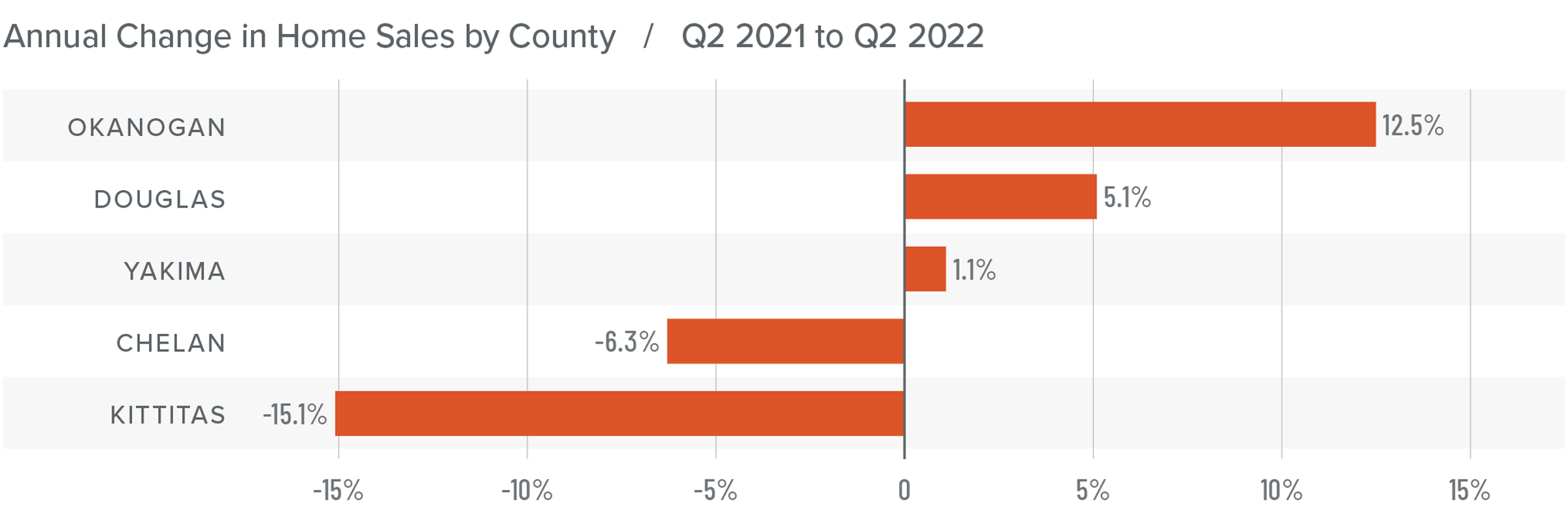
A bar graph showing the annual change in home sales for various counties in Central Washington from Q2 2021 to Q2 2022. Okanogan County came out on top with a 12.5% change, followed by Douglas at 5.1%, Yakima at 1.1%, Chelan at -6.3%, and Kittitas at -15.1%.

Central Washington Home Prices

The average home price in Central Washington rose 12.2% year over year to $521,894. Prices were 3.9% higher than in the first quarter of this year.

I have been watching list prices as they are a leading indicator regarding the direction the market may take. Median list prices were an average of 10.7% higher than in the first quarter. Only Kittitas County saw asking prices pull back, but I do not see this as a concern at the present time.

Only Douglas County saw year-over-year prices rise by less than 10%. Compared to the first quarter, prices rose in three counties, but fell modestly in Kittitas and Douglas counties.

Although interest rates rose to an average of more than 5.5% by the end of second quarter, sellers still appear to be confident in the market. This was demonstrated by rising list prices even in the face of more competition with the increase in inventory.

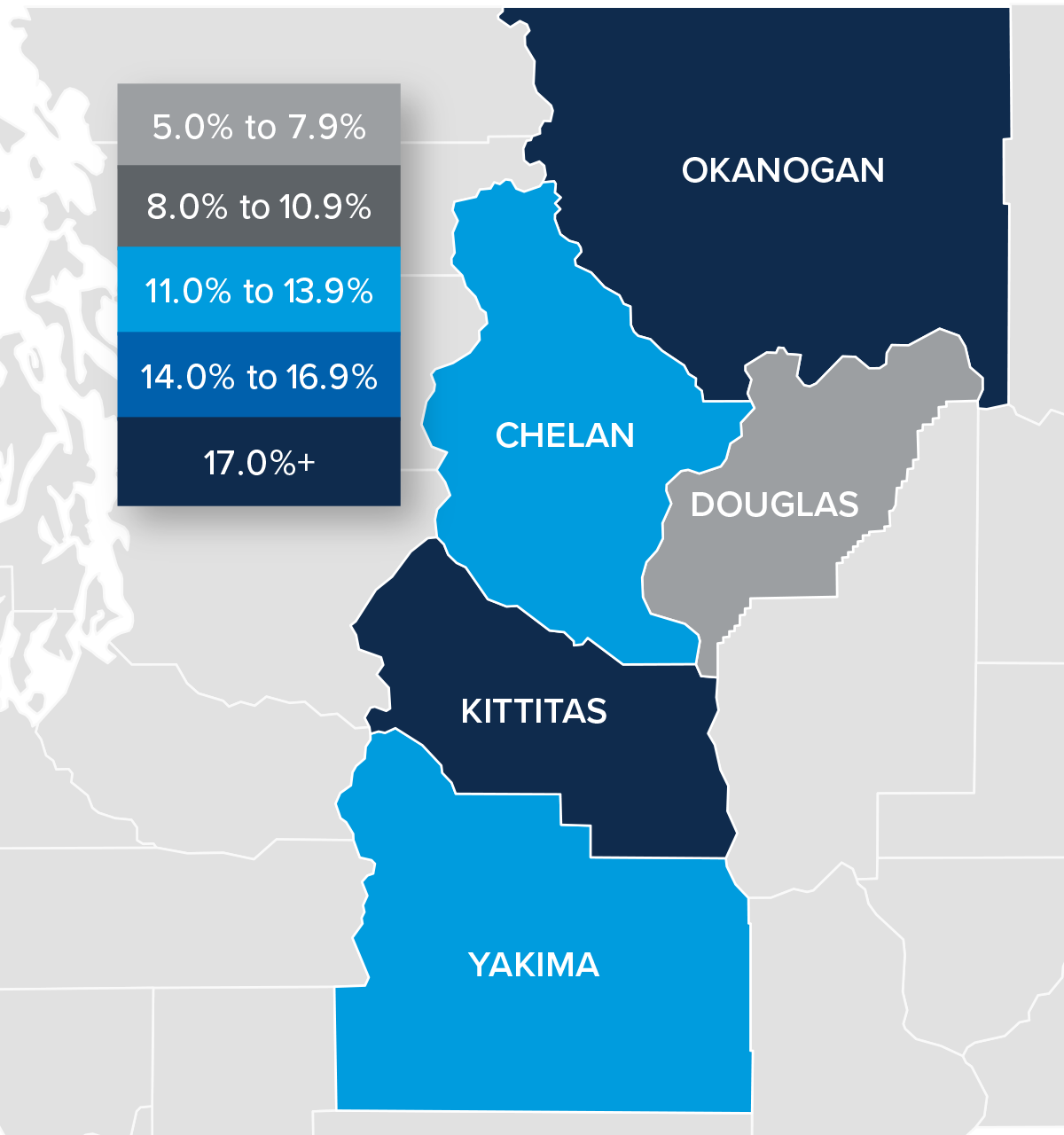
A map showing the real estate home prices percentage changes for various counties in Central Washington. Different colors correspond to different tiers of percentage change. Douglas County is the only county with a percentage change in the 5% to 7.9% range, while Chelan and Yakima are in the 11% to 13.9% change range. Okanogan and Kittitas Counties are in the 17% + change range.

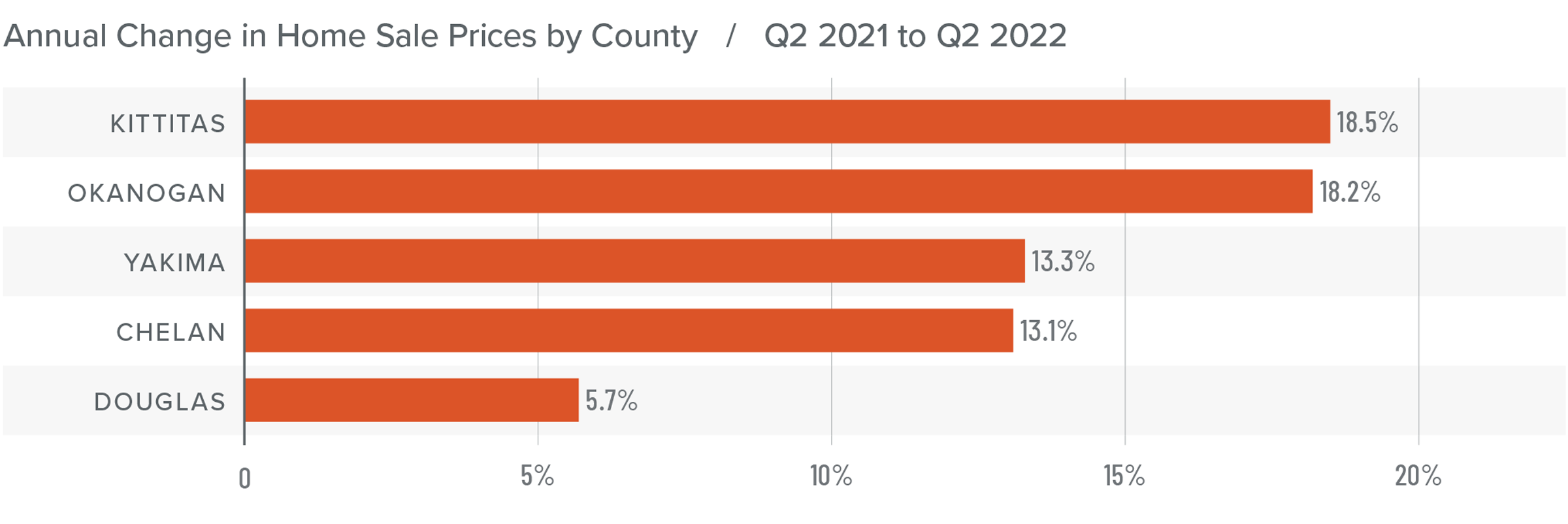
A bar graph showing the annual change in home sale prices for various counties in Central Washington from Q2 2021 to Q2 2022. Kittitas County tops the list at 18.5%, followed by Okanogan at 18.2%, Yakima at 13.3%, Chelan at 13.1%, and Douglas County at 5.7%.

Mortgage Rates

Although mortgage rates did drop in June, the quarterly trend was still moving higher. Inflation—the bane of bonds and, therefore, mortgage rates—has yet to slow, which is putting upward pressure on financing costs.

That said, there are some signs that inflation is starting to soften and if this starts to show in upcoming Consumer Price Index numbers then rates will likely find a ceiling. I am hopeful this will be the case at some point in the third quarter, which is reflected in my forecast.

A bar graph showing the mortgage rates from 2020 to the present, as well as Matthew Gardner's forecasted mortgage rates through Q2 2023. He forecasts mortgage rates continuing to climb to 5.9% in Q4 2022, then tapering off to 5.58% in Q1 2023 and 5.53% in Q2 2023.

Central Washington Days on Market

The average time it took to sell a home in Central Washington in the second quarter was 31 days.

During the quarter, it took six fewer days to sell a home in Central Washington than it did a year ago.

Two counties saw the length of time it took to sell a home drop compared to a year ago. Kittitas and Douglas counties saw no change and market time in Chelan County was up five days. Compared to the first quarter of 2022, market time fell across the region.

On average, it took 24 fewer days to sell a home in the second quarter than it did in the first.

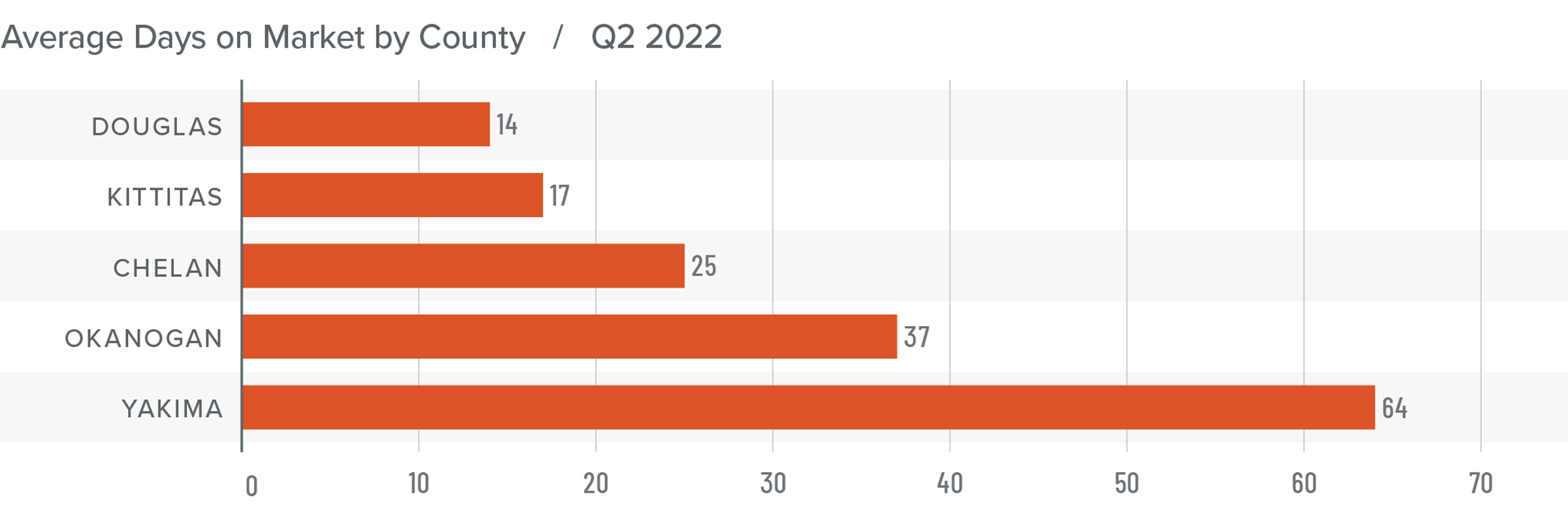
A bar graph showing the average days on market for homes in various counties in Central Washington for Q2 2022. Douglas County has the lowest DOM at 14, followed by Kittitas at 17, Chelan at 25, Okanogan at 37, and Yakima at 64.

Conclusions

This speedometer reflects the state of the region’s real estate market using housing inventory, price gains, home sales, interest rates, and larger economic factors.

Jobs continue to be added to the local economy and the labor force is expanding, which are both positive for the housing market. Inventory levels have risen significantly, but data on pending sales and market time suggests that the market is still buoyant. List-price growth suggests that sellers are still confident even with rising interest rates and considerably more homes for sale. However, the pace of home-price appreciation is starting to cool, which may be of some solace to home buyers.

A speedometer graph indicating a medium seller's market in Central Washington for Q2 2022.

All things considered, I have decided to move the needle a little more in the direction of home sellers. The market is going to start moving, albeit slowly, toward some sort of balance, but for the time being, sellers remain in control.

About Matthew Gardner

Matthew Gardner - Chief Economist for Windermere Real Estate

As Chief Economist for Windermere Real Estate, Matthew Gardner is responsible for analyzing and interpreting economic data and its impact on the real estate market on both a local and national level. Matthew has over 30 years of professional experience both in the U.S. and U.K.

In addition to his day-to-day responsibilities, Matthew sits on the Washington State Governors Council of Economic Advisors; chairs the Board of Trustees at the Washington Center for Real Estate Research at the University of Washington; and is an Advisory Board Member at the Runstad Center for Real Estate Studies at the University of Washington where he also lectures in real estate economics.
Market News July 29, 2022

Q2 2022 Colorado Real Estate Market Update

The following analysis of select counties of the Colorado real estate market is provided by Windermere Real Estate Chief Economist Matthew Gardner. We hope that this information may assist you with making better-informed real estate decisions. For further information about the housing market in your area, please don’t hesitate to contact your Windermere Real Estate agent.


Regional Economic Overview

Colorado continues to add jobs, but the pace of growth has slowed, albeit modestly. At the time of writing this report, the state’s employment had increased by 124,600 jobs over the past 12 months, which represents an annual growth rate of 4.6%. The state unemployment rate in May was 3.5%. Regionally, unemployment rates ranged from a low of 2.4% in Boulder to a high of 3.4% in the Grand Junction and Greeley metropolitan areas.

Colorado Home Sales

In the second quarter, 12,839 homes sold, a drop of 8% compared to a year ago but 57% higher than in the first quarter of this year.

Year over year, sales rose in only three counties covered by this report and fell in the rest of the region. That said, there was a palpable increase in sales across the board compared to the first quarter of 2022.

The significant jump in sales from the first quarter can likely be attributed to the fact that inventory levels spiked, rising more than 190% from the first quarter.

Pending sales (an indicator of future closings) rose 39% from the first quarter, signifying that the third quarter may show further growth in sales activity.

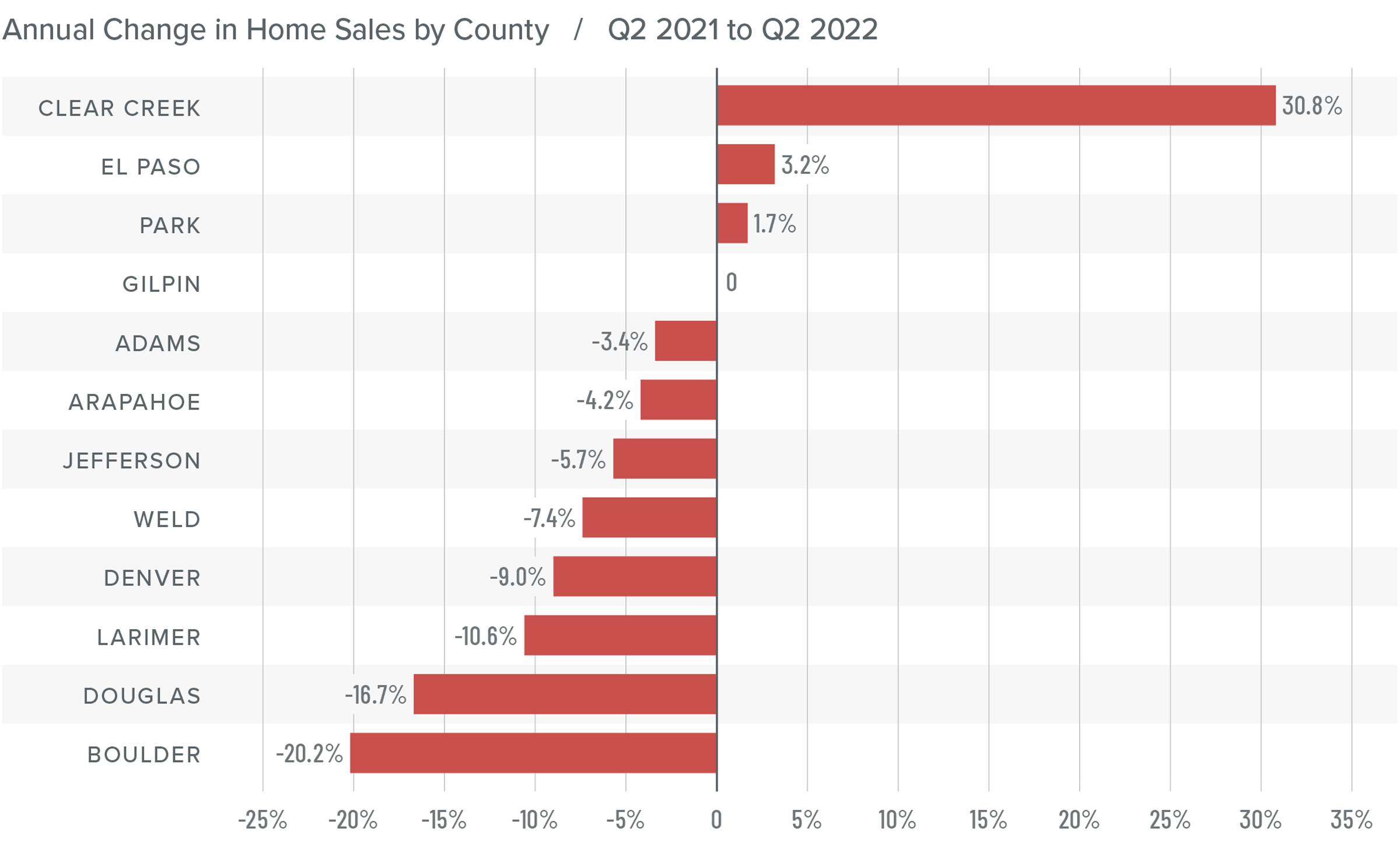
A bar graph showing the annual change in home sales for various counties in Colorado from Q2 2021 to Q2 2022. The counties with a positive percentage year-over-year change are Clear Creek at 30.8%, El Paso at 3.2%, and Park at 1.7%. Gilpin County had a 0% change. The counties with a negative year-over-year change are Adams at -3.4%, Arapahoe at -4.2%, Jefferson at -5.7%, Weld at -7.4%, Denver at -9%, Larimer at -10.6%, Douglas at -16.7%, and Boulder at -20.2%.

Colorado Home Prices

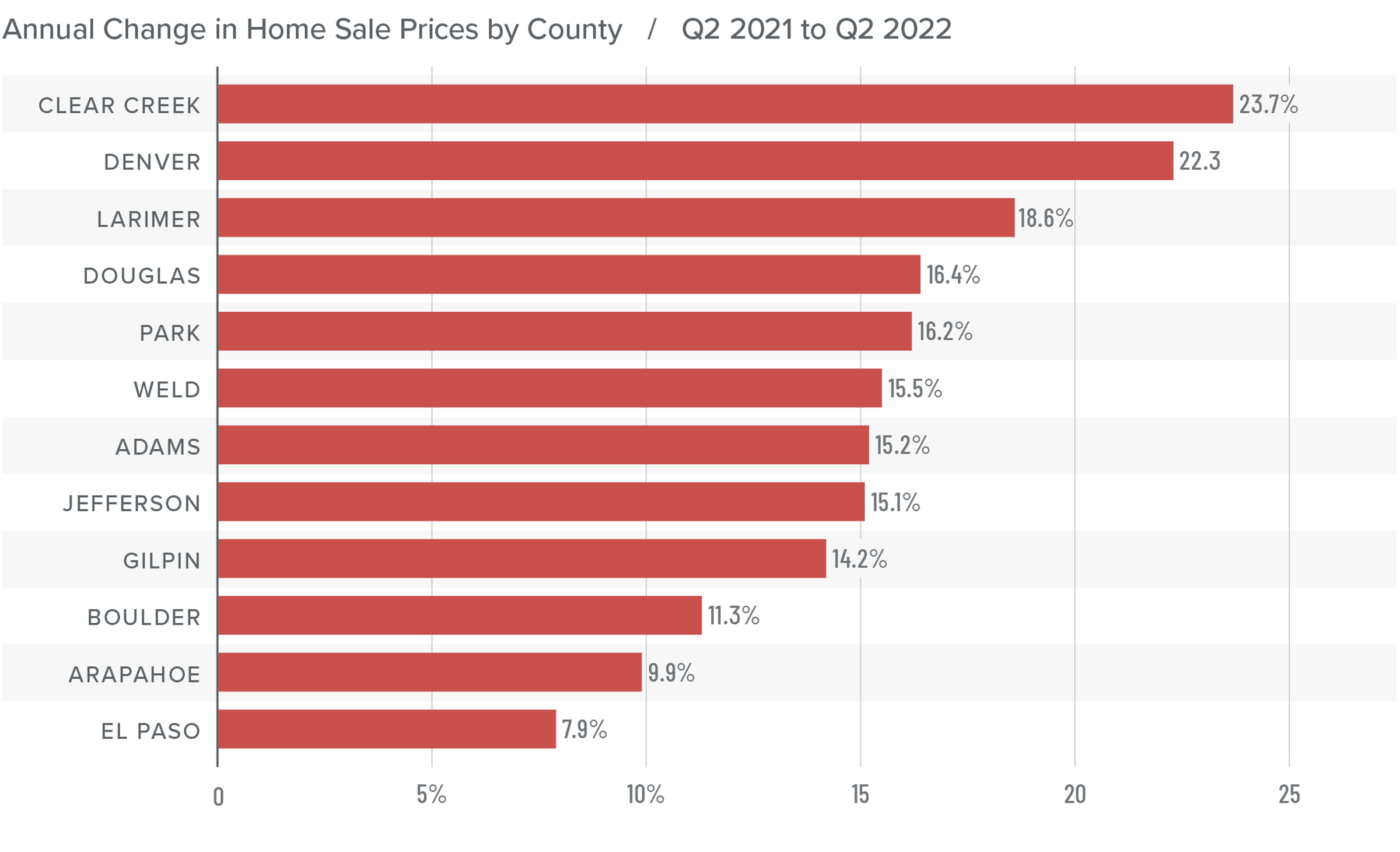
The average home sale price ($700,369) was 14.1% higher than the same period in 2021. Prices were also 9.8% higher than in the first quarter of this year.

Price growth remains strong even in the face of significantly higher inventory levels and mortgage rates, which is an impressive achievement.

Year over year, prices rose by double digits across all markets except El Paso and Arapahoe counties. Prices rose in all counties other than Gilpin (-10.3%) and Clear Creek (-1%) from the first quarter.

With the increase in mortgage rates and the number of homes for sale, I have started to watch list prices more closely. Compared to the first quarter, median list prices are lower in 9 of the 12 counties included in this report. Although it’s too early to say whether this is a trend we should be worried about, I will be watching how prices move during the summer, as it may be an indicator that the market is starting to soften.

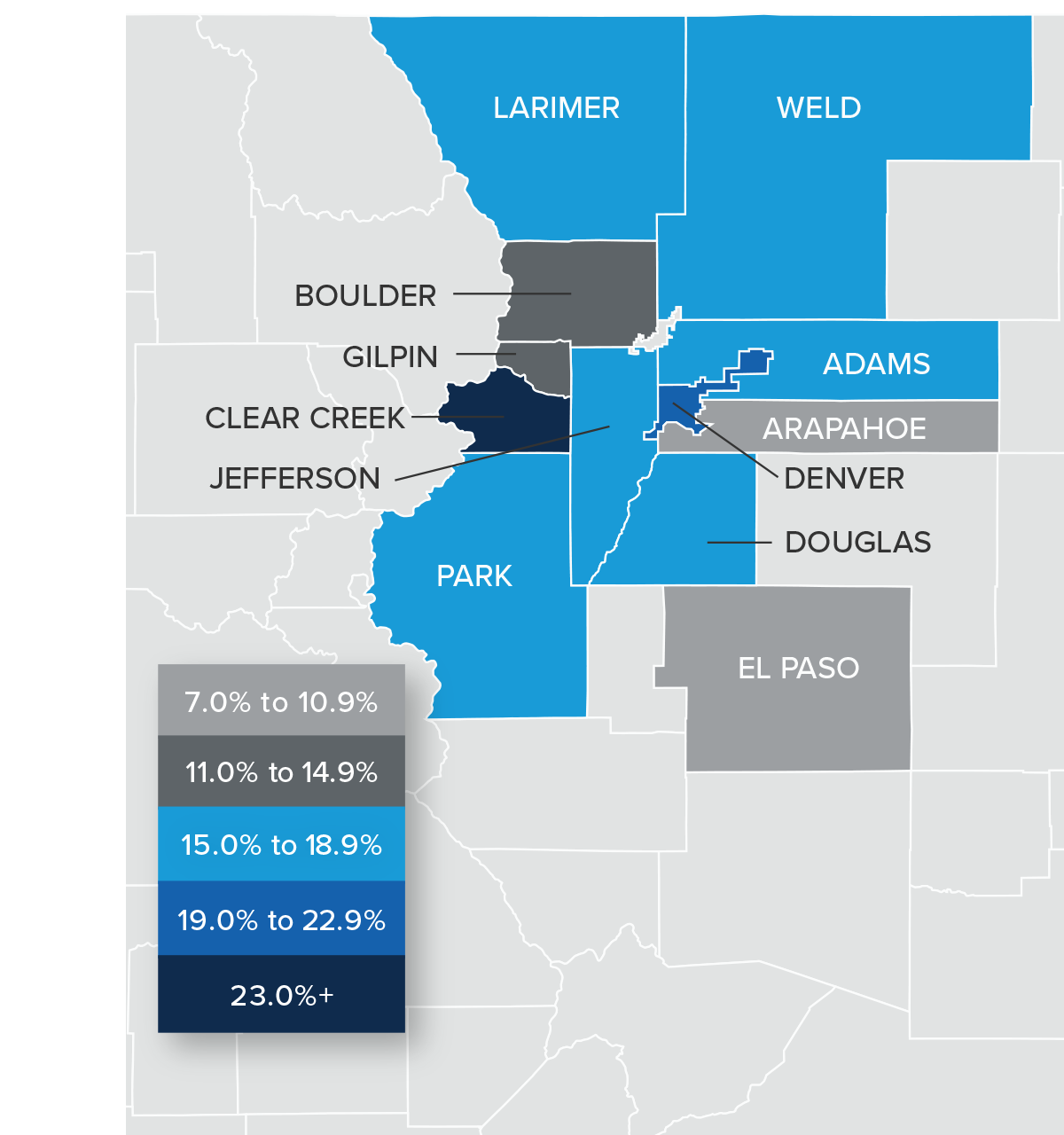
A map showing the real estate home prices percentage changes for various counties in Colorado. Different colors correspond to different tiers of percentage change. El Paso and Arapahoe Counties are the only counties with a percentage change in the 7% to 10.9% range, Boulder and Gilpin counties are in the 11% to 14.9% change range, Larimer, Weld, Adams, Park, Jefferson, and Douglas are in the 15% to 18.9% change range, Denver County is in the 19% to 22.9% change range, and Clear Creek County is the sole county in the 23% + change range.

A bar graph showing the annual change in home sale prices for various counties in Colorado from Q2 2021 to Q2 2022. Clear Creek County tops the list at 23.7%, followed by Denver at 22.3%, Larimer at 18.6%, Douglas at 16.4%, Park at 16.2%, Weld at 15.5%, Adams at 15.2%, Jefferson at 15.1%, Gilpin at 14.2%, Boulder at 11.3%, Arapahoe at 9.9%, and finally El Paso at 7.9%.

Mortgage Rates

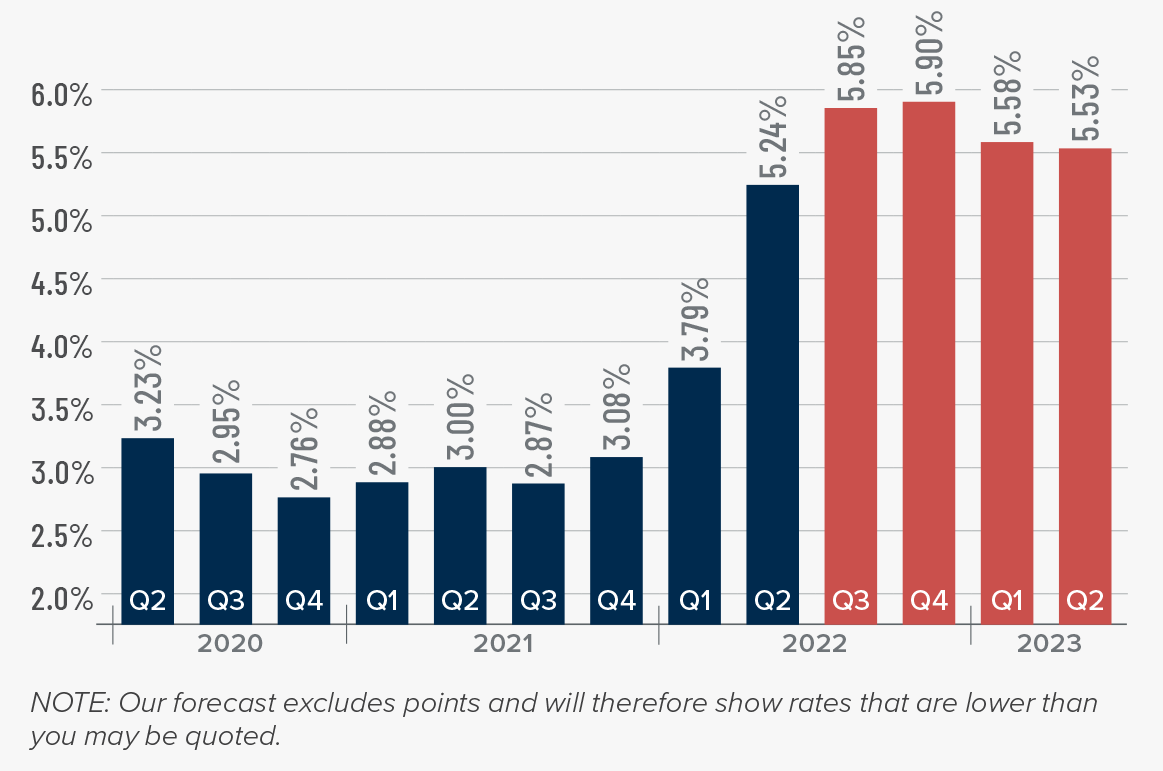
Although mortgage rates did drop in June, the quarterly trend was still moving higher. Inflation—the bane of bonds and, therefore, mortgage rates—has yet to slow, which is putting upward pressure on financing costs.

That said, there are some signs that inflation is starting to soften and if this starts to show in upcoming Consumer Price Index numbers then rates will likely find a ceiling. I am hopeful this will be the case at some point in the third quarter, which is reflected in my forecast.

A bar graph showing the mortgage rates from 2020 to the present, as well as Matthew Gardner's forecasted mortgage rates through Q2 2023. He forecasts mortgage rates continuing to climb to 5.9% in Q4 2022, then tapering off to 5.58% in Q1 2023 and 5.53% in Q2 2023.

Colorado Days on Market

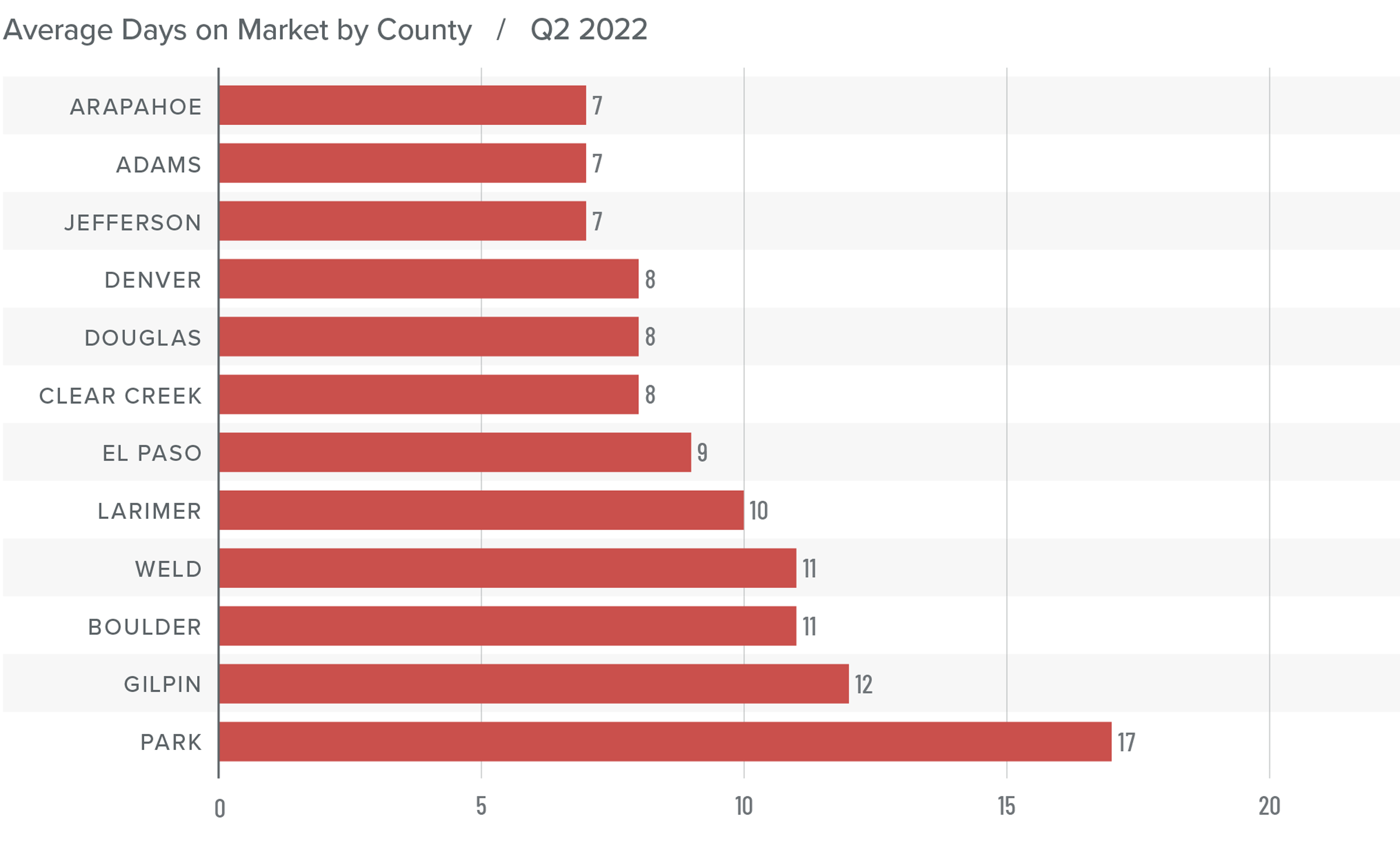
The average time it took to sell a home in the markets contained in this report fell eight days compared to the same period in 2021.

The length of time it took to sell a home dropped in six counties, remained static in three, and rose in the other three compared to the same quarter a year ago.

It took an average of only 10 days to sell a home in the region, which is down 15 days compared to the first quarter of the year.

Compared to the first quarter of 2022, average market time fell across the board, with significant drops in Gilpin (-41 days), Park (-25 days), and Clear Creek (-23 days) counties.

A bar graph showing the average days on market for homes in various counties in Colorado for Q2 2022. Arapahoe, Adams, and Jefferson Counties have the lowest DOM at 7, followed by Denver, Douglas, and Clear Creek at 8, El Paso at 9, Larimer at 10, Weld and Boulder at 11, Gilpin at 12, and Park at 17.

Conclusions

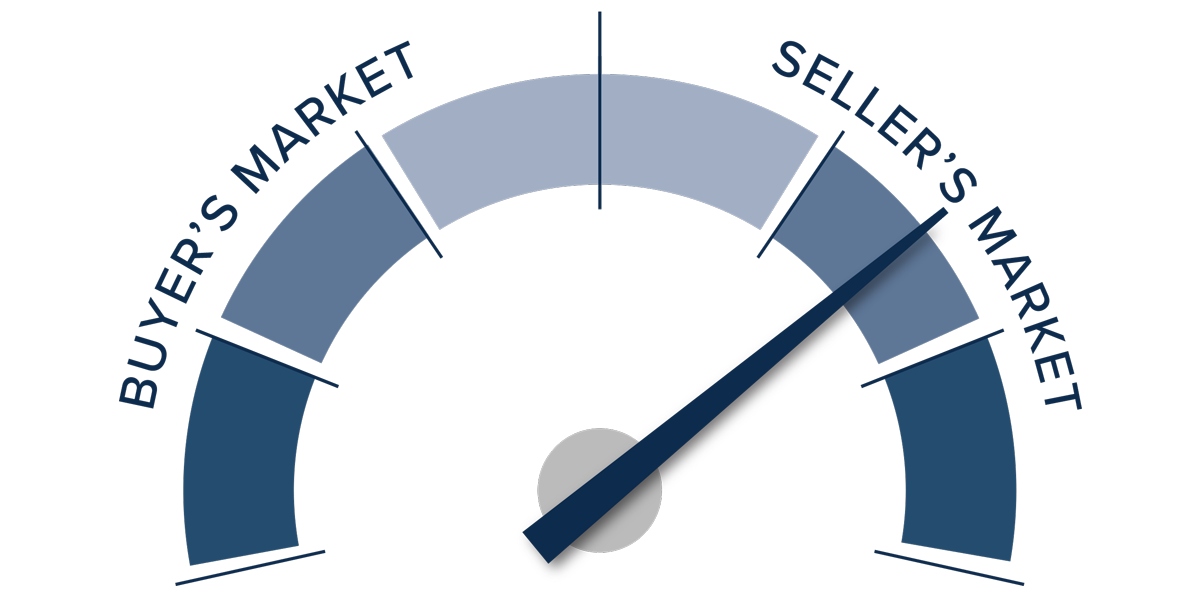
This speedometer reflects the state of the region’s real estate market using housing inventory, price gains, home sales, interest rates, and larger economic factors.

The Colorado economy remains robust and continues to grow. As it stands today, I anticipate income growth here will continue to outpace the nation. The 221,000 current job openings in the state are evidence of significant employer demand, which will lead to higher wages. Housing demand is still remarkably strong, even in light of the rapid increase in the number of homes for sale and rising financing costs.

A speedometer graph indicating a medium seller's market in Colorado for Q2 2022.

As mentioned earlier, I will be watching movement in list prices through the summer as they are a leading indicator in respect to the health of the market. Although we saw some softening in the pace of regional list price growth during second quarter and median list prices pulling back in some markets, it is too early to state that this is a pattern. As such, I am leaving the needle in the same position as the first quarter. The growing number of homes for sale and lower list prices in some markets should favor buyers, but this is offset for the time being by solid demand.

About Matthew Gardner

Matthew Gardner - Chief Economist for Windermere Real Estate

As Chief Economist for Windermere Real Estate, Matthew Gardner is responsible for analyzing and interpreting economic data and its impact on the real estate market on both a local and national level. Matthew has over 30 years of professional experience both in the U.S. and U.K.

In addition to his day-to-day responsibilities, Matthew sits on the Washington State Governors Council of Economic Advisors; chairs the Board of Trustees at the Washington Center for Real Estate Research at the University of Washington; and is an Advisory Board Member at the Runstad Center for Real Estate Studies at the University of Washington where he also lectures in real estate economics.
Market News July 29, 2022

Q2 2022 Southern California Real Estate Market Update

The following analysis of select counties of the Southern California real estate market is provided by Windermere Real Estate Chief Economist Matthew Gardner. We hope that this information may assist you with making better-informed real estate decisions. For further information about the housing market in your area, please don’t hesitate to contact your Windermere Real Estate agent.


Regional Economic Overview

Total employment in the counties covered by this report has risen more than 600,000 jobs over the past year, recovering 97.3% of the jobs lost due to the pandemic. Unsurprisingly, Los Angeles County still has the largest shortfall (-254,000 jobs), followed by Orange County (-44,100) and San Diego County (-15,000). Riverside and San Bernardino counties are now well above pre-pandemic employment levels. The region’s unemployment rate in May was 3.6%, down from 8.2% a year ago. The lowest rates were in Orange County (2.4%) and San Diego County (2.7%). The highest unemployment rate was in Los Angeles County, where 4.5% of the labor force was without a job. The Inland Empire continues to outperform, and I am hopeful that the rest of the region will return to pre-pandemic employment levels by the end of the year. However, it’s likely that Los Angeles County may take somewhat longer to fully recover due to its size.

Southern California Home Sales

In the second quarter, 47,596 homes sold, down 19% from a year ago but up 13.1% compared to the first quarter of the year.

Pending home sales, which are an indicator of future closings, were down modestly from the first quarter. However, I still expect that the summer will see a decent number of sales.

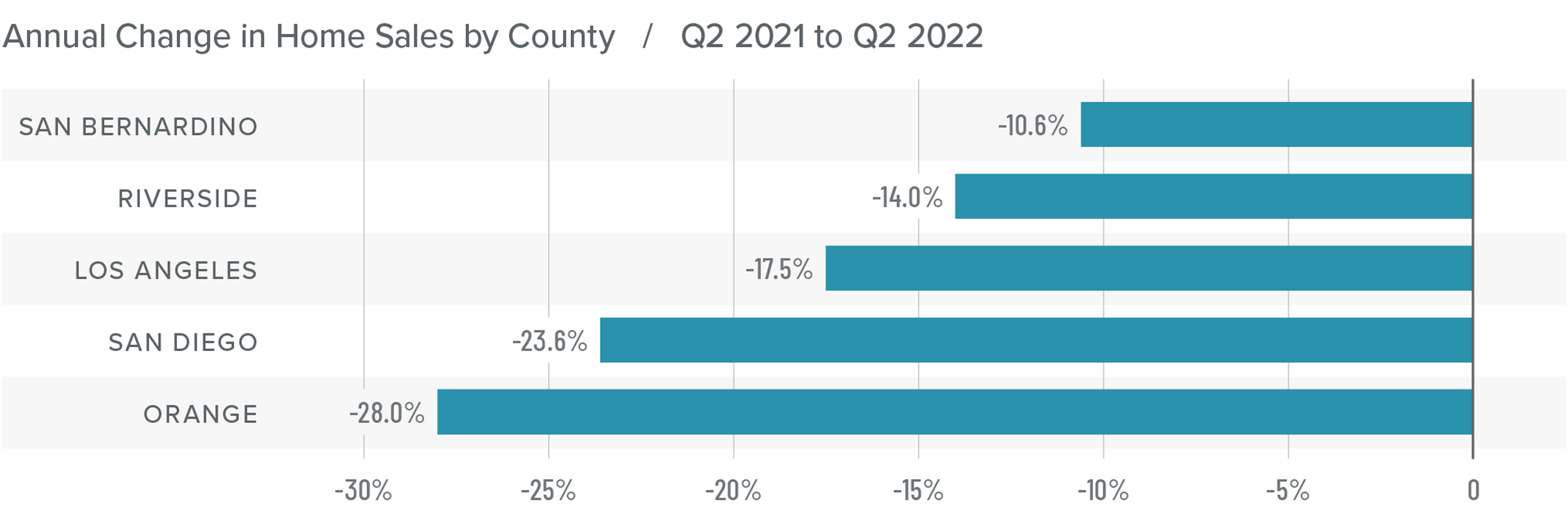
The largest drop in sales was in Orange County, but all markets saw significant declines. That said, the spring market was in place in San Diego, Los Angeles, and Orange counties, which experienced double-digit percentage increases in sales compared to the prior quarter.

Listing activity has risen across the region, which has given buyers more in the way of choice. That may explain, to a certain degree, why pending sales have pulled back; buyers are not feeling as pressured as they were when inventory was very low.

A bar graph showing the annual change in home sales for various counties in Southern California from Q2 2021 to Q2 2022. All five counties listed show negative percentage year-over-year changes: San Bernardino at -10.6%, Riverside at -14.0%, Los Angeles at -17.5%, San Diego at -23.6%, and Orange at -28%.

Southern California Home Prices

Home prices in the second quarter rose 10.9% compared to a year ago and were 5.4% higher than in first quarter of 2022.

Rising mortgage rates have not had as much of an impact as some expected, but increased financing costs appear to have taken at least some of the heat off the market, as demonstrated by the slowing pace of price growth compared to 2021.

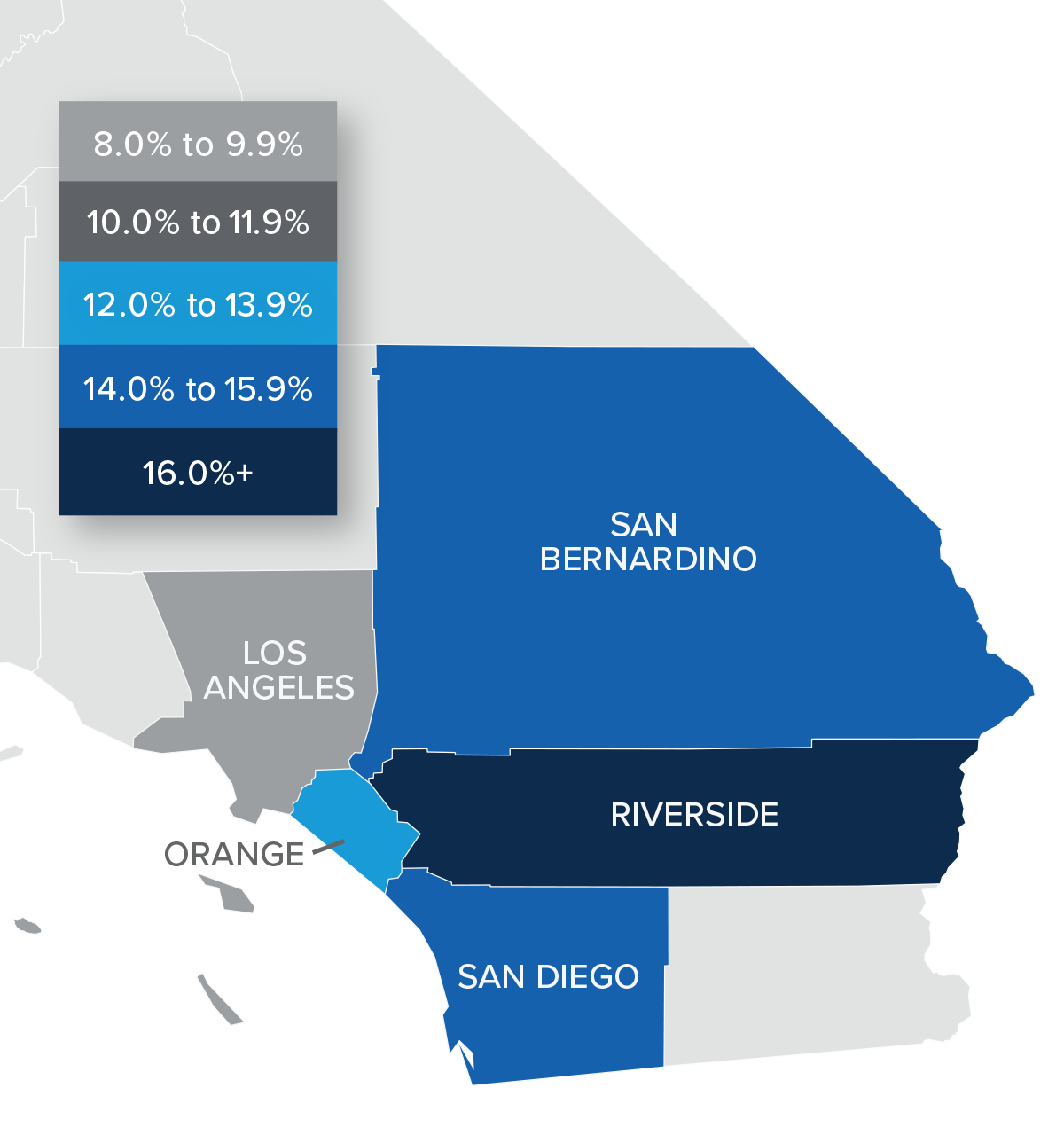
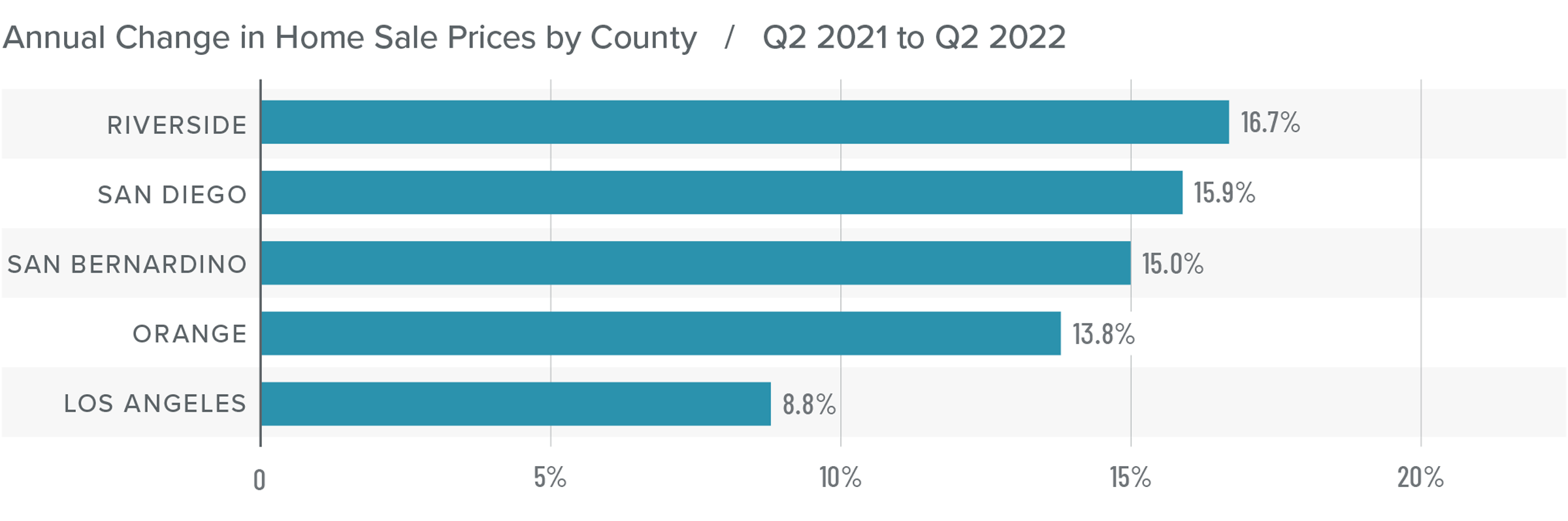
There was double-digit price growth in every county other than Los Angeles. Riverside County led the way with prices rising by 16.7%. The rest of the region also saw very impressive sale price growth.

With relatively high mortgage rates and more homes coming to market, I have started to watch list prices closely. Compared to the first quarter, median list prices are still up an average of 8.7%, suggesting that sellers remain rather bullish.

A map showing the real estate home prices percentage changes for various counties in Southern California. Different colors correspond to different tiers of percentage change. Los Angeles County is the only county with a percentage change in the 8% to 9.9% range, while Orange County is the only county in the 12% to 13.9% change range. San Bernardino and San Diego are in the 14% to 15.9 % change range, and Riverside is the only county in the 16% + range.

A bar graph showing the annual change in home sale prices for various counties in Southern California from Q2 2021 to Q2 2022. Riverside County tops the list at 16.7%, followed by San Diego at 15.9%, San Bernardino at 15%, Orange at 13.8%, and Los Angeles County at 8.8%.

Mortgage Rates

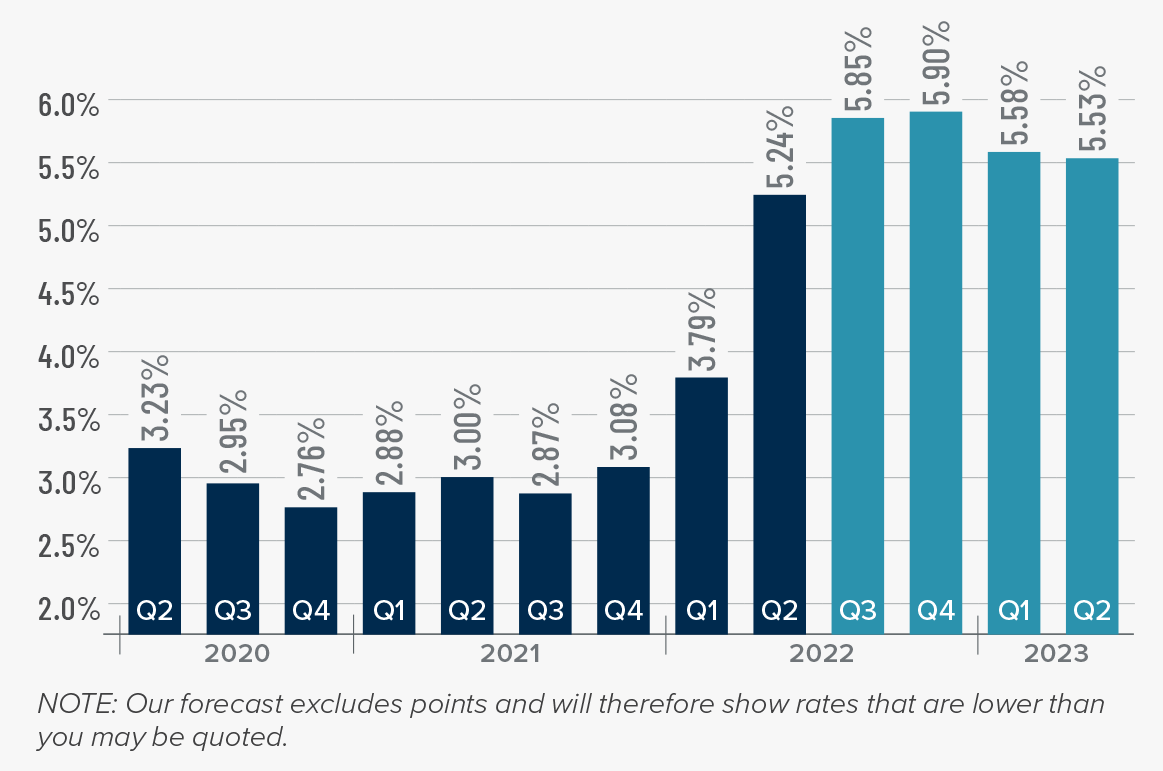
Although mortgage rates did drop in June, the quarterly trend was still moving higher. Inflation—the bane of bonds and, therefore, mortgage rates—has yet to slow, which is putting upward pressure on financing costs.

That said, there are some signs that inflation is starting to soften and if this starts to show in upcoming Consumer Price Index numbers then rates will likely find a ceiling. I am hopeful this will be the case at some point in the third quarter, which is reflected in my forecast.

A bar graph showing the mortgage rates from 2020 to the present, as well as Matthew Gardner's forecasted mortgage rates through Q2 2023. He forecasts mortgage rates continuing to climb to 5.9% in Q4 2022, then tapering off to 5.58% in Q1 2023 and 5.53% in Q2 2023.

Southern California Days on Market

In the second quarter of 2022, the average time it took to sell a home in the region was 16 days, which was 2 fewer days than a year ago and 5 fewer days than in the first quarter of the year.

Compared to the first quarter of 2022, days on market dropped in all counties covered by this report, which was impressive given the higher number of homes for sale.

Homes in San Diego County continue to sell at a faster rate than other markets in the region. All counties other than San Bernardino (where it took one more day for homes to sell than a year ago) saw market time drop.

With inventory levels rising, some may think that the market is set for a correction, but I disagree. Sales are still higher than in 2019 and it took half the time to sell a home in the second quarter of this year than it did during the same period in 2019.

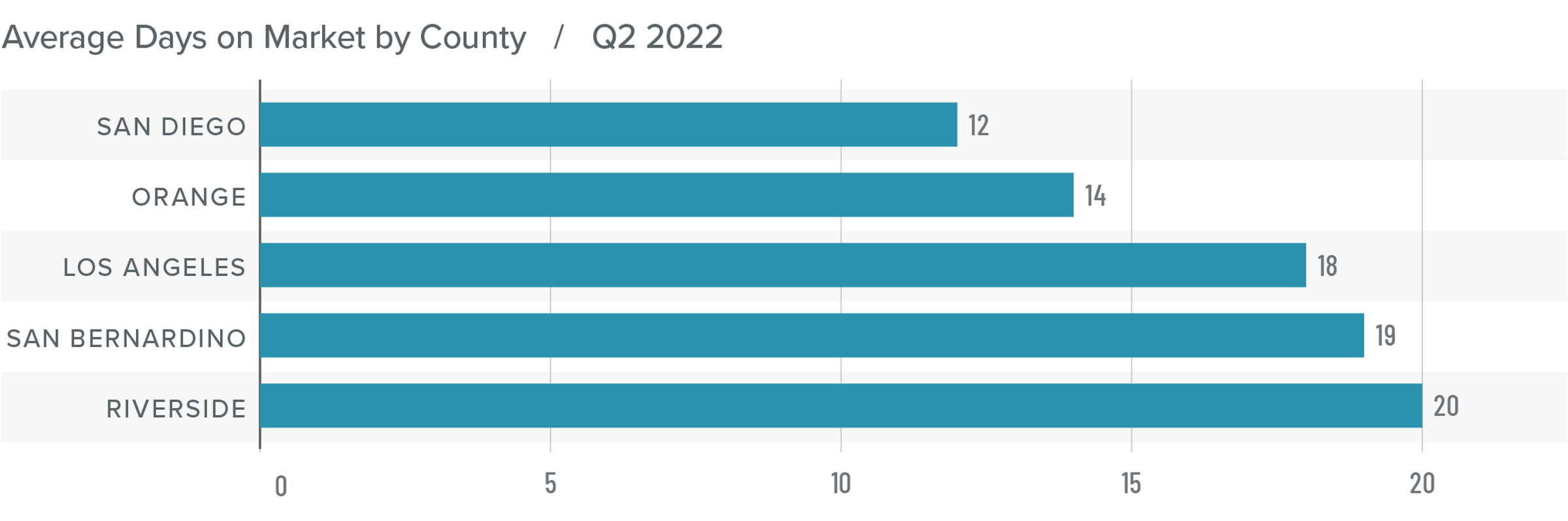
A bar graph showing the average days on market for homes in various counties in Southern California for Q2 2022. San Diego county has the lowest DOM at 12, followed by Orange at 14, Los Angeles at 18, San Bernardino at 19, and Riverside at 20.

Conclusions

This speedometer reflects the state of the region’s real estate market using housing inventory, price gains, home sales, interest rates, and larger economic factors.

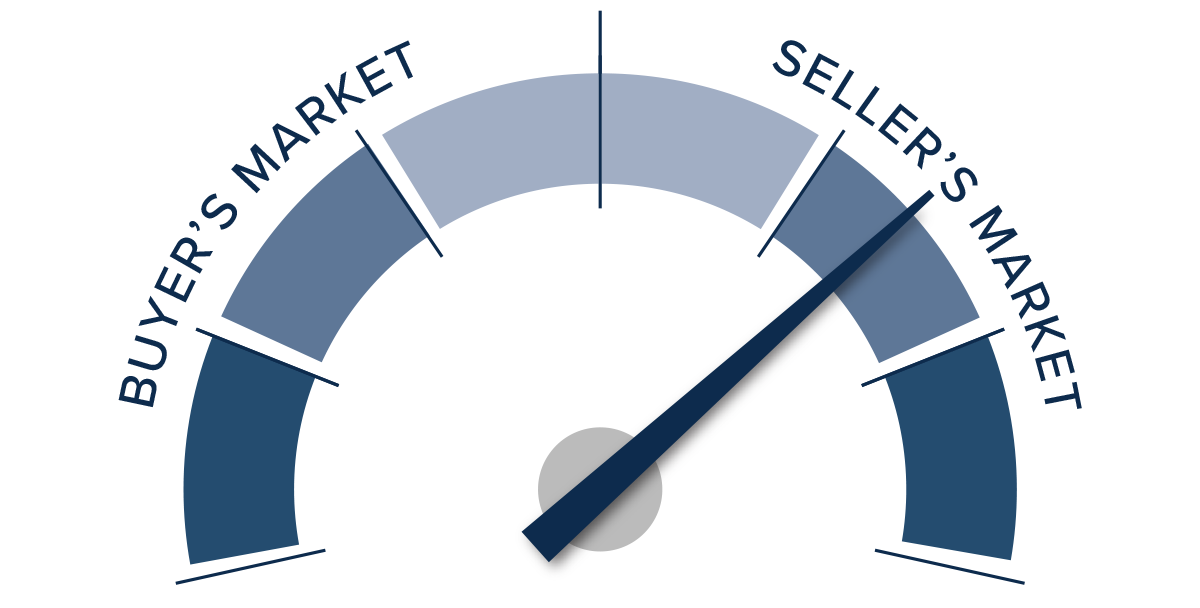
The trend in the job recovery remains positive, and the prospect of a return of all the jobs lost due to the pandemic is becoming more palpable. The housing market is still performing well, even in the face of higher inventory levels and rising financing costs. That said, the frenetic pace of activity of the past 18 months or so will slow, but not to a degree that is concerning.

A speedometer graph indicating a medium seller's market in Southern California for Q2 2022.

More listings led to more sales, which is a little counterintuitive especially given far higher mortgage rates than we’ve seen in years. The market remains favorable to home sellers, and they are still in the driver’s seat.

About Matthew Gardner

Matthew Gardner - Chief Economist for Windermere Real Estate

As Chief Economist for Windermere Real Estate, Matthew Gardner is responsible for analyzing and interpreting economic data and its impact on the real estate market on both a local and national level. Matthew has over 30 years of professional experience both in the U.S. and U.K.

In addition to his day-to-day responsibilities, Matthew sits on the Washington State Governors Council of Economic Advisors; chairs the Board of Trustees at the Washington Center for Real Estate Research at the University of Washington; and is an Advisory Board Member at the Runstad Center for Real Estate Studies at the University of Washington where he also lectures in real estate economics.
Market News July 28, 2022

Q2 2022 Central and Southern Oregon Real Estate Market Update

The following analysis of select counties of the Central and Southern Oregon real estate market is provided by Windermere Real Estate Chief Economist Matthew Gardner. We hope that this information may assist you with making better-informed real estate decisions. For further information about the housing market in your area, please don’t hesitate to contact your Windermere Real Estate agent.


Regional Economic Overview

The Central and Southern Oregon counties covered by this report have added 5,470 new jobs over the past 12 months, representing an annual growth rate of 2.3%. The region has now recovered all but 2,400 of the more than 37,000 jobs that were lost due to the pandemic.The Bend Metro Service Area (MSA) and Crook County have both returned the jobs lost during the pandemic, but the Medford MSA is still lagging, with employment levels 3,200 lower than at the start of 2020. The area’s unemployment rate was 4%, down from 6.1% a year ago and matching the pre-pandemic low. By area, the lowest jobless rate was in Bend (3.4%) and the highest was in Klamath County, where 5.3% of the labor force is still without a job.

Central and Southern Oregon Home Sales

In the second quarter, 2,424 homes sold, which represented a drop of 11.1% compared to the same period a year ago. Sales were 9.6% lower than in the first quarter of the year.

Compared to the first quarter of this year, sales grew in Crook, Jackson, Josephine, and Klamath counties, but fell in Deschutes and Jefferson counties.

Although sales fell overall, Crook and Josephine counties saw transactions grow by 16.8% and 2.4%, respectively.

The drop in sales is not troubling; the market is only reverting back to its pre-pandemic pace. There will certainly be some markets that underperform, and this may make it feel as if the market is collapsing, but it isn’t.

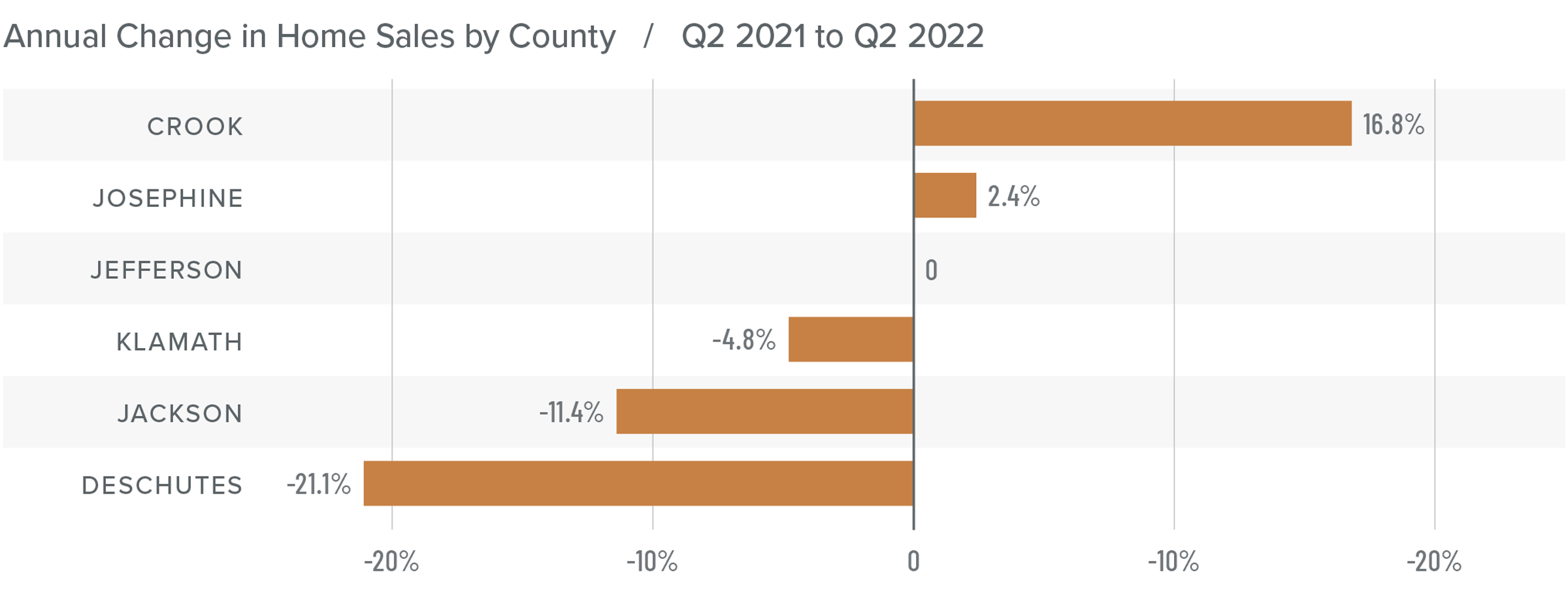
A bar graph showing the annual change in home sales for various counties in Central and Southern Oregon from Q2 2021 to Q2 2022. There are two counties with positive percentage year-over-year changes: Crook at 16.8% and Josephine at 2.4%. All other counties show a negative year-over-year change. Here are the totals: Klamath -4.8%, Jackson -11.4%, and Deschutes -21.1%.

Central and Southern Oregon Home Prices

While home sales fell, prices did not. The average sale price in the region rose 10.8% year over year to $603,271. Prices were up 1.5% compared to the first quarter of 2022.

Compared to the first quarter of the year, average prices rose in all counties other than Josephine. In Bend, prices were up more than 13%.

All counties contained in this report except Crook saw average prices rise compared to a year ago. The Bend area experienced significant increases.

Home prices have not been significantly influenced by the increase in mortgage rates yet. Median list prices in the area rose in all counties other than Josephine (where they were flat), which suggests that home sellers are still confident. I will be closely monitoring list prices going forward, as they will be the first indicator that the market is cooling.

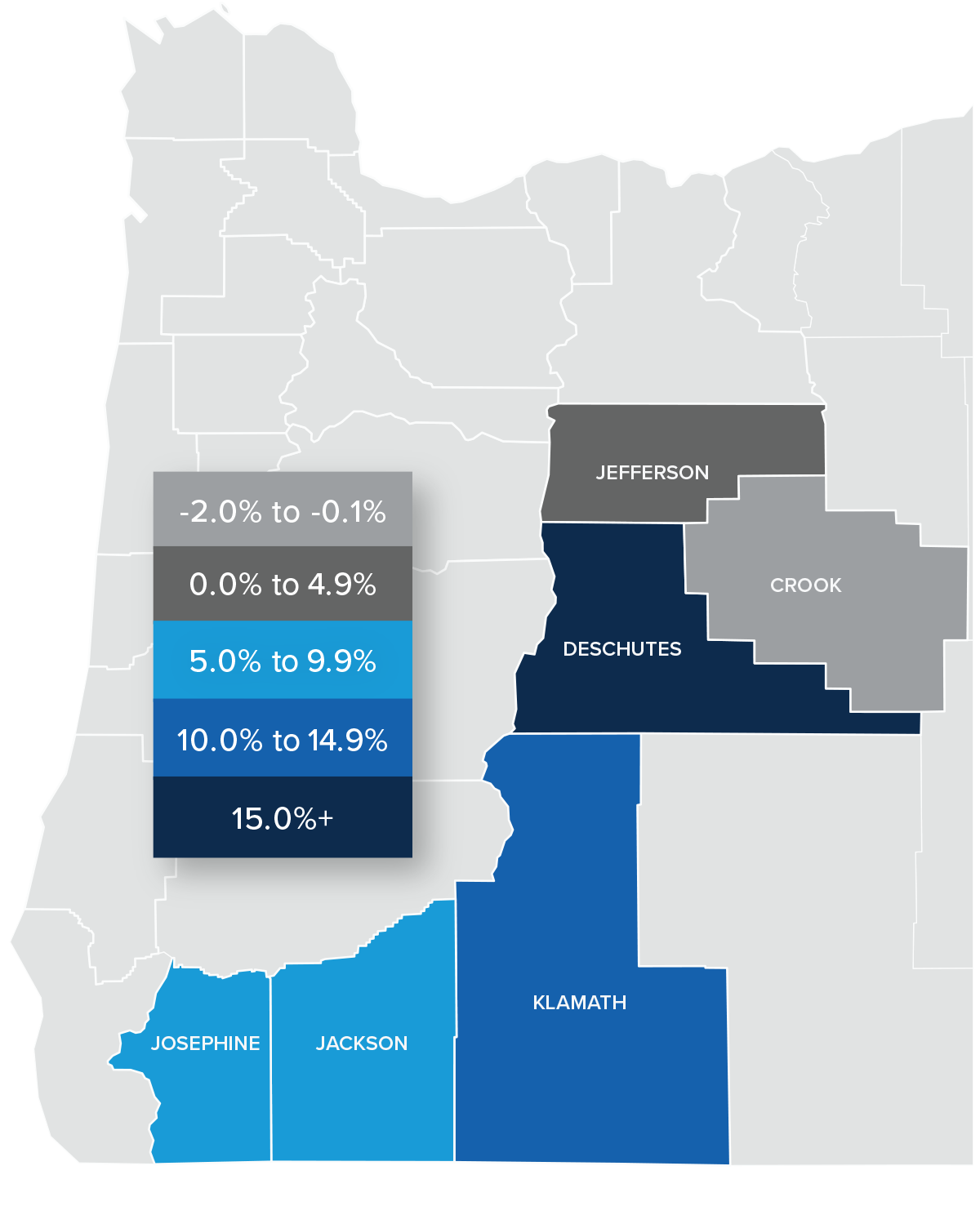
A map showing the real estate home prices percentage changes for various counties in Central and Southern Oregon. Different colors correspond to different tiers of percentage change. Crook County is the only county with a percentage change in the -2% to -0.1% range, while Jefferson County is the only county in the 0% to 4.9% change range. Josephine and Jackson are in the 5% to 9.9 % change range, Klamath is in the 10% to 14.9% change range, and Deschutes is the only county in the 15% + range.

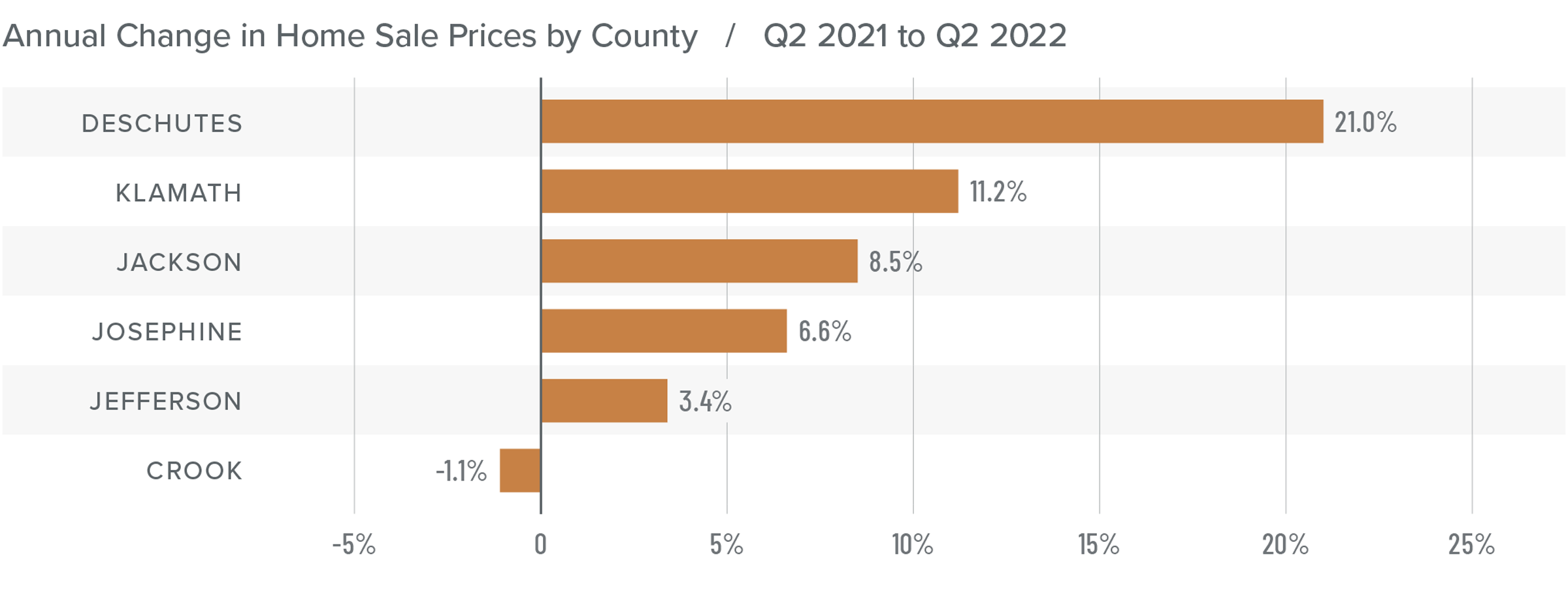
A bar graph showing the annual change in home sale prices for various counties in Central and Southern Oregon from Q2 2021 to Q2 2022. Deschutes county tops the list at 21%, followed by Klamath at 11.2%, Jackson at 8.5%, Josephine at 6.6%, Jefferson at 3.4%, and finally Crook County at -1.1%.

Mortgage Rates

Average rates for a 30-year conforming mortgage were 3.11% at the end of 2021, but since then have jumped over 1.5%—the largest increase since 1987. The speed of the surge in rates is due to the market having quickly priced in the seven-to-eight rate increase that the Fed is expected to implement this year.

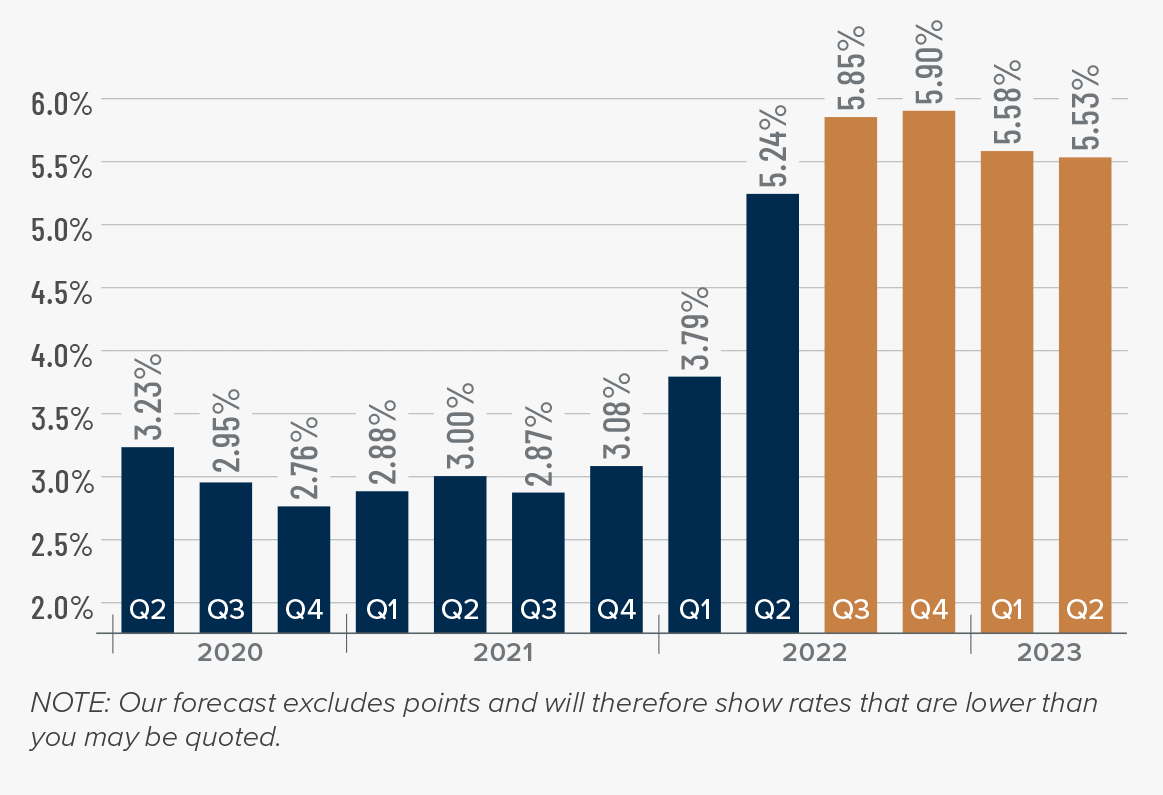
Because the mortgage market has priced this into the rates they are offering today, my forecast suggests that we are getting close to a ceiling in rates, and it is my belief that they will rise modestly in the second quarter before stabilizing for the balance of the year.

A bar graph showing the mortgage rates from 2020 to the present, as well as Matthew Gardner's forecasted mortgage rates through Q2 2023. He forecasts mortgage rates continuing to climb to 5.9% in Q4 2022, then tapering off to 5.58% in Q1 2023 and 5.53% in Q2 2023.

Central and Southern Oregon Days on Market

The average time it took to sell a home in the region rose 2 days compared to a year ago, but it took 14 fewer days for a home to go under contract compared to the first quarter of the year.

The average time it took to sell a home in the second quarter of 2022 was 28 days.

Klamath (-2 days) and Jefferson (-7 days) saw market time drop, while market time rose or remained static in the rest of the region compared to a year ago. Market time fell across the board compared to the first quarter of this year.

Interestingly, the average market time in the second quarter of 2019 (pre-pandemic) was 82 days, which is just one indicator as to the vibrancy of the region’s housing market.

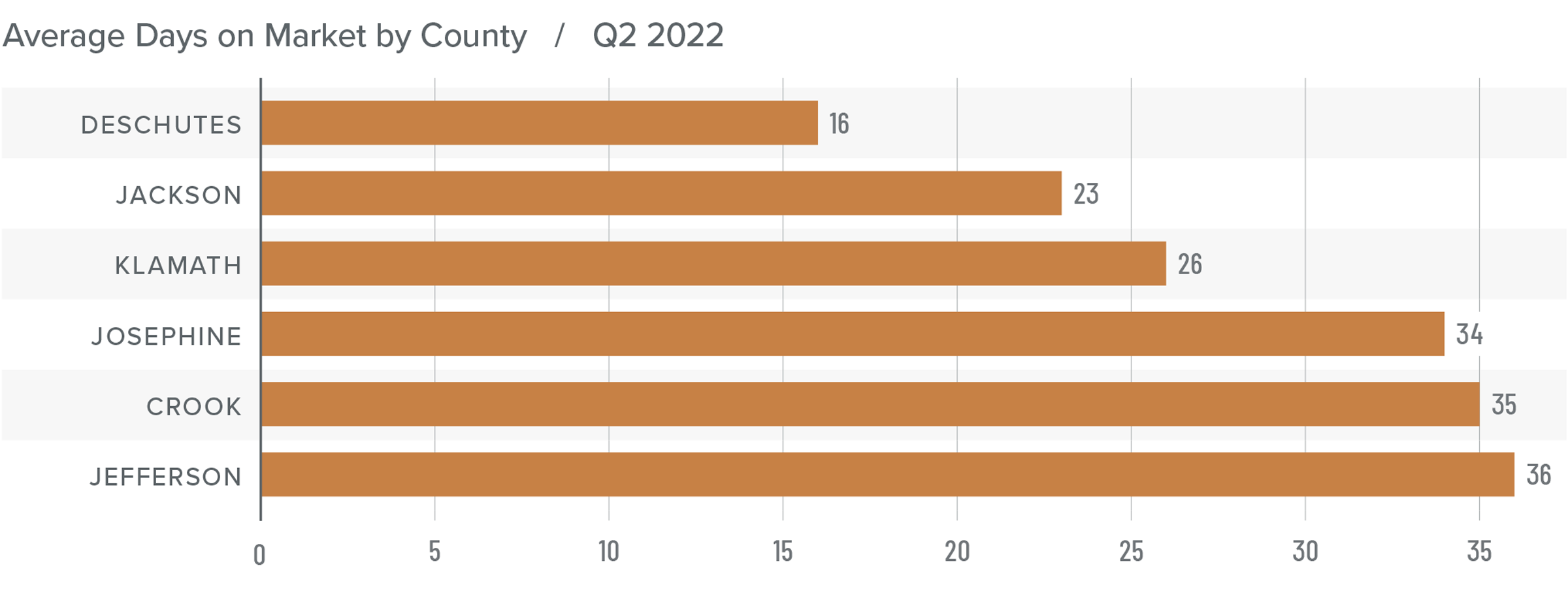
A bar graph showing the average days on market for homes in various counties in Central and Southern Oregon for Q2 2022. Deschutes county has the lowest DOM at 16, followed by Jackson at 23, Klamath at 26, Josephine at 34, Crook at 35, and Jefferson at 36.

Conclusions

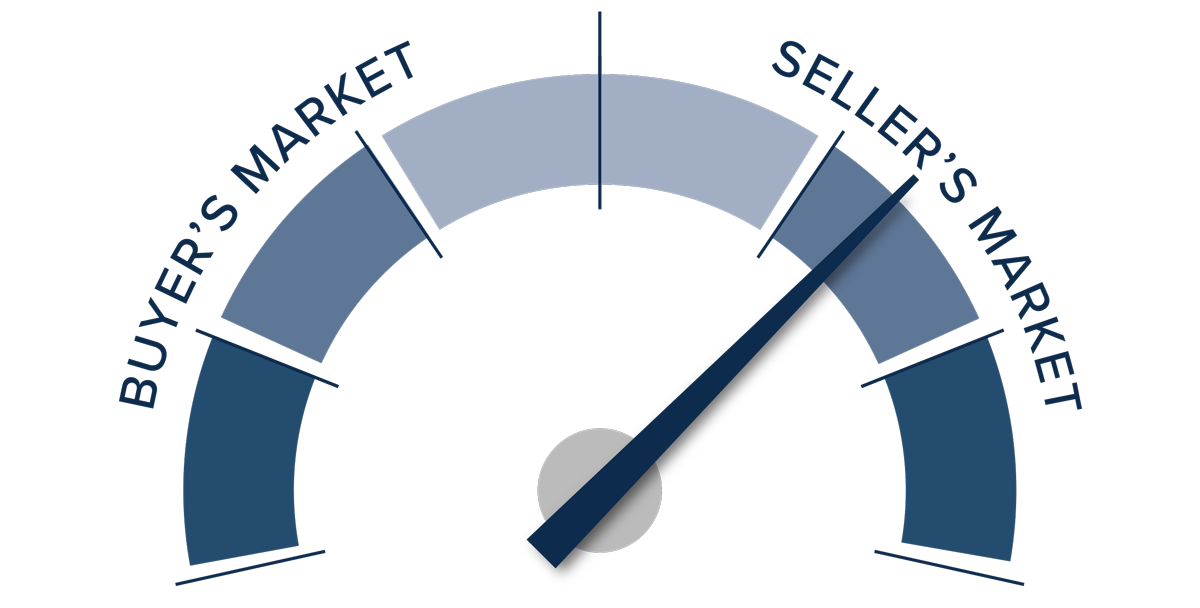
This speedometer reflects the state of the region’s real estate market using housing inventory, price gains, home sales, interest rates, and larger economic factors.

Though the job market is recovering more slowly than I would like, the housing market is still performing strongly. As we move through the year, some may believe that the market is underperforming, but this is not the case. Along with much of the rest of the country, the Central and Southern Oregon housing market has been overperforming since the pandemic started. As the market starts to trend back to its pre-pandemic pace of sales and price growth, the slowdown might feel exaggerated but there is no cause for concern.

A speedometer graph indicating a medium seller's market in Central and Southern Oregon for Q2 2022.

Despite dramatically rising financing costs, buyers still appear to be motivated. List prices have yet to “roll over,” suggesting that sellers are still confident. This, combined with the other data presented here, tells me that they are still in the driver’s seat.

About Matthew Gardner

Matthew Gardner - Chief Economist for Windermere Real Estate

As Chief Economist for Windermere Real Estate, Matthew Gardner is responsible for analyzing and interpreting economic data and its impact on the real estate market on both a local and national level. Matthew has over 30 years of professional experience both in the U.S. and U.K.

In addition to his day-to-day responsibilities, Matthew sits on the Washington State Governors Council of Economic Advisors; chairs the Board of Trustees at the Washington Center for Real Estate Research at the University of Washington; and is an Advisory Board Member at the Runstad Center for Real Estate Studies at the University of Washington where he also lectures in real estate economics.
Market News July 28, 2022

Q2 2022 Northwest Oregon and Southwest Washington Real Estate Market Update

The following analysis of select counties of the Northwest Oregon and Southwest Washington real estate market is provided by Windermere Real Estate Chief Economist Matthew Gardner. We hope that this information may assist you with making better-informed real estate decisions. For further information about the housing market in your area, please don’t hesitate to contact your Windermere Real Estate agent.


Regional Economic Overview

The Oregon counties contained in this report continue to recover, but employment levels are still down more than 61,000 from the pre-pandemic peak. This is mainly due to the Portland market as Multnomah County accounts for over half of the missing jobs. Even with employment not having fully recovered, the region’s unemployment rate was a healthy 3.5%, which is down from the pandemic peak of 12.8%. The Southwest Washington market has recouped all the jobs lost and added 6,600 more. During second quarter, the unemployment rate was 4.4%, which is down from 14% at the start of the pandemic.

Northwest Oregon and Southwest Washington Home Sales

In the second quarter, 14,558 homes sold, which is a drop of 10% compared to a year ago. Sales rose more than 33% compared to the first quarter of the year.

Compared to the first quarter of this year, sales rose across the board, with double-digit increases in every county other than Clatsop.

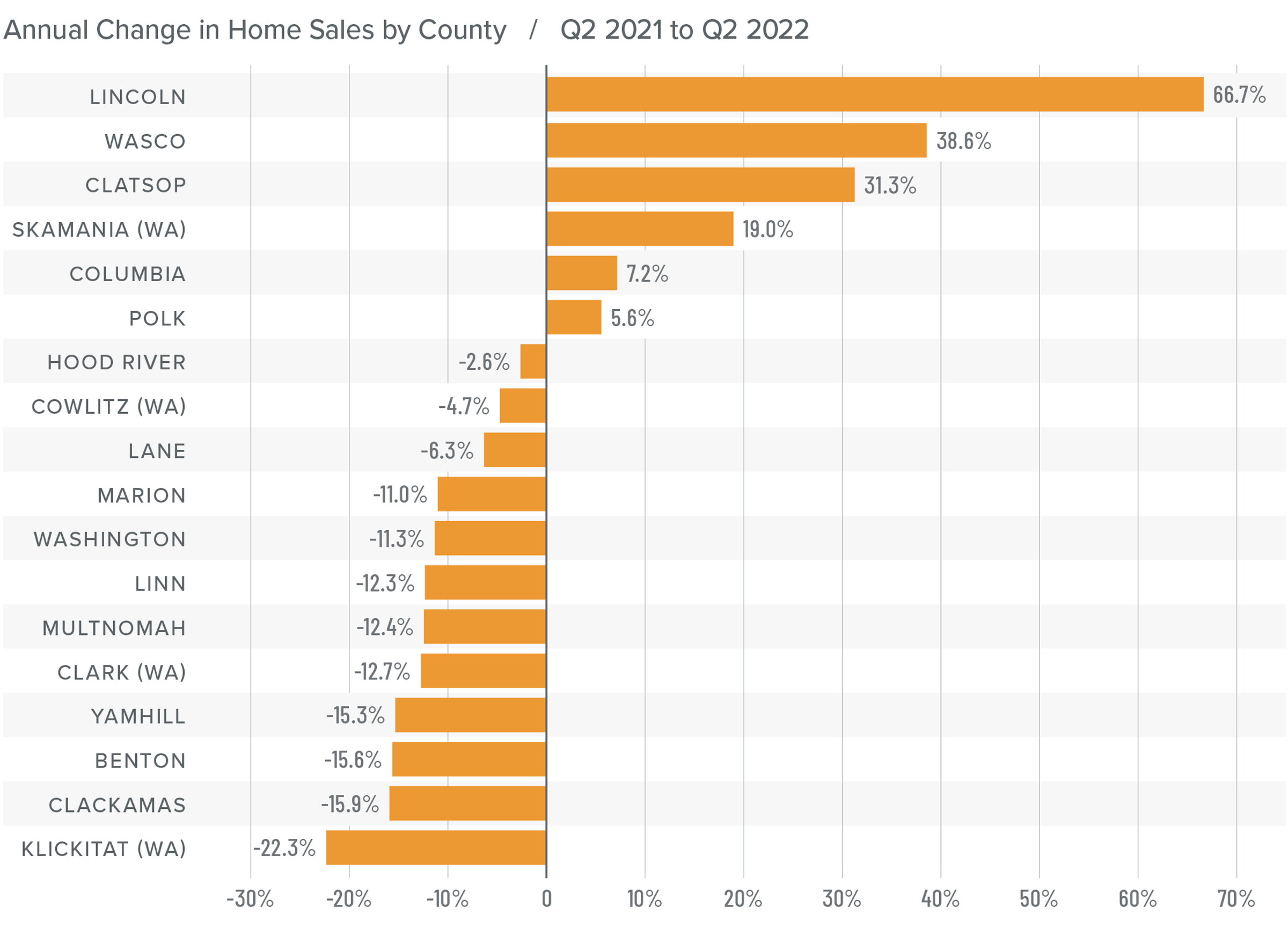
Although year-over-year sales fell overall, several markets saw transactions increase. Lincoln, Wasco, Clatsop, and Skamania counties had solid gains.

The tangible growth in sales comes at a time when inventory levels have also grown significantly. This suggests that demand remains strong.

A bar graph showing the annual change in home sales for various counties in Northwest Oregon and Southwest Washington from Q2 2021 to Q2 2022. The counties with a positive percentage year-over-year change are Lincoln at 66.7%, Wasco at 38.6%, Clatsop at 31.3%, Skamania (WA) at 19%, Columbia at 7.2%, and Polk at 5.6%. The counties with a negative year-over-year change are Hood River at -2.6%, Cowlitz (WA) at -4.7%, Lane at -6.3%, Marion at -11%, Washington at -11.3%, Linn at -12.3%, Multnomah at -12.4%, Clark (WA) -12.7%, Yamhill at -15.3%, Benton at -15.6%, Clackamas at -15.9%, and Klickitat (WA) at -22.3%.

Northwest Oregon and Southwest Washington Home Prices

The average home sale price in the region rose 11.2% year over year to $589,526. Prices were 7.8% higher than in the first quarter of 2022.

Relative to the first quarter of 2022, average prices rose in all counties other than Clatsop and Columbia. Home prices were up by more than 20% in Hood River and Klickitat counties.

All but five counties saw average sale prices rise more than 10% compared to a year ago.

Rising mortgage rates have yet to impact home prices. Median list prices are still rising in most markets, which suggests that home sellers remain confident. I will be closely monitoring list prices going forward, as they will be the first indicator that the market may be cooling; I currently see no real signs of this.

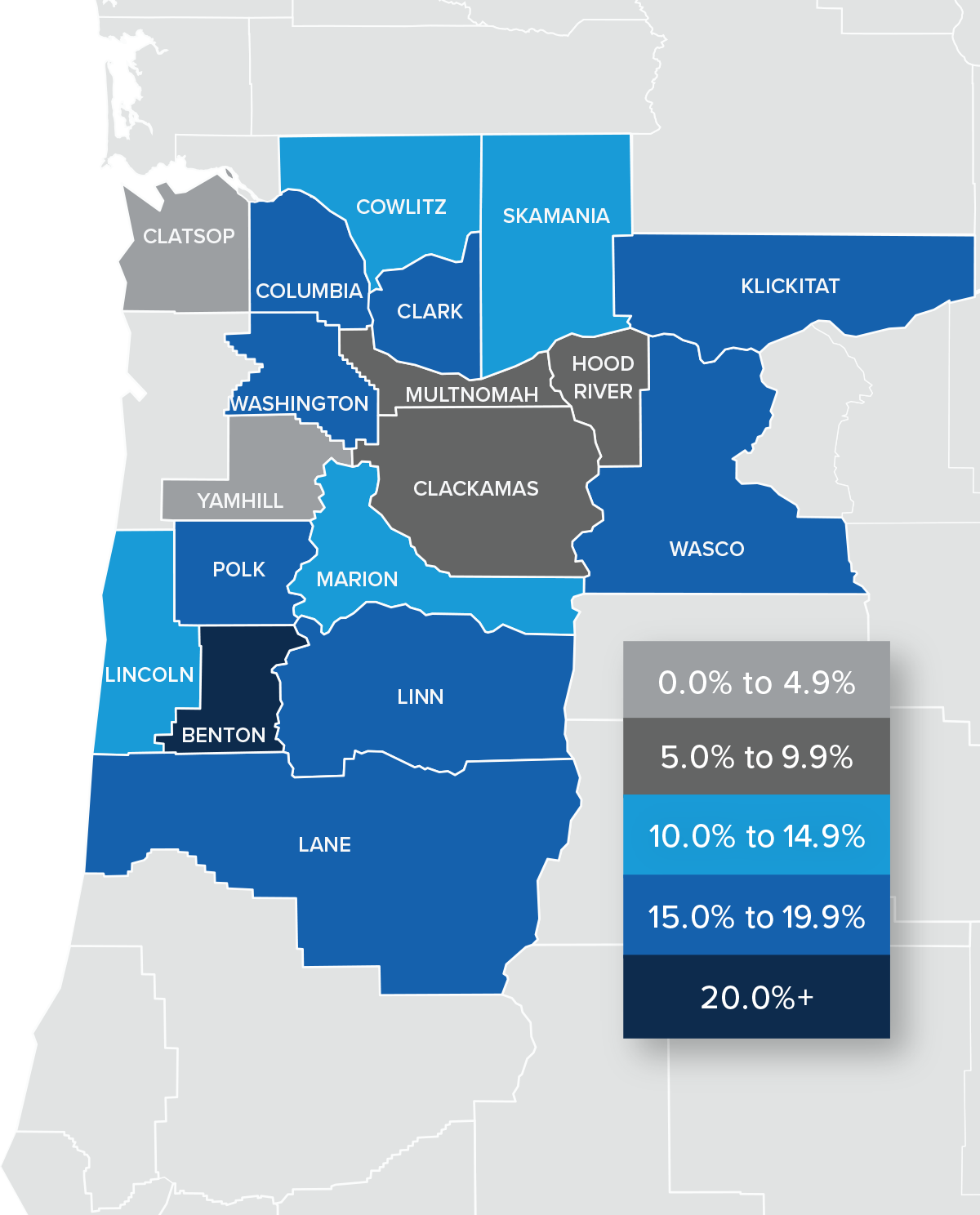
A map showing the real estate home prices percentage changes for various counties in Northwest Oregon and Southwest Washington. Different colors correspond to different tiers of percentage change. Clatsop and Yam Hill Counties are the only county with a percentage change in the 0% to 4.9% range, Hood River, Multnomah, and Clackamas counties are in the 5% to 9.9% change range, Marion, Lincoln, Cowlitz, and Skamania are in the 10% to 14.9% change range, Columbia, Clark, Washington, Polk, Linn, Lane, Wasco, and Klickitat counties are in the 15% to 19.9% change range, and Benton county is the sole county in the 20% + change range.

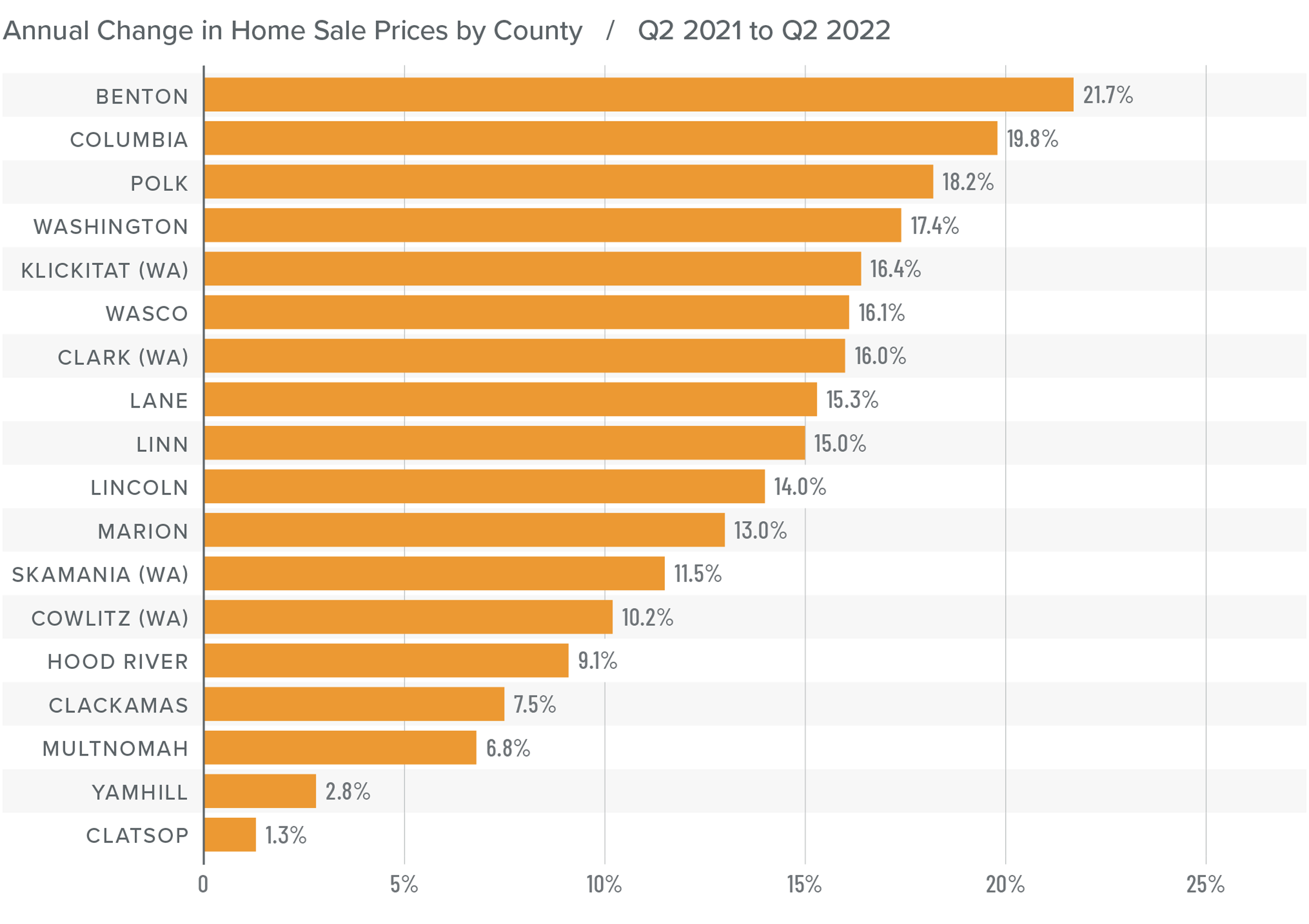
A bar graph showing the annual change in home sale prices for various counties in Northwest Oregon and Southwest Washington from Q2 2021 to Q2 2022. Benton county tops the list at 21.7%, followed by Columbia at 19.8%, Polk at 18.2%, Washington at 17.4%, Klickitat (WA) at 16.4%, Wasco at 16.1%, Clark (WA) at 16%, Lane at 15.3%, Linn at 15%, Lincoln at 14%, Marion at 13%, Skamania (WA) at 11.5%, Cowlitz (WA) at 10.2%, Hood River at 9.1%, Clackamas at 7.5%, Multnomah at 6.8%, Yamhill at 2.8%, and finally Clatsop at 1.3%.

Mortgage Rates

Although mortgage rates did drop in June, the quarterly trend was still moving higher. Inflation—the bane of bonds and, therefore, mortgage rates—has yet to slow, which is putting upward pressure on financing costs.

That said, there are some signs that inflation is starting to soften and if this starts to show in upcoming Consumer Price Index numbers then rates will likely find a ceiling. I am hopeful this will be the case at some point in the third quarter, which is reflected in my forecast.

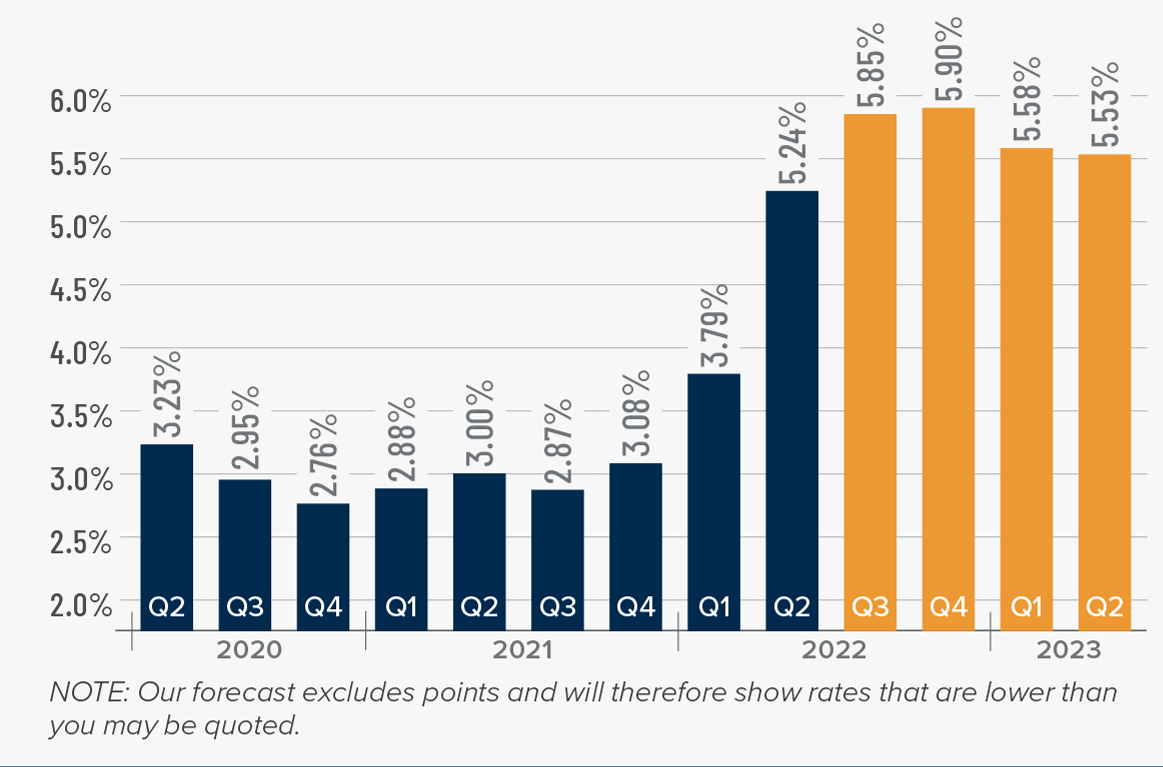
A bar graph showing the mortgage rates from 2020 to the present, as well as Matthew Gardner's forecasted mortgage rates through Q2 2023. He forecasts mortgage rates continuing to climb to 5.9% in Q4 2022, then tapering off to 5.58% in Q1 2023 and 5.53% in Q2 2023.

Northwest Oregon and Southwest Washington Days on Market

The average time it took to sell a home in the region fell 2 days compared to the same period a year ago. It took 11 fewer days for homes to sell compared to the first quarter of 2022.

The average time it took to sell a home in the second quarter of 2022 was 33 days.

Skamania, Polk, Marion, Lane, and Cowlitz counties saw market time rise, while market time dropped or remained static in the rest of the region compared to a year ago. Compared to the first quarter, market time fell in all markets other than Hood River, where it rose by a modest two days.

Interestingly, the average days on market in the second quarter of 2019 (pre-pandemic) was 62 days, which tells me that the current market remains bullish.

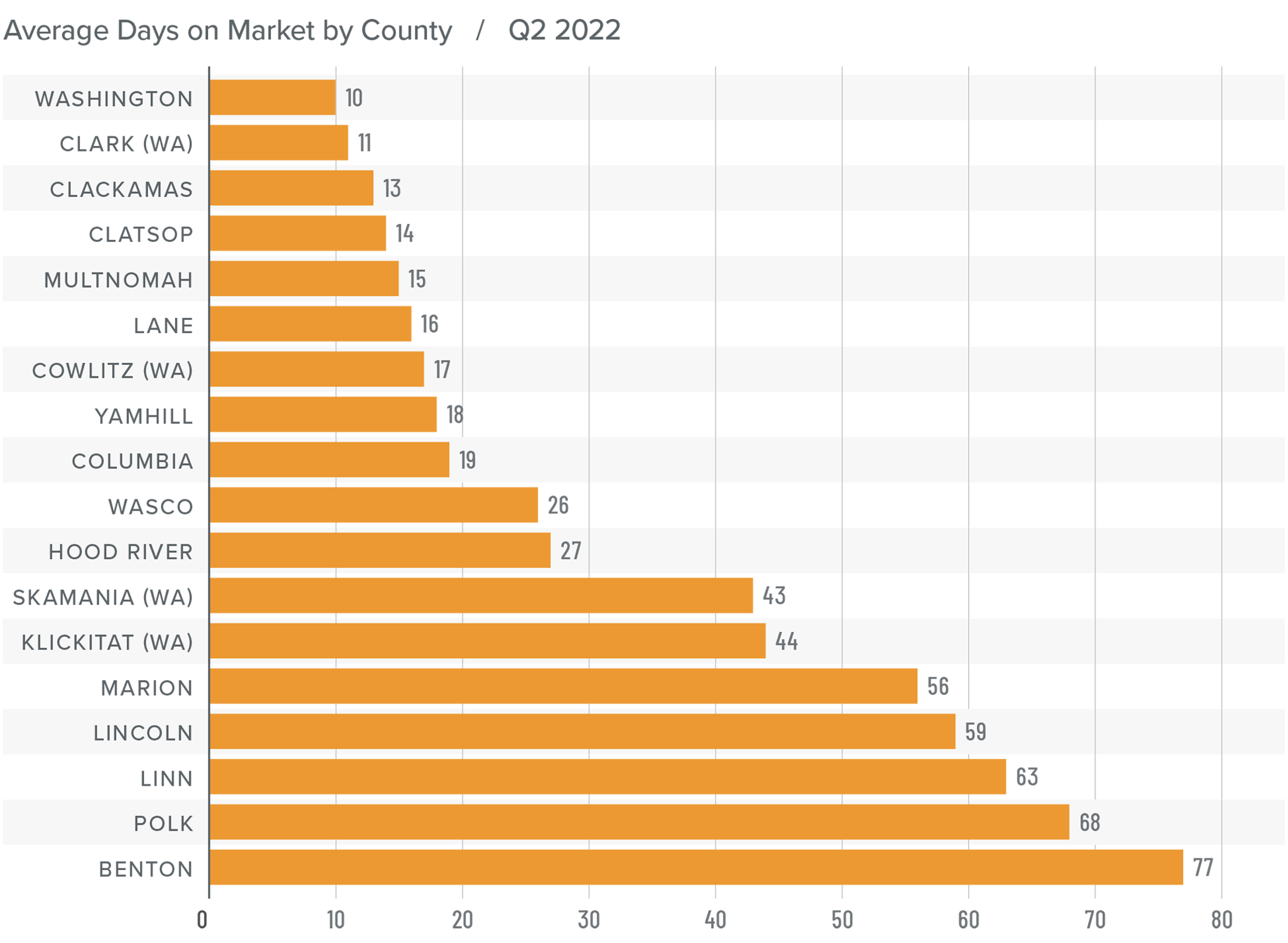
A bar graph showing the average days on market for homes in various counties in Northwest Oregon and Southwest Washington for Q2 2022. Washington County has the lowest DOM at 10, followed by Clark (WA) at 11, Clackamas at 13, Clatsop at 14, Multnomah at 15, Lane at 16, Cowlitz (WA) at 17, Yamhill at 18, Columbia at 19, Wasco at 26, Hood River at 27, Skamania (WA) at 43, Klickitat (WA) at 44, Marion at 56, Lincoln at 59, Linn at 63, Polk at 68, and Benton at 77.

Conclusions

This speedometer reflects the state of the region’s real estate market using housing inventory, price gains, home sales, interest rates, and larger economic factors.

Though the job market is recovering more slowly than I would like, the housing market is still performing strongly. As we move through the year, some may believe that the market is underperforming, but this is not the case. Along with much of the rest of the country, the Northwest Oregon and Southwest Washington housing markets have been overperforming since the onset of the pandemic. As I expect the market to start trending back to its pre-pandemic pace of sales and price growth, the slowdown might feel exaggerated, but there is no cause for concern.

A speedometer graph indicating a medium seller's market in Northwest Oregon and Southwest Washington for Q2 2022.

Despite dramatically rising financing costs, buyers still appear to be motivated. List prices have yet to “roll over,” suggesting that sellers are still confident. This, combined with the other data presented here, tells me that they are still in the driver’s seat.

About Matthew Gardner

Matthew Gardner - Chief Economist for Windermere Real Estate

As Chief Economist for Windermere Real Estate, Matthew Gardner is responsible for analyzing and interpreting economic data and its impact on the real estate market on both a local and national level. Matthew has over 30 years of professional experience both in the U.S. and U.K.

In addition to his day-to-day responsibilities, Matthew sits on the Washington State Governors Council of Economic Advisors; chairs the Board of Trustees at the Washington Center for Real Estate Research at the University of Washington; and is an Advisory Board Member at the Runstad Center for Real Estate Studies at the University of Washington where he also lectures in real estate economics.
Market News July 27, 2022

Q2 2022 Western Washington Real Estate Market Update

The following analysis of select counties of the Western Washington real estate market is provided by Windermere Real Estate Chief Economist Matthew Gardner. We hope that this information may assist you with making better-informed real estate decisions. For further information about the housing market in your area, please don’t hesitate to contact your Windermere Real Estate agent.


Regional Economic Overview

The most recent employment data (from May) showed that all but 2,800 of the jobs lost during the pandemic have been recovered. More than eight of the counties contained in this report show employment levels higher than they were before COVID-19 hit. The regional unemployment rate fell to 4.5% from 5.2% in March, with total unemployment back to pre-pandemic levels. For the time being, the local economy appears to be in pretty good shape. Though some are suggesting we are about to enter a recession, I am not seeing it in the numbers given rising employment and solid income growth.

Western Washington Home Sales

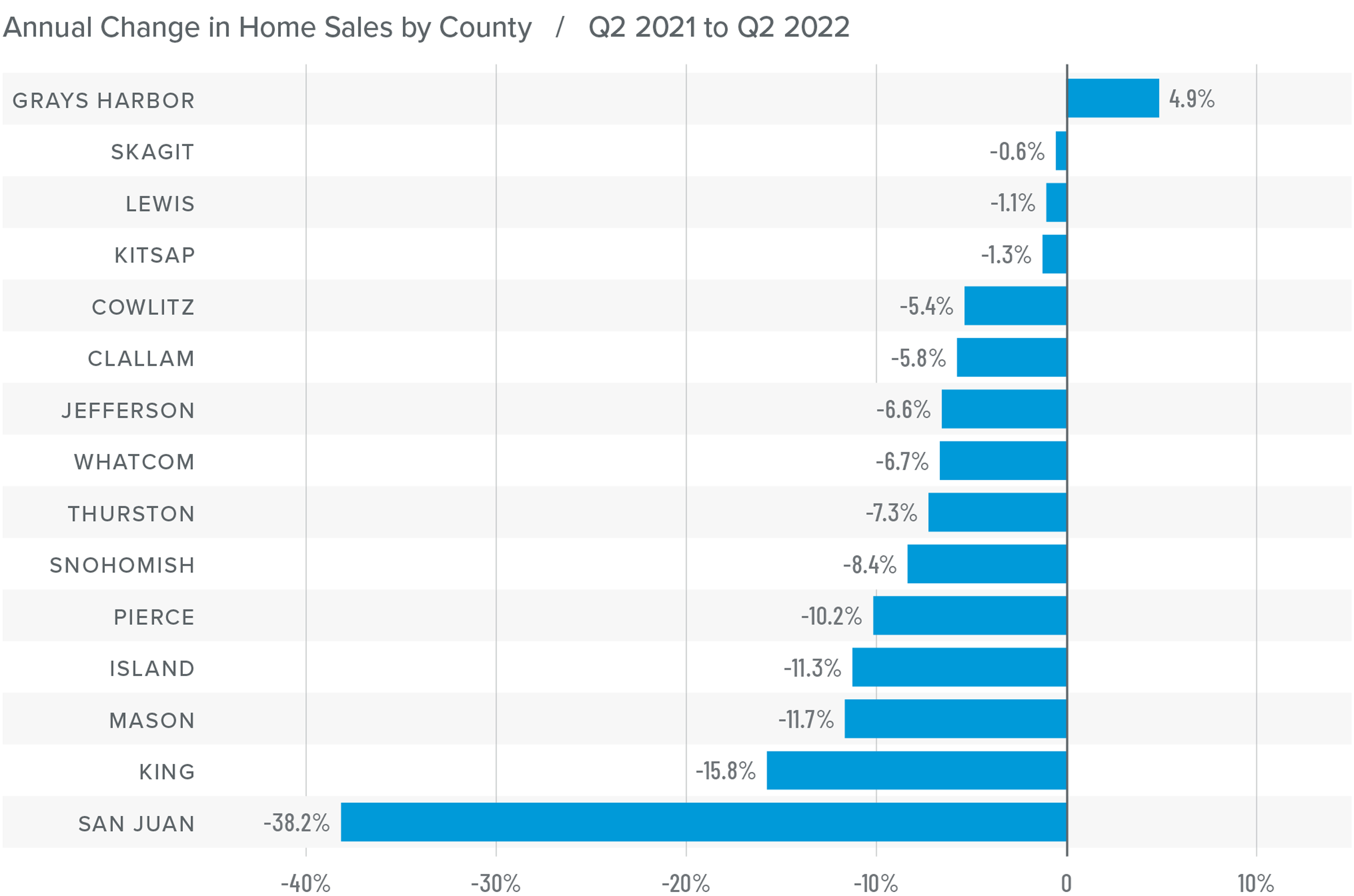
In the second quarter of 2022, 23,005 homes sold, representing a drop of 11% from the same period a year ago, but up by a significant 52% from the first quarter of this year.

Sales rose in Grays Harbor County compared to a year ago but fell across the balance of the region. The spring market, however, was very robust, likely due to growing inventory levels and buyers trying to get ahead of rising mortgage rates.

Second quarter growth in listing activity was palpable: 175% more homes were listed than during the first quarter and 61.98% more than a year ago.

Pending sales outpaced listings by a factor of 3:1. This is down from the prior year but only because of the additional supply that came to market.

A bar graph showing the annual change in home sales for various counties in Western Washington from Q2 2021 to Q2 2022. The only county with a positive percentage year-over-year change is Gray Harbor County at 4.9%. All other counties show a negative year-over-year change Here are the totals: Skagit -0.6%, Lewis -1.1%, Kitsap -1.3%, Cowlitz -5.4%, Clallam -5.8%, Jefferson -6.6%, Whatcom -6.7%, Thurston -7.3%, Snohomish -8.4%, Pierce -10.2%, Island -11.3%, Mason -11.7%, King -15.8%, and San Juan -38.2%.

Western Washington Home Prices

Even in the face of rising mortgage rates, home prices continue to rise at a well-above-average pace, with average prices up 13.3% year over year to $830,941.

I have been watching list prices as they are a leading indicator of the health of the housing market. Thus far, despite rising mortgage rates and inventory levels, sellers remain confident. This is reflected in rising median list prices in all but three counties compared to the previous quarter. They were lower in San Juan, Island, and Jefferson counties.

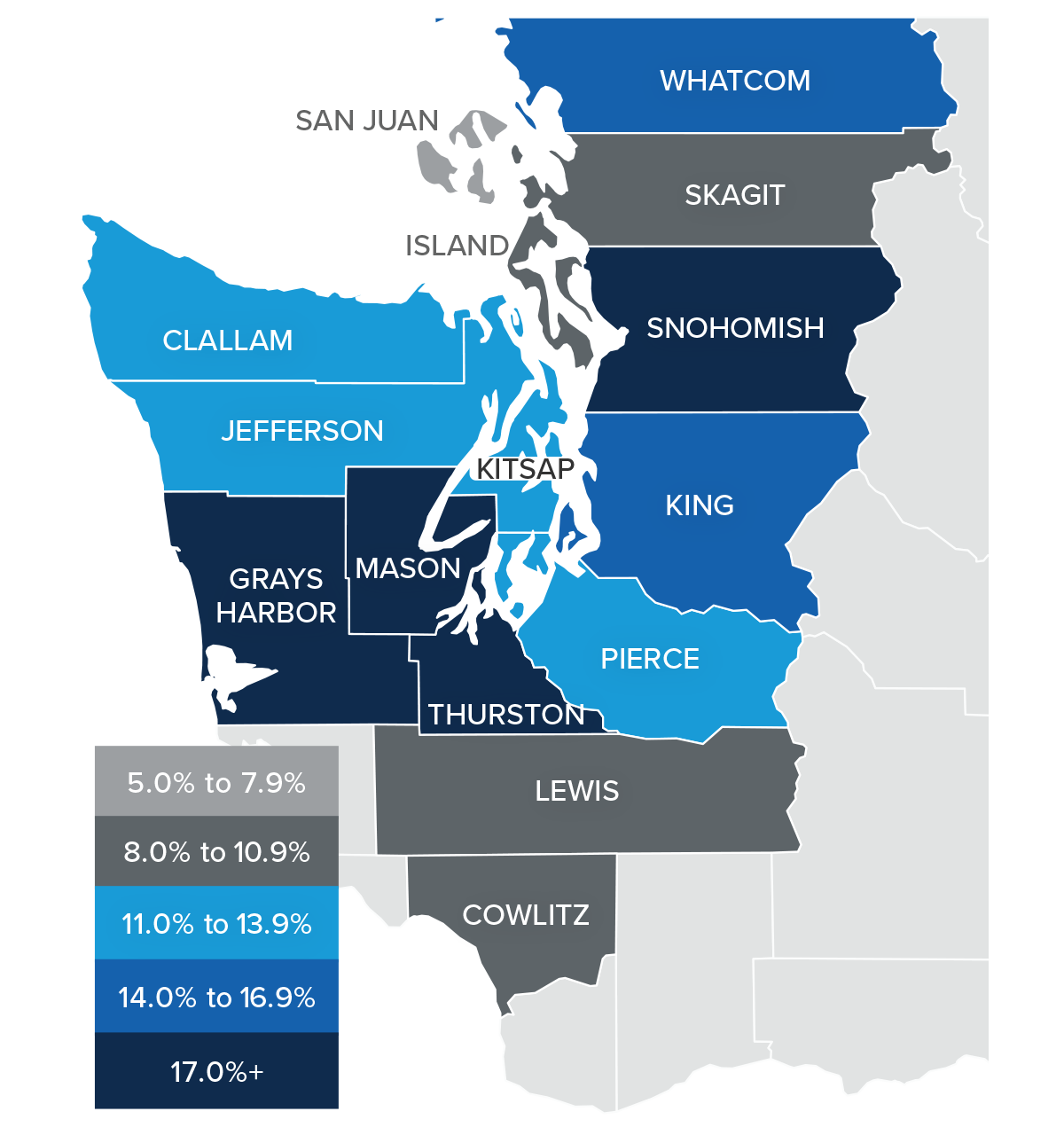
Prices rose by double digits in all but four counties. Snohomish, Grays Harbor, Mason, and Thurston counties saw significant growth.

List prices and supply are both trending higher, but this has yet to slow price growth significantly. I believe we will see the pace of appreciation start to slow, but not yet.

A map showing the real estate home prices percentage changes for various counties in Western Washington. Different colors correspond to different tiers of percentage change. San Juan County is the only county with a percentage change in the 5% to 7.9% range, Skagit, Lewis, and Cowlitz counties are in the 8% to 10.9% change range, Clallam, Jefferson, Kitsap, and Pierce are in the 11% to 13.9 % change range, King and Whatcom counties are in the 14% to 16.9% change range, and Grays Harbor, Mason, Thurston, and Snohomish counties are in the 17% + range.

A bar graph showing the annual change in home sale prices for various counties in Western Washington from Q2 2021 to Q2 2022. Snohomish county tops the list at 20.6%, followed by Grays Harbor at 18.9%, Mason at 18.4%, Thurston at 17.4%, Whatcom at 16.3%, King at 14.3%, Kitsap at 13.8%, Jefferson at 13.6%, Pierce at 13%, Clallam at 12.7%, Skagit at 10.8%, Lewis at 9.1%, Cowlitz at 8.9%, Island at 8.6%, and finally San Juan at 5.6%.

Mortgage Rates

Although mortgage rates did drop in June, the quarterly trend was still moving higher. Inflation—the bane of bonds and, therefore, mortgage rates—has yet to slow, which is putting upward pressure on financing costs.

That said, there are some signs that inflation is starting to soften and if this starts to show in upcoming Consumer Price Index numbers then rates will likely find a ceiling. I am hopeful this will be the case at some point in the third quarter, which is reflected in my forecast.

A bar graph showing the mortgage rates from 2020 to the present, as well as Matthew Gardner's forecasted mortgage rates through Q2 2023. He forecasts mortgage rates continuing to climb to 5.9% in Q4 2022, then tapering off to 5.58% in Q1 2023 and 5.53% in Q2 2023.

Western Washington Days on Market

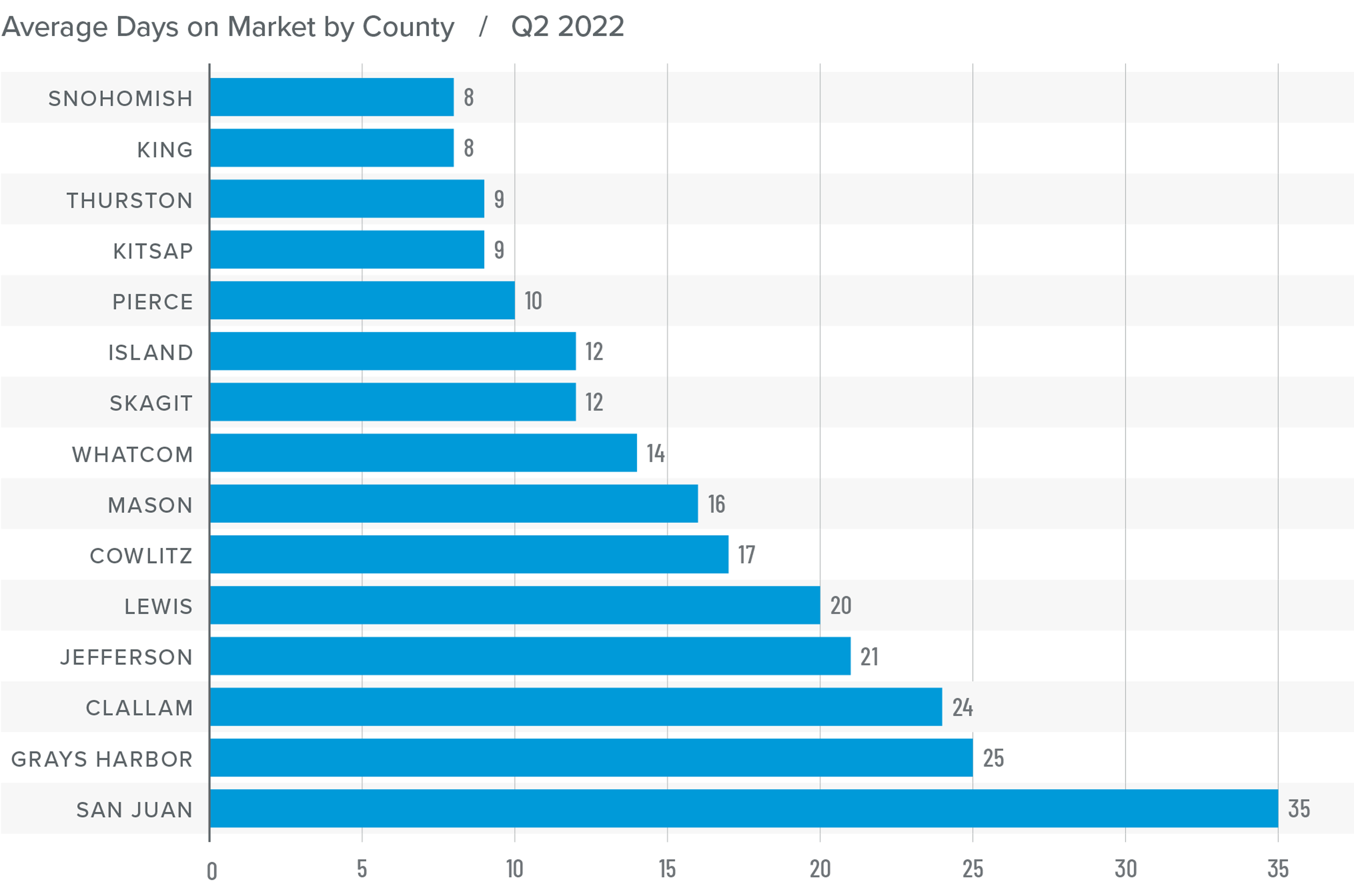
It took an average of 16 days for a home to go pending in the second quarter of the year. This was 2 fewer days than in the same quarter of 2021, and 9 fewer days than in the first quarter.

Snohomish, King, and Pierce counties were, again, the tightest markets in Western Washington, with homes taking an average of between 8 and 10 days to sell. Compared to a year ago, average market time dropped the most in San Juan County, where it took 26 fewer days for a seller to find a buyer.

All but six counties saw average time on market drop from the same period a year ago. The markets where it took longer to sell a home saw the length of time increase only marginally.

Compared to the first quarter of this year, average market time fell across the board. Demand remains very strong.

A bar graph showing the average days on market for homes in various counties in Western Washington for Q2 2022. Snohomish and King counties have the lowest DOM at 8, followed by Thurston and Kitsap at 9, Pierce at 10, Island and Skagit at 12, Whatcom at 14, Mason at 16, Cowlitz at 17, Lewis at 20, Jefferson at 21, Clallam at 24, Grays Harbor at 25, and San Juan at 35.

Conclusions

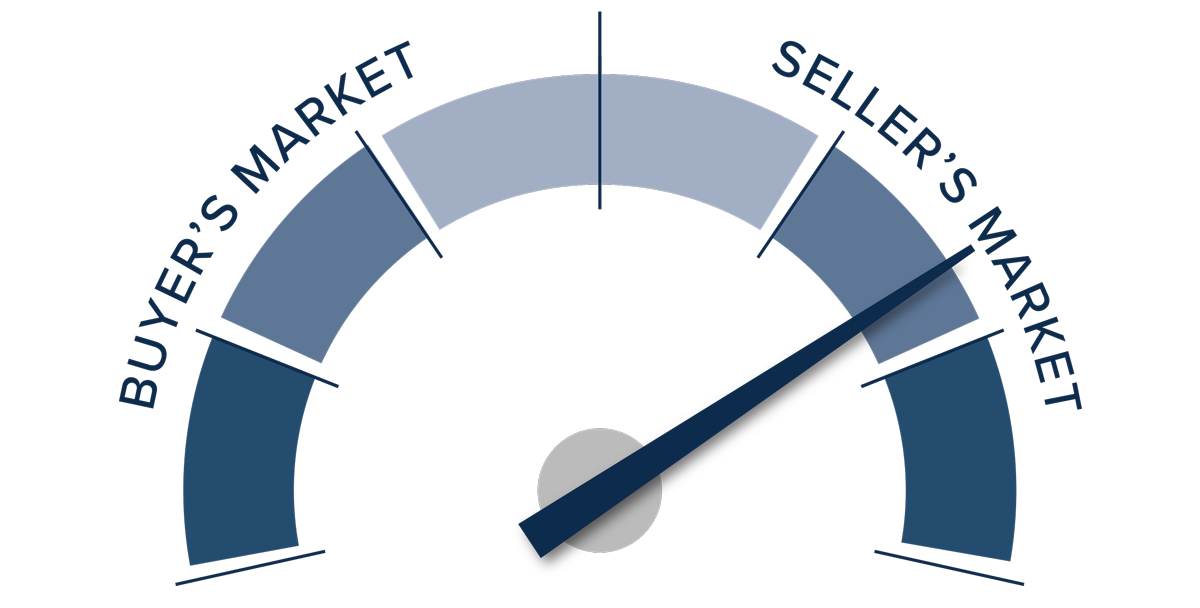
This speedometer reflects the state of the region’s real estate market using housing inventory, price gains, home sales, interest rates, and larger economic factors.

The economy remains buoyant, which is an important factor when it comes to the regional housing market, particularly as it affects buyers. Even though the number of homes that came to market has jumped significantly, which should favor those looking for a new home, demand is still robust, and the market remains competitive.

A speedometer graph indicating a strong seller's market in Western Washington for Q2 2022.

Much to the disappointment of buyers, rising listing prices suggest that sellers are clearly still confident even as financing costs continue to increase. While the pace of price growth is slowing, sellers are still generally in control. As such, I have moved the needle a little more in the direction of sellers. Until we see list-price growth and home sales slow significantly, we will not reach a balanced market.

About Matthew Gardner

Matthew Gardner - Chief Economist for Windermere Real Estate

As Chief Economist for Windermere Real Estate, Matthew Gardner is responsible for analyzing and interpreting economic data and its impact on the real estate market on both a local and national level. Matthew has over 30 years of professional experience both in the U.S. and U.K.

In addition to his day-to-day responsibilities, Matthew sits on the Washington State Governors Council of Economic Advisors; chairs the Board of Trustees at the Washington Center for Real Estate Research at the University of Washington; and is an Advisory Board Member at the Runstad Center for Real Estate Studies at the University of Washington where he also lectures in real estate economics.
Market News July 25, 2022

The Landscape for Mortgage Rates and Inflation in 2022


This video is the latest in our Monday with Matthew series with Windermere Chief Economist Matthew Gardner. Each month, he analyzes the most up-to-date U.S. housing data to keep you well-informed about what’s going on in the real estate market. 


Hello there, I’m Windermere’s Chief Economist Matthew Gardner and welcome to this month’s episode of Monday with Matthew. You know, one of the many things I love about being an economist is that it is a remarkably humbling profession. You see, just when we start to believe that our models are close to perfection, something comes along to remind us that forecasting isn’t an exact science.

And if you’re wondering what I am talking about, I recently took a look at the 2022 mortgage rate forecast I put out at the start of the year and…well, let’s say that rates rose at a far faster pace than I had anticipated. I thought that now would be a good time to take another look at rates and share my thoughts on the direction that they will likely take during the rest of the year and my reasoning behind it. And that means we need to talk about inflation.

30-Year Conventional Mortgage Rates: 2018 – 2022

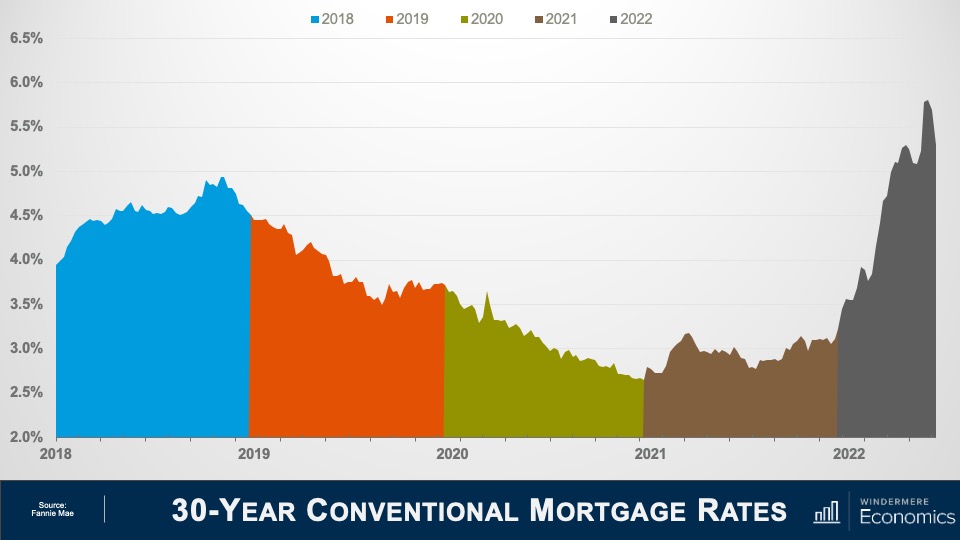
A graph showing the 30-year conventional mortgage rates for the years 2018-2022. The curve of the graph creates a sine wave, increasing from roughly 4% to 5% in 2018, dropping to roughly 3.5% by the end of 2019, decreasing further to roughly 2.5% by the end of 2020, coming back up to roughly 3.0% by the end of 2021, and spiking up to over 5.8% in 2022 before dipping slightly.


So, a quick look back. As you can see, there wasn’t much to celebrate in 2018, with rates rising from 3.95% to 4.94% before pulling back and ending the year at around 4.5%. In 2019, rates fell following the Feds’ announcement that they were likely done with raising the Fed Funds Rate, and the mortgage market also reacted positively to the announcement from the White House that they were going to impose tariffs on select Chinese imported goods. We saw an uptick in late summer, but that was mainly due to news related to BREXIT.
In 2020, rates were dropping but spiked very briefly when COVID-19 shut the country down and bond markets panicked. But with the Fed jumping in with an emergency rate cut and announcing that they would start buying a significant number of treasuries and mortgage-backed securities, rates tumbled to an all-time low of just 2.66%. In 2021, rates rose as new COVID infections plummeted, but then dropped again as the Delta variant took hold, but ultimately trended modestly higher in the second half of the year.

And then we get to 2022. Rates started the year at just over 3.1% but have since skyrocketed to over 5.8% before a small pullback that started a few weeks ago. In as much as economists expected rates to rise this year, nobody anticipated how fast they would rise. So, what went wrong? Well, there’s actually a rather simple answer.

Even though we expected rates to trend higher in 2022, there were two things we hadn’t built into our forecast models.

  1. Russia’s invasion of the Ukraine
  2. Inflation continued to climb for far longer than we expected

So, how do things look for the rest of the year? To explain my thinking, it’s important to remember that the bond market and, by implication, mortgage rates hate nothing more than high inflation because when inflation is running hot, it limits demand for bonds which, in turn, forces the interest rate payable on bonds to rise and this pushes mortgage rates higher.

But what’s been fascinating to watch is that over the past couple of weeks, rates have actually been dropping which is certainly counterintuitive given where inflation is today. And the only reason I can see for this is that bond traders were thinking that inflation might be topping out.

But then we got the June CPI numbers, and it certainly didn’t suggest that inflation was slowing, in fact it showed the opposite. But even though the total inflation rate hasn’t yet peaked, I believe that a shift has actually started and that we are closer to a peak in inflation than you may think.

Indicators of Inflation: Consumer Spending

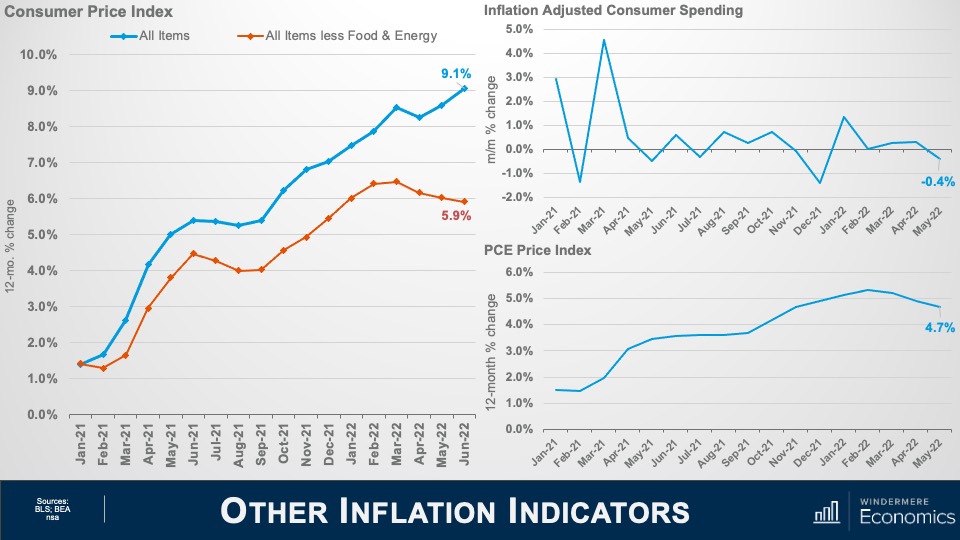
Three line graphs titled "Consumer Price Index," "Inflation Adjusted Consumer Spending," and PCE Price Index. The Consumer Price Index shows year-over-year percentage changes from present day back to January 2021, with two lines showing all items and all items less food and energy. The all items line starts around 1.5% in January 2021, gradually increasing to 9.1% in June 2022, while the all items less food and energy line also starts around 1.5% in January 2021 and undulates to 5.9% in June 2022. The "Inflation Adjusted Consumer Spending" chart shows month-over-month percentage changes from January 2021 to May 2022. The line spikes up and down throughout the first half of 2021, going as high as roughly 4.5% around March 2021 and as low as roughly negative 1.5% in February 2021. The line stabilizes for the remainder of the x-axis, ending at 0.4% in May 2022. The "PCE Price Index" graph shows year-over-year percentage changes from January 2021 to May 2022. The line starts around 1.5% in January 2021, gradually increasing through February 2022 around 5% before tapering to 4.7% in May 2022.


The June CPI report showed the headline inflation rate still trending higher but look at the core rate which excludes the volatile food & energy sectors. That has actually been pulling back for the past three months. And consumer spending when adjusted for inflation fell 0.4% in May. That’s the first monthly drop since last December, and I expect the June number when it comes out at the end of the month to show spending dropping even further.

This is a very important dataset that often gets overlooked but it is starting to tell me that the economy is slowing because of inflation and slower spending acts as a headwind to further price increases.

The core PCE price index is up 4.7% year-over-year, but this was the smallest annual increase since last November and you can see that it is also starting to roll over. This index is actually the Fed’s favored measure of inflation as it’s more comprehensive that the CPI number as it measures the change in spending for all consumers, not just urban households.

Indicators of Inflation: 5-Year Breakevens and Producer Price Index

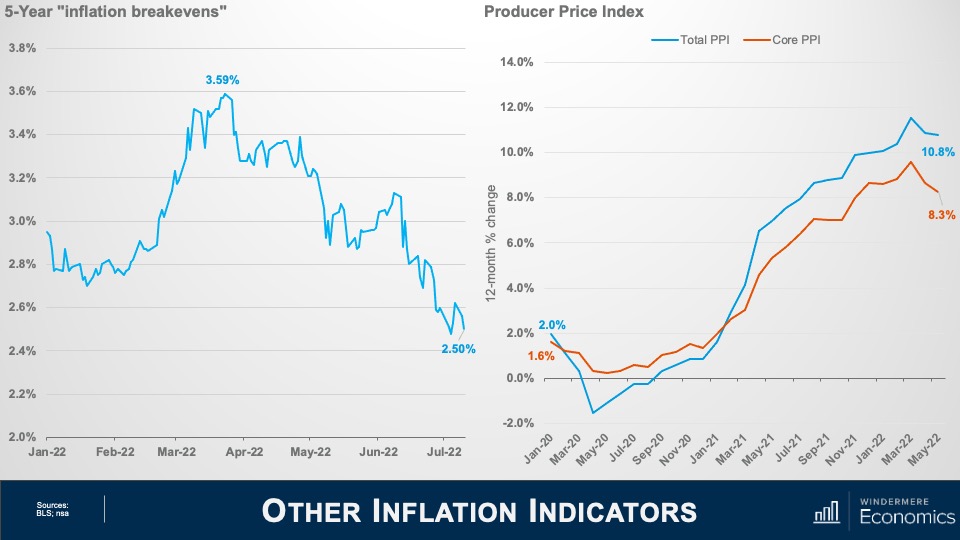
Two line graphs titled "5-Year Inflation Breakevens" and "Producer Price Index." The breakevens graph shows percentage changes from January 2022 to July 2022, starting at 3.0% in January 2022, increasing to 3.59% in March 2022, before gradually decreasing to 2.50% in July 2022. The "Producer Price Index" graph shows year-over-year percentage changes from January 2020 to May 2022, with two lines showing Total PPI and Core PPI. Both lines gradually increase along the x-axis, peaking around March 2022. Total PPI increases from 2.0% from 10.8 in May 2022, while core PPI increases from 1.6% to 8.3% over the same time period.


The five-year “inflation breakeven” has plunged more than a full percentage point since peaking at just under 3.6% in late March. And this number is important as it lets us know where bond traders expect the average inflation rate to be over the next five years.

The Producer Price Index measures inflation at the wholesale, not retail, level and even though the total rate rose as energy costs continue to impact the manufacturing sector, the core rate has been pulling back for the past three months. Now let’s look at some commodity prices and see what’s going on there.

Selected Commodity Prices: Natural Gas, Copper, Soybeans, Wheat

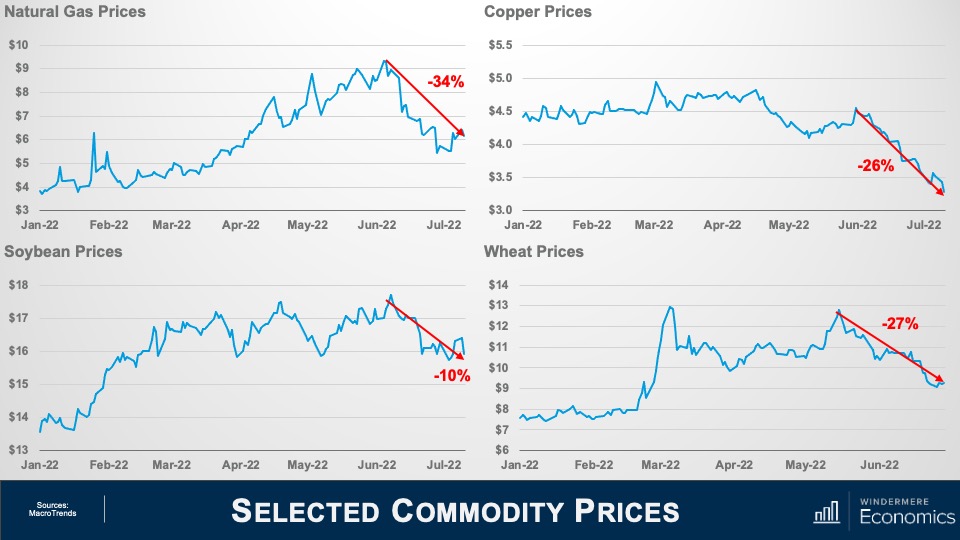
Four line graphs titled "Natural Gas Prices," "Copper Prices," "Soybean Prices," and "Wheat Prices." Natural Gas, Soybean, and Wheat prices all share a similar trend in that they gradually increase from January 2022 to June 2022 before dropping from June to July 2022. Natural gas prices fell by 34% from June to July 2022, while soybean prices fell 10% and wheat prices fell 27% over that same time period. Copper prices are steady from January 2022 to April 2022, before gradually dropping through April and May, then drastically falling 26% from June to July 2022. In summary, prices of all commodities are falling a significant amount over the past month (June to July 2022).


  • The price for natural gas is down over 34% from its recent high
  • Copper prices are down 26% from the recent June peak and down substantially from March
  • Soybean prices are down 10%
  • Despite the war in Ukraine, wheat prices are down 27% from June

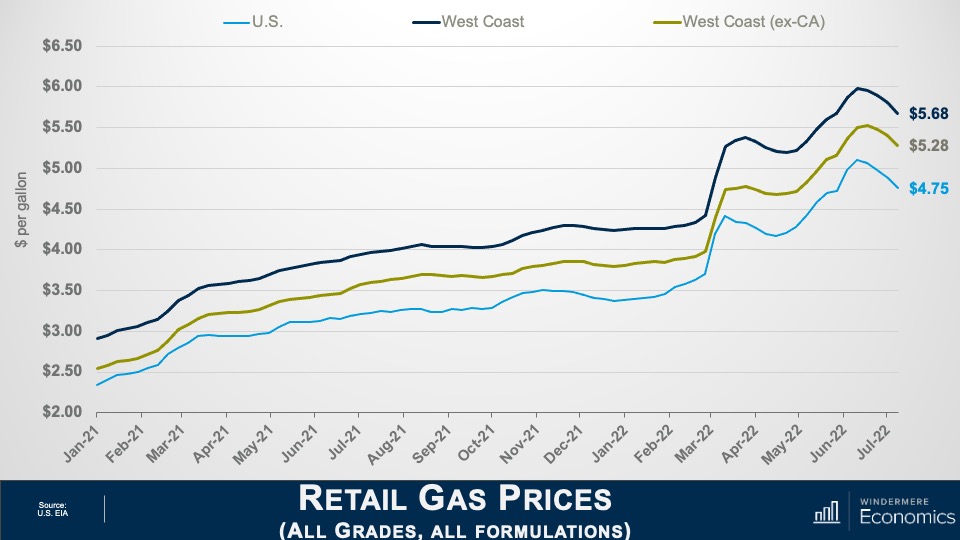
Retail Gas Prices: West Coast, West Coast Excluding CA, U.S.

A line graph titled "Retail Gas Prices" with three lines: U.S., West Coast, and West Coast excluding California. All three lines show increases in price per gallon from January 2021 to July 2022. All three lines peak in June 2022. The West Coast gas prices went from roughly three dollars per gallon to $5.68 per gallon in July 2022, the West Coast excluding California line goes from roughly $2.50 per gallon in January 2021 to $5.28 in July 2022, and the U.S. line goes from just below $2.50 per gallon in January 2021 to $4.75 per gallon in July 2022.


It appears as if gas prices have also rolled over. Of course, here on the West Coast it’s more expensive than the nation even when you take California out of the equation.

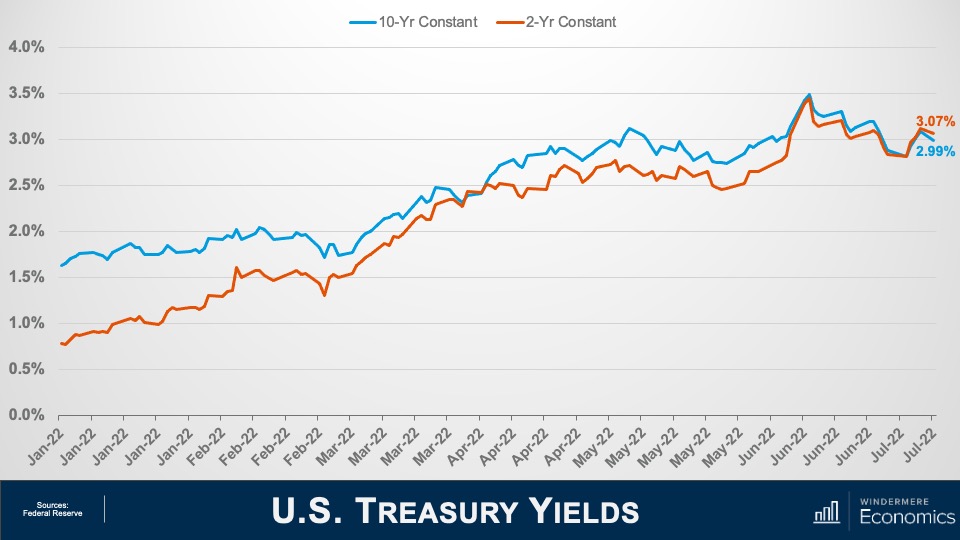
U.S. Treasury Yields: 10-Year and 2-Year Constant

A line graph with two lines showing the U.S. Treasury Yields 10-year constant and 2-year constant from January 2022 to July 2022. The 10-year constant gradually increases over this period of time from 1.5% in January 2022 to 2.99% in July 2022. The 2-year constant gradually increases as well, from roughly 0.75% in January 2022 to 3.07% in July 2022.


And finally, to cap things off, traders must also be pondering the same numbers as I am because bond yields themselves have been tumbling at both the long and short ends of the yield curve with the 10-year note still yielding less than 3% even after the CPI report and two-year yields, while still elevated, are still down from 2.42% just two weeks ago.

So, given all the charts we have looked at, I hope that you too are seeing some light at the end of the tunnel when it comes to the likelihood that inflation is about to start easing.

No doubt, the headline inflation number for June wasn’t one that anyone wanted to see but, if the trends we have looked at continue, I still expect inflation to start slowly creeping lower, which will push bond prices higher, yields will start to pause—if not drop—and that will allow mortgage rates to hold at or close to their current levels for the time being. Although we could see rates coming down, though they will still start with a five for the foreseeable future. I hope that you have found my thoughts of interest.

As always, if you have any questions or comments about this particular topic, please do reach out to me but, in the meantime, stay safe out there. I look forward to visiting with you all again next month.

Bye now.


About Matthew Gardner

As Chief Economist for Windermere Real Estate, Matthew Gardner is responsible for analyzing and interpreting economic data and its impact on the real estate market on both a local and national level. Matthew has over 30 years of professional experience both in the U.S. and U.K.

In addition to his day-to-day responsibilities, Matthew sits on the Washington State Governors Council of Economic Advisors; chairs the Board of Trustees at the Washington Center for Real Estate Research at the University of Washington; and is an Advisory Board Member at the Runstad Center for Real Estate Studies at the University of Washington where he also lectures in real estate economics.