Market News August 3, 2023

Q2 2023 Nevada Real Estate Market Update

The following analysis of select counties of the greater Las Vegas real estate market is provided by Windermere Real Estate Chief Economist Matthew Gardner. We hope that this information may assist you with making better-informed real estate decisions. For further information about the housing market in your area, please don’t hesitate to contact your Windermere Real Estate agent.


Regional Economic Overview

Clark County continues to add jobs, but the pace of growth has started to taper. The market has added 49,200 new jobs over the past 12 months. Although that was the slowest annual growth rate since before the pandemic, it still represents an impressive increase of 4.6%. The non-seasonally adjusted jobless rate in May was a respectable 5.6%. This was up .01% over April, but down from 8.1% the second quarter of 2022. When adjusted for seasonality, the rate was also 5.6%, down from 5.9% in the second quarter of 2022. My latest employment forecast for the Las Vegas metro area suggests that employment growth will continue to taper, but that over 43,000 new jobs will have been created in 2023.

Nevada Home Sales

A total of 6,908 homes sold in the second quarter of the year, which was a drop of 26.3% compared to the second quarter of 2022. However, sales continued the upward momentum we saw in the first quarter and were an impressive 23.7% higher than in the first quarter of the year.

Year over year, sales fell significantly across the board. However, sales rose in every neighborhood compared to the first quarter of 2023. Every area except Aliante, The Lakes/Section 8, and Northeast Las Vegas saw double-digit gains.

Even more impressive was the fact that sales rose from the first quarter despite the 2.5% drop in the average number of homes for sale.

Pending sales, which are an indicator of future closings, rose 10.7% compared to the first quarter, suggesting that the market may see further growth in sales in the third quarter of 2023.
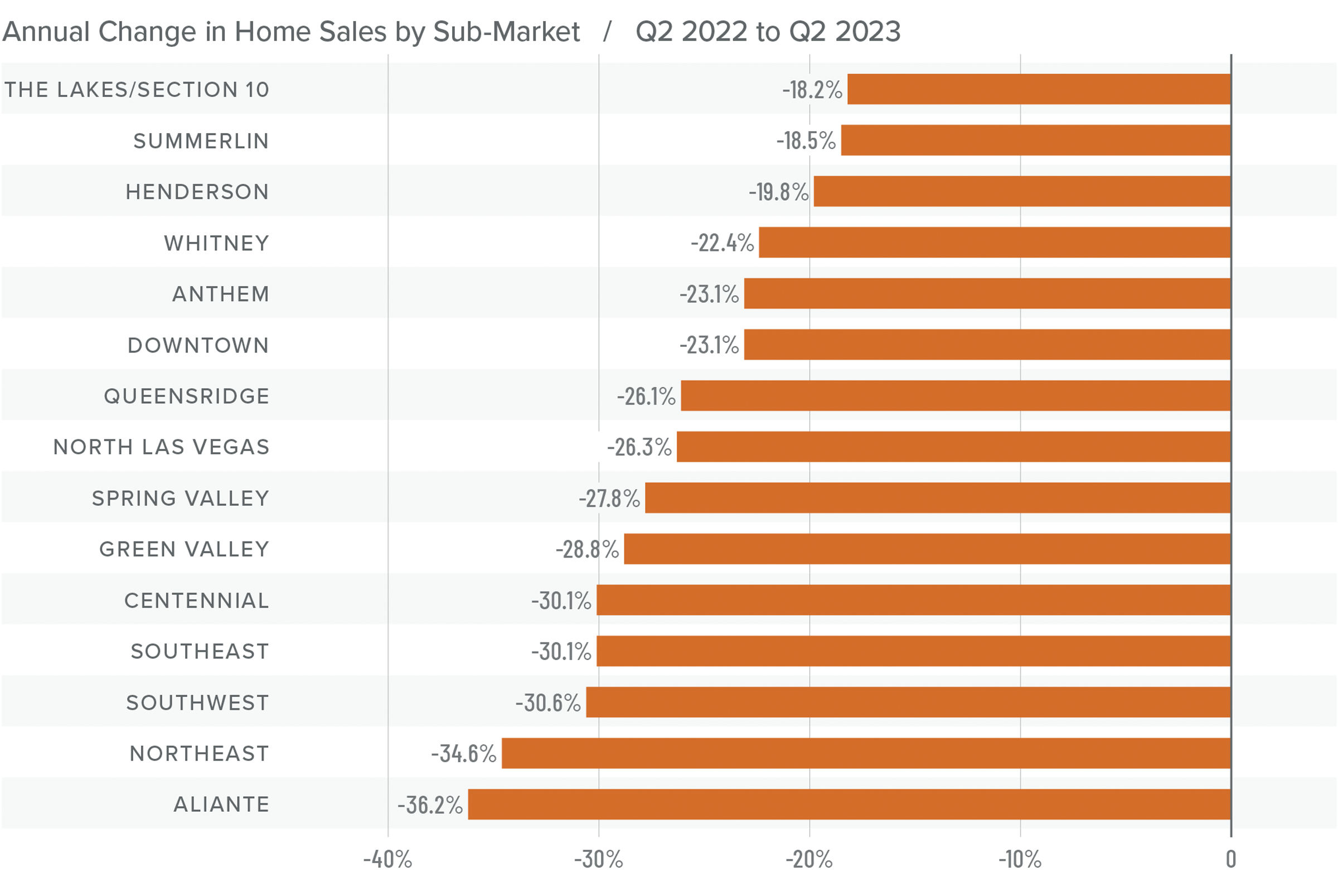
A graph showing the annual change in home sales by sub-market area for Nevada from Q2 2022 to Q2 2023. The Lakes/Section 10 had the least drastic change at -18.2%, while Aliante had the largest change at -36.2%. Areas like North Las Vegas and Queensridge were in the middle at around -26%.

Nevada Home Prices

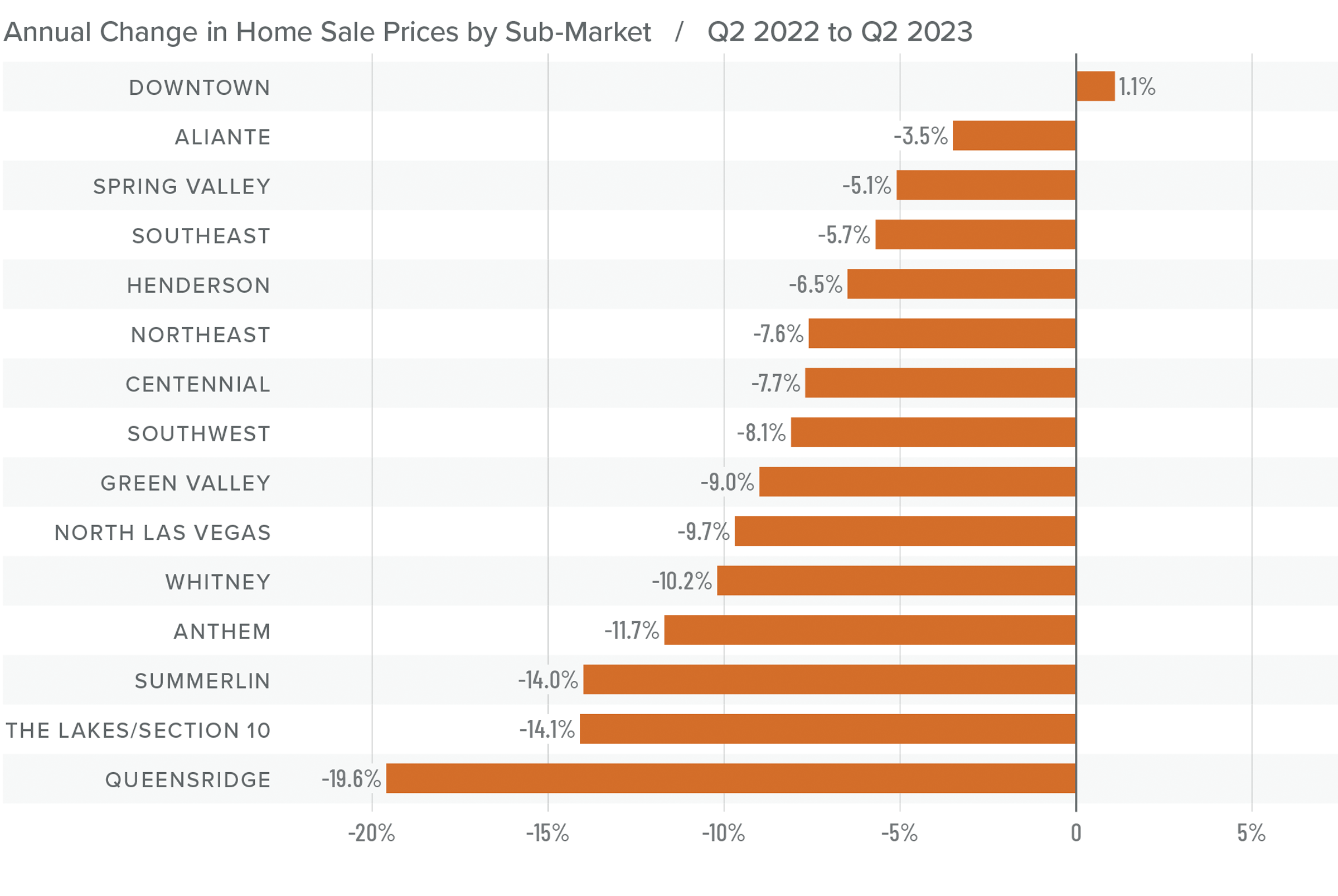
Sale prices fell 10.5% year over year but rose 2.1% compared to the first quarter of 2023. The average home sale price in the area was $481,581.

Median list prices rose 3.9% from the first quarter of the year. The only neighborhood where list prices fell was in Southeast Las Vegas. Even there, the decline was a very modest 1.3%.

Year over year, prices fell in every market other than Downtown. However, compared to the first quarter of this year, prices rose across the board.

It would be natural to think that prices should have fallen further given deteriorating affordability and far higher mortgage rates than we have seen in a number of years; however, that does not appear to be the case.
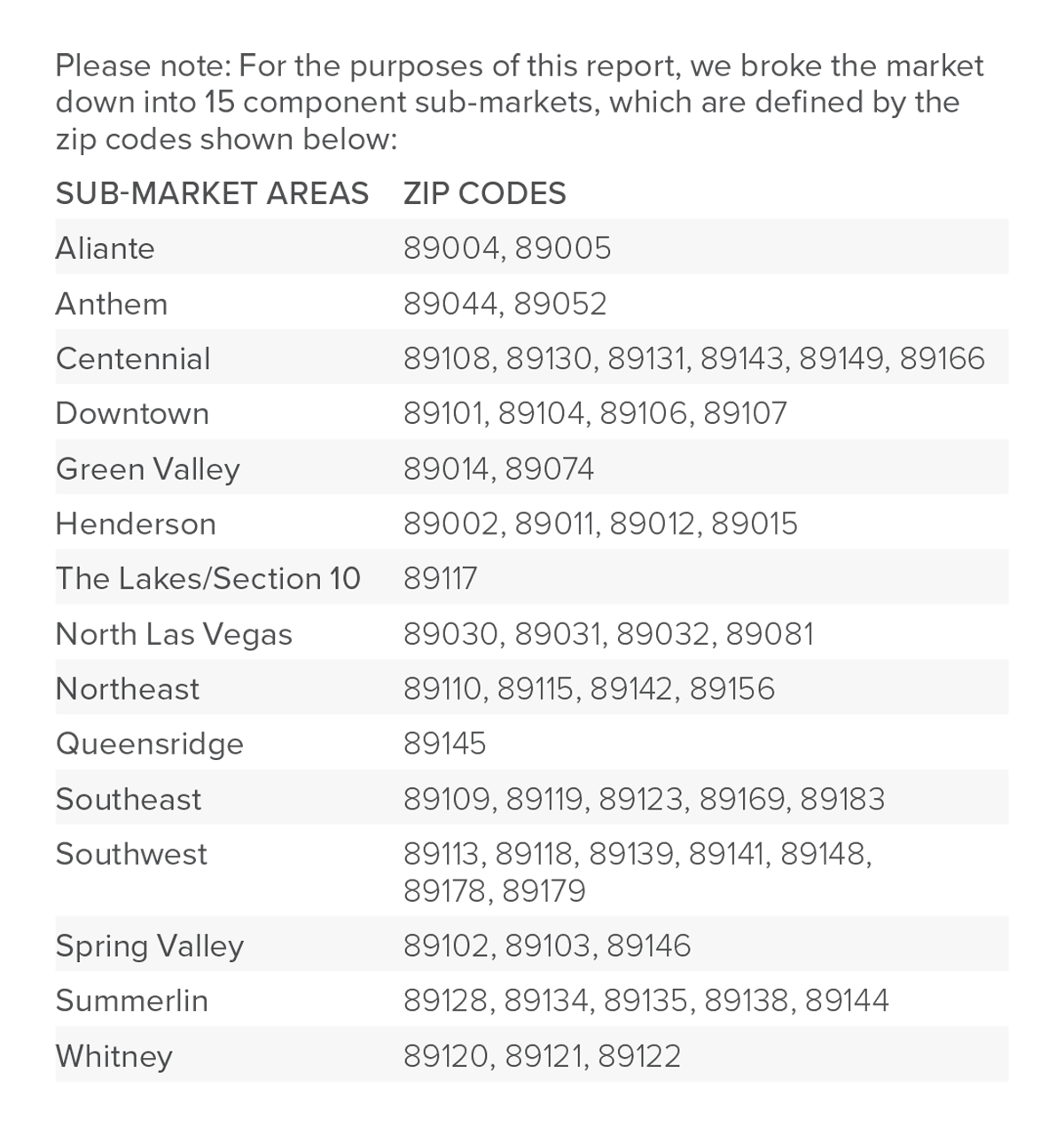
A chart showing the sub-market areas and their corresponding zip codes in the Greater Las Vegas, Nevada area.

A bar graph showing the annual change in home sale prices by sub-market area in Nevada from Q2 2022 to Q2 2023. Downtown tops the list at 1.1%, while Queensridge had the greatest decline at -19.6%. Centennial and Southwest were toward the middle at around -8%.

Mortgage Rates

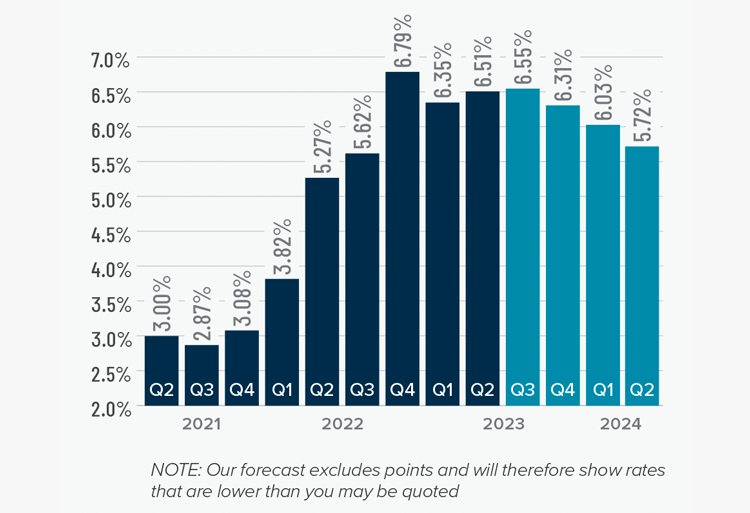
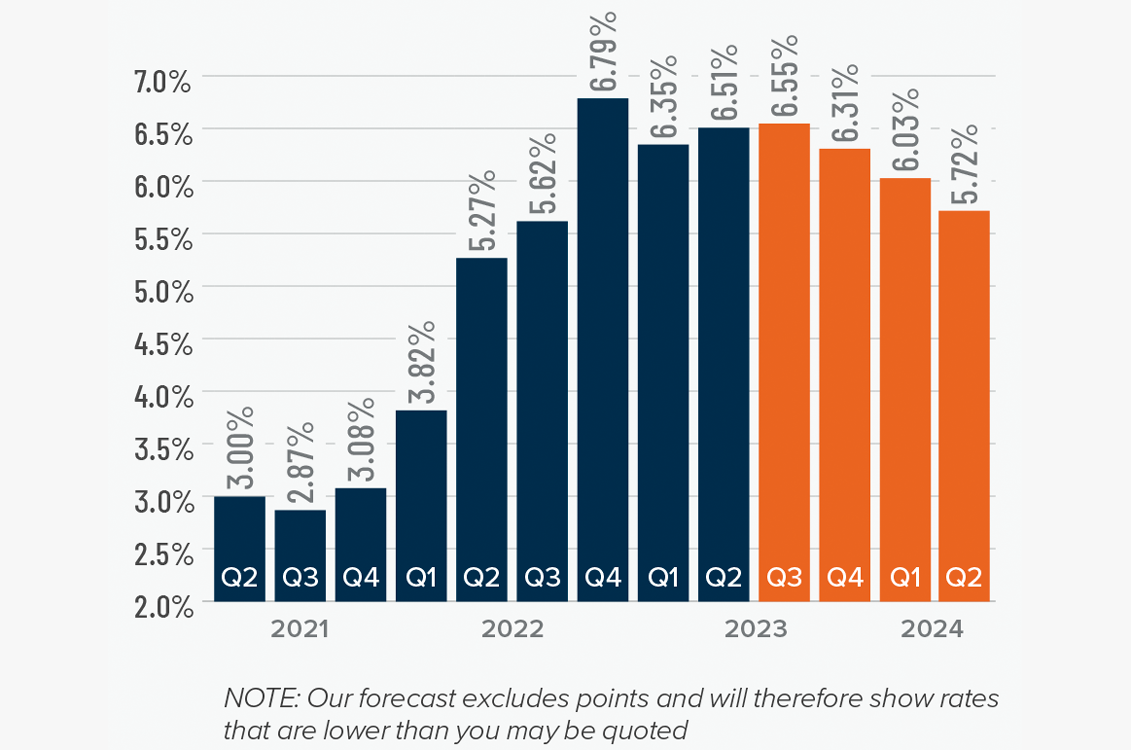
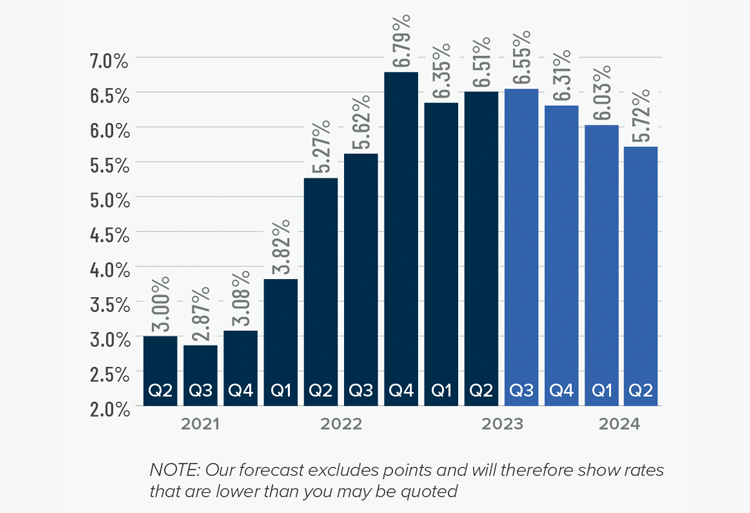
Although they were less erratic than the first quarter, mortgage rates unfortunately trended higher and ended the quarter above 7%. This was due to the short debt ceiling impasse, as well as several economic datasets that suggested the U.S. economy was not slowing at the speed required by the Federal Reserve.

While the June employment report showed fewer jobs created than earlier in the year, as well as downward revisions to prior gains, inflation has not sufficiently slowed. Until it does, rates cannot start to trend consistently lower. With the economy not slowing as fast as expected, I have adjusted my forecast: Rates will hold at current levels in third quarter and then start to trend lower through the fall. Although there are sure to be occasional spikes, my model now shows the 30-year fixed rate breaking below 6% next spring.
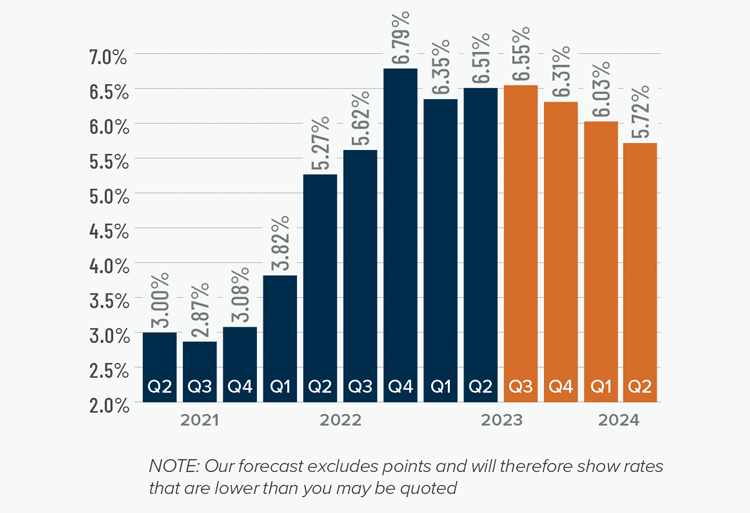
A bar graph showing the mortgage rates from Q2 2021 to the present, as well as Matthew Gardner's forecasted mortgage rates through Q2 2024. After the 6.79% figure in Q4 2022, 6.35% in Q1 2023, and 6.51% in Q2 2023, he forecasts mortgage rates going to 6.55% in Q3 2023, 6.31% in Q4 2023, 6.03% in Q1 2024, and 5.72% in Q2 2024.

Nevada Days on Market

The average time it took to sell a home in the region rose 26 days compared to the second quarter of 2022.

It took an average of 42 days to sell a home in the second quarter, which was 13 fewer days than it took in the first quarter of 2023.

Days on market rose in all neighborhoods compared to the same period in 2022. However, average market time fell in every neighborhood compared to the first quarter of this year.

Tighter inventory levels are offsetting higher financing costs, which is lowering average market time.
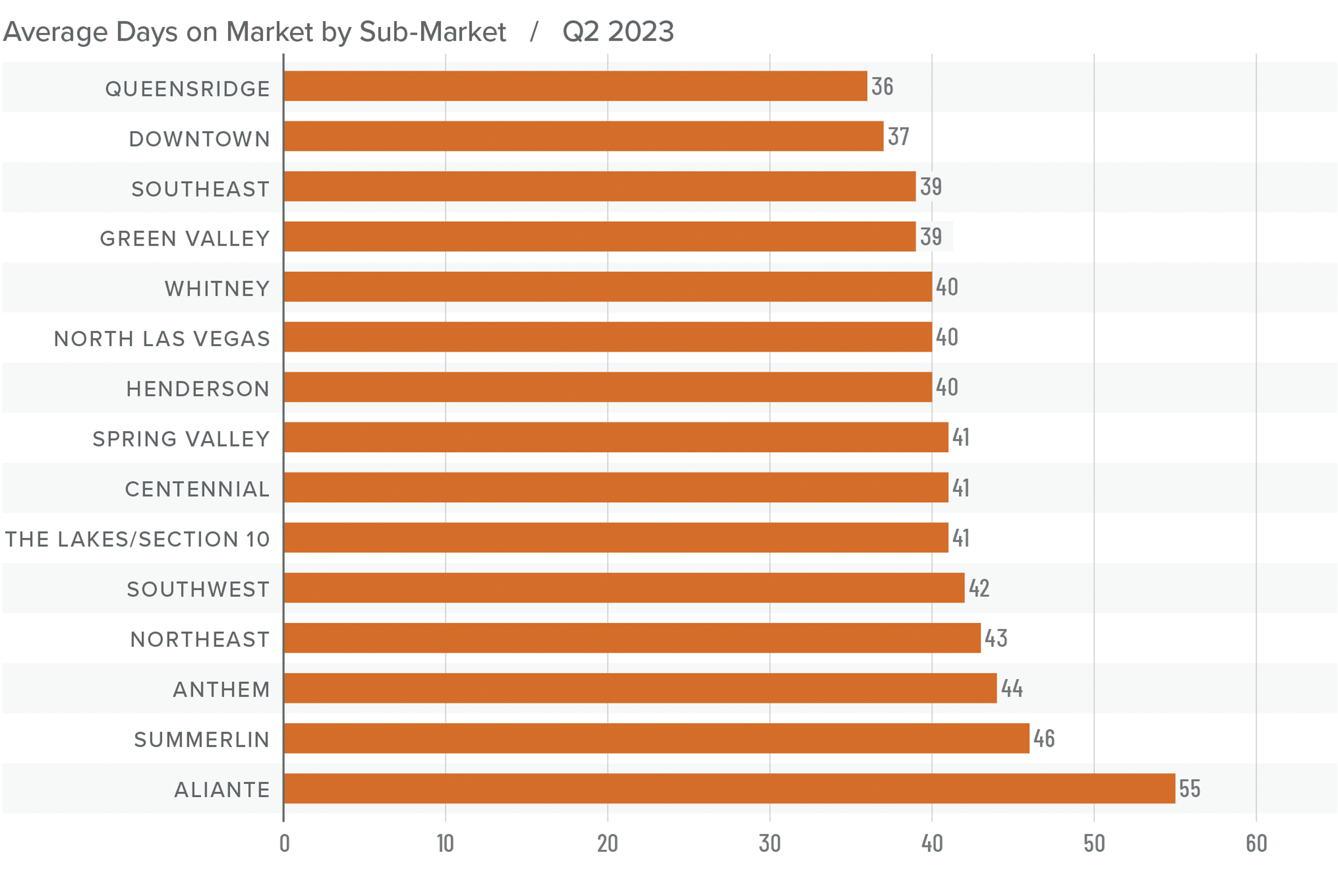
A bar graph showing the days on market by sub-market area for homes in Nevada in Q2 2023. Queensridge had the lowest DOM at 36, while Aliante had the highest at 55. Spring Valley and Henderson were in the middle at around 40 days on market.

Conclusions

This speedometer reflects the state of the region’s real estate market using housing inventory, price gains, home sales, interest rates, and larger economic factors.

Just when you think you can write off Las Vegas, it comes back to prove you wrong. The area’s housing market is resilient and is likely to continue being that way. Every index other than mortgage rates is favoring sellers right now. Inventory levels are down. Pending and closed sales are up, as are list and sale prices.
A speedometer graph indicating a balanced market bordering on a seller's market in Nevada for Q2 2023.

While the market currently favors home sellers, they are not in a completely dominant position. That said, given everything I’ve shared in this report, I have pushed the needle more in their favor.

About Matthew Gardner

Matthew Gardner - Chief Economist for Windermere Real Estate

As Chief Economist for Windermere Real Estate, Matthew Gardner is responsible for analyzing and interpreting economic data and its impact on the real estate market on both a local and national level. Matthew has over 30 years of professional experience both in the U.S. and U.K.

In addition to his day-to-day responsibilities, Matthew sits on the Washington State Governors Council of Economic Advisors; chairs the Board of Trustees at the Washington Center for Real Estate Research at the University of Washington; and is an Advisory Board Member at the Runstad Center for Real Estate Studies at the University of Washington where he also lectures in real estate economics.

Market News August 3, 2023

Q2 2023 Utah Real Estate Market Update

The following analysis of select counties of the Utah real estate market is provided by Windermere Real Estate Chief Economist Matthew Gardner. We hope that this information may assist you with making better-informed real estate decisions. For further information about the housing market in your area, please don’t hesitate to contact your Windermere Real Estate agent.


Regional Economic Overview

Although it slowed in the first quarter of 2023, employment growth has stabilized in Utah. The state added 52,400 jobs over the past 12 months, which represents an annual growth rate of 3.1%. The counties covered by this report added almost 33,000 new jobs over the past year, representing a growth rate of 2.4%. As we saw in the first quarter of the year, the fastest growing county was Summit, which had a 5.8% annual growth rate. The slowest was again Morgan County, where the job level rose 1.6%. Utah’s unemployment rate in May was 2.5%, up .03% from the level in the second quarter of 2022. At the county level, the lowest jobless rate was in Morgan County (1.8%) and the highest was in Weber County, where 2.5% of the workforce was without a job. In aggregate, the unemployment rate within the counties contained in this report was only 2.3%.

Utah Home Sales

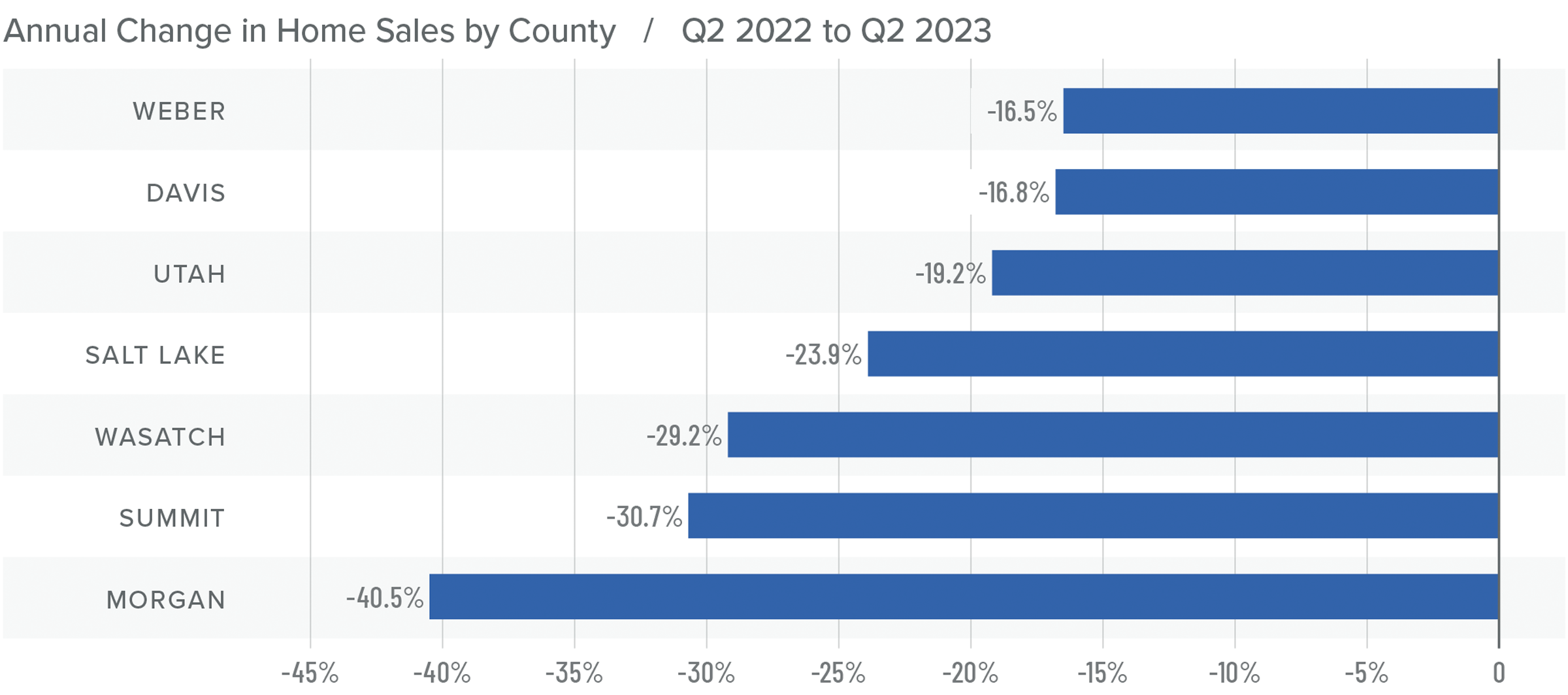
In the second quarter, 6,939 homes were sold in the areas covered by this report. This was down 21% compared to the second quarter of 2022 but was 28.3% higher than in the first quarter of this year.

Year over year, sales fell across the board. However, sales increased by double digits in every county covered by this report compared to the first quarter.

It is quite likely that the higher number of homes sold compared to the previous quarter was a result of the impressive increase in the number of homes for sale. Inventory rose 12.6% over the first quarter.

Pending sales rose 14.6% from the first quarter, suggesting that closings in the upcoming quarter will likely rise.

A graph showing the annual change in home sales by county for Utah from Q2 2022 to Q2 2023. Weber had the least drastic change at -16.5%, while Morgan had the largest change at -40.5%. Counties like Utah and Salt Lake were in the middle at around -20%.

Utah Home Prices

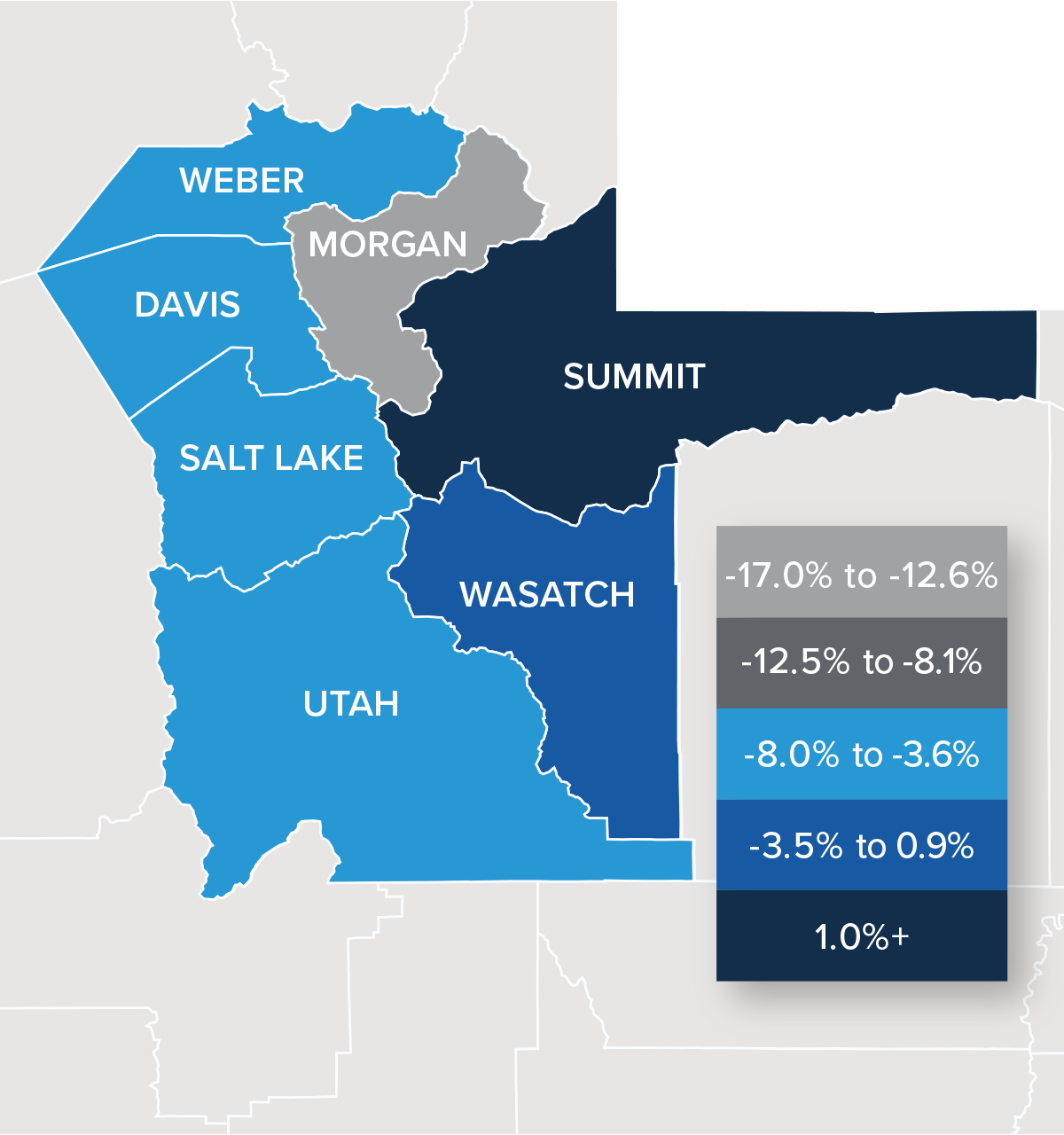
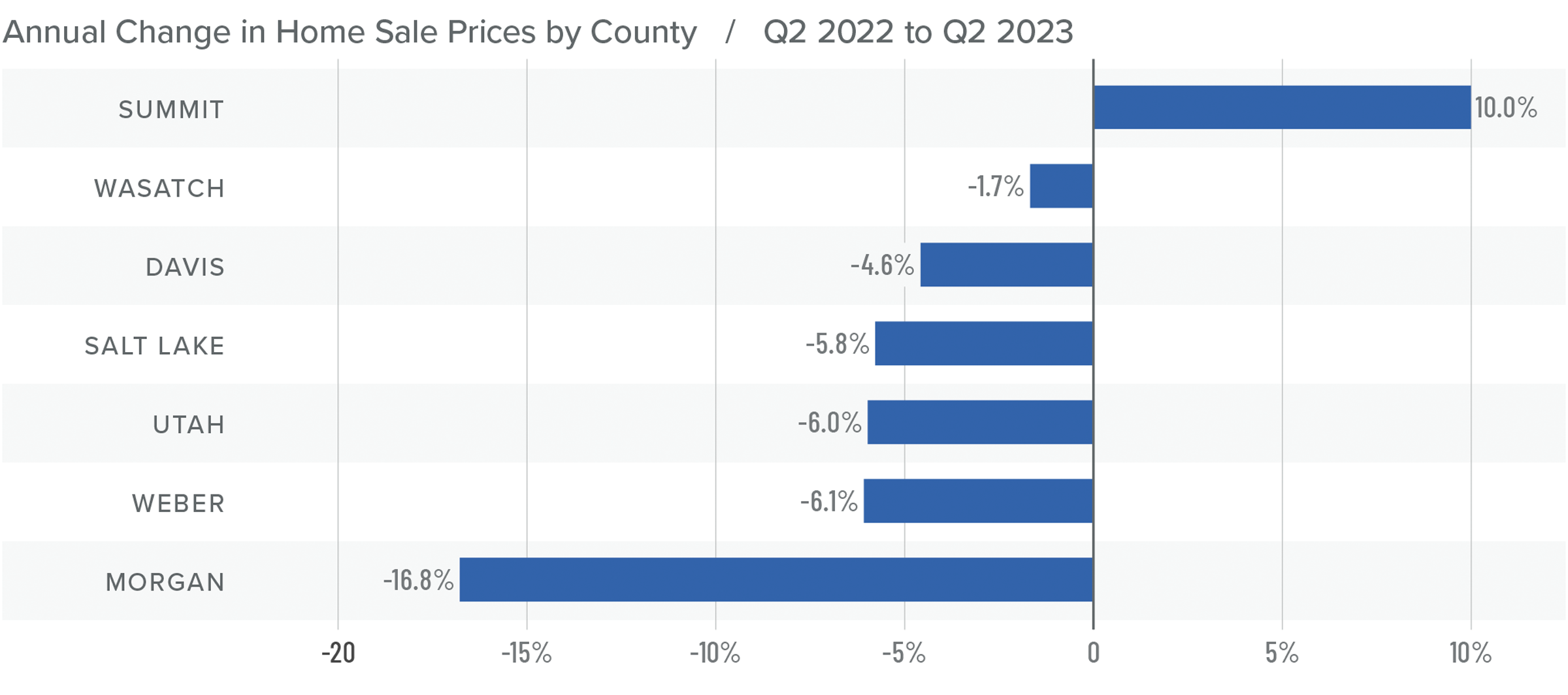
The average sale price in the quarter fell 5.4% from the second quarter of 2022 to $629,289. However, sale prices were 4.1% higher than in the first quarter of 2023.

Median list prices in the second quarter were 8.5% higher than in the first quarter of the year. It’s interesting to see sellers’ continued confidence given the significant increase in mortgage rates the market has experienced.

Year over year, prices rose in Summit County but dropped in the other markets. Compared to the first quarter, prices rose in every county other than Wasatch, where they fell 12.7%.

It was notable that the markets that saw list prices rising were in the more affordable areas. Expensive counties, such as Morgan, Summit, and Wasatch, all had lower median list prices than in the first quarter of this year.

A map showing the real estate home prices percentage changes for various counties in Utah. Different colors correspond to different tiers of percentage change. Morgan had a percentage change in the -17% to -12.6% range. Weber, Davis, Salty Lake, and Utah were in the -8% to -3.6% change range. Wasatch was in the -3.5% to 0.9% change range. Summit was in the 1%+ change range.

A bar graph showing the annual change in home sale prices by county in Utah from Q2 2022 to Q2 2023. Summit County tops the list at 10%, while Morgan County had the greatest decline at -16.8%. Salt Lake and Utah Counties were toward the middle at around -6%.

Mortgage Rates

Although they were less erratic than the first quarter, mortgage rates unfortunately trended higher and ended the quarter above 7%. This was due to the short debt ceiling impasse, as well as several economic datasets that suggested the U.S. economy was not slowing at the speed required by the Federal Reserve.

While the June employment report showed fewer jobs created than earlier in the year, as well as downward revisions to prior gains, inflation has not sufficiently slowed. Until it does, rates cannot start to trend consistently lower. With the economy not slowing as fast as expected, I have adjusted my forecast: Rates will hold at current levels in third quarter and then start to trend lower through the fall. Although there are sure to be occasional spikes, my model now shows the 30-year fixed rate breaking below 6% next spring.

A bar graph showing the mortgage rates from Q2 2021 to the present, as well as Matthew Gardner's forecasted mortgage rates through Q2 2024. After the 6.79% figure in Q4 2022, 6.35% in Q1 2023, and 6.51% in Q2 2023, he forecasts mortgage rates going to 6.55% in Q3 2023, 6.31% in Q4 2023, 6.03% in Q1 2024, and 5.72% in Q2 2024.

Utah Days on Market

The average time it took to sell a home in the counties covered by this report rose 36 days compared to the same period a year ago.

Homes sold fastest in Salt Lake County and slowest in Summit County. All areas saw average market time rise compared to the second quarter of 2022, but market time fell in all areas compared to the first quarter of this year.

During the second quarter, it took an average of 54 days to sell a home. Market time fell 13 days compared to the first quarter of 2023.

It was impressive to see the length of time it took to sell a home in the region fall significantly despite more inventory and higher financing costs.

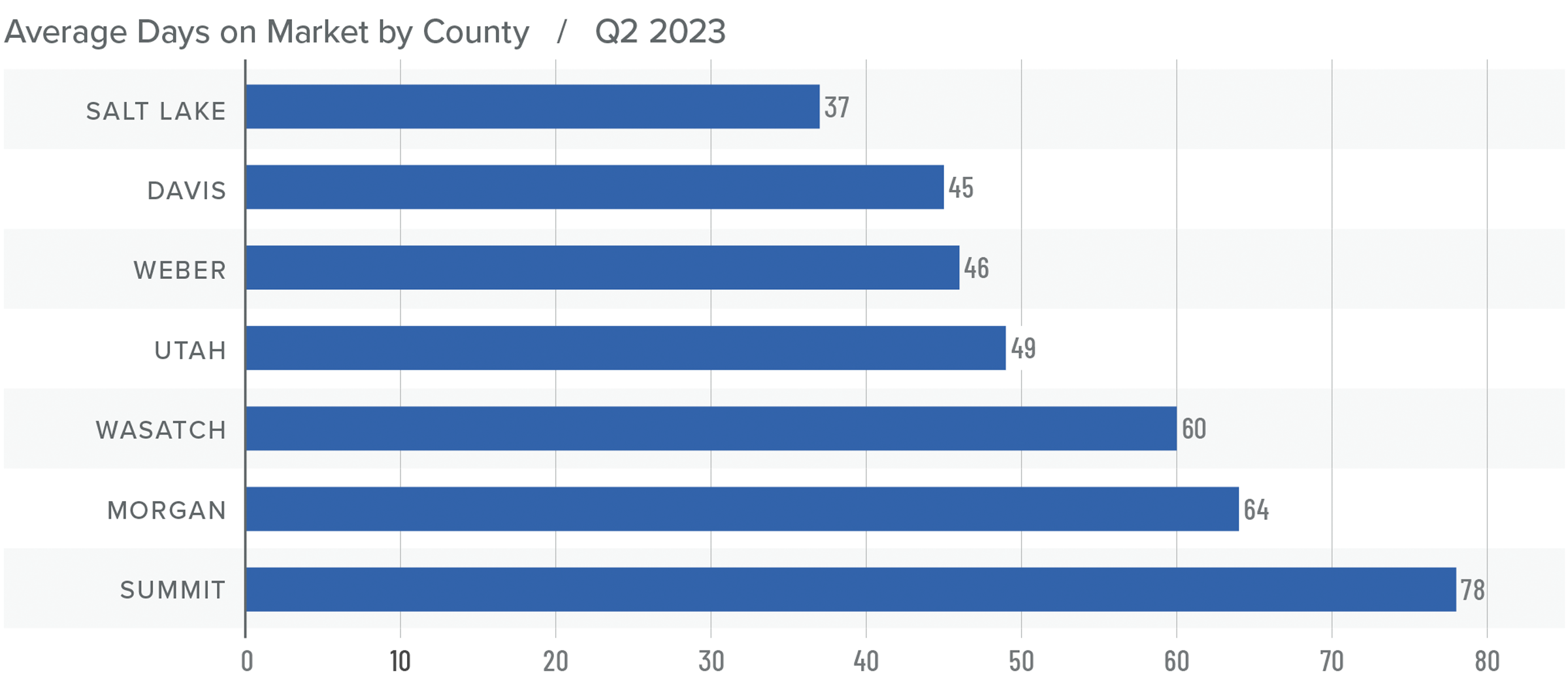
A bar graph showing the days on market by county for homes in Utah in Q2 2023. Salt Lake County had the lowest DOM at 37, while Summit had the highest at 78. Utah and Wasatch Counties were in the middle at around 50 days on market.

Conclusions

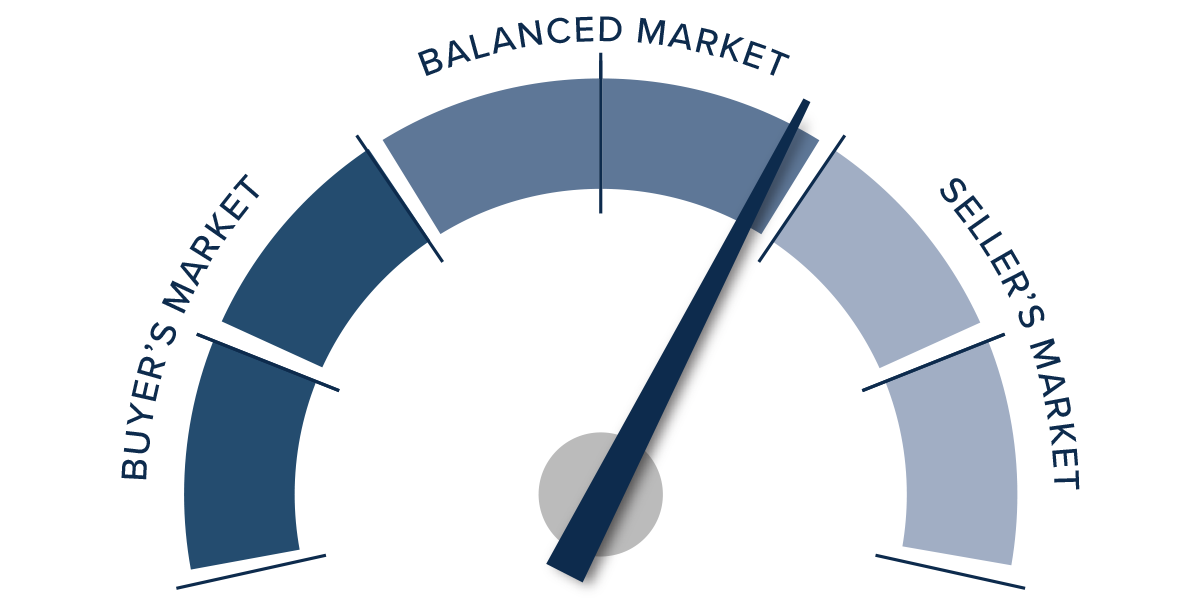
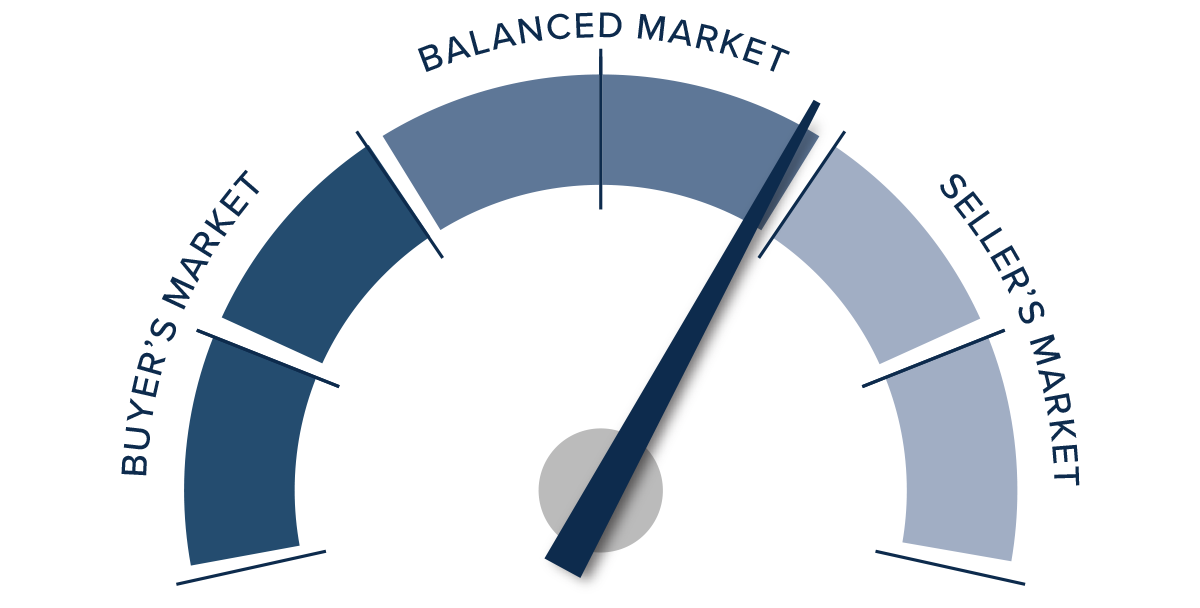
This speedometer reflects the state of the region’s real estate market using housing inventory, price gains, home sales, interest rates, and larger economic factors.

In the first quarter Gardner Report, I suggested that the region was “very close to bottoming out” in respect to price. It appears I underestimated the resilience of Utah’s housing market. Given all the data presented here, the only thing that favors buyers is that there are more homes for sale. That said, while inventory levels have risen, they remain remarkably low by historic standards. This doesn’t come as a surprise given that 87.6% of all homeowners with a mortgage have rates below 5% and 31.6% have rates at or below 3%. If they don’t have to sell, why would they?

A speedometer graph indicating a balanced market bordering on a seller's market in Utah for Q2 2023.

This will keep inventory tight. The only question that remains is how long the market can tolerate high mortgage rates and decreasing affordability. Given all the above factors, I have moved the needle a little more in favor of sellers. I can’t go so far as to suggest that sellers are in a totally dominant position, but they still have the upper hand.

About Matthew Gardner

Matthew Gardner - Chief Economist for Windermere Real Estate

As Chief Economist for Windermere Real Estate, Matthew Gardner is responsible for analyzing and interpreting economic data and its impact on the real estate market on both a local and national level. Matthew has over 30 years of professional experience both in the U.S. and U.K.

In addition to his day-to-day responsibilities, Matthew sits on the Washington State Governors Council of Economic Advisors; chairs the Board of Trustees at the Washington Center for Real Estate Research at the University of Washington; and is an Advisory Board Member at the Runstad Center for Real Estate Studies at the University of Washington where he also lectures in real estate economics.
Buying August 2, 2023

What Is a Pre-Listing Inspection?

A lot of information comes at you during the house hunting process. As you search for a home, you’ll likely come across the term “pre-listing inspection” here and there. It can be confusing, especially if you’re buying a home for the first time. So, what is this special report and why is it only found in certain listings? Let’s take a deep dive on the pre-listing inspection, how it factors into making an offer on a home and unravel why some sellers choose to conduct it.

What is a pre-listing inspection?

A seller’s pre-listing inspection is a report issued by the seller before listing their home for sale. A professional home inspector thoroughly examines the home, checking everything from the roof, foundation, and plumbing to its heating, cooling, and electrical systems to identify any repairs that need to be made or any larger issues that need addressing. During the more developed stages of a real estate transaction, you’ll have a professional home inspector perform an inspection to make sure you’re buying the home as advertised. With a pre-listing inspection, the seller is pre-empting this process. 

Pre-Listing Inspection Benefits

There are three main reasons why sellers conduct a pre-listing inspection: transparency, repairs, and pricing. It also helps to streamline the buying/selling process, especially in highly competitive markets. In these market conditions, it’s also more common for buyers to waive the inspection to sweeten their offer and get a leg up on the competition. Talk to your agent for more information.

  • By providing buyers with a clear picture of the home’s condition upfront, sellers are putting their cards on the table. This transparency helps to build trust with buyers interested in their home.
  • It’s also a way for sellers to identify outstanding repairs and make them before their home goes on the market. The seller can proceed through the selling process with a clear mind knowing they’ve already addressed the issues they found early on. Then, when it’s time for the buyer’s inspection, you can compare the results to make sure you have a full understanding of the home’s condition.
  • The findings of a pre-listing inspection also help to solidify the asking price the seller eventually sets; they either reaffirm its condition or show the areas where it’s lacking or needs attention. After you make an offer, the bank will order an appraisal of the property to make sure you’re paying a fair price.

For you, walking into the buying process with a pre-listing inspection in hand means you have intimate knowledge of the home’s condition right from the beginning, which will inform your strategy for making an offer. If the seller invested heavily in repairs, they may be less likely to budge on price. If there are several outstanding issues, that may be a negotiation opportunity for you and your agent.


A woman talks to a home inspector about a pre-listing inspection for her home.

Image Source: Getty Images – Image Credit: sturti


Who pays for home inspection?

The seller pays for the pre-listing inspection. You’ll want to conduct your own to see whether there are any discrepancies between the two. Even professional inspectors can miss something, so it’s worth it to double check their work. This inspection is just one of the costs of the home buying process, but it can save you from the significant costs of undetected repairs down the road. Besides, even in the short amount of time between the pre-listing inspection and when you make your offer, it’s entirely possible that something regarding the home’s condition changed. Getting your own inspection is crucial to gaining a crystal-clear understanding of the home before purchase.

So, should you trust a seller’s pre-listing inspection? Yes, but approach with caution. It shouldn’t necessarily be the final authority on the home’s condition, but it is mutually beneficial for both parties and allows you to make a better-informed decision on whether you want to move forward with your offer. Talk to your agent for guidance on how to navigate the home inspection process. For more information, visit our comprehensive guide to buying a home:


­­­­­­Featured Image Source: Getty Images – Image Credit: sturti

Market News August 2, 2023

Q2 2023 Montana Real Estate Market Update

The following analysis of select counties of the Montana real estate market is provided by Windermere Real Estate Chief Economist Matthew Gardner. We hope that this information may assist you with making better-informed real estate decisions. For further information about the housing market in your area, please don’t hesitate to contact your Windermere Real Estate agent.


Regional Economic Overview

Year over year, Montana added 7,100 jobs. This represents an annual growth rate of 1.4%, which is the slowest pace of growth the state has seen since pandemic influences started to come into play. Regionally, there were significant variations: Employment fell .7% in Billings while it rose 3.4% in Missoula. Montana’s unemployment rate in May was 2.3%, which was down from 2.6% during the same period in 2022 and may explain slowing job growth. The state has a significant labor shortage. In the metro areas covered in this report, the lowest jobless rate was in Billings at 2.2%, followed by Missoula at 2.3%, and Great Falls at 2.4%.

Montana Home Sales

In the first quarter of 2023, 1,518 homes sold in the counties covered by this report. This represents a 16.1% decline from the second quarter of 2022 but an increase of 58.6% compared to the first quarter of 2023.

Listing activity was 24.8% higher than in the second quarter of 2022 and 17.1% higher than in the first quarter of this year.

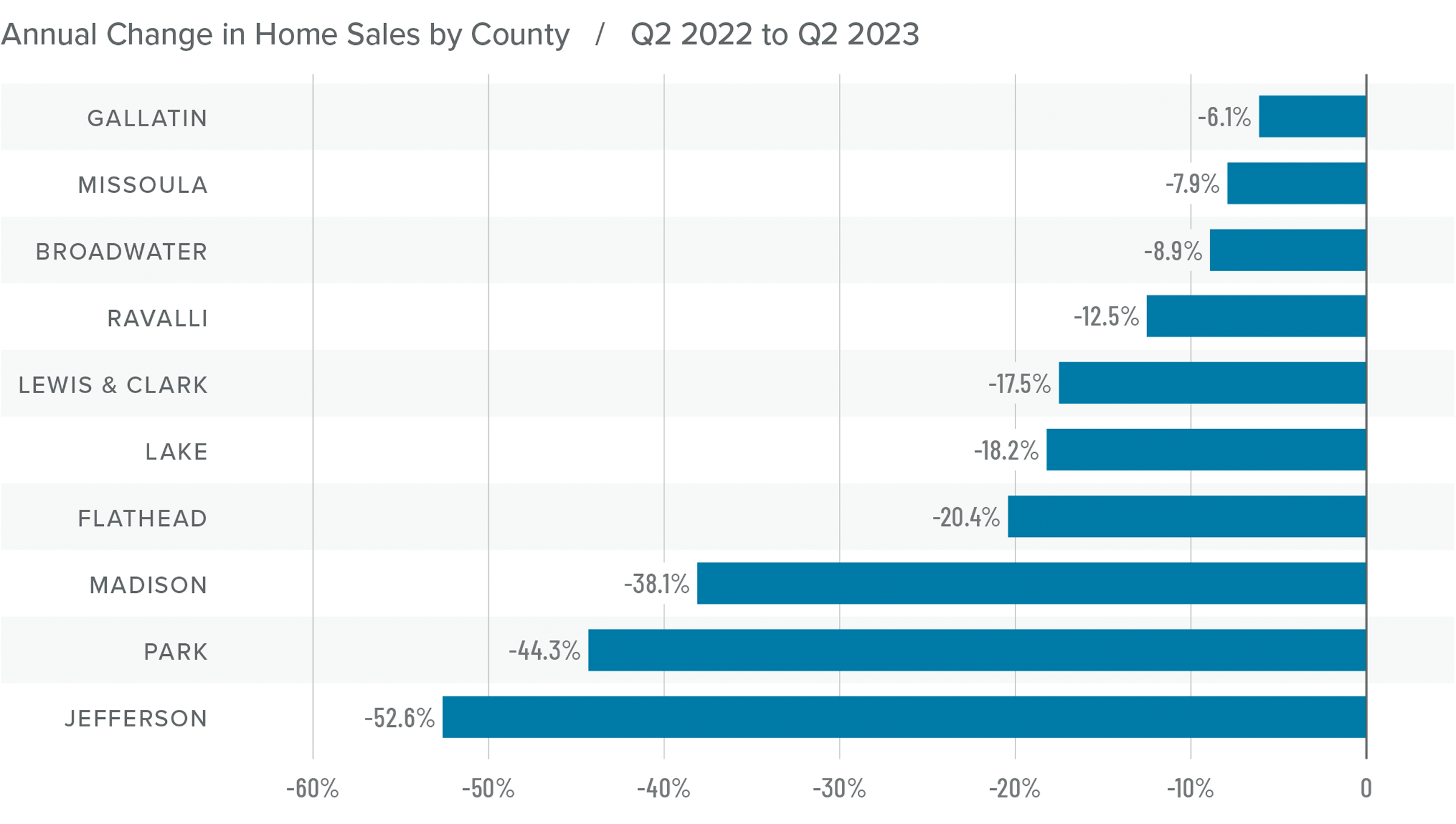
Sales fell across the board from the second quarter of 2022. Compared to the first quarter of this year, sales were up in every county other than Jefferson, which is prone to significant swings given that very few homes sell there.

Pending sales rose 15.4% quarter over quarter, suggesting that closings in the third quarter could show additional improvement.

A graph showing the annual change in home sales by county for Montana from Q2 2022 to Q2 2023. Gallatin had the least drastic change at -6.1%, while Jefferson had the largest change at -52.6%. Counties like Ravalli and Lake were in the middle at around -17%.

Montana Home Prices

Home prices were down 5% year over year, with an average sale price of $760,428. The average home price rose .1% compared to the first quarter of 2022.

I wasn’t surprised that home prices fell in most areas compared to the same period in 2022. A year ago home buyers were scrambling to buy before mortgage rates skyrocketed.

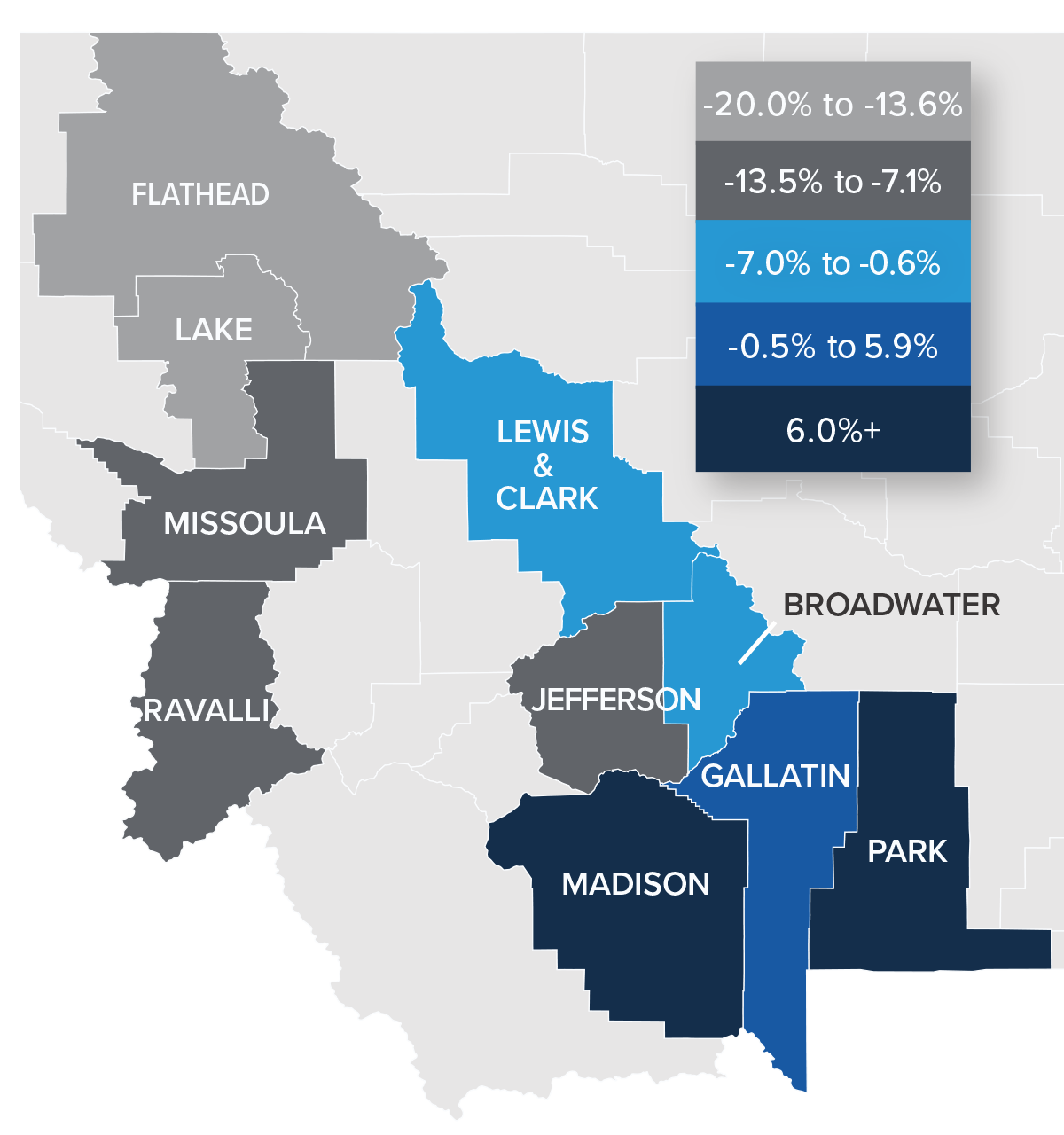
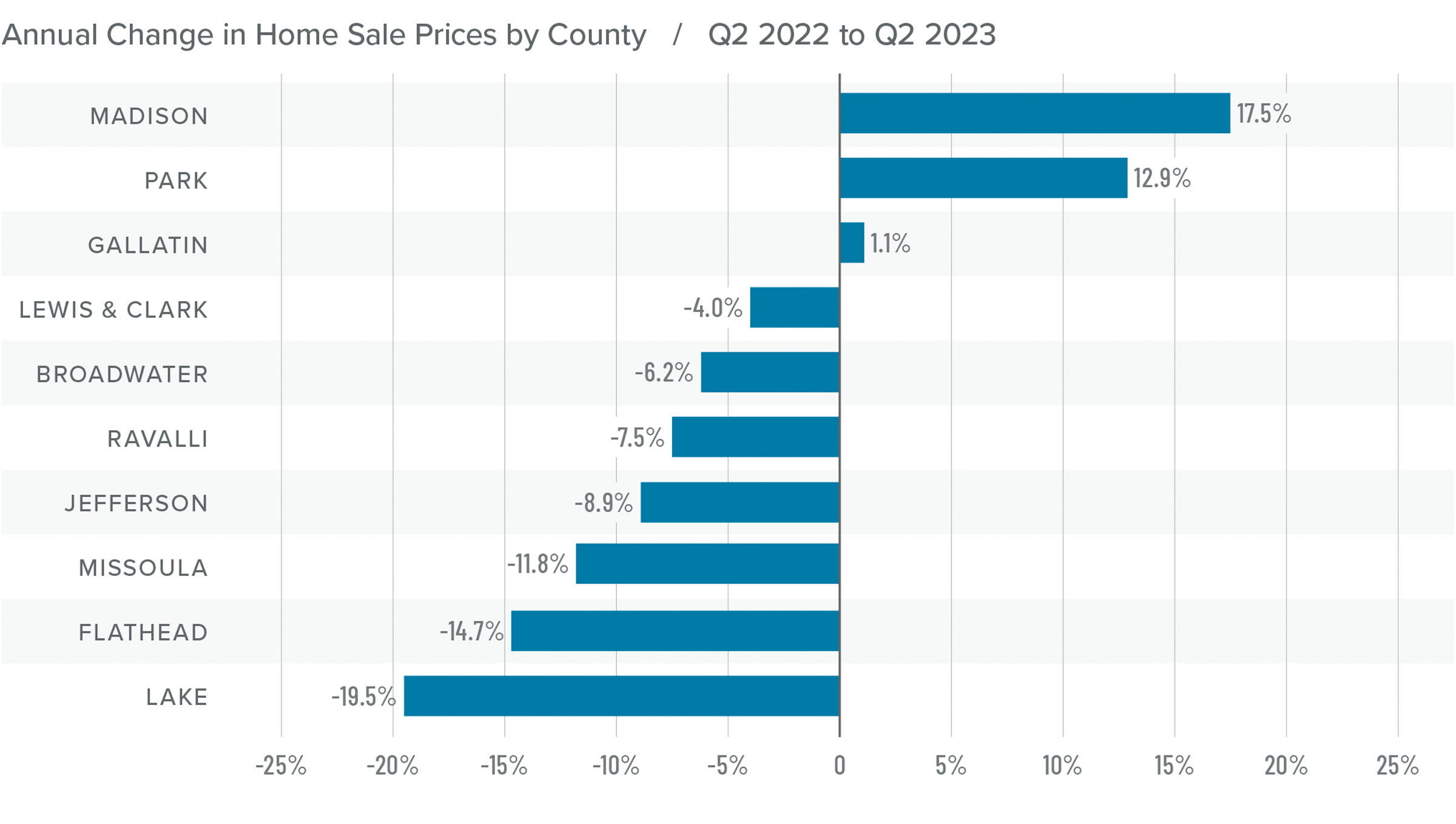
Year over year, prices rose in three counties and fell in seven. Compared to the first quarter of this year, every county other than Lake, Lewis & Clark, and Flathead saw prices rise.

Mortgage rates remain high, and it’s now likely they will remain higher for longer than anticipated. That will take some steam out of price growth in the second half of the year. This is also supported by lower median list prices than in the first quarter. Sellers seem to understand that higher borrowing costs are having an impact on buyers.

A map showing the real estate home prices percentage changes for various counties in Montana. Different colors correspond to different tiers of percentage change. Flathead and Lake had a percentage change in the -20% to -13.6% range. Missoula, Jefferson, and Ravalli were in the -13.5% to -7.1% change range. Lewis & Clark and Broadwater Counties are in the -7% to -0.6% change range. Gallatin was in the -0.5% to 5.9% change range. Madison and Park were in the 6%+ change range.

A bar graph showing the annual change in home sale prices by county in Montana from Q2 2022 to Q2 2023. Madison County tops the list at 17.5%, while Lake County had the greatest decline at -19.5%. Ravalli and Jefferson Counties were toward the middle at around -8%.

Mortgage Rates

Although they were less erratic than the first quarter, mortgage rates unfortunately trended higher and ended the quarter above 7%. This was due to the short debt ceiling impasse, as well as several economic datasets that suggested the U.S. economy was not slowing at the speed required by the Federal Reserve.

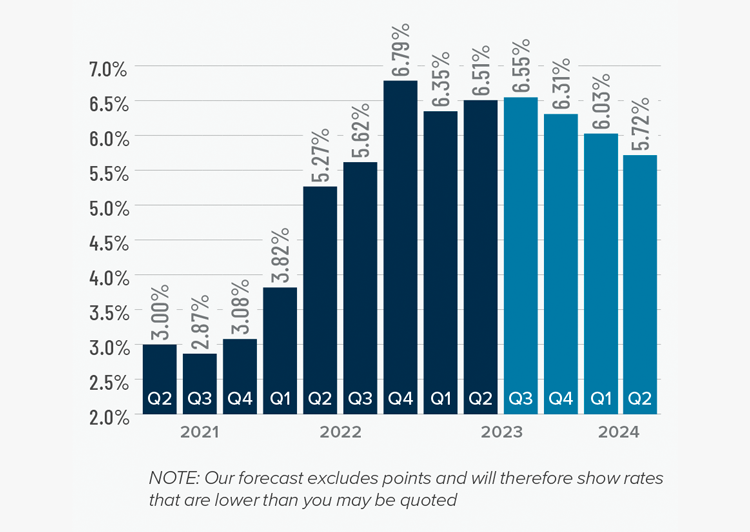
While the June employment report showed fewer jobs created than earlier in the year, as well as downward revisions to prior gains, inflation has not sufficiently slowed. Until it does, rates cannot start to trend consistently lower. With the economy not slowing as fast as expected, I have adjusted my forecast: Rates will hold at current levels in third quarter and then start to trend lower through the fall. Although there are sure to be occasional spikes, my model now shows the 30-year fixed rate breaking below 6% next spring.

A bar graph showing the mortgage rates from Q2 2021 to the present, as well as Matthew Gardner's forecasted mortgage rates through Q2 2024. After the 6.79% figure in Q4 2022, 6.35% in Q1 2023, and 6.51% in Q2 2023, he forecasts mortgage rates going to 6.55% in Q3 2023, 6.31% in Q4 2023, 6.03% in Q1 2024, and 5.72% in Q2 2024.

Montana Days on Market

The average time it took to sell a home rose 26 days compared to the same period in 2022.

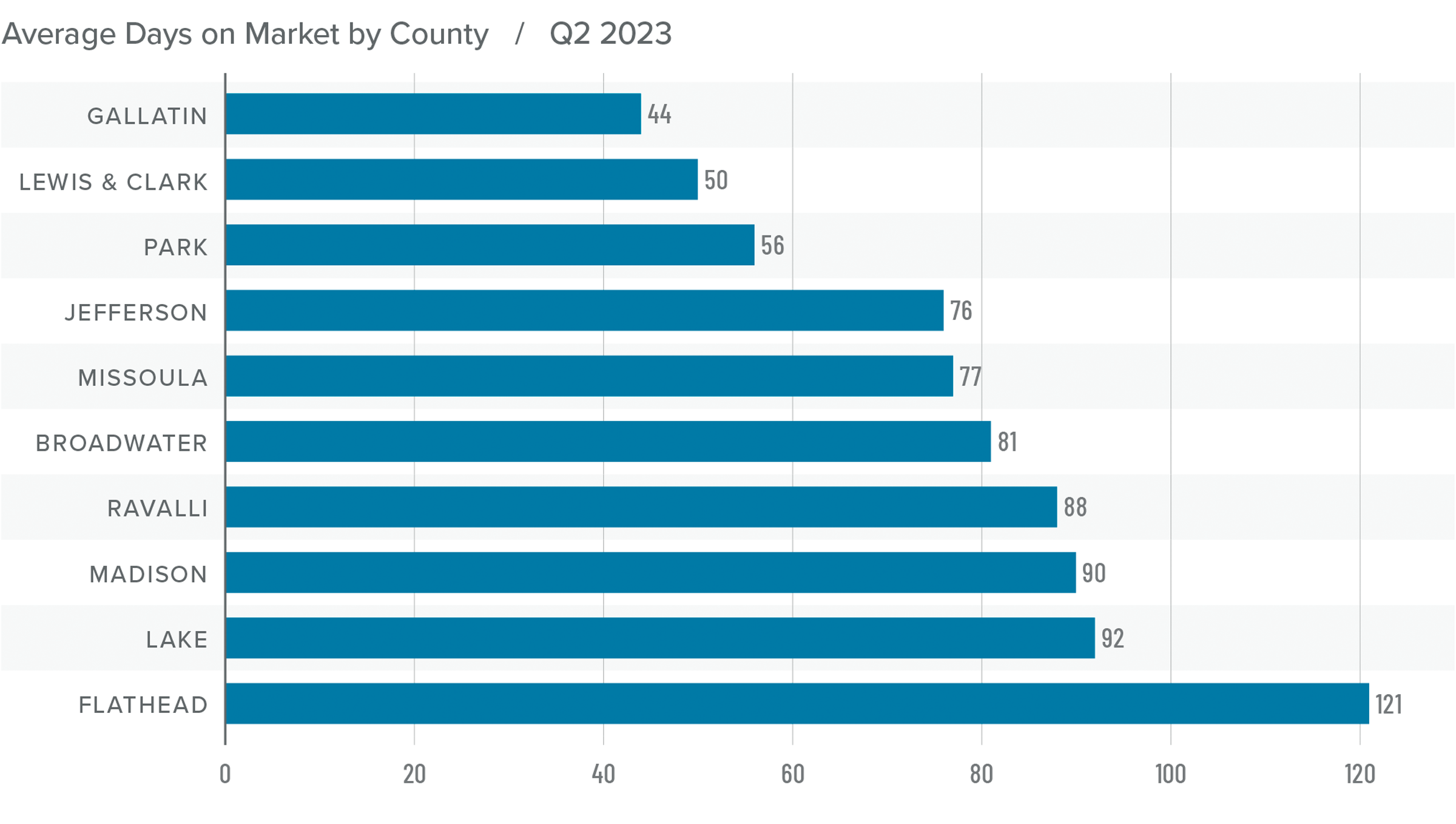
Homes sold fastest in Gallatin County while homes in Flathead County took the longest time to sell. Only Lewis & Clark County saw market time fall compared to the second quarter of 2022. Average market time rose in the rest of the region.

During the second quarter, it took an average of 77 days to sell a home in the markets covered by this report.

Compared to the first quarter of 2023, days on market fell in all counties other than Jefferson, where it took 20 more days for homes to sell.

A bar graph showing the days on market by county for homes in Montana in Q2 2023. Gallatin County had the lowest DOM at 44, while Flathead had the highest at 121. Missoula and Broadwater Counties were in the middle at around 80 days on market.

Conclusions

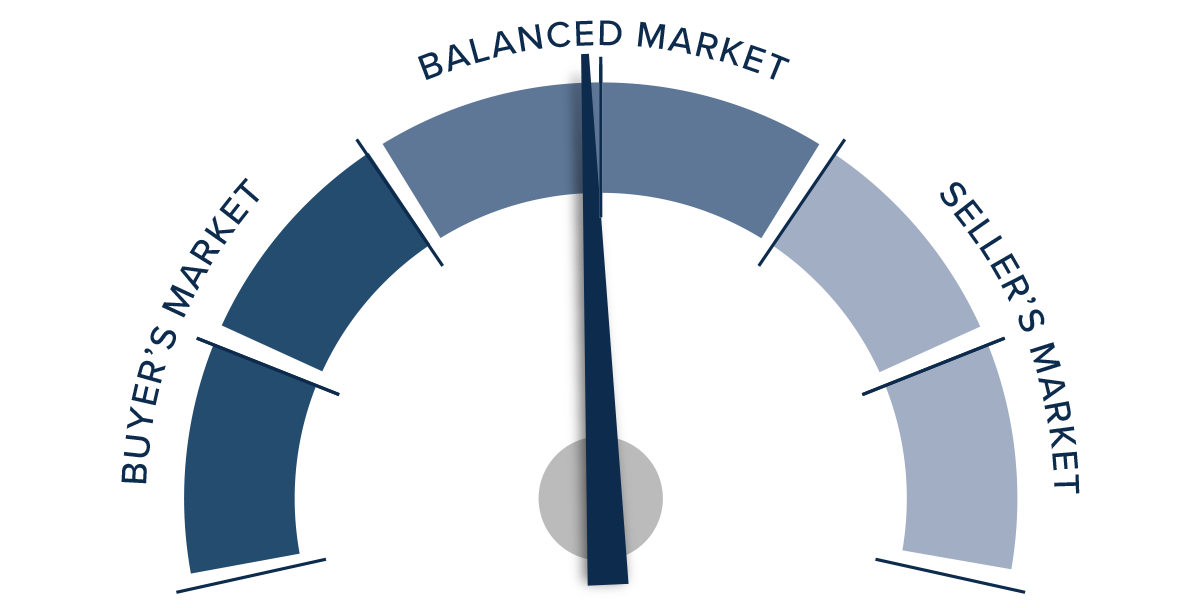
This speedometer reflects the state of the region’s real estate market using housing inventory, price gains, home sales, interest rates, and larger economic factors.

Market indicators are mixed right now. Sales activity increased and the length of time it took for homes to sell fell, which certainly should favor sellers. However, sales price growth was anemic, list prices are generally lower, and there is more inventory to choose from, which favors home buyers.

A speedometer graph indicating a balanced market in Montana for Q2 2023.

Having taken all these factors into consideration, I am leaving the needle inside the balanced quadrant. I am giving a bit of bias in favor of buyers, but the degree to which they have an advantage is minimal.

About Matthew Gardner

Matthew Gardner - Chief Economist for Windermere Real Estate

As Chief Economist for Windermere Real Estate, Matthew Gardner is responsible for analyzing and interpreting economic data and its impact on the real estate market on both a local and national level. Matthew has over 30 years of professional experience both in the U.S. and U.K.

In addition to his day-to-day responsibilities, Matthew sits on the Washington State Governors Council of Economic Advisors; chairs the Board of Trustees at the Washington Center for Real Estate Research at the University of Washington; and is an Advisory Board Member at the Runstad Center for Real Estate Studies at the University of Washington where he also lectures in real estate economics.
Market News August 2, 2023

Q2 2023 Idaho Real Estate Market Update

The following analysis of select counties of the Idaho real estate market is provided by Windermere Real Estate Chief Economist Matthew Gardner. We hope that this information may assist you with making better-informed real estate decisions. For further information about the housing market in your area, please don’t hesitate to contact your Windermere Real Estate agent.


Regional Economic Overview

Idaho’s annual pace of employment growth has started to slow. However, the addition of 25,400 new jobs over the past year represented an impressive 3.1% growth rate. All of Idaho’s metro areas except Lewiston saw solid year-over-year nonfarm job gains. Coeur d’Alene had the greatest increase at 3.9%, followed by Pocatello (+3.6%), Boise (+3.4%), Idaho Falls (3.2%), and Twin Falls (2%). Lewiston saw a very modest decline of 200 jobs, or .2%. The state unemployment rate was a healthy 2.6%, marginally above the 2.5% we saw at this time in 2022, but still the 13th lowest rate in the nation. The lowest regional jobless rate was in Lewiston and Idaho Falls at 2.6%. Boise’s rate was 2.8% and the highest rate was in Coeur d’Alene at 3.3%. Jobs continue to be added across the state. Even if the pace has cooled slightly, the economy appears to be solid. Although I expect the pace of job growth to continue to cool, I do not anticipate jobs to be shed this year, even as the national economy slows.

Idaho Home Sales

In the second quarter of 2023, 5,069 homes sold, which was down 16.1% from the second quarter of 2022. Sales were up 20.8% from the first quarter of this year.

Listing activity was marginally higher than in the second quarter of 2022, but jumped 24.6% from the first quarter of this year, which caused the pace of sales to rise significantly.

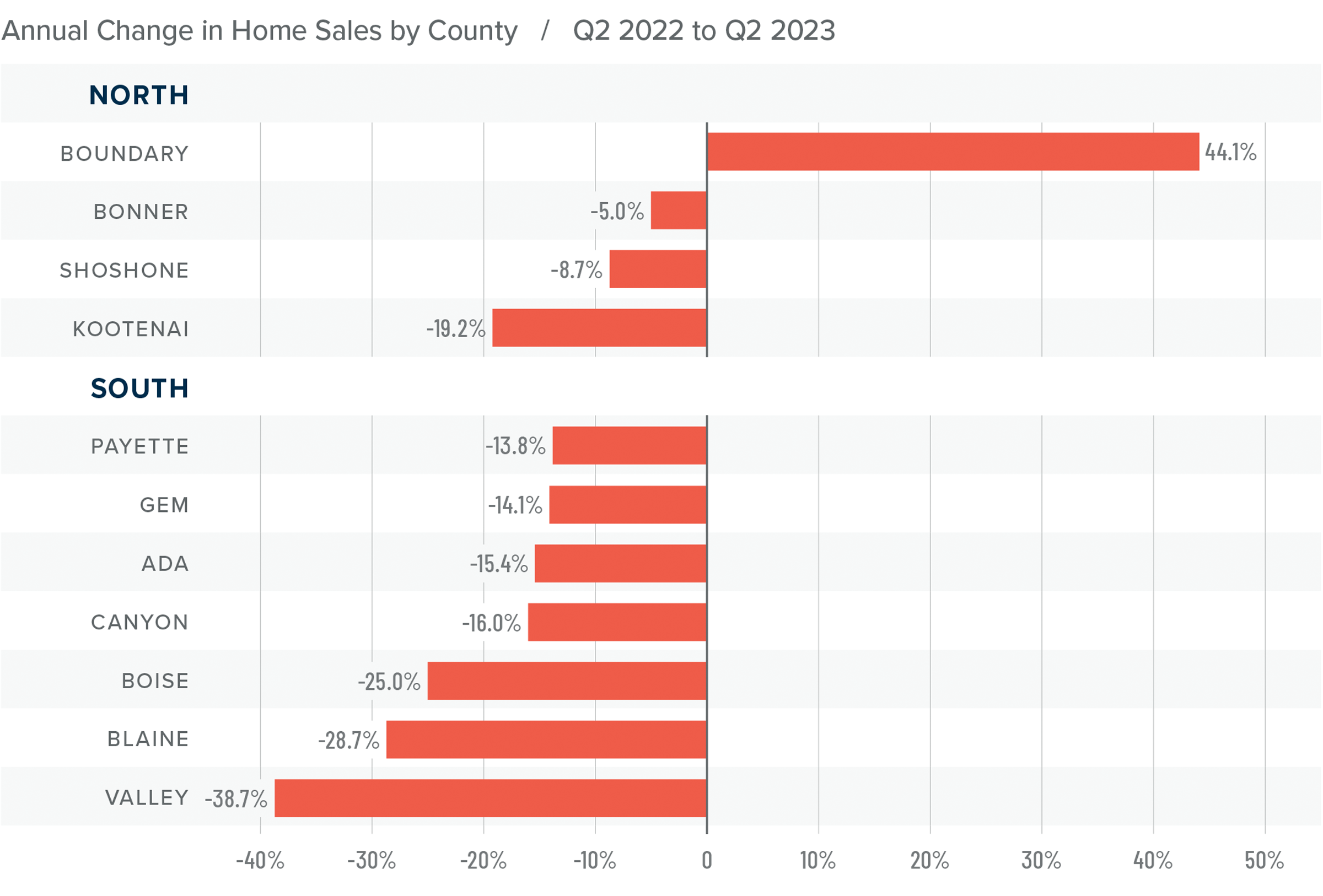
Compared to the same period a year ago, sales fell in every market other than Boundary County, but this is a small market that can be prone to extreme swings. Compared to the first quarter of this year, sales rose in all markets other than Valley County, where they fell by a modest 2.1%.

Pending sales were up 13% from the first quarter of the year, suggesting that sales may continue to rise in the upcoming quarter.

A graph showing the annual change in home sales by county for North and South Idaho from Q2 2022 to Q2 2023. Boundary County had the greatest positive change at 44.1%, while Valley had the largest negative change at -38.7%. Counties like Kootenai and Canyon were in the middle at around -18%.

Idaho Home Prices

The average home price in the region fell 7.9% year over year to $605,535. Sale prices were 5.7% higher than in the first quarter of 2023.

Compared to the first quarter of this year, home prices rose in all the Northern Idaho market areas and rose in every market other than Gem and Valley counties in Southern Idaho.

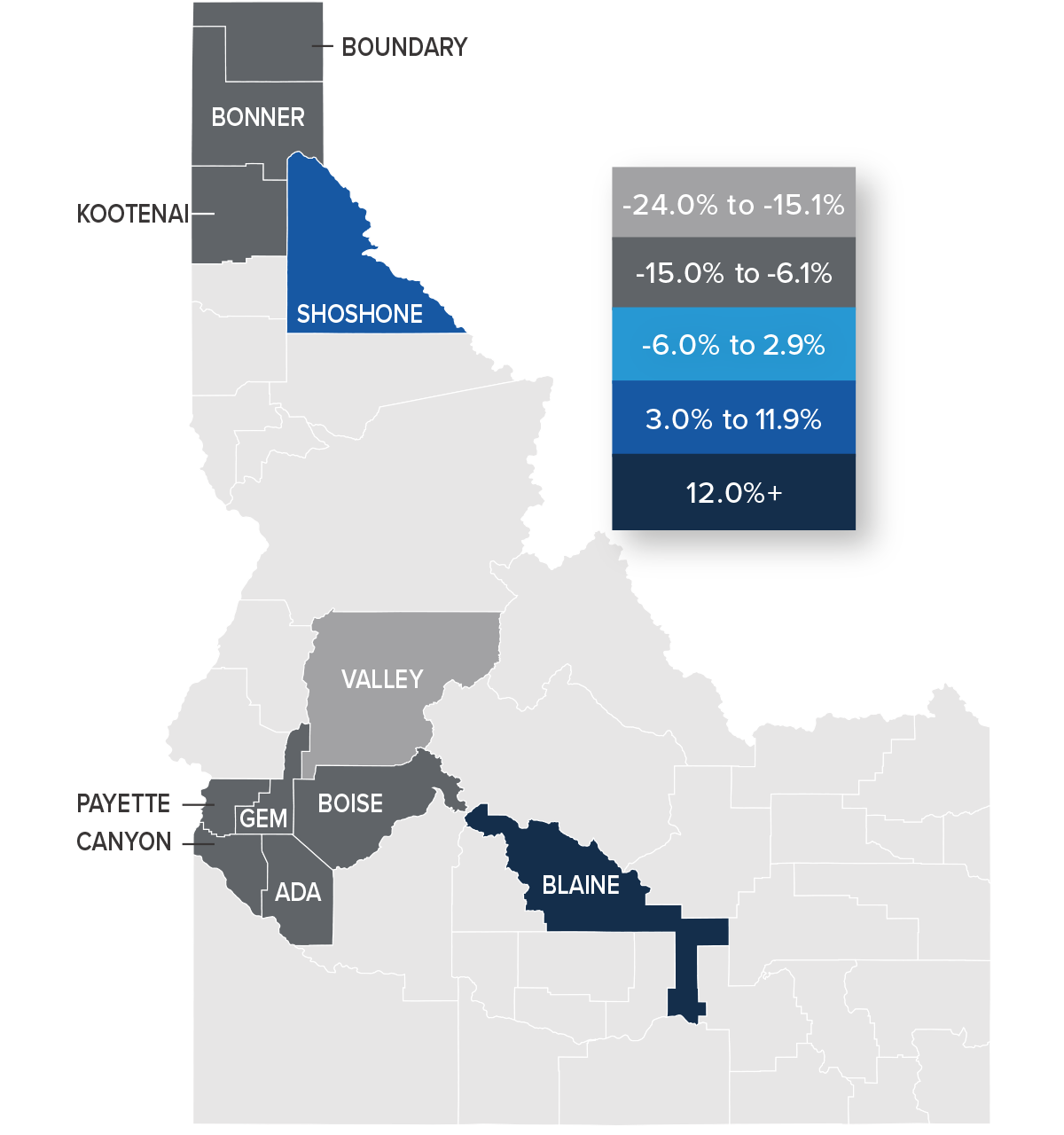
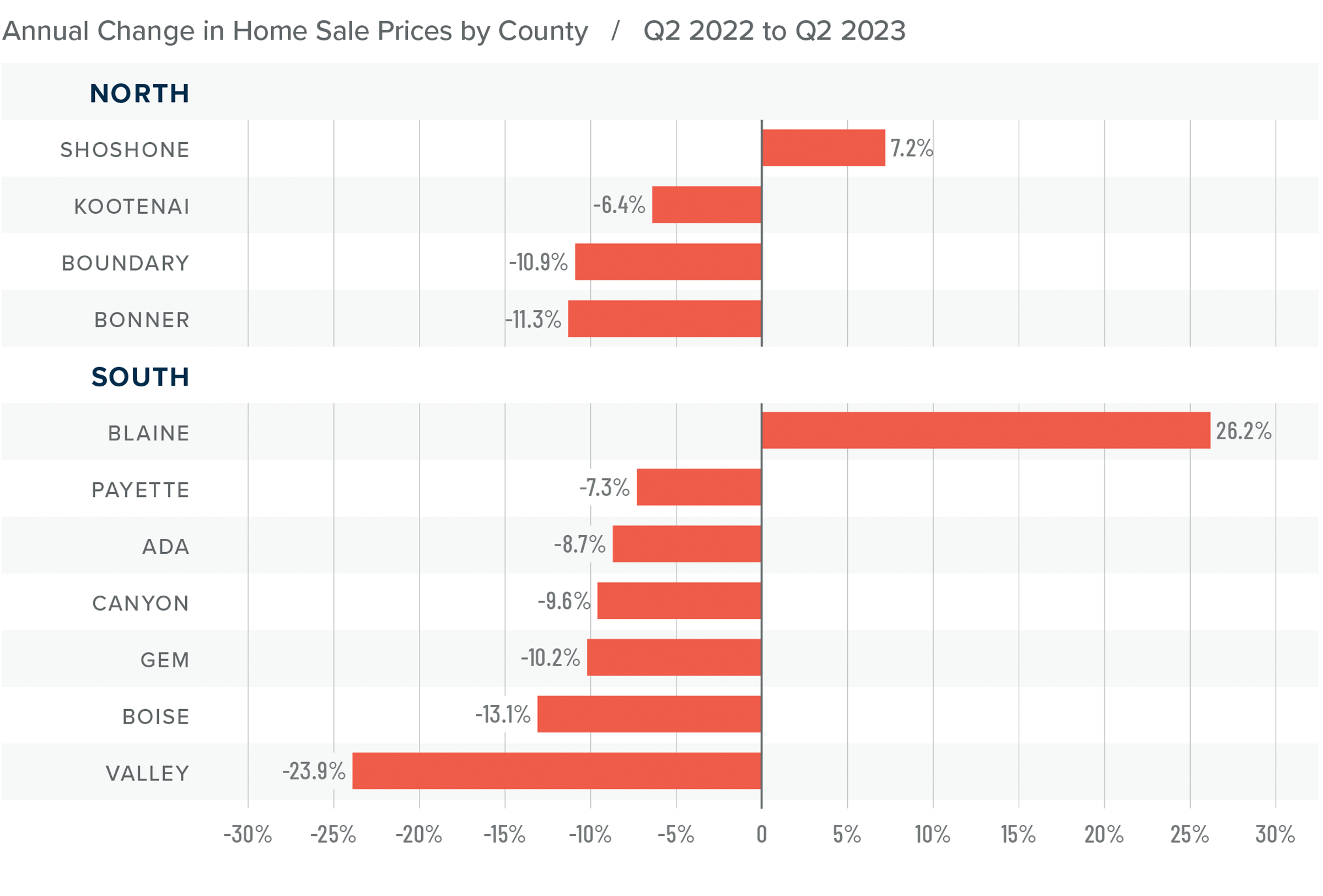
Only one county in each of the northern and southern market areas saw prices rise year over year, while the balance of the region had lower sale prices. Prices fell 8% in the south and 7.6% in the north compared to the second quarter of 2022.

Median list prices in the second quarter were down 2.9% from the first quarter. This may have contributed to the increase in sales and prices, as sellers are likely being more cognizant of the higher financing costs buyers are facing.

A map showing the real estate home prices percentage changes for various counties in North and South Idaho. Different colors correspond to different tiers of percentage change. Valley County had a percentage change in the -24% to -15.1% range. Boundary, Bonner, Kootenai, Boise, Gem, Payette, Canyon, and Ada were in the -15% to -6.1% change range. Shoshone was in the 3% to 11.9% change range. Blain was the only county in the 12%+ change range.

A bar graph showing the annual change in home sale prices by county in North and South Idaho from Q2 2022 to Q2 2023. Blaine County tops the list at 26.2%, while Valley County had the greatest decline at -23.9%. Boise and Bonner Counties were toward the middle at around -12%.

Mortgage Rates

Although they were less erratic than the first quarter, mortgage rates unfortunately trended higher and ended the quarter above 7%. This was due to the short debt ceiling impasse, as well as several economic datasets that suggested the U.S. economy was not slowing at the speed required by the Federal Reserve.

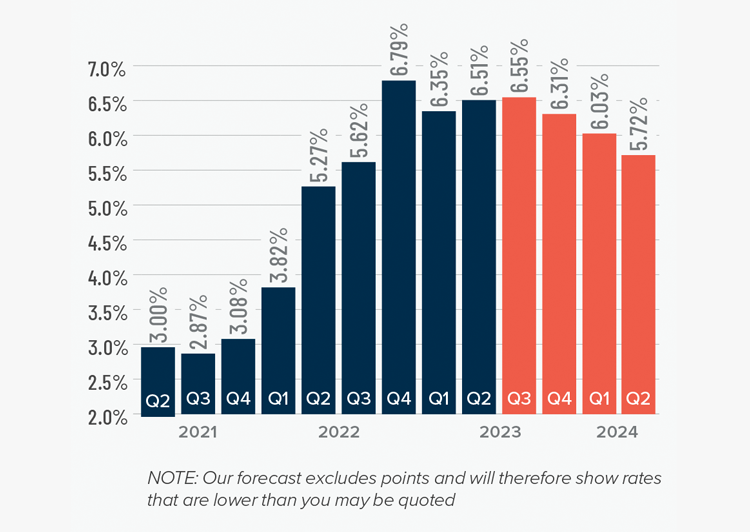
While the June employment report showed fewer jobs created than earlier in the year, as well as downward revisions to prior gains, inflation has not sufficiently slowed. Until it does, rates cannot start to trend consistently lower. With the economy not slowing as fast as expected, I have adjusted my forecast: Rates will hold at current levels in third quarter and then start to trend lower through the fall. Although there are sure to be occasional spikes, my model now shows the 30-year fixed rate breaking below 6% next spring.

A bar graph showing the mortgage rates from Q2 2021 to the present, as well as Matthew Gardner's forecasted mortgage rates through Q2 2024. After the 6.79% figure in Q4 2022, 6.35% in Q1 2023, and 6.51% in Q2 2023, he forecasts mortgage rates going to 6.55% in Q3 2023, 6.31% in Q4 2023, 6.03% in Q1 2024, and 5.72% in Q2 2024.

Idaho Days on Market

The average time it took to sell a home in the region rose 27 days compared to the same quarter of 2022. It took an average of 20 fewer days to find a buyer than in the first quarter of this year.

In all Northern and Southern Idaho counties, days on market rose compared to the same period in 2022. But compared to the first quarter of this year, market time fell in every county other than Valley.

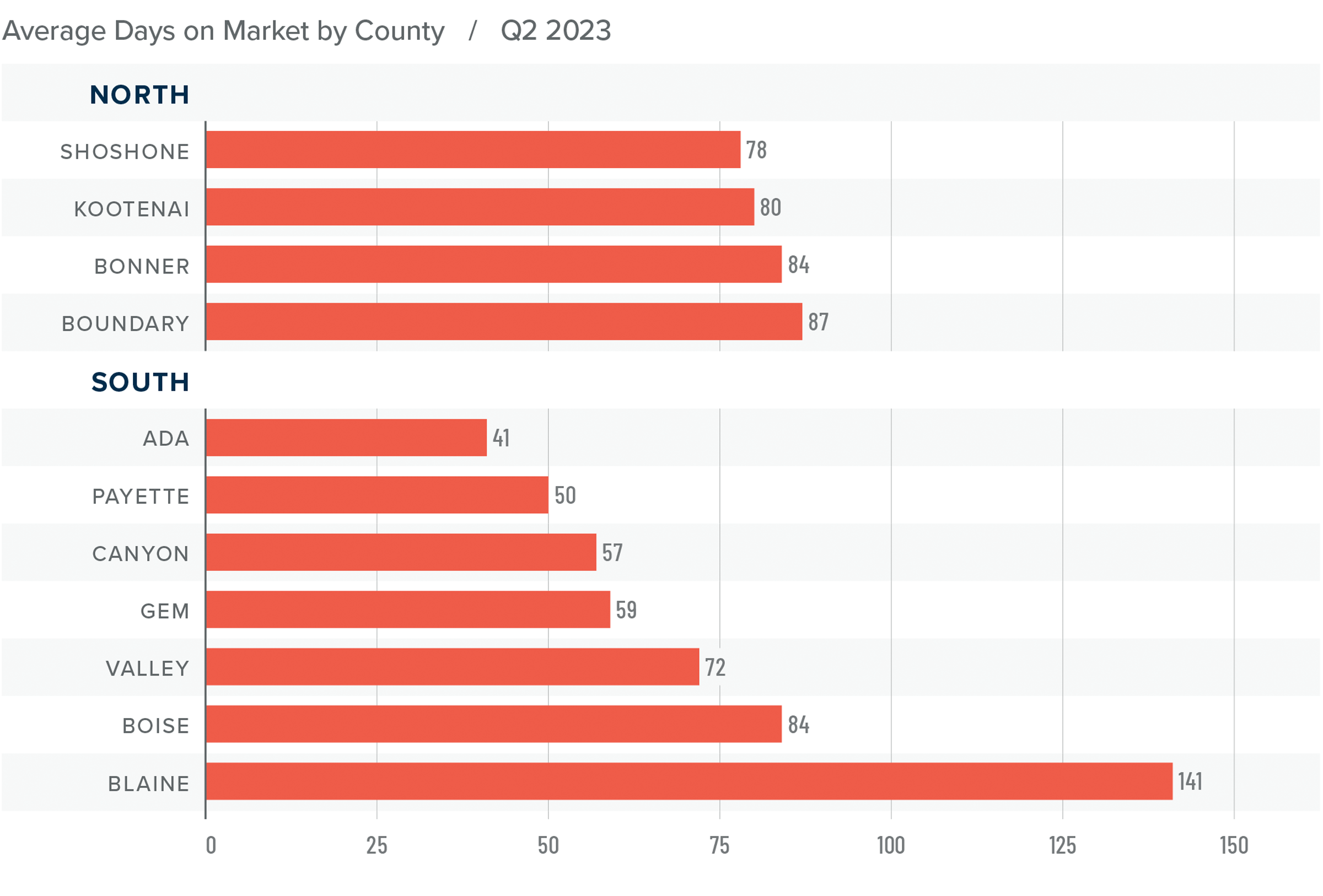
It took an average of 82 days to sell a home in Northern Idaho and 72 days in the southern counties covered by this report.

Homes sold the fastest in Ada County in the southern part of the state and in Shoshone County in Northern Idaho.

A bar graph showing the days on market by county for homes in North and South Idaho in Q2 2023. Ada County had the lowest DOM at 41, while Blaine had the highest at 141. Boise and Boundary Counties were in the middle at around 85 days on market.

Conclusions

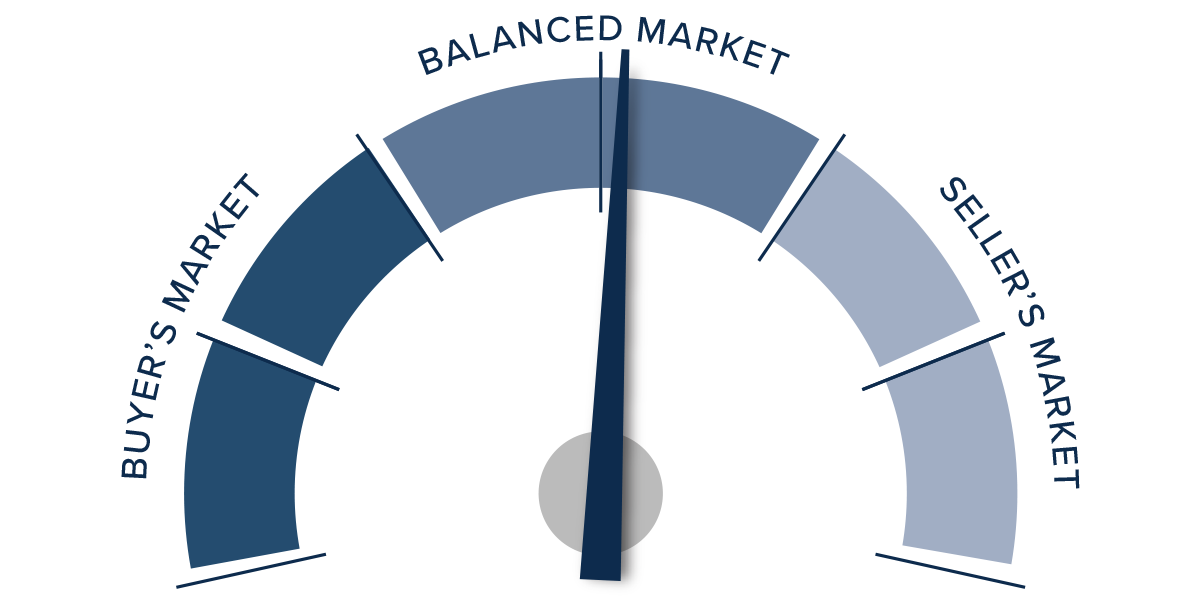
This speedometer reflects the state of the region’s real estate market using housing inventory, price gains, home sales, interest rates, and larger economic factors.

The housing market performed well in the second quarter, even as mortgage rates rose. It will be interesting to see what impact the rate increases in June and July may have on sales activity in the third quarter. Though list prices have not fallen much, the share of homes on the market that have undergone price cuts has increased. This is likely in response to rising mortgage rates. Rising inventory levels favor buyers. If sellers are starting to acknowledge that buyers are being stretched given current mortgage rates, that too works in their favor. That said, higher sales activity and home prices, and lower days on the market all favor sellers.

A speedometer graph indicating a balanced market barely leaning toward a seller's market in North and South Idaho for Q2 2023.

Since there are components of the market that favor both sides, I am leaving the needle in the balanced quadrant, albeit modestly favoring home sellers.

About Matthew Gardner

Matthew Gardner - Chief Economist for Windermere Real Estate

As Chief Economist for Windermere Real Estate, Matthew Gardner is responsible for analyzing and interpreting economic data and its impact on the real estate market on both a local and national level. Matthew has over 30 years of professional experience both in the U.S. and U.K.

In addition to his day-to-day responsibilities, Matthew sits on the Washington State Governors Council of Economic Advisors; chairs the Board of Trustees at the Washington Center for Real Estate Research at the University of Washington; and is an Advisory Board Member at the Runstad Center for Real Estate Studies at the University of Washington where he also lectures in real estate economics.
Market News August 1, 2023

Q2 2023 Central Washington Real Estate Market Update

The following analysis of select counties of the Central Washington real estate market is provided by Windermere Real Estate Chief Economist Matthew Gardner. We hope that this information may assist you with making better-informed real estate decisions. For further information about the housing market in your area, please don’t hesitate to contact your Windermere Real Estate agent.


Regional Economic Overview

The Central Washington region added 4,449 jobs over the past 12 months, representing a decent 2.4% growth rate. At the county level, Chelan County had solid gains, with a growth rate of 5.5%. Douglas and Okanogan counties saw employment levels rise 3.1%, and Yakima County expanded its employment base by 1.4%. Only Kittitas County lost jobs year over year, with a reduction of 1.4%. The seasonally adjusted unemployment rate in Central Washington was 4.9%, down from 5.4% during the same quarter in 2022. The lowest unemployment rate was in Douglas County, where it was 3.2%. The region’s highest jobless rate was in Yakima County, where 6.3% of the labor force was without work.

Central Washington Home Sales

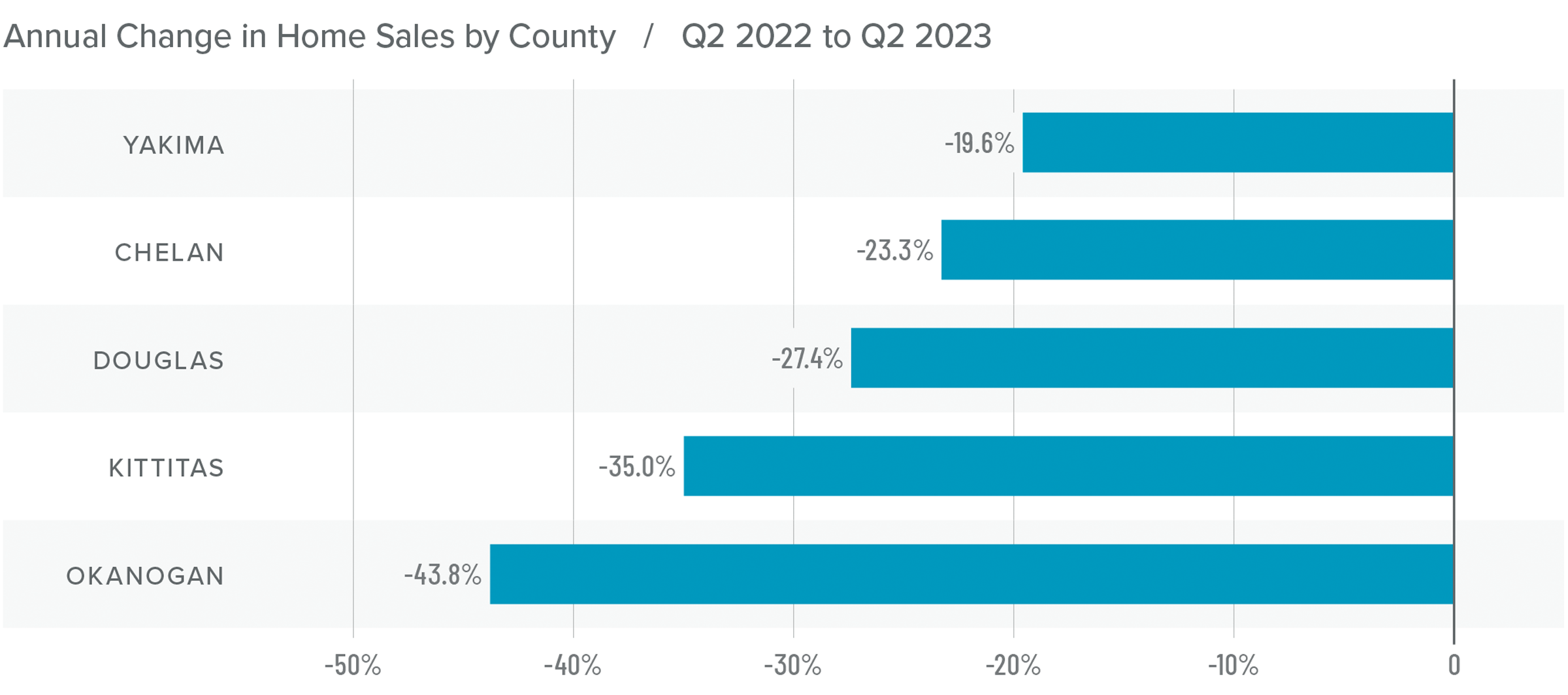
There were 1,007 home sales in Central Washington in the second quarter of 2023, representing a decline of 26.6% from the same quarter in 2022. Sales activity rose 63.5% from the first quarter of this year.

Pending sales, which are an indicator of future closings, rose 48% compared to the first quarter of the year, suggesting that market momentum will likely continue through the summer.

Year over year, sales fell significantly across the board. But the number of homes sold was up across the board compared to the first quarter.

Inventory levels were modestly higher than the second quarter of 2022. However, the number of listings fell from the first quarter. Although this may sound impossible given the increase in sales, sometimes homes sell so quickly they’re not measured in the monthly data, which only looks at the number of homes available on the last day of the month.

A graph showing the annual change in home sales by county for Central Washington from Q2 2022 to Q2 2023. Yakima had the least drastic change at -19.6%, while Okanogan had the largest change at -43.8%. Counties like Chelan and Douglas were in the middle at around -25%.

Central Washington Home Prices

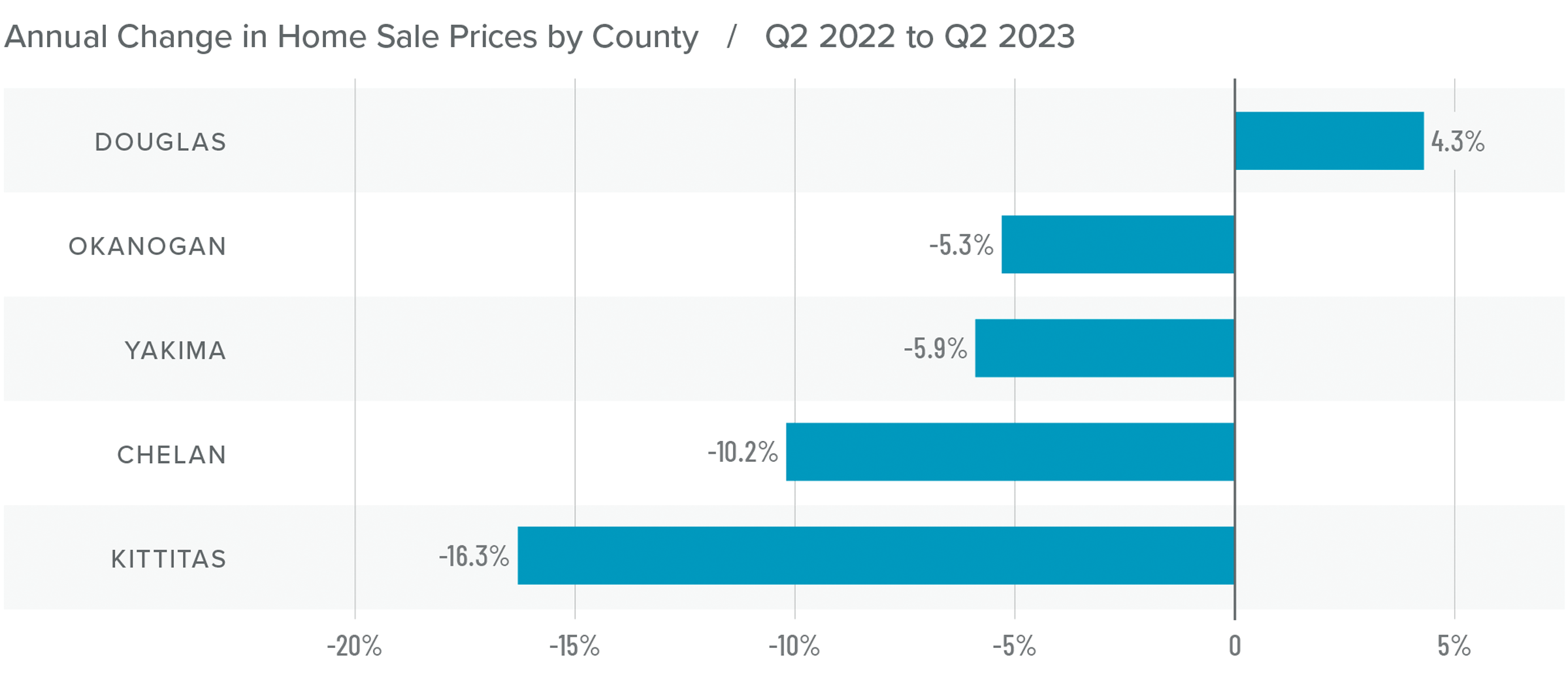
The average home price in Central Washington fell 9.7% year over year to $479,411, but sale prices were 4% higher than in the first quarter of this year.

Median list prices rose in all counties except Yakima compared to the first quarter of the year, suggesting that home sellers are quite bullish about the prospects of successfully finding a buyer even as mortgage rates remain high.

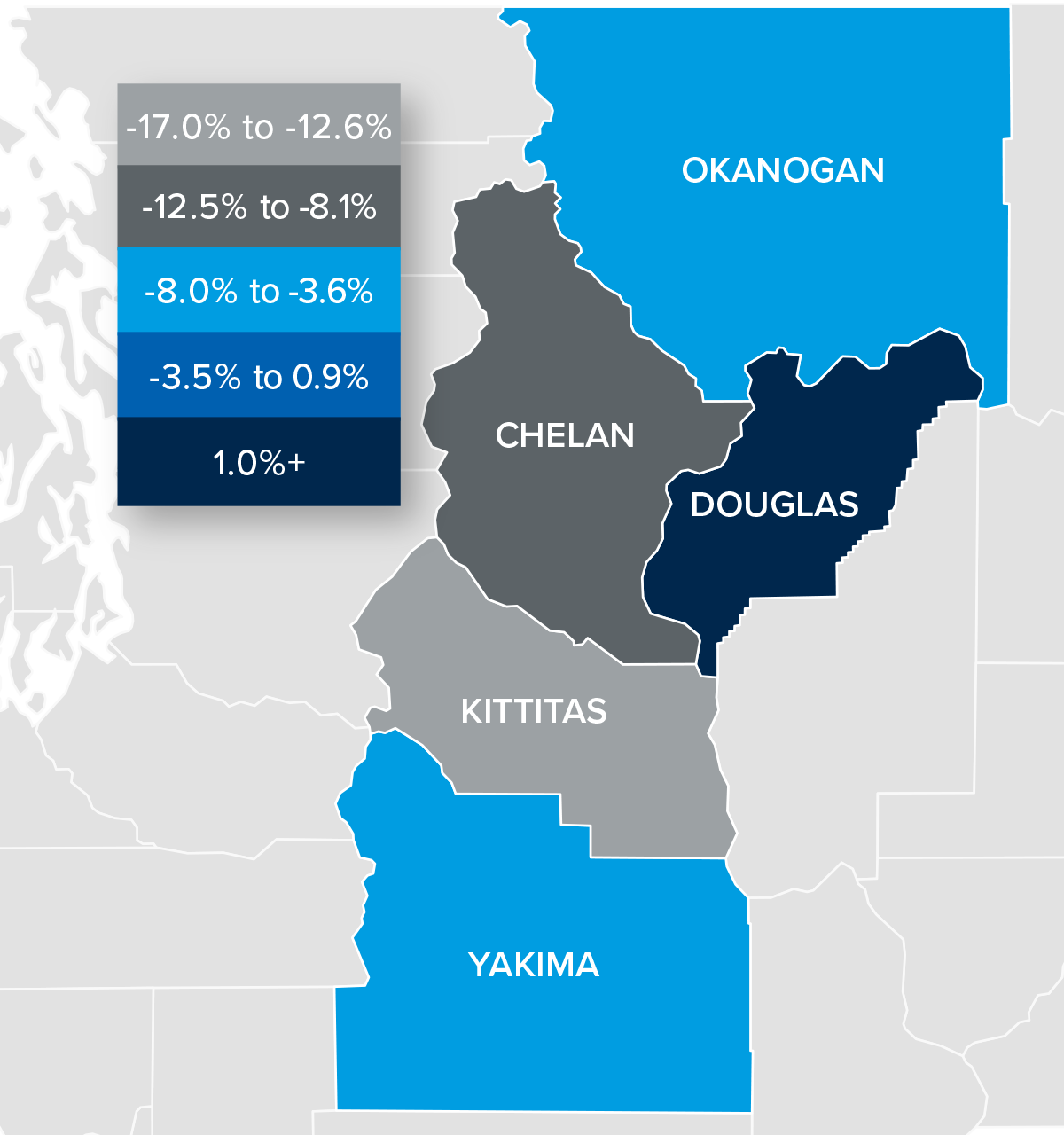
All counties except Douglas saw sale prices fall from the second quarter of 2022. Compared to the first quarter of this year, prices rose across all counties other than Kittitas.

The second quarter experienced a positive turnaround from the first, when sales and prices were still falling. In last quarter’s report, I suggested that the market would return to stability this summer, but it appears to be happening faster than I anticipated.

A map showing the real estate home prices percentage changes for various counties in Central Washington. Different colors correspond to different tiers of percentage change. Kittitas County had a percentage change in the -17% to -12.6% range. Chelan was in the -12.5% to -8.1% change range. Yakima and Okanogan Counties are in the -8% to -3.6% change range. Douglas is in the 1%+ change range.

A bar graph showing the annual change in home sale prices by county in Central Washington from Q2 2022 to Q2 2023. Douglas County tops the list at 4.3%, while Kittitas County had the greatest decline at -16.3%. Okanogan and Yakima Counties are toward the middle at around -5%.

Mortgage Rates

Although they were less erratic than the first quarter, mortgage rates unfortunately trended higher and ended the quarter above 7%. This was due to the short debt ceiling impasse, as well as several economic datasets that suggested the U.S. economy was not slowing at the speed required by the Federal Reserve.

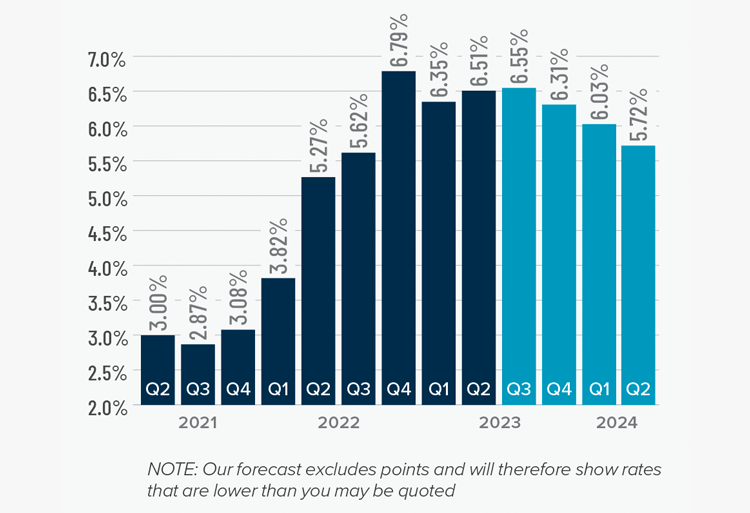
While the June employment report showed fewer jobs created than earlier in the year, as well as downward revisions to prior gains, inflation has not sufficiently slowed. Until it does, rates cannot start to trend consistently lower. With the economy not slowing as fast as expected, I have adjusted my forecast: Rates will hold at current levels in third quarter and then start to trend lower through the fall. Although there are sure to be occasional spikes, my model now shows the 30-year fixed rate breaking below 6% next spring.

A bar graph showing the mortgage rates from Q2 2021 to the present, as well as Matthew Gardner's forecasted mortgage rates through Q2 2024. After the 6.79% figure in Q4 2022, 6.35% in Q1 2023, and 6.51% in Q2 2023, he forecasts mortgage rates going to 6.55% in Q3 2023, 6.31% in Q4 2023, 6.03% in Q1 2024, and 5.72% in Q2 2024.

Central Washington Days on Market

The average time it took to sell a home in Central Washington in the second quarter of 2023 was 53 days.

It took 22 more days to sell a home in Central Washington than it did during the second quarter of 2022.

Year over year, average market time rose in all counties, but it fell across the board compared to the first quarter of this year.

On average, it took 18 fewer days to sell a home in the second quarter of 2023 than it did in the first.

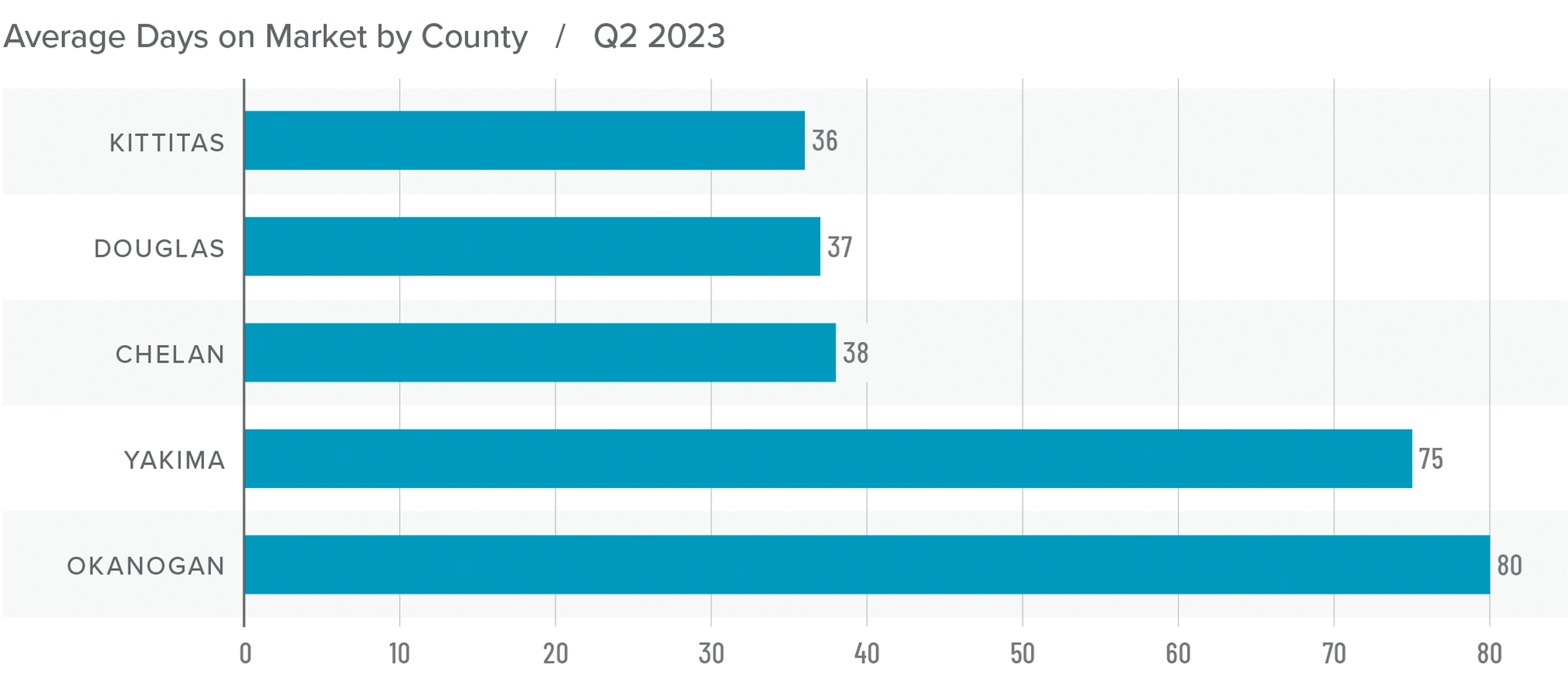
A bar graph showing the days on market by county for homes in Central Washington in Q2 2023. Kittitas County had the lowest DOM at 36, while Okanogan had the highest at 80. Douglas and Yakima Counties were in the middle at around 40 days on market.

Conclusions

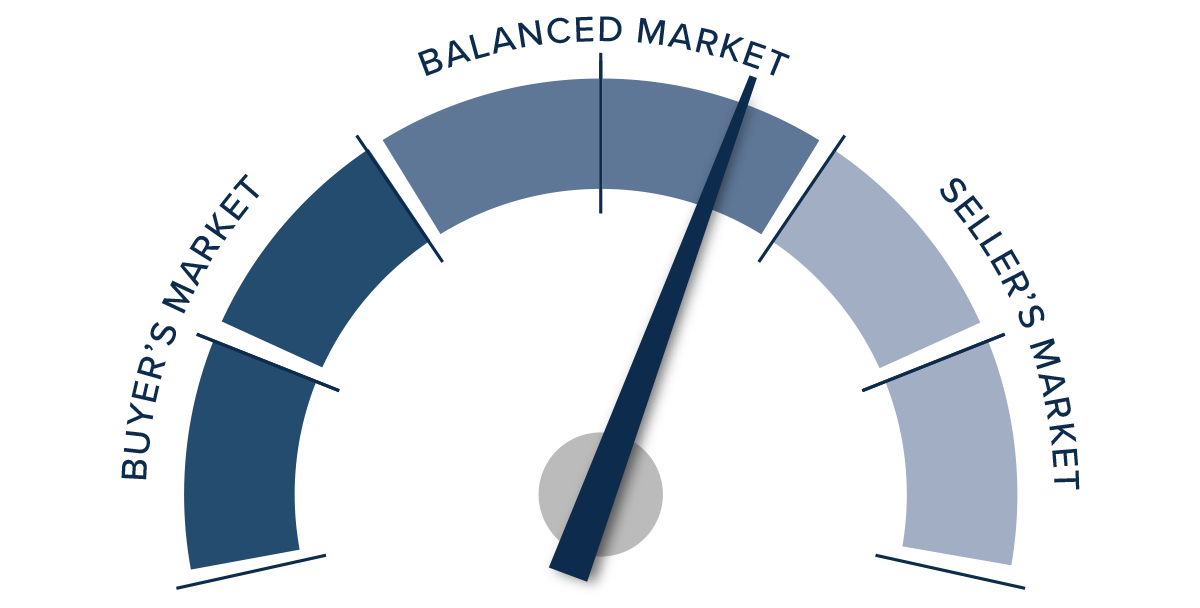
This speedometer reflects the state of the region’s real estate market using housing inventory, price gains, home sales, interest rates, and larger economic factors.

Data for the quarter appears to favor home sellers, with tight inventory levels, rising prices and sales, and shorter market time. What is particularly interesting is that the market appears bullish in the face of financing costs that remain well above the levels buyers have become used to.

A speedometer graph indicating a balanced market leaning toward a seller's market in Central Washington for Q2 2023.

Last quarter, I chose to leave the needle in the balanced quadrant but tilted ever so slightly toward buyers. However, given all the data in this report, I must swing the needle more in favor of sellers. I am not saying it is staunchly a seller’s market given where mortgage rates are today, but they certainly appear to have the upper hand at the moment.

About Matthew Gardner

Matthew Gardner - Chief Economist for Windermere Real Estate

As Chief Economist for Windermere Real Estate, Matthew Gardner is responsible for analyzing and interpreting economic data and its impact on the real estate market on both a local and national level. Matthew has over 30 years of professional experience both in the U.S. and U.K.

In addition to his day-to-day responsibilities, Matthew sits on the Washington State Governors Council of Economic Advisors; chairs the Board of Trustees at the Washington Center for Real Estate Research at the University of Washington; and is an Advisory Board Member at the Runstad Center for Real Estate Studies at the University of Washington where he also lectures in real estate economics.
Market News August 1, 2023

Q2 2023 Eastern Washington Real Estate Market Update

The following analysis of select counties of the Eastern Washington real estate market is provided by Windermere Real Estate Chief Economist Matthew Gardner. We hope that this information may assist you with making better-informed real estate decisions. For further information about the housing market in your area, please don’t hesitate to contact your Windermere Real Estate agent.


Regional Economic Overview

Year over year, total employment in Eastern Washington rose by 11,368 jobs, with most markets seeing decent gains. On a percentage basis, the fastest growing market was Lincoln County, where employment rose 4.2%. This was followed by Benton (+3.9%) and Spokane (+2.8%) counties. Franklin and Grant counties had modest job gains, while 185 jobs were lost in Whitman County. In total, the region’s employment base rose 2.4% from the second quarter in 2022. Unadjusted for seasonality, the regional unemployment rate was 3.2%, down from 4.5% during the second quarter of 2022. The seasonally adjusted jobless rate was 3.4%, down from 4.8% during the same period in 2022.

Eastern Washington Home Sales

In the second quarter of 2023, 2,531 homes sold. This was 28.6% lower than in the second quarter of 2022, but 44.3% higher compared to the first quarter of 2023.

It is likely that the rise in sales can be attributed to the 41.9% increase in the number of homes for sale in the quarter.

Year over year, sales fell across the region, but they were up in every county covered by this report compared to the first quarter.

Pending sales also rose by 31.4%, which suggests that the increase in the number of sales in the second quarter could carry over into the second half of the year.

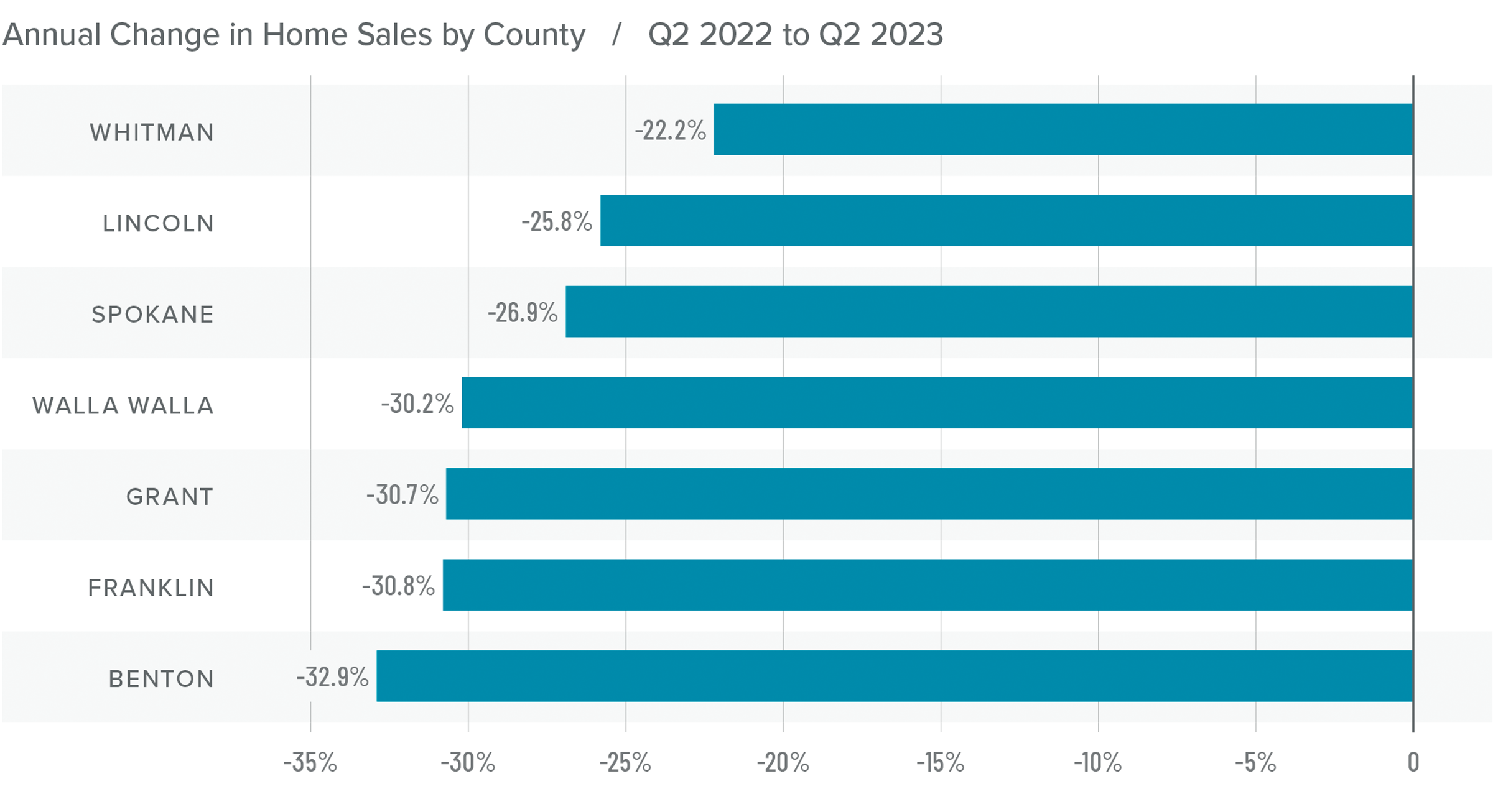
A graph showing the annual change in home sales by county for Eastern Washington from Q2 2022 to Q2 2023. Whitman had the least drastic change at -22.2%, while Benton had the largest change at -32.9%. Counties like Spokane and Walla Walla were in the middle at around -30%.

Eastern Washington Home Prices

Year over year, the average home price in Eastern Washington fell 5.1% to $450,474. Prices rose 9.9% compared to the first quarter of this year.

Compared to the first quarter, prices rose across the board even as median list prices increased by 8.5%. It appears that sales contractions are now in the rearview mirror, at least for the time being.

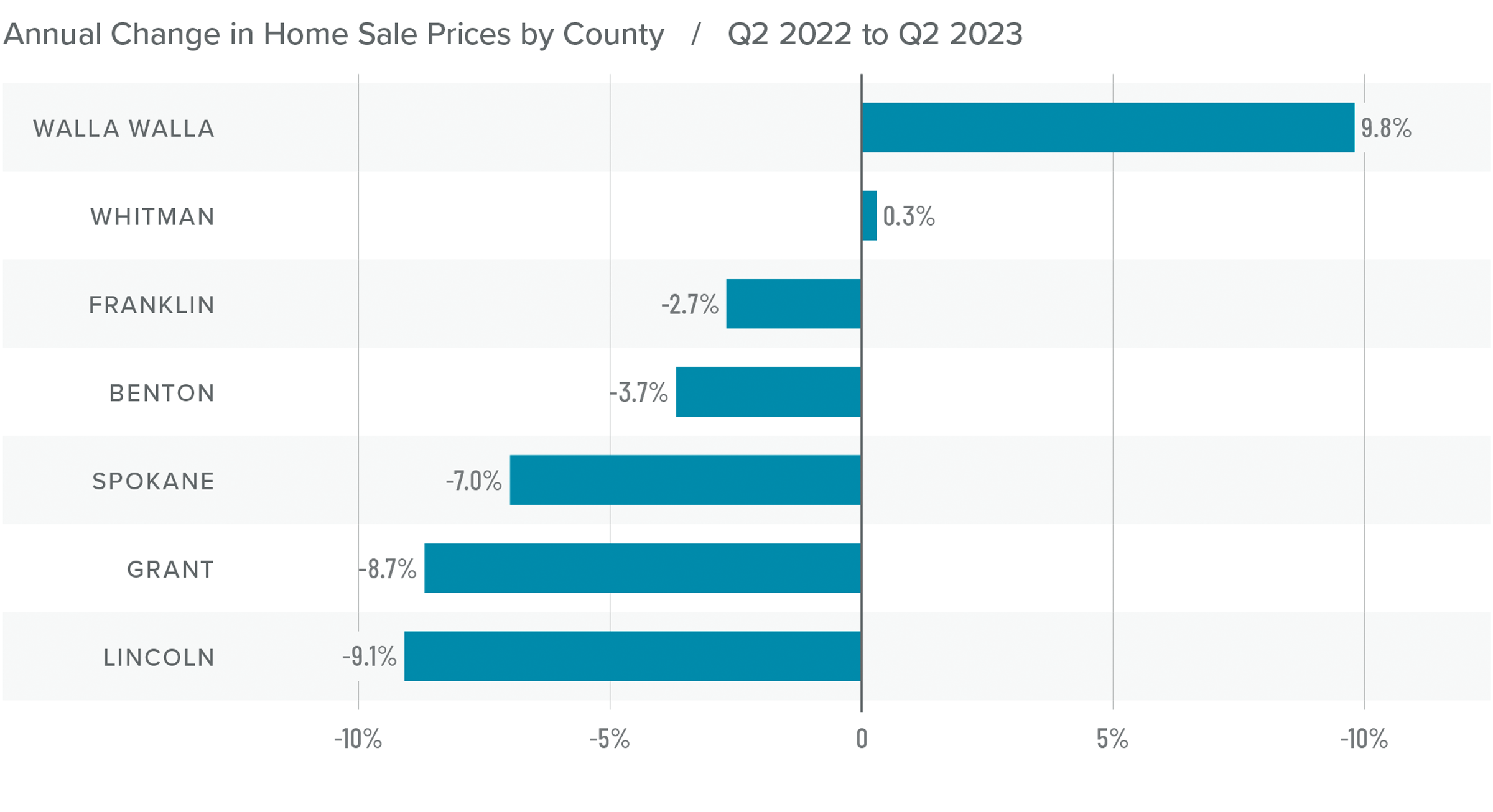
Every county except Walla Walla and Whitman saw average sale prices fall compared to the second quarter of 2022. This decline was modest and not surprising given that prices peaked in the second quarter of last year when mortgage rates started to rise.

Higher mortgage rates do not appear to have been a significant obstacle to home buyers or sellers. Whether this can continue remains to be seen, but I’m hopeful that mortgage rates will start to trend lower.

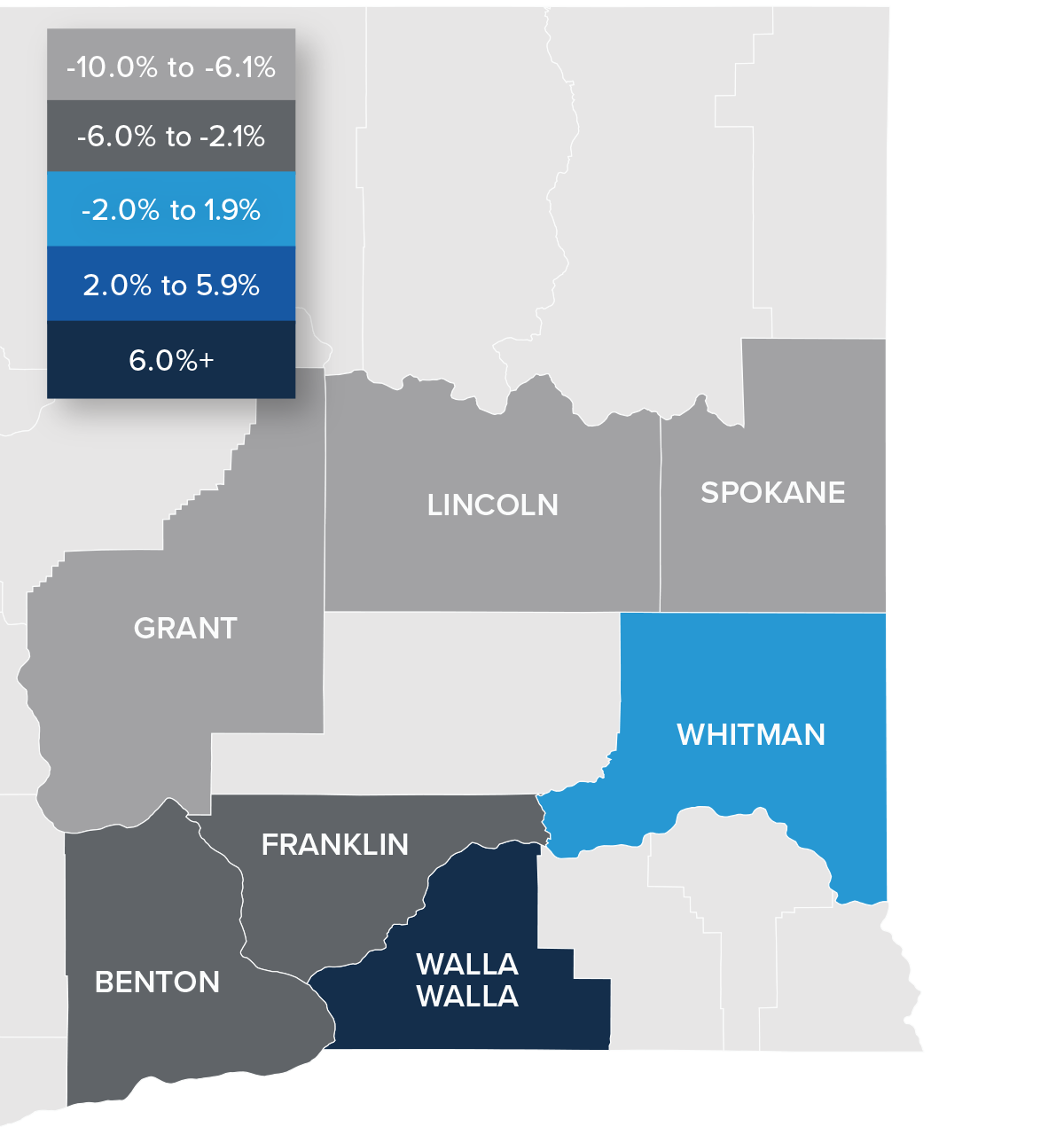
A map showing the real estate home prices percentage changes for various counties in Eastern Washington. Different colors correspond to different tiers of percentage change. Lincoln, Spokane and Grant Counties had a percentage change in the -10% to -6.1% range. Franklin and Benton Counties are in the -6% to -2.1% change range. Whitman County is in the -2% to 1.9% change range. Walla Walla is in the 6%+ change range.

A bar graph showing the annual change in home sale prices by county in Eastern Washington from Q2 2022 to Q2 2023. Walla Walla County tops the list at 9.8%, while Lincoln County had the greatest decline at -9.1%. Benton and Spokane Counties are toward the middle at around -5%.

Mortgage Rates

Although they were less erratic than the first quarter, mortgage rates unfortunately trended higher and ended the quarter above 7%. This was due to the short debt ceiling impasse, as well as several economic datasets that suggested the U.S. economy was not slowing at the speed required by the Federal Reserve.

While the June employment report showed fewer jobs created than earlier in the year, as well as downward revisions to prior gains, inflation has not sufficiently slowed. Until it does, rates cannot start to trend consistently lower. With the economy not slowing as fast as expected, I have adjusted my forecast: Rates will hold at current levels in third quarter and then start to trend lower through the fall. Although there are sure to be occasional spikes, my model now shows the 30-year fixed rate breaking below 6% next spring.

A bar graph showing the mortgage rates from Q2 2021 to the present, as well as Matthew Gardner's forecasted mortgage rates through Q2 2024. After the 6.79% figure in Q4 2022, 6.35% in Q1 2023, and 6.51% in Q2 2023, he forecasts mortgage rates going to 6.55% in Q3 2023, 6.31% in Q4 2023, 6.03% in Q1 2024, and 5.72% in Q2 2024.

Eastern Washington Days on Market

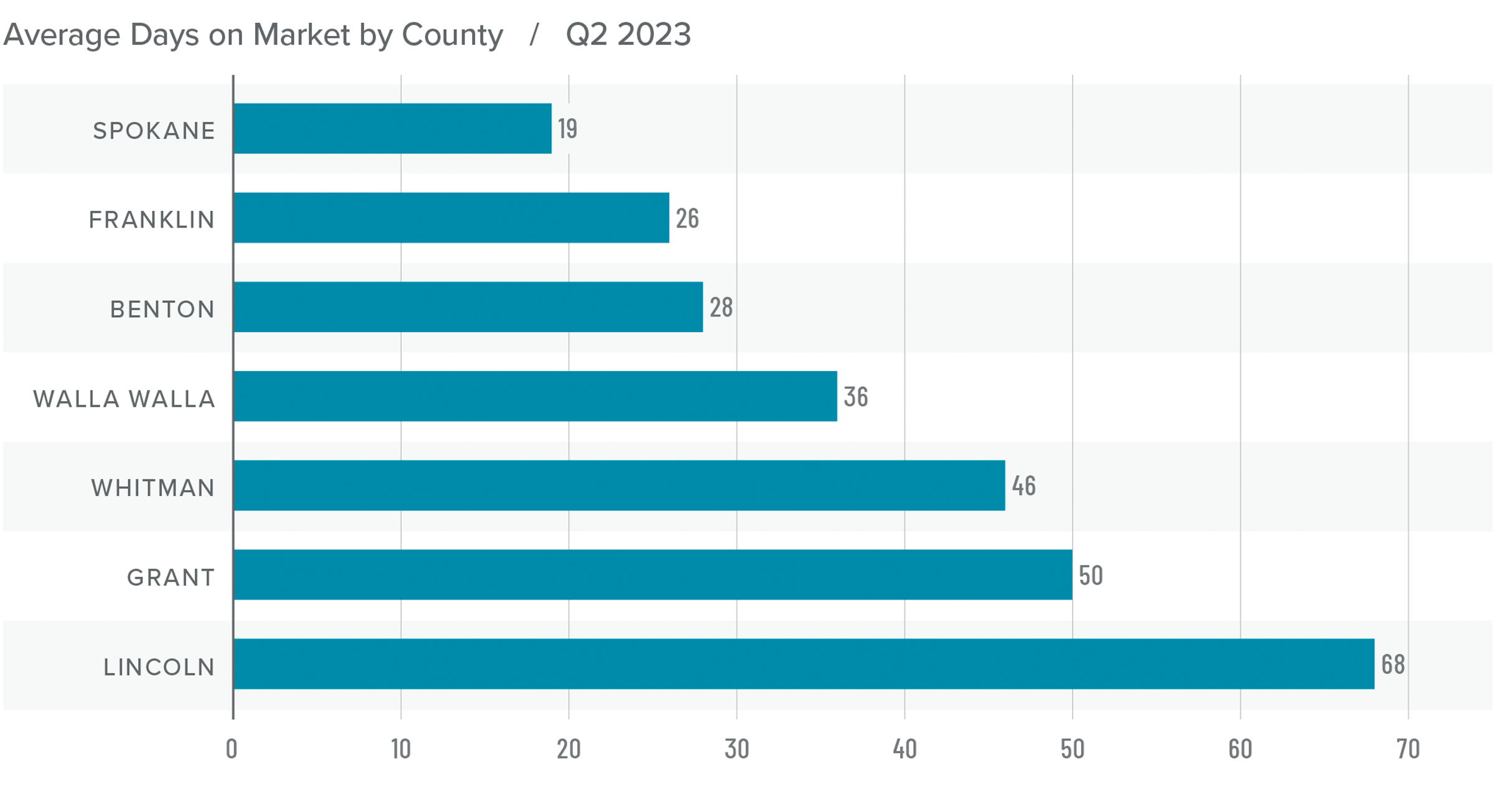
The average time it took to sell a home in Eastern Washington in the second quarter of 2023 was 39 days, which was 22 more than during the same period in 2022.

Compared to the first quarter of this year, average days on market fell in all counties other than Whitman. The regional average fell 15 days.

All counties saw the average number of days it took for a house to sell rise compared to the same period in 2022.

Despite higher mortgage rates and lower affordability, buyers were out in force in the quarter. It’s unknown if this pace of activity will continue, but it’s good to see the market turn around from the year’s dismal start.

A bar graph showing the days on market by county for homes in Eastern Washington in Q2 2023. Spokane County had the lowest DOM at 19, while Lincoln had the highest at 68. Walla Walla and Whitman Counties were in the middle at around 40 days on market.

Conclusions

This speedometer reflects the state of the region’s real estate market using housing inventory, price gains, home sales, interest rates, and larger economic factors.

This report provided a nice change of pace from the first quarter report when prices, sales, and inventory were all headed lower and the only thing increasing was the length of time it took for homes to sell. I believe the market correction is now complete and I’m optimistic that it will continue to gain traction as we move through the second half of the year.

A speedometer graph indicating a balanced market leaning toward a seller's market in Eastern Washington for Q2 2023.

As it stands today, home buyers are benefitting from more choice in the market, but all other factors favor sellers. As such, I am moving the needle more towards sellers, but not so far as to suggest that they entirely control the market.

About Matthew Gardner

Matthew Gardner - Chief Economist for Windermere Real Estate

As Chief Economist for Windermere Real Estate, Matthew Gardner is responsible for analyzing and interpreting economic data and its impact on the real estate market on both a local and national level. Matthew has over 30 years of professional experience both in the U.S. and U.K.

In addition to his day-to-day responsibilities, Matthew sits on the Washington State Governors Council of Economic Advisors; chairs the Board of Trustees at the Washington Center for Real Estate Research at the University of Washington; and is an Advisory Board Member at the Runstad Center for Real Estate Studies at the University of Washington where he also lectures in real estate economics.
Living July 31, 2023

Wildfire Preparation and Evacuation Tips

Wildfires cause chaos for homeowners. Though they are destructive, with the right preparation, you can ensure that you and your household have a plan in case of an emergency. Many homeowners insurance policies cover damage caused by wildfires, but check with your insurance agent to make sure. The following tips are meant to inform your household’s wildfire evacuation protocol, whatever your evacuation timeline may be.

Wildfire Preparation: Immediate Evacuation

Evacuation orders come from local law enforcement agencies, but if you have not received an official evacuation notice and feel threatened by wildfires in your area, do not hesitate to leave. Take only essential vehicles on the road, this will minimize traffic and reduce the chance of gridlock when evacuating the area. Keep the windows rolled up to avoid inhaling smoke and tune into local radio for updates as you head toward safer ground. Don’t forget your masks and remember to bring the six P’s:

  • People and pets
  • Phones and personal computer
    • Chargers, any additional computer hardware
  • Papers and important documents
    • Birth certificates, passports, insurance, legal documents
  • Prescriptions
    • Medication, eyeglasses, contacts
  • Pictures and irreplaceable keepsakes
  • Payment (credit & debit cards, bank cards, cash)

It helps to have a “go bag” or portable kit packed ahead of time if and when a wildfire breaks out. In it, you’ll want to keep a list of essential items in case you’re away from your home for a while. Include the following items in your go bag:

  • Face masks or coverings
  • Extra clothing
  • First aid kit
  • Toiletries
  • Tools
  • Flashlight
  • Batteries
  • Sanitation supplies
  • Copies of important documents
  • Three-day supply of food and water

Wildfire Evacuation Preparation

If you live in an area that is not being evacuated, there are steps you can take now to prepare your home and family, if and when the time comes. These tasks can help to discourage fires from spreading closer to your home and hopefully salvage some household items.

  • Create a “defensible space” by clearing your home’s surroundings of brush and vegetation
  • Turn off sprinklers and main gas lines
  • Clean out roof and gutters
  • Move furniture away from windows toward the center of the room
  • Remove flammable household items
  • Prepare your emergency kit
    • Include essential items listed above

For more information about wildfires and indoor air quality, visit the Environmental Protection Agency (EPA) website. Be sure to check your local news and emergency alert radio stations and social media profiles for the most up-to-date information and helpful resources.

Wildfires are unpredictable. Knowing what to do both in preparation for and during an emergency evacuation will have your household prepared in the event that a wildfire spreads to your area, neighborhood, or home.


­­­­­­Featured Image Source: Getty Images – Image Credit: Daniiielc

Market News July 31, 2023

Q2 2023 Colorado Real Estate Market Update

The following analysis of select counties of the Colorado real estate market is provided by Windermere Real Estate Chief Economist Matthew Gardner. We hope that this information may assist you with making better-informed real estate decisions. For further information about the housing market in your area, please don’t hesitate to contact your Windermere Real Estate agent.


Regional Economic Overview

The slowdown in job gains in Colorado continued this spring. Although the state added 30,200 new jobs over the past year, this represents close to the lowest growth rate since 2011. Additionally, growth is now being driven by gains in government employment and not from increases in the private sector. Part of the reason that job growth has slowed so significantly is that the labor market remains extremely tight. Since the pandemic, the labor pool has only risen a bit under 37,000 over the past year, which is well below average. With a tight labor market, I’m not surprised that the unemployment rate in May was only 2.8%. Regionally, jobless rates ranged from a low of 2.5% in Fort Collins and Boulder to a high of 3.1% in the Grand Junction metropolitan area.

Colorado Home Sales

In the second quarter of this year, 9,615 homes sold, which was a drop of 26% from the same period in 2022, but an increase of 45.6% from the first quarter of 2023.

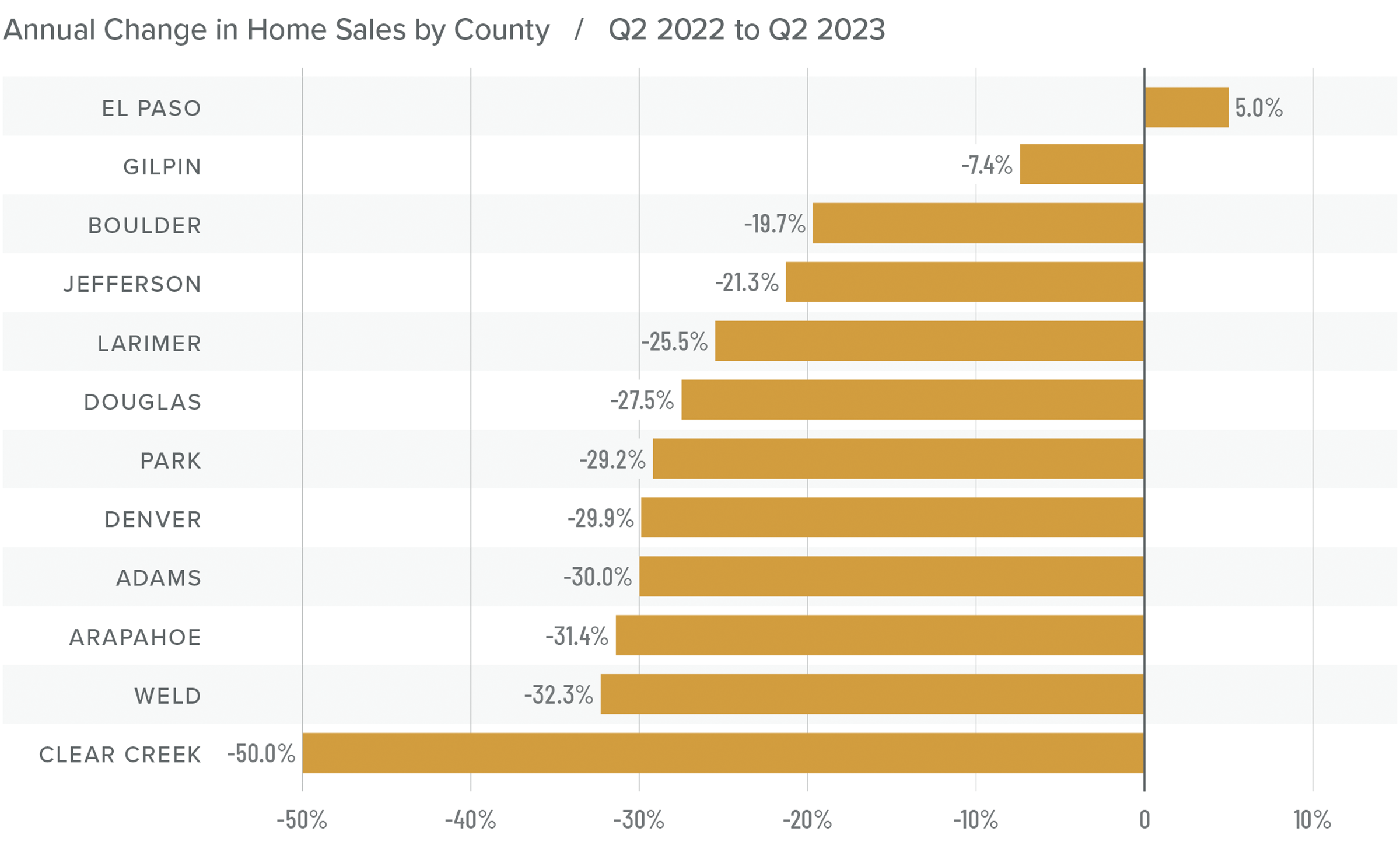
Year over year, sales fell in all the markets covered by this report except El Paso County. Compared to the first quarter of this year, sales rose across the board.

The year-over-year drop in sales is not a surprise given that a year ago mortgage rates were starting to rise, so buyers were keen to lock in low rates while they could. I was pleased to see the significant jump in sales over the first quarter even with remarkably high financing costs.

Pending sales, which are an indicator of future closings, jumped 25.8% from the first quarter. This suggests that sales will likely rise as we move through the summer.

A graph showing the annual change in home sales by county for Colorado from Q2 2022 to Q2 2023. El Paso had the least drastic change at 5%, while Clear Creek had the largest change at -50%. Counties like Park, Denver, and Douglas were in the middle at around -28%.

Colorado Home Prices

Average sale prices fell 4% compared to the same period in 2022 to $672,864. Closed sale prices were 7.6% higher than in the first quarter of this year.

Compared to the first quarter, prices rose in all counties other than Boulder and Gilpin. This may be because these are the two most expensive markets covered by this report.

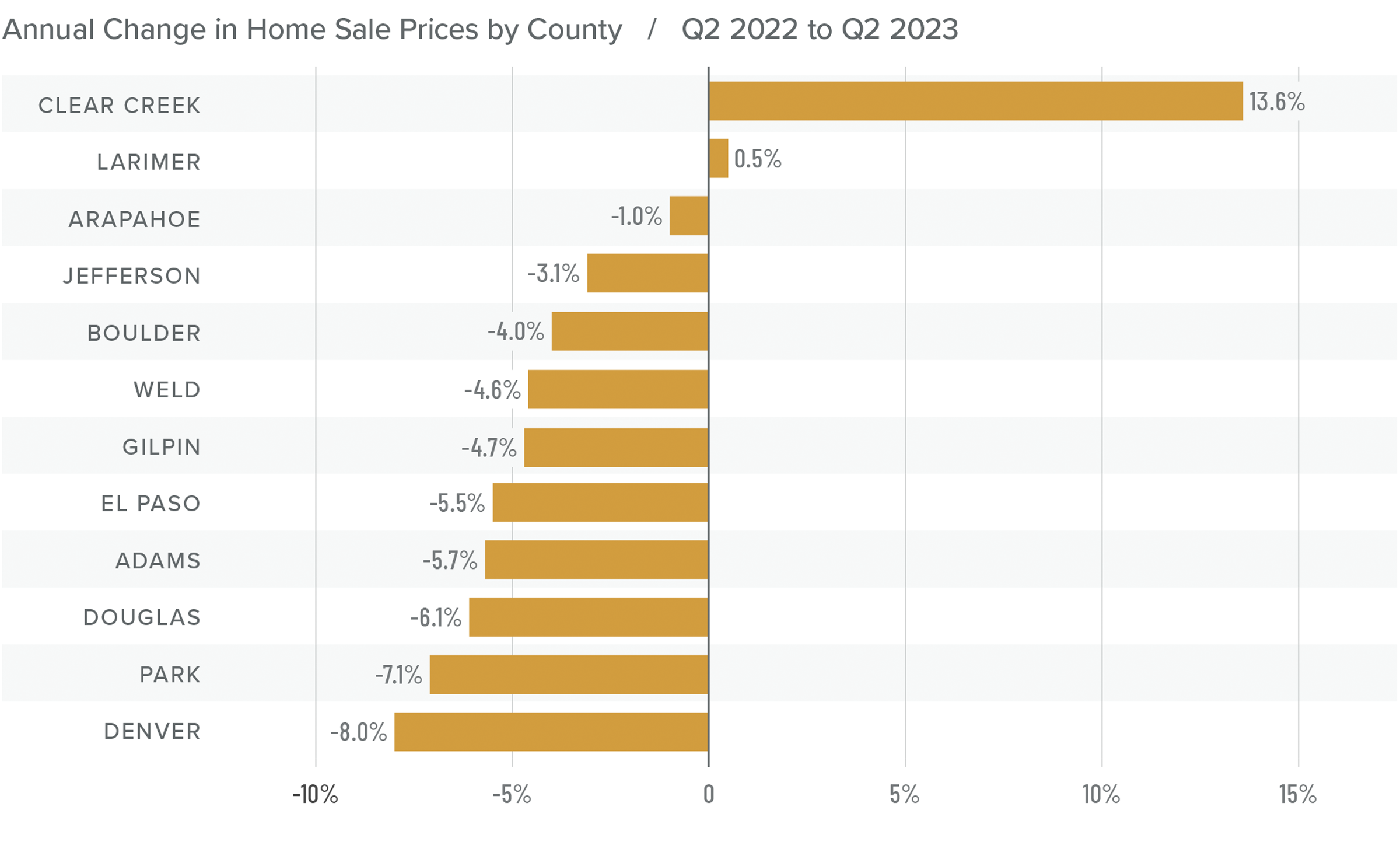
Year over year, prices rose in two counties but fell in the balance of the markets. Clear Creek County saw significant growth, but it is prone to significant swings because very few sales happen there.

The median list price of a home for sale in the second quarter rose 1.9% from the first quarter of this year. In fact, every county except Clear Creek and Park saw list prices rise. Sellers appear to be confident about the market, regardless of mortgage rates.

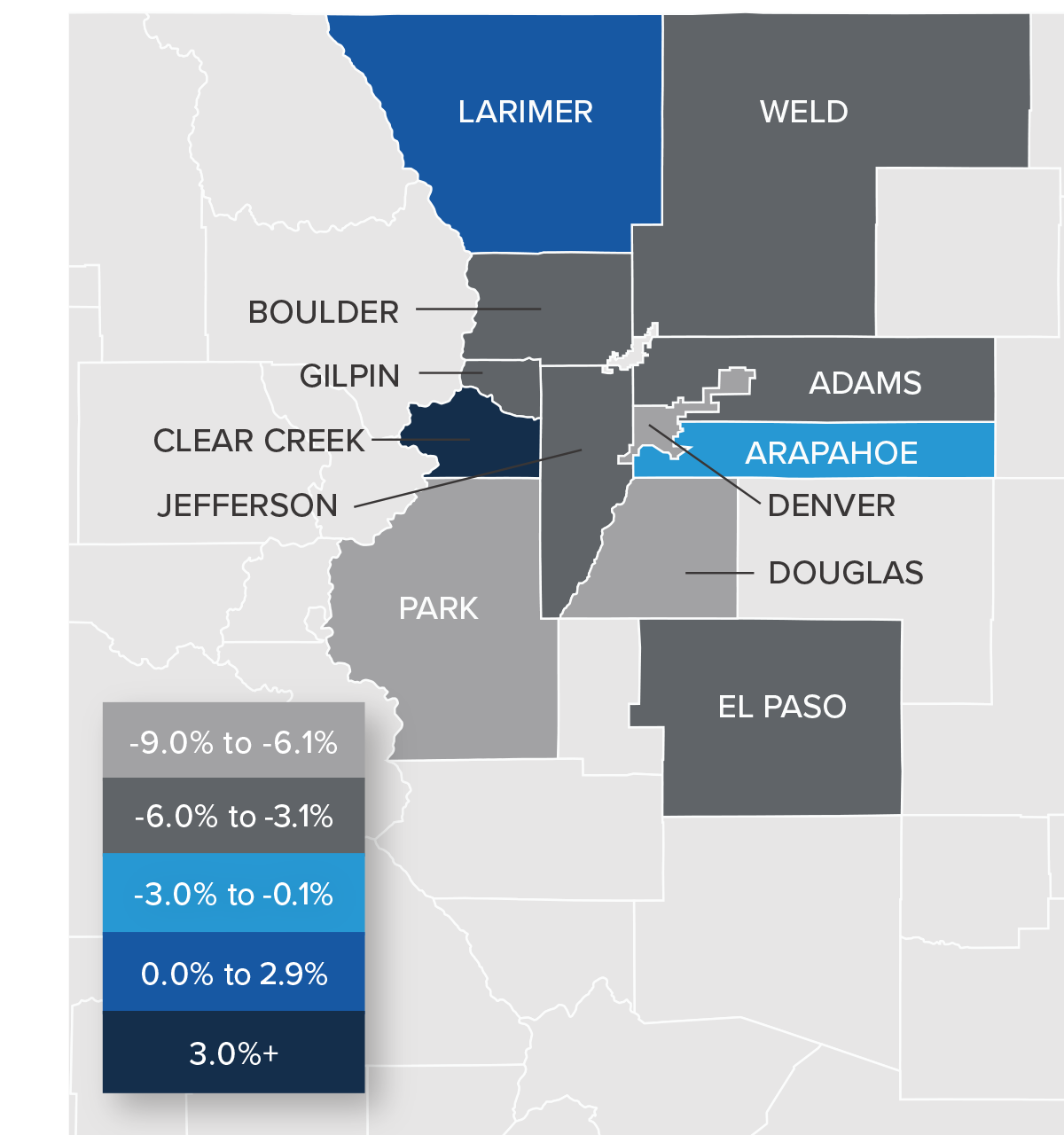
A map showing the real estate home prices percentage changes for various counties in Colorado. Different colors correspond to different tiers of percentage change. Park, Denver and Douglas Counties had a percentage change in the -9% to -6.1% range. El Paso, Weld, Boulder, Gilpin, Jefferson, and Adams Counties are in the -6% to -3.1% change range. Arapahoe County is in the -3% to -0.1% change range. Larimer is in the 0% to 2.9% change range and Clear Creek is in the 3%+ change range.

A bar graph showing the annual change in home sale prices by county in Colorado from Q2 2022 to Q2 2023. Clear Creek County tops the list at 13.6%, while Denver County had the greatest decline at -8%. Boulder, Gilpin, and El Paso Counties are toward the middle at around -5%.

Mortgage Rates

Although they were less erratic than the first quarter, mortgage rates unfortunately trended higher and ended the quarter above 7%. This was due to the short debt ceiling impasse, as well as several economic datasets that suggested the U.S. economy was not slowing at the speed required by the Federal Reserve.

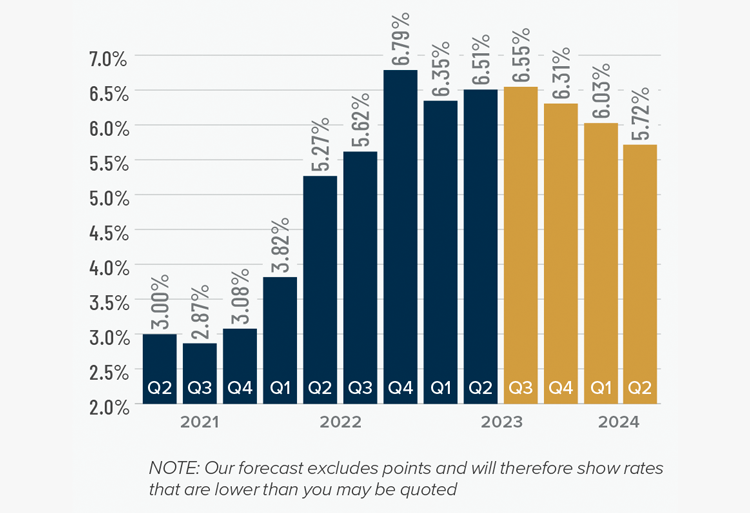
While the June employment report showed fewer jobs created than earlier in the year, as well as downward revisions to prior gains, inflation has not sufficiently slowed. Until it does, rates cannot start to trend consistently lower. With the economy not slowing as fast as expected, I have adjusted my forecast: Rates will hold at current levels in third quarter and then start to trend lower through the fall. Although there are sure to be occasional spikes, my model now shows the 30-year fixed rate breaking below 6% next spring.

A bar graph showing the mortgage rates from Q2 2021 to the present, as well as Matthew Gardner's forecasted mortgage rates through Q2 2024. After the 6.79% figure in Q4 2022, 6.35% in Q1 2023, and 6.51% in Q2 2023, he forecasts mortgage rates going to 6.55% in Q3 2023, 6.31% in Q4 2023, 6.03% in Q1 2024, and 5.72% in Q2 2024.

Colorado Days on Market

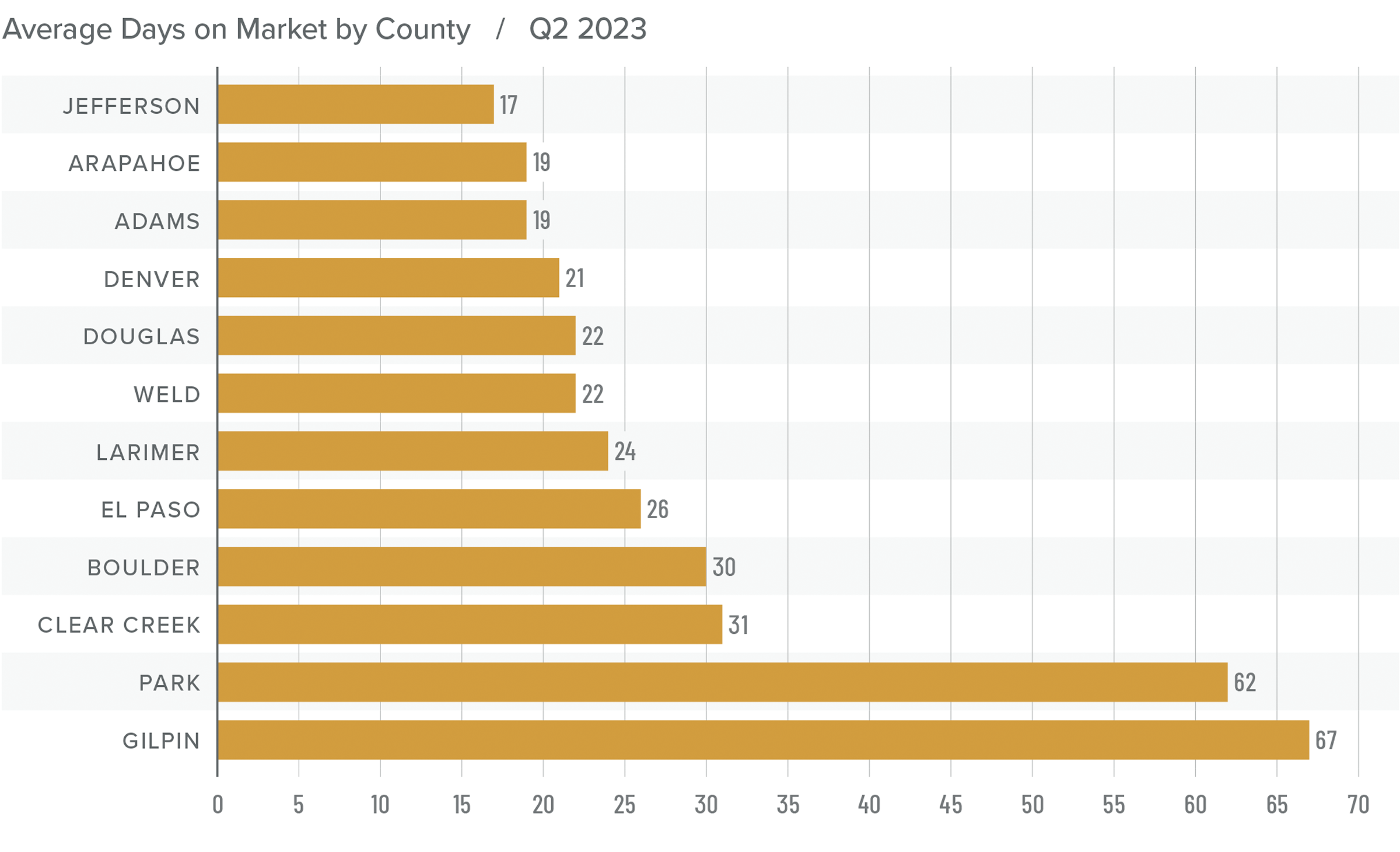
The average time it took to sell a home in the markets contained in this report rose 20 days compared to the same period in 2022.

The length of time it took to sell a home compared to the first quarter of this year fell across all markets except Gilpin County, where market time rose 31 days.

It took an average of 30 days to sell a home in the counties covered by this report, which was down 17 days compared to the first quarter of 2023.

Regardless of being faced with more choice in the market than they’ve had in a long time, buyers picked up the pace in the quarter. It will be interesting to see if this continues despite stubbornly high financing costs.

A bar graph showing the days on market by county for homes in Colorado in Q2 2023. Jefferson County had the lowest DOM at 17, while Gilpin had the highest at 67. Douglas, Larimer, Denver, and Weld Counties were in the middle at around 22 days on market.

Conclusions

This speedometer reflects the state of the region’s real estate market using housing inventory, price gains, home sales, interest rates, and larger economic factors.

Although job growth has slowed significantly, and financing costs remain high, the market appears to have gained traction. Clearly, buyers do not expect prices to fall further. Even if borrowing costs remain high, it appears that buyers believe rates will come down at some point, which will allow them to refinance into a lower rate mortgage.

A speedometer graph indicating a seller's market leaning toward a balanced market in Colorado for Q2 2023.

In last quarter’s Gardner Report, I stated that home prices had likely turned the corner and were going to start rising again, which has proved to be accurate. Listing activity has risen, but so have sales. List and sale prices are trending higher even as market time drops. All in all, the data points to a seller’s market. As such, I have moved the needle accordingly.

About Matthew Gardner

Matthew Gardner - Chief Economist for Windermere Real Estate

As Chief Economist for Windermere Real Estate, Matthew Gardner is responsible for analyzing and interpreting economic data and its impact on the real estate market on both a local and national level. Matthew has over 30 years of professional experience both in the U.S. and U.K.

In addition to his day-to-day responsibilities, Matthew sits on the Washington State Governors Council of Economic Advisors; chairs the Board of Trustees at the Washington Center for Real Estate Research at the University of Washington; and is an Advisory Board Member at the Runstad Center for Real Estate Studies at the University of Washington where he also lectures in real estate economics.

Market News July 31, 2023

Q2 2023 Southern California Real Estate Market Update

The following analysis of select counties of the Southern California real estate market is provided by Windermere Real Estate Chief Economist Matthew Gardner. We hope that this information may assist you with making better-informed real estate decisions. For further information about the housing market in your area, please don’t hesitate to contact your Windermere Real Estate agent.

 

Regional Economic Overview

The Southern California market areas contained in this report added 222,700 jobs over the past 12 months, representing a decent growth rate of 2.4%. Although layoffs in the tech sector and the writers’ strike have been dominating headlines, payrolls in Southern California continue to expand. The Los Angeles market has added over 60,000 jobs through the first five months of this year. This was followed by Orange County, which added 19,000 jobs. San Diego County added 16,600 jobs, and employment grew by 6,700 jobs in Riverside County. The region has seen the pace of employment growth slow, but this appears to be more an issue of labor supply rather than a lack of demand. The region’s unemployment rate in May was 4.3%, up from 3.7% in the same quarter of 2022. The lowest jobless rates were in Orange County (3.2%) and San Diego County (3.5%). The highest rate was in Los Angeles County, where 4.8% of the workforce was without a job.

Southern California Home Sales

In the second quarter of 2023, 35,381 homes sold, which was 25.9% lower than in the second quarter of 2022 but up an impressive 27.7% compared to the first quarter of 2023.

Pending home sales, an indicator of future closings, were 13.9% higher than in the first quarter, suggesting that sales activity has room to rise further as we move into the second half of the year.

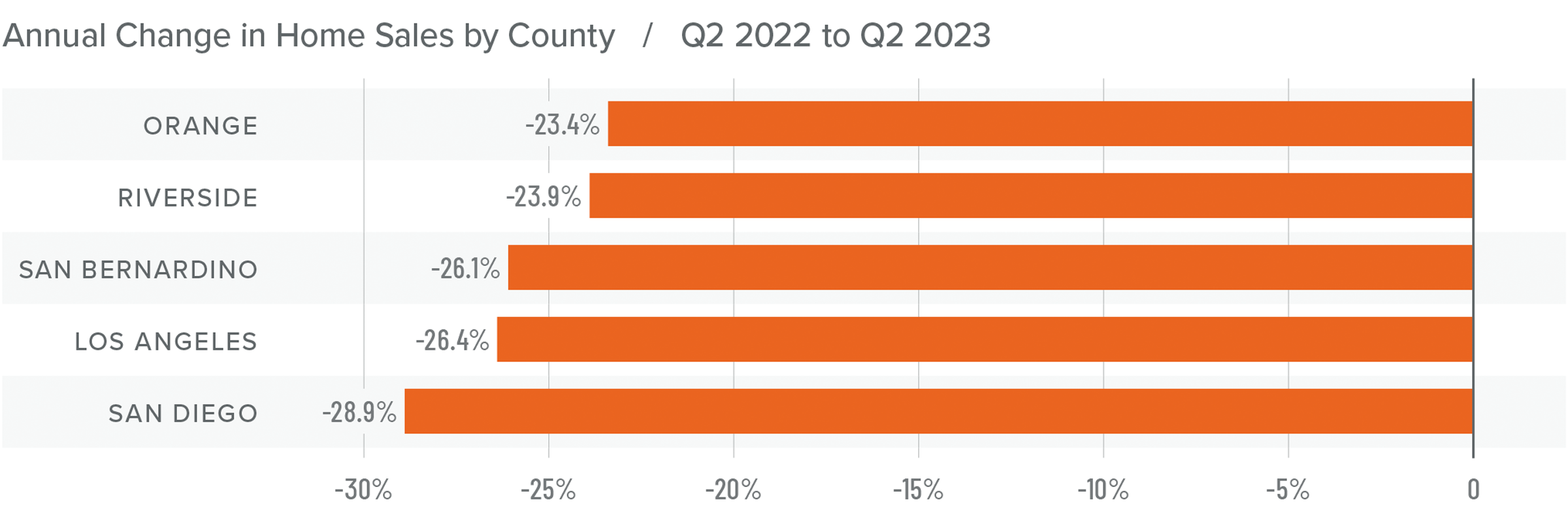
Compared to the same quarter in 2022, sales fell across the board. However, the market heated up in the second quarter compared to the first quarter of 2023: sales were up 36% in Orange County, 29.6% in Los Angeles County, 28.4% in San Bernardino County, 24.3% in Riverside County, and 20.5% in San Diego County.

The growth in sales was even more impressive given significantly rising financing costs in the second quarter.

A graph showing the annual change in home sales by county for Southern California from Q2 2022 to Q2 2023. Orange had the least drastic change at -23.4%, while San Diego had the most largest change at -28.9%.

Southern California Home Prices

Compared to the second quarter of 2022, home sale prices were 5.5% lower. However, they were 2.1% higher than in the first quarter of 2023.

Affordability continues to be a significant constraint in the region. With median list prices rising 21% in San Diego County and 20% in Los Angeles County compared to the first quarter, it appears that sellers’ confidence levels continue to rise, which will further impact housing affordability.

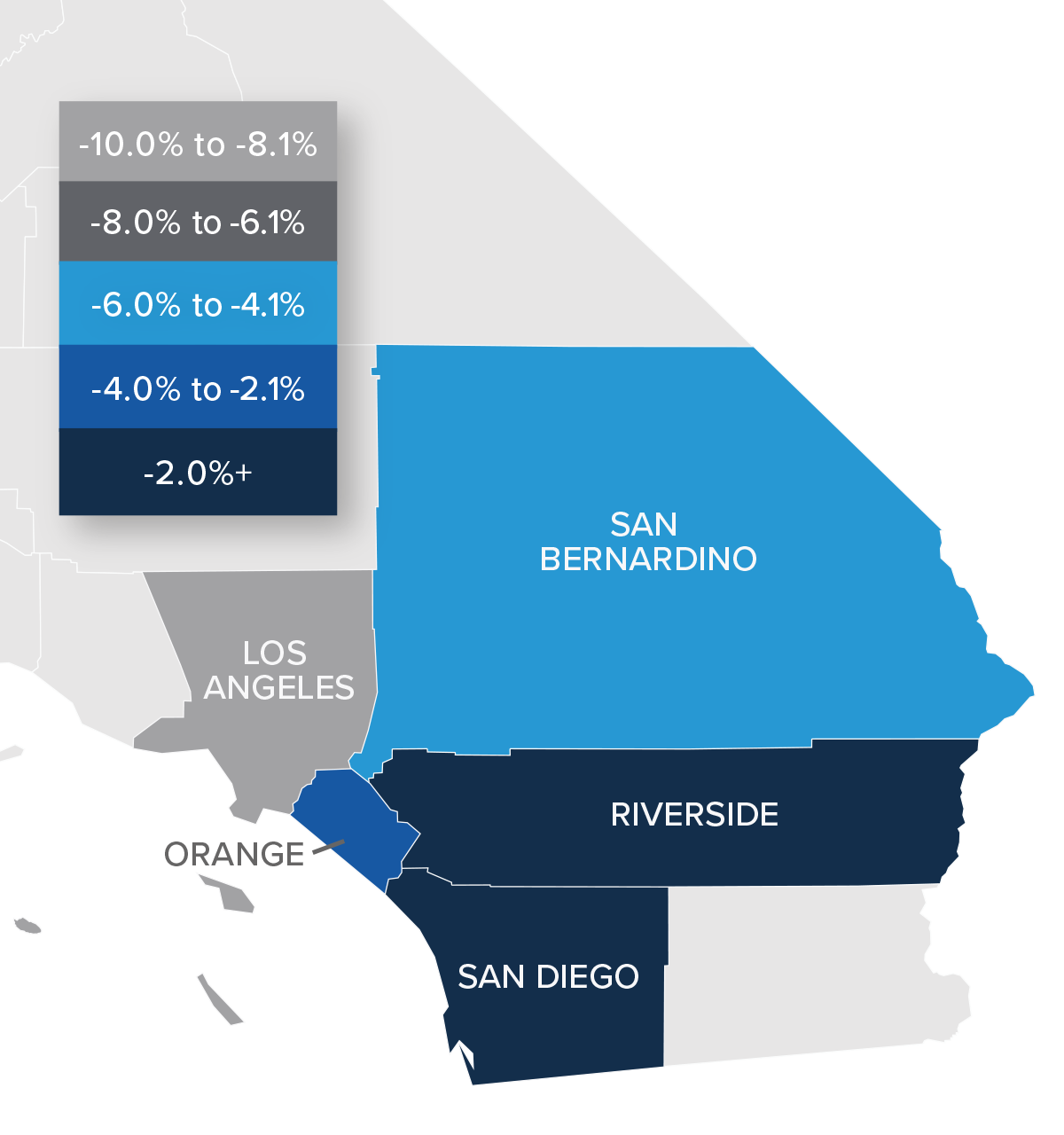
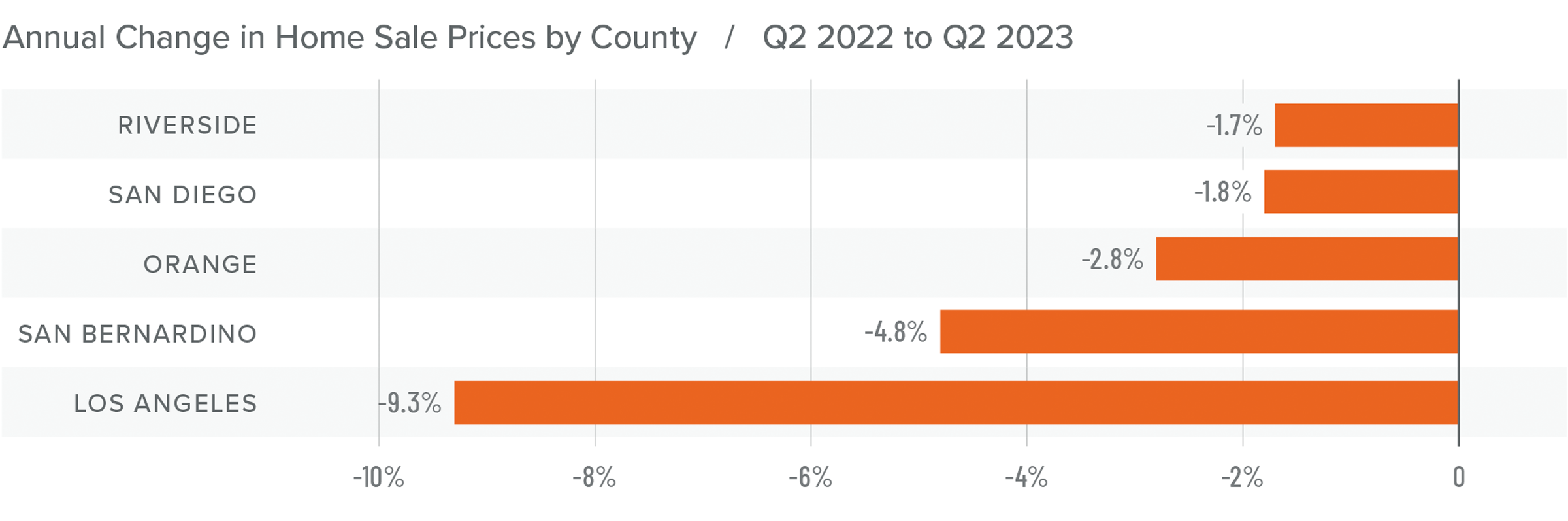
Year over year, prices pulled back across the region, with a significant drop in Los Angeles County. Compared to the first quarter of 2023, Los Angeles prices fell 4.1%. Closed sale prices rose in the rest of the market areas.

The region has demonstrated significantly more resilience to higher financing costs than expected. As we move through the balance of 2023, I expect prices to rise further, but at a very modest pace.

AA map showing the real estate home prices percentage changes for various counties in Southern California. Different colors correspond to different tiers of percentage change. Los Angeles County has a percentage change in the -10% to -8.1% range. San Bernardino County is in the -6% to -4.1% change range. Orange County is in the -4% to -2.1% change range and Riverside and San Diego counties are in the -2%+ change range.

A bar graph showing the annual change in home sale prices by county in Southern California from Q2 2022 to Q2 2023. Riverside County tops the list at -1.7%, while Los Angeles County had the greatest decline at -9.3%.

Mortgage Rates

Although they were less erratic than the first quarter, mortgage rates unfortunately trended higher and ended the quarter above 7%. This was due to the short debt ceiling impasse, as well as several economic datasets that suggested the U.S. economy was not slowing at the speed required by the Federal Reserve.

While the June employment report showed fewer jobs created than earlier in the year, as well as downward revisions to prior gains, inflation has not sufficiently slowed. Until it does, rates cannot start to trend consistently lower. With the economy not slowing as fast as expected, I have adjusted my forecast: Rates will hold at current levels in third quarter and then start to trend lower through the fall. Although there are sure to be occasional spikes, my model now shows the 30-year fixed rate breaking below 6% next spring.

A bar graph showing the mortgage rates from Q2 2021 to the present, as well as Matthew Gardner's forecasted mortgage rates through Q2 2024. After the 6.79% figure in Q4 2022, 6.35% in Q1 2023, and 6.51% in Q2 2023, he forecasts mortgage rates going to 6.55% in Q3 2023, 6.31% in Q4 2023, 6.03% in Q1 2024, and 5.72% in Q2 2024.A bar graph showing the mortgage rates from Q2 2021 to the present, as well as Matthew Gardner's forecasted mortgage rates through Q2 2024. After the 6.79% figure in Q4 2022, 6.35% in Q1 2023, and 6.51% in Q2 2023, he forecasts mortgage rates going to 6.55% in Q3 2023, 6.31% in Q4 2023, 6.03% in Q1 2024, and 5.72% in Q2 2024.

Southern California Days on Market

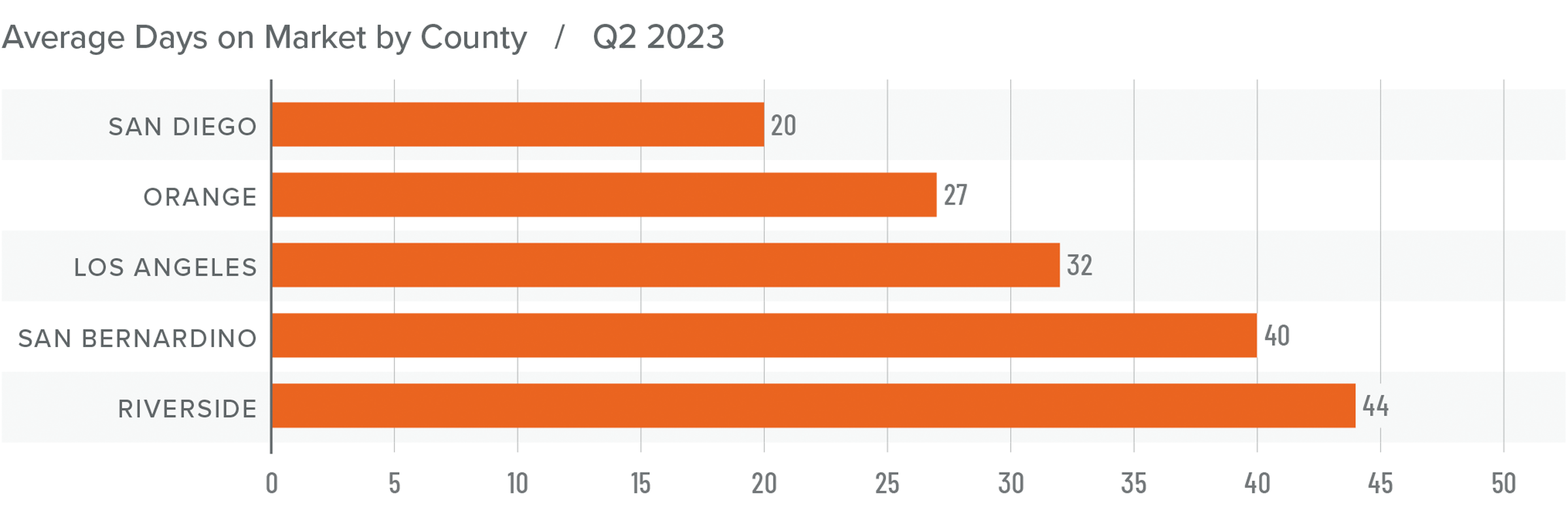
In the second quarter of 2023, the average time it took to sell a home in the region was 32 days, which was 16 more than in the second quarter of 2022 but 13 fewer days than in the first quarter of 2023.

Compared to the first quarter of 2023, market time fell in all counties covered by this report.

Homes in San Diego County continue to sell at a faster rate than other markets in the region, but all counties saw market time increase from a year ago.

Home buyers appear to be resigned to the fact that supply levels are unlikely to improve any time soon and believe that prices are not going to fall further. This is leading them to pursue buying a home even if mortgage rates remain very high, with the hope they will be able to refinance when rates eventually fall.

A bar graph showing the days on market by county for homes in Southern California in Q2 2023. San Diego County had the lowest DOM at 20, while Riverside had the highest at 44.

Conclusions

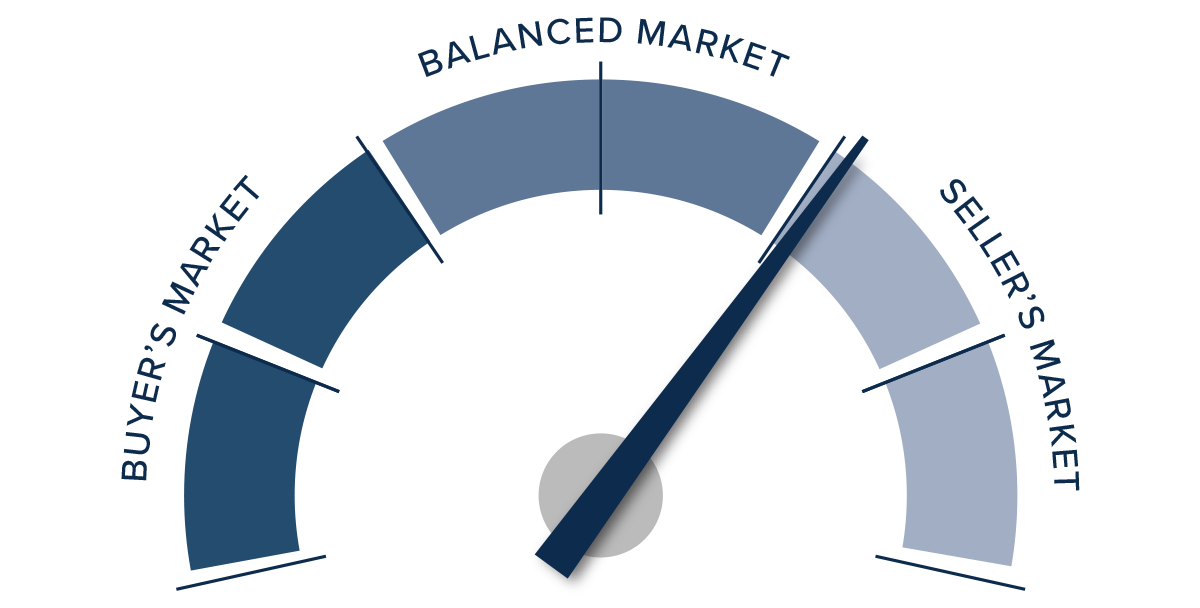
This speedometer reflects the state of the region’s real estate market using housing inventory, price gains, home sales, interest rates, and larger economic factors.

Home prices have stabilized and are starting to trend higher again. This is counterintuitive, especially given that mortgage rates are higher than the market has seen in over 15 years. However, the reason for this is straightforward: a lack of supply is bolstering home values. It will only be when supply levels rise to match demand that we will start to move toward a more balanced market. The issue, though, is that 85.7% of California homeowners with a mortgage have an average interest rate below 5%, and 30% have rates at or below 3%. I find it highly unlikely that homeowners will give up their current rate unless they absolutely have to, which is holding back supply.

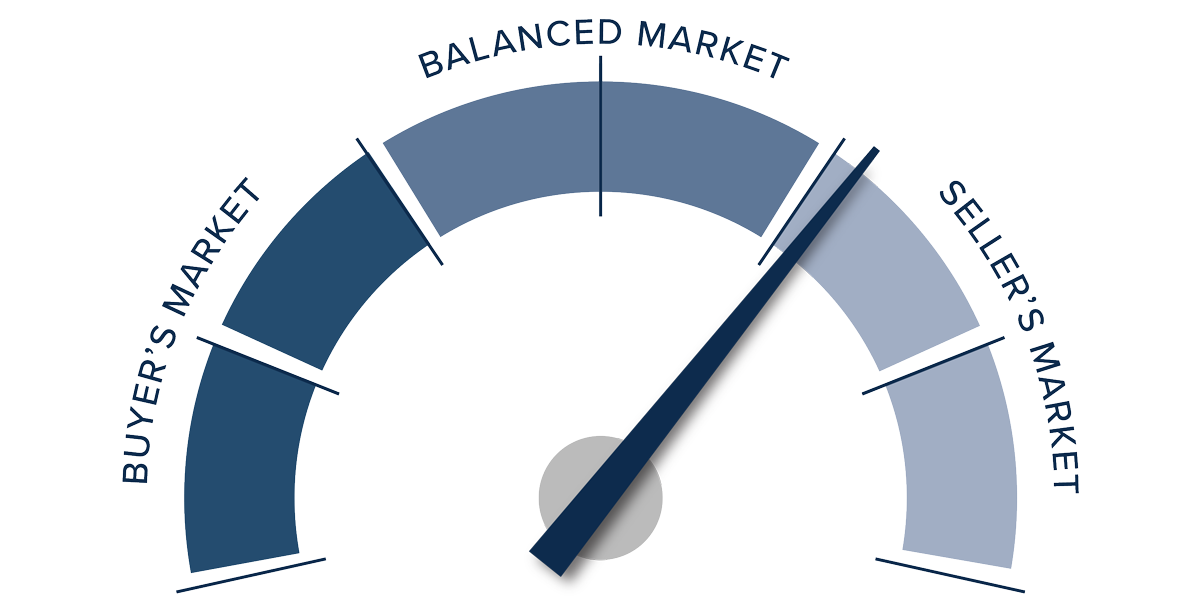
A speedometer graph indicating a seller's market leaning toward a balanced market in Southern California for Q2 2023.

Homeowners who do decide to sell are aware of this and are increasingly confident in their ability to sell their homes regardless of mortgage rates. Given these factors, I have moved the needle into the seller’s sector of the speedometer.

About Matthew Gardner

Matthew Gardner - Chief Economist for Windermere Real Estate

As Chief Economist for Windermere Real Estate, Matthew Gardner is responsible for analyzing and interpreting economic data and its impact on the real estate market on both a local and national level. Matthew has over 30 years of professional experience both in the U.S. and U.K.

In addition to his day-to-day responsibilities, Matthew sits on the Washington State Governors Council of Economic Advisors; chairs the Board of Trustees at the Washington Center for Real Estate Research at the University of Washington; and is an Advisory Board Member at the Runstad Center for Real Estate Studies at the University of Washington where he also lectures in real estate economics.