Market News November 3, 2017

Central Washington Real Estate Market Update


ECONOMIC OVERVIEW

The Washington State economy added 79,600 new jobs over the past 12 months. This impressive growth rate—2.4%—is well above the national rate of 1.2%. However, as we anticipated in last quarter’s report, we are seeing a modest slowdown in the growth rate as the state moves closer to full employment. Expansion has taken place in all major job sectors other than Aerospace (a function of a slowdown at Boeing). Seeing this current rate of expansion, I am raising my employment forecast and now predict that Washington will add 81,000 new jobs in 2017.

Given the robust job market, it is unsurprising that the state unemployment rate continues to fall. The current unemployment rate in Washington State is 4.6% and we are, essentially, at full employment. Additionally, all counties contained within this report reported a drop in their unemployment rate from a year ago.


HOME SALES ACTIVITY

  • Home sales throughout Central Washington were a mixed bag in the third quarter. Only one county saw sales rise compared to a year ago and three markets contracted. In total, there were 1,205 home sales in the quarter—a drop of 4.3% from the same period in 2016 but an increase of 3.1% over the second quarter of this year.
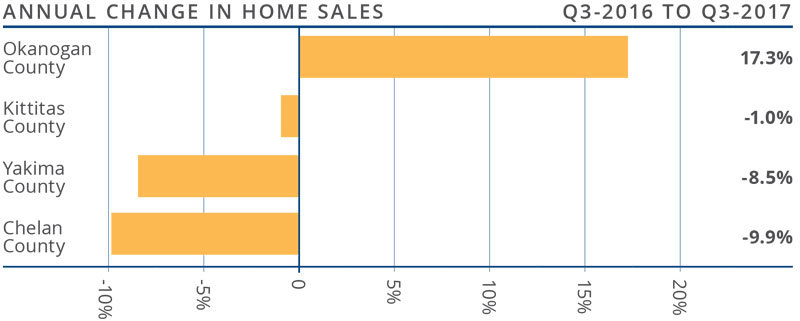
  • Sales rose in Okanogan County, which had an impressive 17.3% increase over the third quarter of 2016.
  • The number of pending home sales—an indicator of future closings—was down in all counties except Okanogan.
  • The supply of homes for sale remains an issue as inventory was down 15.6% compared to the third quarter of last year. The market is clearly starved of inventory, which continues to push home prices higher and slow sales velocities.


HOME PRICES

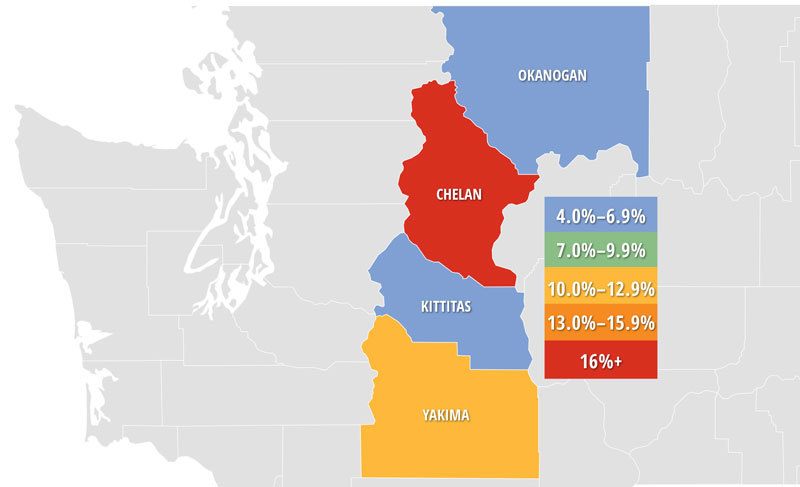
  • Year-over-year, the average home price in the region rose by 10.5% to $278,563. Price growth remains well above the long-term average as demand exceeds supply.
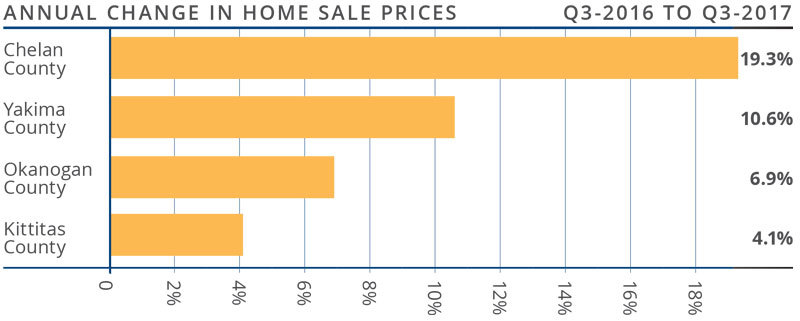
  • Only Kittitas County saw relatively modest price increases while the other three counties had impressive price increases.
  • All counties in this report saw prices rise when compared to the third quarter of 2016. Chelan County led the way with an increase of 19.3%.
  • The takeaway here is that home-price growth continues at above-average rates due to very limited supply. I anticipate that the rate of appreciation will start to taper, but not until next year.


DAYS ON MARKET

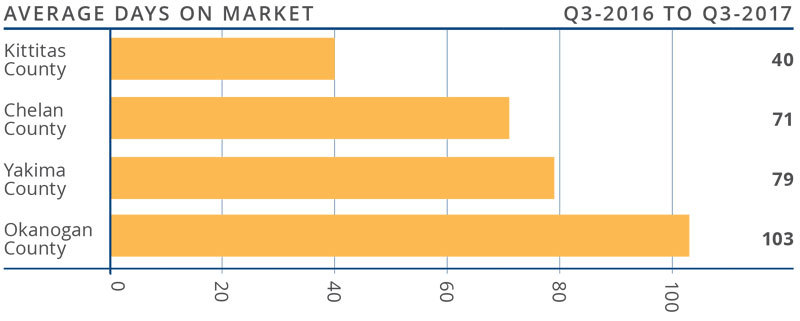
  • The average number of days it took to sell a home dropped 22 days when compared to the third quarter of 2016.
  • The average time it took to sell a home in the region was 73 days, matching the second quarter of this year.
  • All the markets contained in this report saw days on market drop from the same quarter in 2016.
  • Homes sold the fastest in Kittitas County, where it took an average of 40 days to sell a home. The greatest drop in the time it took to sell a home was in Chelan County, where it took 35 fewer days than in the third quarter of last year.


CONCLUSIONS
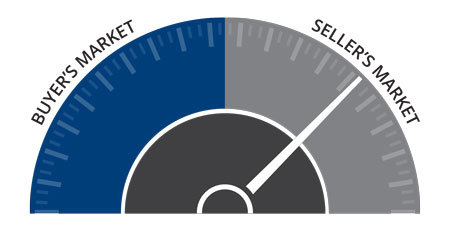
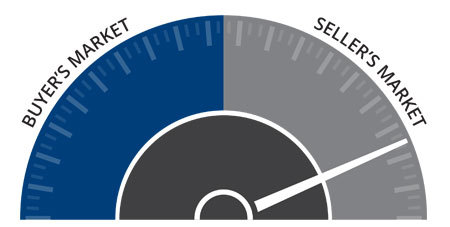
This speedometer reflects the state of the region’s housing market using housing inventory, price gains, home sales, interest rates, and larger economic factors. For the third quarter of 2017, I moved the needle a little more into sellers’ territory. Prices are still trending higher than average due to inventory issues that remain stubbornly in place. The balance of this year will favor sellers as demand continues to exceed supply.



Matthew Gardner is the Chief Economist for Windermere Real Estate, specializing in residential market analysis, commercial/industrial market analysis, financial analysis, and land use and regional economics. He is the former Principal of Gardner Economics, and has over 25 years of professional experience both in the U.S. and U.K.


If you are in the market to buy or sell, we can connect you with an experienced agent here.

Market News November 2, 2017

Oregon and Southwest Washington Real Estate Market Update


ECONOMIC OVERVIEW

The State of Oregon has added 37,400 new jobs over the past 12 months, with solid gains in Construction (+11,600), Education & Health Services (+9,000), and Trade, Transportation & Utilities (+8,000) sectors. Year-over-year, employment in Oregon has risen 2.0%.

In September, the state unemployment rate was 4.2%—up from 3.7% at the end of the second quarter but down from 4.9% in September 2016. The civilian labor force continues to grow and I fully anticipate that the state’s economy will perform well in 2018, though somewhat slower than 2017.


HOME SALES ACTIVITY

  • Third quarter home sales dropped by a very modest 1.5% when compared to the same period last year, with a total of 18,724 homes sold.
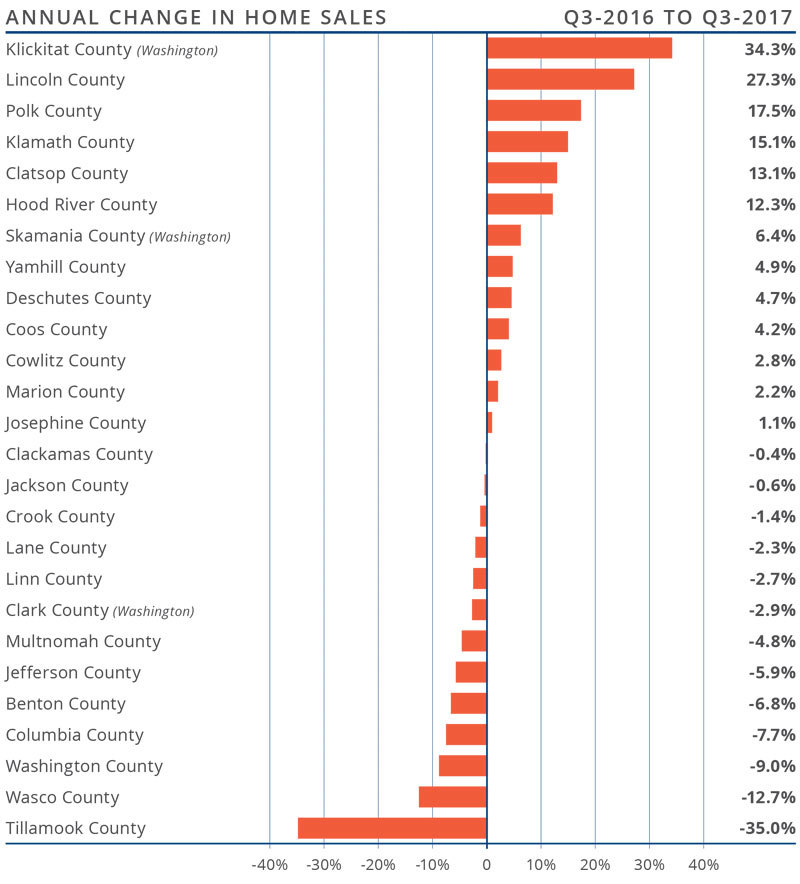
  • Sales rose the fastest in Klickitat County, which had a 34.3% increase over the third quarter of 2016. There were also noticeable sales increases in Lincoln, Polk, Klamath, Clatsop, and Hood River Counties. Home sales fell the most in Tillamook, Washington, and Wasco Counties.
  • Year-over-year sales rose in 13 counties, but dropped in the other 13.
  • The low level of available inventory continues to affect the market, causing sales to slow.


HOME PRICES


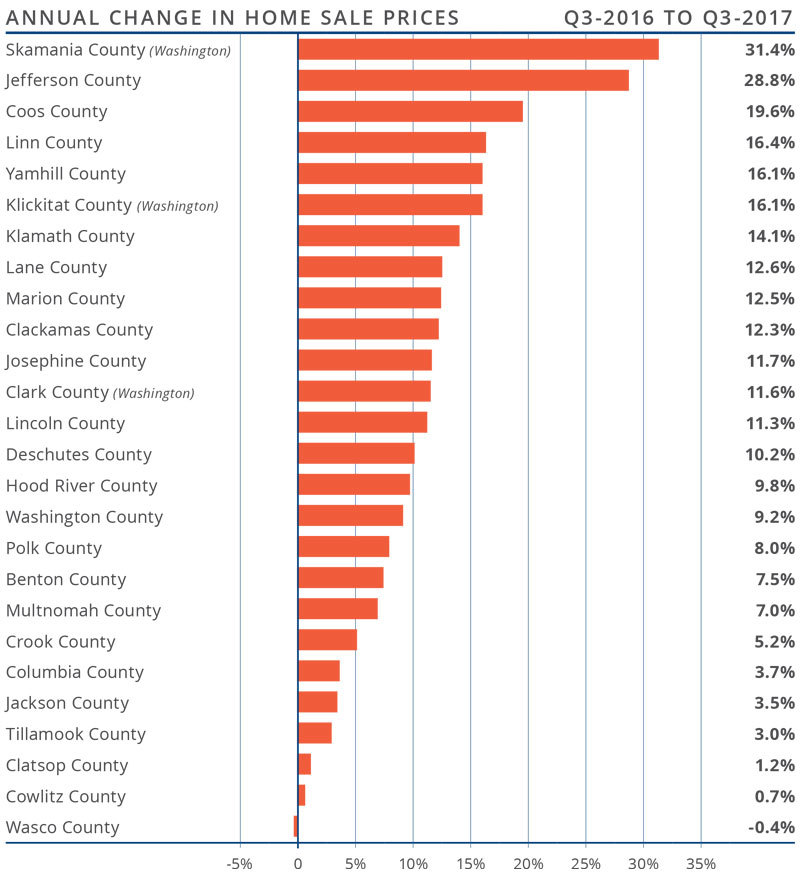
  • The average home price in the region rose 9.4% year-over-year to $368,292. This is also up 1.5% from the second quarter of 2017.
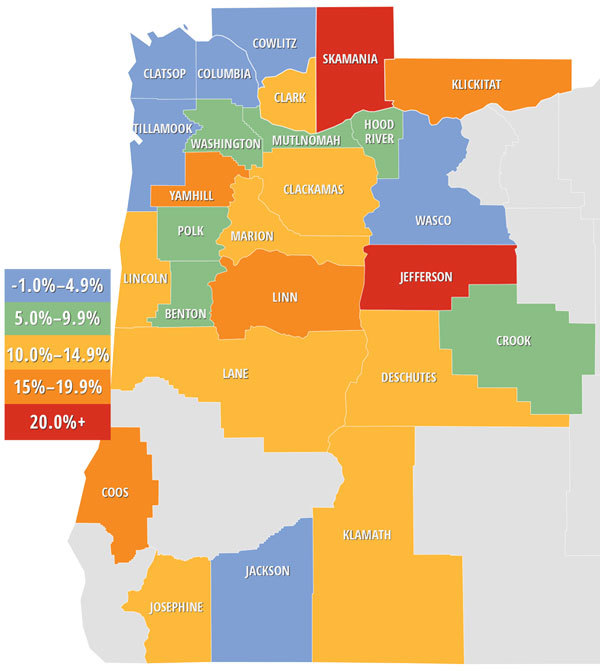
  • Skamania County led the market with the strongest annual price growth. Homes there sold for 31.4% more than a year ago.
  • All counties other than Wasco County experienced rising prices when compared to the third quarter of 2016, and a majority saw significant, double-digit increases.
  • Interest rates in the third quarter dropped by one tenth of a point from Q2, which likely allowed home price growth to rise at a faster rate than earlier in the year.


DAYS ON MARKET

  • The average number of days it took to sell a home in the region dropped by 14 days compared to the third quarter of 2016, and was down 9 days from the second quarter of this year.
  • The average time it took to sell a home in the region last quarter was 67 days.
  • Only four counties saw the length of time it took to sell a home rise compared to a year ago, but I do not see this as a major issue.
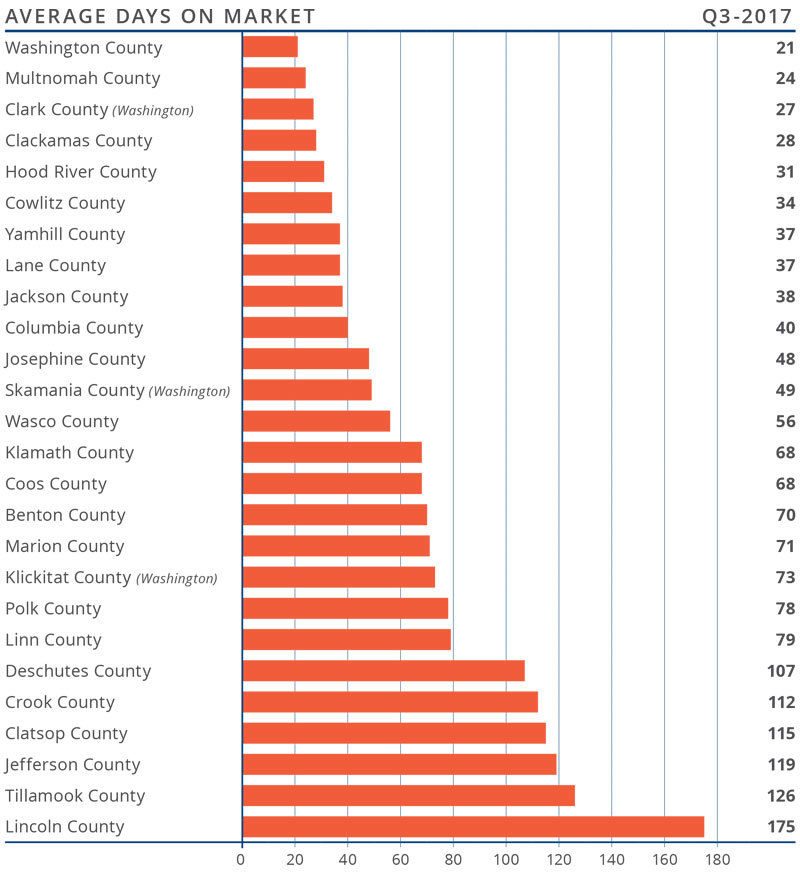
  • Homes sold the fastest in Washington and Multnomah Counties, where it took an average of just 21 and 24 days, respectively, for homes to sell.


CONCLUSIONS

The speedometer reflects the state of the region’s housing market using housing inventory, price gains, home sales, interest rates, and larger economic factors. Housing markets throughout Oregon continue to benefit greatly from the healthy regional economy.

The Oregon/SW Washington housing market remains remarkably strong and, given that inventory levels are unlikely to increase as we head toward the end of the year, sellers remain in the driver’s seat. I have, therefore, moved the needle slightly more toward sellers for the third quarter.


Matthew Gardner is the Chief Economist for Windermere Real Estate, specializing in residential market analysis, commercial/industrial market analysis, financial analysis, and land use and regional economics. He is the former Principal of Gardner Economics, and has more than 30 years of professional experience both in the U.S. and U.K.


If you are in the market to buy or sell, we can connect you with an experienced agent here.
Market News November 1, 2017

Eastern Washington Real Estate Market Update


ECONOMIC OVERVIEW

Employment growth in Washington State continues to slow as it moves closer to full employment. The state added 79,600 jobs between August 2016 and August 2017, and I still predict that we will see an additional 70,000 jobs by the end of the year.

Eastern Washington has seen a pickup in employment, with 15,307 jobs added over the past 12 months. The growth rate has slowed to 3.1% and is expected to continue falling through the balance of the year.


HOME SALES ACTIVITY

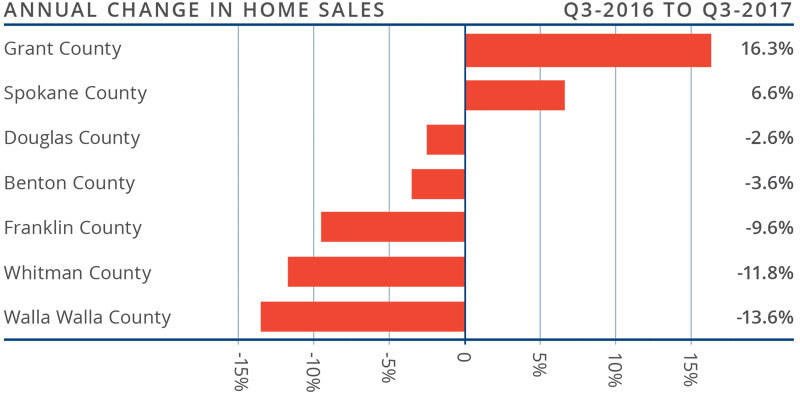
  • Similar to the second quarter, home sales throughout Eastern Washington were a mixed bag. Year-over-year home sales rose in two markets and decreased in five. In total, there were 4,165 home sales in the quarter—an increase of 2.3% over the third quarter of 2016 and 8.7% higher than the second quarter of 2017.
  • Sales rose at the fastest rate in Grant County, which increased by 16.3% versus a year ago. That said, the market is relatively small so sales can fluctuate quite dramatically.
  • Sales fell in five counties, mainly due to low inventory levels. With the number of pending sales varying across the Eastern Washington region, I expect to see sales fluctuate across all counties in the fourth quarter.
  • The number of homes for sale was down by 6.3% year-over-year. Inventory is clearly an issue and will continue to push up home prices (see more, below).


HOME PRICES

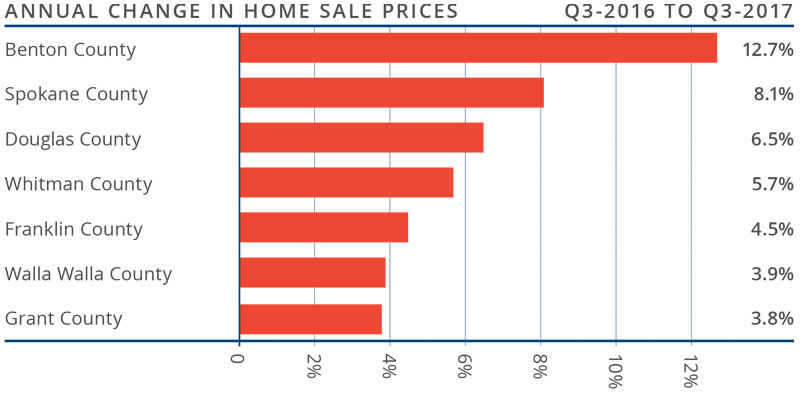
  • Year-over-year, the average home price in the region rose by 7.8% to $249,238, and prices were up by 3% compared to last quarter. Price growth has been moderating across the region, but several counties continue to see well-above-average appreciation.
  • Limited inventory continues to drive prices higher and this is unlikely to change as we move into the winter months.
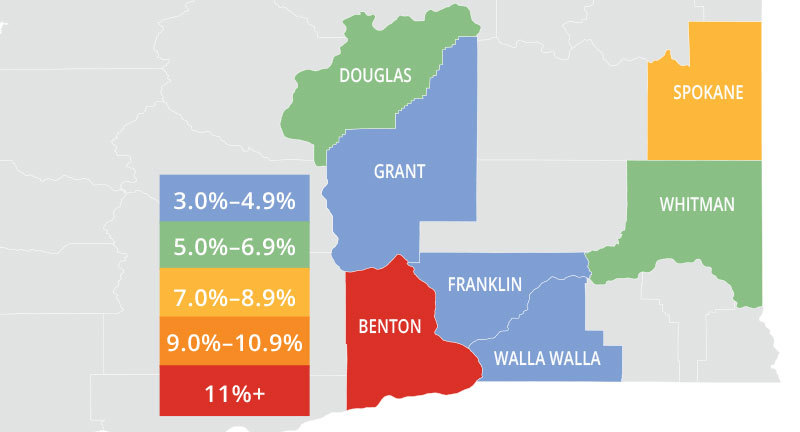
  • All of the counties in this report saw prices rise when compared to the third quarter of 2016. Benton County led the way with an increase of 12.7%.
  • The takeaway here is that home-price growth continues at above-average rates and, as long as mortgage rates remain favorable to would-be buyers, prices will continue to rise.


DAYS ON MARKET

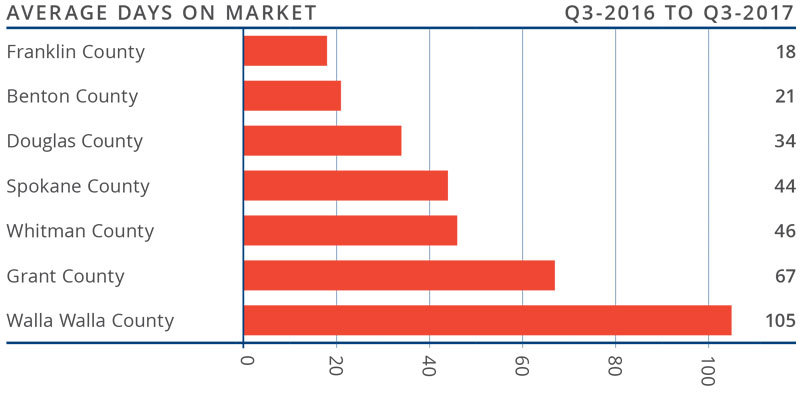
  • The average number of days it took to sell a home dropped by 15 days when compared to the third quarter of 2016.
  • The average time it took to sell a home in the region was 48 days.
  • All areas contained in this report saw the time it took to sell a home drop from the same quarter in 2016.
  • Grant and Whitman Counties had the biggest drop in days on market. Homes sold 26 days faster in Grant County and 24 days faster in Whitman County than at this time last year.


CONCLUSIONS

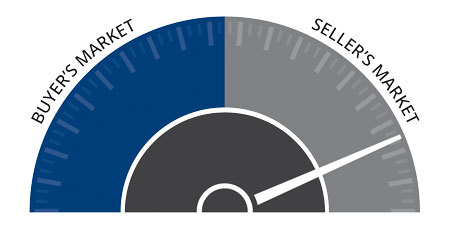
This speedometer reflects the state of the region’s housing market using housing inventory, price gains, home sales, interest rates, and larger economic factors. Given the drop in listings, increase in pending and closed sales, and rising home prices in third quarter, I moved the needle a little more in favor of sellers. The fall and winter months will continue favoring sellers with demand exceeding supply.


Matthew Gardner is the Chief Economist for Windermere Real Estate, specializing in residential market analysis, commercial/industrial market analysis, financial analysis, and land use and regional economics. He is the former Principal of Gardner Economics, and has more than 30 years of professional experience both in the U.S. and U.K.

If you are in the market to buy or sell, we can connect you with an experienced agent here.
Market News October 31, 2017

Colorado Real Estate Market Update


ECONOMIC OVERVIEW

Colorado added 45,800 non-agricultural jobs over the past 12 months, a growth rate of 1.8%. Within the metropolitan market areas included in this report, annual employment growth was seen in all areas other than Grand Junction (where employment was stable) with substantial growth seen in Fort Collins (4.6%) and Greeley (3.5%).

In August, the unemployment rate in the state was 2.2%, down from 3.1% a year ago. The lowest reported unemployment rates were again seen in Fort Collins at just 1.8%. The highest rate was in Grand Junction, at a very respectable 3.0%. It is still reasonable to assume that all the markets contained within this report will see above-average wage growth given the very tight labor market.


HOME SALES ACTIVITY

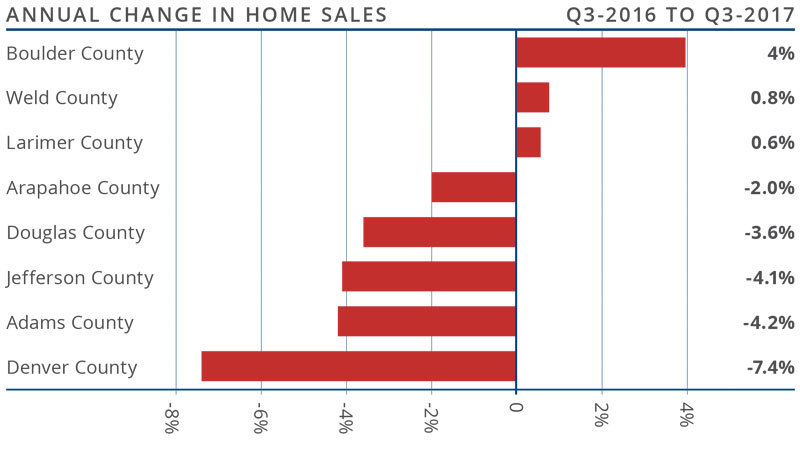
  • There were 17,140 home sales during the third quarter of 2017, which was a drop of 3.3% from the same period in 2016.
  • Sales rose the fastest in Boulder County, which saw sales grow 4% more than the third quarter of 2016. There were marginal increases in Weld and Larimer Counties. Sales fell in all the other counties contained within this report.
  • Home sales slowed due to very low levels of available inventory. Listing activity continues to trend at well below historic averages, with the total number of homes for sale in the third quarter 5.5% below the level seen a year ago.
  • The takeaway here is that sales growth has stalled due to the lack of homes for sale.


HOME PRICES

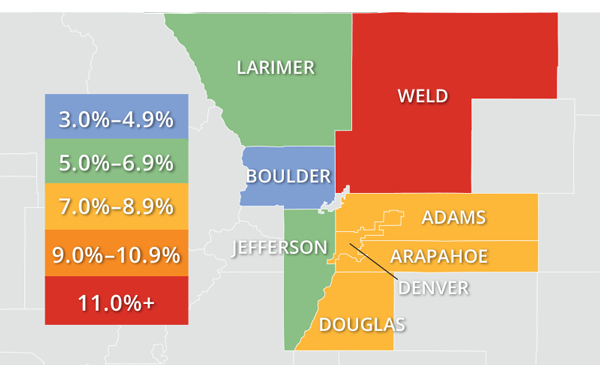
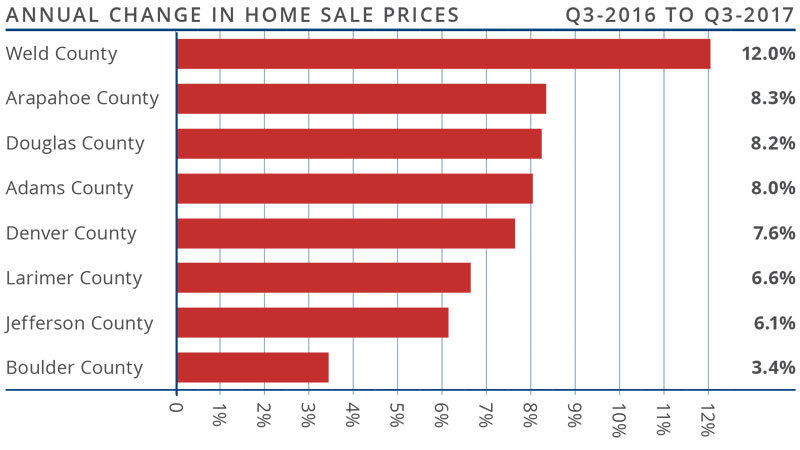
  • With substantial competition for the few available homes, prices continue to rise. Average prices were up 7.5% year-over-year to a regional average of $428,602.
  • Slower appreciation in home values was again seen in Boulder County, but the trend is still positive.
  • Appreciation was strongest in Weld County, which saw prices rise 12%.
  • Due to an ongoing imbalance between supply and demand, home prices will continue to appreciate at above-average rates for the foreseeable future.


DAYS ON MARKET

  • The average number of days it took to sell a home dropped by one day when compared to the third quarter of 2016.
  • Homes in all counties contained in this report took less than a month to sell. Adams County continues to stand out as it took an average of just two weeks to sell a home there.
  • During the third quarter, it took an average of 20 days to sell a home. This is up by 3 days compared to the second quarter of this year.
  • Demand remains strong, and well-positioned, well-priced homes continue to sell very quickly.


CONCLUSIONS

This speedometer reflects the state of the region’s housing market using housing inventory, price gains, home sales, interest rates, and larger economic factors.

In the third quarter of 2017, I have chosen to leave the needle where it was in the second quarter. Homes are still scarce; however, there is a small slowdown in price growth and a decline in both closed and pending sales. This may suggest the market is either getting weary of all the competition or that would-be buyers are possibly putting off buying until they see more choices in the number of homes for sale.


Matthew Gardner is the Chief Economist for Windermere Real Estate, specializing in residential market analysis, commercial/industrial market analysis, financial analysis, and land use and regional economics. He is the former Principal of Gardner Economics, and has more than 30 years of professional experience both in the U.S. and U.K.


If you are in the market to buy or sell, we can connect you with an experienced agent here.
More October 30, 2017

Windermere Foundation Has Raised over $1,500,000 So Far This Year!


Thanks to the generosity of Windermere agents and the community, the Windermere Foundation collected over $1,537,000 in donations through the third quarter of 2017. This is an increase of nine percent compared to this time last year! Individual contributions and fundraisers accounted for 62 percent of the donations, while 38 percent came from donations through Windermere agent commissions. So far, we have raised a total of $34,643,324 in donations since 1989.


Each Windermere office has its own Windermere Foundation fund account that they use to make donations to organizations in their communities. Year to date, a total of $1,179,202 has been disbursed to non-profit organizations dedicated to providing services to low-income and homeless families throughout the Western U.S.


One organization that has been the recipient of Windermere Foundation funds is SafeHouse of the Desert. Safehouse of the Desert provides a “safe” residential environment for children between the ages of 11 to17 years of age. These young people are the victims of physical and emotional abuse, homeless runaways, victims of human trafficking, emotionally unstable home environments and various other unsafe situations. The facility shelters the children from perpetrators and offers education, therapy, artistic expression, coupled with training for future jobs, skills and coaching in being responsible and making wise choices.


The 16 Windermere Homes & Estates offices  in Southern California (Alpine, Big Bear, Del Mar, Escondido, Fallbrook, La Jolla, Palm Desert, Palm Valley, Plaza at Aviara, Rancho Bernardo, Rancho Bernardo-The Plaza, Santaluz, Scripps Ranch, South Carlsbad-Aviara, Temecula, and Trilogy) pooled their funds together and donated $5,000 for SafeHouse’s emergency shelter. They presented the donation check to SafeHouse on October 11, where they also spent the day cleaning, landscaping, organizing storage rooms, and providing breakfast and lunch at Harrison House, the 15-unit complex located behind the shelter and houses its transitional living program.


When asked why they chose this organization to help, Selina Sullivan, Regional Administrator for Windermere Homes & Estates said, “We recognize that the youth of today represents the future adults of tomorrow. Asking ourselves what we would want that future to look like, we realized that by contributing to this organization, we were impacting that future and contributing to the welfare of ALL children. In a world that is often covered in darkness, we wanted to serve as a beacon for others and to contribute to future generations.”


Generous donations to the Windermere Foundation over the years have enabled Windermere offices to continue to support local non-profits like SafeHouse of the Desert. If you’d like to help support programs for low-income and homeless families in your community, please click on the Donate button.


To learn more about the Windermere Foundation,

visit http://www.windermere.com/foundation.

Market News October 30, 2017

Southern California Real Estate Market Update


ECONOMIC OVERVIEW

The counties covered by this report—Los Angeles, San Diego, San Bernardino, Orange, and Riverside—added 108,500 new jobs between August 2016 and August 2017. As a result, the unemployment rate dropped from 5.5% to 5.3%. As noted in last quarter’s report, employment growth in the Southern California market continues to taper, but the economy is still expanding and this will certainly continue through the balance of the year and into 2018.


HOME SALES ACTIVITY

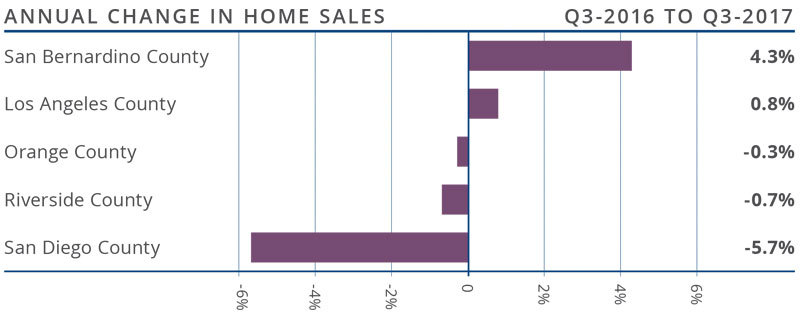
  • There were 51,906 home sales in the third quarter of this year. This was 0.5% lower than the same period in 2016, and 4.8% lower than in the second quarter of this year.
  • The number of homes for sale remains well below the levels seen a year ago (-17.6%), and was 2.7% lower than the second quarter of 2017.
  • Home sales were mixed, with reasonable growth in San Bernardino County but only modest gains in Los Angeles County. There was a small decline in sales in Orange and Riverside Counties but a more substantial drop in San Diego County. This continues a trend seen over the past two quarters that can again be attributed to woefully low levels of inventory.
  • There was an average of 34,753 active listings in the third quarter, well below what is needed to get us to a balanced market.


HOME PRICES

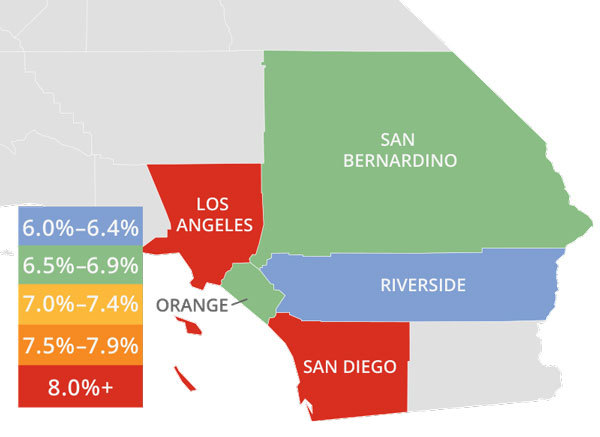
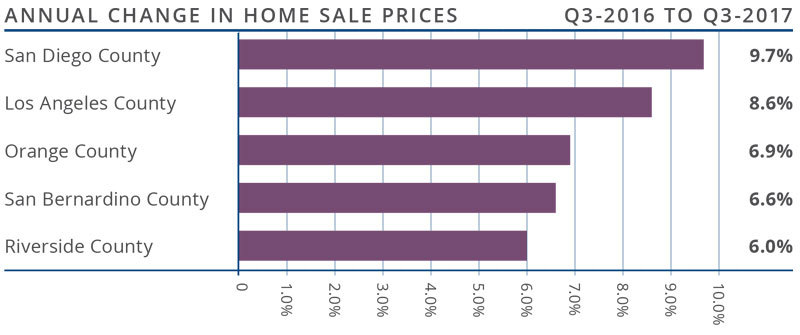
  • Year-over-year, average prices in the region rose by 7.9% but are just 0.3% higher than in the second quarter of this year.
  • Home prices in the region continue to rise, but the pace of growth is decreasing. I do not consider this to be a concern at present, but we must keep an eye on housing affordability. Home prices cannot continue to rise at precipitous rates and a softening in growth has likely started, which is not necessarily a bad thing.
  • San Diego County had the greatest annual appreciation in home values (+9.7%) and there were solid price increases across the rest of the region.
  • Pending home sales dropped by 9% compared to the second quarter—likely due to a lack of inventory. Demand should remain robust, but, with fewer listings than needed, I anticipate a slight cooling in the markets for the balance of the year.


DAYS ON MARKET

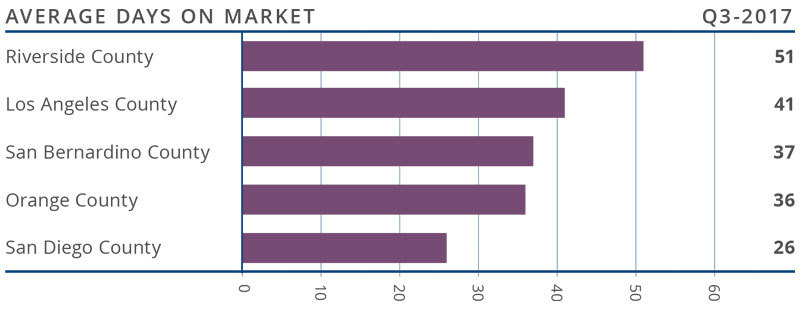
  • The average time it took to sell a home in the region was 38 days. This is a drop of 16 days compared to the third quarter of 2016, and 3 days shorter than the second quarter of 2017.
  • The biggest drop in the number of days it took to sell a home was in Orange and San Bernardino Counties, where it took 24 fewer days to sell a home compared to the same period last year.
  • Homes in San Diego County continue to sell at a faster rate than other markets in the region. In the third quarter, it took an average of just 26 days to sell a home, which is 4 fewer days than a year ago.
  • All five counties saw a drop in the amount of time it took to sell a home between the third quarter of 2016 and the third quarter of 2017.


CONCLUSIONS

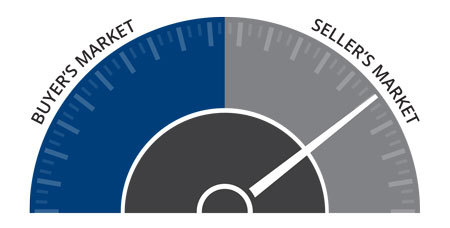
The speedometer reflects the state of the region’s housing market using housing inventory, price gains, home sales, interest rates, and larger economic factors.

Southern California continues to add new households and job formation is still positive, which magnifies demand for housing. Mortgage rates remain historically low and low inventory continues to drive prices higher as demand exceeds supply. The number of homes for sale in the region is still well below the levels needed for a balanced market. Given all of these factors, I have moved the needle a little more in favor of sellers.


Matthew Gardner is the Chief Economist for Windermere Real Estate, specializing in residential market analysis, commercial/industrial market analysis, financial analysis, and land use and regional economics. He is the former Principal of Gardner Economics, and has more than 30 years of professional experience both in the U.S. and U.K.


If you are in the market to buy or sell, we can connect you with an experienced agent here.
Market News October 27, 2017

Nevada Real Estate Market Update


ECONOMIC OVERVIEW

Employment in the Las Vegas metropolitan area continues to moderate from the substantial growth of the past few years, but the region still experienced impressive annual employment growth of 3%. The market has added 28,400 new jobs over the past 12 months. With this growth in employment, the unemployment rate came in at 5.2%.
Las Vegas continues to grow its job base. This has led to solid growth in the civilian labor force, which is now at an all-time high. Given the fact that the area is approaching full employment, I expect to see wages rise at above-average rates. This will allow home price growth to continue, for the time being.


HOME SALES ACTIVITY

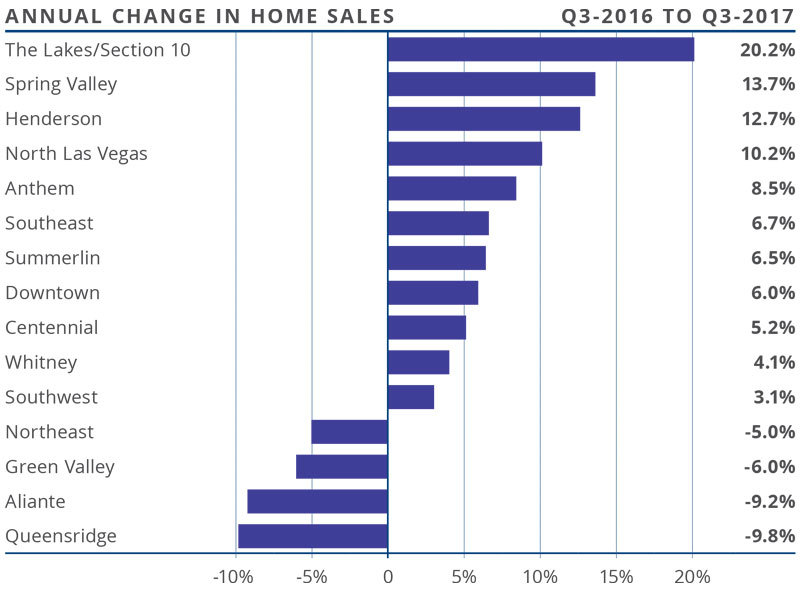
  • A total of 10,018 homes sold in the third quarter, which was an increase of 5.3% over the same period a year ago. With a solid 7.6% increase in pending sales, a strong number of closings are expected to occur in the fourth quarter.
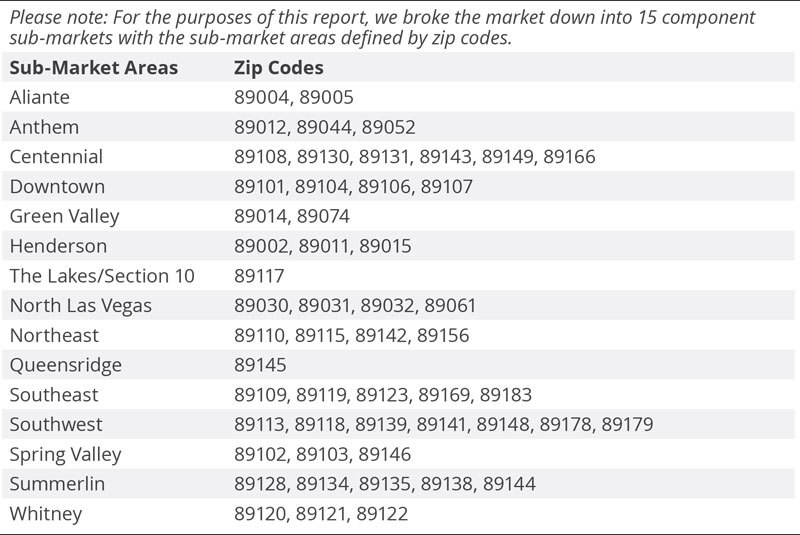
  • Home sales were not as strong in the Queensridge and Aliante sub-markets, but this is due to very low inventory levels rather than a drop in demand.
  • Sales rose substantially in several of the sub-markets within this report, but the greatest increase was seen in The Lakes/Section 10 market area, which saw an annual increase of 20.2%.
  • Inventory levels remain remarkably low, with 36.3% fewer homes for sale than the same period in 2016. Listing activity is unlikely to grow in the fourth quarter, so the market will remain out of balance.


HOME PRICES

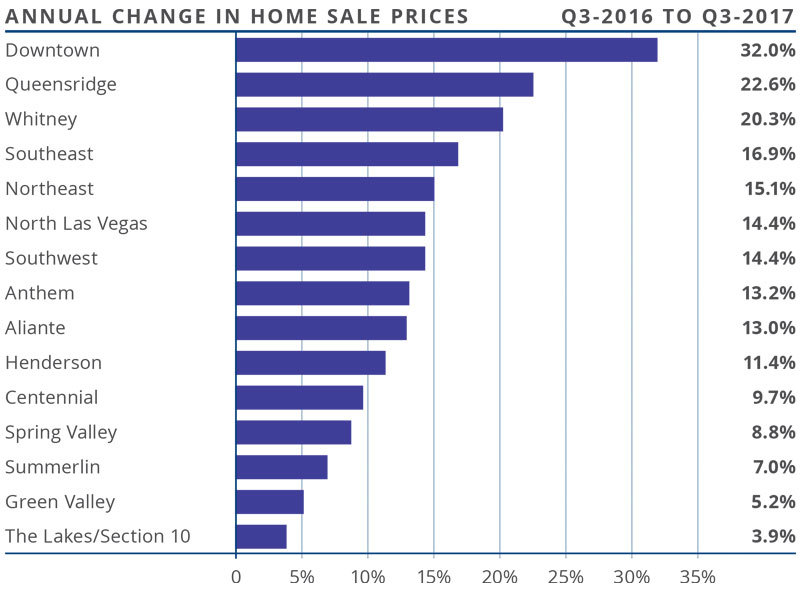
  • Home prices in the area have risen by 12.7% year-over-year, to an average of $268,958.
  • Double-digit gains were seen in an additional eight neighborhoods, and only five sub-markets saw prices rise by less than 10%.
  • Prices rose in all sub-markets compared to the third quarter of 2016. The strongest growth was in the more-affordable Downtown sub-market, where prices were up by 32%.
  • I continue to believe that we will see above-average price growth in the greater Las Vegas market as robust job growth continues and inventory levels remain very constrained.


DAYS ON MARKET

  • The average time it took to sell a home in the region dropped by 19 days compared to the second quarter of 2016.
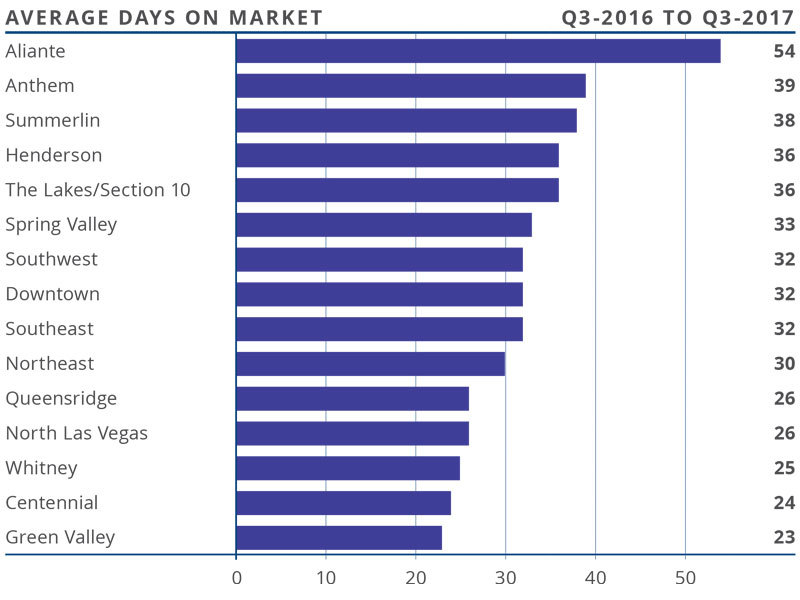
  • It took an average of just 32 days to sell a home in the third quarter.
  • The length of time it took to sell a home dropped in all the Las Vegas sub-markets compared to a year ago.
  • The greatest drop in days-on-market was in the Aliante sub-market, which dropped by 40 days when compared to the same quarter in 2016.


CONCLUSIONS

The speedometer reflects the state of the region’s housing market using housing inventory, price gains, home
sales, interest rates, and larger economic factors. Employment growth in Clark County, although slightly less robust than in the second quarter, is still gaining strength. This, in concert with low inventory levels and competitive mortgage rates, will lead to continued above-average price growth. Given these factors, I have moved the speedometer a little further in favor of sellers.


Matthew Gardner is the Chief Economist for Windermere Real Estate, specializing in residential market analysis, commercial/industrial market analysis, financial analysis, and land use and regional economics. He is the former Principal of Gardner Economics, and has more than 30 years of professional experience both in the U.S. and U.K.


If you are in the market to buy or sell, we can connect you with an experienced agent here.

Market News October 26, 2017

Western Washington Real Estate Market Update


ECONOMIC OVERVIEW

The Washington State economy added 79,600 new jobs over the past 12 months—an impressive growth rate of 2.4%, and well above the national growth rate of 1.2%. However, as we anticipated in last quarter’s report, we continue to see a modest slowdown in the growth rate as the state grows closer to full employment. Growth has been broad-based, with expansion in all major job sectors other than Aerospace (a function of a slowdown at Boeing). Given the current rate of expansion, I am raising my employment forecast and now predict that Washington will add 81,000 new jobs in 2017.

Given the robust job market, it is unsurprising that the state unemployment rate continues to fall. The current unemployment rate in Washington State is 4.6% and we are essentially at full employment. Additionally, all counties contained within this report reported either a drop or stability in their unemployment rate from a year ago. I maintain my belief that the Washington State economy will continue to outperform the U.S. as a whole. Given such a strong expansion, we should also expect solid income growth across Western Washington.


HOME SALES ACTIVITY

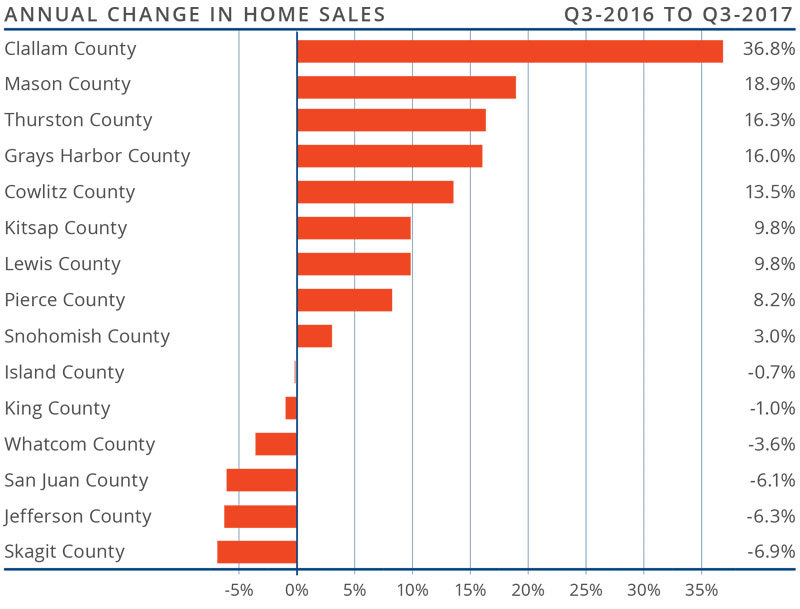
  • There were 25,312 home sales during the third quarter of 2017. This is an increase of 3.6% over the same period in 2016.
  • Clallam County maintains its number one position for sales growth over the past 12 months. Only four other counties saw double-digit gains in sales. This demonstrates continuing issues with the low supply of listings. There were modest declines in sales activity in six counties.
  • The market remains remarkably tight with listing inventory down by 14.2% when compared to the third quarter of 2016. But inventory is up a significant 32% compared to the second quarter of this year. Pending sales rose by 5.2% over the same quarter a year ago, which suggests that closings in Q4 will still be robust.
  • The key takeaway from this data is that inventory is still very low, and the situation is unlikely to improve through the balance of the year.


HOME PRICES

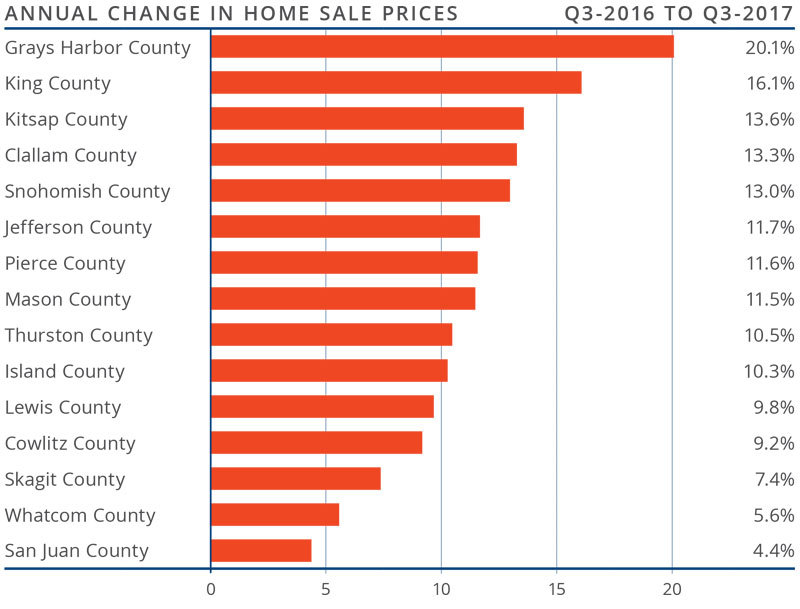
  • Given tight supply levels, it is unsurprising to see very solid price growth across the Western Washington counties. Year-over-year, average prices rose 12.3% to $474,184. This is 0.9% higher than seen in the second quarter of this year.
  • With demand far exceeding supply, price growth in Western Washington continues to trend well above the longterm average. As I do not expect to see the new home market expand at any significant pace, there will be continued pressure on the resale market, which will cause home prices to continue to rise at above-average rates.
  • When compared to the same period a year ago, price growth was most pronounced in Grays Harbor County where sale prices were 20.1% higher than the third quarter of 2016. Nine additional counties experienced double-digit price growth.
  • Mortgage rates in the quarter continue to test the lows of 2017, and this is unlikely to change in the near-term. This will allow home prices to escalate further but I expect we will see rates start to rise fairly modestly in 2018, which could slow price growth.


DAYS ON MARKET

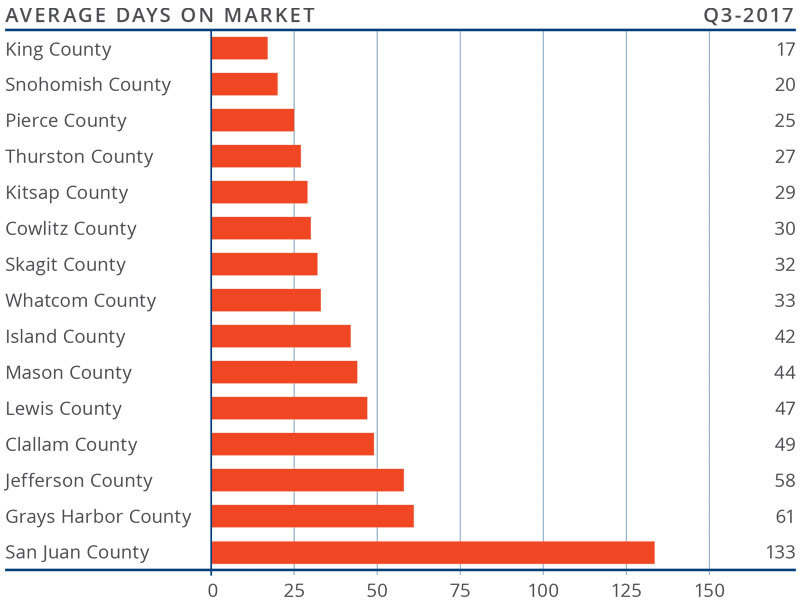
  • The average number of days it took to sell a home in the quarter dropped by eight days when compared to the same quarter of 2016.
  • King County continues to be the tightest market, with homes taking an average of 17 days to sell. Every county except San Juan saw the days on market drop from the same period a year ago.
  • This quarter, it took an average of 43 days to sell a home. This is down from the 51 days it took in the second quarter of 2016 and down by 8 days from the second quarter of this year.
  • At some point, inventory will start to grow and this will lead to an increase in the average time it takes to sell a house. However, I do not expect that to happen at any time soon. So we remain in a seller’s market.


CONCLUSIONS

This speedometer reflects the state of the region’s housing market using housing inventory, price gains, home sales, interest rates, and larger economic factors. For the third quarter of 2017, I have left the needle at the same point as the second quarter. Though price growth remains robust, sales activity has slowed very slightly and listings jumped relative to the second quarter. That said, the market is very strong and buyers will continue to find significant competition for accurately priced and well-located homes.





 

Matthew Gardner is the Chief Economist for Windermere Real Estate, specializing in residential market analysis, commercial/industrial market analysis, financial analysis, and land use and regional economics. He is the former Principal of Gardner Economics, and has more than 30 years of professional experience both in the U.S. and U.K.


If you are in the market to buy or sell, we can connect you with an experienced agent here.

More October 23, 2017

How to Decide Where to Put the Toilet in Your New Bathroom

From the beginning of your bathroom renovation, your plumbers and framers need to know where your toilet should go — whether it’ll be mounted on the floor or wall and where the water supply should be positioned. If that’s not complicated enough, wall paneling, tile installation, shower doors and baseboards will all factor into the equation for your toilet location, too.

Don’t feel overwhelmed — finding the right professional can help you get through the technical stuff, and having a handle on these tips and tricks can help you find a spot for your toilet that works for you and your bathroom’s design.


Toilet 1: Enviable Designs Inc, original photo on Houzz


Take Note of Wall Panels and Baseboards

Most toilets are roughed-in 12 inches from the finished wall. This works well for most floor-mounted toilets.

Tip: Some toilets require floor anchoring clips — another limiting factor because it can interrupt radiant heating. Talk with your floor heating contractor before choosing this type of toilet to make sure that the anchors won't mess with water lines or heating cables.


Toilet 2: kbcdevelopments, original photo on Houzz


What a classic bathroom — I love it. The look and feel of the toilet fits in with the baseboard and crown molding perfectly. I would guess the baseboard wraps behind the toilet for a seamless look.

Tip: It’s very hard to paint behind toilet tanks like this. I suggest painting the wall and installing the baseboard before putting the toilet in.


Plan Out Your Shower First

If you’re planning on having a barrier-free shower near your toilet, consider installing a wall-mount toilet to make waterproofing measures simpler for your contractor.


Toilet 3: Beyond Beige Interior Design Inc, original photo on Houzz


Shower doors also play a role in your toilet’s location. To meet building codes, a shower door needs to open both in and out, so you’ll want to take the door swing into account when choosing your toilet spot.

Tip: Work with your contractor to play with different toilet and door locations when finalizing your shower’s size. Use a piece of string and a marker to draw an arc on the floor to show the door swing. This will help you visualize where a toilet can fit comfortably.


Decide on a Wall Mount or Floor Mount

Installing a wall-mount toilet is a chore. All of them require a wall carrier to support the toilet, and some have very exact water supply positions, which allows for little flexibility in location. However, the look is seamless and modern and has some functional benefits as well.

Tip: A standard toilet is 14 to 15 inches high from the finished floor to the top of the bowl (excluding the fold-down seat). Consider a higher measurement of 16 to 18 inches for your wall-mounted toilet if you plan on aging into your golden years. It may seem high now, but you'll be thankful for the added height later.


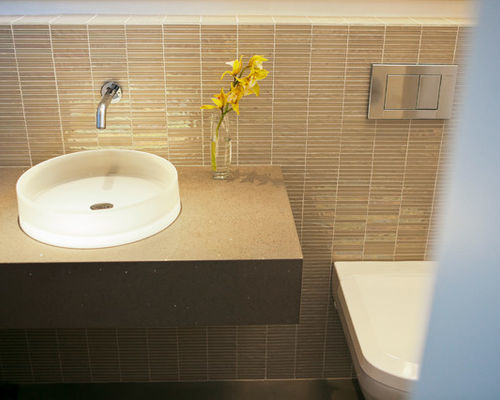
Toilet 4: kbcdevelopments, original photo on Houzz


Wall-mounted toilets are great for smaller spaces because the tank is inside the wall. In this installation, you can see that the builder brought the wall forward for this wall-mounted toilet's water carrier to create a ledge above the sink and toilet for the flush activator. Usually these ledges are larger, and I love the smaller version here.


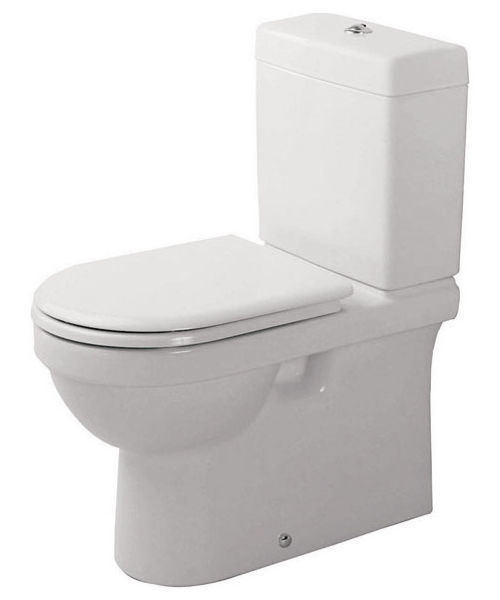
Toilet 5: Fixture Universe, original photo on Houzz


During installation, most toilets are dropped in over two bolts and the bolts are trimmed and capped to keep the toilet in place. Many clean line toilets (which are great for easy cleaning) have separate mounting blocks, and the toilet is screwed into place from the two sides. This Duravit toilet has those great clean lines, but the same easy installation as a regular toilet.

Tip: We have a 10-flush rule with any new toilet. After it’s installed but before using any silicone, we flush the toilet 10 times back to back to make sure everything’s functioning properly.

Note that floor-mounted and wall-mounted toilets come in regular and elongated versions. If you're tight on space, look for a regular or smaller model.


Toilet 6: Bill Fry Construction – Wm. H. Fry Const. Co., original photo on Houzz


Pay Attention to Any Recesses or Compartments

In this photo, the recessed shelves above the toilet allow for more headroom and save space. This clever use of space was no doubt made possible by good planning. Make sure your entire building crew knows about spaces like this ahead of time for a successful build.

Tip: Check that your builders spray paint the framing around these niche locations before any wires, pipes or insulation is installed.

If you are planning a toilet compartment, the NKBA recommends a space about 36 by 66 inches, with a 32-inch-wide doorway. The absolute minimum would be 30 by 60 inches, which leaves just 15 inches of space on either side of the toilet rough-in.

Tip: If you're worried about the bottom of your toilet scratching your floor tile or hardwood during installation, consider using scraps of Kerdi waterproofing membrane on the bottom of the toilet. Anything that will stick to the toilet bottom — extra peel-'n-stick tiles, scraps of linoleum, etc. — can work.


By JW, Houzz

Living October 18, 2017

When Things Go Bump in the Night

It’s almost Halloween; the time of year when people decorate their homes with haunting embellishments and spooky décor. Bats, spiders, and rodents are all good and fun when they’re made of plastic, but when you have the real thing taking up residence in your home, it’s no treat. Here are some tips for making sure these frightening critters don’t make your house their permanent home.


Blood Suckers

While they may not turn into vampires in real life, preventing a bat infestation is actually good for your health. That’s because bats are a known carrier of rabies and an accumulation of their droppings can cause lung problems in humans. Bats can enter your home through holes less than an inch wide, and when they do, they often find the attic to be very accommodating to their needs. So, how do you keep them from settling in? Start by checking your roof and siding for any gaps. Check your attic for any signs of infestation, including: brown stains around any openings in your siding or roof (from oil on their skin), droppings, or strange sounds coming from the attic. Ghosts aren’t the only ones who like it up there.


To prevent or rid your home of bats follow these tips:

  • Get rid of the bats now, so they can find alternative shelter before hibernation season in the winter.
  • Check with local pest control companies; in some states it is illegal to exterminate bats.
  • Locate the point of entry.
  • Hire a professional to evacuate the bats.
    • As mentioned above, bats can cause health problems; hire a professional who has experience and the right equipment. There are humane options available.
  • Prevent re-entry by sealing any openings.
  • Use mothballs to prevent re-nesting. Bats have a tendency to return to previous nesting sites, so this may need to be repeated.


Creepy Crawlies

In lists of common phobias, more than thirty percent of adults report fearing spiders, right behind public speaking and death. Most spiders that you find in your home are perfectly harmless; however, that doesn’t mean you want to share your space with them. To be on the safe side, there are some measures you can take to protect yourself from our little eight legged friends. Even a bite from a harmless spider can cause infections with itchy, red skin. In most cases, it can be treated by washing it with cool, soapy water, elevation, and an ice pack. Of course, if it shows signs of getting worse, your next step should be calling your doctor. Spider varieties that you should avoid include: Hobo spiders, Black Widows, Brown Recluses, and the Yellow Sac spider. These spiders are poisonous and can cause a number of symptoms from vomit to necrotic lesions. According to experts, spiders very rarely cause death in humans; however, if you are bit by a venomous spider you should seek immediate medical attention (and bring the spider remains with you, if possible).


Here are some tips to reduce spiders in your home:

  • Kill spiders on sight.
  • Place non-poisonous spider traps with non-toxic attractants and glue in areas where spiders are commonly found and in corners.
  • Be careful with common insect repellent and spider sprays, these can be toxic and harmful to children and pets.
  • Spiders can be deterred with essential oils: lavender, chestnut, clover leaf, and coconut.
  • Use ultrasonic devices.


Rodents:

The most effective way to prevent mice and rat infestation is to keep them out of your home in the first place. Mice can get through a gap as small as a quarter of an inch, so thoroughly inspecting the foundation and interior of your home for entrance points and sealing any cracks or holes is a great way to start. Rodents are also excellent at tracking food sources. Keep all food, including pet food and pantry items in secure bins and jars.

If you have found evidence of mice or rats (generally droppings or urine) take caution. Rodent secretions can be hazardous, and can spread salmonella or hanta virus. There are multiple methods for removing rodents from your home, including traps, poison bates, electronic and sonic devises and, a house cat, or professional exterminator.


If you are getting rid of the critters on your own you will want to follow these steps:

  • Identify their food source(s), entry points, and common routes around and through your home.
  • Remove food source with secure packaging that cannot be chewed through, such as glass containers.
  • Seal all entry points with wire mesh.
  • Place sonic devises, traps, poison, or other deterrents in the pathway of the rodents.
  • Use caution, make sure poison or exposed traps are not accessible to children or pets.
  • If you find urine, droppings, or a dead mouse you will want to spray the surface and mouse with a bleach/water solution. Using gloves and a face mask, remove the rodent and wipe all surfaces.
  • If you have identified a large quantity of rodents, contact a professional for removal and clean up.
  • You may need to take extra measures to ensure the removal is permanent by changing components of your back yard, replacing siding, or upgrading building materials to prevent outdoor nesting and re-infestation.


Image courtesy of Stuart Miles at FreeDigitalPhotos.net