Market News February 1, 2023

Q4 2022 Montana Real Estate Market Update

The following analysis of select counties of the Montana real estate market is provided by Windermere Real Estate Chief Economist Matthew Gardner. We hope that this information may assist you with making better-informed real estate decisions. For further information about the housing market in your area, please don’t hesitate to contact your Windermere Real Estate agent.


Regional Economic Overview

The slowing job growth trend that started in the summer of last year continued into the fall, with employment increasing only 1.3% year over year. With only 6,500 jobs added over the past 12 months, annual job gains are now below 10,000, a pace we have not seen since the pandemic started having an impact on the job market. Regionally, the picture was the same: all metro areas added jobs but at a far slower pace. Montana’s unemployment rate in November was 2.9%, matching the level of the year prior. In the metro areas covered in this report, the lowest jobless rate was in Billings at 2.1%, followed by Missoula at 2.2%, and Great Falls at 2.5%.

Montana Home Sales

In the final quarter of 2022, 1,203 homes sold in the counties covered by this report. This was a 27% decline from the fourth quarter 2021 and down 40.5% compared to the third quarter of 2022.

Listing activity was 19.3% lower than the same period the prior year and 26.1% lower than in the third quarter. Although a drop in listings is expected as the region enters the winter months, the decline from a year ago was unexpected.

Year over year, sales increased in Broadwater County, were flat in Jefferson and Ravalli counties, and fell in the balance of the markets included in this report. Compared to the third quarter of 2022, sales rose in Broadwater, Jefferson, and Madison counties but fell in all other markets.

Pending sales fell 52.8% from the previous quarter. This may be a function of lower supply levels, but I am noticing that listing prices are starting to pull back in some areas. Higher mortgage rates may have started to affect prices.
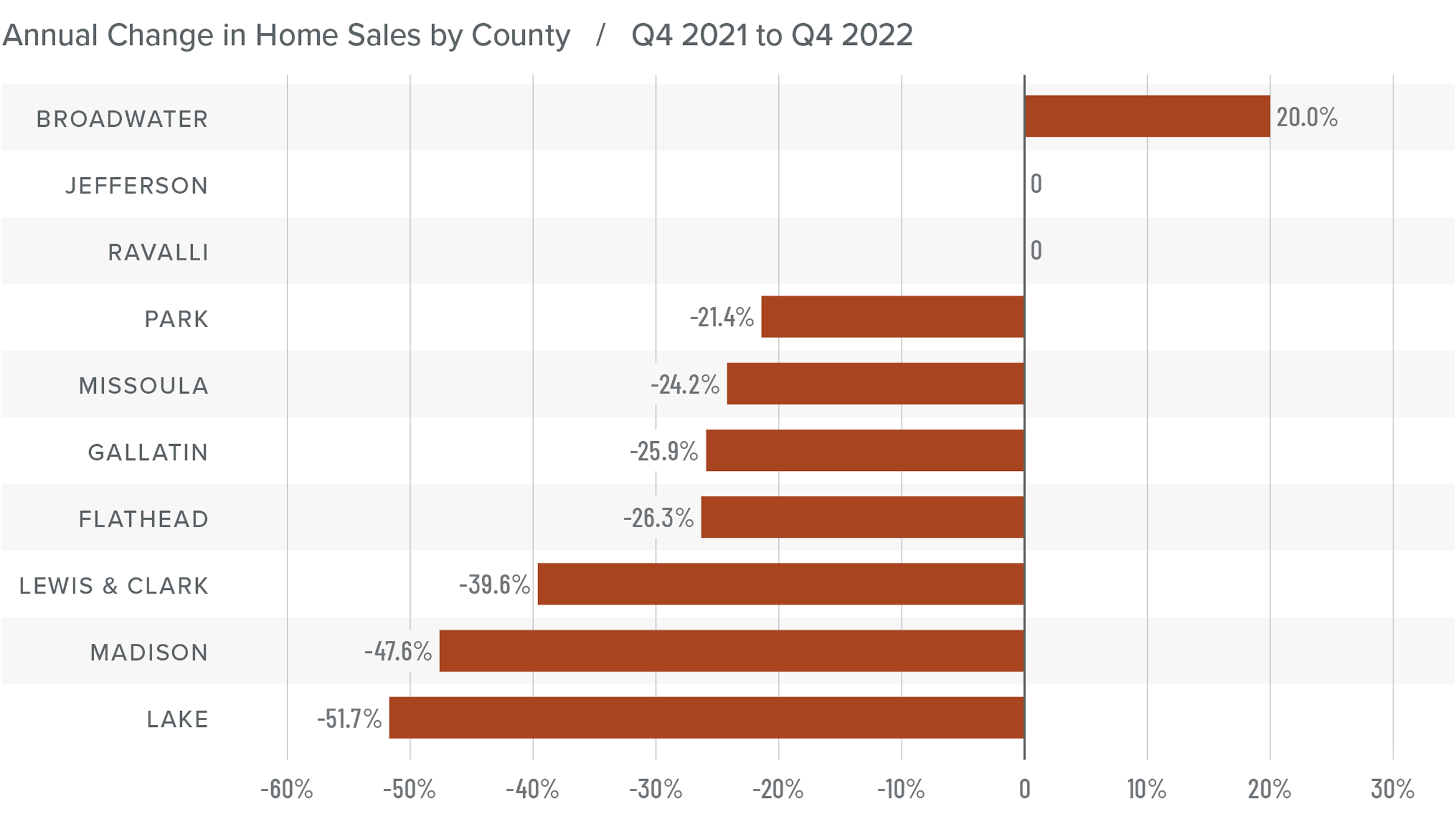
A bar graph showing the annual change in home sales for various counties in Montana from Q4 2021 to Q4 2022. Most counties have a negative percentage year-over-year change. Here are the totals: Broadwater at 20%, Jefferson and Ravalli at 0%, Park -21.4%, Missoula -24.2%, Gallatin at -25.9%, Flathead at -26.3%, Lewis and Clark at -39.6%, Madison at -47.6, and Lake at -51.7%.

Montana Home Prices

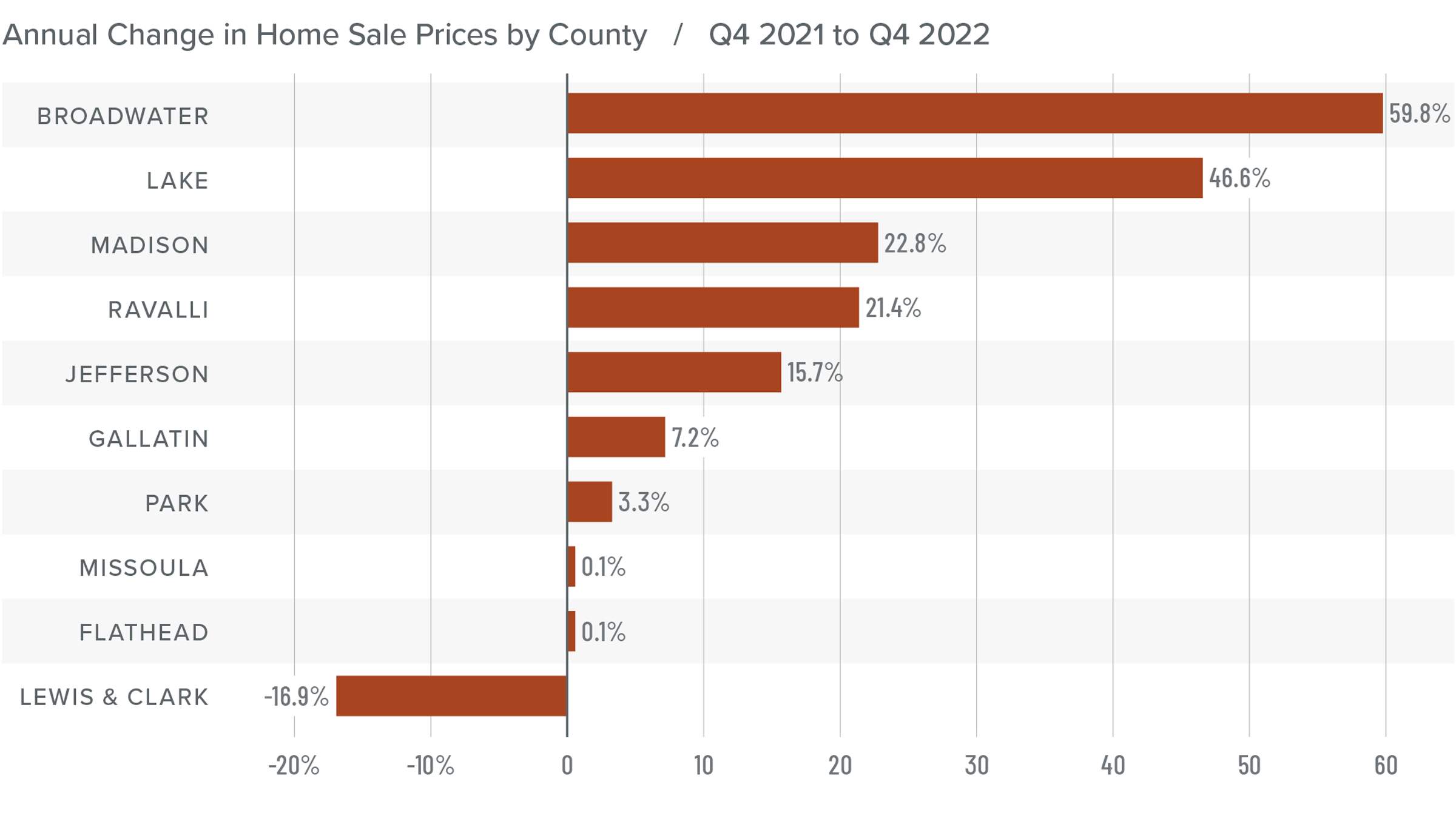
Home prices were up 5.5% year over year to an average of $783,588. Prices were 10.5% higher than in the third quarter of 2022.

I still expect price growth to slow as we move through 2023. The question is whether prices will experience a tangible fall or if they will be able to hold onto modest gains while waiting for mortgage rates to fall, which would stimulate demand.

In many parts of the country, prices have started to soften due to higher mortgage rates, so it was surprising to see the region’s home prices increase from the third quarter. While median listing prices were higher across the board, they did drop in Broadwater, Ravalli, Park, and Gallatin counties.

The Montana housing market is faring much better than most of the country. Whether this can continue, however, is still uncertain.
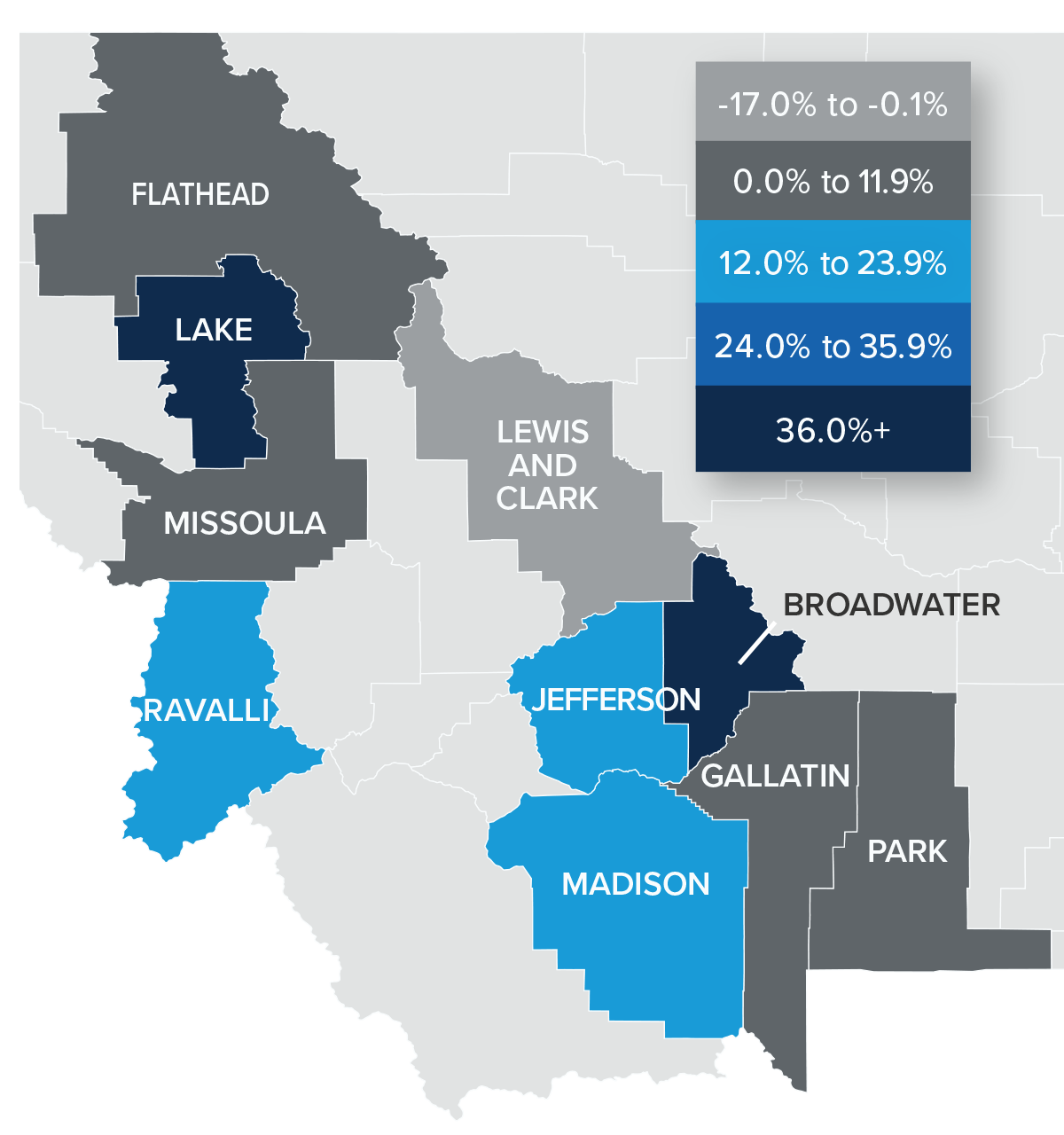
A map showing the real estate home prices percentage changes for various counties in Montana. Different colors correspond to different tiers of percentage change. Lewis and Clark has a percentage change in the -17% to -0.1% range, Flathead, Missoula, Gallatin, and Park are in the 0% to 11.9% change range, Ravalli, Jefferson, and Madison are in the 12% to 23.9% range, and Lake and Broadwater are in the 36%+ change range.

A bar graph showing the annual change in home sale prices for various counties in Montana from Q4 2021 to Q4 2022. Broadwater County tops the list at 59.8%, followed by Lake at 46.6%, Madison at 22.8%, Ravalli at 21.4%, Jefferson at 15.7%, Gallatin at 7.2%, Park at 3.3%, Missoula and Flathead at 0.1%, and Lewis and Clark at -16.9%.

Mortgage Rates

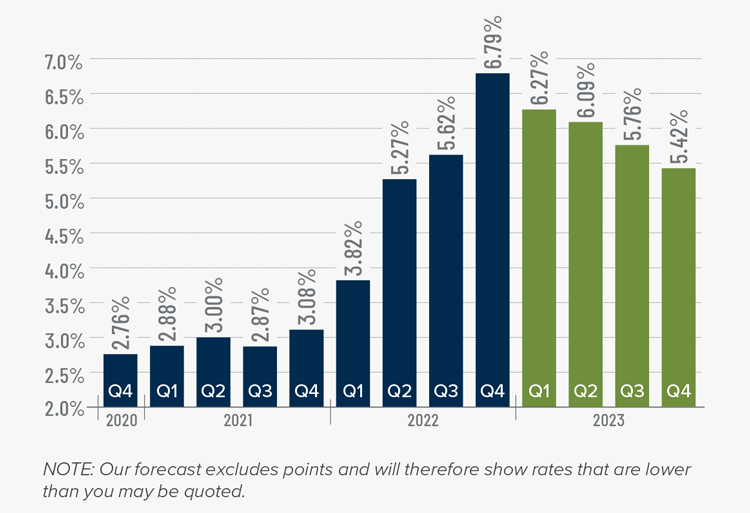
Rates rose dramatically in 2022, but I believe that they have now peaked. Mortgage rates are primarily based on the prices and yields of bonds, and while bonds take cues from several places, they are always impacted by inflation and the economy at large. If inflation continues to fall, as I expect it will, rates will continue to drop.

My current forecast is that mortgage rates will trend lower as we move through the year. While this may be good news for home buyers, rates will still be higher than they have become accustomed to. Even as the cost of borrowing falls, home prices in expensive markets will probably fall a bit more to compensate for rates that will likely hold above 6% until early summer.
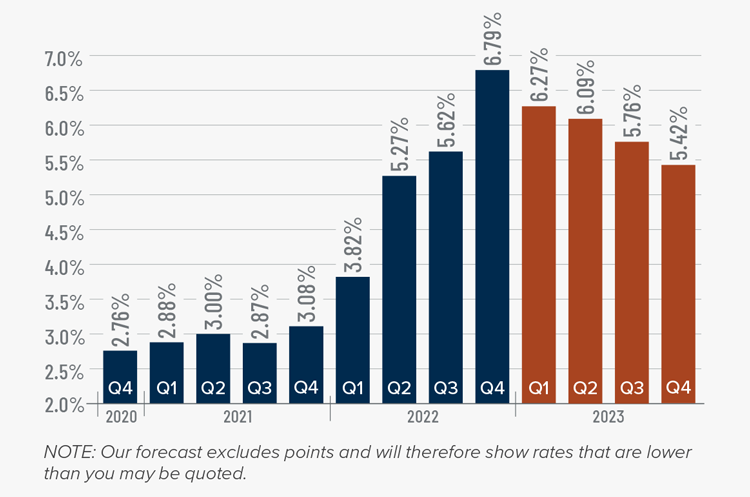
A bar graph showing the mortgage rates from Q4 2020 to the present, as well as Matthew Gardner's forecasted mortgage rates through Q4 2023. After the 6.79% figure in Q4 2022, he forecasts mortgage rates dipping to 6.27% in Q1 2023, 6.09% in Q2 2023, 5.76% in Q3 2023, and 5.42% in Q4 2023.

Montana Days on Market

The average time it took to sell a home rose eight days compared to the same period the prior year.

Homes sold fastest in Gallatin County while homes in Broadwater County took the longest time to sell. Missoula, Lake, Lewis and Clark, and Jefferson counties saw market time fall year over year. Market time rose in the rest of the region.

During the fourth quarter, it took an average of 73 days to sell a home in the markets covered by this report.

Compared to the third quarter of 2022, average market time rose in all counties other than Lake, where it took an average of four fewer days to find a buyer.
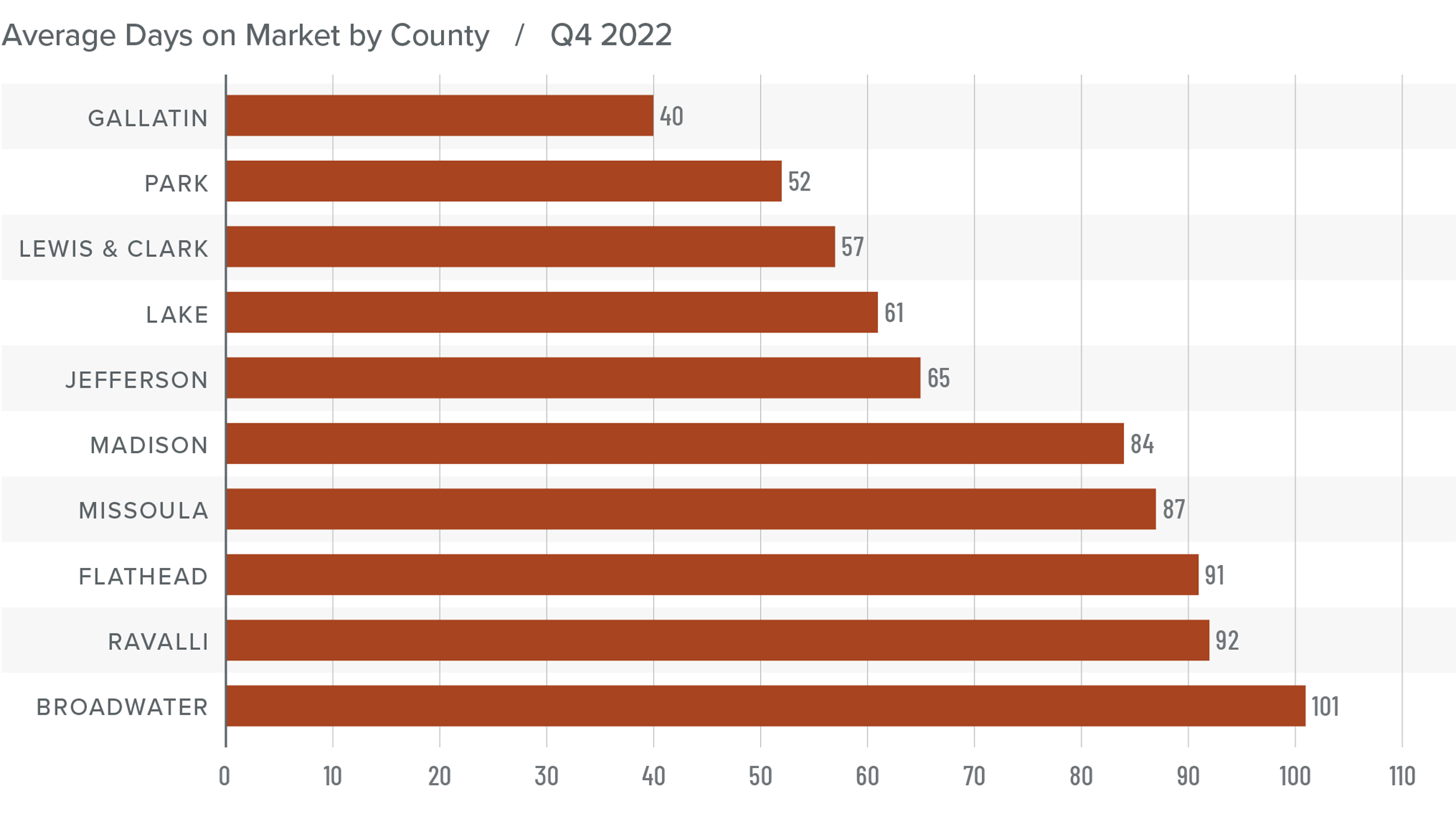
A bar graph showing the average days on market for homes in various counties in Montana for Q4 2022. Gallatin County has the lowest DOM at 40, followed by Park at 52, Lewis and Clark at 57, Lake at 61, Jefferson at 65, Madison at 84, Missoula at 87, Flathead at 91, Ravalli at 92, and Broadwater at 101.

Conclusions

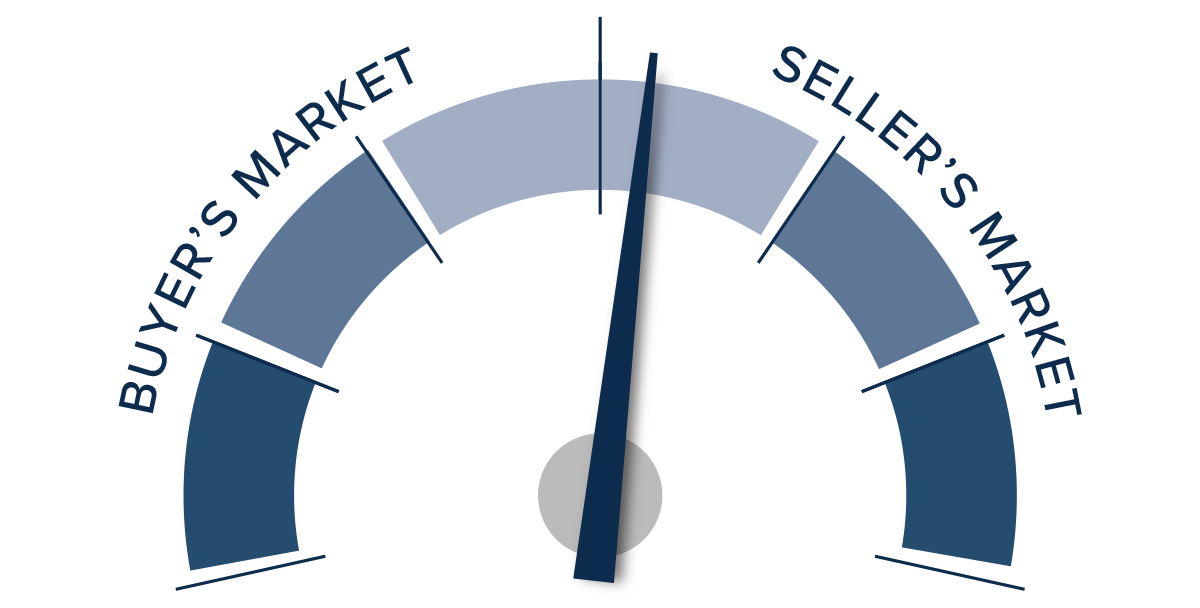
This speedometer reflects the state of the region’s real estate market using housing inventory, price gains, home sales, interest rates, and larger economic factors.

So far, the Montana housing market has been unaffected by the significantly higher financing costs that have led home prices to fall across much of the country. Whether the region can continue to move through 2023 without seeing any substantial drop in home values remains to be seen, but it appears to be in a far better position today than most states. Pending sales in the quarter fell across most counties contained in this report, but whether this can be attributed to slower demand or simply the fact that inventory levels have pulled back is also unclear.
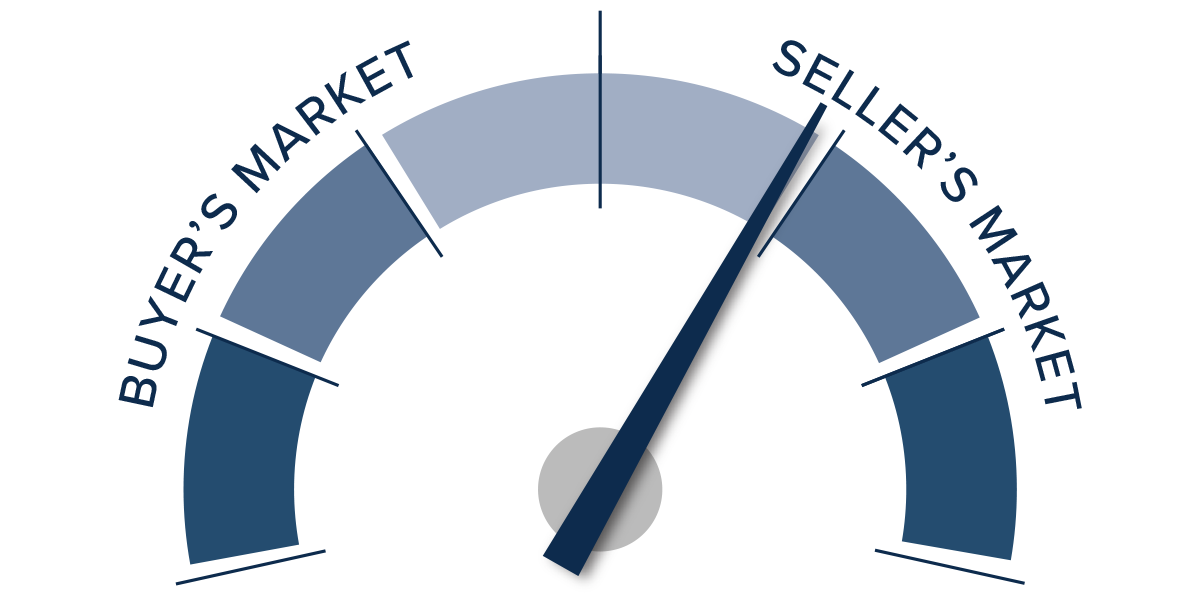
A speedometer graph indicating a balanced market favoring sellers in Montana in Q4 2022.

What is clear is that the market remains resilient. For this reason I am not moving the needle more in favor of buyers, unlike most markets across the U.S. Instead, I am leaving it in the same position as the third quarter of 2022. Hopefully, the spring market will provide more clarity about what we can expect from the rest of the year.

About Matthew Gardner

Matthew Gardner - Chief Economist for Windermere Real Estate

As Chief Economist for Windermere Real Estate, Matthew Gardner is responsible for analyzing and interpreting economic data and its impact on the real estate market on both a local and national level. Matthew has over 30 years of professional experience both in the U.S. and U.K.

In addition to his day-to-day responsibilities, Matthew sits on the Washington State Governors Council of Economic Advisors; chairs the Board of Trustees at the Washington Center for Real Estate Research at the University of Washington; and is an Advisory Board Member at the Runstad Center for Real Estate Studies at the University of Washington where he also lectures in real estate economics.
Market News February 1, 2023

Q4 2022 Idaho Real Estate Market Update

The following analysis of select counties of the Idaho real estate market is provided by Windermere Real Estate Chief Economist Matthew Gardner. We hope that this information may assist you with making better-informed real estate decisions. For further information about the housing market in your area, please don’t hesitate to contact your Windermere Real Estate agent.


Regional Economic Overview

The pace of job growth in Idaho continues to slow. That said, with the addition of 23,800 jobs over the past 12 months, the pace of growth was still an impressive 3%. The Boise metro area grew at a more modest 2.5% rate. The job market there is clearly showing signs of fatigue, adding only 200 new jobs over the past three months. Idaho’s unemployment rate was 3%, down modestly from 3.2% a year ago. In the Boise metro area, 2.6% of the labor force was unemployed, down from 2.8% a year ago. Even if the country enters a recession this year, I expect that Idaho will still add jobs, but at a much slower pace than we have seen since the post-pandemic recovery started. My current forecast shows that the state will add about 114,000 jobs in 2023, which suggests that employment growth will slow to around 2%.

Idaho Home Sales

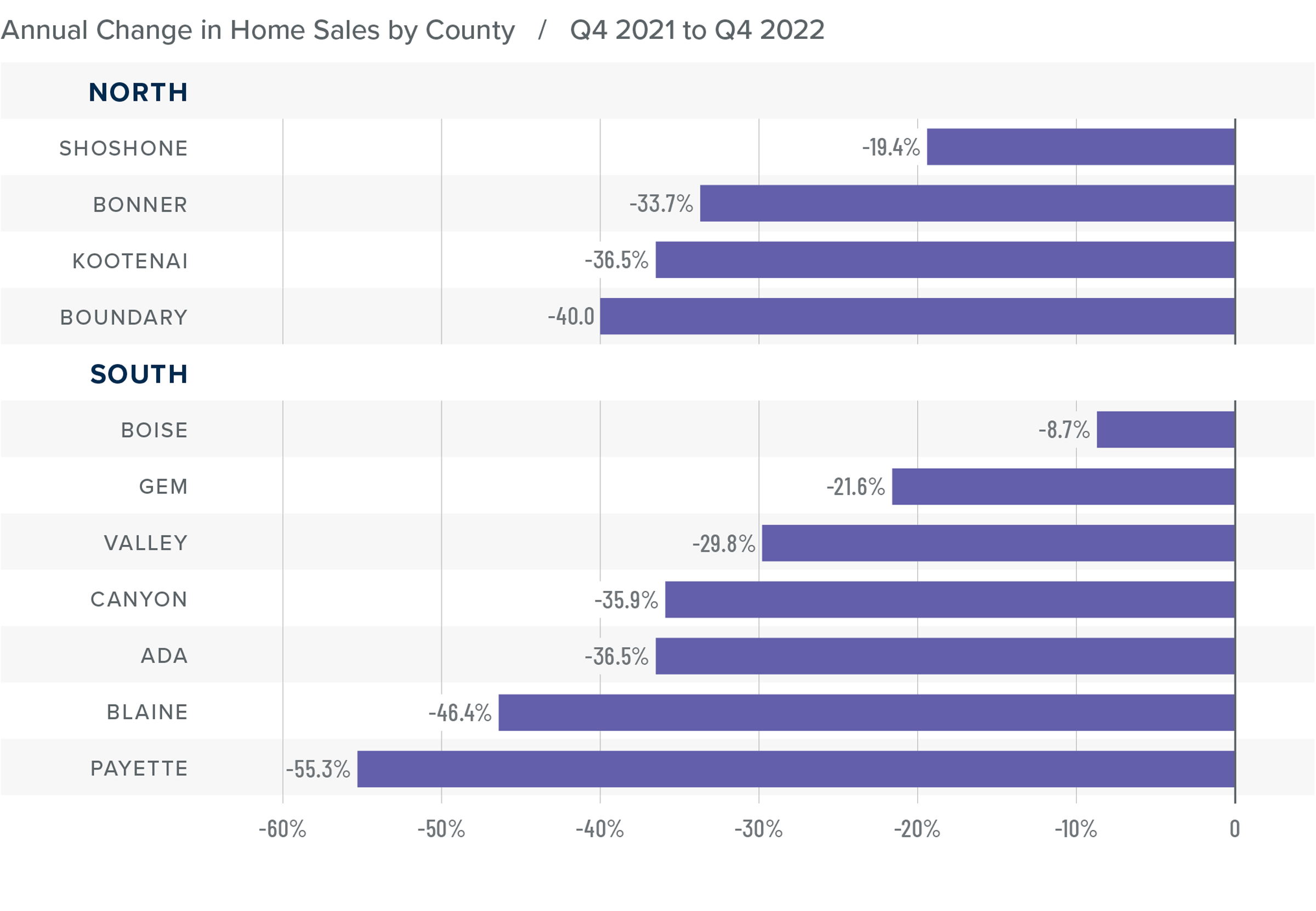
In the final quarter of 2022, 4,777 homes sold, which was 36.1% lower than in the fourth quarter of 2021 and down 8.9% from the third quarter of 2022.

Listing activity fell 12.7% from the third quarter, but was 52.9% higher than fourth quarter of 2021.

Compared to the same period a year prior, sales fell in all markets covered by this report. Relative to the third quarter of 2022, sales rose in all Northern Idaho markets but fell in every southern market other than Gem County.

Pending sales were 19.2% lower than in the third quarter of the year, which means it’s unlikely that the first quarter of 2023 will show any substantial increase in sales.

A bar graph showing the annual change in home sales for various counties in North and South Idaho from Q4 2021 to Q4 2022. All counties have a negative percentage year-over-year change. Here are the totals for North Idaho: Shoshone at -19.4%, Bonner at -33.7%, Kootenai at -36.5%, and Boundary -40%. In South Idaho: Boise at -8.7%, Gem at -21.6%, Valley at -29.8%, Canyon at -35.9%, Ada at -36.5%, Blaine at -46.4%, and Payette at -55.3%.

Idaho Home Prices

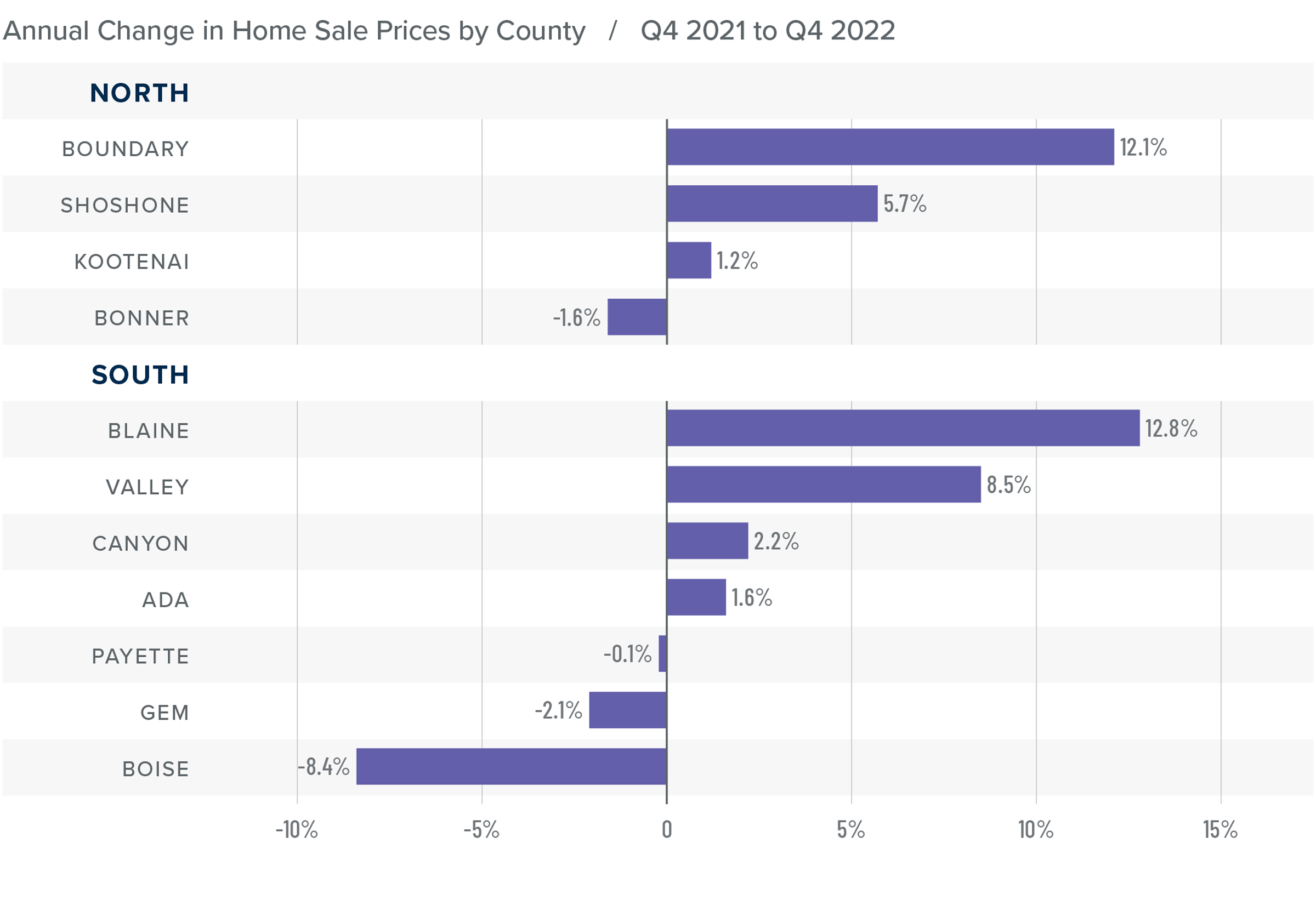
The average home price in the region rose 1.4% year over year to $614,027. Relative to the third quarter of 2022, prices fell 1.8%.

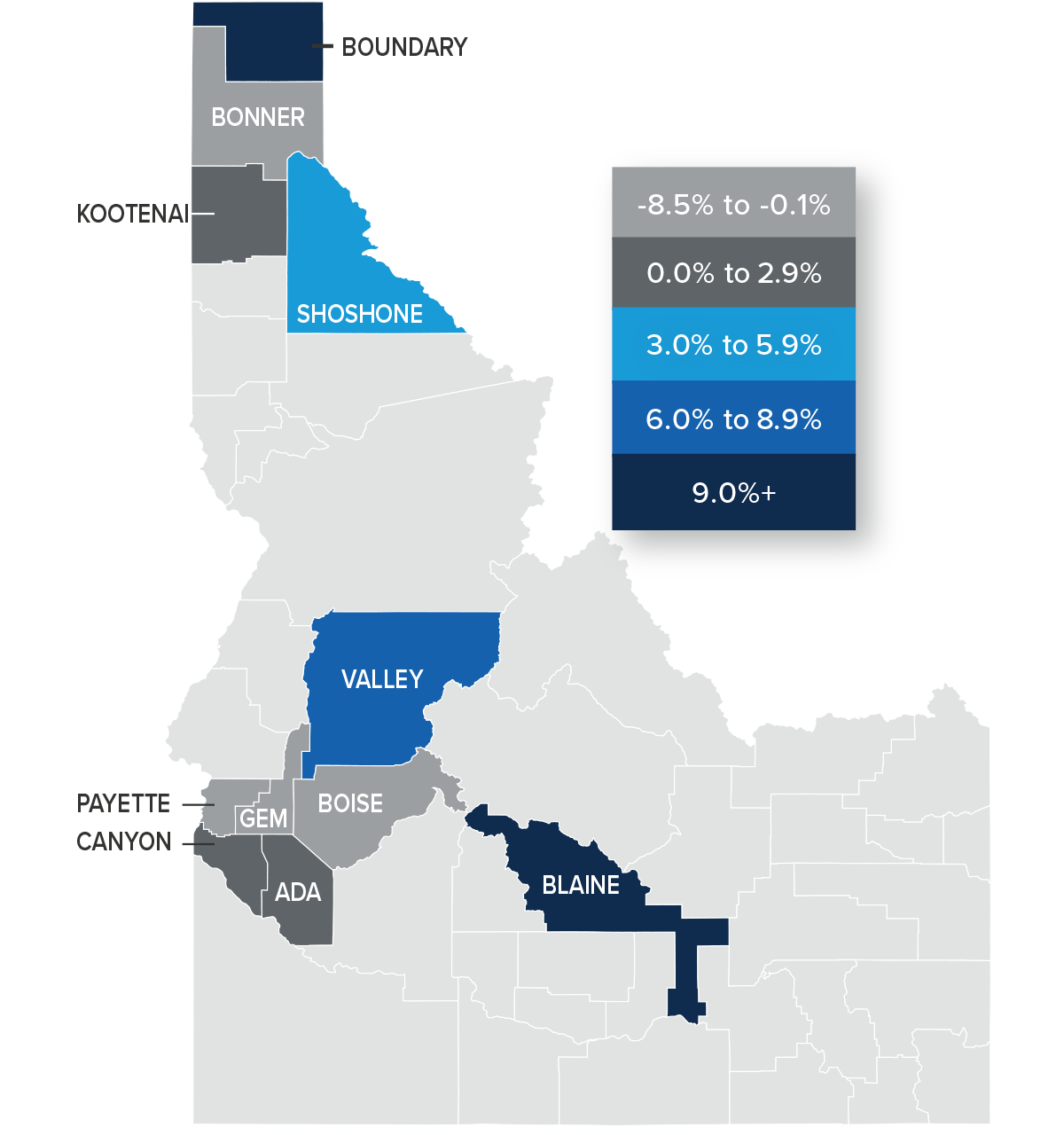
Compared to the third quarter, prices rose in Bonner and Boundary counties in the northern part of the state. In Southern Idaho, prices fell in all counties other than Blaine and Valley.

Year over year, prices rose by double digits in Boundary County and were higher in all Northern Idaho counties except Bonner. In the southern part of the state, prices rose in four counties but fell in Payette, Gem, and Boise counties.

Median listing prices in the fourth quarter were down 1.6% from the third quarter, but they were higher in Blaine, Valley, and Kootenai counties.

A map showing the real estate home prices percentage changes for various counties in Idaho. Different colors correspond to different tiers of percentage change. Bonner, Boise, Gem, and Payette have a percentage change in the -8.5% to -0.1% range, Kootenai, Ada, and Canyon are in the 0% to 2.9% change range, Shoshone is in the 3% to 5.9% range, Valley is in the 6% to 8.9% change range, and Blaine is in the 9%+ range.

A bar graph showing the annual change in home sale prices for various counties in North and South Idaho from Q4 2021 to Q4 2022. In North Idaho, Boundary County tops the list at 12.1%, followed by Shoshone at 5.7%, Kootenai at 1.2%, and Bonner at -1.6%. In South Idaho, it's Blaine at 12.8%, Valley at 8.5%, Canyon at 2.2%, Ada at 1.6%, Payette at -0.1%, Gem at -2.1%, and Boise at -8.4%.

Mortgage Rates

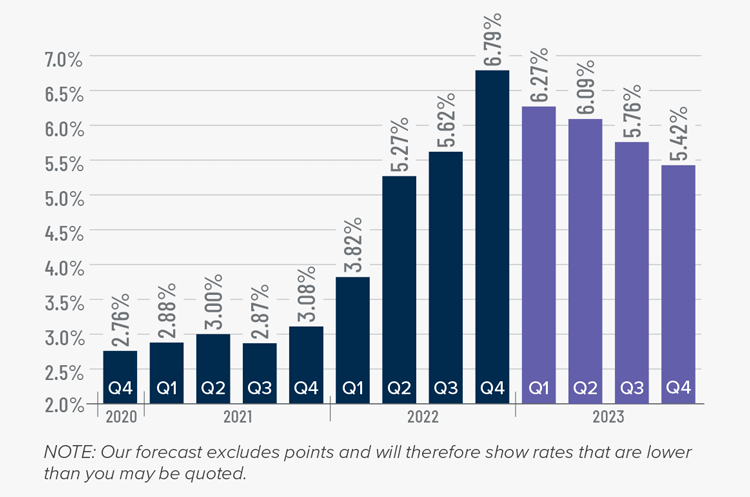
Rates rose dramatically in 2022, but I believe that they have now peaked. Mortgage rates are primarily based on the prices and yields of bonds, and while bonds take cues from several places, they are always impacted by inflation and the economy at large. If inflation continues to fall, as I expect it will, rates will continue to drop.

My current forecast is that mortgage rates will trend lower as we move through the year. While this may be good news for home buyers, rates will still be higher than they have become accustomed to. Even as the cost of borrowing falls, home prices in expensive markets will probably fall a bit more to compensate for rates that will likely hold above 6% until early summer.

A bar graph showing the mortgage rates from Q4 2020 to the present, as well as Matthew Gardner's forecasted mortgage rates through Q4 2023. After the 6.79% figure in Q4 2022, he forecasts mortgage rates dipping to 6.27% in Q1 2023, 6.09% in Q2 2023, 5.76% in Q3 2023, and 5.42% in Q4 2023.

Idaho Days on Market

The average time it took to sell a home in the region rose 14 days compared to the same quarter of 2021. Average days on market rose 21 days from the third quarter of 2022.

Year over year, days on market rose in all Southern Idaho counties. In Northern Idaho, market time rose in every county other than Shoshone.

It took an average of 86 days to sell a home in Northern Idaho and 63 days in the southern counties covered by this report.

Homes again sold the fastest in Ada County in Southern Idaho and in Shoshone County in the northern part of the state.

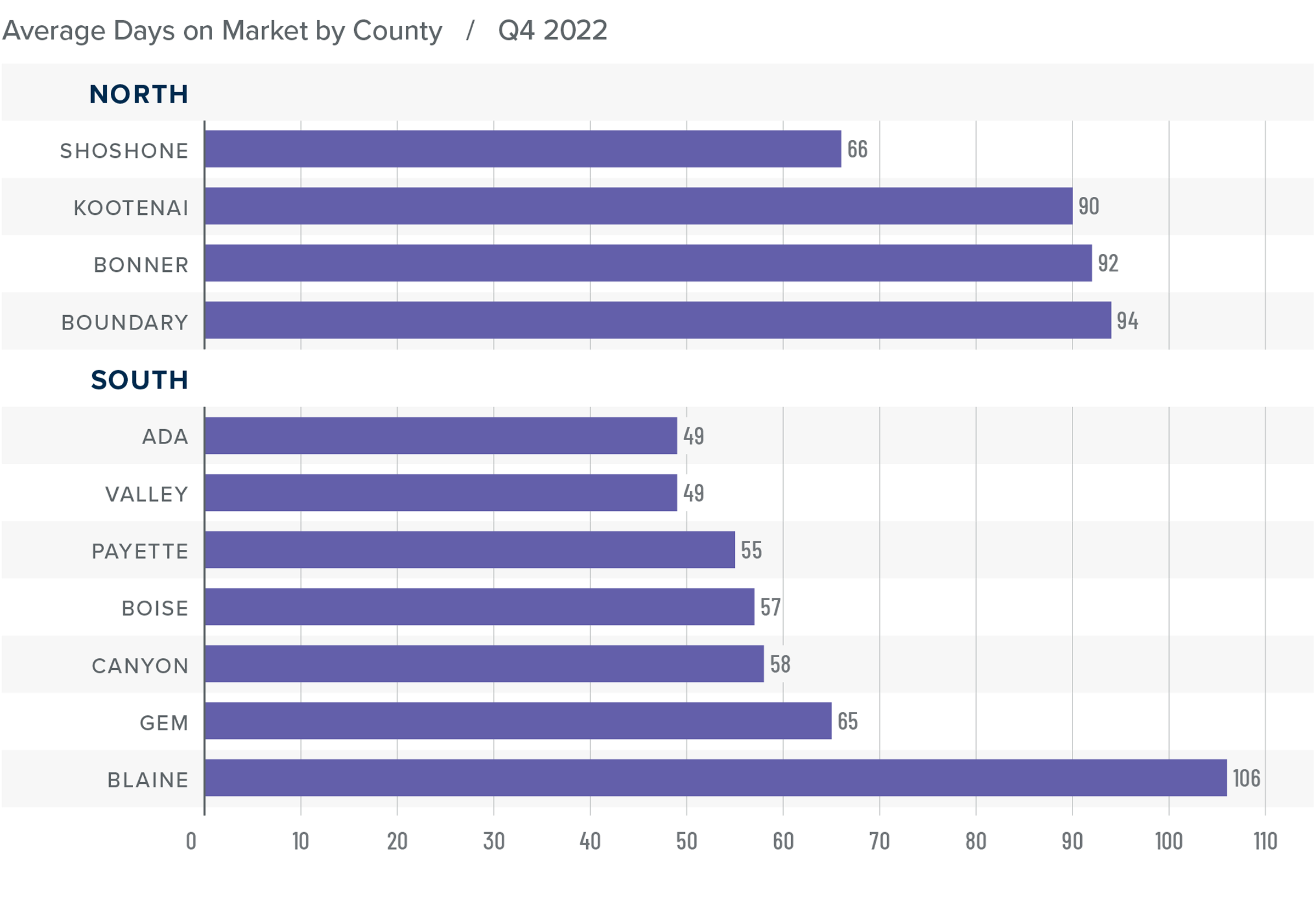
A bar graph showing the average days on market for homes in various counties in North and South Idaho for Q4 2022. In North Idaho, Shoshone County has the lowest DOM at 66, followed by Kootenai at 90, Bonner at 92, and Boundary at 94. In South Idaho, it's Ada and Valley at 49, Payette at 55, Boise at 57, Canyon at 58, Gem at 65, and Blaine at 106.

Conclusions

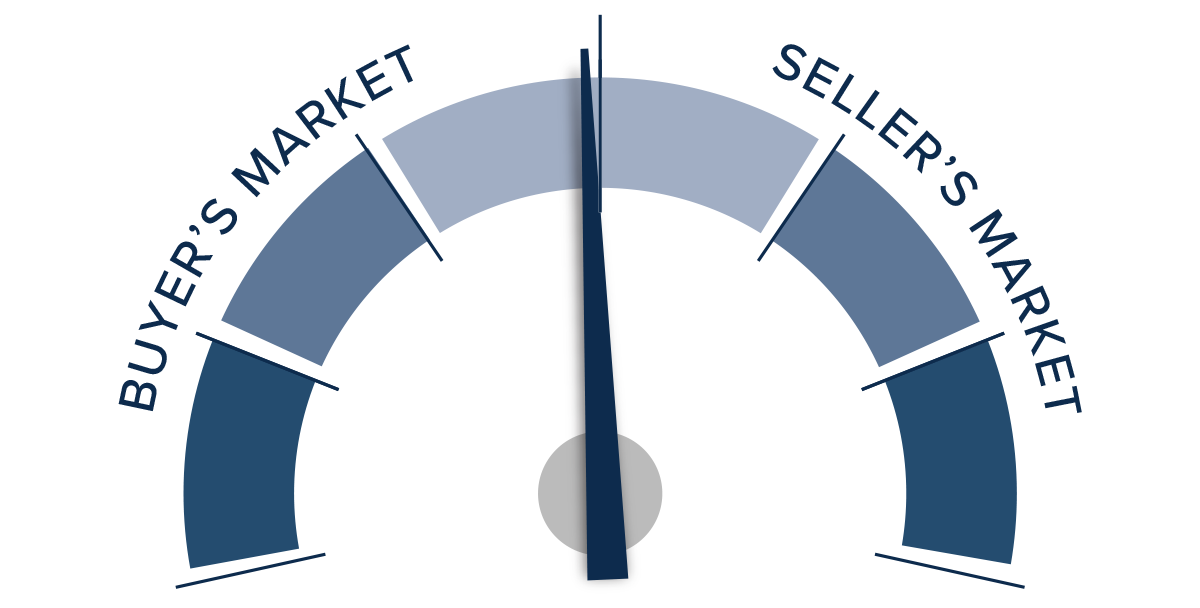
This speedometer reflects the state of the region’s real estate market using housing inventory, price gains, home sales, interest rates, and larger economic factors.

Housing affordability has become a significant concern in Idaho, and high mortgage rates are impacting the ability for buyers to finance a home at current prices. While mortgage rates are expected to fall later this year, they will still be higher than buyers have become accustomed to. This means prices will likely decline as we move through the year, but they should level off as we enter the fall.

A speedometer graph indicating a balanced market in Idaho in Q4 2022.

Although there is ample choice for buyers, I am wondering if listing activity will taper in the coming months as sellers hold off until the market improves. It’s also foreseeable that many of them will decide not to sell because they would lose the historically low interest rate on their current mortgage. Given all of this, I am moving the needle towards a more neutral market. If the number of homes for sale rises significantly in the spring, it’s likely the market will start to favor buyers.

About Matthew Gardner

Matthew Gardner - Chief Economist for Windermere Real Estate

As Chief Economist for Windermere Real Estate, Matthew Gardner is responsible for analyzing and interpreting economic data and its impact on the real estate market on both a local and national level. Matthew has over 30 years of professional experience both in the U.S. and U.K.

In addition to his day-to-day responsibilities, Matthew sits on the Washington State Governors Council of Economic Advisors; chairs the Board of Trustees at the Washington Center for Real Estate Research at the University of Washington; and is an Advisory Board Member at the Runstad Center for Real Estate Studies at the University of Washington where he also lectures in real estate economics.
Market News January 31, 2023

Q4 2022 Central Washington Real Estate Market Update

The following analysis of select counties of the Central Washington real estate market is provided by Windermere Real Estate Chief Economist Matthew Gardner. We hope that this information may assist you with making better-informed real estate decisions. For further information about the housing market in your area, please don’t hesitate to contact your Windermere Real Estate agent.


Regional Economic Overview

Central Washington lost 3,431 jobs over the past 12 months. Although it’s never good to see a region shed jobs, I believe the declines in total employment are due to businesses pulling back in anticipation of a slowing economy. A recession in 2023 is far from guaranteed though, and if we manage to avoid one, I expect businesses will start hiring again. When adjusted for seasonality, unemployment levels in Central Washington were 6.2%, up from 5.4% a year ago. The lowest unemployment rate was in Chelan County, where it was 4.9%. The area’s highest jobless rates were in Yakima and Okanogan counties, where 6.7% of the labor force was unemployed.

Central Washington Home Sales

There were 941 home sales in Central Washington in the final quarter of 2022, which is a decline of 37.5% from the same quarter the prior year.

Pending sales, which are an indicator of future closings, fell 44.2% compared to the third quarter of 2022, suggesting that the market may not show much growth in early 2023.

Sales fell significantly across the board relative to the same period the previous year. The number of homes sold was also down 33.8% from the third quarter of 2022.

Inventory levels rose 24.6% year over year, giving buyers who were still in the market significantly more choices.

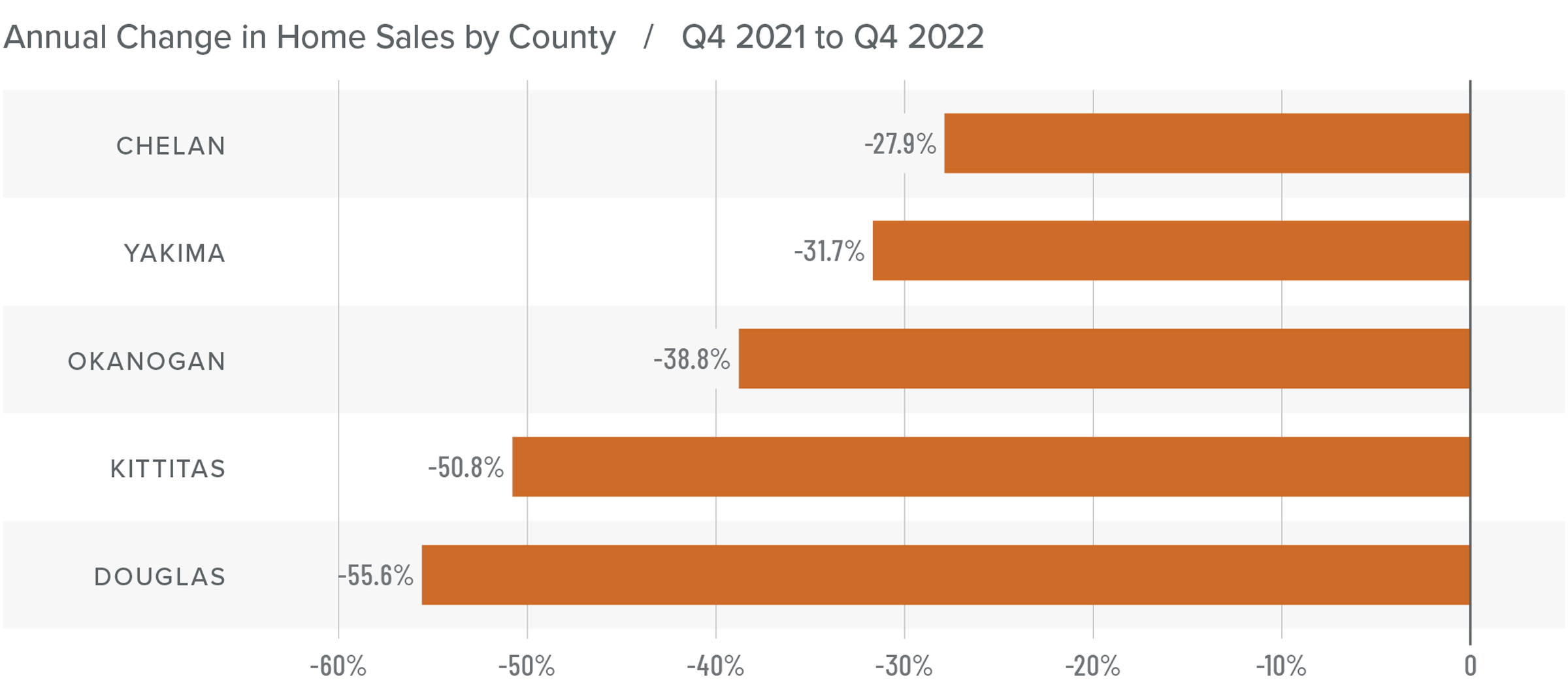
A bar graph showing the annual change in home sales for various counties in Central Washington from Q4 2021 to Q4 2022. All counties have a negative percentage year-over-year change. Here are the totals: Chelan at -27.9%, Yakima at -31.7%, Okanogan -38.8%, Kittitas -50.8%, and Douglas -55.6%.

Central Washington Home Prices

The average home price in Central Washington rose 4.3% year over year to $489,710. Prices were down 5.3% from the third quarter of 2022.

Median listing prices fell in every county other than Kittitas compared to the third quarter of 2022. It appears that sellers are being more realistic about prices given the significant increase in mortgage rates.

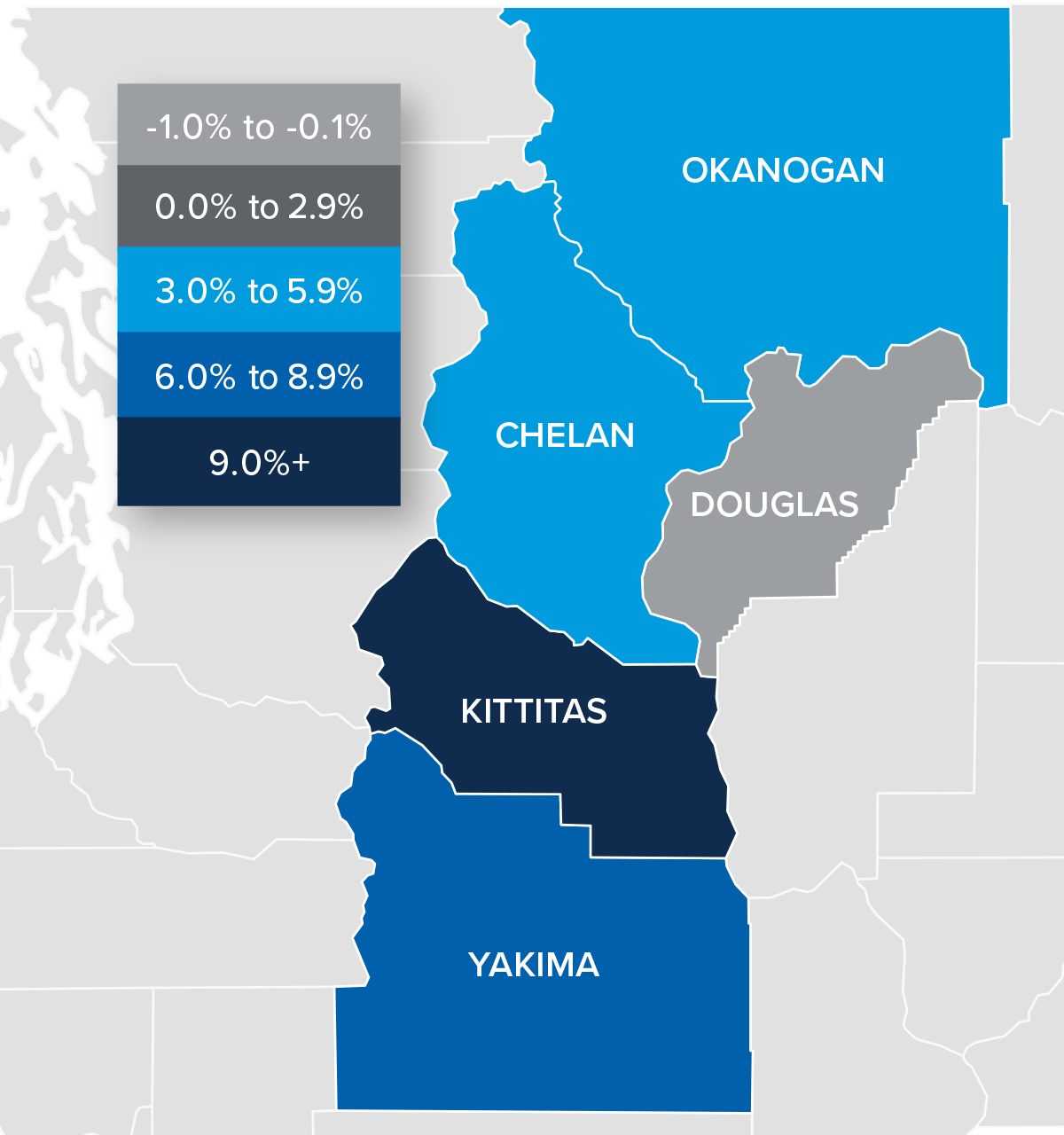
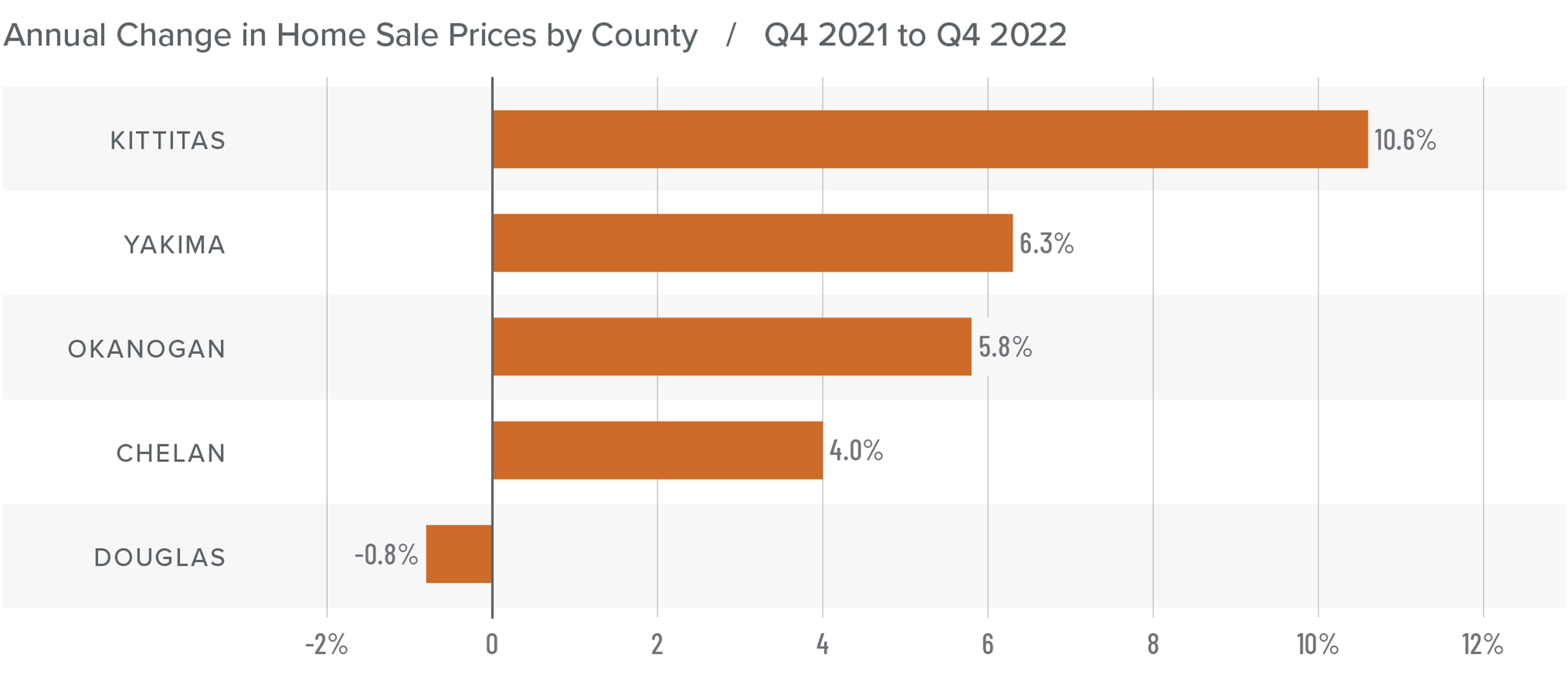
All counties other than Douglas saw prices rise year over year, with an increase of more than 10% in Kittitas County. But prices fell across the board compared to the third quarter of 2022.

The winter months typically see a slowdown in the real estate market. The question now becomes whether buyers will restart their home search in the spring despite higher mortgage rates, or if sellers will have to lower prices further to entice the buyers back into the market. I believe the latter is more likely.

A map showing the real estate home prices percentage changes for various counties in Central Washington. Different colors correspond to different tiers of percentage change. Douglas has a percentage change in the -1% to -0.1% range, Okanogan and Chelan are in the 3% to 5.9% change range, Yakima in the 6% to 8.9%, and Kittitas is in the 9%+ change range.

A bar graph showing the annual change in home sale prices for various counties in Central Washington from Q4 2021 to Q4 2022. Kittitas County tops the list at 10.6%, followed by Yakima at 6.3%, Okanogan at 5.8%, Chelan at 4%, and Douglas at -0.8%.

Mortgage Rates

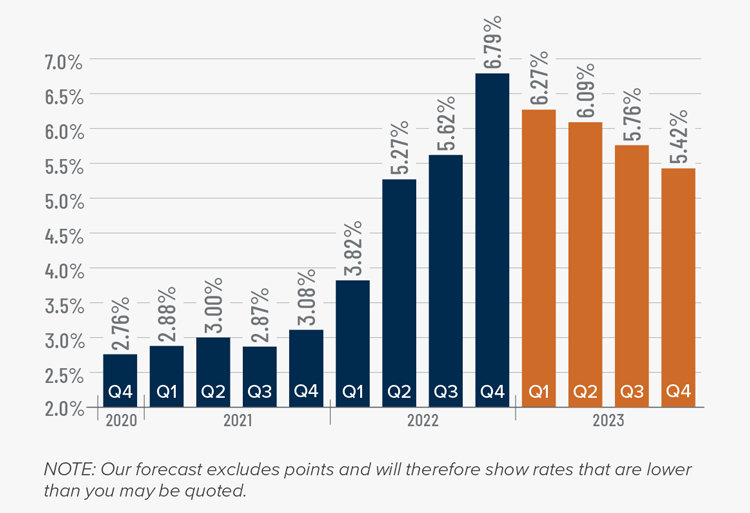
Rates rose dramatically in 2022, but I believe that they have now peaked. Mortgage rates are primarily based on the prices and yields of bonds, and while bonds take cues from several places, they are always impacted by inflation and the economy at large. If inflation continues to fall, as I expect it will, rates will continue to drop.

My current forecast is that mortgage rates will trend lower as we move through the year. While this may be good news for home buyers, rates will still be higher than they have become accustomed to. Even as the cost of borrowing falls, home prices in expensive markets will probably fall a bit more to compensate for rates that will likely hold above 6% until early summer.

A bar graph showing the mortgage rates from Q4 2020 to the present, as well as Matthew Gardner's forecasted mortgage rates through Q4 2023. After the 6.79% figure in Q4 2022, he forecasts mortgage rates dipping to 6.27% in Q1 2023, 6.09% in Q2 2023, 5.76% in Q3 2023, and 5.42% in Q4 2023.

Central Washington Days on Market

The average time it took to sell a home in Central Washington in the final quarter of 2022 was 54 days.

Relative to the same period the year prior, it took 17 more days to sell a home.

On average, it also took 17 more days to sell a home in the fourth quarter of 2022 than it did in the third quarter of the year.

All counties saw the average time it took for homes to sell rise compared to both the third quarter of 2022 and the fourth quarter of 2021.

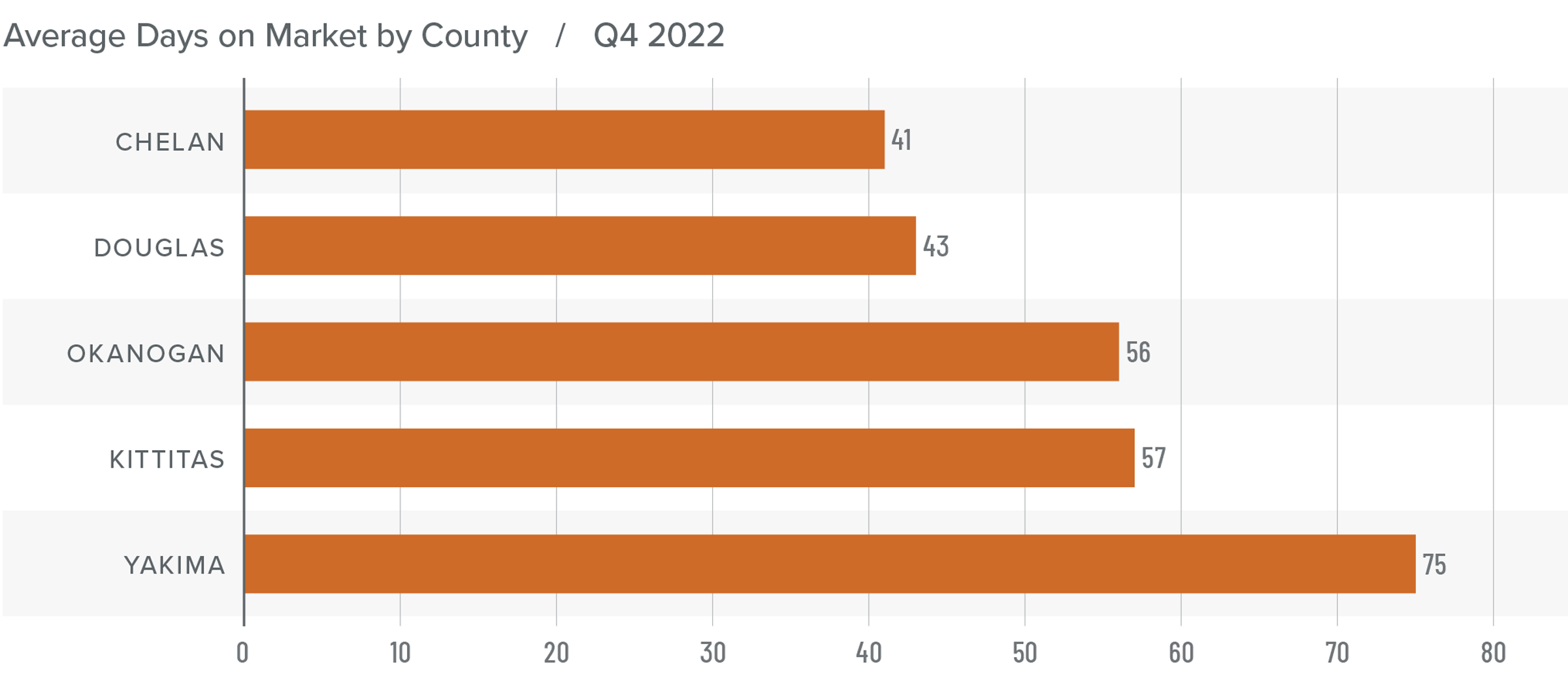
A bar graph showing the average days on market for homes in various counties in Central Washington for Q4 2022. Chelan County has the lowest DOM at 41, followed by Douglas at 43, Okanogan at 56, Kittitas at 57, and Yakima at 75.

Conclusions

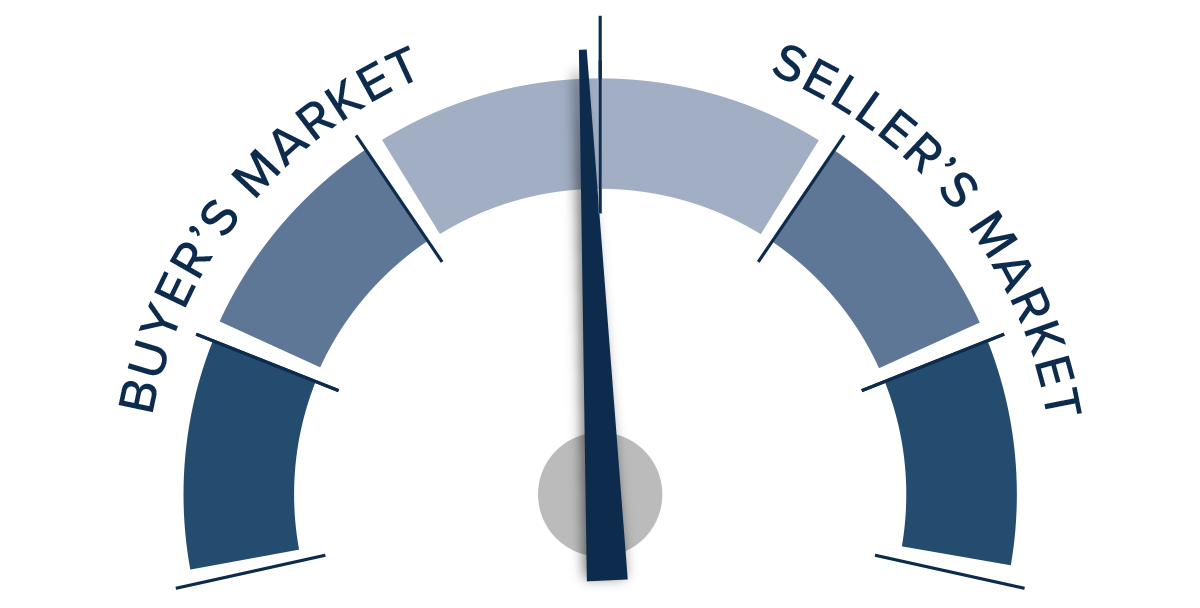
This speedometer reflects the state of the region’s real estate market using housing inventory, price gains, home sales, interest rates, and larger economic factors.

Employment growth has turned negative and uncertainty about the economy is sure to impact demand for housing. Mortgage rates have started to pull back, but I do not see them falling enough in the near-term to result in a surplus of home buyers.

A speedometer graph indicating a balanced market in Central Washington in Q4 2022.

That said, buyers have not abandoned the market entirely. I expect they are waiting for listing prices to soften a little more. If they see this happen and mortgage rates break below 6%, they are likely to resume their home search. Given these dynamics, I am moving the needle to slightly favor buyers, though I would describe the market as being quite neutral.

About Matthew Gardner

Matthew Gardner - Chief Economist for Windermere Real Estate

As Chief Economist for Windermere Real Estate, Matthew Gardner is responsible for analyzing and interpreting economic data and its impact on the real estate market on both a local and national level. Matthew has over 30 years of professional experience both in the U.S. and U.K.

In addition to his day-to-day responsibilities, Matthew sits on the Washington State Governors Council of Economic Advisors; chairs the Board of Trustees at the Washington Center for Real Estate Research at the University of Washington; and is an Advisory Board Member at the Runstad Center for Real Estate Studies at the University of Washington where he also lectures in real estate economics.
Market News January 31, 2023

Q4 2022 Eastern Washington Real Estate Market Update

The following analysis of select counties of the Eastern Washington real estate market is provided by Windermere Real Estate Chief Economist Matthew Gardner. We hope that this information may assist you with making better-informed real estate decisions. For further information about the housing market in your area, please don’t hesitate to contact your Windermere Real Estate agent.


Regional Economic Overview

Year over year, total employment in Eastern Washington fell 2,909 jobs. Spokane and Grant counties collectively lost 3,253 jobs. There were minor job losses in Lincoln, Walla Walla, and Whitman counties, but employment rose in Benton and Franklin counties. Unadjusted for seasonality, the regional unemployment rate was 5%, up from 4.2% a year ago. Seasonally adjusted, the jobless rate was 5.3%, up from 4.4% a year ago. Businesses may be looking to consolidate in anticipation of a possible economic slowdown this year. Although I am not particularly worried now, I will be watching to see if job losses continue as we move through the spring, which would be a greater concern.

Eastern Washington Home Sales

In the fourth quarter of 2022, 2,167 homes sold, which was 42.8% lower than the same period the previous year and 34.4% lower than the third quarter of 2022.

Listing activity rose 111% compared to the fourth quarter of 2021, but the average number of homes for sale was 12.5% lower than in the third quarter of 2022. This is expected given the slowdown that is traditional during the winter months.

Year over year, sales fell across the region. Compared to the third quarter of 2022, sales were flat in Lincoln County but fell everywhere else.

Pending sales fell 39.9% from the prior year, suggesting that the market will likely not see a buoyant early spring.

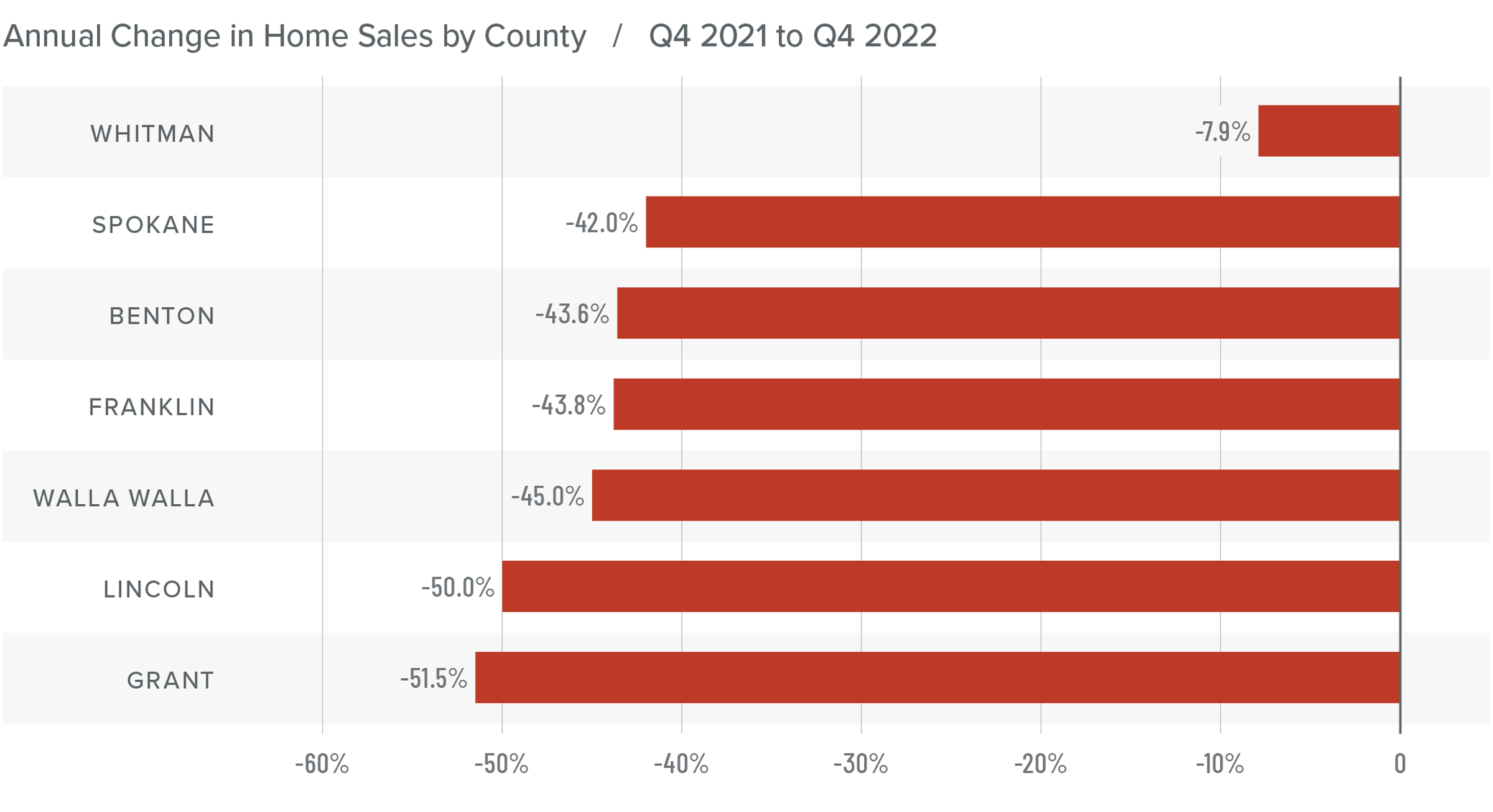
A bar graph showing the annual change in home sales for various counties in Eastern Washington from Q4 2021 to Q4 2022. All counties have a negative percentage year-over-year change. Here are the totals: Whitman at -7.9%, Spokane at -42%, Benton -43.6%, Franklin -43.8%, Walla Walla at -45%, Lincoln at -50%, and Grant -51.5%.

Eastern Washington Home Prices

Year over year, the average home price in Eastern Washington rose 4.3% to $442,603. Average prices were down 4.5% from the third quarter.

Compared to the third quarter of 2022, prices fell in all counties with the exception of Franklin (+1.9%) and Walla Walla (+0.7%).

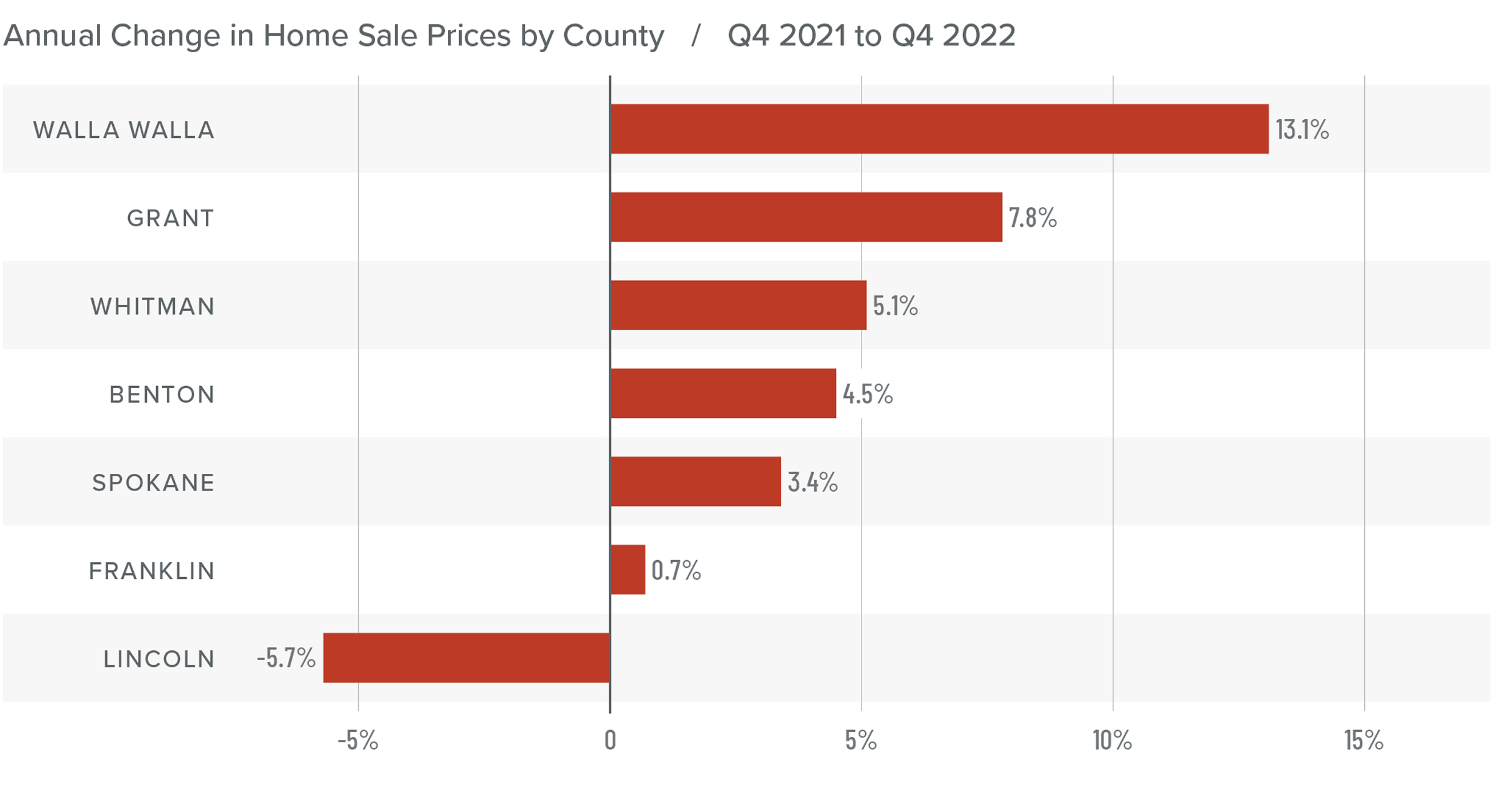
Average sale prices increased year over year in every county but Lincoln. Walla Walla County experienced significant price increases.

Mortgage rates peaked in the quarter, which undoubtedly impacted home prices. Additionally, median listing prices fell in all counties compared to the prior quarter, which also impacted the pace of price growth.

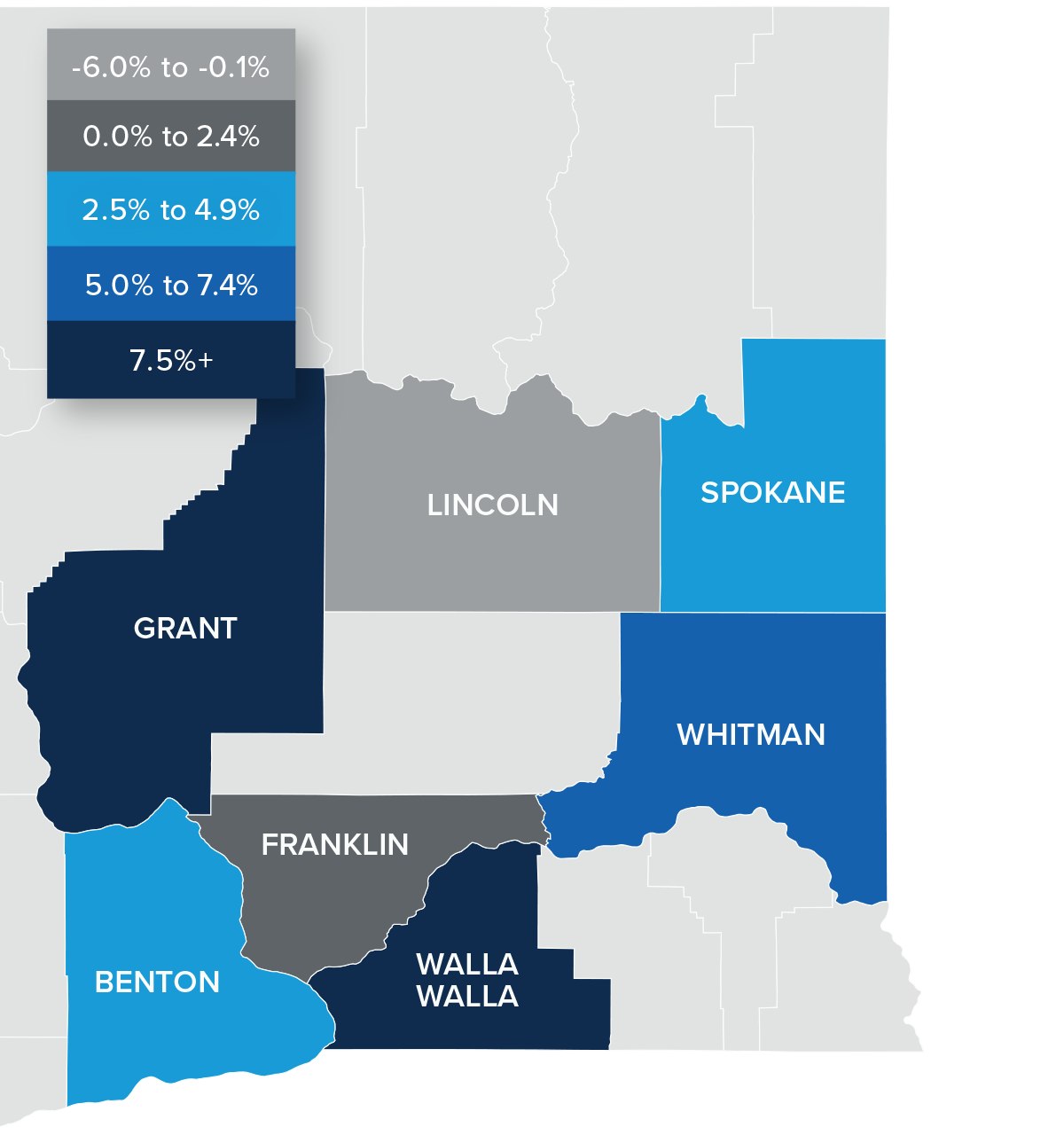
A map showing the real estate home prices percentage changes for various counties in Eastern Washington. Different colors correspond to different tiers of percentage change. Lincoln has a percentage change in the -6% to -0.1% range, Franklin is in the 0% to 2.4% change range, Spokane and Benton are in the 2.5% to 4.9%, Whitman is in the 5% to 7.4% range, and Grant and Walla Walla are in the 7.5%+ change range.

A bar graph showing the annual change in home sale prices for various counties in Eastern Washington from Q4 2021 to Q4 2022. Walla Walla County tops the list at 13.1%, followed by Grant at 7.8%, Whitman at 5.1%, Benton at 4.5%, Spokane at 3.4%, Franklin at 0.7%, and Lincoln at -5.7%.

Mortgage Rates

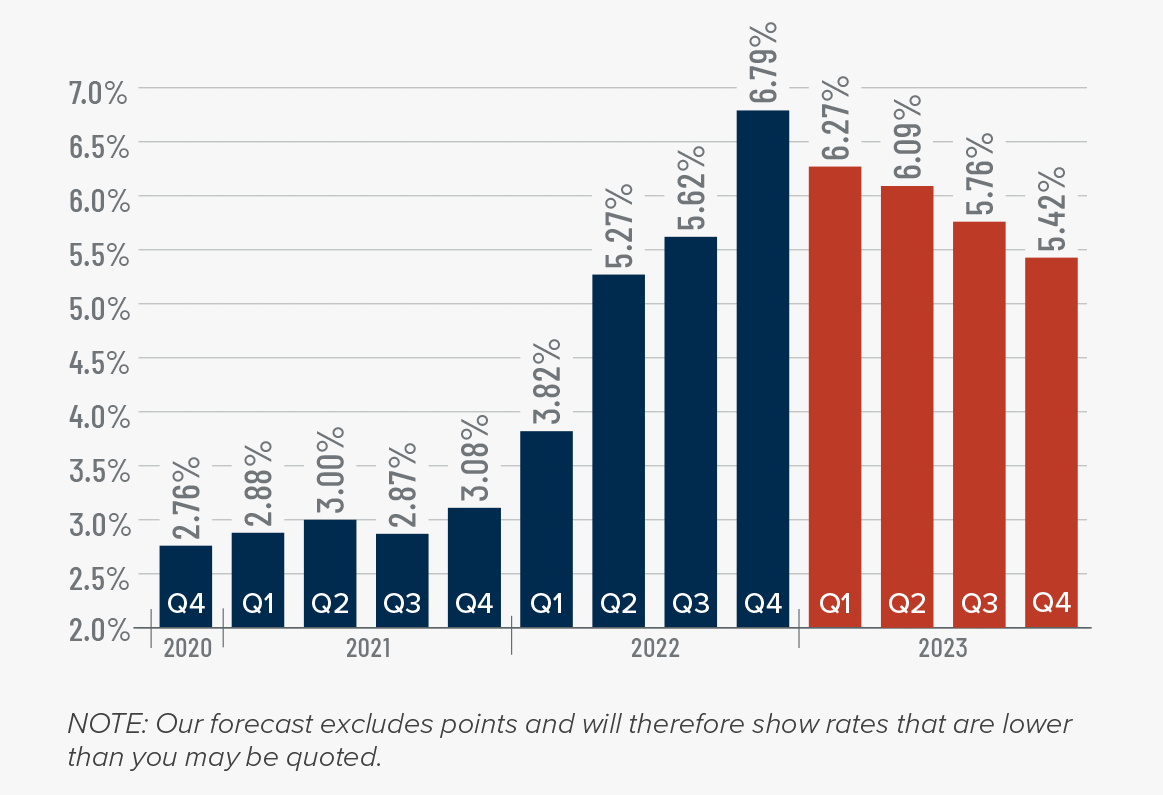
Rates rose dramatically in 2022, but I believe that they have now peaked. Mortgage rates are primarily based on the prices and yields of bonds, and while bonds take cues from several places, they are always impacted by inflation and the economy at large. If inflation continues to fall, as I expect it will, rates will continue to drop.

My current forecast is that mortgage rates will trend lower as we move through the year. While this may be good news for home buyers, rates will still be higher than they have become accustomed to. Even as the cost of borrowing falls, home prices in expensive markets will probably fall a bit more to compensate for rates that will likely hold above 6% until early summer.

A bar graph showing the mortgage rates from Q4 2020 to the present, as well as Matthew Gardner's forecasted mortgage rates through Q4 2023. After the 6.79% figure in Q4 2022, he forecasts mortgage rates dipping to 6.27% in Q1 2023, 6.09% in Q2 2023, 5.76% in Q3 2023, and 5.42% in Q4 2023.

Eastern Washington Days on Market

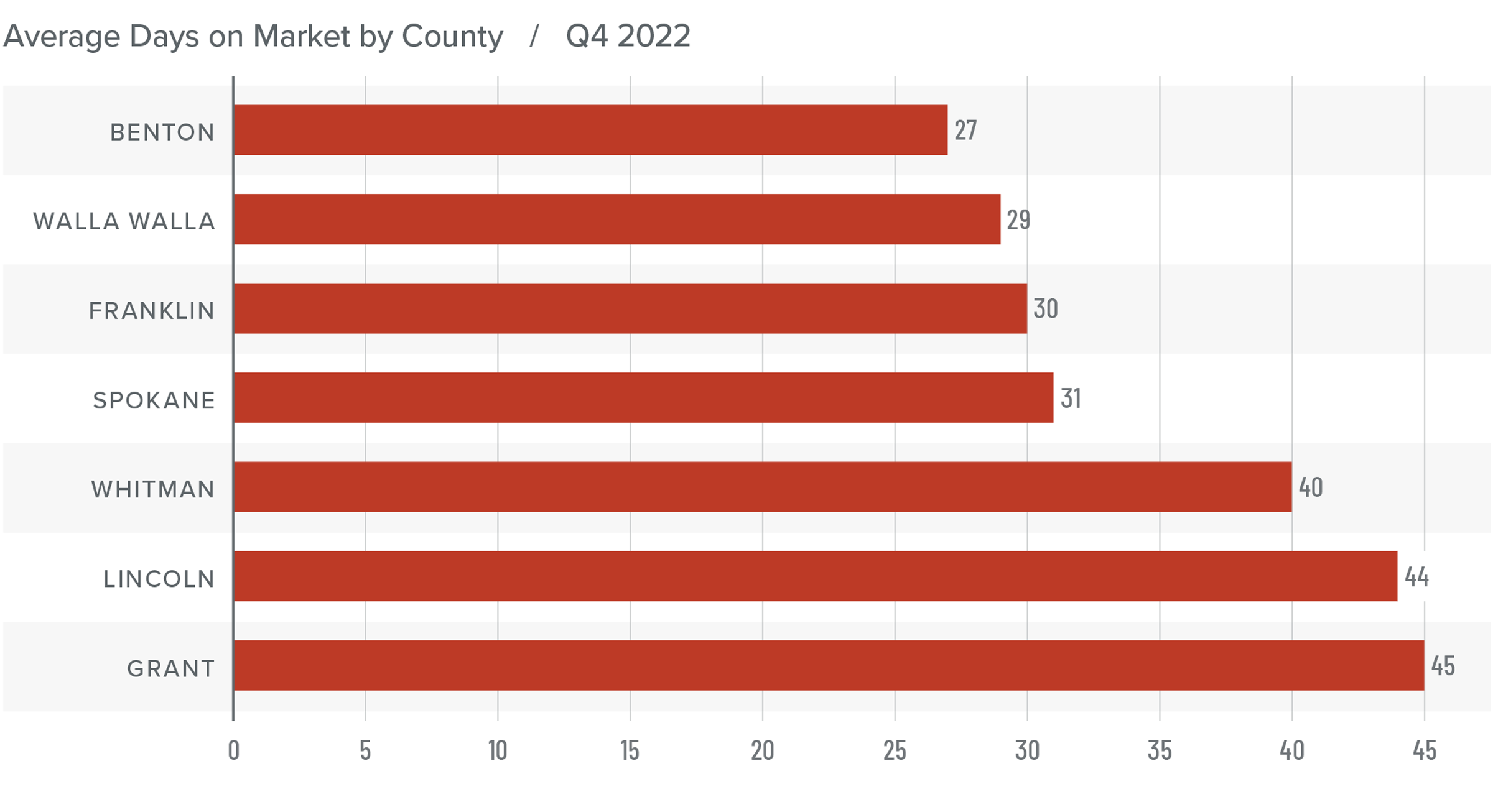
The average time it took to sell a home in Eastern Washington in the final quarter of 2022 was 35 days, which was 11 more days than the same period the previous year.

Compared to the third quarter of 2022, average days on market in the region rose 11 days.

All counties except Lincoln saw the average number of days it took for a house to sell rise compared to the same period the year prior.

Higher financing costs and economic uncertainty have led market time to rise, but it’s possible that buyers are waiting for both mortgage rates and prices to fall further before starting their home search.

A bar graph showing the average days on market for homes in various counties in Eastern Washington for Q4 2022. Benton County has the lowest DOM at 27, followed by Walla Walla at 29, Franklin at 30, Spokane at 31, Whitman at 40, Lincoln at 44, and Grant at 45.

Conclusions

This speedometer reflects the state of the region’s real estate market using housing inventory, price gains, home sales, interest rates, and larger economic factors.

I suggested in the last Gardner Report that higher financing costs were starting to act as a significant headwind in the market, and I stand by this statement. That said, seasonality always skews the numbers, so I will see how the spring market performs before I consider the region to be firmly in the hands of home buyers.

A speedometer graph indicating a balanced market in Eastern Washington in Q4 2022.

I expect prices will fall a little further before stabilizing and then starting to rise again at a significantly slower pace. Because the current market favors neither buyers nor sellers, I have moved the needle to the center.

About Matthew Gardner

Matthew Gardner - Chief Economist for Windermere Real Estate

As Chief Economist for Windermere Real Estate, Matthew Gardner is responsible for analyzing and interpreting economic data and its impact on the real estate market on both a local and national level. Matthew has over 30 years of professional experience both in the U.S. and U.K.

In addition to his day-to-day responsibilities, Matthew sits on the Washington State Governors Council of Economic Advisors; chairs the Board of Trustees at the Washington Center for Real Estate Research at the University of Washington; and is an Advisory Board Member at the Runstad Center for Real Estate Studies at the University of Washington where he also lectures in real estate economics.
Living January 30, 2023

Pros and Cons of Living in a Penthouse

Penthouses take the luxury lifestyle to new heights; they boast the best views in the city, offer unparalleled exclusivity, and often include outdoor spaces not typically found in other units throughout the same building. These perks, however, come at a cost. For those considering renting or purchasing a penthouse, the following information will help to inform your discussions with your real estate agent.

What is a penthouse?

At its core, a penthouse is a luxury apartment/condominium. Located on the top floor of an apartment building, condominium complex, hotel, or tower, its luxury features differentiate it from the building’s lower-level units. The living space of a penthouse is usually set back from the building’s outer edge and the remaining square footage of the roof deck is typically used as a yard, hot tub, pool, outdoor kitchen, etc. 

Pros

  • The View: Even in a densely populated metropolitan area, living in a penthouse is your best chance at an unobstructed view of the city. Perched above the vast majority of other apartment and condominium buildings, a penthouse provides a bird’s eye view of your surroundings without being blocked by neighboring units.
  • Indoor and Outdoor Space: A penthouse is more than a luxury apartment; it’s your own private outdoor terrace. With access to the outdoors, you have more room for your favorite at-home activities, plus an array of entertaining opportunities. Penthouses are typically designed with open-concept floorplans which emphasize their extra square footage. For those looking to increase their living space while remaining in the city, a penthouse may be the perfect solution.
  • Privacy: Because penthouses only have neighbors below them, a penthouse floor sees fewer visitors than the lower floors in a building. Some penthouse floors have a separate, private entrance for added security.

Cons

  • High Price: Gaining access to this exclusive lifestyle is expensive. The high price tags reflect its unique characteristics: being far away from street noise, having more square footage and outdoor space, added privacy, etc. In some places, the costs to purchase or rent a penthouse can outpace the average monthly mortgage payment for a single-family home in the area, especially if you have Homeowners Association (HOA) fees tacked on.
  • Home Maintenance: Having more indoor and outdoor space means there’s more to maintain. Owning or renting one of these units comes with a longer to-do list than a smaller apartment or condominium. You’ll either have to carve out additional time for upkeep or consider hiring a professional to clean your home regularly.

Work closely with your real estate agent to determine whether renting or purchasing a penthouse is right for you. Learn more about other housing types and the differences between them here:

House vs. Townhouse vs. Condo


­­­­­­Featured Image Source: Getty Images – Image Credit: skynesher

Market News January 30, 2023

Q4 2022 Colorado Real Estate Market Update

The following analysis of select counties of the Colorado real estate market is provided by Windermere Real Estate Chief Economist Matthew Gardner. We hope that this information may assist you with making better-informed real estate decisions. For further information about the housing market in your area, please don’t hesitate to contact your Windermere Real Estate agent.


Regional Economic Overview

Although employment in the region is still expanding, the pace of growth continues to slow. Over the past year, 103,400 jobs were added, which is the slowest annual pace since the 12-month period ending in July 2022. The unemployment rate in November stood at a very respectable 3.5%. Regionally, unemployment rates ranged from a low of 2.8% in Boulder to a high of 4% in the Grand Junction metropolitan area.

Colorado Home Sales

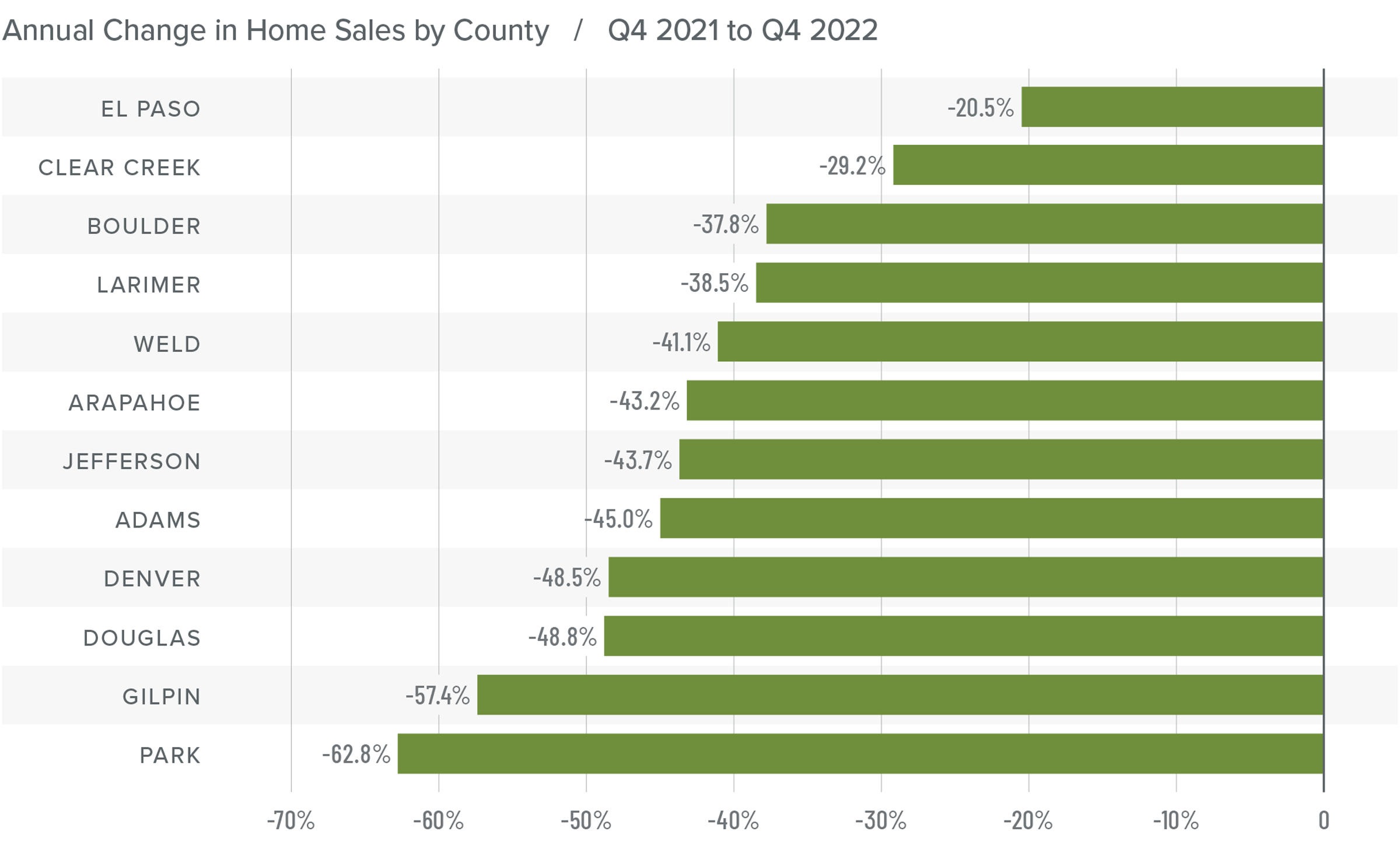
In the fourth quarter of 2022, 7,097 homes sold, which was 43% fewer sales than in the fourth quarter of 2021 and 34% lower than in the third quarter of 2022.

Sales fell across all of the markets covered by this report compared to the same period the year prior and the third quarter of 2022.

Normal seasonal shifts in the market led the number of homes for sale to drop 20.1% compared to the third quarter. However, inventory levels were up by a very significant 164.6% from the fourth quarter of 2021.

Pending sales (an indicator of future closings) dropped 40.1% from the third quarter, which suggests that the market is likely to see little, if any, growth in the early spring of 2023.

A bar graph showing the annual change in home sales for various counties in Colorado from Q4 2021 to Q4 2022. All counties have a negative percentage year-over-year change. Here are the totals: El Paso at -20.5%, Clear Creek at -29.2%, Boulder -37.8%, Larimer -38.5%, Weld -41.1%, Arapahoe -43.2%, Jefferson -43.7%, Adams -45%, Denver -48.5%, Douglas -48.8%, Gilpin -57.4%, and Park -62.8%.

Colorado Home Prices

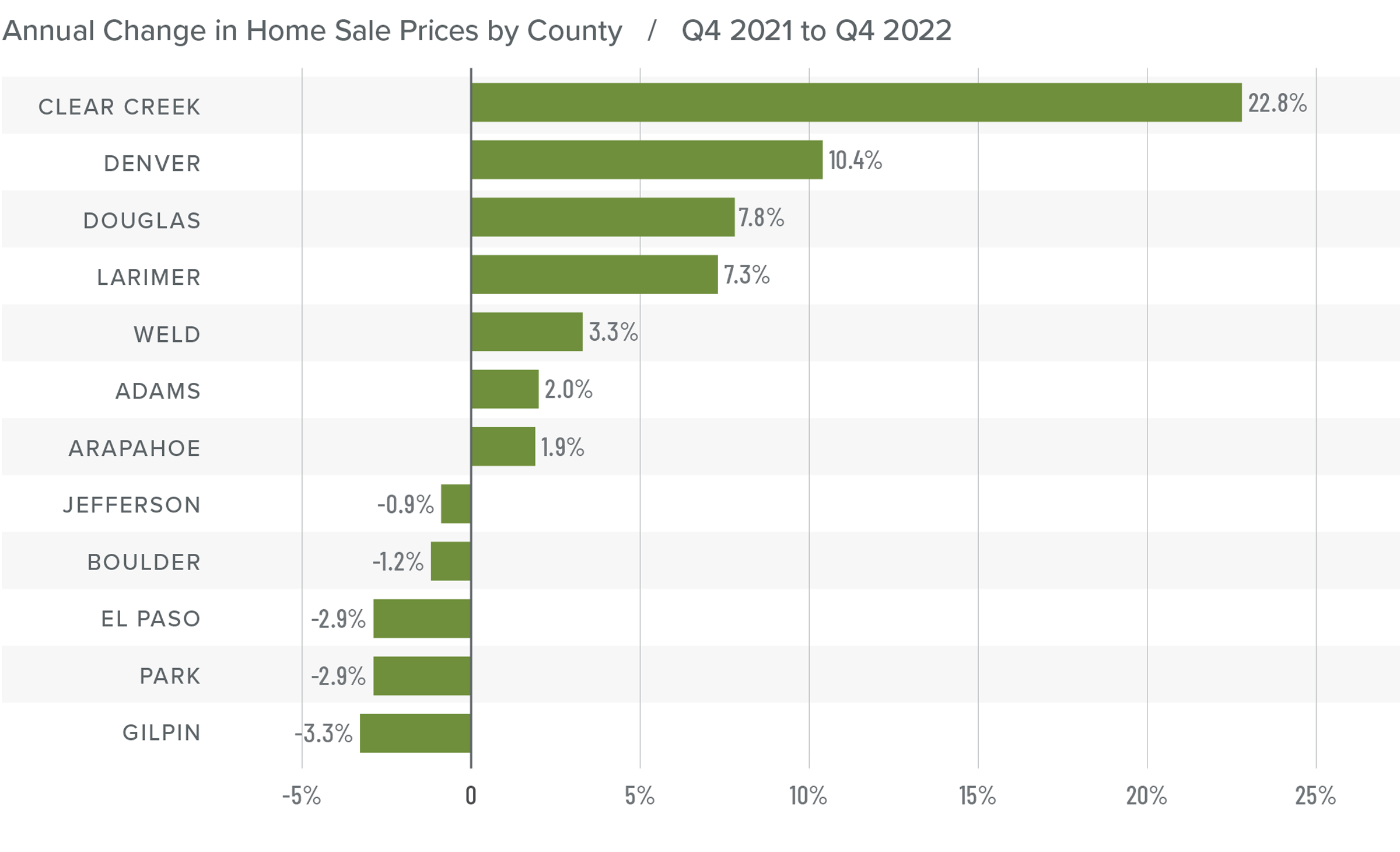
Home prices rose 3.4% from the same period in 2021 to $628,373. However, prices were 4% lower than in the third quarter in 2022.

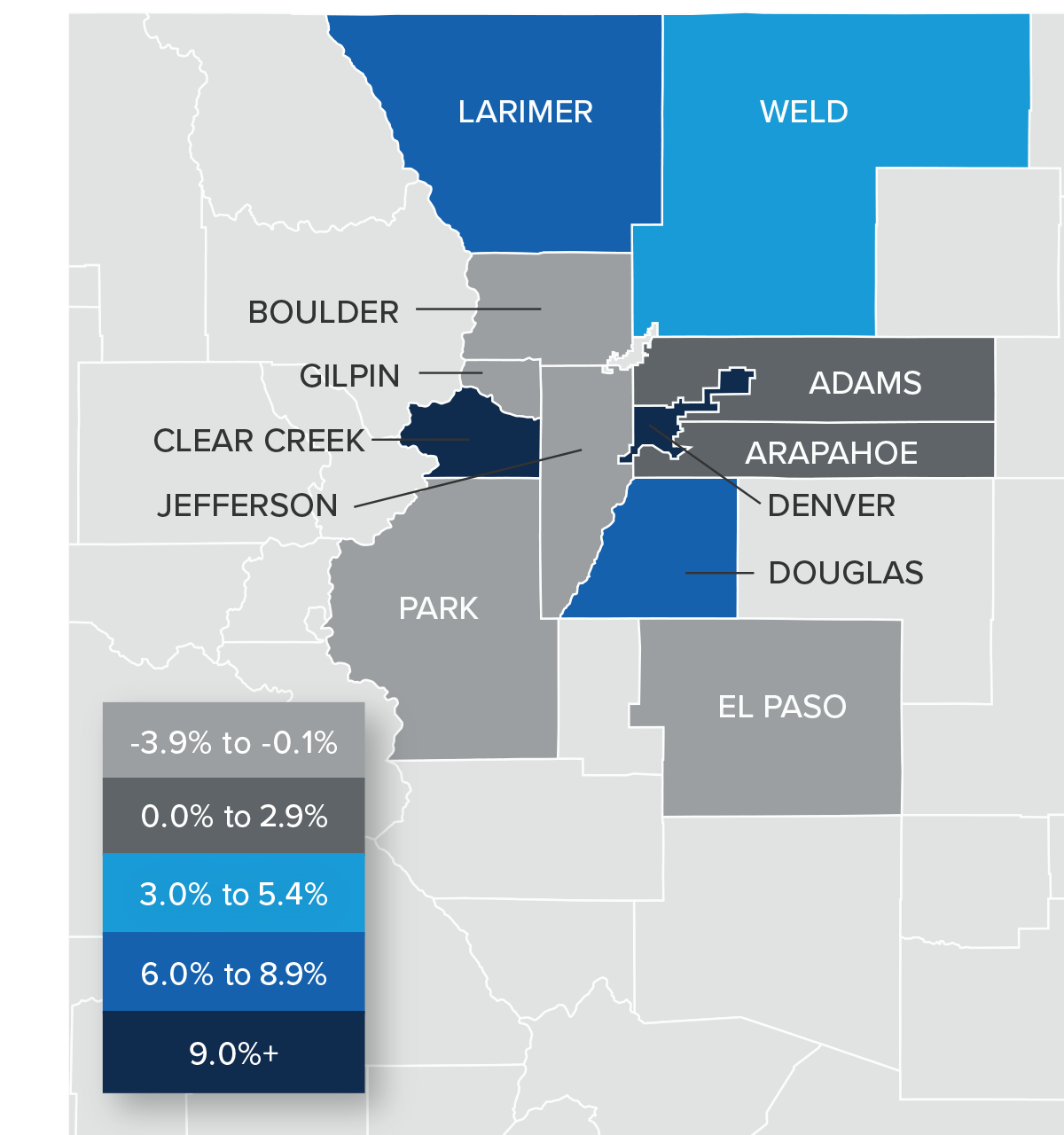
Compared to the third quarter, prices fell in all counties other than Larimer, which rose .4%. Listing prices were down in every county other than Clear Creek and Gilpin.

Year over year, prices rose by double digits in Clear Creek and Denver counties. Annual price growth was negative in five of the other ten counties covered by this report.

Home prices rose at an unsustainable pace during the pandemic but rising mortgage rates, higher inventory levels, and lower affordability are now having an impact. Home sale prices will likely continue to pull back as we enter the spring, but the correction should halt during the summer as mortgage rates continue falling.

A map showing the real estate home prices percentage changes for various counties in Colorado. Different colors correspond to different tiers of percentage change. Boulder, Gilpin, Jefferson, Park, and El Paso have a percentage change in the -3.9% to -0.1%+ range, Adams and Arapahoe counties are in the 0% to 2.9% change range, Weld is in the 3% to 5.4% change range, Douglas is in the 6% to 8.9% change range, and Clear Creek and Denver counties are in the 9%+ change range.

A bar graph showing the annual change in home sale prices for various counties in Colorado from Q4 2021 to Q4 2022. Clear Creek County tops the list at 22.8%, followed by Denver at 10.4%, Douglas at 7.8%, Larimer at 7.3%, Weld at 3.3%, Adams at 2%, Arapahoe at 1.9%, Jefferson at -0.9%, Boulder at -1.2%, El Paso and Park at -2.9%, and finally Gilpin at -3.3%.

Mortgage Rates

Rates rose dramatically in 2022, but I believe that they have now peaked. Mortgage rates are primarily based on the prices and yields of bonds, and while bonds take cues from several places, they are always impacted by inflation and the economy at large. If inflation continues to fall, as I expect it will, rates will continue to drop.

My current forecast is that mortgage rates will trend lower as we move through the year. While this may be good news for home buyers, rates will still be higher than they have become accustomed to. Even as the cost of borrowing falls, home prices in expensive markets will probably fall a bit more to compensate for rates that will likely hold above 6% until early summer.

A bar graph showing the mortgage rates from Q4 2020 to the present, as well as Matthew Gardner's forecasted mortgage rates through Q4 2023. After the 6.79% figure in Q4 2022, he forecasts mortgage rates dipping to 6.27% in Q1 2023, 6.09% in Q2 2023, 5.76% in Q3 2023, and 5.42% in Q4 2023.

Colorado Days on Market

It took an average of 38 days to sell a home in the region.

The average time it took to sell a home in the markets contained in this report rose 18 days compared to the same period in 2021 and the third quarter of 2022.

Year over year, the length of time it took to sell a home rose across the board.

Buyers have a lot more choice in the market than they have been used to. In addition, uncertainty about the direction of mortgage rates and home prices is likely keeping some buyers sidelined.

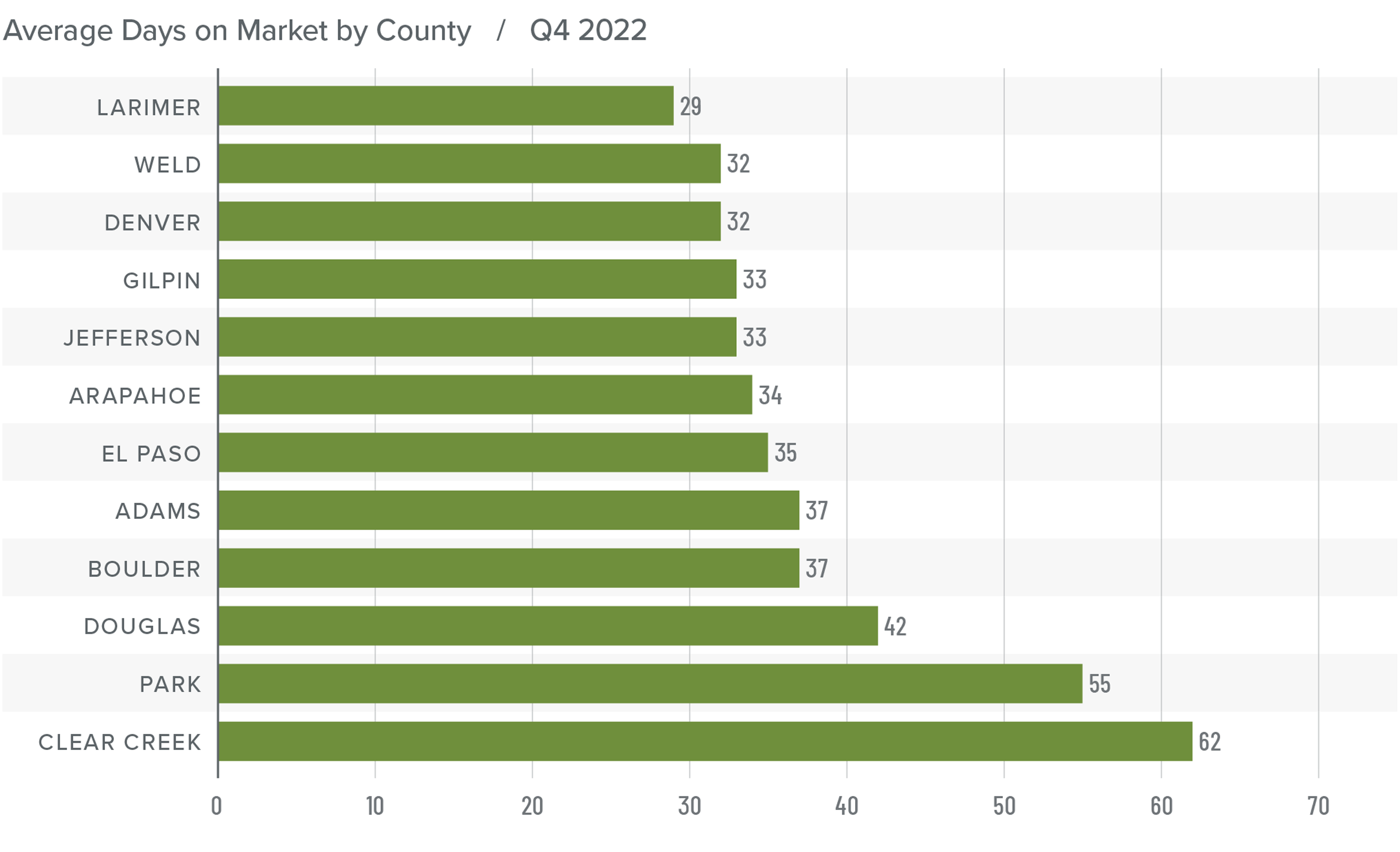
A bar graph showing the average days on market for homes in various counties in Colorado for Q4 2022. Larimer County has the lowest DOM at 29, followed by weld and Denver at 32, Gilpin and Jefferson at 33, Arapahoe at 34, El Paso at 35, Adams and Boulder at 37, Douglas at 42, Park at 55, and Clear Creek at 62.

Conclusions

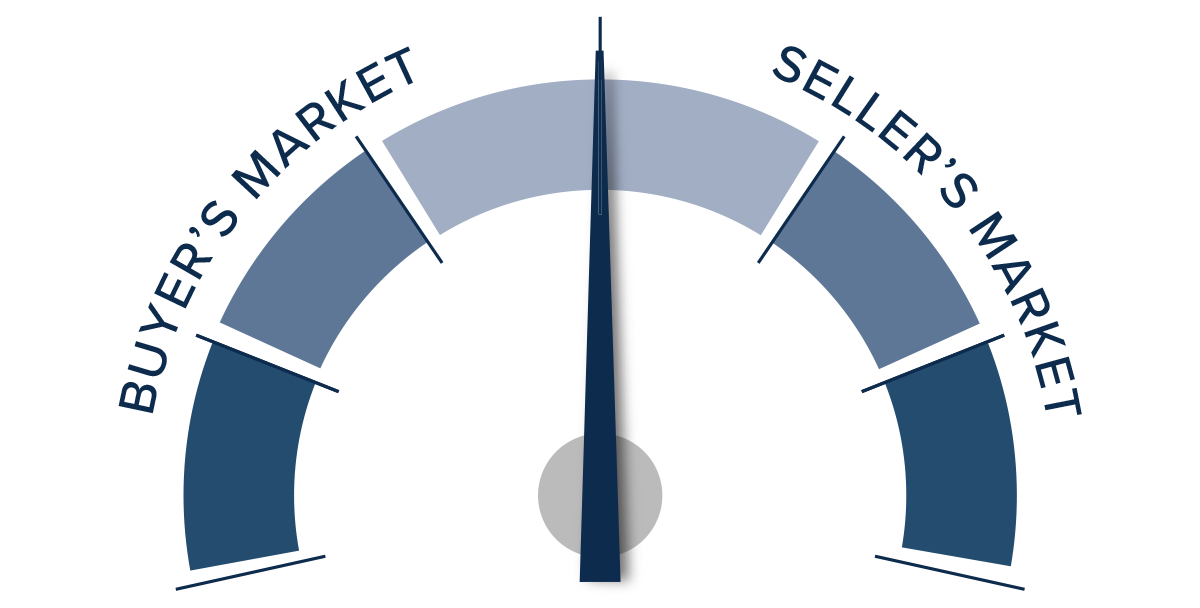
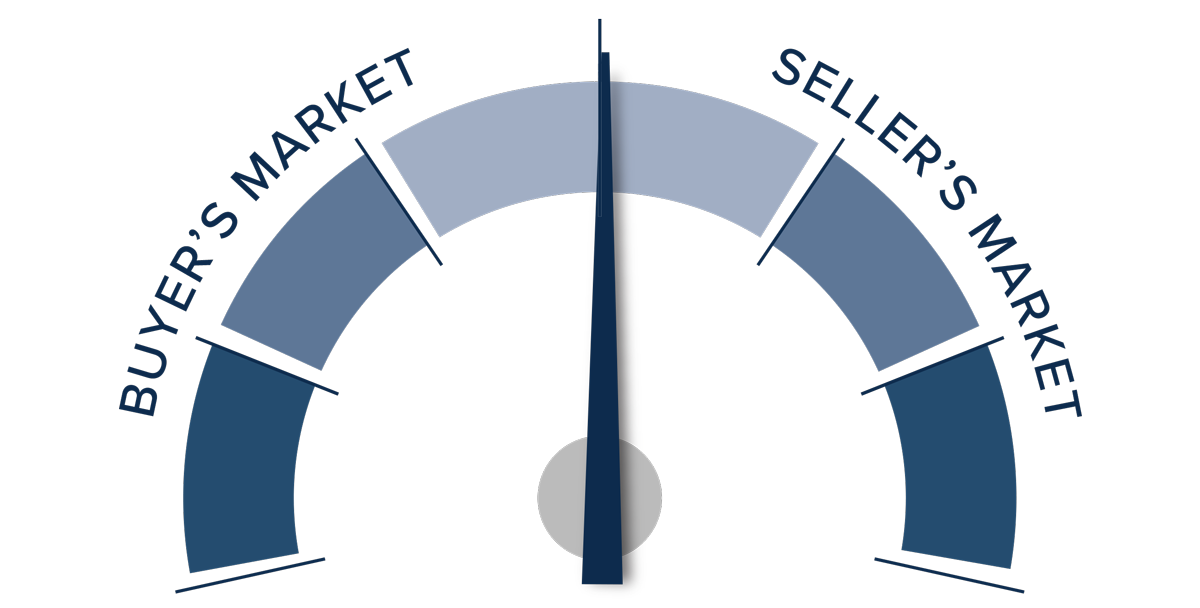
This speedometer reflects the state of the region’s real estate market using housing inventory, price gains, home sales, interest rates, and larger economic factors.

Slowing job growth, the possibility of a mild recession in 2023, and higher financing costs are all weighing on the housing market. I suggested in the third quarter Gardner Report that the market was likely to continue slowing until prices became more realistic given higher mortgage rates; I am holding to this theory. I still anticipate many markets will see negative annual price growth this year, but prices will only pull back to 2021 levels. In other words, there is no significant cause for concern.

A speedometer graph indicating a balanced market in Colorado in Q4 2022.

Prices are likely to fall a little further in the first half of the year before starting to rise again in the second half. All things considered, I have moved the needle to a neutral position, favoring neither buyers nor sellers.

About Matthew Gardner

Matthew Gardner - Chief Economist for Windermere Real Estate

As Chief Economist for Windermere Real Estate, Matthew Gardner is responsible for analyzing and interpreting economic data and its impact on the real estate market on both a local and national level. Matthew has over 30 years of professional experience both in the U.S. and U.K.

In addition to his day-to-day responsibilities, Matthew sits on the Washington State Governors Council of Economic Advisors; chairs the Board of Trustees at the Washington Center for Real Estate Research at the University of Washington; and is an Advisory Board Member at the Runstad Center for Real Estate Studies at the University of Washington where he also lectures in real estate economics.
Market News January 30, 2023

Q4 2022 Southern California Real Estate Market Update

The following analysis of select counties of the Southern California real estate market is provided by Windermere Real Estate Chief Economist Matthew Gardner. We hope that this information may assist you with making better-informed real estate decisions. For further information about the housing market in your area, please don’t hesitate to contact your Windermere Real Estate agent.


Regional Economic Overview

Employment growth in Southern California continues to slow, with only 33,400 jobs added over the past three months. Annual growth also slowed: only 141,100 new jobs were added, which is down from 347,700 added between September 2021 and September 2022. Total employment in the counties covered by this report is still 305,300 shy of the region’s pre-pandemic peak. Los Angeles County still has the largest shortfall (-310,000), followed by Orange County (-36,800) and San Diego County (-19,500). Employment levels in the Riverside and San Bernardino markets remain well above pre-pandemic levels. The region’s unemployment rate in November was 4%, down from 5.4% a year ago. The lowest rates were in Orange County (3%) and San Diego County (3.3%).

Southern California Home Sales

In the final quarter of 2022, 28,953 homes sold. This is 43.9% lower than the same period the year prior and down 24.5% compared to the third quarter of 2022.

Pending home sales, which are an indicator of future closings, were down 30% from the third quarter, suggesting that sales activity in the first quarter of this year may also be down.

On a percentage basis, sales fell the most in Riverside County, but all markets pulled back significantly. Compared to the third quarter, sales were down 24.5%, or 9,400 units.

The lower number of sales can be attributed to more listings in the market, which were up 83.5% year over year, and higher mortgage rates, which make homes less affordable.

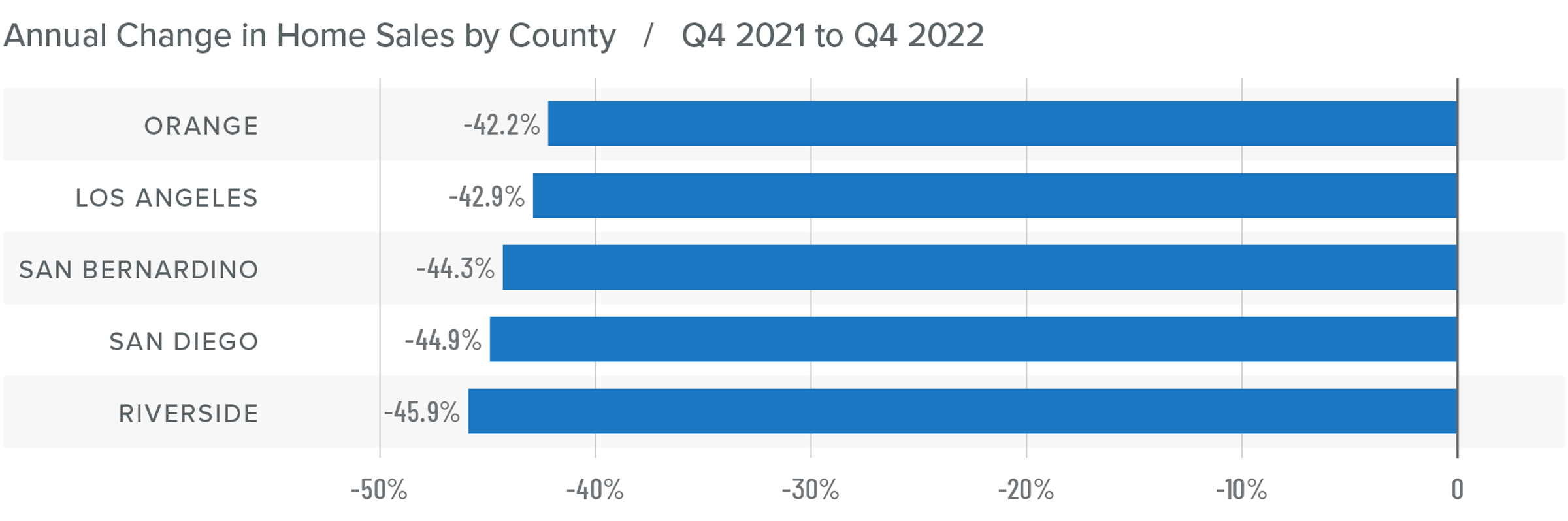
A bar graph showing the annual change in home sales for various counties in Southern California from Q4 2021 to Q4 2022. All counties have a negative percentage year-over-year change. Here are the totals: Orange at -42.2%, Los Angeles at -42.9%, San Bernardino -44.3%, San Diego -44.9%, and Riverside -45.9%.

Southern California Home Prices

Fourth quarter home sale prices were .7% higher than the same period the prior year but were 2.5% lower than in the third quarter of 2022.

Mortgage rates, which peaked in October, have impacted both the number of sales and prices. Median listing prices were down 4.9%, which indicates that sellers have been adjusting their expectations, but I believe they will fall further before stability in the market is restored.

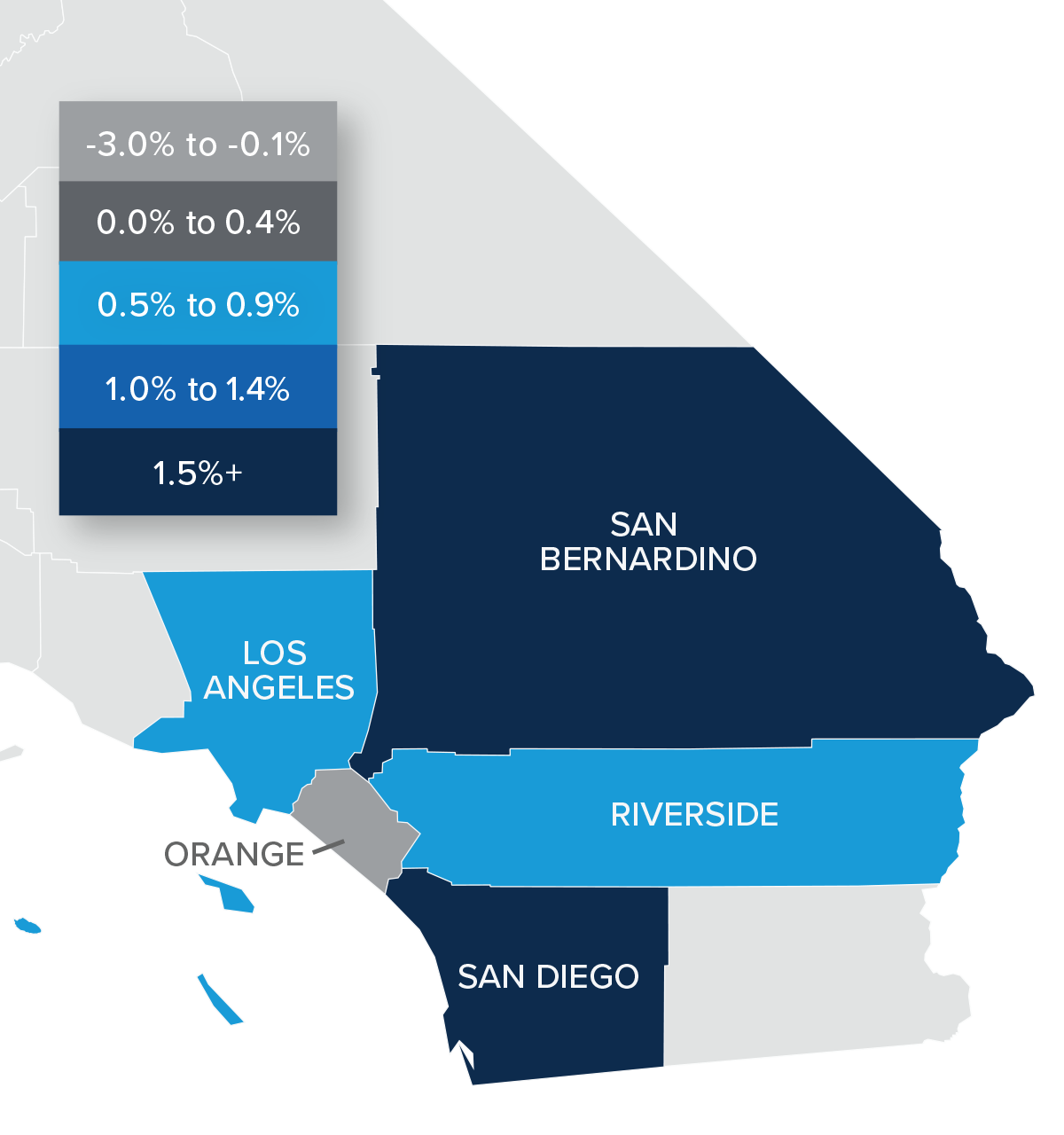
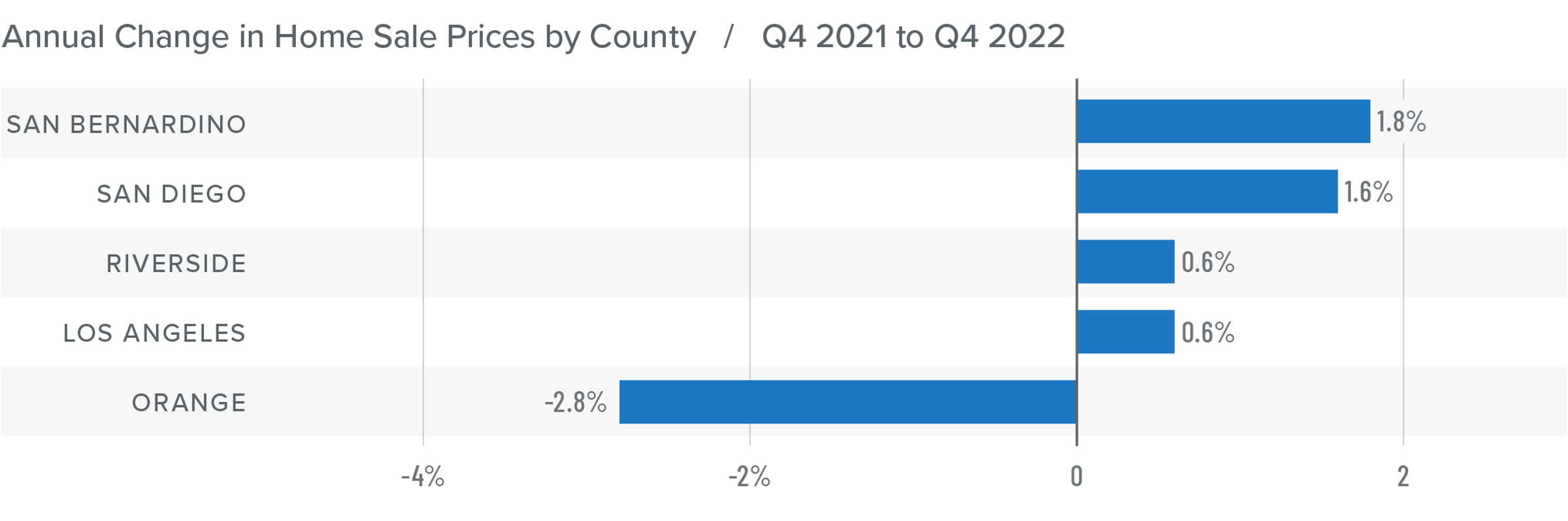
The region had very modest price growth in all markets other than Orange County, where prices fell 2.8%. Compared to the third quarter of 2022, prices were lower across all markets other than Los Angeles County, where they rose .2%.

Mortgage rates have started to pull back. If this continues, I am hopeful that the second half of 2023 will be more active, resulting in rising sales and home prices.

A map showing the real estate home prices percentage changes for various counties in Southern California. Different colors correspond to different tiers of percentage change. Orange County have a percentage change in the -3% to -0.1% range, Los Angeles and Riverside are in the 0.5% to 0.9% change range, and San Diego and San Bernardino are in the 1.5%+ change range.

A bar graph showing the annual change in home sale prices for various counties in Southern California from Q4 2021 to Q4 2022. San Bernardino County tops the list at 1.8%, followed by San Diego at 1.6%, Riverside and Los Angeles at 0.6%, and Orange at -2.8%.

Mortgage Rates

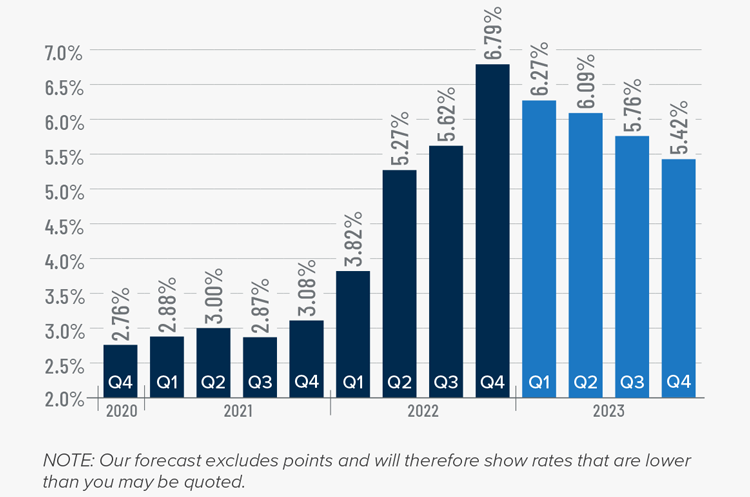
Rates rose dramatically in 2022, but I believe that they have now peaked. Mortgage rates are primarily based on the prices and yields of bonds, and while bonds take cues from several places, they are always impacted by inflation and the economy at large. If inflation continues to fall, as I expect it will, rates will continue to drop.

My current forecast is that mortgage rates will trend lower as we move through the year. While this may be good news for home buyers, rates will still be higher than they have become accustomed to. Even as the cost of borrowing falls, home prices in expensive markets will probably fall a bit more to compensate for rates that will likely hold above 6% until early summer.

A bar graph showing the mortgage rates from Q4 2020 to the present, as well as Matthew Gardner's forecasted mortgage rates through Q4 2023. After the 6.79% figure in Q4 2022, he forecasts mortgage rates dipping to 6.27% in Q1 2023, 6.09% in Q2 2023, 5.76% in Q3 2023, and 5.42% in Q4 2023.

Southern California Days on Market

In the final quarter of 2022, the average time it took to sell a home in the region was 37 days, which was 15 more than the same period the year prior and 11 more than in the third quarter of 2022.

Compared to the third quarter of 2022, market time rose in all counties covered by this report.

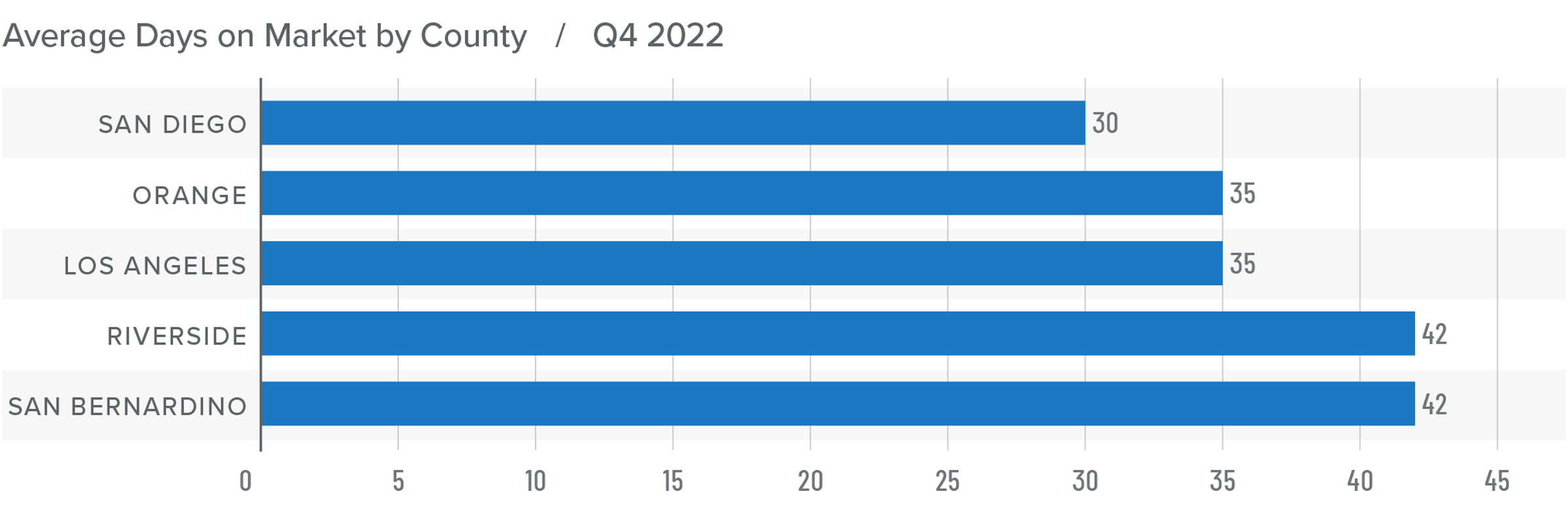
Homes in San Diego County continue to sell at a faster rate than other markets in the region, but market time increased in all counties year over year.

More choice and higher mortgage rates appear to be sidelining some buyers. Whether they resume their search for a home in the spring may depend on the direction of mortgage rates and whether prices start to stabilize.

A bar graph showing the average days on market for homes in various counties in Southern California for Q4 2022. San Diego County has the lowest DOM at 30, followed by Orange and Los Angeles at 35, and Riverside and San Bernardino at 42.

Conclusions

This speedometer reflects the state of the region’s real estate market using housing inventory, price gains, home sales, interest rates, and larger economic factors.

Job growth has slowed, which may be at least partly attributable to businesses expecting to see the economy slow as we move through this year. The housing market is very susceptible to economic turbulence. This, combined with higher financing costs and softening prices, has caused a lull in the market.

A speedometer graph indicating a balanced market in Southern California in Q4 2022.

There is no doubt that regional home values are resetting following the frenetic market during the pandemic when mortgage rates were artificially low. I expect prices to move modestly lower this spring before stabilizing and starting to rise again in the second half of the year. All things considered, I have moved the needle to a neutral position, favoring neither buyers nor sellers.

About Matthew Gardner

Matthew Gardner - Chief Economist for Windermere Real Estate

As Chief Economist for Windermere Real Estate, Matthew Gardner is responsible for analyzing and interpreting economic data and its impact on the real estate market on both a local and national level. Matthew has over 30 years of professional experience both in the U.S. and U.K.

In addition to his day-to-day responsibilities, Matthew sits on the Washington State Governors Council of Economic Advisors; chairs the Board of Trustees at the Washington Center for Real Estate Research at the University of Washington; and is an Advisory Board Member at the Runstad Center for Real Estate Studies at the University of Washington where he also lectures in real estate economics.
Market News January 27, 2023

Q4 2022 Central and Southern Oregon Real Estate Market Update

The following analysis of select counties of the Central and Southern Oregon real estate market is provided by Windermere Real Estate Chief Economist Matthew Gardner. We hope that this information may assist you with making better-informed real estate decisions. For further information about the housing market in your area, please don’t hesitate to contact your Windermere Real Estate agent.


Regional Economic Overview

The Central and Southern Oregon areas covered by this report have now recovered all of the jobs that were shed due to the pandemic and added 720 new ones. Although the Medford metro area is still lagging, the other markets contained in this report have made up for the shortfall. The area’s unemployment rate was 4.8%, matching the level of a year ago. That said, the number of unemployed has started to trend a little higher across the board. By area, the lowest jobless rate was in Deschutes County (4.1%) and the highest was in Klamath County, where 6.1% of the labor force is still without a job.

Central and Southern Oregon Home Sales

In the final quarter of 2022, 1,721 homes sold, which represented a drop of more than 42% compared to the same period the prior year. Sales were 29.4% lower than in the third quarter of 2022.

Home sales fell in all counties relative to the third quarter of 2022. Only Josephine County saw a decline in sales of less than 10%.

Sales fell significantly in all counties compared to the fourth quarter of 2021.

The reason for the drop in home sales is likely because higher inventory levels gave buyers more choice. It also appears that many buyers are waiting to make a move in the hopes that prices and mortgages will fall further in the coming months.

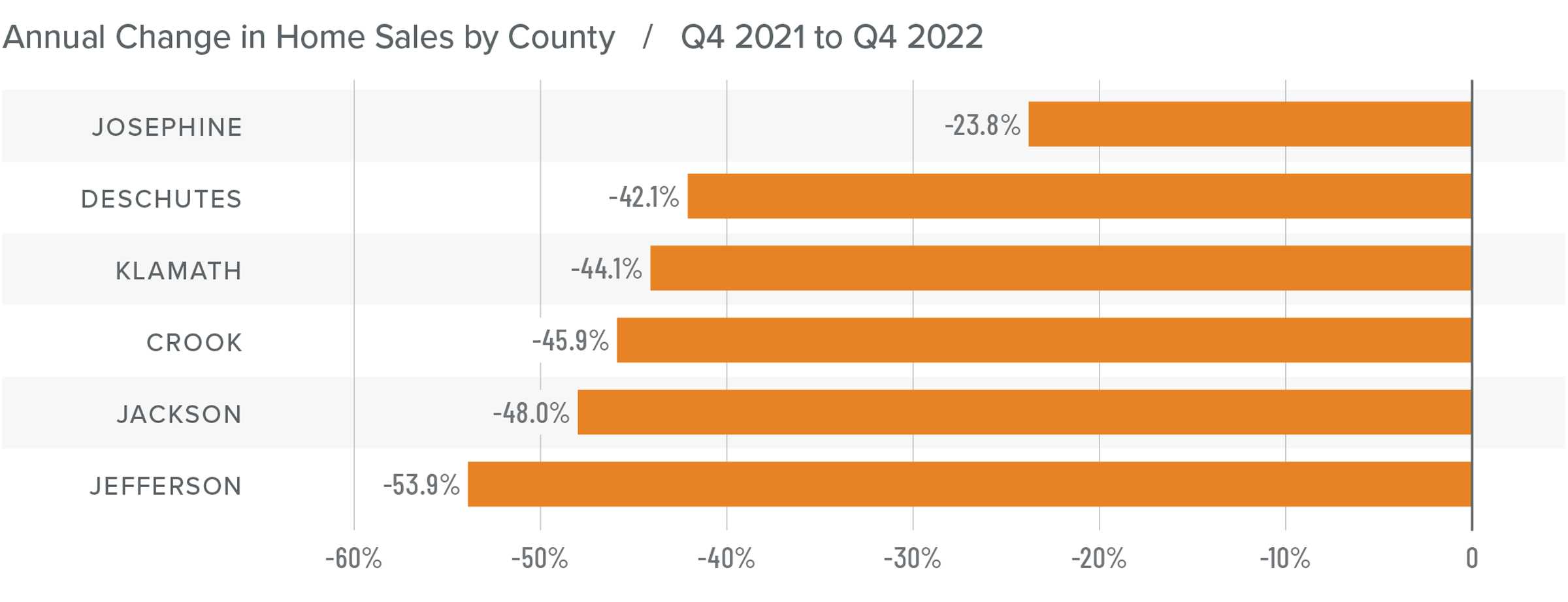
A bar graph showing the annual change in home sales for various counties in Central and Southern Oregon from Q4 2021 to Q4 2022. All counties have a negative percentage year-over-year change. Here are the totals: Josephine at -23.8%, Deschutes at -42.1%, Klamath -44.1%, Crook -45.9%, Jackson -48%, and Jefferson -53.9%.

Central and Southern Oregon Home Prices

The average home sale price in the region rose 1% year over year to $557,517, but it was down 8.4% from the third quarter of 2022.

Compared to the third quarter of 2022, average prices fell in every county other than Jefferson, where they rose 3.4%.

All counties contained in this report saw prices rise year over year, but prices in Deschutes and Jackson counties were essentially unchanged. It doesn’t appear that home prices have been significantly influenced by the increase in mortgage rates yet.

Compared to the third quarter, median listing prices fell in Deschutes, Jackson, Crook, and Josephine counties, but rose in Klamath and Jefferson counties.

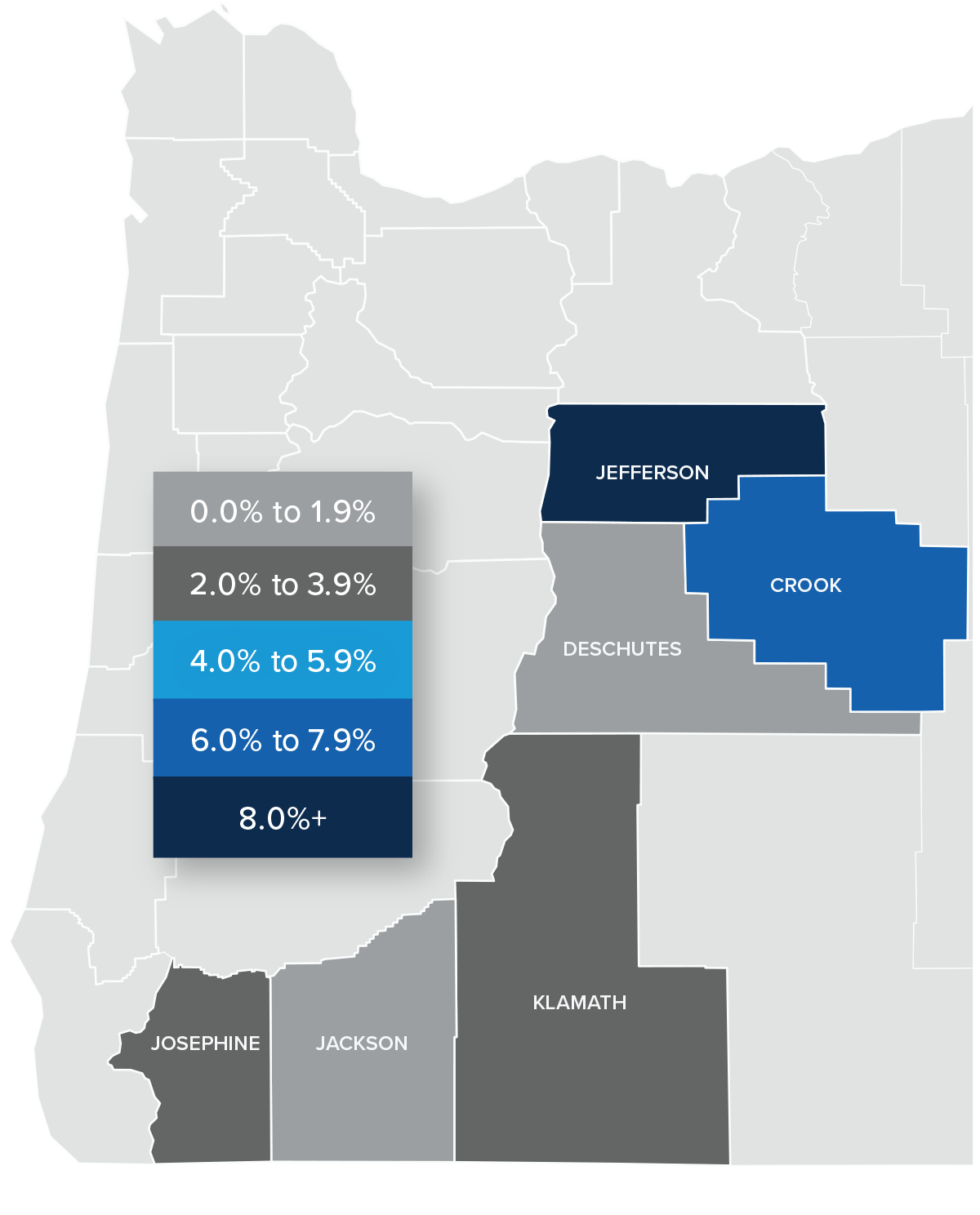
A map showing the real estate home prices percentage changes for various counties in Central and Southern Oregon. Different colors correspond to different tiers of percentage change. Deschutes and Jackson Counties have a percentage change in the 0% to 1.9% range, Klamath and Josephine are in the 2% to 3.9% change range, Crook is in the 6% to 7.9% change range, and Jefferson County is in the 8%+ change range.

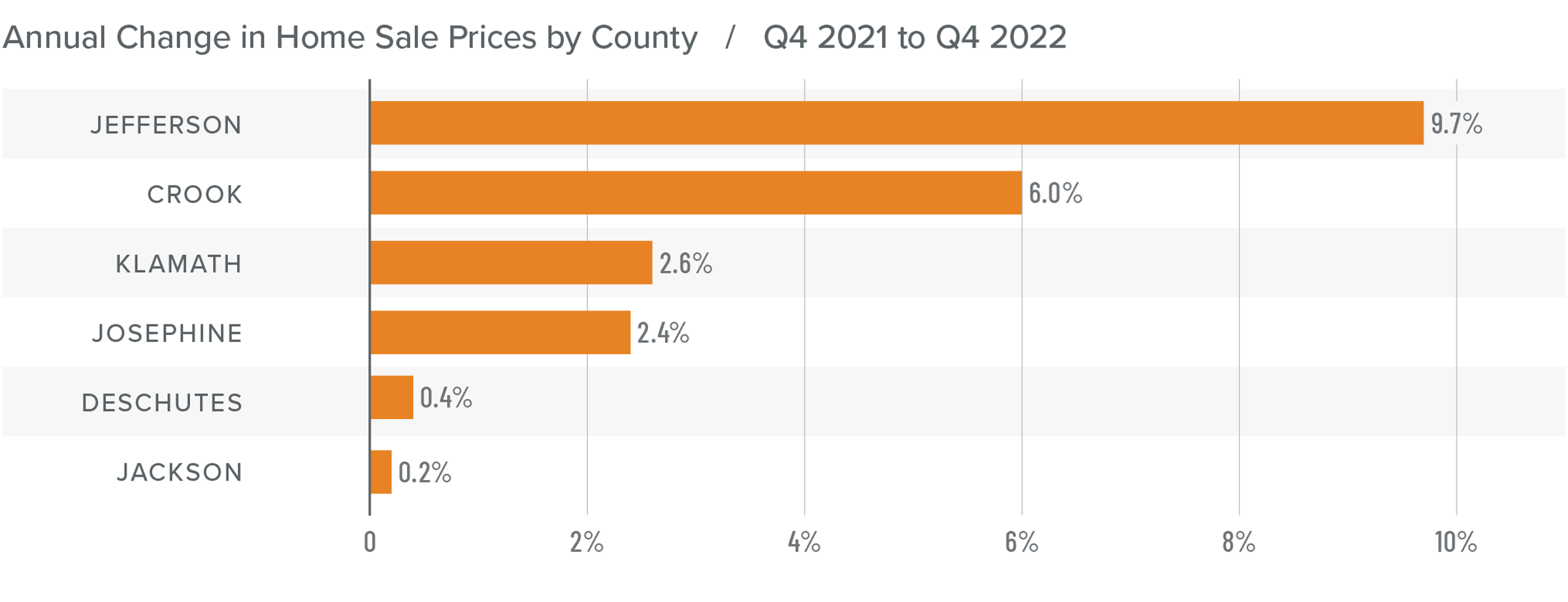
A bar graph showing the annual change in home sale prices for various counties in Central and Southern Oregon from Q4 2021 to Q4 2022. Jefferson County tops the list at 9.7%, followed by Crook at 6%, Klamath at 2.6%, Josephine at 2.4%, Deschutes at 0.4%, and Jackson at 0.2%.

Mortgage Rates

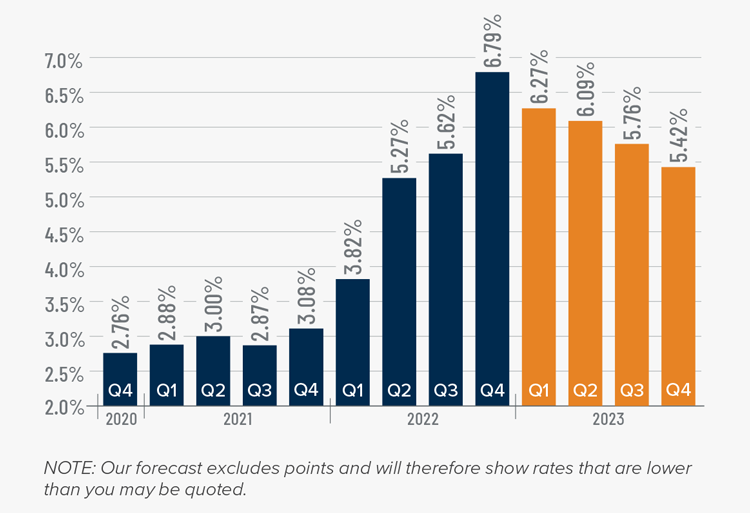
Rates rose dramatically in 2022, but I believe that they have now peaked. Mortgage rates are primarily based on the prices and yields of bonds, and while bonds take cues from several places, they are always impacted by inflation and the economy at large. If inflation continues to fall, as I expect it will, rates will continue to drop.

My current forecast is that mortgage rates will trend lower as we move through the year. While this may be good news for home buyers, rates will still be higher than they have become accustomed to. Even as the cost of borrowing falls, home prices in expensive markets will probably fall a bit more to compensate for rates that will likely hold above 6% until early summer.

A bar graph showing the mortgage rates from Q4 2020 to the present, as well as Matthew Gardner's forecasted mortgage rates through Q4 2023. After the 6.79% figure in Q4 2022, he forecasts mortgage rates dipping to 6.27% in Q1 2023, 6.09% in Q2 2023, 5.76% in Q3 2023, and 5.42% in Q4 2023.

Central and Southern Oregon Days on Market

The average time it took to sell a home in the region rose 26 days year over year. It took 21 more days for a home to sell compared to the third quarter of 2022.

The average time it took to sell a home in the final quarter of 2022 was 54 days.

All counties saw market time rise compared to both the same period the year prior and the third quarter of 2022.

It appears that buyers are being far more selective and taking their time when it comes to making an offer on a home.

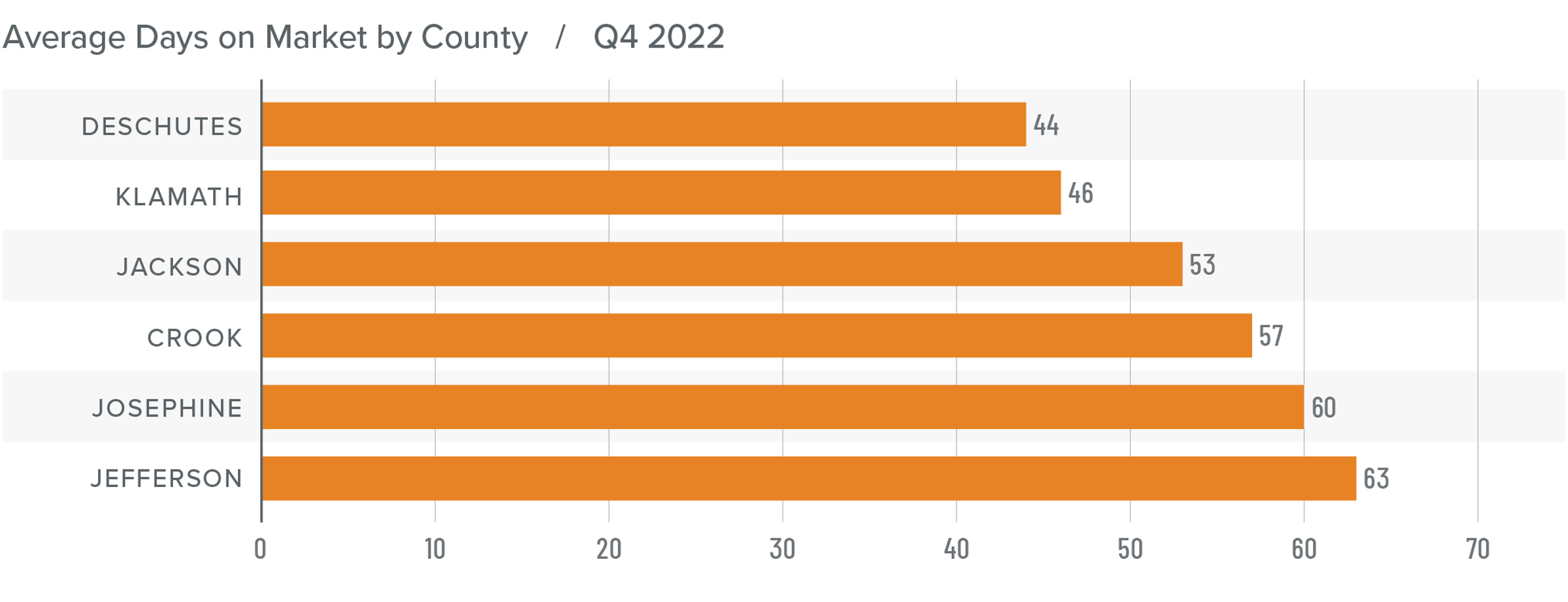
A bar graph showing the average days on market for homes in various counties in Central and Southern Oregon for Q4 2022. Deschutes County has the lowest DOM at 44, followed by Klamath at 46, Jackson at 53, Crook at 57, Josephine at 60, and Jefferson at 63.

Conclusions

This speedometer reflects the state of the region’s real estate market using housing inventory, price gains, home sales, interest rates, and larger economic factors.

Sellers are adjusting to the changing market, as shown by the drop in asking prices in several markets, though this is not the case everywhere. The spring market will be a bellwether for the housing market in 2023. It appears as if mortgage rates have peaked, which should be good news for home buyers. Furthermore, sellers lowered their listing prices by almost 3% in the fourth quarter, demonstrating that they are aware that the market has shifted.

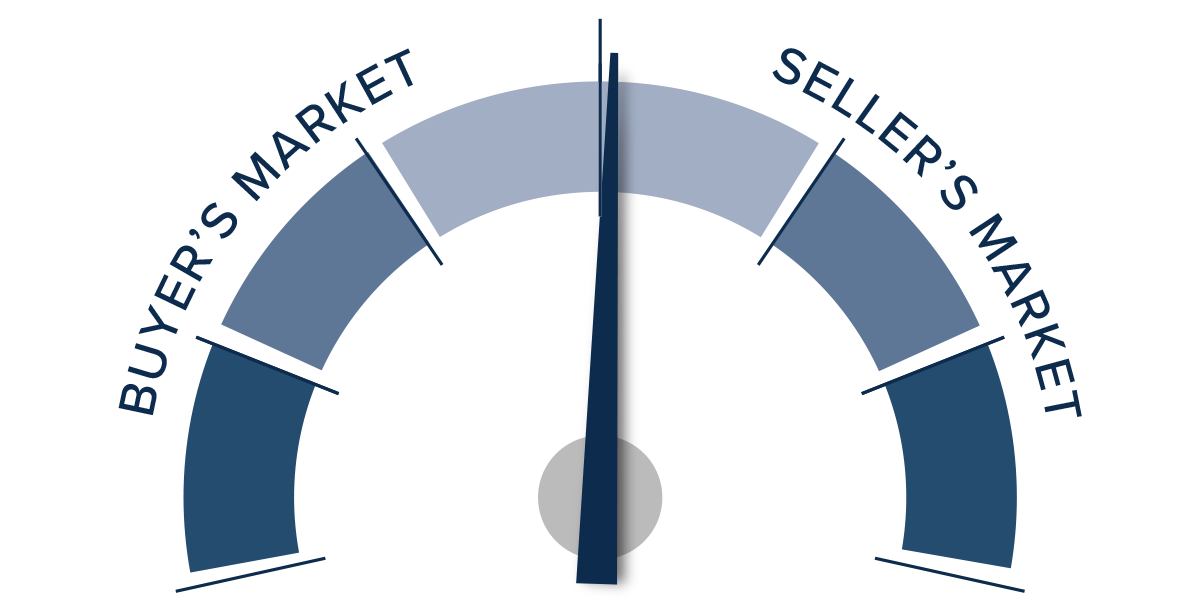
A speedometer graph indicating a balanced market, barely leaning toward a seller's market in Central and Southern Oregon in Q4 2022.

The market appears to be moving more toward buyers. As such, I have moved the needle closer to the center, but I cannot say definitively that the market completely favors buyers. The spring market will be very telling.

About Matthew Gardner

Matthew Gardner - Chief Economist for Windermere Real Estate

As Chief Economist for Windermere Real Estate, Matthew Gardner is responsible for analyzing and interpreting economic data and its impact on the real estate market on both a local and national level. Matthew has over 30 years of professional experience both in the U.S. and U.K.

In addition to his day-to-day responsibilities, Matthew sits on the Washington State Governors Council of Economic Advisors; chairs the Board of Trustees at the Washington Center for Real Estate Research at the University of Washington; and is an Advisory Board Member at the Runstad Center for Real Estate Studies at the University of Washington where he also lectures in real estate economics.
Market News January 27, 2023

Q4 2022 Northwest Oregon and Southwest Washington Real Estate Market Update

The following analysis of select counties of the Northwest Oregon and Southwest Washington real estate market is provided by Windermere Real Estate Chief Economist Matthew Gardner. We hope that this information may assist you with making better-informed real estate decisions. For further information about the housing market in your area, please don’t hesitate to contact your Windermere Real Estate agent.


Regional Economic Overview

Jobs continue to be added in Northwest Oregon. Though we continue to creep toward a full recovery of the jobs lost to the pandemic, employment levels are still down more than 38,000 jobs. The unemployment rate in the region was 5% and has been trending higher as the total number of jobs falls, albeit modestly. The Southwest Washington market also continues to perform well, but the pace of job growth has certainly tapered. Unemployment was on the decline through mid-summer but has started to rise again. The unemployment rate in November was 5.2%, which was the highest level since September 2021.

Northwest Oregon and Southwest Washington Home Sales

In the final quarter of 2022, 8,434 homes sold, representing a drop of 43.4% from the same period in 2021.

Year over year, listing activity was significantly higher but remained well below the long-term average. This suggests that high financing costs and affordability constraints are still impacting the market.

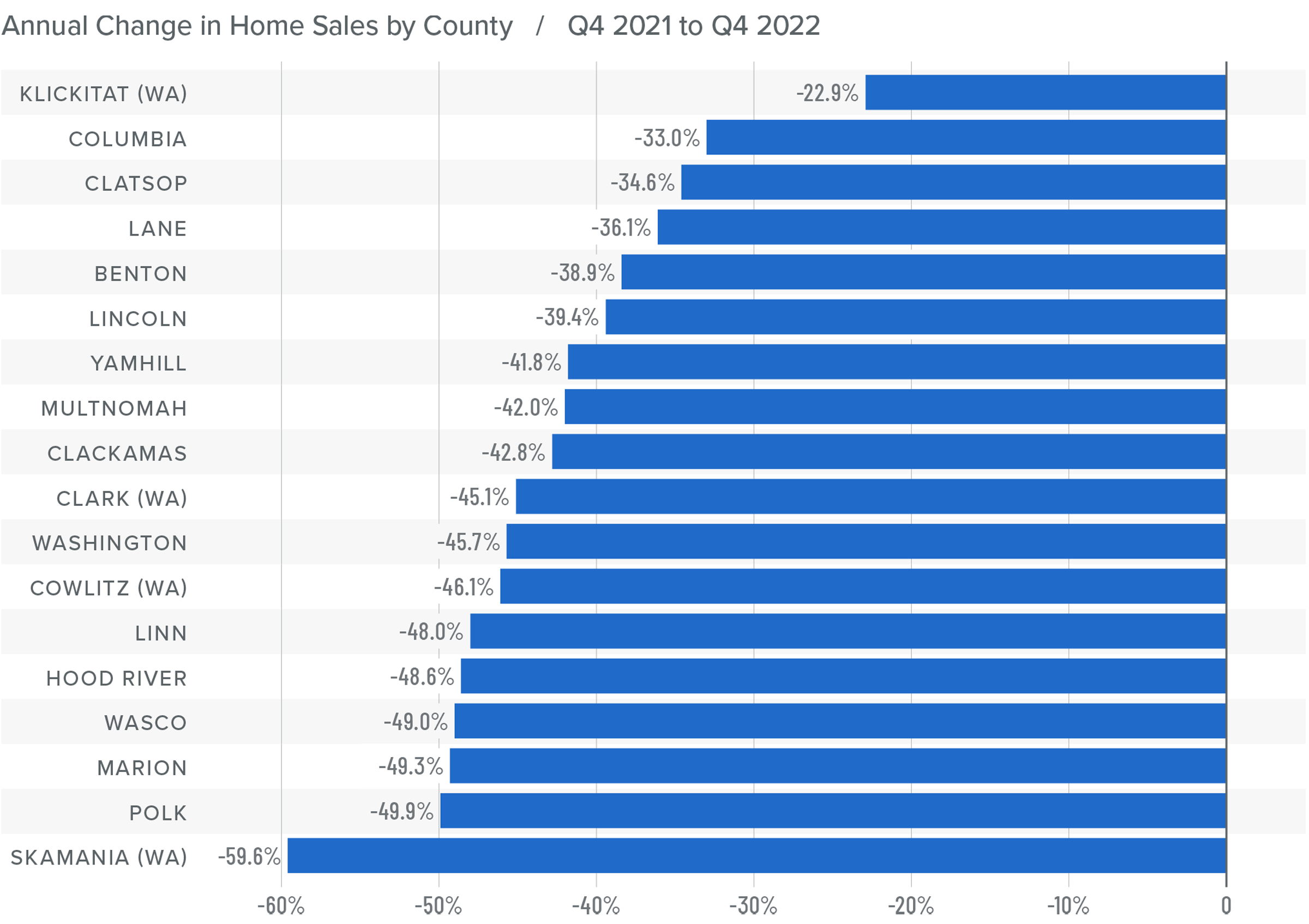
Home sales fell across the board relative to the same time the previous year and the third quarter of 2022.

Buyers have more homes to choose from than they have seen since 2019, yet many are still sitting on the fence. This may be because they are waiting for prices to fall further, mortgage rates to come down, or, likely, both. It will be interesting to see if buyer mentality changes in the spring.

A bar graph showing the annual change in home sales for various counties in Northwest Oregon and Southwest Washington from Q4 2021 to Q4 2022. All counties have a negative percentage year-over-year change. Here are the totals: Klickitat at -22.9%, Columbia at -33%, Clatsop -34.6%, Lane -36.1%, Benton -38.9%, Lincoln -39.4%, Yamhill -41.8%, Multnomah -42%, Clackamas -42.8%, Clark -45.1%, Washington -45.7%, Cowlitz -46.1%, Linn -48%, Hood River -48.6%, Wasco -49%, Marion -49.3%, Polk -49.9%, and Skamania -59.6%.

Northwest Oregon and Southwest Washington Home Prices

The average home sale price in the region matched that of the same period the year prior, but it was down 5.6% compared to the third quarter of 2022.

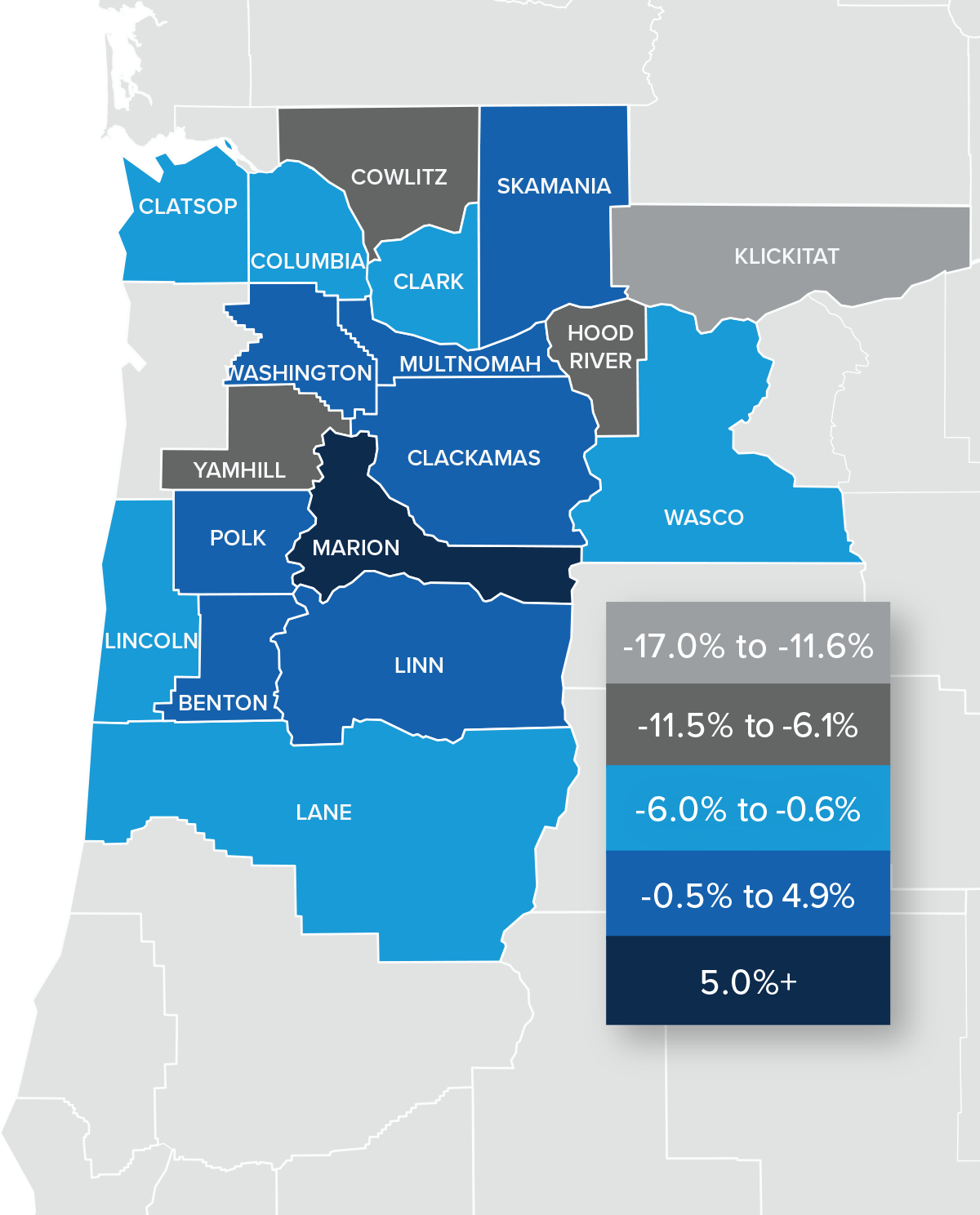
Relative to the third quarter of 2022, average prices fell across the board. Columbia, Hood River, Lincoln, and Wasco counties saw double-digit declines.

Prices in all but seven counties fell year over year. Where prices did rise, the pace of growth was far lower than the market has seen in a number of years.

Several markets appear to show listing prices either stabilizing or increasing modestly. It is possible that some markets have adjusted to account for higher mortgage rates. It will be interesting to see if this continues as we move into the spring market, or if we will see prices erode further.

A map showing the real estate home prices percentage changes for various counties in Northwest Oregon and Southwest Washington. Different colors correspond to different tiers of percentage change. Klickitat County has a percentage change in the -17% to -11.6%+ range, Cowlitz, Hood River, and Yamhill counties are in the -11.5% to -6.1% change range, Clatsop, Columbia, Clark, Wasco, Lincoln, and Lane are in the -6% to -0.6% change range, Skamania, Washington, Multnomah, Clackamas, Polk, Benton, and Linn counties are in the -0.5% to 4.9% change range, and Marion County is in the 5%+ change range.

A bar graph showing the annual change in home sale prices for various counties in Northwest Oregon and Southwest Washington from Q4 2021 to Q4 2022. Marion County tops the list at 6.5%, followed by Linn at 2.9%, Washington at 1.6%, Benton, Polk, and Skamania at 1.5%, Multnomah at 0.1%, Clackamas at -0.2%, Clark at -0.6%, Lane at -0.9%, Wasco at -1.8%, Clatsop at -3.5%, Columbia at -4.2%, Lincoln at -5%, Cowlitz at -6.2%, Yamhill at -6.9%, Hood River at -10.4%, and finally Klickitat at -16.8%.

Mortgage Rates

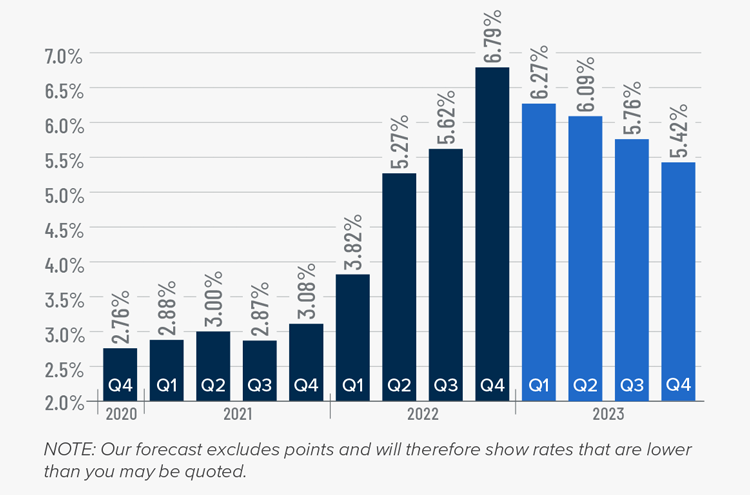
Rates rose dramatically in 2022, but I believe that they have now peaked. Mortgage rates are primarily based on the prices and yields of bonds, and while bonds take cues from several places, they are always impacted by inflation and the economy at large. If inflation continues to fall, as I expect it will, rates will continue to drop.

My current forecast is that mortgage rates will trend lower as we move through the year. While this may be good news for home buyers, rates will still be higher than they have become accustomed to. Even as the cost of borrowing falls, home prices in expensive markets will probably fall a bit more to compensate for rates that will likely hold above 6% until early summer.

A bar graph showing the mortgage rates from Q4 2020 to the present, as well as Matthew Gardner's forecasted mortgage rates through Q4 2023. After the 6.79% figure in Q4 2022, he forecasts mortgage rates dipping to 6.27% in Q1 2023, 6.09% in Q2 2023, 5.76% in Q3 2023, and 5.42% in Q4 2023.

Northwest Oregon and Southwest Washington Days on Market

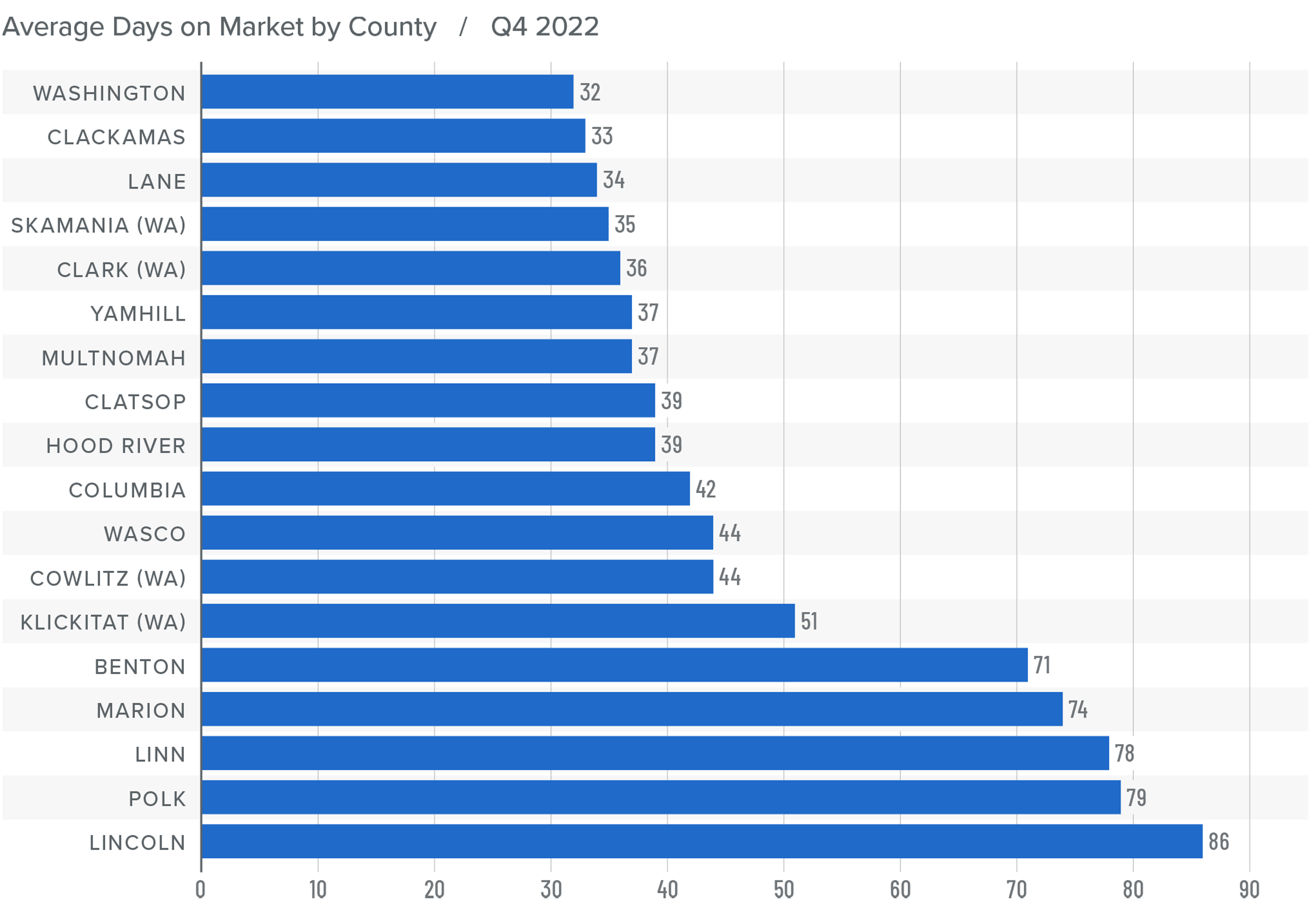
The average time it took to sell a home in the region rose 12 days compared to the same period the previous year. It took 11 more days for homes to sell than it did in the third quarter of 2022.

The average time it took to sell a home in the final quarter of 2022 was 50 days.

Skamania County was the only area where market time fell compared to the same period the prior year. Relative to the third quarter of 2022, market time fell in Benton and Skamania counties.

Longer market time is a function of additional supply. While this gives buyers more choice, it also causes uncertainty in the housing market. As a result, buyers are significantly more cautious than they have been in quite some time.

A bar graph showing the average days on market for homes in various counties in Northwest Oregon and Southwest Washington for Q4 2022. Washington County has the lowest DOM at 32, followed by Clackamas at 33, Lane at 34, Skamania at 35, Clark at 36, Yamhill and Multnomah at 37, Clatsop and Hood River at 39, Columbia at 42, Wasco and Cowlitz at 44, Klickitat at 51, Benton at 71, Marion at 74, Linn at 78, Polk at 79, and Lincoln at 86.

Conclusions

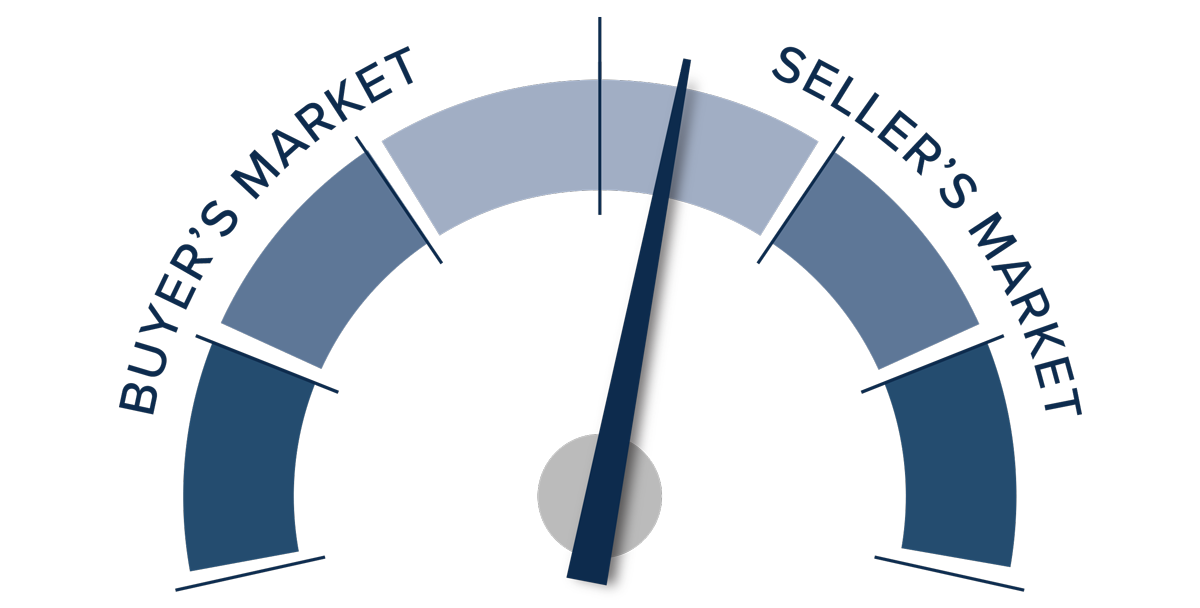
This speedometer reflects the state of the region’s real estate market using housing inventory, price gains, home sales, interest rates, and larger economic factors.

I believe the market will remain somewhat soft as we move through the spring, but with many sellers believing that prices have found a bottom (as indicated by the stabilization in listing prices), buyers may not end up in as strong a position as they might think.

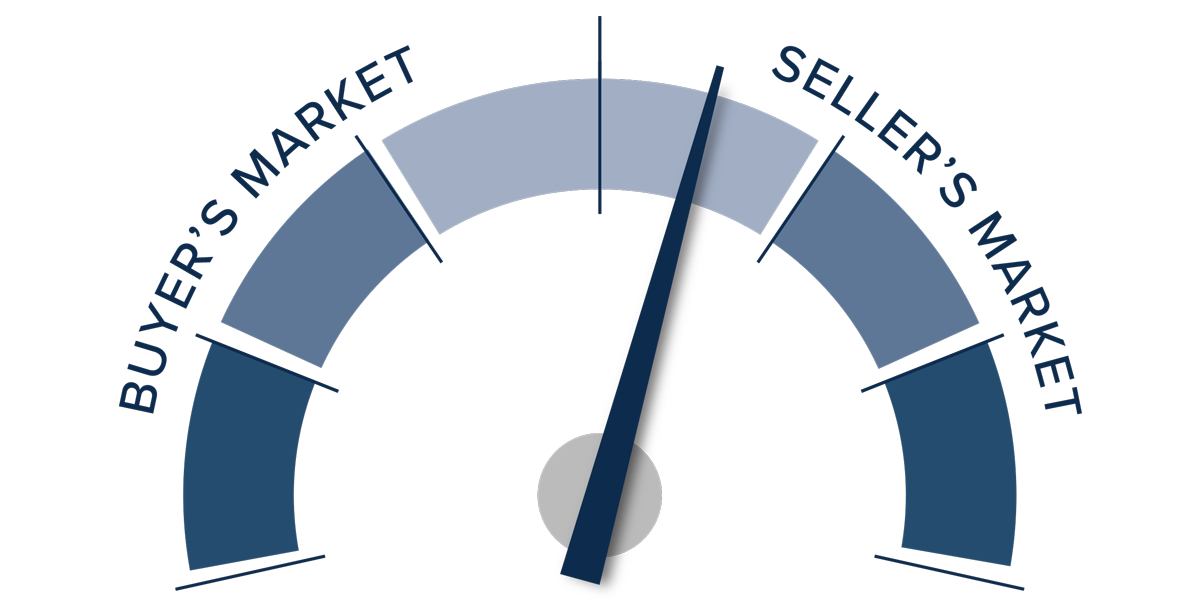
A speedometer graph indicating a balanced market, barely leaning toward a seller's market in Northwest Oregon and Southwest Washington in Q4 2022.

The market is, without a doubt, closer to balance than it has been in over a decade. As such, I have moved the needle as close to the balance line as we have seen in a very long time.

About Matthew Gardner

Matthew Gardner - Chief Economist for Windermere Real Estate

As Chief Economist for Windermere Real Estate, Matthew Gardner is responsible for analyzing and interpreting economic data and its impact on the real estate market on both a local and national level. Matthew has over 30 years of professional experience both in the U.S. and U.K.

In addition to his day-to-day responsibilities, Matthew sits on the Washington State Governors Council of Economic Advisors; chairs the Board of Trustees at the Washington Center for Real Estate Research at the University of Washington; and is an Advisory Board Member at the Runstad Center for Real Estate Studies at the University of Washington where he also lectures in real estate economics.
Market News January 26, 2023

Q4 2022 Western Washington Real Estate Market Update

The following analysis of select counties of the Western Washington real estate market is provided by Windermere Real Estate Chief Economist Matthew Gardner. We hope that this information may assist you with making better-informed real estate decisions. For further information about the housing market in your area, please don’t hesitate to contact your Windermere Real Estate agent.
 

Regional Economic Overview

Although the job market in Western Washington continues to grow, the pace has started to slow. The region added over 91,000 new jobs during the past year, but the 12-month growth rate is now below 100,000, a level we have not seen since the start of the post-COVID job recovery. That said, all but three counties have recovered completely from their pandemic job losses and total regional employment is up more than 52,000 jobs. The regional unemployment rate in November was 3.8%, which was marginally above the 3.7% level of a year ago. Many business owners across the country are pondering whether we are likely to enter a recession this year. As a result, it’s very possible that they will start to slow their expansion in anticipation of an economic contraction.

Western Washington Home Sales

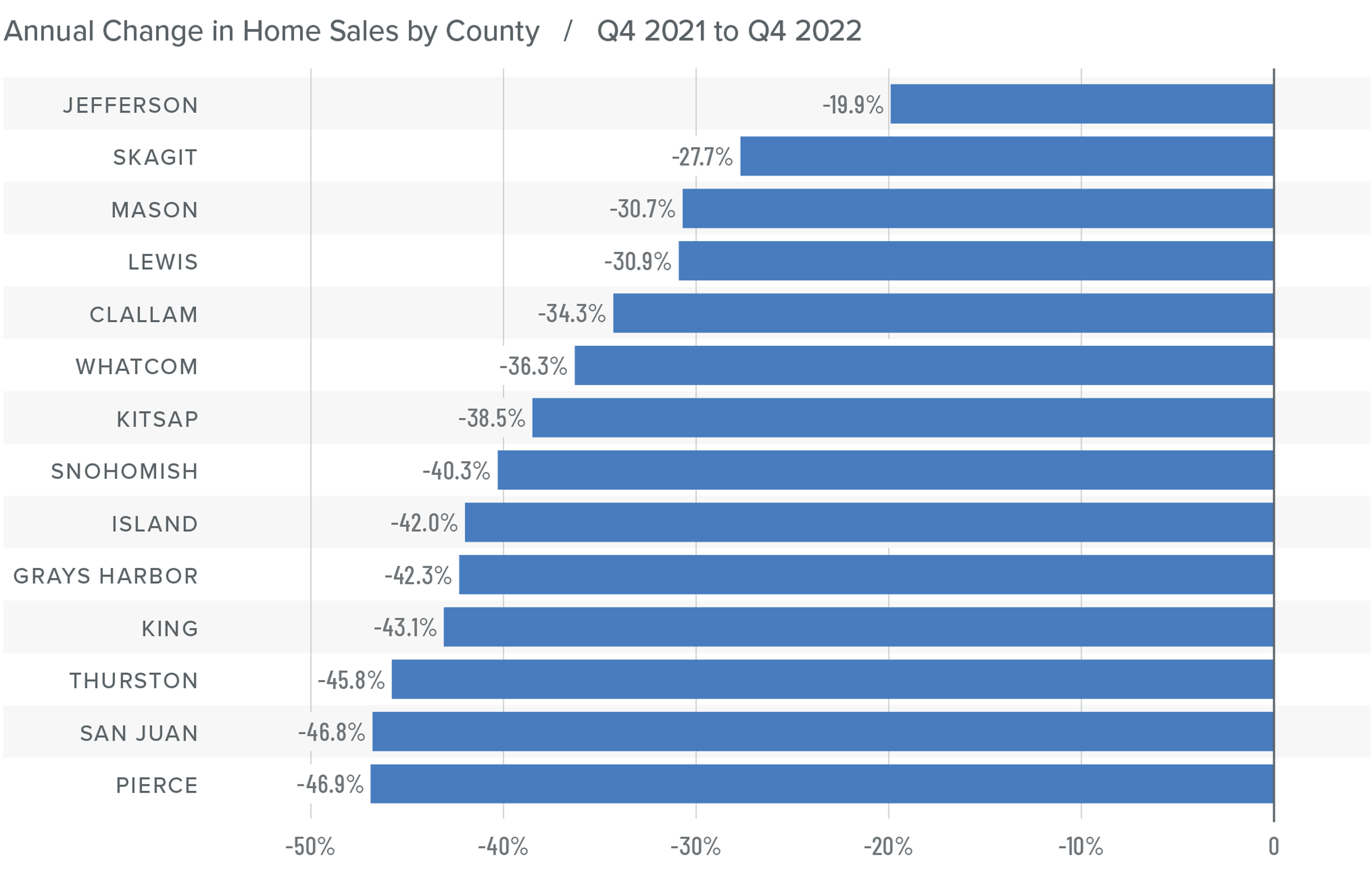
In the final quarter of 2022, 12,711 homes sold, representing a drop of 42% from the same period in 2021. Sales were 34.7% lower than in the third quarter of 2022.

Listing activity rose in every market year over year but fell more than 26% compared to the third quarter, which is expected given the time of year.

Home sales fell across the board relative to the fourth quarter of 2021 and the third quarter of 2022.

Pending sales (demand) outpaced listings (supply) by a factor of 1:2. This was down from 1:6 in the third quarter. That ratio has been trending lower for the past year, which suggests that buyers are being more cautious and may be waiting for mortgage rates to drop.

A bar graph showing the annual change in home sales for various counties in Western Washington from Q4 2021 to Q4 2022. All counties have a negative percentage year-over-year change. Here are the totals: Jefferson at -19.9%, Skagit at -27.7%, Mason -30.7%, Lewis -30.9%, Clallam -34.3%, Whatcom -36.3%, Kitsap -38.5%, Snohomish -40.3%, Island -42%, Grays Harbor -42.3%, King -43.1%, Thurston -45.8%, San Juan -46.8%, Pierce -46.9%.

Western Washington Home Prices

Sale prices fell an average of 2% compared to the same period the year prior and were 6.1% lower than in the third quarter of 2022. The average sale price was $702,653.

The median listing price in the fourth quarter of 2022 was 5% lower than in the third quarter. Only Skagit County experienced higher asking prices. Clearly, sellers are starting to be more realistic about the shift in the market.

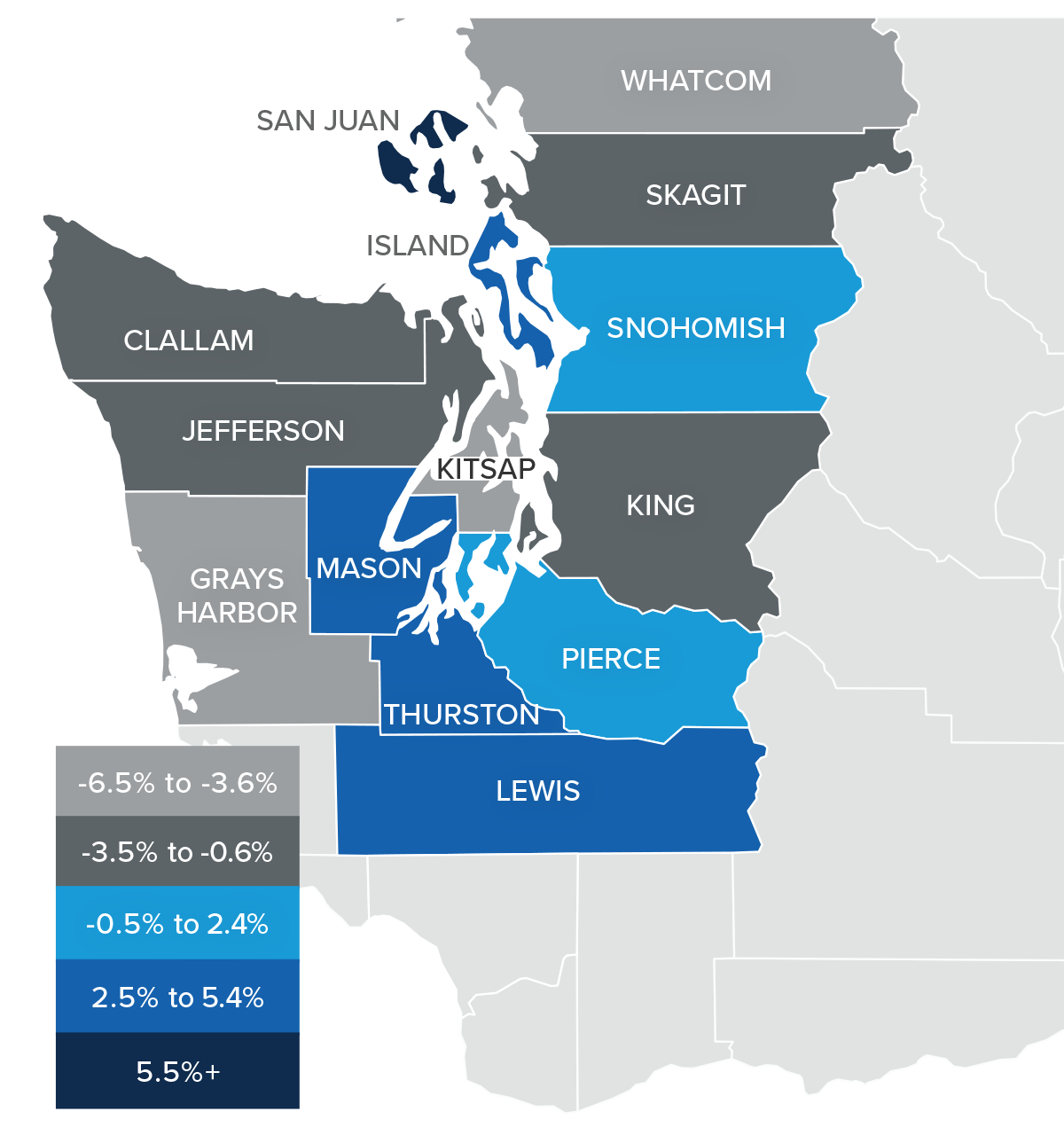
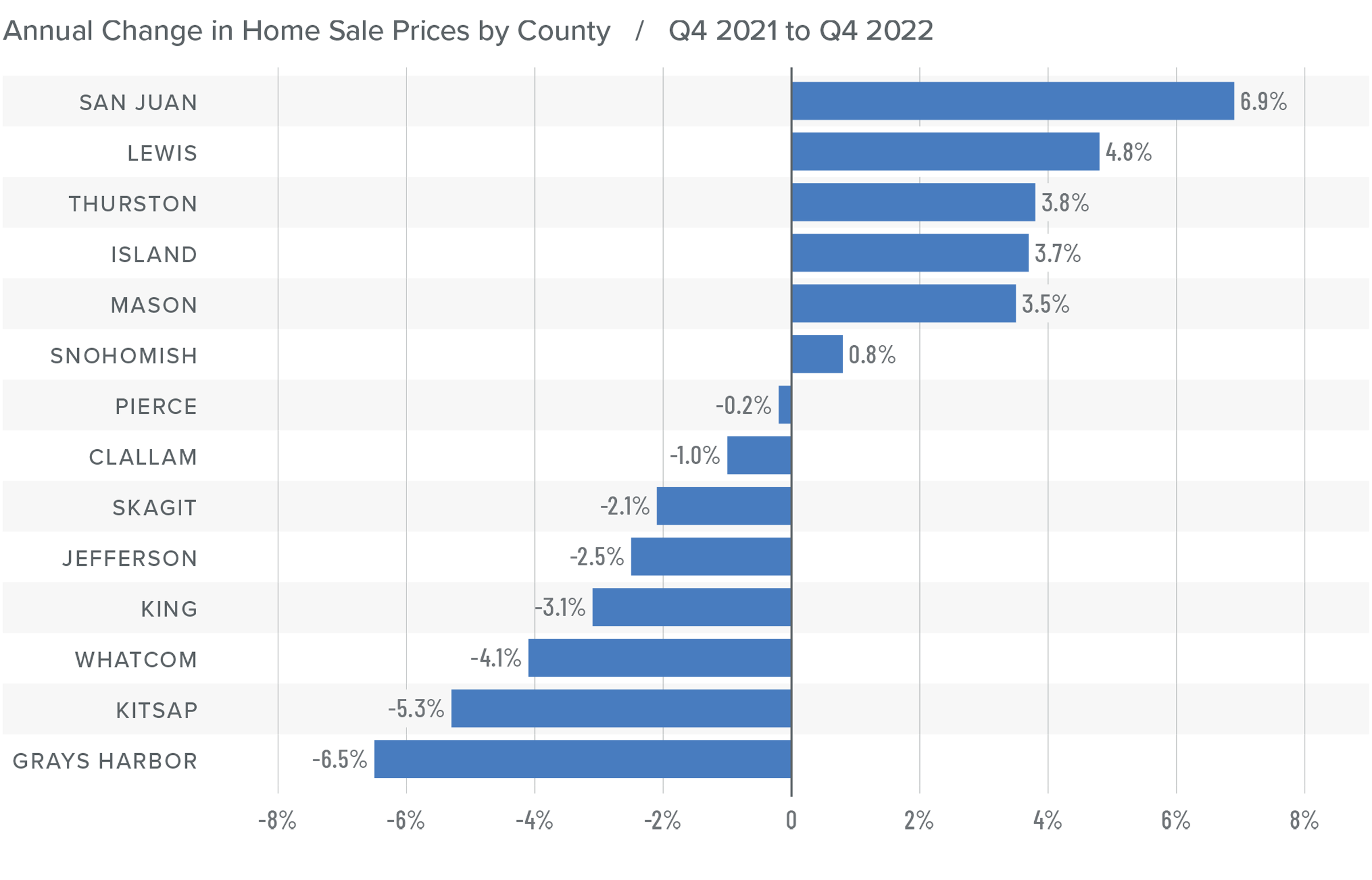
Even though the region saw aggregate prices fall, prices rose in six counties year over year.

Much will be said about the drop in prices, but I am not overly concerned. Like most of the country, the Western Washington market went through a period of artificially low borrowing costs, which caused home values to soar. But now prices are trending back to more normalized levels, which I believe is a good thing.

A map showing the real estate home prices percentage changes for various counties in Western Washington. Different colors correspond to different tiers of percentage change. Grays Harbor and Whatcom Counties have a percentage change in the -6.5% to -3.6%+ range, Clallam, Jefferson, King, and Skagit counties are in the -3.5% to -0.6% change range, Snohomish and Pierce are in the -0.5% to 2.4% change range, Mason, Thurston, Island, and Lewis counties are in the 2.5% to 5.4% change range, and San Juan County is in the 5.5%+ change range.

A bar graph showing the annual change in home sale prices for various counties in Western Washington from Q4 2021 to Q4 2022. San Juan County tops the list at 6.9%, followed by Lewis at 4.8%, Thurston at 3.8%, Island at 3.7%, Mason at 3.5%, Snohomish at 0.8%, Pierce at -0.2%, Clallam at -1%, Skagit at -2.1%, Jefferson at -2.5%, King at -3.1%, Whatcom at -4.1%, Kitsap at -5.3%, and finally Grays Harbor at -6.5%.

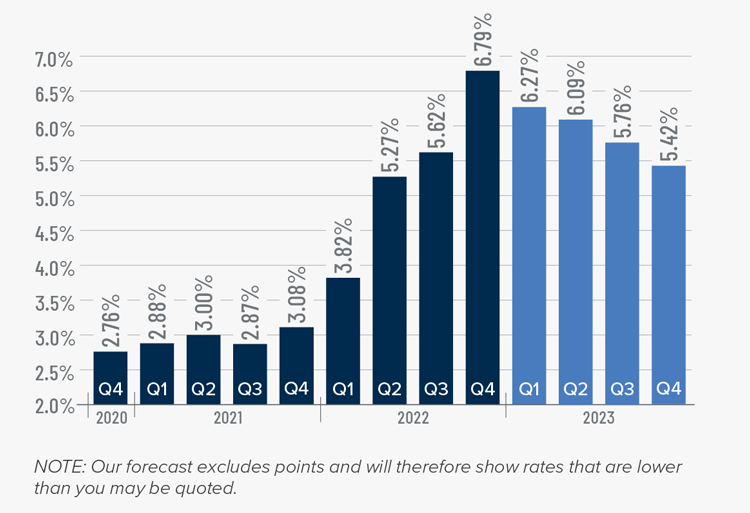
Mortgage Rates

Rates rose dramatically in 2022, but I believe that they have now peaked. Mortgage rates are primarily based on the prices and yields of bonds, and while bonds take cues from several places, they are always impacted by inflation and the economy at large. If inflation continues to fall, as I expect it will, rates will continue to drop.

My current forecast is that mortgage rates will trend lower as we move through the year. While this may be good news for home buyers, rates will still be higher than they have become accustomed to. Even as the cost of borrowing falls, home prices in expensive markets such as Western Washington will probably fall a bit more to compensate for rates that will likely hold above 6% until early summer.

A bar graph showing the mortgage rates from Q4 2020 to the present, as well as Matthew Gardner's forecasted mortgage rates through Q4 2023. After the 6.79% figure in Q4 2022, he forecasts mortgage rates dipping to 6.27% in Q1 2023, 6.09% in Q2 2023, 5.76% in Q3 2023, and 5.42% in Q4 2023.

Western Washington Days on Market

It took an average of 41 days for homes to sell in the fourth quarter of 2022. This was 17 more days than in the same quarter of 2021, and 16 days more than in the third quarter of 2022.

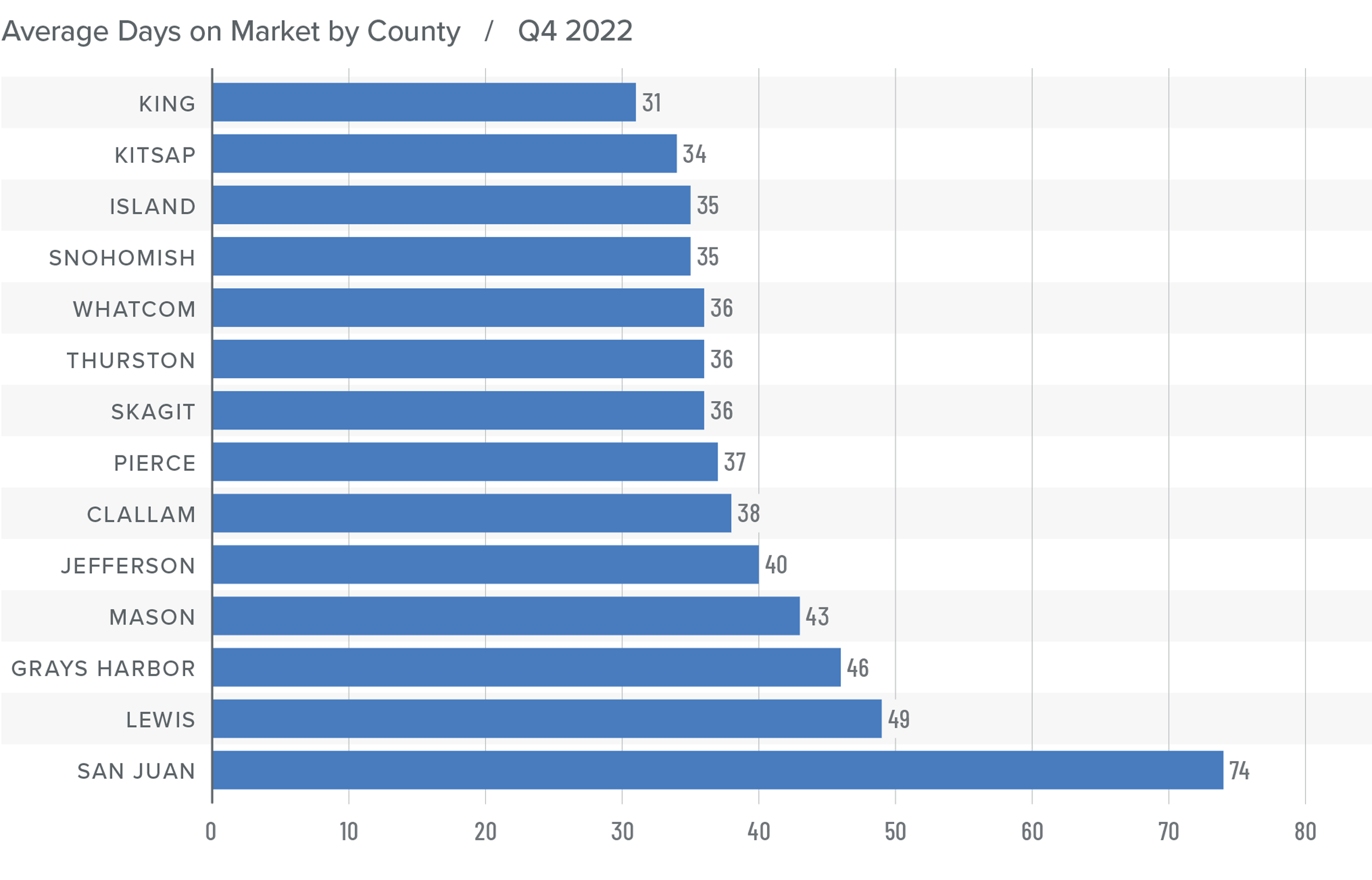
King County was again the tightest market in Western Washington, with homes taking an average of 31 days to find a buyer.

All counties contained in this report saw the average time on market rise from the same period a year ago.

Year over year, the greatest increase in market time was Snohomish County, where it took an average of 23 more days to find a buyer. Compared to the third quarter of 2022, San Juan County saw average market time rise the most (from 34 to 74 days).

A bar graph showing the average days on market for homes in various counties in Western Washington for Q4 2022. King County has the lowest DOM at 31, followed by Kitsap at 45, Island and Snohomish at 35, Whatcom, Thurston, and Skagit at 36, Pierce at 37, Clallam at 38, Jefferson at 40, Mason at 43, Grays Harbor at 46, Lewis at 49, and San Juan at 74.

Conclusions

This speedometer reflects the state of the region’s real estate market using housing inventory, price gains, home sales, interest rates, and larger economic factors.

The regional economy is still growing, but it is showing signs of slowing. Although this is not an immediate concern, if employees start to worry about job security, they may decide to wait before making the decision to buy or sell a home. As we move through the spring I believe the market will be fairly soft, but I would caution buyers who think conditions are completely shifting in their direction. Due to the large number of homeowners who have a mortgage at 3% or lower, I simply don’t believe the market will become oversupplied with inventory, which will keep home values from dropping too significantly.

A speedometer graph indicating a balanced market, barely leaning toward a seller's market in Western Washington in Q4 2022.

Ultimately, however, the market will benefit buyers more than sellers, at least for the time being. As such, I have moved the needle as close to the balance line as we have seen in a very long time.

About Matthew Gardner

Matthew Gardner - Chief Economist for Windermere Real Estate

As Chief Economist for Windermere Real Estate, Matthew Gardner is responsible for analyzing and interpreting economic data and its impact on the real estate market on both a local and national level. Matthew has over 30 years of professional experience both in the U.S. and U.K.

In addition to his day-to-day responsibilities, Matthew sits on the Washington State Governors Council of Economic Advisors; chairs the Board of Trustees at the Washington Center for Real Estate Research at the University of Washington; and is an Advisory Board Member at the Runstad Center for Real Estate Studies at the University of Washington where he also lectures in real estate economics.