Facebook
 X
X
 Pinterest
 Copy Link

Will the Trump administration have an impact on the U.S. housing market? Windermere Chief Economist, Matthew Gardner, weighs in on how mortgage rates, inflation, and the possible repeal of Dodd-Frank could impact housing in the foreseeable future.
Market News •
May 18, 2017
Windermere’s Chief Economist Weighs in on White House Uncertainty

Windermere Real Estate Chief Economist, Matthew Gardner, was interviewed by real estate industry news leader, Inman News, on what impact recent White House turmoil could have on the U.S. housing market. This is what he had to say:
Windermere Chief Economist Matthew Gardner says that housing will be isolated from yesterday’s events, at least for now. “Financial markets hate one thing more than anything else, and that is uncertainty,” Gardner told Inman. “Yesterday’s sell-off was a clear response to the appointment of a special counsel and markets were clearly on edge.
“As far as housing goes, the downside will likely be muted, at least for the time being. Yesterday’s news headlines cast further doubt on the new administration’s ability to rapidly enact the legislation that prompted investors to make big bets on higher stocks and interest rates.
“Unsurprisingly, investors pushed stocks and interest rates lower following the news. This triggered mortgage rates to drop significantly, as part of the broad-based sell-off in equities. At least for the time being, I do not see any long-term housing related issues following the political turmoil that currently embroils Washington.”
You can find insights from other industry leaders in the full article here: http://www.inman.com/2017/05/18/white-house-uncertainty-hurt-housing-market/
More •
May 18, 2017
5 Things Your Contractor Doesn’t Want to Hear

There are parts of every job, no matter what field you’re in, that are just less fun than others. Building professionals pride themselves on doing anything and everything to make clients happy. But that doesn’t always mean the builder is jumping up and down with excitement at every stage of a project.
Related: 10 Things to Discuss With a Contractor Before Work Starts
When it comes to remodeling and home building, contractors will do just about anything to make you happy. They’ll meet with you on short notice. They’ll come up with creative solutions to your unique requests. They’ll even clean your toilets if you ask (although maybe not for free).
Contractors may have a brave face on at all times, but I’ll let you in on a little secret: There are some things they just don’t like to hear. Such as …

Comments 1: Gepetto, original photo on Houzz
1. “I reselected my plumbing fixtures.” Most good contractors will harp on how important it is to get all your selections made as soon as possible. Some won’t even start a project until everything is selected. It’s a great practice, and it helps to keep your project going as smoothly as possible.
Related: Bathroom Sinks for Every Budget
So if you come to your builder in the middle of the project and say, “Hey, by the way, I chose all new plumbing fixtures for the master bathroom,” they might get a little nervous. Depending on what stage of work they’re in and what you reselected, this could be no big deal. Or it could mean doing a lot of extra work to prepare for the new fixtures. Even worse, there may be a lead time associated with your new selections. This could cause an unplanned stop in work, which nobody (homeowners, subcontractors, builders, neighbors) likes.
Comments 2: BCV ARCHITECTS, original photo on Houzz
2. “Can we hang this chandelier up there?” (Points to 20-foot-tall ceiling.) Why, yes! Yes, we can. I’ll just be sitting in the corner biting my nails as I watch my electricians stand on massive ladders that I (the person with the fear of heights) would never set foot on, all while they hold and hang a massively heavy and most likely expensive chandelier. But, yeah, we can definitely do that. No problem.
Related: Search Chandeliers by Style
There’s really no way to avoid challenges like this. But it helps to give your builder a heads up on out-of-the-ordinary needs you may have. That way, he or she can take extra precautions, such as setting up scaffolding, and warn you of any additional costs that your request could involve.
Comments 3: Buildwell, original photo on Houzz
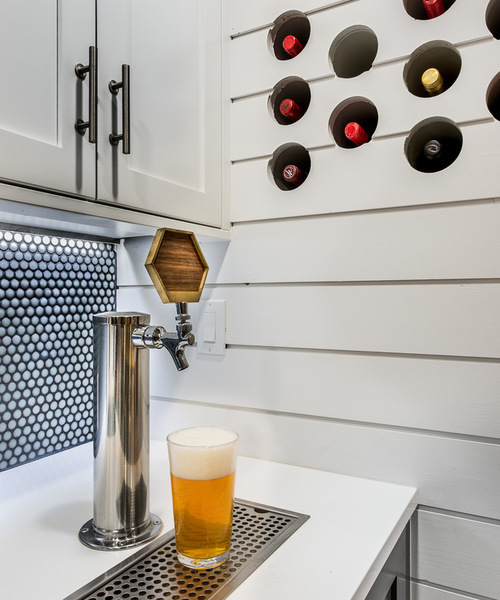
3. “Can you meet at 5 p.m. this Friday?” Admittedly, I don’t think anyone likes to hear this. Contractors may work long hours and be available pretty much whenever you need them to be, but that doesn’t mean that they don’t want to go home a little early (or at least leave on time) on Friday to relax.
A great way to ensure you’ll have your contractor’s undivided attention is to set up recurring meetings. Find a time that works for both of you and save it in your calendars. That way, no one has to worry about last-minute, pre-weekend meetings.
Comments 4: Kasper Custom Remodeling, LLC, original photo on Houzz
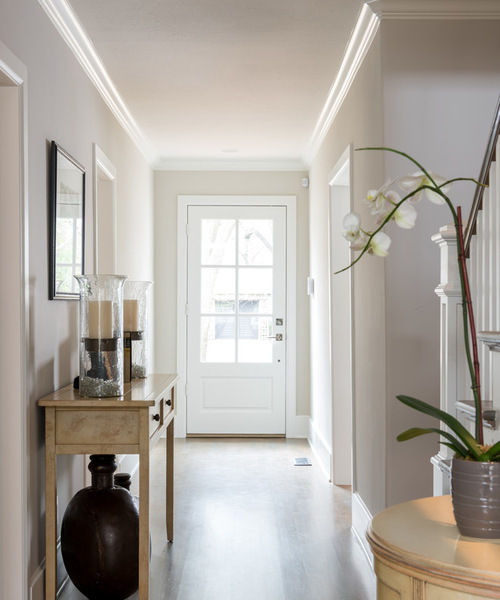
4. “Let’s make all of the walls smooth!” I think smooth walls are beautiful. They’re crisp and clean and are a must in my book. I’ll say this much, though: They aren’t always easy. It’s one thing to hire a high-quality drywall contractor who is a pro at smooth finishes. It’s another thing entirely to have all involved parties be happy with the final product.
It’s kind of like If You Give a Moose a Muffin. It starts with one thing that needs to be fixed (“That corner isn’t perfectly square”) and seemingly overnight turns into a mile-long punch list detailing everything from millimeter-wide blemishes to areas of texture that look weird in a certain light. Like I said, I adore smooth walls, but getting them to a level of smoothness that everyone can agree on can be a bit of a task.
If you can find it within yourself to hold off on the nitpicking until your builder at least has the paint primer up (this is the stage when it’s easiest to see any remaining imperfections), you’ll save yourself and your builder a headache.
Comments 5: Barbara Bagot Architecture, original photo on Houzz
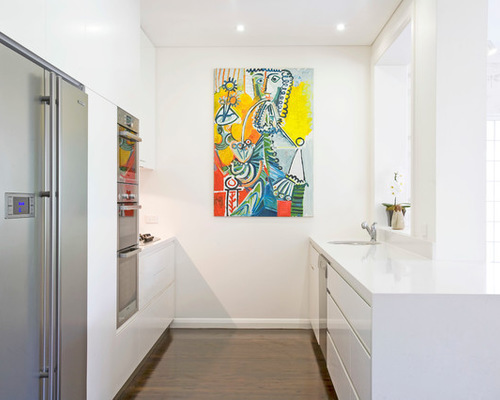
5. “Could you help me move [insert expensive item here]?” Grand pianos, $50,000 paintings, one-of-a-kind sculptures — you name it, I’m afraid of moving it. Asking remodelers to help you move something valuable to you (whether monetarily or emotionally) is asking them to take on a lot of liability.
While it may make sense to ask them for a little help — after all, they have plenty of crews, and they’re already at your house — it’s not worth the risk for any party involved. Your best bet is rephrasing the question to “Do you know anyone I could hire to help me move [insert expensive item here]?”
As I was speaking to my co-workers for their take on things contractors “hate” to do, it became apparent to me that, for the most part, there isn’t too much that we won’t do to make our customers happy. On top of that, there aren’t a huge number of things that make us shudder. (Notable exception: When someone used the toilet at a house where the water wasn’t on — yuck.)
There might be materials or tasks contractors try to avoid if they can, and some might even steer their customers away from certain things to make everyone’s life a little easier. (Our in-house designer avoids marble in kitchens at all costs because of its susceptibility to stains.) But in the end, we’re in the customer service game for a reason. We love to make people happy, and we’ll do whatever we can to facilitate that.
By Hannah Kasper, Houzz
More •
May 17, 2017
Windermere Helps Fight Food Insecurity by Funding Weekend and Summer Meal Programs


For many children, the free meals that they receive in the school cafeteria may be the only food that they get for the entire day. And that’s just on the weekdays. On the weekends, children often go hungry because their families cannot afford to cover basic household expenses, including groceries. And when the school year ends, they lose the security of those two meals, making summer the hungriest season of the year for children in our communities.
Through the Windermere Foundation, many Windermere offices throughout our network support programs that provide weekend and summer meal programs. These programs help girls and boys at risk of hunger get access to nutritious meals outside of school.
Here are just a few of the programs that our agents and offices support…
California
For the past two years, the Windermere Redding office has supported an afterschool/summer program at Eagles Soar Youth Activity Center (ESYAC) with a monthly donation of $54 that they can use to purchase food, clothes, and other necessities. The program serves “housed” homeless kids—kids who live in transient housing such as motel rooms and trailer parks. It is a 100 percent volunteer organization that is funded by donations from the community. Program volunteers pick the kids up after school twice a week and they also have a summer events program. They feed and tutor the kids, provide them with clothes if needed, and send them home with food for the weekend. Over 90 percent of the kids they help are on the honor roll.
Montana
For the past two years, the Windermere Missoula office has supported the Missoula Food Bank’s Kids Empower Pack program. The Kids Empower Pack is a nutrition program helping kids stay nourished when school is not in session. School officials identify children living with chronic hunger and enroll them in the program. And every Friday, they are sent home with a backpack full of nutrition for the weekend. In 2016, the Missoula office donated $1,200, with half of the proceeds from their annual standup paddle board race being donated to the program. The program will be one of the beneficiaries again for this year’s event. Last school year, Kids Empower Pack was helping 528 local kids every weekend. In 2017, Kids Empower Pack will feed 750 kids every weekend.
Oregon
The Windermere Gearhart and Cannon Beach offices support Warrenton-Hammond Healthy Kids, Inc., donating $500 to them in 2016 and $3,500 over the past six years. WHHKids currently serves Warrenton Grade School's 771 students and Warrenton High School’s 261 students with food weekend backpacks, clothing, and hygiene items. The student population that receives free and reduced lunches is 55 percent. This is down from a high of 64 percent for the past few years. They also serve the district's homeless population.
In 2016, the Windermere Portland-Raleigh Hills office donated $2,000 to Take Action INC. Take Action INC is an all-volunteer backpack program, non-profit organization, whose mission is to find resources to feed hungry kids, educate the public of the severity of childhood hunger in our midst, and encourage local communities to adopt schools of their own. One hundred percent of the grant is used to purchase food at a generous five percent discount from their Beaverton Grocery Outlet store partner to help 36 low-income families and feed 45 food-insecure kids at Hayhurst Elementary School.
Washington
Over the past three years, the Windermere Seattle-Wedgwood office has supported the Hunger Intervention Program with approximately $9,000 in Windermere Foundation grants. The program provides nutritious weekend food for students eligible for free or reduced price lunch when school lunches aren’t available, in addition to providing meals during the summer. The program currently serves students at Olympic Hills, John Rogers, BrierCrest, and ViewLands Elementary schools, as well as Kellogg Middle School and Nathan Hale High School.
Sometimes individual agents recognize a need in their communities and create their own programs, like Anne Jones, an agent at the Windermere Tacoma-Professional Partners office. After speaking with representatives from various schools, it was determined that food insecurity was a significant issue. So last fall, Anne created the Snacks for Schools program to support Tacoma area schools. The ultimate goal of the program is to not only provide food, but to also foster connections between community members and schools throughout the city. The program’s first delivery took place in March 2017 at First Creek Middle School, where they were able to provide a snack for all 750 students. In April, they stocked the pantry at Blix Elementary. So far, snacks have been provided for 2,400 students. With the help of other agents and community partners, the program hopes to reach 13 more schools during the month of May.

Thanks to the efforts of our Windermere offices and agents, we are tackling issues of food insecurity in our communities and helping our nonprofit partners provide nutritious meals for children in need. If you’d like to help support programs in your community, please click on the Donate button.
To learn more about the Windermere Foundation, visit http://www.windermere.com/foundation.
Market News •
May 15, 2017
Oregon and Southwest Washington Real Estate Market Update

ECONOMIC OVERVIEW
Oregon State has added almost 40,000 new jobs over the past 12 months. Although growth has slowed significantly, we can attribute this to the fact that the state has reached “full employment.” When this is achieved, growth has to rely on the population rising to drive jobs higher and, inevitably, the pace slows. Year-over-year, employment in Oregon rose by 2.2%.
In February, the state unemployment rate fell to 4% and is now at a level that has not been seen in more than four decades. Additionally, the number of people who are unemployed dropped to about 82,000—a figure last seen in August of 1995.
HOME SALES
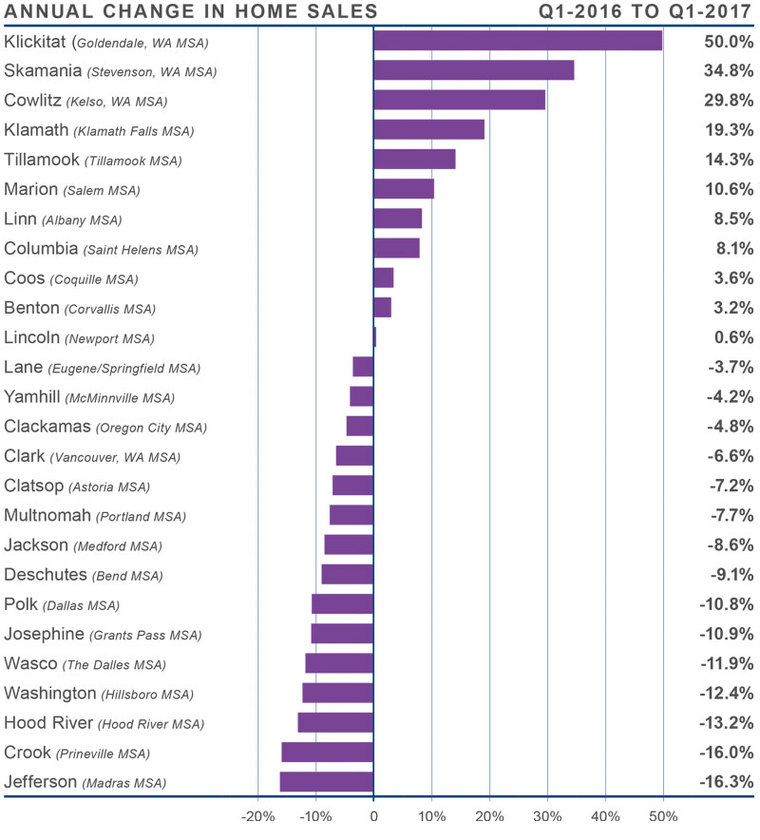
- First quarter home sales fell by 4.5% compared to the same period last year. In total, 12,299 homes sold in the first quarter of this year.
- Sales rose the fastest in Klickitat County, which saw a 50% increase over Q1 2016. There were also noticeable increases in sales in Skamania, Cowlitz, Klamath, and Tillamook Counties. Home sales fell the most in Jefferson, Crook, Hood River, and Washington Counties.
- There were 11 counties where sales rose year over year, and 15 counties that reported declines.
- The low number of homes for sale continues to affect the market and is pushing home sales activity lower. This means sellers remain firmly in the driver’s seat.
HOME PRICES
![]() The average home price in the region rose by 9.4% year-over-year to $334,299. This is down from 10.9% in the fourth quarter of 2016.
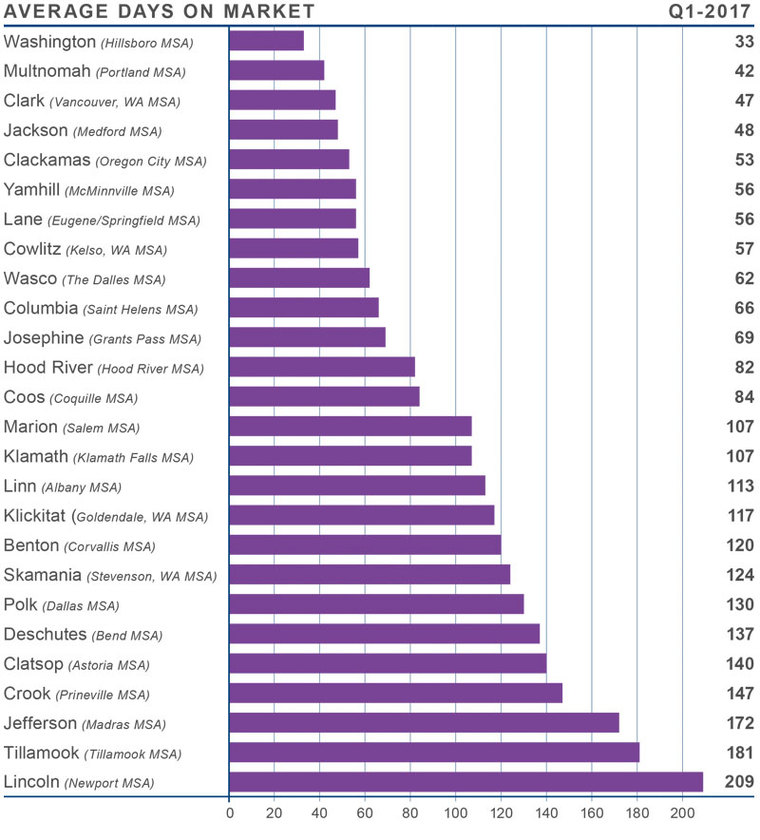
The average home price in the region rose by 9.4% year-over-year to $334,299. This is down from 10.9% in the fourth quarter of 2016.- Jefferson County took over as the market with the strongest annual price growth, with homes selling for 30.7% above the level seen a year ago.
- All but three counties experienced rising prices when compared to the first quarter of 2016, and most of these saw significant, double-digit increases.
- Despite rising interest rates, the lack of inventory continues to drive home prices higher.
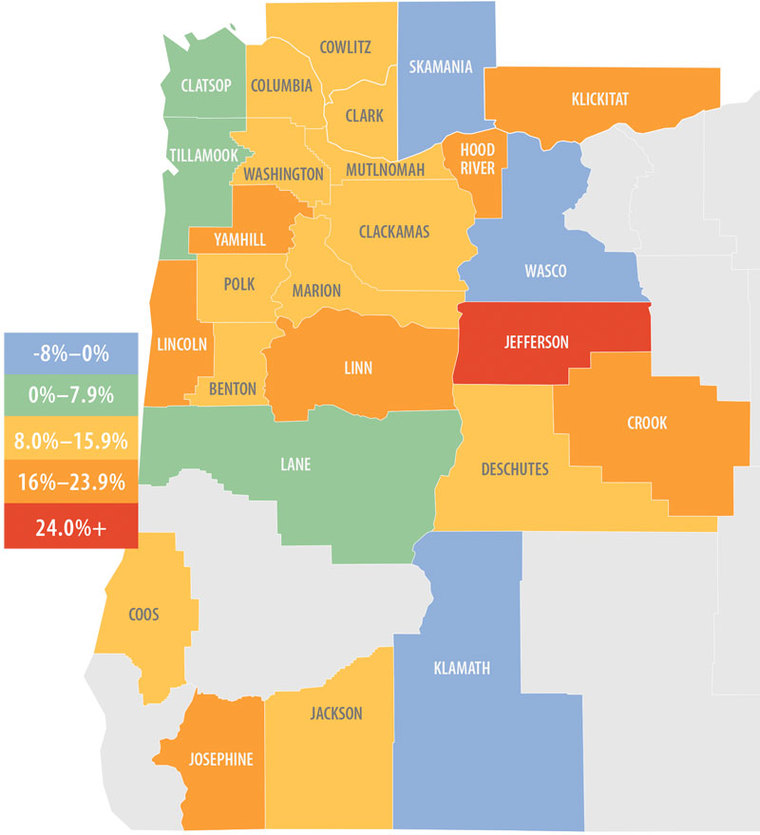 The average home price in the region rose by 9.4% year-over-year to $334,299. This is down from 10.9% in the fourth quarter of 2016.
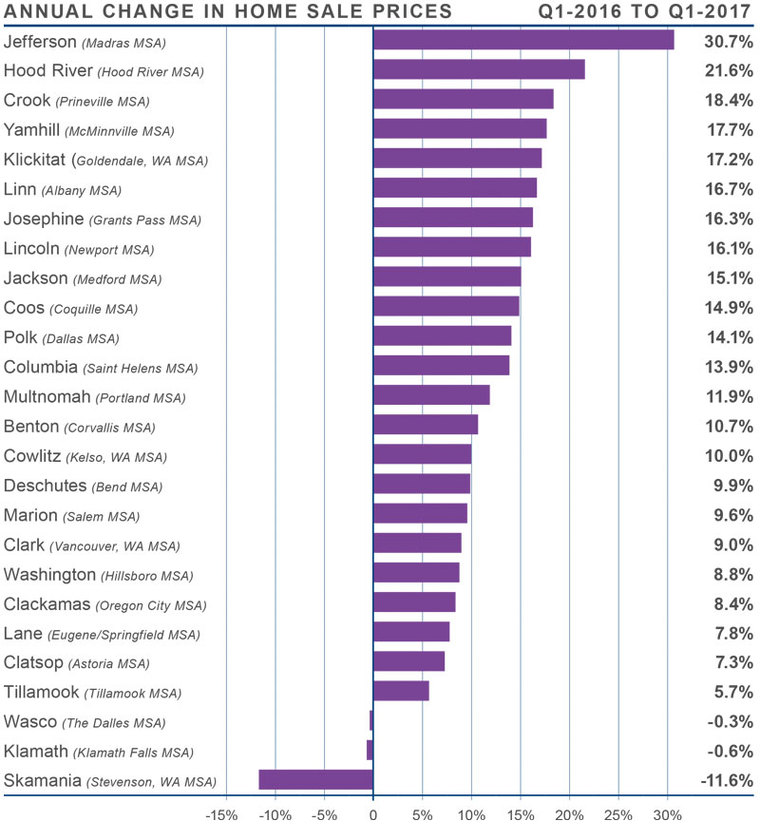
DAYS ON MARKET
- The average number of days it takes to sell a home in the region dropped by five days when compared to the first quarter of 2016, but it took 17 days longer to sell a home than in the fourth quarter of 2016.
- The average time it took to sell a home in the region was 98 days.
- In several counties, days on market rose when compared to the same period a year ago. This is not too surprising given that the counties where sales slowed are small, which often leads to erratic demand.
- Counties where homes sold the fastest were Washington and Multnomah Counties, where it took an average of 33 and 42 days respectively for homes to sell.
CONCLUSIONS
 The speedometer reflects the state of the region’s housing market using housing inventory, price gains, home sales, interest rates, and larger economic factors. Economic growth in Oregon State remains impressive, and the region’s housing market clearly continues to benefit from such robust growth. Home sales have slowed, which has taken a little steam out of the strong appreciation rates we’ve seen over the past several months. That said, the market remains remarkably tight and unlikely to shift dramatically for the duration of 2017. As such, I have moved the needle slightly more toward sellers for the first quarter.

Matthew Gardner is the Chief Economist for Windermere Real Estate, specializing in residential market analysis, commercial/industrial market analysis, financial analysis, and land use and regional economics. He is the former Principal of Gardner Economics and has over 25 years of professional experience both in the U.S. and U.K.
More •
May 12, 2017
How to Stay Organized During a Home Renovation
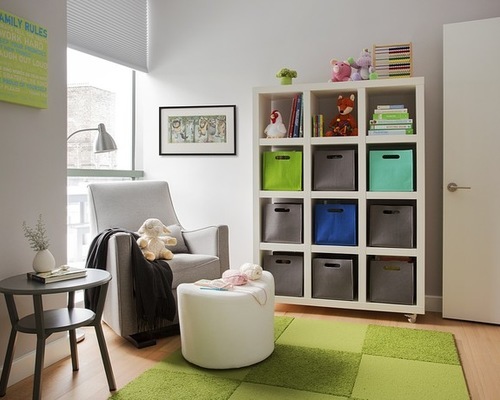
When you’re embarking on a renovation project, it’s a good idea to clear as much space as possible before the chaos ensues. Think about what you want and need in your new room, and thoroughly declutter the area. Follow these tips for clearing, organizing and storing to ensure your building work creates as little upheaval as possible.
Be systematic. Start sifting through your cupboards and bookshelves. If you need to pack up a room or two, now is a great time to assess what’s lurking in the back of your cabinets.
Pack frequently used items into transparent storage boxes. Label them clearly and move them to another room. They’ll be out of the way of dust and builders, but still easily accessible.
Items used less often can be packed in cardboard boxes and stored out of the way. Pack them carefully and label each box with the general contents. It’s a great idea to take photos of the box and label in its new location, so you can easily find things during the renovation or when you’re unpacking after the work is complete.
Organize 1: Hannah Brown, original photo on Houzz
Consider your needs. If you’re planning an interior remodel to change the way you use your space, think about why you want to change the layout. Do you need a safe play area for young children, or maybe a small office space to facilitate working from home?
Provide your designer or architect with as much information as possible about how you want to use your space, so he or she can make it really work for you. A good professional will listen and provide a solution tailored to your requirements. In this dining area, for example, the designer has incorporated neat wine storage beneath the bench seating.
Look at the space objectively. Once you have an idea of how you want your renovated space to look, you can plan your decluttering strategy. Take a few photos of your room and look at them with a friend or relative whose opinion you trust. Talk about what you need to take out to achieve your desired look. This will help motivate you as you declutter, getting rid of everything that doesn’t contribute toward your goal.
Also, think about whether you want to take on the mammoth task of decluttering yourself, or whether it’s worth calling in a professional organizer to help you declutter at the outset.
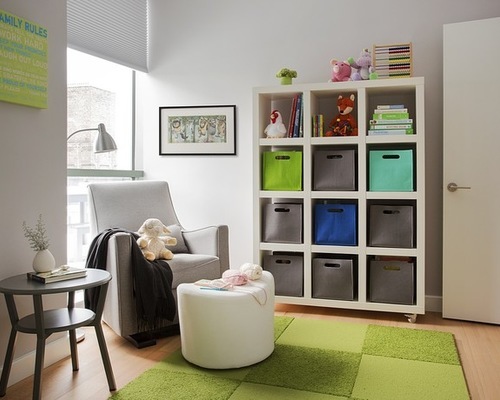
Organize 2: ZeroEnergy Design, original photo on Houzz
Use storage that moves. Plastic storage boxes on wheels will come in very handy, as you’ll probably be moving things around to give your builders access around the house.
If you’re planning a bedroom refurbishment, you’ll need to be selective about which clothes and toiletries you pack away and which you want to keep on hand for the duration of the improvements. A portable covered clothes rail and some lightweight drawers on wheels can store a capsule wardrobe and keep your clothes dust-free.
Think about daily routines. Most home remodeling projects involve some disruption, so plan ahead for changes to your daily routine. If you’re having your kitchen renovated, you could think about setting up a mini cook station elsewhere in the house. This could be something as simple as a table and microwave.
Related: Search for Console Tables
Alternatively, you could arrange to stay somewhere else for a while. Pets might also need a place to go; ask a friend to help out or research reputable pet sitters in your area.

Organize 3: Kelly Hoppen London, original photo on Houzz
Store valuables securely. While it’s important that you trust your builders, there will be periods during the renovation when your home will be left unlocked. It might possibly be without windows, doors and even walls at some point. In addition, a stream of tradespeople will be coming and going. So take precautions and keep valuables in a safe in your home, or in a deposit box off-site.
Make some room. Almost any renovation project will require you to be living in fewer rooms than usual, and these areas will probably need to be multifunctional. If you’re not going to keep all your room furniture when the work is finished, it’s a good idea to pass pieces on or sell them before the work starts. Decluttering prior to the renovation means you’ll have fewer items to move, pack, store and unpack once the work is finished.
If you’re planning to use a garage or loft for storage during the project, check in advance that large items will fit through doors and openings. Also, make sure you’ve cleared out sufficient space for the furniture to fit. Alternatively, you could rent a secure storage locker while the renovation is taking place.
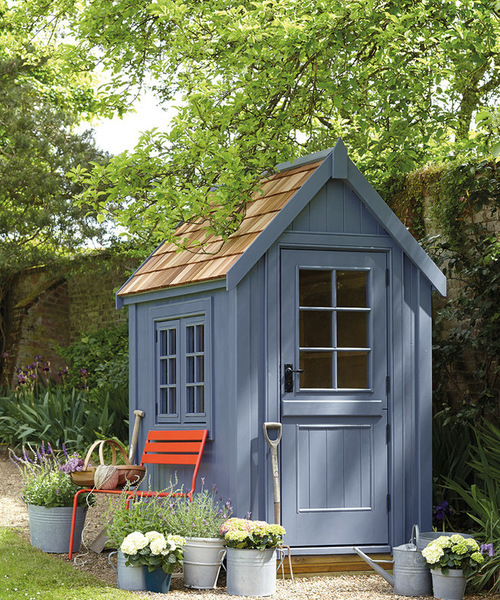
Organize 4: The Posh Shed Company, original photo on Houzz
Don’t forget the outside. If your project involves some external work, do that outside decluttering you’ve been putting off. Clear away all those items you’ve left outside to deal with in the future, as the future has now arrived! Rent a dumpster or a van and get rid of your accumulated junk. If it’s not junk, add to your project budget by selling your unwanted possessions.
Gather everyday essentials. With all the disruption of a home improvement project, it’s crucial that you don’t lose essentials such as your keys, phone, chargers, project paperwork and tape measure. Consider setting up a special workstation to keep these necessities on hand.
By Hannah Young, Houzz
Market News •
May 10, 2017
Colorado Real Estate Market Update


ECONOMIC OVERVIEW
Annual employment in Colorado grew by a respectable 2.3% in February, which equated to about 64,000 new jobs over the past 12 months. Within the metropolitan market areas included in this report, employment has been mixed, with Denver, Fort Collins, and Colorado Springs reporting above-average growth. However, Greeley and Grand Junction saw a modest decline in employment.
In February, the unemployment rate in Colorado was 2.9%, down from 3.3% a year ago. The lowest reported unemployment rates were in Fort Collins and Boulder, at just 2.6%. The highest rate was in Grand Junction, but it was still a respectable 4.7%.
HOME SALES
- There were 11,640 home sales during the first quarter of 2017, an annual increase of 2.2%.
- Arapahoe County saw sales grow at the fastest rate over the past 12 months, with a 7.9% increase. There were also impressive increases in Douglas County. There were very modest sales declines in the relatively small Larimer and Weld Counties.
- Listing activity remains well below historic averages, with the total number of homes for sale in the first quarter 10.7% below that seen a year ago.
- Home sales are generally higher than seen a year ago, but inventory levels are well below where they need to be to satisfy would-be buyers.
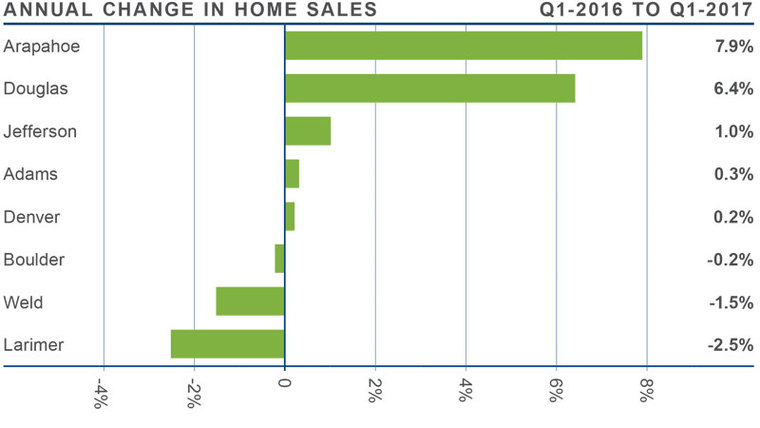
HOME PRICES
![]() With demand remaining strong, home prices continue to escalate. In the first quarter of this year, average prices rose by 8% when compared to a year ago. Average home prices across the region broke the $400,000 barrier at $402,273.
With demand remaining strong, home prices continue to escalate. In the first quarter of this year, average prices rose by 8% when compared to a year ago. Average home prices across the region broke the $400,000 barrier at $402,273.- Home prices remain well above historic highs and continue to trend upward. While there are very modest slowdowns in price growth—possibly a function of rising interest rates—they should continue to appreciate at above-average rates throughout 2017.
- Appreciation was strongest in Arapahoe and Weld Counties, where prices rose by 12.2% and 10.1% respectively.
- The housing market remains strong and this will continue until we see a substantial increase in the number of homes for sale, which is unlikely in the near-term.
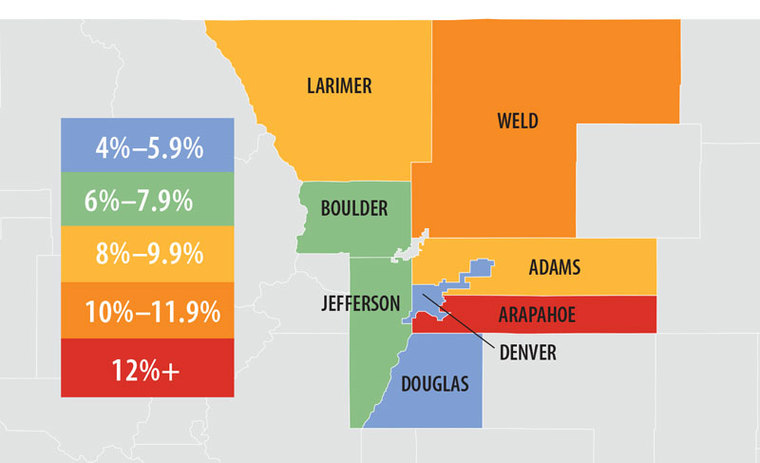 With demand remaining strong, home prices continue to escalate. In the first quarter of this year, average prices rose by 8% when compared to a year ago. Average home prices across the region broke the $400,000 barrier at $402,273.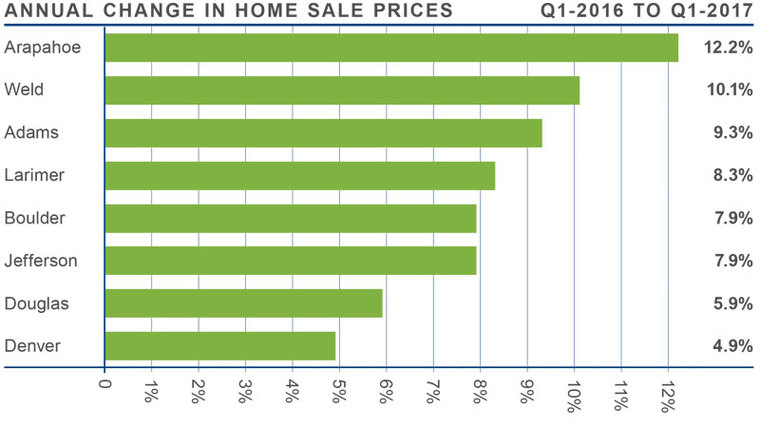
DAYS ON MARKET
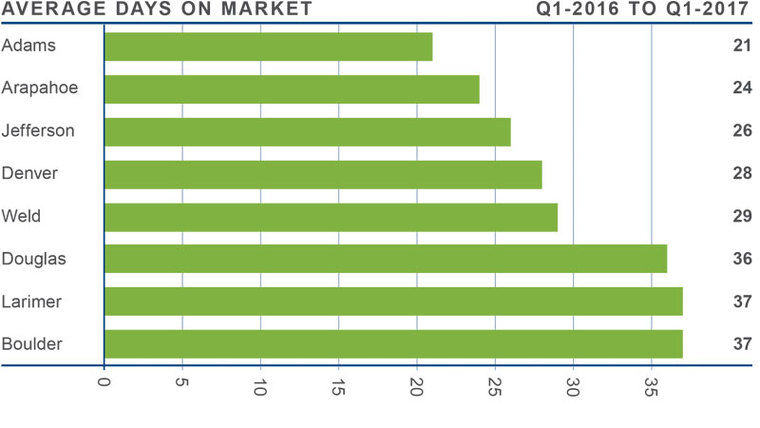
- The average number of days it took to sell a home dropped by one day when compared to the first quarter of 2016.
- Homes in a majority of the counties took less than a month to sell.
- During the first quarter, it took an average of 30 days to sell a home. This is down by one day compared to the same time last year.
- Demand remains very strong across the region, which is evident by the remarkably short amount time that it takes to sell a home.
CONCLUSIONS
 This speedometer reflects the state of the region’s housing market using housing inventory, price gains, home sales, interest rates, and larger economic factors. In the first quarter of 2017, the needle remains well into seller’s territory. The recent increases in mortgage rates have not had any dampening effect on either demand or home prices, and I expect this will remain unchanged through the end of the year.
Matthew Gardner is the Chief Economist for Windermere Real Estate, specializing in residential market analysis, commercial/industrial market analysis, financial analysis, and land use and regional economics. He is the former Principal of Gardner Economics, and has over 25 years of professional experience both in the U.S. and U.K.
Market News •
May 9, 2017
Nevada Real Estate Market Update

ECONOMIC OVERVIEW
Employment in the Las Vegas area continues to improve, reporting a 3.2% increase compared to first quarter of last year, while the unemployment rate remained essentially the same. As of February, 966,300 people were employed in the Las Vegas market, up by 29,900 from February 2016. Another good sign is that the labor force continues to expand, suggesting that there is more confidence in the area’s economy. I believe we will continue to see the job market improve as we move through the year
HOME SALES
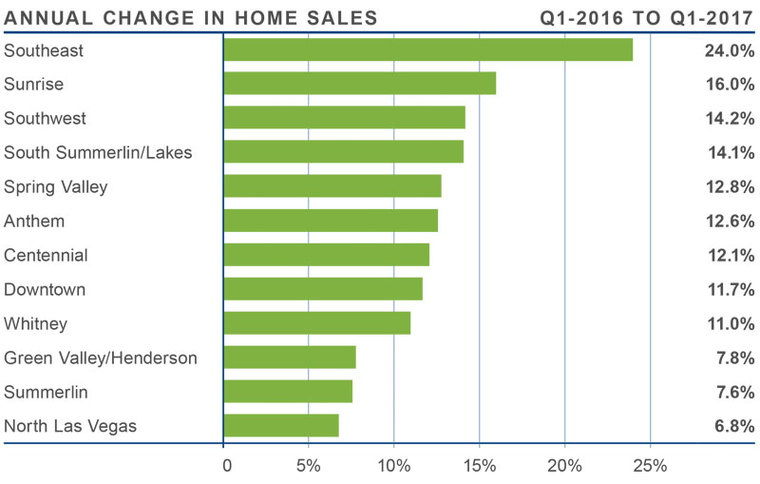
- A total of 8,623 homes sold in the first quarter, which was an increase of 11.9% over the same period a year ago. Sales were 14.2% lower than last quarter, but I believe that’s due to seasonality.
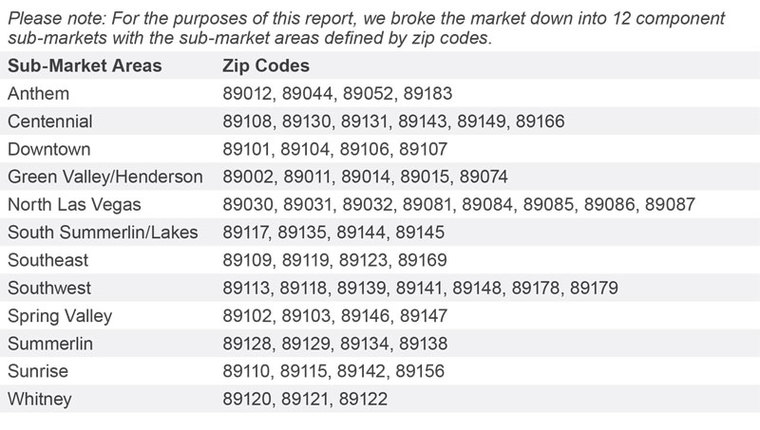
- Home sales were somewhat less robust in the North Las Vegas, Summerlin, and Green Valley/Henderson sub-markets, but this is likely due to low inventory and is not a cause for concern.
- There were sizable increases in home sales in a majority of the sub-markets reviewed within this report, but sales grew the fastest in the Southeast Las Vegas sub-market, which saw a 24% increase when compared to a year ago.
- Inventory levels remain very low, with 28% fewer homes for sale than the same period in 2016. We may see a spring “bump” in listings; however, the market is going to remain very tight for the foreseeable future.
HOME PRICES
- Over the past year, home prices in the region rose by 7.8% to $245,121. When compared to the fourth quarter of 2016, prices are up by 2.3%.
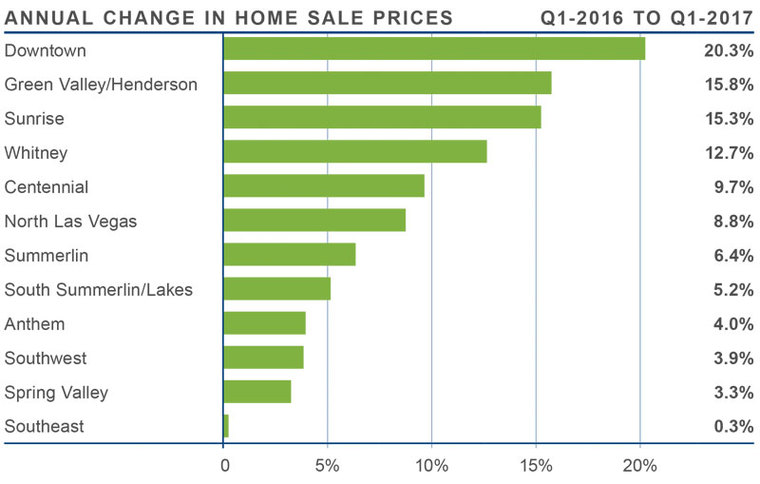
- The relatively affordable downtown sub-market saw the strongest annual growth, with home prices rising by 20.3% to $158,300. Double-digit gains were also seen in the Green Valley/Henderson, Sunrise, and Whitney neighborhoods.
- Prices rose in all sub-markets when compared to the first quarter of 2016, with several continuing to rise at rates that are well above their long-term averages.
- The only market that did not see prices rise significantly over the past year was in the Southeast Las Vegas market.
DAYS ON MARKET
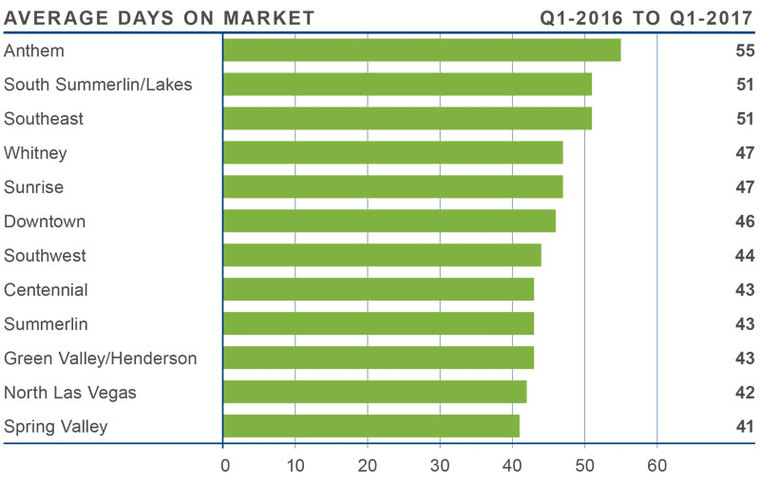
- The average time it took to sell a home in the region dropped by 16 days when compared to the first quarter of 2016.
- It took an average of 47 days to sell a home in the first quarter of this year, which is two days higher than seen last quarter.
- The length of time it takes to sell a home dropped in all the Las Vegas sub-markets compared to a year ago.
- The greatest drop in days-on-market was in the Green Valley/Henderson and Southwest sub-markets, which both dropped by 22 days when compared to the same quarter in 2016.
CONCLUSIONS
 The speedometer reflects the state of the region’s housing market using housing inventory, price gains, home sales, interest rates, and larger economic factors. Employment growth in Clark County has picked up again, and this bodes well for the housing market in this region. Due to the low number of homes for sale, home prices continue to increase despite rising mortgage rates. Given these factors, I have moved the speedometer more towards the seller’s side. Inventory levels are still very low and competition for well-located—and well-priced—homes remains high.
Matthew Gardner is the Chief Economist for Windermere Real Estate, specializing in residential market analysis, commercial/industrial market analysis, financial analysis, and land use and regional economics. He is the former Principal of Gardner Economics, and has over 25 years of professional experience both in the U.S. and U.K.
Market News •
May 8, 2017
Eastern Washington Real Estate Market Update

ECONOMIC OVERVIEW
I’m happy to report that Washington State continues to add jobs at a steady rate. While the rate of growth is tapering, this is because many markets are getting close to “full employment”, during which time growth naturally slows. That said, I believe that the state will add around 70,000 jobs in 2017. Eastern Washington continues to see employment growth, albeit modest in some markets, as well as a decline in unemployment. It is still my expectation that we will continue to see the regional economy improving as we move through the balance of the year.
HOME SALES
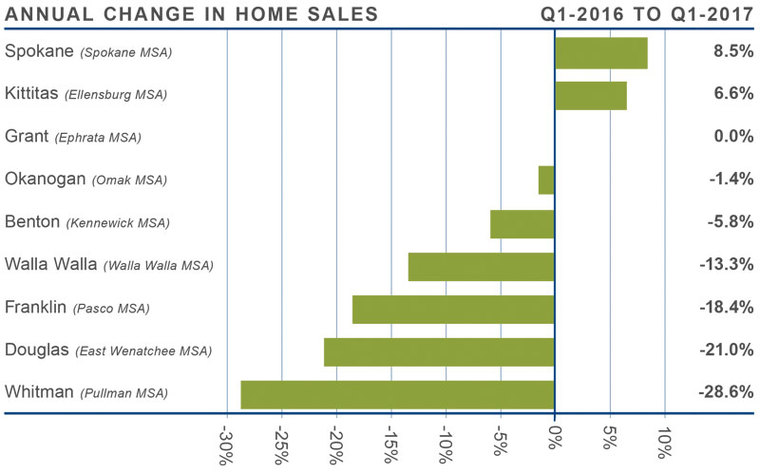
- Home sales throughout Eastern Washington fell very modestly in the first quarter when compared to the same period in 2016. In total, there were 2,383 home sales in the first quarter of this year—a drop of 0.3%.
- Sales rose at the fastest rate in Spokane County, which had an 8.5% increase over the first quarter of 2016. There were also reasonable increases in Kittitas County.
- A majority of counties in the region saw home sales fall relative to the first quarter of
- 2016, but two counties did experience an increase. The number of pending home sales, which are an indicator of future closings, was down across the board. We are likely to see slower sales until later this spring at the earliest.
- As I suggested in my last report, sales are a product of supply and Eastern Washington is sadly lacking in the number of homes that are on the market. Listing activity is down by 28% from the first quarter of 2016 and the decline in sales is a natural result of this.
HOME PRICES
![]() Year-over-year, average prices in the region rose by 8.3% to $228,955. Although home prices did fall compared to last quarter, this rate of growth remains well above average.
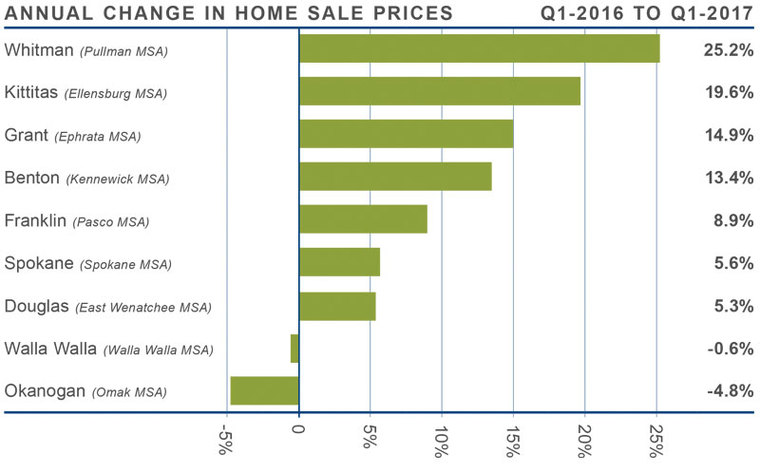
Year-over-year, average prices in the region rose by 8.3% to $228,955. Although home prices did fall compared to last quarter, this rate of growth remains well above average.- Whitman County had the greatest price growth, with homes selling for 25.2% above that seen a year ago.
- All but one of the counties in this report saw prices rise when compared to the first quarter of 2016, with four counties exhibiting price growth over 10%.
- The key takeaway here is that home price growth continues at above-average rates because of very limited supply.
 Year-over-year, average prices in the region rose by 8.3% to $228,955. Although home prices did fall compared to last quarter, this rate of growth remains well above average.
DAYS ON MARKET
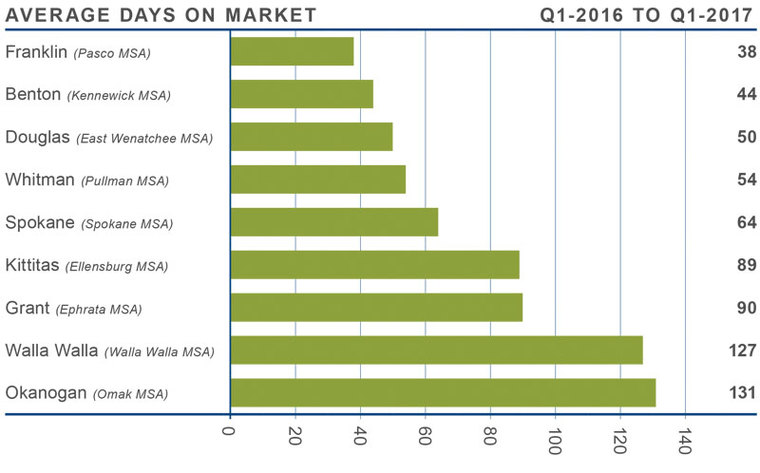
- The average number of days it took to sell a home dropped by 17 days when compared to the first quarter of 2016.
- The average time it took to sell a home in the region was 76 days.
- Okanogan County was the only area where the average days on market rose (from 130 to 131 days).
- Counties where homes sold the fastest were Franklin and Benton—the same two counties that saw the fastest pace of sales last quarter.
CONCLUSIONS
 This speedometer reflects the state of the region’s housing market using housing inventory, price gains, home sales, interest rates, and larger economic factors. For the first quarter of 2017, I moved the needle a little more in favor of sellers. The rapid increase in mortgage rates during the fourth quarter of 2016 has slowed and buyers are clearly out in force. Home prices continue to increase as the number of homes for sale drops. The market remains staunchly in favor of sellers, and this is unlikely to change in the near- to mid-term.
Matthew Gardner is the Chief Economist for Windermere Real Estate, specializing in residential market analysis, commercial/industrial market analysis, financial analysis, and land use and regional economics. He is the former Principal of Gardner Economics, and has over 25 years of professional experience both in the U.S. and U.K.
Market News •
May 3, 2017
Southern California Real Estate Market Update

ECONOMIC OVERVIEW
The markets covered by this report, which include Los Angeles, San Diego, San Bernardino, Orange, and Riverside Counties, added 115,900 new jobs between February 2016 and February 2017, and the unemployment rate dropped from 5.2% to 4.6%. This represents fewer new jobs than were seen in our last report, but as we continue to move toward “full employment”, a slowing in employment growth is to be expected.
HOME SALES
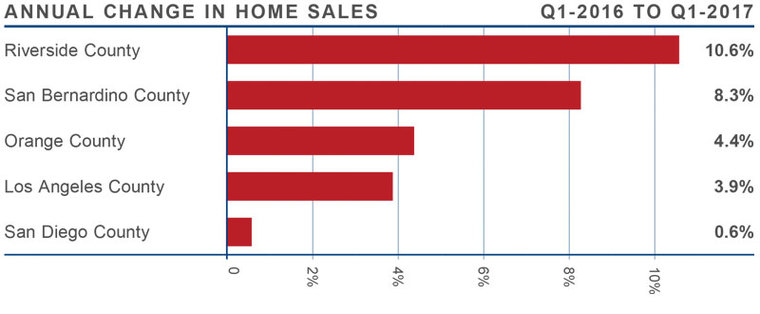
- There were a total of 40,561 home sales in first quarter of this year. This was 5.1% higher than the same period in 2016, but 12% lower than the fourth quarter of last year. This can be attributed to the continued low level of homes for sale throughout the region.
- The average number of homes for sale remains well below that seen a year ago (-15.2%), reversing the more modest decline in listings that we saw in the last quarter of 2016.
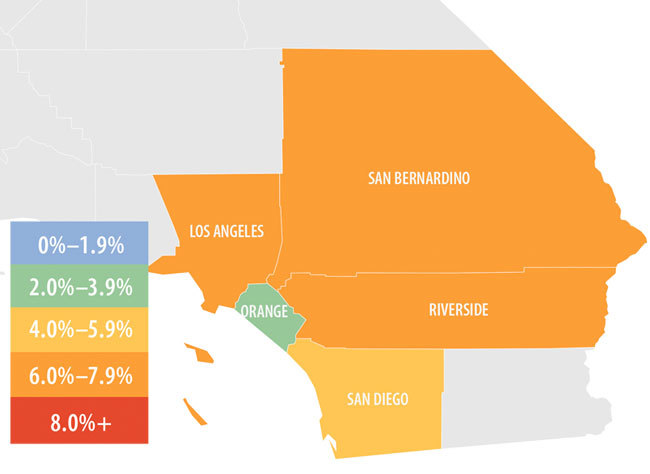
- Home sales were up across the board, with Riverside County continuing to hold the lead with a substantial 10.6% increase relative to the same period in 2016. Healthy sales were also seen in San Bernardino County. San Diego County experienced some slowing in home sales, but that’s likely due to the fact that the number of homes for sale is down 20% compared to a year ago.
- With just 31,000 active listings in the first quarter, sellers are firmly in the driver’s seat. I remain hopeful that inventory levels will rise as we move through the spring; however, the Southern Californian markets are likely to see a housing supply shortage through the balance of the year.
HOME PRICES
![]() Average prices in the region rose by 5.3% compared to first quarter of 2016, and are 2.6% higher than fourth quarter of 2016.
Average prices in the region rose by 5.3% compared to first quarter of 2016, and are 2.6% higher than fourth quarter of 2016.- Home values in San Diego, Los Angeles and Orange Counties rose to levels that are getting close to their pre-recession peaks. It is possible that home prices —in concert with rising mortgage rates—are likely to slow at some point, but not quite yet.
- San Bernardino County saw the greatest annual appreciation in home values (+7.7%). This was followed by Riverside County, where the average price rose 7.2% year-over-year.
- Pending home sales continue to trend higher, but are slowing due to tight inventory levels. Demand remains strong and sales prices will likely continue their upward trajectory as buyers outnumber sellers.
 Average prices in the region rose by 5.3% compared to first quarter of 2016, and are 2.6% higher than fourth quarter of 2016.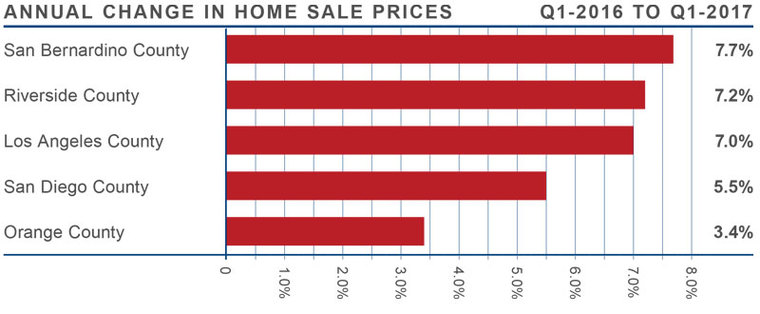
DAYS ON MARKET
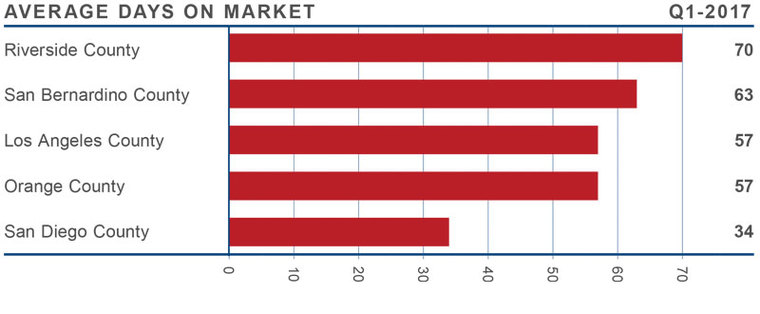
- The average time it took to sell a home in the region was 56 days. This is a drop of 11 days when compared to the first quarter of 2016, but two days longer than in the fourth quarter of 2016.
- The biggest drop in the number of days it took to sell a home was in San Bernardino and Orange Counties, where it took 14 fewer days to sell a home compared to a year ago.
- Homes in San Diego County continue to sell at a faster rate than the other markets in the region. In the first quarter, it took an average of 34 days to sell a home, which is four days less than a year ago.
- All five counties saw a drop in the amount of time it took to sell a home between the first quarter of 2016 and the first quarter of 2017.
CONCLUSIONS
 The speedometer reflects the state of the region’s housing market using housing inventory, price gains, home sales, interest rates, and larger economic factors.
The Southern California economy continues to add jobs, which in turn is increasing the already-high demand for housing. Rising mortgage rates have had a modest effect on slowing home price growth, but they are getting close to record territory in several of the region’s markets.
I was hopeful that we would see a bit of a spring “bump” in listings, but that has not been the case. As such, the market continues to strongly favor sellers, so I have moved the needle a little more in their direction.
 Matthew Gardner is the Chief Economist for Windermere Real Estate, specializing in residential market analysis, commercial/industrial market analysis, financial analysis, and land use and regional economics. He is the former Principal of Gardner Economics, and has over 25 years of professional experience both in the U.S. and U.K.