It’s February – winter’s not over yet, but spring is right around the corner. If you have cabin fever from being inside, cleaning and freshening up your house can help you get through this last month of winter and be ready to get outside when spring arrives.
Once you check these items off your to-do list, you’ll be able to relax by the fire with a good book and enjoy the last few weeks of winter.
Mop entryway floors. Clean your floors regularly to prevent damage from road salt and melting snow. Place a basket of old towels near the door to wipe up water and salt as soon as it is tracked inside.
Rotate or flip your mattress. Extend the life and comfort of your mattress by flipping or rotating it. At the same time, vacuum box springs and the mattress to eliminate allergy causing dust- mites.
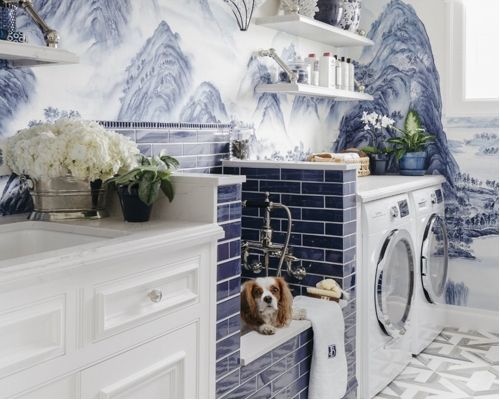
Organize your laundry room. Scrape dried-on laundry detergent from the ridges in your washer. Throw away laundry products you never use and replace damaged sorting bins.
Clean out your spice cabinet. Throw away expired spices and other seasonings, which may not only lose their taste, but could harbor mold and bacteria.
Sanitize hand-held devices. Prevent germs that cause the spread of colds and the flu by disinfecting your phone, remote controls, tablets, as well as your door and cabinet knobs.
Dust blinds, ceiling fans and fixtures. Wipe down or use a feather duster to remove the dirt that builds up on blinds, ceiling fans, light fixtures other small electronics.
Add color to your table. Treat yourself to some fresh flowers to add cheer to your kitchen table while waiting for spring blooms to make their first appearance.
Plan your summer vacation. Reserve your vacation home now to get the best selection of available properties. Start your planning today at Long & Foster’s Vacation Rentals website.
Whether you’re starting a family, moving for your job, getting ready to retire or embarking on a new chapter in your life, when your home no longer suits your current situation, it’s time to think about selling it. Although this can be a bit complicated, with the help of your agent, you can minimize the hassles, get the best possible price, and shorten the distance between “For Sale” and “Sold”.
Price it right
If you want to get the best possible price for your home and minimize the time it stays on market, you need to price it correctly from the beginning. Your agent can give you a clear picture of your particular market and can provide you with a comparative market analysis (CMA). A CMA contains detailed information on comparable homes in your area, including square footage, date built, number of bedrooms, lot size and more. It lists pending sales and houses sold in your area in the past six months, along with their actual sale prices.
By comparing your home to similar homes in your neighborhood and reviewing their list prices and actual selling prices, your agent can help you arrive at a fact-based assessment of your home’s market price.
Prepping your house for sale
You want to make a positive first impression when you list your home for sale. Here are some tips on how to enhance your home’s best features:
Work on your curb appeal
Get rid of moss on your roof. Power wash your front walk, porch, deck and patio. Mow the lawn, trim the hedges, weed the flowerbeds and add spots of color with container plants. Clean all the windows inside and out and repair them if they don’t open and close easily.
Refresh, repair and repaint
This goes for interiors and exteriors. If you see peeling paint, add a fresh coat. If your living room is bright lime green, consider painting it a more neutral shade. Make necessary repairs. You don’t want to turn off a buyer with a dripping faucet, a broken doorbell, a clogged downspout or a cracked windowpane.
Deep-clean, from floor to ceiling
Clean rugs, drapes and blinds and steam-clean carpeting. Get rid of any stains or odors. Make sure kitchen appliances, cupboards and counters are spotless and that bathrooms shine.
Declutter and depersonalize
Clean, light-filled, expansive rooms sell houses. So be sure to downsize clutter everywhere in your home, including cupboards, closets and counters. You might also consider storing some furniture or personal items to make rooms look more spacious. Take advantage of views and natural light by keeping drapes and blinds open.
Make an impact on the market
If you want to sell your home, you need to go where the buyers are, and today they’re on the Internet. According to the National Association of REALTORS®, in 2012 90 percent of homebuyers used the Internet as an information source, and for 41 percent of homebuyers it was the first step in the home-buying process.
By working with your agent, you can list your home on Windermere.com and other relevant websites. He or she will put together a listing with attractive photos, an appealing description and all the information a potential buyer needs. Your agent will also market your house, which may include advertising, direct mail and open houses.
Show your house
After you’ve taken care of all the repairs and cleaning tasks outlined above, your home is ready for its close-up: an open house. It’s actually best for you and your family to leave when potential buyers are present so they can ask your agent questions. But before you go, you might want to:
· Take your pets with you
· Open the shades and turn on the lights
· Light a fire in the gas fireplace
· Bake cookies
· Keep money, valuables and prescription drugs out of sight
Be flexible in negotiating
If you get offers below your asking price, there are a number of strategies you can try in your counteroffer. You could ask for full price and throw in major appliances that were not originally included in the asking price, offer to pay some of the buyer’s fees, or pay for the inspection. You could also counter with a lower price and not include the appliances. If you receive multiple offers, you can simply make a full-price counter.
Your agent can suggest other strategies as well and help you negotiate the final price.
If your house doesn’t sell or you’ve received only lowball offers, ask your agent to find out what these prospective buyers are saying about your house. It might reveal something you can consider changing to make your house more appealing in the future.
Breeze through your inspection
When a buyer makes an offer on your home, it’s usually contingent on a professional inspection. A standard inspection includes heating and cooling, interior plumbing and electrical systems; the roof, attic and visible insulation; walls, ceilings, floors, windows and doors; and the foundation, basement and visible structure. The inspector will be looking for cracks in cement walls, water stains and wood rot.
You can always opt for having an inspection done prior to putting your house on the market, so you can address any potential problems in advance. Your agent can give you several recommendations for qualified inspectors in your area.
Close with confidence
Whether this is your first time or your tenth, your agent can help guide you though the complex process of selling a home. Moreover, he or she can answer any questions you may have about legal documents, settlement costs and the status of your sale.
Your agent’s expertise, resources and extensive network also work for you when you’re buying your next house. Even if you’re moving out of the area, your agent can refer you to a professional agent in your new community.
A crisp white ceiling is a classic look, but it’s not the only option for making a room look polished. Here are a few other design considerations to bring some personality to your ceiling.
The sky is the limit when it comes to the amount of creativity and beautiful layering you can put into creating a decorative statement on the ceiling. But before we discuss the many stylish or unusual treatments to consider, let’s start with a classic finish you’ve probably seen before.
In my own design projects, I find many clients are excited to remove a popcorn ceiling treatment, and this is usually my preference as well. The results can be subtle, yet striking.
In some cases, the results can be dramatic. Removing a popcorn ceiling, and the entire drywall layer above, can often reveal architectural finishes, such as a cool concrete surface.
An exposed concrete ceiling gives a room a bit of industrial, architectural flair, adding drama and texture in a modern way. Of course, not every home has a concrete ceiling to reveal, so it’s important to speak with your designer or contractor before making any plans.
It’s also important to note that stripping a ceiling back to the concrete will leave no space for recessed ceiling lights. For this reason I usually include an area of dropped ceiling to allow potlights, define a gathering space or focal point and visually break up the look a bit.
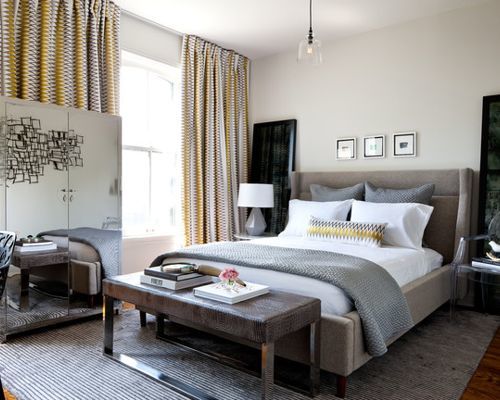
From my experience, the most popular contemporary ceiling style is the simple flat drywall ceiling. If a room includes other sound-absorbing materials like rugs, curtains or a fabric headboard, you can skip the acoustic ceiling treatment without worrying about echoes.
As I mentioned before, it is not always easy to achieve a perfectly crisp drywall ceiling, but skilled tradespeople can install either a new drywall ceiling or scrape the texture paint from an existing ceiling to reveal a much more sleek, modern surface.
Trimming a ceiling with crown molding painted to match the ceiling hue is a great alternative way to hide subtle imperfections in the slope of the ceiling and achieve a bright, airy, classic look.
A drywall ceiling doesn’t only come in one shade, so while we’re discussing this finish, let’s touch on some differing paint choices.
White. A white or just-off-white ceiling is popular because it’s a great way to make any room feel open and airy and let light bounce from any windows or light fixtures back into the room.
For a contemporary or modern home, plain white can work great, but for a more traditional home or a space with definite warm tones (like this room with a lot of welcoming beige), choose a subtle off-white that complements the tone of the walls.
For a fun, trendy take, cheat the ceiling line a bit by starting the ceiling paint 12 to 24 inches down the wall (or only painting the walls up to that point, whichever way you think of it). The result is a breezy modern effect without using any bold hues or new materials.
Gray. Using a darker hue on the ceiling than on the walls visually brings the ceiling down, which can make a room feel more intimate.
Using a neutral gray shade (or one with a hint of cool blue) achieves this effect without drawing too much attention, so the room still feels serene and sophisticated.
This makes gray a great choice for bedrooms, dens and nurseries, bringing a peaceful, cozy atmosphere.
Accent colors. For a room with a unique personality, adding an accent color to the ceiling infuses a lot of drama in an unexpected spot.
I won’t lie: As a DIY task, painting the ceiling is not nearly as easy as painting a wall, and even for professionals it usually requires the room be fully emptied first. So, it’s best to be absolutely sure that you love a hue before applying it to the “fifth wall.” The upside is that the ceiling is often a relatively small surface area, meaning that splash of color is a more controlled dose than painting the walls.
While a painted ceiling is immediately noticeable in a room with stark white walls, when a room has a lot of interesting and eclectic finishes on other surfaces, a rich hue can actually blend in better than a white ceiling. It’s a daring look for sure, but for those who love a lot of personality in their home, a colorful ceiling can be a very livable choice.
For the best of both worlds, a navy, deep teal or royal blue shade will feel dramatic but still appear neutral enough to not overwhelm you.
Matching ceilings and walls. Painting the ceiling to match the walls may sound overwhelming, but sometimes it can actually be the more subtle choice. When the ceiling and the walls (or even just a few walls) are the same hue, the lack of contrast makes the ceiling less of a dramatic feature and more of a singular background color. Of course, this applies best to softer hues like gentle pink, watery blue or heritage butter yellow.
I personally match the ceiling to the walls quite often when using light neutral shades. While it may appear white on your screen, the walls, ceiling and molding in this project are all Benjamin Moore’s Classic Gray, a subtle, warm gray shade. In an older home, using an all-over hue is a great way to deemphasize imperfections such as sloped ceilings that don’t meet walls in a perfectly straight line.
Two-tone paint. Using a dark or dramatic paint color on the ceiling doesn’t have to be an all-or-nothing decision. Like the opposite of an area rug, painting just part of a ceiling can help define a particular zone. Lining up the edge or edges with another element in the room will help it make visual sense.
Paint Finishes
Semigloss. The higher the degree of gloss in a paint, the more visual depth it will have and the lighter the perceived color will be. So, when choosing a darker shade especially, selecting a semigloss or more subtle satin finish can make a color seem less aggressive and more multidimensional and help keep the paint from absorbing all of the light in the room.
Matte. Matte and eggshell finishes represent the less-glossy end of the spectrum, and thus reflect less light. This will make a color seem more pure and vivid, and a bit darker. For those who don’t want to shy away from a rich statement, a matte finish gives a crisp contemporary look.
Gloss. Ultra-high-gloss paint is not easy to apply to a ceiling because it has a slower drying time and thus lots of opportunity to drip or become uneven. But it’s not impossible for expert professionals, and the results can be stunning, especially when paired with sparkling ceiling fixtures and beautiful natural light.
Alternately, a “stretched ceiling” uses a layer of high-tech material suspended just below the true ceiling to create a gloss effect (or other finishes) that paint alone cannot achieve.
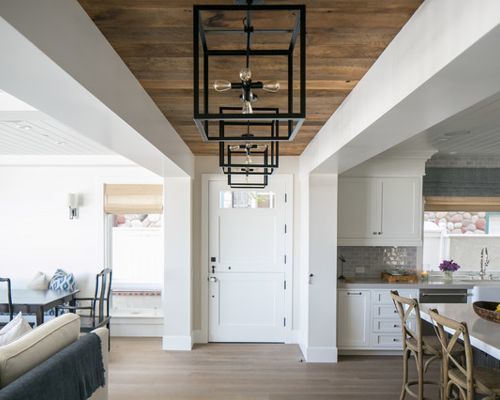
Wood planks are most often seen on the floor, but they look just as beautiful above.
While wood-paneled ceilings are often associated with cottages and farmhouses, they can work with a variety of styles of home. Panelling works well for transitional homes, especially in controlled doses like the small strip seen here, bringing texture and richness to the ceiling that a solid color can’t match.
Generally, thinner strips of wood, and species with more knots, will appear more cottage-inspired, while wider planks or sheets, often with a less-grainy finish, will carry a more modern appearance.
Both types work well in kitchens with airy white or off-white cabinetry, taking a classic “white kitchen” and giving it added warmth and a natural appeal.
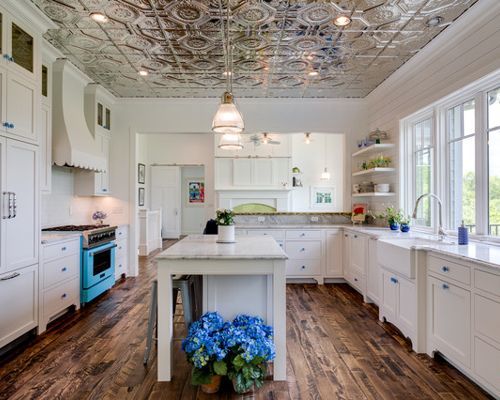
While these panels are not necessarily made from tin, the pressed-tin look endures as a charming option for traditional kitchens, or contemporary or transitional kitchens that want to add some classic flair.
These panels can be visually quite dominant with their glam or antiqued finishes and busy patterning, so they work well in rooms with otherwise simple palettes, or as a small accent over an island or seating group.
To keep the look fresh and bright, try using classic tin panels with stainless steel appliances, so the primary metal tone repeats and the room feels cohesive.
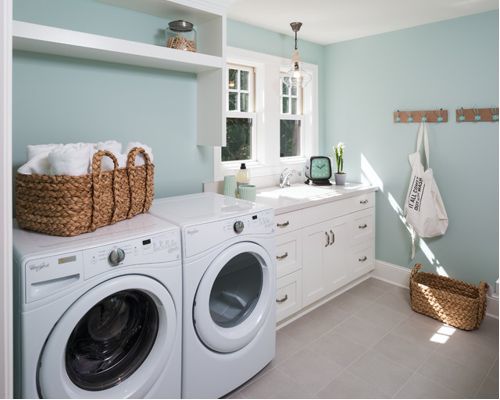
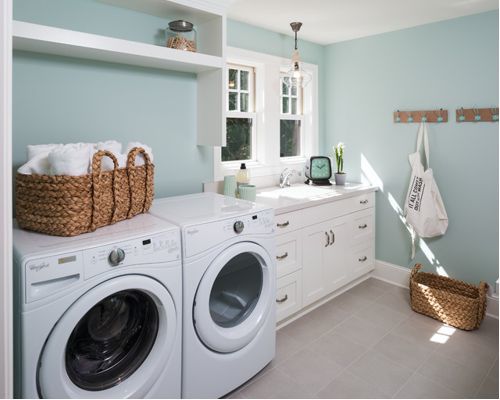
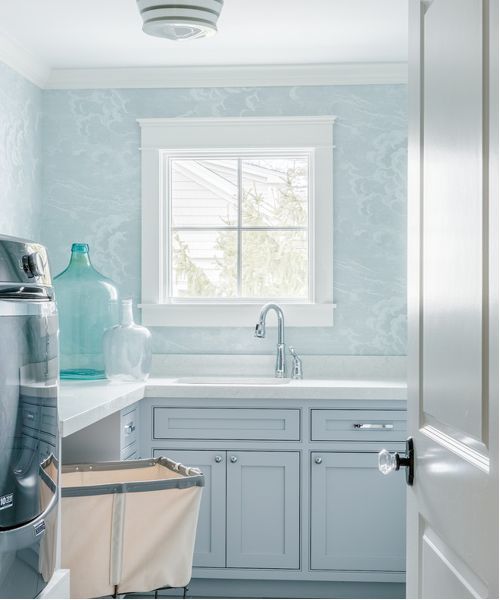
Hoping to transform your tired laundry room into a sparkling clean, efficiently working space, but without the major costs of a full remodel? By not changing the layout or adding square feet, you can bring costs down while still making meaningful changes to your space. Use this guide to help you decide what to prioritize and what to put on the back burner, and give your laundry room an update that works with your space — whether your budget is $100 or $10,000.
If your budget is about $100: Clean, declutter and upgrade laundry baskets that have seen better days. It’s worth spending a little more for hampers that can stand up to heavy use.
Also think about which features would be most helpful to have, such as hampers on wheels, triple-sorter bins or stackable baskets that can tuck out of the way when you’re not using them.
If your budget is about $300: Clean up, get hampers and then give the walls a fresh coat of paint. A cheerful color can make your laundry room feel brand-new without breaking the budget — especially if you’re willing to DIY.
If your budget is about $500: Get hampers, fresh paint and then a soft new rug. You’ll appreciate the dose of color as much as the softness underfoot. If moisture is a concern (for example, if your laundry room is in the basement), you may want to choose a sturdy indoor-outdoor rug.
If your budget is about $700: Get hampers, fresh paint and a new rug, and then swap out the lighting.
Ample lighting is important when you’re trying to check laundry for stains and read labels, so pay attention to the recommended wattage of any light fixture you are considering — anything less than 75 watts may not shed enough light (especially if it’s the sole light source in the room).
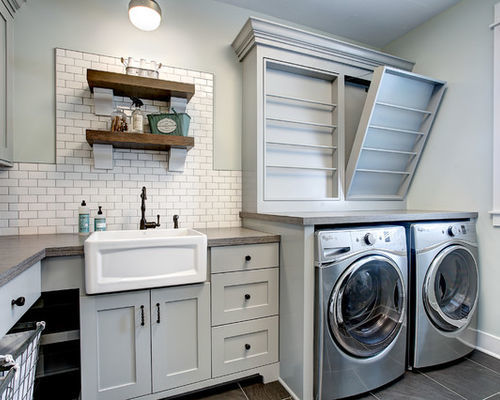
If your budget is about $1,200: Tackle all the above, and then treat your space to some bonus storage and extras, like an ironing station, a drying rack or open shelves. If your laundry room is small, look for space-saving designs like folding drying racks, retractable clotheslines and wall-mounted ironing boards.
If your budget is about $3,500: What’s next? New appliances! A new washer and dryer can work more efficiently than older models, operate more quietly and get your clothes cleaner.
If you’re going from top-loading to front-loading machines, consider adding a countertop above to hold supplies and act as a surface for folding. Not in the market for a new set? Give your old machines a thorough cleaning to keep them running well (and smelling fresh).
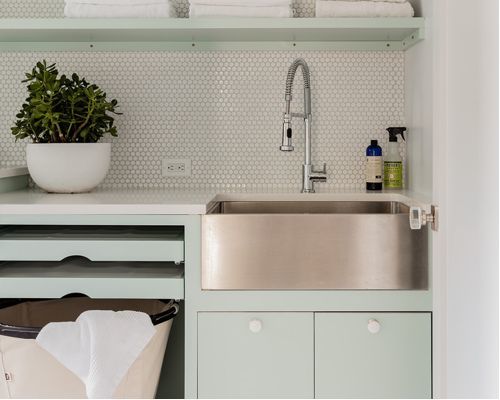
If your budget is about $5,000: If you have more room in the budget, think about replacing the laundry room sink and faucet. If you’re hoping to avoid additional installation costs, choose a new model that is the same size as the old one. If you don’t already have a sink in the laundry room, adding one will require more extensive help from a plumber, and costs will be significantly more.
If your budget is about $10,000: So you have the hampers, paint, rug, lighting, storage, appliances and sink. If you still have room in the budget, think about tackling a bigger project like installing a new tile floor or a pet-washing station. Your furry friend may not thank you but sure will look cute sitting in that tub.
The Washington State economy added 104,600 new jobs over the past 12 months. This impressive growth rate of 3.1% is well above the national rate of 1.4%. Interestingly, the slowdown we experienced through most of the second half of the year reversed in the fall, and we actually saw stronger employment growth.
The counties contained in this report added 4,310 new jobs over the past 12 months, representing a respectable employment growth of 2.8%. It should be noted that the rate of growth continues to slow, but this is to be expected as the area tracks toward full employment. The local unemployment rate for the area continues to fall with a drop from 8.4% at the end of 2016 to 7.3% in December 2017.
HOME SALES ACTIVITY
Home sales throughout Central Washington were a mixed bag in the fourth quarter. Two counties showed growth in sales, one remained static, and two had declines. In total, there were 1,293 home sales in fourth quarter—a drop of 2.3% from the same period in 2016.
Sales rose most in Kittitas County, which had a reasonable 6% increase over the fourth quarter of 2016. Okanogan County also saw sales rise at a reasonable pace.
The number of pending home sales—an indicator of future closings—was down in all counties other than Kittitas and Douglas, suggesting that first quarter closings will also be mixed.
The supply of homes for sale remains an issue. Inventory was down 8% compared to the fourth quarter of 2016. The market continues to suffer from inventory constraints, which will push home prices higher and slow sales velocities.
HOME PRICES
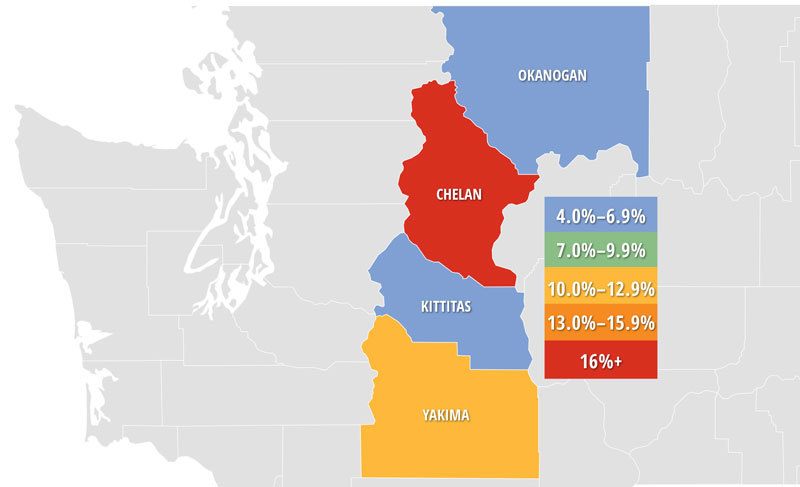
Year-over-year, the average home price in the region rose 4.8% to $292,691. Price growth has started to trend down but remains well above the long-term average as demand continues to exceed supply.
Okanogan and Douglas Counties saw relatively modest price contractions, but that was offset by the other three counties that had solid price increases.
Three of the five counties in this report saw prices rise compared to the fourth quarter of 2016. Chelan County led the way with an increase of 7.7%.
The takeaway here is that home-price growth, although slowing, continues at above-average rates due to very limited supply. I expect that the rate of appreciation will continue to taper as we move through 2018.
DAYS ON MARKET
The average number of days it took to sell a home dropped eight days compared to the fourth quarter of 2016.
The average time it took to sell a home in the region was 83 days—up 10 days compared to the third quarter, but we can attribute this increase to seasonal factors.
All the markets contained in this report saw days-on-market drop from the same quarter in 2016.
Homes sold the fastest in Douglas County, where it took an average of 49 days to sell a home. The greatest drop in the time it took to sell a home was in Chelan County, where it took 18 fewer days than in the fourth quarter of last year.
CONCLUSIONS
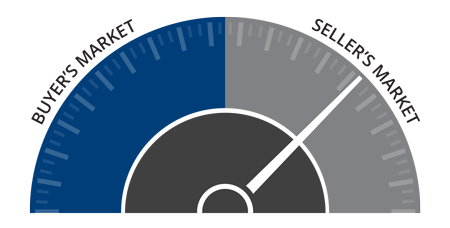
This speedometer reflects the state of the region’s housing market using housing inventory, price gains, home sales, interest rates, and larger economic factors. For the final quarter of 2017, I held the needle at the same position as third quarter. Prices are still trending higher, but the pace of increase has started to taper. In a similar fashion to most of the state, demand for housing in Central Washington continues to exceed supply and, although price growth has slowed somewhat, it still remains a seller’s market. I fully expect the Central Washington market to continue performing well in 2018.
Matthew Gardner is the Chief Economist for Windermere Real Estate, specializing in residential market analysis, commercial/industrial market analysis, financial analysis, and land use and regional economics. He is the former Principal of Gardner Economics, and has over 25 years of professional experience both in the U.S. and U.K.
Each year, design pros eagerly await the Color of the Year announcement from the experts at Pantone®. No matter what the hue, it’s always sure to make a splash—and home goods are no exception. From appliances and décor to tile and paint, manufacturers will start rolling out options to match (and complement) the Pantone Color of the Year.
Pantone® Ultra Violet is the pick for 2018. This is no shrinking violet: It’s a deep blue-purple that isn’t for the shy. No wonder that the Pantone announcement referenced icons known for showmanship like David Bowie, Prince and Jimi Hendrix.
Embracing a color this bold into your home might seem like a giant leap, but it could make a big mood difference in your home during the long, grey days of Seattle winters. We have assembled a few ways to incorporate Ultra Violet into your home – some large and some small.
Make an Entrance
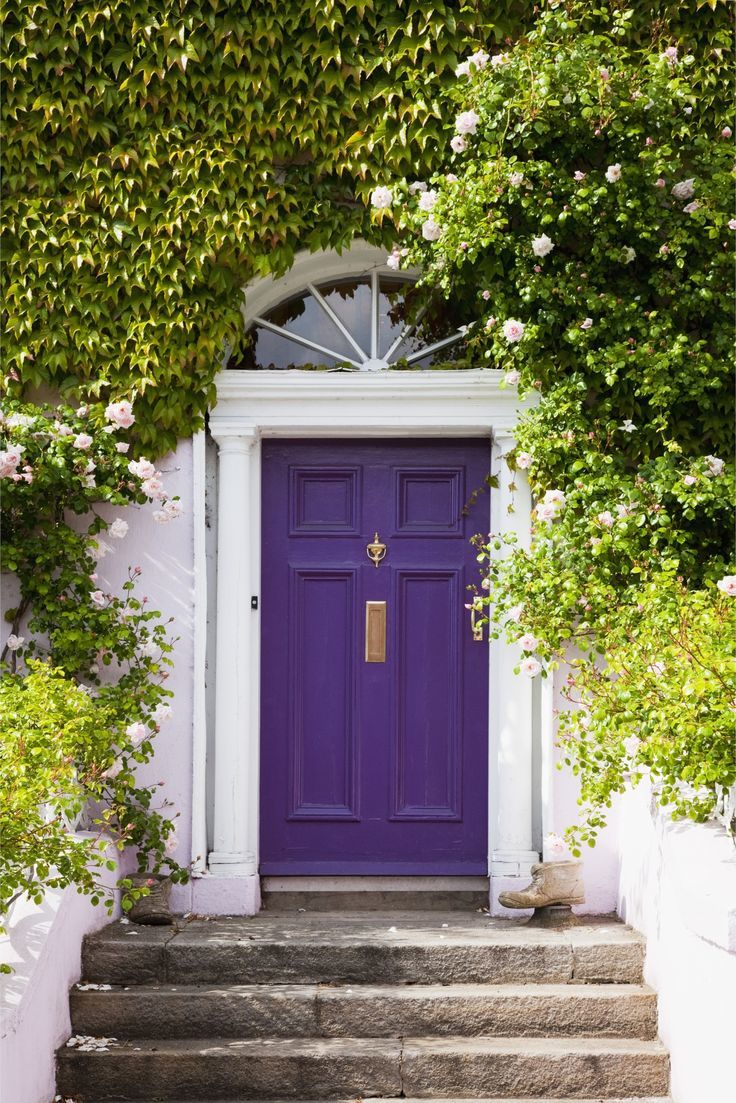
Painting your front door adds instant curb appeal. Red's a classic hue and teal is an up-and-comer, but this entry's regal purple is a real knockout.
Set the Scene
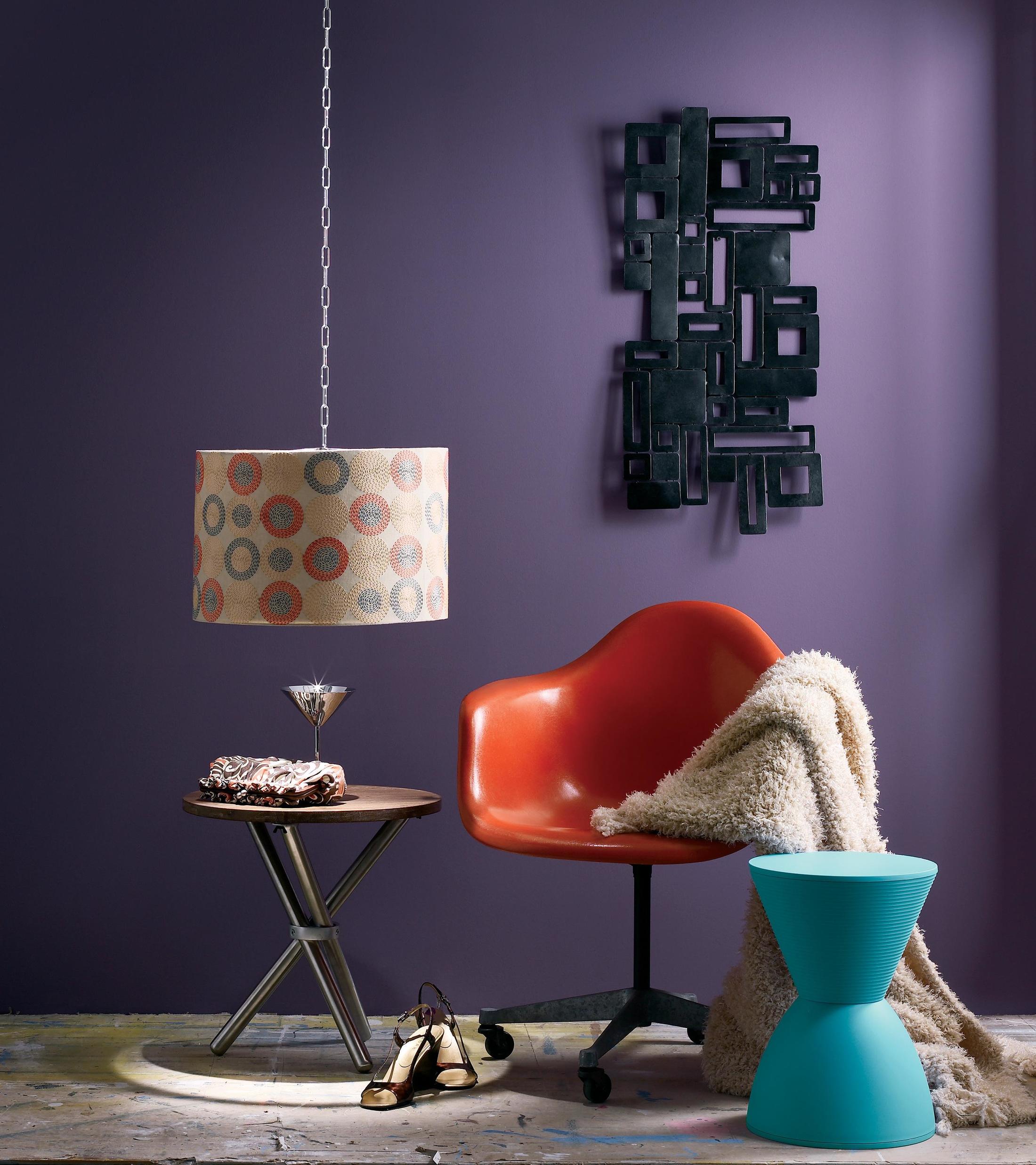
Funny thing about purple: Though we tend to think of it as a scene-stealer, cooler shades in the blue-gray range can work almost like neutrals. Here, purple walls marry an eclectic mix of midcentury-inspired décor.
Look Around
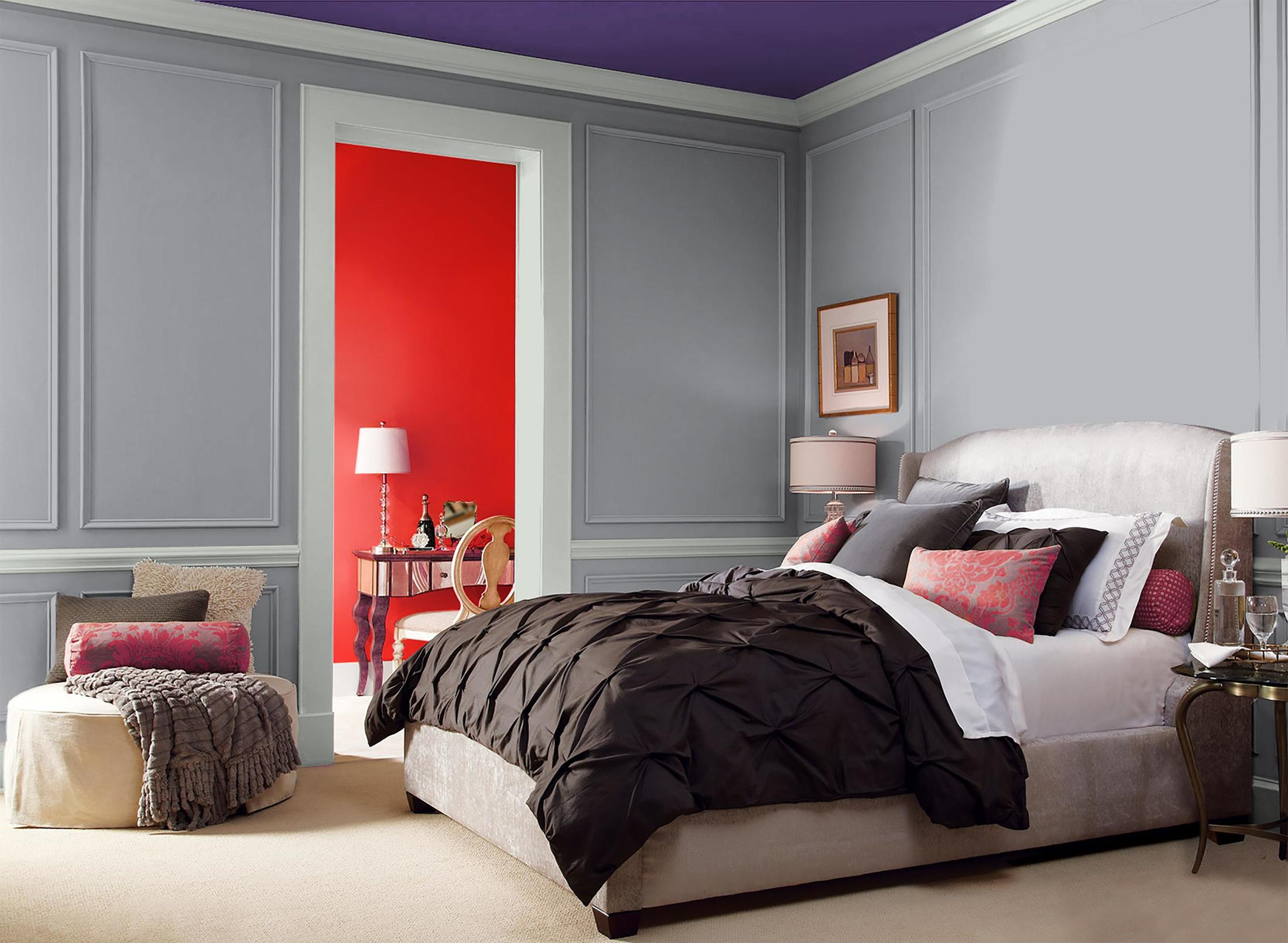
You've seen the accent wall. How about the accent ceiling? A rich grape hue adds an unexpected twist to this bedroom's gray walls and white trim. It gets extra punch from the peek of red seen through the doorway.
Consider Texture and Sheen
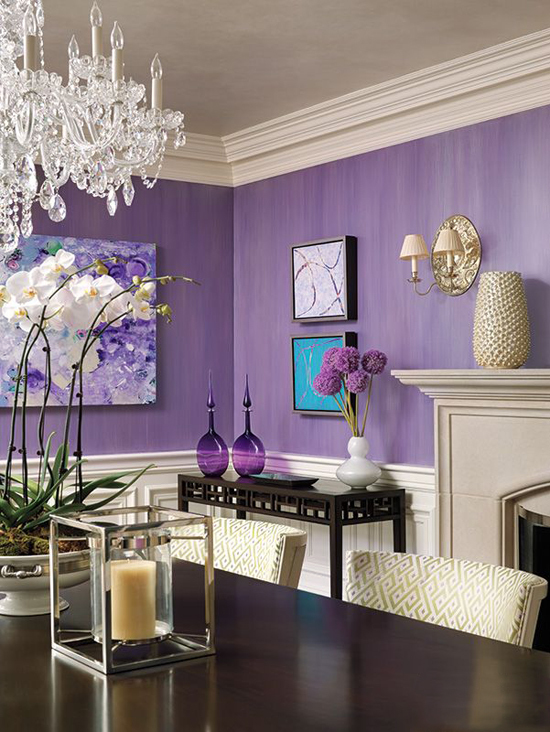
One secret to pulling off a jewel tone like these royal purple walls: Choose a matte finish. Shine plus color can be hard to pull off, but a flatter finish is, well, flattering.
Add Statement Furniture
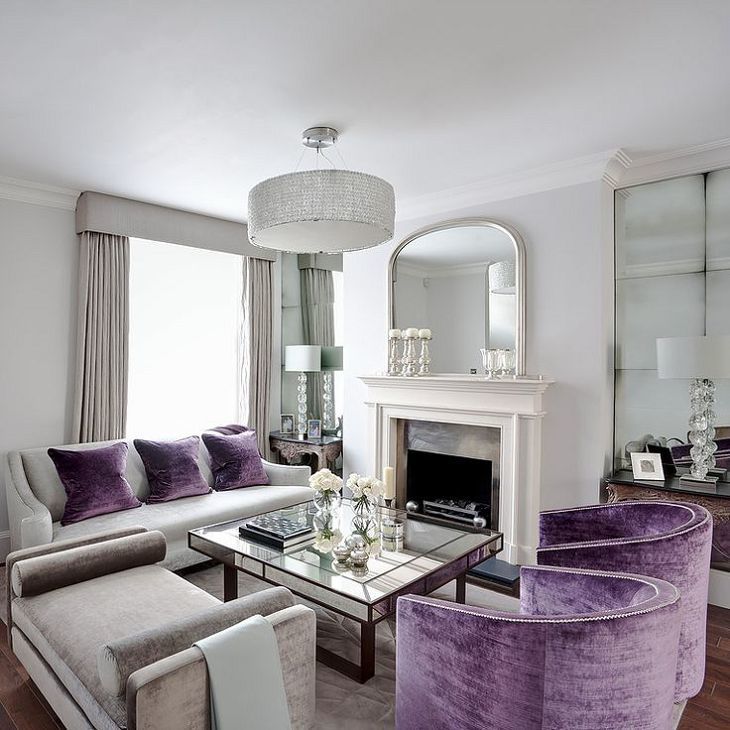
If you’re planning on using Ultra Violet in a bedroom or living area, consider incorporating it in a piece of statement furniture. In this case, the piece will act as the focal point of the room, since it will undoubtedly capture plenty of attention. With that in mind, bed frames, ottomans and reading chairs are excellent options to fill this role.
Opt for Accessories
For those who are a bit nervous about jumping into a design full of intense shades, keep in mind that you can always incorporate Ultra Violet into your accessories. These are a great starting point because they generally include lower-cost items that can easily be replaced when your tastes change or if you decide you’re not a big fan of the look.
Idaho added 14,700 new jobs in 2017, representing a growth rate of 2.1%. Although this is still a reasonable figure—and well above the total U.S. rate— this rate continues a cooling off we’ve seen over the past few quarters, which is to be expected as the state has essentially reached full employment.
In December, the state unemployment rate was 2.9%. With the labor force continuing to expand, it is clear there are still jobs out there to be filled. I continue to anticipate that Idaho will outperform the U.S. in growth through 2018.
HOME SALES ACTIVITY
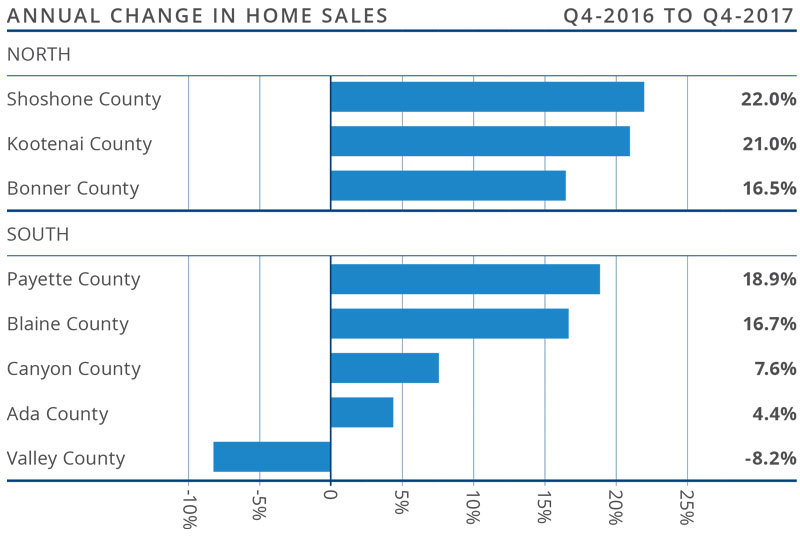
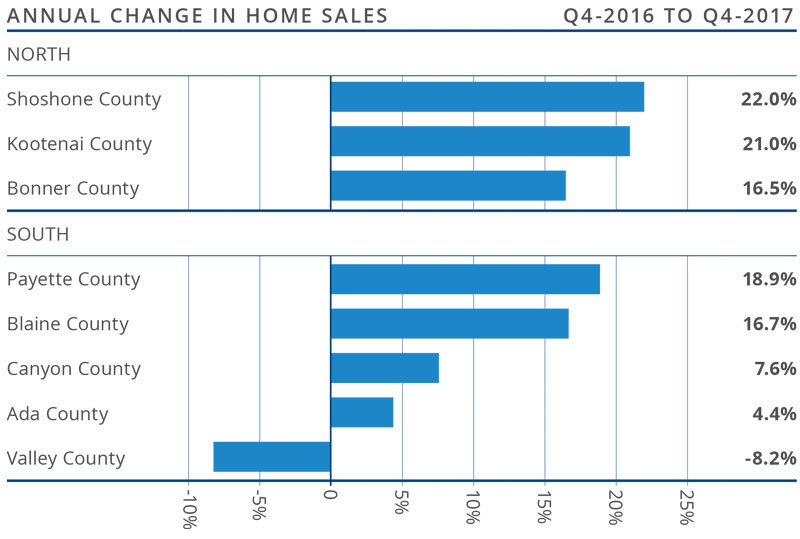
Fourth quarter home sales rose by 9.1% compared to the same period last year, with a total of 5,787 homes changing hands.
Sales rose the fastest in Shoshone County, which had a 22% increase over the fourth quarter of 2016. There were also noticeable increases in Kootenai, Payette, Blaine, and Bonner Counties.
Year-over-year sales dropped in Valley County, but given that this is a remarkably small market, I am not concerned.
The number of available homes for sale rose over the fourth quarter of 2016, which is an encouraging sign.
HOME PRICES
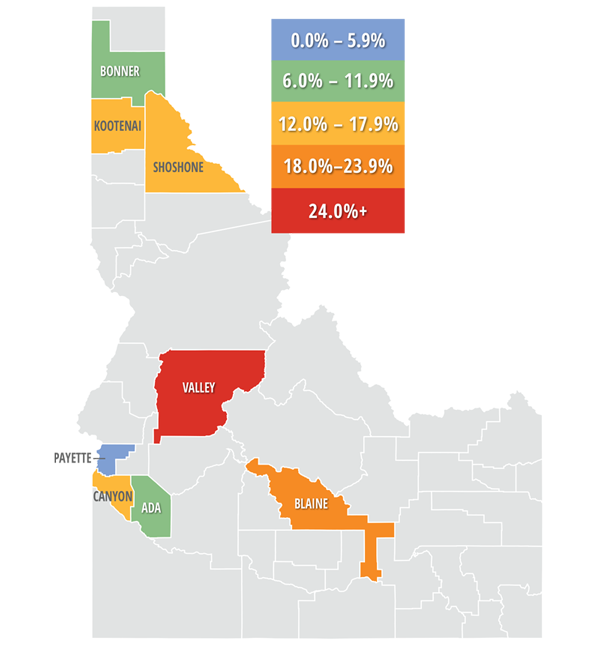
The average home price in the region rose 14% year-over-year to $306,938.
Valley County led the market with the strongest annual price growth. Homes there sold for 34% more than a year ago.
All counties in this report saw home prices increase compared to the fourth quarter of 2016. All but one county saw double-digit gains.
Home prices are still trending well above the long-term average as demand continues to exceed supply. Although we did see some growth in listings, it remains a seller’s market.
DAYS ON MARKET
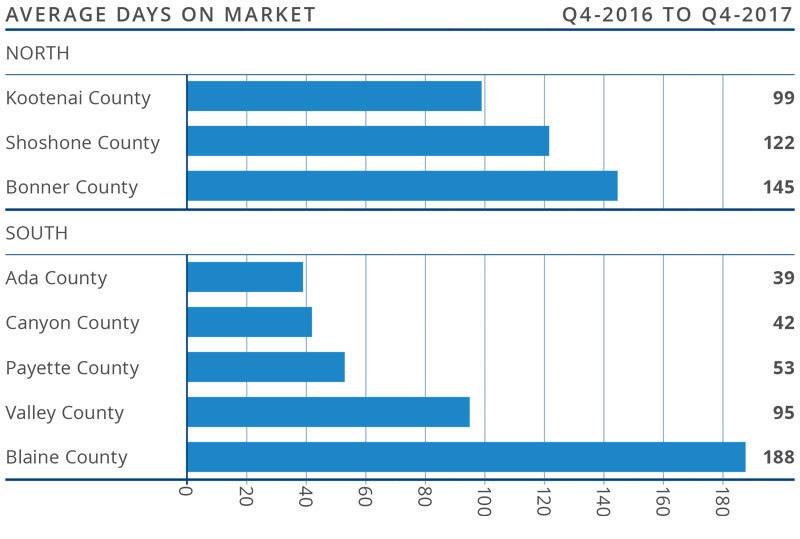
The average number of days it took to sell a home in the region dropped 20 days compared to the prior year.
It took an average of 122 days to sell a home in Northern Idaho and 83 days in the southern part of the state.
Homes in all three Northern Idaho counties took less time to sell than they did in the same quarter of 2016, and all but one of the southern counties in this report saw sales take less time to close that in the fourth quarter of 2016.
Homes sold the fastest in Ada and Canyon counties, where it took an average of 39 and 42 days, respectively.
CONCLUSIONS
The speedometer reflects the state of the region’s housing market using housing inventory, price gains, home sales, interest rates, and larger economic factors. Consumer confidence in the housing market seems to have returned, causing the markets in this report to perform well overall, and for home prices to continue trending upward. As mentioned in my last report, the market remains out of balance, with more buyers than sellers. Even with the modest increase in listings seen in the quarter, the market still heavily favors sellers. Unless we see a major increase in the number of homes for sale in early spring, the market will continue to see above-average home price growth.
Matthew Gardner is the Chief Economist for Windermere Real Estate, specializing in residential market analysis, commercial/industrial market analysis, financial analysis, and land use and regional economics. He is the former Principal of Gardner Economics, and has more than 30 years of professional experience both in the U.S. and U.K.
The Washington State economy added 104,600 new jobs over the past 12 months. This impressive growth rate of 3.1% is well above the national rate of 1.4%. Interestingly, the slowdown we experienced through most of the second half of the year reversed in the fall, and we actually saw more robust employment growth. The counties contained in this report added 13,597 new jobs over the past 12 months, representing a respectable employment growth of 2.8%. It should be noted that the rate of growth continues to drop, but this is to be expected as the area approaches full employment.
HOME SALES ACTIVITY
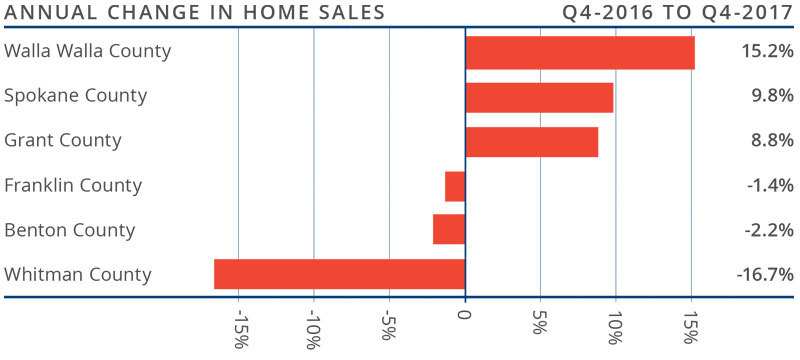
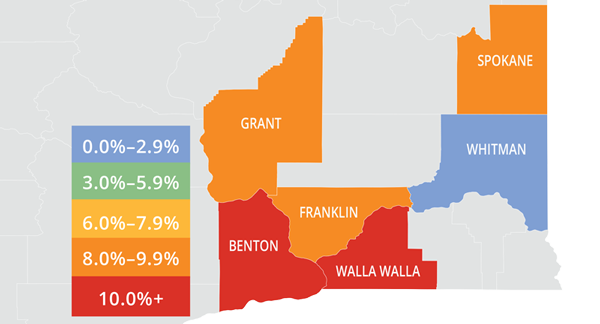
In aggregate, home sales throughout Eastern Washington performed well in the fourth quarter, with sales rising 6.3% compared to the same quarter of 2016. Year-over-year, home sales rose in three markets and decreased in three. In total, there were 3,469 home sales in the fourth quarter.
Sales rose at the fastest rate in Walla Walla County, which increased 15.2% over a year ago. That said, the market is relatively small, so a slight shift in sales can dramatically change the numbers.
Sales fell in half of the counties in this report, mainly as a function of low inventory levels—a problem across the whole of Washington State.
The number of homes for sale was down 9.3% from last year. Inventory clearly remains an issue and this will continue to push home prices higher.
HOME PRICES
Year-over-year, the average home price in the region rose 9.5% to $241,667. Price growth has been moderating across the region, but several counties continue to see well-above-average appreciation.
Limited inventory continues to drive prices higher. This is unlikely to change as we move into the winter months.
All of the counties in this report saw prices rise compared to the final quarter of 2016. Benton County led the way again with an increase of 14.8%.
The takeaway here is that home-price growth continues at above-average rates and, as long as mortgage rates remain favorable to would-be buyers, prices will continue to rise.
DAYS ON MARKET
The average number of days it took to sell a home dropped by two days compared to the fourth quarter of 2016.
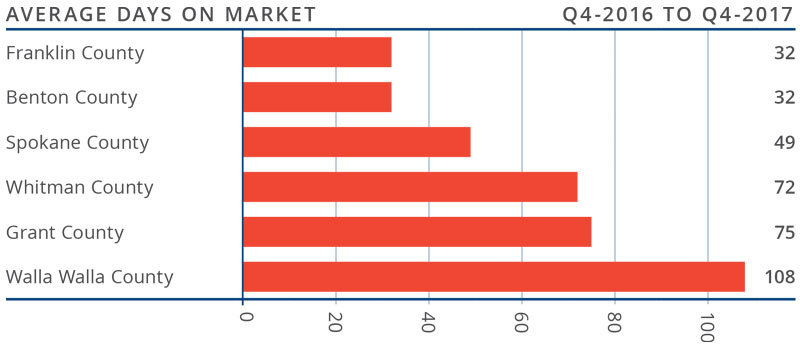
The average time it took to sell a home in the region was 61 days.
Every county except Grant saw the time it took to sell a home drop from the same quarter in 2016.
Spokane County had the biggest drop in days on market. The time it took to sell a home there dropped by seven days compared to the fourth quarter of 2016.
CONCLUSIONS
This speedometer reflects the state of the region’s housing market using housing inventory, price gains, home sales, interest rates, and larger economic factors. Given the drop in listings, rising pending and closed sales, and climbing home prices, I have nudged the needle just a little more in favor of sellers. We are all hoping for a jump in new listings in the first quarter, which would help would-be buyers. For now, however, the market clearly favors sellers.
Matthew Gardner is the Chief Economist for Windermere Real Estate, specializing in residential market analysis, commercial/industrial market analysis, financial analysis, and land use and regional economics. He is the former Principal of Gardner Economics, and has more than 30 years of professional experience both in the U.S. and U.K.
The State of Oregon added 30,600 new jobs over the past 12 months, representing an annual growth rate of 1.7%. Although job growth continues to slow, solid gains were still seen in the Construction (+7,400), Education & Health Services (+6,400), and Leisure & Hospitality (+5,200) sectors.
Oregon’s unemployment rate was in record low territory for all of 2017, diving to 3.6% in May of 2017, before drifting up to 4.2% by November. It is clear that the annual average unemployment rate for the whole of 2017 will be the lowest on record.
HOME SALES ACTIVITY
Fourth quarter home sales dropped by a very modest 1.5% compared to the same period last year, with a total of 15,314 homes sold.
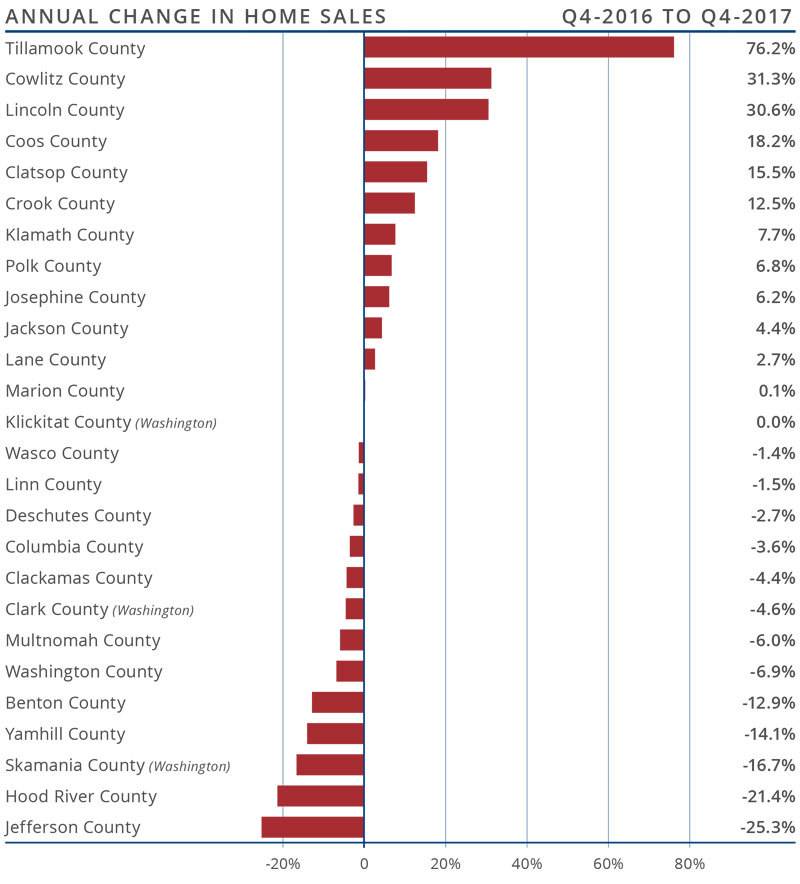
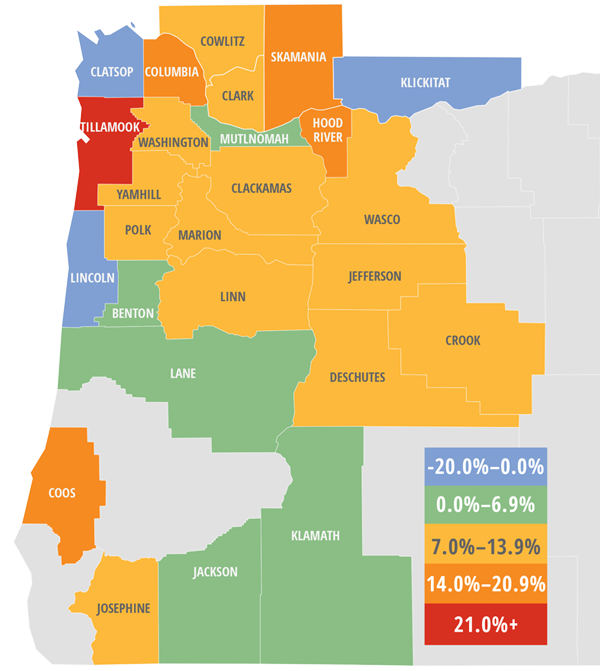
Sales rose the fastest in Tillamook County, which saw a 76.2% increase over the fourth quarter of 2016. There were also noticeable sales increases in Cowlitz, Lincoln, Coos, Clatsop, and Crook Counties. Home sales fell the most in Jefferson, Hood River, Skamania, and Yamhill Counties.
Year-over-year sales rose in 12 counties, remained static in one, and dropped in the other 13.
Although sales were a mixed bag, I still contend that any drop in sales was due to low levels of available inventory rather than declining demand.
HOME PRICES
The average home price in the region rose 7% year-over-year to $363,110. This is down 1.4% from the third quarter of 2017.
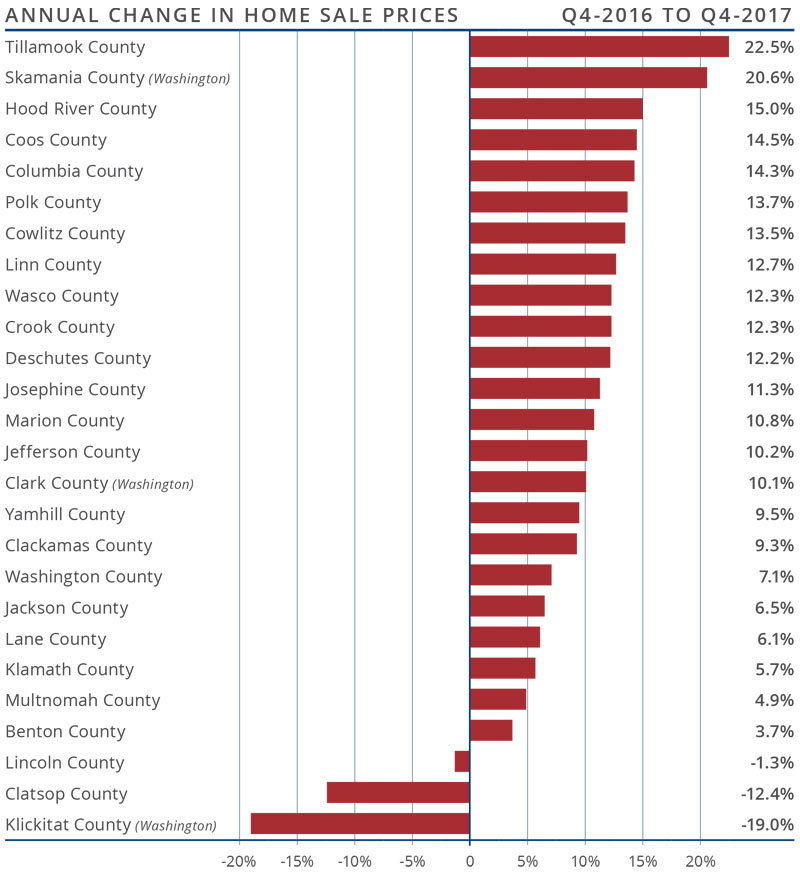
Tillamook County led the market with the strongest annual price growth. Homes there sold for 22.5% more than a year ago.
All counties other than Klickitat, Clatsop, and Lincoln experienced rising prices when compared to the fourth quarter of 2016. The majority of counties saw significant, double-digit increases.
This slowdown in price growth is likely due to buyers feeling priced out of the market.
DAYS ON MARKET
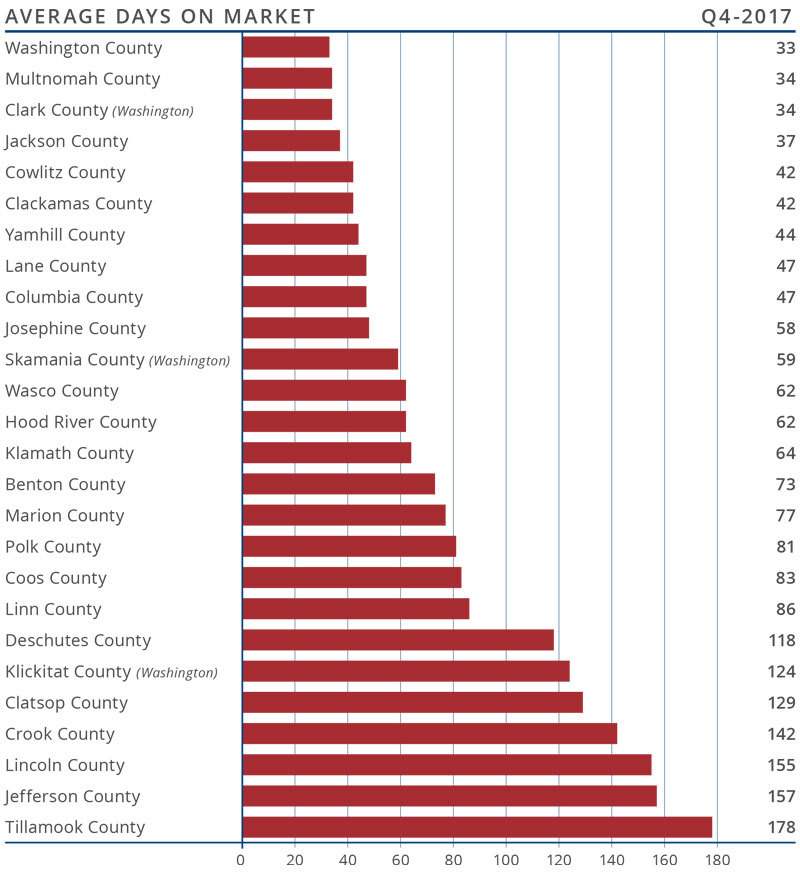
The average number of days it took to sell a home in the region dropped by 7 days from the fourth quarter of 2016, but was up 13 days from the third quarter of this year.
The average time it took to sell a home in the region last quarter was 80 days.
Eight counties saw the length of time it took to sell a home rise compared to a year ago, but I still do not see this as troublesome. Listings are scarce during the winter months, and it’s not unusual for buyers to wait until spring in anticipation of more choices in the market.
Once again, homes sold the fastest in Washington and Multnomah Counties, where it took an average of 33 and 34 days, respectively, for homes to sell.
CONCLUSIONS
The speedometer reflects the state of the region’s housing market using housing inventory, price gains, home sales, interest rates, and larger economic factors. Housing markets throughout Oregon continue to benefit greatly from the healthy regional economy.
The Oregon/Southwest Washington housing market remains fairly strong and, given that inventory levels are unlikely to increase as we head toward the traditionally busier spring market, sellers remain firmly in the driver’s seat. That said, price growth and home sales have slowed, so I am leaving the needle in the same position as last quarter.
Matthew Gardner is the Chief Economist for Windermere Real Estate, specializing in residential market analysis, commercial/industrial market analysis, financial analysis, and land use and regional economics. He is the former Principal of Gardner Economics, and has more than 30 years of professional experience both in the U.S. and U.K.
The State of Utah added 41,200 non-agricultural jobs over the past 12 months, representing a solid growth rate of 2.8%. Although the area has experienced a slowing in employment gains, the economy is running at full employment, which limits how many new jobs can be created. In last quarter’s report, I forecasted that the pace of employment growth was likely to kick back up during the last quarter of the year, but any substantial gains have, so far, failed to materialize; average monthly job growth is essentially static. That said, we are still waiting for December data and I believe that the final yearly number will be higher.
In November, the unemployment rate was 3.2%, matching the fourth quarter of 2016. With the unemployment rate leveling around 3%, it is unsurprising to see wages rising. The annual rate of pay was up 2.8% over this time last year.
HOME SALES ACTIVITY
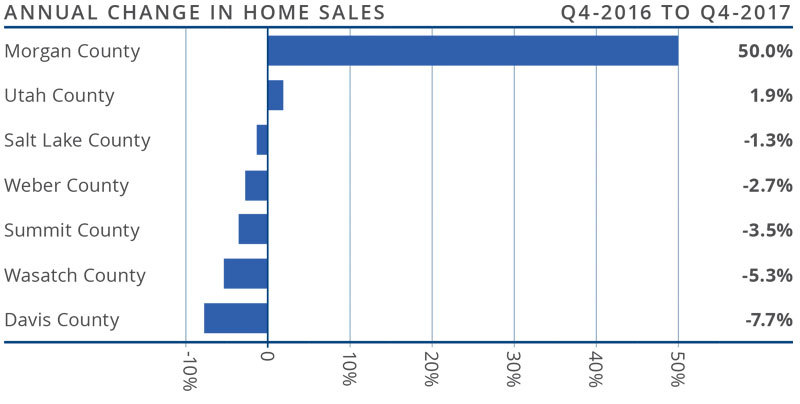
There were 8,529 home sales during the last quarter of 2017, a drop of 1.8% from the same period in 2016.
Similar to third quarter, sales rose in just two of the counties analyzed in this report: small Morgan County saw sales grow 50% year-over-year—it’s worth noting though that this equates to an increase of only eight units—and there were moderate sales increases in Utah County. Sales fell marginally in Salt Lake and Weber Counties, and a more substantial drop was seen in Wasatch and Davis Counties.
Home sales continue to be held back by very low levels of available inventory. Listing activity continues to trend at well below historic averages, with the total number of homes for sale in the fourth quarter down 33.7% from a year ago.
The takeaway from this report is that unless we see a drastic increase in listings, sales growth will continue to remain at below-average levels.
HOME PRICES
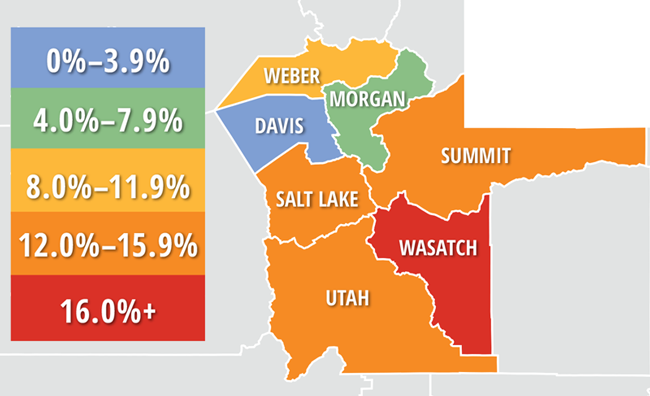
Given the considerable competition for the few homes for sale in the fourth quarter, prices continue to rise at fairly rapid rates. Prices in the region were up 11.6% yearover-year to an average of $342,507.
Appreciation was strongest in Wasatch County, where home prices rose by 22%.
Substantial price growth was also seen in Summit, Salt Lake, Utah, and Weber Counties, where prices rose by doubledigit percentage points.
The imbalance between supply and demand persists, which means home prices continue to appreciate at aboveaverage rates. This is likely to continue for the foreseeable future as inventory levels are unlikely to rise sufficiently to meet demand.
DAYS ON MARKET
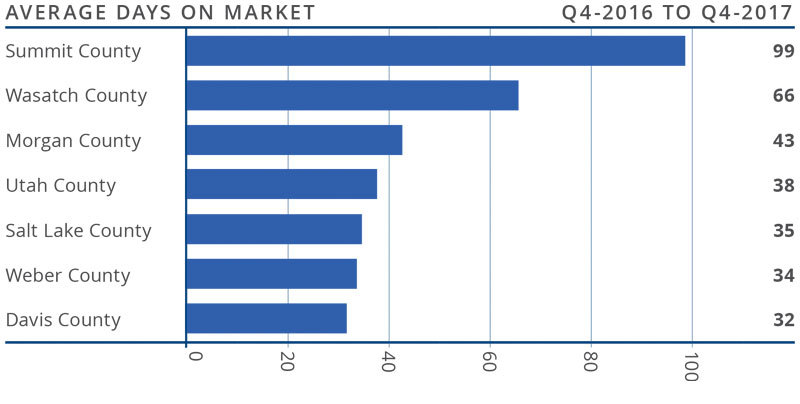
The average number of days it took to sell a home rose by one day when compared to the fourth quarter of 2016.
It took an average of one month to sell a home in Davis County. Sales were also brisk in Weber, Salt Lake, and Utah Counties.
During the fourth quarter, it took an average of 50 days to sell a home in the region.
I believe that the length of time it takes to sell a house will drop back down as we enter the traditionally active spring market. That said, sales will be limited by inventory constraints.
CONCLUSIONS
This speedometer reflects the state of the region’s housing market using housing inventory, price gains, home sales, interest rates, and larger economic factors. For the fourth quarter of 2017, I left the needle at the same point as third quarter. Supply issues persist and this continues to create competition for well-priced and well-located homes. The increase we’re seeing in the amount of time it takes to sell a home may suggest that the market is either getting weary of all the competition or buyers are delaying their purchase until there are more homes to choose from.
Matthew Gardner is the Chief Economist for Windermere Real Estate, specializing in residential market analysis, commercial/industrial market analysis, financial analysis, and land use and regional economics. He is the former Principal of Gardner Economics, and has more than 30 years of professional experience both in the U.S. and U.K.

 Facebook
 X
X
 Pinterest
 Copy Link



 Year-over-year, the average home price in the region rose 4.8% to $292,691. Price growth has started to trend down but remains well above the long-term average as demand continues to exceed supply.

 This speedometer reflects the state of the region’s housing market using housing inventory, price gains, home sales, interest rates, and larger economic factors. For the final quarter of 2017, I held the needle at the same position as third quarter. Prices are still trending higher, but the pace of increase has started to taper. In a similar fashion to most of the state, demand for housing in Central Washington continues to exceed supply and, although price growth has slowed somewhat, it still remains a seller’s market. I fully expect the Central Washington market to continue performing well in 2018.



 The speedometer reflects the state of the region’s housing market using housing inventory, price gains, home sales, interest rates, and larger economic factors. Consumer confidence in the housing market seems to have returned, causing the markets in this report to perform well overall, and for home prices to continue trending upward. As mentioned in my last report, the market remains out of balance, with more buyers than sellers. Even with the modest increase in listings seen in the quarter, the market still heavily favors sellers. Unless we see a major increase in the number of homes for sale in early spring, the market will continue to see above-average home price growth.
 Year-over-year, the average home price in the region rose 9.5% to $241,667. Price growth has been moderating across the region, but several counties continue to see well-above-average appreciation.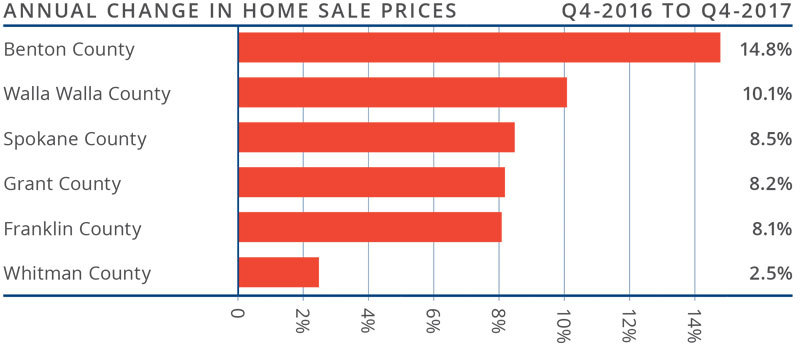
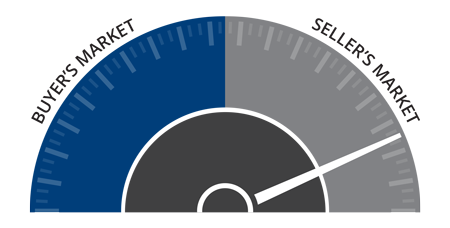 This speedometer reflects the state of the region’s housing market using housing inventory, price gains, home sales, interest rates, and larger economic factors. Given the drop in listings, rising pending and closed sales, and climbing home prices, I have nudged the needle just a little more in favor of sellers. We are all hoping for a jump in new listings in the first quarter, which would help would-be buyers. For now, however, the market clearly favors sellers.
 The speedometer reflects the state of the region’s housing market using housing inventory, price gains, home sales, interest rates, and larger economic factors. Housing markets throughout Oregon continue to benefit greatly from the healthy regional economy.
 Given the considerable competition for the few homes for sale in the fourth quarter, prices continue to rise at fairly rapid rates. Prices in the region were up 11.6% yearover-year to an average of $342,507.
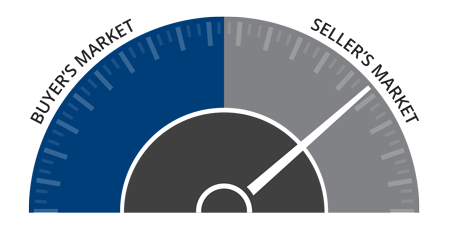 This speedometer reflects the state of the region’s housing market using housing inventory, price gains, home sales, interest rates, and larger economic factors. For the fourth quarter of 2017, I left the needle at the same point as third quarter. Supply issues persist and this continues to create competition for well-priced and well-located homes. The increase we’re seeing in the amount of time it takes to sell a home may suggest that the market is either getting weary of all the competition or buyers are delaying their purchase until there are more homes to choose from.