More May 10, 2018

Helping Fight Hunger in Our Communities


Recent research from the U.S. Department of Agriculture (USDA) found that more than 13 million children in the U.S. experience food insecurity. That’s one in six children who live in households where they do not have enough food to eat on a regular basis. And over 20 million children rely on free or reduced-price school lunches for their meals during the school year.


For those families relying on the free and reduced meals during the school year, summer can be especially stressful. Many families do not have access to food assistance programs during the summer. And the national summer meal programs reach only a small percentage of children who need help when school is not in session–around 16 percent. That is why many of our Windermere offices choose to support local non-profits that provide weekend and summer meals to children and families in need.


One of those non-profits that Windermere offices support is the Hunger Intervention Program (HIP) in Seattle, Washington, whose mission is to increase food security for underserved populations in North King County through nutritious meals, educational programs, and advocacy. According to HIP, one in four children in Washington State live in households where families experience hunger. Their Healthy HIP Packs Program is a weekend food backpack program that provides nutritious and kid-friendly foods, enough for six meals and two snacks per child, when school meals are not available during the school year. And HIP’s Summer Eats for Kids program provides freshly made, nutritious lunches at kid-friendly locations around the north Seattle community during the summer.


The Windermere Northgate, Sand Point, and Wedgwood offices have supported Hunger Intervention Program since 2013 with donations via the Windermere Foundation. A total of $14,700 has been donated to HIP over the years, to help fund meal programs so that children do not have to go hungry on the weekends or over summer break.

 

Thanks to donations from our Windermere owners, offices, and agents, and donations from the public, the Windermere Foundation is able to provide support to local nonprofits that provide nutritious meals for children in need. If you’d like to help support food programs for children experiencing hunger in your community, please consider making a donation to the Windermere Foundation through a Windermere office near you. Just click on the Donate button.


To learn more about the Windermere Foundation, visit https://www.windermere.com/foundation.

More May 10, 2018

Premier Crews from Four Nations Highlight 32nd Windermere Cup This Saturday


On May 5 the Montlake Cut will play host once again to the Windermere Cup rowing regatta. For the past 32 years, Windermere Real Estate and the University of Washington have joined together to host this event, which brings the world’s best crews to Seattle to compete against the perennially acclaimed UW men’s and women’s teams. Held annually on the first Saturday in May, the Windermere Cup is both an international sporting event and opening day party, followed by the world’s largest boat parade.


The races will be headlined by four of the strongest crews in the world. On the men’s side, UW Rowing will be opposed by two strong squads. Oxford Brookes University is the defending collegiate champion in Great Britain, and the University of British Columbia holds the most recent collegiate title in Canada. Both will oppose a Washington men’s crew that has been the most dominant program of the decade in the United States and missed out on a national championship by less than a tenth of a second in 2017. The reigning national champion UW women will be opposed by the Dutch national team, which recently placed 6th in the world at both the World Championships and the 2016 Olympic Games.


In addition to the 23 crew races throughout the morning, the family-friendly Windermere Cup event also includes food vendors, booths to purchase UW and Windermere Cup apparel and commemorative gear, as well as a bouncy house for the kids. Admission to the event is free.


Windermere Cup App:

The crew races start at 10 am and end around noon. Following the final Windermere Cup race is the Seattle Yacht Club’s Opening Day Boat Parade. Download the Windermere Cup App by downloading Attendee Hub, available on the App Store for both Android and iOS. There you can access schedule and team information, event details, and more! For live race results: https://event.crowdcompass.com/w18c


Windermere Party on the Cut:

This year’s pre-race Party on the Cut will take place Friday, May 4th, from 6 PM to 10 PM. Join us on the Montlake Cut for an evening of live music, lawn games, and food and drinks. $25 gets you into the beer garden where you can hear live performances by Groove Surfers, Brian DiJulio & the Love Jacks, and Spike & the Impalers. Kids get in for just $10, and tickets can be found through Brown Paper Tickets.


Windermere Cup Book:

This book is about the athletes, colorful characters, and brilliant people the Windermere Cup rowing regatta has featured every first Saturday in May since 1987. Through interviews, original documents and pages upon pages of breathtaking photographs, author Gregg Bell captures this event’s more than 30 remarkable years, its spirit and its soul.

The Windermere Cup is a touchstone for our company, our family of offices and agents, and the University of Washington. Not only is this an international sporting event, it’s a celebration of camaraderie, teamwork, and community – and truly great tradition that we are honored to be a part of.


For more information please visit windermerecup.com and follow us at Facebook.com/WindermereCup and @WindermereCup on Twitter.

Living May 9, 2018

Simple Steps for Maintaining Air Quality in Your Home


Most of us tend to think of air pollution as something that occurs outdoors where car exhaust and factory fumes proliferate, but there’s such a thing as indoor air pollution, too.  Since the 1950s, the number of synthetic chemicals used in products for the home has increased drastically, while at the same time, homes have become much tighter and better insulated. As a result, the EPA estimates that indoor pollutants today are anywhere from five to 70 times higher than pollutants in outside air.

Luckily, there are many ways to reduce indoor air pollution. We all know that buying organic and natural home materials and cleaning supplies can improve the air quality in our homes, but there are several other measures you can take as well.

How pollutants get into our homes

Potentially toxic ingredients are found in many materials throughout the home, and they leach out into the air as Volatile Organic Compounds or VOCs. If you open a can of paint, you can probably smell those VOCs. The “new car smell” is another example of this. The smell seems to dissipate after a while, but VOCs can actually “off-gas” for a long time, even after a noticeable smell is gone.

We all know to use paint and glue in a well-ventilated room, but there are many other materials that don’t come with that warning. For instance, there are chemicals, such as formaldehyde, in the resin used to make most cabinets and plywood particle board. It’s also in wall paneling and closet shelves, and in certain wood finishes used on cabinets and furniture. The problems aren’t just with wood, either. Fabrics—everything from draperies to upholstery, bedding, and carpets—are a potent source of VOCs.

The good news about VOCs is that they do dissipate with time. For that reason, the highest levels of VOCs are usually found in new homes or remodels. If you are concerned about VOCs, there are several products you can buy that are either low- or no-VOC. You can also have your home professionally tested.

How to reduce VOCs in your home

Make smart choices in building materials. 

  • For floors, use tile or solid wood—hardwood, bamboo, or cork – instead of composites.
  • Instead of using pressed particle board or indoor plywood, choose solid wood or outdoor-quality plywood that uses a less toxic form of formaldehyde.
  • Choose low-VOC or VOC-free paints and finishes.

Purify the air that’s there. 

  • Make sure your rooms have adequate ventilation, and air out newly renovated or refurnished areas for at least a week, if possible.
  • Clean ductwork and furnace filters regularly.
  • Install air cleaners if needed.
  • Use only environmentally responsible cleaning chemicals.
  • Plants can help clean the air: good nonpoisonous options include bamboo palm, lady palm, parlor palm, and moth orchids.
  • Air out freshly dry-cleaned clothes or choose a “green” cleaner.

Fight the carpet demons.

  • Choose “Green Label” carpeting or a natural fiber such as wool or sisal.
  • Use nails instead of glue to secure carpet.
  • Install carpet LAST after completing painting projects, wall coverings, and other high-VOC processes.
  • Air out newly carpeted areas before using.
  • Use a HEPA vacuum or a central vac system that vents outdoors.

Prevent Mold. 

  • Clean up water leaks fast.
  • Use dehumidifiers, if necessary, to keep humidity below 60 percent.
  • Don’t carpet rooms that stay damp.
  • Insulate pipes, crawl spaces, and windows to eliminate condensation.

  • Kill mold before it gets a grip with one-half cup of bleach per gallon of water.

We hope this information is helpful. If you would like to learn more about VOCs and indoor air quality, please visit http://www.epa.gov/iaq/

Market News May 8, 2018

Idaho Real Estate Market Update


The following analysis of select Idaho real estate markets is provided by Windermere Real Estate Chief Economist Matthew Gardner. We hope that this information may assist you with making better-informed real estate decisions. For further information about the housing market in your area, please don’t hesitate to contact me.

ECONOMIC OVERVIEW

Idaho has added 24,000 new jobs over the past 12 months, representing an impressive growth rate of 3.4%. In February, the state unemployment rate was 3% and, with the ongoing growth in the labor force, there are clearly still jobs out there to be had. Through the duration of the year, I expect Idaho’s employment growth to continue outperforming the U.S. as a whole.

HOME SALES ACTIVITY

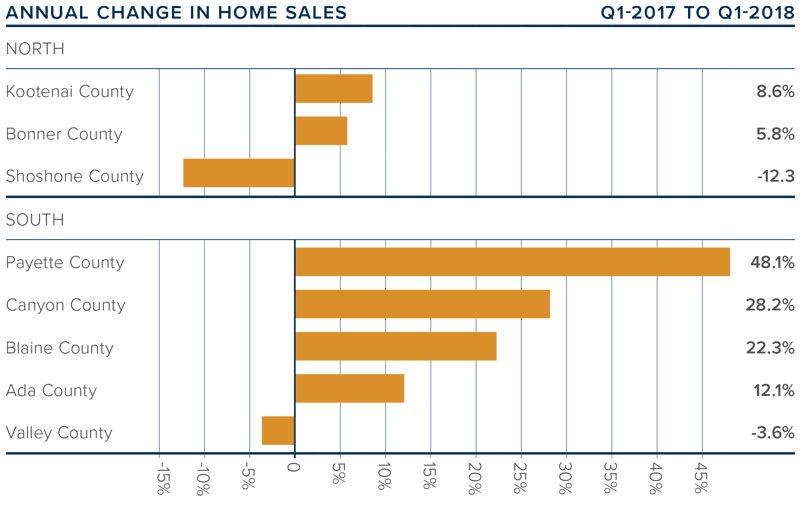
  • There were a total of 4,496 home sales during first quarter, representing an increase of 14.7% compared to the same period last year.
  • Sales rose the fastest in Payette County, where they were 48% higher than the first quarter of 2017. There were also noticeable increases in Canyon and Blaine Counties.

  • Year-over-year sales growth was generally positive across the state. Only Shoshone and Valley Counties experienced modest drops.
  • First quarter home sales data indicates that demand for housing remains very strong.

HOME PRICES

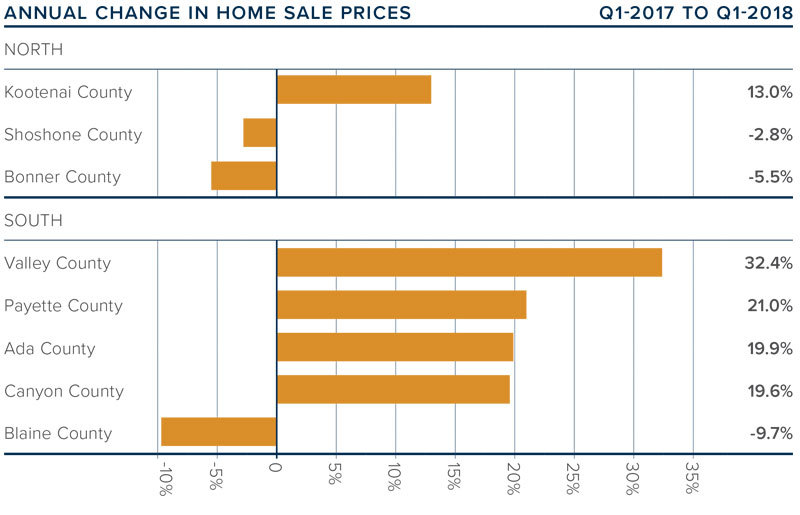
  • The average home price in the region rose 14.6% year-over-year to $315,528.
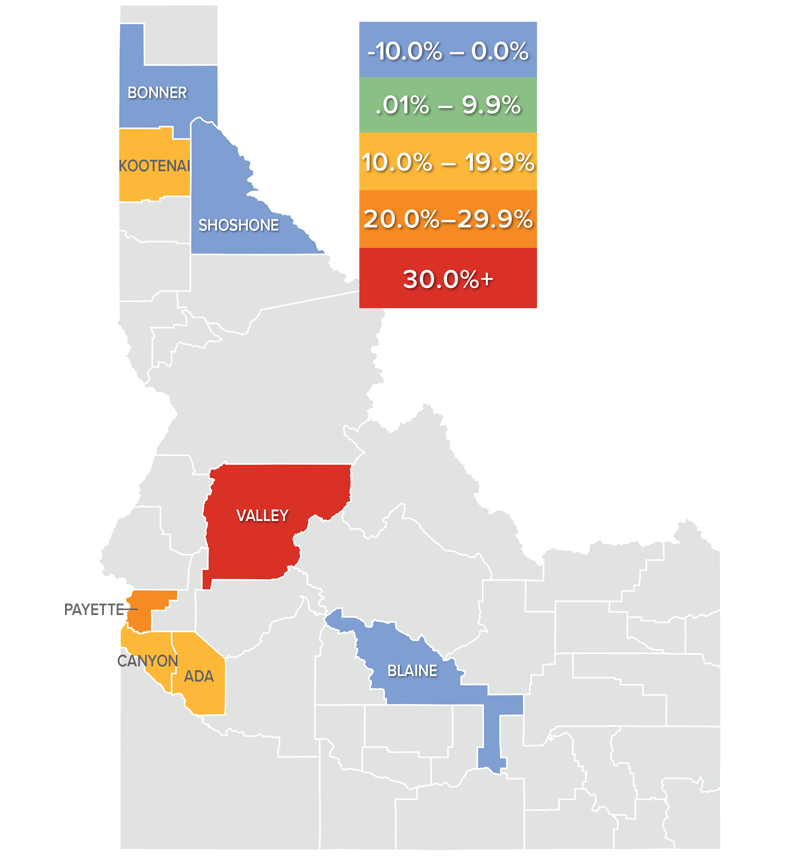
  • Valley County again led the market with the strongest annual price growth. Homes there sold for 32.4% more than a year ago.
  • Price increases were a mixed bag when compared to the first quarter of 2017. All but one county in Southern Idaho saw prices rise, but two of three counties in Northern Idaho saw prices drop from a year ago. 
  • Although prices dropped in some markets, I don’t believe there’s a cause for concern because these areas are relatively small.

DAYS ON MARKET

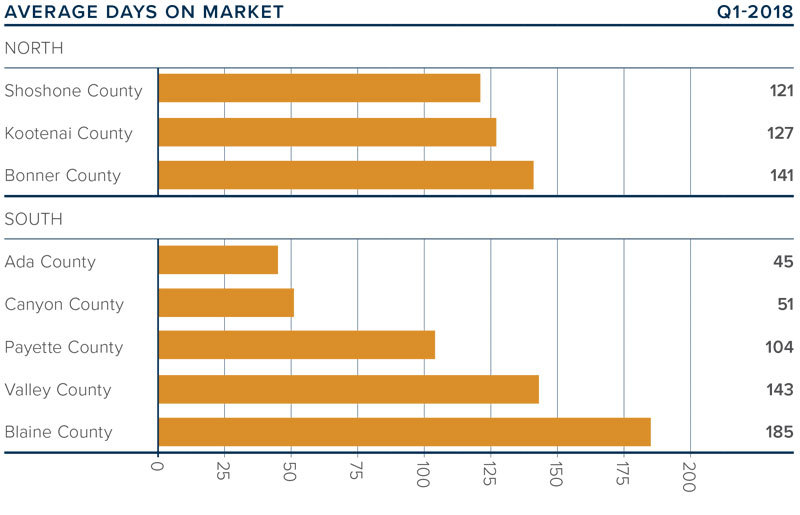
  • The average number of days it took to sell a home in the region dropped by nine days when compared to the first quarter of 2017.
  • It took an average of 130 days to sell a home in Northern Idaho and 106 days in the southern part of the state.
  • Homes in two out of three Northern Idaho counties took less time to sell than they did in the same quarter of 2017. Three out of five Southern Idaho counties saw a drop in the time it took a home to sell.
  • Again, homes sold the fastest in Ada and Canyon Counties, where it took an average of 45 and 51 days, respectively.

CONCLUSIONS

The speedometer reflects the state of the region’s housing market using housing inventory, price gains, home sales, interest rates, and larger economic factors. Consumer confidence in housing seems to have returned, causing the markets in this report to perform well overall, and for home prices to continue trending upward.

I still contend that we will see solid demand for well-positioned, well-priced homes, resulting in the continuation of a seller’s market.

Matthew Gardner is the Chief Economist for Windermere Real Estate, specializing in residential market analysis, commercial/industrial market analysis, financial analysis, and land use and regional economics. He is the former Principal of Gardner Economics and has more than 30 years of professional experience both in the U.S. and U.K.

Market News May 7, 2018

Central Washington Real Estate Market Update


The following analysis of the Central Washington real estate market is provided by Windermere Real Estate Chief Economist Matthew Gardner. We hope that this information may assist you with making better-informed real estate decisions. For further information about the housing market in your area, please don’t hesitate to contact me.

ECONOMIC OVERVIEW

The Washington State economy added 96,900 new jobs over the past 12 months, representing an annual growth rate of 2.9%—still solidly above the national rate of 1.5%. Most of the employment gains were in the private sector, which rose by 3.4%. The public sector saw a more modest increase of 1.6%.

The counties contained in this report added 1,616 new jobs over the past 12 months, which was a modest growth of 0.8%. The local unemployment rate for the area continued to fall, with a drop from 9% to 8%.

HOME SALES ACTIVITY

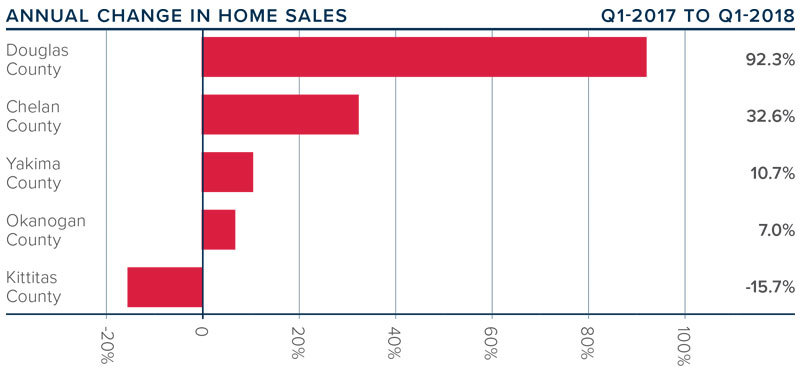
  • Home sales throughout Central Washington were generally higher in the first quarter of the year; four out of five counties saw growth in sales. In total, there were 859 home sales in the quarter—an increase of 13.5% from the same period in 2017.
  • Sales rose most in Douglas County, which almost doubled. That said, the actual number of sales only rose by 48. Sales fell in Kittitas County, but this was likely due to lack of inventory rather than lack of interest.

  • Demand for homes remained strong even as mortgage interest rates rose through the quarter. I do not expect that rising rates will impact sales until they breach the 5% barrier, but that is unlikely to happen until next year.
  • The lack of homes for sale remains an issue, but I am optimistic that inventory levels will rise modestly as we move toward the summer.

HOME PRICES

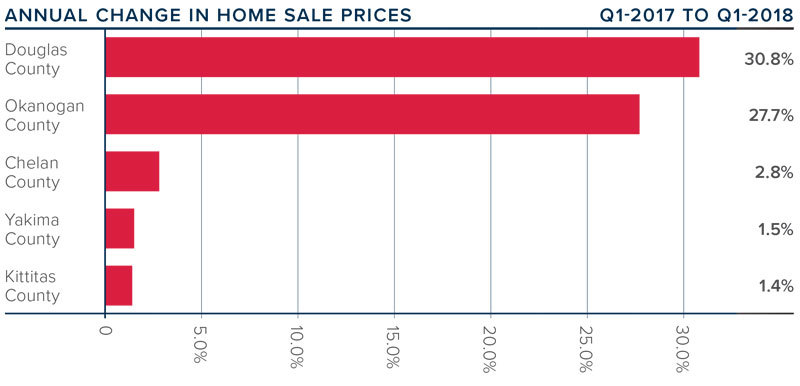
  • Year-over-year, the average home price in the region rose 6.3% to $291,728. Price growth picked back up in the first quarter and remains well above the long-term average as demand continues to exceed supply.
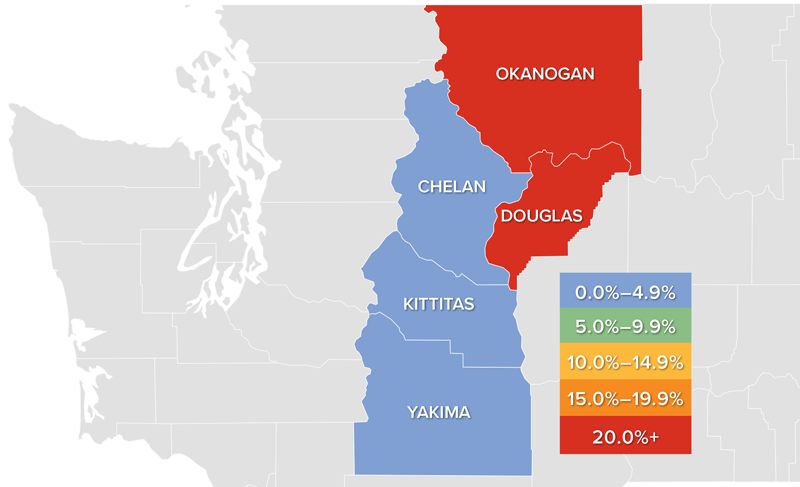
  • Chelan, Yakima, and Kittitas Counties saw relatively modest price contractions. I believe this is due to seasonality, and it is not a cause for concern at the present time.
  • All five counties in this report saw prices rise compared to the fourth quarter of 2017. Douglas and Okanogan Counties stood out with very substantial increases. This is largely due to the fact that they are both relatively small markets and, therefore, can see large swings in sale prices. 
  • Home-price growth continues to increase at above-average rates due to supply constraints. I expect this trend to continue through the duration of 2018.

DAYS ON MARKET

  • The average number of days it took to sell a home dropped nine days compared to the first quarter of 2017.
  • The average time it took to sell a home in the region was 79 days, down four days compared to the fourth quarter of 2017.
  • All the markets contained in this report, other than Chelan, saw days-on-market drop from the same quarter in 2017.
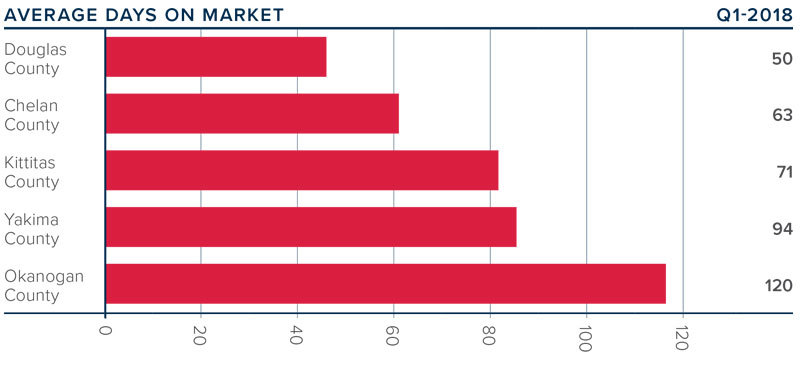
  • Homes sold fastest in Douglas County, where it took an average of 50 days to sell a home. The greatest drop in days on market was in Kittitas County, at 22 fewer days than in the fourth quarter of last year.

CONCLUSIONS

This speedometer reflects the state of the region’s housing market using housing inventory, price gains, home sales, interest rates, and larger economic factors. 

For the first quarter of 2018, I held the needle at the same position as last quarter. The market still favors sellers, but supply is improving—albeit modestly.

Matthew Gardner is the Chief Economist for Windermere Real Estate, specializing in residential market analysis, commercial/industrial market analysis, financial analysis, and land use and regional economics. He is the former Principal of Gardner Economics and has more than 30 years of professional experience both in the U.S. and U.K.

Market News May 3, 2018

Eastern Washington Real Estate Market Update


The following analysis of the Eastern Washington real estate market is provided by Windermere Real Estate Chief Economist Matthew Gardner. We hope that this information may assist you with making better-informed real estate decisions. For further information about the housing market in your area, please don’t hesitate to contact me.


ECONOMIC OVERVIEW

The Washington State economy added 96,900 new jobs over the past 12 months, representing an annual growth rate of 2.9%—still solidly above the national rate of 1.5%. Most of the employment gains were in the private sector, which rose by 3.4%. The public sector saw a more modest increase of 1.6%. Even with solid increases in jobs, the state unemployment rate held steady at 4.7% — a figure that has not moved since September of last year. The counties contained in this report added 3,430 new jobs over the past 12 months, representing an annual growth rate of 0.8%.


HOME SALES ACTIVITY

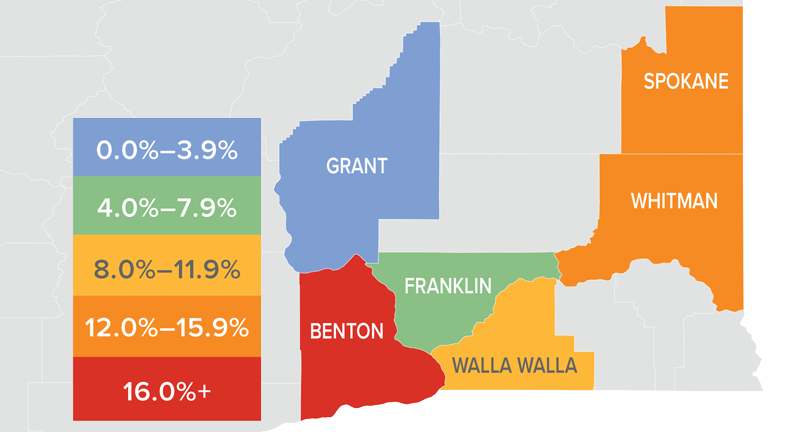
  • In aggregate, home sales throughout Eastern Washington continue to outperform historic averages, with sales rising 18.4% compared to the same quarter of 2017.
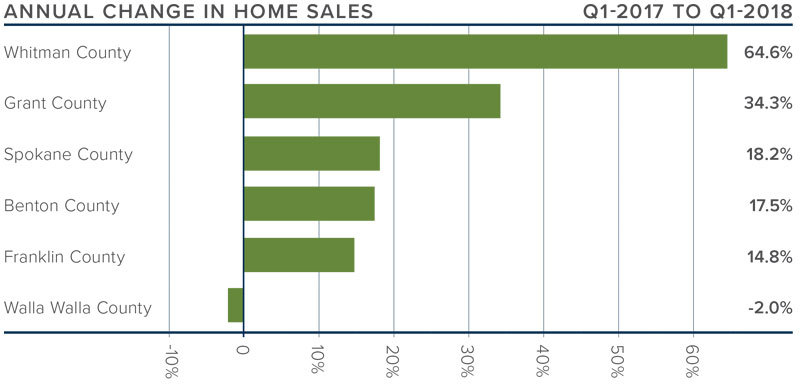
  • Sales rose at the fastest rate in Whitman County, which increased 64.6% over a year ago. However, because that market is relatively small, a modest shift in sales can dramatically change the rate of growth in either direction.
  • Year-over-year, home sales rose in all counties except Walla Walla, where there was a very modest drop. In total, there were 2,545 home sales in the first quarter.
  • The number of homes for sale was down 15.2% from the first quarter of 2017. Inventory clearly remains an issue and this will continue to push home prices higher.


HOME PRICES

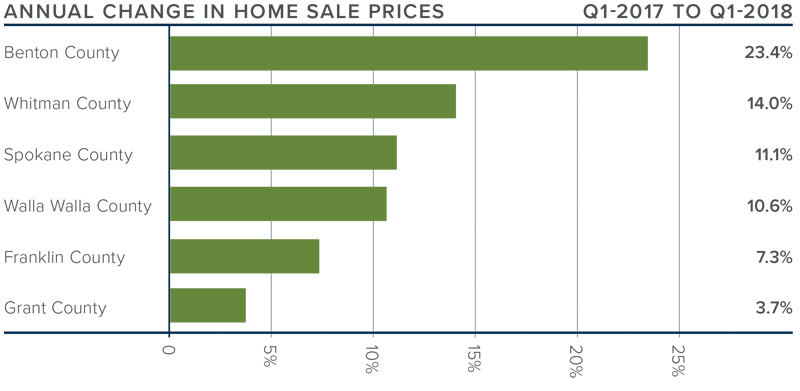
  • All the counties in this report saw prices rise compared to the final quarter of 2017. Benton County led the way again, with an increase of 23.4%. 
  • Home-price growth continues at above-average rates, even as mortgage rates rose through first quarter.
  • Year-over-year, the average home price in the region rose 13.1% to $250,376. Price growth had been moderating, but this was not the case in the first quarter of this year. 
  • Limited inventory continues to drive prices higher. This is unlikely to change as we move into the normally buoyant spring market.


DAYS ON MARKET

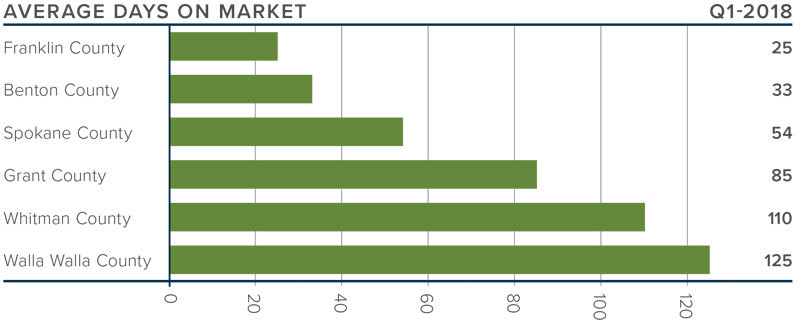
  • The average number of days it took to sell a home dropped by one day compared to the first quarter of 2017.
  • The average time it took to sell a home in the region was 72 days. 
  • Every county except Whitman saw the time it took to sell a home drop from the same quarter in 2017.
  • Franklin County had the biggest drop in days on market. The time it took to sell a home there fell by 13 days compared to the first quarter of 2017.


CONCLUSIONS

This speedometer reflects the state of the region’s housing market using housing inventory, price gains, home sales, interest rates, and larger economic factors. Listing activity increased in Franklin and Benton Counties, which was positive news for buyers in those areas. However, the overall trend remains firmly in favor of home sellers, so I moved the needle a little more in their direction.



Matthew Gardner is the Chief Economist for Windermere Real Estate, specializing in residential market analysis, commercial/industrial market analysis, financial analysis, and land use and regional economics. He is the former Principal of Gardner Economics and has more than 30 years of professional experience both in the U.S. and U.K.

Market News May 2, 2018

Oregon & Southwest Washington Real Estate Update


The following analysis of the Oregon and Southwest Washington real estate market is provided by Windermere Real Estate Chief Economist Matthew Gardner. We hope that this information may assist you with making better-informed real estate decisions. For further information about the housing market in your area, please don’t hesitate to contact me.

ECONOMIC OVERVIEW

The State of Oregon has added 43,700 new jobs over the past 12 months, representing a robust annual growth rate of 2.3%. Job growth picked up in the first quarter of 2018, with significant annual gains in Education & Health Services (+26,000), Leisure & Hospitality (+9,700), and Construction (+7,400). Oregon’s unemployment rate was 4.1%, matching the number seen a year ago and remaining in record low territory.

HOME SALES ACTIVITY

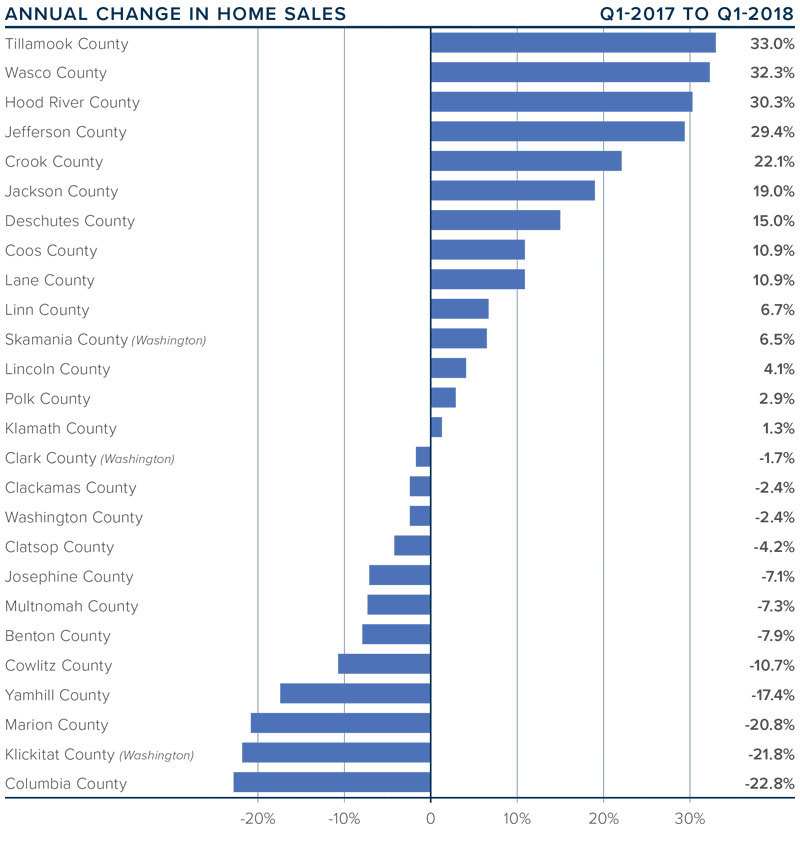
  • First quarter home sales dropped by a modest 0.8% compared to the same period last year, with a total of 12,775 sales.
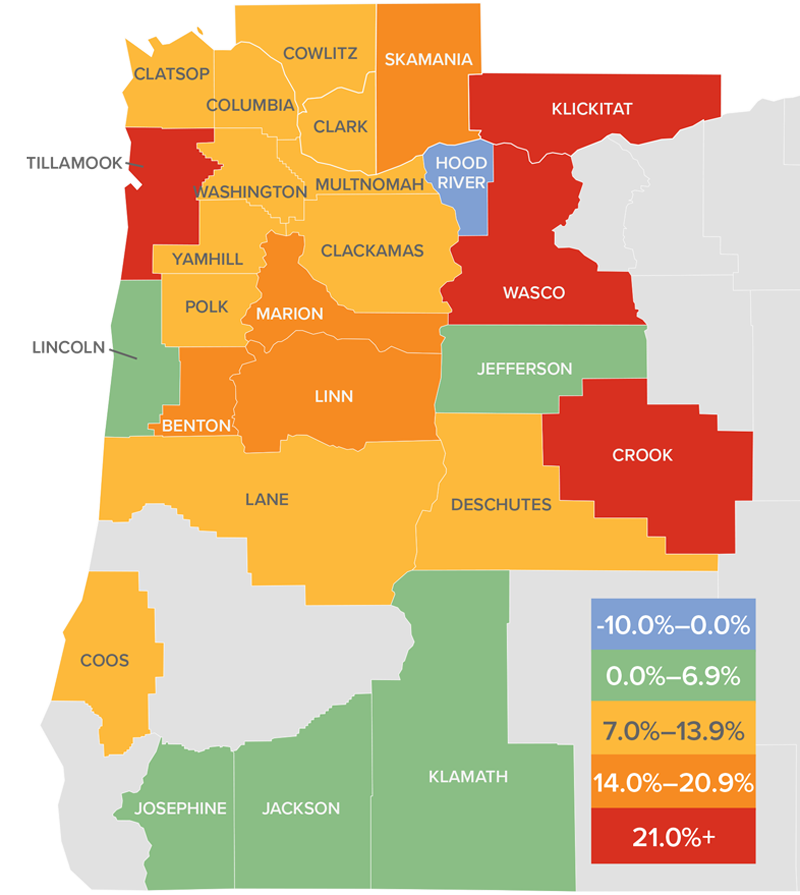
  • Sales rose the most in Tillamook County, which saw a 33% increase compared to the first quarter of 2017. There were also noticeable increases in Wasco, Hood River, Jefferson, and Crook Counties. Home sales fell the most in Columbia, Klickitat, Marion, and Yamhill Counties.

  • Year-over-year sales rose in 14 counties and dropped in the other 12 counties contained in this report.
  • Sales were a bit of a mixed bag in the first quarter, but I still believe that lower sales velocities are due to extremely low levels of inventory in the region and not a decline in demand.

HOME PRICES

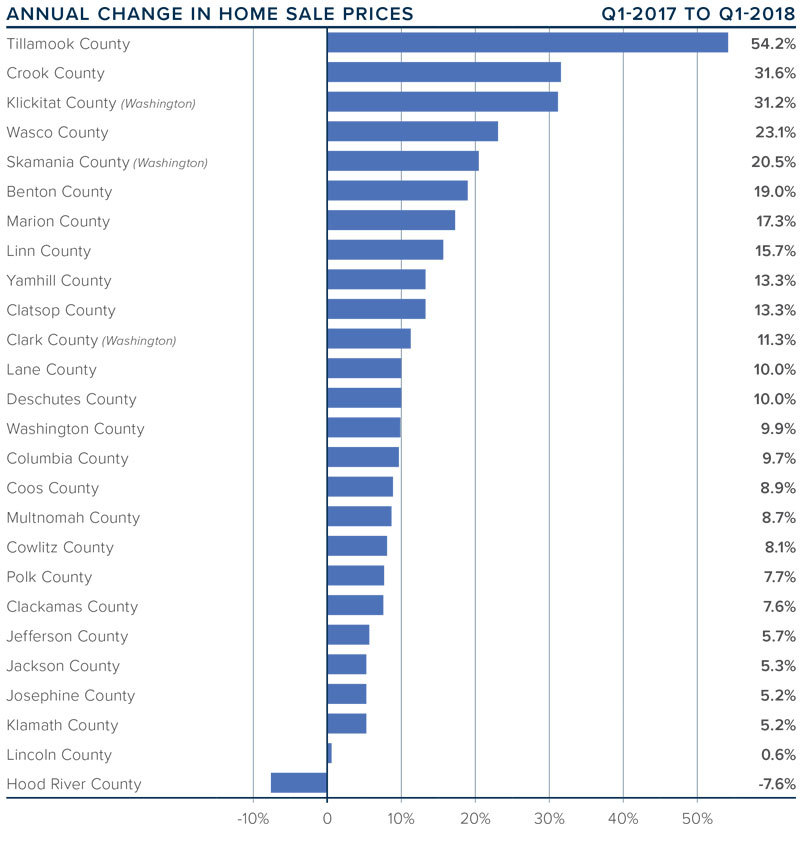
  • The average home price in the region rose 9.9% year-over-year to $367,316. That number is 1.2% higher than the fourth quarter of 2017.
  • Tillamook County again led the market with the strongest annual price growth. Homes there sold for 54.2% more than a year ago. That said, it’s worth noting that it is a very small market, making it prone to substantial swings in average sale prices.
  • All counties other than Hood River saw price growth over the first quarter of 2017. Half experienced significant, double-digit increases. 
  • The takeaway from this report is that, in aggregate, price growth continues to trend well above historic averages.

DAYS ON MARKET

  • The average number of days it took to sell a home in the region dropped by 12 days when compared to the first quarter of 2017, but was up 9 days from the fourth quarter of 2017. 
  • The average time it took to sell a home in the region last quarter was 88 days.
  • Twenty-one counties saw the length of time it took to sell a home drop when compared to a year ago. One remained the same while four saw market time rise.
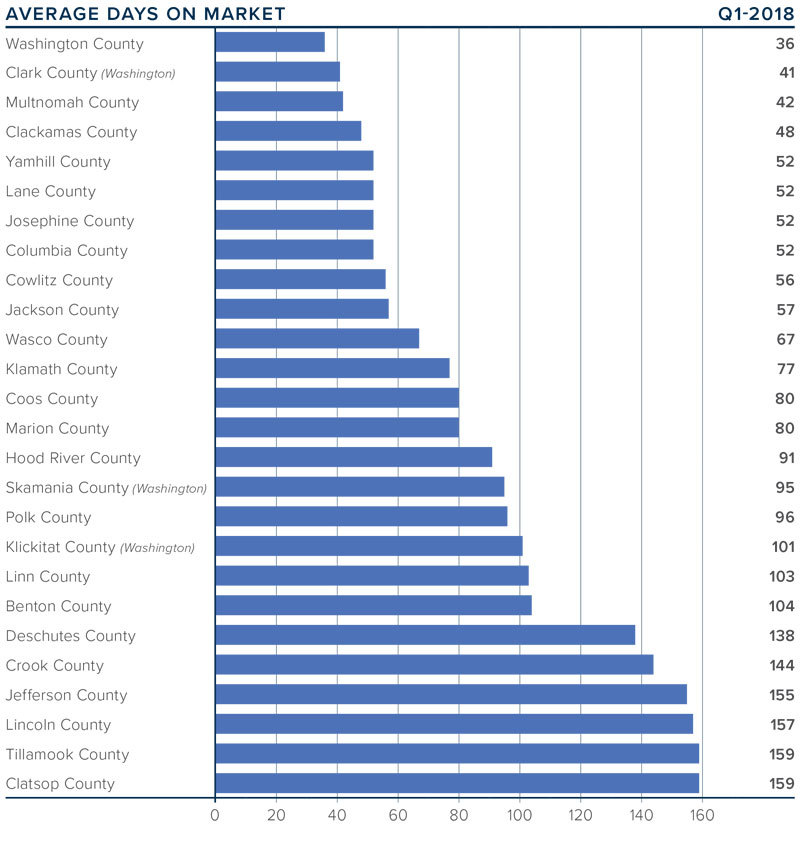
  • Homes sold the fastest in Washington (36 days), Clark (41 days), and Multnomah (42 days) Counties.

CONCLUSIONS

The speedometer reflects the state of the region’s housing market using housing inventory, price gains, home sales, interest rates, and larger economic factors. Housing markets throughout Oregon and Southwest Washington continue to benefit greatly from the healthy regional economy. Home sales remain very strong and, given that inventory levels are unlikely to increase substantially in the near term, sellers remain firmly in the driver’s seat. Even with rising interest rates, demand continues to outstrip supply, so I have moved the needle a little more in favor of sellers.

Matthew Gardner is the Chief Economist for Windermere Real Estate, specializing in residential market analysis, commercial/industrial market analysis, financial analysis, and land use and regional economics. He is the former Principal of Gardner Economics and has more than 30 years of professional experience both in the U.S. and U.K.

Market News May 1, 2018

Utah Real Estate Market Update


The following analysis of select counties of the Utah real estate market is provided by Windermere Real Estate Chief Economist Matthew Gardner. We hope that this information may assist you with making better-informed real estate decisions. For further information about the housing market in your area, please don’t hesitate to contact me.


ECONOMIC OVERVIEW

According to the Labor Department, Utah added 46,200 non-agricultural jobs over the past 12 months, representing a very substantial growth rate of 3.1%. Although the area has experienced a slowing in employment gains, the economy is running at full employment, which limits how many new jobs can be created. In February, the unemployment rate was measured at 3.1%, down from 3.3% a year ago. I maintain my position that the regional economy will continue to outperform the country in terms of job growth and remain one of the most dynamic markets in the country.


HOME SALES ACTIVITY

  • There were 7,002 home sales during the first quarter of 2018, an increase of 3.2% from the same period in 2017.
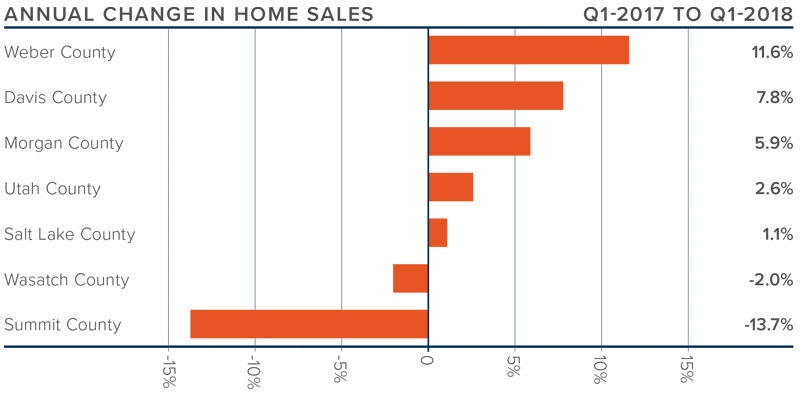
  • Total sales activity rose in five of the counties analyzed in this report, with a solid increase of 11.6% in Weber County. Sales fell the most in Summit County, but this is a relatively small market so the drop is not a concern.
  • Listing activity continues to run at well below historic averages, with the average number of homes for sale in the first quarter down 39.8% from a year ago.
  • The lack of supply continues to put downward pressure on home sales.


HOME PRICES

  • The average home price in the region continues to rise with a year-over-year increase of 8.4% to $350,403.
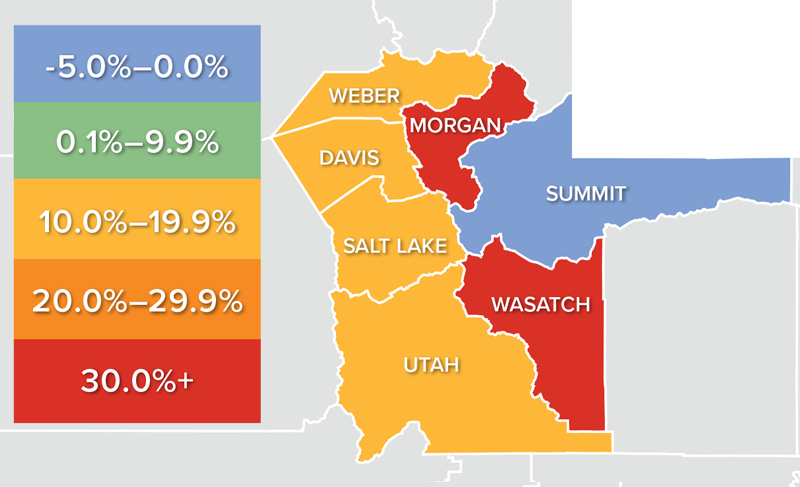
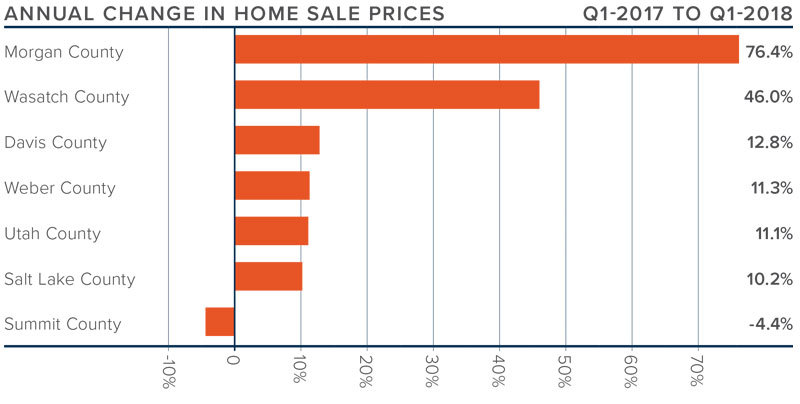
  • Wasatch County experienced solid price growth. Average sale prices there rose by 46%, which is largely a function of it being a relatively small county. Interestingly, average sale prices fell in Summit County—again, due to its small market size.
  • Appreciation was strongest in Morgan County, where home prices rose by a substantial 76.4%. Although this may sound extreme, it is a very small market and subject to major swings. In this case, the average home price in January was $1 million which substantially skewed the numbers.
  • In aggregate, home prices continue to appreciate at above-average rates due to  supply limitations.


DAYS ON MARKET

  • The average number of days it took to sell a home dropped by 20 days when compared to the first quarter of 2017.
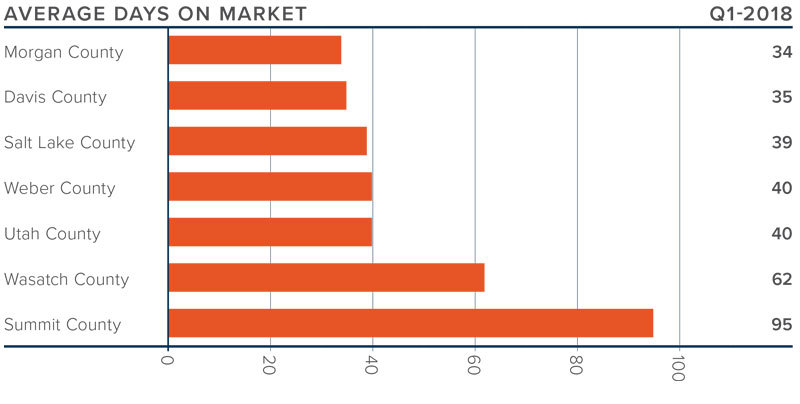
  • Sales occurred the fastest in Morgan and Davis Counties and slowest in Summit County, but all markets saw the length of time it took to sell a home either remain static or drop compared to the first quarter of 2017.
  • During the first quarter of this year, it took an average of 49 days to sell a home in the region.
  • The market remains robust, and well-priced homes are selling very quickly.


CONCLUSIONS

This speedometer reflects the state of the region’s housing market using housing inventory, price gains, home sales, interest rates, and larger economic factors. For the first quarter of 2018, I moved the needle a little more in favor of sellers. Unfortunately, I don’t believe we’ll see much improvement in listing activity in the coming months, which means sellers will continue to remain firmly in the driver’s seat.


Matthew Gardner is the Chief Economist for Windermere Real Estate, specializing in residential market analysis, commercial/industrial market analysis, financial analysis, and land use and regional economics. He is the former Principal of Gardner Economics and has more than 30 years of professional experience both in the U.S. and U.K.

More May 1, 2018

Windermere Real Estate Hits Refresh Button on Company Brand


When you’ve been in business for 46 years, you learn that one of the keys to being successful is knowing when it’s time to spruce things up – and that’s exactly what we’ve done with the Windermere brand. We knew we didn’t need an entire brand overhaul, but a little facelift was definitely in order.

It all started in the spring of 2017 when we launched Windermere’s ultra-luxury marketing brand, W Collection. The development of that program and its visual identity caused us to take a step back and look at how the primary Windermere brand and all of its sub-brands worked together as a cohesive unit.
The result was a 12-month process that saw every element of the Windermere brand updated to reflect a more modern look and feel. Everything from signage to business cards, marketing materials, and the Windermere website now features our new and improved brand. For a complete look, please visit windermererefresh.com.

May 1 marks the official launch of the refreshed Windermere brand; to commemorate this major company milestone, we produced a video that visually embodies our core values of professionalism, relationships, collaboration, and community.

We’re incredibly proud of the refreshed Windermere brand and thankful that we’ve been able to serve communities up and down the West Coast for the past 46 years.


Market News April 30, 2018

Colorado Real Estate Market Update


The following analysis of the Metro Denver & Northern Colorado real estate market is provided by Windermere Real Estate Chief Economist Matthew Gardner. We hope that this information may assist you with making better-informed real estate decisions. For further information about the housing market in your area, please don’t hesitate to contact me.


ECONOMIC OVERVIEW

It’s good news for the state of Colorado, which saw annual employment grow in all of the metropolitan markets included in this report. The state added 63,400 non-agricultural jobs over the past 12 months, an impressive growth rate of 2.4%. Colorado has been adding an average of 5,300 new jobs per month for the past year, and I anticipate that this growth rate will continue through the balance of 2018.

In February, the unemployment rate in Colorado was 3.0%—a level that has held steady for the past six months. Unemployment has dropped in all the markets contained in this report, with the lowest reported rates in Fort Collins and Denver, where 3.1% of the labor force was actively looking for work. The highest unemployment rate was in Grand Junction, which came in at 4.6%.


HOME SALES ACTIVITY

  • In the first quarter of 2018, there were 11,173 home sales—a drop of 5.6% when compared to the first quarter of 2017.
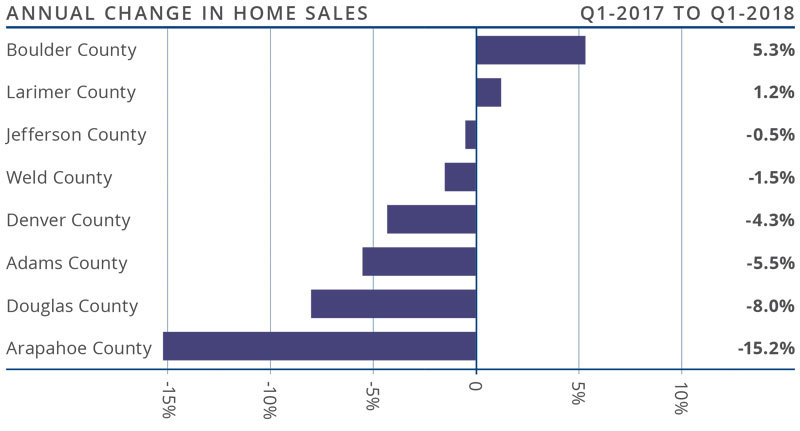
  • With an increase of 5.3%, home sales rose the fastest in Boulder County, as compared to first quarter of last year. There was also a modest sales increase of 1.2% in Larimer County. Sales fell in all the other counties contained within this report.
  • Home sales continue to slow due to low inventory levels, which were down 5.7% compared to a year ago.
  • The takeaway here is that sales growth continues to stagnate due to the lack of homes for sale.


HOME PRICES

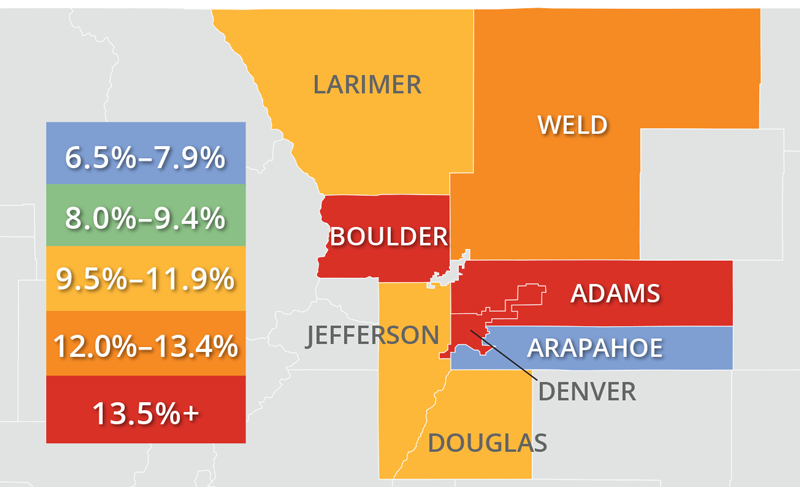
  • Strong economic growth, combined with limited inventory, continued to push prices higher. The average home price in the markets covered by this report was up by 11.7% year-over-year to $448,687.
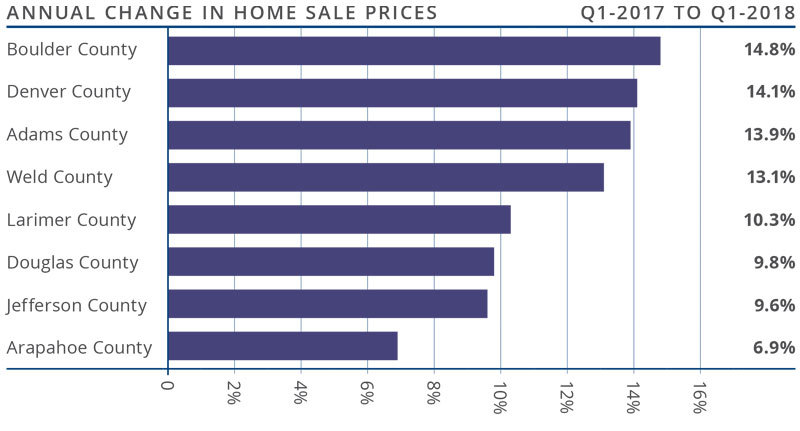
  • Arapahoe County saw slower appreciation in home values, but the trend is still positiveand above its long-term average.
  • Appreciation was strongest in Boulder County, which saw prices rise 14.8%. Almost all other counties in this report experienced solid gains.
  • The ongoing imbalance between supply and demand persists and home prices continue to appreciate at above-average rates.


DAYS ON MARKET

  • The average number of days it took to sell a home dropped by three days when compared to the first quarter of 2017.
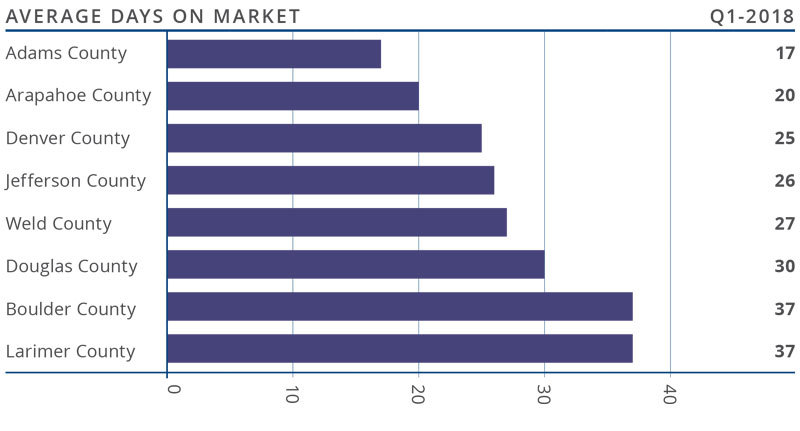
  • Homes in all but two counties contained in this report took less than a month to sell. Adams County continues to stand out where it took an average of just 17 days to sell a home.
  • During the first quarter, it took an average of 27 days to sell a home. That rate is down 2 days from the fourth quarter of 2017.
  • Housing demand remains strong and would-be buyers should expect to see stiff competition for well-positioned, well-priced homes.


CONCLUSIONS

This speedometer reflects the state of the region’s housing market using housing inventory, price gains, home sales, interest rates, and larger economic factors. In the first quarter of 2018, I have left the needle where it was in the fourth quarter of last year. Even as interest rates trend higher, it appears as if demand will continue to outweigh supply. As we head into the spring months, I had hoped to see an increase in the number of homes for sale, but so far that has not happened. As a result, the housing market continues to heavily favor sellers.





Matthew Gardner is the Chief Economist for Windermere Real Estate, specializing in residential market analysis, commercial/industrial market analysis, financial analysis, and land use and regional economics. He is the former Principal of Gardner Economics, and has more than 30 years of professional experience both in the U.S. and U.K.