Design August 20, 2018

Avoiding the Pitfalls of Home Addition Construction

When dissatisfaction with your current home strikes, it can be exciting to launch into a plan for a new addition. A new living room, bedroom, or more can add value to your home while improving your quality of life. 

On the other hand, even a modest addition can turn into a major construction project, with architects and contractors to manage, construction workers traipsing through your home, hammers pounding, and sawdust everywhere. And although new additions can be a very good investment, the cost-per-square-foot is typically more than building a new home, and much more than buying a larger existing home.


Define your needs

To determine if an addition makes sense for your particular situation, start by defining exactly what it is you want and need. By focusing on core needs, you won’t get carried away with a wish list that can push the project out of reach financially.

If it’s a matter of needing more space, be specific. For example, instead of just jotting down “more kitchen space,” figure out just how much more space is going to make the difference, e.g., “150 square feet of floor space and six additional feet of counter space.”

If the addition will be for aging parents, consult with their doctors or an age-in-place expert to define exactly what they’ll require for living conditions, both now and over the next five to ten years.


Types of additions

Bump-out addition—“Bumping out” one or more walls to make a first-floor room slightly larger is something most homeowners think about at one time or another. However, when you consider the work required, and the limited amount of space created, it often figures to be one of your most expensive approaches.

First-floor addition—Adding a whole new room (or rooms) to the first floor of your home is one of the most common ways to add a family room, apartment or sunroom. But this approach can also take away yard space.

Dormer addition—For homes with steep rooflines, adding an upper floor dormer may be all that’s needed to transform an awkward space with limited headroom. The cost is affordable and, when done well, a dormer can also improve the curb-appeal of your house.

Second-story addition—For homes without an upper floor, adding a second story can double the size of the house without reducing surrounding yard space.


Garage addition—Building above the garage is ideal for a space that requires more privacy, such as a rentable apartment, a teen’s bedroom, guest bedroom, guest quarters, or a family bonus room.


Permits required

You’ll need a building permit to construct an addition—which will require professional blueprints. Your local building department will not only want to make sure that the addition adheres to the latest building codes, but also ensure it isn’t too tall for the neighborhood or positioned too close to the property line. Some building departments will also want to ask your neighbors for their input before giving you the go-ahead.


Requirements for a legal apartment

While the idea of having a renter that provides an additional stream of revenue may be enticing, the realities of building and renting a legal add-on apartment can be sobering. Among the things you’ll need to consider:

  • Special permitting—Some communities don’t like the idea of “mother-in-law” units and therefore have regulations against it or zone-approval requirements.
  • Separate utilities—In many cities, you can’t charge a tenant for heat, electricity, and water unless utilities are separated from the rest of the house (and separately controlled by the tenant).
  • ADU Requirements—When building an “accessory dwelling unit” (the formal name for a second dwelling located on a property where a primary residence already exists), building codes often contain special requirements regarding emergency exists, windows, ceiling height, off-street parking spaces, the location of main entrances, the number of bedrooms, and more.

In addition, renters have special rights while landlords have added responsibilities. You’ll need to learn those rights and responsibilities and be prepared to adhere to them.


Average costs

The cost to construct an addition depends on a wide variety of factors, such as the quality of materials used, the laborers doing the work, the type of addition and its size, the age of your house and its current condition. For ballpark purposes, however, you can figure on spending about $200 per square foot if your home is located in a more expensive real estate area or about $100 per foot in a lower-priced market.

You might be wondering how much of that money your efforts might return if you were to sell the home a couple years later? The answer to that question depends on the aforementioned details, but the average “recoup” rate for a family room addition is typically more than 80 percent.


The bottom line

While you should certainly research the existing-home marketplace before hiring an architect to map out the plans, building an addition onto your current home can be a great way to expand your living quarters, customize your home, and remain in the same neighborhood.
Market News August 16, 2018

How Zoning and Regulatory Costs Impact Housing Affordability

Design August 15, 2018

The Most Ambitious Trends in Luxury Pool Design

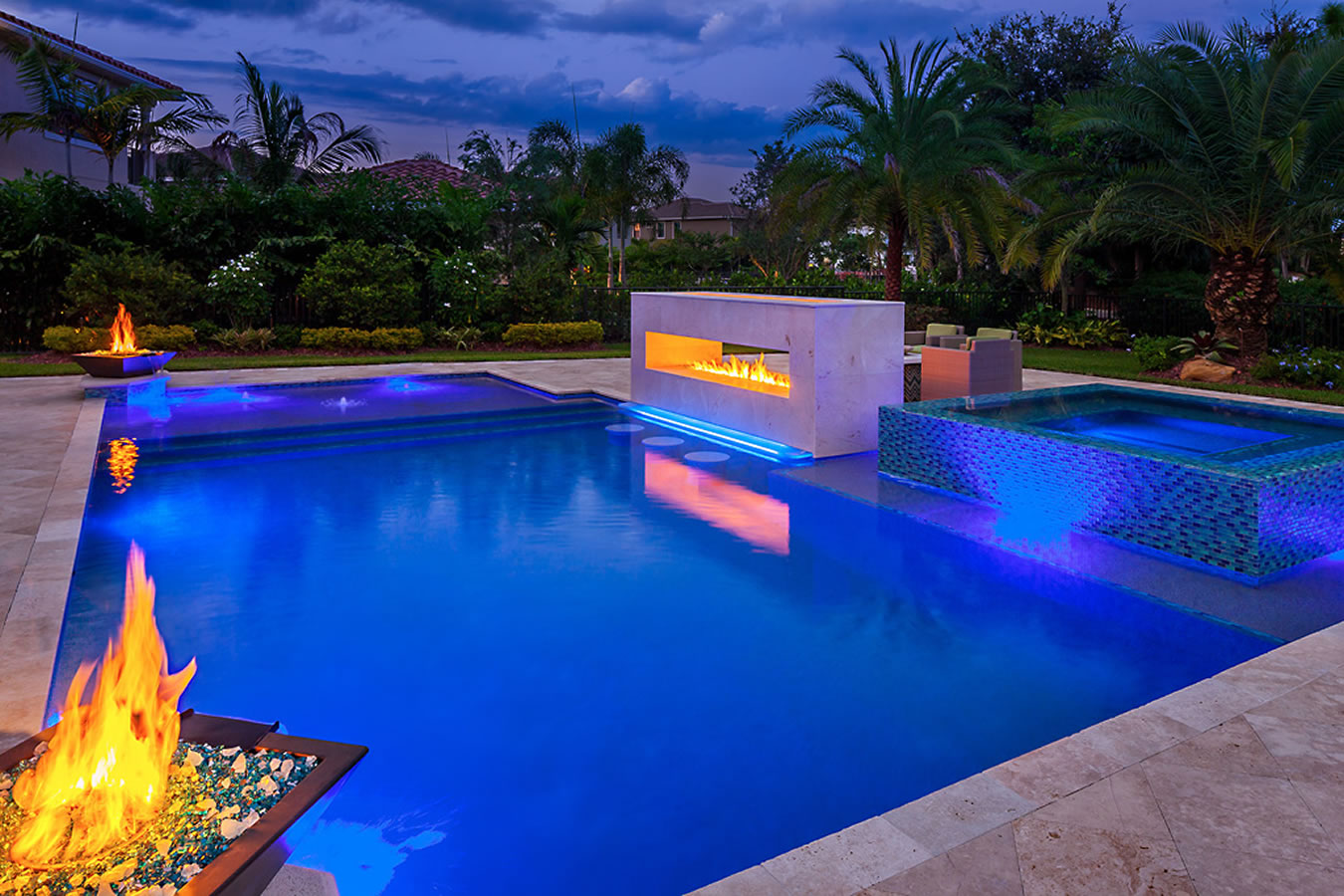
When it comes to luxury home design, if you can imagine it, it can be done. In-home spas, luxe bowling alleys, and glass wine rooms are just a few examples we’re seeing out there. The same idea extends outdoors to swimming pools, which are a must for most luxury homes. But we aren’t talking about just any old backyard pool; they’re usually more masterpiece than mainstream. We consulted a few designers to get some insights into what’s trending in the world of luxury pools and here’s what we found. 

Fire Features

Photo credit to AAA Custom Pools Inc.

  • Catching the eye of all who behold it is the principal goal of a luxury pool. Since the dawn of time, nothing has delivered that reaction quite like fire.
     
  • Accenting your backyard pool with stylish braziers emphasizes both elegance and authority.
     
  • Such a style demands forethought, as safety is a priority. The right flame, however, sparks an ambiance unlike any other.


Custom Art Accoutrement 


Photo credit to Van Kirk & Sons Pools and Spas.

  • A home should represent its owners. A pool should be an extension of that.
     
  • Styling a pool with custom art allows for expression. It can be a showcase of personal style, cultural heritage, or even personal fandom.
     
  • Commissioning a professional artist to stylize your pool will ensure a one-of-a-kind amenity.


Nature-Infused Design


Photo credit to HomesOfTheRich.Net.

  • Creating a man-made island with a creatively carved pool will render your yard an oasis unlike any other.
     
  • With an integrated natural feel, you and your fellow swimmers can truly feel like you’ve discovered a secret spring in the midst of a jungle.
     
  • Creating naturally treed islands or rocky outcroppings that serve as a waterfall in the midst of your pool can transform the feel into that of an exotic bar on the edge of the world.


Living August 13, 2018

Refreshing Your Home and Your Spirit With Seven Easy Steps

The yearning to move lives in the spirit of many homeowners, but that desire for something new is often at odds with what feels feasible. That sense of newness needn't come from a dramatic uprooting, however. The great part about having a home of your own is you can make improvements and give your home a chance to evolve over time. You just need to help your home live up to its potential!  We picked seven of our favorite improvements to help you make the most of your home.

  1. Find your home’s purpose. Each home is as unique as its owners, so in order to fully utilize your home, consider how you view your home’s purpose. Some people like to entertain, others find it a calm space in the frenzy of daily life; some nurture their families and others nurture their creativity. Your home’s purpose can be any combination of these and more, but it helps to consider the function of your space in order to ultimately find its purpose.
  2. Assemble a list. A list always helps me figure out where to start or prioritize what is the most important project. Think about what you want to change in your home, inspirations, and preferences. .
  3. Make an “inspiration board”. An “inspiration board” is a great way to visualize your home’s decor. You can create a board online with a tool like Pinterest to organize ideas you love or you can do it the old fashioned way with a board, magazine cutouts, color swatches, and fabric samples. Doing this will allow you to see all the elements you like in one place so that you can then tie it all together into a room you love.
  4. Create a collection. If you have items that you like to collect, think about how to transform that collection into something you can display. If you don’t already have a collection of loved objects think about what this collection would be for you. You can center a room design around your travel souvenirs, old camera collection, figurines, unique plates, or familial objects. Adding to this collection over time can be a great way to keep your spaces new while maintaining a personal feel to your decor.

  5. Choose a new palate. Shake up your sensibilities and think of a color that will compliment your room while making a statement. It’s easy to fall into the white/beige standby to keep our rooms neutral, but sometimes a color that provides a contrast to your décor will make the room pop.
  6. Rearrange. Moving furniture around is another easy way to reinvent your space. Try placing your sofa on an angle to open up your entertaining room or move your lamps to improve lighting. You can also think about moving a piece of furniture into a room to give it new life, like using a unique dresser for a credenza or a chair as a side table.
  7. Find design motivation. Home design evolves over time and can be sustained by finding items that inspire you. Read magazines and books that inspire your interests in architecture, design, art, etc. Or find stores and flea markets that sell pieces that influence your aesthetic. Or bring a camera with you when you’re doing your favorite activities and bring back memories or inspirations. Most of all have fun!
Market News August 9, 2018

Montana Real Estate Market Update


The following analysis of the Montana real estate market is provided by Windermere Real Estate Chief Economist Matthew Gardner. We hope that this information may assist you with making better-informed real estate decisions. For further information about the housing market in your area, please don’t hesitate to contact your Windermere agent.


ECONOMIC OVERVIEW

According to the Labor Department, Montana added 2,900 non-agricultural jobs over the past 12 months, representing an annual growth rate of 0.6%. For perspective, the U.S growth rate is running at about 1.6%. Although the state has experienced significant increases in employment since the last recession, the pace of growth has slowed significantly, which is mainly due to a lack of workers, rather than a lack of demand for new employees. Although the annual growth rate was somewhat tepid, I believe Montana’s non-farm employment will increase by 2% by the end of 2018. 

In June, the state unemployment rate was a healthy 3.8%, down from 4.0% a year ago. 


HOME SALES ACTIVITY

  • 1,919 homes sold during the second quarter of 2018, representing an increase of 13.8% from the same period in 2017. 
     
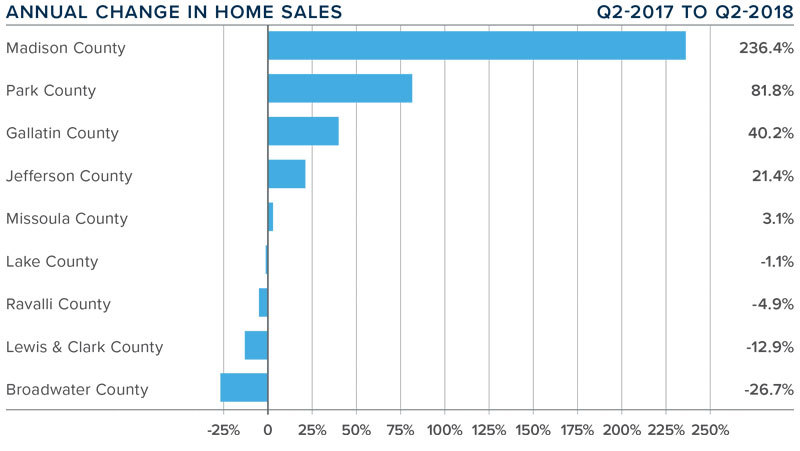
  • Total sales activity rose in five of the counties analyzed in this report. The largest increase was in Madison County, which had a substantial 236.4% increase, from 22 home sales to 74. Sales contracted in the four remaining counties with the greatest decline in Broadwater County, where sales were down 26.7% (representing a drop of only eight units). 
     
  • The number of homes that are for sale has risen substantially from a year ago, with an average of 1,980 active listings in the counties contained in this report. This has supported the growth in home sales. 
     
  • Inventory growth—albeit positive—is not equal across the region. I anticipate that we will see more listings come on the market as we move toward the fall selling season. 


HOME PRICES

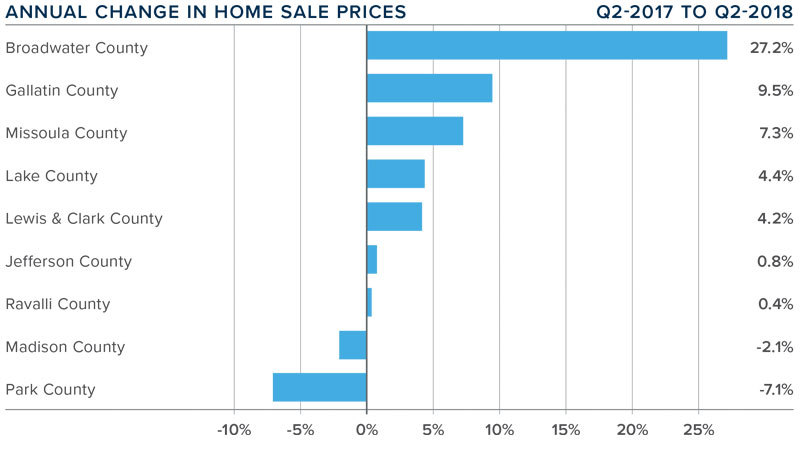
  • The average home price in the region continued to rise in second quarter, with a year-over-year increase of 12.8% to $377,407. 
     
  • In addition to Broadwater County, two additional counties saw solid price increases when compared to a year ago. 
     
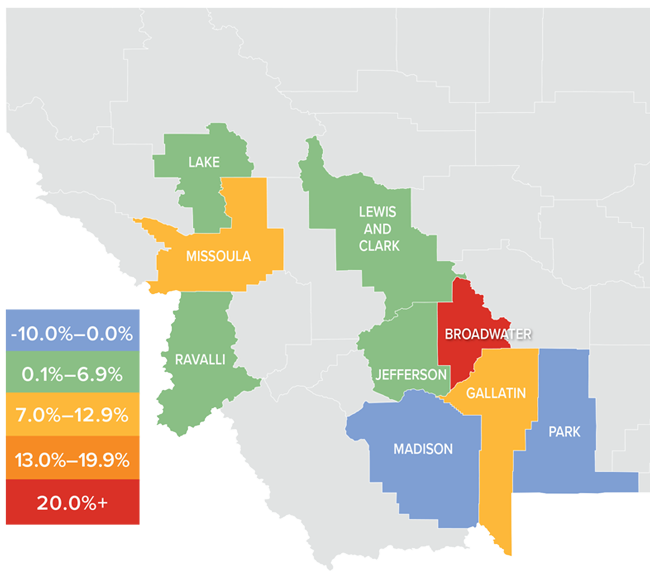
  • Price appreciation was strongest in Broadwater County, where home prices rose by a substantial 27.2%. Although this sounds extreme it is a very small market and subject to major swings. 
     
  • The takeaway from this data is that demand is still exceeding supply, which continues to put upward pressure on home prices.  


DAYS ON MARKET

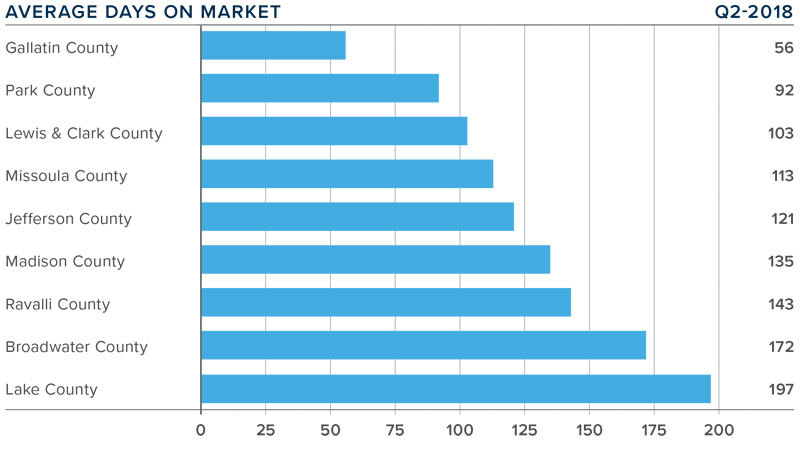
  • The average number of days it took to sell a home dropped by six days compared to the second quarter of 2017. 
     
  • During the second quarter of this year, it took an average of 126 days to sell a home in the region. 
     
  • Homes sold fastest in Gallatin County and slowest in Lake County. In four counties — Missoula, Broadwater, Gallatin, and Park — days on market rose when compared to the second quarter of 2017. 
     
  • In most markets, well-priced and well-positioned homes continue to sell relatively quickly.   


CONCLUSIONS

The speedometer reflects the state of the region’s housing market using housing inventory, price gains, home sales, interest rates, and larger economic factors. 

For the second quarter of 2018, I have placed the needle well into sellers’ territory despite the growth in inventory, which will be a relief to home buyers. Well-priced and well-positioned homes are selling quickly and regional price growth is well above the long-term average as demand still exceeds supply. Housing affordability is still a concern in some markets, and this is something that I will be watching as we move through the balance of 2018. 


Matthew Gardner is the Chief Economist for Windermere Real Estate, specializing in residential market analysis, commercial/industrial market analysis, financial analysis, and land use and regional economics. He is the former Principal of Gardner Economics and has more than 30 years of professional experience both in the U.S. and U.K.

Market News August 8, 2018

Oregon and Southwest Washington Real Estate Market Update


The following analysis of the Oregon and Southwest Washington real estate market is provided by Windermere Real Estate Chief Economist Matthew Gardner. We hope that this information may assist you with making better-informed real estate decisions. For further information about the housing market in your area, please don’t hesitate to contact your Windermere agent.


ECONOMIC OVERVIEW

The State of Oregon has added 30,400 new jobs over the past 12 months, representing a reasonable annual growth rate of 1.6%. It is clear, however, that job growth in Oregon has started to taper, with the annual rate dropping below 2% in the early spring of this year. This is no great cause for concern as the state has essentially reached full employment, which tends to slow employment growth. 

The Southwest Washington market area added 5,580 new jobs over the past 12 months, representing an annual growth rate of 2.7%. 

Oregon’s unemployment rate was 4.0% in June, marginally below the 4.1% rate seen a year ago. In Southwest Washington, the unemployment rate was measured at 5.3%, marginally lower than the year-ago rate of 5.4%. 


HOME SALES ACTIVITY

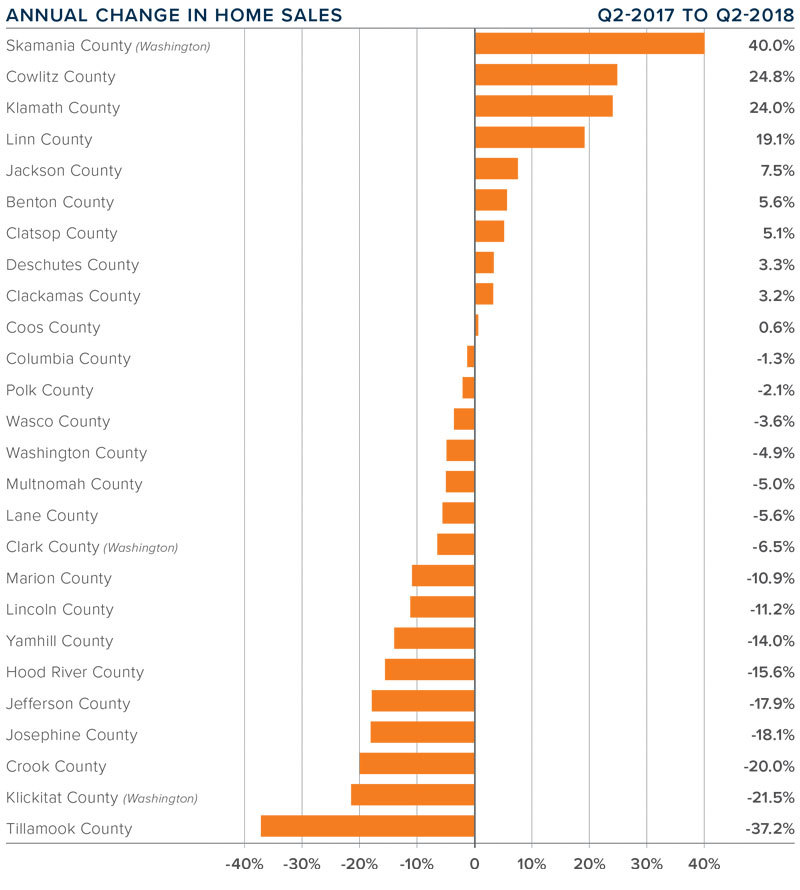
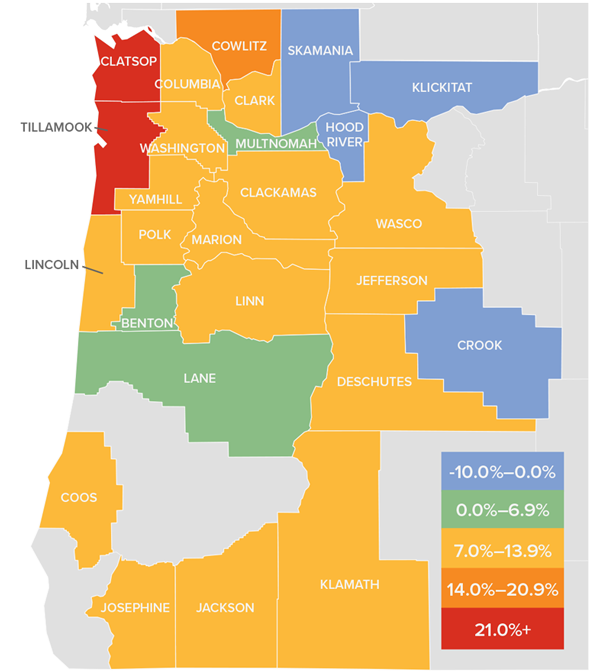
  • Second quarter home sales dropped by a modest 2.8% compared to the same period last year, with a total of 17,156 transactions occurring. 
     
  • Sales rose the most in Skamania County, which saw a 40% increase compared to the second quarter of 2017. There were also noticeable increases in Cowlitz, Klamath, and Linn counties. Home sales fell the most in Tillamook, Klickitat, Crook, Josephine, and Jefferson counties.
     
  • Year-over-year sales rose in 10 counties and dropped in the other 16 counties contained in this report. 
     
  • Sales continue to be a mixed bag in the region. I am not overly concerned by the drop in sales in several counties as they are all small markets that are prone to substantial swings. Inventory remains tight and this can drag home sales lower. 


HOME PRICES

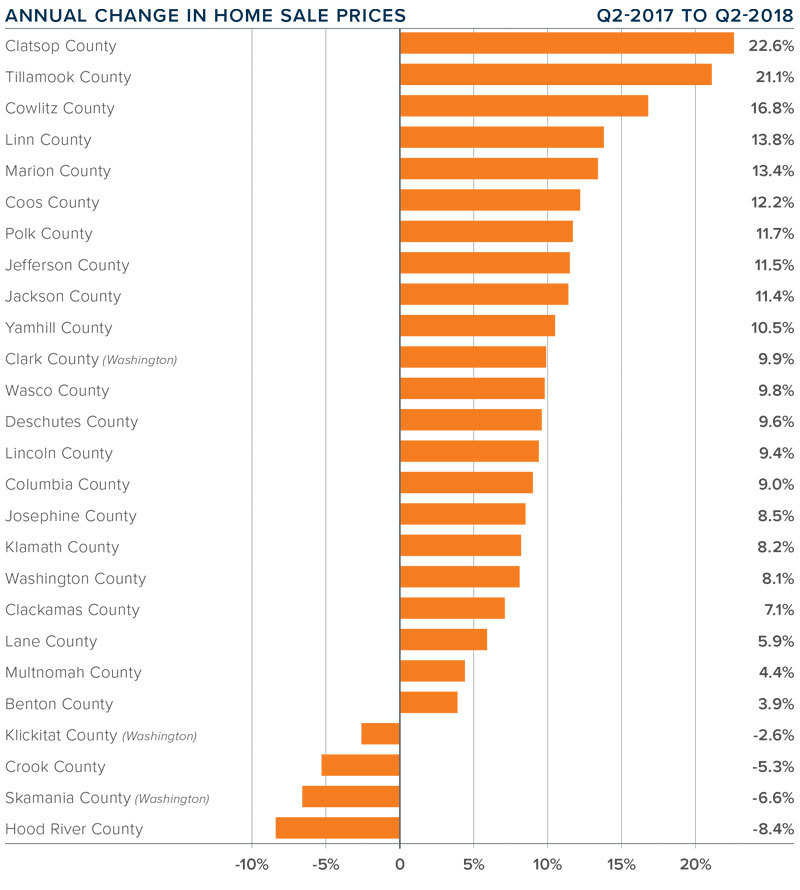
  • The average home price in the region rose 7.9% year-over-year to $391,725. That number is 6.6% higher than the first quarter of 2018. 
     
  • Clatsop County led the market with the strongest annual price growth. Homes there sold for 22.6% more than a year ago. 
     
  • All but four counties saw price growth relative to the second quarter of 2017, with 10 of them experiencing double-digit increases. 
     
  • The takeaway from this report is that, in aggregate, price growth has started to slow but remains above the long-term average. 


DAYS ON MARKET

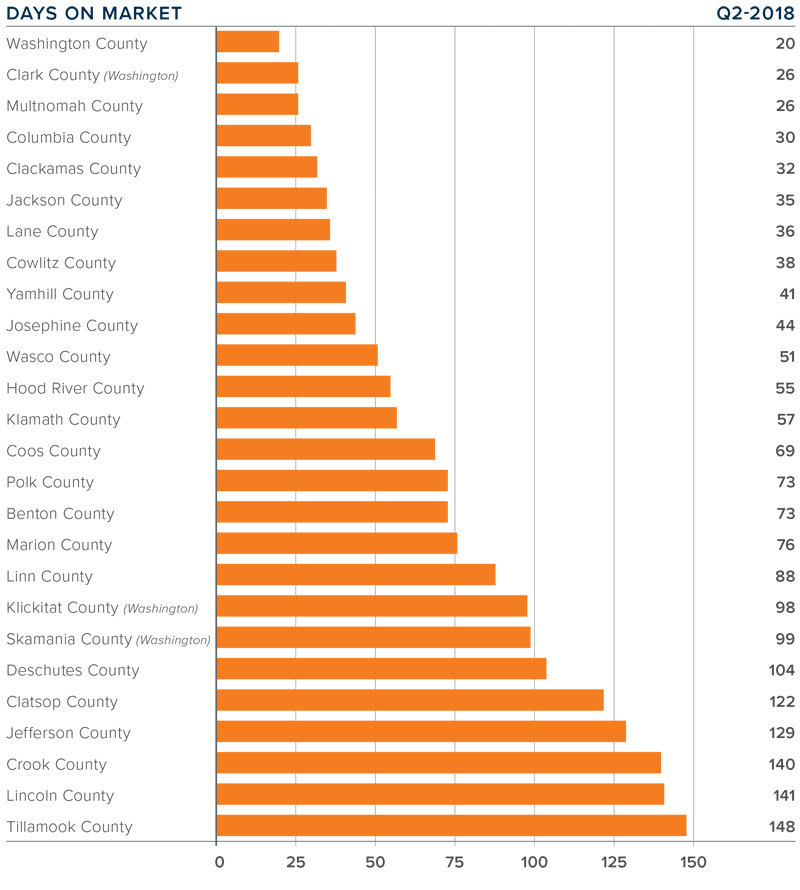
  • The average number of days it took to sell a home in the region dropped by four days compared to the second quarter of 2017 and was down by 17 days from the first quarter of 2018.
     
  • The average time it took to sell a home in the region last quarter was 71 days.
     
  • Nineteen counties saw the length of time it took to sell a home drop or remain static when compared to a year ago. Seven counties saw market time rise. 
     
  • Homes again sold the fastest in Washington (20 days), Clark (26 days), and Multnomah (26 days) counties.


CONCLUSIONS

The speedometer reflects the state of the region’s housing market using housing inventory, price gains, home sales, interest rates, and larger economic factors.

Housing markets throughout Oregon and Southwest Washington continue to benefit greatly from the healthy regional economy. Home sales remain solid; however, we are seeing some slowdown in prices, which I consider to be positive as affordability issues could start to taper. That said, housing inventory is still well below balanced-market levels. Sellers remain in the driver’s seat, but I am hopeful that inventory levels will start to increase, which will be a relief to home buyers. Because of this, the needle remains the same as last quarter.


Matthew Gardner is the Chief Economist for Windermere Real Estate, specializing in residential market analysis, commercial/industrial market analysis, financial analysis, and land use and regional economics. He is the former Principal of Gardner Economics and has more than 30 years of professional experience both in the U.S. and U.K.


Market News August 7, 2018

Idaho Real Estate Market Update


The following analysis of select Idaho real estate markets is provided by Windermere Real Estate Chief Economist Matthew Gardner. We hope that this information may assist you with making better-informed real estate decisions. For further information about the housing market in your area, please don’t hesitate to contact your Windermere agent.


ECONOMIC OVERVIEW

Job growth in Idaho tapered somewhat over the past few months but the state is still adding jobs at a fair pace. In total, the state has added 21,800 new jobs over the past 12 months, representing a solid growth rate of 3.1%. 

In May, the state unemployment rate was 3.1%, down from 3.4% a year ago. The state is, essentially, at full employment but I still stand by my forecast that Idaho will have added around 20,000 new jobs by the end of 2018.


HOME SALES ACTIVITY

  • 5,865 homes were sold during the second quarter, representing an increase of 5.7% over the second quarter of 2017. 
     
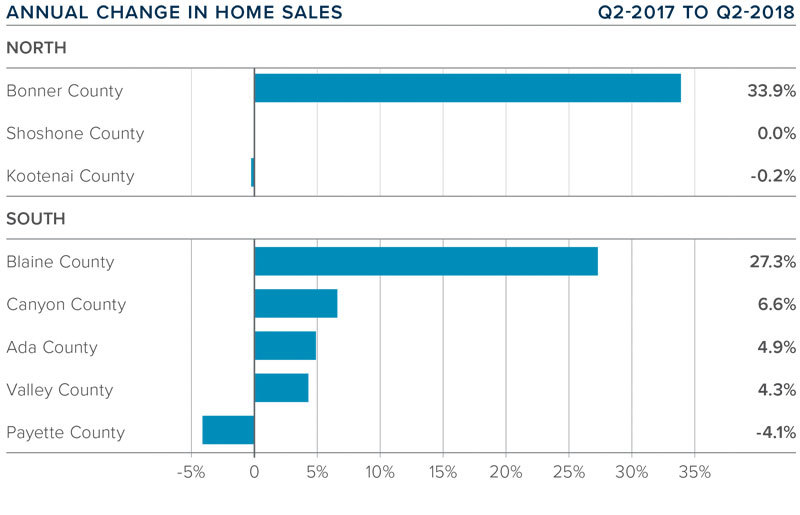
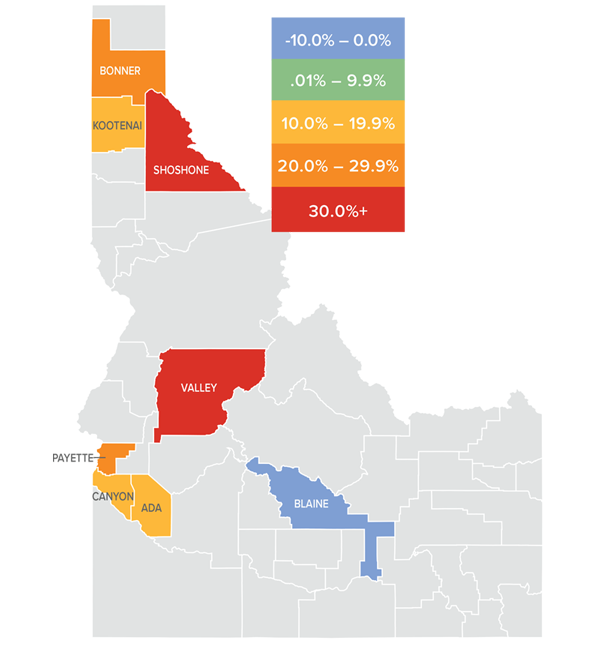
  • Sales rose the fastest in Bonner County, where they were up by a substantial 33.9% relative to the second quarter of 2017. There was also a noticeable increase in Blaine County. 
     
  • Year-over-year sales growth remains generally positive across the region, with relatively modest declines in sales in Payette County and Kootenai County. 
     
  • The data continues to suggest that demand for housing remains strong; however, pending home sales only rose by 4.7% compared to the second quarter of 2017. This suggests that closings in the third quarter may be slower. 


HOME PRICES

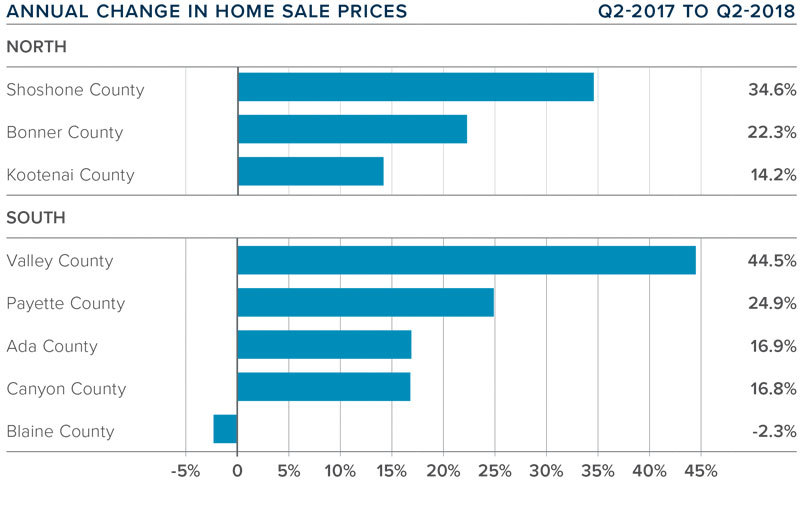
  • The average home price in the region rose 16.6% year-over-year to $334,021. 
     
  • Valley County again led the market with the strongest annual price growth. Homes there sold for 44.5% more than a year ago, but, as regular readers know, markets with very few sales are sometimes prone to extreme price swings.
     
  • The region saw price increases in all but one county when compared to the second quarter of 2017. The outlier was Blaine County, which saw a modest drop. 
  • Listing activity—which was down by 20% from a year ago — continues to drive home prices up at above-average rates. This is likely to continue through the balance of the year and into 2019. 


DAYS ON MARKET

  • The average number of days it took to sell a home in the region dropped by 13 days when compared to the second quarter of 2017. 
     
  • Homes in all surveyed counties took less time to sell than they did in the same quarter of 2017, suggesting that demand remains buoyant. 
     
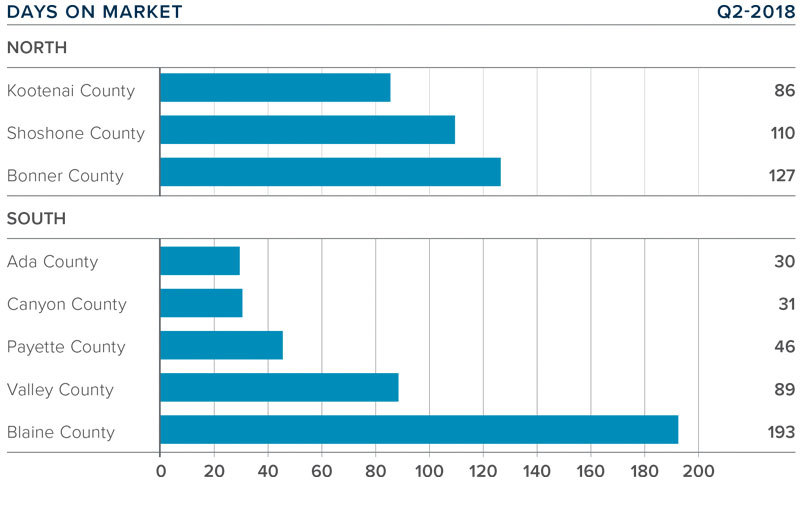
  • It took an average of 108 days to sell a home in Northern Idaho and 78 days in the southern part of the state. 
     
  • Again, homes sold the fastest in Ada and Canyon Counties, where it took an average of 30 and 31 days, respectively. 


CONCLUSIONS

The speedometer reflects the state of the region’s housing market using housing inventory, price gains, home sales, interest rates, and larger economic factors. 

Confidence in housing has not diminished even in the face of modestly rising interest rates, causing the markets in this report to perform well overall. Home prices will continue to appreciate at above-average rates as long as inventory does not meet demand. As such, I have moved the needle just a little more in favor of home sellers. 


Matthew Gardner is the Chief Economist for Windermere Real Estate, specializing in residential market analysis, commercial/industrial market analysis, financial analysis, and land use and regional economics. He is the former Principal of Gardner Economics and has more than 30 years of professional experience both in the U.S. and U.K.

Market News August 6, 2018

Central Washington Real Estate Market Update


The following analysis of the Central Washington real estate market is provided by Windermere Real Estate Chief Economist Matthew Gardner. We hope that this information may assist you with making better-informed real estate decisions. For further information about the housing market in your area, please don’t hesitate to contact your Windermere agent.

ECONOMIC OVERVIEW

The Washington State economy added 83,900 new jobs over the past 12 months, representing an annual growth rate of 2.5%. This is a slowdown from the last quarter, but employment growth remains well above the national rate of 1.6%. Employment gains continue to be robust in the private sector, which was up by 2.8%. The public sector (government) grew by a more modest 1.1%. Last quarter the state’s unemployment rate was 4.7%, down from 4.8% a year ago.

Washington State will continue adding jobs for the balance of the year and I anticipate total job growth for 2018 will be around 80,000, representing a total employment growth rate of 2.4%.

The counties within Central Washington have added 2,709 new jobs over the past 12 months, for a growth rate of 1.2%. The local unemployment rate for the area continued to fall, with a drop from 5.9% to 5.6%.

HOME SALES ACTIVITY

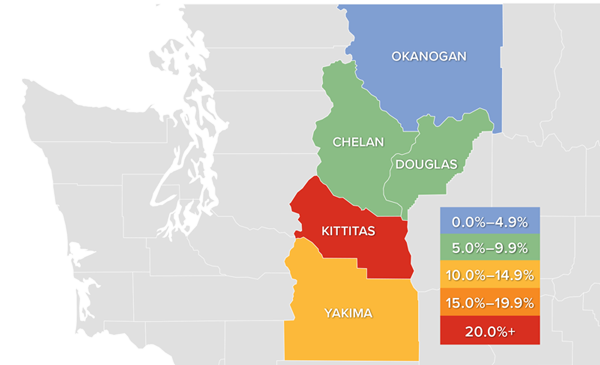
  • Last quarter, home sales throughout Central Washington saw an annual gain; only two of the five counties in this report did not report increases. In total, there were 1,299 home sales in second quarter — an increase of 3.2% from the same period in 2017, and up 51.2% when compared to the first quarter of this year.
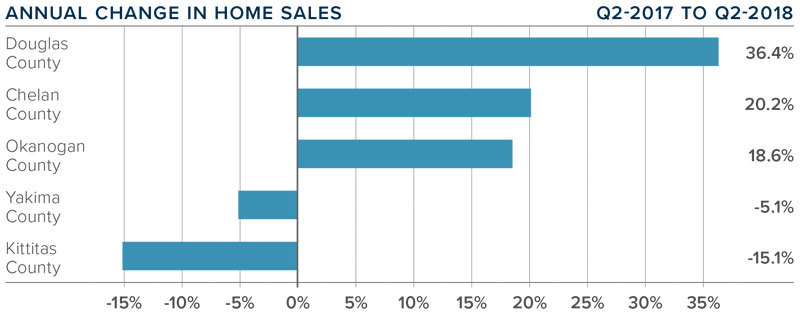
  • Sales rose most in Douglas County, which had an impressive 36.4% increase over the second quarter of 2017. Chelan and Okanogan Counties also saw sales rise at a significant pace.
  • The number of pending home sales—an indicator of future closings — was down in two counties, suggesting that third quarter growth in closings may be modest.
  • The shortage of homes for sale remains an issue, although there has been some improvement. Last quarter, inventory levels were only down by a modest 1.3% compared to last year, which means the market may be moving, albeit slowly, toward greater balance.

HOME PRICES

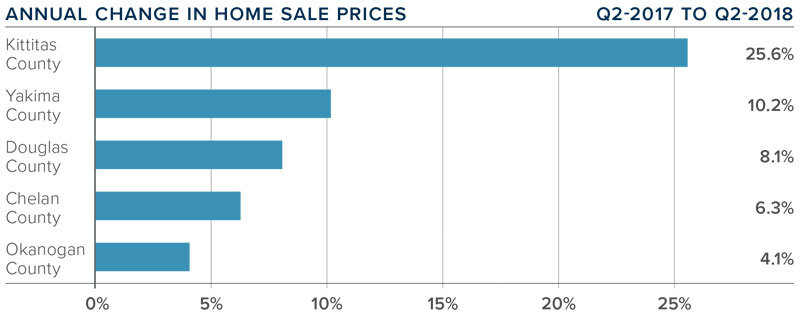
  • Year-over-year, the average home price in the region rose 12.8% to $318,189. Price growth picked up again in the second quarter and remains well above the long-term average as demand continues to exceed supply.
  • Prices in the remaining four counties — Yakima, Douglas, Chelan, and Okanogan — rose between 4 and 10% — still generally above
    the long-term trend.
  • All five counties in this report saw prices rise compared to the second quarter of 2017. Kittitas County stood out with a very substantial increase of 25.6%.
  • Home-price growth continues to increase at above-average rates due to supply constraints. I expect this trend to continue through the balance of 2018.

DAYS ON MARKET

  • The average number of days it took to sell a home dropped five days compared to the second quarter of 2017.
  • All the markets contained in this report, other than Douglas, saw days-on-market drop from the same quarter in 2017.
  • The average time it took to sell a home in the region was 67 days, down 12 days compared to the first quarter of 2017.
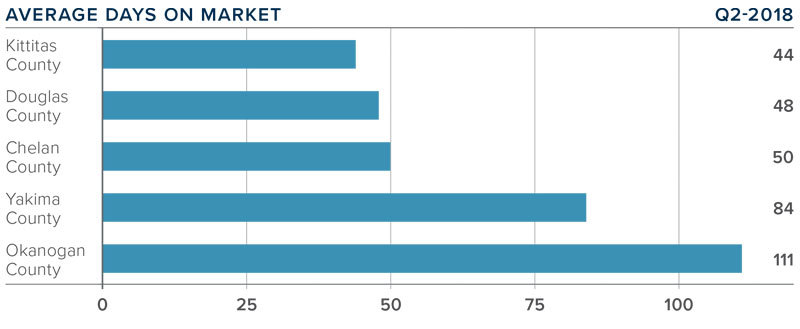
  • Homes sold fastest in Kittitas County, where it took an average of 44 days to sell a home. The greatest drop in the time it took to sell a home was in Okanogan and Chelan Counties, where it took 15 fewer days than in the second quarter of last year.

CONCLUSIONS

This speedometer reflects the state of the region’s real estate market using housing inventory, price gains, home sales, interest rates, and larger economic factors.

For the second quarter of 2018, I have moved the needle a little farther in favor of sellers. Although it was good to see inventories increase, the Central Washington market remains tight thanks to low housing supply and high buyer demand.


Matthew Gardner is the Chief Economist for Windermere Real Estate, specializing in residential market analysis, commercial/industrial market analysis, financial analysis, and land use and regional economics. He is the former Principal of Gardner Economics and has more than 30 years of professional experience both in the U.S. and U.K.

Buying August 6, 2018

Generational Trends in Home-Buying

When making an important decision like buying a new home, personal circumstances are often a driving force. Whether you are a first-time homebuyer, need more space for your growing family, downsizing to fit an empty nest, or looking for a retirement property, finding the right information, the right real estate agent, and the right properties that fit your needs are all important parts of that process. Based on recent studies by the National Association of REALTORS®on generational trends, we can identify the best resources to help you in any phase of your life.

Among all generations, the first step most buyers take when searching for a home is online. Younger generations tend to find the home they eventually purchase online, while older generations generally find the home they purchase through their real estate agent.

Across generations, home ownership still represents a significant step in achieving the American Dream. According to a study by LearnVest, an online financial resource, 77 percent of those surveyed believed that buying a home of their own was, “first and foremost in achieving the American Dream”.

How that dream manifests is different for those who have grown up in different eras.

Millennials:

1980-2000

Also known as Generation Y or the Echo Boomers because this generation almost equals the baby boomers in population. This age group is the second largest group of recent homebuyers, representing 28 percent according to the National Association of REALTORS. 79 percent of homebuyers in this age are purchasing their first home. According to the 2012 Trulia American Dream Study, 93 percent of renters in this generation plan on purchasing a home someday.

When considering a home purchase, Millennials (and some Generation X buyers) place a high value on convenience to work, affordability, and the quality of school district. This generation is the most likely to choose an urban center as the location of their first home. According to market research by Gfk Roper, this group is most interested in their home as a social hub, with a focus on entertainment and amenities.

When looking for a real estate agent, Millennials are most likely to looks to friends and family for a referral. They generally place a high value on an agent’s honesty and trustworthiness because they are often relying on their agent to walk them through the home purchase process for the first time.


Generation X: 

1965-1979

As the largest group of recent homebuyers, the LearnVest findings suggest that 72 percent of Americans in this generation are already homeowners. They also represent the largest group of home sellers, with a substantial percentage of the group looking to upgrade their home to accommodate their growing families or increase investment. Experts in the real estate industry expect this group to lead in the recovered real estate market.

Generation X households are more likely to have a dual income, with both adult members in the household working. According to a study by GfK Roper, a market research company, this generation placed state-of-the-art kitchens at the top of their priorities, as well as large closets and amenities for organization, since many Gen Xers have children living in their homes. They are less concerned about formality in their home and have less interest in formal dining and living rooms.


Baby Boomers:

1946-1964

Interestingly enough, the NAR study finds that as the age of the homebuyer increases, the age of the home being purchased declines. Baby boomers and older buyers are looking for newer construction, with less need for renovations or large maintenance issues. This generation ranks state-of-the-art kitchens, whirlpool baths, walk-in closets, and hobby spaces high on their list of must-haves, according to GfK Roper.

The boomer generation is also looking to the future for both themselves and their aging parents, “fourteen percent of homebuyers over the age of 48 are looking to purchase senior-related homes, for themselves or others” according to the NAR study. Boomer parents are becoming accustomed to (or preparing for) an empty nest, so this group may be downsizing or looking for a home that specifically fits their needs.


Silent Generation:

1925-1945

This generation of buyers places a bigger emphasis on finding a home closer to friends, family, and health facilities. While this generation uses the Internet to find their home in the early stages of a home search, they work more directly with a trusted real estate agent to find the home that specifically fits their needs. A home purchase for members of this generation will likely not be a first-time experience so they are less willing to compromise on the price, size, or condition of a home.

This generation is generally more satisfied with the homebuying and selling process because they have been through it before and know what to expect. According to the Trulia American Dream study, this group is also most likely to have realistic assumptions about the cost of a home and mortgage. 

Market News August 3, 2018

Utah Real Estate Market Update


The following analysis of select counties of the Utah real estate market is provided by Windermere Real Estate Chief Economist Matthew Gardner. We hope that this information may assist you with making better-informed real estate decisions. For further information about the housing market in your area, please don’t hesitate to contact your Windermere agent.


ECONOMIC OVERVIEW

According to the Labor Department, Utah added 49,800 non-agricultural jobs over the past 12 months, representing a substantial growth rate of 3.4%. For perspective, the U.S growth rate is running at about 1.6%. Monthly employment gains have averaged 4,520 new jobs per month so far in 2018. I am becoming increasingly confident that we will end the year having added 50,000 new jobs. 

In February, the state unemployment rate was 3%, down from 3.3% a year ago. 


HOME SALES ACTIVITY

  • 9,750 homes sold during the second quarter of 2018, representing a drop of 2.6% from the same period in 2017. 
     
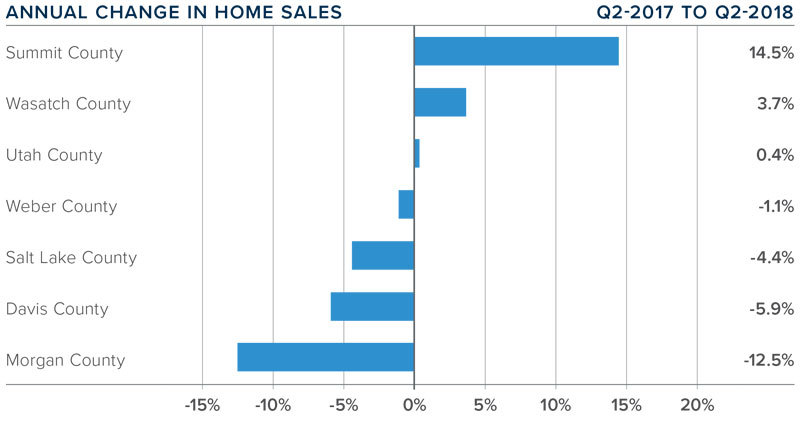
  • Total sales activity rose in three of the counties analyzed in this report, the largest of which was in Summit County, which had a substantial 14.5% increase. Of the four counties that saw sales drop, the greatest decline was in Morgan County, where sales were off by 12.5%. 
     
  • Listing activity continues to run at well below historic averages, which is causing home sales to drop across the region. The average number of homes for sale in the second quarter was down 14.8% from a year ago.
     
  • It is clear from the data in this report that low supply continues to have a negative effect on home sales. 


HOME PRICES

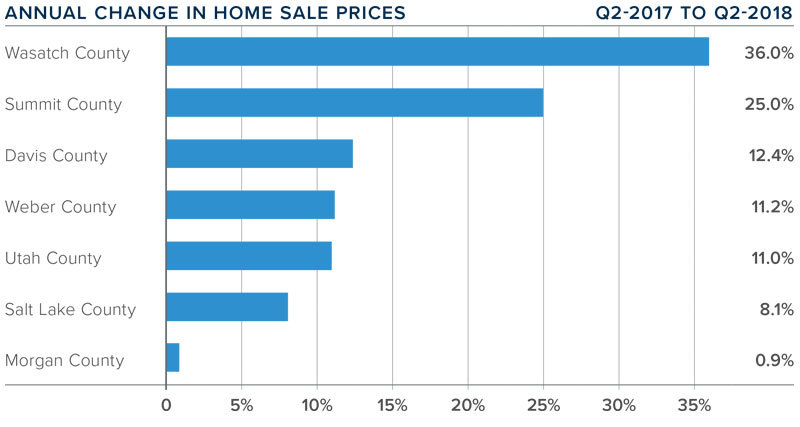
  • The average home price in the region continued to rise in second quarter with a year-over-year increase of 12% to $369,831. 
     
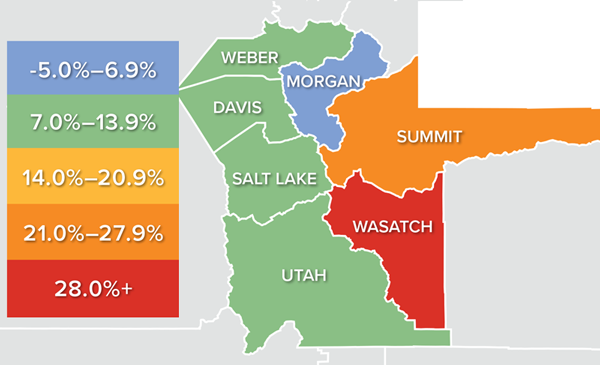
  • In addition to Wasatch County, four counties saw double-digit price increases when compared to a year ago. 
     
  • Price appreciation was strongest in Wasatch County, where home prices rose by a substantial 36%. Although this sounds extreme, it is a very small market and subject to major swings. 
     
  • The takeaway from this data is that demand continues to exceed supply, which is causing upward pressure on home prices. 


DAYS ON MARKET

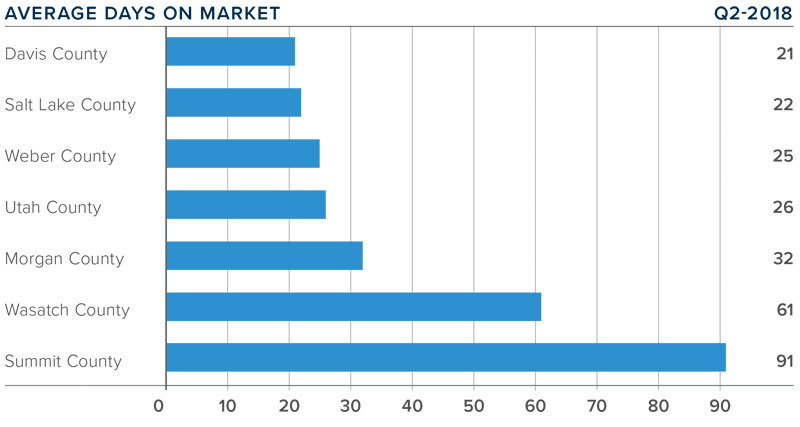
  • The average number of days it took to sell a home dropped by five days compared to the second quarter of 2017. 
     
  • Homes sold fastest in Davis and Salt Lake Counties and slowest in Summit County. In all other counties, days on market either remained static or dropped compared to the second quarter of 2017. 
     
  • During the second quarter of this year, it took an average of 40 days to sell a home in the region. 
     
  • The takeaway here is that the market remains robust, with well-priced and well-positioned homes selling rapidly. 


CONCLUSIONS

This speedometer reflects the state of the region’s real estate market using housing inventory, price gains, home sales, interest rates, and larger economic factors. For the second quarter of 2018, I left the needle at the same position as first quarter. Listing activity — while still well below the level I would like to see — is showing some signs of improving, which will be a relief to would-be home buyers. 




Matthew Gardner is the Chief Economist for Windermere Real Estate, specializing in residential market analysis, commercial/industrial market analysis, financial analysis, and land use and regional economics. He is the former Principal of Gardner Economics and has more than 30 years of professional experience both in the U.S. and U.K.