Market News February 6, 2019

Central Washington Real Estate Market Update


The following analysis of the Central Washington real estate market is provided by Windermere Real Estate Chief Economist Matthew Gardner. We hope that this information may assist you with making better-informed real estate decisions. For further information about the housing market in your area, please don’t hesitate to contact your Windermere agent.

ECONOMIC OVERVIEW

The Washington State economy continues to add jobs at an above-average rate, though the pace of growth is starting to slow as the business cycle matures. Over the past 12 months, the state added 96,600 new jobs, representing an annual growth rate of 2.9% — well above the national rate of 1.7%. Private sector employment gains continue to be quite strong, increasing at an annual rate of 3.6%. Public sector employment was down 0.3%. The strongest growth sectors were Real Estate Brokerage and Leasing (+11.4%), Employment Services (+10.3%), and Residential Construction (+10.2%). During fourth quarter, the state’s unemployment rate was 4.3%, down from 4.7% a year ago.


The counties within Central Washington have added 12,257 new jobs over the past 12 months, representing a very significant growth rate of 5.7%. A majority of that increase was in Yakima County, where total employment rose by 7.4% (or 8,500 jobs). The local unemployment rate rose when compared to a year ago from 5.7% to 5.9%. However, this increase can be attributed to a significant increase in the labor force.

HOME SALES ACTIVITY

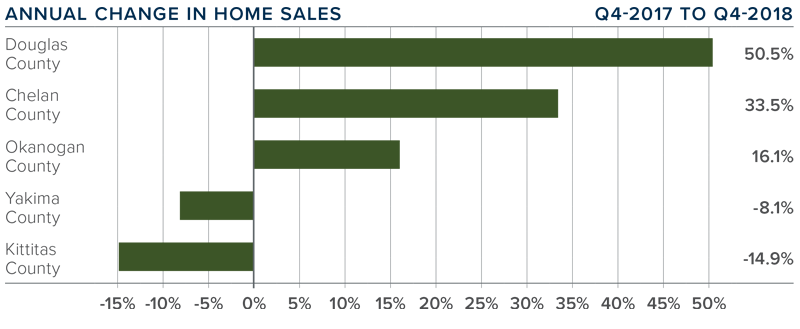
  • In the fourth quarter of this year, home sales throughout Central Washington rose by 2.8% to a total of 1,363 but sales were 1.7% lower than the third quarter of 2018.
  • Sales rose most in Douglas County, which had a very impressive increase of 50.5% over the fourth quarter of 2017. Yakima and Kittitas counties saw sales activity slow, but I do not see it as a pervasive trend or cause for concern.
  • The number of pending home sales was up 4.1% compared to the third quarter, indicating that closings will likely rise in the first quarter of 2019.
  • Listing activity rose by 1.4% when compared to the final quarter of 2017. This should offer some relief to would-be home buyers. I will be interested to see how much listing activity rises as we move into the spring selling market. I believe we will see more homes for sale as we start to trend toward a balanced market in the Central Washington area.
HOME PRICES
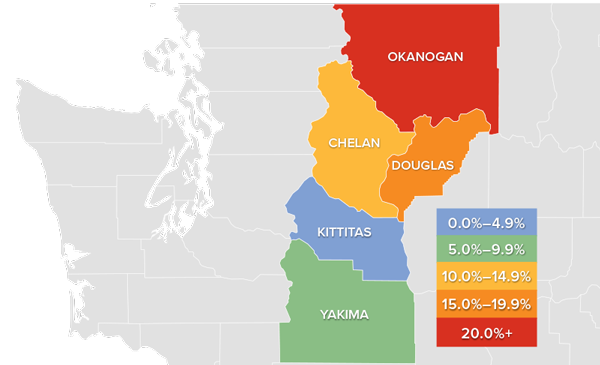
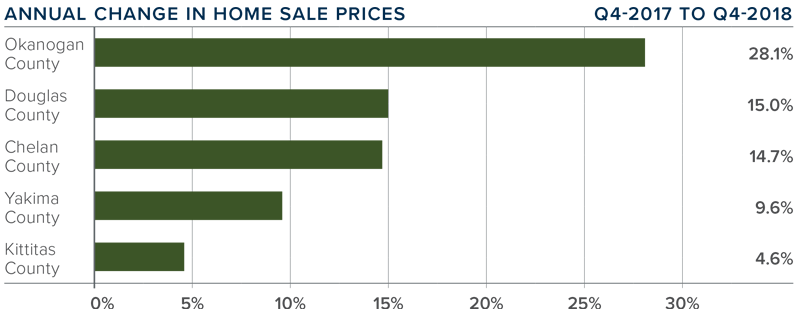
  • Year-over-year, the average home price in the region rose 12.9% to $317,064. Price growth continues to trend well above the long-term average, but I am hopeful that increasing supply in the spring will start to cool home-price appreciation.
  • Kittitas and Yakima counties were the only areas where the average sale prices rose by single digits, suggesting that even with increasing inventory it remains a solidly sellers’ market.
  • Prices rose in all counties contained in this report compared to the fourth quarter of 2017. Okanogan County stood out with a very substantial increase of 28.1%.
  • Home-price growth continues to trend at above-average rates due to supply constraints, but I hope increasing listing activity will start to take some heat off the market.
DAYS ON MARKET

  • The average number of days it took to sell a home dropped four days compared to the fourth quarter of 2017.
  • The average time it took to sell a home in the region was 71 days, up 16 days compared to the third quarter of 2018. This is to be expected in the traditionally slower winter months.
  • Three markets contained in this report— Okanogan, Chelan, and Douglas — saw days-on-market drop from the same quarter in 2017. Homes in Kittitas and Yakima counties took the same time to sell as a year ago.
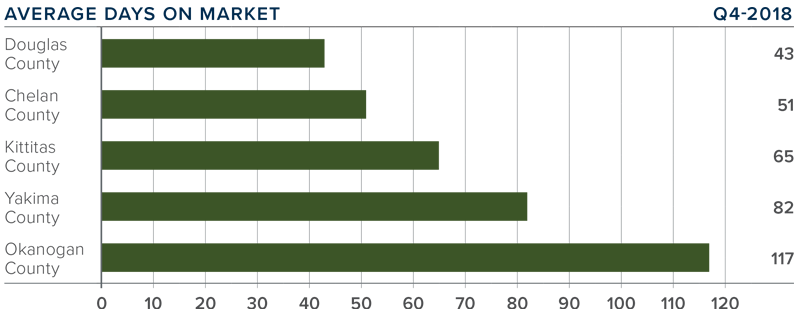
  • Homes sold fastest in Douglas County, where it took an average of 43 days to sell a home. The greatest drop in the time it took to sell a home was in Chelan County, where it took 11 fewer days than in the final quarter of 2017.
CONCLUSIONS

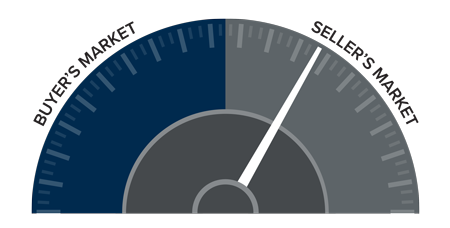
The speedometer reflects the state of the region’s real estate market using housing inventory, price gains, home sales, interest rates, and larger economic factors.

For the final quarter of 2018, I have held the needle at the same position as third quarter. Although we did see an increase in the number of homes for Chelan County sale, price growth is still well above the long-term average and the market clearly continues to favor Kittitas County home sellers.

 

As Chief Economist for Windermere Real Estate, Matthew Gardner is responsible for analyzing and interpreting economic data and its impact on the real estate market on both a local and national level. Matthew has over 30 years of professional experience both in the U.S. and U.K.

In addition to his day-to-day responsibilities, Matthew sits on the Washington State Governor’s Council of Economic Advisors; chairs the Board of Trustees at the Washington Center for Real Estate Research at the University of Washington; and is an Advisory Board Member at the Runstad Center for Real Estate Studies at the University of Washington where he also lectures in real estate economics.

Market News February 5, 2019

Utah Real Estate Market Update


The following analysis of select counties of the Utah real estate market is provided by Windermere Real Estate Chief Economist Matthew Gardner. We hope that this information may assist you with making better-informed real estate decisions. For further information about the housing market in your area, please don’t hesitate to contact your Windermere agent.


ECONOMIC OVERVIEW

Utah added 43,700 non-agricultural jobs over the past 12 months, representing a growth rate of 2.9%. For perspective, the U.S growth rate is 1.7%. Monthly employment growth in Utah has started to slow, but I attribute this to the fact that the region is essentially at full employment and it is typical to see job growth slow, especially at this stage of the business cycle. In November, the state unemployment rate was 3.2%, matching the level seen a year ago.


HOME SALES ACTIVITY

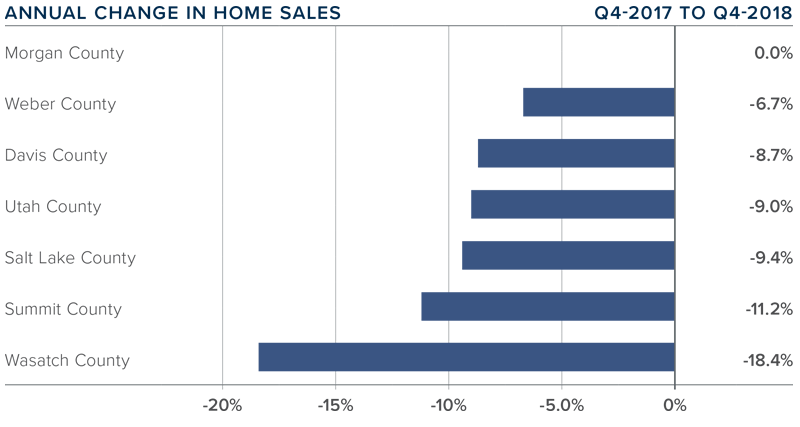
  • 7,989 homes sold during the fourth quarter of 2018, representing a drop of 9.1% from the same period in 2017, and down 16.7% from the third quarter.

  • Total sales activity dropped in all counties contained in this report except Morgan County, which saw sales at the same level as a year ago.

  • The number of homes for sale in fourth quarter rose by a significant 16.1% compared to the same period a year ago. This increase in choice for buyers is likely the reason home sales slowed. As a result, buyers have more options and are taking their time when making the decision to buy a new home.

  • I think we’ll see the number of homes for sale rise in the spring, which should be a pleasant relief for buyers who are tired of the lack of choices.

  • A greater supply of listings will likely allow sales to grow in 2019.


HOME PRICES

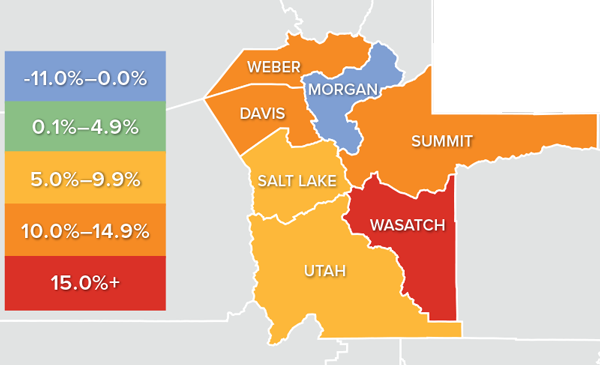
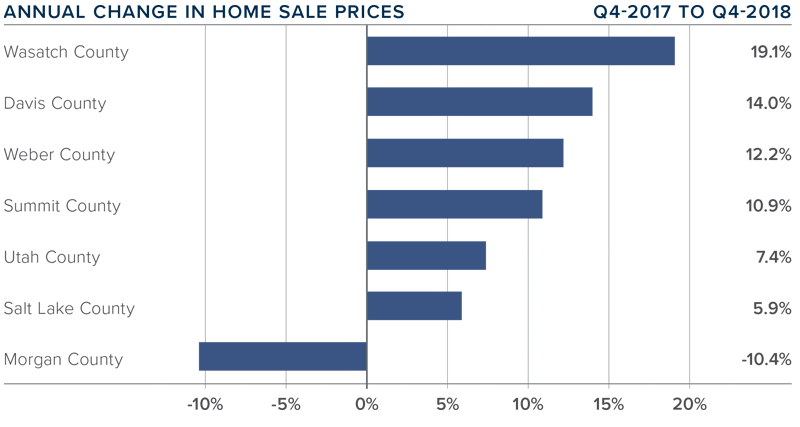
  • The average home price in the region continued to rise in the fourth quarter, with a year-over-year increase of 8.1% to $368,885.

  • In addition to Wasatch County, three counties saw double-digit price increases when compared to a year ago. Home prices dropped in Morgan County but it’s important to remember that small counties are subject to significant swings in value.

  • Appreciation was strongest in Wasatch County, where prices rose by a substantial 19.1%. Although this sounds extreme, it is a very small market and subject to major swings.

  • The takeaway from this data is that home prices continue to grow at above-average rates but I believe we will see a trend toward the longer-term average as we move through 2019.


DAYS ON MARKET

  • The average number of days it took to sell a home in Utah rose three days compared to the final quarter of 2017.

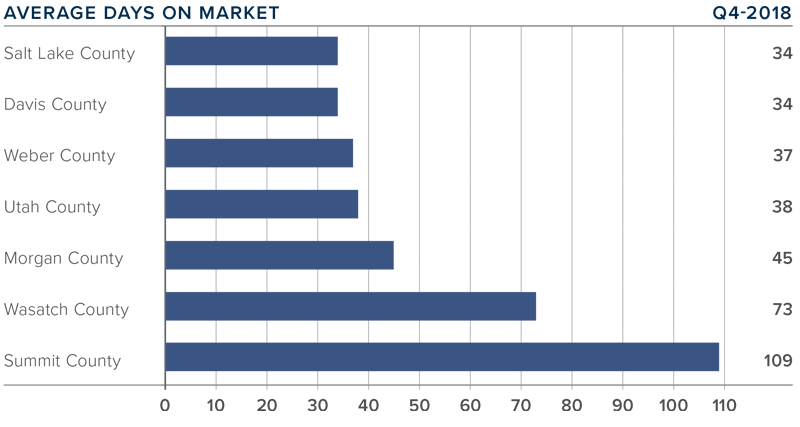
  • Homes sold fastest in Davis and Salt Lake counties and slowest in Summit County. All counties, other than Salt Lake (-1), saw days-on- market rise when compared to the fourth quarter of 2017.

  • During the fourth quarter of this year, it took an average of 53 days to sell a home in the region.

  • The regional economy continues to perform very well, and this will continue to drive housing demand. That said, rising inventory levels will give buyers more choice and less urgency, which will lead to market time rising.


CONCLUSIONS

The speedometer reflects the state of the region’s real estate market using housing inventory, price gains, home sales, interest rates, and larger economic factors.

For the fourth quarter of 2018, I have moved the needle very slightly toward buyers, though it clearly remains a sellers’ market. 2019 is very likely to be another good year for home sellers, but I expect to see home-price growth start to moderate.


As Chief Economist for Windermere Real Estate, Matthew Gardner is responsible for analyzing and interpreting economic data and its impact on the real estate market on both a local and national level. Matthew has over 30 years of professional experience both in the U.S. and U.K.

In addition to his day-to-day responsibilities, Matthew sits on the Washington State Governor's Council of Economic Advisors; chairs the Board of Trustees at the Washington Center for Real Estate Research at the University of Washington; and is an Advisory Board Member at the Runstad Center for Real Estate Studies at the University of Washington where he also lectures in real estate economics.
Buying February 4, 2019

More Than a Yard: Finding the Right Home for Your Pooch

For many house hunters, a dream home isn’t complete without being a good fit for the family dog. Some might see the fenced in yard, and consider the box checked. However, if you are looking for your next home, you may want to look a little deeper to be sure the fit is right before signing on the dotted line. 

It’s worth taking a little extra time to consider your pooch in a little more depth. Here is a quick checklist of considerations to be sure you find the right fit for your canine companion:


What’s in a Yard?


A fenced yard is, of course, ideal for many dog owners. It gives you the ability for off-leash play, a must for meeting the exercise needs of active breeds such as Border Collies or Labradors. But not all yards are the same. Here’s a quick checklist of what to look for:

  • Check the fencing to be sure it is secure. Factor in any repair costs into the cost of the home since they will need to be addressed right away. 
  • Are there flower beds with potentially toxic plants that will need to be moved outside of the fenced area? Examples include many spring bulb favorites such as daffodils, tulips, and crocus, as well as some bushes such as azaleas. 
  • Is there a nice shady spot so your pooch can find shelter from the heat on a hot summer day? 
  • Is there access to water for an outdoor bath? 
  • Will delivery people be able to access your main entrance when the dog is outside without entering the fenced part of your yard? It is easy to overlook, but this can become a major annoyance if you do a lot of online shopping. 


Indoor Space Considerations


It won’t always be a beautiful sunny day, even in your dream home. Make sure your new home will have enough space for a little indoor play on rainy days and during colder winter months. A long hallway can make a great runway for a game of fetch when getting outside just isn’t practical. 

Likewise, consider the needs of aging or injured dogs. Does the layout of the home require going up and down stairs to get to the most used areas of the home? This can be a major problem for some special needs dogs, and a deal breaker for some pet owners. 

Finally, most dog trainers recommend that every dog has a little space to call their own during times of stress. This may be as simple as a corner of the living room with a comfy dog bed or crate. If you have a puppy, however, a space that can be puppy-proofed and cordoned off (with appropriate flooring for potential accidents during potty training) is in order. 


Go for a Walk


It may be impractical to include a dog walk for every home you look at while searching for your dream house. However, once you are down to a short list, it is time to actually take your dog on what is likely to be the daily walk route. Make sure this is a walk you would feel comfortable making every day, or even letting the kids take. 

Be on the lookout for hazards: A dangerous intersection, a portion of the walk that requires walking in the road, or a neighbor who lets their dog run right up to the curb with invisible fencing (a recipe for territorial fights with leashed dogs passing by). A drive through is unlikely to reveal these walk spoiling annoyances. In addition, look for evidence of good lighting for evening or early morning walks. 


Nearby Canine Amenities


If you are moving to a new part of town or relocating to a new state altogether, it is worth doing some research to find out where the pet services are located. Depending on the services you tend to use, it can make a big difference in your quality of life to be able to take advantage of nearby conveniences. 

Think about what services you are likely to use most, and check on Google Maps to locate:

  • Veterinarians
  • Dog boutiques (particularly important if you buy specialty food)
  • Grooming services
  • Doggy daycare and boarding
  • Pet sitting and dog walking services
  • Dog-friendly restaurants (BringFido.comis a great research tool for this)
  • Dog parks and dog-friendly paths for long walks


Flooring


Although luxurious hardwood flooring adds a great deal of ambiance to a home, it will have the opposite effect if it gets scratched up from the nails of a rambunctious canine. Large and even medium sized dogs can easily create unsightly scars in hardwood floors that can only be fixed by a professional who will need to sand away the wood then stain and refinish it. It’s a costly fix! 

Modern carpets can generally hold up to doggy traffic. However, think about where you will be coming in and out of the house with your pooch to be sure you have a place to wipe muddy paws first on rainy days. A mudroom or garage entrance can easily stow a few extra towels for the job. 

Tile and high-quality laminate flooring are the most durable as both will resist scratching and are easy to clean. 


Consider Pet-Friendly Condos and Planned Communities


If you have a truly pampered pooch, one way to go the extra mile is to ask your realtor about dog-friendly communities in your area. Many condominium complexes, for example, have pet services right on site. Pet grooming, pet-sitting, dog walking services, and even a fenced in dog park and/or pool is available in some areas. 

Work with a Knowledgeable Realtor


Make sure to let your agent know upfront that you have a canine member of your family to consider during the house hunt. If there are certain “musts” such as a fenced yard, or proximity to veterinary services, be sure to put that on the table upfront to help your realtor find a home that works for you and your furry friend. 


Sharon is the lead author at wileypup.com. She received her M.S. in Science & Technology Studies from Virginia Tech and has worked as a professional dog trainer for over 10 years.

Market News February 4, 2019

Eastern Washington Real Estate Market Update


The following analysis of the Eastern Washington real estate market is provided by Windermere Real Estate Chief Economist Matthew Gardner. We hope that this information may assist you with making better-informed real estate decisions. For further information about the housing market in your area, please don’t hesitate to contact your Windermere agent.


ECONOMIC OVERVIEW

The Washington State economy continues to add jobs at an above-average rate, though the pace of growth is starting to slow as the business cycle matures. Over the past 12 months, the state added 96,600 new jobs, representing an annual growth rate of 2.9%—well above the national rate of 1.7%. Private sector employment gains continue to be quite strong, increasing at an annual rate of 3.6%. Public sector employment was down 0.3%. The strongest growth sectors were Real Estate Brokerage and Leasing (+11.4%), Employment Services (+10.3%), and Residential Construction (+10.2%). During fourth quarter, the state’s unemployment rate was 4.3%, down from 4.7% a year ago.

Eastern Washington added 4,984 jobs over the past 12 months, representing an annual growth rate of 1.1%. Although the region added jobs at a fairly healthy clip, the unemployment rate matched that seen a year ago at 5%.


HOME SALES ACTIVITY

  • Home sales throughout Eastern Washington slowed in the final quarter of the year, with total sales down 8.7% over the same quarter in 2017 to 3,211 units.

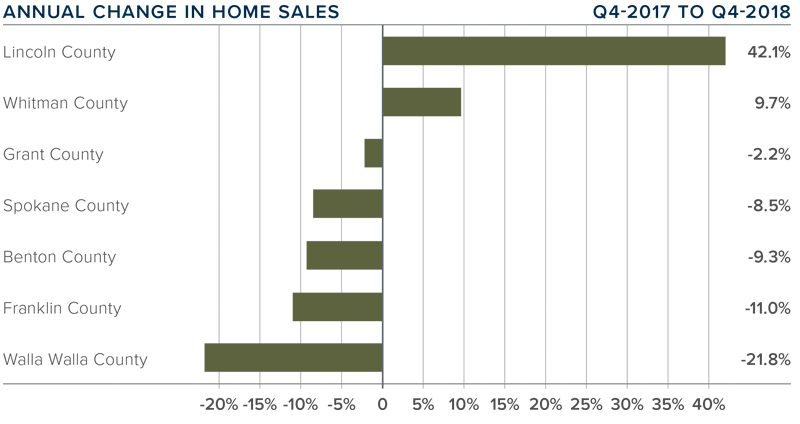
  • Sales rose fastest in the small Lincoln County area, which increased by a significant 42.1%. For perspective, that translates to only eight additional sales. Walla Walla County was again a laggard, with a drop of 21.8%. But it, too, is a small market that can be prone to significant swings.

  • Year-over-year, home sales rose in just two counties, with the balance of the market seeing some fairly significant drops.

  • Interestingly, the number of homes for sale dropped by 15.2% from the fourth quarter of 2017. Many Pacific Northwest markets saw significant increases in inventory levels last fall, but that was not the case in Eastern Washington. That said, I anticipate we will see more homes for sale as we move into the spring selling season.


HOME PRICES

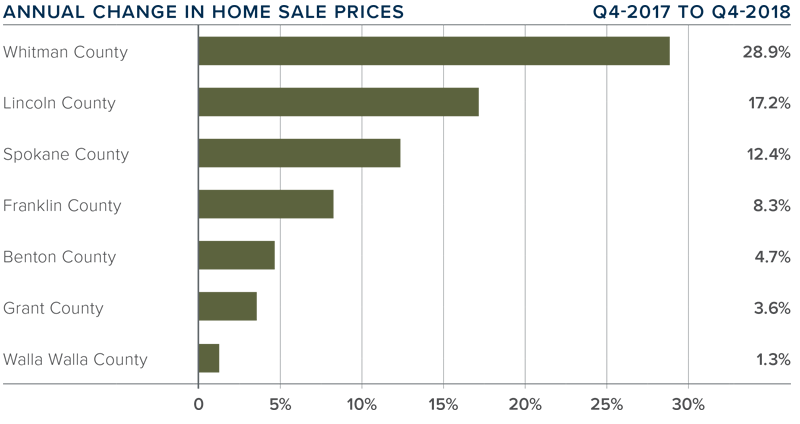
  • Year-over-year, the average home price in Eastern Washington rose 9.5% to $264,231. However, price growth slowed somewhat between third and fourth quarter, reporting a 2.6% drop in the average sales price.

  • Low inventory in the region continues to be a significant hurdle to many home buyers. I had hoped more homes would come onto the market in the fall, but that was not the case. The spring market should provide more choice for buyers.

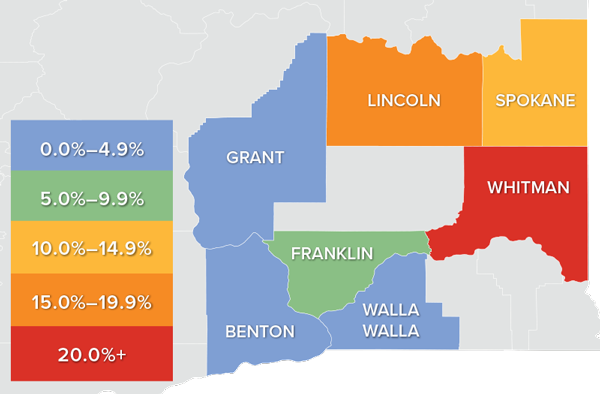
  • All the counties in this report saw prices rise compared to the fourth quarter of 2017. Whitman County took over the number one spot, with an annual price increase of 28.9%.

  • The takeaway here is that home-price growth has cooled a little but remains well above the long-term average.


DAYS ON MARKET

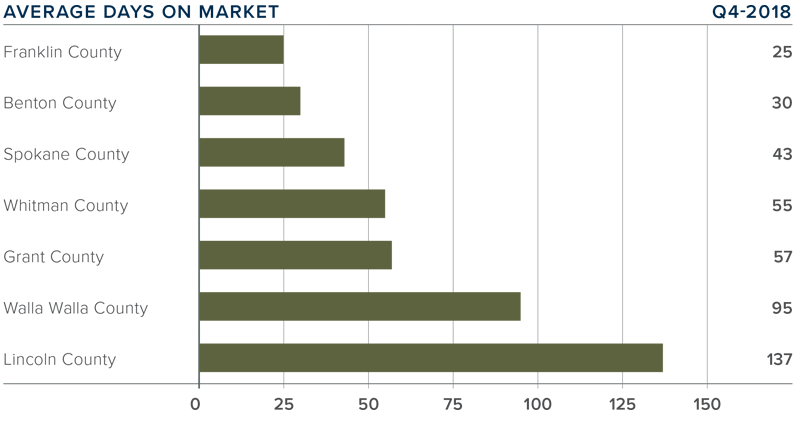
  • The average time it took to sell a home in Eastern Washington in the fourth quarter of 2018 was 63 days.

  • The average amount of time it took to sell a home in Eastern Washington dropped nine days compared to the fourth quarter of 2017.

  • Every county other that Lincoln (+2days) saw the time it took to sell a home drop compared to the same quarter in 2017.

  • Notably, it took 17 more days to sell a home in the fourth quarter than it did in the third quarter of last year, but I attribute that to seasonality.


CONCLUSIONS

The speedometer reflects the state of the region’s real estate market using housing inventory, price gains, home sales, interest rates, and larger economic factors.

The number of homes for sale dropped off in recent months and housing markets throughout Eastern Washington remain very tight. The overall trend continues to favor home sellers, so I am moving the needle slightly more in their favor.


As Chief Economist for Windermere Real Estate, Matthew Gardner is responsible for analyzing and interpreting economic data and its impact on the real estate market on both a local and national level. Matthew has over 30 years of professional experience both in the U.S. and U.K.

In addition to his day-to-day responsibilities, Matthew sits on the Washington State Governor's Council of Economic Advisors; chairs the Board of Trustees at the Washington Center for Real Estate Research at the University of Washington; and is an Advisory Board Member at the Runstad Center for Real Estate Studies at the University of Washington where he also lectures in real estate economics.
Market News January 31, 2019

Colorado Real Estate Market Update


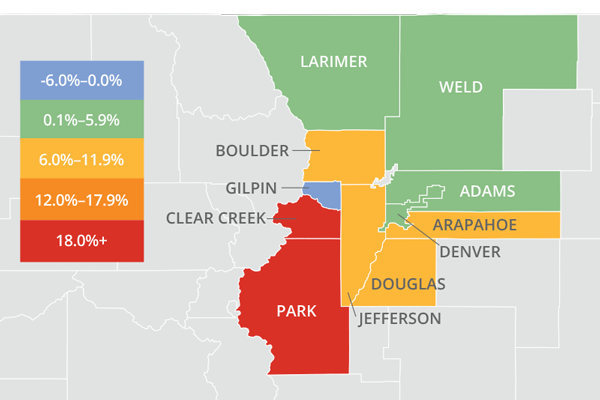
The following analysis of the Metro Denver & Northern Colorado real estate market (which now includes Clear Creek, Gilpin, and Park Counties) is provided by Windermere Real Estate Chief Economist Matthew Gardner. We hope that this information may assist you with making better-informed real estate decisions. For further information about the housing market in your area, please don’t hesitate to contact your Windermere agent.


ECONOMIC OVERVIEW

The Colorado economy continues to grow, adding 69,100 new non-agricultural jobs over the past 12 months, which represents a solid growth rate of 2.6%. That said, we are continuing to see a modest slowdown in employment gains, but that is to be expected at this stage of the business cycle. My latest forecast suggests that Colorado will add a total of 65,000 new jobs in 2019, representing a growth rate of 2.3%.

In November, the state unemployment rate was 3.3%, up from 3% a year ago. The increase is essentially due to an increase in the labor force, which rose by 77,279 people. On an un-seasonally adjusted basis, unemployment rates in all the markets contained in this report dropped between November 2017 and November 2018. The highest rate was in Grand Junction, but that was still a very respectable 4%. Fort Collins and Boulder had the lowest unemployment rate of 2.9%. All the regions contained in this report are essentially at full employment.


HOME SALES ACTIVITY

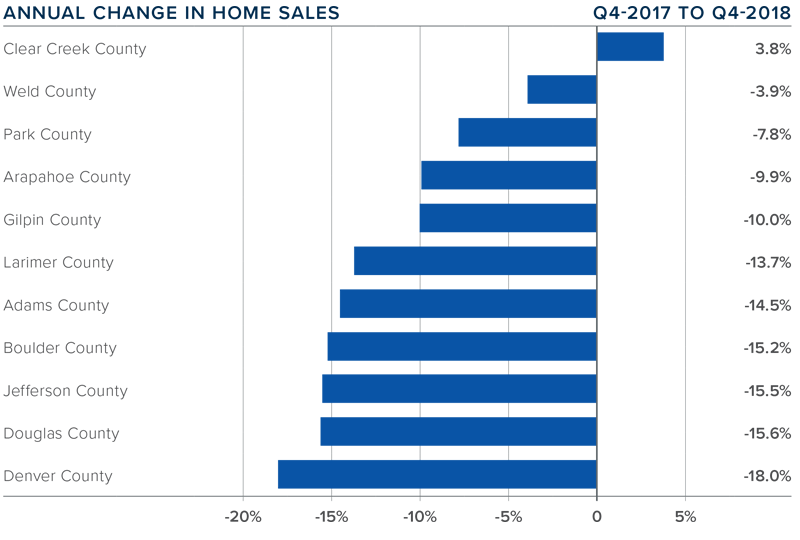
  • In the fourth quarter of 2018, 12,911 homes sold — a drop of 13.8% compared to the last quarter of 2017 and down 22% from the third quarter.​
  • The only market that saw growth in sales was Clear Creek, which rose by 3.8%. This is a small market, however, and is prone to rapid swings in price as well as sales. There was a significant drop in sales in the Denver market. I will be watching closely to see if this is an anomaly or a longer-term trend. At this time, I believe the former to be true.​
  • Interestingly, this decline in sales in Denver came as inventory levels rose by 37%. For now, I attribute this to seasonality and expect to see sales growth return in the spring.
  • Inventory growth continues to give buyers more choice, allowing them to be far more selective — and patient — before making an offer on a home. That said, well-positioned and well-priced homes are selling relatively quickly.


HOME PRICES

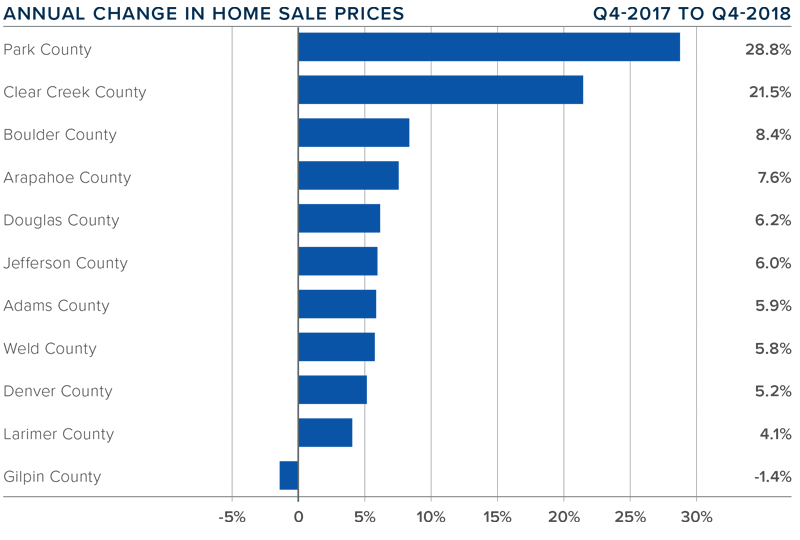
  • Despite the rapid rise in listings and slowing home sales, prices continue to trend higher, though the rate of growth is slowing. The average home price in the region rose 6% year-over-year to $454,903. Home prices were 2% higher than in the third quarter.
  • In all, the data was not very surprising. As with many markets across the country, affordability is starting to become an issue. However, the recent drop in interest rates likely stimulated buyers at the end of 2018 and I expect to see good price growth in the first quarter of 2019.
  • Appreciation was strongest in Park County, where prices rose 28.2%. We can attribute this rapid increase to it being a small market. Only Gilpin County saw a drop in average home price. Though this, too, is due to it being a very small market, making it more prone to significant swings.
  • As mentioned, affordability is becoming an issue in many Colorado markets and I anticipate that we will see some cooling in home price appreciation as we move through late 2019.


DAYS ON MARKET

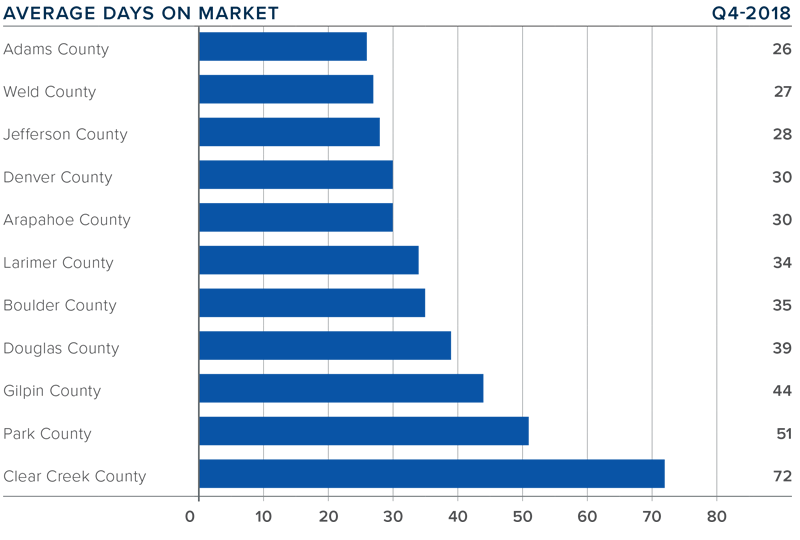
  • The average number of days it took to sell a home in Colorado rose by one day compared to the final quarter of 2017.
  • The amount of time it took to sell a home dropped in four counties: Boulder, Larimer, Gilpin, and Park. The rest of the counties in this report saw days on market rise relatively modestly with the exception of the small Clear Creek market, which rose by 20 days.
  • In the fourth quarter of 2018, it took an average of 38 days to sell a home in the region, but it took less than a month to sell a home in five of the eleven counties contained in this report.
  • Housing demand is still there, but buyers appear to have taken a little breather. I anticipate, however, that the spring will bring more activity and rising sales.


CONCLUSIONS

The speedometer reflects the state of the region’s real estate market using housing inventory, price gains, home sales, interest rates, and larger economic factors.

For the fourth quarter of 2018, I continue the trend I started last summer and have moved the needle a little more in favor of buyers. I will be closely watching listing activity in the spring to see if we get any major bumps above the traditional increase because that may further slow home price growth — something that would-be buyers appear to be waiting for.


As Chief Economist for Windermere Real Estate, Matthew Gardner is responsible for analyzing and interpreting economic data and its impact on the real estate market on both a local and national level. Matthew has over 30 years of professional experience both in the U.S. and U.K.

In addition to his day-to-day responsibilities, Matthew sits on the Washington State Governor’s Council of Economic Advisors; chairs the Board of Trustees at the Washington Center for Real Estate Research at the University of Washington; and is an Advisory Board Member at the Runstad Center for Real Estate Studies at the University of Washington where he also lectures in real estate economics.
Market News January 30, 2019

Nevada Real Estate Market Update


The following analysis of the greater Las Vegas, Nevada real estate market is provided by Windermere Real Estate Chief Economist Matthew Gardner. We hope that this information may assist you with making better-informed real estate decisions. For further information about the housing market in your area, please don’t hesitate to contact your Windermere agent. 


ECONOMIC OVERVIEW

Job growth in the Las Vegas metropolitan area remains very strong. A total of 38,900 new jobs were added over the past 12 months, representing an impressive annual growth rate of 3.9%. For perspective, the U.S. as a whole is growing at around 1.7% or less than half the rate of Las Vegas.

As jobs are added to the local economy, the unemployment rate is trending lower. The seasonally adjusted rate is 4.5%, down from 5.1% a year ago, but it is still higher than the national average. As I mentioned in last quarter’s Gardner Report, this is attributable to the rapidly rising labor force, which has grown by over 38,000 in the past year.


HOME SALES ACTIVITY

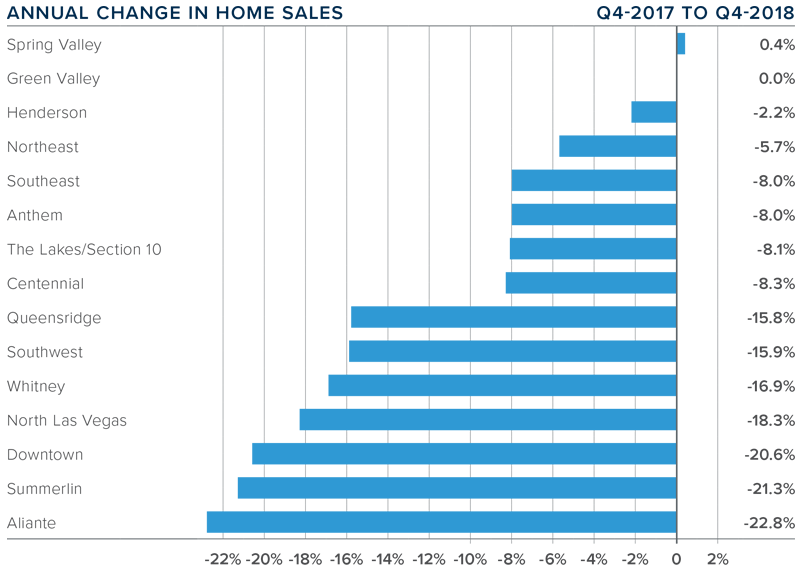
  • A total of 7,439 homes were sold in the fourth quarter of 2018 — a drop of 11.8% over the same period a year ago and 18.7% lower than the third quarter of 2018. The area had been suffering from a significant lack of inventory but that started to rise in mid-2018. Buyers have more choice and less urgency, so they are taking their time, which is leading to lower sales.

  • Year over year, pending sales dropped 10.5% and were down 22% compared to the third quarter. This suggests that closings in the first quarter of 2019 will not be very robust.    

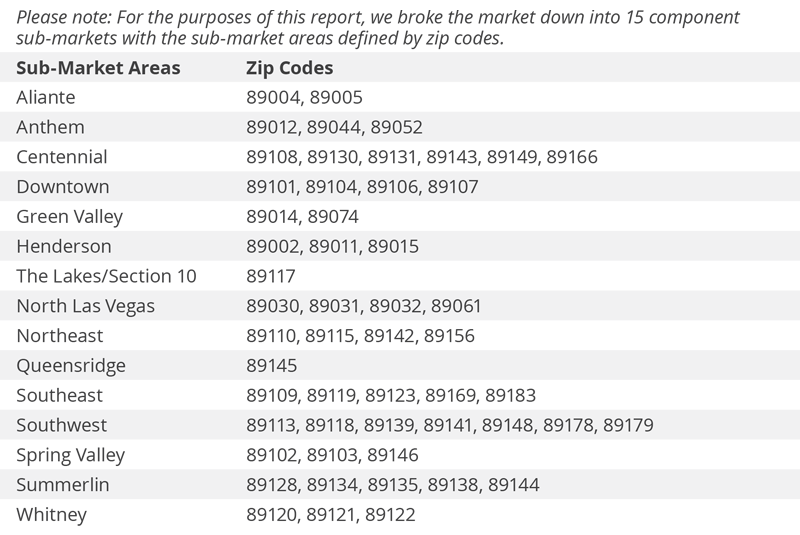
  • Sales rose very modestly in the Spring Valley area but dropped across the rest of the market areas covered by this report. The most substantial dip in sales was in the Aliante neighborhood, but this is a very small area and, therefore, prone to significant swings.

  • The Las Vegas market is experiencing the same increase in listing activity as a majority of U.S. markets. I don’t believe this is a cause for concern, but more choice will lead to a temporary slowing in sales as buyers take their time when choosing a new home.


HOME PRICES

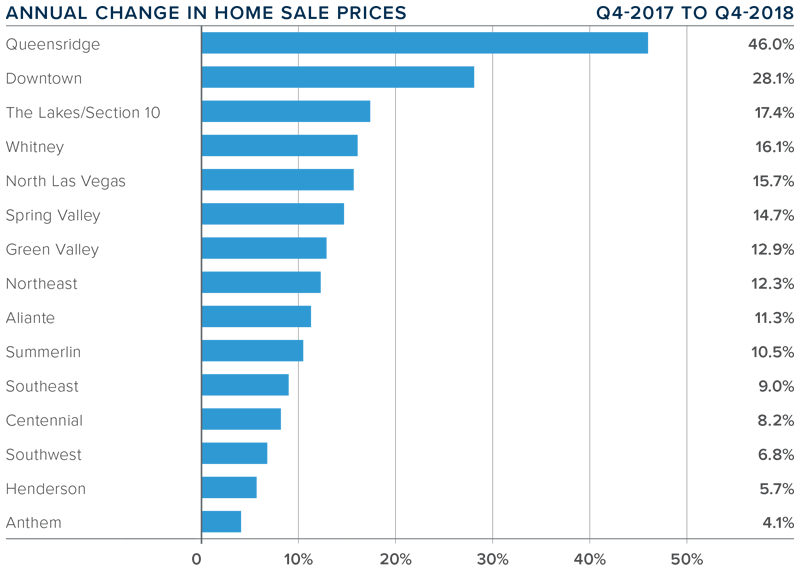
  • Home prices in the area rose to an average of $307,068, an increase of 10.5% compared to the fourth quarter of 2017, and were a modest 0.9% higher than in the third quarter of 2018.

  • Home prices continue to rise in the Las Vegas market, but I believe we will start to see a slowdown as affordability issues appear and listing activity increases this spring.​

  • Prices in all sub-markets rose compared to the same quarter last year. The strongest growth was in the Queens Ridge sub-market, where prices were up a substantial 46%. Nine sub-markets saw double-digit price growth.​

  • Home values are likely to continue to increase but more choice, in concert with affordability constraints, will lead to a slowdown in the rate of price growth.


DAYS ON MARKET

  • The average time it took to sell a home in the region dropped two days compared to the fourth quarter of 2017.

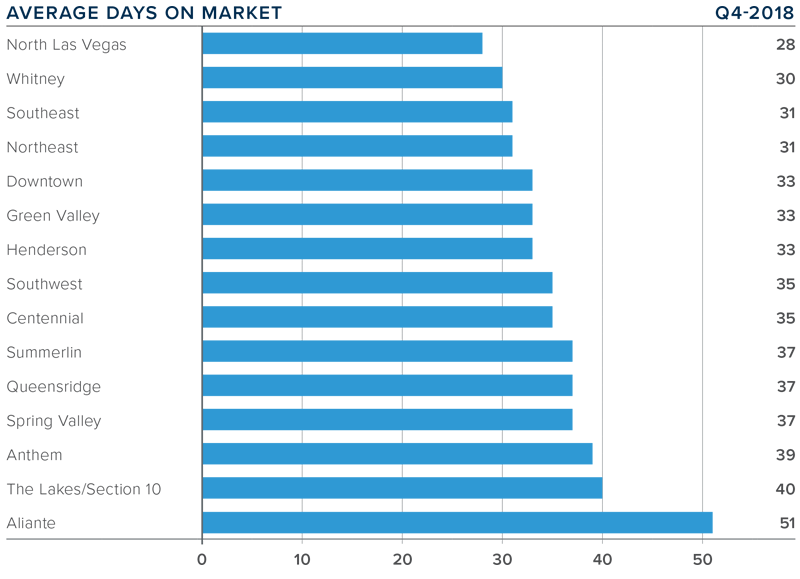
  • Region-wide it took an average of 35 days to sell a home in the fourth quarter of 2018.

  • Days on market fell in four of the sub-markets compared to a year ago, while two remained static and nine rose.

  • The greatest drop in days on market was in Aliante, which fell by four days compared to the same quarter in 2017. The greatest increase in market time was in Queens Ridge and Spring Valley, which rose by nine days.


CONCLUSIONS                                                                                               

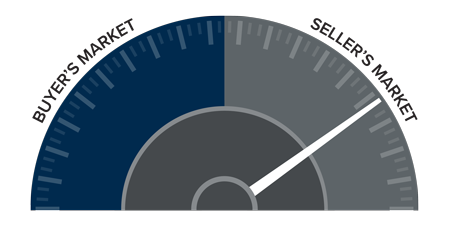
The speedometer reflects the state of the region’s real estate market using housing inventory, price gains, home sales, interest rates, and larger economic factors. 

Employment growth in Clark County continues to be very robust and we are likely to see tangible income growth, which can offset increasing home prices. Even though we are seeing signs that the housing market is trending toward balance, I believe Las Vegas will be one of the best performing areas in the Western United States for home price growth in 2019.


As Chief Economist for Windermere Real Estate, Matthew Gardner is responsible for analyzing and interpreting economic data and its impact on the real estate market on both a local and national level. Matthew has over 30 years of professional experience both in the U.S. and U.K.

In addition to his day-to-day responsibilities, Matthew sits on the Washington State Governor's Council of Economic Advisors; chairs the Board of Trustees at the Washington Center for Real Estate Research at the University of Washington; and is an Advisory Board Member at the Runstad Center for Real Estate Studies at the University of Washington where he also lectures in real estate economics.

More January 30, 2019

Beautiful Inside & Out – Timber Interiors for a Timber Frame Home


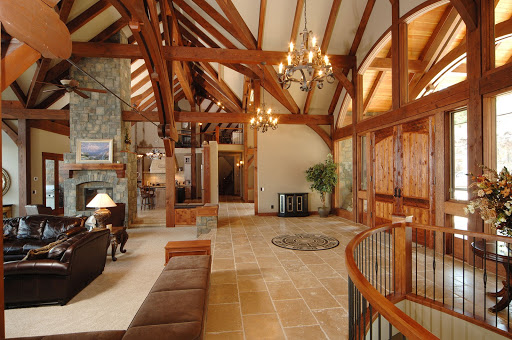
Photo Credit: Hamill Creek

A home that exudes beauty from the inside and the outside is also a true reflection of its owner. Today, homes are not just mere living spaces that are filled up with furniture – every home has a character, design theme, and personality of its own, characterized largely by the material used to build it, the color scheme on the inside and outside, and also the accents and hues of every element that goes into it.

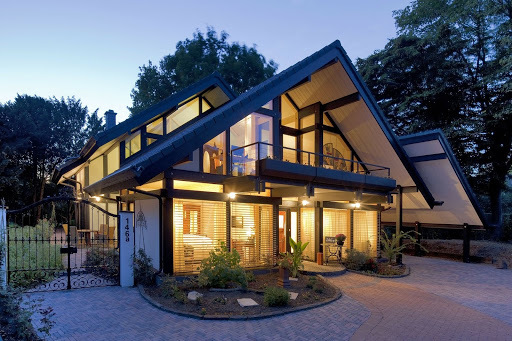
One such building material is Timber, which truly brings out the class and beauty in a home. Timber frame houses have many positive attributes to them and are rightfully becoming one of the most popular choices for home building material. Let’s look at some of the pros of using timber for your home:


1. Look and feel

Timber is one of the classiest looking building materials, with a sleek finish and a light but sturdy build. Timber, being a natural material, also has a natural feel to it, of course without compromising on reliability. Timber both on the inside and the outside looks amazing and is also quite easy to work with in terms of designing and color palettes. Timber comes in a number of finishes and colors. You could go for a smooth and sleek finish it even a textured look for a more rustic feel. There’s also distressed timber which gives a home a vintage and retro look and comes in a darker shade.
2. Heat and cold

Timber framing and construction allows you to enjoy the benefits of its insulating properties. Not just that, it also retains heat and maintains a conducive temperature and atmosphere inside the home. Timber is one of those materials that would sustain you in both hot and cold climatic conditions, and you wouldn’t have to spend too much on HVAC solutions either.
3. Longevity and ease of use

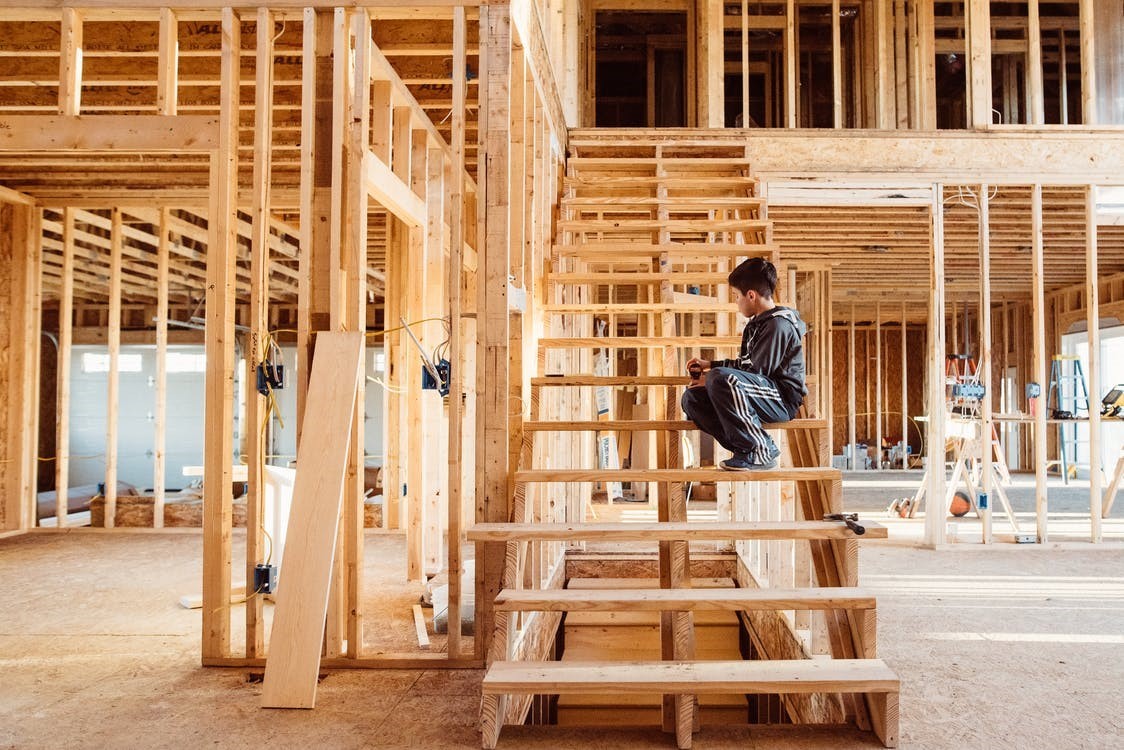
Timber is surely one of the most durable materials for constructing a home, especially the new age timber frames which go through special treatment to make the material is stronger, more resistant and also durable. The best part is that timber is also such an easy and convenient material to work with. The build time for a timber frame home is significantly lesser than most other traditional materials. Erecting a timber frame home can be done with ease, and it also does not require any extensive concrete footings, hence the quickness of construction.
4. Versatility outdoors and indoors

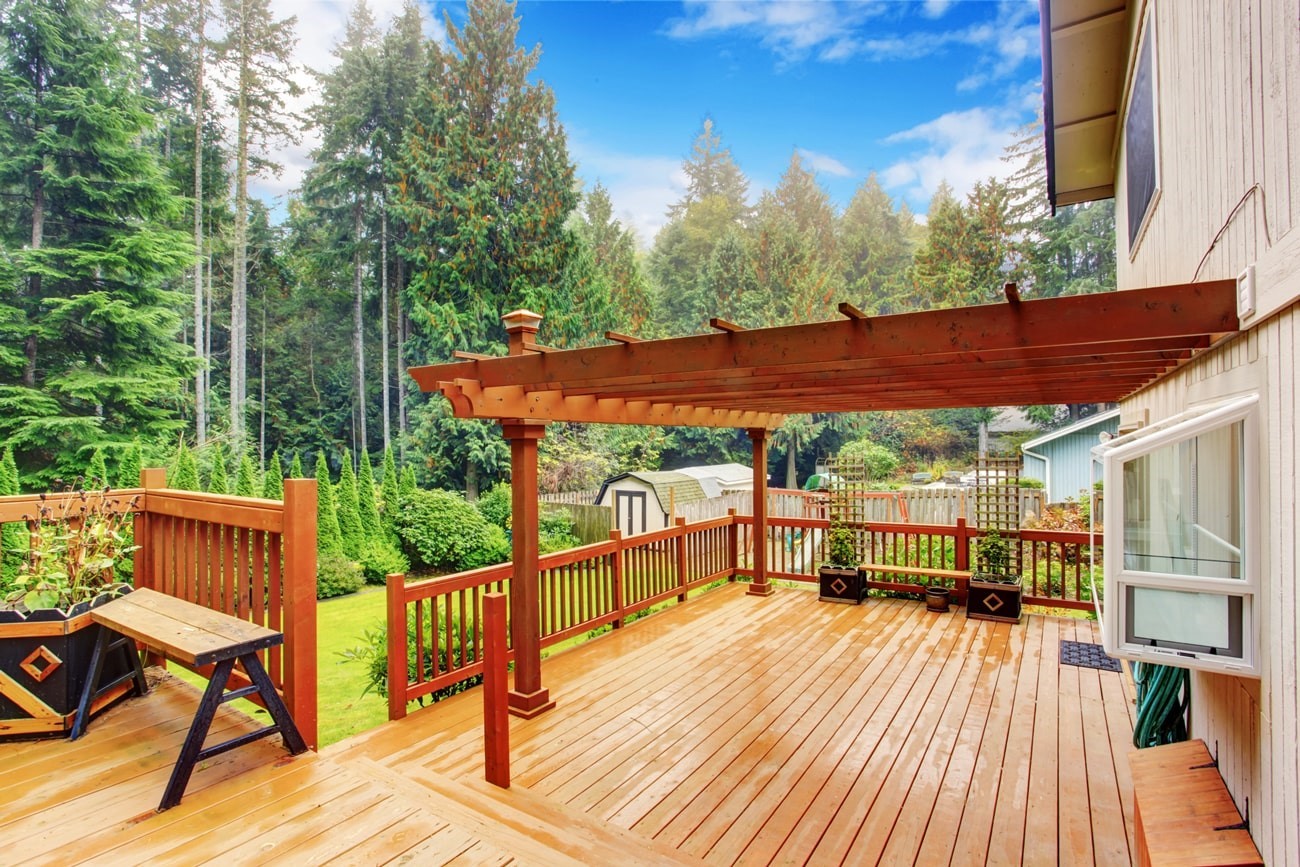
There are umpteen options for you to choose from, where timber can be used to add-on to the beauty of your home both internally and externally. Outdoor kitchens, pergolas, gazebos, picnic shelters, covered decks, bridges and so much more can be done to the external area of your home.

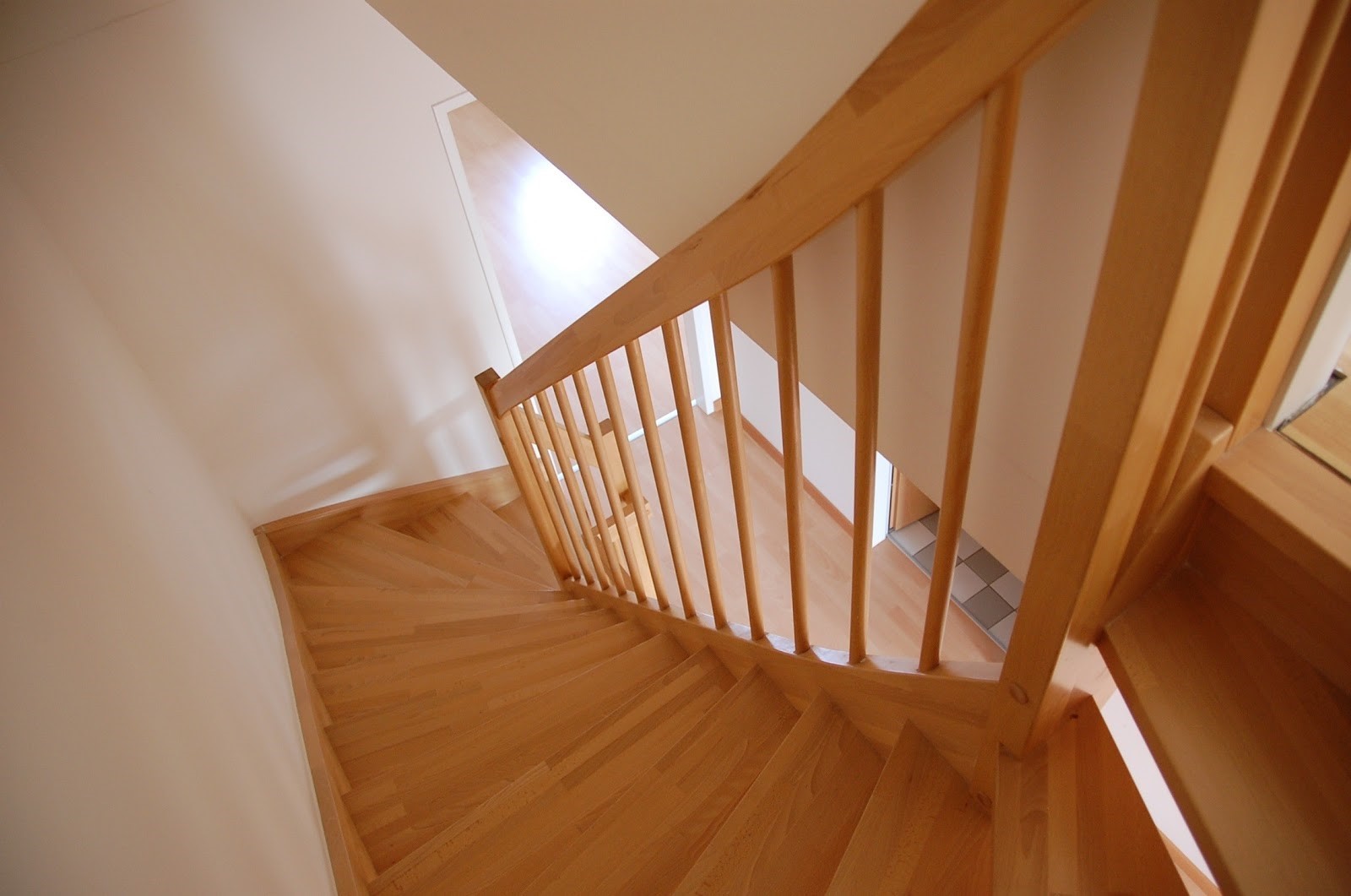
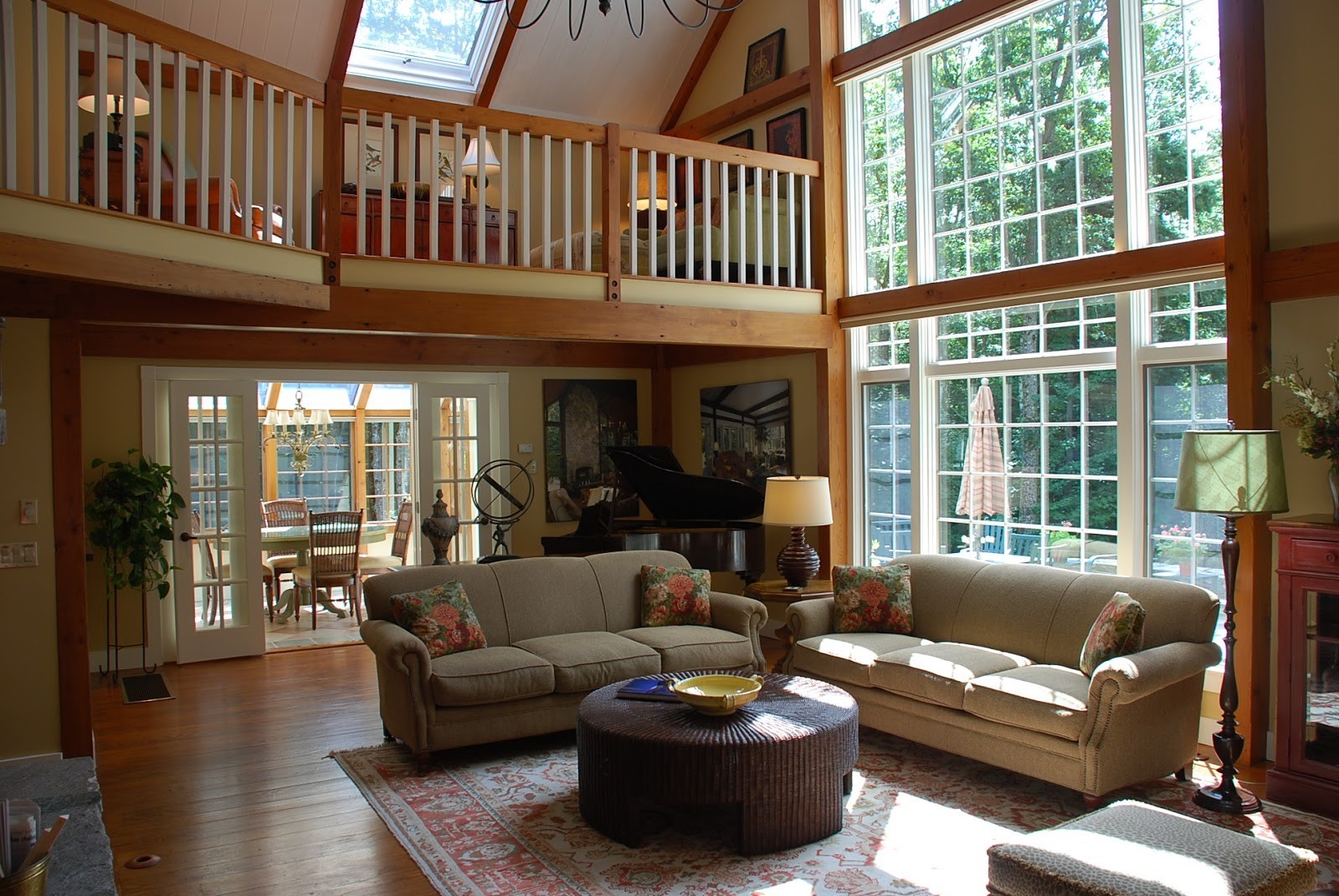
For the interiors as well, timber can be used for frame accents, staircases, and beautiful railings, and complete timber frame kits and packages come with everything you’d need, including door, window, roof and wall enclosure systems that provide the support your timber frame home needs. Imagine a spacious timber frame home with an open, gourmet kitchen and a dramatic winding staircase? Or even floor to ceiling windows that allow ample natural light to encompass the home. All of this and more is very much possible with timber as the main material.

5. Space utilization

Want to make the most of every inch of space you have for your home? Timber framing is one of the best ways to do this! A timber frame floor plan is so flexible and dynamic, and you can add absolutely anything you want, as long as you include it into the final plan. Want to add an extra room? Opt for bigger doors and windows? Or maybe use the extra roof space to create a handy loft? All of this and more is quite easy to do with a timber frame home, and that’s what makes your home uniquely yours in both design and functionality.

Bottom Line

Costs are usually a concern while building a new home or re-doing an existing one, but timber is one material that gives you total value for the money you spend. A regular brick and mortar home is expensive as is and doesn’t provide you with any additional benefits. Timber, on the other hand, gives you all the above-mentioned benefits and more, so in terms of cost to value ratio, is a much smarter and more sensible option to go for. So, to create a uniform look and feel both inside and outside, timber is the ideal material to bring out the true beauty of your abode!

Our Guest Author is Tyler of Hamill Creek Timber Homes.

Market News January 29, 2019

Southern California Real Estate Market Update


The following analysis of the Southern California real estate market is provided by Windermere Real Estate Chief Economist Matthew Gardner. We hope that this information may assist you with making better-informed real estate decisions. For further information about the housing market in your area, please don’t hesitate to contact your Windermere agent. 


ECONOMIC OVERVIEW

The counties covered by this report — Los Angeles, San Diego, San Bernardino, Orange, and Riverside — added 139,000 new jobs between November 2017 and November 2018, representing an annual growth rate of 1.4%. The unemployment rate held at 4%. Employment growth in Southern California continues to slow but, as I discussed in the third quarter Gardner Report, the market is heavily affected by the substantial Los Angeles County market, which is seeing significantly slower employment growth. My 2019 forecast for employment in Southern California is for growth to continue at around 1.5%.


HOME SALES ACTIVITY

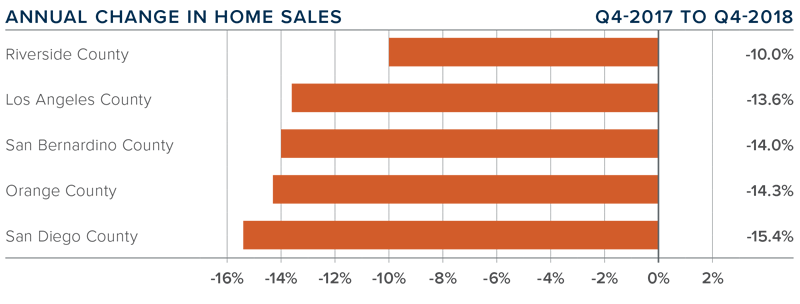
  • There were 39,655 home sales in the final quarter of 2018. This was a drop of 13.5% from the same period in 2017 and 16.2% lower than the third quarter of this year.

  • Pending home sales (an indicator of future closings) were 8.8% lower than during the same period a year ago, and down 21.6% compared to the third quarter of 2018. This suggests that total sales in the first quarter of 2019 are likely to also be down.

  • Home sales dropped across the board, but the most noticeable decline was again seen in San Diego County, which fell by 15.4%. I am still attributing this to the significant rise in inventory (+51.7%) as well as high average home prices. Interestingly, however, price growth in the San Diego area remains robust.

  • There was an average of 41,199 active listings in the fourth quarter — up 38.2% from a year ago.


HOME PRICES

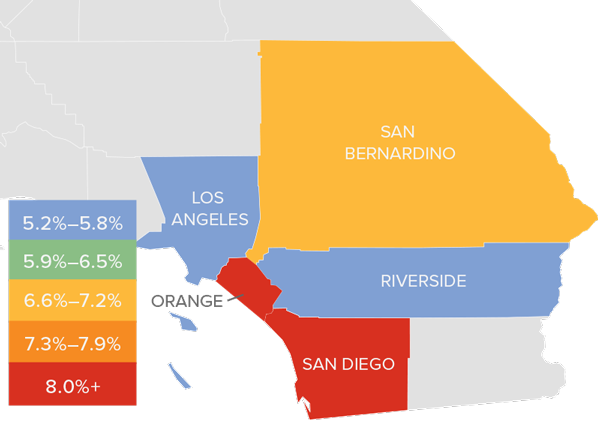
  • Year-over-year average prices in the region rose 4.1%, but they were 2% lower than in the third quarter of 2018.
  • Affordability remains an issue in most of the Southern Californian counties contained in this report, which, in concert with growing inventory, continues to limit home price growth.
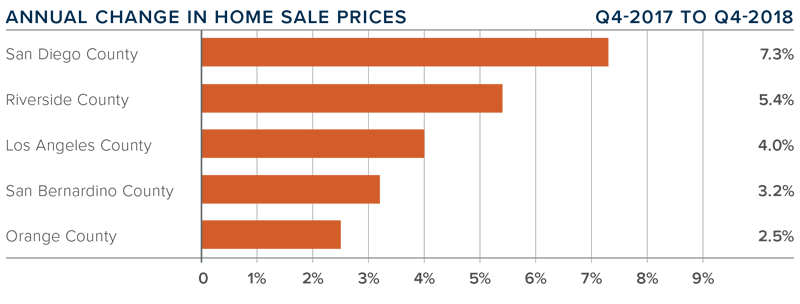
  • Price growth was varied, with San Diego County showing the greatest annual appreciation (+7.3%). The slowest appreciation was in Orange County, which saw prices rise only 2.5%.
  • Home prices will continue to rise in 2019, but the rate of growth will continue to taper as the economy slows and income growth remains muted.


DAYS ON MARKET

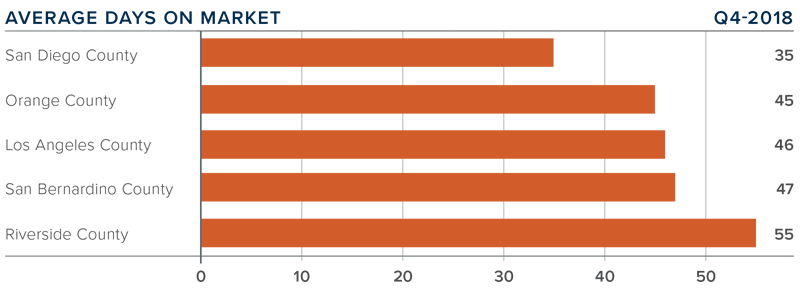
  • The average time it took to sell a home in the region was 46 days. This is a three-day increase compared to the fourth quarter of 2017, and seven days more than in the third quarter of 2018.

  • No market saw the time it took to sell a house drop compared to the fourth quarter of 2017. It also took more time to sell a home in the fourth quarter than it did in the third.

  • Homes in San Diego County continue to sell at a faster rate than other markets in the region. In the fourth quarter, it took an average of 35 days to sell a home, five days more than it took a year ago.

  • Market time is increasing, which may concern some; however, it is simply a move back to normal averages.


CONCLUSIONS                                                                                               

The speedometer reflects the state of the region’s real estate market using housing inventory, price gains, home sales, interest rates, and larger economic factors.

The Southern California economy continues to slow and the number of homes for sale is rising. This combination will lead to slower price appreciation, but I do not see it as anything to worry too much about. We are simply trending back to a “normal” housing market. Given these factors, I have moved the needle a little further toward buyers.


As Chief Economist for Windermere Real Estate, Matthew Gardner is responsible for analyzing and interpreting economic data and its impact on the real estate market on both a local and national level. Matthew has over 30 years of professional experience both in the U.S. and U.K.

In addition to his day-to-day responsibilities, Matthew sits on the Washington State Governor's Council of Economic Advisors; chairs the Board of Trustees at the Washington Center for Real Estate Research at the University of Washington; and is an Advisory Board Member at the Runstad Center for Real Estate Studies at the University of Washington where he also lectures in real estate economics.

Market News January 28, 2019

Western Washington Real Estate Market Update


The following analysis of the Western Washington real estate market is provided by Windermere Real Estate Chief Economist Matthew Gardner. We hope that this information may assist you with making better-informed real estate decisions. For further information about the housing market in your area, please don’t hesitate to contact your Windermere Agent. 


ECONOMIC OVERVIEW

The Washington State economy continues to add jobs at an above-average rate, though the pace of growth is starting to slow as the business cycle matures. Over the past 12 months, the state added 96,600 new jobs, representing an annual growth rate of 2.9% — well above the national rate of 1.7%. Private sector employment gains continue to be quite strong, increasing at an annual rate of 3.6%. Public sector employment was down 0.3%. The strongest growth sectors were Real Estate Brokerage and Leasing (+11.4%), Employment Services (+10.3%), and Residential Construction (+10.2%). During fourth quarter, the state’s unemployment rate was 4.3%, down from 4.7% a year ago.


My latest economic forecast suggests that statewide job growth in 2019 will still be positive but is expected to slow. We should see an additional 83,480 new jobs, which would be a year-over-year increase of 2.4%.


HOME SALES ACTIVITY

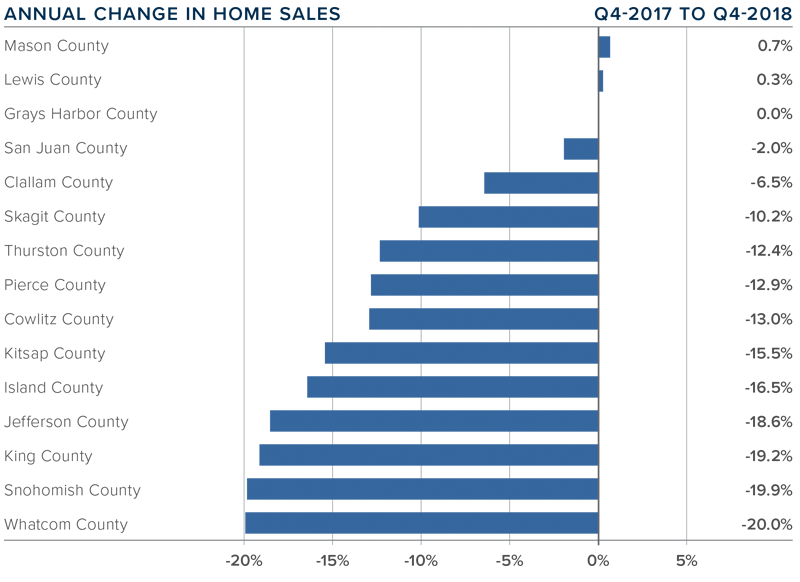
  • There were 17,353 home sales during the fourth quarter of 2018. Year-over-year sales growth started to slow in the third quarter and this trend continued through the end of the year. Sales were down 16% compared to the fourth quarter of 2017.​
  • The slowdown in home sales was mainly a function of increasing listing activity, which was up 38.8% compared to the fourth quarter of 2017 (continuing a trend that started earlier in the year). Almost all of the increases in listings were in King and Snohomish Counties. There were more modest increases in Pierce, Thurston, Kitsap, Skagit, and Island Counties. Listing activity was down across the balance of the region.
  • Only two counties—Mason and Lewis—saw sales rise compared to the fourth quarter of 2017, with the balance of the region seeing lower levels of sales activity.​
  • We saw the traditional drop in listings in the fourth quarter compared to the third quarter, but I fully anticipate that we will see another jump in listings when the spring market hits. The big question will be to what degree listings will rise.


HOME PRICES

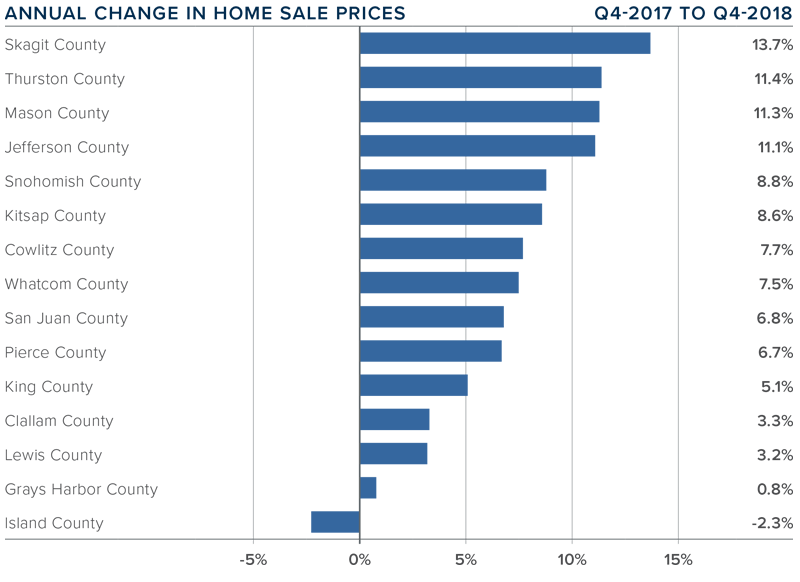
  • With greater choice, home price growth in Western Washington continued to slow in fourth quarter, with a year-over-year increase of 5% to $486,667. Notably, prices were down 3.3% compared to the third quarter of 2018.

  • Home prices, although higher than a year ago, continue to slow. As mentioned earlier, we have seen significant increases in inventory and this will slow down price gains. I maintain my belief that this is a good thing, as the pace at which home prices were rising was unsustainable.

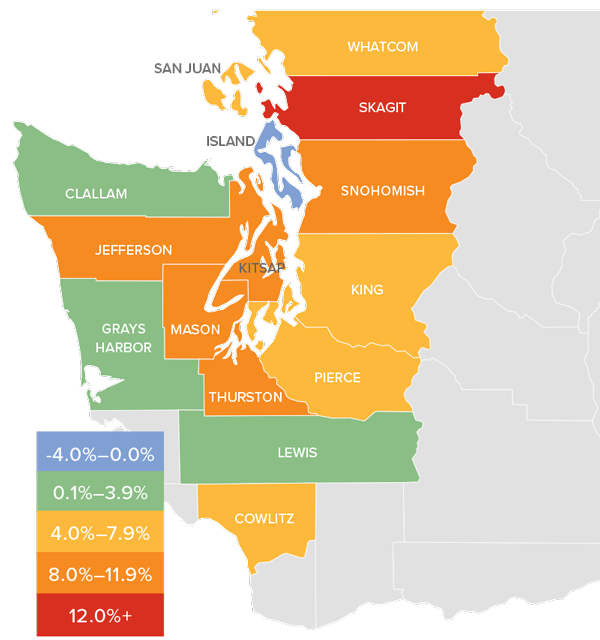
  • When compared to the same period a year ago, price growth was strongest in Skagit County, where home prices were up 13.7%. Three other counties experienced double-digit price increases.

  • Price growth has been moderating for the past two quarters and I believe that we have reached a price ceiling in many markets. I would not be surprised to see further drops in prices across the region in the first half of 2019, but they should start to resume their upward trend in the second half of the year.


DAYS ON MARKET

  • The average number of days it took to sell a home dropped three days compared to the same quarter of 2017.

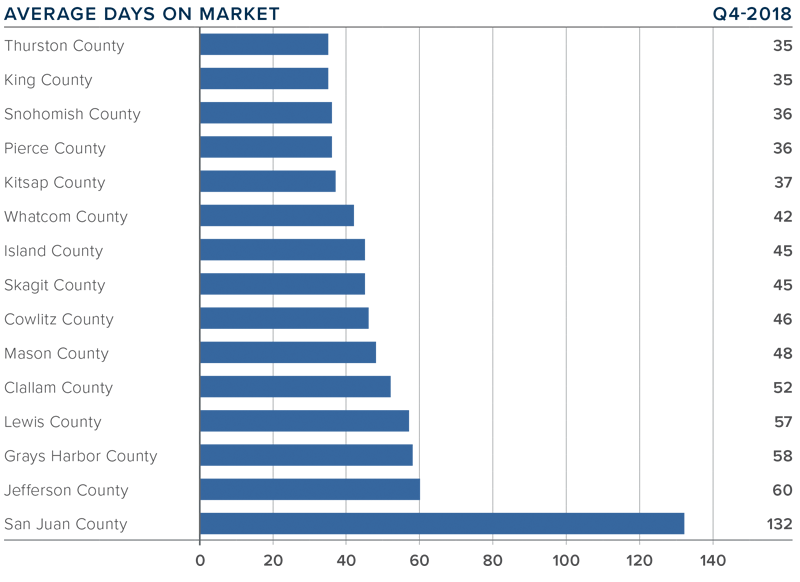
  • Thurston County joined King County as the tightest markets in Western Washington, with homes taking an average of 35 days to sell. There were eight counties that saw the length of time it took to sell a home drop compared to the same period a year ago. Market time rose in five counties and was unchanged in two.

  • Across the entire region, it took an average of 51 days to sell a home in the fourth quarter of 2018. This is down from 54 days in the fourth quarter of 2017 but up by 12 days when compared to the third quarter of 2018.

  • I suggested in the third quarter Gardner Report that we should be prepared for days on market to increase, and that has proven to be accurate. I expect this trend will continue, but this is typical of a regional market that is moving back to becoming balanced.​


CONCLUSIONS

This speedometer reflects the state of the region’s real estate market using housing inventory, price gains, home sales, interest rates, and larger economic factors. I am continuing to move the needle toward buyers as price growth moderates and listing inventory continues to rise.

2019 will be the year that we get closer to having a more balanced housing market. Buyer and seller psychology will continue to be significant factors as home sellers remain optimistic about the value of their home, while buyers feel significantly less pressure to buy. Look for the first half of 2019 to be fairly slow as buyers sit on the sidelines waiting for price stability, but then I do expect to see a more buoyant second half of the year.


As Chief Economist for Windermere Real Estate, Matthew Gardner is responsible for analyzing and interpreting economic data and its impact on the real estate market on both a local and national level. Matthew has over 30 years of professional experience both in the U.S. and U.K.

In addition to his day-to-day responsibilities, Matthew sits on the Washington State Governors Council of Economic Advisors; chairs the Board of Trustees at the Washington Center for Real Estate Research at the University of Washington; and is an Advisory Board Member at the Runstad Center for Real Estate Studies at the Unversity of Washington where he also lectures in real estate economics.

Design January 16, 2019

8 Ways to Make the Most of the Home You Have

"Staying Put" by architect and writer Duo Dickinson is not your typical architect's book about design. There's no obscure language nor design-for-design's-sake ideas. It is a practical, down-to-earth guide that walks anyone through the rational process of how to remodel your house to get the home you want, from how to think about your house and overcoming hurdles to a list of "Duo's Do's and Don'ts" for the homeowner. Along the way, there's plenty of nice before-and-after photos to help explain the points. Do read the book. You'll be glad you did.

Read on for eight of Dickinson's brightest suggestions:


Consider the compass points. The tips and illustrated examples are wonderfully straightforward. For example, we see a house that gets overheated, the siding degrades and the front door bakes in the sun because it all faces south.

Dickinson's common-sense advice: Rework the front of the house with a new wide porch that shades the front door and some smaller, yet well-sized windows to create a lot more curb appeal while reducing maintenance and energy consumption. It's a triple win: more beauty and comfort with less cost.

Avoid gutters. Statements such as "gutters and leaders are devout to be avoided" may sound like heresy to many, but certainly are the truth. Proving his point, Dickinson illustrates how a properly-built roof overhang can shed all the water it must without the complications, such as ice dams, caused by gutters.

Embrace small moves. Dickinson provides a wealth of simple solutions illustrated with before-and-after photos. He shows how to use small moves for big dividends, such as taking out a wall between a kitchen and a hallway to make room for more kitchen storage.

Enhance curb appeal. The book offers solutions to common problems with a particular style, such as how to improve and enhance an entrance into a split-level home.

Open up to the outside. Dickinson provides some excellent examples of how we can use modern windows and doors to strengthen the connection between inside and outside. Our homes, says Dickinson, no longer need be "later-day caves."

Find your home. Learning more about the style of the house you have will help you avoid obstacles in remodeling and recognize the best opportunities for improving your particular home.

Open up the inside. Snippets of advice sprinkled throughout the book are like refreshing raindrops that clear the cobwebs away. One such snippet: "If you walk through a room to get to a room, something is wrong." You know — it's when that new great room gets added onto a modest house, and the result is some kind of dyslexic creature that's really two houses rather than one.

So rather than even building an addition, Dickinson suggests you make the most of what you already have. In this example, widening the opening between rooms strengthens this room's connection with the rest of the home, increasing its utility and spaciousness.

Work with what you've got (before): Keeping the kitchen size the same while vaulting the ceiling dramatically increases the overall spaciousness of the room, as you'll see in the next photo.

Work with what you've got (after): Walls, doors, appliances, and even the skylight and kitchen sink were all left where they were. This all avoided costly plumbing, electrical and mechanical work and rework.

Working with what you've got (plans): Dickinson has included before-and-after floor plans for many of the examples. These plans help provide that much more context, allowing the reader to better understand what they may be able to do with the home they already have.

By Bud Dietrich AIA