Market News November 5, 2019

Oregon and Southwest Washington Real Estate Market Update


The following analysis of the Oregon and Southwest Washington real estate market is provided by Windermere Real Estate Chief Economist Matthew Gardner. We hope that this information may assist you with making better informed real estate decisions. For further information about the housing market in your area, please don’t hesitate to contact your Windermere agent. 


ECONOMIC OVERVIEW

The State of Oregon added 29,300 new jobs over the past 12 months, representing an annual growth rate of 1.5%. The current pace of job growth has slowed as we’ve moved through 2019. I anticipate this trend will continue.

The Southwest Washington market (Clark, Cowlitz, Skamania, and Klickitat counties) added 2,200 new jobs over the past 12 months, which represents an annual growth rate of 1.3%.

Oregon’s unemployment rate was 4% in August, down from 4.1% a year ago. In Southwest Washington, the unemployment rate was 5.8%, up from 4.9% a year ago.


HOME SALES

  • Third-quarter home sales dropped a very modest 1.5% compared to the same period last year, with a total of 17,885 transactions occurring.
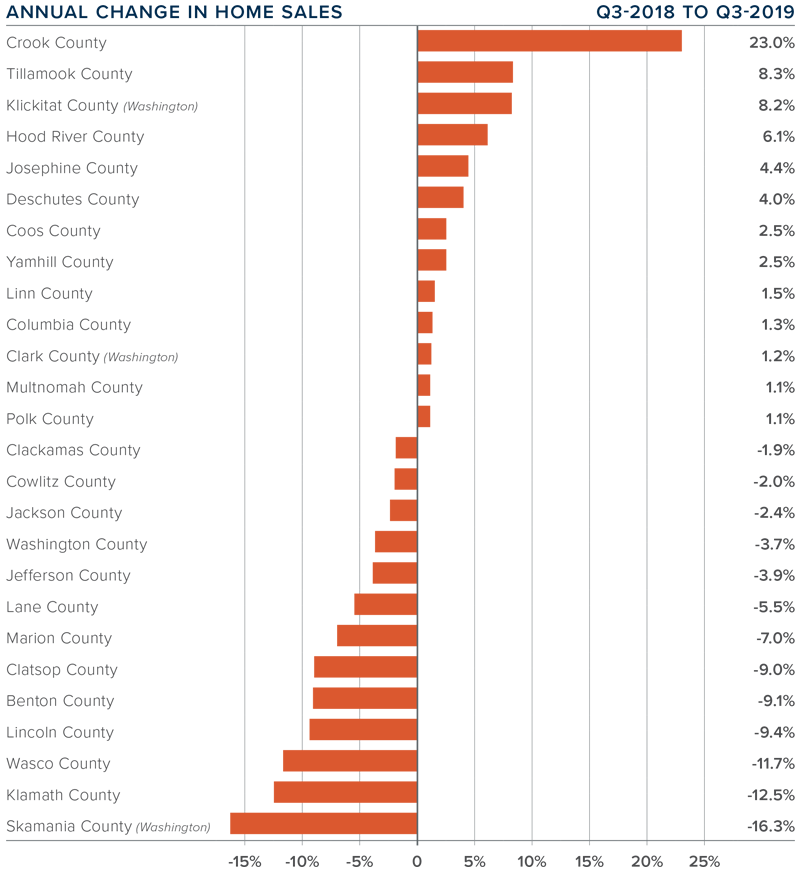
  • Sales rose fastest in Crook County, which saw a significant 23% increase compared to the third quarter of 2018. There were also solid increases in Tillamook and Klickitat counties. Home sales fell the most in Skamania, Klamath and Wasco counties, but they are relatively small markets so I am not overly concerned.
  • Year-over-year sales rose in 13 counties and dropped in the other 13 counties contained in this report.
  • Sales in the third quarter rose 7% compared to the second quarter of this year, which suggests that the region’s housing market remains quite buoyant.


HOME PRICES

  • The average home price in the region rose 3.5% year-over-year to $403,584. Sale prices were 0.6% higher compared to the second quarter of this year.
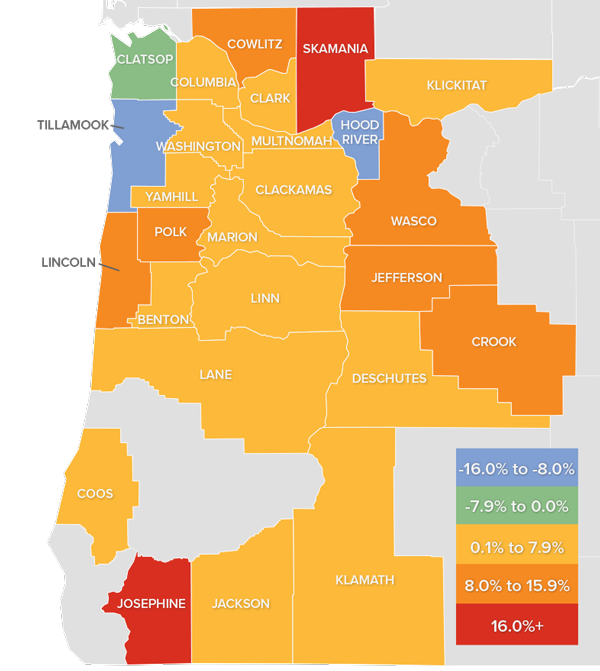
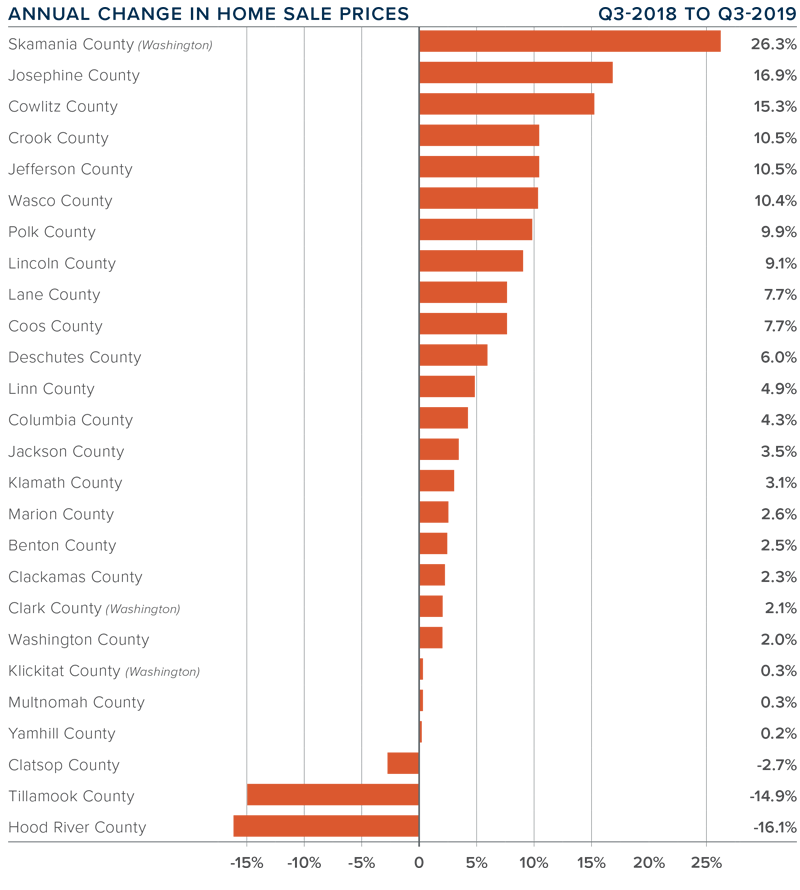
  • Skamania County led the market with the strongest annual price growth. Homes there sold for 26.3% more than a year ago. The greatest contraction in sale prices was in small Hood River and Tillamook counties. Smaller markets can be prone to significant swings, though, so I see no cause for concern.
  • All but three of the counties contained in this report experienced price growth compared to the third quarter of 2018. Although prices continue to appreciate, we are seeing some softening in appreciation in many markets.
  • The takeaway from this section is that price growth continues to moderate. Pervasively low mortgage rates will allow prices to continue rising, but at slower rates than over the past several years.


DAYS ON MARKET

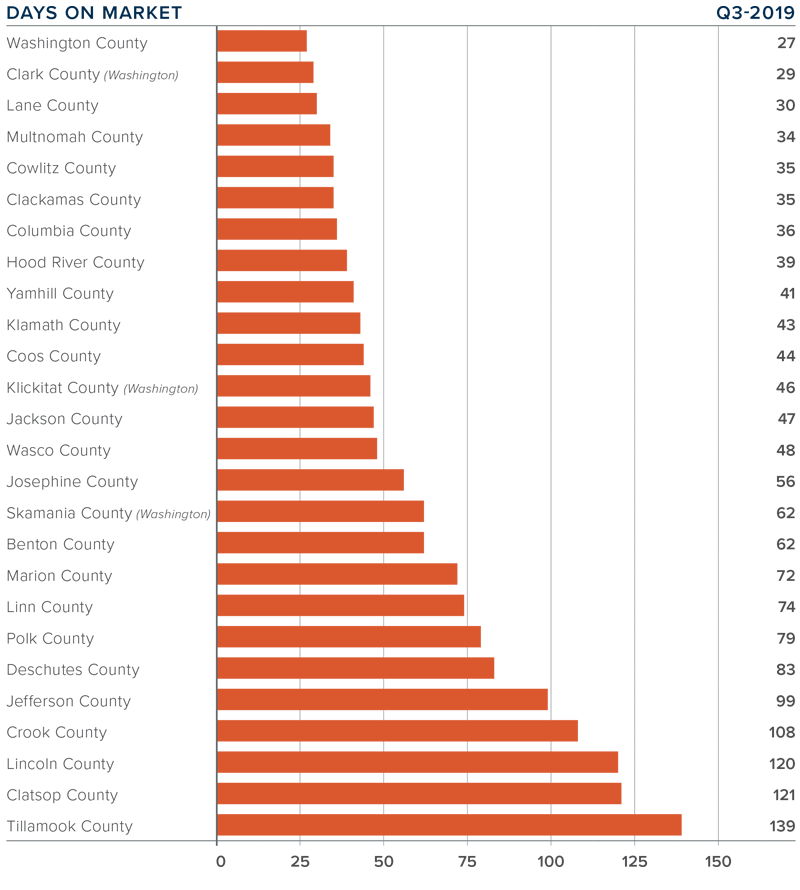
  • The average number of days it took to sell a home in the region dropped two days compared to the third quarter of 2018 and was down eight days compared to the second quarter of 2019.
  • The average time it took to sell a home last quarter was 62 days.
  • Compared to a year ago, 12 counties saw the length of time it took to sell a home drop, 1 remained static, and 13 saw market time rise.
  • Homes again sold fastest in Washington (27 days) and Clark (29 days) counties.


CONCLUSIONS

The speedometer reflects the state of the region’s real estate market using housing inventory, price gains, home sales, interest rates, and larger economic factors.

Although sales activity moderated in the quarter, there appears to still be significant demand for housing in the region. Inventory levels, although rising, are still lower than I would like. Given economic vitality in the state and low mortgage rates, I expect to see more home buyers start their search for a new home.

Because of these factors, I have moved the needle a little more in favor of home sellers.


ABOUT MATTHEW GARDNER

As Chief Economist for Windermere Real Estate, Matthew Gardner is responsible for analyzing and interpreting economic data and its impact on the real estate market on both a local and national level. Matthew has over 30 years of professional experience both in the U.S. and U.K.

Matthew also sits on the Washington State Governors Council of Economic Advisors; chairs the Board of Trustees at the Washington Center for Real Estate Research at the University of Washington; and is an Advisory Board Member at the Runstad Center for Real Estate Studies at the University of Washington.

Living November 4, 2019

Your November To-Do List

The month of November brings the end to daylight savings time, for most of us anyway, and the start to the holiday season. Don’t be left in the cold, jumpstart your preparations with this quick checklist.


Check Your Fire Safety System

Test your smoke alarms and CO detectors to make sure they’re in working order. Locate your fire extinguisher and be sure the gauge shows that it has enough pressure. If it isn’t already stored in or near the kitchen, re-locate it closer to the oven for quick action should Thanksgiving dinner go up in flames.


Clean Your Garbage Disposal

Don’t let a stinky garbage disposal ruin your appetite, keep it smelling fresh with a few pieces of lemon rind and some ice cubes. The lemon cleans and deodorizes the odor causing bacteria and the ice scrapes away any debris, as well as sharpen the blades.


Check and Repair Other Plumbing Issues

Run the water in each sink to determine if it’s draining properly.

If your bathroom sink is not draining quickly, a great natural way to clear debris, with ingredients that you likely already have in the house, is to put ½ cup of baking soda down the drain, followed by ½ cup of vinegar, then plug the drain and let it sit for an hour. When you unplug the drain, pour boiling water down until it drains quickly.

Send a snake down your tub drain, then add a hair trap to each drain to prevent future blockage, especially when you have guests over for the holidays.

For a slow kitchen drain, the likely cause is a build up of fat, oil, or grease (FOG drain clog). The best way to clear this kind of clog is with 2 liters of water and a few tablespoons of dish washing detergent. Pour slowing and keep pouring until the drain is cleared.


Pull Out Your Winter Essentials

For those of you in cold climates, get out the shovels and replenish the ice-melt bucket before the snow and ice hit this season. Don’t get caught in the storm, make sure they’re easy to access or easy to pull out when the weather forecast calls for below freezing temperatures.

It’s also a good idea to get out your snow gear and toys. Don’t miss an opportunity to play in the snow because you can’t get to your shed to pull out your snow boots, gloves, or sled!


Check and Replace Floor Protectors

Prevent damage to your floors by checking any pads on your chair legs as well as the rug mat.

Make sure the pads on your chairs, sofas, and tables are intact so when you move them, they won’t rub and scuff or dent flooring. Lift the rug to double check that the rug mat isn’t causing damage to the floor as well. Sometimes, the adhesive can stick to the floors, leaving a residue that’s almost impossible to clean, this is especially important on cement floors.


Prepare the Guest Bedroom

Has it been a while since anyone, besides the dog or cat, has slept in the guest bed? This is a great time of year to wash the sheets and clean the room in preparation for holiday guests. And don’t forget the cobwebs in the corners! Organize and re-stock the closets so your guests can easily access more blankets and towels during their stay. 


Once you’ve completed your November checklist, you can sit back with your hot apple cider and know that you’re ready for the holiday season.

Market News November 4, 2019

Idaho Real Estate Market Update


The following analysis of select counties of the Idaho real estate market is provided by Windermere Real Estate Chief Economist, Matthew Gardner. We hope that this information may assist you with making better-informed real estate decisions. For further information about the housing market in your area, please don’t hesitate to contact your Windermere agent.


ECONOMIC OVERVIEW

Following a trend that started last fall, job growth in Idaho continues to moderate. The addition of 15,700 new jobs year-over-year represents an annual growth rate of 2.1%. This is to be expected at this point in the economic cycle, though it’s worth adding that the current rate of job growth remains well above the national average of 1.4%.

In August, the state unemployment rate was 2.9%, marginally higher than the 2.8% rate a year ago. It cannot be disputed that the state remains at full employment. It’s also interesting to note that the employment rate remained below 3% even as the labor force rose by 2.2%, suggesting that the economy remains very strong and new entrants to the labor force are finding jobs relatively easily.


HOME SALES

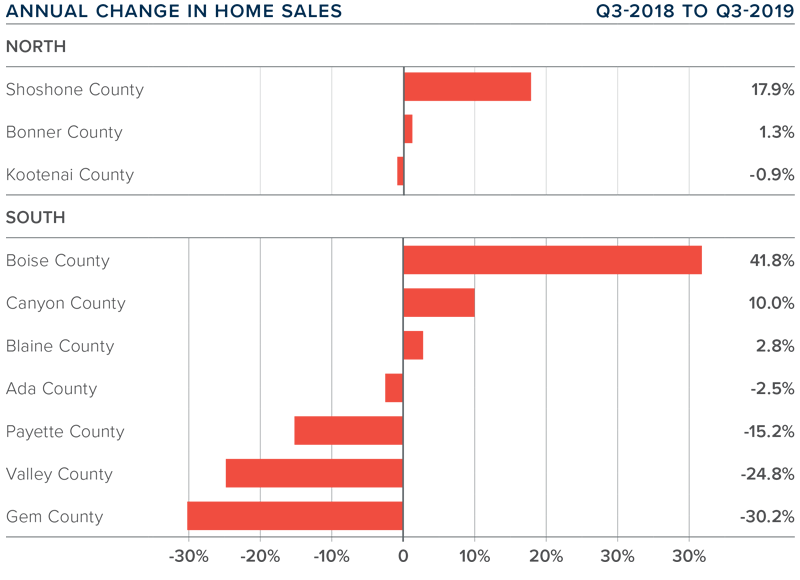
  • During the third quarter, 7,342 homes sold, representing a modest drop of 3.4% compared to the third quarter of 2018.
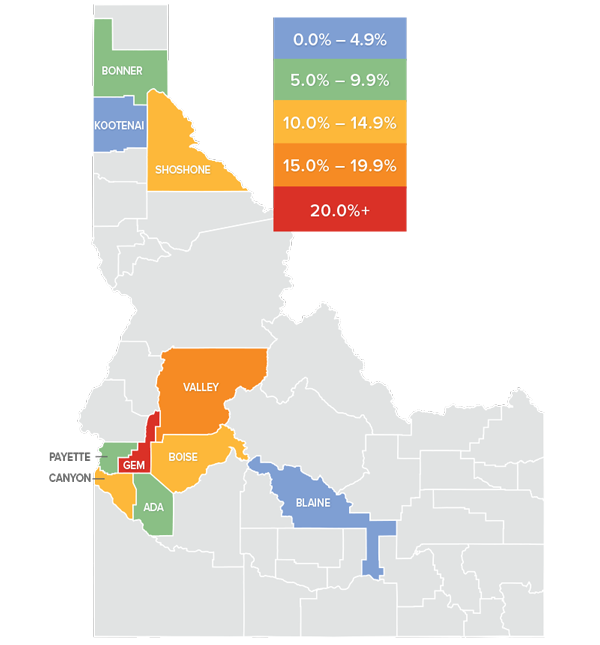
  • In Northern Idaho, Shoshone County experienced a 17.9% increase in sales over the third quarter of 2018. There was a modest increase in Bonner County and a very slight contraction in Kootenai County. In Southern Idaho, sales jumped in Boise and Canyon counties. Blaine County also saw a slight increase, but sales activity was lower in the rest of the region.
  • Year-over-year sales growth was positive in two Northern Idaho counties and three Southern Idaho counties.
  • Pending sales rose in the third quarter, suggesting that closed sales in the final quarter of this year are likely to be an improvement over current figures.


HOME PRICES

  • The average home price in the region rose 8% year-over-year to $367,963. Prices were 2.7% higher than in the second quarter of this year.
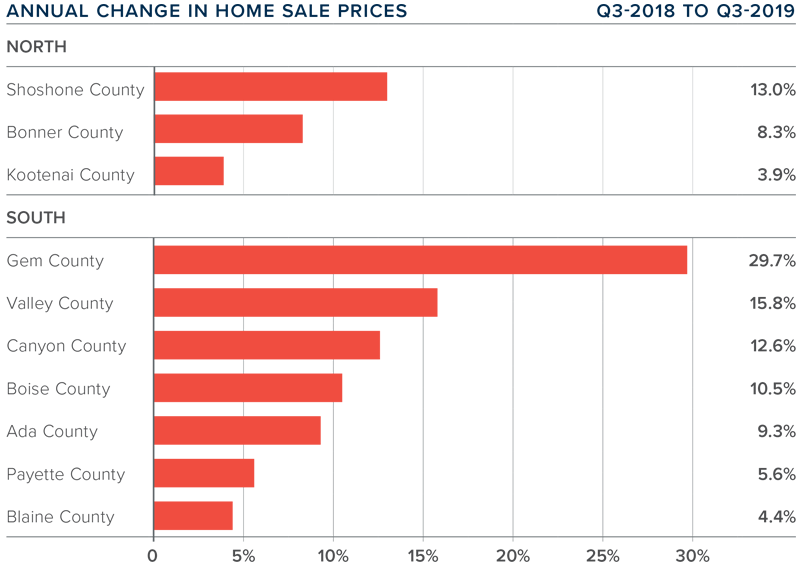
  • Prices rose in all counties compared to the third quarter of 2018.
  • In Northern Idaho, Shoshone County led the market with the strongest annual price growth. Bonner County also had solid price growth. In Southern Idaho, Gem County saw prices rise a very significant 29.7%, and there were notable increases in Valley, Canyon, and Boise counties.
  • Inventory continues to be an issue. The number of homes for sale is down 3.4% compared to the third quarter of 2018. Although listings are up 7% over the second quarter, the market remains very tight, and this is pushing prices higher.


DAYS ON MARKET

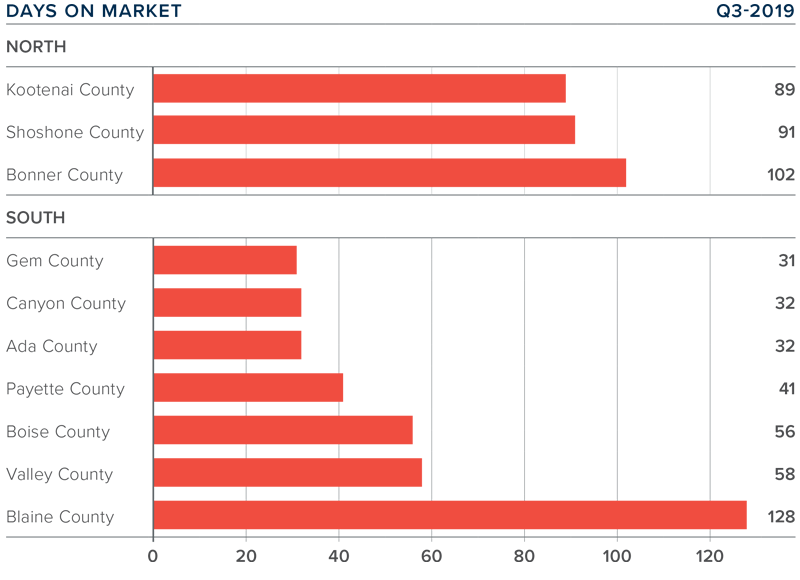
  • It took an average of 94 days to sell a home in Northern Idaho, and 54 days in the southern part of the state.
  • The average number of days it took to sell a home in the region dropped ten days compared to the third quarter of 2018. It was also ten days lower than in the second quarter of this year.
  • In Northern Idaho, days-on-market dropped across the board. In Southern Idaho, market time dropped in all counties except Ada and Canyon, though the rise in average market time was very modest.
  • Homes sold the fastest in Gem, Canyon, and Ada counties.


CONCLUSIONS

The speedometer reflects the state of the region’s housing market using housing inventory, price gains, home sales, interest rates, and larger economic factors.

Job growth continues to slow from the frenetic pace of the past few years but remains quite impressive. As is commonly known, economic/job growth leads to demand for homeownership and this continues to bode well for the Idaho market; however, home sales continue to be held back by a lack of inventory and this is leading to higher prices.

As such, it remains a sellers’ market so I have moved the needle just a little more in their direction.


ABOUT MATTHEW GARDNER

As Chief Economist for Windermere Real Estate, Matthew Gardner is responsible for analyzing and interpreting economic data and its impact on the real estate market on both a local and national level. Matthew has over 30 years of professional experience both in the U.S. and U.K.

Matthew also sits on the Washington State Governors Council of Economic Advisors; chairs the Board of Trustees at the WA Center for Real Estate Research; and is an Advisory Board Member at the Runstad Center for Real Estate Studies at the University of Washington where he also lectures in real estate economics.

Market News October 31, 2019

Central Washington Real Estate Market Update


The following analysis of the Central Washington real estate market is provided by Windermere Real Estate Chief Economist Matthew Gardner. We hope that this information may assist you with making better-informed real estate decisions. For further information about the housing market in your area, please don’t hesitate to contact your Windermere agent.


ECONOMIC OVERVIEW

Washington State employment has softened slightly to an annual growth rate of 2%, which is still a respectable number compared to other West Coast states and the country as a whole. In all, I expect that Washington will continue to add jobs at a reasonable rate though it is clear that businesses are starting to feel the effects of the trade war with China and this is impacting hiring practices.

The state unemployment rate was 4.6%, marginally higher than the 4.4% level of a year ago.

On a seasonally adjusted basis, the counties within Central Washington added 1,514 new jobs over the past 12 months, representing a growth rate of 0.7%. The local unemployment rate rose compared to a year ago from 5.4% to 6.7%. However, a significant reason for the rise in unemployment is due to a 2% increase in the civilian labor force.


HOME SALES

  • In the third quarter of 2019, home sales throughout Central Washington rose 4.3% year-over-year, with a total of 1,457 homes sold.
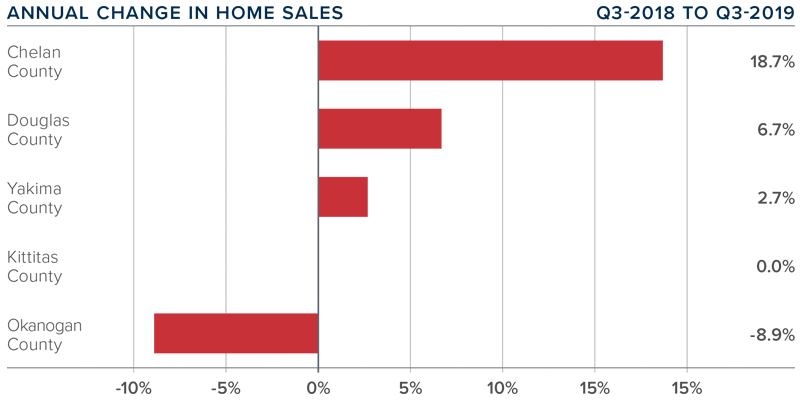
  • Sales rose significantly in Chelan County, which saw an increase of 18.7% over the third quarter of 2018. Sales also rose in Douglas and Yakima counties, but fell in Okanogan County, though the drop was modest (-14 units).
  • The number of pending home sales — an indicator of future closings — was up more than 70% compared to the second quarter, indicating that closings likely have further to rise in the final quarter of this year.
  • Listing activity in the quarter was lower compared to a year ago, but there were modest increases in Chelan and Yakima counties. It’s unlikely inventory levels will rise in the near term, but I do hope to see more choice in the market as we move into 2020.


HOME PRICES

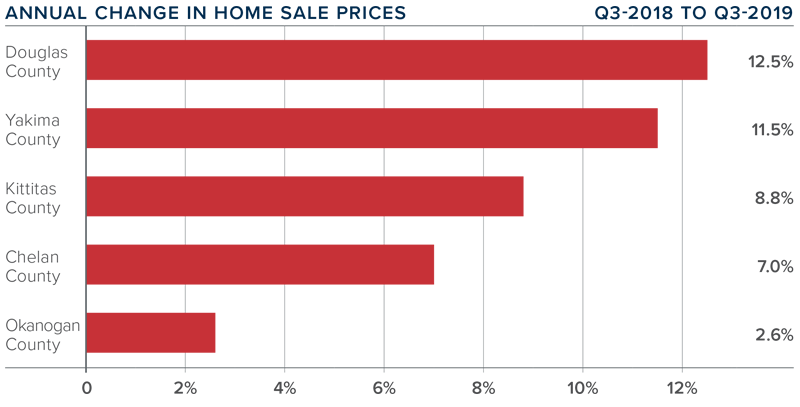
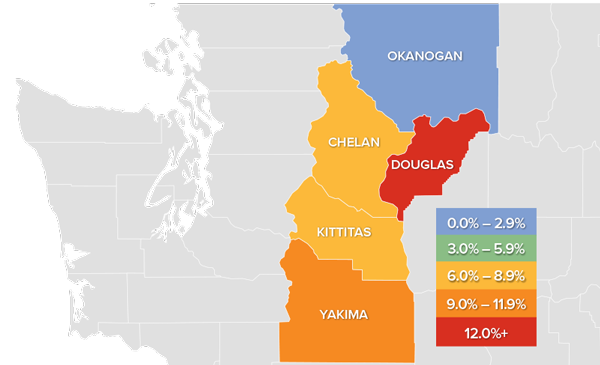
  • Year-over-year, the average home price in the region rose 10.4% to $360,903. Price growth continues to trend well above the long-term average, with limited inventory pushing prices higher.
  • Prices were 16% higher than in the second quarter of this year.
  • Prices rose in all counties contained in this report compared to the third quarter of 2018, with double-digit growth in Douglas and Yakima counties.
  • While the area continues to experience significant home-price growth, I expect to see a slowdown as we move through the quieter winter months.


DAYS ON MARKET

  • The average number of days it took to sell a home rose three days compared to the third quarter of 2018.
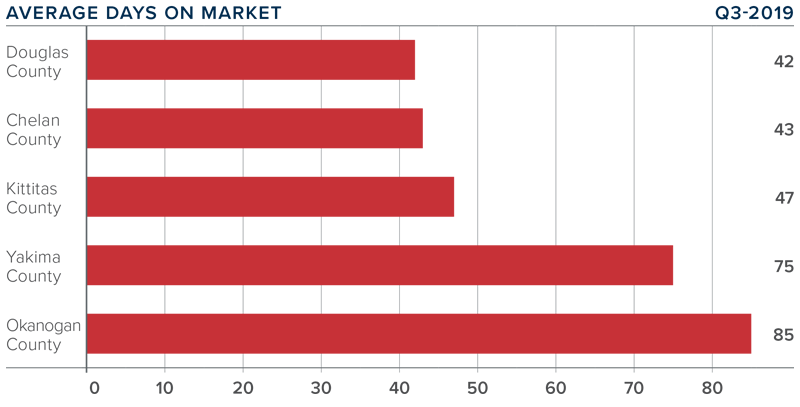
  • The average time it took to sell a home in the region was 58 days, down 24 days compared to the second quarter of 2019.
  • Three markets contained in this report — Chelan, Yakima, and Douglas — saw days-on-market drop from the same quarter in 2018. The balance of the region took slightly longer to sell a home.
  • Homes sold fastest in Douglas County, where it took an average of 42 days to sell a home. The greatest drop in the time it took to sell a home was also in Douglas County, where it took 10 fewer days than in the third quarter of 2018.


CONCLUSIONS

This speedometer reflects the state of the region’s real estate market using housing inventory, price gains, home sales, interest rates, and larger economic factors.

For the third quarter of 2019, I have moved the needle a little more in favor of sellers. Inventory levels remain low, and prices resumed their upward trajectory. This, in concert with very favorable mortgage rates, continues to bode well for home sellers.


ABOUT MATTHEW GARDNER

As Chief Economist for Windermere Real Estate, Matthew Gardner is responsible for analyzing and interpreting economic data and its impact on the real estate market on both a local and national level. Matthew has over 30 years of professional experience both in the U.S. and U.K.

In addition to his day-to-day responsibilities, Matthew sits on the Washington State Governors Council of Economic Advisors; chairs the Board of Trustees at the Washington Center for Real Estate Research at the University of Washington; and is an Advisory Board Member at the Runstad Center for Real Estate Studies at the University of Washington where he also lectures in real estate economics.

Market News October 30, 2019

Nevada Real Estate Market Update

The following analysis of the greater Las Vegas real estate market is provided by Windermere Real Estate Chief Economist Matthew Gardner. We hope that this information may assist you with making better-informed real estate decisions. For further information about the housing market in your area, please don’t hesitate to contact your Windermere agent.


ECONOMIC OVERVIEW

Job growth in the Las Vegas metropolitan area has been softening lately, but the area still added 17,900 new jobs over the past 12 months. This represents an annual growth rate of 1.8%, which is the lowest annual growth rate since the summer of 2012. Employment growth is still above the national average (1.4%) but slowing job growth came as a bit of a surprise. I will be watching to see if this is a pervasive trend or just a temporary blip.

The unemployment rate in the Las Vegas area was 4.4%, down from 4.7% a year ago.


HOME SALES

  • A total of 9,427 homes sold in the third quarter of 2019, an increase of 3.1% compared to the same period a year ago but 1.3% lower than in the second quarter of this year.
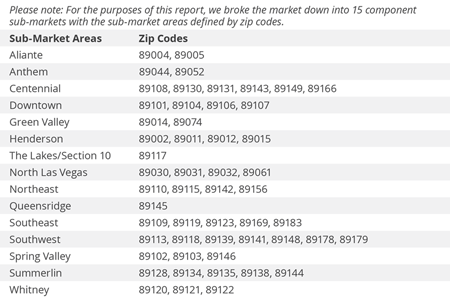
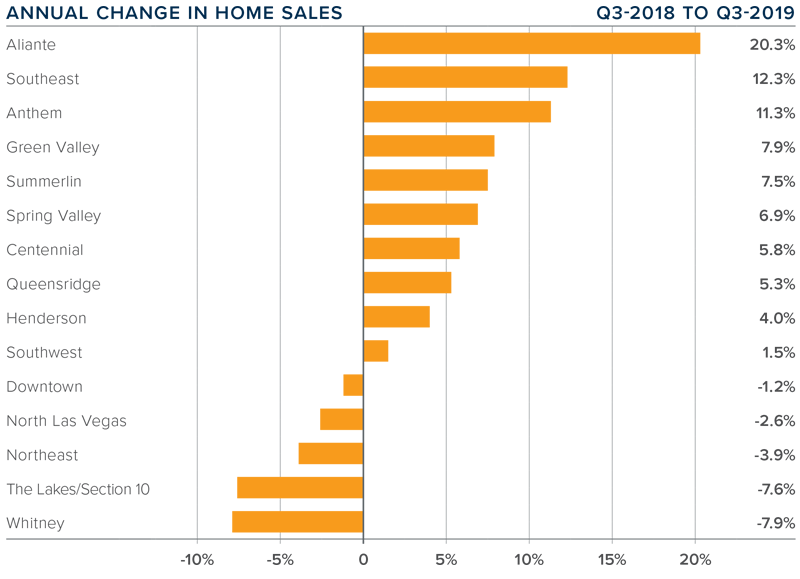
  • Home sales rose the most in the Aliante neighborhood. There were also double-digit increases in the Southeast Las Vegas and Anthem neighborhoods.
  • Sales were a mixed bag, with transactions rising in ten submarkets but falling in five. The most significant drop was in the Whitney neighborhood.
  • Pending sales rose a significant 13.1% year-over-year but were 5.3% lower compared to the second quarter of 2019. This suggests that closings in the final quarter of the year may be lower than in the third quarter.


HOME PRICES

  • Home prices in the area rose 5.7% compared to the third quarter of 2018 to an average of $321,606. Prices were up 2.3% compared to the second quarter of this year.
  • Home price increases picked back up in the third quarter and continue to rise at rates that are well above most of the nation. It’s clear that demand remains strong and, in concert with very attractive mortgage rates, I anticipate home prices will continue rising through the balance of the year and into 2020.
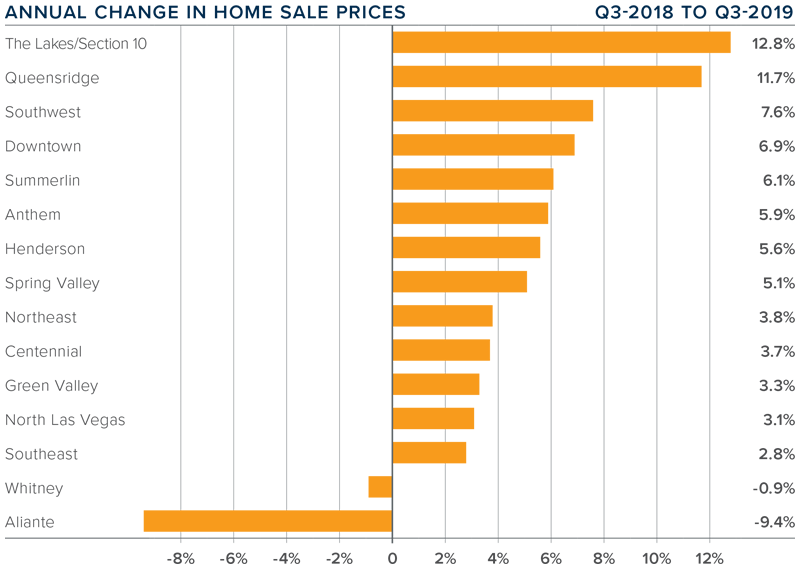
  • Prices rose in all but two submarkets compared to the same quarter last year. The strongest growth was in The Lakes/Section 10 Las Vegas submarket, where prices were up 12.8%.
  • The takeaway here is that, although job growth has slowed, demand for homeownership remains very strong.


DAYS ON MARKET

  • The average time it took to sell a home in the region rose 17 days compared to the third quarter of 2018.
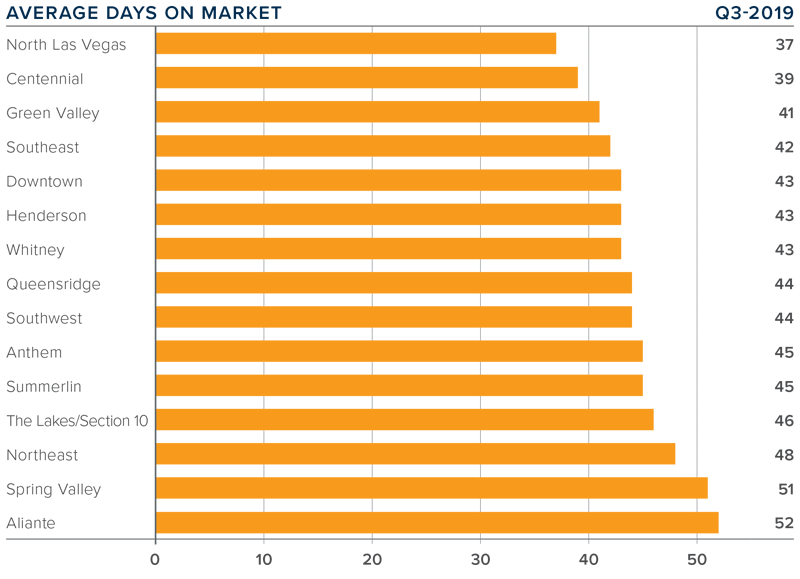
  • Regionwide, it took an average of 44 days to sell a home in the third quarter of 2019 — a day more than in the second quarter of the year.
  • Days-on-market rose in all submarkets compared to a year ago.
  • As mentioned above, market time rose compared to the third quarter of 2018, with the greatest increases occurring in the Northeast Las Vegas and Whitney neighborhoods, where home sales took 27 and 21 more days, respectively than in the third quarter of 2018.


CONCLUSIONS

The speedometer reflects the state of the region’s real estate market using housing inventory, price gains, home sales, interest rates, and larger economic factors.

Employment growth in Clark County is still positive and, although the number of new jobs created has been slowing, there is clearly demand for homeownership. But with demand comes rising home prices. When combined with ongoing low mortgage rates, these factors tell me that the Las Vegas market will be one of the strongest in the Western U.S. for home price growth in 2019.

There are more homes for sale, which I’m sure is of some relief to buyers, but the market continues to favor sellers, so I am leaving the needle in the same position as in the second quarter.


ABOUT MATTHEW GARDNER

As Chief Economist for Windermere Real Estate, Matthew Gardner is responsible for analyzing and interpreting economic data and its impact on the real estate market on both a local and national level. Matthew has over 30 years of professional experience both in the U.S. and U.K.

In addition to his day-to-day responsibilities, Matthew sits on the Washington State Governors Council of Economic Advisors; chairs the Board of Trustees at the Washington Center for Real Estate Research at the University of Washington; and is an Advisory Board Member at the Runstad Center for Real Estate Studies at the University of Washington where he also lectures in real estate economics.

More October 30, 2019

Windermere Foundation Has Raised Over $1.5 Million This Year!


Windermere offices throughout the Western U.S. have been busy raising money and making donations to non-profit organizations in their local communities that provide services to low-income and homeless families. And their efforts are paying off; so far this year we’ve raised over $1.5 million, bringing the total raised by the Windermere Foundation to $39.5 million since 1989.


Here are just a few examples of how our offices are giving back to their communities:


Fort Collins, Colorado

The Windermere Real Estate office in Fort Collins held its 5th Annual Windermere Foundation Tailgate Party on Friday, September 20. The family-friendly event featured food, drinks, a bouncy house obstacle course, corn hole, face painting, and live music. Over $1,800 was raised for the Windermere Foundation during this event. All proceeds from the tailgate “party with a purpose” benefitted Partners Mentoring Youth and Crossroads Safehouse.


Centralia, Washington

The Windermere office in Centralia, WA sponsored the “Down Home: A Toledo Shindig” event held at Bonanza BBQ on September 14 to benefit Toledo School District students in need. Local businesses and residents came together to donate auction items, food, and volunteer their time. Windermere Centralia office managing broker Paula Burrows, Dan Gorton owner of Bonanza BBQ, and others from the community formed a committee and spearheaded the organization of the fundraising event, seeing a need in the community that was not being met. The Gortons provided the venue and the BBQ. Other sponsors provided additional food items, entertainment, and big-ticket items for the auction. The event raised $34,000 for a fund to help provide basic needs for students in the school district, things that low-income families couldn’t otherwise afford.


Photo Courtesy of Josie Ray Photography


Spokane, Washington

The Windermere office in Spokane, WA held their annual Windermere Shoes and Socks Event at their local Big 5 sporting goods store on August 24. Windermere agents and family members volunteered their time to help 132 children select a pair of shoes and socks. An additional 250 pairs of socks were also donated by Liberty Lake Rotary. In total, the Windermere office donated over $5,400 to provide shoes and socks to local children in need.


Windermere offices are proud to host events in their communities, like the ones mentioned above. These generous donations to the Windermere Foundation further our mission to support low-income and homeless families in the areas where we live and work. If you’d like to help support programs in your community, please click the Donate button.


To learn more about the Windermere Foundation, visit WindermereFoundation.com.

Market News October 29, 2019

Utah Real Estate Market Update


The following analysis of select counties of the Utah real estate market is provided by Windermere Real Estate Chief Economist Matthew Gardner. We hope that this information may assist you with making better-informed real estate decisions. For further information about the housing market in your area, please don’t hesitate to contact your Windermere Agent.


ECONOMIC OVERVIEW

Utah’s non-agricultural employment rose by 42,100 jobs over the past 12 months, representing a solid growth rate of 2.8%. For perspective, the U.S growth rate is 1.4%. Year to date, Utah has added an average of 3,350 jobs per month, which is down from 4,200 per month last year. I expect we will continue to see modest slowing in employment gains as we move forward given the maturity of the economic cycle. Although the trend is slowing, I anticipate the state will see job growth around 2.8% in  2019. My early forecast for 2020 suggests that Utah will see employment growth of 2.6%.

In August, the state unemployment rate was 2.8%, below the 3.1% level of a year ago.


HOME SALES

  • In the third quarter of 2019, 10,562 homes sold, representing a solid increase of 8.2% compared to the same period in 2018 and 4.3% higher than in the second quarter of this year.
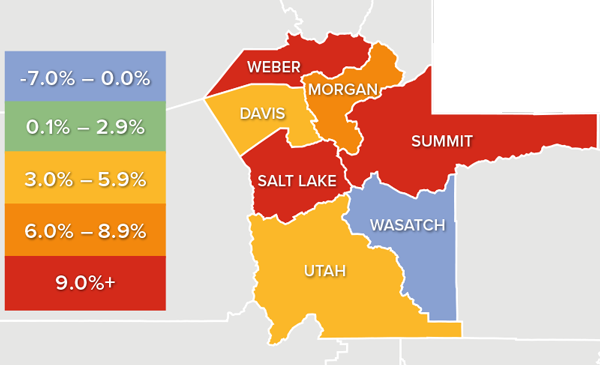
  • Total sales activity rose in all but the very small Morgan County. Year-over-year, sales rose by double digits in three counties, with impressive increases in Summit and Utah counties.
  • The number of homes for sale in the third quarter was only 2.6% higher than in the same period a year ago but was 11% higher than the second quarter of this year. There continues to be significantly more choice in the market, which is good news for home buyers.
  • Pending sales in the third quarter were up 13% compared to a year ago, but were 7% lower than in the second quarter, suggesting that closings in the final quarter of this year may drop from current levels.


HOME PRICES

  • The average home price in the region continued to rise in the third quarter, with a year-over-year increase of 9% to an average of $401,638. Sale prices were 2.5% higher than in the second quarter of this year.
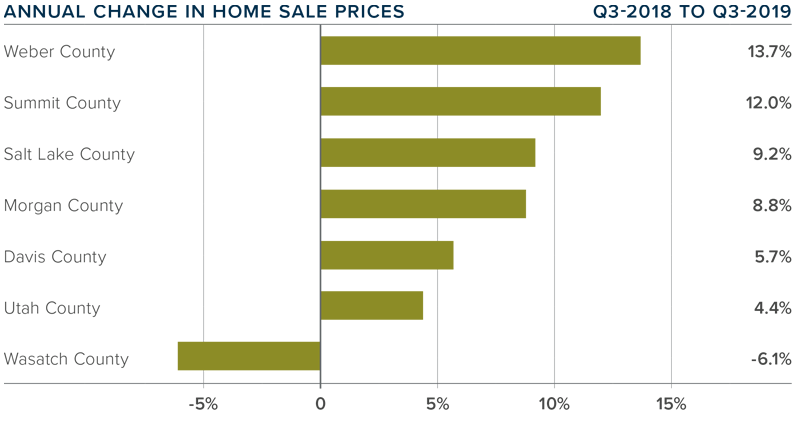
  • All but Wasatch County saw price increases compared to the same period a year ago. The contraction of price in Summit County was significant, but, because it is a small and very expensive area, I am not overly concerned this represents a pervasive trend.
  • Appreciation was again strongest in Weber County, where sale prices were up by 13.7% to $298,333. As the most affordable market in the area, this is not surprising.
  • The takeaway here is that home prices continue to appreciate at significant rates. I still expect to see some moderation in price growth as we move through the year and into 2020, but Utah will clearly continue to outperform the nation as a whole.


DAYS ON MARKET

  • The average number of days it took to sell a home in the counties covered by this report rose eight days compared to the third quarter of 2018.
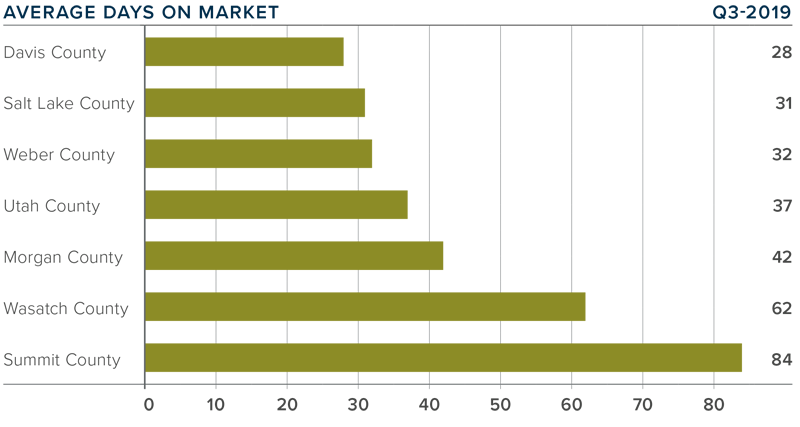
  • Homes sold fastest in Davis, Salt Lake, and Weber counties, and slowest in the expensive Summit County. All counties saw days-on-market rise compared to the third quarter of 2018.
  • During the third quarter of this year, it took an average of 45 days to sell a home in the region, down from 53 days in the second quarter.
  • The Utah economy is still outperforming almost all other states and this will continue to drive housing demand.


CONCLUSIONS

This speedometer reflects the state of the region’s real estate market using housing inventory, price gains, home sales, interest rates, and larger economic factors.

For the third quarter of 2019, I have moved the needle a little more in favor of sellers. Although the area has seen a modest increase in the number of homes for sale and days-on-market, prices, pending sales, and closed sales are higher, which certainly favors sellers.


ABOUT MATTHEW GARDNER

As Chief Economist for Windermere Real Estate, Matthew Gardner is responsible for analyzing and interpreting economic data and its impact on the real estate market on both a local and national level. Matthew has over 30 years of professional experience both in the U.S. and U.K.

In addition to his day-to-day responsibilities, Matthew sits on the Washington State Governors Council of Economic Advisors; chairs the Board of Trustees at the Washington Center for Real Estate Research at the University of Washington; and is an Advisory Board Member at the Runstad Center for Real Estate Studies at the University of Washington where he also lectures in real estate economics.

Market News October 28, 2019

Eastern Washington Real Estate Market Update


The following analysis of the Eastern Washington real estate market is provided by Windermere Real Estate Chief Economist Matthew Gardner. We hope that this information may assist you with making better-informed real estate decisions. For further information about the housing market in your area, please don’t hesitate to contact your Windermere agent.


ECONOMIC OVERVIEW

Washington State employment has softened slightly to an annual growth rate of 2%, which is still a respectable number compared to other West Coast states and the country as a whole. In all, I expect that Washington will continue to add jobs at a reasonable rate, but it’s clear that businesses are starting to feel the effects of the trade war with China and this is impacting hiring practices. My most recent economic forecast suggests that statewide job growth in 2019 will rise by 2.2%, with a total of 88,400 new jobs created.

The state unemployment rate last quarter was 4.6%, marginally higher that the 4.4% level of a year ago. The Eastern Washington market added 14,588 total jobs over the past 12 months, representing an annual growth rate of 3.1%. That said, and even as the region added jobs, the unemployment rate rose to 5.6% from 4.7% a year ago. This does not worry me though, as the county data is not seasonally adjusted, and the areas covered by this report tend to see unemployment rates rise as we approach the winter months.


HOME SALES

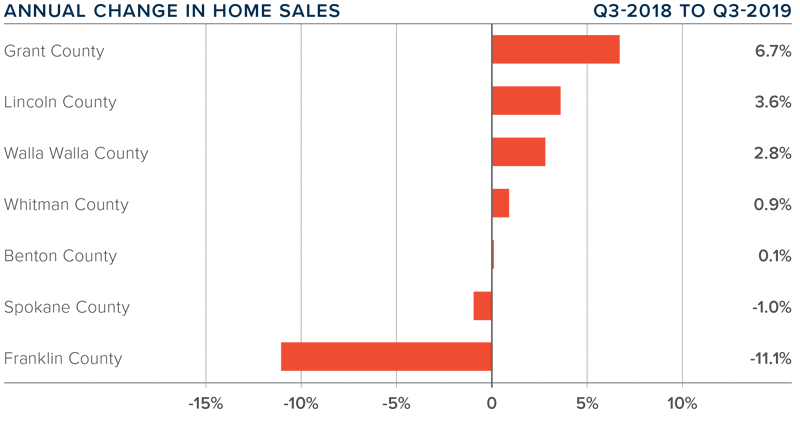
  • Home sales throughout Eastern Washington were down by a modest .5% compared to the same quarter in 2018, with a total of 4,176 closed sales.
  • Pending home sales in the region were 16% higher than second quarter, suggesting that fourth quarter closings will likely be higher.
  • The drop in home sales was driven by Franklin and Spokane counties, while all other counties covered in this report saw sales rise.
  • The average number of homes for sale in the quarter was 16.6% lower than a year ago, suggesting that the market remains very tight. I do not anticipate a significant increase in listings until next spring.


HOME PRICES

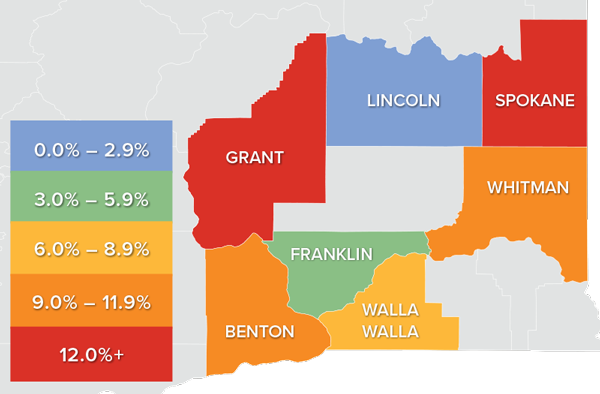
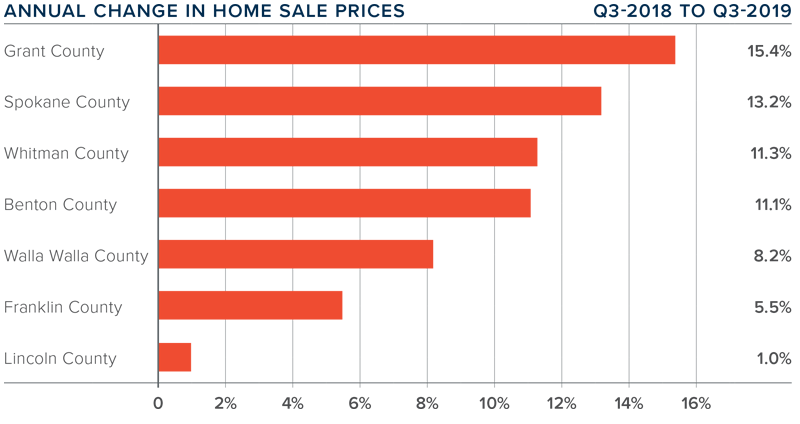
  • Year-over-year, the average home price in Eastern Washington rose by a significant 12.1% to $303,658. Prices were also 3.4% higher than in the second quarter.
  • As mentioned in the previous section, low inventory levels are pervasive and are likely the most significant hurdle to many home buyers. Low inventory continues to put upward pressure on prices.
  • Prices rose in all counties contained in this report, with Benton, Whitman, Grant, and Spokane counties showing double-digit price gains.
  • The takeaway is that average home-price growth in Eastern Washington remains well above the long-term average.


DAYS ON MARKET

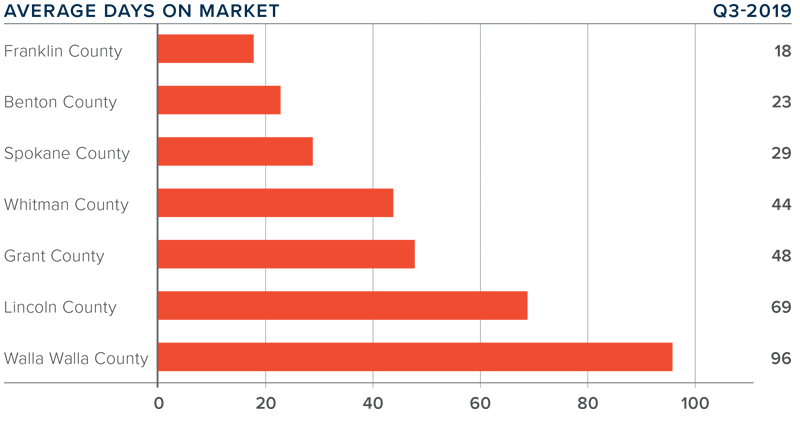
  • The average time it took to sell a home in Eastern Washington in the third quarter of 2019 was 47 days.
  • During the third quarter, it took the same number of days to sell a home in Eastern Washington as it did a year ago.
  • The regional market was split: it took longer to sell homes in Lincoln and Walla Walla counties, but days on market dropped in Grant, Spokane, Benton, Whitman, and Franklin counties.
  • It took five fewer days to sell a home in the third quarter than it did in the second quarter of this year.


CONCLUSIONS

This speedometer reflects the state of the region’s real estate market using housing inventory, price gains, home sales, interest rates, and larger economic factors.

Home sales are up and so are prices, which certainly favors sellers. However, mortgage rates remain remarkably competitive and this is allowing buyers to afford more house for their money. Inventory levels are still well below what I would like to see and, therefore, the Eastern Washington housing market remains very tight. As such, I am moving the needle just a little more in favor of home sellers.


ABOUT MATTHEW GARDNER

As Chief Economist for Windermere Real Estate, Matthew Gardner is responsible for analyzing and interpreting economic data and its impact on the real estate market on both a local and national level. Matthew has over 30 years of professional experience both in the U.S. and U.K.

In addition to his day-to-day responsibilities, Matthew sits on the Washington State Governors Council of Economic Advisors; chairs the Board of Trustees at the Washington Center for Real Estate Research at the University of Washington; and is an Advisory Board Member at the Runstad Center for Real Estate Studies at the University of Washington where he also lectures in real estate economics.

Market News October 24, 2019

Colorado Real Estate Market Update


The following analysis of the Metro Denver & Northern Colorado real estate market is provided by Windermere Real Estate Chief Economist Matthew Gardner. We hope that this information may assist you with making better-informed real estate decisions. For further information about the housing market in your area, please don’t hesitate to contact your Windermere real estate agent. 


ECONOMIC OVERVIEW

Colorado’s economy picked up, adding 64,900 new non-agricultural jobs over the past 12 months — a growth rate of 2.4%. Over the past three months, the state added an impressive 28,300 new jobs.

In August, the state unemployment rate was 2.8%, down from 3.4% a year ago. Unemployment rates in all the counties contained in this report were lower than a year ago. It is fair to say that all markets are now at full employment.


HOME SALES

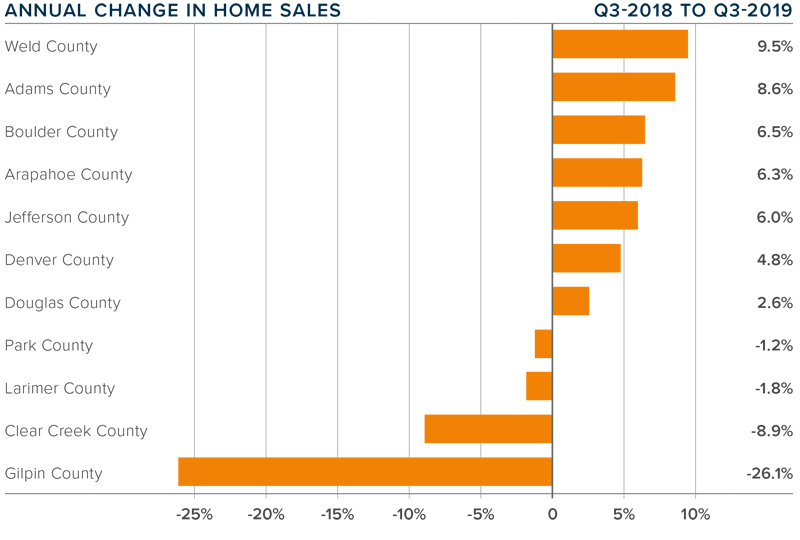
  • In the third quarter of 2019, 17,562 homes sold. This is an increase of 5.1% compared to the third quarter of 2018 but 1.6% lower than the second quarter (which can be attributed to seasonality). Pending sales — a sign of future closings —rose 9.7%, suggesting that closings in the final quarter of 2019 are likely to show further improvement.
  • Seven counties contained in this report saw sales growth, while four saw sales activity drop. I am not concerned about this because all the markets that experienced slowing are relatively small and, therefore, subject to significant swings.
  • I was pleased to see an ongoing increase in the number of homes for sale (+16.9%), which means home buyers have more choice and feel less urgency.
  • Inventory levels are moving higher, and demand for housing appears to be quite strong. As I predicted last quarter, home sales rose in the third quarter compared to a year ago.


HOME PRICES

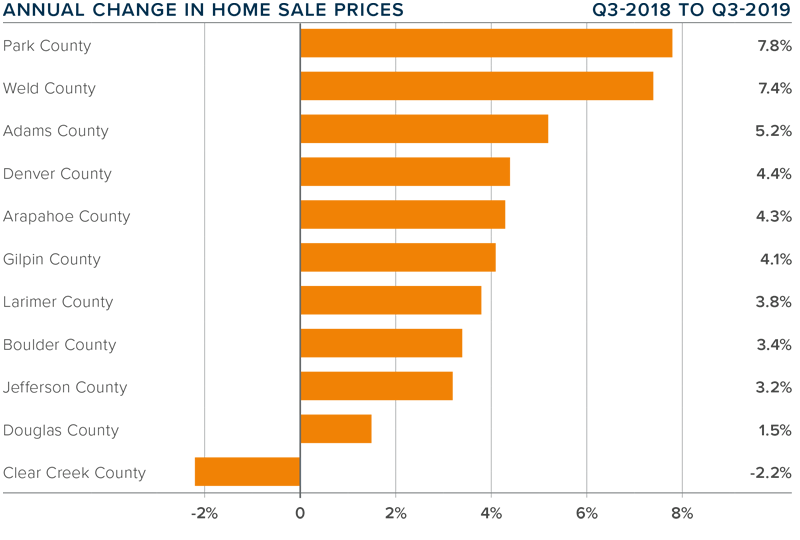
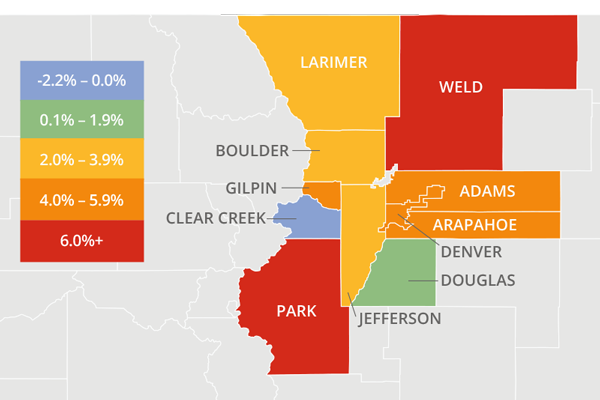
  • Home prices continue to trend higher, with the average home price in the region rising 3.8% year-over-year to $477,776.
  • Interest rates are at very competitive levels and are likely to remain below 4% for the balance of the year. As a result, prices will continue to rise but at a more modest pace.
  • Appreciation was again strongest in Park County, where prices rose 7.8%. We also saw strong growth in Weld County, which rose 7.4%. Home prices dropped in Clear Creek County, but, as mentioned earlier, this is a small market so I don’t believe this is indicative of an ongoing trend.
  • Affordability remains an issue in many Colorado markets and this will act as a modest headwind to ongoing price growth.


DAYS ON MARKET

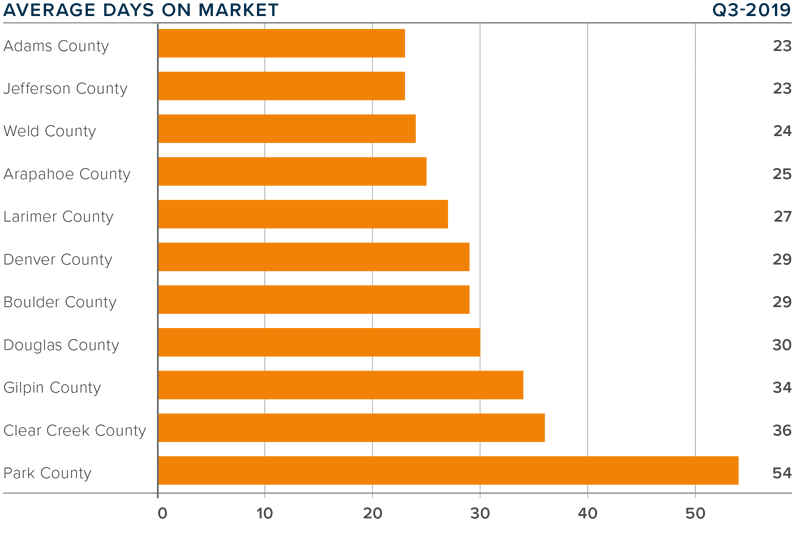
  • The average number of days it took to sell a home in the markets contained in this report rose seven days compared to the third quarter of 2018.
  • The amount of time it took to sell a home rose in all counties compared to the third quarter of 2018.
  • It took an average of 30 days to sell a home in the region — an increase of 1 day compared to the second quarter of this year.
  • The Colorado housing market is still performing well, and the modest increase in the length of time it took to sell a home is a function of greater choice in homes for sale and buyers taking a little longer to choose a home.


CONCLUSIONS

This speedometer reflects the state of the region’s real estate market using housing inventory, price gains, home sales, interest rates, and larger economic factors.

For the third quarter of 2019, I continue the trend I started last summer and have moved the needle a little more in favor of buyers. I continue to closely monitor listing activity to see if we get any major bumps above the traditional increase because that may further slow home price growth. However, the trend for 2019 will continue to be a move toward a more balanced market.


ABOUT MATTHEW GARDNER

As Chief Economist for Windermere Real Estate, Matthew Gardner is responsible for analyzing and interpreting economic data and its impact on the real estate market on both a local and national level. Matthew has over 30 years of professional experience both in the U.S. and U.K.

In addition to his day-to-day responsibilities, Matthew sits on the Washington State Governors Council of Economic Advisors; chairs the Board of Trustees at the Washington Center for Real Estate Research at the University of Washington; and is an Advisory Board Member at the Runstad Center for Real Estate Studies at the University of Washington where he also lectures in real estate economics.

Market News October 23, 2019

Southern California Real Estate Market Update

The following analysis of the Southern California real estate market is provided by Windermere Real Estate Chief Economist Matthew Gardner. We hope that this information may assist you with making better-informed real estate decisions. For further information about the housing market in your area, please don’t hesitate to contact your Windermere agent.


ECONOMIC OVERVIEW

The counties covered by this report — Los Angeles, San Diego, San Bernardino, Orange, and Riverside — saw total employment rise by 21,700 jobs (+0.2%) year-over-year, reversing the drop in total employment in the second quarter. Job growth was a mixed bag among the counties though. There was growth in San Diego, Riverside, and San Bernardino counties but modest drops in Los Angeles and Orange counties.

Over the past year, the unemployment rate in Southern California dropped from 4.4% to 4.2%, with total unemployment down year-over-year by 21,700 persons. In all, this was a pretty good report and demonstrates a return to normalized growth rates after the state re benchmarking, which led the second quarter numbers to appear worse than they really were.


HOME SALES

  • There were 49,214 home sales in the third quarter. This was an increase of 3.5% from the same period in 2018 but 1.6% lower than in the second quarter of this year.
  • Pending home sales (an indicator of future closings) rose 10.3% compared to a year ago, suggesting that total sales in the fourth quarter are likely to be an improvement over current levels.
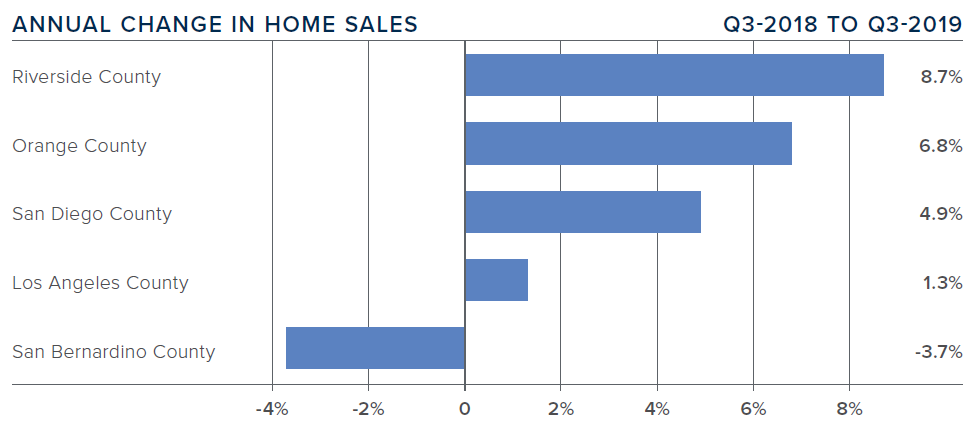
  • Third-quarter home sales rose in all counties other than San Bernardino. There was also a significant growth in the relatively affordable Riverside County (+8.7%).
  • There was an average of 39,208 active listings in the third quarter — down 5.9% from a year ago and 2.4% lower than in the second quarter of the year. The market is tighter than I would like but there is clearly demand from buyers.


HOME PRICES

  • Year-over-year, average home prices in the region were modestly higher (+1.2%). Compared to the second quarter of this year, they were a mere 0.5% higher.
  • Affordability concerns, combined with slowing job growth, suggest that price growth is likely to continue to taper in many Southern California markets.
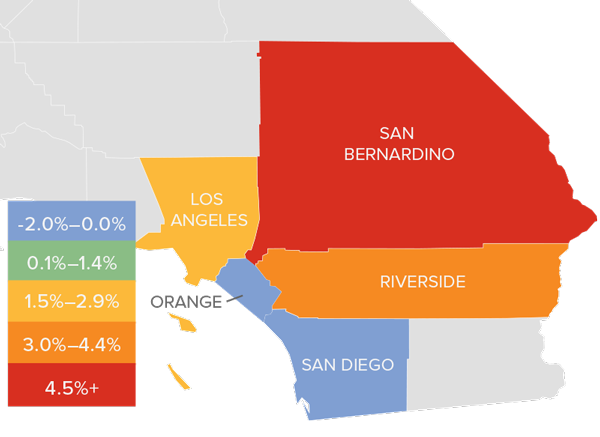
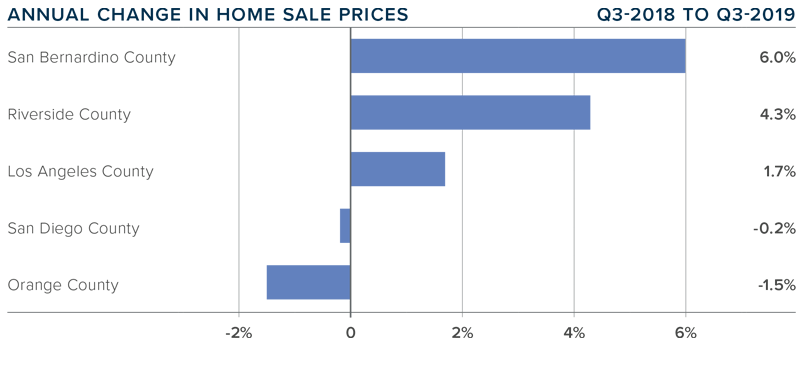
  • Continuing the trend we saw in the second quarter of this year, price growth in the third quarter was mixed. Sale prices were higher in three counties but modestly lower in two. San Bernardino County took over the number one spot for price growth (+6%). Riverside County also saw significant price gains. Sale prices dropped in San Diego and Orange counties, but this is not of great concern at the present time.
  • On a year-over-year basis, I still expect home prices to continue rising, but this is primarily due to very low mortgage rates.


DAYS ON MARKET

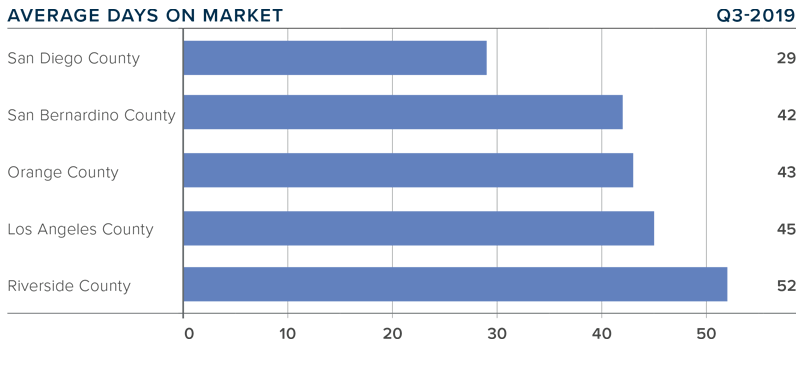
  • The average time it took to sell a home in the region was 42 days, which is 4 days more than a year ago, but 2 days less than last quarter.
  • All markets saw the time it took to sell a house increase compared to the third quarter of 2018.
  • Homes in San Diego County continue to sell at a faster rate than other markets in the region. In the second quarter, it took an average of 29 days to sell a home. This is only 2 more days than it took a year ago.
  • Market time is increasing, which may concern some, but it is simply a move back to a more balanced market.


CONCLUSIONS

The speedometer reflects the state of the region’s real estate market using housing inventory, price gains, home sales, interest rates, and larger economic factors.

Inventory levels and affordability concerns in many markets continue to have a slowing effect on price growth. However, pending sales are higher which suggests that the market is still buoyant, thanks in part to competitive mortgage rates.

Given the drop in the number of homes for sale, I have moved the needle a little more toward sellers.


ABOUT MATTHEW GARDNER

As Chief Economist for Windermere Real Estate, Matthew Gardner is responsible for analyzing and interpreting economic data and its impact on the real estate market on both a local and national level. Matthew has over 30 years of professional experience both in the U.S. and U.K.

In addition to his day-to-day responsibilities, Matthew sits on the Washington State Governors Council of Economic Advisors; chairs the Board of Trustees at the Washington Center for Real Estate Research at the University of Washington; and is an Advisory Board Member at the Runstad Center for Real Estate Studies at the University of Washington where he also lectures in real estate economics.