Market News April 29, 2022

Q1 2022 Southern California Real Estate Market Update

The following analysis of select counties of the Southern California real estate market is provided by Windermere Real Estate Chief Economist Matthew Gardner. We hope that this information may assist you with making better-informed real estate decisions. For further information about the housing market in your area, please don’t hesitate to contact your Windermere Real Estate agent.


Regional Economic Overview

The counties covered by this report have now recovered 1.89 million of the 2.17 million jobs that were lost due to the pandemic. With only 279,000 jobs needed for a full recovery, it is likely that the region will break above the pre-pandemic employment level by sometime this summer. Of note is that both Riverside and San Bernardino counties have already seen a full job recovery, and current employment levels are now more than 33,000 above the pre-pandemic peak. The region’s unemployment rate in February was 4.8%, down from 9.8% a year ago. The lowest rates were in Orange (3.7%) and San Diego (4%) counties. The highest rate was again in Los Angeles County, where it was 5.4%. In all, the Southern California economy continues to recover, with the Inland Empire performing very well. Of course, the region’s performance is influenced by Los Angeles County given its size, which is still acting as a bit of a drag to the overall job recovery. Although I hope the pace of job growth here will pick up, it will be held back by a labor force that has fewer persons in it today than it did at the start of 2020.

Southern California Home Sales

In the first quarter of the year, 42,069 homes sold, which is down 9.7% from a year ago. There were 9.6% fewer sales than in the fourth quarter of 2021.

Pending home sales—an indicator of future closings—rose more than 10% from the prior quarter, suggesting that sales activity in the spring may pick back up.

The most significant decreases in sales were in Orange and San Diego counties, but all markets fell. Significant supply-side issues persist as listing activity was down more than 25% compared to the same period in 2021. There were 8.9% fewer homes for sale than in the fourth quarter of 2021.

Buyers are looking, but choices are limited. Although listing activity has picked up in San Diego County, the other markets have not seen any growth. This will hopefully change as we move through the spring, but it’s not guaranteed, and buyers will likely remain frustrated.
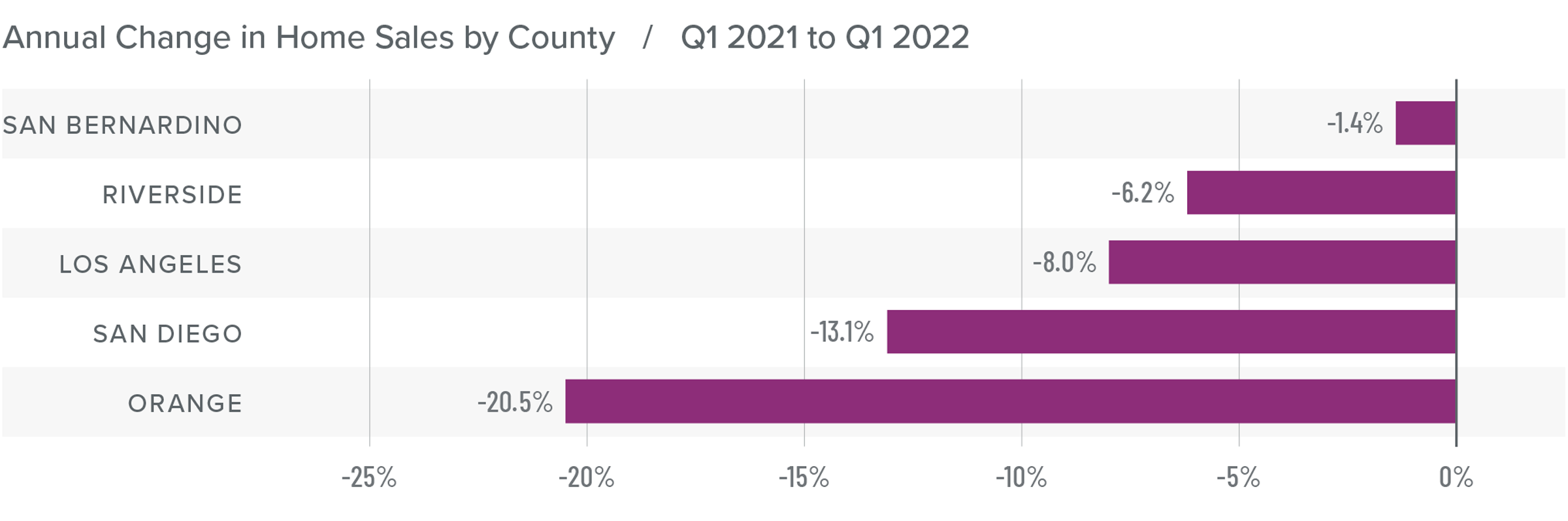
A bar graph showing the annual change in home sales for various counties in Southern California between Q1 2021 and Q1 2022.

Southern California Home Prices

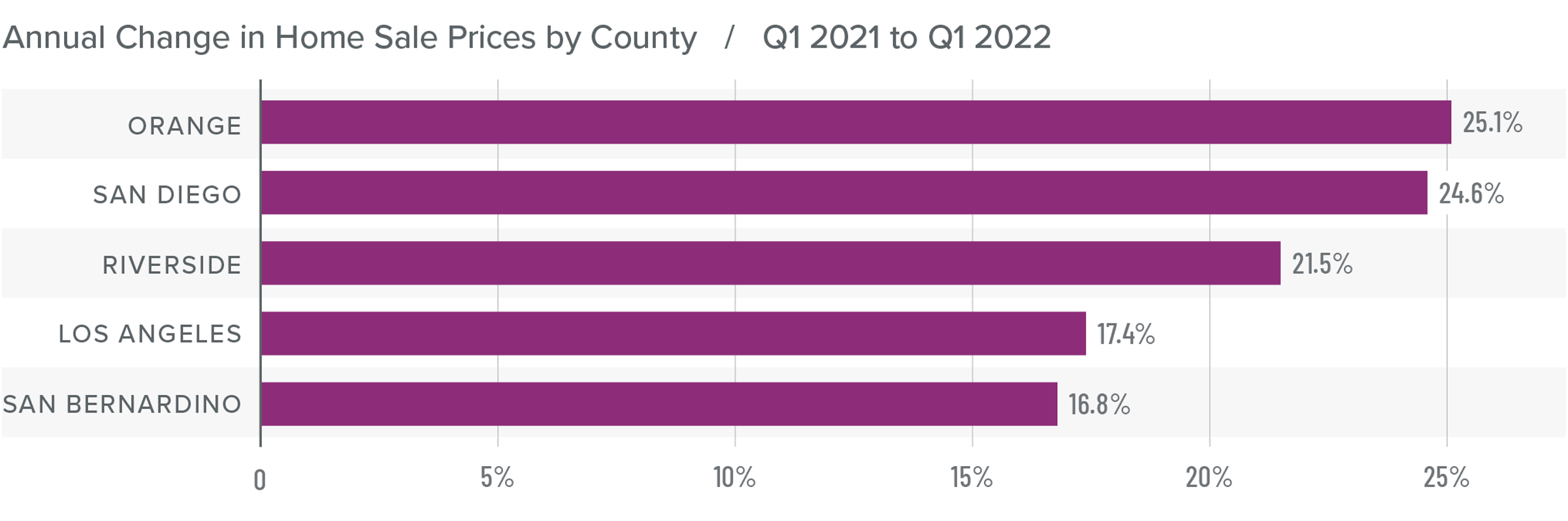
Home prices in the first quarter rose 19.1% compared to a year ago and were 4.2% higher than in the fourth quarter of 2021.

It appears as if the spike in mortgage rates during the first quarter has not dampened the market and, with more buyers than sellers, the market is still extremely hot.

The region saw double-digit price growth across the board, with Orange County again leading the way. Of note is that home prices in Riverside County rose 10.7% compared to the prior quarter.

Rising mortgage rates and prices are certain to push affordability down even further, which is concerning. The question remains whether rising financing costs will start to slow the market. For the time being, this does not appear to be the case.
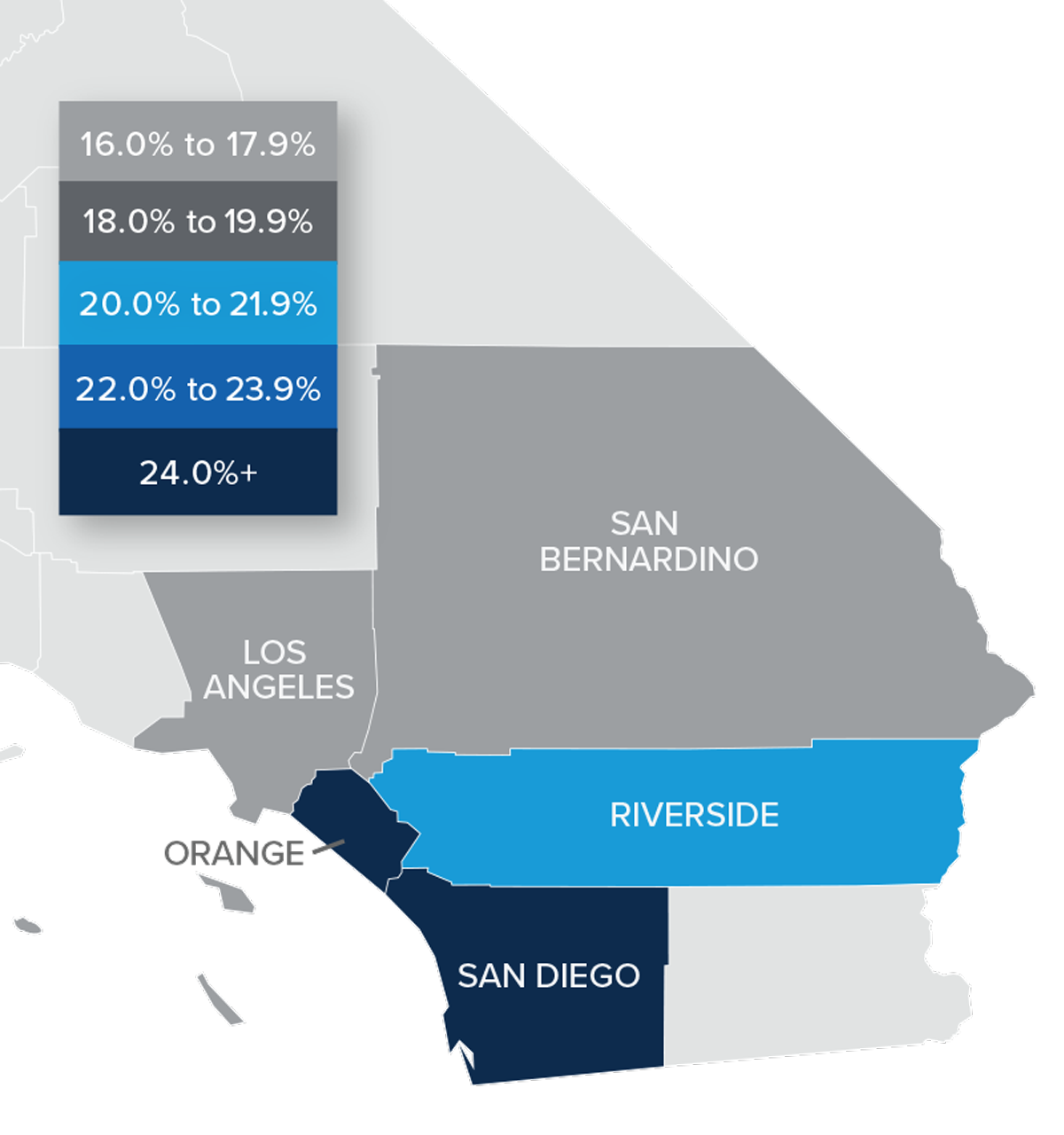
A map showing the year-over-year real estate market percentage changes in various counties in Southern California for Q1 2022.

A bar graph showing the annual change in home sale prices for various counties in Southern California from Q1 2021 to Q1 2022.

Mortgage Rates

Average rates for a 30-year conforming mortgage were 3.11% at the end of 2021, but since then have jumped over 1.5%—the largest increase since 1987. The speed of the surge in rates is due to the market having quickly priced in the seven-to-eight rate increase that the Fed is expected to implement this year.

Because the mortgage market has priced this into the rates they are offering today, my forecast suggests that we are getting close to a ceiling in rates, and it is my belief that they will rise modestly in the second quarter before stabilizing for the balance of the year.

A bar graph showing the average rates for a 30-year conforming mortgage, plus Matthew Gardner's mortgage rate forecasts for Q2 2022 through Q1 2023.

Southern California Days on Market

In the first quarter of the year, the average time it took to sell a home in the region was 22 days, which was 6 fewer days than a year ago but 1 day longer than in the final quarter of 2021.

Homes in San Diego County continue to sell at a faster rate than other markets in the region. In the fourth quarter, it took an average of 16 days to sell a home there—two fewer days than it took a year ago.

The other four counties also saw the time it took to sell drop compared to a year ago, but market time rose very modestly in Riverside, Los Angeles, and San Bernardino counties compared to the fourth quarter of 2021.

Limited inventory combined with growing buyer demand is creating a very tight market. Any increases we see in the number of homes for sale in the coming months is not likely to be enough to satisfy buyers.
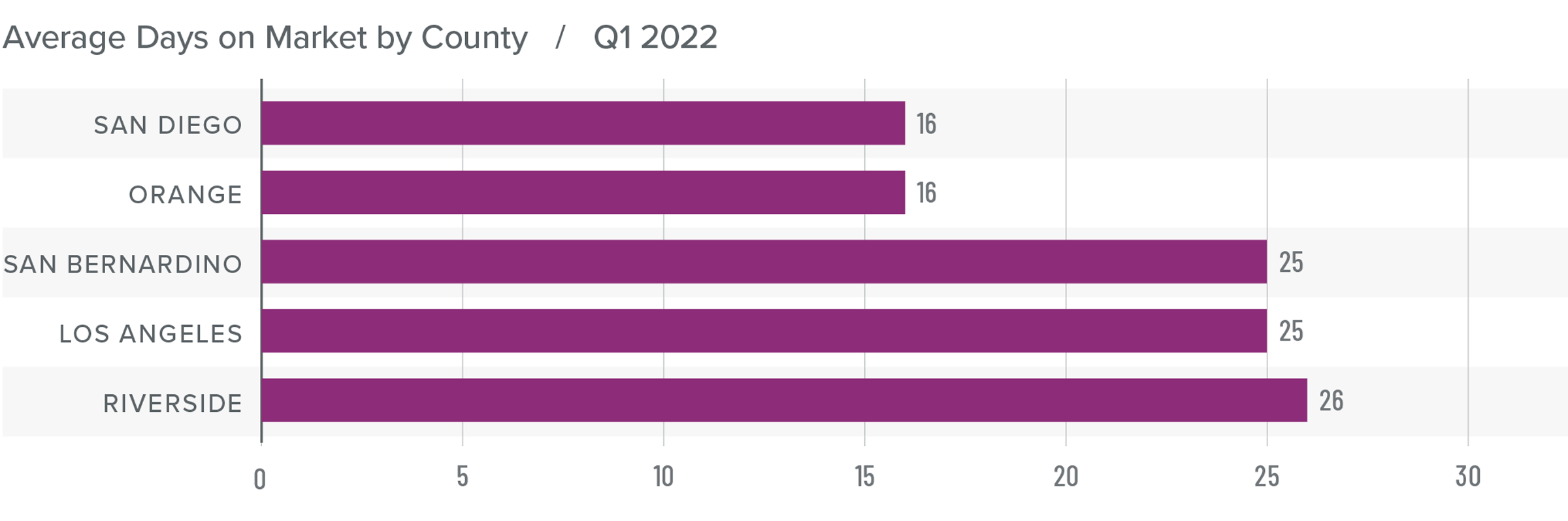
A bar graph showing the average days on market for homes in various counties in Southern California during Q1 2022.

Conclusions

This speedometer reflects the state of the region’s real estate market using housing inventory, price gains, home sales, interest rates, and larger economic factors.

Despite low inventory levels and rising mortgage rates, the housing market continues to perform very well in Southern California. The spike in mortgage rates has yet to have a significant impact on price growth or demand; however, it will be interesting to check back in the second quarter because if there is an impact, that’s when we would likely see it.
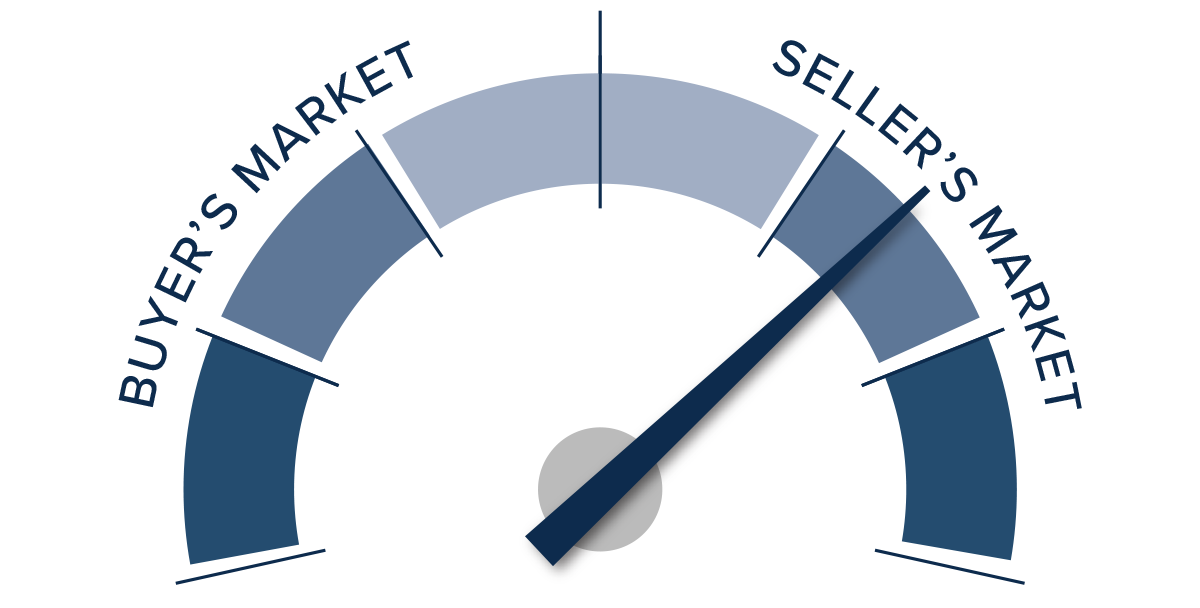
A speedometer graph indicating a seller's market in Southern California during Q1 2022.

Sellers remain in the driver’s seat, but if higher financing costs start to affect the market, there may be a shift back towards more normal conditions. My instincts suggest that this will not be the case, but only time will tell. With all of this in mind, I have left the needle in the same position as last quarter.

About Matthew Gardner

Matthew Gardner - Chief Economist for Windermere Real Estate

As Chief Economist for Windermere Real Estate, Matthew Gardner is responsible for analyzing and interpreting economic data and its impact on the real estate market on both a local and national level. Matthew has over 30 years of professional experience both in the U.S. and U.K.

In addition to his day-to-day responsibilities, Matthew sits on the Washington State Governors Council of Economic Advisors; chairs the Board of Trustees at the Washington Center for Real Estate Research at the University of Washington; and is an Advisory Board Member at the Runstad Center for Real Estate Studies at the University of Washington where he also lectures in real estate economics.

Market News April 29, 2022

Q1 2022 Colorado Real Estate Market Update

The following analysis of select counties of the Colorado real estate market is provided by Windermere Real Estate Chief Economist Matthew Gardner. We hope that this information may assist you with making better-informed real estate decisions. For further information about the housing market in your area, please don’t hesitate to contact your Windermere Real Estate agent.


Regional Economic Overview

The most recent jobs data showed that by February of this year Colorado had recouped all of the more than 375,000 jobs that were shed due to the pandemic and had added an additional 6,000 positions. The recovery in employment was faster than I had expected, which has led me to revise my 2022 forecast: I now predict that the Colorado job market will increase by 4% this year and will add more than 112,000 new jobs. The state unemployment rate in February was 4%, which is well below the pandemic peak of 11.8% but still above the 2.6% average in 2019. Regionally, unemployment rates ranged from a low of 3.1% in Boulder to a high of 4% in the Colorado Springs and Greeley metropolitan areas.

Colorado Home Sales

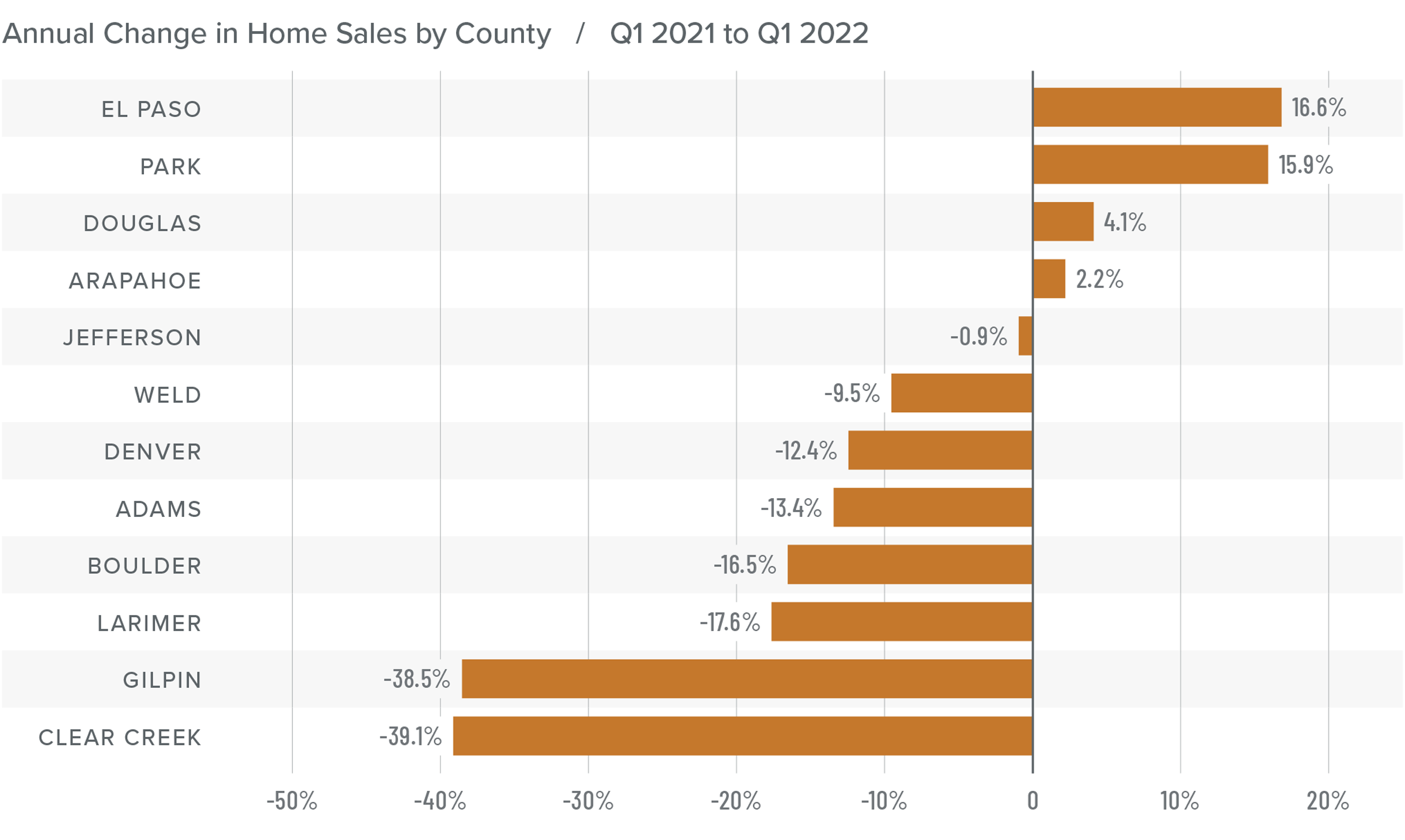
In the first quarter of the year, 8,178 homes sold, representing a drop of 6.3% compared to the same period a year ago and 30% lower than in the fourth quarter of 2021.

Sales increased in 4 of the 12 counties covered by this report but fell in the balance of the market areas.

Similar to last quarter, low inventory levels continue to constrict sales. Listing activity was 17.3% lower than the same period in 2021 and 29.5% lower than in the fourth quarter of 2021.

Pending sales, which are an indicator of future closings, also declined, though the drop of 4.3% is not that significant. That said, unless we see a surge in inventory levels in the spring, second quarter sales may also be light.

A bar graph showing the annual change in home sales for various counties in Colorado between Q1 2021 and Q1 2022.

Colorado Home Prices

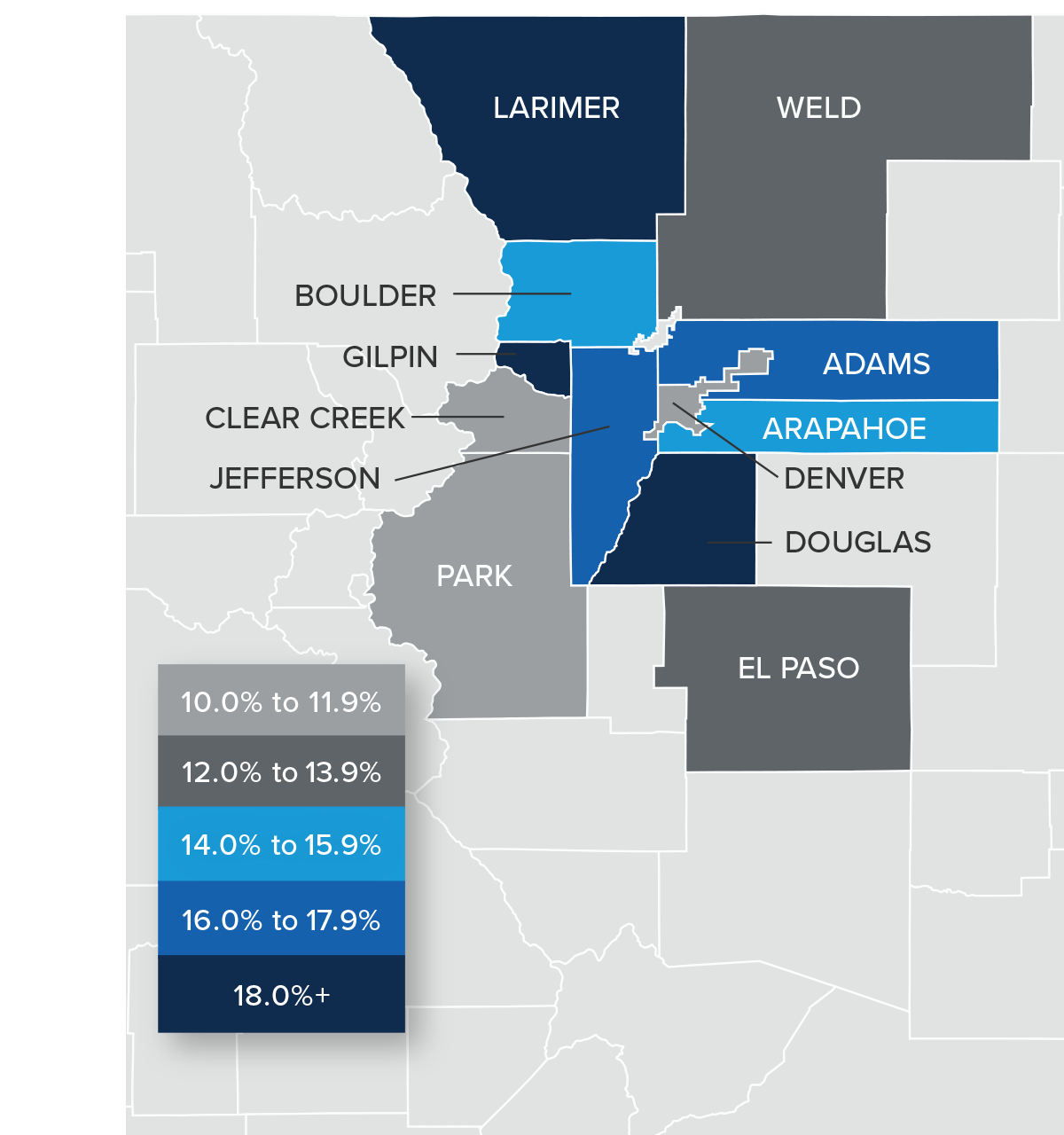
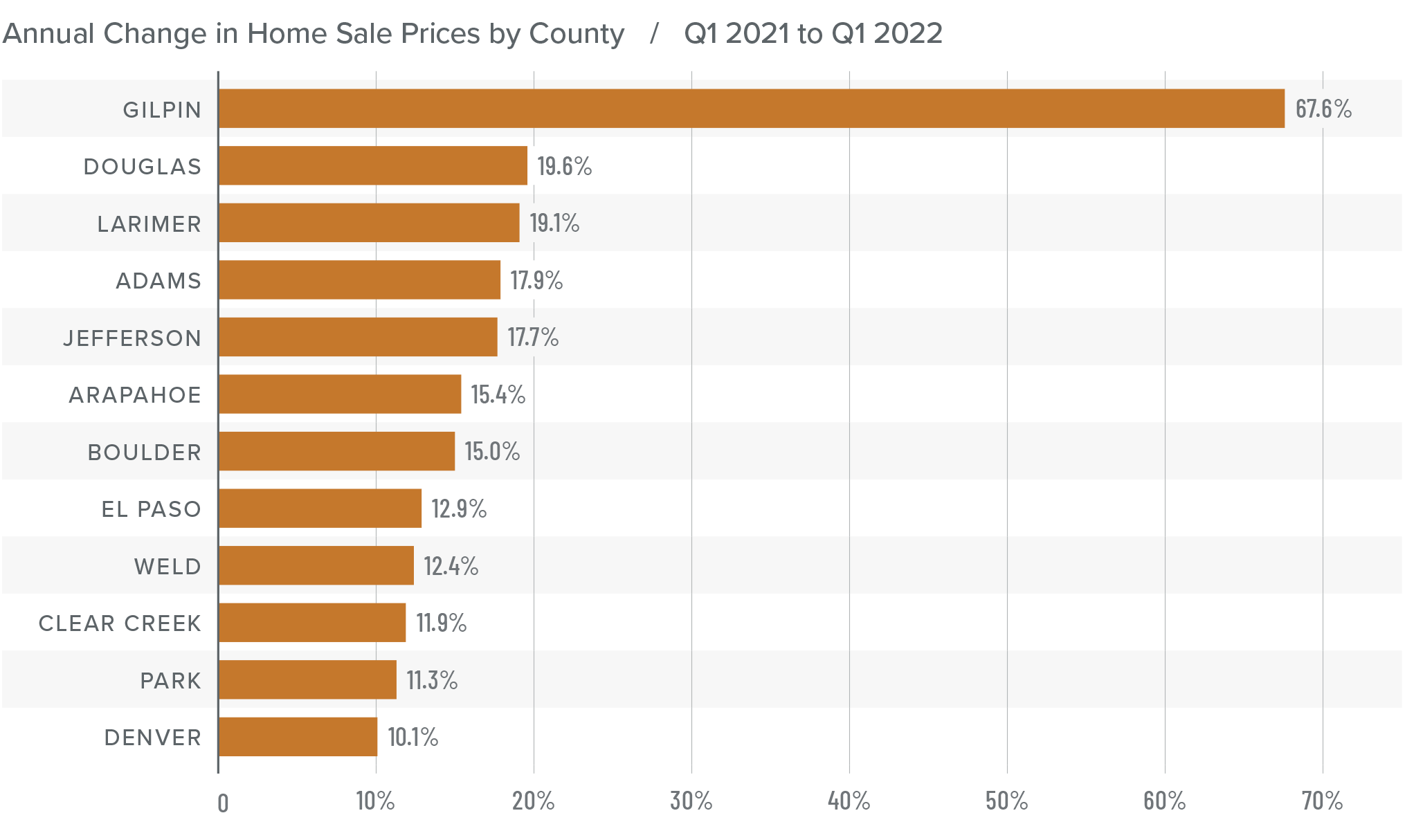
With limited inventory and rising mortgage rates, buyers were motivated, as demonstrated by the 14.9% increase in average prices compared to a year ago. Home prices in first quarter averaged $637,963, which is 4.5% higher than last quarter.

Boulder County continues to see average sale prices holding above $1 million. Although we have seen some softening in list prices, I expect this market to remain above the $1 million mark as we move through the year.

Year over year, prices rose by double-digits across all markets covered by this report, with a huge jump in the small Gilpin market.

With little in the way of choice for buyers—as well as a “fear of missing out” given rising mortgage rates—it’s no surprise there was such solid price appreciation. That said, there is normally a lag between rising rates and any impact on home prices. The second quarter should indicate if the jump in rates has had a softening effect on price growth.

A map showing the year-over-year real estate market percentage changes in various counties in Colorado for Q1 2022.

A bar graph showing the annual change in home sale prices for various counties in Colorado from Q1 2021 to Q1 2022.

Mortgage Rates

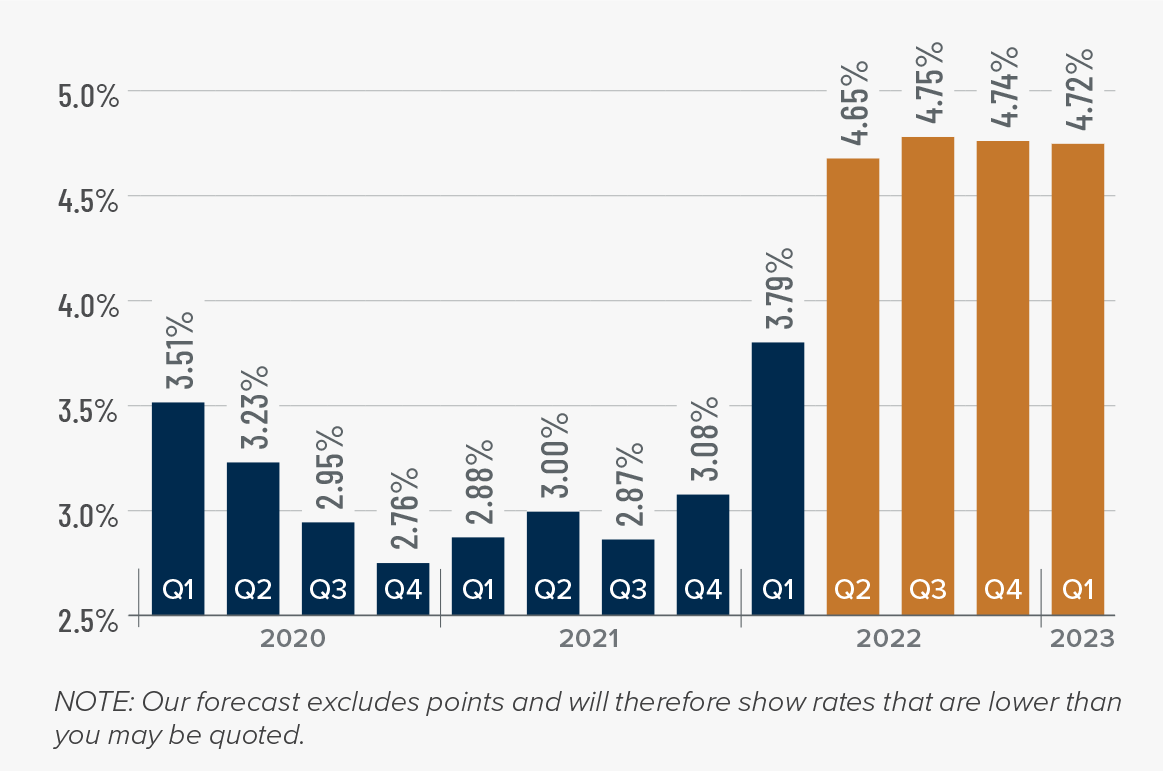
Average rates for a 30-year conforming mortgage were 3.11% at the end of 2021, but since then have jumped over 1.5%—the largest increase since 1987. The speed of the surge in rates is due to the market having quickly priced in the seven-to-eight rate increase that the Fed is expected to implement this year.

Because the mortgage market has priced this into the rates they are offering today, my forecast suggests that we are getting close to a ceiling in rates, and it is my belief that they will rise modestly in the second quarter before stabilizing for the balance of the year.

A bar graph showing the average rates for a 30-year conforming mortgage, plus Matthew Gardner's mortgage rate forecasts for Q2 2022 through Q1 2023.

Colorado Days on Market

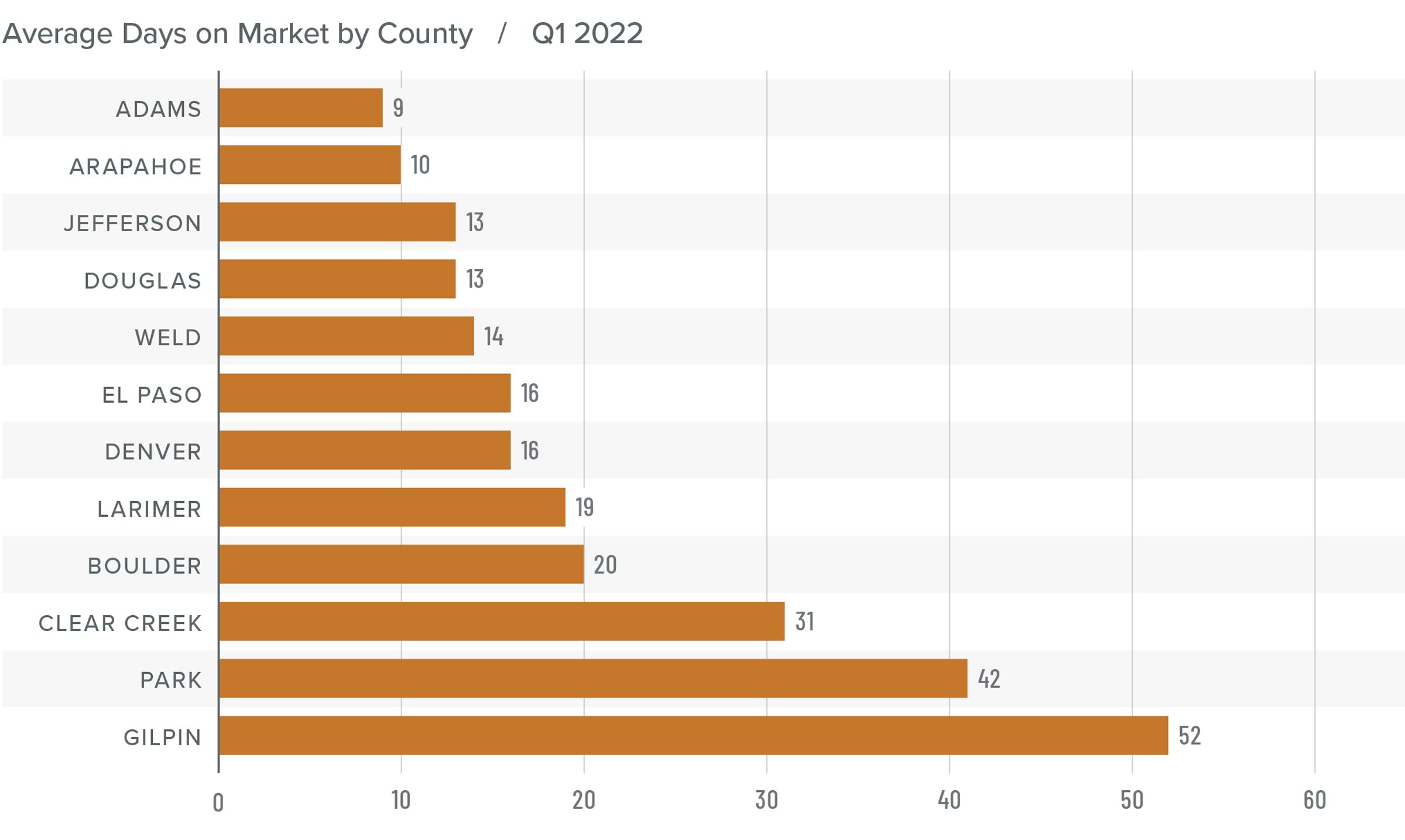
The average number of days it took to sell a home in the markets contained in this report fell four days compared to the first quarter of 2021.

The length of time it took to sell a home dropped in every county other than Gilpin compared to the same quarter a year ago.

It took an average of only 21 days to sell a home in the region, matching the previous quarter.

Compared to the final quarter of 2021, average market time fell in Clear Creek, Adams, Denver, Jefferson, and Arapahoe counties, but rose in the balance of the markets contained in this report.

A bar graph showing the average days on market for homes in various counties in Colorado during Q1 2022.

Conclusions

This speedometer reflects the state of the region’s real estate market using housing inventory, price gains, home sales, interest rates, and larger economic factors.

With Colorado on solid economic footing, I expect housing demand to remain strong even in the face of rising financing costs. Inventory levels remain very low, and new home construction has not expanded enough to meet demand, which continues to put upward price pressure on resale homes. The market appears to have shrugged off the jump in mortgage rates in the first quarter, but the full effects won’t be felt until later this spring. We’ll have to wait and see what impact, if any, there will be, but data on listing prices shows that home sellers remain bullish.

A speedometer graph indicating a seller's market in Colorado during Q1 2022.

Given all these factors, I am leaving the needle in the same position as last quarter. The market clearly still favors sellers, but we need a few more months of information to determine how rising mortgage rates may impact home sales and/ or prices.

About Matthew Gardner

Matthew Gardner - Chief Economist for Windermere Real Estate

As Chief Economist for Windermere Real Estate, Matthew Gardner is responsible for analyzing and interpreting economic data and its impact on the real estate market on both a local and national level. Matthew has over 30 years of professional experience both in the U.S. and U.K.

In addition to his day-to-day responsibilities, Matthew sits on the Washington State Governors Council of Economic Advisors; chairs the Board of Trustees at the Washington Center for Real Estate Research at the University of Washington; and is an Advisory Board Member at the Runstad Center for Real Estate Studies at the University of Washington where he also lectures in real estate economics.
Market News April 28, 2022

Q1 2022 Oregon and Southwest Washington Real Estate Market Update

The following analysis of select counties of the Oregon and Southwest Washington real estate market is provided by Windermere Real Estate Chief Economist Matthew Gardner. We hope that this information may assist you with making better-informed real estate decisions. For further information about the housing market in your area, please don’t hesitate to contact your Windermere Real Estate agent.


Regional Economic Overview

Oregon added 20,400 new jobs in the first quarter of 2022, leaving the state only 36,000 shy of its pre-pandemic peak. I predicted in the fourth quarter 2021 Gardner Report that a full job recovery would occur by this summer. If the current pace of job growth continues, that forecast will be accurate. The Southwest Washington economy— being far smaller—recovered all the jobs lost to COVID-19 last summer. Employment levels in Klickitat and Skamania counties are still modestly lower than before the pandemic, but solid growth in Clark and Cowlitz counties more than offset the shortfall elsewhere. Oregon’s unemployment rate was 3.8%, which is still lower than the pre-pandemic low of 3.4% but impressive all the same given the growing labor force. The jobless rate in Southwest Washington was 5.1%.

Oregon and Southwest Washington Home Sales

In the first quarter of 2022, 13,837 homes sold, which is an increase of 1.1% compared to the same period a year ago, but 22.5% lower than in the prior quarter.

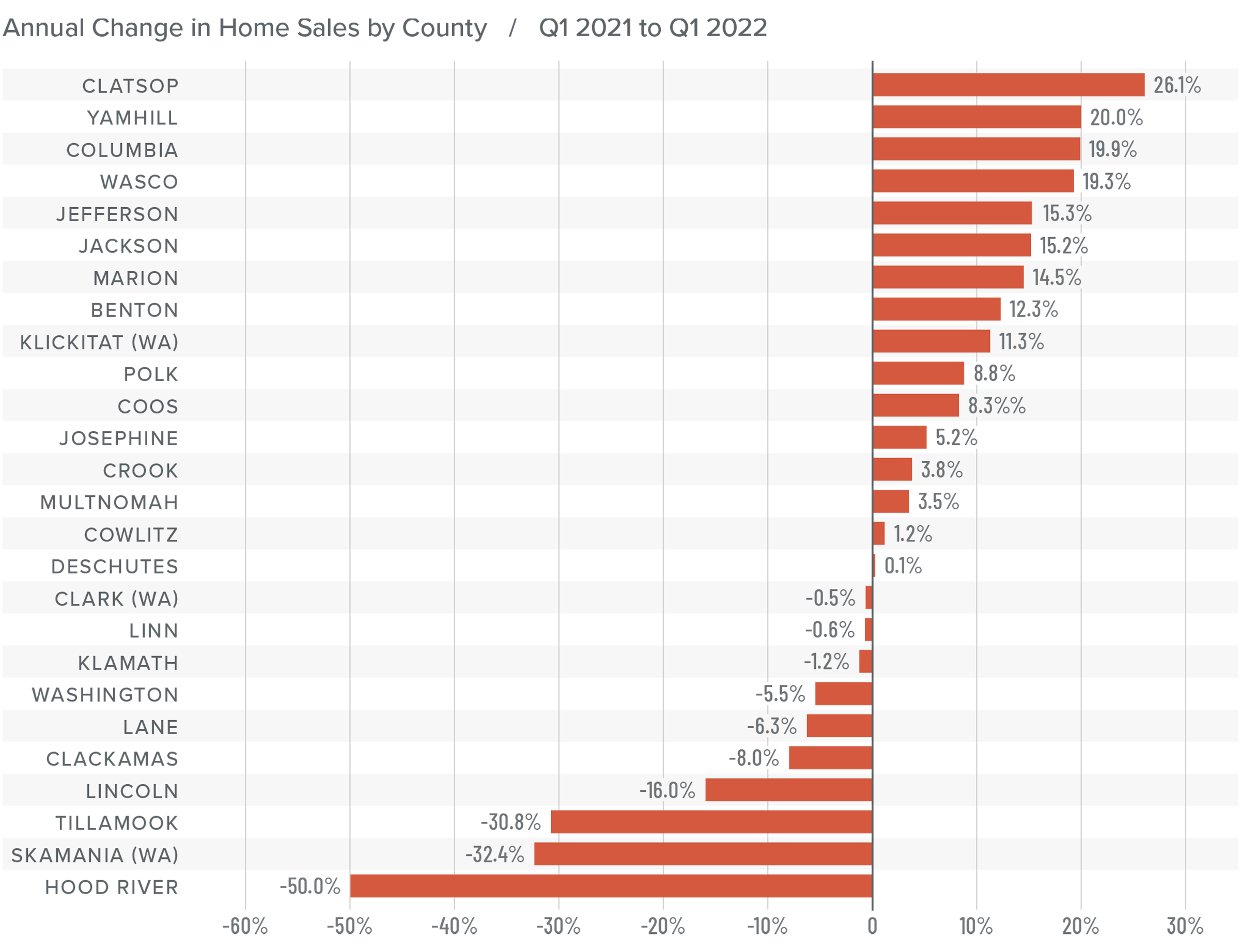
Compared to a year ago, sales rose in more than half of the markets in this report. The areas where sales fell were mainly small markets that can fluctuate dramatically. That said, sales dropped in the more populous Clackamas and Lane counties, but I attribute this to low inventory levels.

Although the number of transactions dropped significantly from the final quarter of 2021, this was more a function of inventory constraints than slack demand.

Listing activity has not seen its spring bump yet, and it will be interesting to see if this happens sooner than usual given the spike in mortgage rates in the first quarter.

A bar graph showing the annual change in home sales for various counties in Oregon and Southwest Washington between Q1 2021 and Q1 2022.

Oregon and Southwest Washington Home Prices

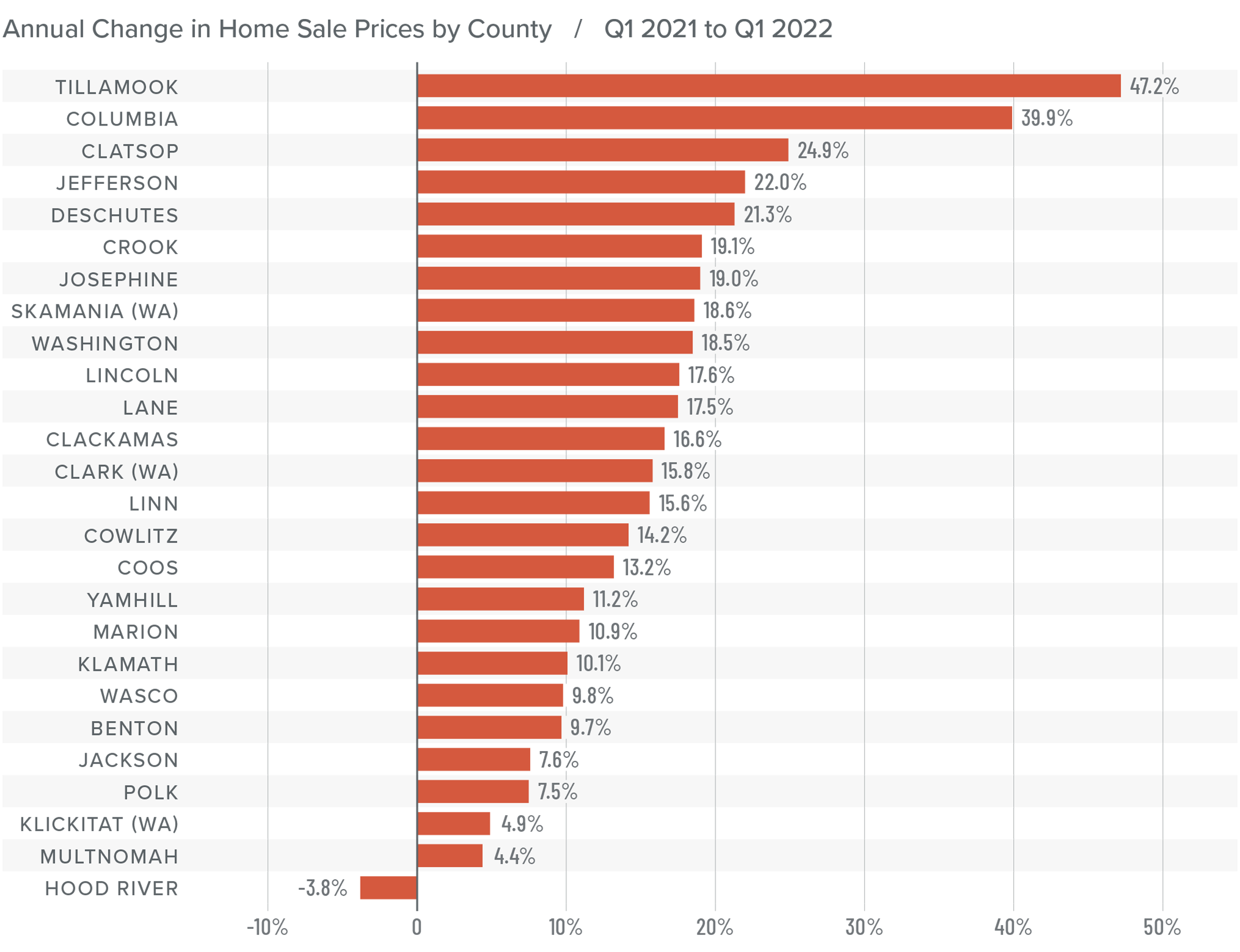
The pace of home-price growth is still tapering, yet prices rose by 13.2% year over year, which is well above the state’s long-term average.

Compared to the final quarter of 2021, average prices rose 2.5%, which is particularly impressive given rising financing costs.

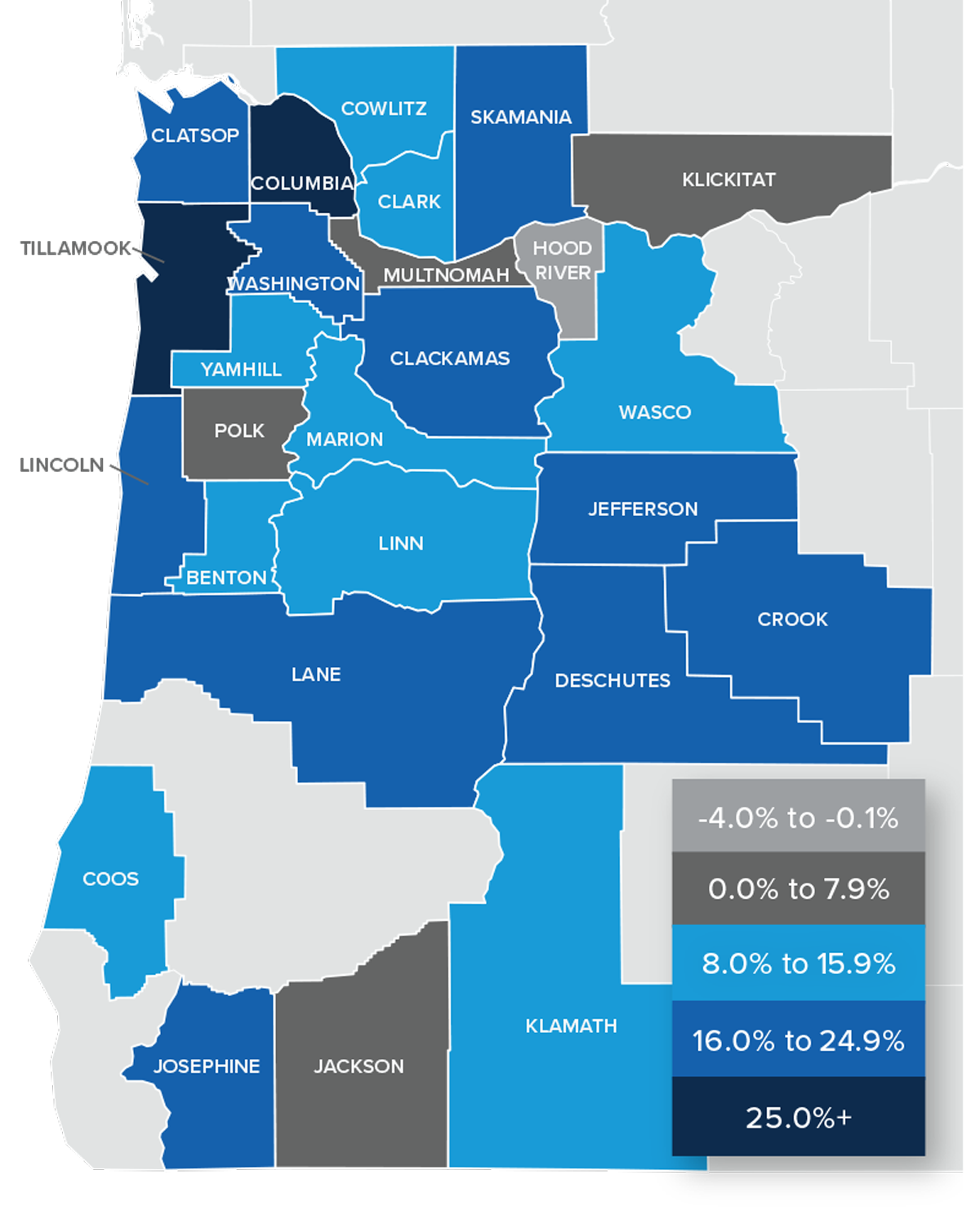
All counties contained in this report except Hood River had higher sale prices than a year ago, with significant increases in Tillamook and Columbia counties. Almost three-quarters of the markets saw prices rise more than 10%.

The spike in mortgage rates has yet to have a significant impact on prices. However, it will be interesting to check back in the second quarter because if there is an impact, this is when we would likely see it.

A map showing the year-over-year real estate market percentage changes in various counties in Oregon and Southwest Washington for Q1 2022.

A bar graph showing the annual change in home sale prices for various counties in Oregon and Southwest Washington from Q1 2021 to Q1 2022.

Mortgage Rates

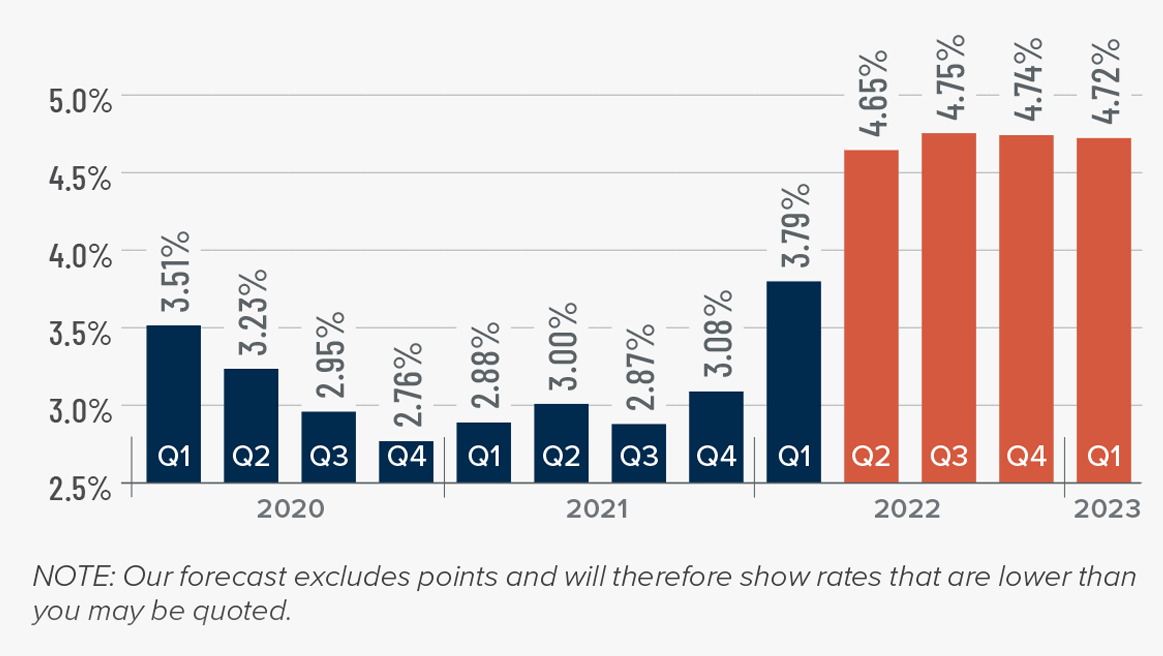
Average rates for a 30-year conforming mortgage were 3.11% at the end of 2021, but since then have jumped over 1.5%—the largest increase since 1987. The speed of the surge in rates is due to the market having quickly priced in the seven-to-eight rate increase that the Fed is expected to implement this year.

Because the mortgage market has priced this into the rates they are offering today, my forecast suggests that we are getting close to a ceiling in rates, and it is my belief that they will rise modestly in the second quarter before stabilizing for the balance of the year.

A bar graph showing the average rates for a 30-year conforming mortgage, plus Matthew Gardner's mortgage rate forecasts for Q2 2022 through Q1 2023.

Oregon and Southwest Washington Days on Market

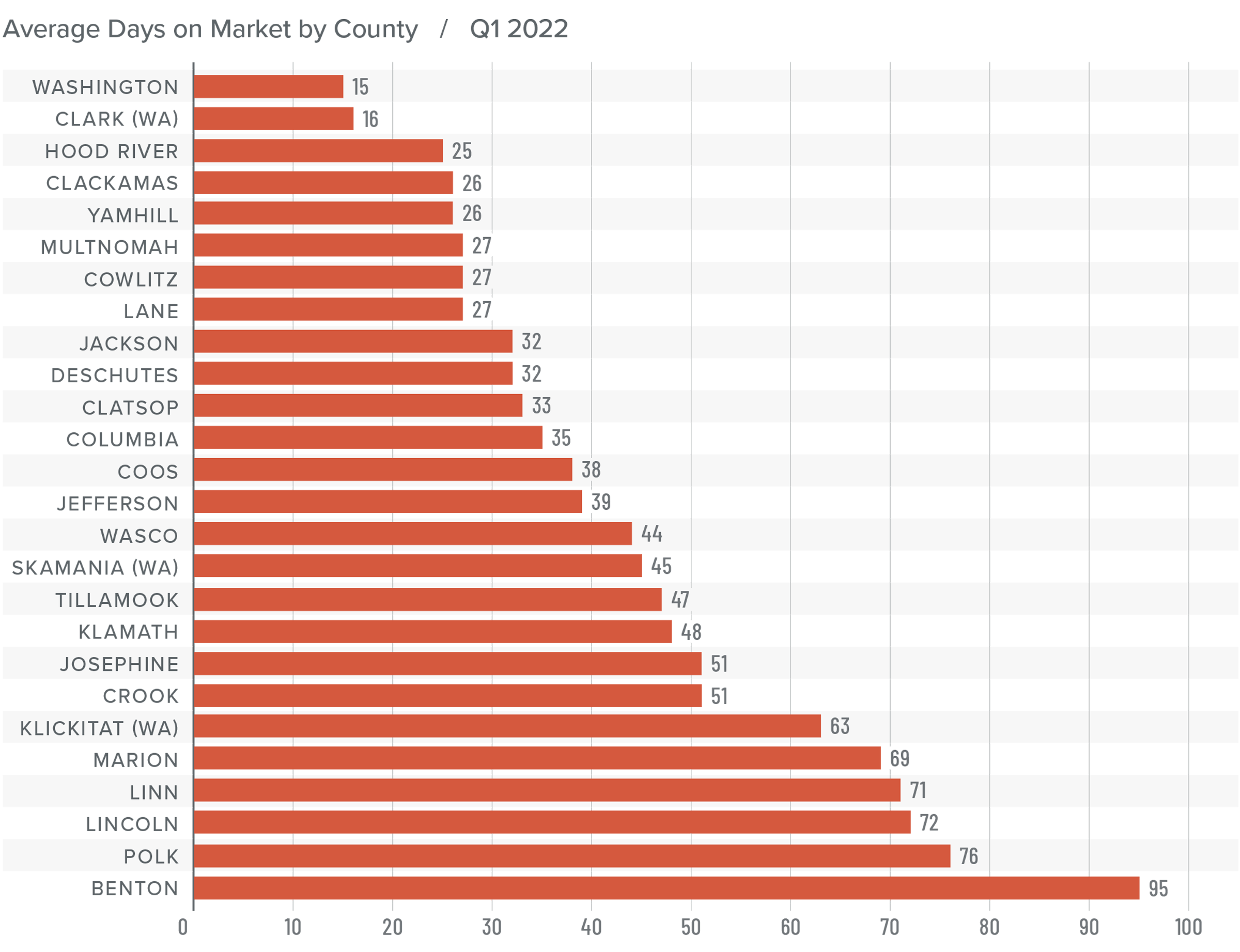
The average number of days it took to sell a home in the region dropped by six compared to a year ago, but it took ten more days for a home to go under contract compared to the fourth quarter of 2021.

The average time it took to sell a home in the first quarter of 2022 was 43 days.

Sixteen of the 26 counties covered in this report saw days on market drop from the first quarter of 2021, but only 5 counties saw average market time drop compared to the fourth quarter of last year. This is likely a function of seasonality, and I expect this to correct itself as we enter the spring buying season.

Homes sold the fastest in Washington County, where it took an average of only 15 days for a home to sell. An additional seven counties saw an average market time of less than a month.

A bar graph showing the average days on market for homes in various counties in Oregon and Southwest Washington during Q1 2022.

Conclusions

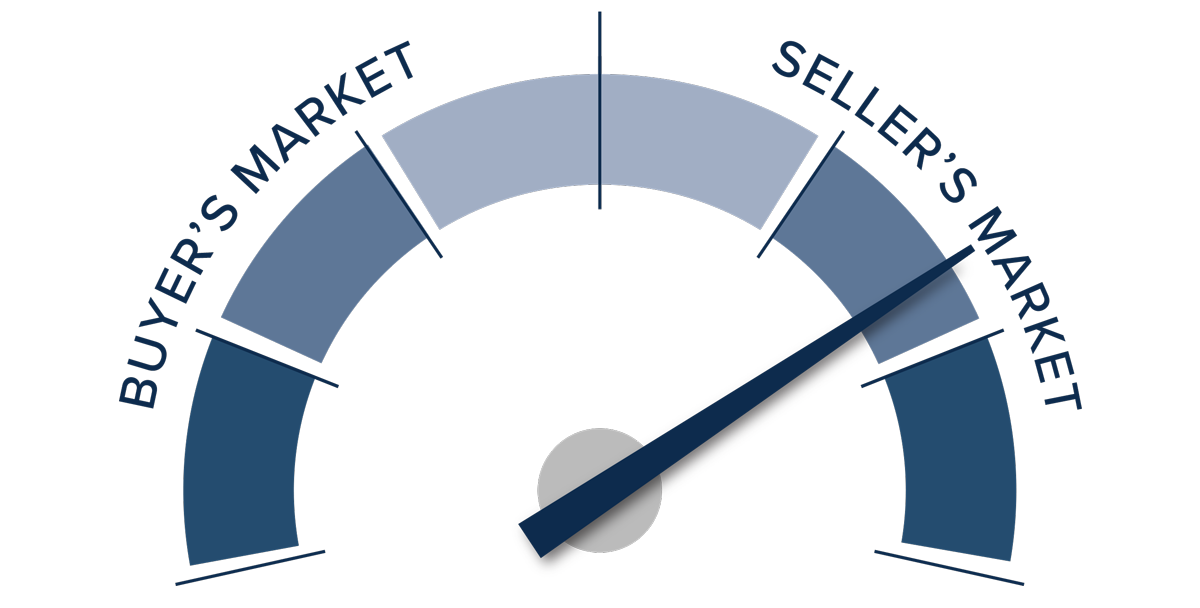
This speedometer reflects the state of the region’s real estate market using housing inventory, price gains, home sales, interest rates, and larger economic factors.

Despite higher rates and rising prices, buyers continue to be very motivated. As such, I don’t foresee any significant downturn in demand. However, home price growth could start to taper in the coming months, which is not a bad thing.

A speedometer graph indicating a seller's market in Oregon and Southwest Washington during Q1 2022.

Given remarkably low inventory levels and solid demand, home sellers still have the upper hand, though we will have to wait and see how prices will be impacted by higher mortgage rates. As such, I am leaving the needle in the same position it was last quarter.

About Matthew Gardner

Matthew Gardner - Chief Economist for Windermere Real Estate

As Chief Economist for Windermere Real Estate, Matthew Gardner is responsible for analyzing and interpreting economic data and its impact on the real estate market on both a local and national level. Matthew has over 30 years of professional experience both in the U.S. and U.K.

In addition to his day-to-day responsibilities, Matthew sits on the Washington State Governors Council of Economic Advisors; chairs the Board of Trustees at the Washington Center for Real Estate Research at the University of Washington; and is an Advisory Board Member at the Runstad Center for Real Estate Studies at the University of Washington where he also lectures in real estate economics.
Market News April 27, 2022

Q1 2022 Western Washington Real Estate Market Update

The following analysis of select counties of the Western Washington real estate market is provided by Windermere Real Estate Chief Economist Matthew Gardner. We hope that this information may assist you with making better-informed real estate decisions. For further information about the housing market in your area, please don’t hesitate to contact your Windermere Real Estate agent.


Regional Economic Overview

The post-COVID job recovery continues. Though data showed the number of jobs dropped in January, February saw gains that almost offset the jobs lost the prior month. As of February (March data is not yet available), the region had recovered all but 47,000 of the more than 300,000 jobs lost due to the pandemic. Of note is that employment levels in Grays Harbor, Thurston, San Juan, and Clallam counties are now above their pre-pandemic levels. In February, the regional unemployment rate rose to 4.1% from 3.7% in December. Although this may be disconcerting, an improving economy has led more unemployed persons to start looking for a job, which has pushed the jobless rate higher. I expect the regional economy to continue expanding as we move into the spring and summer, with a full job recovery not far away.

Western Washington Home Sales

In the first quarter of 2022, 15,134 homes sold, representing a drop of 5.8% from the same period a year ago, and down 31.7% from the fourth quarter.

Yet again, supply-side constraints limited sales. Every county except Snohomish showed lower inventory levels than a year ago.

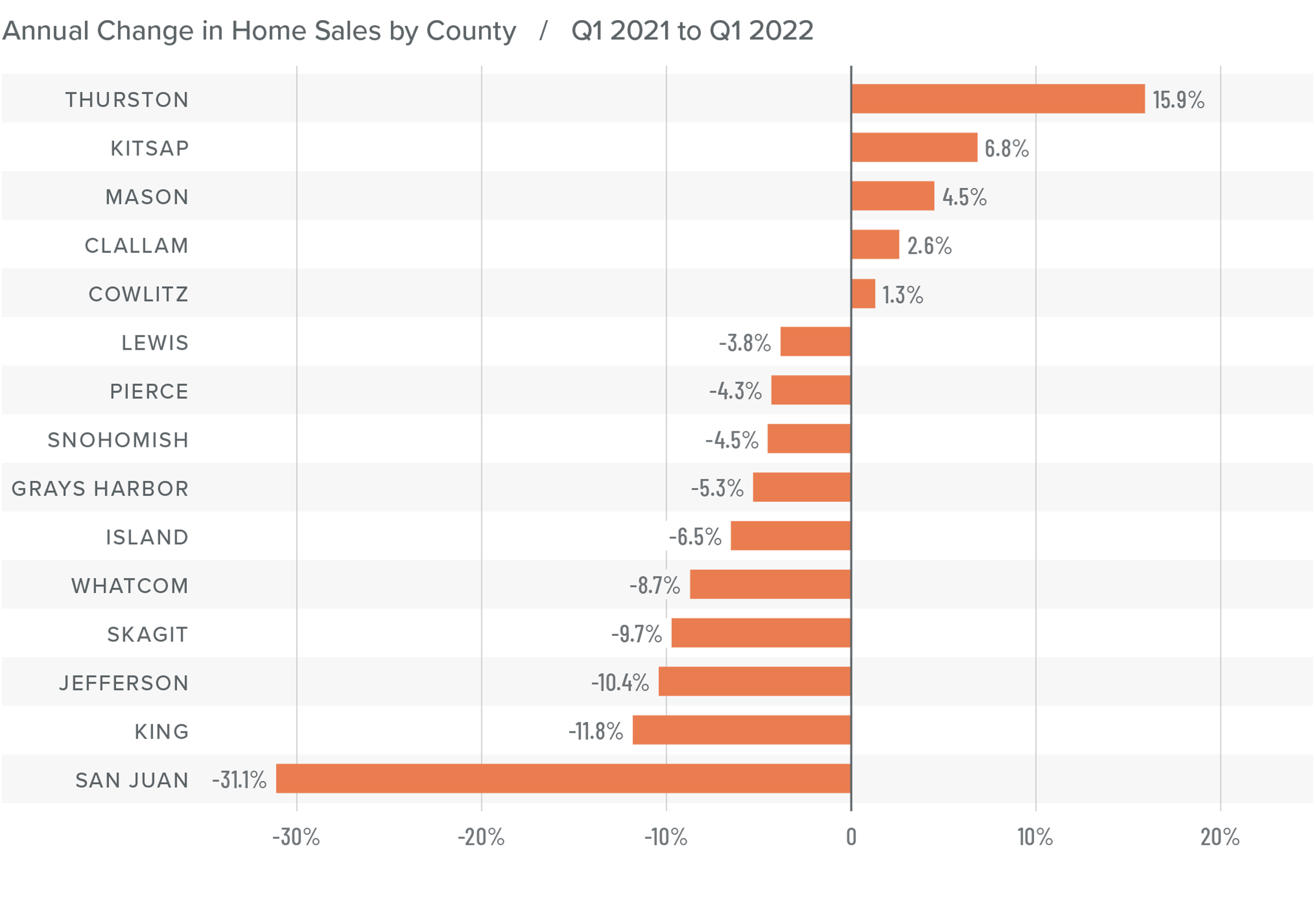
Sales grew in five counties across the region but were lower across the balance of the counties contained in this report. Compared to the fourth quarter, sales were lower across all market areas.

The ratio of pending sales (demand) to active listings (supply) showed pending sales outpacing listings by a factor of 6.7. Clearly, the significant jump in mortgage rates in the first quarter has not yet impacted demand. Rather it appears to have stimulated buyers partly due to FOMO (Fear of Missing Out)!

A bar graph showing the annual change in home sales for various counties in Western Washington between Q1 2021 and Q1 2022.

Western Washington Home Prices

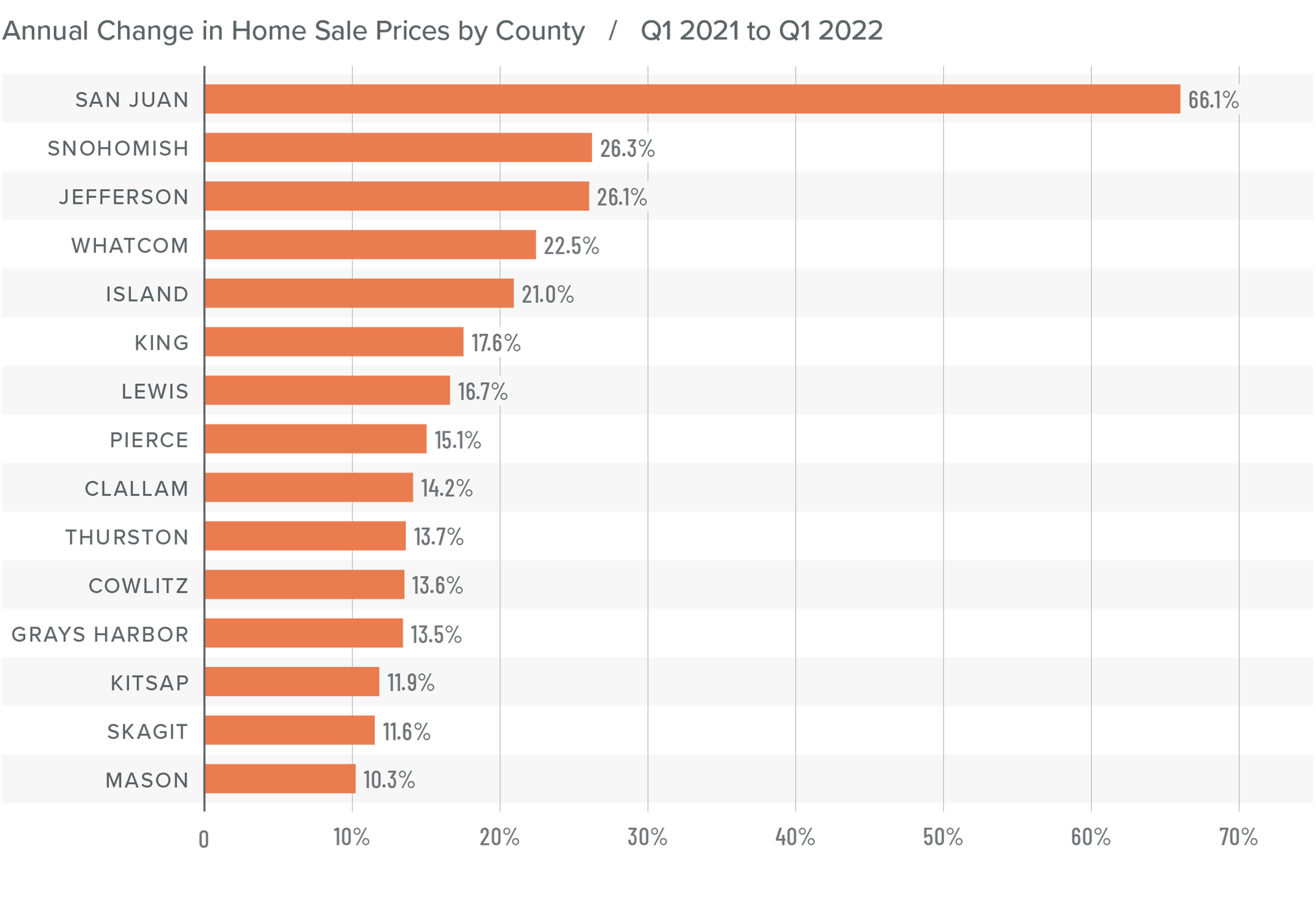
Although financing costs have jumped, this has yet to prove to be an obstacle to buyers, as prices rose 16.4% year-over-year to an average of $738,152. Naturally, there is a lag between rates rising and any impact on market prices. It will be interesting to see what, if any, effect this has in the next quarter’s report.

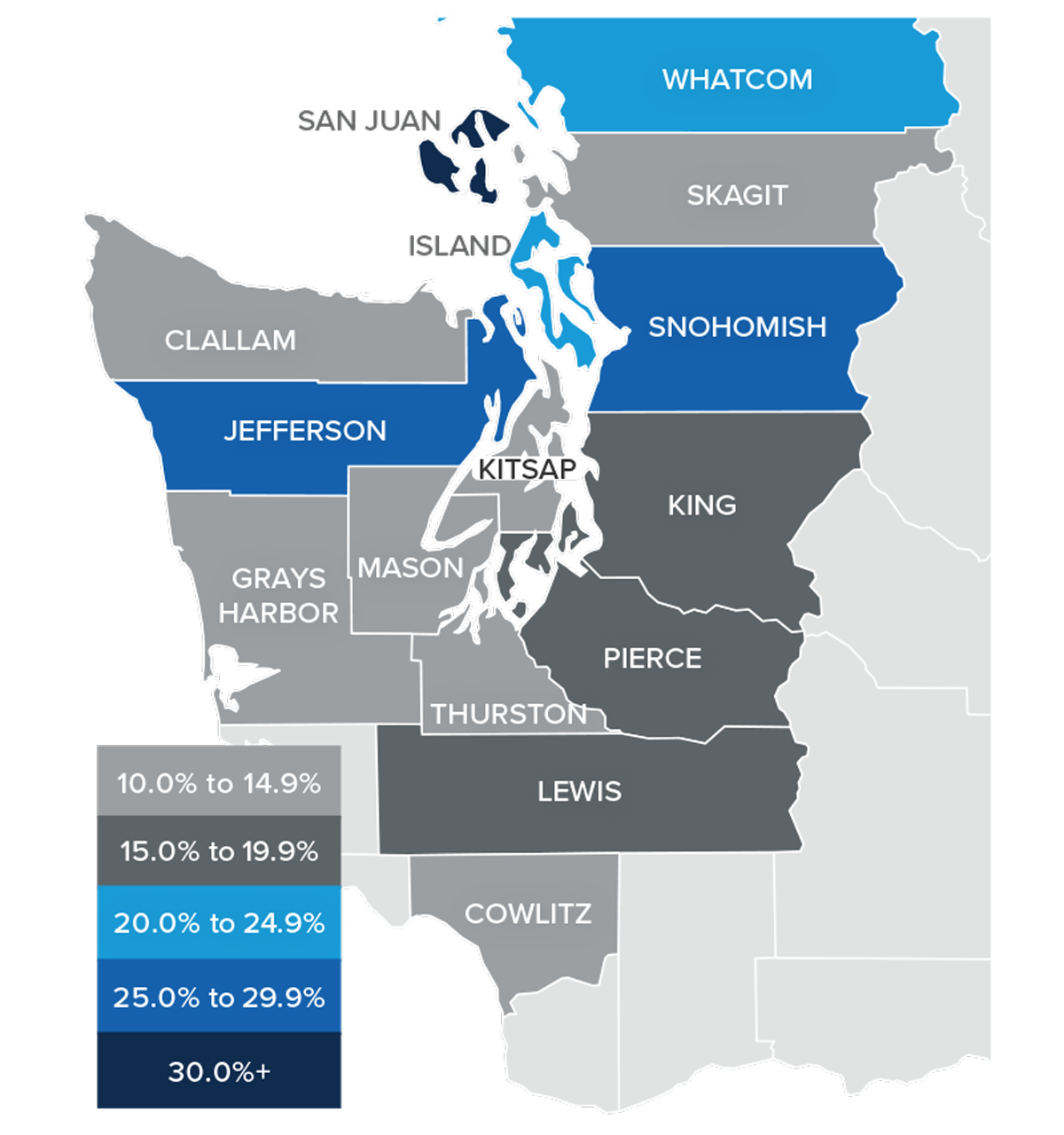
Compared to the same period a year ago, price growth was again strongest in San Juan County, but all markets saw prices rising more than 10% from a year ago.

Relative to the final quarter of 2021, all but Kitsap (-2.7%), Mason (-1.5%), Skagit (-1.8%), Jefferson (-6.3%), and Clallam (-0.1%) counties saw home prices rise.

The market remains supply starved. While increases in “new” listings suggest that more choice is coming to market, it remains insufficient to meet demand.

A map showing the year-over-year real estate market percentage changes in various counties in Western Washington for Q1 2022.

A bar graph showing the annual change in home sale prices for various counties in Western Washington from Q1 2021 to Q1 2022.

Mortgage Rates

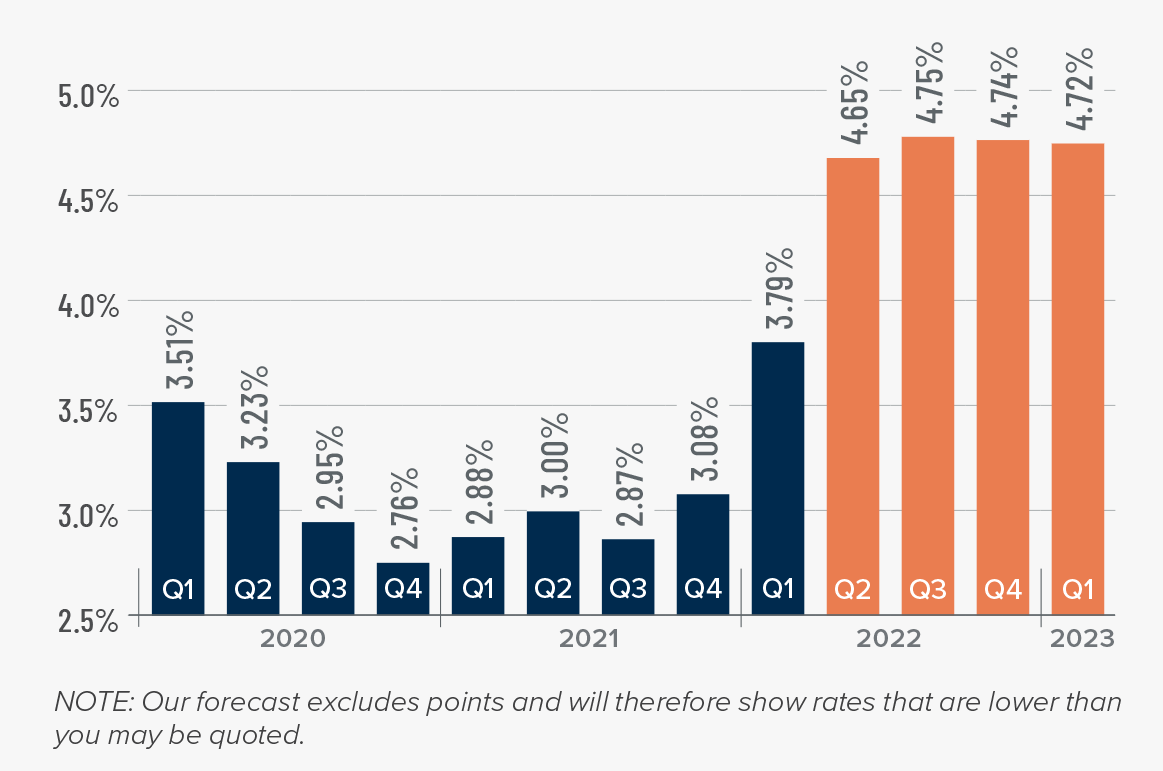
Average rates for a 30-year conforming mortgage were 3.11% at the end of 2021, but since then have jumped over 1.5%—the largest increase since 1987. The speed of the surge in rates is due to the market having quickly priced in the seven-to-eight rate increase that the Fed is expected to implement this year.

Because the mortgage market has priced this into the rates they are offering today, my forecast suggests that we are getting close to a ceiling in rates, and it is my belief that they will rise modestly in the second quarter before stabilizing for the balance of the year.

A map showing the real estate market percentage changes in various counties in Utah during the third quarter of 2021.

Western Washington Days on Market

It took an average of 25 days for a home to go pending in the first quarter of 2022. This was 4 fewer days than in the same quarter of 2020, but 2 days more than in the fourth quarter of 2021.

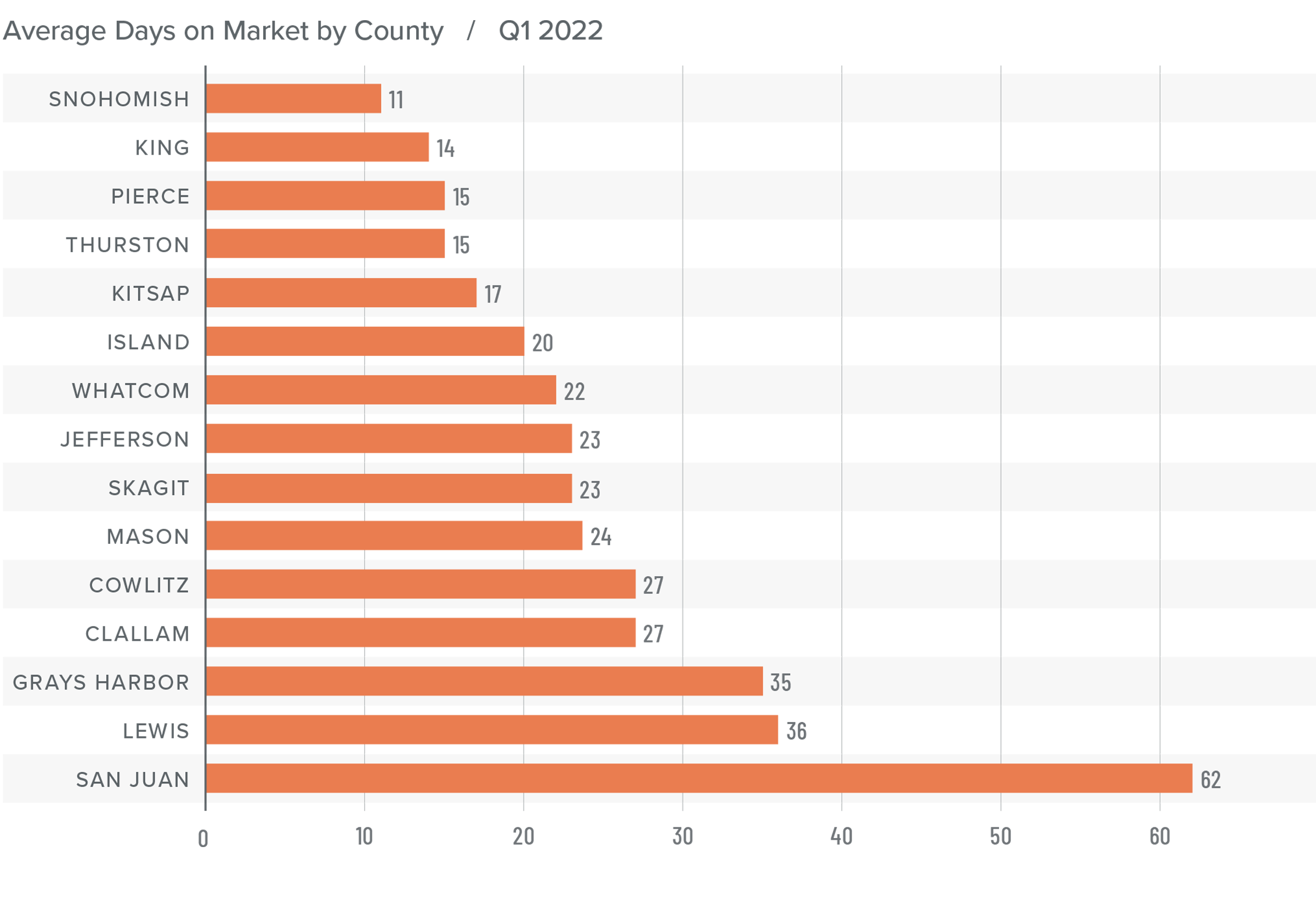
Snohomish, King, and Pierce counties were the tightest markets in Western Washington, with homes taking an average of 11 to 15 days to sell. The greatest drop in market time compared to a year ago was in San Juan County, where it took 23 fewer days for homes to sell.

All but five counties saw average time on market drop from the same period a year ago, but the markets where it took longer to sell a home saw the length of time increase only marginally.

Quarter over quarter, market time dropped in Snohomish, King, and Pierce counties. Jefferson and Clallam counties also saw modest improvement. In the balance of the region the length of time a home was on the market rose, but seasonality undoubtedly played a part.

A bar graph showing the average days on market for homes in various counties in Utah during the third quarter of 2021.

Conclusions

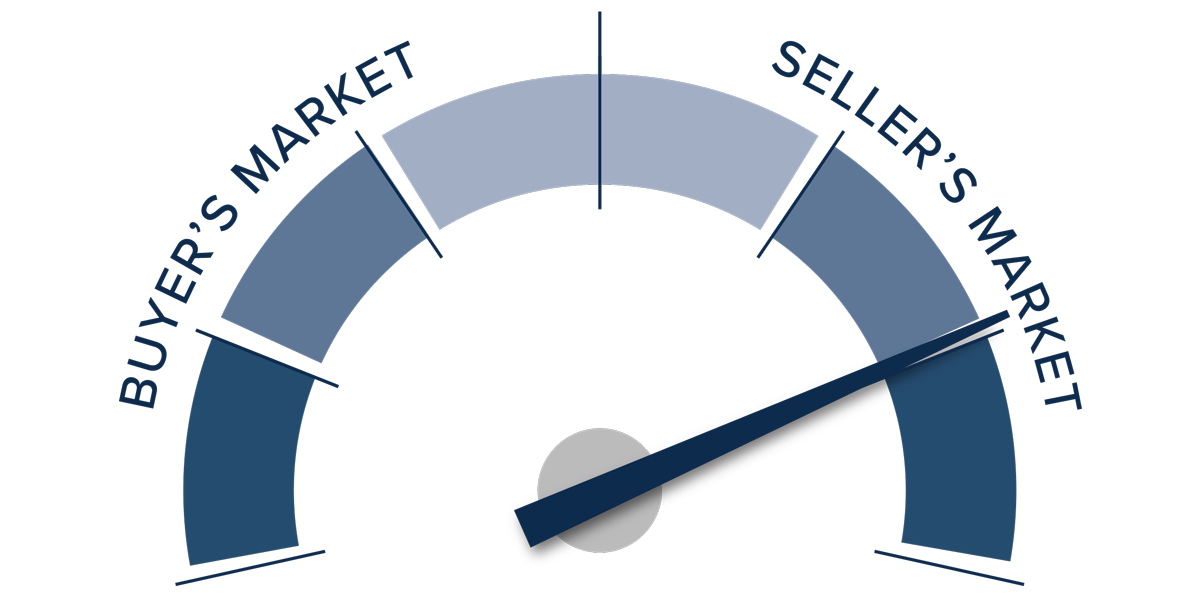
This speedometer reflects the state of the region’s real estate market using housing inventory, price gains, home sales, interest rates, and larger economic factors.

The numbers have yet to indicate that demand is waning amid rising interest rates, but this is sure to become a greater factor as we move into the spring. A leading indicator I pay attention to is changes to list prices and, in most counties, these continue to increase. This suggests that sellers remain confident they will be able to find a buyer even in the face of higher borrowing costs. If this pace of increase starts to soften, it may be an indication of an inflection point, but it does not appear to be that way yet.

A speedometer graph indicating a seller's market in Western Washington during Q1 2022.

Given all the factors discussed above, I have decided to leave the needle in the same position as the last quarter. The market still heavily favors sellers, but if rates rise much further, headwinds will likely increase.

About Matthew Gardner

Matthew Gardner - Chief Economist for Windermere Real Estate

As Chief Economist for Windermere Real Estate, Matthew Gardner is responsible for analyzing and interpreting economic data and its impact on the real estate market on both a local and national level. Matthew has over 30 years of professional experience both in the U.S. and U.K.

In addition to his day-to-day responsibilities, Matthew sits on the Washington State Governors Council of Economic Advisors; chairs the Board of Trustees at the Washington Center for Real Estate Research at the University of Washington; and is an Advisory Board Member at the Runstad Center for Real Estate Studies at the University of Washington where he also lectures in real estate economics.
Market News April 25, 2022

The Current State of the U.S. Housing Market


This video is the latest in our Monday with Matthew series with Windermere Chief Economist Matthew Gardner. Each month, he analyzes the most up-to-date U.S. housing data to keep you well-informed about what’s going on in the real estate market. 


Hello there, I’m Windermere’s Chief Economist Matthew Gardner, and welcome to this month’s episode of Monday with Matthew. With home prices continuing to defy gravity, mortgage rates spiking, the Fed raising interest rates significantly, a yield curve that is just keeping its nose above water, and some becoming vocal about the possibility that we are going to enter a recession sooner rather than later, it’s not at all surprising that many of you have been asking me whether the housing market is going to pull back significantly, and a few of you have asked whether we aren’t in some sort of “bubble” again.

Because this topic appears to be giving many of you heartburn, I decided that it’s a good time to reflect on where the housing market is today and give you my thoughts on the impact of rising mortgage rates on what has been an historically hot market.

The Current State of the U.S. Housing Market

Home Sale Prices

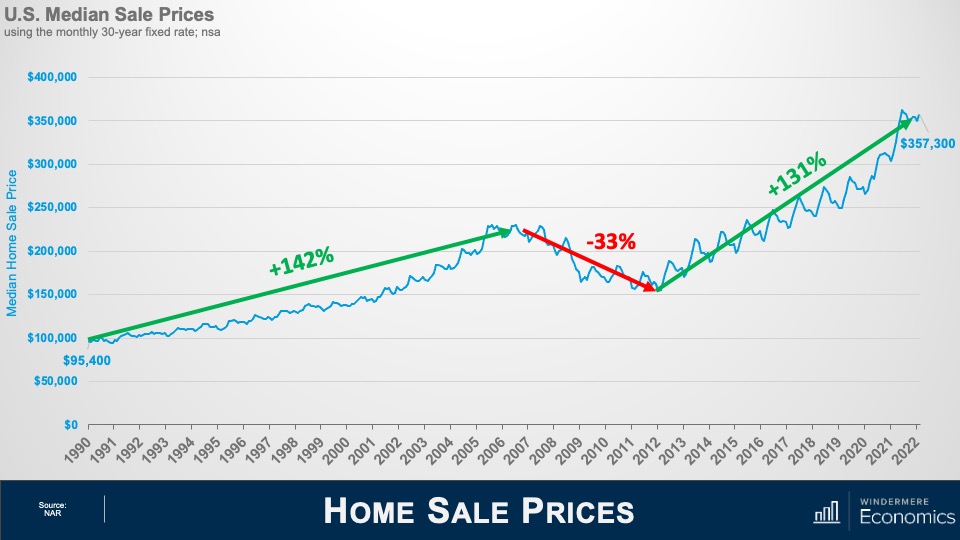
A slide titled "Home Sale Prices" showing the U.S. media home sale prices from 1990 to 2022. From 1990 to 2006, there was a positive 142% change. From 2006 to 2012, there was a negative 33% change. And from 2012 to 2022, there has been a positive 1315 change, with the most recent U.S. median sale price shown at $357,300.


As usual, a little perspective. Between 1990 and the pre-bubble peak in 2006, home prices rose by 142%, which was a pretty impressive annual increase of 5.6% over a 16 1/2-year period. When the market crashed, prices dropped by 33%, but from the 2012 low to today, prices have risen by 131%, or at an even faster annual rate of 8.6% over a shorter period of time—10 years.

You may think that prices rising at an annual rate that exceeds the pace seen before the market crash is what has some brokers and home buyers concerned, but that really isn’t what has many people scared. It’s this.

Mortgage Rates in 2022

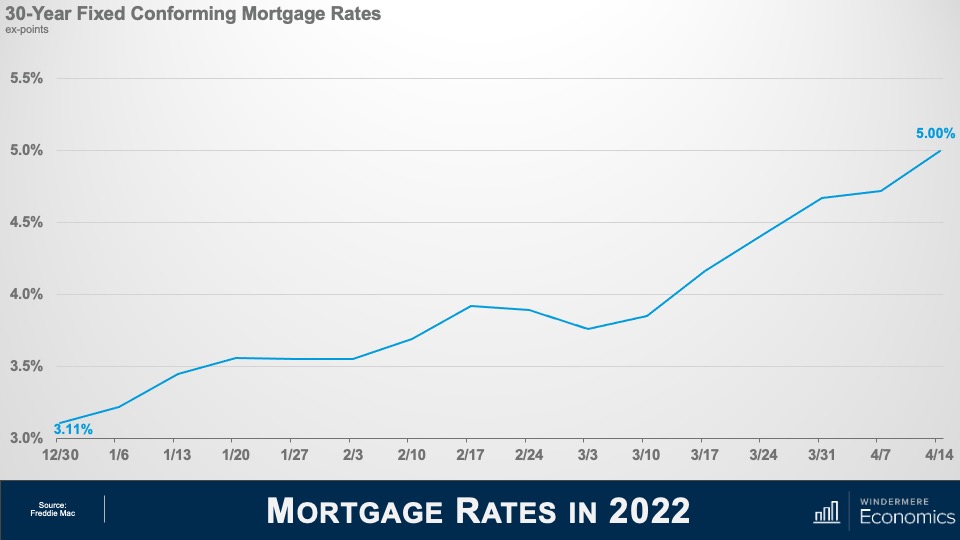
A slide titled "Mortgage Rates in 2022" showing the increase in 30-year fixed conforming mortgage rates between December 30, 2021 (3.11%) and April 14, 2022 (5%).


At the start of 2022, the average 30-year fixed mortgage rate was just a little above 3%. But, over a brief 15-week period, they have skyrocketed to 5%. This has led some to worry that the market is about to implode. Of course, nobody can say that the run-up in home prices hasn’t been phenomenal over the past few years, and it’s certainly human nature to think that “what goes up, must come down,” but is there really any reason to panic? I think not, and to explain my reasoning, let’s look back in time to periods when rates rose significantly and see how increasing mortgage rates impacted the marketplace.

Housing and Mortgage Markets During Times of Rising Rates

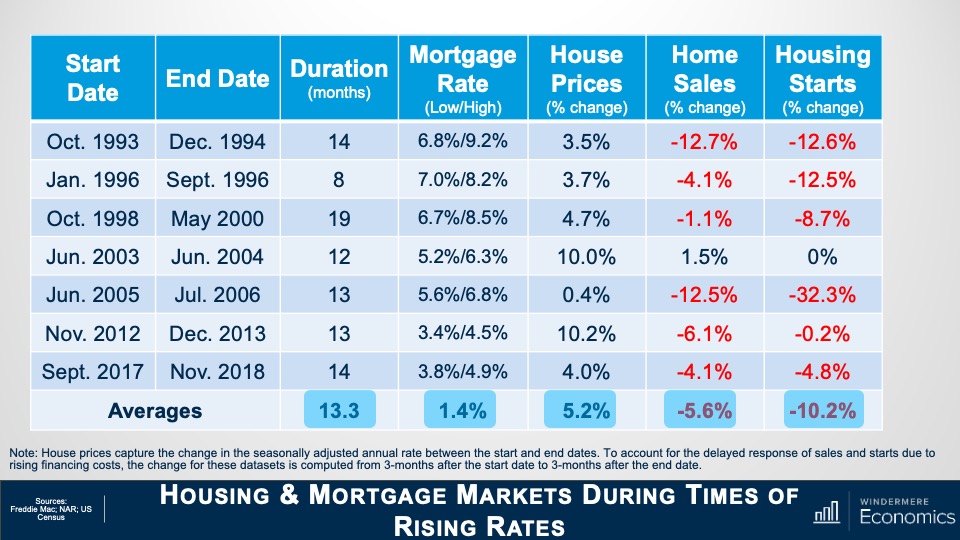
A slide titled "Housing & Mortgage Markets During Times of Rising Rates." Two extreme statistics are as follow: Between June 2005 and July 2006 there was a negative 32.3% change in housing starts and between October 1993 and December 1994 there was a negative 12.7% change in home sales.


This table shows seven periods over the past 30 years when mortgage rates rose significantly. On average, rates trended higher for just over a year before pulling back, and the average increase was 1.4%. But now look at how it impacted home prices: it really didn’t. On average, during these periods of rising financing costs, home prices still rose by just over 5%.  Clearly, not what some might have expected. But there were some negatives from mortgage rates trending higher, and these came in the form of lower sales in all but one period and new housing starts also pulled back.

So, if history is any indicator, the impact of the current jump in mortgage rates is likely to be seen in the form of lower transactions rather than lower prices. And this makes sense. Although rising financing costs puts additional pressure on housing affordability, what people don’t appear to think about is that mortgage rates actually tend to rise during periods of economic prosperity. And what does a flourishing economy bring? That’s right. Rising wages. Increasing incomes can certainly offset at least some of the impacts of rising mortgage rates.

Static Equilibrium Analysis – 1/3

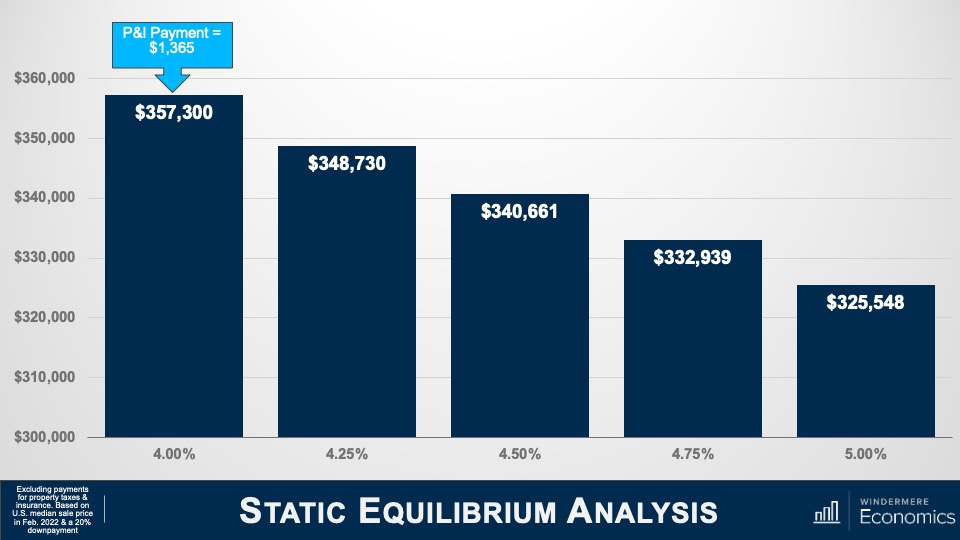
A slide titled "Static Equilibrium Analysis" showing that the P&I payment would be $1,365 for a $357,300 home with a 4% mortgage rate, using the February 2022 U.S. median sale price. This assumes the buyer has put down 20% on the home.


To try and explain this, I’m using the median US sale price in February of this year, assuming a 20% down payment and the mortgage rate of 4%. And you can see that the monthly P&I payment would be $1,365. But as mortgage rates rise, and if buyers wanted to keep the same monthly payment, then they would have to buy a cheaper home. Using a rate of 5%, a buyer could afford a home that was 9% cheaper if they wanted to keep the payment the same as it would have been if rates were still at 4%.

But, as I mentioned earlier, an expanding economy brings higher wages, and this is being felt today more than usual, given the worker shortage that exists and businesses having to raise compensation. Average weekly wages have risen by over five-and-a-half percent over the past year—well above the pre-pandemic average of two-and-a-half percent. Although increasing incomes would not totally offset rising mortgage rates, it does have an impact.

Static Equilibrium Analysis – 2/3

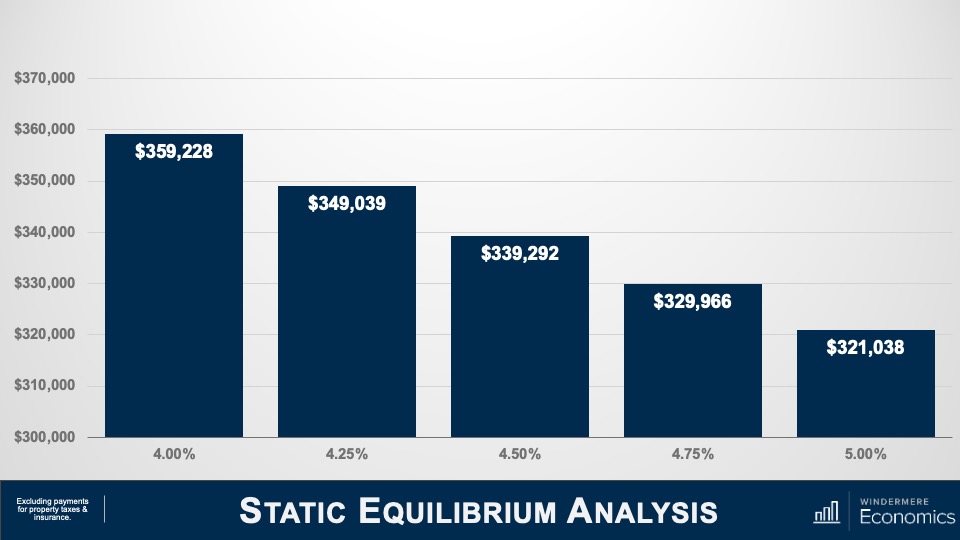
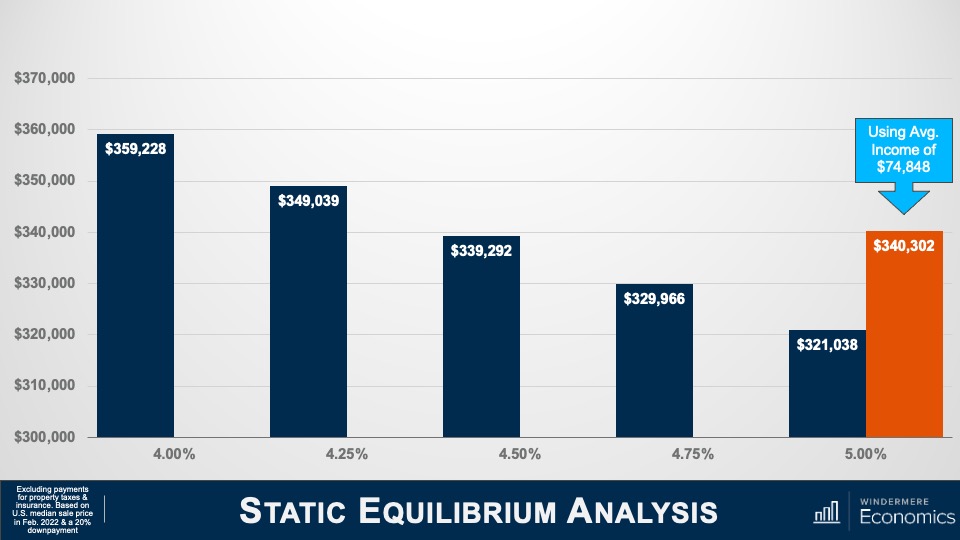
A slide titled "Static Equilibrium Analysis" showing what home buyers would be able to afford at different mortgage rates, using the U.S. average household income of $70,611, assuming they've put 20% of their gross income down for the down payment. At 4%, they could afford a home just under $360,000 and at 5%, they could afford a home at $321,038.


To demonstrate this, let’s use the U.S. average household income of $70,611.  Assuming that they’ve put aside 20% of their gross income for a down payment, they could afford a home priced just under $360,000 if mortgage rates were at 4%. As rates rise—and assuming that their income doesn’t—their buying power is reduced by over 10%, or just over $38,000.

Static Equilibrium Analysis – 3/3

A follow up to the "Static Equilibrium Analysis" slide showing that if the average income were raised to $74,848, the buyer would be able to afford a home of $340,302 at a 5% mortgage rate.


But if we believe that incomes will rise, then the picture looks very different. Assuming wages rise by 6%, their buying power drops by just 5% if rates rose from 4% to 5%, or a bit less than $19,000.

Although rates have risen dramatically in a short period, because they started from an historic low, the overall impacts are not yet very significant. If history is any indicator, mortgage rates increasing are likely to have a more significant impact on sales, but a far smaller impact on prices.

But there are other factors that come into play, too. Here I’m talking about demand. The only time since 1968 that home prices have dropped on an annualized basis was in 2007 through 2009 and in 2011, and this was due to a massive increase in the supply of homes for sale. When supply exceeds demand, prices drop.

So, how is it different this time around? Well, we know that the supply glut that we saw starting to build in mid-2006 was mainly not just because households were getting mortgages that, quite frankly, they should never have gotten in the first place, but a very large share held adjustable rate mortgages which, when the fixed interest rate floated, they found themselves faced with payments that they could not afford. Many homeowners either listed their homes for sale or simply walked away.

Although it’s true that over the past two or so months more buyers have started taking ARMs as rates rose, it’s not only a far smaller share than we saw before the bubble burst, but down payments and credit quality remained far higher than we saw back then.

So, if we aren’t faced with a surge of inventory, I simply don’t see any reason why the market will see prices pull back significantly. But even if we do see listing activity increase, I still anticipate that there will be more than enough demand from would-be buyers. I say this for several reasons, the first of which is inflation.

What a lot of people aren’t talking about is the proven fact that owning real estate is a significant hedge against rising inflation. You see, most buyers have a mortgage, and a vast majority use fixed-rate financing. This is the hedge because even as consumer prices are rising, a homeowner’s monthly payments aren’t.  They remain static and, more than that, their monthly payments actually become lower over time as the value of the dollar diminishes. Simply put, the value of a dollar in—let’s say 2025—will be lower than the value of a dollar today.

But this isn’t the only reason that inflation can actually stimulate the housing market. Home prices historically have grown at a faster pace than inflation.

Hedge Against Inflation

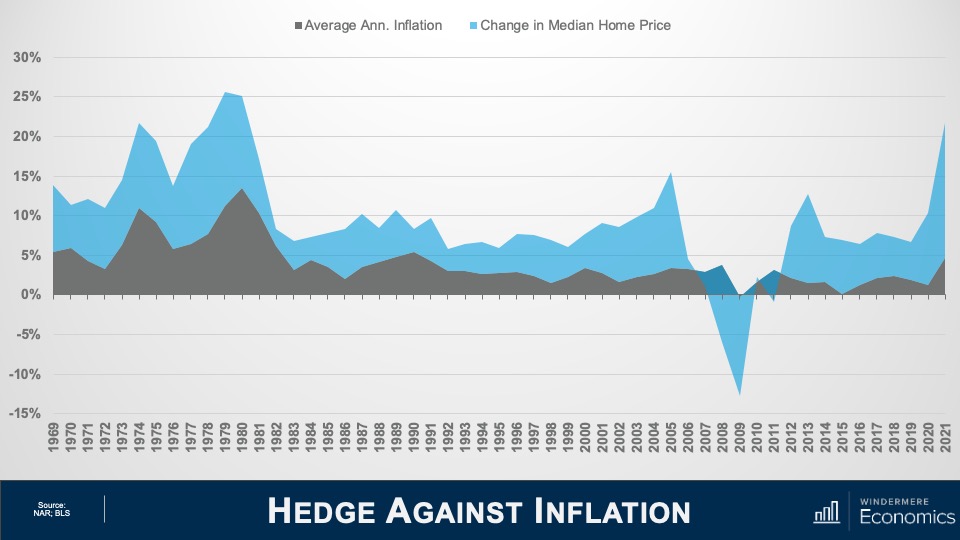
A slide titled "Hedge Against Inflation" showing a line graph of the average annual inflation and change in median home price from 1969 to 2021. While the average annual inflation fluctuates between 1% and 5% for most of the chart except for the mid-70s and early-80s, the change in median home price fluctuates between 25% in the late-70s to roughly negative 12% in 2009.


This chart looks at the annual change in total CPI going back to 1969. Now let’s overlay the annual change in median U.S. home prices over the same time period. Other than when home prices crashed with the bursting of the housing bubble, for more than fifty years home price growth has outpaced inflation. And this means we are offsetting high consumer prices because home values are increasing at an even faster rate.

But inflation has additional impacts on buyers. Now I’m talking about savings. As we all know, the interest paid on savings today is pretty abysmal. In fact, the best money market accounts I could find were offering interest rates between 0.5% and 0.7%. And given that this is significantly below the rate of inflation, it means that dollars saved continue to be worth less and less over time while inflation remains hot.

Now, rather than watching their money drop in value because of rising prices, it’s natural that households would look to put their cash to work by investing in assets where the return is above the rate of inflation—meaning that their money is no longer losing value—and where better place to put it than into a home.

Housing as a Hedge Against Inflation

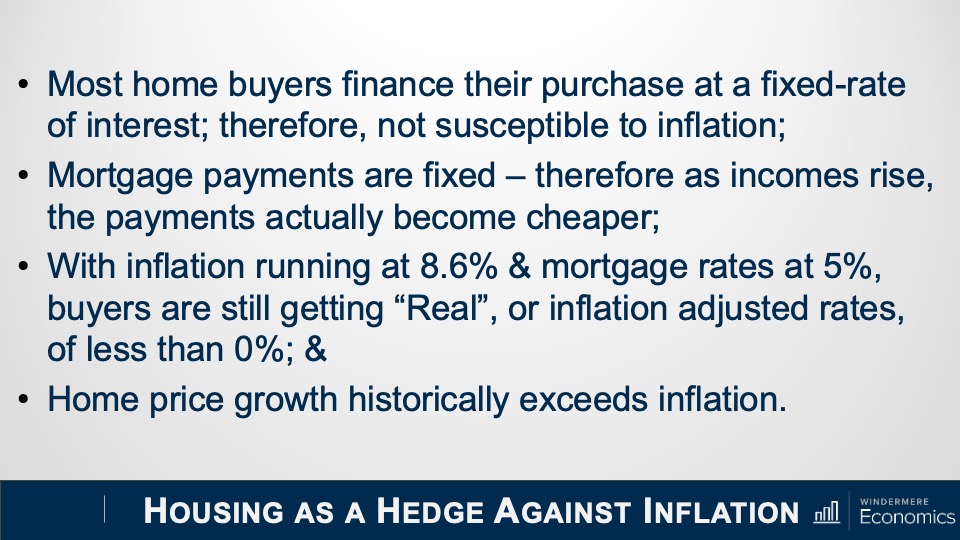
A slide titled "Housing as a Hedge Against Inflation" showing that most home buyers finance their purchase at a fixed-rate of interest, which is not susceptible to inflation. Mortgage payments are fixed, therefore as incomes rise, the payments actually become cheaper.


So, the bottom line here is that inflation supports demand from home buyers because:

  1. Most are borrowing at a fixed rate that will not be impacted by rising inflation
  2. Monthly payments are fixed, and these payments going forward become lower as incomes rise, unlike renters out there who continue to see their monthly housing costs increase
  3. With inflation at a level not seen since the early 1980s, borrowers facing 5% mortgage rates are still getting an amazing deal. In fact, by my calculations, mortgage rates would have to break above 7% to significantly slow demand, which I find highly unlikely, and
  4. If history holds true, home price appreciation will continue to outpace inflation

Demand appears to still be robust, and supply remains anemic. Although off the all-time low inventory levels we saw in January, the number of homes for sale in March was the lowest of any March since record keeping began in the early 1980’s.

But even though I’m not worried about the impact of rates rising on the market in general, I do worry about first-time buyers. These are households who have never seen mortgage rates above 5% and they just don’t know how to deal with it! Remember that the last time the 30-year fixed averaged more than 5% for a month was back in March of 2010!

And given the fact that these young would-be home buyers have not benefited from rising home prices as existing homeowners have, as well as the fact that they are faced with soaring rents, making it harder for them to save up for a down payment on their first home, many are in a rather tight spot and it’s likely that rising rates will lower their share of the market.

So, the bottom line as far as I am concerned is that mortgage rates normalizing should not lead you to feel any sort of panic, and that current rates are highly unlikely to be the cause of a market correction.

And I will leave you with this one thought. If you agree with me that a systemic drop in home prices has to be caused by a significant increase in supply, and that buyers who are currently taking out adjustable-rate mortgages are more qualified, and therefore able to manage to refinance their homes when rates do revert at some point in the future, then what will cause listings to rise to a point that can negatively impact prices?

It’s true that a significant increase in new home development might cause this, but that is unlikely. And as far as existing owners are concerned, I worry far more about a prolonged lack of inventory. I say this for one very simple reason and that is because a vast majority off homeowners either purchased when mortgage rates were at or near their historic lows, or they refinanced their current homes when rates dropped.

And this could be the biggest problem for the market. Even if rates don’t rise at all from current levels, I question how many owners would think about selling if they were to lose the historically low mortgage rates that they have locked into. It is quite possible that for this one reason, we may experience a tight housing market for several more years.

As always, if you have any questions or comments about this particular topic, please do reach out to me but, in the meantime, stay safe out there and I look forward to visiting with you all again next month.

Bye now.

Living April 20, 2022

Springtime Gardening Tips by Region

This time of year, there is much to be done in the garden. Whether you tend to a few veggie plants, have a sprawling urban farm, or tend to a flourishing, flowering sanctuary, spring is a critical time of the year to focus on the health of your garden to keep it fertile heading into summer. Geography and climate play a large role in what a garden needs at different times throughout the year. The following information will help you build out your springtime gardening to-do list depending on where you live. But first, here are a few tips that apply to gardeners of all regions and climates.

Gardening During Spring

Weeding

No matter where you live, weeds can be an issue for your garden. By carving out some time to weed your flower beds and garden in spring, you’ll be ahead of the curve when summer comes around. Use this time to check for any infestations or fungi growing on your plants and flowers.

Watering

Water is the lifeblood of a healthy garden. Keeping your plants and flowers irrigated is paramount, especially so in the spring, since proper watering now will have your garden in top shape as the months get warmer and drier. For plants that require significant watering, place saucers under their pots to catch the excess.

Mulching

Spring is a great time of year to mulch your garden. Mulch helps to keep your soil moisturized when temperatures rise, keeps weeds at bay, and enriches your soil with organic matter.

Clean Your Water Features

Throughout the warmer months of the year, ponds, bird baths, and other water features become a magnet for rapid algae growth. Clean your water filters and remove decaying leaves to keep them clean and algae-free.


A woman shovels dirt in the flower bed of her garden.

Image Source: Getty Images – Image Credit: Jurgute


Springtime Gardening Tips by Region

Pacific Northwest

Pacific Northwesterners can expect to continue to divide perennials while it is still wet out. Once the sun becomes more consistent in late spring, it’s time to transfer any plants you seeded indoors to the outdoors. This time of year brings more sun breaks, which, combined with steady rain, creates rich gardening conditions. Deadhead your rose bushes of any old blooms and begin seeding your annuals.

Northern California

By April, gardeners in Northern California can begin to plant warm-season plants and fertilize perennials. With sunny and dry days dominating the weather pattern, temperatures will begin to rise. Accordingly, it’s important to check your sprinkler and irrigation systems and make repairs/replacements as needed before it gets hot. Check for signs of fungal diseases or evidence of insects throughout the garden before their damage spreads.

Southern California

As the days get hotter in Southern California, gardeners can plant tropical plants and perennials outdoors. This is a great time of year to check whether you have substantial mulch around the base of your plants and trees and add as necessary. If you plan to grow tomato plants, potatoes, or bell peppers, they should be planted by mid-spring.

Southwest

Southwesterners should fertilize their perennials and plant warm-season plants in early spring. When adding mulch, be mindful of your garden’s mulching limit. Adding too much can make it difficult for plants to push up through the ground. Given the fact that this climate typically experiences very few rainy days in mid-Spring and beyond, it’s the right time to plant palm trees and cacti. It’s also the right time of year to give your sprinklers and irrigation system a complete checkup.

Mountain West

There is a bit of waiting game with springtime gardening in the Mountain West, but once the snow has melted, the green thumbs have the green light to get out in the garden. Plant fruit trees and strawberries once it has begun to warm up in April and spread compost around the garden to help reduce weeds and enrich the soil. Once frost is a thing of the past, turn on your irrigation system and check for any leaks. Early May is usually a good time of year to begin planting your vegetable garden.


For more tips on working out in the garden, read our guide to sustainable gardening:

10 Tips for Sustainable Gardening

Selling April 18, 2022

Selling Your Home: Capital Gains Tax

When you sell your home, you stand to receive an influx of cash. Though there are several costs associated with a home sale, you can likely still bank on the fact that you’ll be depositing a lump sum in the near future. But before you start planning how you’ll use the money or start looking for a new home, you’ll want to understand whether you fall under the criteria of the capital gains tax. If so, the profit from your home sale could end up being smaller than you expected.

What is a capital gains tax?

A capital gains tax is a fee on the profits gained from the sale of an asset. This tax appears in transactions involving various assets—bonds, stocks, boats, cars, and real estate. In real estate, it’s common for homes to appreciate, often leading to a situation where the seller sells the property for more than they originally purchased it. The capital gains tax on the sale of a home is assessed on the difference between those two prices.

Avoiding Capital Gains Tax on a Home Sale

  • The 2-in-5 rule: If you have owned the home and it has been your primary residence for two of the five years leading up to the sale, you can exclude up to $250,000 of gains if you’re single, or $500,000 if you’re married and file a joint return. If the profit exceeds these amounts, then the excess is reported as a capital gain. The two years of living in the home don’t have to be consecutive, nor do they need to be the final two years leading up to the sale.
  • Two-year window: You can claim the $250k or $500k exclusion as long as you haven’t already claimed it on the sale of another home in the past two years.
  • Cost of repairs/improvements: In the context of the capital gains tax, the “cost basis” of your home includes the purchase price, certain legal fees, improvement costs, and more. Including the expenses incurred making repairs and improvements to the home will increase the home’s cost basis, thereby reducing the capital gains.


A young man drinks coffee while doing his taxes at home.

Image Source: Getty Images – Image Credit: bymuratdeniz


Paying Capital Gains Tax on a Home Sale

Sometimes, avoiding the capital gains tax may not be possible. If these criteria fit your situation, the gains from the sale of your home may be fully taxable:

  • The home you sold is not your primary residence
  • You owned the home or lived in it for less than two years in the five years leading up to the sale
  • You purchased the property through an investment exchange (known as a 1031 exchange)
  • You are subject to expatriate taxes
  • You sold another home within the previous two years and used the capital gains exclusion on that sale

Capital Gains Tax Rates

Capital gains tax rates break down into two basic categories: short- and long-term. Short-term capital gains tax rates apply if you owned the home for less than a year. The rate is usually the same as your ordinary income. For example; if you purchase a home, home values in your area go through the roof within the first few months, and you decide to sell right away to take advantage of the competitive market, you’ll be required to pay capital gains tax on the sale. Long-term capital gains tax rates apply if you own the home for longer than a year, and are taxed at 0%, 15%, and 20% thresholds.


For more information on the financial characteristics of a home sale, read A Guide to Understanding Escrow

More April 15, 2022

Windermere Foundation Sets Sights on $50 Million in Total Donations

In honor of Windermere’s 50th anniversary, the Windermere Foundation has set a goal to reach $50 million in total donations raised by the end of 2022. At the end of last year, the Foundation surpassed $46 million in total donations, leaving a nearly $4 million gap to eclipse the $50 million mark. Through the fundraising efforts of offices across the Windermere footprint, 2022 is off to a strong start. Here are a few highlights from early 2022.

Windermere Northern Colorado

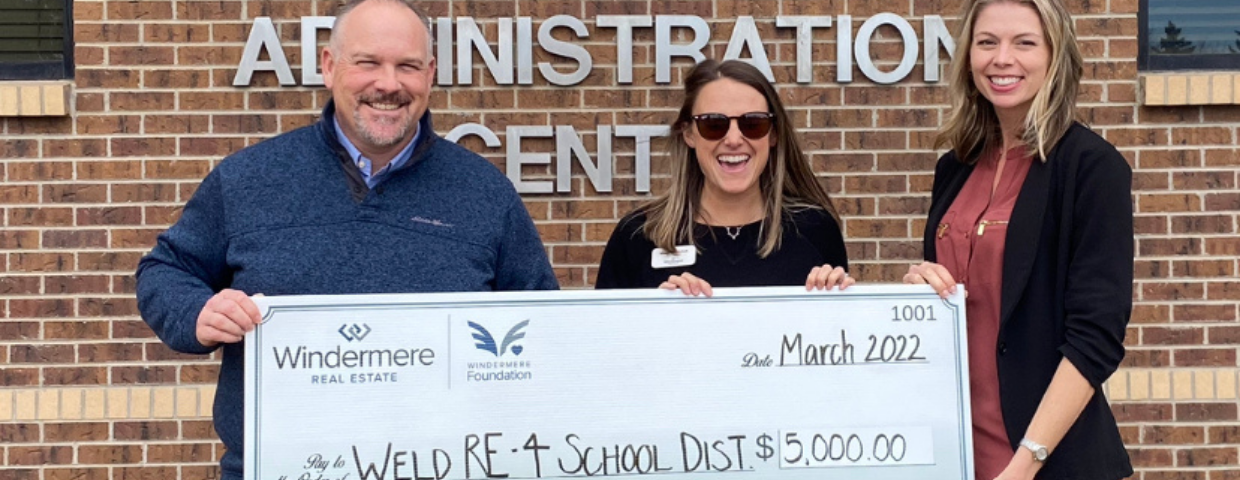
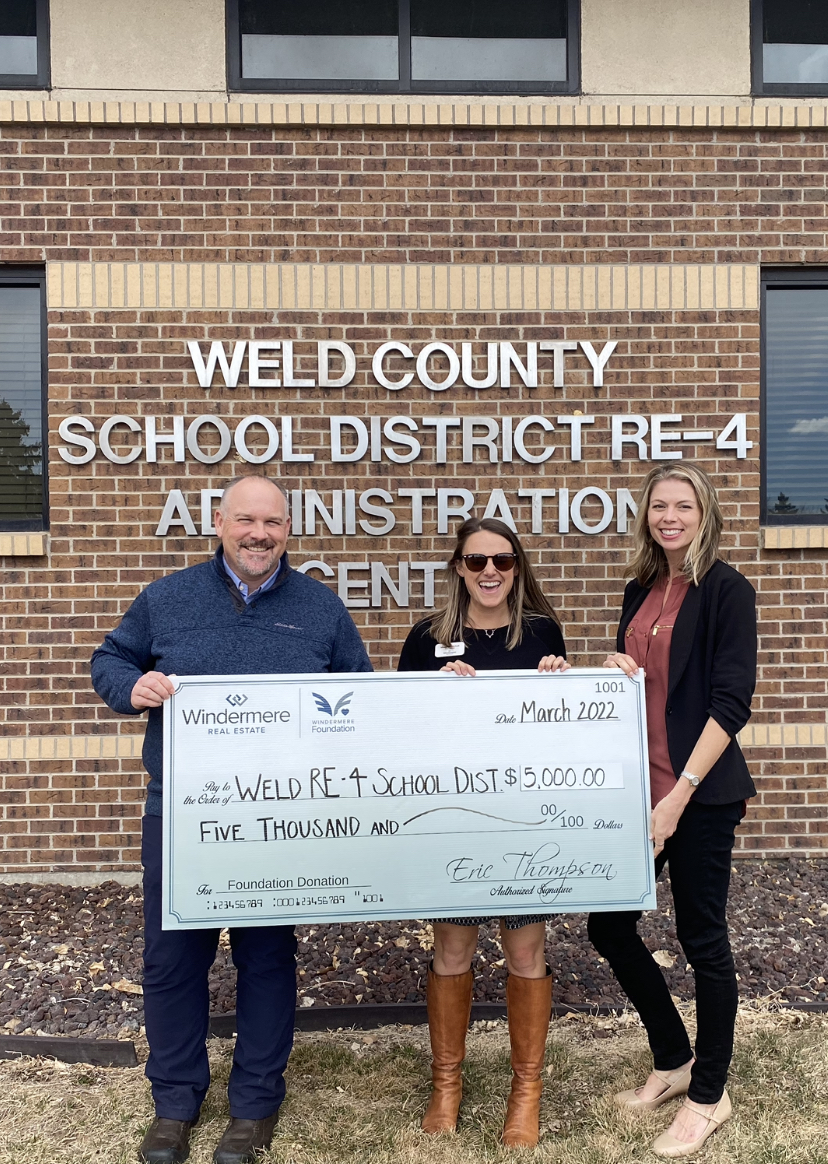
Windermere Northern Colorado has burst out the gate this year, organizing multiple fundraising events and supporting multiple local organizations throughout the early months of 2022. ChildSafe, based in Fort Collins, CO, provides children with responsive treatment, education, and recovery from child abuse. The Windermere office has supported ChildSafe in the past and wanted to continue to do so in 2022, donating $10,000 to them in February to help heal the trauma experienced by local victims of child abuse. In March, the office directed its giving efforts to the Weld County School District, with the goal of helping local children and families struggling with homelessness. Windermere Northern Colorado’s donation of $5,000 allowed the school district to purchase grocery gift cards for local families and students in need.


Two women and a man hold up a check for $5,000.

Pictured left to right: Weld RE-4 School District Director of Exceptional Student Services JonPaul Burden, Meaghan Nicholl, Elizabeth Dolton.


Windermere Utah

For the agents, owners, and staff at Windermere Utah, The Make-A-Wish Foundation has a special place in their hearts. Supporting children in need in their community has been a focal point of the office’s giving over the years, so when looking to kickstart their 2022 giving, Make-A-Wish was a natural fit. The office donated $5,000, which will go toward the organization’s ability to grant another child’s wish.


Windermere Coast Offices (Oregon)

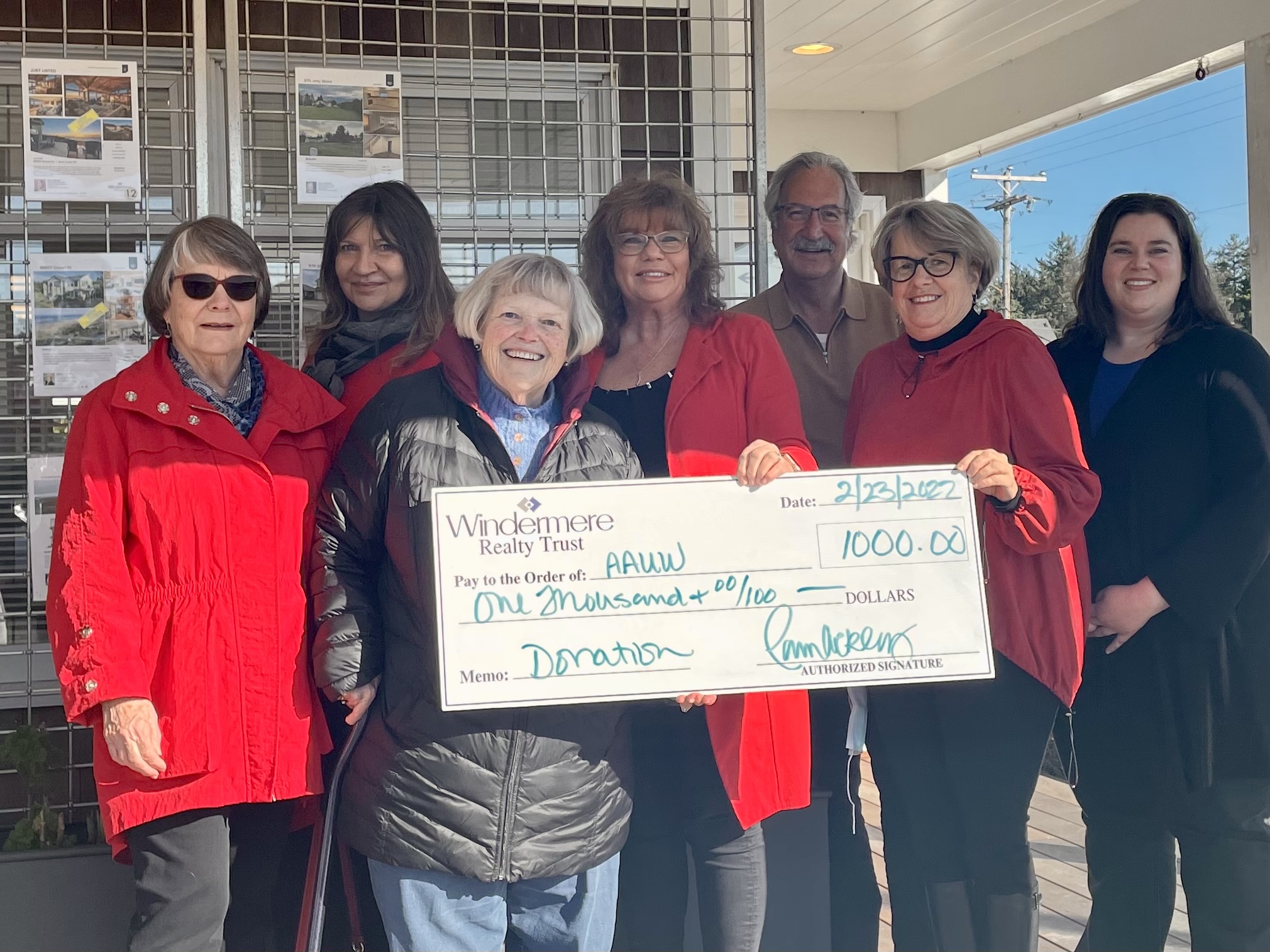
The Windermere Coast Offices of Gearhart and Cannon Beach have made it a point to support the aspirations and success of women in their community. They’ve been loyal supporters of the Astoria, OR branch of the American Association of University Women (AAUW) since learning about the organization years ago. AAUW provides scholarships for women who may not otherwise have the resources to pursue and succeed in their educational and vocational goals.


A group of people hold up a check for $1,000.

Pictured left to right: AAUW Branch Officer Judith Carder, Melissa Eddy, Co-President of Seaside AAUW Scholarship Foundation Maureen Casterline, Pam Ackley, Lynn Brigham, Barbara Maltman, Stefanie Wallace


To learn more about the Windermere Foundation, visit windermerefoundation.com. To help support programs in your community, click the donate button below.

content_Donate_button.jpg

Design April 13, 2022

What is Industrial Design?

Although primarily found in lofts, large apartments, commercial buildings, and other industrial spaces, you can easily borrow elements of industrial design when decorating your home. Born out of the Industrial Revolution, industrial’s unique style can create dynamic and visually striking interior spaces that feel clean, minimalist, and above all, modern.

What is Industrial Design?

The industrial style is based on the revolutionary concept of showcasing the building materials themselves as a design element. It creates an atmosphere akin to that of shipyards, places with reclaimed and repurposed materials, ports, etc. The common thread between all these places is openness. Industrial design prioritizes open spaces and a minimalist approach to filling the negative space. Whereas craftsman and cottage style homes were designed to evoke comfort, industrial design seeks to highlight architecture.  


A loft apartment showcasing various industrial design features.

Image Source: Getty Images – Image Credit: vicnt


Industrial Design Elements

When you walk into an industrial space, you know it right away. The ceilings are higher than your typical single-family home. This stretches the scale and proportion of the space, which opens up new possibilities when decorating. Industrial spaces allow for vertical décor: ladders, vertically arranged gallery walls, and loft beds. A tenet of industrial design is the harnessing of natural light, so you’ll often see a preference for floor-to-ceiling windows. Features like weathered wood floors, bare ceilings, prevalent light bulbs, and structural beams help to tie industrial spaces together. These features are generally exposed, which helps the room from feeling too empty. Go-to materials for industrial décor include wood, aluminum, copper, steel, brick, and stone.

In modern and contemporary residential design, there has been a shift toward fusing elements of industrial design with other styles, such as mid-century modern or farmhouse, to create edgy yet comfortable living environments that look and feel sustainable. This is further proof that even if your home doesn’t have typical industrial features, you can blend in pieces of it to create something unique.

For more information on using modern design elements in your home, read out blog post on modern color design trends.

Colorful Modern Design Trends for Your Home

Buying April 11, 2022

Renting vs Buying: Which is better for you?

Deciding whether to rent or buy can be a difficult decision, but with the right analysis, you can determine which is best for you. Knowing whether it’s the right time to rent or buy depends on your buying power, what you’re looking for in a home, your local market conditions, your plans for you and your household, and the responsibilities you’re prepared to take on at your residence.

Renting vs. Buying: Which is Better for You?

Renting gives you greater flexibility to relocate, fewer home maintenance responsibilities, and can often be more the more affordable option, depending on where you live. The extra costs associated with owning a home—interest payments, taxes, repairs—may be too much for some renters to handle. Becoming a homeowner has its respective advantages. You’ll have stable monthly payments and greater freedom to customize your living space. Advocates of buying will contend that purchasing a home is an investment in equity, which can increase in value every year you live in the home, whereas if you rent a property, you’re essentially paying for someone else’s mortgage. 

Ultimately, the right decision depends on your situation. If you don’t plan to be living in the same place for at least five years, renting might be more logical, as it allows you more flexibility when it comes time to move again. If you’re looking to settle down for the better part of a decade or longer and can afford to buy a home, becoming a homeowner may be the better option. Here are a few additional considerations to guide your renting-versus-buying decision making process.

What are the local real estate market conditions?

Investigate the local sales and rental markets. Industry groups put out reports every quarter stating the average national sales price for a home and the average monthly payment for a rental. These reports are typically based on an average of all the cities in the U.S. But what really matters is what the numbers show when you dig into them on a local level. When looking at these reports, you’ll see there are some cities that fall below that average, while others rise above it. When comparing housing costs, be sure to base your evaluation on what’s happening in your city and neighborhood, not the nationwide averages.

For a quarterly breakdown of local market conditions, explore our Market Updates page. With data analyzed by our Chief Economist Matthew Gardner, each report breaks down the latest figures in home sales, home prices, and days on market for regions throughout Windermere’s footprint. Gardner also provides his estimation of where each market sits on the buyer’s-market-to-seller’s-market spectrum.

What can you afford?

Making the jump from renter to homeowner is often a question of affordability. Your mortgage rate will depend on your financial strength, your credit score, and other factors, so make sure to talk to a loan officer before you start looking for a home. Getting pre-approved for a mortgage will identify what you’re able to afford and helps strengthen your offer when the time comes.

To get an idea of what you can afford, use our free Home Monthly Payment Calculator by clicking the button below. With current rates based on national averages and customizable mortgage terms, you can experiment with different values to get an estimate of your monthly payment for any listing price. By using the Home Monthly Payment Calculator, you can make a well-informed estimation of whether it’s the right time to buy.


Will you need to make repairs to your new home?

Buying a fixer-upper may seem like a great way to get a deal on a house, but if the money you spend on the repairs is too great, your profit could be diminished when it comes time to sell. The same is true for remodeling and improvement projects. There are various renovation financing loans available to you that can help with the costs of home repairs, though extra consultations, inspections, and appraisals are often required in the process of securing these loans. Ultimately, if you can only afford a home that demands major improvements, and you don’t have the skills to do much of the work yourself, you may be better off renting.

Can you rent part of the house you’re buying?

If you buy a house with rental-capable space (extra bedroom, mother-in-law unit, etc.), you could use the rental income to pay off your mortgage faster and contribute more to your savings. But, of course, you need to be willing to share your home with a tenant and take on the responsibilities of being a landlord or working with a professional property manager to help you with those duties. Renting out a space in your home will also require you to purchase landlord insurance on top of your existing homeowners insurance policy.

Making Your Decision to Rent or Buy

At the end of the day, the decision is up to you. Based on the conditions laid out above, it simply may not be the right time for you to buy. Fortunately, when it comes to being a homeowner, it’s not now or never. A real estate agent will be your ultimate resource in gauging whether it’s the right time to buy and guiding you through the process toward homeownership. To get started, connect with a local Windermere agent today.