Market News August 7, 2019

Idaho Real Estate Market Update


The following analysis of select counties of the Idaho real estate market is provided by Windermere Real Estate Chief Economist Matthew Gardner. We hope that this information may assist you with making better-informed real estate decisions. For further information about the housing market in your area, please don’t hesitate to contact your Windermere agent.


ECONOMIC OVERVIEW

Following a trend that started last fall, job growth in Idaho continues to moderate. The addition of 18,400 new jobs year-over-year represents an annual growth rate of 2.5%. This is to be expected at this point in the economic cycle, but it’s worth noting that the current rate of job growth remains well above the national average of 1.6%.

In May, the state unemployment rate was 2.8%, marginally lower than the 2.9% rate of a year ago. The state remains at full employment, though it is interesting to note that the employment rate remained below 3% even as the labor force rose 2%, suggesting that the economy remains very robust as there are still job openings to accommodate new workers.


HOME SALES

  • 6,936 homes were sold during the second quarter of 2019, representing a modest drop of 2.8% from the second quarter of 2018.
  • In Northern Idaho, Shoshone County was the only county to experience sales growth, with sales up by 21.3% over the second quarter of 2018. There was a modest decline in sales in the other two counties. In Southern Idaho, Canyon and Payette counties had modest sales growth, but the rest of the region experienced lower sales activity.
  • Year-over-year sales growth was positive in just one of the Northern Idaho counties. Sales rose in two Southern Idaho market areas relative to the same period a year ago.
  • Pending sales rose in the quarter, suggesting that closed sales next quarter are likely to be an improvement over current figures.


HOME PRICES

  • The average home price in the region rose 7.8% year-over-year to $358,406 and was 3.2% higher than the first quarter of this year.
  • In Northern Idaho, Bonner County led the market with the strongest annual price growth. Kootenai County also saw solid price growth. In Southern Idaho, small Boise County saw prices rise a very significant 21.1%, but this is an anomaly.
  • There were price increases in all but one county compared to the second quarter of 2018. The outlier was Blaine County, where prices dropped 12%. Blaine County is a very small market that can be prone to significant swings, so I am not too concerned at the present time. That said, it is the most expensive market, and this may be having an impact on values.
  • Inventory continues to be an issue, which is driving up home prices. I expected to see more homes come on the market in the late spring, but that wasn’t the case. Until there are more listings, price growth will continue at above-average levels.


DAYS ON MARKET

  • It took an average of 101 days to sell a home in Northern Idaho, and 66 days in the southern part of the state covered by this report.
  • The average number of days it took to sell a home in the region dropped 6 days compared to the second quarter of 2018 and was 24 days lower than in the first quarter of the year.
  • In Northern Idaho, days on market dropped in Bonner and Shoshone counties, but rose marginally in Kootenai. In Southern Idaho, market time dropped in all but Ada, Canyon, and Valley counties, but the change was very modest.
  • Homes sold fastest in Gem and Ada counties, where it took an average of 31 and 34 days, respectively.


CONCLUSIONS

The speedometer reflects the state of the region’s housing market using housing inventory, price gains, home sales, interest rates, and larger economic factors.

Job growth continues to slow from the frenetic pace of the past few years but is still very impressive. Economic vitality leads to demand for homeownership and this bodes well for the Idaho market. Home sales are being held back by the lack of inventory and this is leading to higher prices. As such, it remains a sellers’ market so I have moved the needle just a little more in their direction.


ABOUT MATTHEW GARDNER

As Chief Economist for Windermere Real Estate, Matthew Gardner is responsible for analyzing and interpreting economic data and its impact on the real estate market on both a local and national level. Matthew has over 30 years of professional experience both in the U.S. and U.K.

Matthew also sits on the Washington State Governors Council of Economic Advisors; chairs the Board of Trustees at the WA Center for Real Estate Research; and is an Advisory Board Member at the Runstad Center for Real Estate Studies at the University of Washington where he also lectures in real estate economics.

Market News August 6, 2019

Central Washington Real Estate Market Update

The following analysis of the Central Washington real estate market is provided by Windermere Real Estate Chief Economist Matthew Gardner. We hope that this information may assist you with making better-informed real estate decisions. For further information about the housing market in your area, please don’t hesitate to contact your Windermere agent.


ECONOMIC OVERVIEW

Washington State employment jumped back up to an annual growth rate of 2.4% following a disappointing slowdown earlier in the spring. As stated in the first quarter Gardner Report, the dismal numbers earlier this year were a function of the state re benchmarking its data (which they do annually).

The state unemployment rate was 4.7%, marginally up from 4.5% a year ago. On a seasonally adjusted basis, the counties within Central Washington added 3,910 new jobs over the past 12 months, representing a growth rate of 1.7%. The local unemployment rate rose compared to a year ago from 5.3% to 6.1%. However, a majority of the increase can be attributed to a 2.5% increase in the civilian labor force.


HOME SALES

  • In the second quarter of 2019, home sales throughout Central Washington fell 5.6% compared to the same period last year, with a total of 1,239 homes sold. Sales were up by a significant 64.1% compared to the first quarter of 2019.
  • Sales rose most in Okanogan County, which had an increase of 9.1% over the second quarter of 2018. Sales were lower in all other counties contained in this report, but the contraction was relatively marginal (74 units).
  • The number of pending home sales — an indicator of future closings — was up by more than 60% compared to the first quarter, indicating that closings will likely rise in the third quarter of 2019.
  • Listing activity in the quarter was generally higher than a year ago, with significant increases in Kittitas and Yakima counties but decreases in the rest of the region. I still expect overall inventory levels to rise modestly as we move through the balance of the year.


HOME PRICES

  • Year-over-year, the average home price in the region rose 7.2% to $340,677. Price growth continues to trend well above the long-term average. Inventory growth has not yet been sufficient to meet demand and is pushing prices higher.
  • Sale prices were 9.8% higher than in the first quarter of this year.
  • Prices rose in all counties contained in this report compared to the second quarter of 2018. Okanogan and Douglas counties both saw double-digit price growth.
  • The takeaway from this dataset is that significant home-price growth resumed in the quarter, likely because prices were depressed earlier in the year due to inclement weather.


DAYS ON MARKET

  • The average number of days it took to sell a home dropped six days compared to the second quarter of 2018.
  • The average time it took to sell a home in the region was 62 days, down 20 days from the first quarter of 2019.
  • Two markets contained in this report — Okanogan and Yakima — saw days-on-market drop from the same quarter in 2018. It took slightly longer to sell a home in the rest of the region.
  • Homes sold fastest in Kittitas County, where it took an average of 47 days to sell a home. The greatest drop in the time it took to sell a home was in Okanogan County, where it took 30 fewer days than in the second quarter of 2018.


CONCLUSIONS

This speedometer reflects the state of the region’s real estate market using housing inventory, price gains, home sales, interest rates, and larger economic factors.

For the second quarter of 2019, I have moved the needle a little more in favor of sellers. Inventory levels remain low, and prices resumed their upward trajectory. This, in concert with very favorable mortgage rates, bodes well for home sellers.


ABOUT MATTHEW GARDNER

As Chief Economist for Windermere Real Estate, Matthew Gardner is responsible for analyzing and interpreting economic data and its impact on the real estate market on both a local and national level. Matthew has over 30 years of professional experience both in the U.S. and U.K.

In addition to his day-to-day responsibilities, Matthew sits on the Washington State Governors Council of Economic Advisors; chairs the Board of Trustees at the Washington Center for Real Estate Research at the University of Washington; and is an Advisory Board Member at the Runstad Center for Real Estate Studies at the University of Washington where he also lectures in real estate economics.

Market News August 5, 2019

Nevada Real Estate Market Update

The following analysis of the greater Las Vegas real estate market is provided by Windermere Real Estate Chief Economist Matthew Gardner. We hope that this information may assist you with making better-informed real estate decisions. For further information about the housing market in your area, please don’t hesitate to contact your Windermere agent. 


ECONOMIC OVERVIEW

Job growth in the Las Vegas metropolitan area continues to outperform the rest of the country, adding a total of 27,700 new jobs over the past 12 months. This represents an annual growth rate of 2.8%. For perspective, employment growth for the U.S. as a whole is around 1.5%.

The labor market continues to grow and is now at a record level of over 1.12 million jobs. But the 4% unemployment rate suggests there are still jobs for those entering the workforce. My current forecast is for the Las Vegas metropolitan area to add a little over 30,000 new jobs in 2019.


HOME SALES

  • A total of 9,553 homes traded hands in the second quarter of 2019, a drop of 2.3% compared to the same period a year ago, but substantially higher than the first quarter of this year. I believe the recent run-up in sales is not only due to additional inventory, but also very favorable financing rates that are enticing would-be home buyers.
  • Home sales rose the most in the Lakes/Section 10 neighborhood. There were also decent increases in the Green Valley and North Las Vegas markets.
  • Sales were a mixed bag, with transactions rising in six sub-markets but falling in nine. The most significant drop was in the Spring Valley neighborhood. Summerlin also reported a double-digit drop in sales.
  • Pending sales rose by a modest 0.9% year-over-year. However, there was a significant increase of 16.4% when compared to the first quarter of 2019, which suggests that closings in the third quarter should be positive


HOME PRICES

  • Home prices in the area rose by 4% compared to the second quarter of 2018 to an average of $314,481 and were 1.2% higher than in the first quarter of 2018.
  • Home price increases continue to moderate but are still performing better than a large majority of the country. Demand for ownership is strong and mortgage rates are still very competitive. I expect home prices to continue rising in 2019.
  • Prices rose in all but three sub-markets compared to the same quarter last year. The strongest growth was in the Northeast Las Vegas sub-market, where prices were up 11.2%.
  • Ongoing job growth in Las Vegas will continue to drive demand for housing.


DAYS ON MARKET

  • The average time it took to sell a home in the region rose 15 days compared to the second quarter of 2018.
  • Regionwide, it took an average of 43 days to sell a home in the second quarter of 2019, 4 days less than in the first quarter of the year.
  • Days on market rose in all sub-markets compared to a year ago.
  • All market areas rose when compared to the second quarter of 2018. The greatest increase in market time was in Southwest Las Vegas, which rose by 21 days.


CONCLUSIONS

The speedometer reflects the state of the region’s real estate market using housing inventory, price gains, home sales, interest rates, and larger economic factors.

I remain very impressed with economic and employment growth in Clark County. This continues to drive incomes higher, which offsets increasing home prices. Moreover, mortgage rates remain very competitive. Given these factors, I anticipate the Las Vegas market will be one of the best performing areas in the Western U.S. in terms of home price growth in 2019. As such, I am moving the needle just a little more in favor of home sellers.


ABOUT MATTHEW GARDNER

As Chief Economist for Windermere Real Estate, Matthew Gardner is responsible for analyzing and interpreting economic data and its impact on the real estate market on both a local and national level. Matthew has over 30 years of professional experience both in the U.S. and U.K.

In addition to his day-to-day responsibilities, Matthew sits on the Washington State Governors Council of Economic Advisors; chairs the Board of Trustees at the Washington Center for Real Estate Research at the University of Washington; and is an Advisory Board Member at the Runstad Center for Real Estate Studies at the University of Washington where he also lectures in real estate economics.


Market News August 1, 2019

Utah Real Estate Market Update


The following analysis of select counties of the Utah real estate market is provided by Windermere Real Estate Chief Economist Matthew Gardner. We hope that this information may assist you with making better-informed real estate decisions. For further information about the housing market in your area, please don’t hesitate to contact your Windermere agent. 


ECONOMIC OVERVIEW

Utah’s non-agricultural employment rose by 42,600 jobs over the past 12 months, representing a solid growth rate of 2.8%. For perspective, the U.S. growth rate is 1.5%. It is appropriate to note that the pace of growth has started to slow and that this is likely to continue given the maturity of the economic cycle. That said, I anticipate the state will see job growth of around 3% in 2019.

In May, the state unemployment rate was 2.9%, marginally below the 3.1% level seen a year ago.


HOME SALES

  • 10,131 homes sold in the second quarter of 2019, representing an increase of 1.5% compared to the same period in 2018.
  • Total sales activity rose in four counties contained in this report and fell in three, though the contraction was relatively small in the markets that historically see fewer sales.
  • The number of homes for sale in the second quarter was 22.2% higher than in the same period a year ago and was 18.9% higher than the first quarter of the year. There continues to be significantly more choice in the market, which must be pleasing to home buyers.
  • Pending sales in the second quarter were up 10.4% compared to a year ago, suggesting that closings in the third quarter are likely to be an improvement over the current numbers.


HOME PRICES

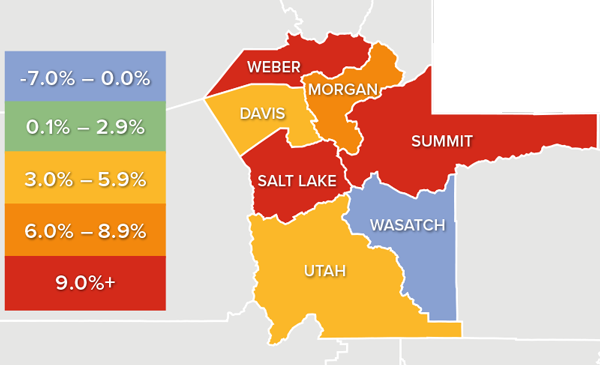
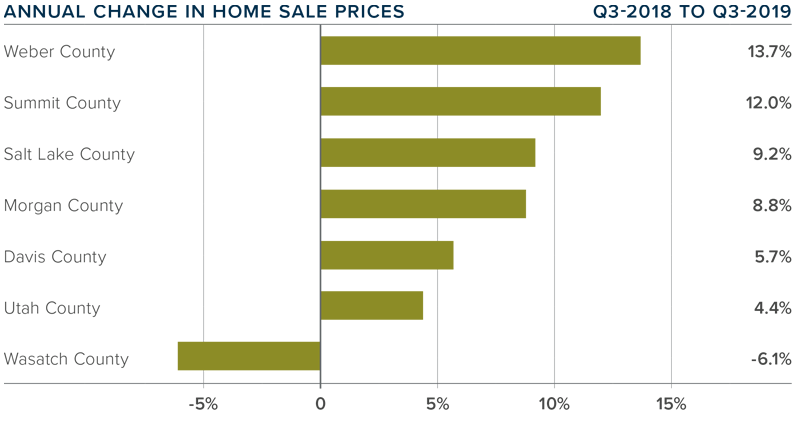
  • The average home price in the region continued to rise in the second quarter, with a year-over-year increase of 6.1% to an average of $391,914.
  • All but Summit County saw price increases compared to the same period a year ago. The drop in prices in Summit County was significant but, because it is a small and expensive area, I am not overly concerned this represents a pervasive trend.
  • Appreciation was strongest in Weber County. Prices there rose 16.2% to $297,000. As the most affordable market in the area, this is not surprising.
  • The takeaway here is that home prices continue to appreciate at quite significant rates. I expect to see some moderation in price growth, but the region will continue to outperform the nation as a whole.


DAYS ON MARKET

  • The average number of days it took to sell a home in the counties covered by this report rose 13 days compared to the second quarter of 2018.
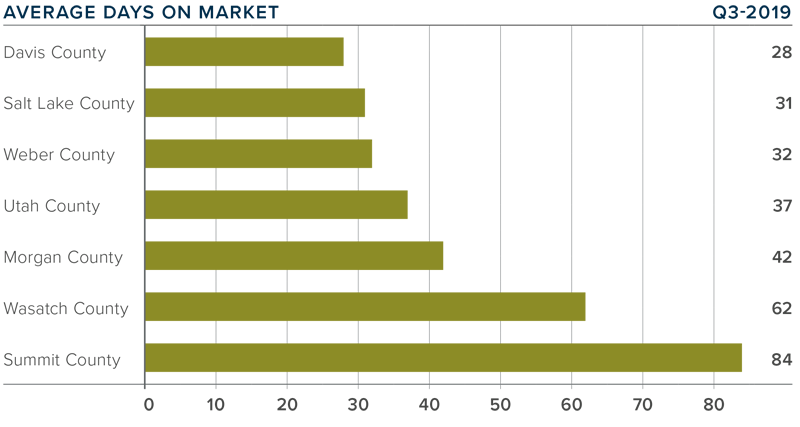
  • Homes sold fastest in Davis and Salt Lake counties and slowest in the pricey Summit County. All counties saw days-on-market rise compared to the second quarter of 2018.
  • During the second quarter of this year, it took an average of 53 days to sell a home in the region, down from the 65 days it took in the first quarter.
  • The regional economy continues to outperform the U.S. as a whole, and this continues to drive housing demand. Inventory levels have risen, and this gives buyers more choice, which will lead to market time rising.


CONCLUSIONS

This speedometer reflects the state of the region’s real estate market using housing inventory, price gains, home sales, interest rates, and larger economic factors.

For the second quarter of 2019, I have left the needle at the same position as last quarter. While inventory levels are rising, this year will be another good one for home sellers. Furthermore, mortgage rates remain quite low which will result in home prices continuing to rise.


ABOUT MATTHEW GARDNER

As Chief Economist for Windermere Real Estate, Matthew Gardner is responsible for analyzing and interpreting economic data and its impact on the real estate market on both a local and national level. Matthew has over 30 years of professional experience both in the U.S. and U.K.

In addition to his day-to-day responsibilities, Matthew sits on the Washington State Governors Council of Economic Advisors; chairs the Board of Trustees at the Washington Center for Real Estate Research at the University of Washington; and is an Advisory Board Member at the Runstad Center for Real Estate Studies at the University of Washington where he also lectures in real estate economics.

Market News July 31, 2019

Eastern Washington Real Estate Market Update

The following analysis of the Eastern Washington real estate market is provided by Windermere Real Estate Chief Economist Matthew Gardner. We hope that this information may assist you with making better-informed real estate decisions. For further information about the housing market in your area, please don’t hesitate to contact your Windermere agent. 


ECONOMIC OVERVIEW

Washington State employment jumped back up to an annual growth rate of 2.4% following a disappointing slowdown earlier in the spring. As stated in the first quarter Gardner Report, the dismal numbers earlier in the year were a function of the state re-benchmarking its data (which they do annually). The state unemployment rate was 4.7%, marginally up from 4.5% a year ago. My current economic forecast suggests that statewide job growth in 2019 will rise by 2.6%, with a total of 87,500 new jobs created. Eastern Washington added 18,143 total jobs over the past 12 months, representing an annual growth rate of 3.9%. Even with decent job formation, the unemployment rate rose to 5% from 4.8% a year ago.


HOME SALES

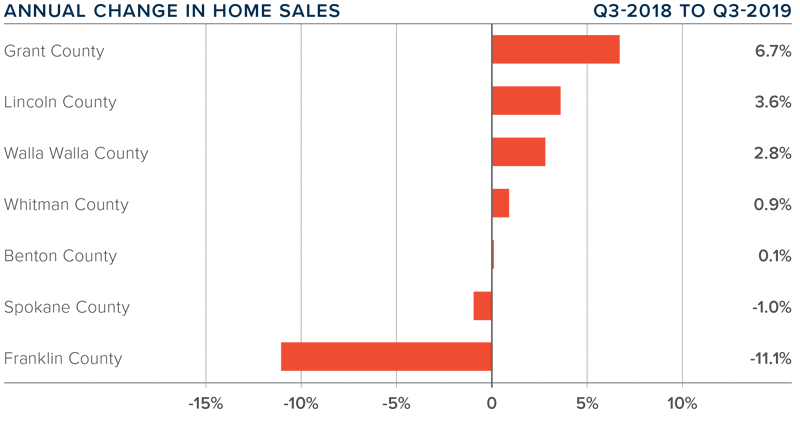
  • Home sales throughout Eastern Washington were down 11% compared to the same quarter in 2018, for a total of 3,468 closed sales.
  • Pending home sales were lower year-over-year but were up by 4.1% over the first quarter, suggesting that third-quarter closings should be higher.
  • Year-over-year, home sales fell in all counties other than Lincoln, which saw no change. The greatest drops were in Walla Walla and Spokane counties.
  • Interestingly, the number of homes for sale was 7.5% lower than a year ago, which is somewhat counterintuitive as most western markets have seen the number of homes for sale rise over the past several months. I do not believe this will be a trend that will continue. If it does, we will likely see further upward price pressure as the market remains tight.


HOME PRICES

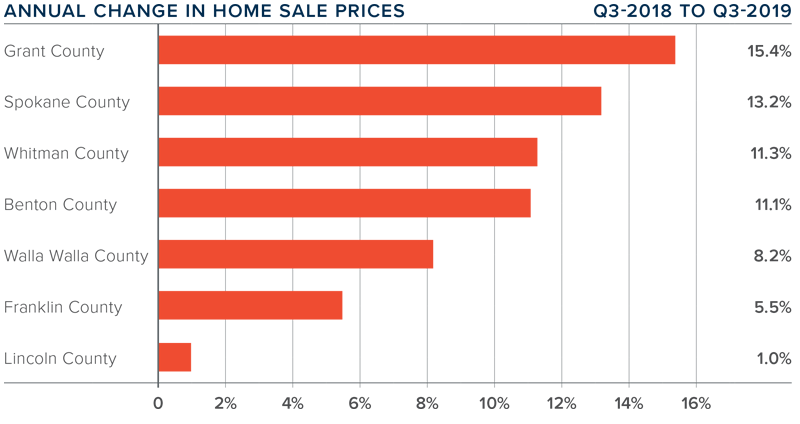
  • Year-over-year, the average home price in Eastern Washington rose by a significant 8% to $293,767. Price growth remains remarkably robust.
  • Low inventory levels continue to be the most significant hurdle to many home buyers. As previously discussed, the number of homes for sale remains low and this continues to put upward pressure on prices.
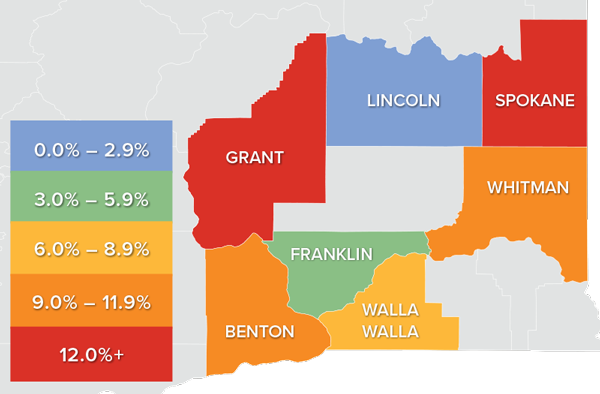
  • Prices rose in all of the counties contained in this report. Benton, Whitman, and Lincoln counties showed double-digit gains.
  • The takeaway is that average home-price growth in Eastern Washington remains well above the long-term average.


DAYS ON MARKET

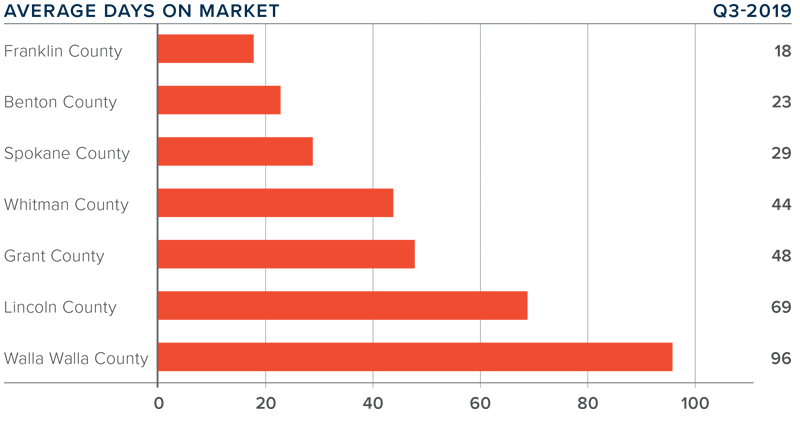
  • The average time it took to sell a home in Eastern Washington in the second quarter of 2019 was 51 days.
  • The average amount of time it took to sell a home dropped by four days compared to the second quarter of 2018.
  • Every county other than Franklin and Benton (which both rose by three days) saw the time it took to sell a home drop compared to the same quarter in 2018.
  • It took sixteen fewer days to sell a home in the second quarter than it did in the first quarter of this year.


CONCLUSIONS

This speedometer reflects the state of the region’s real estate market using housing inventory, price gains, home sales, interest rates, and larger economic factors.

The number of homes for sale remains well below normal levels, causing housing markets throughout Eastern Washington to remain very tight. It’s worth noting that concerns about affordability can cause buyer demand to decrease, which eventually functions to slow home price growth, but that has yet to occur. As such, I am leaving the needle in the same position as last quarter.


ABOUT MATTHEW GARDNER

As Chief Economist for Windermere Real Estate, Matthew Gardner is responsible for analyzing and interpreting economic data and its impact on the real estate market on both a local and national level. Matthew has over 30 years of professional experience both in the U.S. and U.K.

In addition to his day-to-day responsibilities, Matthew sits on the Washington State Governors Council of Economic Advisors; chairs the Board of Trustees at the Washington Center for Real Estate Research at the University of Washington; and is an Advisory Board Member at the Runstad Center for Real Estate Studies at the University of Washington where he also lectures in real estate economics.
Market News July 29, 2019

Southern California Real Estate Market Update

The following analysis of the Southern California real estate market is provided by Windermere Real Estate Chief Economist Matthew Gardner. We hope that this information may assist you with making better-informed real estate decisions. For further information about the housing market in your area, please don’t hesitate to contact your Windermere agent.


ECONOMIC OVERVIEW

Unexpectantly, the counties covered by this report — Los Angeles, San Diego, San Bernardino, Orange, and Riverside — saw total employment drop by 10,700 jobs (-0.1%) year-over-year. However, while Los Angeles and Orange counties reported declines, the smaller Riverside, San Bernardino, and San Diego counties saw employment rise. This is a significant reversal from the growth rates that have been in place for quite some time and may be due to re-benchmarking, which is when the government compares its sample to broader, historic data. I suspect that this is an anomaly and will reverse course, but I will continue to follow employment data closely as we move through the balance of the summer to see if this is a trend.

Over the past year, the unemployment rate in Southern California dropped from 3.6% to 3.4%, which further points to a data issue rather than a new trend that we need to be concerned about. I’ll know more when we publish the third quarter Gardner Report.


HOME SALES

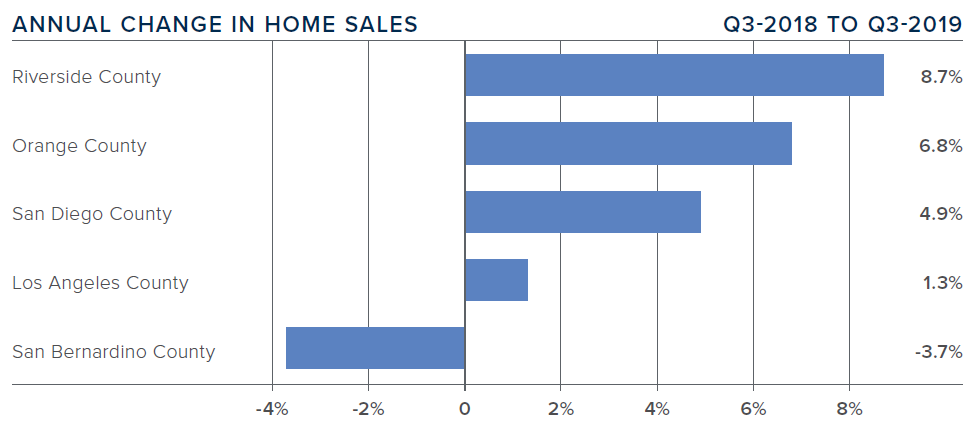
  • There were 49,996 home sales in the second quarter of 2019. This was a drop of 3.6% from the same period in 2018 but 46.4% higher than the first quarter of this year.
  • Pending home sales (an indicator of future closings) rose by 3.7% compared to a year ago, suggesting that total sales in the third quarter are likely to be an improvement over current levels.
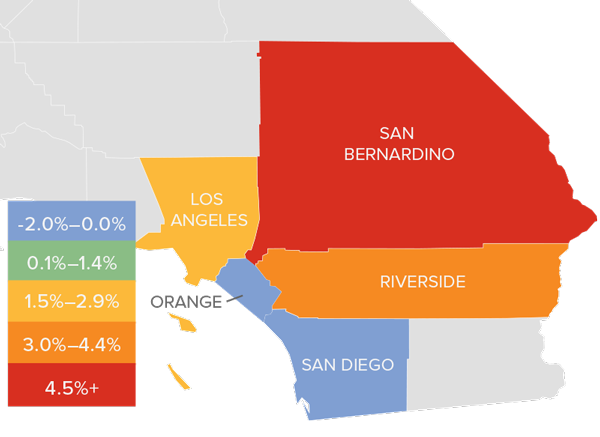
  • Following a trend that started last fall, home sales fell across the board. The most noticeable decline was again in San Bernardino County, which fell by 6.7%. The smallest drop was in the relatively affordable Riverside County.
  • There was an average of 40,174 active listings in the second quarter — up 13.1% from a year ago and 6.7% higher than in the first quarter of the year.


HOME PRICES

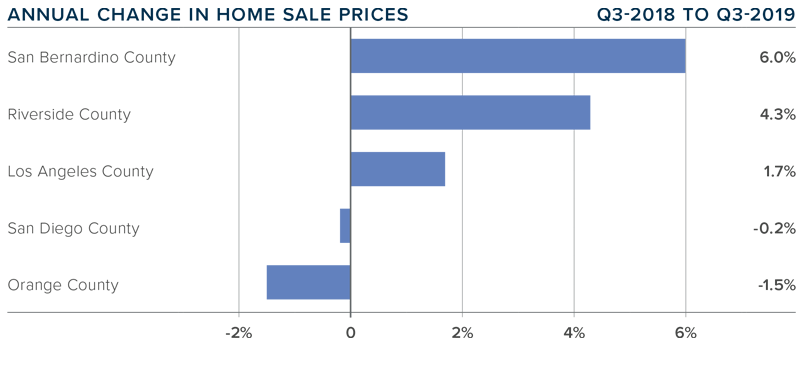
  • Year-over-year, average prices in the region were flat but were 5.3% higher than in the first quarter of 2019.
  • As stated above, affordability issues continue in most Southern California markets and this will likely lead price growth to taper.
  • Price growth in second quarter was mixed. Riverside County continues to have the greatest annual appreciation (+4.1%). Price gains were also seen in San Bernardino and San Diego counties. There were modest drops in average sale prices in Los Angeles and Orange counties, but this is not of great concern at the present time. That said, it is clear that affordability issues are present in these markets.
  • On a year-over-year basis, I still expect to see home prices continue to rise, but this likely only due to the very competitive mortgage rates. If rates move higher, this will have an impact on price growth.


DAYS ON MARKET

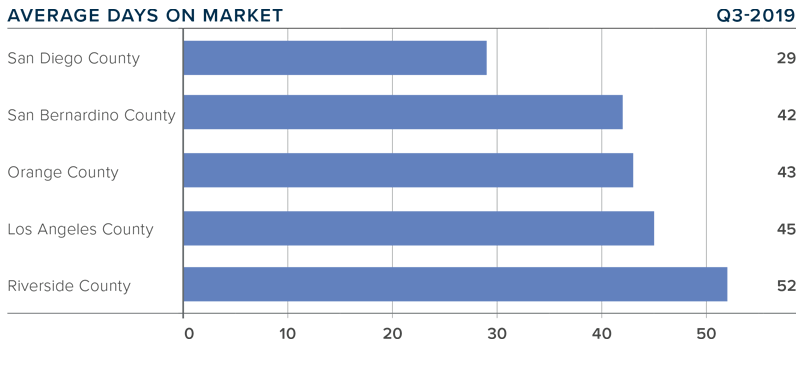
  • The average time it took to sell a home in the region was 44 days. This is an 8-day increase over the second quarter of 2018 but is down 9 days compared to the first quarter of 2019.
  • All markets saw the time it took to sell a house increase compared to the second quarter of 2018.
  • Homes in San Diego County continue to sell at a faster rate than other markets in the region. In the second quarter it took an average of just 29 days to sell a home. I would note that this is 5 more days than it took a year ago.
  • Market time is increasing, which may concern some, but it is simply a move back to historic averages.


CONCLUSIONS

The speedometer reflects the state of the region’s real estate market using housing inventory, price gains, home sales, interest rates, and larger economic factors.

Rising inventory levels, and affordability concerns in many markets will likely lead to slower price growth as we move through 2019. That said, mortgage rates are still very attractive, and this can offset affordability issues to some degree.

Given rising inventories and slower price growth, I have moved the needle just a little more toward buyers, though it still remains a sellers market.


As Chief Economist for Windermere Real Estate, Matthew Gardner is responsible for analyzing and interpreting economic data and its impact on the real estate market on both a local and national level. Matthew has over 30 years of professional experience both in the U.S. and U.K.

In addition to his day-to-day responsibilities, Matthew sits on the Washington State Governors Council of Economic Advisors; chairs the Board of Trustees at the Washington Center for Real Estate Research at the University of Washington; and is an Advisory Board Member at the Runstad Center for Real Estate Studies at the University of Washington where he also lectures in real estate economics.


Market News July 29, 2019

Colorado Real Estate Market Update

The following analysis of the Metro Denver & Northern Colorado real estate market (which now includes Clear Creek, Gilpin, and Park counties) is provided by Windermere Real Estate Chief Economist Matthew Gardner. We hope that this information may assist you with making better-informed real estate decisions. For further information about the housing market in your area, please don’t hesitate to contact your Windermere agent. 


ECONOMIC OVERVIEW

Colorado’s economy continues to grow with the addition of 45,900 new non-agricultural jobs over the past 12 months, which represents a growth rate of 1.7%. As I have stated in the last two Gardner Reports, we continue to see a modest slowdown in employment gains, but that is to be expected at this stage of the business cycle.

In May, the state unemployment rate was 3.2%, up from 3.1% a year ago. The increase in the rate is essentially due to labor force growth, which rose by over 55,700 people over the past year. On a seasonally adjusted basis, unemployment rates in all the markets contained in this report were lower than a year ago and are at full employment.


HOME SALES

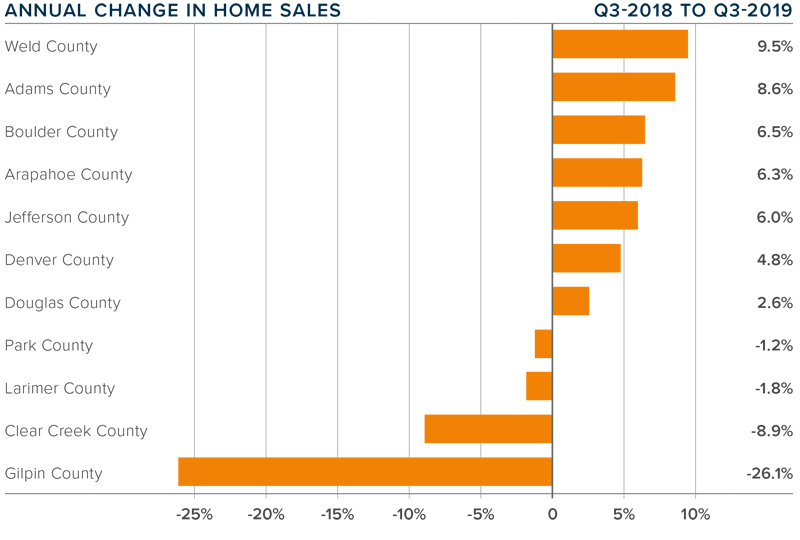
  • In the second quarter of 2019, 17,853 homes sold. This is a drop of 1% compared to the second quarter of 2018 but a substantial 59.9% higher than the first quarter of this year. Pending sales — a sign of future closings — rose 5.8%, suggesting that closings in the third quarter are likely to show further improvement.
  • Half of the counties contained in this report saw sales growth, while the other half had fewer closings. Sales in the small Clear Creek County fell precipitously. However, it was only a drop of 20 sales.
  • The marginal drop in the number of sales compared to a year ago can be attributed to the ongoing increase in listing activity (+34.8%), which continues to give would-be home buyers more choice and less urgency.
  • Inventory levels continue to rise, but demand for housing appears to be ongoing. I am not concerned by the marginal year-over-year slowdown and anticipate that sales will rise again in the third quarter.


HOME PRICES

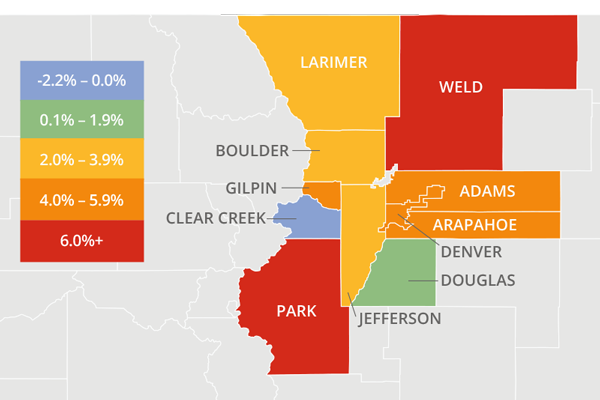
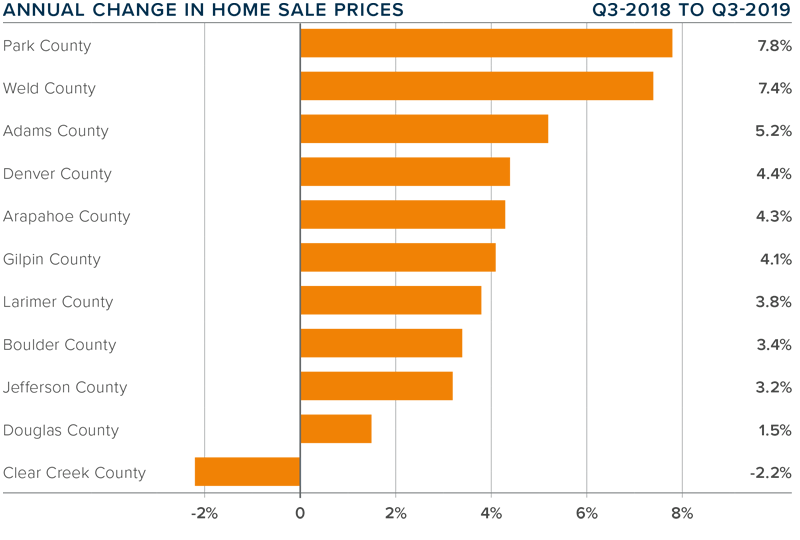
  • Home prices continue to trend higher, but the rate of growth has taken a pause, with the average home price in the region rising by just 2.3% year-over-year to $490,575.
  • The drop in interest rates this year has nudged more buyers off the fence and this can allow further price growth as we move through the year.
  • Appreciation was again strongest in Park County, where prices rose 6.1%. We also saw strong growth in Weld County, which rose by 6.1%. Home prices dropped in Clear Creek, Boulder, and Gilpin counties, but I do not see this as being indicative of a trend in these markets.
  • Affordability continues to be an issue in many Colorado markets and this may act as a modest headwind to ongoing price growth. However, some of the slowing may be offset by very favorable mortgage rates.


DAYS ON MARKET

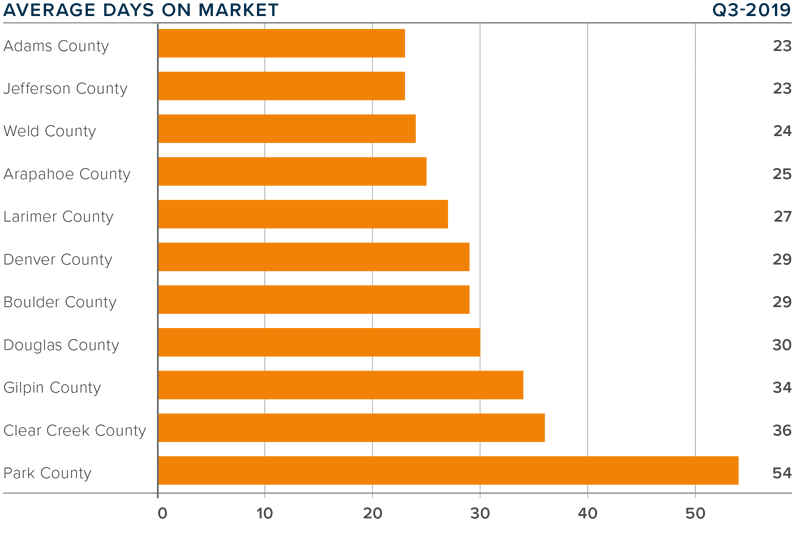
  • The average number of days it took to sell a home in the markets contained in this report rose four days over the second quarter of 2018.
  • The amount of time it took to sell a home rose in all counties except Gilpin when compared to the second quarter of 2018.
  • It took an average of 29 days to sell a home in the region — a drop of 13 days compared to the first quarter of this year.
  • It is likely that the drop in time-on-market was a function of the emerging spring selling season as well as falling mortgage rates.


CONCLUSIONS

This speedometer reflects the state of the region’s real estate market using housing inventory, price gains, home sales, interest rates, and larger economic factors.

For the second quarter of 2019, I continue the trend I started last summer and have moved the needle a little more in favor of buyers. I continue to closely monitor listing activity to see if we get any major bumps above the traditional increase because that may further slow home price growth. However, the trend for 2019 will continue to be a move toward a more balanced market.


ABOUT MATTHEW GARDNER

As Chief Economist for Windermere Real Estate, Matthew Gardner is responsible for analyzing and interpreting economic data and its impact on the real estate market on both a local and national level. Matthew has over 30 years of professional experience both in the U.S. and U.K.
In addition to his day-to-day responsibilities, Matthew sits on the Washington State Governors Council of Economic Advisors; chairs the Board of Trustees at the Washington Center for Real Estate Research at the University of Washington; and is an Advisory Board Member at the Runstad Center for Real Estate Studies at the University of Washington where he also lectures in real estate economics.

Market News July 25, 2019

Western Washington Real Estate Market Update


The following analysis of the Western Washington real estate market is provided by Windermere Real Estate Chief Economist Matthew Gardner. We hope that this information may assist you with making better-informed real estate decisions. For further information about the housing market in your area, please don’t hesitate to contact your Windermere agent.


ECONOMIC OVERVIEW

Washington State employment jumped back up to an annual growth rate of 2.4% following a disappointing slowdown earlier in the spring. As stated in the first quarter Gardner Report, the dismal numbers earlier this year were a function of the state re-benchmarking its data (which they do annually).

The state unemployment rate was 4.7%, marginally up from 4.5% a year ago. My current economic forecast suggests that statewide job growth in 2019 will rise by 2.6%, with a total of 87,500 new jobs created.


HOME SALES

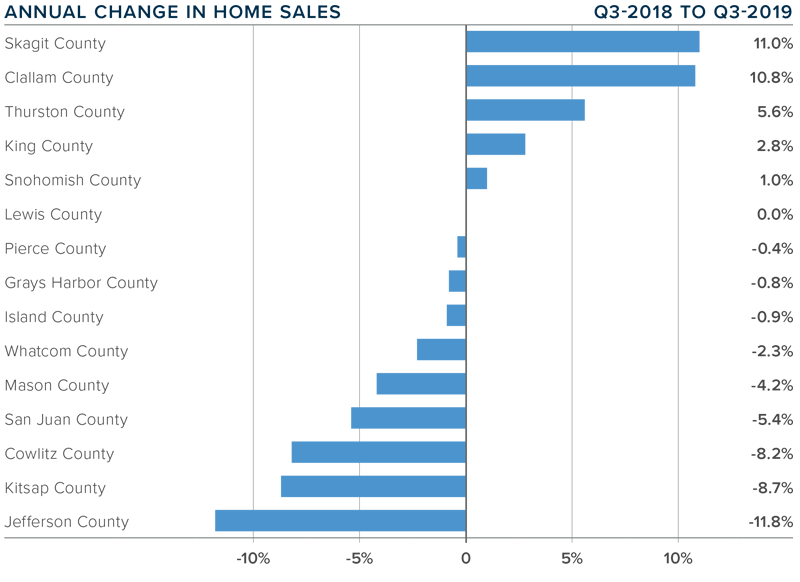
  • There were 22,281 home sales during the second quarter of 2019, representing a drop of 4.8% from the same period in 2018. On a more positive note, sales jumped 67.6% compared to the first quarterof this year.
  • Since the middle of last year, there has been a rapid rise in the number of homes for sale, which is likely the reason sales have slowed. More choice means buyers can be more selective and take their time when choosing a home to buy.
  • Compared to the second quarter of 2018, there were fewer sales in all counties except Whatcom and Lewis. The greatest declines were in Clallam, San Juan, and Jefferson counties.
  • Listings rose 19% compared to the second quarter of 2018, but there are still a number of very tight markets where inventory levels are lower than a year ago. Generally, these are the smaller — and more affordable — markets, which suggests that affordability remains an issue.


HOME PRICES

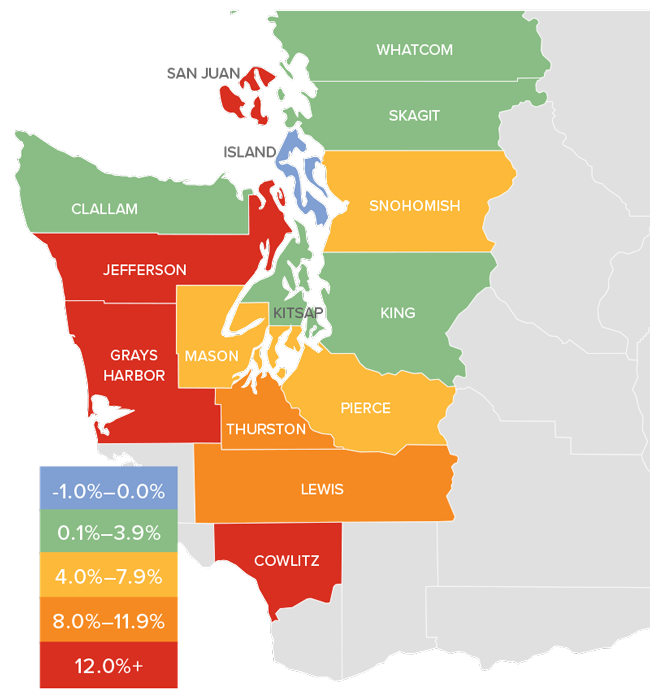
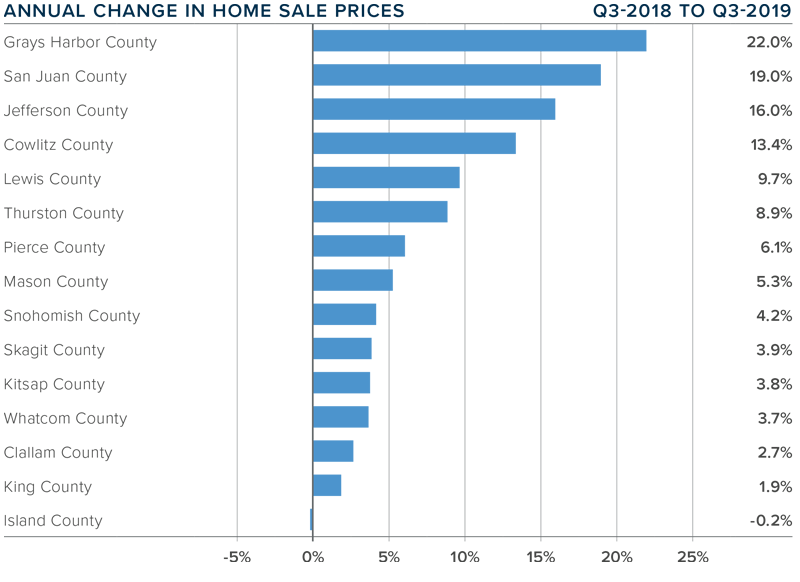
  • Year-over-year price growth in Western Washington continues to taper. The average home price during second quarter was $540,781, which is 2.8% higher than a year ago. When compared to first quarter of this year, prices were up 12%.
  • Home prices were higher in every county except King, which is unsurprising given the cost of homes in that area. Even though King County is home to the majority of jobs in the region, housing is out of reach for many and I anticipate that this will continue to act as a drag on price growth.
  • When compared to the same period a year ago, price growth was strongest in Lewis County, where home prices were up 15.9%. Double-digit price increases were also seen in Mason, Cowlitz, Grays Harbor, and Skagit counties.
  • The region’s economy remains robust, which should be a positive influence on price growth. That said, affordability issues are pervasive and will act as a headwind through the balance of the year, especially in those markets that are close to job centers. This will likely force some buyers to look further afield when searching for a new home.


DAYS ON MARKET

  • The average number of days it took to sell a home matched the second quarter of 2018.
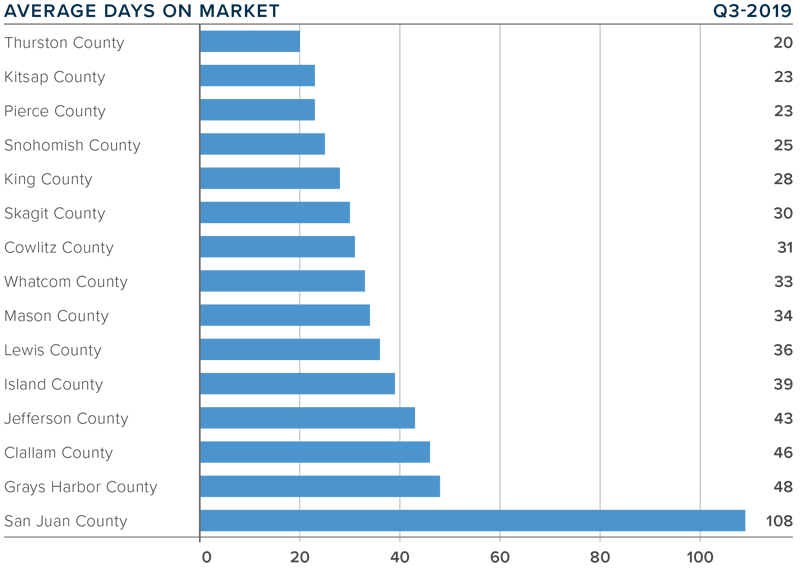
  • Snohomish County was the tightest market in Western Washington, with homes taking an average of only 21 days to sell. There were five counties where the length of time it took to sell a home dropped compared to the same period a year ago. Market time rose in eight counties and two were unchanged.
  • Across the entire region, it took an average of 41 days to sell a home in the second quarter of 2019. This was the same as a year ago but is down 20 days compared to the first quarter of 2019.
  • As stated above, days-on-market dropped as we moved through the spring, but all markets are not equal. I suggest that this is not too much of an issue and that well-priced homes will continue to attract attention and sell fairly rapidly.


CONCLUSIONS

This speedometer reflects the state of the region’s real estate market using housing inventory, price gains, home sales, interest rates, and larger economic factors. I am leaving the needle in the same position as the first quarter as demand appears to still be strong.

The market has benefitted from a fairly significant drop in mortgage rates. With average 30-year fixed rates still below 4%, I expect buyers who have been sitting on the fence will become more active, especially given that they have more homes to choose from.


As Chief Economist for Windermere Real Estate, Matthew Gardner is responsible for analyzing and interpreting economic data and its impact on the real estate market on both a local and national level. Matthew has over 30 years of professional experience both in the U.S. and U.K.
In addition to his day-to-day responsibilities, Matthew sits on the Washington State Governors Council of Economic Advisors; chairs the Board of Trustees at the Washington Center for Real Estate Research at the University of Washington; and is an Advisory Board Member at the Runstad Center for Real Estate Studies at the University of Washington where he also lectures in real estate economics.


Design July 22, 2019

Extend the Life of your Roof

Your roof is one of the most important and expensive assets of your home, but no other element is quite as valuable. While the average lifespan of a roof is about 15 years, careful homeowners can extend the life of their homes without enduring too many hardships. Take a look at these three quick maintenance tips to help your roof last.


Keep Your Gutters Clear

Debris that accumulates and clogs your gutters adds extra weight and pulls at your roof’s fascia, which can be a costly fix. Look down the length of your roof for any signs of sagging or bending – that’s a sure sign your gutters are carrying too much weight and pulling at your roof.

Don't forget the downspouts either, and don’t be fooled by easy-flowing water. Moss and algae buildup on and around your roof can slowly eat away at your roofing material and severely compromise its integrity.


Focus On The Attic

The exterior of your roof isn’t the only area you should focus on as your attic is your roof’s first line of defense against damage with a two-pronged approach: insulation and ventilation.

Insulating your attic has the double benefit of keeping your home’s internal temperature consistent while also preventing vapor and moisture buildup on the underside of your roof. When combined with proper ventilation your attic can stay dry and keep your roof’s rafters safe from moisture damage.

A great way to keep properly ventilate is to add a fan or dehumidifier to the attic.


Catch Problems Early

Check on your roof regularly, an easy time to remember to check is with every change of the season, or after a significant storm. Catching small issues early on will save you money in the long run, so utilizing the services of a reliable, professional roofer is an invaluable asset. As with any working professional, it’s a good idea to establish a working relationship with a roofer and even consider scheduling a yearly checkup for your roof just to make sure there aren’t any problems sneaking up on you. After all, spending a little each year to maintain your roof is a lot better than dropping $15,000-$50,000 on a new one, right?

More July 17, 2019

Building Stronger Communities By Helping Those In Need


We’re halfway through the Windermere Foundation’s 30-year anniversary and our offices aren’t showing any signs of slowing down their donations. Last quarter, the Windermere Foundation collected $556,937, bringing our year-to-date total to $865,029, and our grand total to $38,871,157 raised since 1989. These donations are used to support non-profit organizations and programs that help low-income and homeless families throughout the Western U.S.


Every Windermere office has its own Windermere Foundation fund account from which they make donations to help those in need in their local communities. This quarter, we’re highlighting Windermere offices in Oregon, Utah, and Colorado, which are each doing their part to give back by hosting clothing and donation drives, contributing to educational programs, and funding weekend backpack meals for public elementary schools.


Windermere Medford

The Windermere office in Medford, Oregon collected clothing donations for CASA of Jackson County’s summer clothing drive for kids in local foster care homes. The Windermere agents also volunteered their time to help sort and put away the collected items. According to CASA, the donations are enough to help 150 kids going through the court and foster care system. CASA was grateful to have the help and support of the Windermere Medford office.

“Thank you all for everything! Your team goes over the top each year and it is so fun and heartwarming.  If we could only share the stories of these children, but please know what a difference having a new summer outfit, shoes, swimsuits, etc. makes. Many, many happy hearts and smiles to come!” ~Erin Carpenter, Development and Media Manager, CASA of Jackson County


Windermere Utah

The Windermere offices in Utah combined their funding to make a donation to American Foundation for Suicide Prevention (AFSP) Salt Lake City Walk. Through the Windermere Foundation, they donated $5,000 to raise awareness about mental health issues and teen suicide. The mission of the AFSP is to save lives and bring hope to those affected by suicide. The programs are offered in schools and include speakers which are usually the surviving parents or other siblings telling their stories of loss to prevent others from making the same deadly mistakes.


Windermere DTC

The Windermere DTC office in Centennial, CO donated $5,000 to The CE Shop Foundation to support their recent fundraising campaign at the Elephant Rock Cycling Festival. Donations collected will help fund weekend backpacks of food for two Denver public elementary schools for the 2019-2020 school year. The CE Shop Foundation is on a quest to help Eliminate Childhood Hunger.


Thanks to our agents, offices, and everyone who supports the Windermere Foundation, we have been able to make a difference in the lives of many families in our local communities. This year we celebrate the Windermere Foundation’s 30th anniversary with a renewed year-long focus on giving back, doing more, and providing service to the communities that have made us who we are.


Our goal for 2019 is to raise over $40 million in total donations. If you’d like to help us reach this goal, or learn more about the Windermere Foundation, please visit WindermereFoundation.com.