Market News May 6, 2019

Utah Real Estate Market Update


The following analysis of select counties of the Utah real estate market is provided by Windermere Real Estate Chief Economist Matthew Gardner. We hope that this information may assist you with making better-informed real estate decisions. For further information about the housing market in your area, please don’t hesitate to contact your Windermere agent.


ECONOMIC OVERVIEW

Utah’s economy continues to outperform the country with the addition of 43,700 non-agricultural jobs over the past 12 months, representing a growth rate of 3.1% that is very solid compared to the U.S. rate of 1.7%. However, growth has started to slow — albeit modestly — and this is likely to continue given the maturity of the economic cycle. That said, I anticipate the state will continue to see job growth north of 3% in 2019.

In February, the state unemployment rate was 3%, marginally below the 3.1% level a year ago.


HOME SALES

  • 6,492 homes sold in the first quarter of 2019, representing a drop of 10.1% from the same period in 2018, and down 18.7% from the final quarter of 2018.
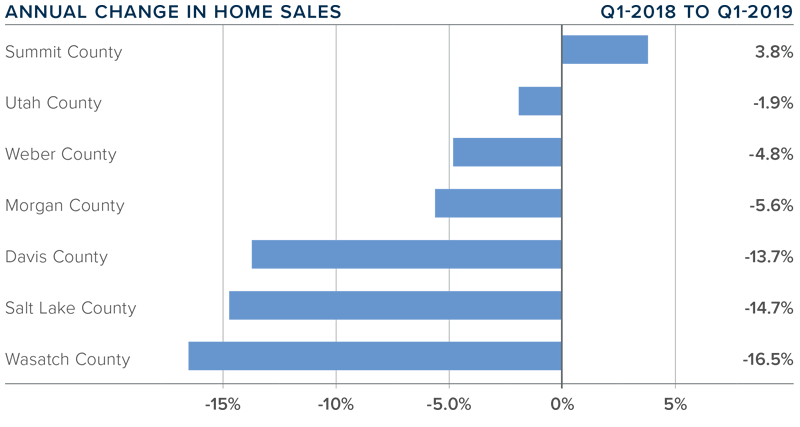
  • Total sales activity dropped in all counties contained in this report except for Summit County, which saw sales rise by a modest 3.8%.
  • The number of homes for sale in first quarter rose by a very significant 37.3% compared to the same period a year ago, but was 18% lower than the fourth quarter of 2018. There is significantly more choice in the market today than we’ve seen in many years, and this should bring relief to many home buyers.
  • Pending sales in the first quarter were a mixed bag. Improvements were seen in Utah, Summit, Morgan, and Davis counties, but there were drops in Weber, Salt Lake, and Wasatch. This suggests that closings in the second quarter will be an improvement over current numbers.


HOME PRICES

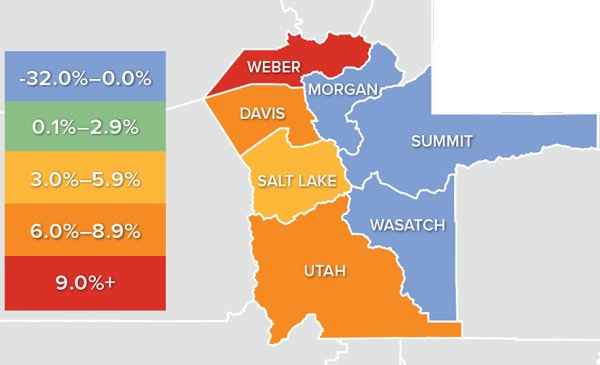
  • The average home price in the region continued to rise in the first quarter, with a year-over-year increase of 4.7% to $366,509.
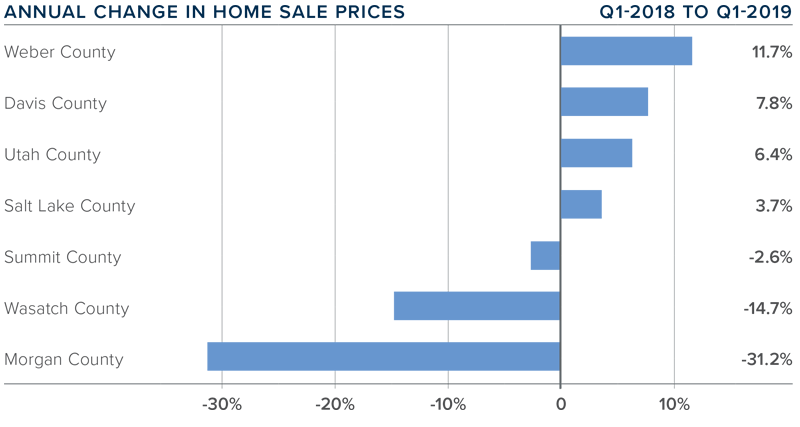
  • Weber and three other counties saw decent price increases compared to a year ago. Home prices dropped the most in Morgan County, but it’s important to remember that small counties such as Morgan, Wasatch, and Summit are subject to significant swings in value.
  • Appreciation was strongest in Weber County, where prices rose by 11.7% to $266,333. As the most affordable market in the area, this is not very surprising.
  • The takeaway here is that home prices continue to appreciate, but the rate of growth is starting to taper. This trend is likely to continue as we move through the balance of 2019.


DAYS ON MARKET

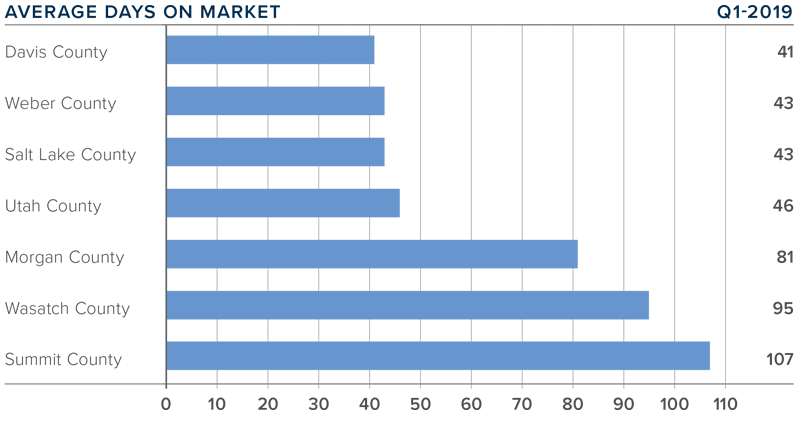
  • The average number of days it took to sell a home in the counties covered by this report rose 16 days compared to the first quarter of 2018.
  • Homes sold fastest in Davis, Weber, and Salt Lake counties and slowest in Summit County. All counties saw days-on-market rise when compared to the first quarter of 2018.
  • During the first quarter of this year, it took an average of 65 days to sell a home in the region.
  • The regional economy is still performing very well, and this will continue to drive housing demand. That said, inventory levels are on the rise and this gives buyers more choice and less urgency, which will lead to an increase in days on market.


CONCLUSIONS

This speedometer reflects the state of the region’s real estate market using housing inventory, price gains, home sales, interest rates, and larger economic factors.

For the first quarter of 2019, I have moved the needle very slightly toward buyers, though it clearly remains a sellers’ market. 2019 is very likely to be another good year for home sellers, but I expect home-price growth to continue to moderate.
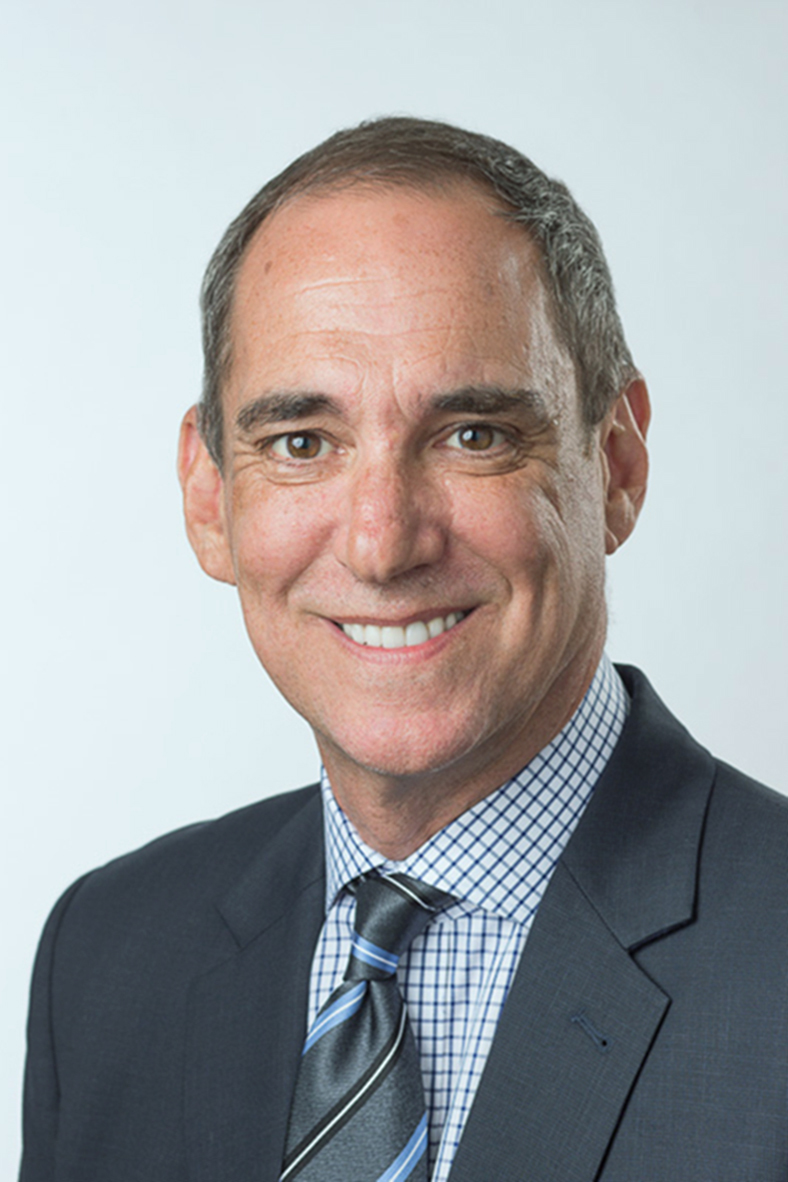


As Chief Economist for Windermere Real Estate, Matthew Gardner is responsible for analyzing and interpreting economic data and its impact on the real estate market on both a local and national level. Matthew has over 30 years of professional experience both in the U.S. and U.K.

In addition to his day-to-day responsibilities, Matthew sits on the Washington State Governors Council of Economic Advisors; chairs the Board of Trustees at the Washington Center for Real Estate Research at the University of Washington; and is an Advisory Board Member at the Runstad Center for Real Estate Studies at the University of Washington where he also lectures in real estate economics.

Market News May 2, 2019

Eastern Washington Real Estate Market Update


The following analysis of the Eastern Washington real estate market is provided by Windermere Real Estate Chief Economist Matthew Gardner. We hope that this information may assist you with making better-informed real estate decisions. For further information about the housing market in your area, please don’t hesitate to contact your Windermere agent.


ECONOMIC OVERVIEW

Washington State employment slowed to an annual growth rate of 1.7% — a level not seen since 2012 — and continues a trend of slowing that started in the summer of 2018. Over the past 12 months, the state added 56,100 new jobs. Month-over-month, all metropolitan areas in the state either saw the number of jobs contract or remain at their existing levels. This is a little unusual and may be due to the state re-benchmarking their data. As such, I am not overly concerned about the numbers but will be watching to see if this trend continues as we move through the spring months.

The state unemployment rate was 4.5%, marginally below the 4.6% level a year ago. My latest economic forecast suggests that statewide job growth in 2019 will be positive but is expected to slow. We should see an additional 84,000 new jobs, which would be a year-over-year increase of 2.2%.

Eastern Washington added a very impressive 20,640 jobs over the past 12 months, representing an annual growth rate of 4.6%. Even with this significant amount of job formation, however, the unemployment rate rose to 6.8%. This is simply a function of a growing labor force, which rose by over 22,000 year-over-year, and not something to be concerned about.


HOME SALES

  • Home sales throughout Eastern Washington slowed further in the first quarter of the year, with total sales down 17.3% over the same quarter in 2018 to 2,131 units.
  • Pending home sales were also lower, with the number of homes going under contract down 11% compared to the final quarter of 2018. This suggests that second-quarter closings may also be lower.
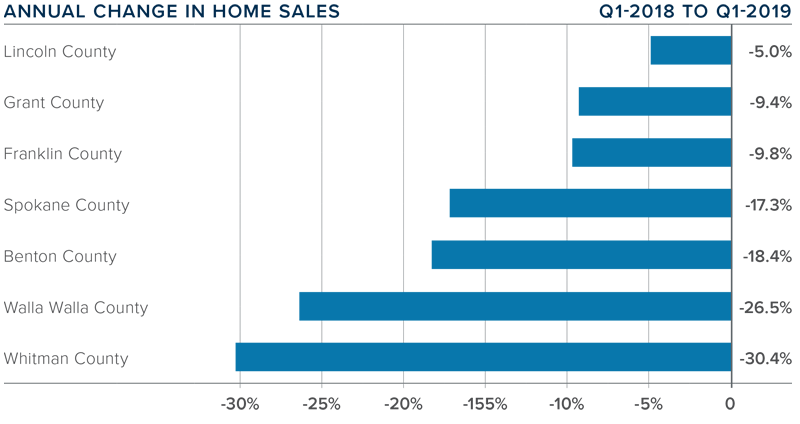
  • Year-over-year, home sales fell in all counties, with the greatest drops in Whitman and Walla Walla counties.
  • Interestingly, the number of homes for sale was 9.5% lower than a year ago. This may be due to the inclement weather early in the quarter. I will be watching to see if this is a persistent trend or whether we will see a pick up in the number of homes for sale as we move into the spring. I think the latter is more likely.


HOME PRICES

  • Year-over-year, the average home price in Eastern Washington rose by a significant 8.5% to $271,427. Price growth started to slow in the third quarter but remains remarkably robust.
  • Low inventory levels remain the most significant hurdle to many home buyers. I had expected more homes to come on the market in the early spring months, but that was not the case. Notably, the average number of listings is 9.5% lower than the same period a year ago.
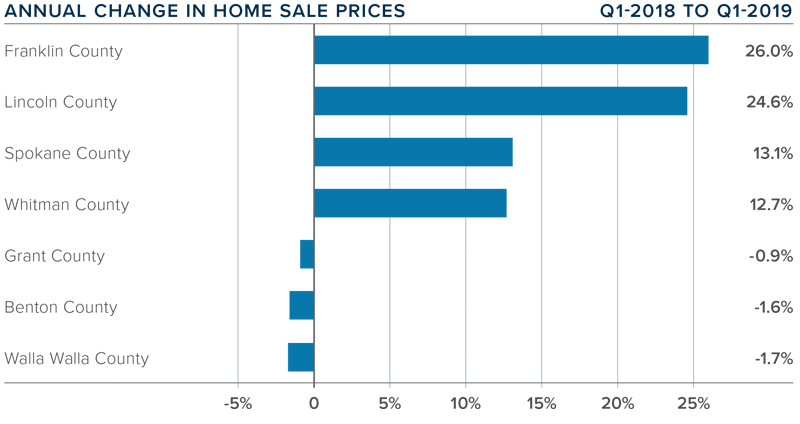
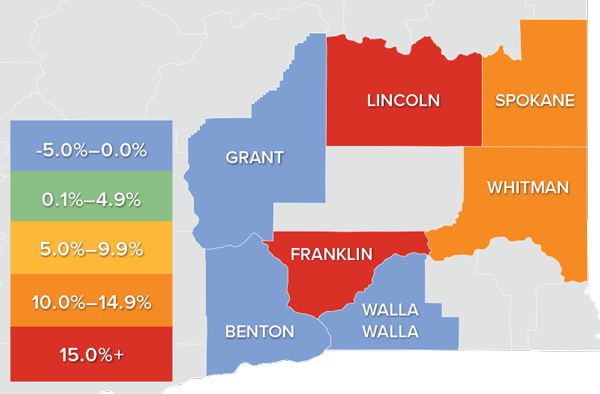
  • Prices rose in four of the seven counties contained in this report, with modest drops in three. Franklin County took over the number one spot, with an annual price increase of 26%.
  • The takeaway is that average home-price growth in Eastern Washington remains well above the long-term average.


DAYS ON MARKET

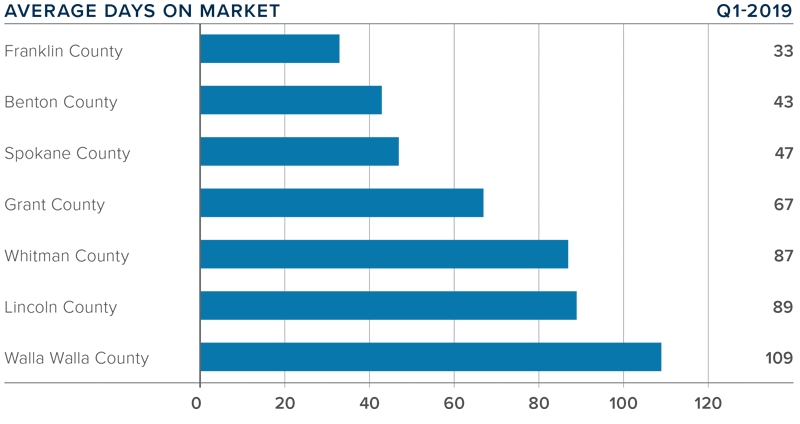
  • The average time it took to sell a home in Eastern Washington in the first quarter of 2019 was 68 days.
  • Days on market dropped by ten days compared to the first quarter of 2018.
  • Every county other than Franklin (+8 days) and Benton (+10 days) saw the time it took to sell a home drop compared to the same quarter in 2018.
  • It took five more days to sell a home in the first quarter than it did in the fourth quarter of last year, but this is not significant.


CONCLUSIONS

This speedometer reflects the state of the region’s real estate market using housing inventory, price gains, home sales, interest rates, and larger economic factors.

The number of homes for sale is still well below normal levels, causing housing markets throughout Eastern Washington to remain very tight. That said, home sales were down, and I believe affordability issues may be forming. It is likely that we will eventually see home price growth start to move back to the long-term average. As such, I am leaving the needle in the same position as last quarter.


As Chief Economist for Windermere Real Estate, Matthew Gardner is responsible for analyzing and interpreting economic data and its impact on the real estate market on both a local and national level. Matthew has over 30 years of professional experience both in the U.S. and U.K.

In addition to his day-to-day responsibilities, Matthew sits on the Washington State Governors Council of Economic Advisors; chairs the Board of Trustees at the Washington Center for Real Estate Research at the University of Washington; and is an Advisory Board Member at the Runstad Center for Real Estate Studies at the University of Washington where he also lectures in real estate economics.

Market News May 1, 2019

Colorado Real Estate Market Update


The following analysis of the Metro Denver & Northern Colorado real estate market (which now includes Clear Creek, Gilpin, and Park counties) is provided by Windermere Real Estate Chief Economist Matthew Gardner. We hope that this information may assist you with making better-informed real estate decisions. For further information about the housing market in your area, please don’t hesitate to contact your Windermere agent.


ECONOMIC OVERVIEW

Colorado’s economy continues to grow with the addition of 44,800 new non-agricultural jobs over the past 12 months. This represents a reasonable growth rate of 1.7%. As stated in last quarter’s Gardner Report, we continue to see a modest slowdown in employment gains, but that’s to be expected at this stage of the business cycle. I predict that employment growth in Colorado will pick back up as we move through the year, adding a total of 70,000 new jobs in 2019, which represents a growth rate of 2.6%.

In February, the state unemployment rate was 3.7%, up from 2.9% a year ago. The increase is essentially due to labor force growth, which rose by more than 84,000 people over the past year. On a seasonally adjusted basis, unemployment rates in all the markets contained in this report haven’t moved much in the past year, but Boulder saw a modest drop (2.7%), and the balance of the state either remained at the same level as a year ago or rose very modestly.


HOME SALES

  • In the first quarter of 2019, 11,164 homes sold — a drop of 3% compared to the first quarter of 2018 and down 13.5% from the fourth quarter of last year. Pending sales in the quarter were a mixed bag. Five counties saw an increase, but five showed signs of slowing.
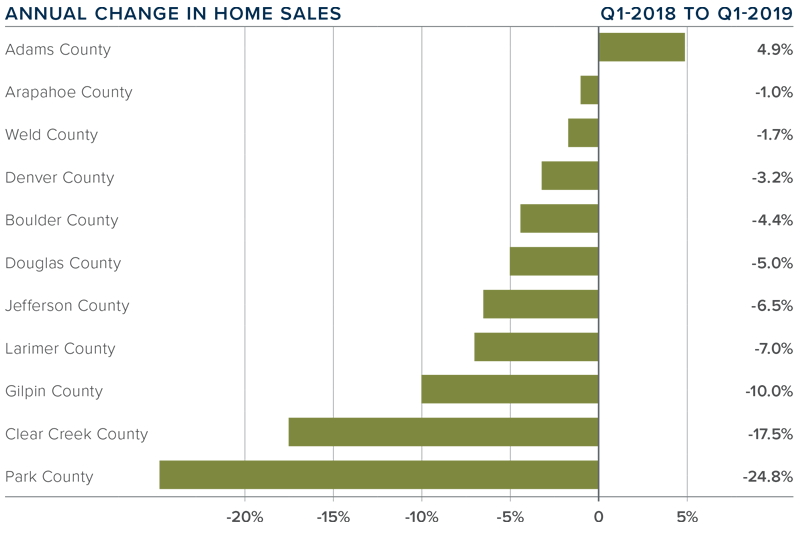
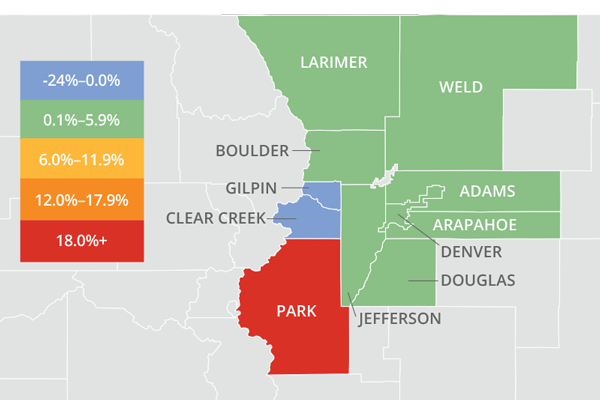
  • The only market that had sales growth was Adams, which rose 4.9%. The rest of the counties contained in this report saw sales decline, with a significant drop in the small Park County area.
  • I believe the drop in the number of home sales is partially due to the significant increase in listings (+45.6%), which has given would-be home buyers more choice and less need to act quickly.
  • As mentioned above, inventory growth in the quarter was significant, but I continue to believe that the market will see sales rise. I expect the second half of the year to perform better than the first.


HOME PRICES

  • Home prices continue to trend higher, but the rate of growth is tapering. The average home price in the region rose just 2.1% year-over-year to $456,243. Home prices were .3% higher than in the fourth quarter of 2018.
  • I anticipate that the drop in interest rates early in the year will likely get more buyers off the fence and this will allow prices to rise.
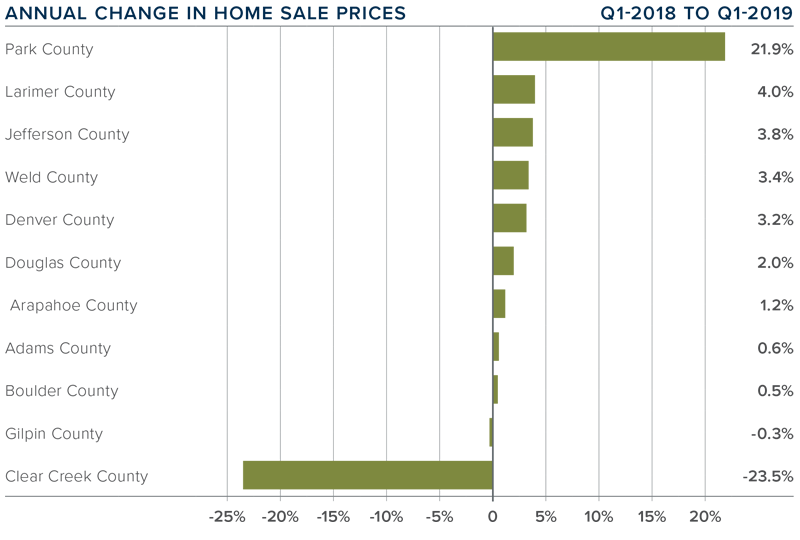
  • Appreciation was again strongest in Park County, where prices rose 21.9%. We still attribute this rapid increase to it being a small market. Only Clear Creek County experienced a drop in average home price. Similar to Park County, this is due to it being a very small market, making it more prone to significant swings.
  • Affordability remains an issue in many Colorado markets but that may be offset by the drop in interest rates.


DAYS ON MARKET

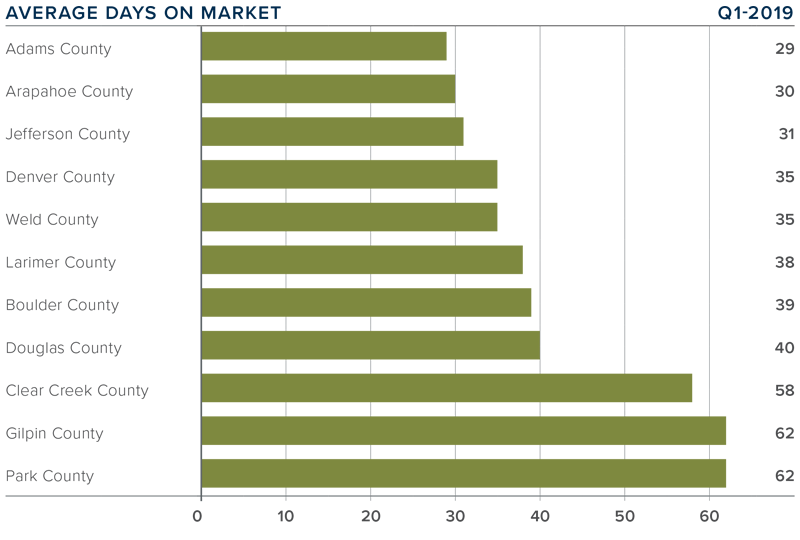
  • The average number of days it took to sell a home in Colorado rose five days compared to the first quarter of 2018.
  • The amount of time it took to sell a home dropped in two counties — Gilpin and Park — compared to the first quarter of 2018. The rest of the counties in this report saw days-on-market rise modestly with the exception of the small Clear Creek market, which rose by 26 days.
  • In the first quarter of 2019, it took an average of 42 days to sell a home in the region, an increase of four days compared to the final quarter of 2018.
  • Job growth drives housing demand, but buyers are faced with more choice and are far less frantic than they were over the past few years. That said, I anticipate the late spring will bring more activity and sales.


CONCLUSIONS

This speedometer reflects the state of the region’s real estate market using housing inventory, price gains, home sales, interest rates, and larger economic factors.

For the first quarter of 2019, I have moved the needle a little more in favor of buyers. I am watching listing activity closely to see if we get any major bumps above the traditional increase because that may further slow home price growth; however, the trend for 2019 will continue towards a more balanced market.


As Chief Economist for Windermere Real Estate, Matthew Gardner is responsible for analyzing and interpreting economic data and its impact on the real estate market on both a local and national level. Matthew has over 30 years of professional experience both in the U.S. and U.K.

In addition to his day-to-day responsibilities, Matthew sits on the Washington State Governors Council of Economic Advisors; chairs the Board of Trustees at the Washington Center for Real Estate Research at the University of Washington; and is an Advisory Board Member at the Runstad Center for Real Estate Studies at the University of Washington where he also lectures in real estate economics.
More May 1, 2019

Join Us for the 33rd Annual Windermere Cup This Saturday


On May 4 the Montlake Cut will play host once again to the Windermere Cup rowing regatta. For the past 33 years, Windermere Real Estate and the University of Washington have joined together to host this event, which brings the world’s best crews to Seattle to compete against the perennially acclaimed UW men’s and women’s teams. Held annually on the first Saturday in May, the Windermere Cup is both an international sporting event and opening day party. The races are followed by the world’s largest boat parade which is put on by the Seattle Yacht Club.

The UW men will go up against one of the oldest programs in rowing, Boston University, and the German National Federation, who is the current World Champion after taking gold in the 2018 World Championship. This is the first time in the Windermere Cup’s 33 year history that the Germans have competed in this regatta. Both will oppose a Washington men’s crew that has been a dominant program in the United States for several decades and came second in last year’s national championship.

The UW women, who also came in second at the 2018 NCAA Championship, will be opposed by the UCLA Bruins who have been a consistent national competitor in the last four NCAA Championships and the German National Federation women’s team, who have rowed in the A final of the eight competition in the past three Under-23 World Championships.

In addition to the 24 crew races throughout the morning, the family-friendly Windermere Cup event also includes food vendors, booths to purchase UW and Windermere Cup apparel and commemorative gear, as well as a bouncy house for the kids and a selfie stand by Snap Bar. The crew races start at 10:15 am and end around noon, followed by the Opening Day Boat Parade.

Windermere Party on the Cut: Boats Brats Beers Bands

In honor of the German National Crews visiting Seattle to race in the Cup races, we’ll be celebrating German-style. So break out your lederhosen and dirndls and come on out to the party! This year’s pre-race Party on the Cut will take place Friday, May 3rd, from 6 PM to 10 PM. Join us on the northeast shore of the Montlake Cut for an evening of live music, lawn games, and food and drinks. Advance tickets are just $20, or $30 at the door. This year features live performances by Nite Wave and Brian DiJulio & the Love Jacks. This event is 21+ and tickets can be found through Brown Paper Tickets.

For more information please visit windermerecup.com and follow us at Facebook.com/WindermereCup@WindermereCup on Twitter, and @Windermere on Instagram. Share your excitement and your day-of experience by including the official hashtag: #WindermereCup2019.

Market News April 30, 2019

Nevada Real Estate Market Update


The following analysis of the greater Las Vegas real estate market is provided by Windermere Real Estate Chief Economist Matthew Gardner. We hope that this information may assist you with making better-informed real estate decisions. For further information about the housing market in your area, please don’t hesitate to contact your Windermere agent. 


ECONOMIC OVERVIEW

Job growth in the Las Vegas metropolitan area remains robust. A total of 28,000 new jobs were added over the past 12 months, representing an annual growth rate of 2.8%. For perspective, the U.S. as a whole is growing at around 1.7%, or less than half the rate of Las Vegas.

As the labor market expands, the unemployment rate continues to trend lower. The seasonally adjusted rate was 4.2%, down a full percentage point from a year ago but still above the national average. As I have mentioned in the last few Gardner Reports, this is partially attributable to a growing labor force.


HOME SALES

  • There were 6,798 home sales in the first quarter of 2019 — a drop of 14.6% compared to the same period a year ago and 9% lower than the final quarter of 2018. It is likely that this slowdown in sales is due to a combination of growing inventory levels that started last summer and rising interest rates. However, mortgage rates dropped significantly in the first two months of this year, so I expect home sales to pick back up in the second quarter.
  • Pending sales dropped 2.9% versus the same period a year ago and were down 26.4% compared to the final quarter of 2018. This suggests that closings in the second quarter of 2019 will likely disappoint.
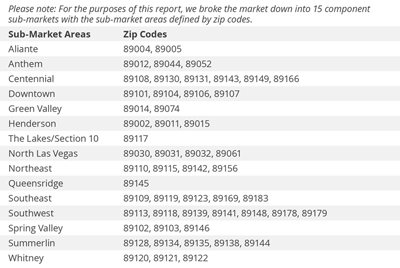
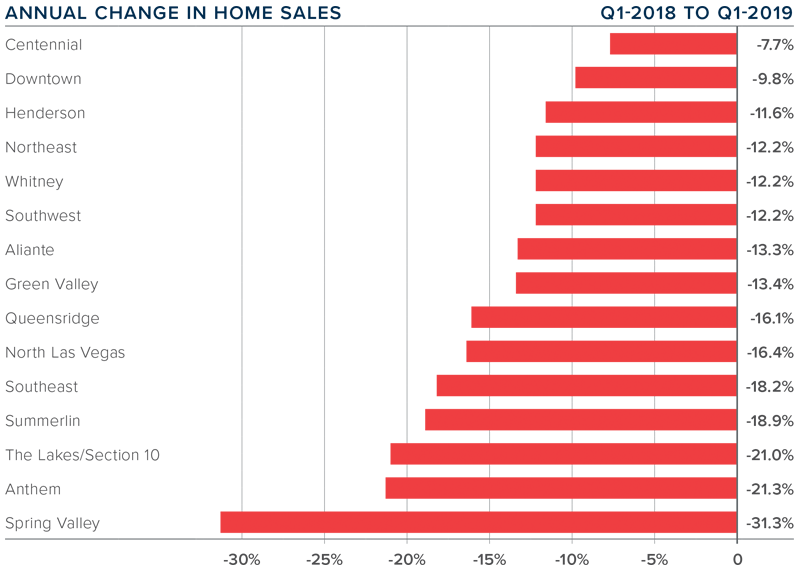
  • Sales dropped across the board, with the most substantial dip occurring in the Spring Valley neighborhood. Double-digit contractions in sales were seen in all areas other than the Centennial and Downtown neighborhoods.
  • The Las Vegas housing market continues to move toward balance. I maintain my position that there is no cause for panic, but more choice will lead to a temporary slowing in sales as buyers take their time when choosing a new home.


HOME PRICES

  • Home prices in the area rose by 6.7% compared to the first quarter of 2018 to an average of $310,890, and were 1.2% higher than the fourth quarter of 2018.
  • The increase in Las Vegas home prices is moderating, but the area is still performing better than the country as a whole. Demand is likely to grow as we enter the spring market and I anticipate home prices will continue to rise in 2019.
  • Prices in all sub-markets other than Queens Ridge rose when compared to the same quarter last year. The strongest growth was in The Lakes/Section 10 sub-market, where prices were up by 14.4%. Five additional sub-markets saw double-digit price growth.
  • Economic growth is leading to rising incomes and this, in concert with attractive mortgage rates, will allow homes to continue to appreciate in value.


DAYS ON MARKET

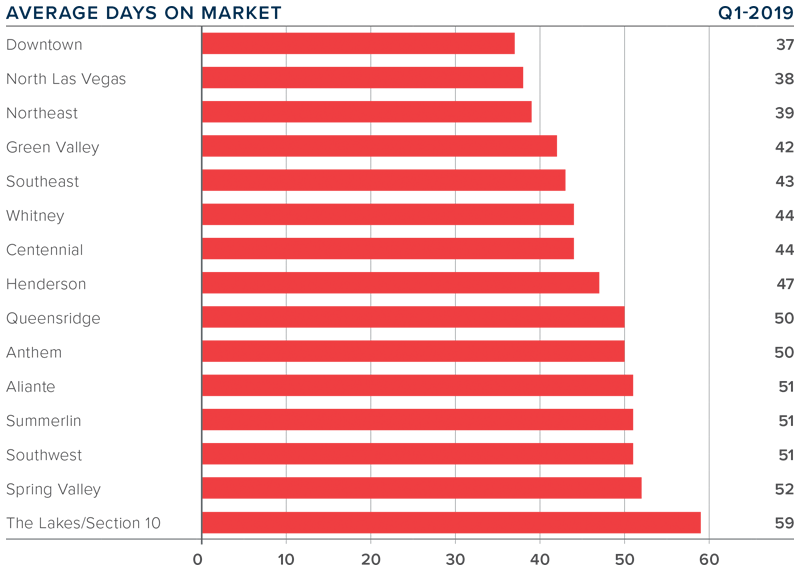
  • The average time it took to sell a home in the region rose nine days compared to the first quarter of 2018.
  • Region-wide, it took an average of 47 days to sell a home in the first quarter of 2019.
  • Days-on-market rose in all but one sub-market compared to a year ago.
  • The only market where the length of market time dropped was in the Aliante neighborhood, which saw a significant decrease from 64 to 51 days. The greatest increase in market time was in Queens Ridge, which rose by 20 days.


CONCLUSIONS

The speedometer reflects the state of the region’s real estate market using housing inventory, price gains, home sales, interest rates, and larger economic factors.

Employment growth in Clark County remains robust and this is leading to tangible income growth, which can offset increasing home prices. Mortgage rates dropped in the early spring and I expect to see transactional velocities rise as we move through the traditionally buoyant spring months. I still believe the Las Vegas market will be one of the best-performing areas in the Western United States in home price growth in 2019.


As Chief Economist for Windermere Real Estate, Matthew Gardner is responsible for analyzing and interpreting economic data and its impact on the real estate market on both a local and national level. Matthew has over 30 years of professional experience both in the U.S. and U.K.

In addition to his day-to-day responsibilities, Matthew sits on the Washington State Governors Council of Economic Advisors; chairs the Board of Trustees at the Washington Center for Real Estate Research at the University of Washington; and is an Advisory Board Member at the Runstad Center for Real Estate Studies at the University of Washington where he also lectures in real estate economics.

Selling April 29, 2019

Follow Our Sellers Checklist To Stay Safe While Selling Your Home

Staying organized while uprooting your life and moving from one home to another can feel impossible. Not only are you trying to get the best financial return on your investment, but you might also be working on a tight deadline. There’s also the pressure to keep your home clean and organized at all times for prospective buyers. However, one thing you can be sure of when selling your home is that there will be strangers entering your space, so it’s important for you and your agent to take certain safety precautions. Like so many things in life, they can feel more manageable once written down, so we made this handy checklist.

  • Go through your medicine cabinets and remove all prescription medications.
  • Remove or lock up precious belongings and personal information. You will want to store your jewelry, family heirlooms, and personal/financial information in a secure location to keep them from getting misplaced or stolen.
  • Remove family photos. We recommend removing your family photos during the staging process so potential buyers can see themselves living in the home. It’s also a good way to protect your privacy.
  • Check your windows and doors for secure closings before and after showings. If someone is looking to get back into your home following a showing or an open house, they will look for weak locks or they might unlock a window or door.
  • Consider extra security measures such as an alarm system or other monitoring tools like cameras.
  • Don’t show your own home! If someone you don’t know walks up to your home asking for a showing, don’t let them in. You want to have an agent present to show your home at all times. Agents should have screening precautions to keep you and them safe from potential danger.

Talk to your agent about the following safety precautions: 

  • Do a walk-through with your agent to make sure you have identified everything that needs to be removed or secured, such as medications, belongings, and photos.
  • Go over your agent’s screening process:
    • Phone screening prior to showing the home
    • Process for identifying and qualifying buyers for showings
    • Their personal safety during showings and open houses
  • Lockboxes to secure your keys for showings should be up to date. Electronic lockboxes actually track who has had access to your home.
  • Work with your agent on an open house checklist:
    • Do they collect contact information of everyone entering the home?
    • Do they work with a partner to ensure their personal safety?
  • Go through your home’s entrances and exits and share important household information so your agent can advise how to secure your property while it’s on the market.
Market News April 29, 2019

Southern California Real Estate Market Update


The following analysis of the Southern California real estate market is provided by Windermere Real Estate Chief Economist Matthew Gardner. We hope that this information may assist you with making better-informed real estate decisions. For further information about the housing market in your area, please don’t hesitate to contact your Windermere agent. 


ECONOMIC OVERVIEW

The counties covered by this report — Los Angeles, San Diego, San Bernardino, Orange, and Riverside — added 165,000 new jobs between February 2018 and February 2019. This represents an annual growth rate of 1.7%. In the same timeframe, the unemployment rate dropped from 4.4% to 3.9%. Employment growth in Southern California picked up a little in the late winter. Los Angeles County led the way, adding 96,500 new jobs. My 2019 forecast for employment in Southern California is for continued growth at around 1.5%.


HOME SALES

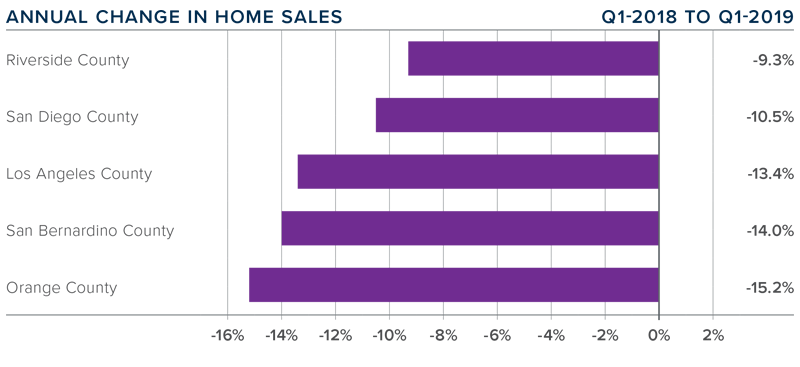
  • There were 34,142 home sales in the first quarter of 2019. This was a drop of 12.4% from the same period in 2018 and 13.9% lower than the final quarter of last year
  • Pending home sales (an indicator of future closings) were just 2.8% lower than during the same period a year ago, but down 18% compared to the fourth quarter of 2018. This suggests that second-quarter sales are likely to disappoint.
  • Home sales dropped across the board, but the most noticeable decline was again in Orange County, which fell by 15.2%. This drop is probably temporary and was more than likely driven by the 49% increase in inventory and high home prices. The smallest drop was in the more affordable Riverside County.
  • There was an average of 37,641 active listings in the first quarter — up 30.5% from a year ago.


HOME PRICES

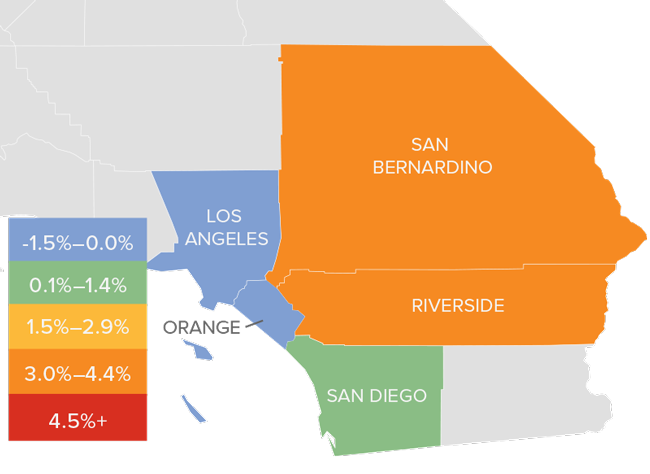
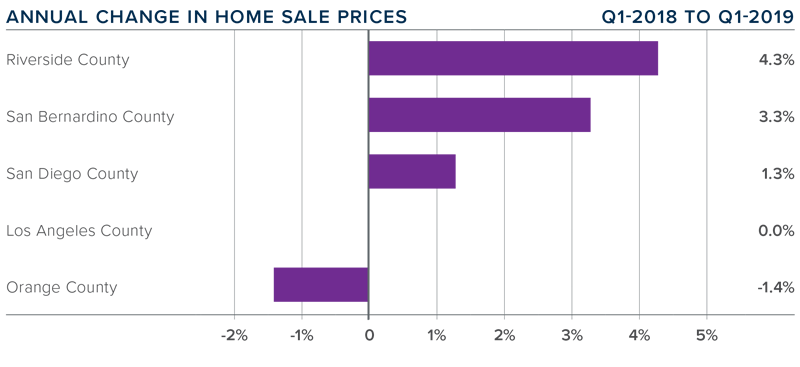
  • Year-over-year, average prices in the region rose a very modest .3% and were 2.4% lower than in the fourth quarter of 2018.

  • Affordability remains an issue in most of the Southern California counties contained in this report, which, in concert with growing inventory, will likely continue to limit home price growth.
  • Price growth was varied. Riverside County showed the greatest annual appreciation (+4.3%). Average home prices dropped 1.4% in Orange County.
  • On a year-over-year basis, I expect to see home prices continue to rise through 2019, but the rate of growth will be more modest than the market has seen in several years.


DAYS ON MARKET

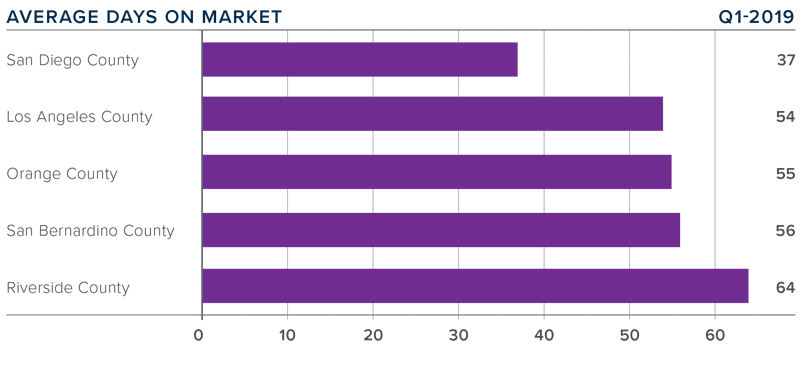
  • The average time it took to sell a home in the region was 53 days. This is a 10-day increase compared to the first quarter of 2018, and eight days more than in the fourth quarter of 2018.
  • All markets saw an increase in the time it took to sell a house in the first quarter of this year compared to both the first and fourth quarters of 2018.
  • Homes in San Diego County continue to sell at a faster rate than other markets in the region. In the first quarter, it took an average of 37 days to sell a home, which is eight days more than it took a year ago.
  • Market time is increasing, which may concern some; however, it is simply a move back to normal averages.


CONCLUSIONS

The speedometer reflects the state of the region’s real estate market using housing inventory, price gains, home sales, interest rates, and larger economic factors.
The Southern California economy saw a bit of a boost in early 2019, which is good news. But rising inventory levels and low affordability in many markets will lead to slower price growth. Affordability remains a significant issue and I will be watching proposed legislation, such as Senate Bill 50, to see whether there is enough interest in addressing this obstacle to home ownership.

Rising inventories and slower price growth has led me to move the needle a little further toward buyers.


As Chief Economist for Windermere Real Estate, Matthew Gardner is responsible for analyzing and interpreting economic data and its impact on the real estate market on both a local and national level. Matthew has over 30 years of professional experience both in the U.S. and U.K.

In addition to his day-to-day responsibilities, Matthew sits on the Washington State Governors Council of Economic Advisors; chairs the Board of Trustees at the Washington Center for Real Estate Research at the University of Washington; and is an Advisory Board Member at the Runstad Center for Real Estate Studies at the University of Washington where he also lectures in real estate economics.

Market News April 25, 2019

Western Washington Real Estate Market Update


The following analysis of the Western Washington real estate market is provided by Windermere Real Estate Chief Economist Matthew Gardner. We hope that this information may assist you with making better-informed real estate decisions. For further information about the housing market in your area, please don’t hesitate to contact your Windermere agent.


ECONOMIC OVERVIEW

Washington State employment slowed to an annual growth rate of 1.7% — a level not seen since 2012 — and continues a trend of slowing that started in the summer of 2018. I was a little surprised to see such a significant drop in employment growth, but it may be due to the state re-benchmarking their data (which they do annually). As such, I am not overly concerned about the lower-than-expected numbers but will be watching to see if this trend continues as we move through the spring months. The state unemployment rate was 4.5%, marginally below the 4.6% level a year ago.

My latest economic forecast suggests that statewide job growth in 2019 will be positive but is expected to slow. We should see an additional 84,000 new jobs, which would be a year-over-year increase of 2.2%.


HOME SALES

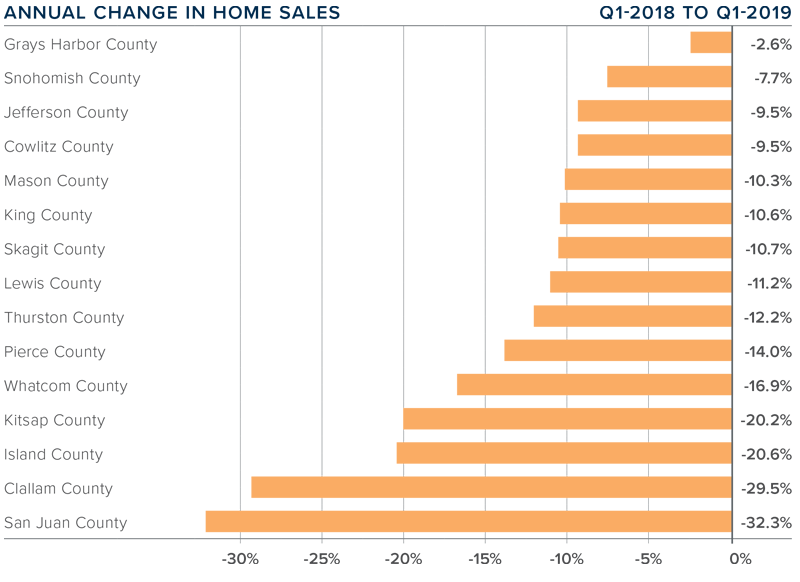
  • There were 13,292 home sales during the first quarter of 2019. Year-over-year, sales were down 12.3% and were 23.4% lower than the fourth quarter of 2018.​
  • It is quite likely that part of the slowdown can be attributed to the very poor weather in February. That said, anecdotal information from our brokers suggests that March was a very active month and I expect to see sales rise again through the spring selling season. Notably, pending home sales were only off by 3.5% from the first quarter of 2018.​
  • All counties contained in this report saw sales drop when compared to a year ago. The greatest drops were in the relatively small counties of San Juan, Clallam, Island, and Kitsap.​
  • The decline in interest rates during the first two months of the quarter nudged many home buyers off the fence. I believe this will cause a significant bump in sales activity in the second quarter numbers.


HOME PRICES

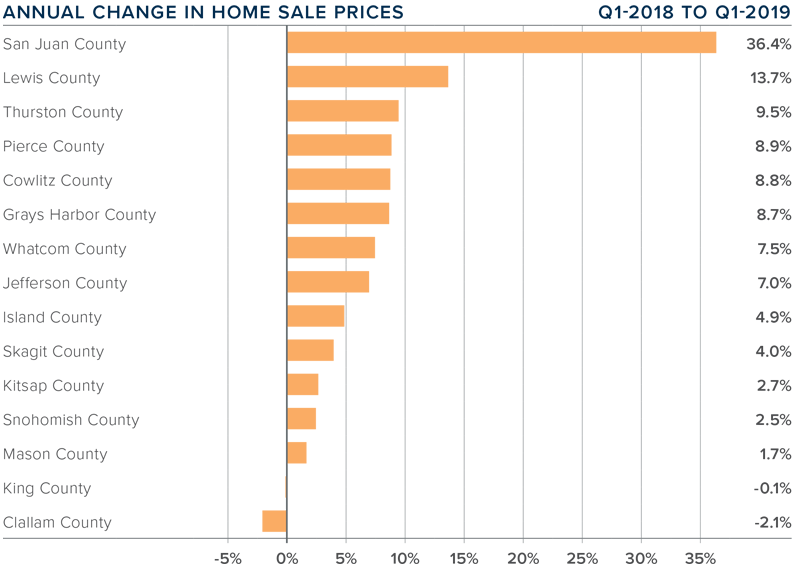
  • In combination with the factors discussed earlier, the 40% increase in listings has caused home price growth to taper to a year-over-year increase of 3.3%.
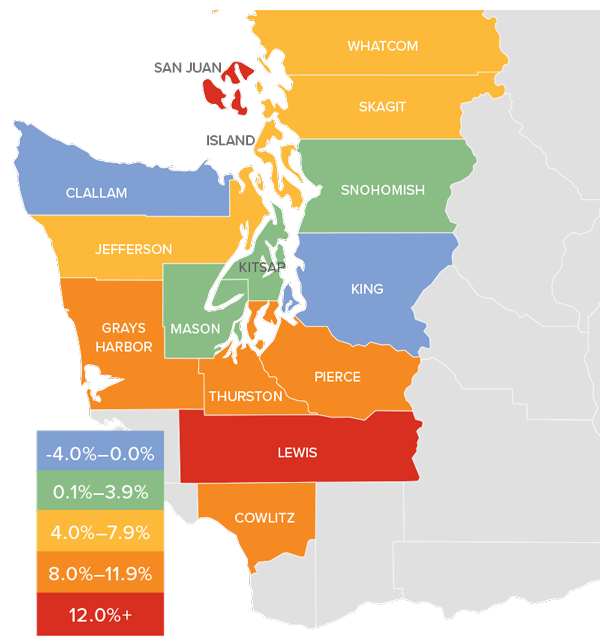
  • Home prices were higher in every county except Clallam. While the growth of prices is slowing, the strong local economy, combined with lower interest rates, will cause home prices to continue rising through 2019.
  • When compared to the same period a year ago, price growth was strongest in San Juan County, where home prices were up 36.4%. Only one other county experienced a double-digit price increase.
  • As I have said for quite some time now, there must always be a relationship between incomes and home prices, and many areas around Western Washington are testing this ceiling. That said, the region’s economy continues to perform well and incomes are rising, which, in concert with low interest rates, will allow prices to continue to rise but at a significantly slower pace.


DAYS ON MARKET

  • The average number of days it took to sell a home matched the same quarter of 2018.
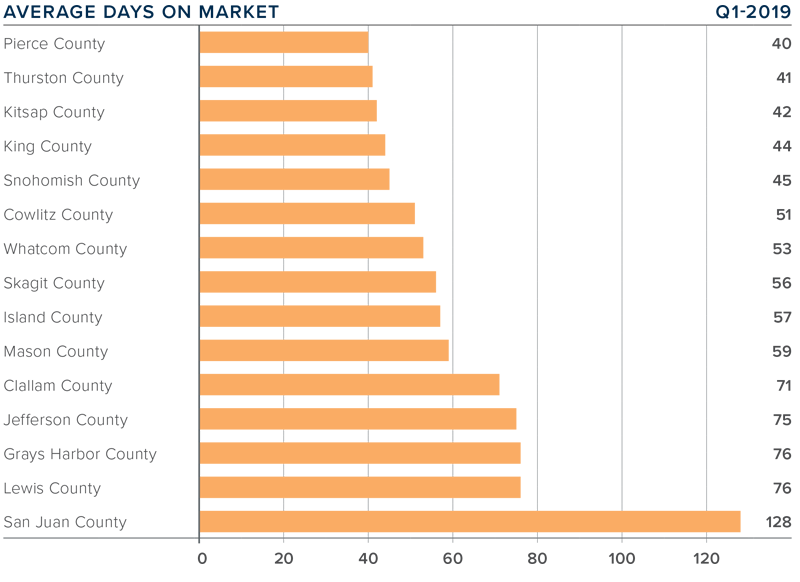
  • Pierce County was the tightest market in Western Washington, with homes taking an average of 40 days to sell. There were seven counties that saw the length of time it took to sell a home drop compared to the same period a year ago. Market time rose in seven counties and one was unchanged.
  • Across the entire region, it took an average of 61 days to sell a home in the first quarter of 2019. This matches the level seen a year ago but is up by 10 days when compared to the fourth quarter of 2018.
  • In the last two Gardner Reports, I suggested that we should be prepared for days-on-market to increase, and that is now occurring. Given projected increases in inventory, this trend will continue, but this is typical of a regional market that is moving back toward balance.


CONCLUSIONS

This speedometer reflects the state of the region’s real estate market using housing inventory, price gains, home sales, interest rates, and larger economic factors. I am again moving the needle toward buyers as price growth moderates and listing inventory continues to rise.

I do not see any clouds on the horizon that suggest we will see a downturn in sales activity in 2019. That said, this will be the year we move closer to balance. Buyers who were sidelined by the significant increase in listings in the second half of 2018 are starting to get off the fence as mortgage rates drop. I foresee a buoyant spring market ahead.


As Chief Economist for Windermere Real Estate, Matthew Gardner is responsible for analyzing and interpreting economic data and its impact on the real estate market on both a local and national level. Matthew has over 30 years of professional experience both in the U.S. and U.K.

In addition to his day-to-day responsibilities, Matthew sits on the Washington State Governors Council of Economic Advisors; chairs the Board of Trustees at the Washington Center for Real Estate Research at the University of Washington; and is an Advisory Board Member at the Runstad Center for Real Estate Studies at the University of Washington where he also lectures in real estate economics.

More April 24, 2019

Caring for our Communities through the Windermere Foundation


Windermere offices have been busy this year raising money for the Windermere Foundation which provides funding to support low-income and homeless families throughout the Western U.S. Last quarter alone, the Windermere Foundation collected over $308,236 in donations, bringing our total to $38,314,364 raised since 1989 when the Windermere Foundation first started.


Each Windermere office has its own Windermere Foundation fund account that they use to make donations to organizations in their local communities. These accounts are funded by donations from owners, agents, staff, and the community, and from donations through Windermere agent commissions. The Windermere Hillsboro office in Oregon, and Windermere Coeur d’Alene Realty in Idaho, are two great examples of how our offices go above and beyond to support their local communities.


Windermere Hillsboro

Earlier this year, the Windermere Hillsboro office donated $1,500 to the Hillsboro School District’s McKinney-Vento program, a program which ensures that students who face housing instability and hardship have access to public education, despite the lack of a fixed living environment or a supervising parent or guardian. There are 20,000 students in the district and more than 400 of those students face housing instability. Every school district in Oregon has at least one designated McKinney-Vento Liaison. The Hillsboro School District has a team of three that works tirelessly to support each student and their families with rental and utilities assistance. If there is housing stability at home, then those students are more likely to stay in school.


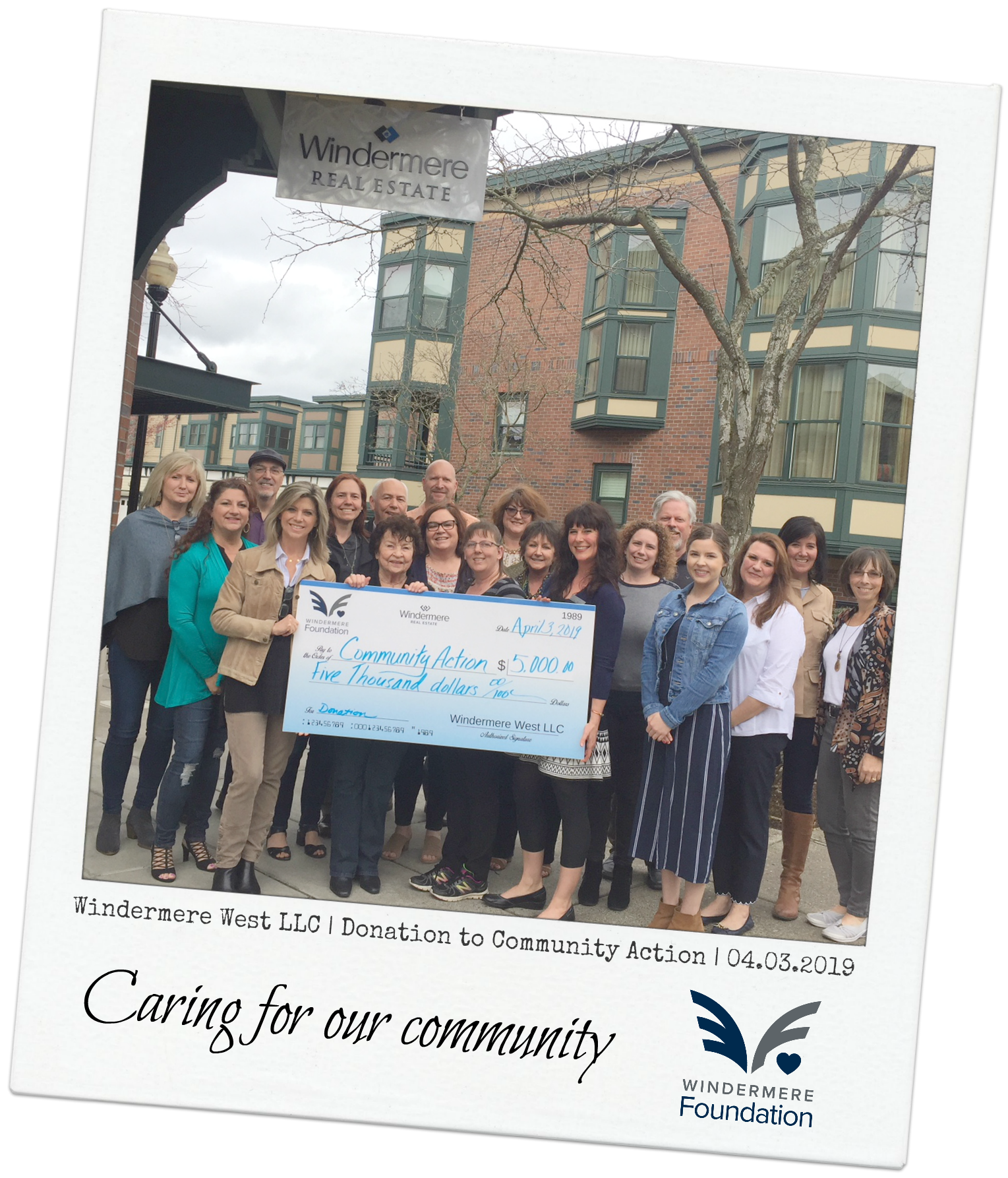
The Windermere Hillsboro office also made a $5,000 donation to Community Action, whose mission is to lead the way to eliminate conditions of poverty and create opportunities for people and communities to thrive. The donation will go towards programs that help approximately 26,000 individuals and families: Energy Assistance, Early Childhood Development, Family Development, and Housing Stability.


Windermere/Coeur d’Alene Realty

In March, Windermere/Coeur d’Alene Realty, which has offices in Coeur d’Alene, Post Falls, and Hayden, was recognized as the Best Real Estate Office by The Business Journal of North Idaho in their “Best of 2019” awards. This is the ninth year-in-a-row that they have received this honor. The brokerage was also named Idaho’s Brightest Star for their philanthropy and community involvement. Through the Windermere Foundation, they have given back nearly one million dollars to local charities and humanitarian agencies in Kootenai County, and more than 11,000 warm winter boots to local children in need.


Thanks to our agents, offices, and everyone who supports the Windermere Foundation, we have been able to make a difference in the lives of many families in our local communities. This year we celebrate the Windermere Foundation’s 30th anniversary with a renewed year-long focus on giving back, doing more, and providing service to the communities that have made us who we are.


Our goal for 2019 is to raise over $40 million in total donations. If you’d like to help us reach this goal, or learn more about the Windermere Foundation, please visit WindermereFoundation.com.


Design April 22, 2019

Blinds or Curtains? Or Both? Top Things to Consider When Choosing Your Window Style

Some rooms just need blinds, other rooms just need curtains, and then some rooms look best with both. But how do you decide which rooms need what? There are a number of factors to consider when you’re picking window treatments for rooms in your house, from price to insulation to style to orientation within the room.

Price

Adding a combination of blinds and curtains on your windows may seem like the best idea for almost any room in your home. But that can get pricey. Basically, you’re doubling up the cost of the treatments for each window. So when you’re deciding on a budget for your treatments, be methodical. Guest bedrooms, laundry rooms, bathrooms, or any uncommon, informal areas in your home are good candidates for either blinds or curtains, not both—you likely don’t spend much time in these spaces, they don’t need to be the most styled part of your home and/or they don’t require a high level of privacy. Save the money on these areas and choose a treatment that gets the job done. On the other hand, living areas, formal dining rooms, and master bedrooms are places where a combination of both can add ultimate style, privacy, and temperature comfort, and it could be worth the money to invest in these high-impact areas.

Insulation

Sunlight can be a blessing and a curse for your home. It can fill living areas with wonderful natural light. It can liven up dining areas or kitchens. But, harsh sunlight can also heat up a room late in the afternoon, it can fade furniture, or it can wake you up too early on the weekends. When it comes to blocking out the sun, faux wood blinds and heavier curtains should be considered. Wood blinds or faux wood blinds block out a great deal of sun, but not all of it. If you want complete darkness to grab a few more winks on weekends, add some curtains over the binds to double up the sun defense. Consider the positioning of the windows throughout the house and protect the windows and rooms that bear the brunt of the sun, while making it easy for natural light to shine through when you want it.

When it comes to curtains and shades, there are a number of sun-blocking options. Cellular shades filter out the sunlight while still letting enough natural light into the room. Roman shades, sheer shades, and curtain fabrics all have different thicknesses, which block out different levels of UV rays and sunlight. If your living room faces west, you will certainly want some thicker shades to block out that evening sunshine and keep the temperature in the room manageable.

Style

Just about any style under the sun is available when it comes to choosing window treatments. Gone are the days when curtains were the only way to add style, warmth, and luxury to a room. Many options in shades and blinds can achieve the same effect.

Whichever you choose, you want the window treatments to accent the furniture in your room, not vice versa. For example, if your furniture is heavily patterned, choosing solid colors for blinds and curtains is the way to go. If your furniture is solid, light patterns and designs could accentuate certain colors or themes in the room. Keep theme and tone in mind: You wouldn’t choose earthy bamboo shades for a room with a sleek, industrial vibe, or beachy plantation shutters for a room with a modern artsy feel.

Choosing the proper window treatments for each room in your home comes down to a handful of factors. Don’t break the bank or overspend where you don’t need it, make sure you know where the sun is most intrusive in what rooms, and go with a style that fits the vibe of your home. Blinds and curtains can complete the look of a room, and make it feel like home.