The following analysis of the Oregon and Southwest Washington real estate market is provided by Windermere Real Estate Chief Economist Matthew Gardner. We hope that this information may assist you with making better-informed real estate decisions. For further information about the housing market in your area, please don’t hesitate to contact your Windermere Real Estate agent.
Regional Economic Overview
The region’s job recovery, which stalled in the fall of 2020, has picked up again and I am hopeful this will continue.
Of the more than 285,000 Oregon jobs that were shed at the onset of the pandemic, 153,000 have now returned. Although employment levels are still 132,000 below the prior peak in February of 2020, the trend is again heading in the right direction. That said, rising COVID-19 infections have led the state to pull back on reopening and it is uncertain how this might impact the job market this spring. In Southwest Washington, 10,400 of the 22,000 jobs that were lost have returned and the trajectory appears to be similar to Oregon’s. With more jobs returning, the unemployment rate in Oregon continues to trend lower and now stands at 6% — a significant improvement from the 14.9% rate last April. The jobless rate in Southwest Washington currently stands at 6.7%, matching the level at the end of 2020.
oregon and southwest washington Home Sales
❱ In the first quarter of 2021 sales rose 7.1% compared to the same period a year ago, with a total of 12,342 homes sold.
❱ Sales rose in 14 counties but dropped in 12. As I mentioned in the last edition of the Gardner Report, most of the counties that saw sales drop were small and these markets can see significant swings. It appears as if this trend continues as smaller markets again saw lower sales.
❱ Following the trend seen last fall, sales were lower than fourth quarter. This can be attributed to a very significant lack of homes for sale rather than a slowdown in demand.
❱ Housing demand remains strong and is only being impacted by a lack of supply. Additionally, buyers are even more active today given the recent rise in mortgage rates. I expect an increase in inventory and sales in the coming year as homeowners who are able to continue working remotely sell and move to more affordable markets.
oregon and southwest washington Home Prices
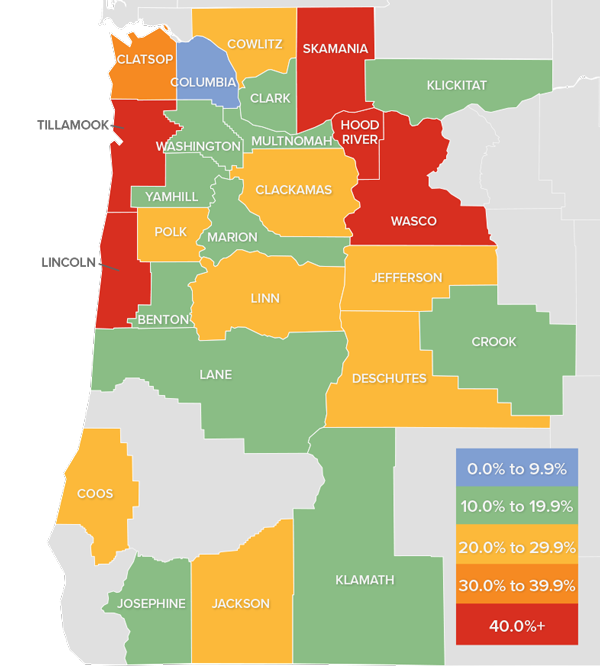
❱ Home prices in the region continue to skyrocket. The average sale price was up 21.7% year over year to $503,089. Prices were 5.7% higher than in the fourth quarter of 2020.
❱ Tillamook County led the market with the strongest annual price growth, but this is a very small market prone to significant swings. The most expensive market was Hood River County, where the average sale price was $694,333.
❱ Prices were higher in all counties contained in this report, with double-digit appreciation in all but one.
❱ Home prices continue to rise at a very significant pace, but I anticipate some headwinds—mainly in the form of higher mortgage rates—that may cool the market somewhat. That said, the pace of appreciation will remain above its longterm average throughout 2021.
Days on Market
❱ The average number of days it took to sell a home in the region dropped 30 days compared to the first quarter of 2020. It took 6 fewer days to sell a home compared to the final quarter of last year.
❱ The average time it took to sell a home in the first quarter of 2021 was 51 days.
❱ All but one county (Tillamook, +1 day) saw the length of time it took to sell a home drop compared to a year ago.
❱ Homes again sold fastest in Washington County, where it took 17 days to sell. An additional eight counties saw the average market time drop to below a month.
Conclusions
This speedometer reflects the state of the region’s real estate market using housing inventory, price gains, home sales, interest rates, and larger economic factors.
Home sales continue to grow, and robust demand is causing prices to rise significantly, resulting in a market that strongly favors sellers. The additional supply of homes that I’m predicting for 2021, combined with modestly rising interest rates, may start to slow the momentum in price growth, but for now I have moved the needle further in favor of sellers.
About Matthew Gardner
As Chief Economist for Windermere Real Estate, Matthew Gardner is responsible for analyzing and interpreting economic data and its impact on the real estate market on both a local and national level. Matthew has over 30 years of professional experience both in the U.S. and U.K.
In addition to his day-to-day responsibilities, Matthew sits on the Washington State Governors Council of Economic Advisors; chairs the Board of Trustees at the Washington Center for Real Estate Research at the University of Washington; and is an Advisory Board Member at the Runstad Center for Real Estate Studies at the University of Washington where he also lectures in real estate economics.
This video is the latest in our Monday with Matthew series with Windermere Chief Economist Matthew Gardner. Each month, he analyzes the most up-to-date U.S. housing data to keep you well-informed about what’s going on in the real estate market.
Hello there and welcome to the April edition of Mondays with Matthew. I’m Windermere Real Estate’s Chief Economist, Matthew Gardner
There were a lot of rich, housing-related datasets released this month so let’s get going.
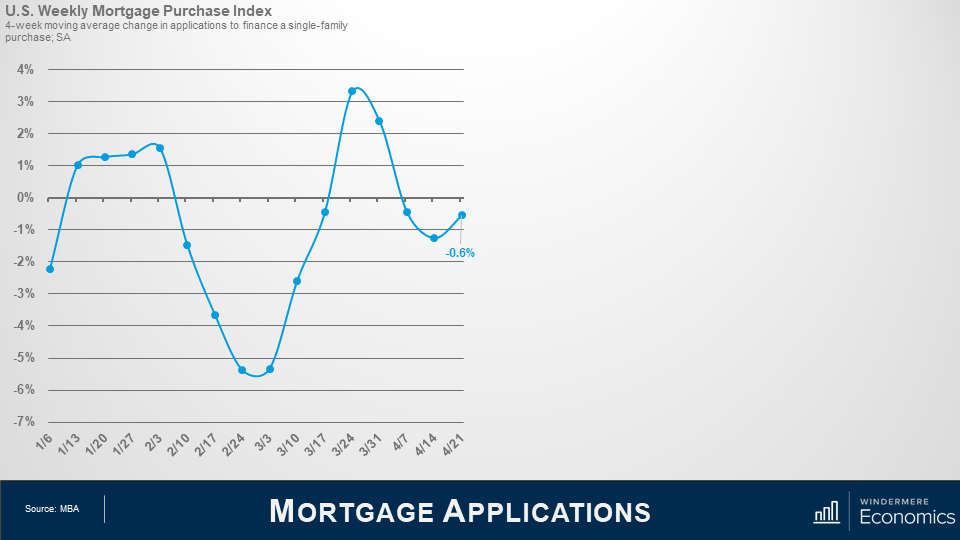
And first up, I want to look at mortgage applications.
Source: MBA
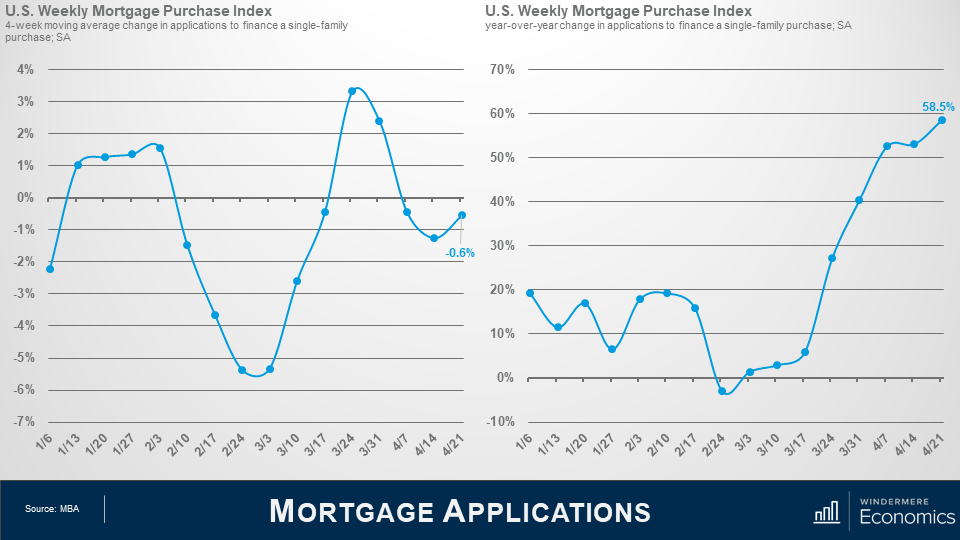
You may remember last month we discussed what was going on with mortgage rates as they had started to trend higher beginning in the New Year. Well, as rates rose, you can see here that mortgage applications slowed before picking back up in at the end of February, which was interesting as rates were still rising at that time.
And for those who find it curious that applications picked up even as rates were rising, well it was partly because buyers started to believe that rates would not be headed back down, and they wanted to get locked in for fear that they would continue trending higher.
Now, this pattern did reverse at the end of March as rising rates started to take a toll on would be buyers and affordability issues started to come more into play, but as mortgage rates pulled back in April, applications picked up again – albeit modestly.
Source: MBA
But when we take a look at the data on a year-over-year basis. Well, WOW!
Applications were up by over 58%! But remember what happened in March of last year? Who can forget….?
And its therefore really not surprising to see this kind of spike, but, I would caution you all that almost any dataset that compares current numbers to those seen a year ago – well, they are likely to paint far too rosy a picture, and one that is removed from reality.
Something to be aware of.
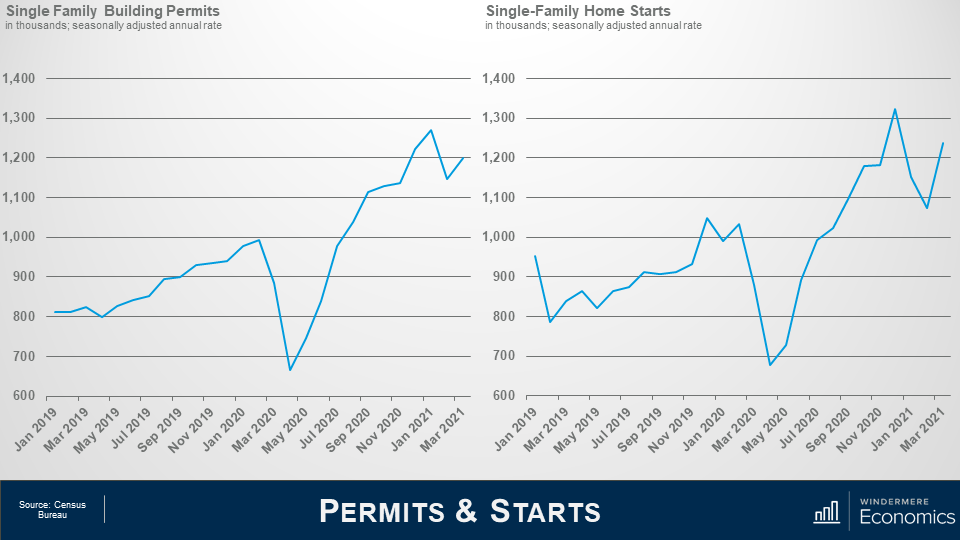
Next up, we got several datasets regarding the new home market March and we will start off with permits and starts.
Source: Census Bureau
Following the pullback in permit applications that was seen in February, builders were more optimistic in March with single family permits up by 4.6% on the month and 35.6% higher than a year ago – but don’t forget what we just said about year over year data!
Looking at housing starts – well they pulled back in January and February, but also saw a solid 15% monthly increase in March.
Interestingly, there was a massive spike in starts in the mid-west where they were up by 109% month-over-month, but they were actually down by over 12% out here in the west.
I would also let you know that the number of homes under construction rose by 1.6% versus February and this was particularly pleasing given that construction costs remain very elevated.
And it hasn’t just been material costs that have been hitting home builders, they have also seen significant pressures with labor costs and here’s why…
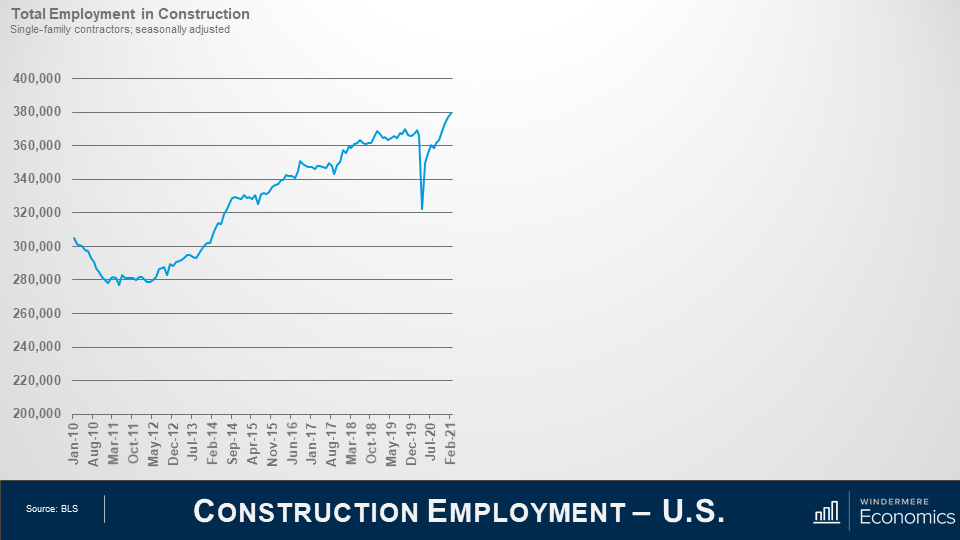
Source: BLS
This chart shows how many people are employed in the construction of single-family homes and, at face value, it looks pretty good with constant growth seen since 2012 – of course, ignoring the impact of the pandemic but….
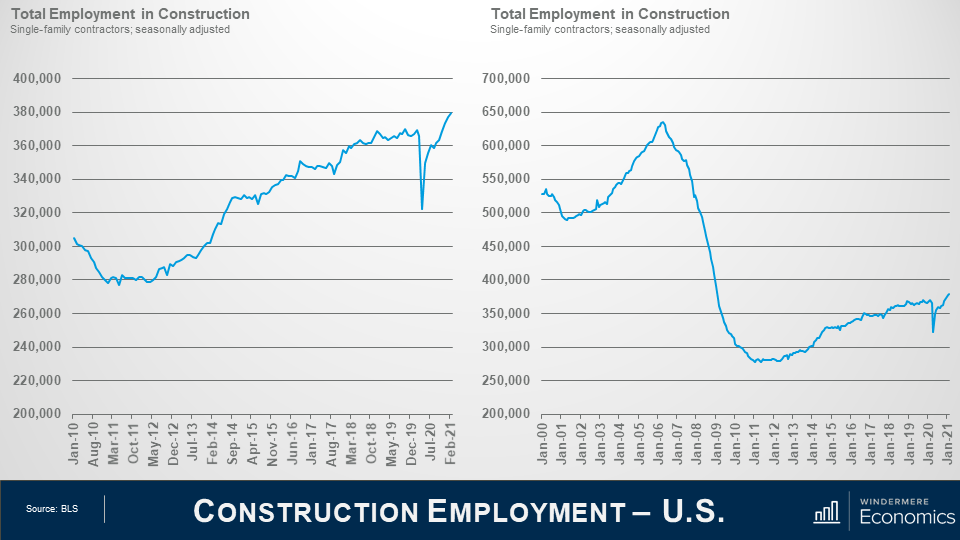
Source: BLS
Looking at a longer timeline, it doesn’t paint as good a picture. At its peak in 2006, there were almost 650,000 people employed building homes, but the number today is just 60% of that.
Of course, there are fewer homes being started today than there were back in those halcyon days but starts today aren’t 40% lower, so the job market remains tight. In fact, there are over 260,000 job openings in the construction sector. Of course, not all of them are for the single-family construction market, but we do know that builder’s cost of labor is rising and that, in concert with higher land and material costs continue to impact builder’s ability to bring homes to market that are relatively affordable as the increase in costs is transferred directly into the price that a home must sell for and that brings me to data on new home listings, sales and prices in March.
Source: Census Bureau
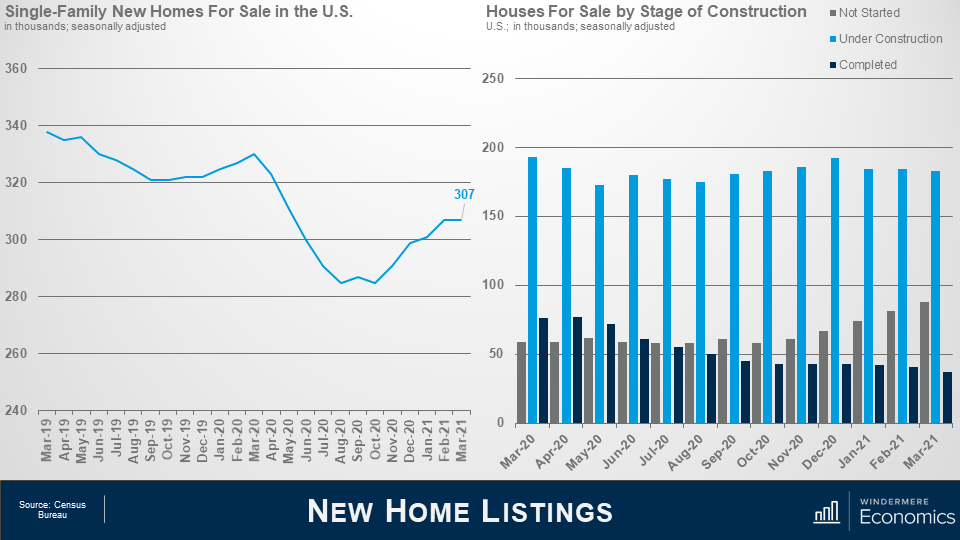
Even with new housing permits and starts rising significantly the seasonally adjusted estimate of new houses for sale at the end of March was 307,000. This represents a supply of 3.6 months at the current sales rate.
The number of new homes for sale was down by 7% from a year ago, but I do expect that the increase in permits and starts bodes well for this arena, and I do expect to see more listings come online over time.
If you look at the chart to the right, you will notice that the number of homes for sale that have yet to be started continues to rise. This is because builders want some certainty that the home will be sold, and it’s, therefore, easier to sell before you build it.
Source: Census Bureau
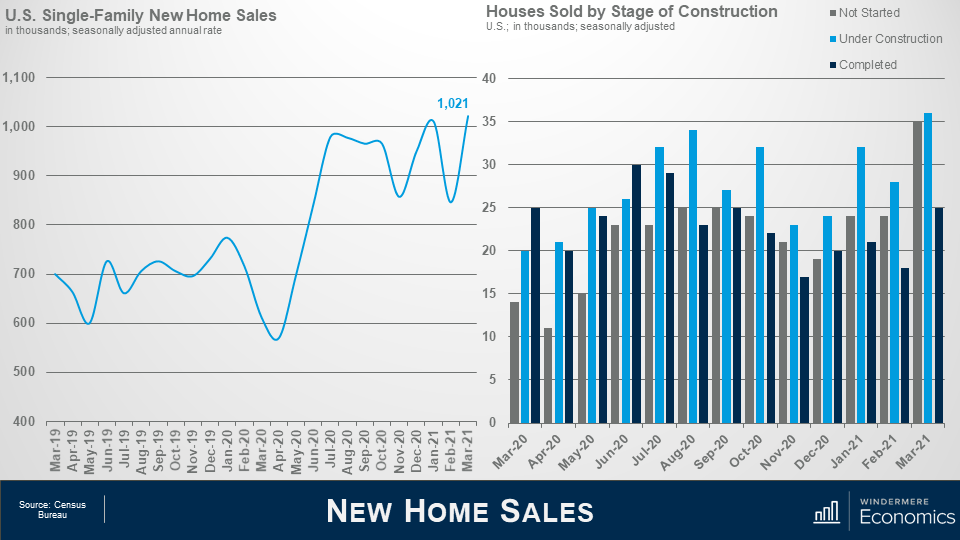
And when we look at sales, well they rise by 20.7% in March to an annual rate of over 1 million units and clearly rebounded from the previous month when we saw a massive drop as severe winter storms wreaked havoc across much of the country.
Interestingly, you will see that as many homes sold that hadn’t yet started as were under construction. Clearly, demand is robust to the degree that buyers willing to commit to buying a home that hasn’t yet been built.
The median new home sale price came in at $330,800 – that’s down by 4.4% on the month but 0.8% higher than a year ago.
Source: NAR
OK – now we have covered the new home market, let’s take a look at how the resale market fared in March.
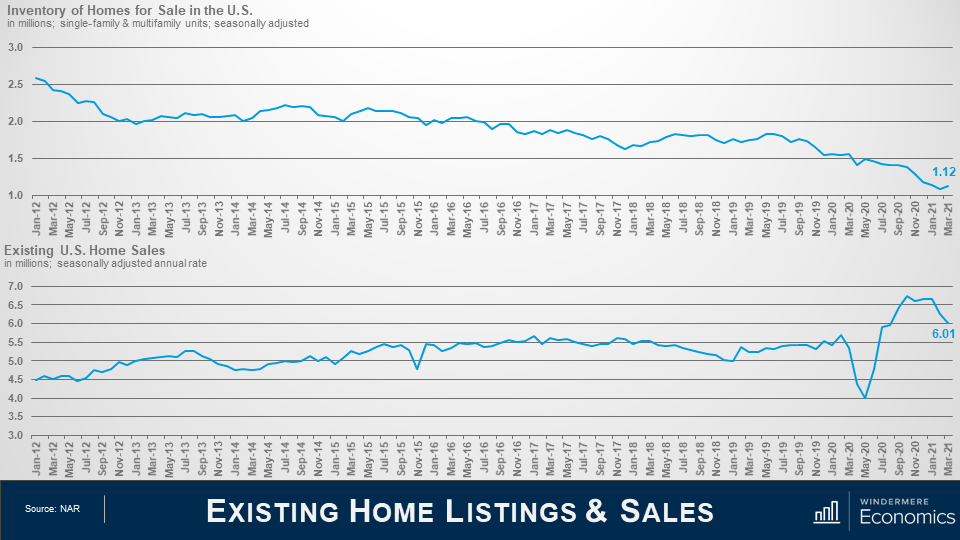
The number of homes for sale remains at almost historically low levels with marginally more than 1 million units on the market. Now there may be some of you out there who say that is inaccurate as NAR is reporting 1.07 million homes for sale, and you’d be absolutely correct. But I have adjusted the data to account for seasonality, so it is slightly different.
Anyway, with such limited choice across the country, it wasn’t a surprise to see sales pulling back, with the total number of closings running at an annual rate of 6 million units – that’s down by 3.7% month over month, and down by 12.3% when compared to March of 2020.
Am I worried about this? No, I am not. Why? Well, as I just mentioned, just look at the inventory numbers. With little choice, it’s not at all surprising to see sales pull back but I would add that the market still hit 6 million transactions and that was in the face of the increase in mortgage rates that we saw last month so, to tell you the truth, I was actually a little surprised to see that the number held above that 6 million level.
Source: NAR
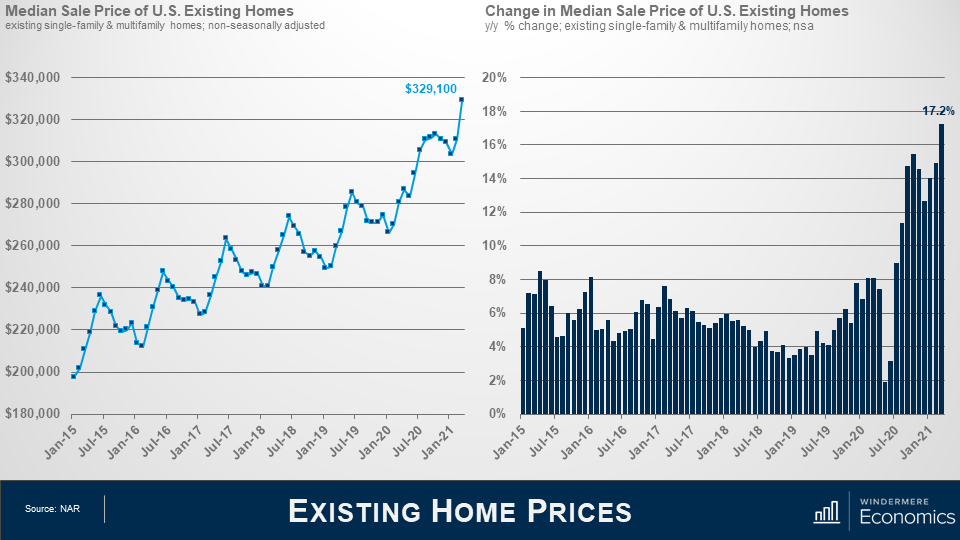
But even as sales pulled back a little, prices didn’t, and more records were broken with the median sale price hitting an all-time high, and year-over-year price growth above 17% was another record shattered.
Source: NAR
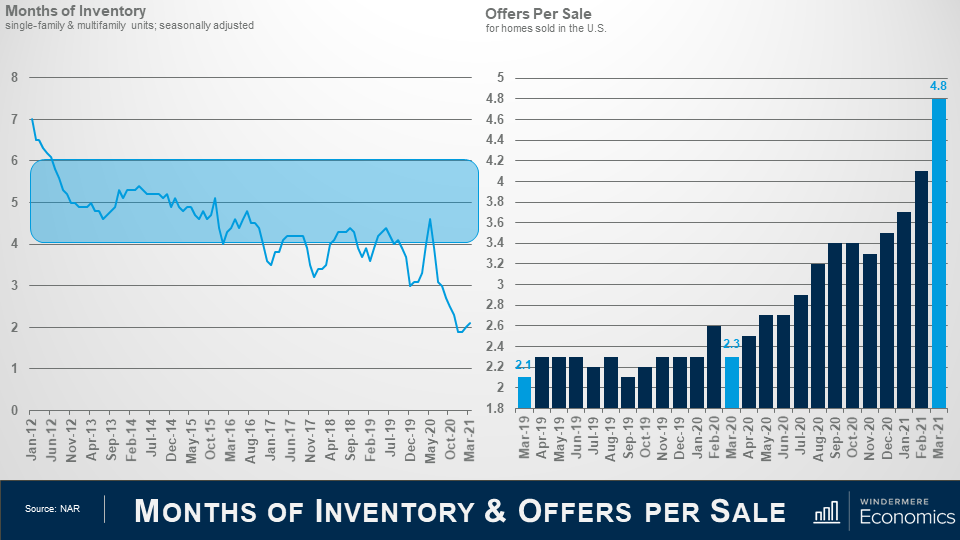
And if you need further proof that there is little to be concerned about when it comes to sales pulling back, you only need to look at these charts. Low supply, but still very robust demand has months of supply at levels that indicate a highly unbalanced market. Nationally, I like to see somewhere between 4 and 6 months of supply, not 2.1…
But look at the right. For every offer accepted in March, there were 3.8 additional offers, and I would also tell you that the average length of time it took to sell a home in March was just 18 days and that’s down by one day from February but down by eleven days when compared to a year ago.
Surely if demand was waning, wouldn’t the number of offers be going down, and days on market going up?
Source: NAR with Windermere Economics seasonal adjustments
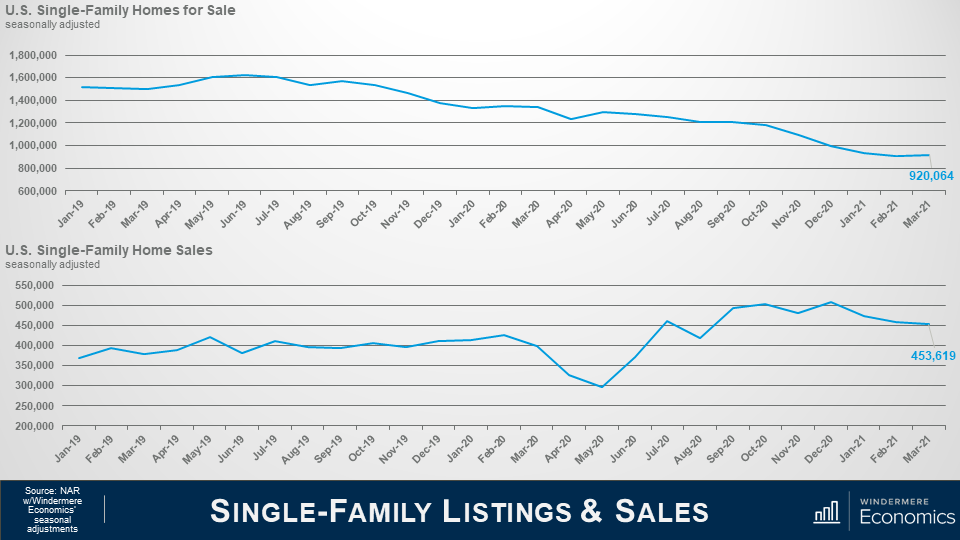
And when we separate out the single-family market, you can see that listings notched very slightly higher – up by 1.2%, but the level is still close to an all-time low with listings down by over 31% year over year.
As far as sales are concerned, well they also pulled back a little and were down by 1.3% versus February but were 14% higher year over year.
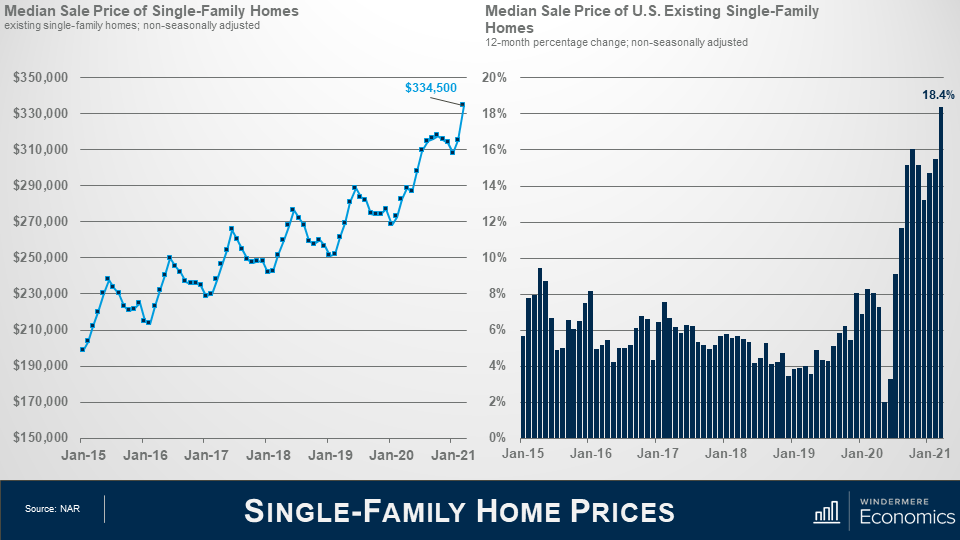
Source: NAR
And as we discussed earlier, even with lower sales activity, sale prices are still rising at a very rapid pace and are now over 18% higher than seen a year ago and a remarkable 6.2% higher than seen in February.
The median price also broke above $330,000 for the first time.
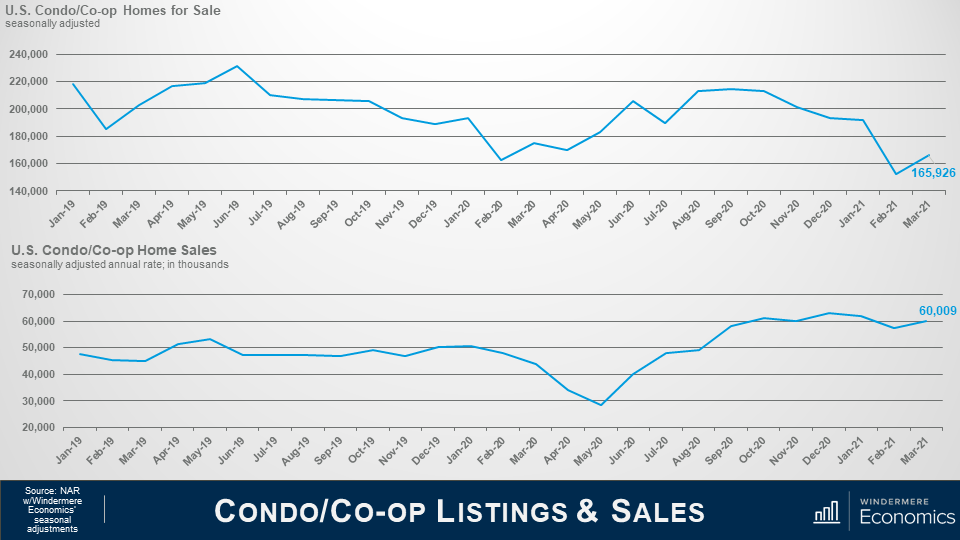
Source: NAR with Windermere Economics Seasonal Adjustments
Moving on to the condominium market, we saw listings rise as the pandemic took hold, and there were concerns back then that we were at the start of a systemic increase in listings with people fleeing cities over fears of COVID-19, as well as the ability to work remotely, but the increase soon wore off, even if it rise by 9% in March when compared to February, but there were 5.1% fewer listings than seen a year ago.
But on the sales front – and with listings rising – we saw demand for those homes with sales up by 5% versus February and 36.4% higher than seen in March of 2020.
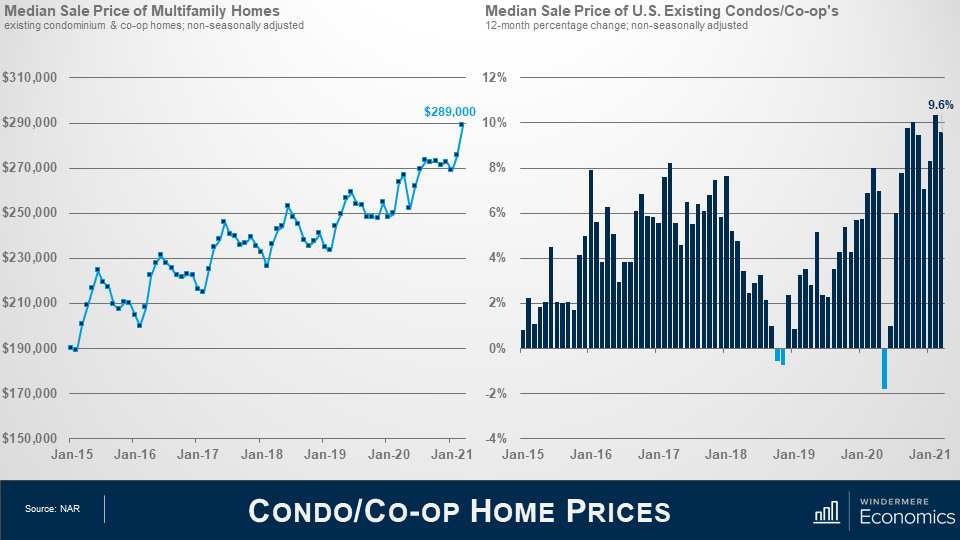
Source: NAR
In a similar fashion to single-family prices, sale prices for condominium units saw a spike in price in March and were up by 4.9% versus February and almost 10% higher than seen a year ago.
Although you will see that annual sale price growth did turn negative last May – due to COVID – it is actually rare to see this. We did see a tiny drop back in 2018 but you will likely remember that mortgage rates were rising then and knocking on the door of 5%.
Anyway, since last May, sale prices have picked back up very nicely and worries of any significant drop in condo prices appears to be overblown.
As far as the ownership market is concerned, I am far less worried that mortgage rates have been ticking higher than I am that there are just not enough homes for sale to meet demand.
We had seen some growth in the new construction arena – and that took just a tiny bit of heat off the resale arena – but demand continues to exceed supply, and that is pushing prices higher and affordability issues have already started to appear in several markets across the country.
At some point, we will see price growth slow, but I think that it will be far more to do with affordability limitations than it will rising mortgage rates.
So, there you have it. My thoughts on the housing market in March.
As always, if you have any questions or comments about the numbers, we have looked at today, feel free to reach out. I would love to hear from you.
In the meantime, thank you for watching, stay safe out there, and I look forward to visiting with you again, next month.
The following analysis of the Western Washington real estate market is provided by Windermere Real Estate Chief Economist Matthew Gardner. We hope that this information may assist you with making better-informed real estate decisions. For further information about the housing market in your area, please don’t hesitate to contact your Windermere Real Estate agent.
Regional Economic Overview
In the summer and fall of 2020, Western Washington regained some of the jobs lost due to COVID-19, but employment levels in the region have been in a holding pattern ever since. As of February, the region had recovered 132,000 of the 297,000 jobs that were lost, but that still leaves the area down by 165,000 positions. Given the announcement that several counties may have to roll back to phase 2 of reopening, I would not be surprised to see businesses hold off on plans to add to their payrolls until the picture becomes clearer. Even with this “pause” in the job recovery, the region’s unemployment rate ticked down to 6.1% from the December rate of 6.4% (re-benchmarking in 2020 showed the December rate was higher than the originally reported 5.5%). The lowest rate was in King County (5.3%) and the highest rate was in Grays Harbor County, which registered at 9.2%. Despite the adjustment to the 2020 numbers, my forecast still calls for employment levels to increase as we move through the year, though the recovery will be slower in areas where COVID-19 infection rates remain elevated.
western washington Home Sales
❱ Sales in the first quarter were impressive, with 15,893 home sales. This is an increase of 17.5% from the same period in 2020, but 32% lower than in the final quarter of last year—a function of low levels of inventory.
❱ Listing activity continues to be well below normal levels, with total available inventory 40.7% lower than a year ago, and 35.5% lower than in the fourth quarter of 2020.
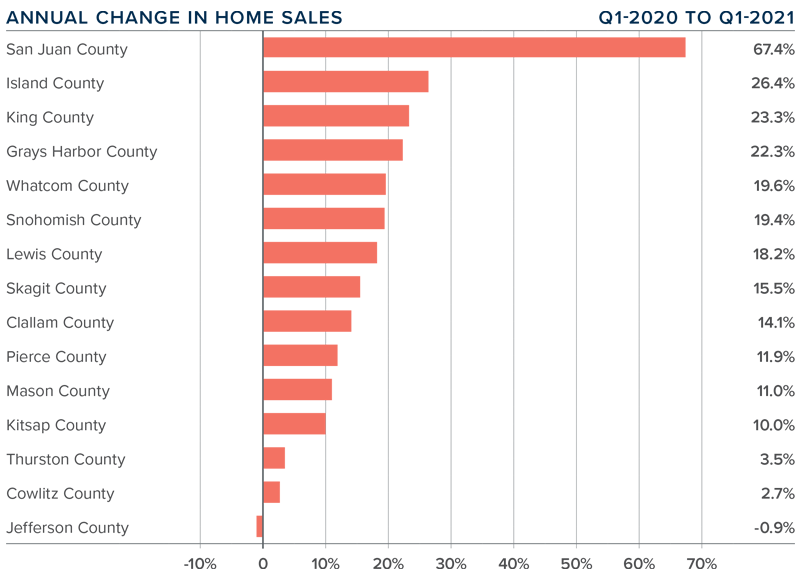
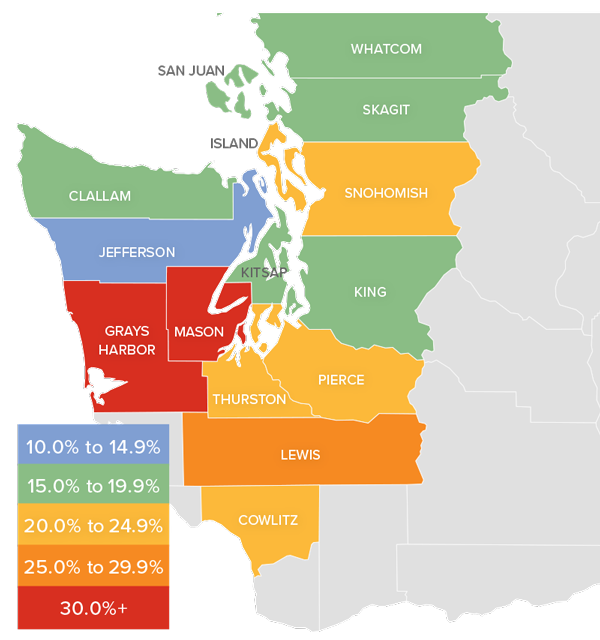
❱ Sales rose in all counties other than Jefferson, though the drop there was only one unit. There were significant increases in almost every other county, but sales growth was more muted in Cowlitz and Thurston counties. San Juan County again led the way, likely due to ongoing interest from second-home buyers.
❱ The ratio of pending sales (demand) to active listings (supply) shows how competitive the market is. Western Washington is showing pendings outpacing new listings by a factor of almost six to one. The housing market is as tight now as I have ever seen it.
western washington Home Prices
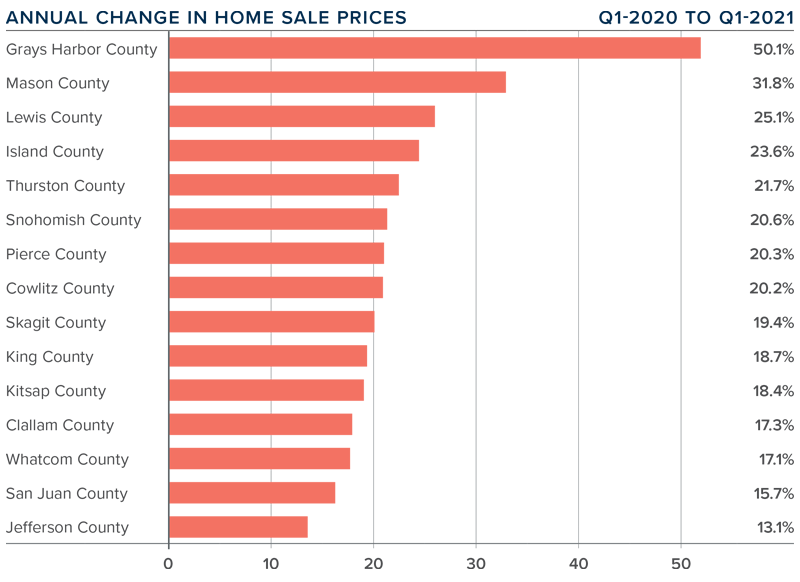
❱ Home price growth in Western Washington continues to trend well above the long-term average, with prices 21.3% higher than a year ago. The average home sale price was $635,079.
❱ Compared to the same period a year ago, price growth was strongest in Grays Harbor and Mason counties, but all markets saw double-digit price growth compared to a year ago.
❱ Home prices were also 2.9% higher than in the final quarter of 2020, which was good to see given that 30-year mortgage rates rose .4% in the quarter.
❱ I expect to see mortgage rates continue to trend higher as we move through the year, but they will remain significantly lower than the long-term average. Any increase in rates can act as a headwind to home-price growth, but excessive demand will likely cause prices to continue to rise.
Days on Market
❱ The market in early 2021 continued to show far more demand than supply, which pushed the average time it took to sell a home down 25 days compared to a year ago. It took 2 fewer days to sell a home than it did in the final quarter of 2020.
❱ Snohomish and Thurston counties were the tightest markets in Western Washington, with homes taking an average of only 15 days to sell. The greatest drop in market time was in San Juan County, where it took 52 fewer days to sell a home than it did a year ago.
❱ Across the region, it took an average of only 29 days to sell a home in the quarter. All counties saw market time decrease from the first quarter of 2020.
❱ Very significant demand, in concert with woefully low levels of supply, continues to make the region’s housing market very competitive. This will continue to be a frustration for buyers.
Conclusions
This speedometer reflects the state of the region’s real estate market using housing inventory, price gains, home sales, interest rates, and larger economic factors.
Demand is very strong and, even in the face of rising mortgage rates, buyers are still out in force. With supply still lagging significantly, it staunchly remains a seller’s market. As such, I am moving the needle even further in their favor.
As I mentioned in last quarter’s Gardner Report, 2021 will likely see more homeowners make the choice to sell and move if they’re allowed to continue working remotely. On the one hand, this is good for buyers because it means more listings to choose from. However, if those sellers move away from the more expensive core markets into areas where housing is cheaper, it could lead to increased competition and affordability issues for the local buyers in those markets.
About Matthew Gardner
As Chief Economist for Windermere Real Estate, Matthew Gardner is responsible for analyzing and interpreting economic data and its impact on the real estate market on both a local and national level. Matthew has over 30 years of professional experience both in the U.S. and U.K.
In addition to his day-to-day responsibilities, Matthew sits on the Washington State Governors Council of Economic Advisors; chairs the Board of Trustees at the Washington Center for Real Estate Research at the University of Washington; and is an Advisory Board Member at the Runstad Center for Real Estate Studies at the University of Washington where he also lectures in real estate economics.
Of all the components involved in a successful home sale, there is perhaps no greater contributing factor than timing. Knowing when to sell your house gives you the best chance to make an impact when you hit the market. Every seller’s situation is unique but choosing when to sell comes down to how prepared you are, finding the right agent, and local market conditions. Once you’ve got a grasp of these elements, then you can decide if it’s the right time to sell.
Are You Ready to Sell?
Before you sell your home, your finances must be in order. Equity is a natural starting point for assessing your financial health. To calculate your equity, you’ll need to know your home’s market value. Your real estate agent can help you determine this by conducting a comparative market analysis (CMA), which involves comparing your home to others in your area by such characteristics as square footage, the number of bedrooms/bathrooms, age, and lot size. Once you know your home’s market value, subtract your current mortgage balance from that number and you’ll have your current home equity. If your equity is negative, then it may not be the best time to sell.
Beyond your home equity, there are plenty of other financial factors to consider when preparing to sell. Selling a home does not come without its own set of costs. Commission fees, home repairs, inspections, and staging are just some of the expenses you can expect to incur. For more information on the costs involved with selling your home, talk to your Windermere agent.
Selling a home is an emotional process that comes with significant lifestyle changes, so it’s important to make sure it’s the right time for you and everyone in your household. Part of a real estate agent’s’ role is understanding how the varying emotions of the selling process apply to different people. For every fear, worry, and hesitancy you may experience when trying to decide if it’s the right time to sell, your agent can share similar experiences while working with past clients.
Local Market Conditions
The state of the real estate market in your area could dictate whether it’s the right time to sell. Various factors affect local market conditions like inventory, seasonality, mortgage rates, and home price growth. Talk to your real estate agent about what the local conditions mean for your selling strategy and what kind of buyer negotiations you can expect to encounter. Agents have the tools and know-how to perform a complete analysis of the market to help you decide when the right time is to sell.
Find the Right Agent
Real estate agents are the catalyst for a successful home sale. They not only bring a wealth of resources to the table, but they can also offer helpful advice on the optimal time to sell. Agents can assess your goals for selling your home, how that aligns with your budget, and how those factors fit into the context of current local market conditions.
To truly know whether it’s the right time to sell, it’s important to find the right agent who understands the needs of your household. The more an agent knows about your situation, the better they can formulate a selling strategy. This also allows them to understand what the best offer for your home looks like. When searching for an agent, ask for referrals from your inner circle. Interview multiple agents to get an idea of their qualities, and select the one that makes the most sense for you.
When you’re ready to sell, or if you have any questions about the selling process, talk to an experienced Windermere agent here:
At the mention of interior design, the first things that often come to mind are furniture, wall art, paint colors, and other material components. However, plants are an important décor element that have the power to refresh the look and feel of any indoor space, while making your home eco-friendlier. Keep the following tips in mind when decorating your home with plants.
Ideas for Decorating with Plants
Consider Your Space
Before you make a trip to the nursery, think about which spaces in your home are best suited for plants. It’s also important to research the needs of the plant varieties you’re considering. By knowing how much shade and direct sunlight they need, you’ll be able to identify the best home for each plant type and the care they need to grow.
Go Vertical
Empty vertical wall spaces provide the perfect opportunity to incorporate hanging plants. Whether you use planters or install shelving, hanging plants attract the eye and bring an organic, living element to what was previously a blank canvas. Hanging herb gardens are a wonderful addition to the kitchen, allowing you to keep fresh ingredients and flavors out in the open air and within reach at all times.
Floor Plants
Floor plants are typically large and require plenty of space. Due to their size, they are often used to balance the proportion of rooms containing large furniture items like couches, desks, and tables. Common floor plants include the fishtail palm, olive trees, the rubber plant, fiddle leaf fig, and bird of paradise.
Low Maintenance Plants
For those who don’t consider themselves to be green thumbs, cacti and succulents are the way to go. Most succulents come from hot climates with little humidity and have thick tissue that stores water for long periods. Accordingly, they are lower maintenance than most other plants and require little watering.
Decorate with Terrariums
Another creative, relatively low-maintenance option for indoor gardeners is a terrarium. Terrariums are contained indoor gardens, usually in a glass container that can be left either sealed or open. Closed terrariums are self-nourishing, creating their own water cycle. Plants that grow in humid conditions are best suited for this environment. Open terrariums provide a good home for plants that need less water, like cacti and succulents. Terrariums make for eye-catching décor, with styles ranging from minimalistic to intricate.
Spring is calling and the flowers are in bloom. It’s the time of the year that many homeowners start spending more time in the garden. Having a healthy garden is one of the best ways to create a sustainable homeandreduce your household’s carbon footprint. Here are some eco-friendly tips that will help to make your garden even more sustainable.
10 Tips for Sustainable Gardening
1. Compost Your Waste
Composting, which puts your natural waste to good use, is the cornerstone of any sustainable garden. All grass clippings, dead leaves, plants, flowers, and the like are rich in nutrients. By composting, you provide your garden with a natural fertilizer, free of contaminants. Not only will this provide nourishment, but it will also help to produce healthier and tastier food.
2. Mulching
If having a sustainable garden is your goal, it’s important to treat your soil with care. Mulching enriches the soil and ensures it’s as healthy as can be. Mulch conserves the moisture in your soil, ensuring it won’t dry out. It also reduces weed growth and naturally moderates the temperature of the soil. Mulching can cover either bare soil or freshly planted food and flowers.
3. Garden Design
It’s natural to want to accentuate the beauty of your garden when designing it, but the sustainable gardener will prioritize giving plants what they need. Take into consideration which plants need direct access to sunlight, which need the most space in the garden, and any special requirements a plant may need to inhabit optimal growing conditions.
4. Use Natural Weed Killers
One of the pillars of organic gardening is to reduce the use of chemicals whenever and wherever possible. Homemade recipes involving vinegar and corn gluten meal are effective substitutes for harmful, chemical-based weed killers. Whichever method you choose, it’s important to weed by hand often.
5. Use Water Efficiently
Substantial watering is critical to keeping your garden healthy, but overwatering is a common practice and leads to an unsustainable garden. Research the amount of water your plants and flowers need to make sure you aren’t overwatering. If you live in a rainy climate, rain barrels are a useful tool as their function is to catch and conserve the water from your downspouts.
6. Animal Manure
For a more sustainable garden and even healthier soil, consider adding animal manure. Chicken, sheep, and cow manure are all popular choices. Rich in nutrients, it can be used both as a fertilizer and as a soil conditioner. Make sure the manure you purchase is free of pathogens and ask about the recommended window of time from application to harvest before you begin using it.
7. Go Local
Planting natively is a fast ticket to sustainable gardening. Native plants are innately acclimated to local climate conditions, making them easier to grow and maintain. Native plants often require less water to grow due to their familiarity with the soil and rainfall in your region, which cuts down on your garden’s total water intake.
8. Collect Dried Seeds
Believe it or not, you can save your seeds and sow them next year. Wait until the seed is fully ripe before you collect it. It’s important to gather seeds when the weather is dry and to store them in a dry place. To produce healthy plants in the future, the seed must be completely dry.
9. Control Garden Slugs
Slugs are known to wreak havoc on gardens, eating through leaves and fruit, leaving a trail of destruction. There are many ways of controlling slugs in your gardens, but some may do more harm than good. If you choose to use slug bait, go organic. Many slug baits contain chemicals that are highly toxic to other animals.
10. Replace Your Gas Mower
How else can you reduce your garden’s carbon footprint? Replace your gas mower with a more sustainable alternative. Electric mowers and push mowers are functional and more eco-friendly replacements. For added sustainability, consider replacing your other gas-powered equipment, such as trimmers and leaf blowers.
Every home buyer has a list of must-have amenities that they’re just not willing to compromise on. For some, it could be an open floor plan or maybe a certain number of bedrooms. For others, that priority is a place to garden.
A garden provides a place where one can nurture the earth, feel connected to other living things, and have a positive impact on the environment. If you’re a home buyer who requires space to garden, here are a few things to consider.
The Hardiness Zone
When searching for a home, location is always high on the list of priorities, and for gardeners, it’s no different. If having a garden is important to you, the first thing you should do is check the hardiness zone to determine what you can realistically grow at any home you are considering buying.
Hardiness Zones are used by gardeners and growers around the United States to determine which plants will grow best in their region. The USDA uses the average annual minimum water temperature in the area to establish the zones, making it a great place to start when looking for your next garden.
Hardiness Zones don’t change by street like neighborhoods do but knowing where you are in the zones map can be a helpful guide to what to expect, especially if you’re moving to a completely new region.
Outdoor Space
Your Windermere agent will be able to use a combination of property metrics, photos, and land surveys to help narrow down your search to homes with adequate outdoor space for a garden.
Ask your agent about lot size versus the home size to make sure there is enough land to build and sustain a garden. Prior to visiting homes in person, check the exterior photos to get an idea of the area.
Local Wildlife
Local wildlife organizations have resources about the animals that might appear in your backyard. Knowing this will not only help you protect your veggies, herbs, and other plantings, but also aid in creating a wildlife-friendly sanctuary. The National Wildlife Foundation offers suggestions on how to do this and offers tips on how to attract songbirds and butterflies to your garden.
Infrastructure Requirements
Depending on the size of your garden, you may need to set up appropriate infrastructure for easier care, like a sprinkler system, raised beds, or outbuildings. If the land is uneven, consider installing raised beds that will help flatten the growing surface for your veggies and fickle flowers. A greenhouse can help you control humidity and light levels but be sure to consider the construction costs alongside your home loan amount.
Sellers dream of a flawlessly executed home sale where everything goes smoothly, and they end up with a satisfied buyer. To achieve this ideal end goal, it’s important to be aware of the mistakes along the way that could potentially derail the sale. Mistakes in the selling process come in all sizes, but some can be more costly than others.
7 Costly Mistakes in the Selling Process
1. Incorrect Pricing
Simply put, sellers want to get the most value for their home. Inaccurately priced homes create complications in the selling process and can be costly. Overpriced homesare unable to compete with other homes in a more expensive bracket, reducing its appeal to buyers. The longer a home stays on the market, the more likely the seller will have to lower the price, and this could result in a final asking price that is well below what the home is worth. Underpricing can be used as a strategy to generate added interest among buyers and thereby drive up the home’s market value, but it requires that a bidding war take place among buyers.
2. Underestimating Selling Costs
There are many costs associated with selling a home that can easily pile up if not planned for. Commission fees take up a significant portion of selling costs, typically between five to six percent of the sale price. Sellers must budget for home inspections, making repairs, and staging the home to get it market-ready. During closing, sellers need to prepare for various costs including sales tax, attorney fees, and any fees related to the transfer of the title, and more. Not accounting for any of these costs can come as an unpleasant surprise.
3. Selling When Underwater
It may be tempting to think of selling a home solely as a revenue-generating event. However, if a seller still owes more on their mortgage than what their home is worth, or if the property has gone down in value, they still may not make enough money on the sale to pay off the mortgage. Any homeowner who finds themselves underwater on their mortgage should consider building more equity before they sell.
4. Selling FSBO
Selling a home “For Sale By Owner” (FSBO) presents sellers with the opportunity to save on commission fees but is a complex and risky process that can easily lead to serious costs. Not only does selling FSBO mean that the seller will incur all costs an agent would have taken on to market the home, but they are accepting added liability as well. If any mistake occurs during the offer process, negotiations, or closing, the seller finds themselves without the representation of an experienced professional. This leaves a great opportunity for costly mistakes that could potentially jeopardize the sale.
5. Failing to Disclose Repairs
If a seller fails to disclose any outstanding repairs and issues inherent in the home, they will likely come to light during the buyer’s inspection and can create a very costly situation for the seller. These losses can be avoided by being transparent about what repairs are needed ahead of time. Sellers can also opt to conduct a pre-listing inspection, which can be especially helpful in competitive markets. Disclosure rules vary by state.
6. Neglecting to Stage Your Home
Home staging is a critical element for getting the most value for a home and selling it quickly. By neglecting to stage, sellers are opening the door for lowered offers and reduced sale prices. The staging process is also the perfect time for sellers to inspect their home for any minor or cosmetic repairs that can be addressed quickly.
7. Not Choosing the Best Offer
Naturally, the highest offer received on a home may seem like the most enticing. But just because an offer may be higher than another doesn’t mean it’s the best one. It’s critical for sellers tocommunicate with their agent about the full terms of the offer to understand its contingencies, how it affects their bottom line, and how those components align with their needs and preferences.
For more information on selling your home and how to avoid costly mistakes, an experienced Windermere agent is ready to help. Click below to get started.
Spring is in the air and homeowners everywhere are preparing for a season of tending to their yards. Whether you’re looking to tackle a complete makeover, boost your home’s curb appeal, or simply make a few DIY upgrades, these ideas will help you make the most of your home’s landscaping.
7 Ideas for Creating a Beautiful Yard
1. Remodel Your Patio
The best patiosare durable and long-lasting. If your patio requires repair, a remodel can play a significant role in creating the beautiful backyard you envision. Think about how your patio will be used before choosing materials. For example, if you plan on using it as a dining area, an uneven material like cobblestone may not be the best choice. Design your new patio pattern, including gaps between pavers for loose materials, before getting started.
2. Upgrade Your Deck
Decks can often be the focal point of a backyard. A few upgrades can easily transform the look and feel of the space. If you are building a new deck, take your local climate into account when deciding on materials. To upgrade your existing deck, create a seating area using chairs or a bench and decorate the area with plants to make it feel more welcoming. Pergolas and patio umbrellas will help to keep the area shady and cool while adding some color to the space. If you are rebuilding, consider building in seating during construction.
3. Start a Vegetable Garden
Gardens don’t just pop up in your backyard overnight, they take time to grow. Start by building your garden beds, aligning them north to south for maximum sunlight. Choose an area of your backyard where your veggies will have direct access to sunlight, without being blocked by shade from trees and shrubs. Research your local climate to determine which vegetables you should grow and what kind of yield you can expect. To protect your garden from weeds, insert a barrier in the bottom of the beds.
4. Edge Your Walkways
Nothing catches the eye in the garden like clean, crisp edging. Edging comes in a variety of materials, from plastic to more durable options like aluminum or steel. Before you install the edging, use a lawn edger or spade to make the cuts and shape the pattern. Tap the edging it into the ground with a mallet to solidify it into the ground and to protect it from animals.
5. Add Landscape Lighting
A beautiful backyard deserves to be enjoyed around the clock. Landscaping lighting can extend those days spent in the yard well into the nighttime. There is an array of landscaping lighting options to choose from, including spotlights, floodlights, in-ground lighting, outdoor post lights, and more. Choose the one that best highlights the features of your yard.
6. Install a Fire Pit
Fire pits help to tie a backyard together. The style of your fire pit should match other features in your backyard to bring cohesiveness to the space. Traditional fire pits are usually accompanied by circular seating, while more modern options like fire troughs provide a centerpiece to take in surrounding views. Wood fire pits provide a classic, crackling environment, gas pits burn cleaner than wood and come with an on-off switch, while gel-powered fire pits create a smaller frame and are typically used for accent lighting.
7. Add Garden Containers
Garden containers of all shapes and sizes can be very useful in the yard, especially for homeowners with limited garden space. By adding pots, wooden boxes, or bowls to your yard, you’ll provide a flexible home for a variety of plant life. Just make sure each container has proper drainage holes. If not, you’ll need to make the holes yourself, or you can opt for self-watering pots.
We don’t need to tell you that COVID-19 drastically changed the way we live and work. An estimated 58% of Americans are now working remotely, and it has had an impact on how we use the space in our homes. Home offices, once a luxury, are now in high demand as working from home became the new normal over the past year. That being said, is your home office operating at its highest potential? Let’s look at some ways to upgrade your home office and turn it into the workspace of your dreams.
The New Normal
It’s been almost a year since millions of employees started working remotely, so we are all familiar with the concept of a home office and working from home. While some have space to spare, not everyone has a dedicated room in their home or apartment to turn into an office. Whether you have a setup that would make Google HQ jealous or you’re currently borrowing your teenager’s closet to conduct Zoom meetings, it is important to prioritize the functionality of your space. Take advantage of every inch you have to give yourself a comfortable working environment.
With functionality top of mind, here are some crucial things to consider when revamping or creating your home office.
Create a Dedicated Space
It can be difficult living and working within the same couple hundred square feet. For the sake of maintaining some semblance of work-life balance, create a space dedicated to work and only work. Set all of your work equipment in a singular area and keep it there. Use dividers, doors, or your desk to mark off the area you’ve made.
Those who have been working from home for years have said that creating a designated workspace is one of the best things you can do for your mental health and overall wellbeing. A separation of work and home communicates to your brain that one area of your home is a place to work, and the other is a place to live – which can reduce work-related anxiety.
Make Your Windows Count
Setting up your desk under or near a window can do wonders for your creativity and productivity. If you can avoid it, don’t position your desk toward a wall. If you don’t have windows available, be sure to turn your desk outward, toward your room. This position will give your eyes the ability to bounce around the room instead of staring at a blank wall, which can be just as draining as it is boring.
Even if your desk is set up near a window, remember to head outside every so often. It’s all too easy to sit at your computer for hours at a time without standing up and enjoying some sunshine. Give yourself set breaks to soak in some vitamin D, whether you take your lunch outside or simply sneak some fresh air between meetings.
Some WFH Must-Haves
Enough of the basics. Here are some must-haves that will brighten your office space and make you excited to “go to work”.
A therapy light can have a positive impact on your mood and energy by simulating natural light. Set one up on your desk to increase alertness and improve your sleep.
Save your back with an ergonomic chair made for longer periods of sitting. This will help reduce back pain and improve your posture.
Standing desks are another back-saver that will save you from sitting for eight hours a day. Seen to increase activity and overall health, standing desks can change how you work for the better.
A full-size keyboard provides all the keys necessary to get the job done, including a number pad and function keys. Tenkeyless keyboards (keyboards without a number pad) are gaining popularity, but full-size keyboards remain on top due to their ease of use and practicality.
Mini humidifiers are an effective way to combat dry air, giving you happy lungs, sinuses, and skin. Put one on your desk to increase the humidity in your space.
Working on screens all day exposes you to blue light, which can negatively impact your sleep and overall mood. Get a pair of blue light glasses to combat these rays.
With many of us still working from home for the foreseeable future, it’s more important than ever that your workspace serves your unique needs. Make your area work for you to improve your productivity and personal wellbeing. At the end of the day, we’re all human, and we work best when we’re feeling our best.
Disclaimer: This is a guest post written by the real estate experts at The CE Shop. The CE Shop is the leading provider of online real estate education with convenient courses available in all 50 states and D.C. To find out more about The CE Shop and the resources they provide, visit www.TheCEShop.com.

 Facebook
 X
X
 Pinterest
 Copy Link