American Country style captures something many homeowners are craving: warmth, authenticity, and a sense of home that feels both personal and timeless. Rooted in rural American heritage, this design aesthetic celebrates simplicity, functionality, and craftsmanship. It’s cozy without feeling cluttered, nostalgic without feeling dated, and welcoming in a way that instantly puts guests at ease.
Inspired by pastoral landscapes and traditional materials, American Country interiors embrace comfort first. But while its origins may be rural, this style adapts beautifully to modern living, whether you’re in a farmhouse, a suburban home, or even a city condo.
Defining Features of American Country Interior Design
Inviting, Comfortable Spaces
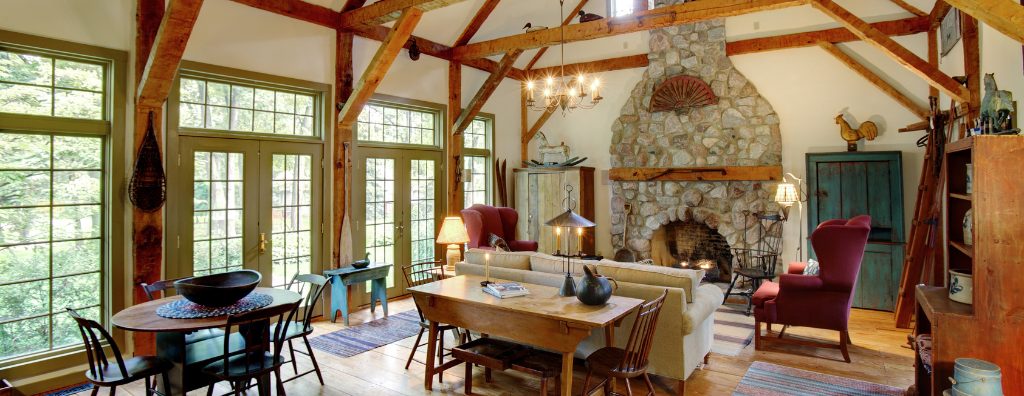
At its heart, American Country design is about creating rooms that feel relaxed and lived in. These are spaces where oversized sofas invite long conversations, where a stone or brick fireplace becomes the gathering point, and where nothing feels too precious to use.
Wood or stone floors ground the space, often softened by natural fiber rugs. Furniture tends to be substantial and comfortable. Think leather armchairs, slipcovered sofas, or simple patterned fabrics like gingham, stripes, or muted florals. The overall effect is welcoming and unpretentious.
A Warm and Muted Color Palette
American Country interiors favor warm, inviting tones over stark contrasts. Beige and soft browns often serve as foundational colors for walls and upholstery. Cream-colored cabinetry or beadboard walls add lightness without feeling stark.
To round out the palette, muted greens and soft blues bring in subtle depth while maintaining the overall warmth. These colors feel connected to the natural landscape—fields, forests, and wide-open skies.
The key is restraint. Rather than bold statements, American Country style relies on layered neutrals and earthy tones that feel timeless and easy to live with.
Natural Materials and Craftsmanship
Traditional materials play a central role in American Country homes. Wooden furniture, whether it’s a large farmhouse dining table, Windsor chairs, or a well-worn rocking chair, reflects durability and simplicity.
Exposed ceiling beams, if your home has them, instantly elevate the look while honoring the style’s roots. Stone fireplaces, carved wood details, and hand-formed metal accents add depth and character.
Decorative elements are often functional as well as beautiful: pottery, woven baskets, mason jars, and wooden crates that double as shelving. These pieces feel collected over time rather than purchased all at once.
Textiles with History and Texture
Textiles are essential to achieving a true American Country feel. Handmade quilts layered across beds or draped over sofas add warmth and story. Patchwork pillows mix patterns in a way that feels intentional but not overly coordinated.
Natural fiber rugs, such as jute or sisal, bring texture underfoot while reinforcing the connection to organic materials. Floral and botanical prints, whether in wallpaper, framed artwork, or upholstery, introduce a gentle nod to the outdoors.
Antiques and Vintage Touches
American Country style thrives on pieces with history. A vintage dresser, a weathered wooden trunk used as a coffee table, or antique brass hardware can instantly add depth and authenticity.
Local antique shops and estate sales are often treasure troves for finding accessories that feel genuine. The goal isn’t perfection, it’s personality. A slightly worn finish or hand-crafted detail only enhances the charm.
Simple, Functional, Designed for Real Life
Above all, American Country design prioritizes practicality. Rooms are arranged for ease of movement and everyday use. Open shelving in the kitchen, for example, keeps essentials within reach while displaying beautiful dishware or preserved goods in glass jars. It’s a design philosophy that reminds us of how a home should support daily life.
If you’re drawn to interiors that feel warm, welcoming, and rooted in tradition, American Country might be the perfect place to start. For more design inspiration, tips, and trends, visit the design section of our blog.
In real estate, we all know how important first impressions are. For decades, curb appeal has been the gold standard for catching a buyer’s attention—but today, those first impressions are happening online, often in under 30 seconds. As more buyers scroll listings on their phones or stumble across homes on social media, video has become one of the most powerful tools in a listing agent’s toolkit.
Enter: Reels.
Reels have completely redefined how we make an impact online. With a single scroll-stopping clip, you can showcase the flow of a home, highlight its best features, and spark an emotional connection long before a showing is ever scheduled. Where we used to say, “Make them fall in love in the driveway,” now we’re saying, “Make them fall in love on their For You Page.”
Why Reels Matter in Real Estate
Short-form video is dominating the digital space, and real estate is no exception. According to recent reports, Instagram Reels receive 22% more engagement and twice the visibility of any other content type. That means more views, more saves, more shares, and more potential buyers seeing your listing.
Even more compelling? Most users decide whether to keep watching in the first 3 seconds. In a market where timing matters and attention is limited, that makes every second count.
With Reels, you’re not just marketing a home—you’re creating an experience, expanding your reach, and showing up exactly where today’s buyers are: on mobile, on social, and online.
The Language of Social Media, Decoded
If you’re new to the social media space, all the jargon can feel overwhelming. Here’s a quick guide to the terms that matter most:
Impressions: How many times your content was shown, even if the same person views it multiple times
Reach: The total number of unique people who saw your content
Interactions: The real engagement, including likes, comments, shares, and saves
Engagement rate: A measure of how much people are interacting with your posts
Social reading: The process of learning from performance to see what’s working, what’s not, and how to pivot
Understanding these numbers helps you make informed choices about what to post and when—turning social into a strategic tool, not just a to-do list.
How a Reel Can Boost a Listing
Reels help your listing show up where buyers already are: scrolling, saving, and planning their next move. Photos can showcase a home’s style, but video brings it to life. A reel allows buyers to experience the home’s layout, lighting, and feel—something static images can’t always convey. Think of reels as a guided tour that lives right on their screen.
When your reel helps someone imagine themselves living there, you create something powerful: connection. And that leads to more views, more clicks, more showings, and ultimately, more offers.
Tips for Creating Scroll-Stopping Reels
You don’t need to be a content creator to make an impact. Here’s a checklist for effective real estate reels:
Keep it short—ideally under 30 seconds
Use trending or high-quality audio (voiceovers or music)
Open with movement or your most impressive feature
Use on-screen text to highlight what viewers are seeing
End with a CTA (“Message me for a private tour”)
Pro tip: Reels with trending audio, natural lighting, and a clear opening shot perform best. Start strong and guide the viewer through the story of the home.
Reels = Results
We’ve already seen how reels are helping agents across the industry expand their reach. One well-timed reel can:
Double the impressions of a standard photo post
Attract new buyers who weren’t actively looking but got inspired
Drive traffic from Instagram and Facebook directly to a listing
The best part? Reels often reach people who don’t even follow your account—giving your listing even more visibility.
Social Is the New Curb Appeal
Today’s buyers are online. They’re discovering homes through hashtags, algorithms, and short-form video. That’s why investing in reels isn’t just smart—it’s strategic. Whether you’re showcasing a cozy condo, a luxury estate, or a hidden gem with a killer view, reels help you tell the story of the home in a way that resonates.
Ready to make your home stand out? Connect with a Windermere agent who understands how to market your home in today’s digital world.
This is the latest in a series of videos with Windermere Principal Economist Jeff Tucker, where he delivers the key economic numbers to follow to keep you well-informed about what’s going on in the real estate market.
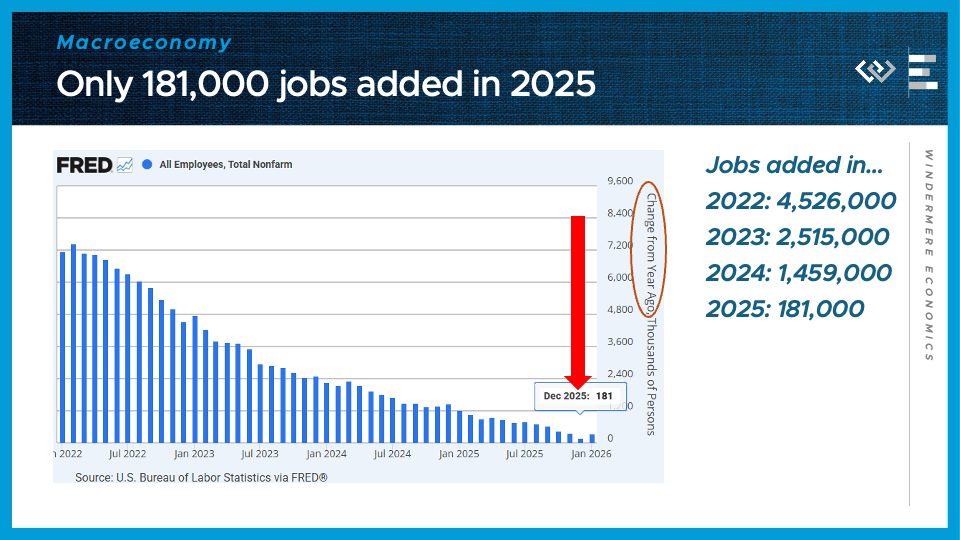
I’ll start with some bad news and some good news from the latest jobs report. The first number to know this week is the bad news: 181,000. That’s the total number of jobs added in the entire year of 2025, according to the latest data from the Bureau of Labor Statistics, which follow a standard annual revision updating their models to match more accurate but less timely data sources. These revisions drove home the conclusion that job growth basically stalled out in 2025, and was much worse than even the weak monthly payrolls reports were showing us. That total job growth compares to previous annual totals in the millions, although the trend of slowing growth has been clear for quite some time.
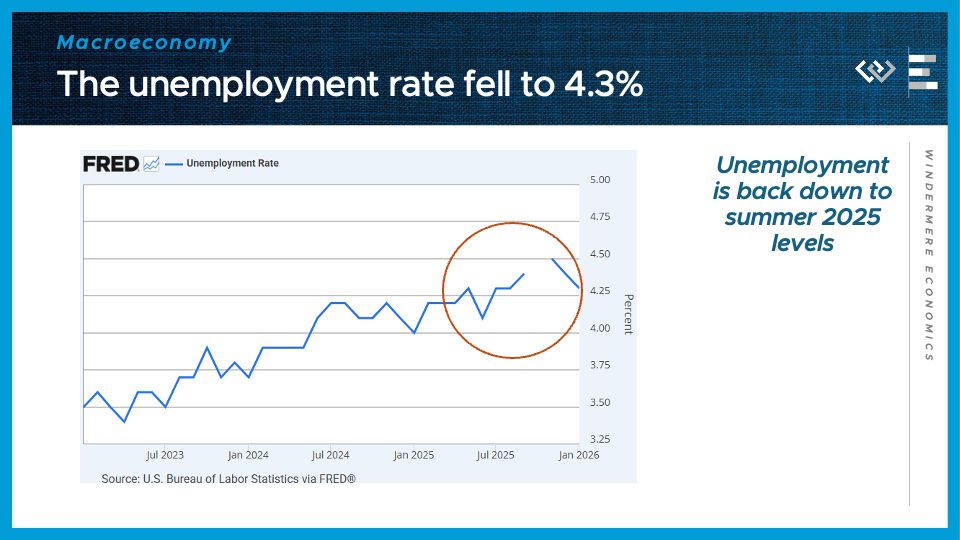
The second number to know this week was the good news in the latest jobs report: 4.3%. That’s the unemployment rate in January, which stepped down again, from a high in November of 4.5%, bringing it back down to summer 2025 levels. That’s one indication that the labor market MAY have begun to turn the corner this winter, with some modest improvement to start the year after several straight months of weakening. These are just preliminary numbers, but coupled with what we know will be strong economic tailwinds from the huge tax cuts in last year’s budget bill, the stage seems to be set for stronger economic growth this spring.
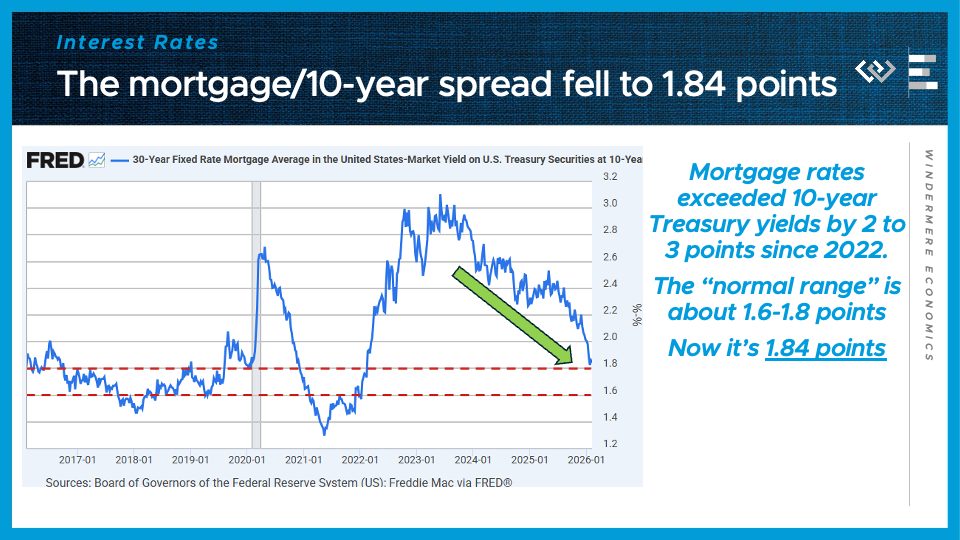
The third number to know right now: 1.84 percentage points. That was the average spread, or how much higher 30-year mortgage rates were than the benchmark 10-year Treasury yield in the first week of February. That means we are knocking at the door of a normal spread after almost four years of a really abnormally wide spread. This was a major culprit in the pain that homebuyers felt trying to get a mortgage. Last month I talked about the surprise announcement that Fannie Mae and Freddie Mac would be buying mortgage-backed securities, and I think the proof is in the pudding that the news of that purchasing plan helped bring this spread down by that last 30 basis points just in the last month.
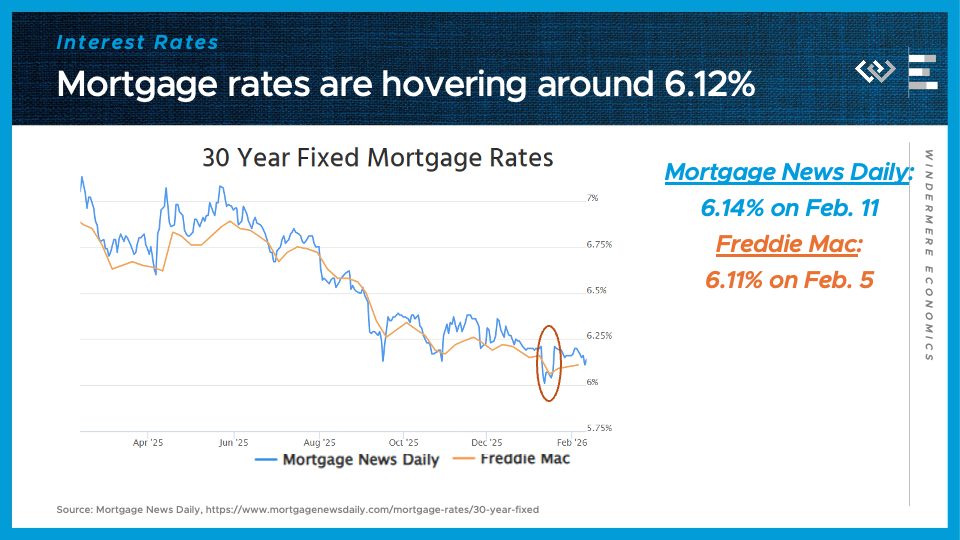
So where are mortgage rates now? Well, they’ve been hovering around 6 and an eighth all year, which is an improvement from this time in 2025 of at least half a point, maybe ¾ or a whole point, for most borrowers. I think the takeaway here is that we’ve now seen most of the improvement to mortgage rates that we were expecting from that spread closing, which is a little bittersweet – it’s great news that it happened, but now that potential avenue for rate improvement has run its course, which makes me less optimistic about prospects for further rate declines in the near term. It’ll depend instead on the overall interest rate and inflation environment cooling down, and those prospects look a lot dicier: the big increase in borrowing that the budget bill is kicking off this year will tend to push up Treasury yields, and the boost to economic growth should also keep inflation elevated. So my takeaway for anyone considering a mortgage is that rates have come down a lot, and there’s no point waiting on the sidelines in hopes of further declines, given what we can expect in the year ahead.
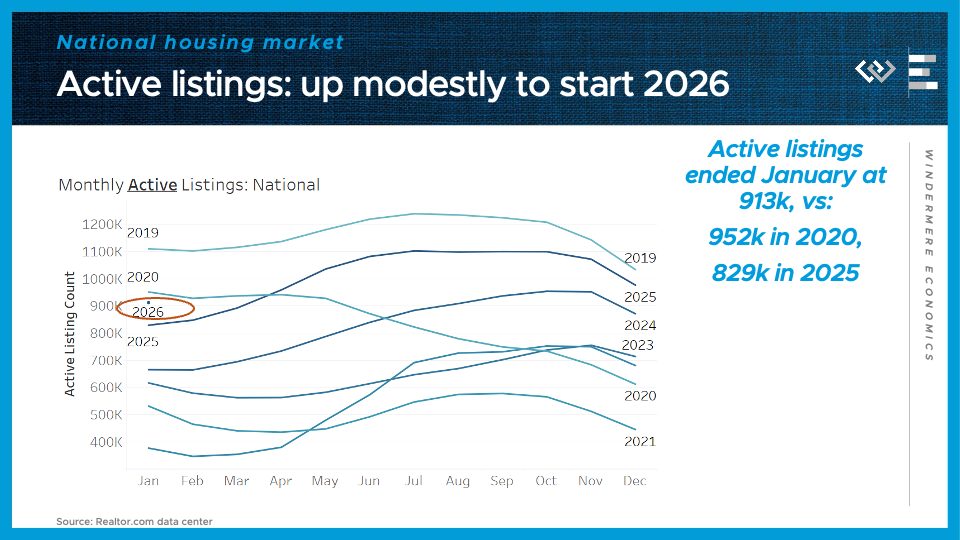
Turning to the housing market, we saw 913,000 active listings at the end of January, which is the most since January 2020, on the eve of the pandemic. In other words, nationally, inventory is finally nearly back to normal.
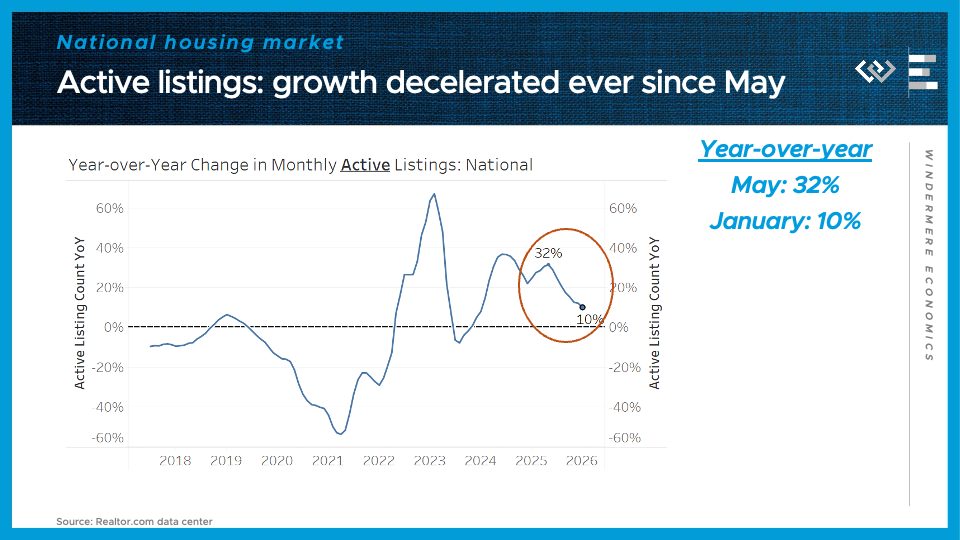
That 10% growth in inventory continues a consistent trend since last May, of active listings growing but at an ever slower pace. I think there’s good news for everyone in that fact: buyers will have more options to choose from this spring, and sellers don’t need to worry about competing against a glut of inventory, but they should be prepared to put their best foot forward when they list their home this spring, because it’s always worth it to stand out from the competition.
After decades of city living being the goal, a fresh trend is emerging. More and more people—especially young adults—are reimagining what “home” looks like, and that picture is starting to look a lot like small-town life. From coast to coast, smaller communities are seeing new life as individuals and families seek more space, deeper connections, and a quieter pace. This blog explores why so many are making the move and what it could mean for your next chapter.
A Big Shift Toward Smaller Places
It’s not just nostalgia or affordability driving people back to Main Street. Small towns offer a sense of balance that can be hard to find in big cities. Less time commuting means more time doing what you love. Smaller crowds make room for bigger conversations. And without the constant rush of city life, people are rediscovering how good it feels to slow down and stay awhile.
What’s Driving the Move?
Affordability and the Dream of Homeownership
Big city rent and home prices continue to climb, pricing out many first-time buyers. In smaller towns, buyers are finding more space, greater value, and a better chance of affording their first home. Whether it’s trading a one-bedroom apartment for a three-bedroom house or simply paying less for everyday essentials, the savings are adding up.
Remote work and Flexibility
With more jobs going remote (and staying that way), people are no longer tied to a specific metro area. This new freedom has allowed many to choose where they want to live based on lifestyle rather than commute.
Lifestyle and Access to Nature
Small towns often come with quieter streets, shorter commutes, and greater access to outdoor recreation. From scenic trails to lakefronts and beaches, natural amenities are high on the priority list for today’s buyers.
Community and Connection
In a time when many people feel disconnected, small towns offer something invaluable: a strong sense of community. You’re more likely to know your neighbors, shop at local businesses, and feel rooted in something bigger than yourself. For some, these towns also offer more chances to get involved, including local politics or town-wide initiatives that are often more accessible and welcoming to newcomers.
Entrepreneurship and New Opportunity
According to recent IRS data, small towns have seen a faster rise in new business formation than large cities post-2020. With less competition, lower startup costs, and supportive communities, many entrepreneurs are finding that perfect launchpad in small-town markets.
Education and Family Life
Families are also being drawn to the more personal, community-based education options often found in small towns. Smaller class sizes and greater access to teachers can make a big difference for growing kids. With lower crime rates and more outdoor space, many parents feel they can offer their children a safer and more well-rounded upbringing.
The Other Side: What to Consider
While small-town life has its perks, it’s not without trade-offs. Here are a few things to consider before packing your bags:
Limited medical services: Access to specialists and immediate care may be limited.
Fewer job options: While remote work helps, certain industries may have fewer local opportunities.
Diversity and culture: Small towns may have less cultural diversity and fewer entertainment options.
Transportation: Public transportation is often sparse or nonexistent. Owning a car or other means of transportation may be necessary.
How Places Like Seabrook, WA Are Leading the Way
One standout example of this new wave of small-town living is Seabrook, Washington. Perched on the Washington coast, Seabrook was designed to blend timeless charm with walkability, coastal views, and a strong sense of place.
Founded in 2004, Seabrook has grown to include 600 homes, over 20 parks, 24 shops and restaurants, a grocery store, pools, trails, and more. It was designed to offer an urban-meets-coastal lifestyle, and today, it’s a thriving year-round community with schools, medical clinics, and a regenerative farm that supports local restaurants and residents.
Whether it’s a full-time move or a weekend escape, places like Seabrook are proving that small towns can offer everything people are looking for: modern convenience, community, and a deep sense of belonging.
Is Small-Town Living Right for You?
If you’ve been dreaming of a slower pace, a bigger yard, or just more breathing room, you’re not alone. Ask yourself:
Do you work remotely or have a flexible schedule?
Are you craving more nature and outdoor recreation?
Would you trade a bustling nightlife for stronger community ties?
Is homeownership feeling out of reach in your current city?
If you answered yes to most of these, a move to a small town might be worth exploring.
Whether you’re relocating, downsizing, or just rethinking what you want from your next move, small towns have never looked more appealing. Connect with a Windermere agent to learn more about growing communities, small-town living, and finding places that feel like home.
Design trends have always reflected more than style. They reflect how people want to live. And as we move into 2026, home design continues to shift away from one-size-fits-all aesthetics and toward spaces that feel intentional, expressive, and more personal.
After several years shaped by minimalism, fast trends, and highly curated interiors, homeowners are now prioritizing warmth, character, and longevity, creating environments that support everyday life. That shift is reflected across design forecasts, color reports, and industry insights, where a few defining themes continue to show up. These are the top interior design trends shaping homes in 2026 and how they translate into real, livable spaces.
Lived-In, Layered Interiors
In recent years, many interiors have leaned towards polished, photo-ready spaces that always look perfect. In 2026, that approach continues to soften, and perfection takes a back seat to personality.
Layered, collected interiors are leading the way. Spaces that look as though they have come together over time feel warmer and more inviting. Mixing vintage with new pieces, displaying meaningful objects, and creating soft structure through books, art, textiles, and ceramics adds depth and story. A worn wood table, a reupholstered vintage chair, or a gallery wall that grows naturally gives a home character that can’t be replaced overnight.
Rich, Grounding Color Palettes
Color continues to shape how a home feels, and 2026 paint color trends lean into depth with a calming edge. Think nature-inspire tones like smoky blues, warm browns, muted reds, and softened neutrals that ground a room without feeling heavy.
Behr’s 2026 Color of the Year,Hidden Gem, fits beautifully into this direction. It’s a smoky green-blue that feels rich yet refined, perfect for homeowners who want a space that’s serene yet still has presence. Similar color stories are appearing across other forecasts too, from patina-inspired blues, greens, and browns to warm khakis and layered whites.
Color Drenching and Moody Rooms
If you’re seeing more immersive, saturated rooms online, that’s no accident. Color drenching, which uses a single hue across walls, trims, and sometimes ceilings, continues to rise as one of the standout interior design trends in 2026. When done thoughtfully, it creates a cocoon-like effect that feels polished, intimate, and cohesive.
This is also part of a broader shift toward moodier spaces. Deeper greens, tobacco-inspired browns, warm blacks, and earth reds are showing up in dining rooms, powder baths, offices, and libraries. The key is balance—pairing saturated color with warm wood, soft lighting, and texture to keep the room inviting.
Warm Woods and Character Grain
Wood is making a confident return in 2026, but not in a shiny, match-everything way. Interiors now favor deeper stains, visible grain, and pieces with real character. Reclaimed materials, vintage finds, and finishes that show variation all add warmth and depth.
This shows up in kitchens, furniture, and architectural details like beams, built-ins, and trim. If you’re bringing wood into your home,Minwax’s 2026 Stain Color of the Year, Special Walnut, fits the mood: a warm, versatile brown that enhances natural grain and works across styles frommoderntotraditional.
Paired with stone, linen, and even metal, wood brings warmth and timelessness—two qualities today’s buyers tend to notice immediately when they walk into a home.
Texture as the New Luxury
Another defining shift in home décor trends for 2026 is the return of texture, especially tactile, handcrafted, and visually soft elements. Textile wall hangings, tapestries, layered rugs, and subtle decorative trims like fringe and tassels are making an easy way to add depth without clutter. You don’t need to go maximal to make it work. A fabric panel hung like art, a woven wall piece, or even vintage textiles repurposed as décor can make a space feel warmer and more grounded. In a world that often feels overly digital, texture brings a human, lived-in quality that’s hard to fake.
Function Forward Design
Function continues to shape design decisions in 2026. Modular furniture, flexible layouts, and thoughtful storage solutions are becoming more prevalent as homes are expected to support multiple roles. Benches with hidden storage, ottomans that double as work surfaces, and adaptable seating arrangements allow spaces to shift easily between hosting, working, andrelaxing.
Sustainability as the Standard
Sustainability is no longer a niche consideration. In 2026, it’s an expectation. It shows up in material choices, sourcing, and the lifespan of the pieces we bring into our homes. Homeowners are paying close attention to upgrades that support energy efficiency and long-term livability.
At the same time, thrifting and buying secondhand continue to grow across age groups, driven by both environmental awareness and the search for higher-quality materials. Vintage and antique furniture often offers better craftsmanship and longevity than mass-produced alternatives, while adding instant character to a space.
Whether you’re updating a room or thinking about your next move, these trends offer a thoughtful lens for creating a home that feels both current and enduring.
Connect with a Windermere agent today to talk about your next move and how to design a home that fits the way you live.
Hi. I’m Jeff Tucker, principal economist at Windermere Real Estate, and this is a Local Look at the January 2026 data from the Northwest MLS.
So far in 2026, the housing market is still in the grips of a winter slowdown.
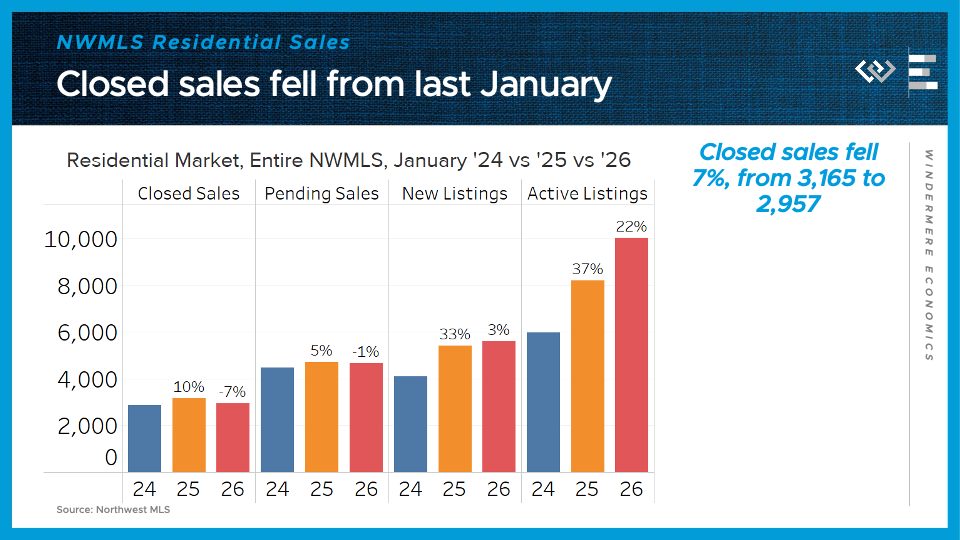
Across the Northwest MLS, there were 7% fewer closed home sales than in January 2025. However, pending sales suggest the slowdown may have bottomed out, as they were down only 1% year-over-year.
On the supply side, the flow of new listings was up 3% from last January’s pace. Finally, the month ended with 22% more active listings than last January, continuing a trend of more options, and more negotiating leverage, for home buyers.
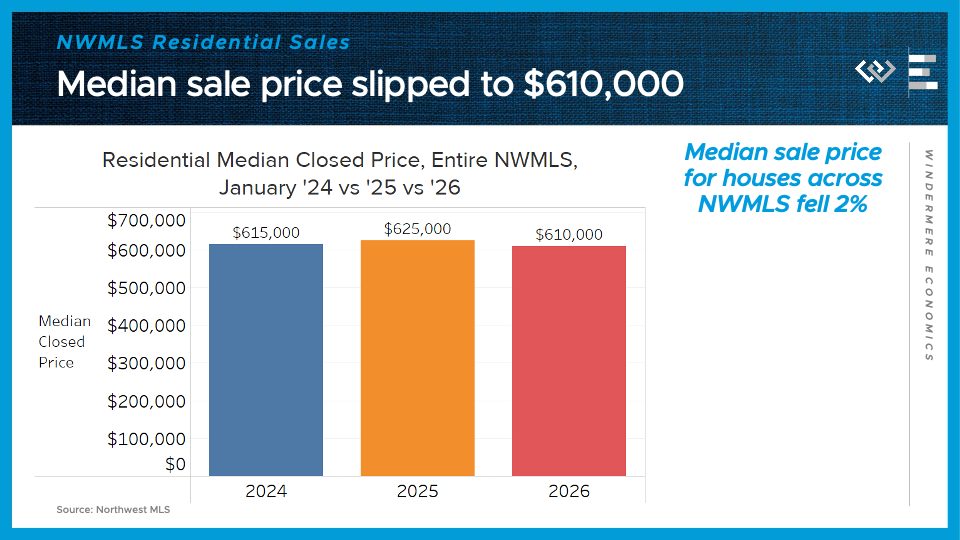
That stronger negotiating leverage translated into lower home prices in January: down 2 and a half percent from last year, and even 1% lower than in January 2024.
Now for a closer look at the four counties encompassing the greater Seattle area.
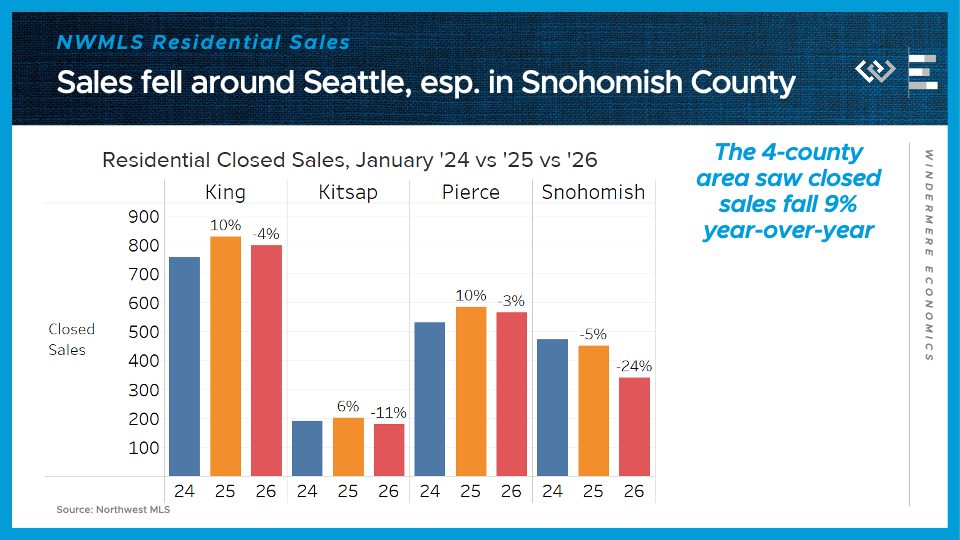
Closed sales dropped by 9% from last January around the region, but that decline was most stark in Snohomish County, where sales fell 24%, perhaps due to weaker demand for longer commutes in response to more return-to-office mandates.
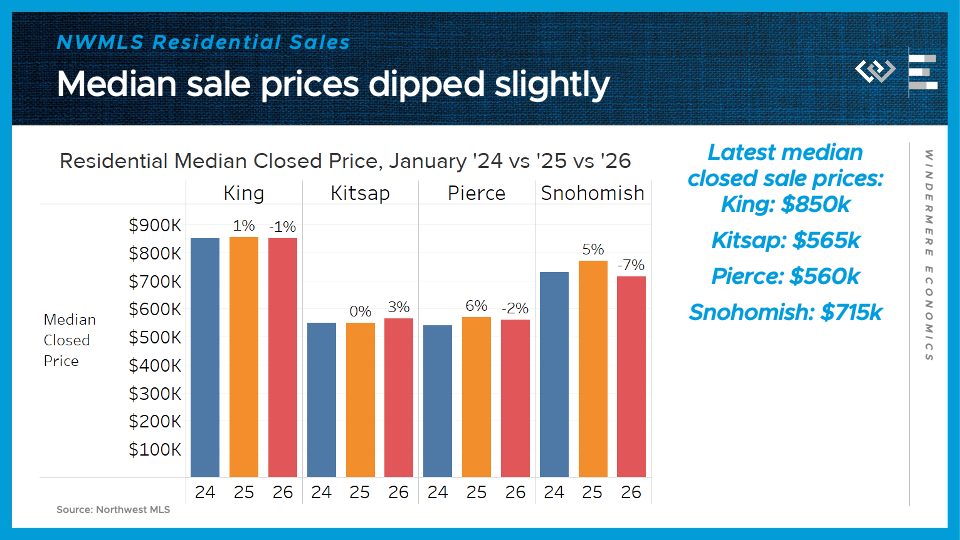
Median sale prices saw modest declines in most of the region: 1% lower in King; 3% higher in Kitsap; 2% lower in Pierce, and 7% lower in Snohomish County, which gave up all of last year’s price gains and more.
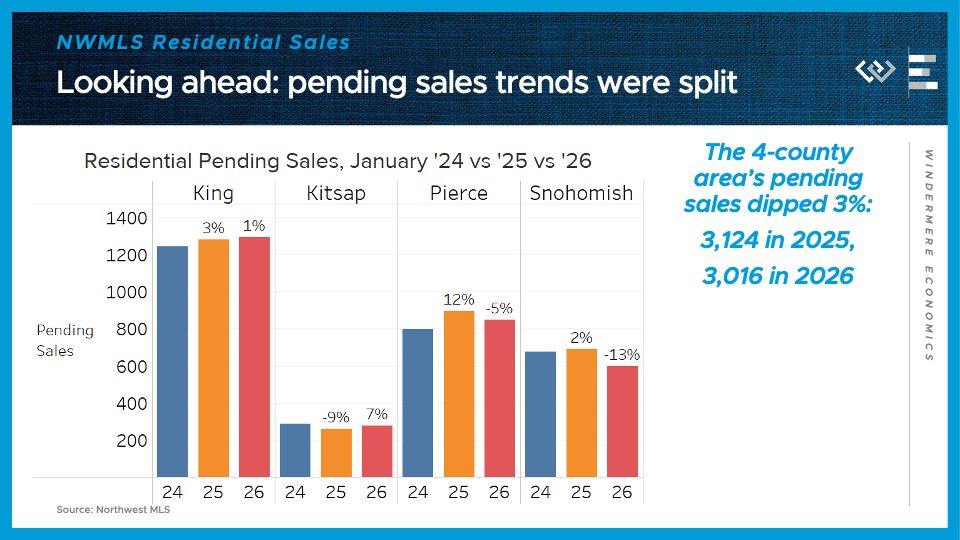
Looking ahead, pending sales dipped by 3% across the region in January, led by a 13% decline in Snohomish County and a 5% drop in Pierce, while King and Kitsap showed some pending sales growth.
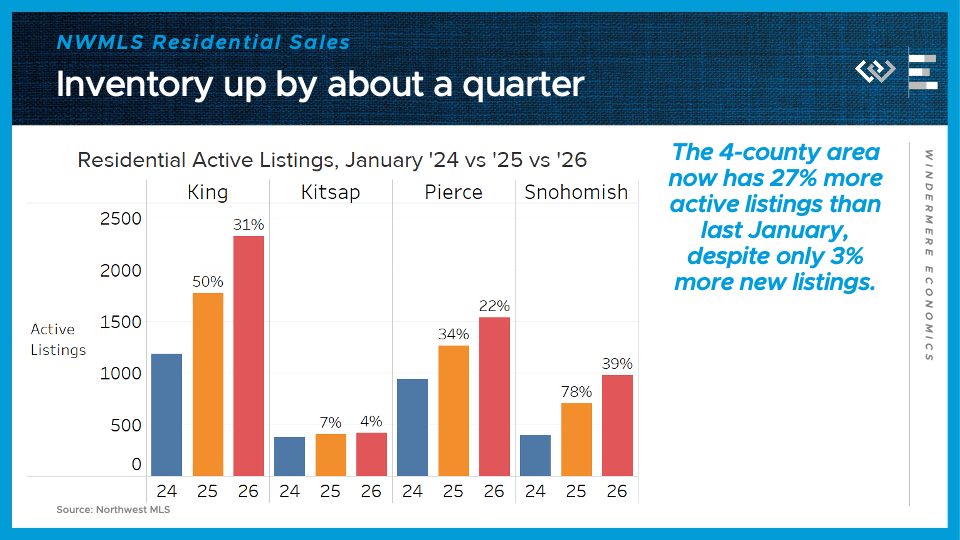
On the supply side, the 4-county greater Seattle area had 27% more active listings than at the end of January 2025. While that pace of inventory growth has decelerated, we can see now that in most of the region there’s now a solid 2 consecutive years of inventory growth, pushing conditions into a buyer’s market.
That’s the main takeaway from this first look at 2026 housing market data: buyers have finally wrestled some price concessions out of sellers, and they’ve got more listings to choose from than in any recent winter. Still, we are on the verge of the busiest season of the year for housing, and that will absolutely mean an uptick in both sales and prices in the months ahead.
If you’ve ever walked through an older neighborhood and felt drawn to a home that looks balanced, practical, and quietly confident, you were likely looking at an American Foursquare. Sometimes called a Prairie Box or Prairie Cube, this architectural style is one of the most straightforward designs in the American architectural tradition, and one of the most enduring.
Popular from the late 1890s through the 1920s, the Foursquare emerged during a time when ornateVictorian homesdominated the landscape. In contrast, these homes favored simplicity, efficiency, and sold craftsmanship. Influenced by the Prairie and Arts and Crafts movements, the Foursquare prioritized thoughtful design over decoration, making it both practical and approachable.
A Shape That Works
True to its name, the Foursquare is defined by its box-style construction. The home’s nearly square footprint creates a symmetrical form, with rooms occupying each quadrant. Most Foursquares are two to two-and-a-half stories tall, with the half story tucked into a spacious attic. This efficient layout was intentionally designed to make the most of smaller lot sizes while still providing generous living space.
Rooflines, Porches, and Presence
A low-pitched hipped roof is one of the most recognizable features of a Foursquare home. The roof slopes evenly on all four sides, often forming a pyramid shape, and is frequently paired with a central dormer window that brings light and air into the attic level.
Many Foursquares also feature a covered front porch—sometimes spanning the full width of the home—supported by simple columns. These porches extend the living space outdoors and give a home a welcoming, grounded presence on the street.
Materials and Details
Building materials for Foursquare homes vary by region, with brick and wood being the most common. While the exterior design remains restrained, later models often incorporate Arts and Crafts details, especially inside the home. Built-in shelves, benches, bookcases, and window seats add warmth and function without excess ornamentation.
Inside the Foursquare
The interior layout reflects the same efficiency seen on the exterior. Traditionally, the main floor contains shared living spaces such as the living room, dining room, kitchen, and entryway, while bedrooms are located on the second floor. Hallways are minimal, and because each room typically sits at a corner of the home, natural light enters from multiple directions, a detail that homeowners still appreciate today.
Why Foursquare Homes Still Matter
More than a century later, American Foursquare homes remain highly desirable for their smart layouts, timeless proportions, and understated character. They’re homes designed to work well, on their lots, in their neighborhoods, and in everyday life. That kind of thoughtful simplicity never goes out of style.
This is a recurring series of blog posts taking a closer look at the U.S. economy and several major regional markets in Windermere’s nine-state footprint. Updates will be released on a quarterly basis.
Economic Overview
Last year did not deliver the hoped-for breakout from the low-sales housing market that has persisted since interest rates skyrocketed in 2022. Just over four million existing homes sold in 2025 – nearly identical to the totals in 2023 and 2024.
Mortgage rates edged lower in the fourth quarter, falling from an average of 6.35% in September to 6.19% in December. That downward trend continued into early 2026, particularly following the announcement that Fannie Mae and Freddie Mac would purchase additional mortgage-backed securities.
Greater Seattle Area (King, Snohomish, Pierce, and Kitsap Counties)
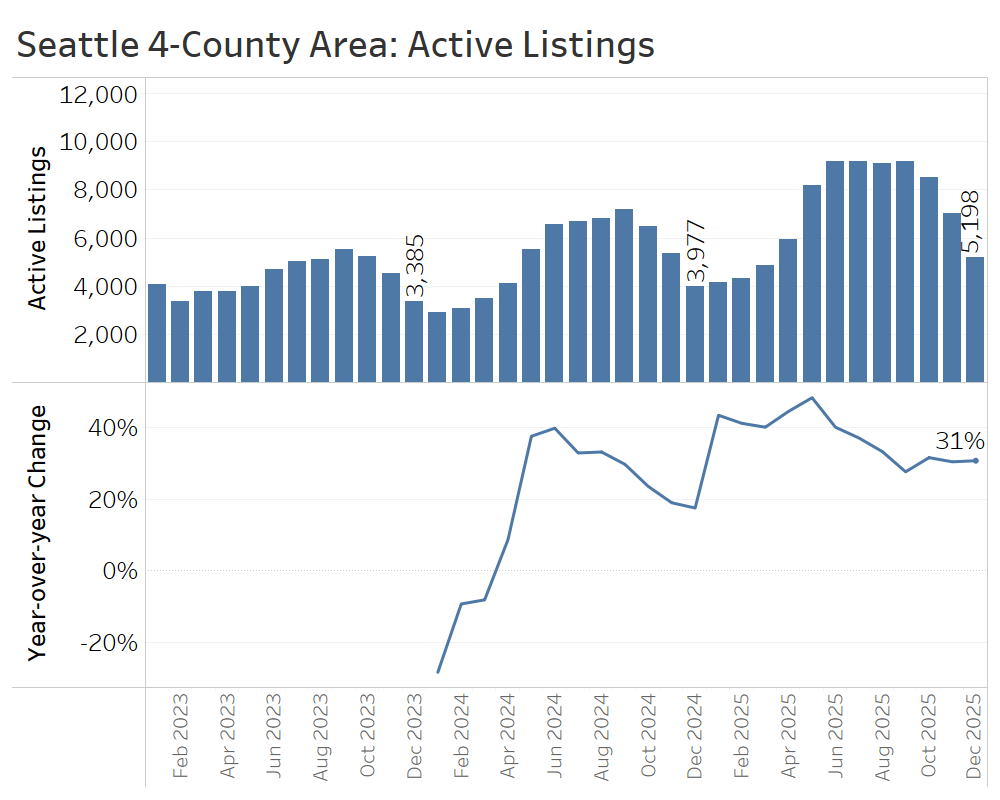
The fourth quarter cemented the defining themes of 2025 for the Seattle-area housing market: higher inventory and more negotiating power for buyers. Active listings totaled nearly 5,200 at year-end, which was 31% higher than at the end of 2024, yet well below the more than 9,000 listings on the market as recently as September, reflecting the typical seasonal pullback in the fall.
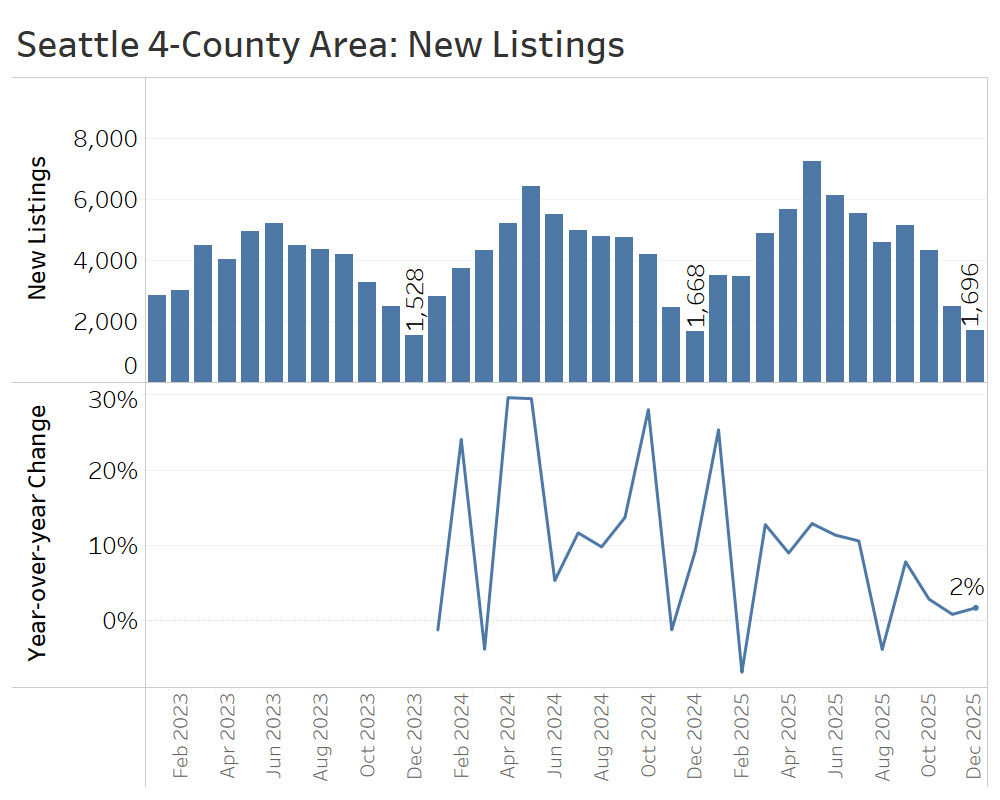
The fourth quarter is typically the low-water mark for new listings, and 2025 was no exception: just under 1,700 new listings hit the market in December, barely 2% more than a year earlier. That modest year-over-year increase marked a major cooldown from the faster pace of new-listings growth seen earlier in the year.
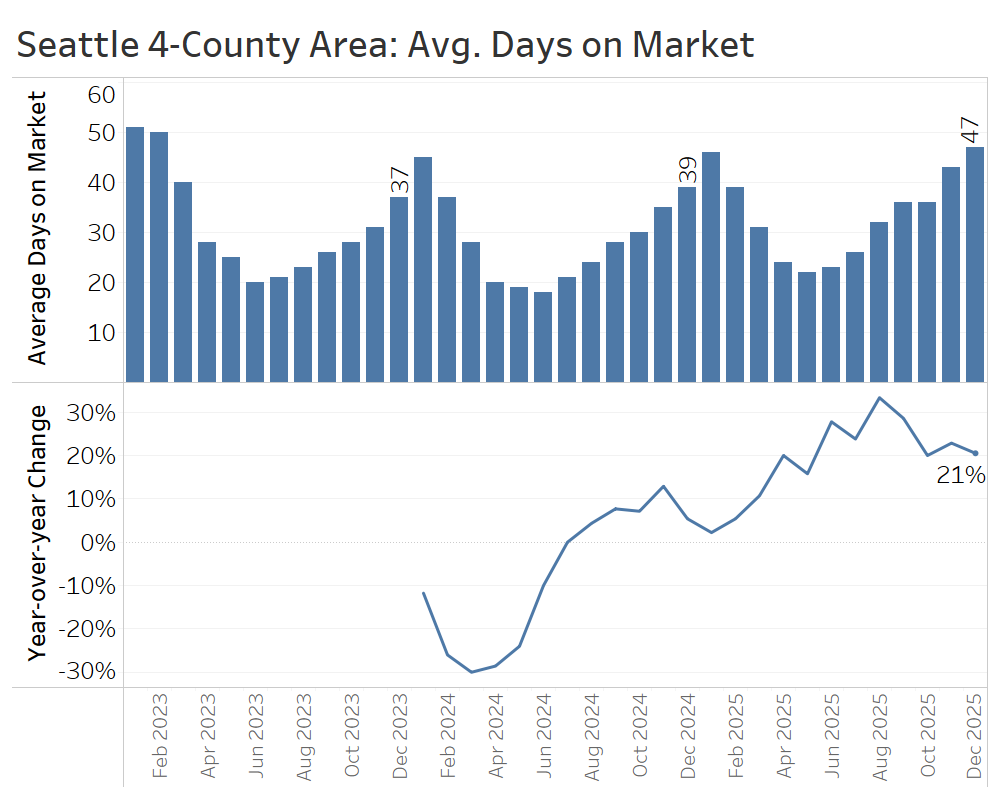
Listings continued to linger on the market longer in the fourth quarter compared to the prior year. In December, homes averaged 47 days on market, up from 39 days in December 2024. January will likely mark the seasonal high-water mark before time on market plunges with the onset of the spring selling season later in the first quarter.
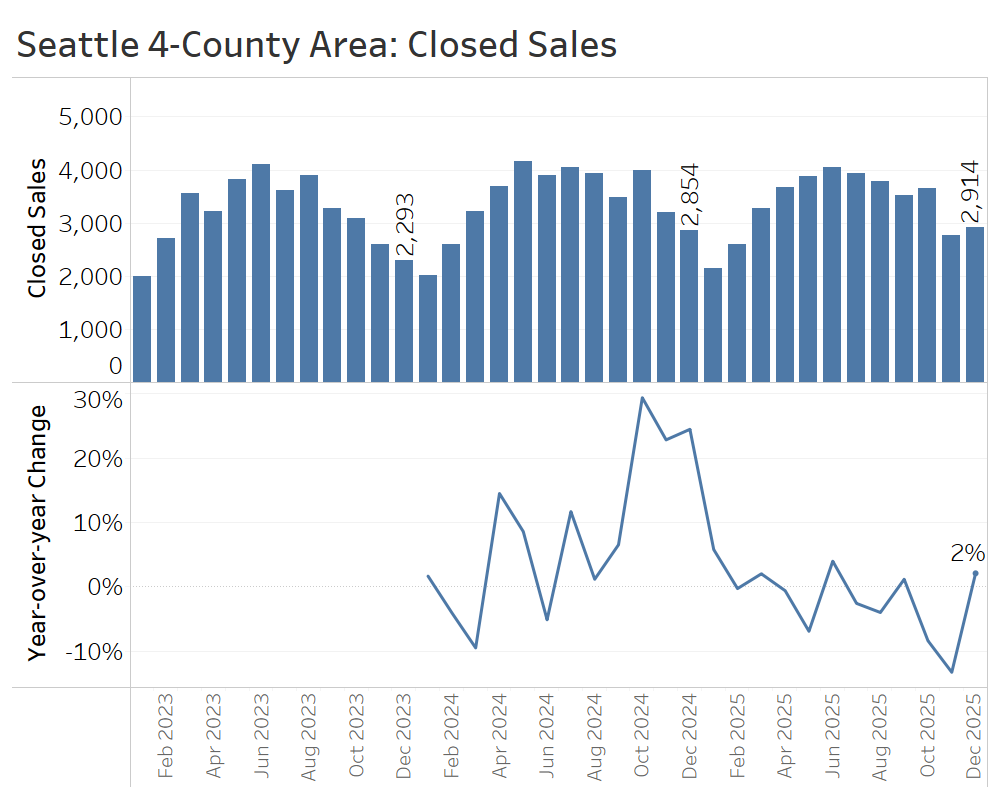
Closed sales in the fourth quarter generally fell short of fourth-quarter2024 levels, which were boosted by a frenzy of buyer activity following the Federal Reserve’s initial interest rate cuts in September of that year. Closed sales year over year declined 8% in October and 13% in November, before rebounding to a 2% year-over-year increase in December.
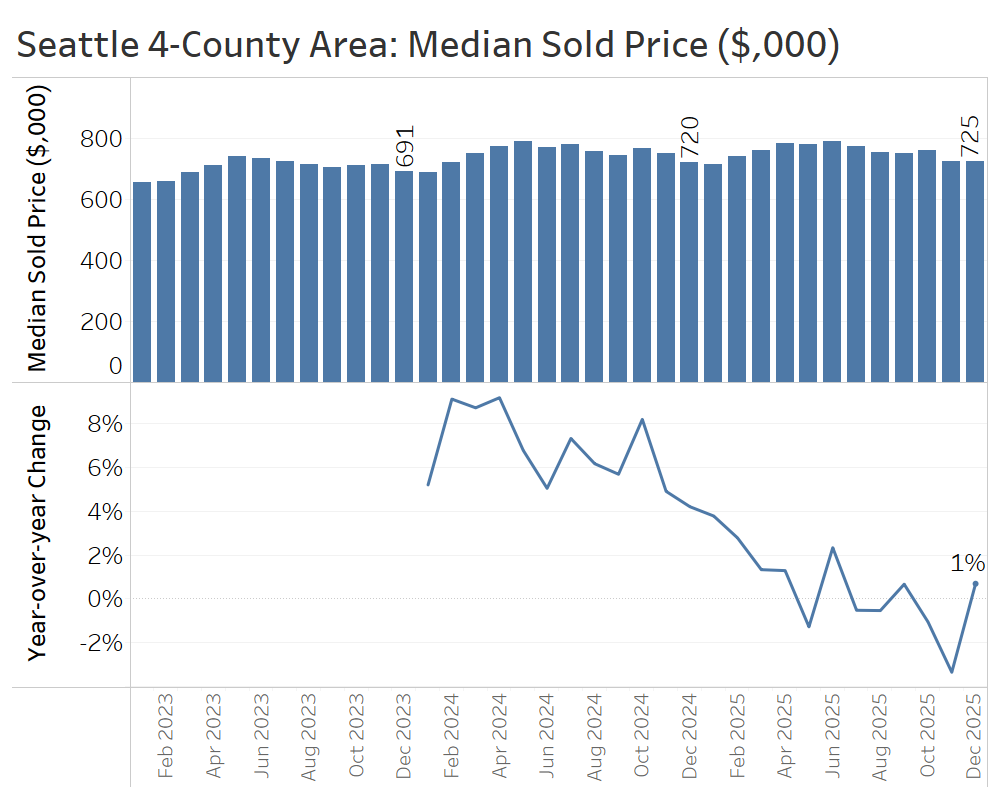
Cooler demand this quarter showed up in prices, too. October and November saw median sale price drops of 1% and 3% from 2024, before ending the year at $725,000, about 1% higher than the end of 2024. High inventory tends to depress price growth, as sellers are forced to compete for limited buyers.
The fourth quarter brought 2025 to a subdued close in the Seattle-area housing market, with no surge of activity to rival the fourth quarter of 2024 and higher inventory continuing to weigh down prices. That said, the new year is kicking off with much lower interest rates than a year ago, which may be enough to jump-start buyer demand after a quiet winter.
Greater Portland Area (Multnomah, Washington, Clackamas, and Clark Counties)
The Greater Portland Area notched another quiet quarter of normalization to round out 2025, with modestly rising inventory and slightly lower prices than 2024.
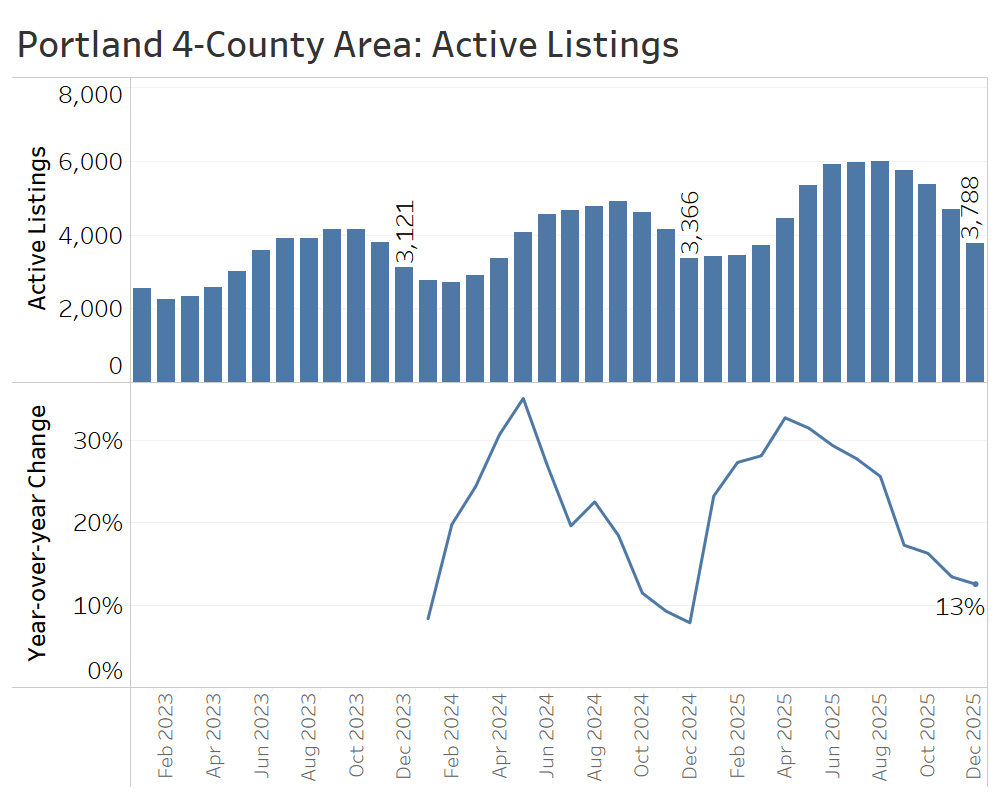
Active listings ended the year at 3,788, or 13% higher than the previous year. That continues a trend of decelerating inventory growth since May.
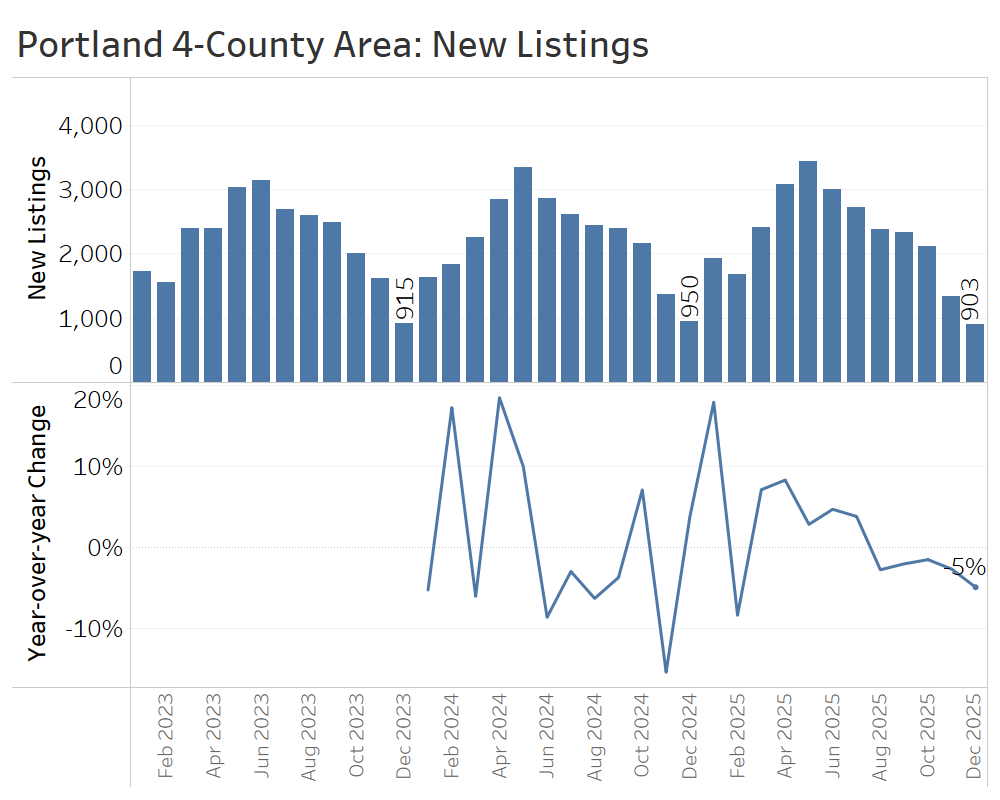
New listings in the fourth quarter of 2025 remained below fourth-quarter 2024 levels for the third straight month, capped by a 5% decline in December, traditionally the quietest month for new listings. The slower inflow of listings to the market has contributed to the more modest inventory growth seen above.
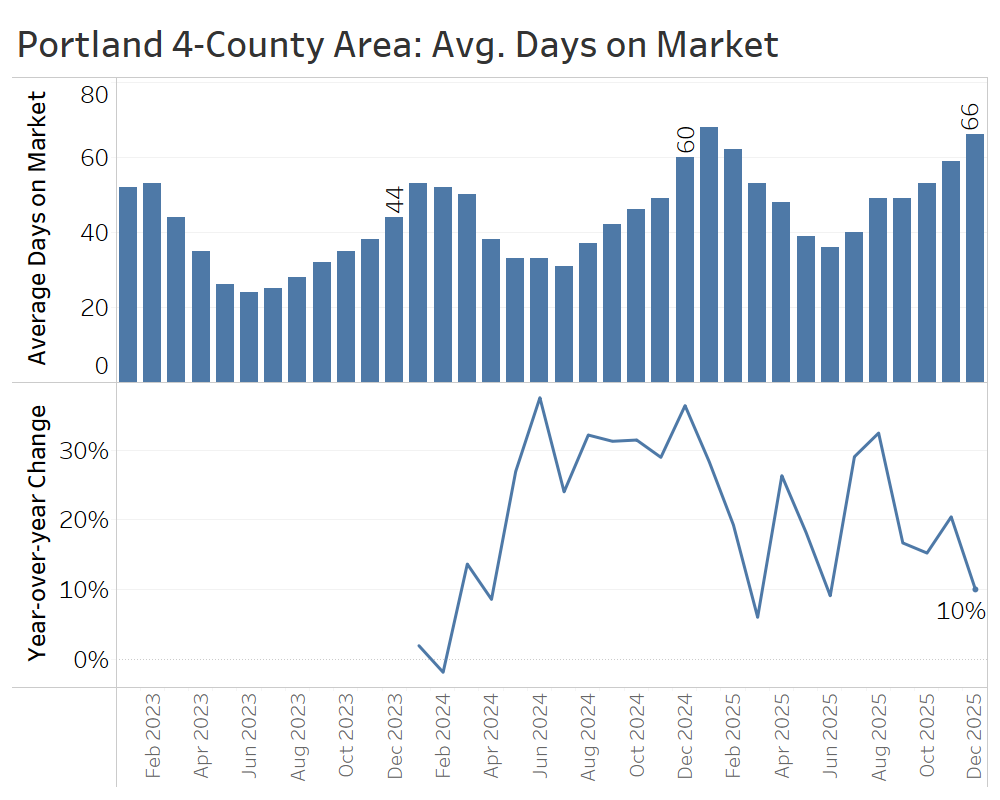
The average home sold after 66 days on the market—about six days longer than December 2024. Homes that linger for several months often end up selling below their original asking price, a trend that has increasingly worked in buyers’ favor in the fourth quarter.
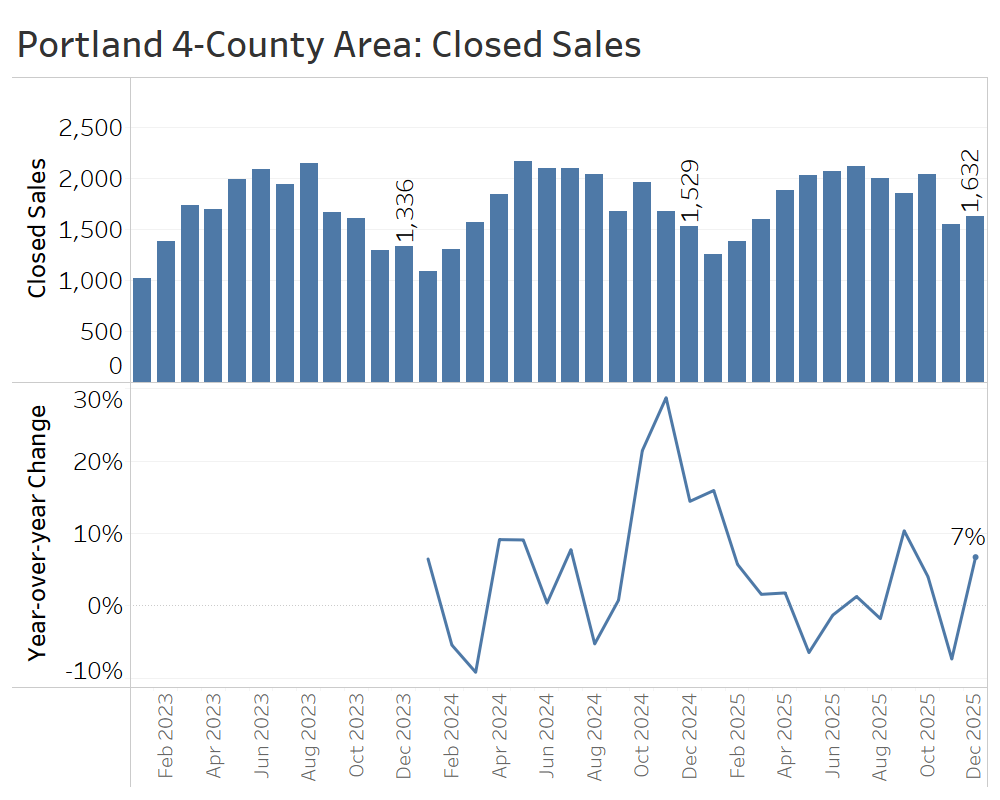
Closed sales of single-family homes rose 7% year over year in December, following a significant dip in November. Overall, the 5,221 closed sales in the fourth quarter narrowly exceeded the 5,162 sales recorded in the final quarter of 2024, suggesting that more buyers were motivated to get off the fence this fall.
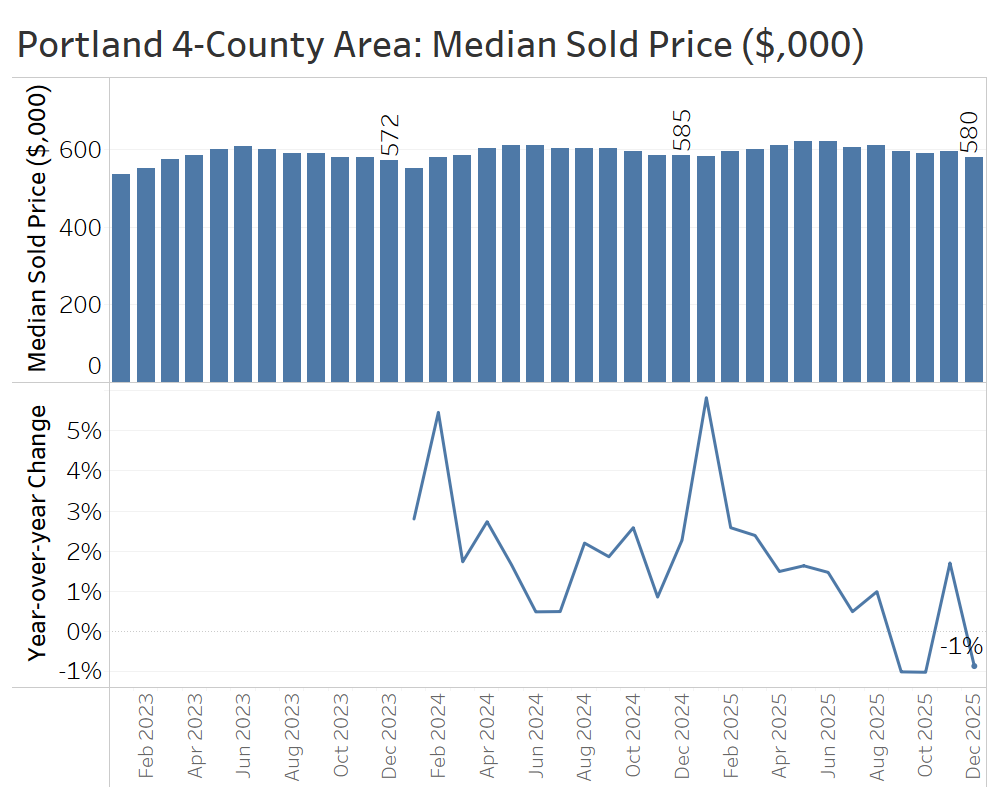
Median home sale prices in the Portland area edged down slightly, ending the year at $580,000 – about 1% below December 2024. Paired with the rebound in sales, this suggests buyers were able to negotiate for some deals at the end of 2025.
The fourth quarter continued to demonstrate the downstream effects of higher inventory in the Portland area: it helped attract buyers and support affordability, while also discouraging some sellers who are likely waiting to list.
Greater Sacramento Area (Sacramento, Yolo, El Dorado, and Placer Counties)
The Greater Sacramento Area is another market where the advantage has decisively shifted in favor of buyers. Inventory has climbed, prices have cooled, and sales activity has remained relatively flat.
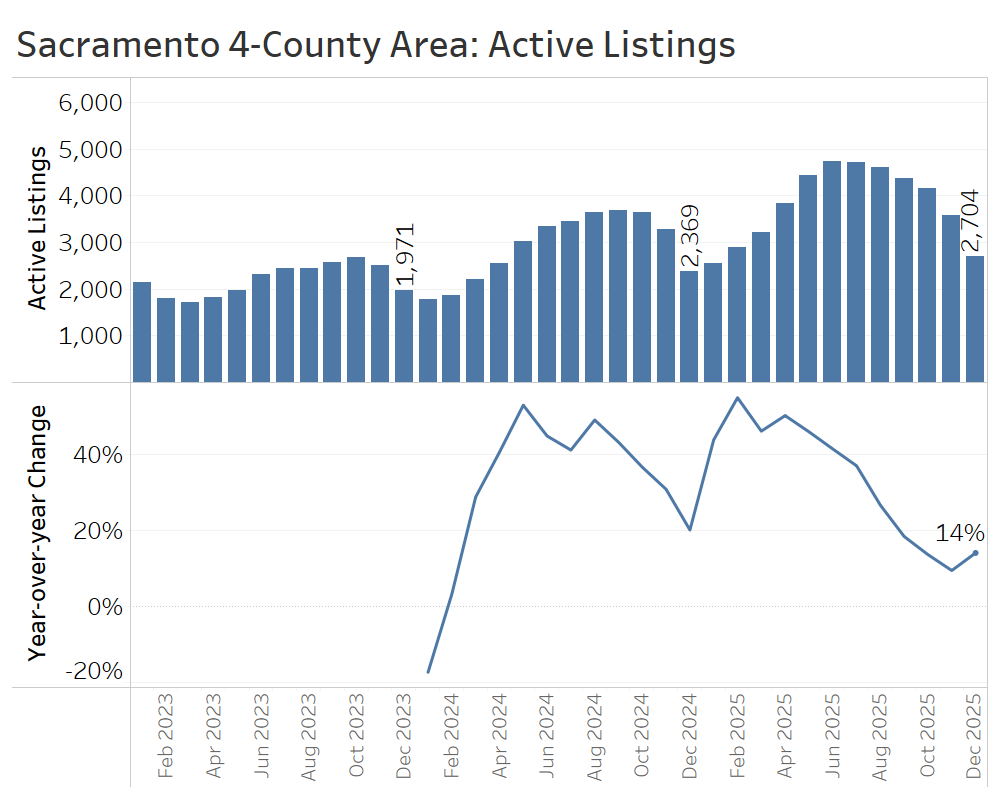
At the end of December, there were about 2,700 active listings—an increase of 14% compared to the end of 2024. Overall, inventory growth in the fourth quarter was much more modest than in early 2025, when listings were up 50% or more compared with 2024.
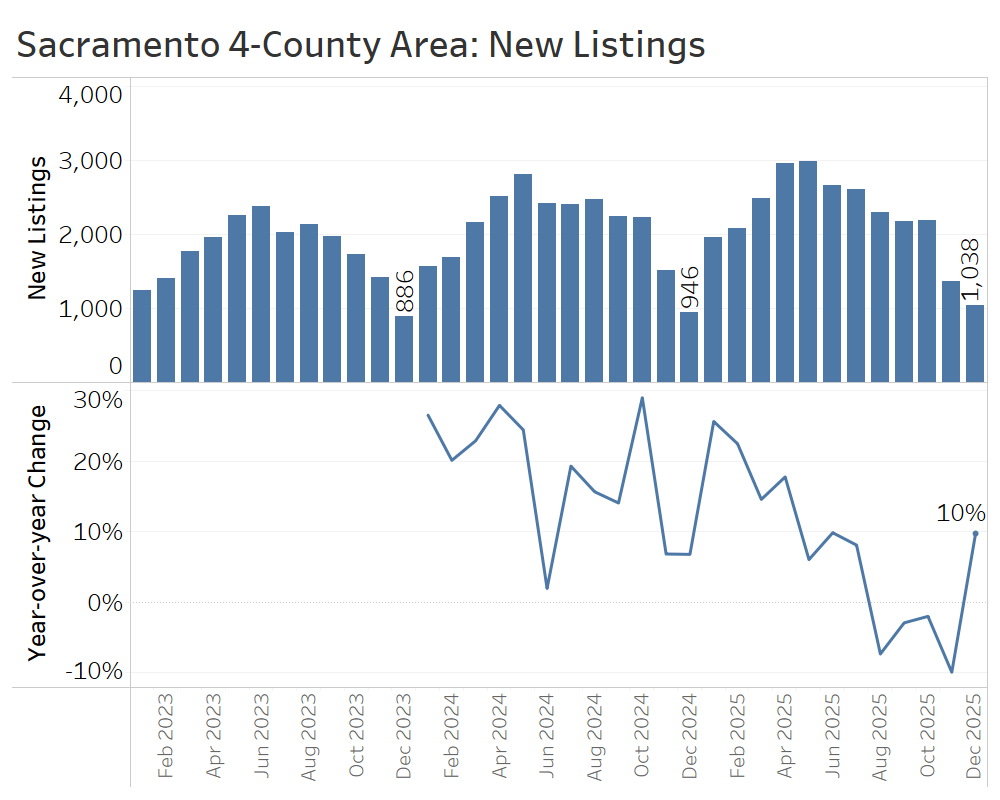
New listings ran below December 2024 levels for four straight months, before ticking up 10% in December 2025—a modest boost to end the year.
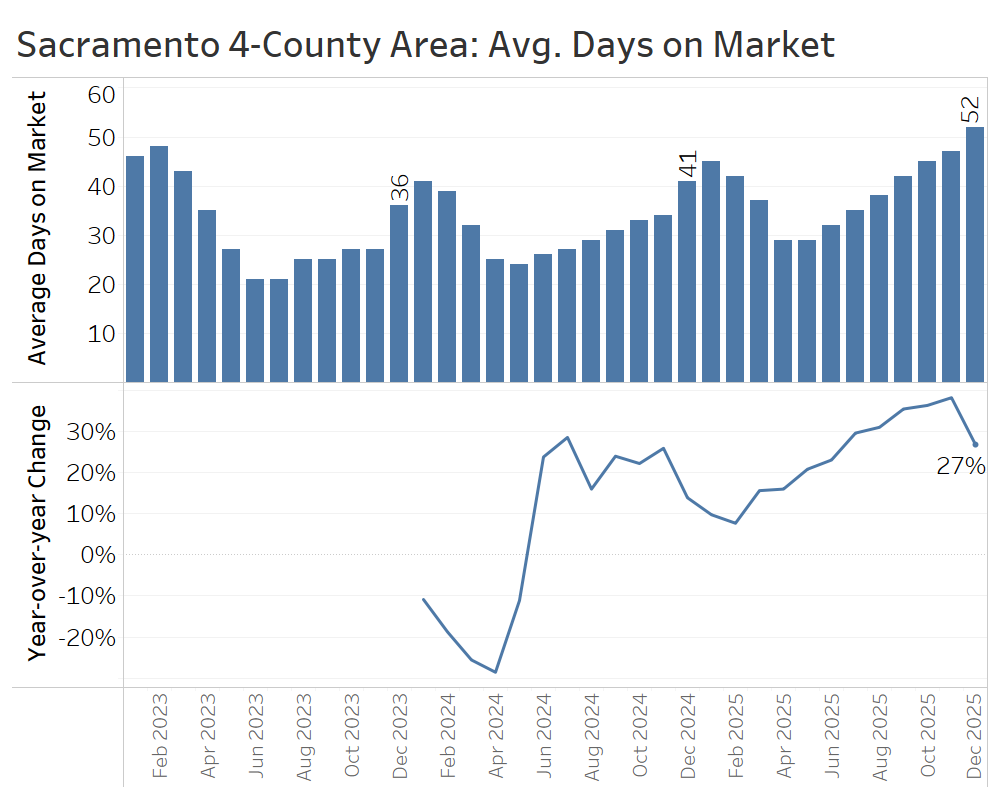
Average days on market rose by about 11 days compared to December 2024, reaching 52 days. While this eases some of the pressure on home shoppers, seasonal trends are likely to bring the number down later in the first quarter.
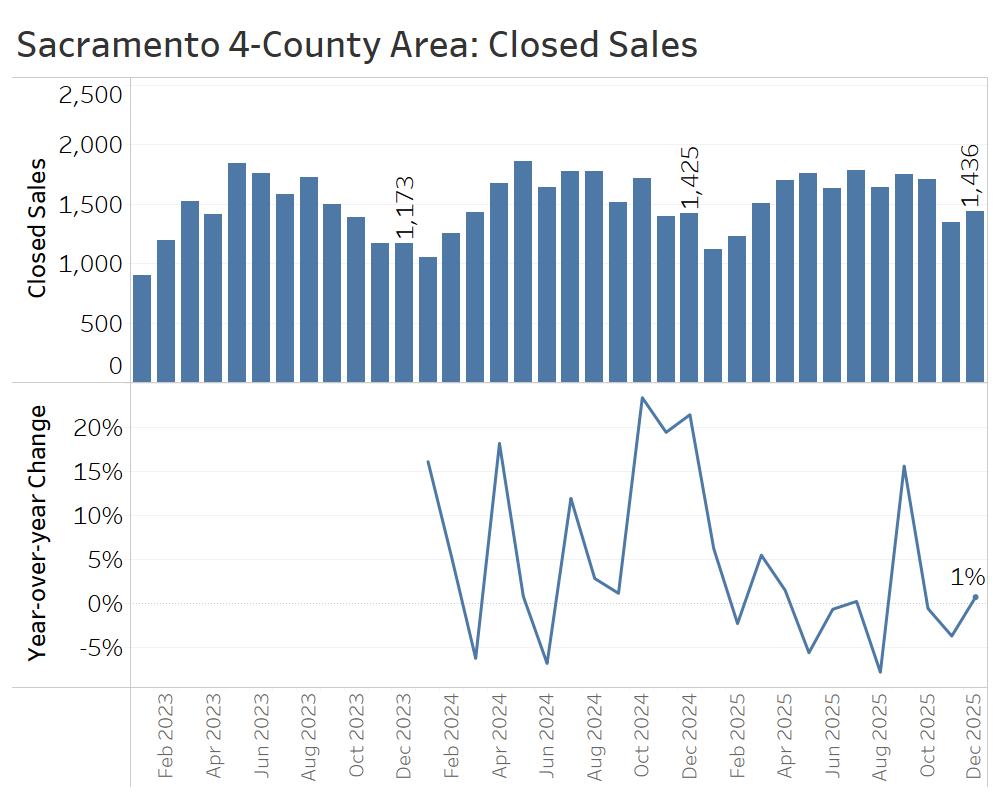
Sales activity in the fourth quarter of 2025 was remarkably similar to the fourth quarter of 2024, with nearly 4,500 homes sold in 2025 compared with just over 4,500 the year before.
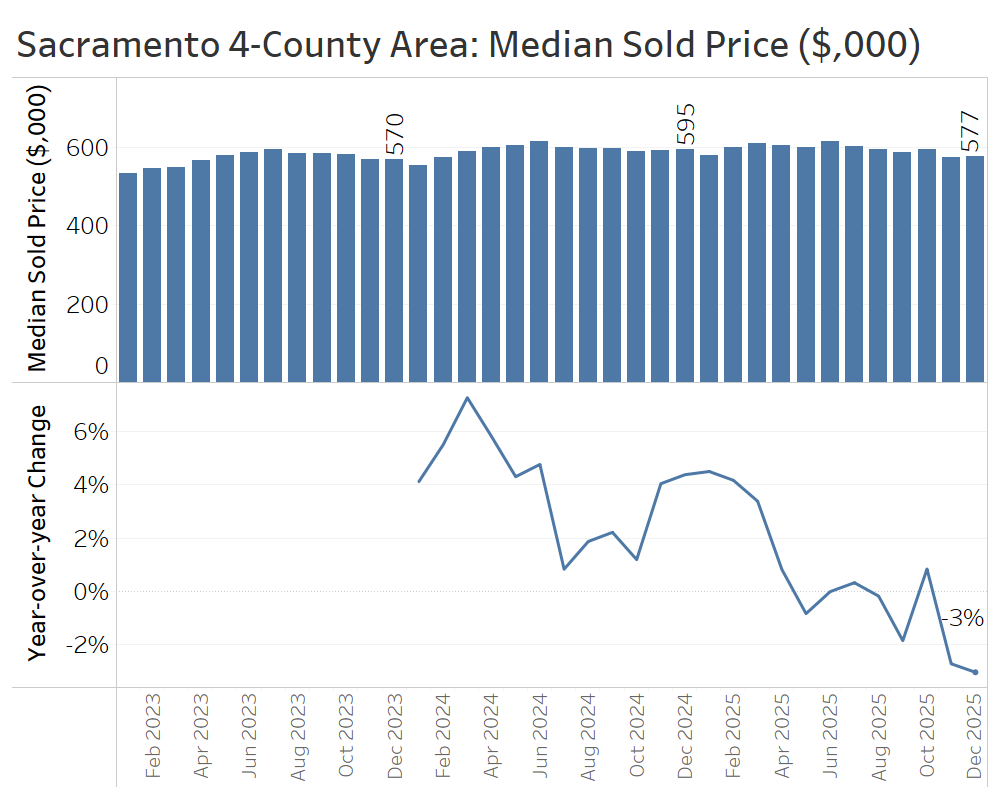
Median sale prices fell 3%, from around $595,000 in December 2024 to $577,000 in December 2025. The main causes of the softer pricing were higher inventory and longer time on market.
The fourth-quarter takeaway in the Greater Sacramento Area is that buyers came to appreciate and act on their greater negotiating power, winning some bargains while sales volume remained basically flat.
Northwest Washington (Skagit, Whatcom, San Juan, and Island Counties)
The market conditions in the four northernmost counties of Western Washington are experiencing a major shift in favor of buyers.
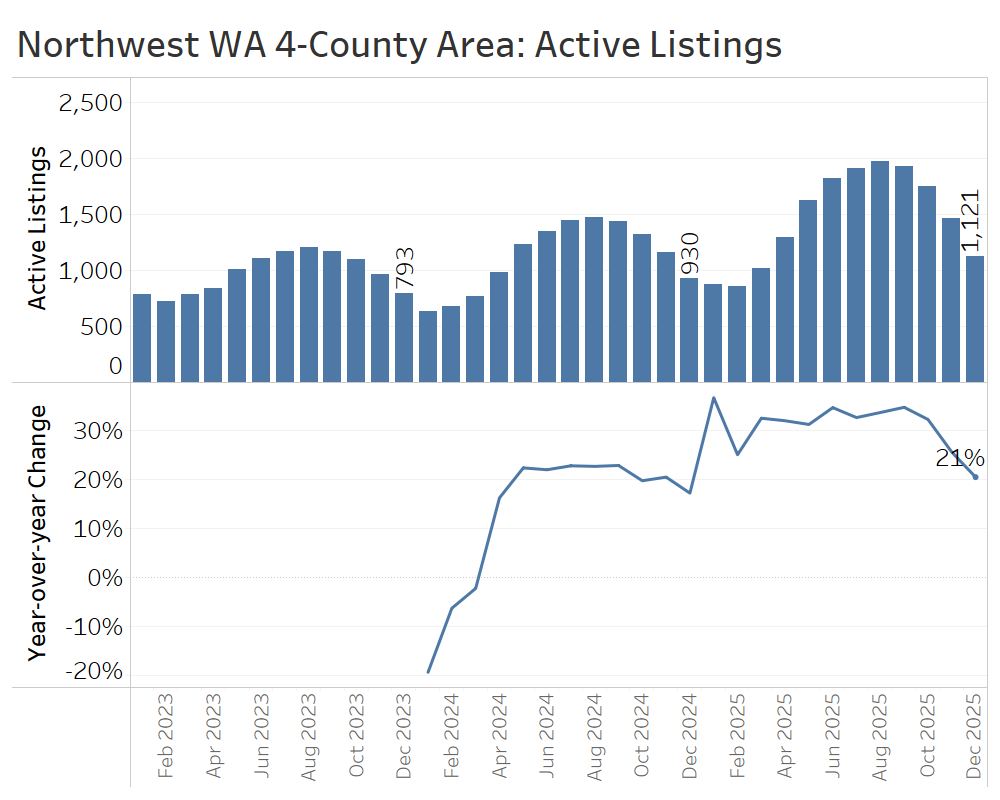
At the end of December, there were 1,121 active listings, up 21% from a year earlier. That marked a slowdown in inventory growth in the fourth quarter, down from increases of 30% or more in the middle of the year.
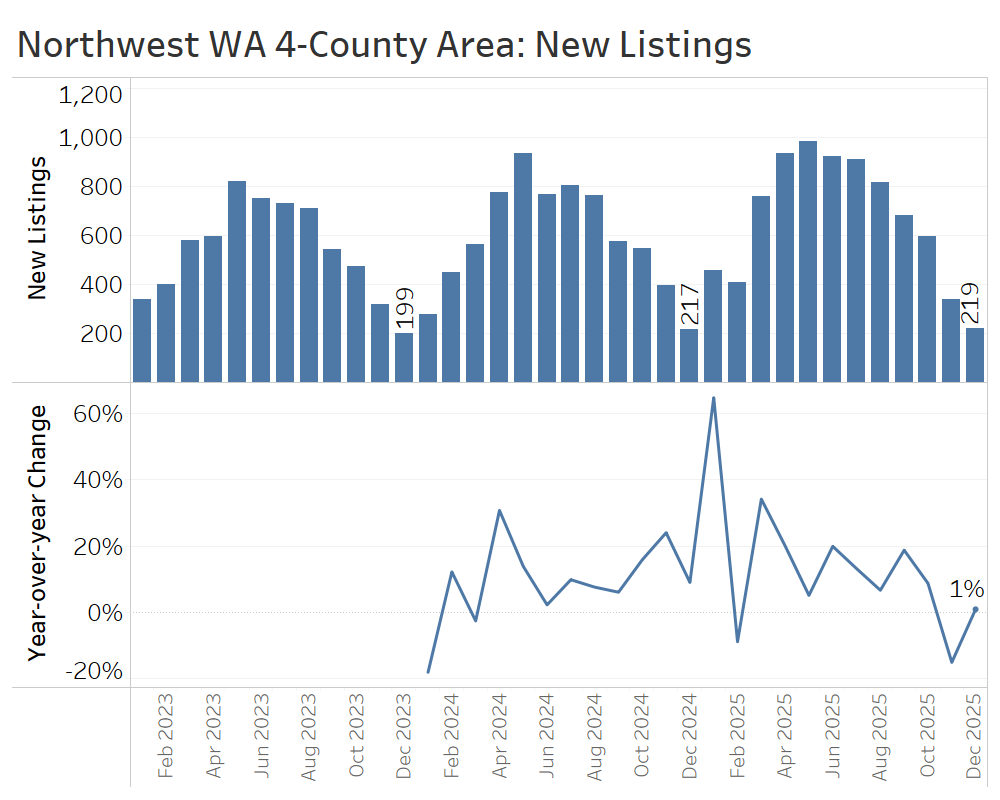
The flow of new listings fell sharply in the fourth quarter, even by seasonal standards. Some listings may have been affected by flooding during the atmospheric rivers that slammed Washington State; others may have been withheld by sellers clued into the cooler selling conditions.
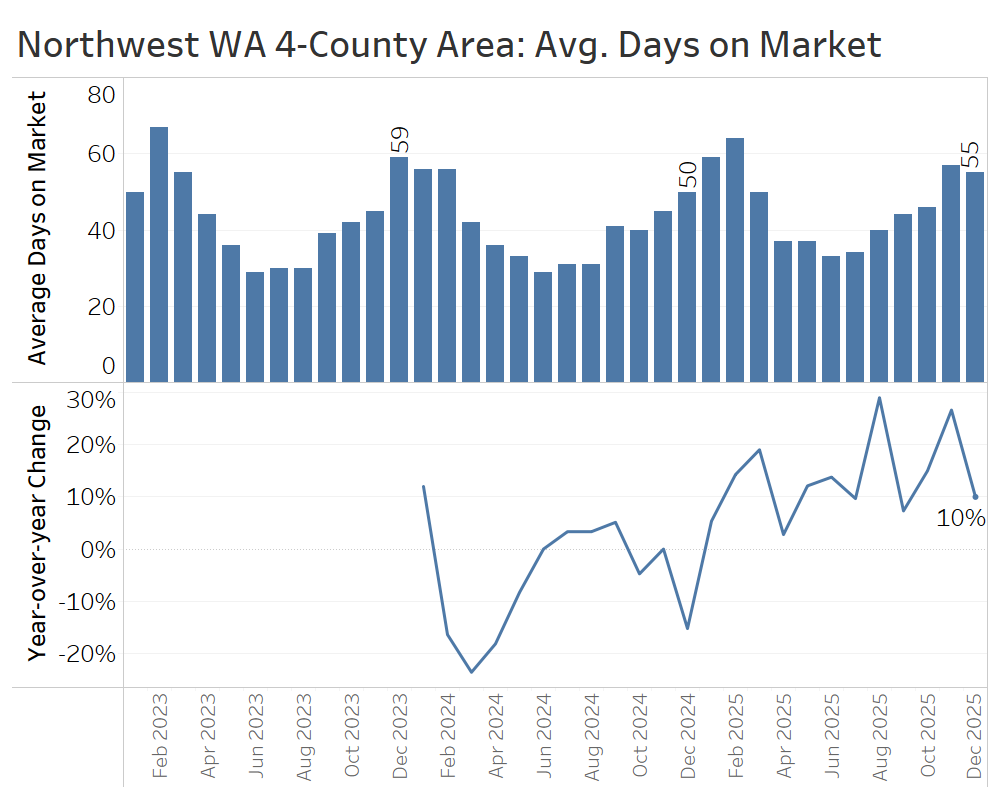
Days on market continued to climb compared to a year earlier, with homes in December taking about five days longer to sell than they did at the same time a year earlier.
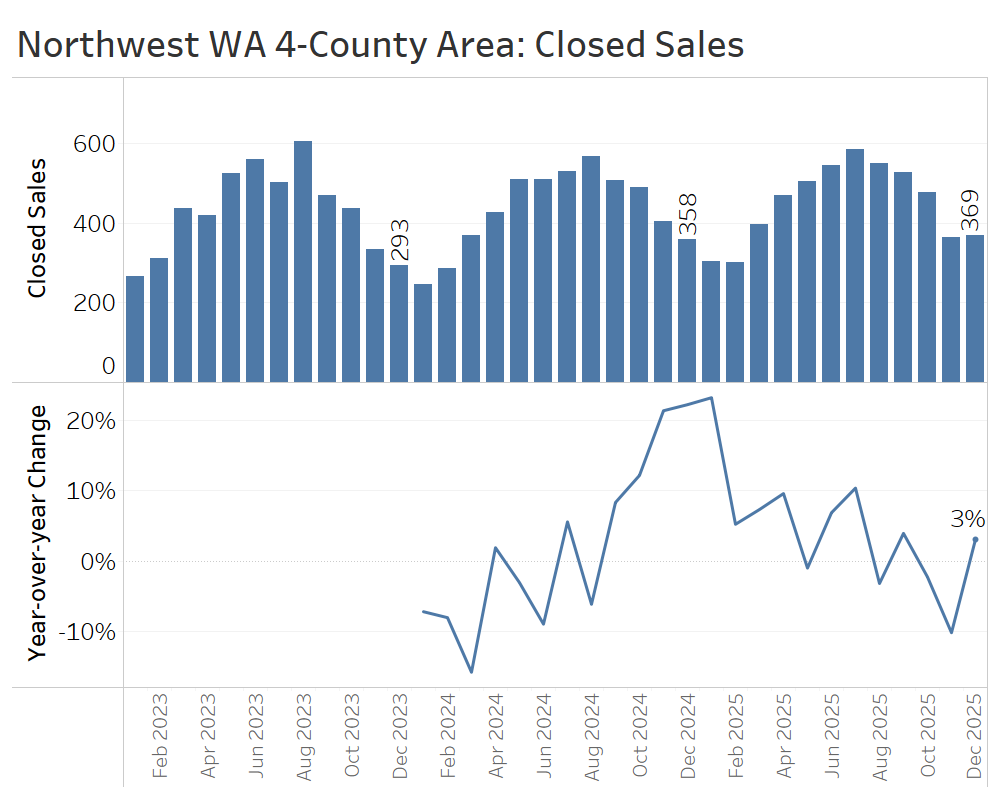
Closed home sales in the fourth quarter of 2025 generally trailed fourth-quarter 2024 levels, except for a modest uptick in December. In total, the 1,210 closed sales for the quarter fell about 4% short of the 1,251 homes sold in the fourth quarter of 2024.
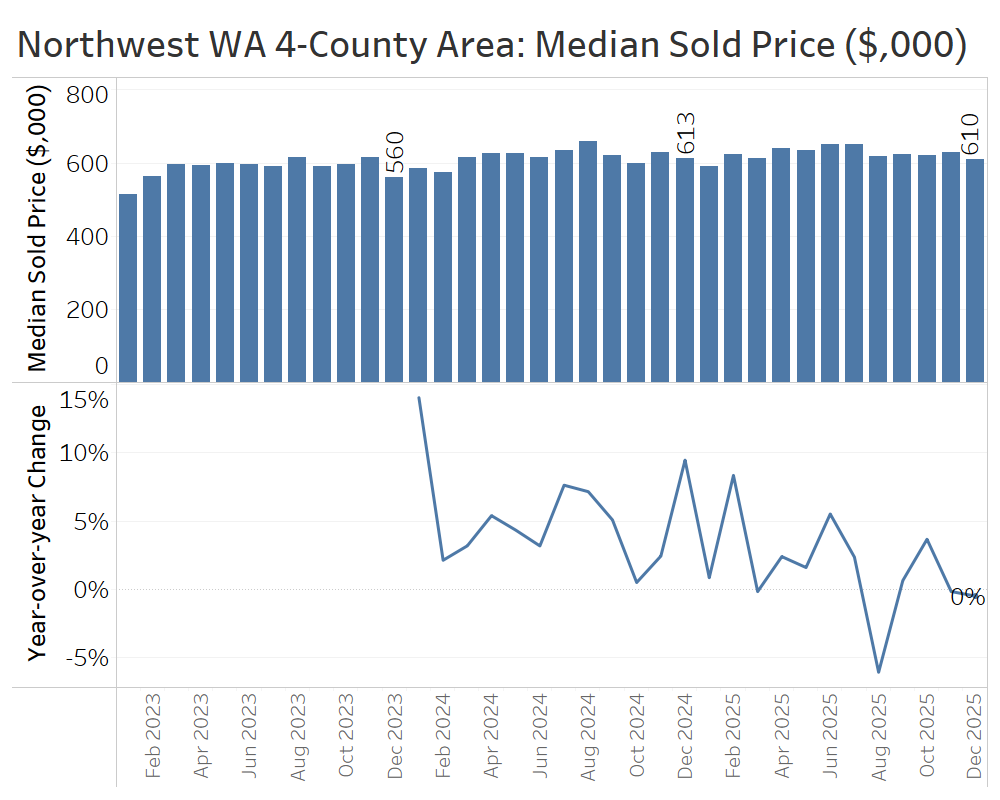
Compared to the same time the previous year, median home prices were virtually flat in November and December, after a brief bump in October. This marks a continuation of the cooldown of price growth that had characterized 2024 and early 2025.
Fourth quarter confirmed that higher inventory levels finally gave buyers more negotiating leverage in Northwest Washington.
Spokane, WA and Coeur d’Alene, ID Area (Spokane and Kootenai Counties)
The greater Spokane-Coeur d’Alene region, spanning the Washington-Idaho border, is experiencing many of the same market trends seen in Western Washington, including higher inventory, softer buyer demand, and flattening home prices.
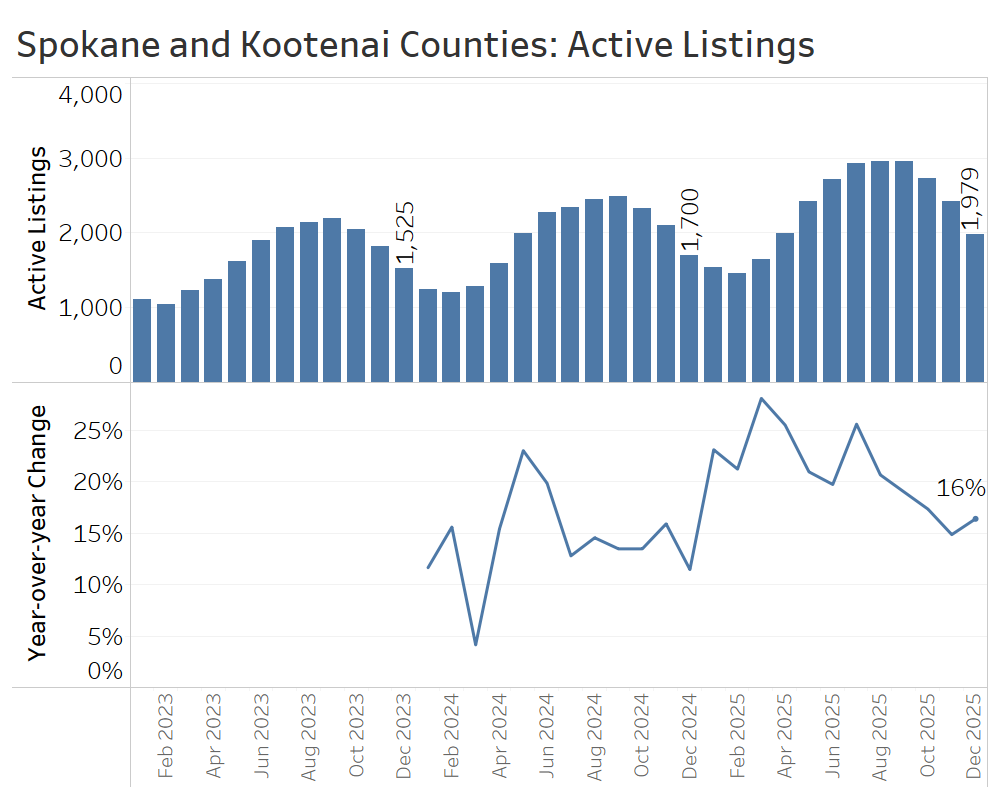
At the end of December, there were 1,979 active listings, up 16% from December 2024. That represented a modest slowdown in inventory growth from the year-over-year increases of more than 20% seen earlier in 2025.
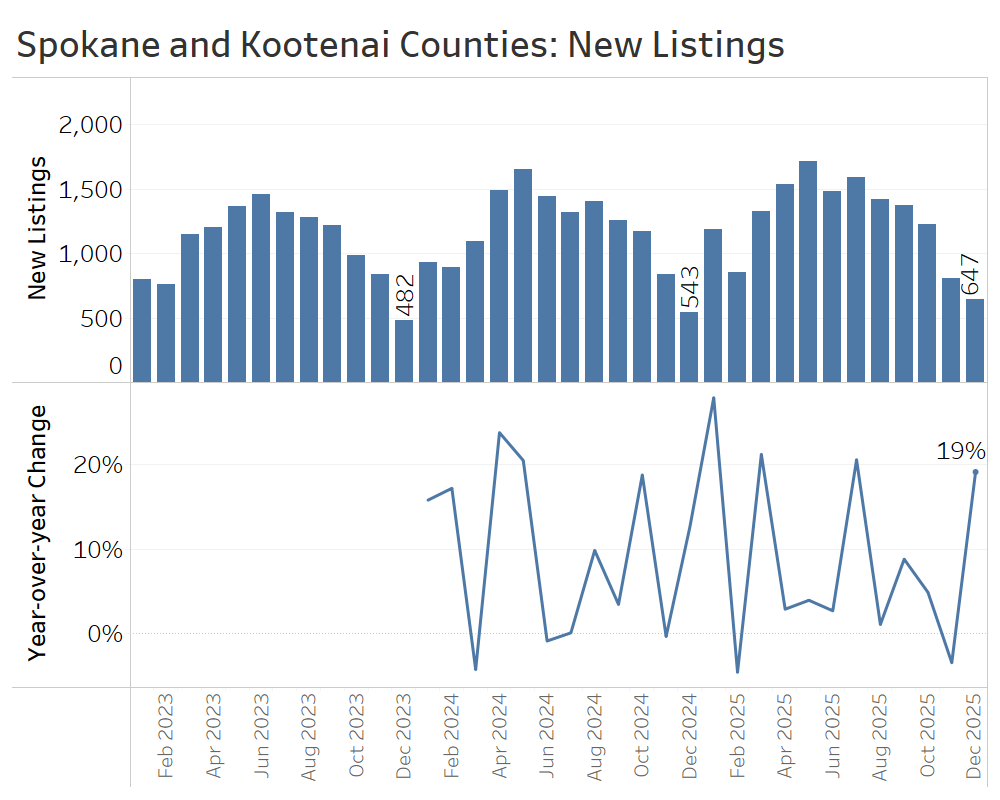
New listings jumped 19% compared to December 2024, but month-to-month changes in new listings were quite volatile. During the quarter as a whole, there were 2,681 new listings, up from 2,549 in the fourth quarter of 2024, representing a 5% increase.
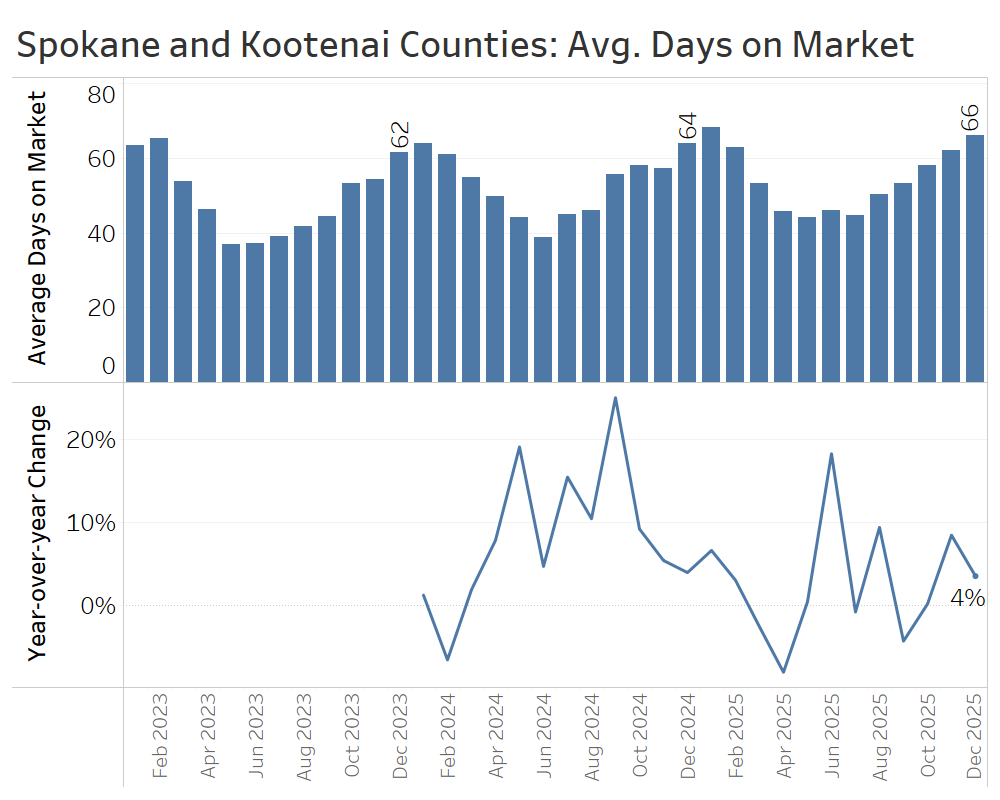
The pace of home sales, which is measured by days on market, only crept up modestly in the fourth quarter, ending the year at 66 days in December. However, that average obscures a wide divide across the state line, with homes averaging 47 days on market in Spokane County compared with 106 days in Kootenai County.
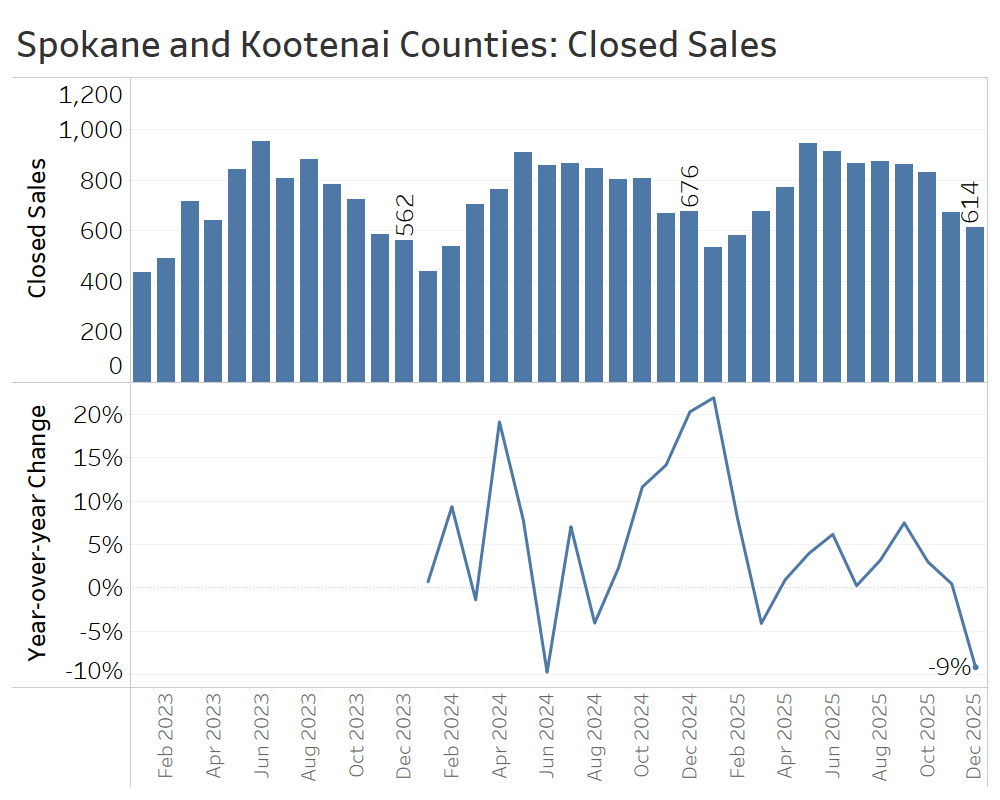
Closed sales in December were down 9% year-over-year, and the quarter also saw a modest decline. Sales slipped from 2,152 in the fourth quarter of 2024 to 2,117 in the fourth quarter of 2025.
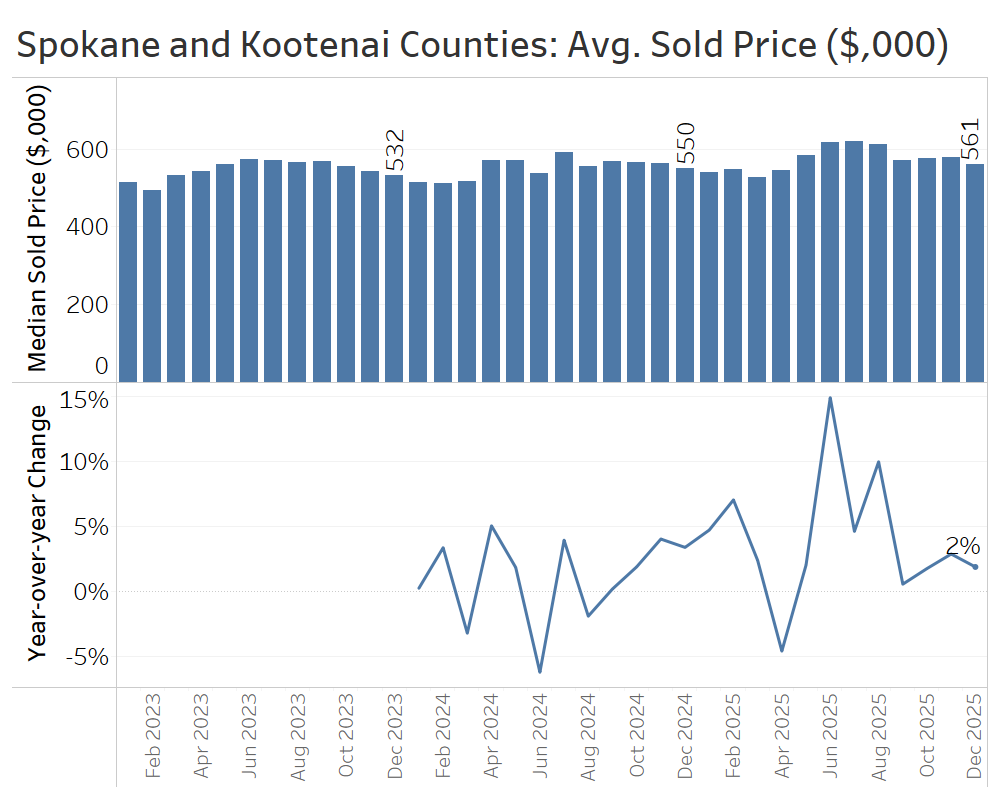
Because of challenges associated with combining data from multiple MLSs, we report average sale prices rather than medians for the Spokane-Coeur d’Alene area. Compared with December 2024, the average sale price in December rose about 2%, from $550,000 to $561,000. For the quarter as a whole, average prices also increased 2%, rising from $560,000 in the fourth quarter of 2024 to $572,000 in the fourth quarter of 2025.
That increase was driven entirely by higher average sale prices in Kootenai County, where prices climbed 8%, while average prices in Spokane County fell 2%.
Altogether, the shift towards a buyer’s market in the greater Spokane-Coeur d’Alene area began to flatten prices without yielding an increase in sales. Many metrics diverged across the Washington-Idaho border, with evidence of resilient demand for homes at Coeur d’Alene’s higher price points, while demand lagged in Spokane County.
Salt Lake County, Utah
Market conditions in Salt Lake County swung sharply in buyers’ favor early in 2025, as rapid inventory growth led to modest price declines. More recently, however, the market has begun to look more balanced rather than distinctly a buyer’s market.
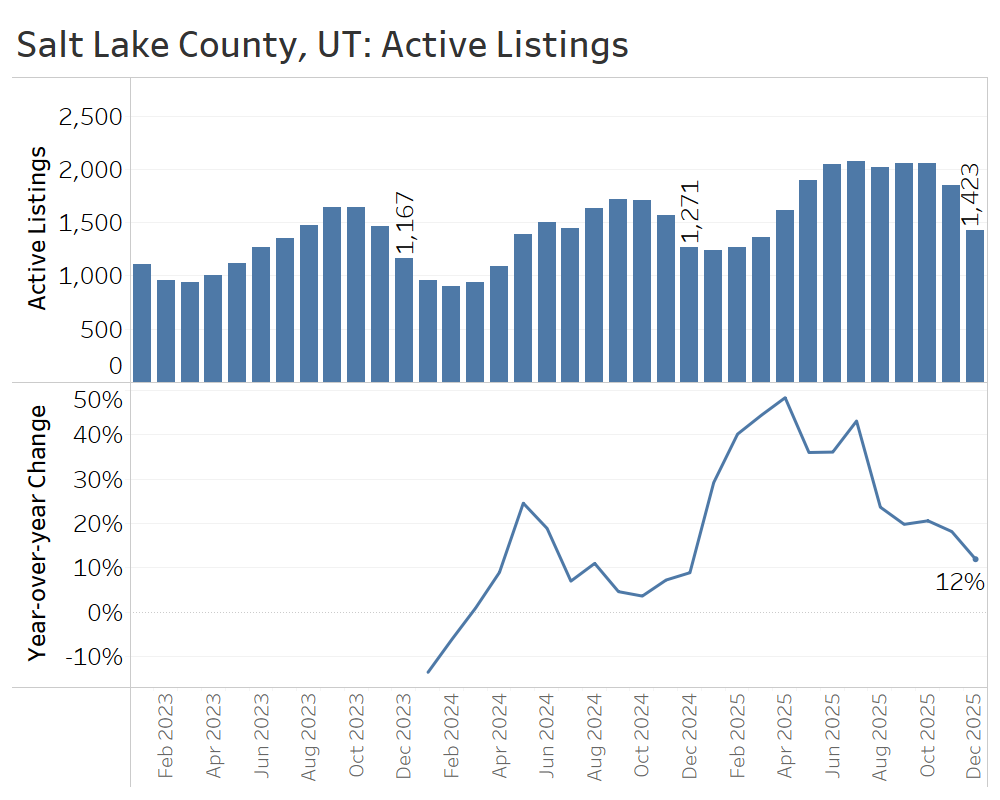
Active listings at the end of December stood at 1,423 homes, up 12% from a year ago—a major slowdown from the 43% inventory growth seen in July of last year.
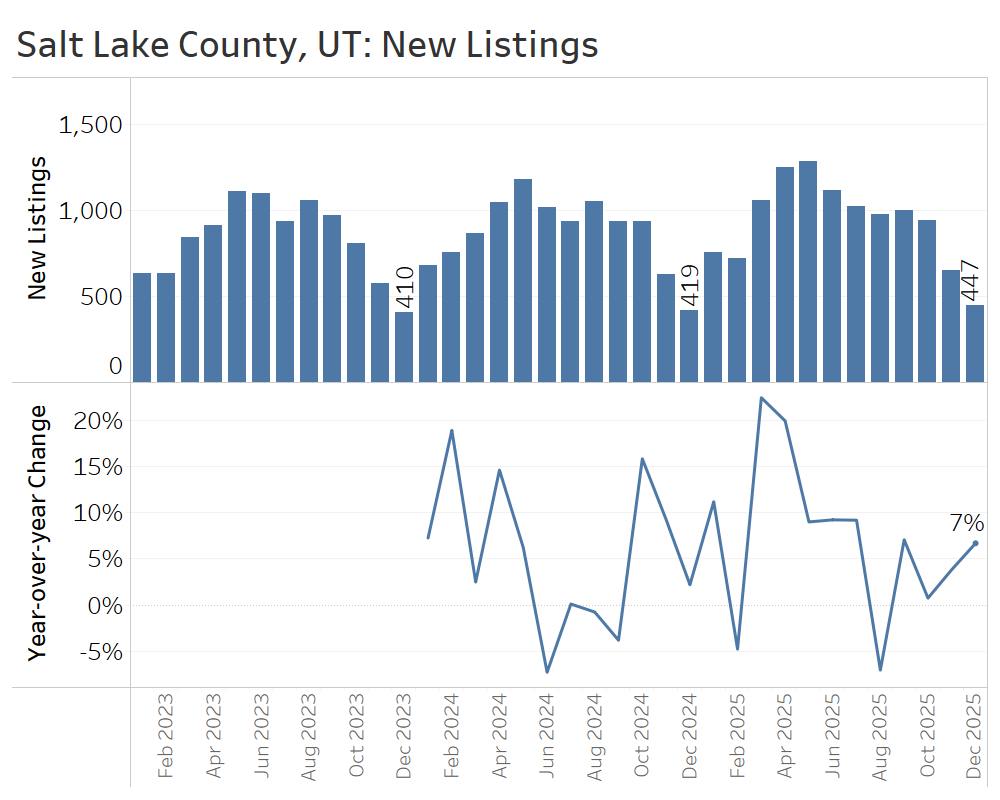
Salt Lake County experienced strong year-over-year growth in new listings early in 2025, exceeding 20% in March and April, but slowing to just 7% growth in December. The waning seller enthusiasm is helping to rebalance the market.
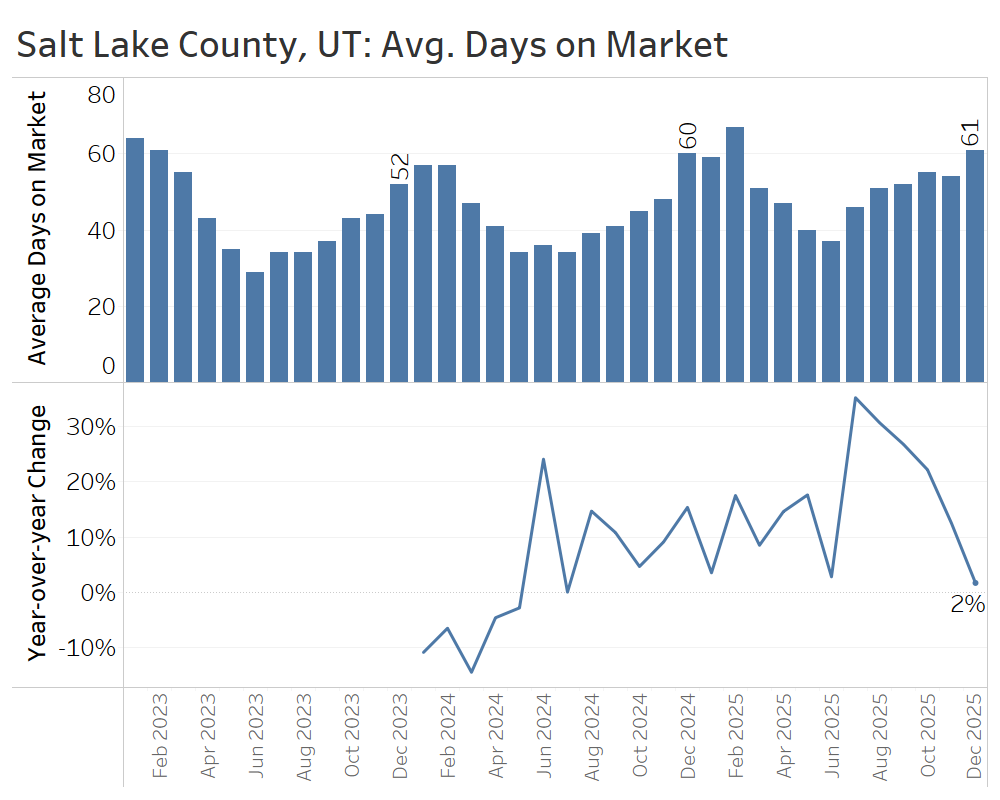
The average number of days it took to sell a home in Salt Lake County ended the year at 61 days, just slightly longer than the 60-day average at the end of 2024.
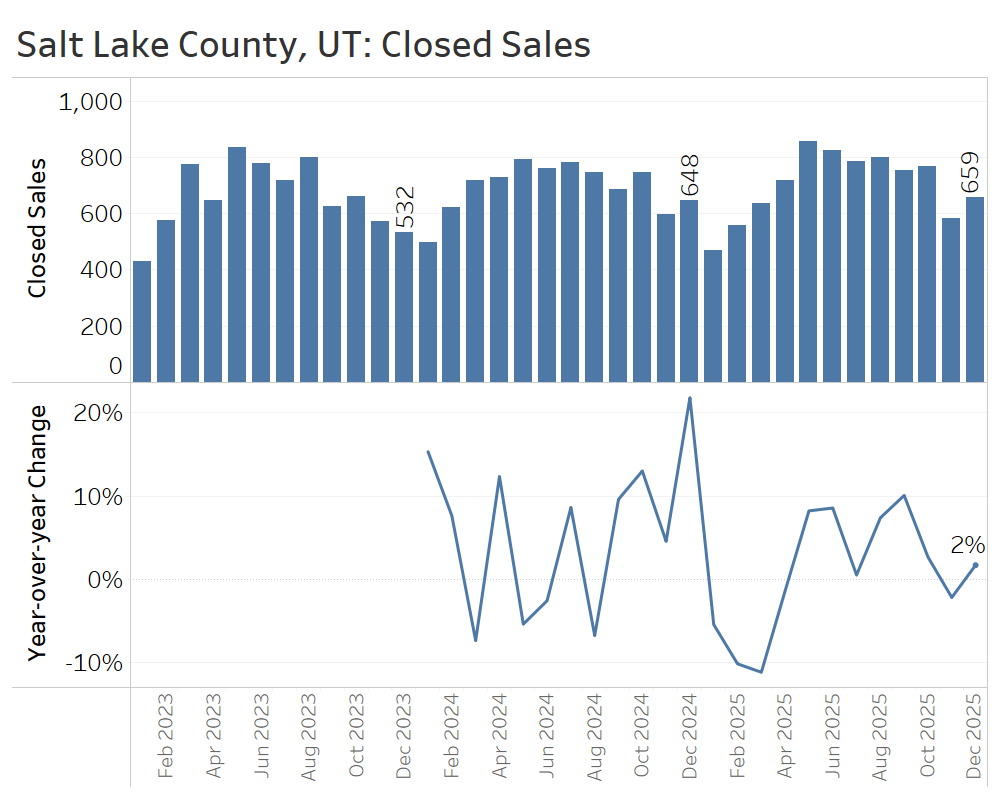
Closed home sales in December 2025 rose 2% compared to December 2024, capping a fourth quarter that roughly matched the strong sales seen in the same period the year before.
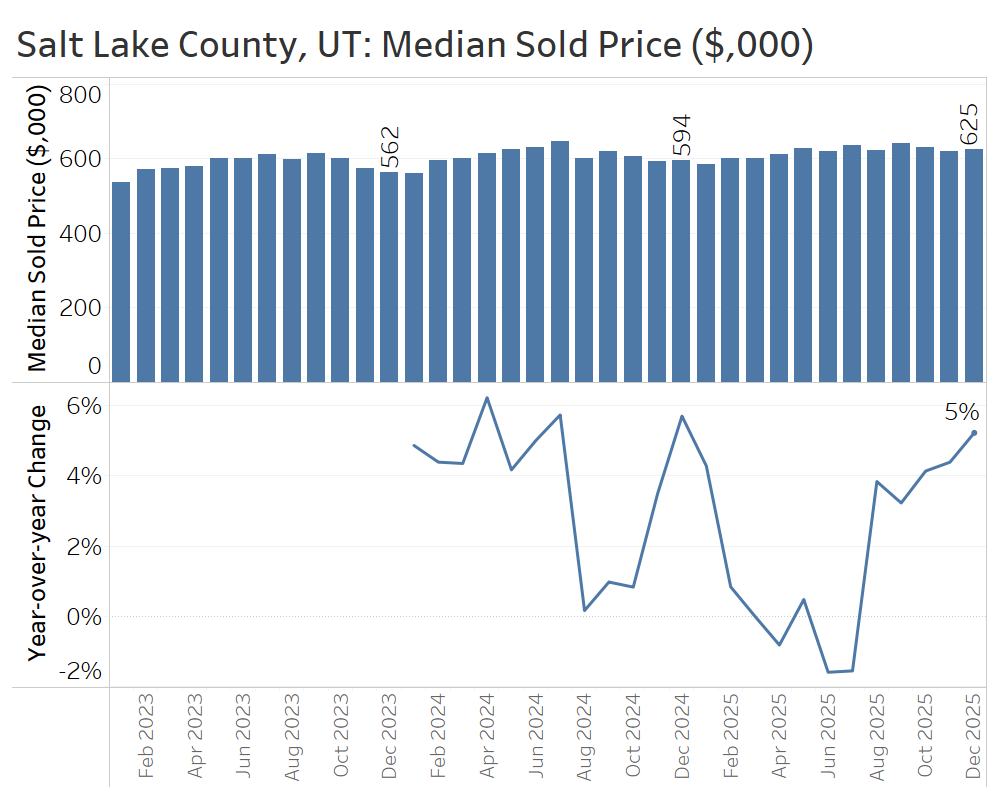
In December, the median sale price in Salt Lake County rose 5% year over year—from $594,000 to $625,000. That marked the fifth straight month of price gains, reversing a trend of modest price declines in mid-summer.
All in all, Salt Lake County has shifted into a more balanced market, driven by modest price growth and a slowdown from the significant inventory buildup seen earlier in 2025.
Conclusion:
All of the markets covered in this report shifted in buyers’ favor in 2025, though some, like Salt Lake County, show that the pendulum can—and will—begin to swing back toward more balanced conditions.
Going forward, buyers should be aware that in most markets, there are more listings than in recent years, home prices have remained roughly flat for at least a year, and mortgage rates are near three-year lows. Together, these factors create a strong opportunity to buy. That said, buyers should also be mindful of the usual spring surge in competition, which will accelerate home sales and push prices higher, as it does every year. Savvy buyers can try to get ahead by shopping earlier, but they should also be prepared to write a competitive offer if their ideal home hits the market this spring.
For sellers, the peak selling season is fast approaching. But even in a more balanced market, homes do not sell themselves. The best outcomes still depend on presenting the home well, setting the right list price, and marketing effectively to the right buyers. With the right strategy, this spring presents a great opportunity to sell for the best possible price, especially as lower mortgage rates bring more buyers off the fence.
Sources: TrendGraphix analysis of NWMLS, RMLS, Spokane MLS, MetroList MLS, and Wasatch Front MLS data.
Buying a home is a major milestone, and it comes with a lot of decisions, details, and moving parts. While online searches and market headlines can offer helpful context, there’s no substitute for having a knowledgeable real estate professional by your side.
The right agent does more than show homes. They help you understand the market, weigh opportunities, and make informed choices at every stage of the process. Asking thoughtful questions early on can set the tone for a smoother, more confident homebuying experience.
Here are some of the most important questions every buyer should ask their real estate agent, and why they matter.
Ask Them About Themselves
Choosing a real estate agent is about more than credentials and experience; it’s also about fit. Before deciding who to work with, take time to get to know your agent as a person.
Ask them about their background, how they work, and what drew them to real estate. Having an agent with a similar communication style, lifestyle, or understanding of your priorities makes the process feel more comfortable and collaborative. At the end of the day, this is someone you’ll be working closely with during one of the most important life decisions, so feeling aligned and understood matters.
What Services Do You Provide Me as My Agent?
Real estate agents offer a wide range of services, and not all approaches look the same. That’s why it’s essential to understand exactly how an agent will support you throughout the buying process.
Ask what services they provide from start to finish–such as market research, property tours, negotiation, inspection, and coordination through closing. You may also want to ask what tools or resources they use, and how involved they are at each stage.
In addition, it’s helpful to ask whether your agent can recommend trusted service providers—such as lenders, inspectors, contractors, or other professionals who can assist with financing, repairs, and other tasks that come up before closing. Having access to a reliable network can help streamline the process and reduce stress.
What’s Happening in the Market Right Now?
Real estate markets are constantly evolving, and what’s happening nationally doesn’t always reflect what’s happening locally. Ask your agent:
How is the market performing in the areas I’m considering?
Are homes selling quickly, or are buyers taking more time to decide?
What trends should I be aware of at my price point?
What strategies are working well for buyers right now?
A strong agent will provide local insight and context, helping you understand not just the numbers, but what they mean for you as a buyer.
How Should I Prepare Financially Before I Start Making Offers?
Being financially prepared goes well beyond getting pre-approved. While your lender will guide you through financing specifics, your real estate agent plays a key role in helping you understand how those details shape your overall buying strategy.
Your agent should help you think through what sellers are typically looking for in an offer, how loan terms, contingencies, and timelines can influence negotiations, and how to plan for additional costs before, during, and after the purchase.
What Should I Prioritize and Where Can I Be Flexible?
Most buyers begin their search with a list of wants and needs, but flexibility can often open the door to better opportunities.
A knowledgeable agent can help you identify which features are essential and which are optional, understand how factors like location, layout, and condition affect a home’s value, and balance your lifestyle preferences with long-term considerations. An experienced agent brings perspective, helping you see the bigger picture while keeping your goals front and center throughout the process.
What’s Your Approach to Pricing and Making an Offer?
Every offer should be strategic and tailored to the situation. Your agent should be able to clearly explain how they evaluate pricing and market value, what factors influence offer terms beyond price, and how inspections, contingencies, and timing play a role in negotiations.
Having this conversation early helps ensure you’re aligned and confident when it’s time to move forward, with a clear understanding of how your agent will advocate for you in a competitive and nuanced market.
How Will We Communicate Throughout the Process?
Clear communication is essential during a home purchase. Be sure to ask:
How often can I expect updates?
What’s the best way to reach you with questions?
How do you handle time-sensitive situations?
You should also ask what will be included in your written buyer agreement so you can have a clear understanding of roles and responsibilities. The right agent will set expectations early and make sure you feel informed and supported at every stage, from start to finish.
What Should I Know About a Home Before Making a Decision?
Once you’ve found a home you’re excited about, your agent’s guidance becomes even more important. They should help you understand:
How the home compares to similar properties.
What to expect during inspections.
Any potential considerations that could impact your decision.
This step isn’t about creating doubt; it’s about ensuring clarity, confidence, and peace of mind.
If you’re considering buying a home, start with a conversation. Asking the right questions and working with an experienced real estate agent can help you navigate the homebuying process with confidence.
This is the latest in a series of videos with Windermere Principal Economist Jeff Tucker, where he delivers the key economic numbers to follow to keep you well-informed about what’s going on in the real estate market.
2026 is already proving to be a busy news year for the housing market, starting with our first number to know:
$200 billion
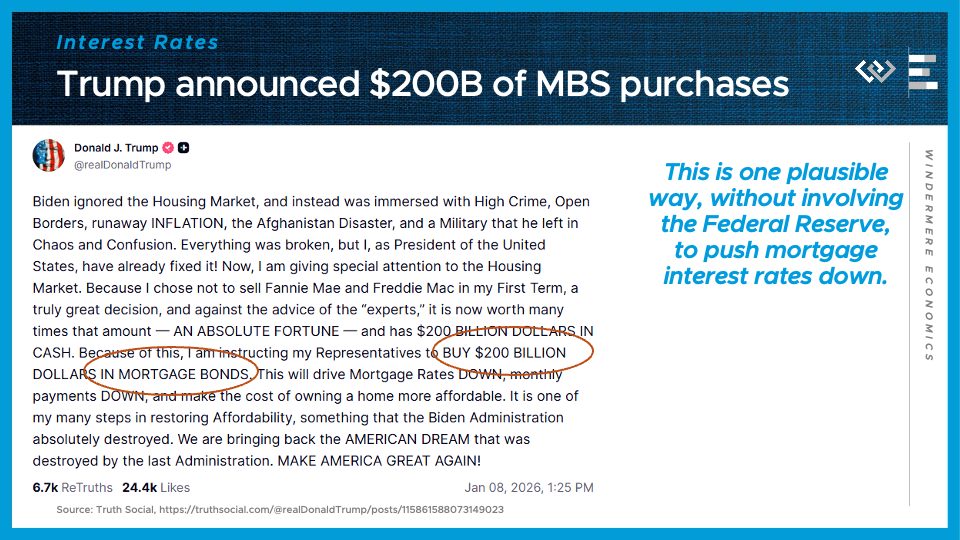
That’s the total value of mortgage-backed securities that President Trump announced on January 8th he’s directed “his Representatives” to purchase, with a stated goal of reducing mortgage interest rates. A big new buyer of mortgages will tend to bid their prices up, which – for bonds – means pushing interest rates down.
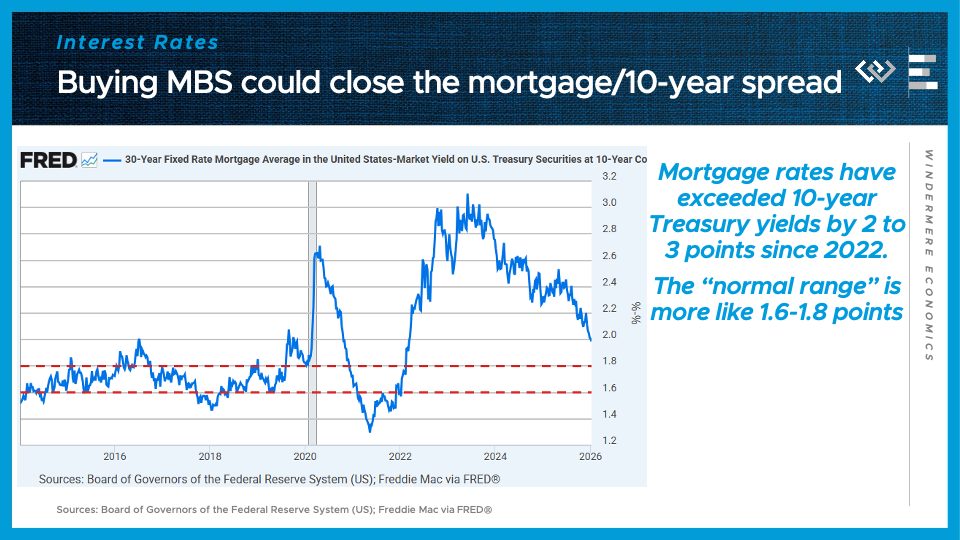
For the last 3 years, mortgage rates have been unusually high relative to the benchmark 10-year Treasury rate, which has been gradually compressing back to a normal range, and this buying spree, evidently by Fannie Mae and Freddie Mac, should accelerate that process of shrinking the spread.
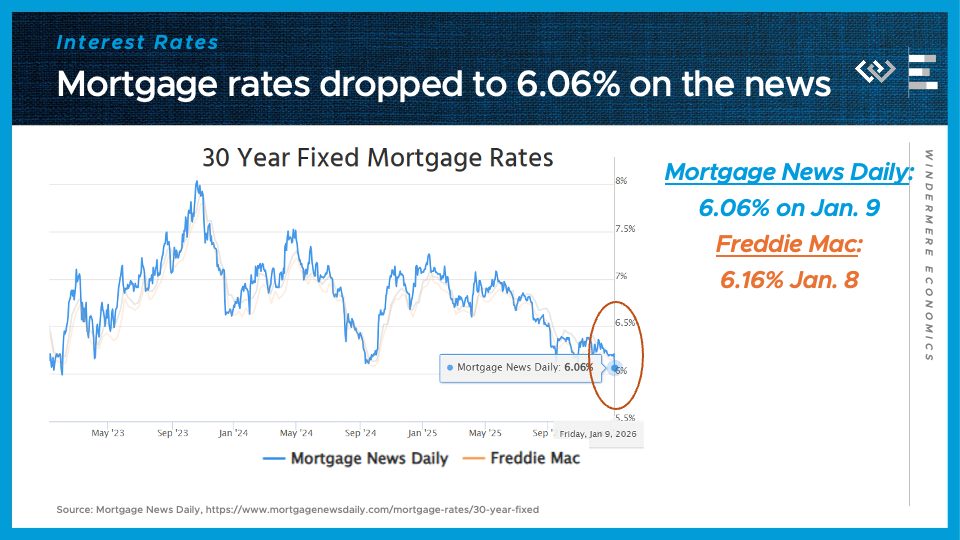
Markets have taken this announcement quite seriously. In just the first day of trading after Trump’s announcement, mortgage rates dropped 15 basis points, bringing us to our second number to know right now:
6.06%
That was Mortgage News Daily’s average 30-year mortgage rate on Friday, January 9th, and that marks the lowest mortgage rate they’ve reported in almost 3 years. Now – trading has been unusually volatile, and there are still a lot of unanswered questions about this new program, but there’s no doubt that in the short term, it has begun moving markets, and I think SOME highly qualified buyers and sellers who start to see mortgage rates in the 5% range will be more motivated to transact this spring.
Another number to know right now:
56,000
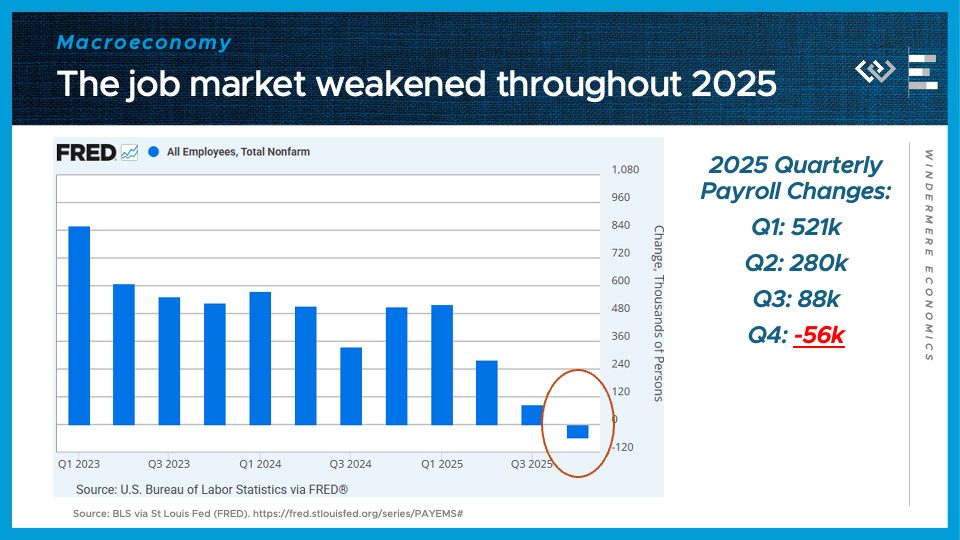
That’s the number of jobs lost on net over the fourth quarter of 2025, capping a year of slowing, and finally shrinking, payrolls in the U.S. economy. Now, other data shows economic activity held up fine in the fourth quarter, so this is not the beginning of a recession, but slowing job growth could help explain why home purchases disappointed in the fourth quarter, despite lower mortgage rates than in late 2024.
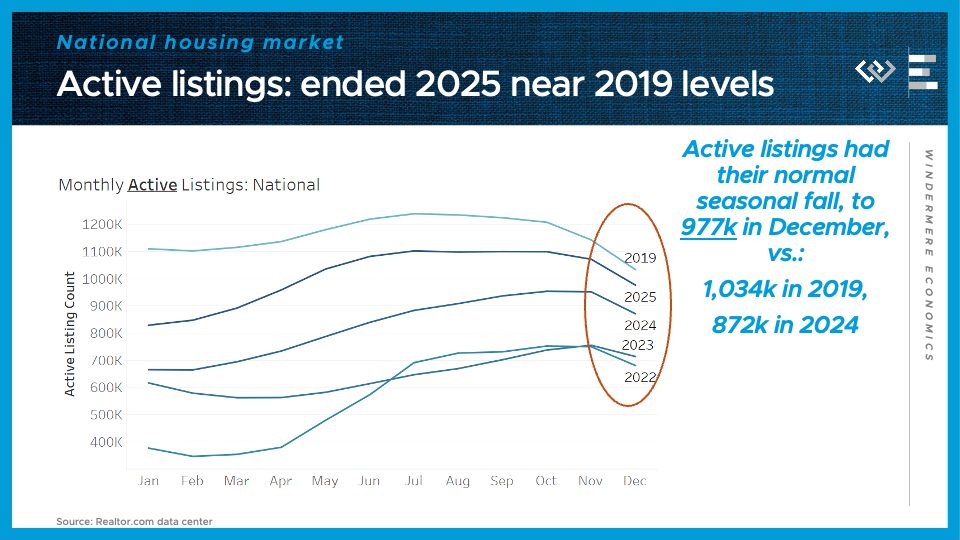
Speaking of housing, 2025 ended with the housing market still just shy of an important benchmark I’ve been watching: the moment when active inventory recovers to its pre-pandemic, 2019 levels. The year ended with just under a million active listings, vs just over a million 6 years ago on the eve of the Covid pandemic.
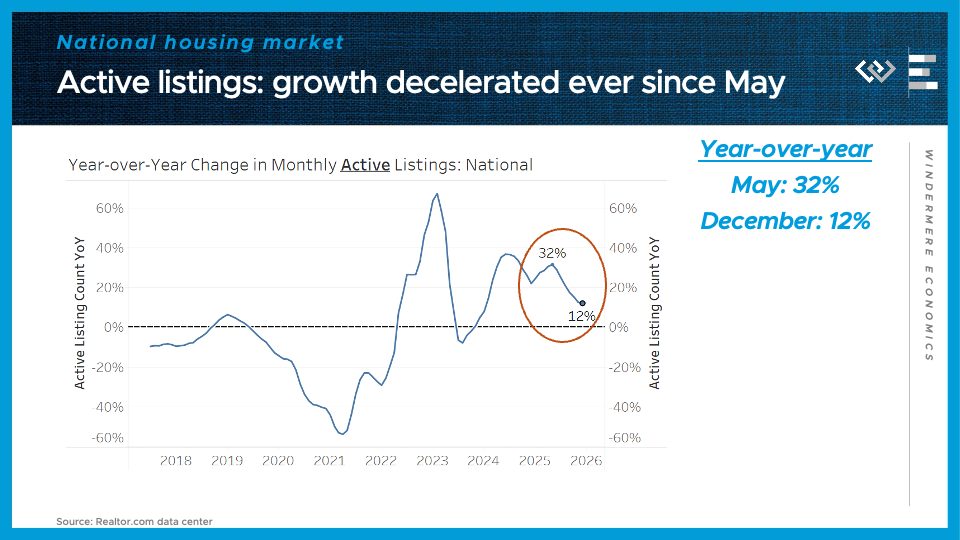
That is still up substantially from this time last year, but the trend of year-over-year listing growth clearly slowed over the course of 2025. That helps explain why 2025 went down as the year of cooling and normalization, but NOT anything like a fire sale or glut of unsold homes. Rather, it’s a market that made a lot of progress back toward normalcy, foretelling a healthy, balanced market in the year ahead.

 Facebook
 X
X
 Pinterest
 Copy Link