Market News March 27, 2023

Will Rising Foreclosures Impact the Housing Market?

How will rising foreclosures impact the U.S. housing market? To give his answer, Windermere Chief Economist Matthew Gardner sheds light on the latest foreclosure data and shows how prepared home buyers are to manage their mortgage debt today compared to the 2000s.

This video on foreclosures is the latest in our Monday with Matthew series with Windermere Chief Economist Matthew Gardner. Each month, he analyzes the most up-to-date U.S. housing data to keep you well-informed about what’s going on in the real estate market.


Rising U.S. Foreclosures

The market has certainly shifted since mortgage rates started skyrocketing last year and, with prices pulling back across much of the country, some have started to become concerned about the likelihood of foreclosures rising—clearly a timely topic given current circumstances.

Hello there! I’m Windermere Real Estate’s Chief Economist Matthew Gardner and for this month’s episode of Monday with Matthew, I pulled the latest data on foreclosure starts and looked and the quality of mortgages that have been given to buyers in order to give you a clear idea of how foreclosures will impact the overall housing market.

For the purposes of this exercise, I’m going to concentrate on foreclosure starts rather than foreclosure filings because data shows us that a majority of homeowners where a foreclosure filing has been submitted to a court by their lender are able to avoid it by refinancing or selling the home, which makes total sense as over 93% of owners in the U.S. have positive equity.


U.S. Foreclosures: Starts 2007-2022

A bar graph showing U.S. foreclosures starts from 2007 to 2022. The numbers spiked in 2009 at over 2 million foreclosure starts and gradually decreased every year until 2022, where the numbers increased from 2021. Though they were 181% higher in 2022 than in 2021, it’s important to note that foreclosure starts in 2022 were 31% lower than 2019 and 88% lower than the 2009 peak.


As you can see here, foreclosure starts rose significantly last year. In fact, they were 181% higher than in 2021. But if we zoom out, it’s important to note that foreclosure starts were 31% lower than 2019 and 88% lower than the 2009 peak.

Am I surprised at the increase in foreclosure starts? Not really. The forbearance program was put in place at the start of the pandemic, and it allowed homeowners to temporarily stop making mortgage payments and not be foreclosed on, but that program ended 18 months ago.

And, although a vast majority of the 4.7 million households who entered the program have left it and sold or refinanced their homes, there were always going to be some who were not able to, and this has led to the overall foreclosure activity rising. Let’s take a closer look.


U.S. Foreclosures in 2022

A map showing foreclosures starts for each state in the U.S. California, Texas, and Florida have the highest number of foreclosure starts inn 2022. California had 27,541, Florida had 24,190, and Texas had 23,151.


This is a heat map of foreclosure starts by state. And you can see that California, Florida, and Texas saw the highest numbers in 2022. But remember that these are the states that have the greatest number of homes with mortgages so, statistically, we would expect the total number of homes in foreclosure in those states would be higher than the rest of the country. That said, foreclosure starts were significantly higher in Florida, California, Texas, and New York than they were in 2019, the last “pre-COVID” year and before the forbearance program started.

And when we look more myopically, metro areas including New York/New Jersey, Washington DC, the Delaware Valley, Atlanta, Miami, Baltimore, and Dallas all saw total foreclosure starts rise well above what they were in 2019. This may suggest that there are some markets that could see foreclosure activity rise to a level that could materially impact housing in those locations.

But looking at the country as a whole, there are other factors leading me to believe that we will not see the number of homes entering foreclosure rising above the long-term average, and certainly not sufficient to have a material impact on U.S. housing prices. 

Let me show you what’s happening on the mortgage side of things. First: credit quality.


Median FICO Scores for New Mortgages 2003-2022
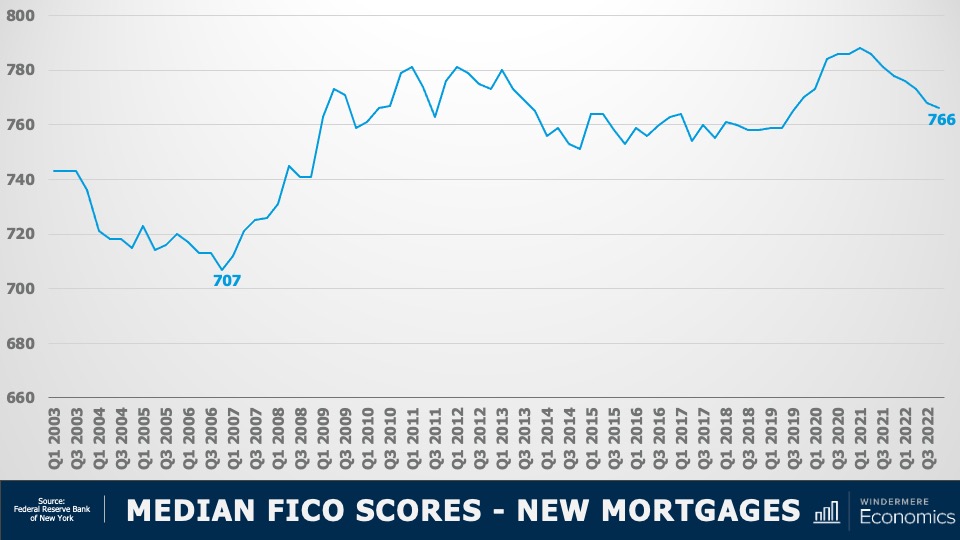
A line graph showing the median FICO scores for new mortgages from Q1 2003 through Q3 2022. The median FICO score generally decreased from 2003 to the low of 707 during 2007, then gradually increased throughout the years 2008-2022. The median FICO score inn Q3 2022 was 766.


The median FICO score for new mortgages was 766 in the 4th quarter of 2022. Yes, this is down from the peak seen in early 2021 when it was a whopping 788 but as shown here, it’s far higher than we saw before the housing crisis. Buyers over the past several years had very good credit and, given the tight labor market, we are certainly in a very different place than back before the housing bubble burst.


Mortgage Debt Payments Percentages 2007-2022
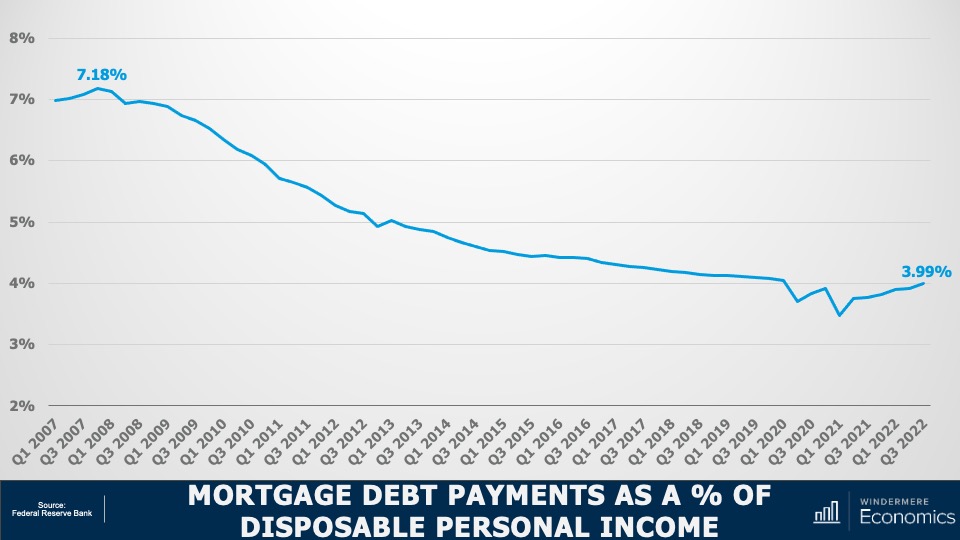
A line graph showing mortgage debt payments as a percentage of disposable personal income for home buyers from Q1 2007 through Q3 2022. In 2007, mortgage debt payments were around 7% of disposable personal income, in Q3 2022 it was 3.99%. Between those two points in time, the percentage gradually and consistently decreased.


Secondly, buyers are using larger down payments than in the mid-2000’s, and with the historically low mortgage rates that we saw during the first two years of the pandemic benefitting new buyers as well as allowing existing homeowners to refinance, the share of disposable income that is used to cover mortgage payments remains very low. This basically means that owners aren’t as burdened by their house payments as they were in 2007-2009. And finally…


Equity Rich Households Q4 2022

A map showing the percentage of equity rich households for each state in Q4 2022. The highest values are Vermont at 76.6%, Florida at roughly 62%, and California at 61.5%.


With the significant run-up in housing values that we have seen over the past few years, 48% of all homeowners with a mortgage have more than 50% equity. Although this share has pulled back a little as mortgage rates rose and values pulled back, it’s still a massive amount of money and, as I mentioned earlier, many homeowners who are faced with foreclosure will end up selling their homes as they still have positive equity rather than go through the foreclosure process.

So, my answer to those of you wondering if we will see foreclosures rise to a level that could impact the overall housing market is “no.”

I don’t see any reason to believe that distressed sales will hurt the market in general, but I will say that there are some local markets where distressed sales could rise to levels that could act as a headwind to price growth in these areas. As always, I’d love to get your thoughts on this topic so please comment below! Until next month, take care and I will see you all soon. Bye now.


To see the latest housing data for your area, visit our quarterly Market Updates page.


About Matthew Gardner

As Chief Economist for Windermere Real Estate, Matthew Gardner is responsible for analyzing and interpreting economic data and its impact on the real estate market on both a local and national level. Matthew has over 30 years of professional experience both in the U.S. and U.K.

In addition to his day-to-day responsibilities, Matthew sits on the Washington State Governors Council of Economic Advisors; chairs the Board of Trustees at the Washington Center for Real Estate Research at the University of Washington; and is an Advisory Board Member at the Runstad Center for Real Estate Studies at the University of Washington where he also lectures in real estate economics.


Selling March 22, 2023

8 Tips for First-Time Home Sellers

You’ve seen “For Sale” signs around your neighborhood, but what does it take to actually put your home on the market? First-time home sellers often enter the selling process unaware of what’s to come, their heads full of questions. Understanding the selling process will inform your conversations with your real estate agent and will help you stay organized and on schedule as you sell your home for the first time.

8 Tips for First-Time Home Sellers

1. Know the Costs of Selling a Home

Though you’ll eventually walk away from the sale of your home with a lump sum in your pocket, the selling process isn’t without its costs. Real estate agent commission costs typically account for five to six percent of the sale price, but they’re not the only expense you’ll encounter on your selling journey. Between repairs, home upgrades, staging, escrow fees, Capital Gains Tax and more, it’s important to budget for these costs before listing your home.

 2. Find the Right Agent

A successful selling experience starts by working with a professional real estate agent. Real estate agents specialize in keeping up with local market conditions, they have the tools to competitively price your home, and they understand what is driving buyer interest in your area. But beyond these qualities, it’s important that first-time home sellers choose an agent who understands their goals and cares about their happiness. Selling a home can be an emotional roller coaster and having a trusted expert beside you will help you navigate its ups and downs.

3. The Importance of Home Staging

Whether you hire a professional or decide to stage your home yourself, what’s important is that you make the commitment. Staging your home creates universal appeal, capturing the attention of the widest possible buyer pool. If your interior is too personalized, it makes it harder for buyers to see themselves in your home. Staging makes financial sense as well, as it often equates to higher sales prices. According to a 2020 survey performed by the Real Estate Staging Association (RESA®), of the 13,000 homes surveyed, 85% of staged homes sold for 5-23% over list price.1

4. High ROI Remodeling Projects

Remodeling projects cost a significant amount of money; there’s no way around it. This is where your agent’s expertise can help you spend wisely: they can inform you of which home features and upgrades are driving buyer interest in your area. Target the high ROI remodeling projects that increase home value to get the most bang for your buck and know which remodeling projects to avoid when selling your home.


A young Caucasian man lays on his back in a bathroom with white hexagon tile flooring and white subway tile walls. A first-time home seller, he uses a wrench to turn the drainpipe under the bathroom sink as he prepares to sell his home.

Image Source: Getty Images – Image Credit: Hispanolistic

5. Pre-Listing Inspection

Anything that could potentially give your home a competitive advantage over other listings is worth discussing with your agent. One such strategy is conducting a pre-listing inspection before putting your home on the market. Not only do pre-listing inspections give sellers a better understanding of what repairs may be in order, but they also streamline the selling process by transparently disclosing the details of a property’s condition to the buyer. These reports are especially helpful in competitive markets, since buyers are more likely to waive inspections.

6. How to Price Your Home

Of all the information coming at you during the selling process, you’ll likely have your mind set on getting the best price for your home. Determining home value is one area where real estate agents excel; their Comparative Market Analysis (CMA) will help them set an accurate and competitive figure. It’s important to separate your emotional attachment to your home from your agent’s calculations. In your mind, your home possesses a certain value, but that may not match what it can realistically fetch on the market. Sometimes it may be even more than you thought!

7. Safety Tips for Open Houses

The more buyer interest you’re able to drum up, the better. Open houses play an important role in the selling process in that they allow buyers to experience the property firsthand. Making this connection requires opening your doors to strangers, which is cause for taking the appropriate safety measures. Remove all prescriptions from your medicine cabinets, lock up precious belongings and personal information, make sure all doors and windows are locked at the end of each day, and discuss your buyer screening process with your agent so you’re on the same page.

8. Moving Timeline

The planning doesn’t stop once you’ve sold your home. Before the ink is dry on your real estate contract, your gears will be turning about how to efficiently move into your new home. We’ve created an interactive Moving Checklist with a step-by-step guide to the moving process, from twelve weeks before moving day all the way up until you make your move. The list is also available as an interactive web page and downloadable PDF here:

For more information on the selling process from list to closing, visit our comprehensive selling guide here:


1: Real Estate Staging Association (RESA®). “The Consumer’s Guide to Real Estate Staging.”  Realestatestagingassociation.com. 2020.


­­­­­­Featured Image Source: Getty Images – Image Credit: Hispanolistic

Design March 20, 2023

What Is a Tudor Style House?

One look at a Tudor style house and you’re instantly transported to the English countryside. This distinct architecture dates back hundreds of years, borrowing elements of Renaissance and Gothic design, and later experienced a revival in the United States that continued to grow in popularity through the mid-twentieth century. Similar to cottage homes, their medieval imagery evokes a storybook charm, and their unique combination of materials makes for a truly signature look. 


A profile shot of a brown and white English Tudor style house with a thatched roof and a tall chimney. The siding is made up of half-timbering wood patterns and brick accents. The garden surrounding the home is in full bloom, producing lettuce and spices.

Image Source: Getty Images – Image Credit: oversnap


Features of Tudor Style Houses

Known for their brown-and-white color scheme, Tudor style houses are typically built from stone or bricks, with a façade of stucco and exposed timbering framing. The framing creates straight lines that connect each level of the home, giving it a sense of geometry. Their steep-pitched, intersecting gabled roofs are tailor-made for climates that experience high levels of precipitation; snow slides off before accumulating, and rainwater has a natural path to the gutter system.


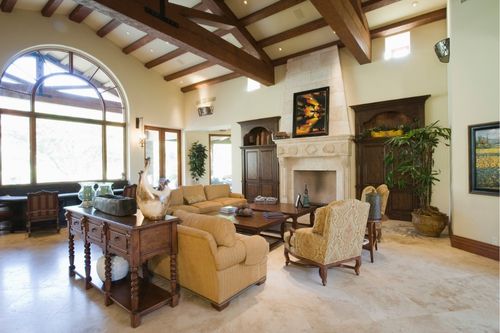
The interior of a brown and white English Tudor style house with exposed wood ceiling beams. The furniture is soft Victorian-style, and the accent pieces are dark mahogany wood.

Image Source: Getty Images – Image Credit: IPGGutenbergUKLtd


From the outside of a Tudor home, you can imagine sitting around the hearth under exposed wood ceiling beams, taking in the cozy atmosphere as the fireplace crackles. And your imagination would be spot on! A large fireplace is a central feature of these homes, given that they were the primary heating source for households early on in their history. Arched entryways with stonework accents, decorative chimneys, and narrow, closely grouped windows are also defining features of Tudor architecture.


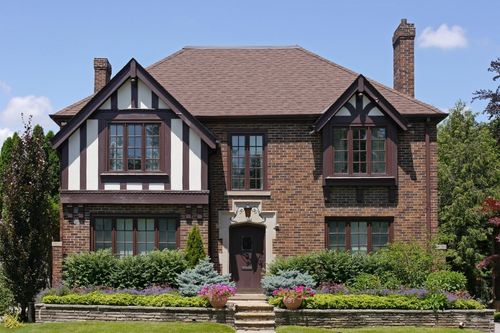
The front façade of a brown and white Tudor style house with interlocking gabled roofs, brick accents, a tall chimney, several windows, and a decorative front entrance with stone masonry framing the doorway. There are several shrubs and a hedge in the front yard garden beds.

Image Source: Getty Images – Image Credit: peterspiro


Once World War II-era housing development began to shift toward addressing suburban sprawl affordably, the masonry-heavy Tudor style house became less popular. However, they are still found throughout the U.S. today.

To learn more about the various styles of home design, visit our Architectural Styles page:

Windermere – Architectural Styles


­­­­­­Featured Image Source: Getty Images – Image Credit: quackersnaps

Buying March 15, 2023

Mansion vs Estate: Features of Luxury Properties

Mansion vs Estate

If there’s one thing that’s clear about a mansion or an estate, it’s that they’re not your average houses. But what differentiates the two? Are the two terms interchangeable? Mansions and estates actually each have separate characteristics that give them their special classification. Understanding a bit more about what makes them special can help inform your discussions with your real estate agent when looking for a luxury property of this class.

What defines a house as a mansion?

Mansions typically have a larger footprint than regular houses. Added square footage is a hallmark of mansions where the land allows, but a lesser-square-footage property may also qualify as a mansion in areas where space is limited based on its luxuriousness. Which properties qualify as mansions varies by location.

Mansions deal in excess by nature. Accordingly, these properties will have a greater number of bedrooms and bathrooms than what you’d see in a typical single-family home.

They’ll have rooms designed and built for a specific activity or function. For example, it’s common for mansions to have a game room, an indoor sauna or pool room, a home theater, or even a small bowling alley. These properties are the ideal living situation for homeowners who love to entertain. Elsewhere on the property, a mansion may boast any combination of sport courts, pools, gardens, and multiple-car garages.

In terms of their architectural style, many mansions borrow from older design styles to incorporate a sense of grandeur and prestige. The Victorian architectural style lends itself well to mansions while capturing that classic old-world charm. You may recognize Spanish Revival style homes sold by celebrities on the West Coast, and Colonial style mansions on the East Coast. Modern home designs will often incorporate cutting-edge smart home technology, smart home upgrades, and sustainable home design features such as solar power.


A mansion that incorporates elements of Greek Revival home design, with marble columns, terra cotta roofing, and large arched doorways. There is a large blue in the mansion’s front courtyard, with landscaping design woven throughout.

A mansion with an outdoor pool. Image Source: Getty Images – Image Credit: TerryJ


What is the difference between a mansion and an estate?

Estate properties share many of the aforementioned qualities with mansions. They are both luxury properties that feature several bedrooms and bathrooms with impressive amenities such as pools, saunas, sport courts, etc.

But estates differ from mansions in regard to the land they occupy and the historical context of the property. Estates sit on large, several-acre parcels of land. These extensive grounds are primarily where the mansion-vs-estate distinction can be made.

In England, the usage of “estate” usually means there was some form of income-producing activity present on property supporting the house. American estates typically do not have this same relationship between the property and the house. In the U.S. today, estates are differentiated by their size, grounds, and luxury amenities, but typically don’t yield enough agricultural goods to support the property.


An aerial photo of The Biltmont Estate in Asheville, North Carolina. It is a chateau-style mansion built in the late 1800s. It is massive, with dozens of rooms visible from its front façade. The front lawn extends hundreds of feet out from the house, lined by trees on either side.

The Biltmont Estate in Asheville, North Carolina – Image Source: Shutterstock – Image Credit: ZakZeinert


To learn more about the mansions and estates available in your area, contact a local Windermere agent:


­­­­­­Featured Image Source: Getty Images – Image Credit: hikesterson

Living March 13, 2023

How to Fix Your Toilet

A homeowner’s life is filled with mini hazards that pop up at a moment’s notice. Our appliances make life easier, but they are subject to malfunction. A broken toilet interrupts your day and can cause serious water damage, which emphasizes the importance of timely repairs. The following tips to fix your toilet will help you get your water system and your home life flowing properly again.

If these repairs are beyond your capabilities, don’t hesitate to call a professional plumber.

Problem: there’s water around the base of the toilet

A leaking toilet can have you dealing with the perils of a water damage emergency in no time. If there’s water around the base of your toilet, that’s a telltale sign that the leak has sprung from the wax ring seal. You’ll have to remove your toilet to replace it.

How to Fix a Leaking Toilet

  1. Use a wrench to disconnect the water supply from the shutoff valve. Drain the tank until all water is removed from the bowl.
  2. Disconnect the water supply valve from the toilet tank. Using a screwdriver and wrench, remove the caps on the base of the toilet and the hex bolts beneath them.
  3. Grab the toilet by the bottom and lift it from the ground. Set it aside on material that will prevent damage to your bathroom floor, like a towel or blanket.
  4. Remove the old wax gasket from the flange and install a new one on it by centering it on the flange and pressing it down into place.
  5. Reinstall the toilet by placing it on the bolt holes, keeping it level as you go. Use your weight to press down on the toilet bowl before putting the bolts back in. This helps to compress the new gasket. Caulk around the base of the toilet if needed.
  6. Reconnect the water supply to the shutoff valve and open it before giving your new toilet a test flush. If there are no leaks, you’re done!


A closeup shot of a man in a plaid shirt preparing to fix a toilet in a bathroom with white tile walls. He has the tank open and is getting ready to remove the toilet from the floor.

Image Source: Getty Images – Image Credit: photovs


Problem: the toilet won’t stop running

Another common issue homeowners face is a running toilet. The constant sound of running water coming from your bathroom isn’t just annoying; it wastes water and can cause spikes in your utility bills. A running toilet is typically due either to a faulty flapper or the water level being too high in the tank, causing overflow.

How to Fix a Running Toilet

  • The most common cause of a running toilet is that the flapper chain is caught on something. To check for this issue, take the top off the tank to see if the chain is too taught. If so, see if you can release it, after which the flapper should fall into place and stop the run.
  • If the flapper or the chain are compromised, they’ll need to be replaced. But no sweat, that’s easy! Start by shutting off the water supply and drain the tank by pulling up on the flapper chain. Remove the flapper by unhooking it or removing the ring that holds it in place. Pick up a new matching flapper at your local hardware store and reverse the process to install it and reconnect the chain. If this doesn’t solve your running toilet problem, it may be a larger issue, such as the flush valve.

Problem: the toilet isn’t flushing correctly

If your toilet isn’t flushing correctly, there’s likely something wrong with the flush handle or the water level, or it could be a clogging issue.

How to Fix Flushing Issues

  • Tighten the flush handle if it’s loose and see if that solves the problem. When you do, make sure the flush lever is working properly. If there’s too much slack in your lift chain, it won’t trigger a proper flush. Make sure it’s not too loose, but not so tight that it can’t flush properly either.

Problem: the toilet has started wobbling

Sometimes homeowners will suddenly notice their toilet feels uneven or is rocking slightly. This is usually because the flange that connects to the drainpipe is sitting higher than the floor.

How to Fix a Wobbly Toilet

  • The best fix is to wedge shims under the base of the toilet and caulk the area to solidify it.

For more tips on home maintenance, read the following blog post about controlling mold:

How to Prevent and Deal with Mold


­­­­­­Featured Image Source: Getty Images – Image Credit: Fertnig

Selling March 8, 2023

Selling Your Home in a Balanced Market

Your local market conditions dictate the real estate climate around you. Where things are on the buyer’s/seller’s market spectrum will impact how you and your Windermere real estate agent approach selling your home. As a part of this process, it’s important to understand the different types of markets and how their conditions play into accurately pricing your home.

See the latest data on home sales, home prices, mortgage rates and more for your area here:

Regional Market Updates

What is a seller’s market?

The housing market is categorized as a seller’s market when demand for homes is greater than the supply on the market. With limited inventory, competition is high amongst buyers. This drives home prices up, decreases days on market, and often leads to multiple offers from buyers. These are ideal conditions for selling your home, given that buyers are forced to continually sweeten their offers to win out. For example, buyers are often more apt to remove contingencies from their offers in a seller’s market.

What is a buyer’s market?

A buyer’s market is on the opposite end of the real estate market spectrum. It is usually defined as having six or more months of available inventory—meaning if no new homes were listed, it would take six (or more) months for all available listings to sell.

Because there’s greater supply than demand, there’s less competition among buyers, and it’s the buyer’s agents who often have the leverage during negotiations. Selling in these conditions emphasizes the importance of investing in improving your home before putting it on the market.


A Black heterosexual couple meet with their real estate agent to sell their home. They sit at a coffee table. The agent is a young Black man. He carries a notebook filled with paperwork, a laptop, and real estate paperwork.

Image Source: Getty Images – Image Credit: kate_sept2004

Selling Your Home in a Balanced Market

A balanced market exists in equilibrium between a seller’s market and a buyer’s market. It is the middle part of the Venn diagram between the two; it shares certain aspects of each, but only dips its toes into both.

When your local real estate market is balanced, it’s important to approach the selling process with a realistic mindset. In a balanced market, bidding wars are less likely and the chances of buyers having complete leverage are slim. These conditions, however, are all the more reason to make your home stand out amongst competing listings. Making repairs, remodeling, and boosting curb appeal can all help attract buyers while increasing the value of your home.

When coming out of a seller’s market, it’s important not to panic when your local real estate market experiences a cool-down or a return toward balance. In a balanced market, there are still plenty of buyers actively seeking homes, albeit at a lesser pace. Even as aggregate home sales decline and days on market increase, these market conditions should not be confused with more extreme situations like the housing market crash of the late 2000s.

Our Chief Economist Matthew Gardner covers recent housing marketing conditions as they compare to the Great Recession. Read his analysis in two recent articles:

Working With an Agent to Sell Your Home

All these factors highlight the importance of working with your agent to accurately price your home in a balanced market. Real estate agents have access to the Multiple Listing Service (MLS), which gives them access to a huge network of data on available homes both present and historical. They’ll use this data to conduct a Comparative Market Analysis (CMA) to competitively price your home. To get started, connect with a local, experienced Windermere agent:


­­­­­­Featured Image Source: Windermere Real Estate

Design March 6, 2023

5 Features of Mid-Century Modern Interior Design

Few interior design styles have captivated our imaginations like mid-century modern. Though the mid-century modern movement began to impact design culture many decades ago, we still see its lasting impact today. This vintage style remains popular for homeowners everywhere and shows no signs of slowing down. To aid your home décor efforts, let’s dig a bit deeper into what makes mid-century modern so special.

What is mid-century modern interior design?

The mid-century modern movement came to define graphic design, architecture, product development, and interior design in the 1940s, 1950s, and 1960s. Its emphasis on simplicity was a direct reaction to the more opulent styles that preceded it, heralding a shift in suburban home life. Here are a few of its signature features.


A mid-century modern living room with an open credenza containing cameras and books, a comfortable yellow chair with wooden peg legs, a small minimalist table, and several house plants. The colors of the furniture and plants pop against the white walls and white sheer curtains.

Image Source: Shutterstock – Image Credit: Ground Picture


5 Features of Mid-Century Modern Interior Design

1. Minimalism

Both mid-century modern architecture and interior design live by the maxim “less is more.” With minimal decoration, the space between objects is emphasized, giving interiors a fresh and clean look. Straight lines are a tenet of this design style, reflected in the signature pieces of the era, such as the Eames chair (pictured below). This minimalist approach to interior design maximizes each object by removing all unnecessary elements.


A leather Eames chair in a modern brick loft apartment with hardwood floors, an open kitchen/dining room area, and a large bookshelf decorated with accent items and house plants.

Image Source: Shutterstock – Image Credit: Karen Culp


2. Combining Outdoor and Indoor

The minds behind the mid-century modern movement prioritized nature and questioned how interiors could interact with the outside world. Nowadays, it’s common for homeowners incorporating this style to decorate with house plants, but the harmony with nature extends further into home design with such elements as stone materials, exposed wood beams, and floor-to-ceiling windows to maximize natural light.

3. Mid-Century Modern Color Scheme

If you’re a fan of decorating with a neutral color palette, this style is perfect for your home. With a reliance on colors like black, white, cream, and grey, a quintessential feature of this décor style is using bolder colors as accents to pop against a neutral backdrop. Primary colors create added contrast and help to lead the eye throughout a room. Experiment with dark brown or black to create different moods within the mid-century modern color spectrum.


A mid-century modern living room with a herringbone hardwood floor, low leather couch and matching chair with black metal framing, a minimalist bookshelf, and a small coffee table with wooden peg legs.

Image Source: Getty Images – Image Credit: gremlin


4. Materials and Texture

Its ability to remain popular for decades is what separates this style. Its principles are still reflected in the latest home design trends. Perhaps nowhere is this more evident than its philosophy on materials and texture. It combines natural and synthetic materials to bridge the gap between eras, creating interiors that feel simultaneously vintage and modern. Plastic and fiberglass are commonly used manmade materials, while wood, marble, and stone are typical natural elements.

5. More Space, Less Clutter

Just as the space between objects is emphasized, open floorplans are typical in mid-century modern design to create spacious environments. Decorative décor is limited to reduce clutter, and enclosed storage spaces are kept to a minimum. If you’re planning to decorate in this style, it’s an opportunity to pare down your belongings and keep only what’s essential for your lifestyle at home.

For more information on interior design, architecture styles, décor tips, and more, visit the Design category of our blog:

Windermere Blog – Design


­­­­­­Featured Image Source: Getty Images – Image Credit: vicnt

Buying March 1, 2023

Homeownership Terms to Know: Pre-Approval, Pre-Qualification & More

Throughout the home buying process, you’ll encounter several checkpoints. At every stop, you’ll get closer to the ultimate goal of purchasing your next home. Each one satisfies unique criteria required to become a homeowner, and each one has its own terminology. Before you begin your home buying journey, it’s helpful to know about pre-approval, pre-qualification, and proof of funds, and the role they play in a real estate transaction.

Pre-Qualification and Pre-Approval

What is pre-qualification?

Pre-qualification and pre-approval go hand in hand, but one precedes the other. Pre-qualification is a very early step in the home buying process leading to pre-approval. After sharing your financial information with your bank or lender, they’ll give you an estimate of the loan amount you can expect to qualify for. During this time, you’ll learn about the different home loans available to you to help you decide which is best. Pre-qualification usually only takes a few business days.

What is pre-approval?

A sibling to pre-qualification, pre-approval takes things a step further. Once you submit a mortgage application, you’ll provide your lender with the required information to perform a financial background check to assess your creditworthiness. You’ll get a pre-approval letter showing the lender’s offer of a specific loan amount, so you’ll know how much you can borrow. You’ll also get a better understanding of what interest rate you can expect to pay on your loan. Mortgage pre-approvals are typically valid for 60 to 90 days.

More information on the benefits of pre-approval and when to get pre-approved:

Once you’ve gone through the pre-approval process, it’s helpful to know which homes you can afford. Use our free Home Monthly Payment Calculator by clicking the button below. With current rates based on national averages and customizable mortgage terms, you can experiment with different values to get an estimate of your monthly payment for any listing price.


A close up shot of a real estate agent presenting a pre-approval mortgage agreement to their client. There is a calculator, a key, and a small model of a house on the real estate agent’s desk.

Image Source: Getty Images – Image Credit: Thitiphat Khuankaew


What is a proof of funds letter?

Simply put, in real estate, a proof of funds letter is a document that proves to the seller that you have enough money available to purchase the home. Proof of funds letters may vary depending on the terms of the transaction. For example, if you’re making an all-cash offer, your letter will prove that you have enough liquid cash to complete the deal.

For more information on the home buying process, read our blog post on searching for a home:

How to Search for a Home: Buying Guide


­­­­­­Featured Image Source: Getty Images – Image Credit: mixetto

Market News February 27, 2023

Renting vs. Buying a Home: The Financial Benefits of Homeownership

This video is the latest in our Monday with Matthew series with Windermere Chief Economist Matthew Gardner. Each month, he analyzes the most up-to-date U.S. housing data to keep you well-informed about what’s going on in the real estate market.


Renting vs. Buying a Home

One of my followers asked me about some of the financial benefits of owning your home as opposed to renting. I find this topic interesting as there really is a “laundry list” of reasons that, from a financial standpoint, owning a home is better than renting.

I’m Matthew Gardner Chief Economist at Windermere Real Estate and welcome to this month’s episode of Monday with Matthew. Let’s get to the topic at hand. Of course, I don’t have time to go through them all today but here are the ones that I think are the most compelling: wealth building and tax benefits.

The Financial Benefits of Homeownership 

The first thing to understand is that, over time, a mortgage becomes easier to afford. You see, when you buy a home, the mortgage payments themselves don’t change and, over time, your earnings rise but the mortgage payment doesn’t. Simply put, unlike renters who generally see their rents going up every year, your mortgage payment never will and because you’ll hopefully be making more money as time goes by, the share of your income that you spend on a mortgage payment becomes less & less.

The next advantage to owning your home is that it is a good long-term investment. Of course, some will say that this is not the case because we went through the housing bubble bursting back in 2006 but there have actually been very few times in history when home prices have seen any long-term downward adjustment.

Now I know some will say that investing in stocks would give you a higher long-term return. My response to that would be I’ve never seen anyone living under a stock certificate. Have you?

My next reason for believing that ownership is better than renting is rather simple, and that is because a portion of every mortgage payment you make goes toward reducing the principal amount of the loan. Of course, during a majority of the term of the mortgage most of the payment is going towards interest but, a small portion is paying down the debt itself—in essence making it a forced savings plan, building wealth along the way.

Tax Advantages of Owning a Home

But what about the tax advantages? Owning a home offers unique and substantial ways to save on your taxes every year. Firstly, you can deduct your real estate taxes every year. Now, tax reform has limited the total allowed deduction, but it is still meaningful. You can also deduct the interest you pay on your mortgage. Again, there are some limitations but, depending on where you live you could save a significant amount.

And finally, let’s talk Capital Gains Taxes. When you sell your primary residence and have seen its value grow since you purchased it, up to $250,000 of that profit (if you’re a single person) or $500,000 if you’re married and filing jointly is tax free. Now, this is only true if you meet certain requirements with the biggest one being that you have to have lived in the house for a minimum of two years during the preceding five-year period.

If that’s not enough to convince you that there are very significant advantages to owning a home over renting, I will leave you with one last datapoint that you may find of interest.

Renting vs. Owning a Home: Household Net Worth

Using Federal Reserve data as a base, I’ve been able to calculate the median net worth of a household in America who owned their homes versus a household that rents.

  • In 2022, the median household wealth of a homeowner household here in America was approximately $330,000.
  • The median household wealth for a renter household in this country last year was just $8,000.

As you can see, that’s quite the discrepancy between the two. I think it’s very clear that homeownership for a vast majority of families is how they create most of their wealth.

I hope you found this topic of interest. Of course, if you have any questions or comments please do let me know as I do enjoy hearing from you. Take care and I look forward to talking to you all again next month.


Data combined and calculated by Windermere Economics


About Matthew Gardner

As Chief Economist for Windermere Real Estate, Matthew Gardner is responsible for analyzing and interpreting economic data and its impact on the real estate market on both a local and national level. Matthew has over 30 years of professional experience both in the U.S. and U.K.

In addition to his day-to-day responsibilities, Matthew sits on the Washington State Governors Council of Economic Advisors; chairs the Board of Trustees at the Washington Center for Real Estate Research at the University of Washington; and is an Advisory Board Member at the Runstad Center for Real Estate Studies at the University of Washington where he also lectures in real estate economics.

Living February 24, 2023

7 Tips for Cleaning Your Appliances

Your appliances help your home run like a well-oiled machine. But without the proper cleaning and maintenance, they can make your life more complicated. When thinking about the most helpful cleaning tips around the house, we often center our efforts on open, high-foot-traffic areas. However, spending some time cleaning your appliances will have your home feeling fresher than ever.

7 Tips for Cleaning Your Appliances

1. Cleaning Your Refrigerator

Your refrigerator is the lifeblood of your food supply. A clean refrigerator equates to fresher food and a healthier household. Start by clearing the shelves and bins so you can access the tough-to-reach spots and corners. Wipe everything down with soap and warm water or try an equal-parts mixture of vinegar and water as a cleaning solution. This is also a good time to reorganize your refrigerator to cut down on food waste.

2. How to Clean Your Microwave

One simple cleaning hack can have your microwave looking brand new. Fill a microwave-safe bowl or container with water and heat it up until it starts to boil. Turn off the microwave and let the heated water sit for at least five minutes, then safely remove it. By heating up the water, the food particles caked on the walls of your microwave will be much easier to wipe away. To eliminate germs, disinfect your microwave’s handle and buttons.

3. Espresso Machine / Coffee Maker

If your coffee maker is kaput, your whole morning routine gets thrown off. Whether you use a stovetop coffee maker, French press, espresso machine, or a good old coffee pot, performing regular maintenance will decrease bacteria and mold growth. Periodically separate the removable parts of your coffee maker and wash them thoroughly with warm soap and water. If you have a coffee press, run the parts through the dishwasher occasionally to prevent buildup in the mesh.


A closeup shot of a person’s hands. Wearing yellow rubber gloves, they clean the face of an electric stove and oven range.

Image Source: Getty Images – Image Credit: kirstyokeeffe


4. Dishwasher Cleaning Tips

If your dishwasher isn’t clean, your dishes won’t be either. Get it in pristine condition with a few simple cleaning tips. After cleaning all food scraps and gunk from the drain, wipe down the gaskets with warm soapy water. Though there are a variety of dishwasher cleaning products available, you can give your appliance a thorough deep cleaning with vinegar and baking soda. Fill a dishwasher safe container with one to two cups of vinegar and place it in the top rack. Run a cycle without dishwasher detergent nor other dishes. Once the cycle is complete, sprinkle roughly a cup of baking soda along the bottom rack and run another cycle.

5. How to Clean Your Stove Top

No matter how tidy you are as you cook your stove top will collect debris and buildup from splattering oil, butter, and food particles. Throw on some rubber gloves and get ready to give it some elbow grease. Soaking food buildup with warm water will break it down and make cleanup easier. Use a hard plastic scraper to get gas or electric stove tops totally clean, and use a warm, soapy sponge to make your glass top range sparkle. If your stove has removable burners, remove them and soak them in water to make them shine like new.

6. Cleaning Your Washing Machine

Seeing stains in your freshly washed loads of laundry? It’s time to give your washing machine some TLC. Fortunately, your washing machine can do most of the cleaning work itself. Add a little vinegar to the drum and run a cycle on your machine’s hottest setting. Many newer models come with self-cleaning features and higher energy efficiency ratings to save water on each load.

7. Dryer Cleaning Tips

Don’t forget about your dryer, too! Dryer maintenance is largely a matter of cleaning out the lint traps regularly (after each use) and vacuuming the mesh. Without proper maintenance, your dryer can get clogged, leaving your washed clothes damp. And if enough dryer lint builds up, it could start a fire.

For more helpful cleaning tips, read our blog post on commonly missed cleaning spots throughout your home:

6 Commonly Missed Cleaning Spots


­­­­­­Featured Image Source: Getty Images – Image Credit: dusanpetkovic