You’ll never have a second chance at a first impression, so let’s make it count! When it comes to upping your home’s curb appeal, there are plenty of small changes you can make that have a big impact. And best of all, you don’t need to call in the pros or spend a fortune to get beautiful results. Below are some helpful and affordable tips.
A Well-Maintained Yard
Mowing: The first step to a well-manicured lawn is to mow it regularly. The experts recommending mowing high because mowing it too short can damage the grass and allow weeds to set root.
Weeds: To prevent weeds like crabgrass use a pre-emergent herbicide in early spring. These herbicides manage the weeds by stopping the seeds from sprouting in your lawn. Broadleaf weeds like dandelions can be stopped by applying granular weed control products.
Feeding: Lawns consume mostly nitrogen, so look for mixes of fast and slow release fertilizers; they will feed your lawn over time while keeping it lush and green.
Watering: Nighttime watering can result in long spans of moisture on the blades, potentially exposing your grass to disease. Consider watering your lawn in the morning – the sun helps dry out the blades throughout the day.
Flowers: You can quickly and affordably dress up your yard with colorful pre-made flower pots and containers. When placing your flower pots and containers remember that asymmetrical arrangements and staggering plants will provided the liveliest setting.
Dress up the Front Door and Porch
Paint: A fresh coat of paint in a pop color can give your home a well-deserved facelift. Get some color inspiration from House Beautiful.
Replace Old Hardware: Clean off any dirty spots around the door knob, and use a metal polish on the fixtures. Change out house numbers for an updated feel, put up a wall-mounted mailbox, or add an overhead light fixture. Keep in mind that well thought through elements, instead of mix-and-match pieces, will add the most curb appeal.
Create Perfect Symmetry: Symmetry is one of the simplest design techniques to master and is the most pleasing to the eye. Maintain symmetry by flanking your front door with two sidelights (just make sure that your hardware matches); find two urn planters or a unique visual detail to put on either side of your door.
Downsizing is on the minds of many homeowners today. Some are ready to retire, others want to live more simply, and many want to save money and say goodbye to home maintenance. If you can relate to any of those sentiments, ask yourself these five questions:
Have you done the math?
The financial savings that can be generated by downsizing can be significant – especially as they add up over time. When doing the math, make sure the move will save money, rather than spend unnecessarily.
Have you researched elder-care options?
Many homeowners hold on to their current home longer than they should because their parents / parents-in-law may need to come live with them in the future. While a noble gesture, there are many excellent elder care living options available today. Often, all it takes is a tour of those facilities to realize that your loved one may actually be happier, and far better served, in a place devoted to their care and happiness.
Have you considered off-site storage?
You don’t need to immediately discard a big chunk of your belongings in order to downsize. In fact, trying to do so in one fell swoop only creates needless stress. Most people find it works much better to move some of their belongings into off-site storage for six months. During that time, you can gradually incorporate some of those items into your new living arrangement, and slowly figure out what to do with the others.
How do you feel about sharing costs and decision-making?
Townhomes and condominiums are popular downsizing options. But both require that you share the decision-making and expenses associated with any maintenance and improvement projects with your neighbors and potentially an HOA. If you’re a people-person and agree that two heads are better than one, and you like the idea of sharing the cost/responsibility for expensive repairs, you’ll enjoy condo living. If not, this may not be the best option for you.
Have you consulted with a real estate agent?
Many homeowners don’t think to consult with a real estate agent until they’ve made the decision to downsize. This leads to guesstimating about some of the most important factors. The truth is, your real estate agent is someone you want to talk with very early in the decision-making process.
If you try to call or stop by a Windermere office today you’ll notice that we’re closed for business. That’s because the entire Windermere network of agents, franchise owners, and staff are volunteering for our annual Community Service Day. For the past 35 years, our agents have taken one-day-a-year off to dig into hands-on community service projects, volunteering more than one million hours of time in the process.
So, what do we do on Community Service Day? This year, we can be found doing a variety of projects, such as weeding community gardens, cleaning and landscaping at various parks, sorting donations and cleaning up warehouse spaces at local nonprofits, cleaning animal shelters, building and auctioning off Adirondack chairs to benefit school district programs for homeless students, cleaning elementary schools, sorting/distributing food at food banks, preparing land for the growing season at food pantries, and helping to build a playground at a homeless shelter for families. This is just a sample of the projects that our offices have selected to complete on Windermere’s annual day of giving.
Community Service Day is something our company looks forward to every year because it gives us the opportunity to come together as a team to make a positive difference in the communities where we live, work, and play.
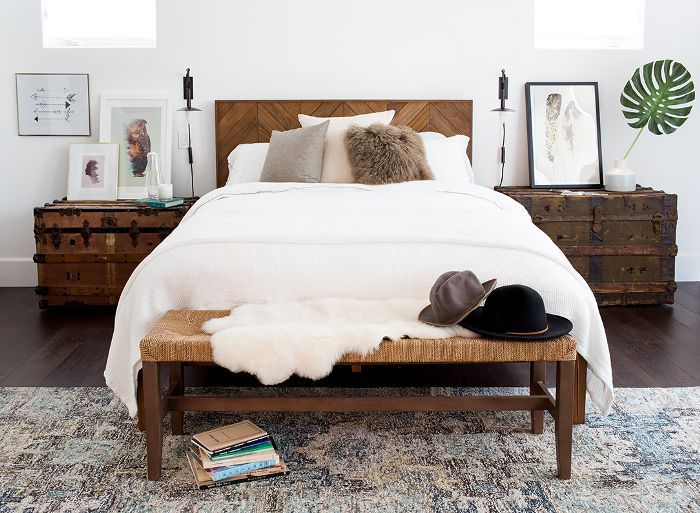
At the end of a long day, your bedroom should be a sanctuary of comfort that welcomes you in. But, as a room that guests rarely see and in which homeowners spend most of their time with their eyes closed, its upkeep frequently gets pushed to the bottom of the to-do list. Thankfully, there are some little design tricks that can make a big difference. Turn your bedroom into a restful retreat when you up its coziness factor with a few of these easy ideas.
Layer textures. Sheepskin rugs, a down comforter, plush pillows, and knit blankets can add a softness to the room that will make you want to sink right in. Lift these textures upward, with a canopy, tufted headboard, billowy curtains and hanging textiles (like a weaving) so even the walls and ceiling feel snuggly.
Pick the right paint. Dark, saturated colors make a room feel like it’s embracing you, which is ideal for setting a sleepy environment. But if you’re nervous to commit to a dark color on the wall, choose a pale dusty blue, sage green or another light natural color for a soothing tone (just steer clear of energetic hues). Have you ever wanted to sleep on a cloud? Go with all-white paint and decor which makes even a basic bedroom feel soft and spa-like.
Personalize it with reminders of the places and things that make you feel at home. Do you have a fondness for flowers? Bring floral patterns in on your textiles. Do you dream of vacation at the lake? Frame a photo of your favorite spot! Photos or paintings of uncluttered natural landscapes—like a sunset reflecting on water or a hammock under the shade of an oak—can rekindle memories of relaxation and are perfect for creating a sense of calm.
Add mood lighting. Soften the light to mimic dusk for an intimate mood with dimmer switches, lamps, lanterns or even string lights. Just make sure you can reach the switch from bed, so you don’t have to disturb your peace to get up and turn it off when you’re ready to roll over and fall asleep.
Skip metallic finishes. Choose warm natural decor options like wood and fabric instead of cold, manufactured metallics. This goes for everything from your bedroom furniture to window treatments. Faux wood blinds, especially when paired with floating curtains, fit with a cozy aesthetic and let you filter out harsh sunlight and maintain privacy for a truly sheltered slumber.
Bring on the books! Stacks of good reads invite you to snuggle in and get lost in another world. A true retreat is a room with plenty of books that begs you to stay.
Fix up—or fake—a fireplace. If your bed sits hearthside, embrace this romantic accent with styled logs and a decorated mantle. If you don’t have such a luxury, create a faux fireplace to add comfort and warmth through your décor: Arrange oversized candles and lanterns safely within a homemade hearth to bring in that cozy fireside feeling without changing the structure of your home.
Keep the room uncluttered. When you want to settle in, a mess distracts you from finding comfort, to minimize the amount of stuff that makes it to your bedroom. Watch your nightstand, which often becomes a catch-all, by making a point to rehome any wandering wares now, and put things away as soon as they enter the room in the future. If you’re apt to let laundry pile up, keep it behind the closed doors of your closet so it doesn’t crowd your peace.
Create a sense of timelessness. Tuck clocks and electronics away so they’re nearby if you need them, but their wires and harsh silhouettes aren’t reminding you of life outside your sanctuary. The hush that falls in a room devoid of gadgets will allow you to easily disengage from the stresses of reality.
Rethink your bedding. Add a pillow-top pad to your mattress so it feels like your bed is hugging you when you climb in. Or, bring in a contoured body pillow which actually can hug you! Linen sheets feel luxe compared to cotton and are a simple swap to boost your bower. Many people also swear by skipping the top sheet while dressing their beds, which allows them to burrow directly into a fluffy comforter.
Appeal to your sense of smell. Aromatherapy can have a huge impact on your perception of a space, so find some soothing essential oils or a sweet candle to blanket the room with an ambiance you adore. As soon as you open the door, you’ll be eager to plunge into your little oasis.
Nestle into nooks. A window seat, a reading nook or an upholstered seating area are all inviting spaces that can draw you in from the doorway. The more intimate alcoves you can create, the cozier your bedroom will feel!
Flooded with soft lighting, plush textures, and other comfy touches, your bedroom environment will envelop you at day’s end. And, perhaps even better than the idea of your bedroom refresh itself, is knowing that none of these tips take longer than a weekend to complete! So, slide into your slippers as you settle on which cozy updates you’ll select for your new favorite room of the house.
Throughout the years, the Windermere Foundation has donated more than $38 million to hundreds of organizations throughout the Western U.S. We’ve helped homeless shelters, food banks, schools, hospitals, community centers, and other nonprofits that provide services to low-income and homeless families.
Most of this funding comes from our agents who give a portion of every commission they earn to the Windermere Foundation. In addition to this, Windermere has a number of vendor partners that do their part by donating a portion of the business they receive from Windermere, back to the Windermere Foundation. Examples of these partners include Bumblejax, Complete Office, Fran’s Chocolates, glassybaby, Knack, Loop & Tie, Morrison Craig Apparel, Posie Turner, Sozo, and Windsor Vineyards.
One partner in particular that we’d like to give special recognition to is trueIMAGE Publishing. Since 2007, trueIMAGE Publishing has provided Windermere agents with beautiful calendars that showcase exclusive images from award-winning photographers. These calendars are popular gift items that agents send to their clients. Through these calendar sales, trueIMAGE Publishing has generously donated over $247,000 to the Windermere Foundation! We cannot thank them enough for all they’ve done to help us continue our tradition of giving.
We are so grateful for all of our “true-ly” wonderful vendor partners who share our passion for helping those less fortunate. Their contributions have helped us continue to provide funding for things such as diapers and formula for babies, housing assistance for families with critically ill children, shoes and school supplies to students in need, and scholarships for low-income adults seeking to continue their education in order to be able to provide more for their families.
To learn more about the Windermere Foundation, or to make a donation, please visit windermerefoundation.com.
Originating in the U.K. in 1988, Red Nose Day started to help end child poverty. In 2015, the public charity, Comic Relief USA, launched the campaign in the U.S.
Last year, the Red Nose campaign raised $47 million, setting the total raised since 2015 to over $150 million, and have changed the lives of over 16 million children. These funds help buy vaccines and medical services, as well as meals, educational assistance and more. Half of the money raised supports programs in the 50 states and Puerto Rico, and the other half helps fund programs in Latin America, Africa, and Asia.
Companies like Bill and Melinda Gates Foundation, M&M’s, Mars Wrigley Confectionary, and NBC have supported the organization as national and programming partners. NBC will have a celebrity-filled Red Nose Day program planned at 8/7 c tonight.
We’ve supported Red Nose Day for the last two years through our philanthropic arm, Windermere Foundation, this year we were happy to give $1000, not to mention the red noses! We are proud to help organizations in our local and global communities who work to support low-income and homeless families. Please join us again this year in giving to this important campaign to end child poverty.
To participate, you can get your $2 Red Nose at your nearest Walgreens. Of that, $1.30 goes to the fund. The nose purchase is not tax deductible, but a donation made directly to them is. You can donate online athttps://donation.rednoseday.org/.
To learn more about the organization and who they help, and how you can participate, go to their website: https://rednoseday.org/home.
The last time we saw a balanced market was late 1990s, meaning many sellers and buyers have never seen a normal housing market. Windermere Real Estate’s Chief Economist Matthew Gardner looks at more longer-term averages, what does he see for the future of the housing market?
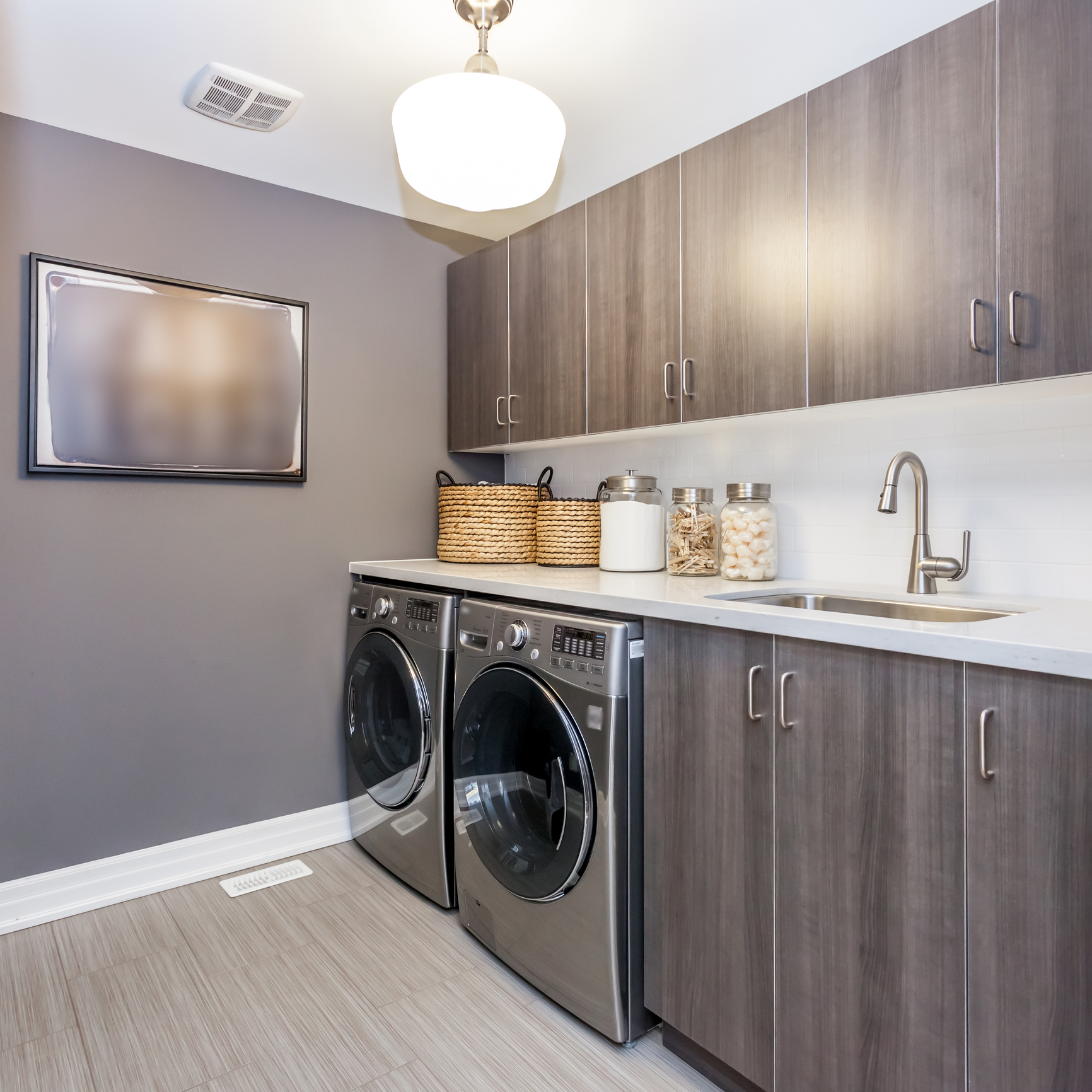
Modern home appliances make our lives so much easier: They tackle dreaded household chores, saving us time and effort. There are lots of ways to use them, however, that you may not have thought of before. Here are 13 little-known tricks for getting more than your money’s worth from your appliances.
Sanitize small toys and more. Use your dishwasher to wash and sanitize teething rings, small plastic toys, mouth guards, and even baseball caps. Place items on the top rack and run the dishwasher as usual with detergent (without any dirty dishes). Put smaller items in a small mesh laundry bag so that they don’t move around.
Clean ceiling fixtures. At least once or twice a year, remove and clean your glass ceiling fixtures and light covers in an empty dishwasher. Run the machine on the normal cycle.
Eliminate wrinklesfrom clothing. To smooth out wrinkled clothes or linens left too long in the dryer, toss a damp, lint-free cloth in with them. Run the load on the lowest setting for 10 to 15 minutes. Newer dryers also feature a steam setting that removes wrinkles and refreshes clothing between wears.
Disinfect sponges and dishcloths. Kitchen sponges and dishcloths contain billions of germs. Clean and disinfect them daily by zapping them on high in the microwave for 2 minutes to kill germs.
Freshen up your curtains. Vacuum heavy drapes with the upholstery attachment. Use the dusting brush attachment for lighter drapes. Wash sheer curtains in the washing machine on the delicate cycle, then hang them up while they’re damp to prevent wrinkles.
Remove wax from fabric or carpet. To get rid of wax on a tablecloth, place it in your freezer until the wax is hard. Then put a flat paper bag over the wax and another under the fabric. Iron the top bag with a medium-hot iron until all the wax transfers to the bag. To remove wax from a carpet or rug, place an ice pack on the spot until the wax hardens. Shatter the wax and vacuum up the chips.
Clean baseboards. Dusting baseboards can be a backbreaking chore. Use your vacuum cleaner and the dusting brush attachment to avoid having to bend down. Do the same to clean chair and table legs.
Organize your fridge. Use the built-in features of your refrigerator to organize food by category. Designate certain shelves or areas for leftovers, preferably front and center, so you don’t forget they’re in there. Use special-purpose bins for their intended use: crispers for vegetables, deli trays for deli meats and cheeses, cold storage trays for meats. Newer models also feature convertible cooling zones to keep food fresh.
Dust blinds. Extend the blinds fully and turn the slats to the closed position. Use the dusting brush attachment on your vacuum cleaner to clean the slats from top to bottom. Then open and reclose the slats in the opposite direction and repeat the process.
Clean your microwave. The best time to clean your microwave is immediately after using it. Thanks to residual steam, all you have to do is wipe it out with a paper towel or damp sponge. To clean old messes, microwave 2 cups of water on high for 5 minutes. The steam will soften cooked-on spills, which you can wipe off with a paper towel or cloth.
Exterminate dust mites. Dust mites live off human and animal dander and other household dust particles. They thrive in sofas, carpets, and bedding. Use the upholstery attachment to vacuum your mattress and upholstered furniture regularly to minimize dust mites. Be sure to empty the canister in an outdoor trashcan.
Groom your pet. After you’ve groomed your dog or cat, use the dusting brush attachment to clean up after. It’s an easy way to collect shedding fur, especially from carpetted areas or upholstery.
Remove grime from shower liners. Wash plastic shower curtain liners in the washing machine with hot water and detergent on the regular cycle. Throw in a small bath towel to help “scrub” mildew and soap scum off the liner. Then rehang the liner and let it air-dry.
Have you found any unusual cleaning hacks for your appliances? Share in the comments below!
The following analysis of select Maui real estate markets is provided by Windermere Real Estate Chief Economist Matthew Gardner. We hope that this information may assist you with making better-informed real estate decisions. For further information about the housing market in your area, please don’t hesitate to contact your Windermere agent.
ECONOMIC OVERVIEW
Hawaii’s economy continues to add jobs, but the rate of growth remains tepid. Over the past 12 months, the state added 3,200 new jobs, representing a growth rate of .5%. This lackluster growth may be due to the fact that the unemployment rate was a very healthy 2.7%.
On Maui, employment growth dropped 2.2% year-over-year, and has been contracting for the past 14 months. Even with this drop in employment, the unemployment rate was a healthy 2.8%, up from 2.2% a year ago. The unemployment rate may remain low, even given job losses, as the labor force continues to grow smaller. It is also worth noting that there are almost 3,600 job openings on Maui.
HOME SALES
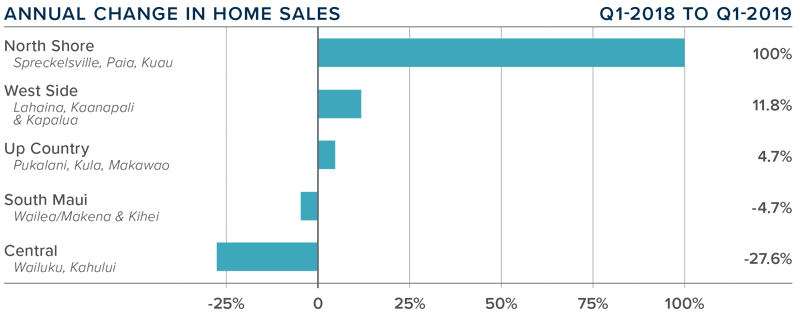
In the first quarter of 2019, 490 homes sold—a drop of 7.4% compared to the first quarter of 2018.
Three markets saw growth in sales over the first quarter of 2018: North Shore, the West Side, and Up Country. There was a significant decline in sales in the Central area.
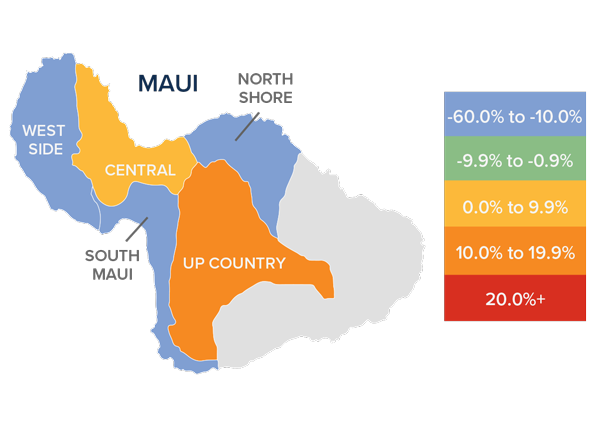
The contraction in sales came as inventory levels dropped 7.3%. Three market areas saw listing inventories rise: Up Country, the Westside, and the Central area. Lower inventory levels were seen in South Maui and North Shore.
Pending home sales in the quarter were down 5.8% from a year ago but up 16% from the fourth quarter of 2018, suggesting that second quarter closings may be more positive.
HOME PRICES
The average home price in the region dropped 9.9% year-over-year to $824,955.
Affordability is a significant issue on Maui, where average home prices in areas like Westside and Up Country are now above $1 million. I’m hopeful the recent drop in interest rates will stimulate more buyers. It’s worth noting that jumbo loan interest rates are also very competitive, which may help the higher-end markets.
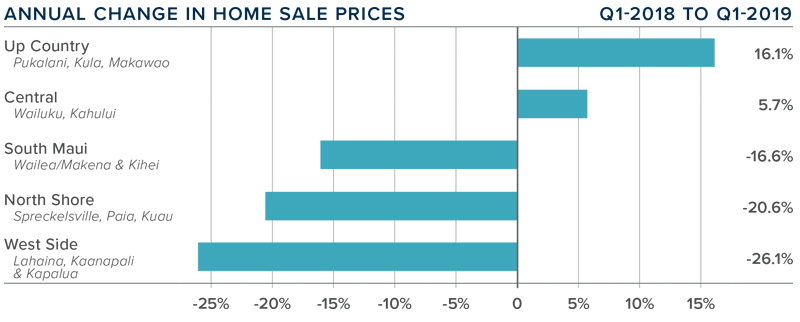
Although the region saw an overall drop in average home prices, the Up Country area experienced an increase of 16.1%. One additional area saw prices rise year-over-year, while prices dropped in the remaining three markets.
Even given affordability constraints in many Maui market areas, I anticipate we will see home prices rise in 2019, though at fairly modest rates.
DAYS ON MARKET
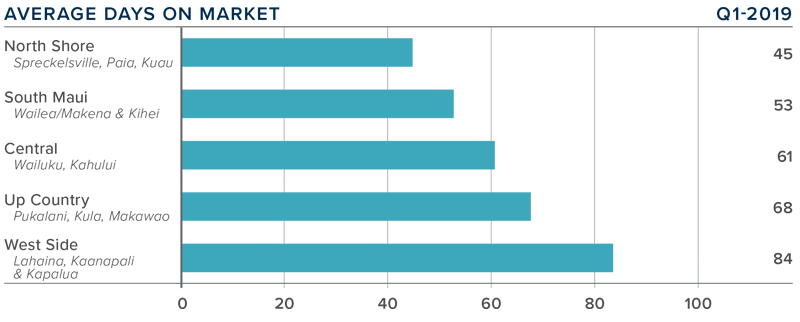
The average number of days it took to sell a home on Maui dropped two days compared to the first quarter of 2018.
The amount of time it took to sell a home dropped in two markets: South Maui and the Westside. Market time rose in the rest of the markets.
In the first quarter, it took an average of 62 days to sell a home. The fastest-moving market was North Shore and the slowest was the Westside.
The drop in days on market suggests a healthy demand for housing, despite the slowing pace of home sales. I anticipate we will see modestly rising activity as we move through 2019.
CONCLUSIONS
This speedometer reflects the state of the region’s real estate market using housing inventory, price gains, home sales, interest rates, and larger economic factors.
For the first quarter of 2018, I have moved the needle a little more in favor of buyers but the market is not yet at equilibrium, even given the drop in sales and lower home prices. Though the market is in need of more inventory, I remain positive about the longer-term outlook for home prices and demand on Maui.
As Chief Economist for Windermere Real Estate, Matthew Gardner is responsible for analyzing and interpreting economic data and its impact on the real estate market on both a local and national level. Matthew has over 30 years of professional experience both in the U.S. and U.K.
In addition to his day-to-day responsibilities, Matthew sits on the Washington State Governors Council of Economic Advisors; chairs the Board of Trustees at the Washington Center for Real Estate Research at the University of Washington; and is an Advisory Board Member at the Runstad Center for Real Estate Studies at the University of Washington where he also lectures in real estate economics.
The following analysis of the Big Island real estate market is provided by Windermere Real Estate Chief Economist Matthew Gardner. We hope that this information may assist you with making better-informed real estate decisions. For further information about the housing market in your area, please don’t hesitate to contact your Windermere agent.
ECONOMIC OVERVIEW
Hawaii’s economy continues to add jobs, but the rate of growth is tepid. Over the past 12 months, Hawaii added just 1,400 new jobs, representing a growth rate of 0.2%. Even with this lack of job formation, the state has a very healthy 2.8% unemployment rate.
On the Big Island, year-over-year employment dropped 4.7% to 84,600 persons and has been negative for the past eight months. The unemployment rate was a respectable 3.7%, up from 2.6% a year ago. As stated in the last Gardner Report, the Island continues to see its civilian workforce contract and this may be a reason for the lack of job growth. Notably, there are over 3,900 job openings on the Big Island. Additionally, the area is still recovering from the 2018 volcanic eruption which hit the Island’s economy very hard.
HOME SALES
In the first quarter of 2019, 689 homes traded hands, a drop of 10.4% compared to the first quarter of 2018 and 5.9% lower than the fourth quarter of 2018.
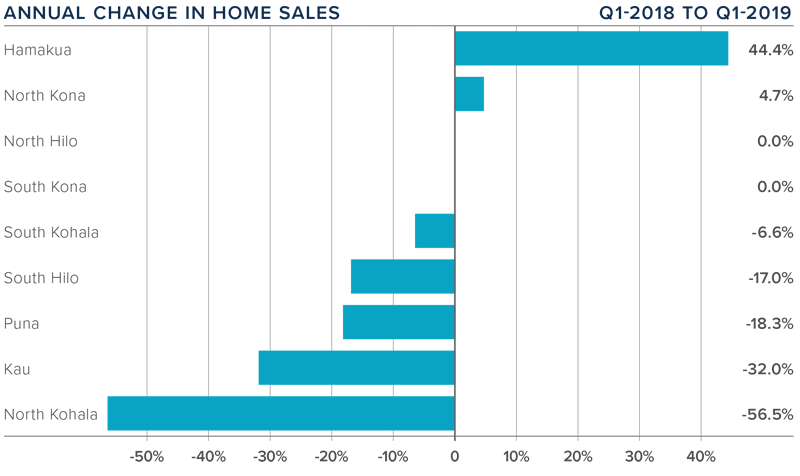
The only markets that saw growth in sales were Hamakua and North Kona, which rose by a very significant 44% and 4.7% respectively. There was a significant decline in sales in North Kohala, but it is a very small market and the 56.5% drop equated to a loss of only 13 sales.
The regional drop in sales came as inventory levels rose 15.4% from a year ago and 11.2% from the fourth quarter of 2018. There may well be some hangover from the 2018 volcanic eruption, but that reason might be growing stale. I will continue to monitor the data as we move through 2019 to see if this is still the case or if there are other reasons for the contraction.
Inventories rose in six of the markets analyzed: North Kohala, South Hilo, North and South Kona, Kau, and Puna. South Kohala, Hamakua, and North Hilo saw modest drops. Buyers have more choice and continue to be far more selective — and patient — in making an offer on a home.
HOME PRICES
The average home price in the region dropped 7.1% year-over-year to $541,135.
Affordability is still an issue, but the current low interest rate environment may stimulate buyers as we move through the later spring season. I expect to see prices start to pick up, but at fairly modest rates.
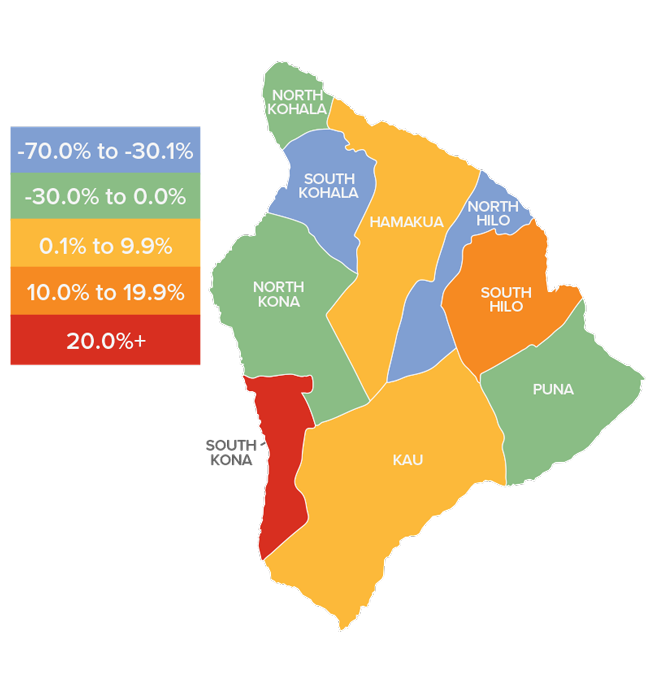
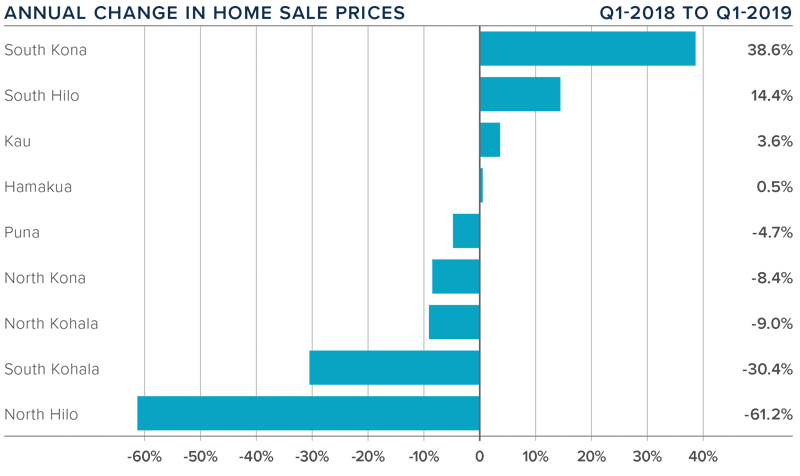
Appreciation was strongest in the South Kona market, where prices rose by 38.6%—again, a function of it being a very small area with limited sales. Three additional areas saw prices rise between the first quarter of 2018 and the first quarter of 2019, and five markets saw average sale prices drop.
Despite ongoing affordability issues in many Big Island market areas, I still expect home prices to rise in 2019.
DAYS ON MARKET
The average time it took to sell a home on the Big Island dropped 22 days compared to the first quarter of 2018.
Notably, the amount of time it took to sell a home dropped across the board.
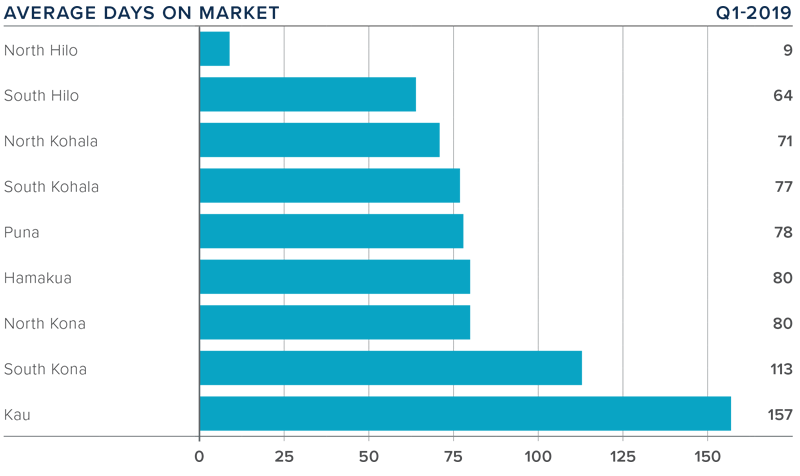
In the first quarter, it took an average of 81 days to sell a home. Homes sold fastest in North Hilo and slowest in Kau.
The recent drop in mortgage interest rates will likely continue to stimulate demand as we move through 2019.
CONCLUSIONS
This speedometer reflects the state of the region’s real estate market using housing inventory, price gains, home sales, interest rates, and larger economic factors.
For the first quarter of 2019, I have placed the needle close to the middle. Although we saw a decline in sales and prices compared to the first quarter of 2018, I anticipate prices will rise as inventory levels — although trending higher — will not be sufficient to meet demand. Locational attributes will be increasingly important in the coming year as buyers become more selective than we have seen in quite some time. Additionally, the market may take a pause until home buyers get more clarity regarding Bill 108, which could have a substantial effect on investors who are purchasing vacation rental properties.
As Chief Economist for Windermere Real Estate, Matthew Gardner is responsible for analyzing and interpreting economic data and its impact on the real estate market on both a local and national level. Matthew has over 30 years of professional experience both in the U.S. and U.K.
In addition to his day-to-day responsibilities, Matthew sits on the Washington State Governors Council of Economic Advisors; chairs the Board of Trustees at the Washington Center for Real Estate Research at the University of Washington; and is an Advisory Board Member at the Runstad Center for Real Estate Studies at the University of Washington where he also lectures in real estate economics.

 Facebook
 X
X
 Pinterest
 Copy Link














 This speedometer reflects the state of the region’s real estate market using housing inventory, price gains, home sales, interest rates, and larger economic factors.
 As Chief Economist for Windermere Real Estate, Matthew Gardner is responsible for analyzing and interpreting economic data and its impact on the real estate market on both a local and national level. Matthew has over 30 years of professional experience both in the U.S. and U.K.
 This speedometer reflects the state of the region’s real estate market using housing inventory, price gains, home sales, interest rates, and larger economic factors.