Market News July 24, 2020

Eastern Washington Real Estate Market Update


The following analysis of the Eastern Washington real estate market is provided by Windermere Real Estate Chief Economist Matthew Gardner. We hope that this information may assist you with making better-informed real estate decisions. For further information about the housing market in your area, please don’t hesitate to contact your Windermere agent.


ECONOMIC OVERVIEW

It appears as if the massive COVID-19-induced contraction in employment Washington State experienced—along with the rest of the nation—is behind us (at least for now). Employment across Washington State started to drop in March, but April was the real shock: total employment dropped almost 460,000 between March and April, a decline of 13%. However, this turned around remarkably quickly, with 52,500 jobs added in May. Worthy of note is that, in May alone, Eastern Washington recovered 5,200 of the 47,000 jobs that were lost in March and April. However, the unemployment rate in Eastern Washington was still a high 13.4% in May. Although it is certainly too early to say we are out of the woods, we seem to be headed in a positive direction and, assuming we respect the state’s mandates regarding social distancing and mask wearing, I remain hopeful that Washington will not have to re-enter any form of lockdown.


HOME SALES

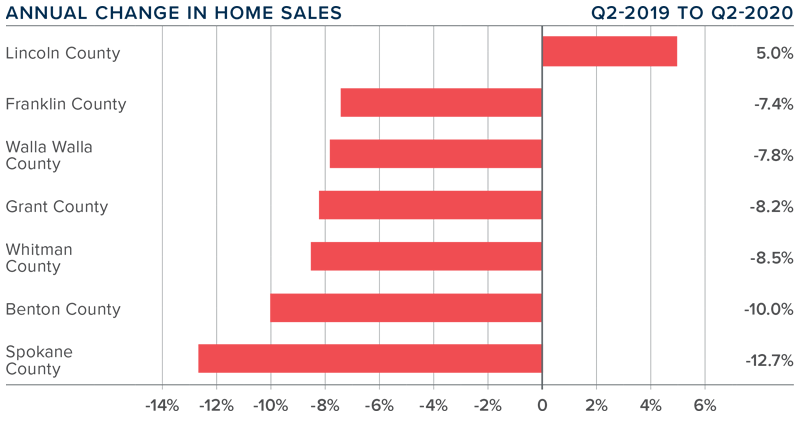
  • Home sales throughout Eastern Washington were down 11% compared to the same quarter in 2019, with a total of 3,101 closed sales.
  • Pending home sales in the region were 36.4% higher than in the first quarter of the year, suggesting that closed sales will pick up again in the third quarter.
  • Sales activity dropped in all but the very small Lincoln County, though growth there was only one unit.
  • The average number of homes for sale in the quarter was 45.1% lower than a year ago, but 10.5% higher than in the first quarter of 2020. This is positive, but inventory levels are well below historic averages.


HOME PRICES
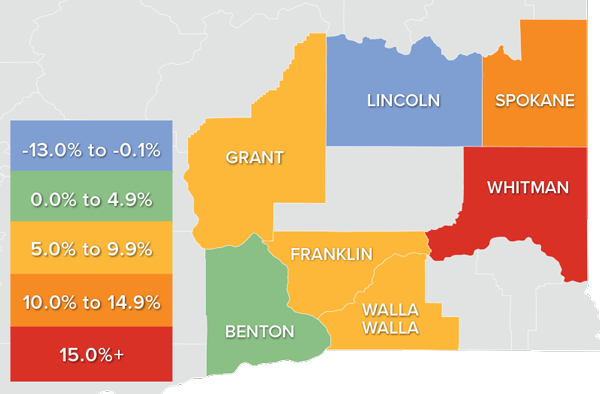
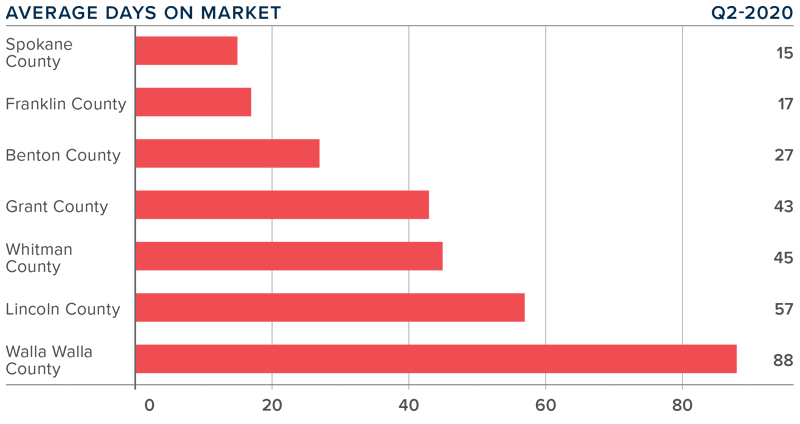
  • Year-over-year, the average home price in Eastern Washington rose a significant 8.4% to $318,275. Prices were also 7% higher than in the first quarter of 2020.
  • As mentioned in the previous section, low inventory levels are pervasive and, even with the bump in the second quarter over the first, listing activity is still very low.
  • Prices rose in every county other than Lincoln. Whitman and Spokane counties showed double-digit gains.
  • The takeaways are that average home-price growth in Eastern Washington remains well above the long-term average and, so far, there have been no real price impacts from COVID-19.


DAYS ON MARKET

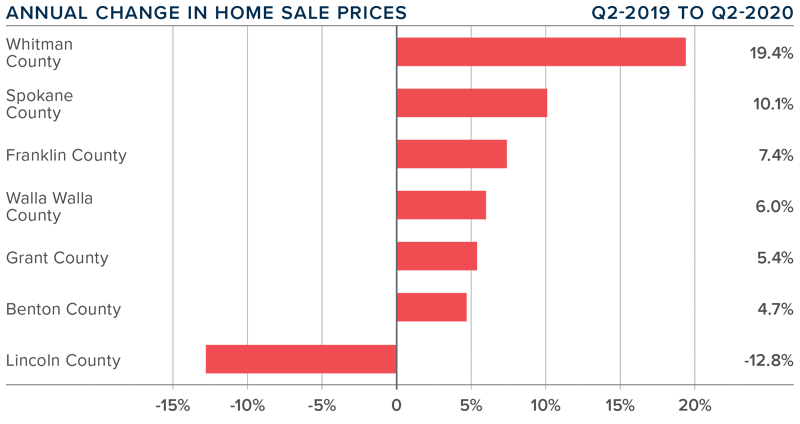
  • The average time it took to sell a home in Eastern Washington in the second quarter of 2020 was 42 days.
  • During the second quarter, it took ten fewer days to sell a home in Eastern Washington than it did a year ago.
  • All markets other than Whitman saw the length of time it took to sell a home drop compared to the second quarter of 2019.
  • It took 21 fewer days to sell a home in the second quarter than it did in the first.


CONCLUSIONS
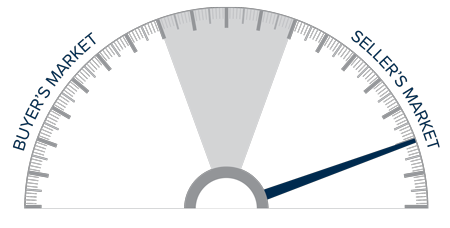
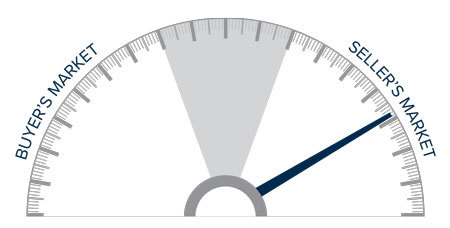
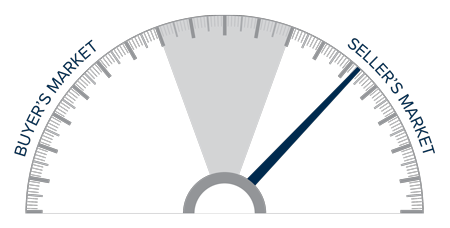
This speedometer reflects the state of the region’s real estate market using housing inventory, price gains, home sales, interest rates, and larger economic factors.

Given robust demand and historically low interest rates, it certainly remains a seller’s market, and I don’t expect this to change in the foreseeable future. The overall housing market has exhibited remarkable resilience, and housing demand has rebounded faster than most would have expected. I do not anticipate any drop in demand, but I am watching housing affordability. Prices cannot continue to rise at the pace the market is currently seeing without exacerbating affordability issues. The needle above remains unchanged from the first quarter due to ongoing uncertainty surrounding COVID-19.


ABOUT MATTHEW GARDNER

As Chief Economist for Windermere Real Estate, Matthew Gardner is responsible for analyzing and interpreting economic data and its impact on the real estate market on both a local and national level. Matthew has over 30 years of professional experience both in the U.S. and U.K. 

In addition to his day-to-day responsibilities, Matthew sits on the Washington State Governors Council of Economic Advisors; chairs the Board of Trustees at the Washington Center for Real Estate Research at the University of Washington; and is an Advisory Board Member at the Runstad Center for Real Estate Studies at the University of Washington where he also lectures in real estate economics.

Market News July 23, 2020

Colorado Real Estate Market Update


The following analysis of the Metro Denver & Northern Colorado real estate market is provided by Windermere Real Estate Chief Economist Matthew Gardner. We hope that this information may assist you with making better-informed real estate decisions. For further information about the housing market in your area, please don’t hesitate to contact your Windermere agent. 


ECONOMIC OVERVIEW

COVID-19 had significant negative impacts on employment in Colorado. The pandemic caused the loss of over 342,000 jobs in March and April as unemployment rose to 12.2%. For comparison, peak unemployment following the Great Recession was 8.9%. However, it appears as if the massive contraction in employment is behind us (at least for now). Employment in Colorado rose in May by 68,800 jobs, a monthly increase of 2.8%, pushing the unemployment rate down to 10.2%. Regionally, the Denver metro area added 18,600 jobs in May and the Fort Collins metro area added 3,500 jobs. It is certainly too early to say that we are out of the woods, but we seem to be headed in a positive direction. Colorado’s COVID-19 infection rates started increasing again in June, which could slow down the economic recovery. However, I do not believe that it is likely to have any substantial impact on the housing market.


HOME SALES

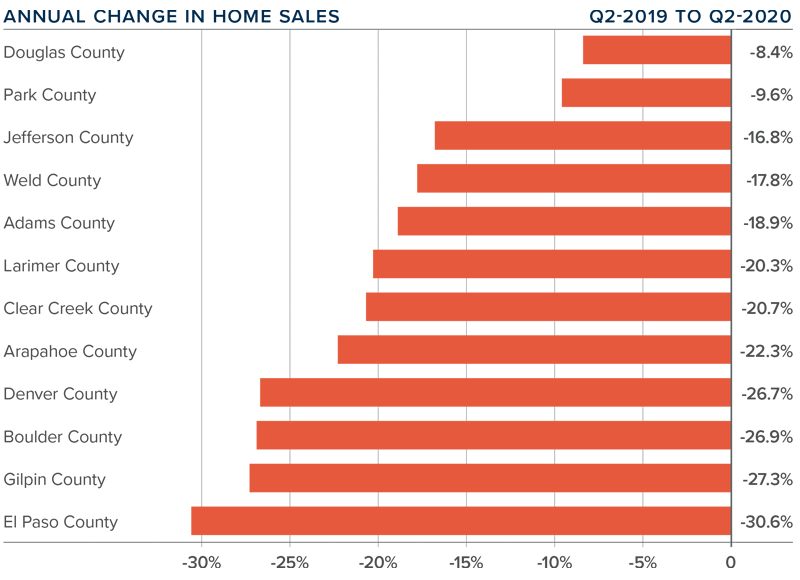
  • In the second quarter of 2020, 9,867 homes sold. This represents a drop of 20.7% compared to the second quarter of 2019, but sales were 7.4% higher than in the first quarter of this year.
  • Sales dropped across all markets compared to the second quarter of 2019. I do not find this concerning as the drop can be attributed to limited supply and COVID-19.
  • Inventory levels remain tight, with the average number of homes for sale in the quarter down 21.3% from the same period in 2019. However, listings were up an impressive 15.6% over the first quarter of 2020.
  • I was pleased to see total pending sales in the quarter increase 16.3% compared to the first quarter, suggesting closing data for the third quarter will be better than we are currently experiencing.


HOME PRICES

  • Home prices held steady compared to the second quarter of 2019 at an average of $480,831. Prices were up 0.7% compared to the first quarter of this year.
  • Interest rates remain at very low levels and will stay in the low 3% range for the balance of the year, if not longer. This can allow prices to pick back up.
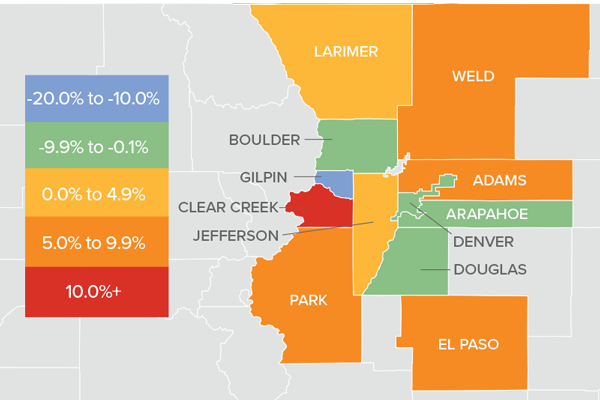
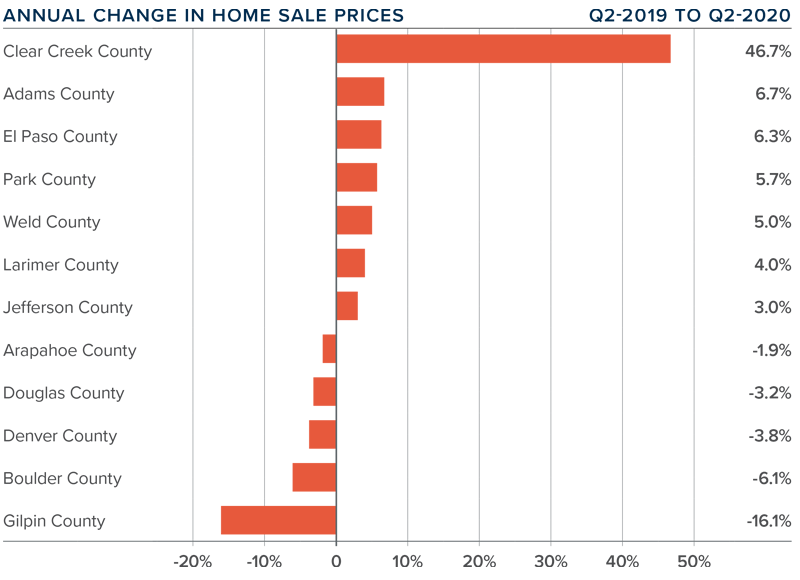
  • Price growth across the region was varied. Seven counties saw price growth and five experienced a drop in average sale price. Clear Creek County again saw prices rise substantially. However, as you are likely aware, it is a very small market and subject to wild swings. Prices dropped most in the equally small Gilpin County.
  • I am still watching affordability in many Colorado markets and will take this temporary “pause” as a good thing.


DAYS ON MARKET

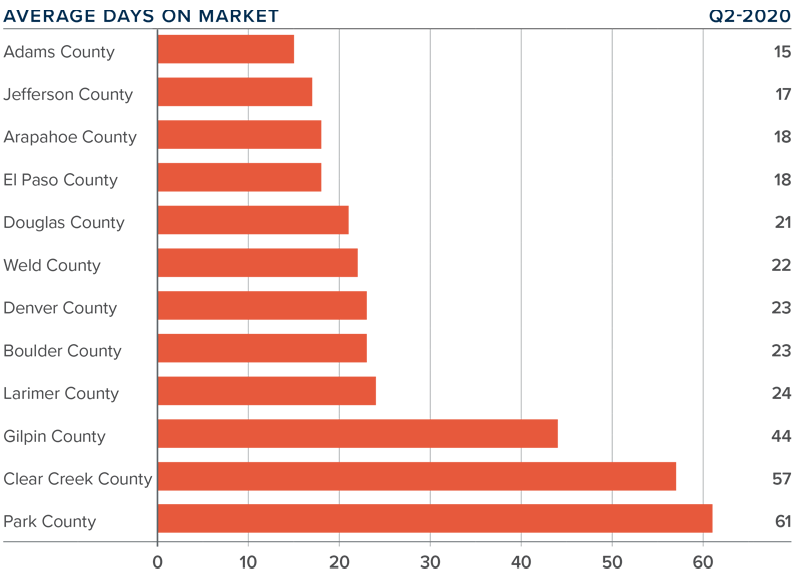
  • The average number of days it took to sell a home in the markets contained in this report dropped by only one day compared to the second quarter of 2019.
  • The amount of time it took to sell a home dropped in eight counties, remained static in one, and rose in three compared to the second quarter of 2019.
  • It took an average of 29 days to sell a home in the region.
  • The Colorado housing market is demonstrating solid demand, and listing activity is trending higher. I expect that the summer market will be brisk.


CONCLUSIONS

This speedometer reflects the state of the region’s real estate market using housing inventory, price gains, home sales, interest rates, and larger economic factors.

Demand appears to be returning, which—combined with historically low interest rates—should lead to a brisk summer housing market. Assuming that the state gets new infection rates under control, I do not see why the housing market wouldn’t perform well this summer. As such, I have moved the needle just a little more in favor of home sellers.


ABOUT MATTHEW GARDNER

As Chief Economist for Windermere Real Estate, Matthew Gardner is responsible for analyzing and interpreting economic data and its impact on the real estate market on both a local and national level. Matthew has over 30 years of professional experience both in the U.S. and U.K.

In addition to his day-to-day responsibilities, Matthew sits on the Washington State Governors Council of Economic Advisors; chairs the Board of Trustees at the Washington Center for Real Estate Research at the University of Washington; and is an Advisory Board Member at the Runstad Center for Real Estate Studies at the University of Washington where he also lectures in real estate economics.
Market News July 23, 2020

Southern California Real Estate Market Update


The following analysis of the Southern California real estate market is provided by Windermere Real Estate Chief Economist Matthew Gardner. We hope that this information may assist you with making better-informed real estate decisions. For further information about the housing market in your area, please don’t hesitate to contact your Windermere agent.


ECONOMIC OVERVIEW

Employment levels across the Southern Californian counties contained in this report have been significantly impacted by the COVID-19-induced recession. Total employment in the region has dropped by a collective 1.99 million jobs between February and May of this year. With this massive contraction, it’s not surprising to see the unemployment rate rise from 4% in February to 17.6% in May. Unfortunately, as I write this, it appears as if infection rates in many California markets have increased significantly. As such, the likelihood of tangible increases in employment will be further delayed.


HOME SALES

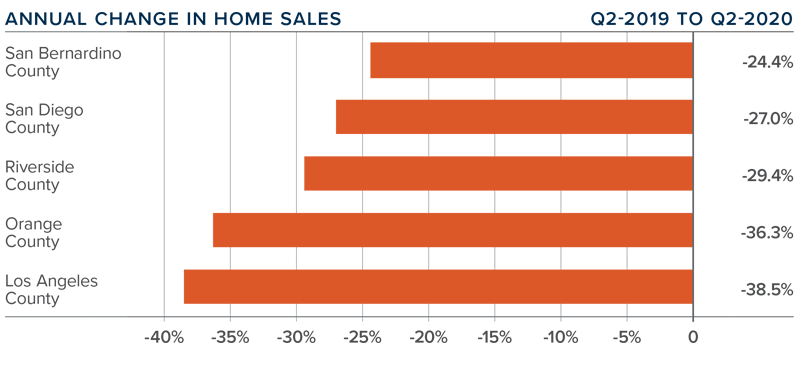
  • In the second quarter of 2020, 33,614 homes sold. This was a drop of 32.6% compared to the same period in 2019. Sales were 2.5% lower than in the first quarter of the year.
  • If there is some solace in this report, it’s that pending home sales (an indicator of future closings) rose 6.4% over the first quarter of this year, suggesting that sales in the third quarter should pick up modestly from current levels.
  • Second quarter home sales activity dropped in all counties contained in this report. Of note was a significant decrease in Los Angeles County, where more than 6,600 fewer homes sold than a year ago.
  • There was an average of 26,957 homes for sale in the second quarter—down 32.4% from a year ago but 5.3% higher than in the first quarter of this year.


HOME PRICES

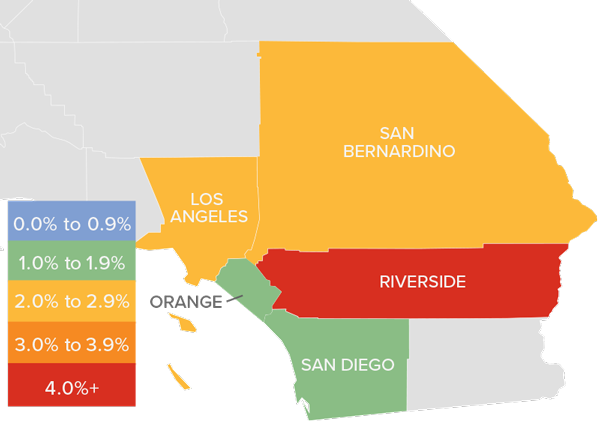
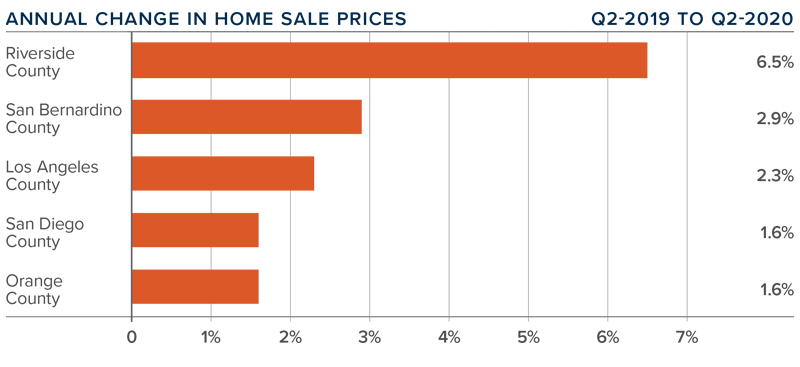
  • Year-over-year, the average home sale price in the region was $726,613. This was 0.6% higher than a year ago and 4.5% higher than in the first quarter of 2020.
  • Affordability concerns persist, which has had a negative effect on home price growth. Though prices did rise significantly between the first and second quarters, I wonder how much of this can be attributed—if even tangentially—to COVID-19.
  • Sale prices were higher in all counties contained in this report, with a significant increase of 6.5% in the more affordable Riverside County.
  • Conventional mortgage rates continue to break through historic lows and will remain that way for the foreseeable future. However, jumbo mortgage rates are still higher than we have seen in over a year. With higher rates, and tighter credit requirements, there will likely be ongoing impact on the counties with more expensive homes.


DAYS ON MARKET

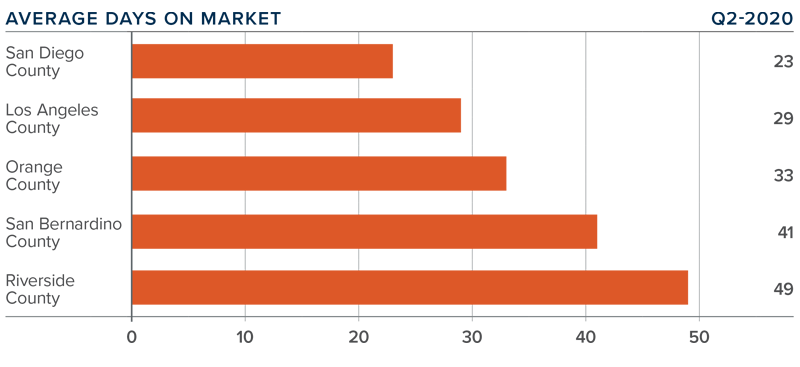
  • It took an average of 35 days to sell a home in the second quarter, 10 fewer days than a year ago and 9 fewer days than in the first quarter of 2020.
  • All markets contained in this report saw the time it took to sell a house drop compared to the second quarter of 2019.
  • Homes in San Diego County continue to sell at a faster rate than other markets in the region. In the second quarter, it took an average of 23 days to sell a home there. This is 6 fewer days than a year ago.
  • Days on market shows that, although home sales are lower—a function of limited inventory levels—there still appears to be demand for homes when they do come on-line.


CONCLUSIONS

This speedometer reflects the state of the region’s real estate market using housing inventory, price gains, home sales, interest rates, and larger economic factors.

Although there is demand for homes, the renewed round of shutdowns could dampen that demand until infection rates level out and businesses reopen their doors.

The overall housing market is resilient but will likely not see significant growth until the state gets a handle on COVID-19. For that reason, I am holding the needle in the same position it was in the first quarter. It is still a seller’s market, but uncertainty persists.


ABOUT MATTHEW GARDNER

As Chief Economist for Windermere Real Estate, Matthew Gardner is responsible for analyzing and interpreting economic data and its impact on the real estate market on both a local and national level. Matthew has over 30 years of professional experience both in the U.S. and U.K.

In addition to his day-to-day responsibilities, Matthew sits on the Washington State Governors Council of Economic Advisors; chairs the Board of Trustees at the Washington Center for Real Estate Research at the University of Washington; and is an Advisory Board Member at the Runstad Center for Real Estate Studies at the University of Washington where he also lectures in real estate economics.
Market News July 22, 2020

Oregon and Southwest Washington Real Estate Market Update


The following analysis of the Oregon and Southwest Washington real estate market is provided by Windermere Real Estate Chief Economist Matthew Gardner. We hope that this information may assist you with making better-informed real estate decisions. For further information about the housing market in your area, please don’t hesitate to contact your Windermere agent.


ECONOMIC OVERVIEW

The very significant COVID-19-induced contraction in employment Oregon experienced — along with the rest of the nation — looks as if it is behind us (at least for now).

Employment growth across the state turned negative in March, but April was the real shocker: total employment dropped by 252,800 jobs, a decline of 13%. However, this turned around remarkably quickly with 22,500 jobs added in May. The Southwest Washington region saw a drop in total employment of almost 30,000 jobs, but also turned around in May with 1,650 jobs returning. In May, the unemployment rate was 14.2% in Oregon and 14.4% in Southwest Washington.

As the rate of COVID-19 infections slow, we should see more jobs return.


HOME SALES

  • Second quarter home sales dropped 19.3% compared to the same period last year. A total of 14,342 transactions closed.
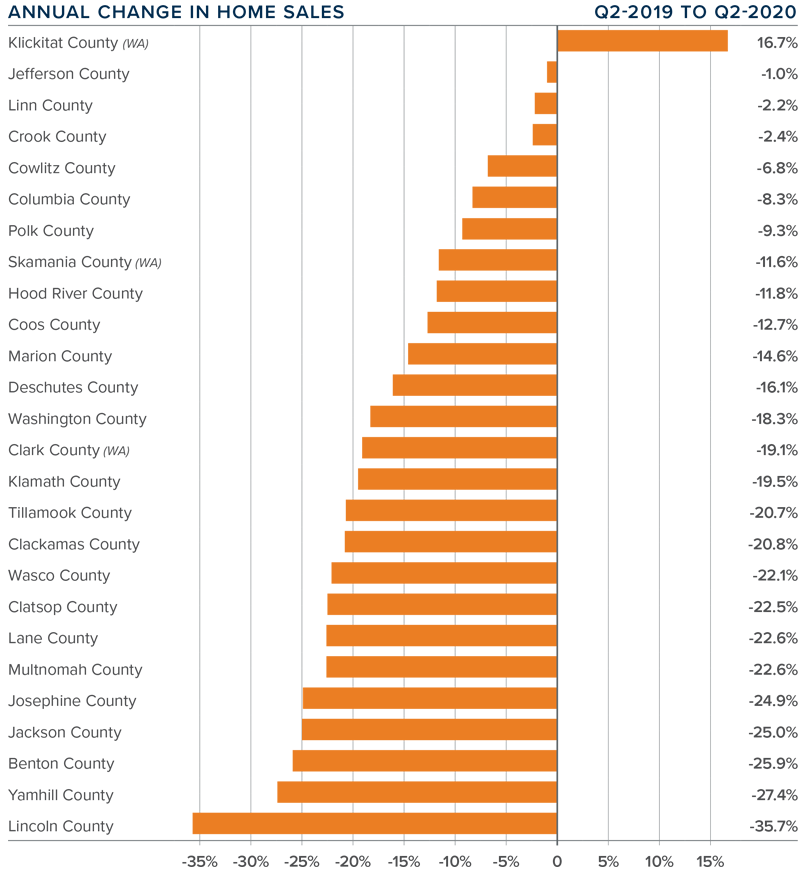
  • Sales dropped in every county except Klickitat, but it is a very small market and is subject to massive swings. Home sales fell most in Lincoln County.
  • Although significantly lower than what we saw a year ago, closings were 20% higher than in the first quarter of 2020. Housing appears to be recovering faster than the overall economy.
  • These numbers are not surprising given the onslaught of COVID-19. However, there are “green shoots” as pending sales have started to rise significantly. I expect to see decent growth in the third quarter.


HOME PRICES

  • The average home price in the region rose 5% year-over-year to $421,068. Home prices were 5.3% higher than in the first quarter of 2020.
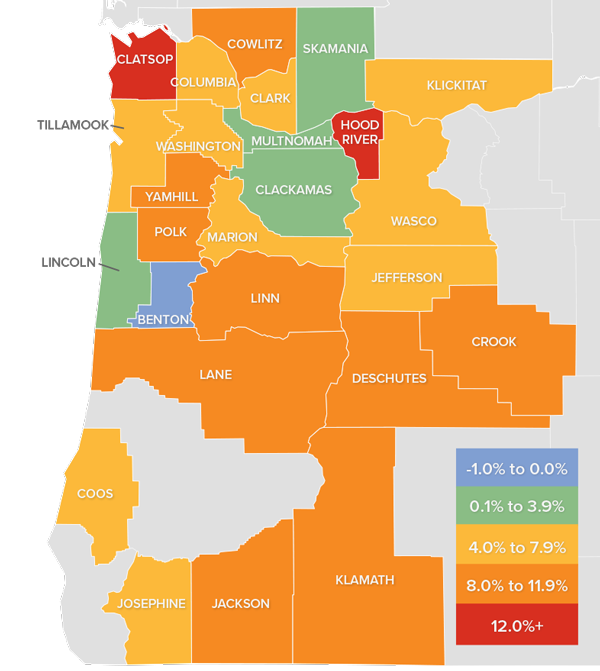
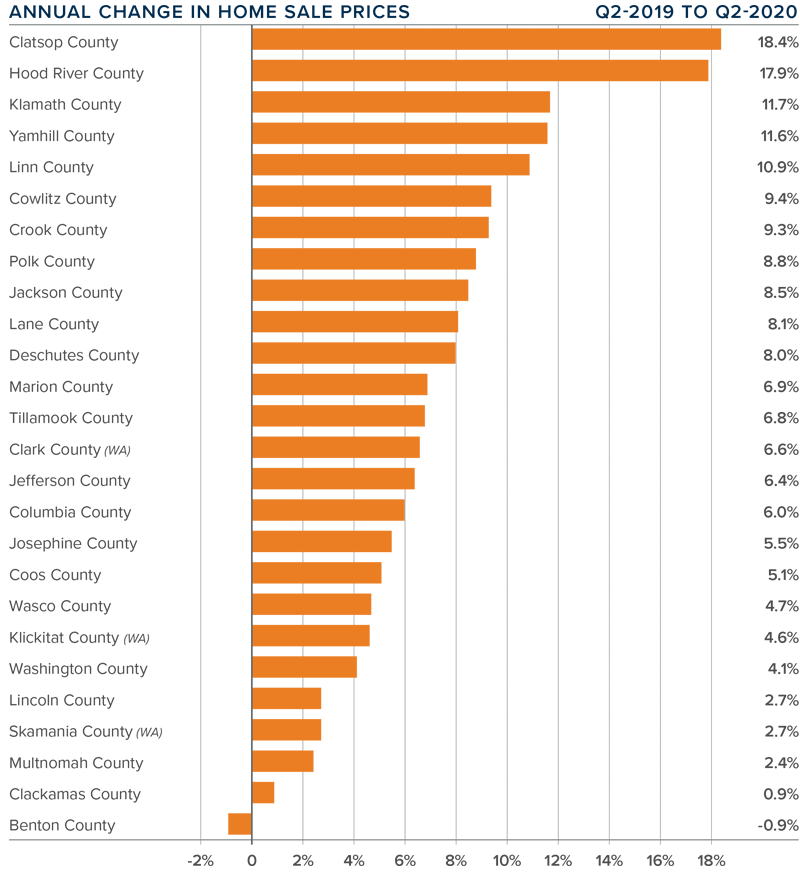
  • Clatsop County led the market with the strongest annual price growth. Homes there sold for 18.4% more than a year ago. Prices were lower in Benton County, but the decline was very modest.
  • All but one of the counties contained in this report experienced price growth over the second quarter of 2019. Annual price growth continues to outperform historic averages.
  • The takeaway from this report is that home prices appear to have been somewhat immune to COVID-19 (no pun intended). This is likely a function of extremely low levels of inventory across the region.


DAYS ON MARKET

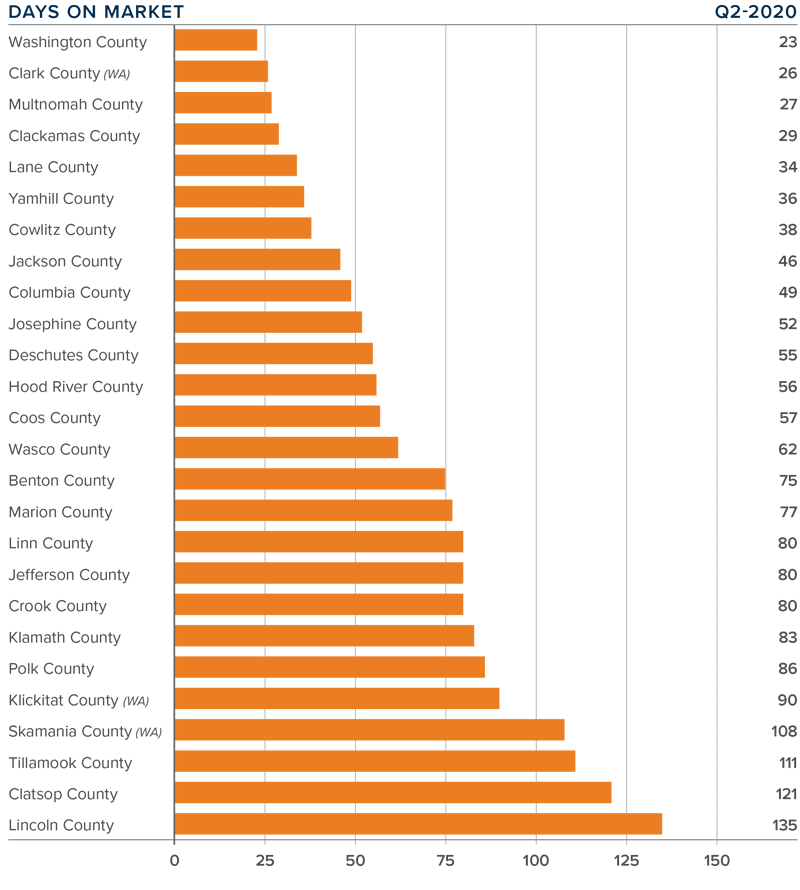
  • The average number of days it took to sell a home in the region dropped one day compared to the second quarter of 2019. It took 19 fewer days to sell a home than in the first quarter of 2020.
  • The average time it took to sell a home in the second quarter was 66 days.
  • Fourteen counties saw the length of time it took to sell a home drop compared to a year ago. Twelve counties saw market time rise.
  • Homes again sold the fastest in Washington County where it only took 23 days to sell.


CONCLUSIONS

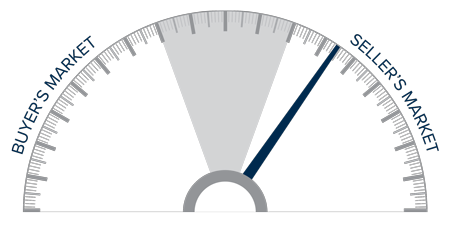
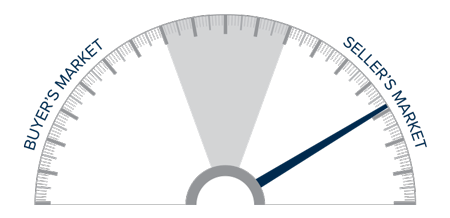
This speedometer reflects the state of the region’s real estate market using housing inventory, price gains, home sales, interest rates, and larger economic factors.

Given the current economic environment, I have decided to freeze the needle in place until we see a restart in the economy. Once we have resumed “normal” economic activity, there will be a period of adjustment with regard to housing. Therefore, it is appropriate to wait until later in the year to offer my opinions about any quantitative impact the pandemic will have on the housing market.


ABOUT MATTHEW GARDNER

As Chief Economist for Windermere Real Estate, Matthew Gardner is responsible for analyzing and interpreting economic data and its impact on the real estate market on both a local and national level. Matthew has over 30 years of professional experience both in the U.S. and U.K.

In addition to his day-to-day responsibilities, Matthew sits on the Washington State Governors Council of Economic Advisors; chairs the Board of Trustees at the Washington Center for Real Estate Research at the University of Washington; and is an Advisory Board Member at the Runstad Center for Real Estate Studies at the University of Washington where he also lectures in real estate economics.
Market News July 21, 2020

Western Washington Real Estate Market Update


The following analysis of the Western Washington real estate market is provided by Windermere Real Estate Chief Economist Matthew Gardner. We hope that this information may assist you with making better-informed real estate decisions. For further information about the housing market in your area, please don’t hesitate to contact your Windermere agent.


REGIONAL ECONOMIC OVERVIEW

It appears as if the massive COVID-19 induced contraction in employment that Washington State — along with the rest of the nation — experienced this spring is behind us (at least for now). Statewide employment started to drop in March, but April was the real shock: total employment dropped almost 460,000 between March and April, a decline of 13.1%. However, this turned around remarkably quickly, with a solid increase of 52,500 jobs in May. Worthy of note is that, in May alone, Western Washington recovered 43,500 of the 320,000 jobs that were lost in the region the prior month. Although it is certainly too early to categorically state that we are out of the woods, the direction is positive and, assuming we respect the state’s mandates regarding social distancing and mask wearing, I remain hopeful that Washington will not have to re-enter any form of lockdown.


HOME SALES

  • There were 17,465 home sales during the second quarter of 2020, representing a drop of 22.2% from the same period in 2019, but 30.6% higher than in the first quarter of this year.
  • The number of homes for sale was 37% lower than a year ago, but was up 32% compared to the first quarter of the year.
  • Given COVID-19’s impacts, it’s not surprising that sales declined across the board. The greatest drops were in Whatcom and King counties. The smallest declines were in Grays Harbor and Cowlitz counties.
  • Pending sales — a good gauge of future closings — rose 35.7% compared to the first quarter of the year, suggesting that third quarter closings will grow as well.


HOME PRICES

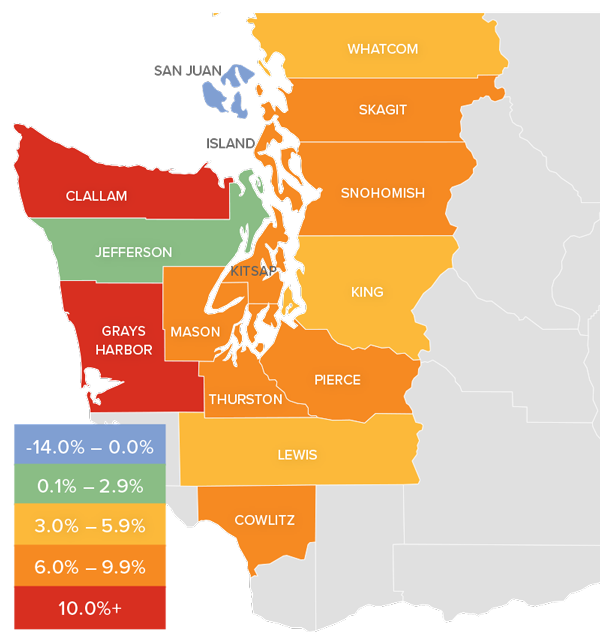
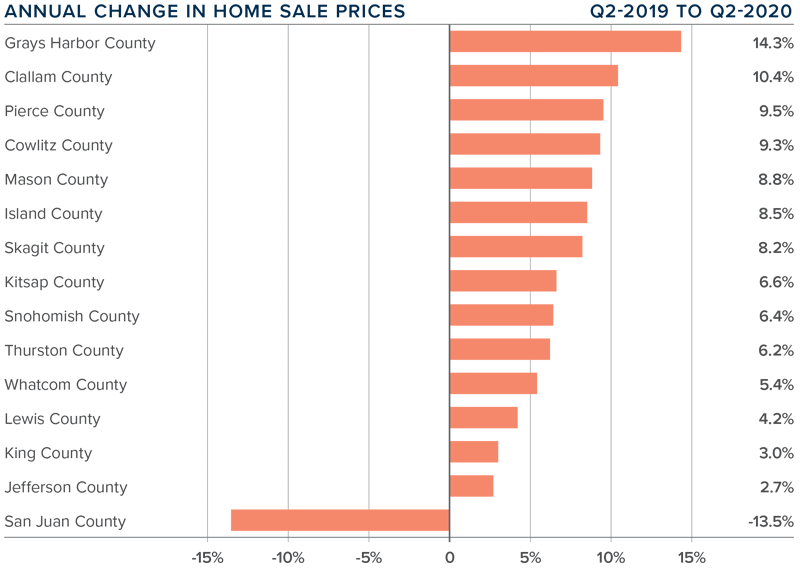
  • Home-price growth in Western Washington rose by a relatively modest 3.5% compared to a year ago. The average sale price in the second quarter was $559,194.
  • Compared to the same period a year ago, price growth was strongest in Grays Harbor County, where home prices were up 14.3%. Clallam County also saw a double-digit price increase.
  • It was interesting to note that prices were up a significant 6.6% compared to the first quarter. This suggests that any concern regarding negative impacts to home values as a function of ​    COVID-19 may be overblown.
  • I will be watching for significant price growth in less urbanized areas going forward. If there is, it may be an indication that      COVID-19 is affecting where buyers are choosing to live.


DAYS ON MARKET

  • The average number of days it took to sell a home in the second quarter of this year matched the second quarter of 2019.
  • Across the entire region, it took an average of 40 days to sell a home in the second quarter. I would also note that it took an average of 14 fewer days to sell a home than in the first quarter of this year.
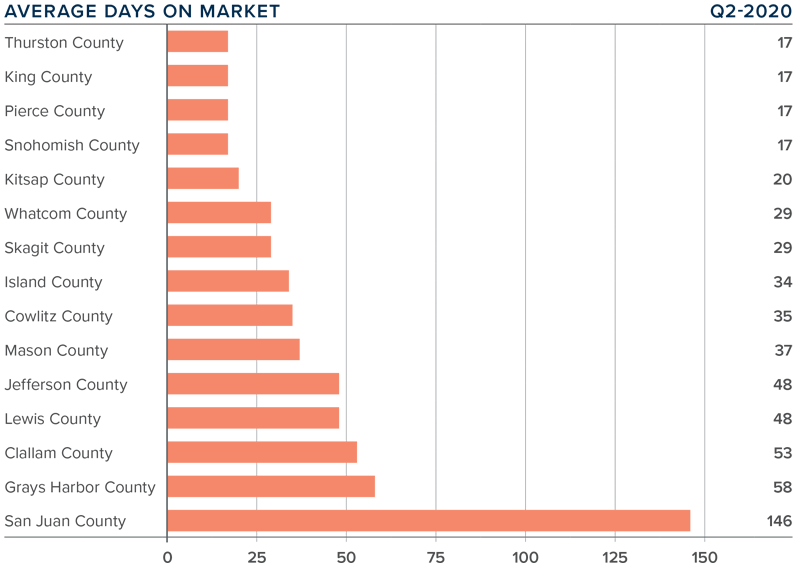
  • Thurston, King, Pierce, and Snohomish counties were the tightest markets in Western Washington, with homes taking an average of only 17 days to sell. All but two counties, Grays Harbor and Cowlitz, saw the length of time it took to sell a home drop compared to the same period a year ago.
  • Market time remains well below the long-term average across the region. This is due to significant increases in demand along with the remarkably low level of inventory available.


CONCLUSIONS

This speedometer reflects the state of the region’s real estate market using housing inventory, price gains, home sales, interest rates, and larger economic factors.

What a difference a quarter makes! Given that demand has reappeared remarkably quickly and interest rates remain historically low, it certainly remains a seller’s market and I don’t expect this to change in the foreseeable future.

The overall housing market has exhibited remarkable resilience and housing demand has rebounded faster than most would have expected. I anticipate demand to remain robust, but this will cause affordability issues to remain as long as the new construction housing market remains muted.


ABOUT MATTHEW GARDNER

As Chief Economist for Windermere Real Estate, Matthew Gardner is responsible for analyzing and interpreting economic data and its impact on the real estate market on both a local and national level. Matthew has over 30 years of professional experience both in the U.S. and U.K.

In addition to his day-to-day responsibilities, Matthew sits on the Washington State Governors Council of Economic Advisors; chairs the Board of Trustees at the Washington Center for Real Estate Research at the University of Washington; and is an Advisory Board Member at the Runstad Center for Real Estate Studies at the University of Washington where he also lectures in real estate economics.
Market News July 20, 2020

Matthew Gardner Weekly COVID-19 Housing & Economic Update: 7/20/2020

On this week's episode of "Mondays with Matthew," Windermere Chief Economist, Matthew Gardner, dives into the most recent National Housing Survey results which tell us a lot about consumer confidence both pre- and post-COVID and whether or not they feel this is a good time to buy or sell a home. The results might surprise you.

Market News July 13, 2020

Matthew Gardner Weekly COVID-19 Housing & Economic Update: 7/13/2020

Market News July 6, 2020

Matthew Gardner Weekly COVID-19 Housing & Economic Update: 7/6/2020

Living July 1, 2020

Celebrating 4th of July During COVID-19

Image source: Canva


While this year’s Fourth of July festivities will not come with the large crowds and spectacle-filled public events of years past, it is an opportunity to celebrate from the comfort of your home, and ring in the summer in a more intimate setting. Here is your guide to an at-home Independence Day celebration.


Create a backyard oasis

Nothing says “summer” like spending time outside, and the Fourth of July is the focal point of that tradition. Creating a backyard oasis will bring an added dimension to your summertime plans and will give celebrating at home a special touch. Popular summer decorative items such as outdoor furniture, string lights, and plants bring comfort to the outdoors and are the makings for long evenings spent in the backyard with family and loved ones.


BBQs & Picnics

With summer upon us, it’s the time of year to bolster your barbecue menu, and July 4th celebrations are the perfect occasion to take it to the next level. Here are simple takes on classic Independence Day dishes from the Food Network.


Picnics and Fourth of July go hand-in-hand, so get out your red, white, and blue napkins and continue the tradition—with a twist—in these times of social distancing.

  • Picnic basket swap: Organize a picnic basket swap in your neighborhood, where each household contributes a dish, dropping off the basket at each other’s doorsteps.
  • Socially distant picnic: If neighbors are comfortable with in-person meetups, picnic in a common area, while remaining properly distanced. Take safety precautions for interactions: wear masks except when eating, wash your hands before and after, and remain six feet apart at all times.
  • Virtual recipe share: Exchange your favorite recipes with a friend and find a time on July 4th to prep the meal. Arrange a video chat to eat together and share notes on how the dishes turned out.


Camp out, at home

With restrictions still keeping many parks and campsites closed, round up the family to camp among the wilderness of your home. A money-saving, hassle-reducing approach to a camping trip, this is an opportunity for you and your family to connect with nature in the security of your backyard.

Local burn ban policies may affect your ability to participate in a fixture of the Fourth’s tradition: sitting around the campfire. If that’s the case, heat up the grill and make your s’mores by wrapping them up in foil. Place the foil on the grill and let them heat until they reach that melted, gooey perfection.


Fireworks

With the status of large-scale firework celebrations varying city-to-city, some event organizers have opted to broadcast pre-recorded material in their place. Arrange for your household to tune in or organize a Zoom call with friends to watch the fireworks online together. If your hometown is moving forward with a public firework show, be sure to check their safety guidelines and follow CDC and Department of Health guidelines in attendance.


Though the methods of celebration may look a little different than what you’re used to, the reason for celebrating remains the same. This year is as important as any to commemorate our independence, and these ideas will help you and your household make this at-home Fourth of July a holiday to remember.

Market News June 29, 2020

Matthew Gardner Weekly COVID-19 Housing & Economic Update: 6/29/2020