Market NewsMore June 25, 2025

Numbers to Know 6/25/25: Inventory Levels Are Up, So Why Are Home Sales Flat?

This is the latest in a series of videos with Windermere Principal Economist Jeff Tucker where he delivers the key economic numbers to follow to keep you well-informed about what’s going on in the real estate market.

I’ll be starting this month by checking in on one of the most important numbers for the real estate industry: existing-home sales.
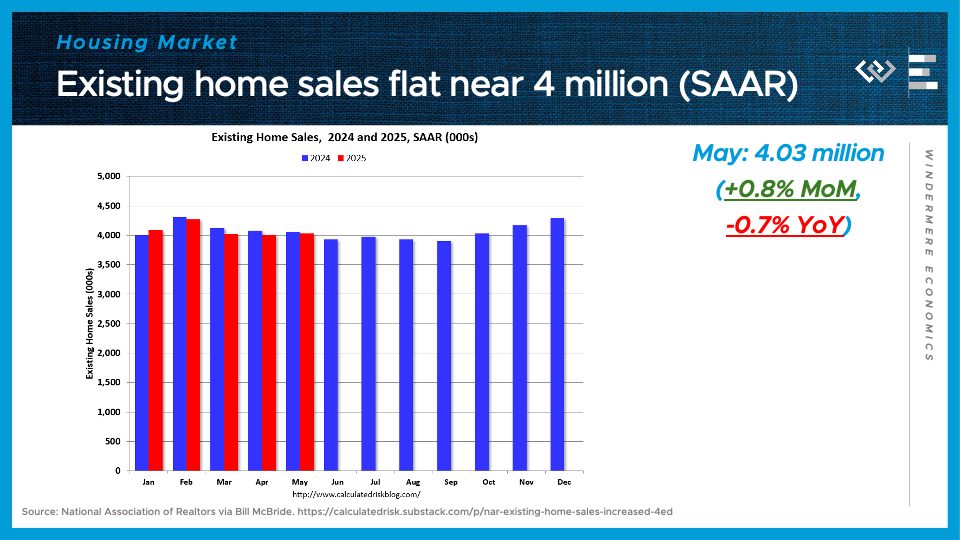
They actually surprised slightly to the upside in May, when closed sales ran at an annualized rate of 4.03 million. That is ever so slightly higher than April’s figure, and ever so slightly lower than in May of 2024, but in both cases it’s less than a percentage point difference – let’s just call it roughly flat. And “flat” pretty much sums up existing-home sales for the last couple of years: outside of some seasonal outperformance this past Q4, we’ve just been bouncing around an annual sales rate of about 4 million.
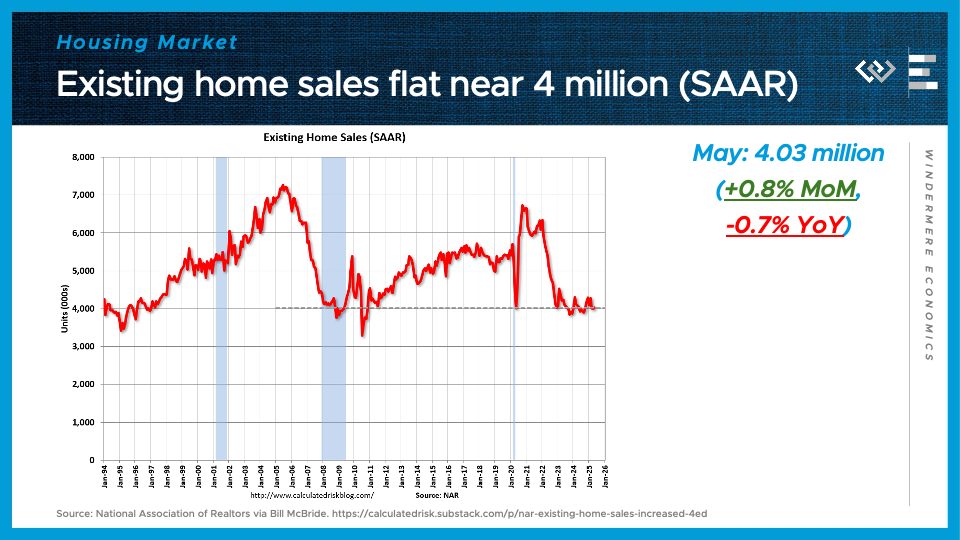
Zooming out to the last 30 years puts that in perspective: 4 million existing home sales puts us right around the lowest lows of home sales in the Great Recession. This lack of turnover is being driven by affordability challenges for buyers and the lock-in effect for sellers, as well as the aging of the US homeowner population: older folks just don’t move and sell as much as younger households.
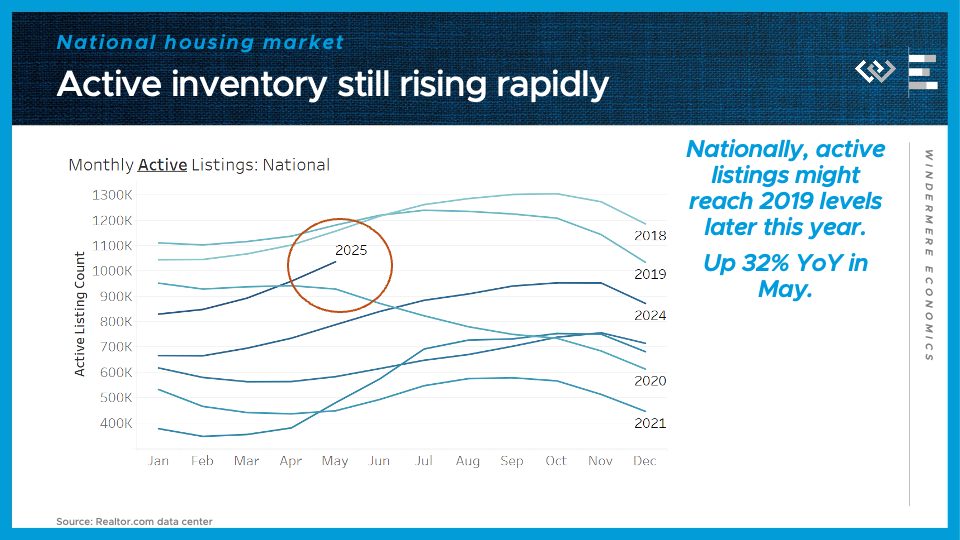
But that doesn’t mean no one is trying to sell. The month of May ended with over a million active listings on the market according to Realtor dot com’s data, bringing the market very close to pre-pandemic inventory norms. In fact, the National Association of Realtors reported that when they measure inventory in terms of Months of Supply, it actually exceeds its May 2019 level.
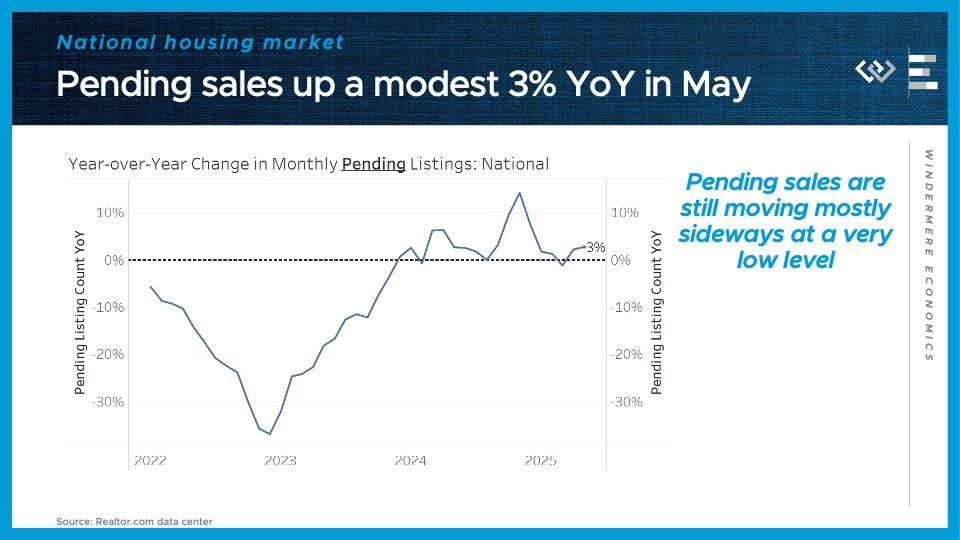
Pending sales ticked up by just under 3% in May, year-over-year. That’s an early indication we may see some modest year-over-year gains for closed sales in June, but the market is still looking quite sluggish.
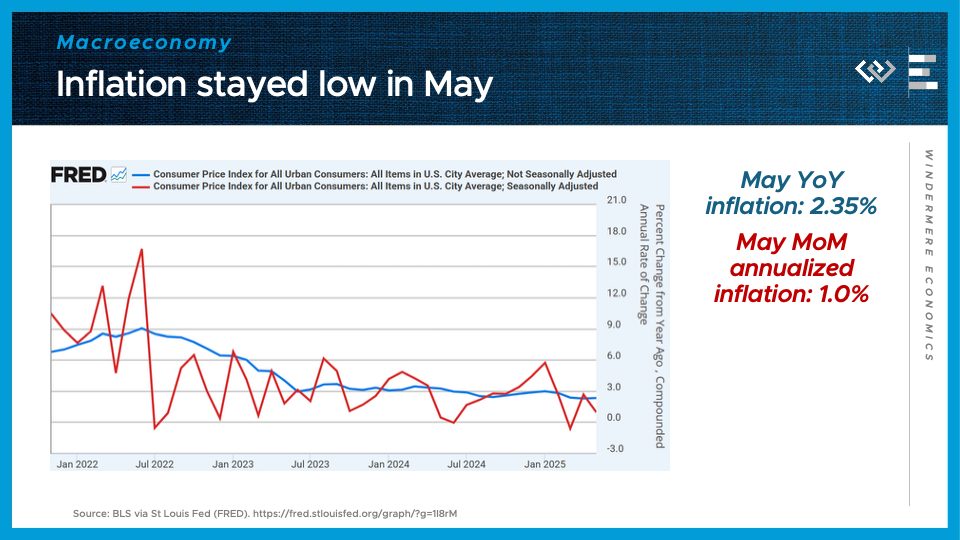
Turning to the macroeconomy, we got another good, surprisingly cool CPI inflation report for the month of May. The annualized monthly growth rate of prices was almost exactly 1%, and the year-over-year change in CPI from last May was only 2.35%. This metric has been inching down closer and closer to the Fed’s goal of a 2% inflation rate, which is part of its dual mandate along with pursuing “maximum employment.”
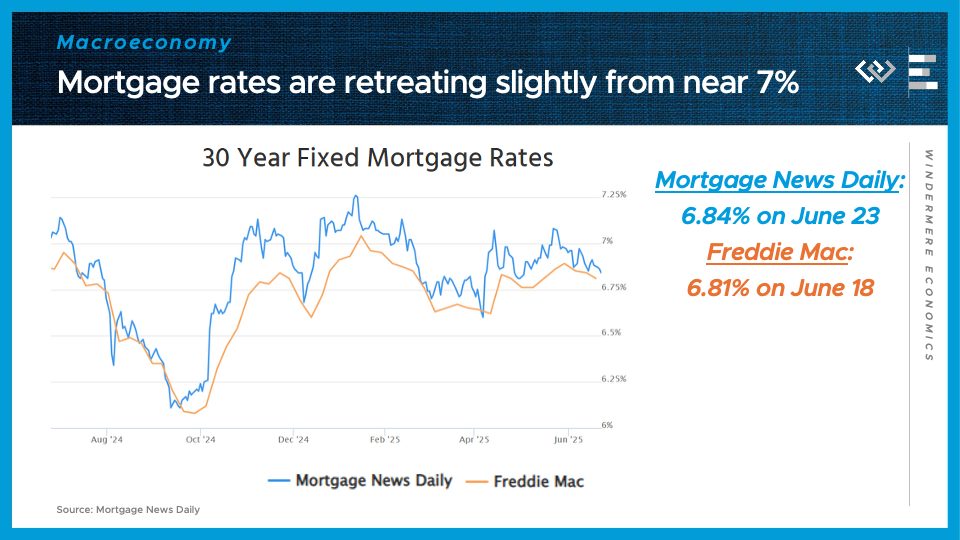
Finally, it’s another pretty quiet month for mortgage rates, which are once again stuck in a range between 6 and ¾, and 7%. It’s been a busy news month, but mortgage rates mostly took it in stride, drifting down slightly in the last couple weeks to end up basically where they were at this time last month. The Federal Reserve declined to change its overnight Federal Funds Rate at its June meeting, but there is growing pressure to resume cutting rates soon, if inflation remains as muted as it has been this spring. Personally, I still think the Fed will wait till clearer signs of labor market deterioration before cutting; moreover, a growth slowdown is probably what bond traders need to see before long-term yields like mortgage rates fall substantially.


Buying June 23, 2025

Planning Ahead: A 12-Month Guide to Buying Your First Home

Thinking about buying a home can be daunting, especially if it’s your first time. What should be an exciting milestone can feel overwhelming without a clearly defined roadmap, and diving in headfirst without a solid plan can lead to unnecessary stress, financial surprises, and missed opportunities. However, by establishing a timeline and breaking the process down into manageable steps, you can move forward with confidence and clarity.

Here is your month-by-month guide to preparing for a successful home purchase in the following year.

12 – 10 Months Out

Know Your Why

Understand your motivation for buying. Are you relocating, growing your household, or ready to invest in your future? Clearly defining your “why” will help shape your search criteria and influence your budget, location, and timeline.

Set Clear Goals

Start to think about what you want in your new home. Create a list of your wants versus must-haves, including location, budget, size, and style of home. These goals will act as a compass throughout your search. Be sure to include your ideal timeline and what you hope to get out of the overall experience.

Find an Agent That Prioritizes Your Goals and Timeline

A trusted real estate agent is more than just a facilitator; they’re a guide, negotiator, and advocate. Look for someone who understands your timeline and long-term vision and is familiar with the local market. Ask them to provide a first-time buyer’s guide or checklist to help you get started. Building this relationship early allows your agent to understand your needs and preferences in advance, setting the stage for a smoother process when you’re ready to make your move.

9 – 7 Months Out

Assess Your Finances

Take a close look at your income, debt, and spending habits. Use this time to create a monthly budget that includes future mortgage payments, utilities, insurance, taxes, and home maintenance. Many experts recommend spending no more than 28% of your gross monthly income on housing costs.

Boost Your Credit

Your credit score has a significant impact on your buying power, including your mortgage rate and loan approval. Take the next few months to pay down high-interest debt, stay current on all payments, and avoid opening new credit accounts. Check your credit report for errors and work on improving your score if needed.

Start Saving

You’ll want to have enough set aside not only for a down payment, which is typically 3% to 20% of the purchase price, but also for closing costs, moving expenses, and initial home repairs or furnishings. During this time, try to avoid nonessential major purchases and think about setting up a dedicated home savings account to stay consistent.

6 – 4 Months Out

Talk to a Financial Advisor

A financial advisor can help you align your financial goals with your homebuying plans. They can offer advice on what you can realistically afford and help identify areas to strengthen your financial readiness. You can also use tools like an online mortgage calculator to get a clearer idea of what your future monthly payments might look like.

Research Homebuyer’s Courses & Guides

Take advantage of first-time homebuyer resources, guides, and online courses. The more you know earlier on, the more confident you’ll feel.

3 – 2 Months Out

Familiarize Yourself with the Market

Start browsing homes and monitoring prices in the neighborhoods you’re interested in. Learn whether your local market is currently favoring buyers or sellers and what that could mean for your strategy.

Meet with a Lender and Get Pre-Approved

Meeting with a lender and getting pre-approved can help give you a clear picture of how much you can borrow and what price range to shop within. It also shows sellers that you’re a serious buyer when the time comes to make an offer. Your realtor can recommend trusted lenders to work with and assist you through this process.

Start Your Home Search

Now that you have your list of wants and needs and know your price range, you’re ready to start searching for your dream home. Use online property research tools to filter by location, features, and price to see what’s available in the locations you like. Narrow down your top homes and start scheduling showings and comparing listings.

1 Month Out

Make an Offer

Once you find “the one,” your agent will help you craft a competitive offer, negotiate terms, and guide you through contingencies.

Get a Home Inspection
If your offer is accepted, a licensed inspector will identify any issues with the property before you finalize your purchase. Depending on what comes up, this can give you leverage to negotiate repairs or price adjustments.

The Time Has Come

Closing On Your New Home
You’ve made it! During closing, you’ll sign paperwork, pay final costs, and receive the keys to your new home. Your agent and lender will walk you through the final steps to ensure everything goes smoothly.

Buying a home may seem like a big leap, but with a solid 12-month plan and the right support, it can be an extremely rewarding experience. Take it one step at a time and know that a trusted agent is here to help whenever you’re ready.

ArchitectureDesign June 16, 2025

Pueblo Revival Architecture and Its Timeless Southwestern Charm

Pueblo Revival architecture is one of the most distinctive and enduring styles in the American Southwest. With its warm stucco walls, rounded edges, and earthy materials, it’s a look that’s both culturally significant and inviting. Rooted in Indigenous and Spanish colonial traditions, this style has evolved over time while remaining closely tied to the landscape and climate it was originally built for. Today, Pueblo Revival homes continue to charm homeowners with a timeless design and unmistakable Southwestern character.

Origins and Historical Significance

Pueblo Revival architecture has roots that run deep, drawing inspiration from the Indigenous Puebloan communities and early Spanish settlers of the Southwest. This blend of cultures creates structures that reflect a centuries-old tradition of building in harmony with the environment. Built to thrive in arid climates, these homes feature thick walls made from adobe or stucco, which helps keep interiors cool during the day and warm at night.

It’s a design ideally suited for the desert, where water isn’t abundant, and staying comfortable means working with, not against, the elements. Spanish influences brought the use of wood, while the earthy colors mirror the atmosphere. Today, you’ll find Pueblo Revival homes across Arizona, New Mexico, California, and beyond, each one a testament to Southwestern living.

Key Features and Design Elements

Pueblo Revival design, also known as Santa Fe and Southwestern, is easy to spot and even easier to love. Here are some hallmark elements:

  • Walls are typically built with adobe, stucco, or sun-dried mud.
  • Flat or low-pitched roofs with parapets.
  • Rounded corners and soft edges create a gentle, organic feel.
  • Neutral and earthy color palettes inspired by the desert landscape.
  • Large Spanish-inspired wooden doors, exposed beams, and vigas add warmth and texture.
  • Small, deep-set windows.
  • Porch posts and covered patios provide shade from the desert sun.

Modern Interpretations and Living Spaces

Today, Pueblo Revival homes continue to evolve, embracing modern conveniences while staying true to their roots. Many still feature signature elements like exposed wood beams, earth-toned exteriors, and textured finishes. Thoughtful landscaping and eco-friendly materials continue to help these homes blend seamlessly with the surrounding desert environment.

Inside, you’ll often find interiors that echo the home’s Southwestern heritage in subtle and loud ways. Handcrafted pottery, cactus plants, woven textiles, and other nods to regional artistry bring warmth and character to the space. Rich desert-inspired hues like terracotta, sunset red, adobe orange, and golden yellow are often paired with earthy neutrals to create depth. Vibrant accent colors like turquoise or deep blue add a touch of contrast, reflecting the natural beauty of the landscape. The result is a space that feels grounded, soulful, and full of life.

Explore our guide to Southwestern interior design for more inspiration.

Pueblo revival homes are a celebration of history, craftsmanship, and natural beauty. Whether you’re captivated by their timeless charm or drawn to their modern interpretations, these homes offer a well-balanced, organic lifestyle that’s always in style.

Selling June 9, 2025

Finding the Right Agent to Sell Your Home

Selling your home is a collaborative effort between you and your real estate agent. As you prepare to sell your home, it’s crucial to find an agent who not only can answer your questions throughout the selling process but also understands your unique goals and values the happiness of you and your household. 

Before You Begin Your Agent Search  

Once you’ve decided to sell, there are some things to consider before selecting an agent to work with.
 

Communicate Your Reason for Selling 

  • Behind every homeowner who decides to sell their home, there’s a story, and every story is unique. In the early stages of working together, your agent will be processing a lot of information about your timeline and financial goals. Having these details ironed out and ready to communicate will help them understand your motives and guide the process effectively.  

Think About Selling Strategy 

  • Part of a real estate agent’s expertise is knowing the optimal selling strategy to pursue, but no one knows your home better than you. Putting time and effort into thinking about things like how your home will be marketed and how showings will be conducted will help inform your agent’s strategic advice.

Finding the Right Agent for You 

You and your agent will be communicating throughout the process of selling your home. You’ll be relying on them for updates and information each step of the way. Though your goal in working together is ultimately the sale of your home, your agent’s ability to connect with you on a human level through the emotional ups and downs of the selling process is just as important as their professional attributes. Accordingly, you’ll want to consider what qualities you’re looking for in an agent. 

To set yourself up for identifying good candidates, talk to people you trust who know your personality and goals. Get referrals from your family, friends, colleagues, and neighbors. If they recommend someone, follow up with that agent to see if they are a good fit for you.

Searching for an Agent 

To give yourself the best pool of potential agents, conduct your search both online and in person. Exploring an agent’s social media profiles and reading reviews online can help assess whether they’re someone you want to work with. If in-person showings and open houses are occurring in your market, consider dropping by to get a chance to interact with the agent first-hand. After you have narrowed your agent search, ask for client references to get more insights into what it’s like to work with them.

Agent Certifications   

Some agents choose to earn additional certifications or designations that showcase their commitment to further training, coursework, and learning, helping them specialize and advance their capabilities. Depending on your specific needs, certain designations may appeal to you as you go about finding the right agent to sell your home. The National Association of REALTORS® offers the largest number of professional designations. Explore them here: NAR Designations and Certifications.
 

For help finding the right agent for you, we’re happy to connect you with an agent below: 

Market News June 4, 2025

Local Look: Western Washington Housing Update 6/5/2025

Hi. I’m Jeff Tucker, principal economist at Windermere Real Estate, and this is a Local Look at the March 2025 data from the Northwest MLS.

Last month, we saw a sudden pullback in pending sales, and those chickens came home to roost with fewer closed sales in May.

Many of these impacted closed sales originated from the weeks in April following Trump’s “Liberation Day”, when the stock market had dropped sharply, and a lot of buyers paused their home searches. Now, we saw the stock market fully recover by May, and while it’s still a little too early to tell, there are indications that the housing market is also getting back on track.

Here are the four key metrics I watch to track supply and demand in the market: closed and pending sales, which tell us a lot about demand; and listings – new and active – which tell us a lot about supply.

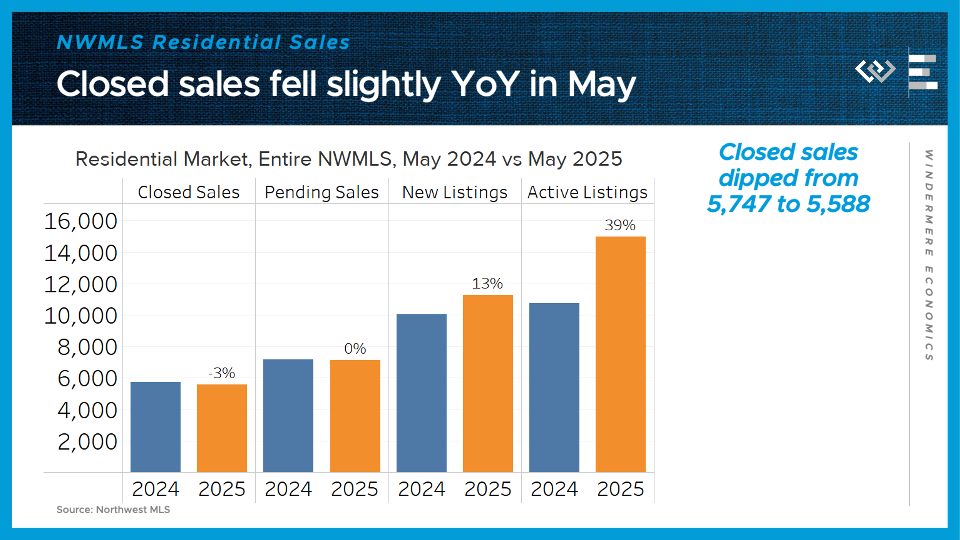
Across the Northwest MLS, closed sales of single-family homes fell 3% in May from their year-ago levels, after growing 1% in April. Pending sales, which are more of a real-time demand indicator, were flat from last year, a promising rebound after falling 4% year-on-year in April.

On the supply side, about 13% more new listings hit the market this May, and the tally of active listings ended the month 39% higher than May 2024’s inventory.  Buyers are still seeing a lot more options than they had last spring, but one little glimmer of an inflection point here is that year-over-year inventory growth has stopped accelerating higher.

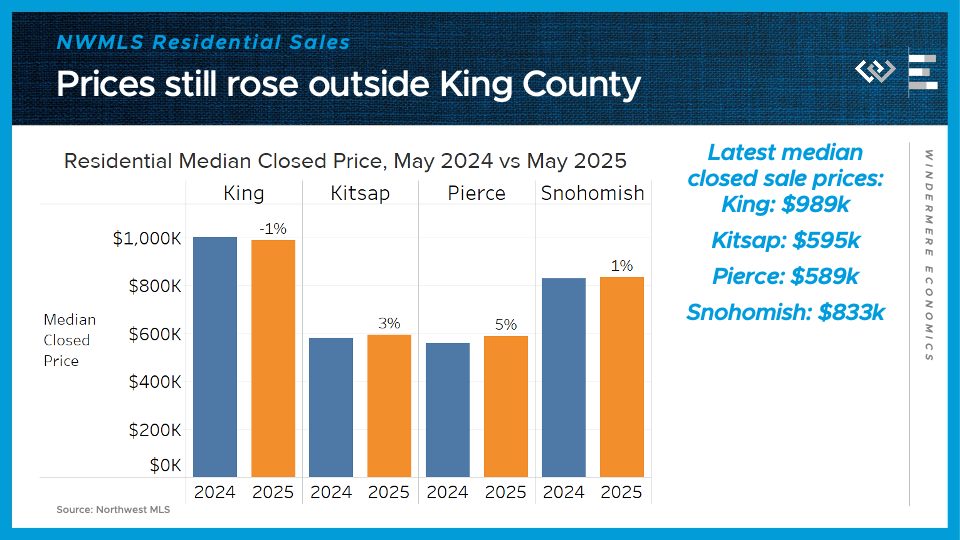
Finally: the median price for those closed single-family home sales fell 1% from last year, to $677,500. The extra inventory and cautious buyers have brought price appreciation to a halt for now.

Putting it all together: closed sales, and home prices, stepped down slightly from last year at this time, which we were expecting after the weak demand signals in April’s data. But the pending sales data suggest that buyers started coming back in May.

Now I’ll dig into details for the four counties encompassing the greater Seattle area.

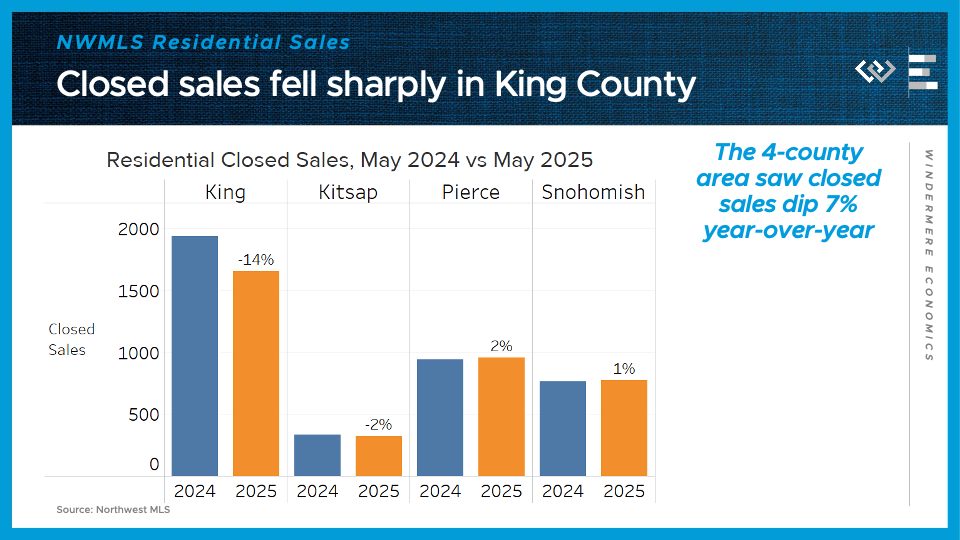
Residential closed sales dipped 7% year over year here in the 4-county region, led by a 14% drop in King County. Closed sales dipped 2% in Kitsap County; climbed 2% in Pierce County, including Tacoma; and climbed 1% in Snohomish County, including Everett. The 3 counties other than King held up surprisingly well, given that all 4 counties had seen sizeable pending sales declines in April. Maybe some buyers came back and closed quickly in May!

Similarly, King County saw the only median sale price decline, by 1.2%, back down just below a million dollars, while median prices kept climbing modestly in Kitsap and Pierce Counties, and just barely climbed in Snohomish County.

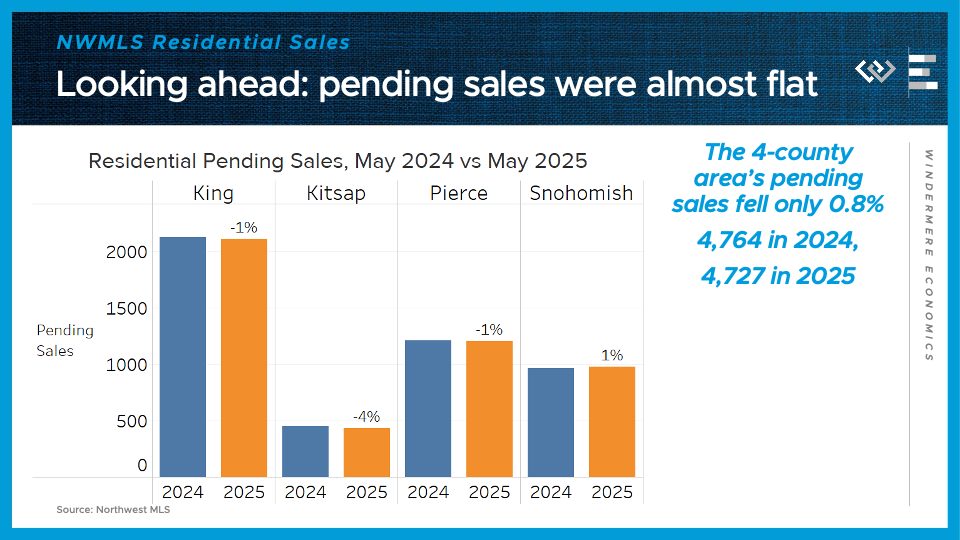
Looking ahead, pending sales dropped only 0.8% in the 4-county area: 0.8% in King, down 4% in Kitsap, down 0.7% in Pierce, and up 0.8% in Snohomish County. That’s a strong indication that local market activity has rebounded a bit after the shock in April around new tariff announcements.

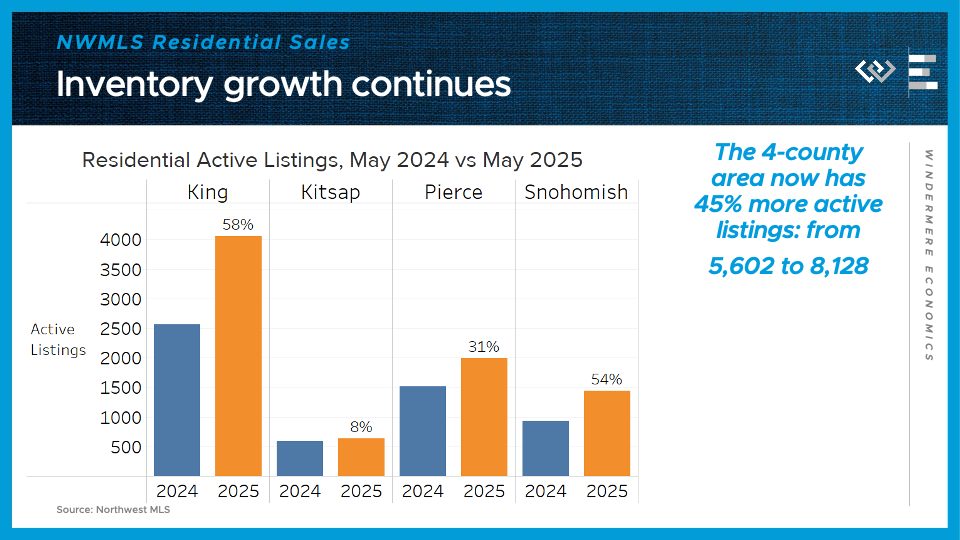
On the supply side, the 4-county greater Seattle area had just over 8,100 active listings at the end of May, up 45% from the same time last year. Just like in April, the inventory growth is especially dramatic in King and Snohomish Counties, where listings are up 58% and 54% respectively. Kitsap inventory is only up 8% year-over-year.

All in all, this report confirmed that greater-Seattle-region buyers stepped back in April, but gave some promising indications that buyers returned at nearly year-ago levels in May. Economic uncertainty is still the watchword, and mortgage rates have unfortunately settled in at a higher range of around 7%. But buyers shopping now will definitely benefit from the most inventory in years, helping them find the perfect fit, all while facing less competition from other buyers than we’ve seen in recent spring selling seasons.

Design June 2, 2025

5 Defining Elements of Moroccan Interior Design

For centuries, Morocco has captivated people from around the world with its rich tapestry of culture, art, and unmatched design. From the lively souks of Marrakech to the serene riads of Fes, Moroccan interiors tell a story of intricate craftsmanship, vibrant colors, and a blend of tradition and global influence.

In this post, we’ll look at the influences behind Moroccan design and explore how you can bring its distinct style into your home.

Influences of Moroccan Design

Moroccan interior design is rooted in ancient tradition and draws from various cultural influences, including Berber, Arab, Mediterranean, and Moorish. This fusion creates a warm, layered aesthetic that pairs detailed patterns with earthy textures and natural materials. You’ll often find colorful tilework, bold textiles, and handmade pieces that reflect centuries of artistry and heritage. And though this style is steeped in history, it remains timeless, seamlessly blending into modern homes while adding warmth, character, and a global touch to any space.

Key Elements of Moroccan Interior Design

Vibrant Colors

Moroccan design is synonymous with a vibrant and expressive color palette. Think of the dazzling blues of Chefchaouen, the rich reds and oranges of Marrakech, or the natural greens found in traditional gardens. Don’t be afraid to experiment with jewel tones like emerald green, sapphire blue, and ruby red, which you can balance with more neutral tones like terracotta, cream, and black to create a harmonious blend that pops. Even the most muted Moroccan room will feature a splash of something bold, whether in the tiles, lanterns, or layers of fabric.

Layered Textures

From olefine and wool rugs to carved wooden furniture and hand-woven baskets, texture is everywhere in Moroccan interiors. Plush, overstuffed cushions and floor pillows bring comfort to seating areas, while airy curtains soften windows and doorways. The thoughtful use of natural materials like clay, metal, leather, and stone gives each space a grounded, organic feel. This layered approach, combined with the intricate patterns and ornate detailing, provides a richness and depth that defines Moroccan design.

Mosaic Tilework

One of the most recognizable elements of Moroccan design is its stunning mosaic tilework, known as zellige. These hand-cut, geometric tiles are meticulously arranged to form intricate patterns that adorn walls, floors, and fountains. Each zellige piece is a testament to centuries-old craftsmanship, bringing a unique sense of artistry and a cool, refreshing feel to any space. Tiled floors are frequently layered with Persian or Berber rugs. At the same time, fireplaces, kitchen backsplashes, and bathroom walls may feature elaborate tilework that feels artistic and architectural. Incorporating zellige in your home, whether as a subtle accent or a vibrant statement, can instantly infuse an authentic touch of Moroccan design.

Riads and Courtyards

The word “riad” means “garden” in Arabic. In Moroccan architecture, a riad refers to a traditional home built around a peaceful interior courtyard. These courtyards are often the heart of the home, featuring tiled fountains, lush greenery, and shaded sitting areas. To replicate this feeling, consider making a designated “courtyard” area in your home by incorporating a small water feature, a collection of plants, and comfortable seating that fosters a sense of tranquility and connection to the outdoors.

Artisan Accessories

No Moroccan interior is complete without a variety of handcrafted accessories. From ornate brass lanterns and pierced-metal sconces to hand-thrown pottery and embroidered pillows, each piece tells a story that celebrates Morocco’s deep tradition of craftsmanship, giving your space a layered, lived-in feel that reflects both style and soul.

By bringing these 5 key elements into your home, you can create a space that feels soulful, timeless, and uniquely yours. For more design inspiration, tips, and trends, visit the design section of our blog.

Market News May 21, 2025

Housing & Economic Update: Numbers to Know 5/21/25

This is the latest in a series of videos with Windermere Principal Economist Jeff Tucker where he delivers the key economic numbers to follow to keep you well-informed about what’s going on in the real estate market.

This week I’m jumping right back in to check on the elephant in the room this spring: tariffs. The first number to know is

17.8%

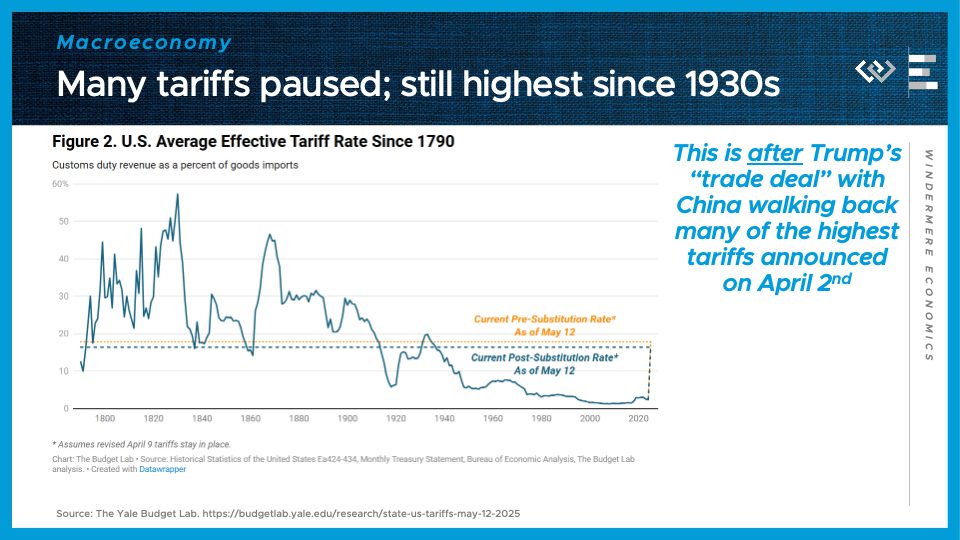
The new average effective tariff rate on US imports, which is down sharply from 27% last month, but still the highest since 1934, and still about 5 times the level prevailing at the start of this year. That’s according to the Yale Budget Lab’s latest estimates as of the week of May 12.

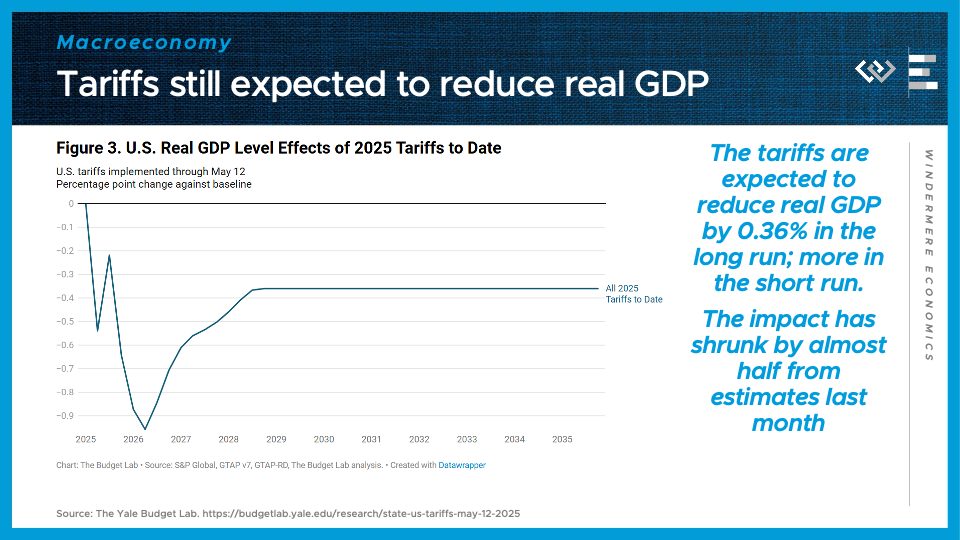
This smaller tariff hike will still be expected to reduce real GDP in the United States. The Yale Budget Lab’s model predicts a decline in real GDP of 0.36 percentage points in the long run, after a deeper short-run negative shock. But like the tariffs themselves, that impact has shrunk by almost half from what was projected under the much harsher tariffs last month.

Just as important as the reduction in proposed tariffs, is the sense that investors are getting that this means more walkbacks are on their way.

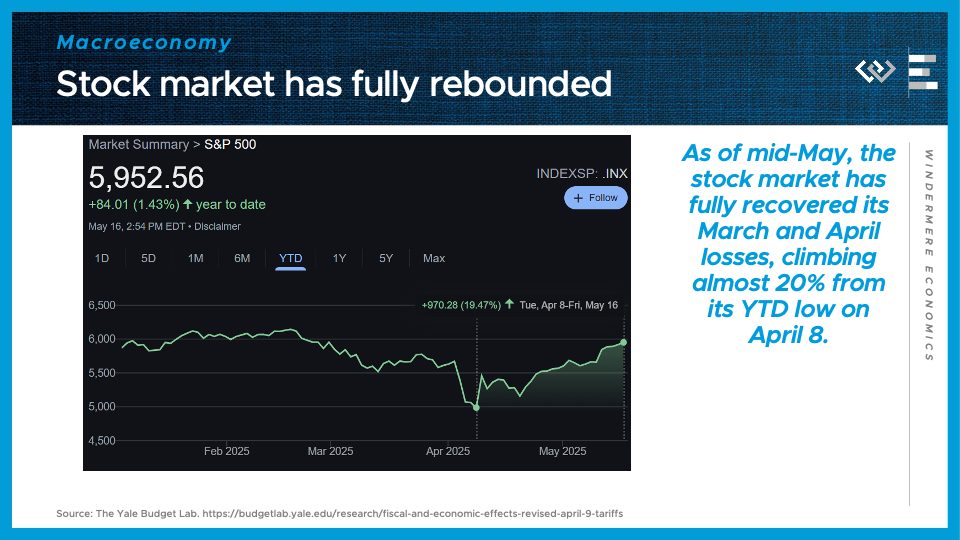
The stock market in particular has now fully regained all its losses, and has now risen slightly year-to-date, or about 20% from its early April trough. That suggests to me that investors have concluded we won’t actually see a major hit to growth of US companies’ profits, and US economic output, after all this year.

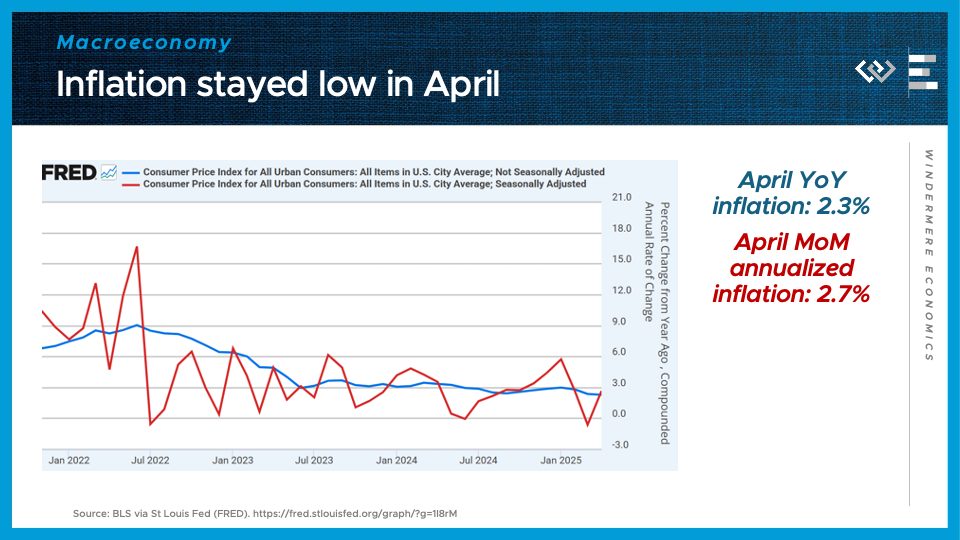
The tariffs that have gone into effect are still not passing through much of a price shock to consumers. April inflation data came in about as expected, without a spike in goods prices yet, so year-over-year inflation ticked down again, now to 2.3%.

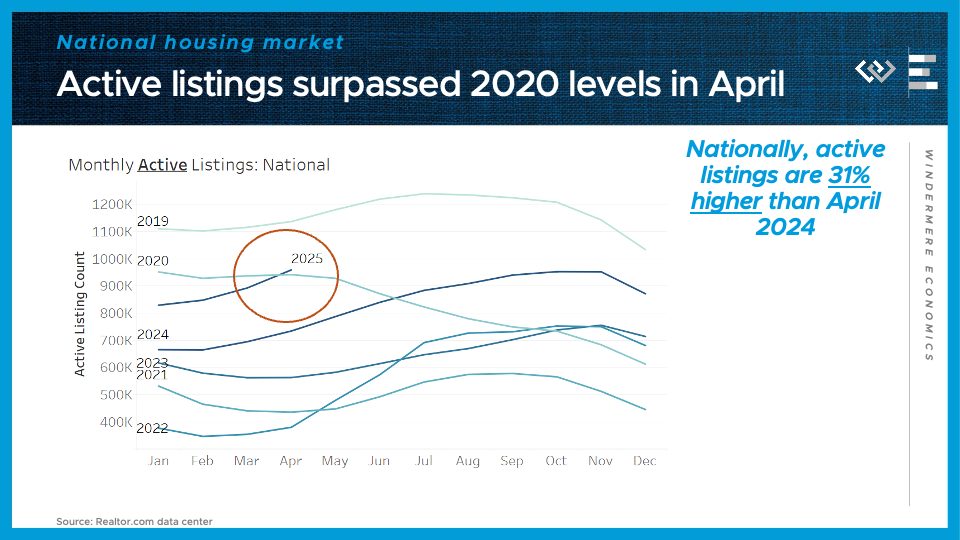
Turning to the national housing market, we reached a major milestone of seeing more active listings at the end of April than the same month in 2020 – the first time that has happened since the inventory plunge began that spring. Many parts of the country now have inventory even above 2019 levels, including the Pacific Northwest. Active listings ended the month of April 31% higher than the same time last year.

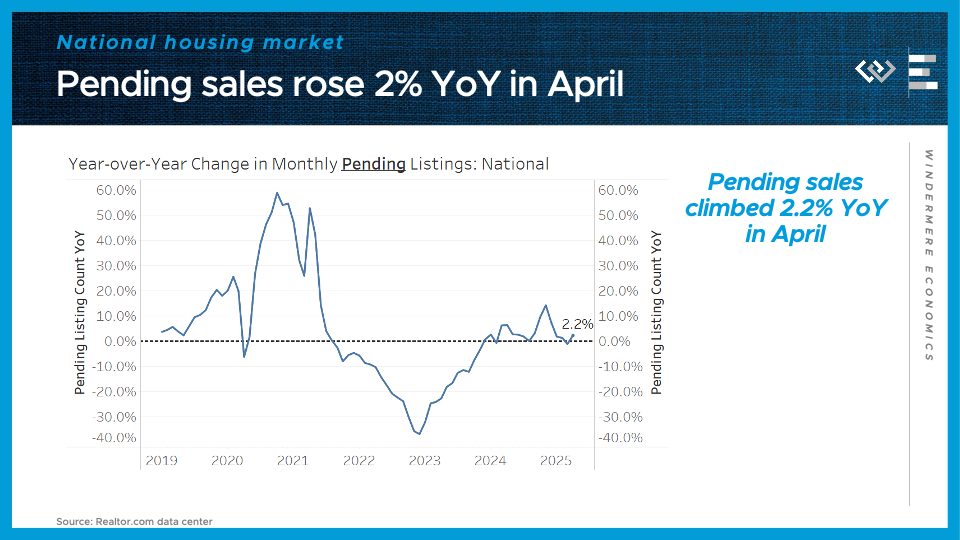
Pending sales actually ticked up slightly year-over-year in April, by 2.2%. This was surprisingly upbeat, given the negative turn in consumer sentiment last month, and I think it masks a lot of regional variation, like a 12.7% year-over-year decline in the Seattle metro area this April.

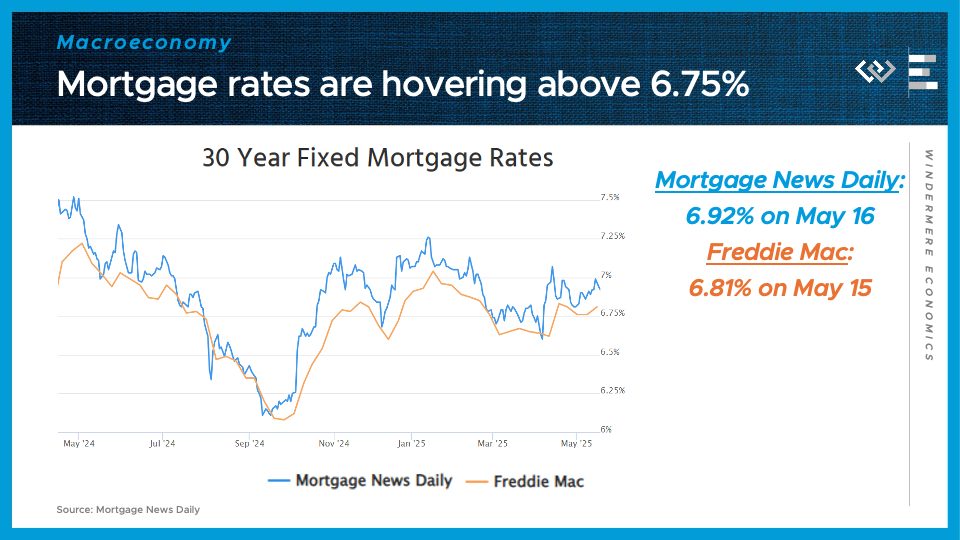
Finally, I’ll end by checking in with the USUAL elephant in the room: mortgage rates, which are still stuck in a range between 6 and ¾, and 7%. It seems like the bond market just can’t catch a break this year, because even after the stock market recovered from the tariff turmoil, the falling fear of a recession, and rising expectations for an explosion in the deficit based on Congressional budget drafts now circulating, are conspiring to keep bond yields and mortgage rates high for the foreseeable future.

Buying May 19, 2025

Real Estate Contingencies: What They Are and Why They Matter

Imagine a home-buying scenario where you make an offer, the seller immediately accepts, and everything goes smoothly until you’re handed the keys. It’s possible, but more often, buying a home involves negotiation, counteroffers, and a back-and-forth dialogue between buyer and seller to reach a deal. And in some cases, the deal can fall through.

That’s where contingencies come in.

Contingencies are built-in protections within a real estate contract. They help both buyers and sellers navigate the natural ups and downs of the home-buying process by setting clear conditions that must be met for the sale to go through. For buyers, they also provide important safeguards, along with strategic tools to shape and strengthen their offer. Whether you’re a first-time home buyer or you’ve bought before, you should be aware of common real estate contingencies and the role they play in making an offer on a home.

Making a Contingent Offer on a Home

Once you and the seller agree on the price of a home, both parties have certain responsibilities before closing. Buyers are responsible for securing financing, scheduling a home inspection, and getting the property appraised. Sellers are responsible for prioritizing the offer on the table and opening their doors to the home inspector when the time comes. The agreed-upon contingencies included in the contract define what happens if something doesn’t go as planned.

Contingencies present a spectrum of options to home buyers, allowing them to walk away from a real estate transaction with their earnest money intact or renegotiate the contract. And while including contingencies offers protection and negotiation leverage, removing them can be an effective strategic move too, especially in a competitive market.

In a seller’s market, competition amongst buyers is high, and they often face multiple-offer situations. It’s not uncommon to see escalation clauses, bidding wars, and all-cash offers as buyers try to stand out and strengthen their position. To sweeten their offers in such market conditions, buyers will typically waive their contingencies. However, while waiving contingencies can make for a more attractive offer, it also presents increased risk due to lack of protection. That’s why it’s necessary to understand each contingency and carefully consider what makes the most sense for your situation.

Common Real Estate Contingencies

Home Inspection Contingency

After you’ve made an offer, a professional home inspector will thoroughly examine the property before the deal is finalized. If issues are uncovered, this contingency allows you and your agent to request repairs, present the seller with a new offer that accounts for the home’s lessened condition, or cancel the contract entirely.

Financing Contingency

Also known as a “mortgage contingency,” a financing contingency gives the buyer a specified period of time to secure adequate financing to purchase the home. Even if you are pre-approved for your mortgage, you may not be able to obtain the right loan for the home. If you are unable to finance the purchase, this contingency allows you to back out of the contract and recover your earnest money, and the seller can re-list the home.

Appraisal Contingency

An appraisal contingency states that the home must appraise for, at minimum, the sales price. In other words, it is to make sure the home is worth the agreed-upon price. It allows you to walk away from the deal if the property’s appraised value is lower than the sales price and typically guarantees that your earnest money will be returned.

Home Sale Contingency

If you’re buying a new home while selling your current one, you may want to include a home sale contingency in your offer. This contingency specifies the date by which you’ll need to sell your current home in order to move forward with your offer. If you don’t sell your home by the specified date, the contract is terminated. Home sale contingencies are financially appealing in that they allow buyers to use the proceeds from their home sale to fund their new home purchase. However, these contingencies force sellers to wait until the buyer’s current home sells, which means they likely won’t accept such offers in competitive markets.

Title Contingency

Before the sale of a home goes final, a search will be performed to ensure that any liens or judgments made against the property have been resolved. A title contingency allows you to raise any issues you may have with the title status of the property and stipulates that the seller must clear these issues up before the transfer of title can be completed. If an unpaid lien or unpaid taxes turn up in the home’s title search, this contingency also allows you to back out of the deal and look for another home.

To learn more about preparing a winning offer, connect with a local, experienced Windermere Real Estate agent.

Selling May 13, 2025

A Step-by-Step Guide to a Smooth and Successful Sale

Navigating everything involved with selling your home can seem intimidating. Breaking the process down step by step will keep you organized and ready to work with your agent toward a successful home sale.

1. Choose an Agent

A lot goes into choosing the right agent. If you’re unsure where to start, get referrals from trusted friends, family, and neighbors. Although the ultimate goal is the sale, think about your compatibility outside of the transaction. Their ability to connect with you on a human level through the ups and downs of a home sale is just as important as their expertise and knowledge of the market.

Pro tip: Look for someone who communicates the way you do—whether that’s testing, emailing, or good old-fashioned phone calls. Feeling heard and understood can make all the difference in building trust and making the process more enjoyable.

2. Set a Timeline 

Depending on your local housing market conditions, your timeline for selling your home may vary. However, a timeline is valuable in that it will keep you organized throughout the selling process and allows you to adjust if circumstances change. Your agent will work with you to build the ideal timeline, one that reflects your personal goals, the local marketplace, and any milestones you may be working around. Having a clear plan reduces stress and ensures everyone is on the same page.

3. What is Your Home Worth?

The key to selling quickly is correctly pricing your home from the first day it hits the market. In particular, overpricing can lead to serious complications in the selling process. Your agent can provide you with a Comparative Market Analysis (CMA) to better determine the best price of your home. CMAs provide information on comparable home sales in your area, both pending and sold, within the past six months.

While an agent will always have the best information, you can also explore your home’s potential value with our real-time automated value estimate tool before connecting with your agent. Our seller page features home values and market information about what buyers are looking for in your area.

4. Repair & Upgrade

Now it’s time to get to work on the house! This is the perfect time to tackle any and all outstanding projects or repairs. Create a list separating which repairs can be done yourself and which need professional attention. This is also a great opportunity to consider a pre-sale home inspection to identify structural and mechanical issues or outdated features that could benefit from attention. Even small updates can go a long way—especially those that boost energy efficiency or add smart home appeal.

5. Make the Best First Impression

Creating a strong first impression can have a lasting impact on buyers, so roll up your sleeves and prepare to check off that to-do-list. Start by cleaning up the garden and lawn, clearing out gutters, and adding color to your flower beds. Apply a fresh coat of paint anywhere you spot peeling or cracked paint. A great way to make an impact is by staging your home, with the goal of making each room feel as spacious and welcoming as possible. Professional photography and even a little social media buzz can make your home stand out from the start.

6. Show Your Home 

Discuss virtual home tour options with your agent and other ways to generate maximum buyer interest. Consider 3D tours, virtual staging, or even drone footage if your property has outdoor highlights. These features can help your home stand out online and attract more attention, especially as many buyers now begin their home search digitally. For in-person showings, it’s best that you leave the premises so the buyer can freely ask their agent questions and visualize the home as their own.

7. Offers & Negotiation 

If you are in a seller’s market—defined by low inventory and high buyer competition—it is likely that you will receive offers at – or above – asking price. You can respond to an offer by a) accepting the offer, b) making a counteroffer, or c) rejecting the offer. Counteroffers should always be made in writing and provide a short window of time for the potential buyer to respond. If you are selling in a buyer’s market, you may have to be more open to negotiation. Discuss negotiation strategies with your agent to work toward a satisfying final price.

8. Prepare for Closing Costs

There are costs throughout the selling process, and as the close date approaches, that remains true. Be sure to budget for your real estate agent’s commission, and other common seller’s costs like title insurance, recording fees, and government transfer tax, among others.

9. Home Inspection

Buyer offers are usually contingent upon a professional home inspection. Ask your agent for a home inspection checklist, so you know what the inspector is looking for ahead of time. They typically inspect the home’s foundation, structure, roof, plumbing and electrical systems, floors, windows, doors, and more for signs of damage and weathering. Some buyers now opt for additional specialized inspections—like sewer scopes or radon testing—so it’s helpful to be prepared in advance for what might come up.

10. Closing Time

Congratulations! Your home is sold, but there are still some final steps before the deal is done. This is the time to ask the buyer to release any contingencies, sign the title, and close escrow before handing over the keys. Consult your real estate agent for any questions about legal documentation and settlement costs.

Whether you’re just starting to think about selling or ready to take on the next step, a Windermere agent is here to guide you. Click the button below to connect today.

Market NewsWestern Washington Real Estate Market Update May 7, 2025

Local Look: Western Washington Housing Update 5/7/25

Hi. I’m Jeff Tucker, principal economist at Windermere Real Estate, and this is a Local Look at the March 2025 data from the Northwest MLS.

Last month I said our local real estate market was on a roller coaster, and that proved true again, this month, as sales trends turned sharply downward after a strong March.

Pending sales fell below last month’s, and last year’s levels, as many buyers pressed “Pause” on their home purchase decisions, in the face of rising economic uncertainty and stock market volatility.

Here are the four key metrics I watch to track supply and demand in the market: closed and pending sales, which tell us a lot about demand; and listings – new and active – which tell us a lot about supply.

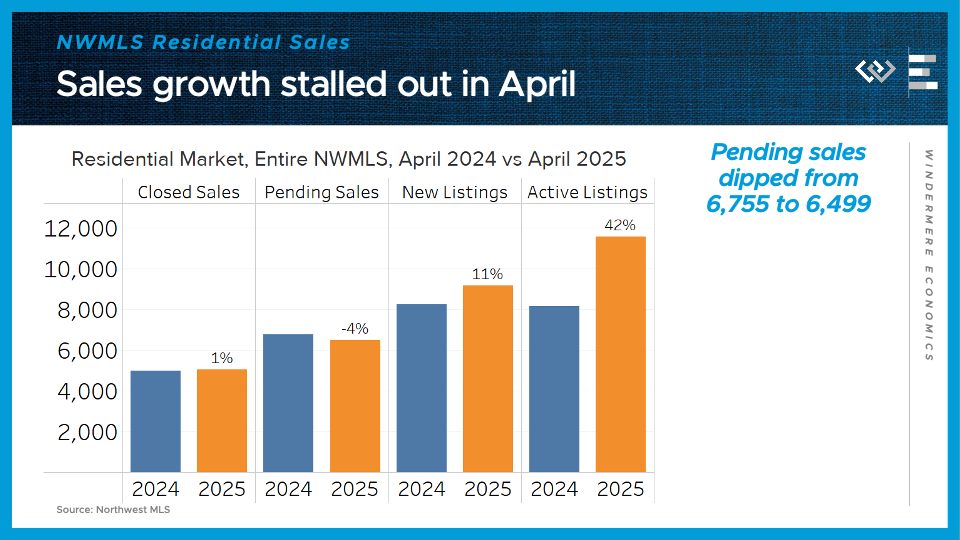
Across the Northwest MLS, closed sales of single-family homes grew just 1% in April from their year-ago levels, after growing 5% in March. Pending sales, which are more of a real-time demand indicator, dipped 4% from last year, a disappointing reversal after climbing 7% in March.

On the supply side, about 11% more new listings hit the market this April, and the tally of active listings ended the month 42% higher than April 2024’s inventory. Buyers are still seeing a lot more options than they had last spring.

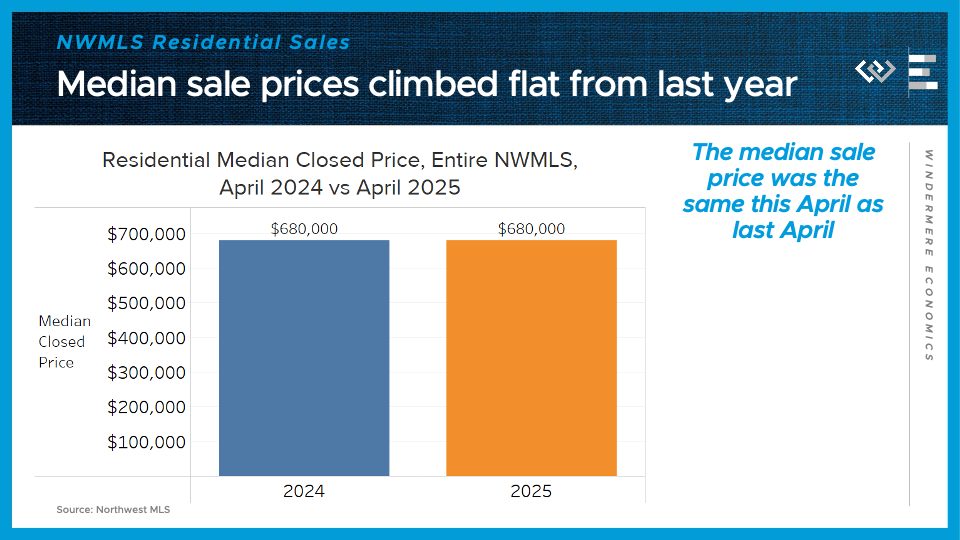
Finally: the median price for those closed single-family home sales was exactly the same this April as last year: $680,000. The extra inventory and cautious buyers seem to have brought price growth to a halt, for now.

Putting it all together: the market is looking pretty balanced across Washington, now that buyers took a step back in April, as they’re taking time to digest the impact of tariffs and stock market volatility.

Now I’ll dig into the four counties encompassing the greater Seattle area, where buyers pulled back even more.

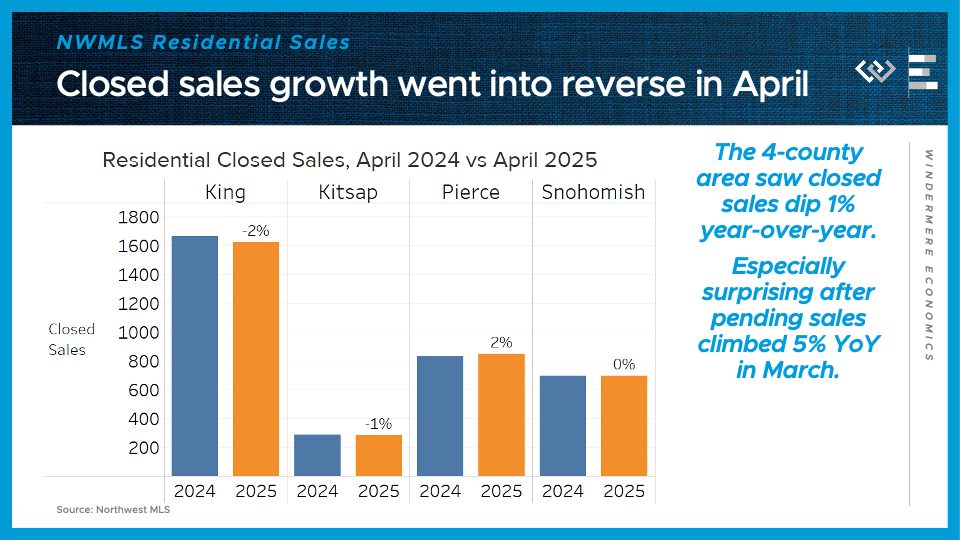
Residential closed sales dipped 1% year over year here in the 4-county region, largely due to a 2% drop in King County. Closed sales dipped 1% in Kitsap County; climbed 2% in Pierce County, including Tacoma; and were flat in Snohomish County, including Everett.

This is especially surprising because there was healthy pending sales growth around the region in March, suggesting either more cancellations, or that this dropoff happened mostly in the end of the month of April.

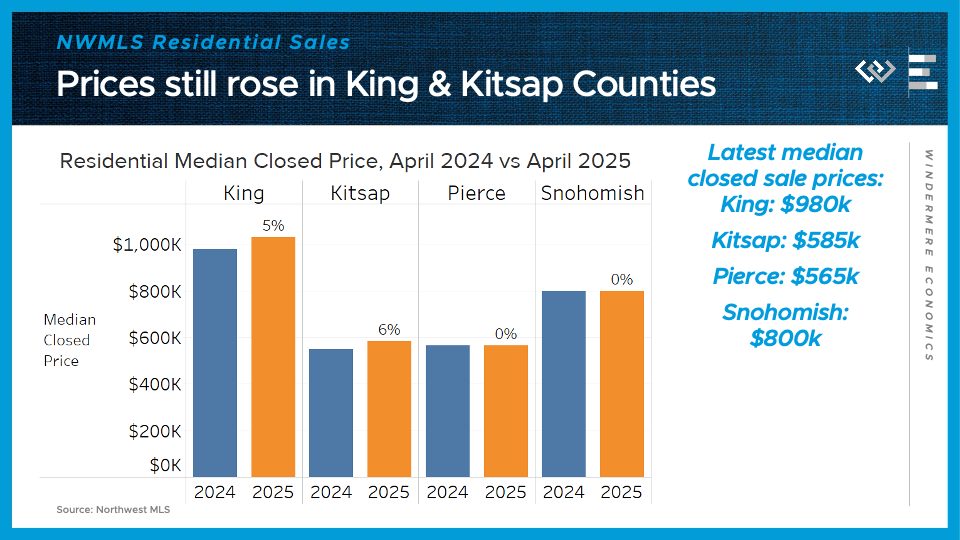
The median sale price kept marching upward in King and Kitsap Counties, by 5-6%, while prices were flat year-over-year in Pierce and Snohomish Counties.

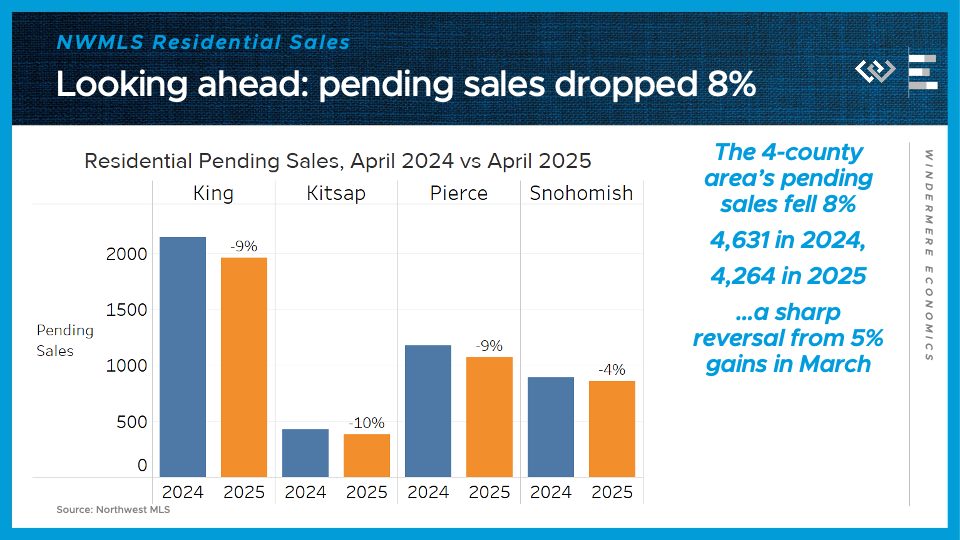
Looking ahead, pending sales dropped 8% in the 4-county area: down 9% in King, down 10% in Kitsap, down 9% in Pierce, and down 4% in Snohomish County. This is a sharp reversal from March’s gains, and suggests we will see closed sales slide in May.

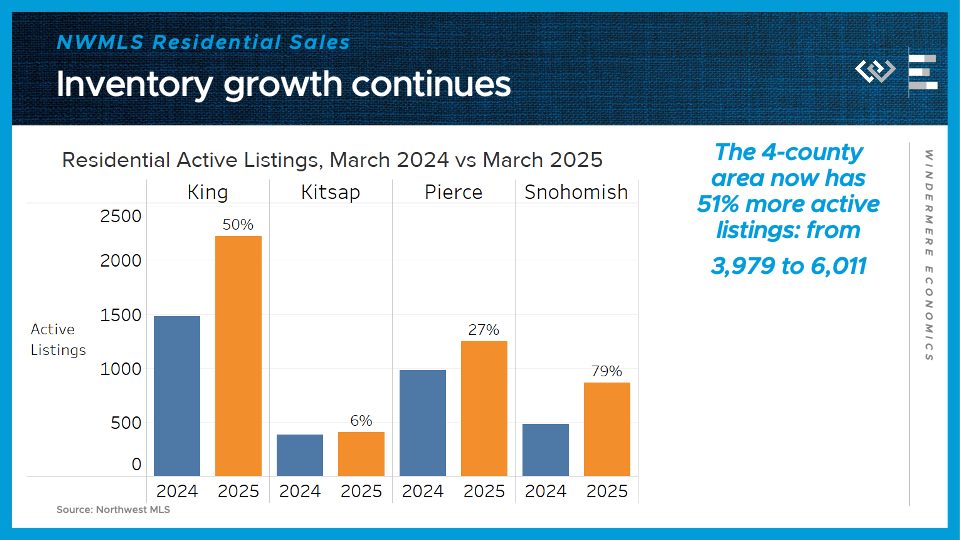
On the supply side, the 4-county greater Seattle area had just over 6,000 active listings at the end of April, up about half from the same time last year. Just like in March, the inventory growth is especially dramatic in King and Snohomish Counties, where listings are up 50% and 79% respectively.

All in all, these indicators from April show that the forward momentum in sales we saw in March has fizzled out for now, at least, because buyers have been hit by economic uncertainty and stock market volatility that’s caused some of them to pause their home buying search. Looking ahead, we saw stock markets actually end April about where they started, after a wild ride down and back up, so that may be cause for optimism that April’s negative shocks start to fade in the rear-view mirror. What comes next depends on whether the economic outlook and stock market movements stabilize and firm up.