More September 8, 2017

Welcome to the New Windermere Living Experience

If you regularly receive Windermere Living magazine, you might notice something a little different about this issue. That’s because we’ve given the magazine a total redesign to better reflect Windermere’s passion for community, connection, and inspired living.

Within the pages of this magazine you will find carefully curated editorial which we hope will give our readers an element of surprise and delight. Our goal is to write about people and places that bring a community to life.

In this issue, we celebrate the magic of Sun Valley, Idaho. A longtime favorite of Hollywood’s A-list and outdoor mavericks, the town of Ketchum and its community of inspired locals make this alpine escape a winter must. Additionally, we’ll take you behind the scenes with celebrity designer Jonathan Adler, who reveals his picks for cozy, chic living spaces. And don’t miss our new Destination GPS, which spotlights Windermere’s vibrant markets throughout the West.

And of course, the homes. Pages upon pages of beautiful homes in all shapes, sizes, prices, and neighborhoods all over the West Coast.

You need not be in the market for a home to enjoy Windermere Living; you just need an appreciation for real estate and elevated living. We hope you like it.

More September 6, 2017

How to Get Back to a Balanced Housing Market

More August 30, 2017

What You Should Know About Load Codes for Your Home Project

Anyone who has built, designed or remodeled a home has heard the term “built to code” and people saying, “The code requires it to be like that.” And when we hear things like this, we tend to think we’re getting a house designed and built to the highest standard.

But that’s not necessarily so. What the building codes do is establish an absolute minimum standard. This minimum may not be what you need in your home. You could, in fact, easily have needs that require the design and construction of your home to exceed code.


Load Codes 1: Wanda Ely Architect Inc, original photo on Houzz


This is especially the case when it comes to structural items. While the code mandates that structural systems be designed to support certain minimum loads, and to do so within certain tolerances, these minimums and tolerances may not be what you actually need. Who wants to live in a house where the floors are so bouncy that you feel like you’re walking on a trampoline? And what happens when you decide to move a water bed into the bedroom next to that stack of heavy books you cherish? Will you need to have your floor joists doubled up under that big soaking tub you are planning?

It’s wise to think about particular situations like this and look at the code mandates as a starting place, not the finish.


Load Codes 2: Bud Dietrich AIA, original photo on Houzz


Weight Loads

Building codes establish many project requirements, not the least of which is the project’s structure. This holds true no matter what material the house will be built of. And a key to designing a structural system is to determine what loads, or weights, will be imposed.

So we first have to look at what the house will be made of (wood, concrete, steel, masonry etc.) to determine the dead load — the weight of materials used in the permanent construction of the house. Note that it doesn’t include items like furniture, people, toys, books, television sets etc. and will vary only a little bit over the lifetime of the house.

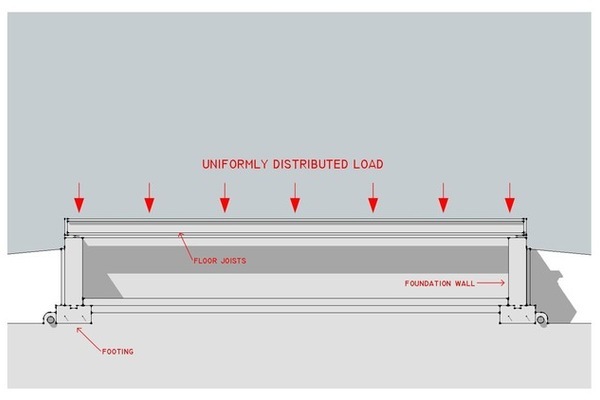
Next we use the governing building code to determine what the minimum live load — the impact of movable objects such as furniture and people — will be. For example, per code, the main living areas of a house have to be able to accommodate a uniform live load of 40 pounds per square foot. Bedrooms have a code requirement of 30 pounds per square foot, and roof structures have a varying live load, depending on climate (more snow equals more weight) and roof pitch (steeper roofs will shed snow faster).


Load Codes 3: Bud Dietrich AIA, original photo on Houzz


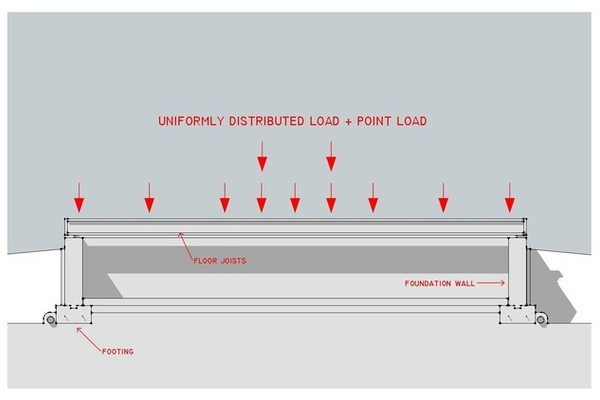
But the code-mandated uniform loading may not accommodate all of your furniture and books, that large cast iron soaking tub, your water bed etc. So you’ll want to identify any items that this code-mandated requirement won’t accommodate and design the structure accordingly. Otherwise, the extra weight of these items can cause the structure to fail.

When we say a structure has failed, we don’t necessarily mean the house has collapsed. Failure can simply mean a part of the structure has failed so there’s too much deflection. This will result in uneven floors, gaps between walls and floors, and so on.


Load Codes 4: Bud Dietrich AIA, original photo on Houzz


Deflection

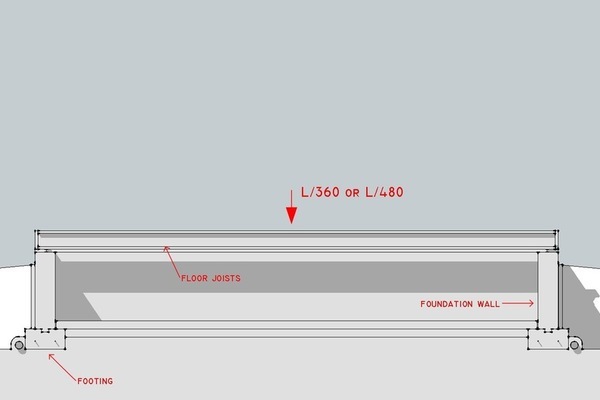
Deflection is the distance that a structural member (say, a floor joist) will bend when a load is placed on it. The greater the distance, the more the deflection and the less level the floor.

In addition to holding up a certain load, a structure has to stay rigid and keep its shape. But that’s nearly impossible, as any structure will start to deflect the moment any load is placed on it.

The code requires that this deflection be limited to L/360, where L is the length of the unsupported span. This means that for a floor structure that spans 18 feet (not uncommon in newer homes with open floor plans), the maximum allowable deflection is 0.6 inches.

In other words, a floor can sag more than a half inch and still be deemed OK. So some architects and engineers will use L/480 to calculate the allowable deflection. For an 18-foot span, using L/480 would limit the amount of deflection to 0.45 inches.

While the difference between 0.6 and 0.45 inches may seem insignificant, it really isn’t when it comes to a floor structure that gets walked on all the time.


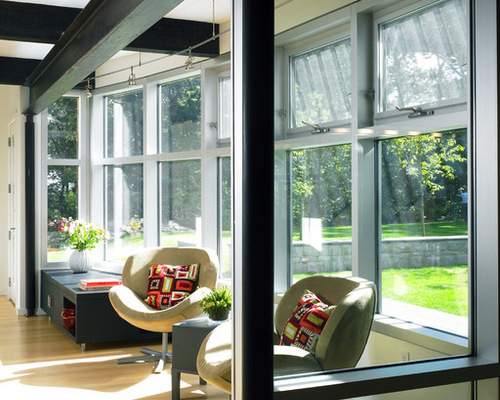
Load Codes 5: LDa Architecture & Interiors, original photo on Houzz


If you’re designing or remodeling a house, have a conversation with your architect and builder about what you plan to put into your home and how the structure will accommodate it.


By Bud Dietrich AIA, Houzz

Market News August 29, 2017

Housing Supply is an Issue that Will Not Improve Any Time Soon and Here’s Why


There are two common concerns about the housing market that one hears from both consumers and real estate professionals alike. First, they question whether or not we are on the brink of another housing bubble, and second, they want to know why there aren’t more homes for sale.

I don’t plan on addressing the concern regarding a housing bubble in this article except to say that we are not currently in “bubble” territory, although affordability does concern me immensely. Today I would like to concentrate on the second question about the lack of homes for sale.

According to the National Association of REALTORS®, there were 1.96 million homes for sale in the United States in May 2017. When adjusted for seasonality, this falls to just below 1.9 million which is essentially the same level we saw back in 2000.

Now consider that the country has added over 21 million new households during that same time period, and you can see why this is so troubling. It is worth noting that many of these new households did move into rental properties, but this still leaves the U.S. with a substantial housing shortfall, which explains why demand for homes is so high.

With the shortage of homes for sale, you would normally expect builders to meet this pent-up demand with new construction housing but, unfortunately, this has not been the case. In fact, new single-family housing starts are running at about 800,000 (annualized), and I believe we need starts to come in at over 1 million to satisfy demand – especially as older Millennials start to create households of their own and begin thinking about buying instead of renting.

We therefore have a quandary. Trust in the housing market has clearly returned, but there are not enough homes to meet the demand of buyers, and when a buyer does find a home, they are met with very stiff competition, which is driving prices increasingly higher.

So why are we in this position and how do we get out of it?

In reality, there is no single reason for the situation we are in today. Rather it is a number of factors that, when combined, suggest to me that the market will not return to equilibrium any time soon.

The first reason for the shortfall is purely demographic. As “Boomers” age, they are not following the trends of previous generations. Many are staying in the workforce far longer than their predecessors, and, as they are postponing retirement, they do not feel compelled to downsize. In fact, almost two-thirds of Boomers plan to age in place and not move even after retirement. Without this anticipated supply of homes from downsizing Boomers, there aren’t enough homes for move-up buyers, which in turn limits the supply of homes for first-time buyers.

Secondly, as a nation we just aren’t moving as often as we used to. When I analyze mobility, it is clear that people no longer have to relocate as frequently to find a job that matches their skill set. There has been a tangible drop in geographic specificity of occupations. Where we used to move to find work, this is no longer as prevalent, which means we are moving with less frequency.

Thirdly, as mentioned earlier, builders aren’t building as many homes as they could. This is essentially due to three factors: land supply/regulation, labor, and materials. The costs related to building a home have risen rapidly since the Great Recession, and this is holding many builders back from building to their potential. Furthermore, in order to justify the additional costs, many of the homes that are being built are larger and more expensive, and this is no help for the first-time buyer who simply can’t afford a new construction price tag.

Fourthly, while the general consensus is that home prices have recovered from the major correction that was seen following the recession, this is actually not the case in some markets. In fact, there are 32 U.S. metro areas where home prices are still more than 15 percent below the pre-recession peak. As equity levels remain low, or non-existent, in these markets, many would-be sellers are waiting until they have sufficient equity in their homes before putting them on the market.

And there is still one more issue that is certain to become a major factor over the next few years: interest rates.

Imagine, if you will, the country a few years from now when interest rates have normalized to levels somewhere around 6 percent. Now consider potential home sellers who are happily locked in at a mortgage rate of about 4 percent who are considering their options. Will they sell and lose the historically low rate that they currently have? Remember that for every 1 percent increase in rates, buyers can afford 10 percent less house. If they don’t HAVE to sell, their thoughts may lead to remodeling rather than moving. I think that this is a very reasonable hypothesis which could lead us to see low inventory levels for a lot longer than many think.

With little assistance from the new home market, I believe we will suffer from low inventory levels until well into 2018.

Our best hope for a more balanced market lies with builders, so hopefully they’ll be allowed to do what they do best – build more homes.

Market News August 28, 2017

Housing Supply is an Issue that Will Not Improve Any Time Soon and Here’s Why


There are two common concerns about the housing market that one hears from both consumers and real estate professionals alike. First, they question whether or not we are on the brink of another housing bubble, and second, they want to know why there aren’t more homes for sale.

I don’t plan on addressing the concern regarding a housing bubble in this article except to say that we are not currently in “bubble” territory, although affordability does concern me immensely. Today I would like to concentrate on the second question about the lack of homes for sale.

According to the National Association of REALTORS®, there were 1.96 million homes for sale in the United States in May 2017. When adjusted for seasonality, this falls to just below 1.9 million which is essentially the same level we saw back in 2000.

Now consider that the country has added over 21 million new households during that same time period, and you can see why this is so troubling. It is worth noting that many of these new households did move into rental properties, but this still leaves the U.S. with a substantial housing shortfall, which explains why demand for homes is so high.

With the shortage of homes for sale, you would normally expect builders to meet this pent-up demand with new construction housing but, unfortunately, this has not been the case. In fact, new single-family housing starts are running at about 800,000 (annualized), and I believe we need starts to come in at over 1 million to satisfy demand – especially as older Millennials start to create households of their own and begin thinking about buying instead of renting.

We therefore have a quandary. Trust in the housing market has clearly returned, but there are not enough homes to meet the demand of buyers, and when a buyer does find a home, they are met with very stiff competition, which is driving prices increasingly higher.

So why are we in this position and how do we get out of it?

In reality, there is no single reason for the situation we are in today. Rather it is a number of factors that, when combined, suggest to me that the market will not return to equilibrium any time soon.

The first reason for the shortfall is purely demographic. As “Boomers” age, they are not following the trends of previous generations. Many are staying in the workforce far longer than their predecessors, and, as they are postponing retirement, they do not feel compelled to downsize. In fact, almost two-thirds of Boomers plan to age in place and not move even after retirement. Without this anticipated supply of homes from downsizing Boomers, there aren’t enough homes for move-up buyers, which in turn limits the supply of homes for first-time buyers.

Secondly, as a nation we just aren’t moving as often as we used to. When I analyze mobility, it is clear that people no longer have to relocate as frequently to find a job that matches their skill set. There has been a tangible drop in geographic specificity of occupations. Where we used to move to find work, this is no longer as prevalent, which means we are moving with less frequency.

Thirdly, as mentioned earlier, builders aren’t building as many homes as they could. This is essentially due to three factors: land supply/regulation, labor, and materials. The costs related to building a home have risen rapidly since the Great Recession, and this is holding many builders back from building to their potential. Furthermore, in order to justify the additional costs, many of the homes that are being built are larger and more expensive, and this is no help for the first-time buyer who simply can’t afford a new construction price tag.

Fourthly, while the general consensus is that home prices have recovered from the major correction that was seen following the recession, this is actually not the case in some markets. In fact, there are 32 U.S. metro areas where home prices are still more than 15 percent below the pre-recession peak. As equity levels remain low, or non-existent, in these markets, many would-be sellers are waiting until they have sufficient equity in their homes before putting them on the market.

And there is still one more issue that is certain to become a major factor over the next few years: interest rates.

Imagine, if you will, the country a few years from now when interest rates have normalized to levels somewhere around 6 percent. Now consider potential home sellers who are happily locked in at a mortgage rate of about 4 percent who are considering their options. Will they sell and lose the historically low rate that they currently have? Remember that for every 1 percent increase in rates, buyers can afford 10 percent less house. If they don’t HAVE to sell, their thoughts may lead to remodeling rather than moving. I think that this is a very reasonable hypothesis which could lead us to see low inventory levels for a lot longer than many think.

With little assistance from the new home market, I believe we will suffer from low inventory levels until well into 2018.

Our best hope for a more balanced market lies with builders, so hopefully they’ll be allowed to do what they do best – build more homes.

More August 25, 2017

How Homeownership Impacts the U.S. Economy

More August 24, 2017

Windermere Offices Help Fulfill Back-to-School Needs


According to a 2017 back-to-school survey, parents will spend an average of $501 per child on school supplies, clothes and accessories, computers and hardware, and electronic gadgets for the school year. For school supplies alone, the average spend per child is $104, which can be a lot for parents who are having difficulties just trying to make ends meet.

Thankfully, through donations from the Windermere Foundation, many of our Windermere offices are able to support local nonprofit organizations that provide backpacks, supplies, and other back-to-school necessities to children and families in need. Some offices have even made this an annual giving/volunteer event.

These are just a few of the Windermere offices that volunteer their time and donate funds to support programs that help children whose families would otherwise be unable to afford the basic necessities for the school year.

El Sobrante, CA

On July 15, the Windermere El Sobrante office kicked off their annual back-to-school supply drive with an ice cream social at their office. At the event they collected backpacks, school supplies and other donations, and provided ice cream for attendees. The drive ran from July 11 through August 10. Office staff also shopped for additional backpacks and supplies. Backpacks were then filled with supplies according to age, and delivered to three local area schools to distribute to students in need at the beginning of the school year.

Helena, MT

From June 26 through August 18, the Windemere Helena office supported The Angel Fund’s 11th Annual Stuff the Bus school supply drive. Agents purchased school supplies to fill up a bin at their office. This is the first year that the office has supported this drive. Students in need from over 30 schools in Helena and surrounding areas benefitted from this event.

Seattle, WA

For the past six years, the Windermere Mount Baker office has supported the Seattle/King County Coalition on Homelessness’s Project Cool back-to-school supply drive by holding drives to collect school supplies, and by participating in their annual backpack-stuffing event. This year, the office made a $1,000 donation to Project Cool through the Windermere Foundation, and 18 Windermere agents, staff, and family members volunteered on July 18 where they stuffed 100 of the 1,100 backpacks provided that day. The stuffed backpacks were delivered to various local social service organizations and homeless shelters, to be distributed to children in need.

Generous donations from Windermere owners, agents, staff, and the community continue to make it possible for the Windermere Foundation to support programs like Project Cool. If you’d like to help children in need in your community during the school year, or throughout the year, please consider donating to the Windermere Foundation. To learn more about the Windermere Foundation, visit http://www.windermere.com/foundation

More August 21, 2017

How to Find the Perfect Paint Colors

Homeowners and designers know what a difference color makes in a home. They can spend hours poring over print and online images in search of the perfect hue. But sometimes the color in the image doesn't end up looking the same on the wall. Why?

"Have you ever bought a piece of clothing online, thinking it's one shade of a particular color, only to find that it's completely different when it arrives?" asks photographer Christopher Stark. "Same goes for photos." We talked with Stark, photographer David Duncan Livingston and designer Jean Verbridge to get the scoop on how you can find and get the perfect color for your walls.


Color 1: David Duncan Livingston, original photo on Houzz


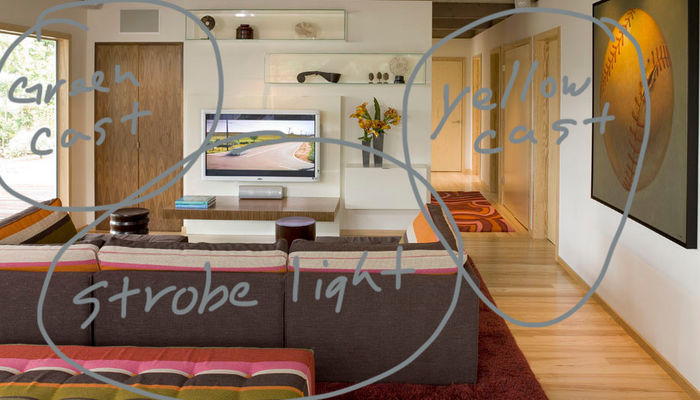
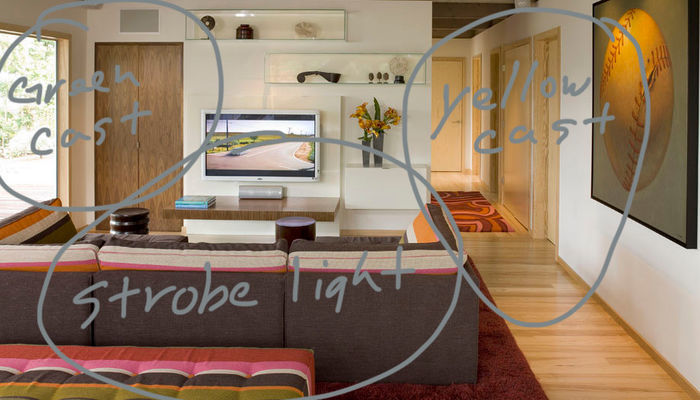
What makes a color look different from space to space? The ambience, look and feel of a color are highly dependent on an area's light and surroundings. The quality of the light in the room and how it hits each object makes a big difference. "The light can create color casts that change the appearance of the colors," says Livingston. "Think of the coolness of fluorescents or the warmth of incandescents."

"I usually pick the final color based on the time of day I'll be spending the most time in that room," says Verbridge. "It's also easier and less expensive to purchase small paint samples instead of painting an entire room and finding out you don't like the color."

Furniture, trim and accessories can change the look of a color from one room to another as well.

Related: Consult a Professional Painter First


Color 2: David Duncan Livingston, original photo on Houzz


Why do colors look different in photos and online? The changes in color and light in different rooms are captured in photos — and often are more exaggerated, as Livingston illustrates here. While most professional photographers work to correct these color shifts and make the colors clearly, the photos will show up on different devices in different ways. "When an image is reproduced on a laptop, a magazine page or a photographic print, each of the outputs is slightly different, and the colors may shift a bit," says Livingston.

Photographers set their monitor colors to the same calibration, which allows them to get very close with color accuracy in postproduction. But the same standard doesn't apply to other devices. "Most consumers are not looking at things on a calibrated monitor," says Stark. "I wouldn't make a major decision that isn't reversible without seeing [the color] in person."


Color 3: Contemporary Dining Room, original photo on Houzz


How do I get a color I love online into my home? While Verbridge doesn't recommend going with a color listed online or in a magazine — since your own light will likely make it look very different in your space — there's still a way to get the hue you're looking for: Get a hefty supply of paint chips to find a match. "Put the color match next to the photo on your screen and squint your eyes. If the two can blur together, you have a match," says Livingston. Try a few samples from that same paint strip to test in your room to find the best one for your room's lighting and surroundings.

Related: A Color Guide for Every Room in the House


By Vanessa Brunner, Houzz

More August 18, 2017

Should You Wait out the Housing Market?

BuyingSelling August 16, 2017

Downsizing: 5 Things to Consider


Downsizing is on the minds of many homeowners today. Some are ready to retire. Others want to live more simply. Many want to save money and say goodbye to home maintenance. If you can relate to any of those sentiments, ask yourself these five questions:


Have you done the math?

The financial savings that can be generated by downsizing can be significant – especially as they add up over time. Boston College Retirement Center (an independent, reliable resource) makes calculating this savings a snap. Visit www.SquaredAway.bc.edu and click on the calculator titled “Figure out how moving changes your finances” in the tools area of the website.


Have you researched elder-care options?

Many homeowners hold on to their current home longer than they should because their parents / parents-in-law may need to come live with them in the future. While a noble gesture, there are many excellent elder care living options available today. Often, all it takes is a tour of those facilities to realize that your loved one may actually be happier, and far better served, in a place devoted to their care and happiness.


Have you considered off-site storage?

You don’t need to immediately discard a big chunk of your belongings in order to downsize. In fact, trying to do so in one fell swoop only creates stress. Most people find it works much better to move some of their belongings into off-site storage for six months. During that time, you can gradually incorporate some of those items into your new living arrangement, and slowly figure out what to do with the others.


How do you feel about sharing costs and decision-making?

Townhomes and condominiums are popular downsizing options. But both require that you share the decision-making and expenses associated with any maintenance and improvement projects. If you’re a people-person, agree with the old adage that two heads are better than one, and you like the idea of sharing the cost/responsibility for expensive repairs, you’ll enjoy condo living. If not, this may not be the best option for you.


Have you consulted with a real estate agent?

Many homeowners don’t think to consult with a real estate agent until they’ve made the decision to downsize. This leads to guesstimating about some of the most important factors. The truth is, your real estate agent is someone you want to talk with very early in the decision-making process.