Market News February 1, 2018

Colorado Real Estate Market Update


ECONOMIC OVERVIEW

Colorado added 45,300 non-agricultural jobs over the past 12 months, a growth rate of 1.7%. Although that is a respectable number, employment growth has been trending lower in 2017 as the state reaches full employment. Within the metropolitan market areas included in this report, there was annual employment growth in all areas other than Grand Junction, where employment was modestly lower. There was solid growth in Greeley and Fort Collins, where annual job growth was measured at 4% and 2.7%, respectively.

In November, the unemployment rate in the state was a remarkably low 2.9%, down from 3% a year ago. The lowest reported unemployment rates were seen in Fort Collins and Boulder, where only 2.5% of the labor force was actively looking for work. The highest unemployment rate (3.7%) was in Grand Junction.

The state economy has been performing very well, which is why the wage growth over the past year has averaged a very solid 3.3%. I expect the labor market to remain tight and this will lead to wages rising at above-average rates through 2018.


HOME SALES ACTIVITY

  • In the fourth quarter of 2017, there were 14,534 home sales—a drop of 2.0% compared to a year ago.
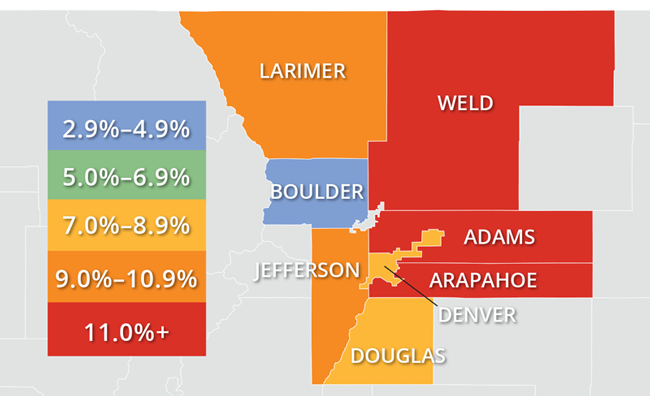
  • Sales again rose the fastest in Boulder County, which saw sales grow 17.9% versus the third quarter of 2016. There were also reasonable increases in Weld and Larimer Counties. Sales fell in all other counties contained within this report because there is such a shortage of available homes for sale.
  • As I discussed in my third quarter report, sales slowed due to the lack of homes for sale. The average number of homes for sale in the markets in this report is down by 8.2% from the fourth quarter of 2016.
  • The takeaway is that sales growth has moderated due to the lack of homes for sale.



HOME PRICES

  • With continued competition for the limited number of available homes, prices continued their upward trend. Average prices were up 9.8% year-over-year to a regional average of $431,403, which was slightly higher than the third quarter of 2017.
  • There was slower appreciation in home values in Boulder County, but the trend is still positive.
  • Appreciation was strongest in Weld County, which saw prices rise 14.3%. There were also solid gains in almost all other counties considered in this report.
  • The ongoing imbalance between supply and demand persists, which means we can expect home prices to continue appreciating at above-average rates for the foreseeable future.


DAYS ON MARKET

  • The average number of days it took to sell a home rose by two days when compared to the fourth quarter of 2016.
  • Homes in all but three counties contained in this report took less than a month to sell. Adams County continues to stand out, where it took an average of just 21 days for homes to sell.
  • It took an average of 29 days to sell a home last quarter. This is up nine days over the third quarter of 2017.
  • Housing demand remains strong in Colorado and this will continue with well-positioned, well-priced homes continuing to sell very quickly.


CONCLUSIONS

This speedometer reflects the state of the region’s housing market using housing inventory, price gains, home sales, interest rates, and larger economic factors.

For the fourth quarter of 2017, I have chosen to leave the needle where it was in the previous quarter. Listings remain scarce, but this did not deter buyers who are still active in the market. As much as I want to see more balance between supply and demand, I believe the market will remain supply-constrained as we move toward the spring, which will continue to heavily favor sellers.


Matthew Gardner is the Chief Economist for Windermere Real Estate, specializing in residential market analysis, commercial/industrial market analysis, financial analysis, and land use and regional economics. He is the former Principal of Gardner Economics, and has more than 30 years of professional experience both in the U.S. and U.K.

DesignSelling January 31, 2018

Affordable Tips To Up Your Home’s Curb Appeal


You’ll never have a second chance at a first impression, so let’s make it count! When it comes to upping your home’s curb appeal, there are plenty of small changes you can make that have a big impact. And best of all, you don’t need to call in the pros or spend a fortune to get beautiful results. Below are some helpful and affordable tips.


A Well-Maintained Yard


Mowing: The first step to a well-manicured lawn is to mow it regularly. The experts recommending mowing high because mowing it too short can damage the grass and allow weeds to set root.

Weeds: To prevent weeds like crabgrass use a pre-emergent herbicide in early spring. These herbicides manage the weeds by stopping the seeds from sprouting in your lawn. Broadleaf weeds like dandelions can be stopped by applying granular weed control products.

Feeding: Lawns consume mostly nitrogen, so look for mixes of fast and slow release fertilizers; they will feed your lawn over time while keeping it lush and green.

Watering: Nighttime watering can result in long spans of moisture on the blades, potentially exposing your grass to disease. Consider watering your lawn in the morning – the sun helps dry out the blades throughout the day.

Flowers: You can quickly and affordably dress up your yard with colorful pre-made flower pots and containers. When placing your flower pots and containers remember that asymmetrical arrangements and staggering plants will provided the liveliest setting.


Dress up the Front Door and Porch


Paint: A fresh coat of paint in a pop color can give your home a well-deserved facelift. If you are hesitant to add a bright color to your front door, check out our article Energize Your Home This Winter With Bright Hues.

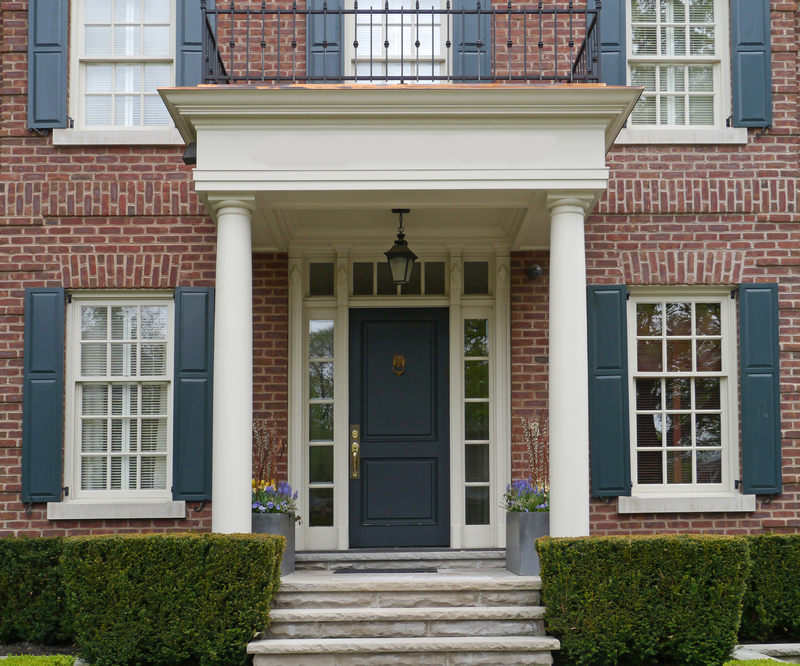
Replace Old Hardware: Clean off any dirty spots around the door knob, and use a metal polish on the fixtures. Change out house numbers for an updated feel, put up a wall-mounted mailbox, or add an overhead light fixture. Keep in mind that well thought through elements, instead of mix-and-match pieces, will add the most curb appeal.

Create Perfect Symmetry: Symmetry is one of the simplest design techniques to master and is the most pleasing to the eye. Maintain symmetry by flanking your front door with two sidelights (just make sure that your hardware matches); find two urn planters or a unique visual detail to put on either side of your door.

Market News January 31, 2018

Southern California Real Estate Market Update


ECONOMIC OVERVIEW

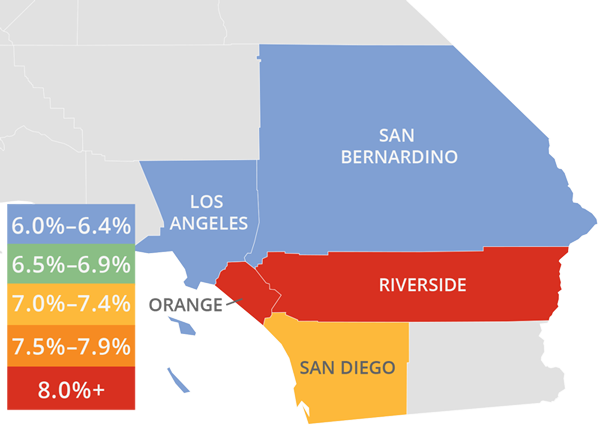
The counties covered by this report—Los Angeles, San Diego, San Bernardino, Orange, and Riverside—added 130,300 new jobs between November 2016 and November 2017. As a result, the unemployment rate dropped from 4.7% to 3.8%. Employment growth in Southern California picked up a bit as we moved through the final quarter of last year, and I expect this to continue as we move into 2018.


HOME SALES ACTIVITY

  • There were 45,342 home sales in the final quarter of 2017. This was 2.4% lower than the same period in 2016.
  • The number of homes for sale remains well below the levels seen a year ago (-18.1%), and down 14.8% from the third quarter of 2017. However, I attribute this to seasonality.
  • Home sales were a mixed bag, with ongoing increases in San Bernardino County, but a drop in sales in all other counties contained in this report. This mirrors a trend seen over the past three quarters that can clearly be attributed to woefully low levels of inventory.
  • There was an average of 29,623 active listings in the fourth quarter, well below what is needed for a balanced market.


HOME PRICES

  • Year-over-year, average prices in the region rose by 6.5%, but are only 0.1% higher than the third quarter of 2017.
  • Home prices in the region keep rising, but the pace of growth is slowing. This is not a concern for now because it is likely due to an ongoing lack of affordability. Home prices cannot continue to appreciate at the rates they have been in recent years, so I expect to see an ongoing slowdown in appreciation. That said, I believe prices will continue to rise for the foreseeable future.
  • Orange County had the greatest annual appreciation in home values (+8.5%) but there were solid price increases across the rest of the region.
  • Pending home sales rose by 4.1% compared to a year ago, which is an indication that closings in the first quarter of 2018 are likely to be fairly robust. Demand for homes in the coming year will remain positive but, with limited inventory in the markets, demand is likely to outstrip supply.


DAYS ON MARKET

  • The average time it took to sell a home in the region was 43 days. This is a drop of 11 days compared to the fourth quarter of 2016, but five days longer than the third quarter of 2017.
  • The biggest drop in the number of days it took to sell a home was in Orange County, where it took 18 fewer days to sell a home than in the same period last year.
  • Homes in San Diego County continue to sell at a faster rate than other markets in the region. In the fourth quarter, it took an average of just 29 days to sell a home, which is five fewer days than a year ago.
  • All five counties saw a drop in the amount of time it took to sell a home between the fourth quarter of 2016 and the fourth quarter of 2017.


CONCLUSIONS

The speedometer reflects the state of the region’s housing market using housing inventory, price gains, home sales, interest rates, and larger economic factors.

Southern California continues to add new households and job formation remains positive, which intensifies the demand for housing. Mortgage rates remain very favorable and low inventory is driving prices higher as demand exceeds supply. The number of homes for sale in the region is still well below the levels needed for a balanced market. Given all of these factors, I have moved the needle a little more in favor of sellers.


Matthew Gardner is the Chief Economist for Windermere Real Estate, specializing in residential market analysis, commercial/industrial market analysis, financial analysis, and land use and regional economics. He is the former Principal of Gardner Economics, and has more than 30 years of professional experience both in the U.S. and U.K.


Market News January 30, 2018

Nevada Real Estate Market Update


ECONOMIC OVERVIEW

Employment in the Las Vegas metropolitan area continues to moderate but, with a year-over-year employment growth rate of 2.7%, the region is still performing well above the national average of 1.4%. Over the past 12 months, the area has added 25,500 new jobs. This has led to a respectable unemployment rate of 5.3%. This is the same rate as a year ago, but that should not be any cause for concern, as we have seen a fairly large increase in the labor force, which can slow the drop in the unemployment rate.

With the region approaching full employment, I expect wages to continue rising at aboveaverage rates. The latest data shows average weekly earnings up 4.7% year-over-year. This should allow further home price increases as we move into the new year.


HOME SALES ACTIVITY

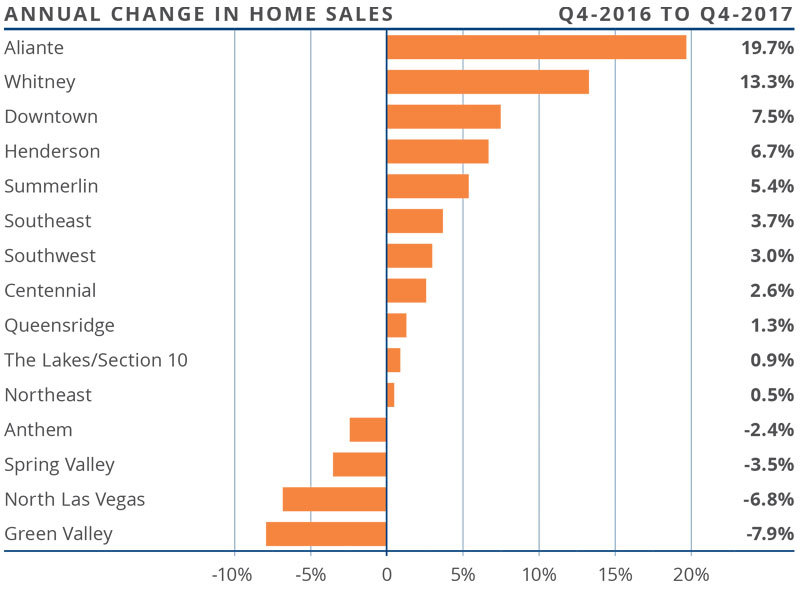
  • A total of 8,156 homes sold in the last quarter of 2017—a 2.2% increase over the same period a year ago. With an increase of 4.7% in pending sales, I expect to see an impressive number of closings in the first quarter of 2018.
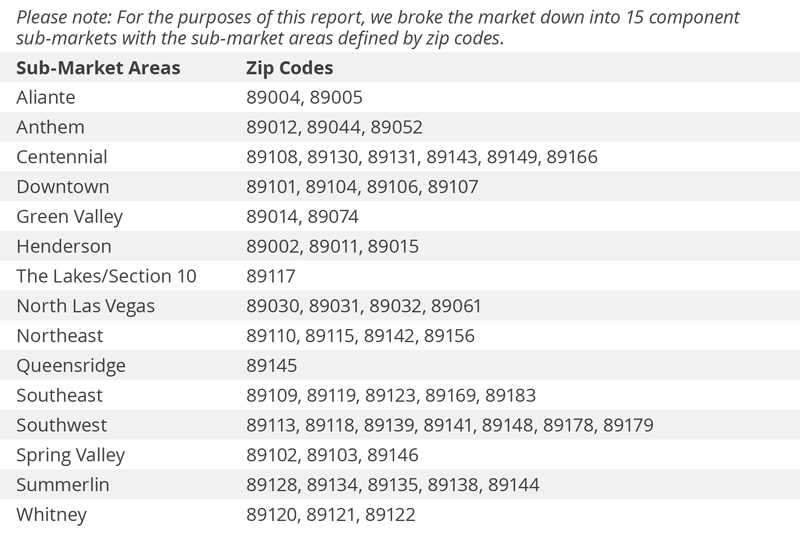
  • Home sales slowed relative to the final quarter of 2016 in four market areas. I am not concerned, though, as this was primarily due to a lack of available inventory.
  • Sales rose substantially in the Aliante and Whitney sub-markets, where transactions rose by 19.7% and 13.3%, respectively. Several other sub-markets saw positive sales growth, but at more modest levels due to inventory constraints.
  • Inventory levels remain remarkably low, with 33.6% fewer homes for sale than in the same period in 2016. As much as I would like to see a bump in listings in early 2018, I think it’s unlikely. The market will remain out of balance for the foreseeable future, with demand outstripping supply.


HOME PRICES

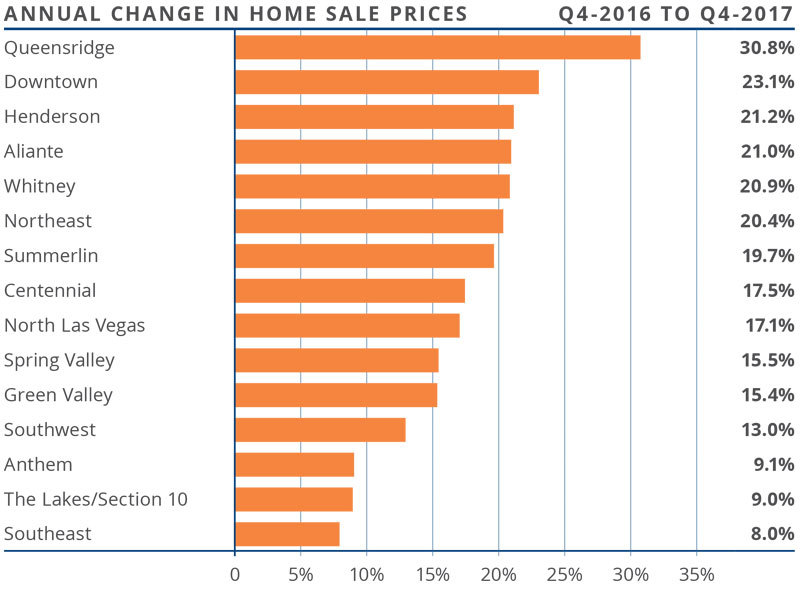
  • Home prices in the area have risen by 15.9% year-over-year to an average of $277,155.
  • There were double-digit gains in twelve neighborhoods, and only three sub-markets saw prices rise by less than 10%.
  • Prices rose in all sub-markets compared to the fourth quarter of 2016. The strongest growth was in the Queens Ridge submarket, where prices were up by a very impressive 30.8%.
  • I maintain my belief that above-average price growth in the greater Las Vegas market will continue through 2018. Robust job growth—in concert with limited inventory and favorable borrowing rates—continues to drive demand for housing.


DAYS ON MARKET

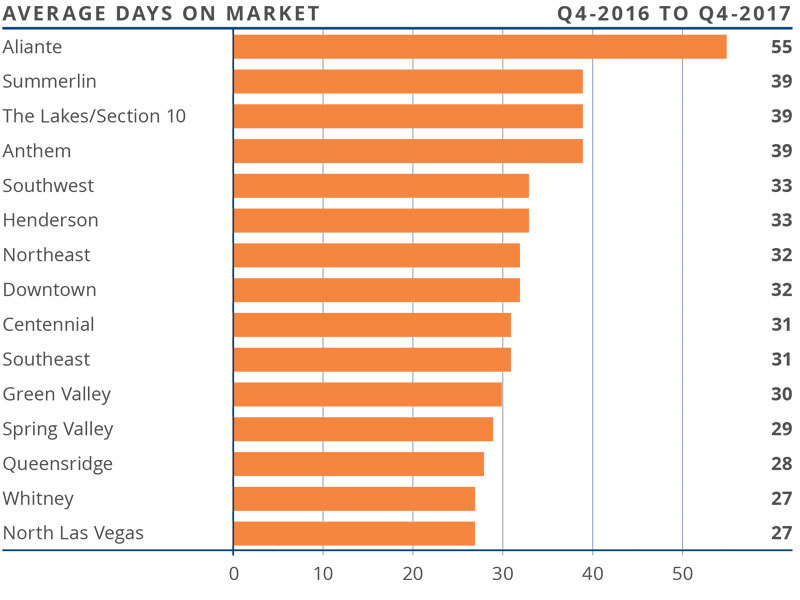
  • The average time it took to sell a home in the region dropped by 14 days compared to the fourth quarter of 2016.
  • It took an average of just 34 days to sell a home in the fourth quarter.
  • The length of time it took to sell a home dropped in all Las Vegas sub-markets compared to a year ago.
  • The greatest drop in days-on-market was in the Whitney sub-market, which dropped by 26 days when compared to the same quarter in 2016. Homes in this area sold in 27 days on average.


CONCLUSIONS

The speedometer reflects the state of the region’s housing market using housinginventory, price gains, home sales, interest rates, and larger economic factors. Employment growth in Clark County, although slowing modestly, is still very positive. This, when combined with low inventory levels and competitive mortgage rates, will push home prices higher. Given these factors, I have moved the speedometer a little further in favor of sellers.


Matthew Gardner is the Chief Economist for Windermere Real Estate, specializing in residential market analysis, commercial/industrial market analysis, financial analysis, and land use and regional economics. He is the former Principal of Gardner Economics, and has more than 30 years of professional experience both in the U.S. and U.K.
Market News January 29, 2018

Western Washington Real Estate Market Update


ECONOMIC OVERVIEW

The Washington State economy added 104,600 new jobs over the past 12 months. This impressive growth rate of 3.1% is well above the national rate of 1.4%. Interestingly, the slowdown we saw through most of the second half of the year reversed in the fall, and we actually saw more robust employment growth.

Growth continues to be broad-based, with expansion in all major job sectors other than aerospace due to a slowdown at Boeing.

With job creation, the state unemployment rate stands at 4.5%, essentially indicating that the state is close to full employment. Additionally, all counties contained within this report show unemployment rates below where they were a year ago.

I expect continued economic expansion in Washington State in 2018; however, we are likely to see a modest slowdown, which is to be expected at this stage in the business cycle.


HOME SALES ACTIVITY

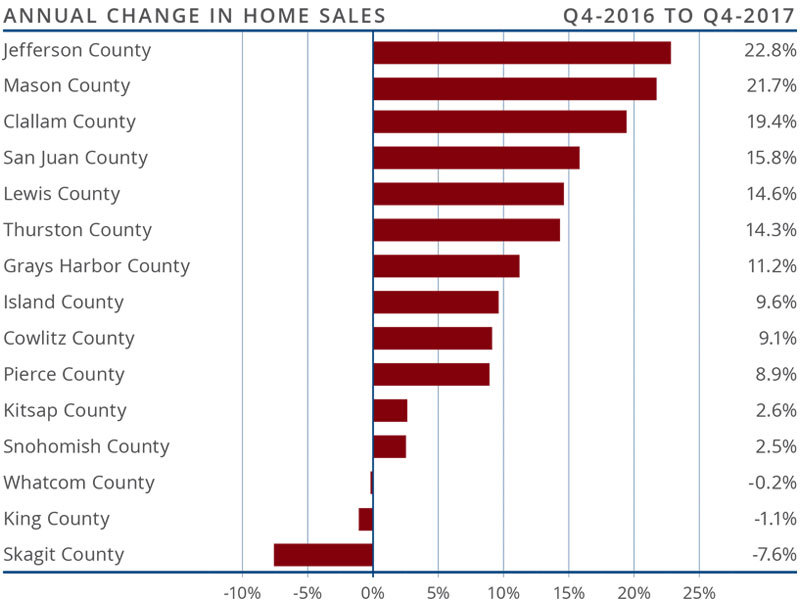
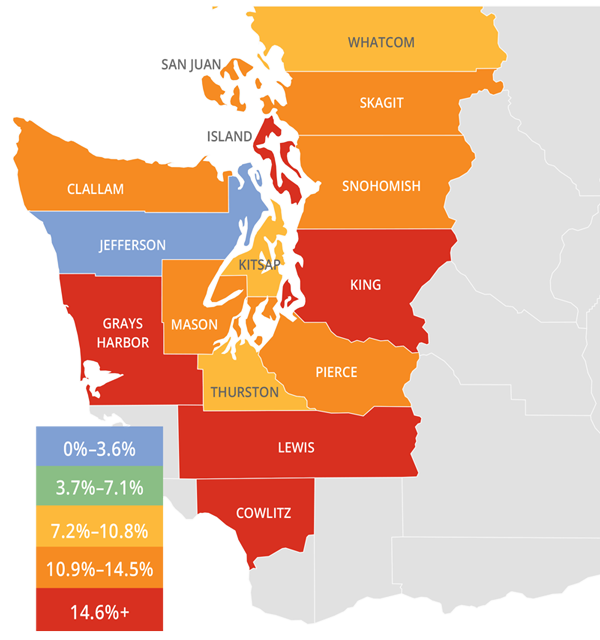
  • There were 22,325 home sales during the final quarter of 2017. This is an increase of 3.7% over the same period in 2016.
  • Jefferson County saw sales rise the fastest relative to fourth quarter of 2016, with an impressive increase of 22.8%. Six other counties saw double-digit gains in sales. A lack of listings impacted King and Skagit Counties, where sales fell.
  • Housing inventory was down by 16.2% when compared to the fourth quarter of 2016, and down by 17.3% from last quarter. This isn’t terribly surprising since we typically see a slowdown as we enter the winter months. Pending home sales rose by 4.1% over the third quarter of 2017, suggesting that closings in the first quarter of 2018 should be robust.
  • The takeaway from this data is that listings remain at very low levels and, unfortunately, I don’t expect to see substantial increases in 2018. The region is likely to remain somewhat starved for inventory for the foreseeable future.


HOME PRICES

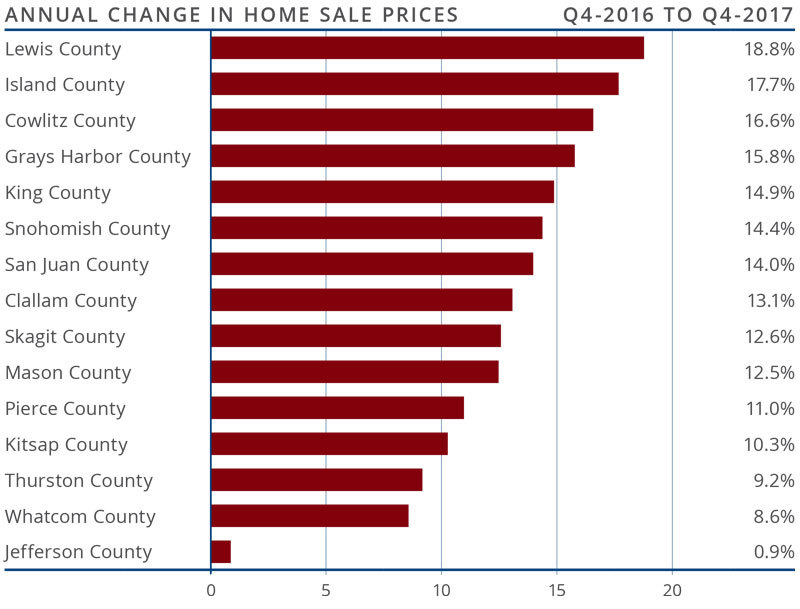
  • Because of low inventory in the fall of 2017, price growth was well above long-term averages across Western Washington. Year-over-year, average prices rose 12% to $466,726.
  • Economic vitality in the region is leading to a demand for housing that far exceeds supply. Given the relative lack of newly constructed homes—something that is unlikely to change any time soon—there will continue to be pressure on the resale market. This means home prices will rise at above-average rates in 2018.
  • Compared to the same period a year ago, price growth was most pronounced in Lewis County, where home prices were 18.8% higher than a year ago. Eleven additional counties experienced double-digit price growth as well.
  • Mortgage rates in the fourth quarter rose very modestly, but remained below the four percent barrier. Although I anticipate rates will rise in 2018, the pace will be modest. My current forecast predicts an average 30-year rate of 4.4% in 2018—still remarkably low when compared to historic averages.


DAYS ON MARKET

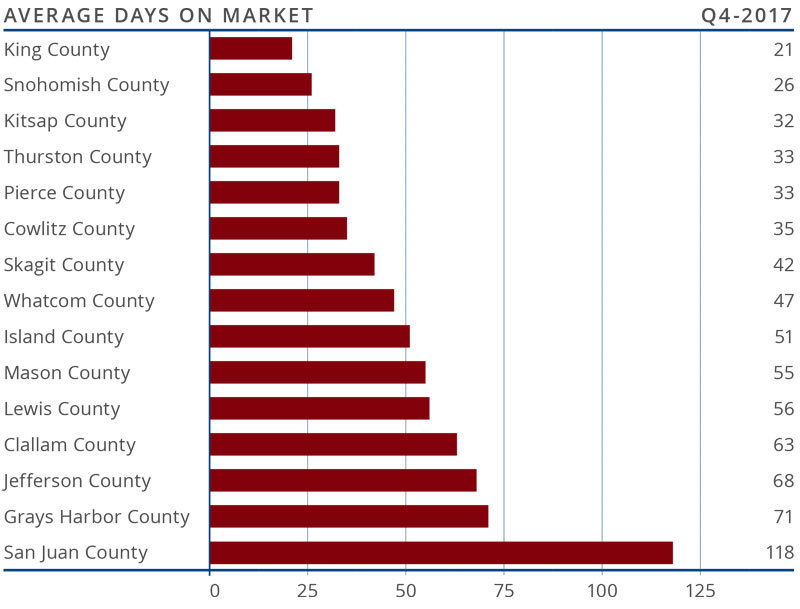
  • The average number of days it took to sell a home in the fourth quarter dropped by eight days, compared to the same quarter of 2016.
  • King County continues to be the tightest market in Western Washington, with homes taking an average of 21 days to sell. Every county in the region saw the length of time it took to sell a home either drop or remain static relative to the same period a year ago.
  •  Last quarter, it took an average of 50 days to sell a home. This is down from 58 days in the fourth quarter of 2016, but up by 7 days from the third quarter of 2017.
  • As mentioned earlier in this report, I expect inventory levels to rise modestly, which should lead to an increase in the average time it takes to sell a house. That said, with homes selling in less than two months on average, the market is nowhere near balanced.


CONCLUSIONS

This speedometer reflects the state of the region’s housing market using housing inventory, price gains, home sales, interest rates, and larger economic factors. For the fourth quarter of 2017, I have left the needle at the same point as third quarter. Price growth remains robust even as sales activity slowed. 2018 is setting itself up to be another very good year for housing.


Matthew Gardner is the Chief Economist for Windermere Real Estate, specializing in residential market analysis, commercial/industrial market analysis, financial analysis, and land use and regional economics. He is the former Principal of Gardner Economics, and has more than 30 years of professional experience both in the U.S. and U.K.

 

More January 22, 2018

Five Reasons You Need Renters Insurance

It might be tempting as a renter to think that you don’t need an insurance policy if you’re renting an apartment or home, but not having one could cost you more than you think. A 2016 poll by the Insurance Information Institute found that only 41 percent of renters have their own renters insurance policy. Here are a few reasons why it’s important to have your own insurance policy as a renter.

  1. To cover your belongings.

In the event that a fire, break-in or other incident occurs that results in the damage or loss of your personal belongings, your landlord’s insurance policy will not pay for their replacement. Consider how much it could cost to replace your clothes, furniture, electronics and other household items. In order to make sure you have the coverage to replace your lost items, it’s critical to have your own renters insurance policy.

  1. To cover people who come to your residence.

If someone were to visit your home and become injured, you could be held liable for their injury and any related medical bills and costs. Having renters insurance helps protect you against this liability, and can help pay for legal expenses in addition to medical bills.

  1. To cover things that might be stolen outside of your home.

Your renters insurance may actually help cover you in incidents that happen away from your home. For example, if some of your personal belongings are stolen from your vehicle, it is unlikely that your auto insurance will cover the theft. However, it’s much more likely that your renters insurance will cover it.

  1. Your landlord might require it.

Agreeing to purchase a rental policy might be a requirement of your landlord. But even if it isn’t, having renter insurance may help your rental application get accepted and it helps show your landlord that you’re a responsible renter.

  1. It won’t break the bank.

Rental policies are usually pretty inexpensive. According to the National Association of Insurance Commissioners, the average rental insurance policy costs $190 per year. That amounts to less than $16 per month.

If you’re wondering whether or not you need a rental insurance policy, talk to your insurance representative or reach out to the professionals at Long & Foster Insurance. They can help guide you to the right policy for your needs so you get the right amount of coverage at the right price for your budget.

This blog was reposted with the permission of Long & Foster.

Living January 17, 2018

Creating Comfort Through Interior Design

Just because the Christmas decor is put away and the festive mood of the holidays is over doesn’t mean we have to stop creating a snug and cozy home. It’s a good time to embrace winter Hygge! If you aren’t familiar with Hygge, it’s a Danish word for feeling content and cozy.

Here are seven ways to bring Hygge style comfort to your home, even during the dreariest winter month of the year!

LAYERED LIGHTS

Even if you feel like you’re lacking in the cozy department, simply addressing your lighting will make a huge difference. Layers of lighting make every room feel more welcoming. In the daytime, natural light is ideal. But for evenings, it’s nice to add a cozy glow. A good rule of thumb is to try to have a least three light sources in every room. Use a mix of table lamps, floor lamps, task lamps, and overhead lighting. Consider using warmer lightbulbs for the coziest ambience.

COMFORTING MOMENTS

Your home will offer a sense of comfort when you incorporate some favorite photos of loved ones, treasured hand-me-downs, antiques or flea-market finds, eye-catching conversation starters, art that inspires you, special mementos, or simply things that make you smile.

AN INVITING AROMA

What aroma feels ‘cozy’ to you? Set the tone for your home by filling it up with winter scents that inspire you.

TOUCHABLE TEXTURES

The coziest homes contain a variety different textures that delight the eye. Incorporate different touch-worthy materials through pillows, drapery, throw blankets, rugs, lamps, and furniture. The fabric possibilities are endless: velvet, woven, knit, embroidered, grain sack, faux fur, tweed, etc. You can also consider creating contrast with varying materials like metal, wood, glass, rattan, mirrored, painted, and more.

A PLACE TO CURL UP

Make yourself a special cozy place to relax. A reading chair will be extra cozy with some good books nearby in a basket, a lamp, a footstool, a side table to set a cup of tea, and a soft blanket you can curl up in.

A BIT OF WARMTH

Every home can benefit from warmth. No matter what your color scheme, you can add warmth through natural tones like wood, leather, jute, warm metals, etc.

SOMETHING LIVING

A room comes to life when an organic element is incorporated into the decor. Every room can benefit from having at least one plant, bouquet of flowers, or even a sprig of greenery like eucalyptus to remind us that spring is on its way.

DesignSelling January 10, 2018

Empty Nesters: Remodel or Sell?


Your kids have moved out and now you’re living in a big house with way more space than you need. You have two choices – remodel your existing home or move. Here are some things to consider about each option.


Choice No. 1: Remodel your existing home to better fit your current needs.

  • Remodeling gives you lots of options, but some choices can reduce the value of your home. You can combine two bedrooms into a master suite or change another bedroom into a spa area. But reducing the number of bedrooms can dramatically decrease the value of your house when you go to sell, making it much less desirable to a typical buyer with a family.
  • The ROI on remodeling is generally poor. You should remodel because it’s something that makes your home more appealing for you, not because you want to increase the value of your home. According to a recent study, on average you’ll recoup just 64 percent of a remodeling project’s investment when you go to sell.
  • Remodeling is stressful. Living in a construction zone is no fun, and an extensive remodel may mean that you have to move out of your home for a while. Staying on budget is also challenging. Remodels often end up taking much more time and much more money than homeowners expect.


Choice No. 2: Sell your existing home and buy your empty nest dream home.

  • You can downsize to a single-level residence and upsize your lifestyle. Many people planning for their later years prefer a home that is all on one level and has less square footage. But downsizing doesn’t mean scrimping. You may be able to funnel the proceeds of the sale of your existing home into a great view or high-end amenities.
  • A “lock-and-leave” home offers more freedom. As your time becomes more flexible, you may want to travel more. Or maybe you’d like to spend winters in a sunnier climate. You may want to trade your existing home for the security and low maintenance of condominium living.
  • There has never been a better time to sell. Our area is one of the top in the country for sellers to get the greatest return on investment. Real estate is cyclical, so the current boom is bound to moderate at some point. If you’re thinking about selling, take advantage of this strong seller’s market and do it now.


Bottom Line

If your current home no longer works for you, consider looking at homes that would meet your lifestyle needs before taking on the cost and hassle of remodeling. Get in touch with a Windermere Real Estate broker to discuss the best option for you.

More January 8, 2018

Keep Herbs Alive and Well in Winter With These 5 Tactics

Temperatures may be dropping, but that doesn’t mean we have to bid farewell to our herb gardens. Cold-hardy herbs, such as chives, mint, oregano, parsley, sage and thyme, can often survive cold-winter temperatures while continuing to produce flavorful foliage, as long as they are provided with some protection or grown indoors. Even herbs like rosemary that are more cold-sensitive can survive winter using additional methods of protection. Let’s explore different ways we can prolong the herb harvest and enjoy the fresh taste of our favorite herbs throughout the cold of winter.


Herbs 1: Bachman’s Landscape Design – Tom Haugo, original photo on Houzz


Herbs 2: Home & Garden Design, Atlanta – Danna Cain, ASLA, original photo on Houzz

A glass cloche protects plants in the center of this raised bed in Atlanta.


1. Protect herbs from the cold by placing them in a cold frame or cloche. Covering herbs helps trap the heat that rises from the soil, elevating the temperature inside by several degrees. This can extend the growing season in both fall and spring.

Cold frames are topped with glass panes that slope downward and are situated so they face south. This ensures that the most sunlight will reach the plants inside, creating an environment that is several degrees warmer than outside.

Cloches are a smaller and more portable way to protect plants from the cold. Traditional ones are bell-shaped and made from glass. They can be expensive, but you can make your own by cutting off the bottom of a 1-gallon plastic milk jug or other large plastic container. Place each one over individual herb plants and nestle the bottom inch or two of the cloche into the soil to anchor it.


Herbs 3: The Room Illuminated, original photo on Houzz


2. Add a thick layer of coarse mulch over herbs. Many herbs can grow through the winter under the insulation provided from straw, shredded bark or other coarse mulch. In areas that experience moderate-winter cold, USDA Zone 6 and warmer, herbs will continue to produce some new growth despite some winter cold. Simply pull back the mulch and cut the herbs you need, then cover them back up. While they won’t produce as much new growth as they do in the warm season, you should be able to obtain a small harvest. Don’t worry if a layer of snow falls, as it will provide additional insulation for the herbs below. Once spring arrives, you can turn the mulch into the soil.


3. Pot up herbs and move them into a frost-free greenhouse or sun porch. If you’re growing herbs in the ground, you can transfer them to pots and move them to a protected spot. Select the herbs you want to keep growing over winter, such as chives, oregano, sage and thyme. Cut them back to 1 inch tall and, using a sharp shovel, divide them at their base, making sure to include the roots so each one will fit into the container. Use well-draining planting mix in the containers and plant each herb in a separate pot. They will grow back and you’ll be able to harvest their flavorful leaves until you transplant them back into the garden once spring arrives.


Related: Move Herbs to a Sunroom for Full Sun


Herbs 4: J M Interiors, original photo on Houzz


4. Grow herbs in front of a sunny window. Herbs can be grown from seed or cuttings and make a great addition to a sunny kitchen window that gets at least six hours of sunlight. If using artificial lighting, 14 hours is usually sufficient. The temperature should range between 60 and 70 degrees Fahrenheit, or 15.6 and 21.1 degrees Celsius, for best results. You can transplant herbs from the garden or begin from scratch by sowing seed.

The rewards of growing herbs indoors throughout the winter are great when the fresh flavor of summer is within arm’s reach. Chives, oregano, parsley and thyme are just a few of the easiest herbs to grow on a sunny windowsill. Use a well-draining planting mix in your container. Water deeply when the top inch of soil is almost completely dry.


Herbs 5: Noelle Johnson Landscape Consulting, original photo on Houzz


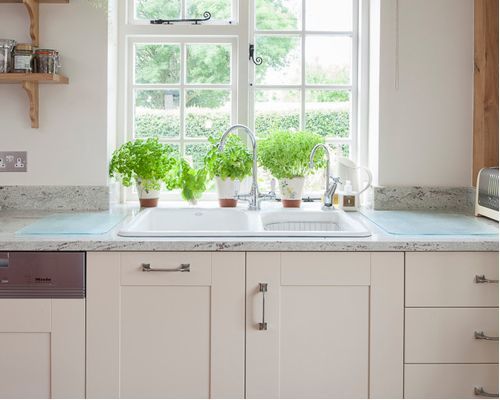
5. Extend the life of fresh herbs by putting them in water. Herbs such as basil and mint grow quickly when placed in a container of water for a few weeks. Other herbs that work well in water are sage, oregano and thyme. When placed in water, they begin to produce roots and will grow new leaves. This is a useful way to prolong the harvest, whether you bring in cuttings from the garden or buy fresh herbs at the grocery store.

The process is easy. Simply cut the ends of each stem and put them in a small jar or cup filled with water. Be sure to remove any lower leaves so they won’t be submerged in the water. Place on a sunny windowsill.

The leaves produced indoors will be thinner and slightly less flavorful than those grown outdoors but will still add welcome flavor to your favorite dishes. Refill the water as needed and enjoy the prolonged harvest for several weeks to come.


Related: Elevate Plants to Reach Sunny Windows With These Plant Stands


By Noelle Johnson, Houzz

More December 18, 2017

Making the Holidays Brighter in Our Communities

Every year, Windermere offices throughout the Western U.S. host events to help make the holidays a little brighter for our neighbors in need. From food drives to fundraisers, here are just a few examples of how our offices are giving back this holiday season.

Henderson, Nevada

This season, the Windermere Anthem Hills office supported Blue Star Mothers of Henderson & Boulder City NV4 by hosting a collection box for the “Stockings 4 Our Troops” holiday drive. Items collected included small packaged foods, mini toiletries, socks and hand/foot warmers, coffee and hot cocoa packets.

“This is a wonderful way to show our troops that we are thinking about them during the holidays, when they are not with their loved ones,” said Linda Hicks, Managing Broker at the Anthem Hills office. “It just might be the first year these young men and women are away from their families during the holidays, and what a wonderful way for us to show them that we care and that we appreciate what they do for our country. We are proud to be a part of this!”

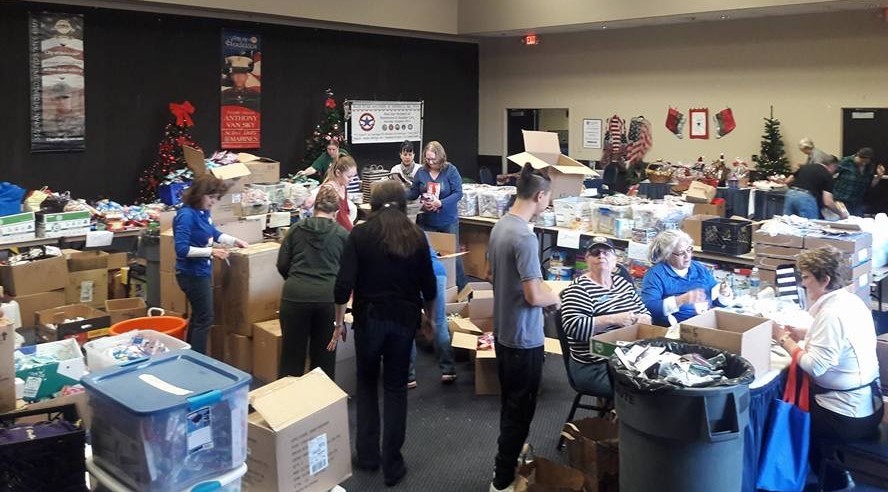
Agents also volunteered their time to help set up, sort, stock, and stuff handmade Christmas stockings for local soldiers deployed in war zones. The photo below shows about half of the packages all wrapped and ready to be sent to the troops. Over 700 boxes were shipped, with just over 1,200 stockings.


Oak Harbor, WA

Agents with the Windermere Whidbey Island – Oak Harbor office are supporting Whidbey’s Hope For Christmas, an annual gift program made up of community volunteers providing special Christmas memories for all eligible children on Whidbey Island, through DSHS in Oak Harbor. The office is sponsoring several children by purchasing and donating $2,000 worth of gifts.


Redmond, WA

The Windermere Redmond office participated in the Friends of Youth Giving Tree by setting up a tree in their office with gift tags for youth aged 16 to 25 that are either homeless or transitioning into a home for the first time. Brokers then selected gift tags and purchased the gifts to be delivered to Friends of Youth. Friends of Youth provides services to at-risk youth and homeless young people at 25 sites in 18 cities. In 2016, they helped over 6,500 youth and their families in crisis.


Seattle, WA

The Windermere Seattle-Ballard office has been busy hosting events to raise money for the Windermere Foundation. The first was a Sip & Swap event where they hosted a holiday dresses/clothing swap and asked for donations for each item. Proceeds benefitted the Ballard Senior Center and a total of $651 was raised. They also hosted a Monday Night Football event at Lagunitas Brewery where beer proceeds from that night, totaling $827, were donated to the Ballard Food Bank. In December, they held a Windermere Boutique Day, where 13 local craft vendors came to sell their goods. A portion of all sales were donated to the Windermere Foundation.


The Windermere Ballard office also hosted their 13th annual Santa Photos event for the community. Over 100 people/families visited the office that day, with a suggested donation of $10 for each Santa photo taken. Around $1,000 was raised from the photos, along with an additional $316 in cash and checks.


Windermere would like to thank our offices and everyone that supports the Windermere Foundation. Through these events, as well as a variety of other fundraisers like the ones described above, the Windermere Foundation is able to support non-profit organizations that provide services to low-income and homeless families throughout the Western U.S.

If you’d like to help, please consider donating to the Windermere Foundation. To learn more about the Windermere Foundation, visit http://www.windermere.com/foundation.