More December 18, 2019

Good tidings we bring, with turkeys and things!

Agents from the Windermere Moses Lake office delivering 100 turkeys to the Moses Lake Food Bank.


Free turkey dinners and programs for women in need. Backpacks for children with food for the weekend. Scholarships for college so youth can realize their dreams. These are a few of our favorite things!


‘Tis the season of giving and Windermere offices across the Western U.S. are out donating to local non-profits and bringing good tidings and cheer to those who need a little extra help during the holidays. This is all made possible through the Windermere Foundation which is funded by donations from our agents, owners, and staff, as well as office fundraisers. Every Windermere office has its own Windermere Foundation fund that can be used to support non-profits in their communities. Below are just a few examples of how our offices are giving back to local non-profits during the holidays and throughout the year.


Windermere Moses Lake

For the past five years, the Windermere office in Moses Lake, Washington has donated 100 Thanksgiving turkeys to the Moses Lake Food Bank. Since 2015, the office has supported the food bank and other local assistance programs with donations totaling over $13,000. Representatives from the Windermere office were on hand to help deliver the turkeys to the food bank this year, which provided 1,278 families with Thanksgiving meals.


Windermere Homes and Estates

The Windermere Homes and Estate group of offices in Southern California (San Diego-Downtown, Scripps Ranch, South Carlsbad-Aviara, Temecula, and The Plaza at Aviara/South Carlsbad) pooled their Windermere Foundation funds together to make a $15,000 donation to support Feeding San Diego’s backpack program.


Holiday and summer breaks are especially hard on families who are reliant on school meal programs. This program aims to meet the nutritional needs of food insecure children over weekends and school holidays. Each child receives an easy-to-carry bag filled with nutritious staple items and fresh produce when leaving school on Thursday or Friday afternoons. Feeding San Diego works closely with 150 partner agencies to provide food and resources to individuals and families across San Diego. According to research by Feeding America, 26 percent of those served by partner agencies are under the age of 18 and 10 percent are under 5.


Photo courtesy of Feeding San Diego


Windermere Missoula

The Windermere office in Missoula, Montana donated $1,550 to Women’s Opportunity and Resource Development, Inc. (WORD). Its mission is to strengthen our community by creating opportunities that support and inspire women. Its programs offer support, education, and training to empower women and their families to move from a place of need to a place of independence, participation and choice.


Windermere Headquarters

The team at Windermere’s head office in Seattle donated $2,500 to the Marcus Trufant Family Foundation (MTFF) to support its annual holiday fundraising event. MTFF awards college scholarships to under-represented students in the greater Seattle area and partnering communities. The Foundation also provides programs of fundamental support needed to achieve life goals. Last year, MTFF awarded over 300 scholarships to youth to help them achieve their dreams of going to college.


Thanks to everyone who supports the Windermere Foundation we have been able to make a significant difference in the lives of many families in communities throughout the Western U.S. And this year, we have also proudly reached our goal of raising over $40 million in total donations since 1989.


To learn more about the Windermere Foundation or to make a donation, please visit WindermereFoundation.com.


Market News December 16, 2019

Matthew Gardner’s 2020 Mortgage Rate Forecast

Market News December 12, 2019

2020 Economic & Housing Market Forecast

As we head into the New Year, it’s time to recap how the U.S. economy and housing markets performed in 2019 and offer my predictions for 2020.


U.S. Economy

In general, the economy performed pretty much as I expected this year: job growth slowed but the unemployment rate still hovers around levels not seen since the late 1960s.

Following the significant drop in corporate tax rates in January 2018, economic growth experience a big jump. However, we haven’t been able to continue those gains and I doubt we’ll return to 2%+ growth next year. Due to this slowing, I expect GDP to come in at only +1.4% next year. Non-residential fixed investment has started to wane as companies try to anticipate where economic policy will move next year. Furthermore, many businesses remain concerned over ongoing trade issues with China.

In 2020, I expect payrolls to continue growing, but the rate of growth will slow as the country adds fewer than 1.7 million new jobs. Due to this hiring slow down, the unemployment rate will start to rise, but still end the year at a very respectable 4.1%.

Many economists, including me, spent much of 2019 worried about the specter of a looming recession in 2020. Thankfully, such fears have started to wane (at least for now).

Despite some concerning signs, the likelihood that we will enter a recession in 2020 has dropped to about 26%. If we manage to stave off a recession in 2020, the possibility of a slowdown in 2021 is around 74%. That said, I fully expect that any drop in growth will be mild and will not negatively affect the U.S. housing market.


Existing Homes

As I write this article, full-year data has yet to be released. However, I feel confident that 2019 will end with a slight rise in home sales. For 2020, I expect sales to rise around 2.9% to just over 5.5 million units.

Home prices next year will continue to rise as mortgage rates remain very competitive. Look for prices to increase 3.8% in 2020 as demand continues to exceed supply and more first-time buyers enter the market.

In the year ahead, I expect the share of first-time buyers to grow, making them a very significant component of the housing market.


New Homes

The new-home market has been pretty disappointing for most of the year due to significant obstacles preventing builders from building. Land prices, labor and material costs, and regulatory fees make it very hard for builders to produce affordable housing. As a result, many are still focused on the luxury market where there are profits to be made, despite high demand from entry-level buyers.

Builders are aware of this and are doing their best to deliver more affordable product. As such, I believe single-family housing starts will rise next year to 942,000 units—an increase of 6.8% over 2019 and the highest number since 2007.

As the market starts to deliver more units, sales will rise just over 5%, but the increase in sales will be due to lower priced housing. Accordingly, new home prices are set to rise just 2.5% next year.


Mortgage Rates

Next year will still be very positive from a home-financing perspective, with the average rate for a 30-year conventional, fixed-rate mortgage averaging under 4%. That said, if there are significant improvements in trade issues with China, this forecast may change, but not significantly.


Conclusion

In this coming year, affordability issues will persist in many markets around the country, such as San Francisco; Los Angeles; San Jose; Seattle; and Bend, Oregon. The market will also continue to favor home sellers, but we will start to move more toward balance, resulting in another positive year overall for U.S. housing.


About Matthew Gardner:

As Chief Economist for Windermere Real Estate, Matthew Gardner is responsible for analyzing and interpreting economic data and its impact on the real estate market on both a local and national level. Matthew has over 30 years of professional experience both in the U.S. and U.K.

In addition to his day-to-day responsibilities, Matthew sits on the Washington State Governors Council of Economic Advisors; chairs the Board of Trustees at the Washington Center for Real Estate Research at the University of Washington; and is an Advisory Board Member at the Runstad Center for Real Estate Studies at the University of Washington where he also lectures in real estate economics.

Market News December 4, 2019

Matthew Gardner’s 2020 Real Estate Forecast

Design December 2, 2019

Four Holiday Décor Trends to Inspire You This Season

The holiday season is here and for many of us, that means it’s time to deck the halls. If you’re looking for some inspiration and a place to start, here are some ideas that are certain to get everyone in the spirit.


A Tree of a Different Color

Photo Credit: Left – Lushome, Center – HGTV, Right – Christmas365

For many, there’s nothing more quintessential during the holidays than a Christmas tree decked out in ornaments. But acquiring a tree can be challenging and expensive. Moreover, housing a tree consumes time and space. That’s why we love the idea of an alternative tree. There are plenty of options you can buy online or create yourself using things you probably already have around the house. And if you miss the smell of a real tree, try a scented candle or essential oils.


The Season of Lights

Photo Credit: Amara

There’s something perpetually charming about twinkling lights. Whether you’re wrapping them around your front porch or adorning your fireplace mantle, extra lights deliver a warm glow during the holiday season. Getting creative and adding light to otherwise unexpected places, including bookcases, around headboards, or even in glassware, is a great way to keep everything looking merry and bright.


Act Natural

Photo Credit: Better Homes & Gardens

Not all holiday climates are built alike. If you’re expecting a white Christmas, you’re probably used to pine trees and winter brush, but for those of you located in regions where the mercury doesn’t drop, sprinkling in natural elements can transform your home into a wintery oasis. Holly and pine needles add a traditional touch, or consider a wreath of olive branches with some sleigh bells interspersed.


Bring it All Home at Dinner

Photo Credit: Amara

When decorating for the holidays, don’t forget the table! A sprig of holly adds a festive touch to your place settings. And instead of the traditional centerpiece, try placing candles in glass vases or mason jars to give your tablescape that added touch of holiday pizzazz.

Design November 20, 2019

Remodel for the Most Resale Value

What’s the best remodeling project for your home? The answer, in part, depends on where you live. Every year, Remodeling Magazine evaluates which projects bring the most return at resale in different markets around the country in their “Cost vs. Value” report.  For the purposes of this blog, we are focusing on the Pacific states (WA, OR, CA, AL) and the Mountain states (MT, ID, UT, CO, NV).

According to the Remodeling 2019 Cost vs. Value Report (www.costvsvalue.com¹), these are the six top projects in those two regions that currently have the best return on your investment when it comes time to sell. 

Garage Door Replacement

The project with the most return from Washington State to Nevada? A new garage door.

In the Pacific States, replacing your garage door will cost an average $3,785, but will increase your resale value by $4,686, recouping 123.8 percent of what you paid for it. Homes in the Mountain States will also benefit from a garage door replacement, recouping 98.6 percent of their costs.

Due to its size, a garage door can have a big impact on a home’s curb appeal.  But adding to your home’s aesthetic is only one advantage; the warranty that comes with the new garage door is also a selling point for potential buyers who can trust that they likely won’t have to deal with any maintenance issues in the near term.

Manufactured Stone Veneer

As long as the new stone veneer is consistent with your neighborhood’s overall look, this siding is the second-best project across the Pacific and Mountain states.

Stone veneer can replace your home’s existing siding, adding a fresh, modern look that conjures a cozy vibe all the way from the street, before buyers ever step foot inside. Along the West Coast, it can recoup 110.4 percent of the cost when you sell, and Mountain states will recoup 96.5 percent of the cost. 

Wood Deck Addition

While building a deck might seem like a big undertaking, it’s actually a pretty cost-effective way to positively impact your home’s resale value. Pacific states can expect to pay around $15,000 and Mountain states just above $13,000, but they’ll see 87.8 percent and 74.3 percent recouped respectively when they sell.

Adding a deck extends the living space of your home and provides even more area for entertaining, relaxing, and enjoying the outdoors.  Whether you choose a natural wood deck or a low-maintenance composite deck, you can pick from a variety of styles based on the lay of your land and the areas of your backyard you wish to highlight.

Minor Kitchen Remodel

No need to move walls or appliances around, a minor kitchen remodel will do the trick to recoup 87.1 percent of the cost in the Pacific states, and 80.3 percent in the Mountain states.

An outdated kitchen can go from drab to fab and become a focal point with a fresh palette. Replace the cabinet doors with new shaker-style wood panels and metal or metal-looking hardware. Switch out the old counter tops with laminate that matches the new look. Think about adding a resilient flooring option, then finish the project with a fresh coat of paint to the walls, trim, and ceiling.

Grand Entrance

Looking to improve your curb appeal and create an entrance that guests and homebuyers won’t soon forget? Add a fiberglass grand entrance. This project involves replacing a standard-sized front door with a larger opening with dual sidelights (glass panels). Typically costing around $8,000, Pacific states will see 85.1 percent of that recouped in the sale, and Mountain states will see 71 percent.

Siding Replacement

Depending on the size of your home, replacing the siding can be an expensive undertaking. However, it’s a project that comes with high returns. For Mountain states, sellers can expect 75.4 percent of the costs recouped, and Pacific sellers will see 84.3 percent.

Not only is siding one of the first things a buyer sees, but it also serves as an indicator of the overall health of the home. Broken or damaged siding could mean that there are other problems with the home, such as pests and rot. Replacing old siding is a cost-effective way to boost your home’s curb appeal and ensure buyers are going to walk through your front door.

At the end of the day, the right remodeling projects for you are the ones that make sense for your household and are within your budget. Talk to an agent about which remodeling projects could add the most value to your home. To connect with an experienced Windermere agent, click the button below.


  1. “© 2019 Hanley Wood, LLC. Complete data from the Remodeling 2019 Cost vs. Value Report can be downloaded free at www.costvsvalue.com.”
Design November 13, 2019

A Gold Thanksgiving

Image Source: Shutterstock


We're in the thick of autumn now, with Thanksgiving just days away. That means it's time to start considering how to best showcase your home before the guests arrive. 


One of the cheeriest bits of fall is the shifting colors that bring a canopy of rustic hues to a walk through the neighborhood. You can bring that cozy feeling inside yourself with some golden-dipped creativity.


Gilded Pears – Use real or fake pears, whichever you prefer, spray paint gold, and allow them to dry completely. You can add little flags to the top if you’re really feeling crafty.  


Magnolia Wreath – Collect some Magnolia branches and use a wreath frame as a base. Spray paint the green side of each leaf with gold and then assemble using wire. It’s not as complicated as it looks!


Dipped Pinecones  – First, you’ll want to make sure your cones are clean and dry. Apply gold leaf adhesive using a foam brush; deciding how much you add will determine how much of the cone is covered in gold. After they dry, consider gold leafing the cone's scales. Wrap it around the cone and use a clean foam brush to rub it into the adhesive. Then give it a light spray with sealant and allow them to dry.


Gold Acorns – Hand pick your acorns, clean, and oven-dry them to make sure they are pest free. Paint them gold and then add a layer of clear shellac for a shiny look. Lastly, you’ll want to use a hot glue gun to attach the caps since they naturally fall off after the acorns dry. You can use these as filler in a glass vase or simply scatter them on a tabletop.


Shimmering Maple Garland – All you’ll need is a bag of artificial leaves, bought at any craft store, some Elmer’s glue, glitter, and string. Use a paintbrush to apply glue to each leaf and sprinkle lots of glitter over them. Let the glue set, then shake off the excess glitter, punch a hole at the top and attach a ribbon. Tie them all to a large strand and voilà, a perfect garland for the holidays.


Petite Pumpkins – If you are still head over heels for pumpkins, then using small ones for place cards will add some spice to your table. Tape each pumpkin halfway with painters tape, choose a design with horizontal, diagonal, or however you want! Next paint the bottom portion with gold craft paint (may require multiple layers) and with the last layer still wet, generously sprinkle gold glitter over the painted half. After your pumpkin is dry and you’ve shaken off the excess glitter, wrap beading foil tightly around the stem. Leave a little extra at the end for you to bend for your place card.


Find these and more decor ideas on our Pinterest Board, "A Gold Thanksgiving."

Market News November 11, 2019

Hawaii/Maui Real Estate Market Update


The following analysis of select Maui real estate markets is provided by Windermere Real Estate Chief Economist Matthew Gardner. We hope that this information may assist you with making better-informed real estate decisions. For further information about the housing market in your area, please don’t hesitate to contact your Windermere agent. 


ECONOMIC OVERVIEW

The State of Hawaii saw employment grow at an annual rate of 1.1%, with 6,000 jobs added over the past 12 months. In September, the state’s unemployment rate was 2.7%, marginally higher than the 2.6% rate of a year ago.

On the island of Maui, employment continues to contract, with a year-over-year drop of 2.8%. I would note that employment growth has been negative for the past 21 months. Even given the lack of new jobs, the island’s unemployment rate was still impressive, coming in at 2.5%, up from 2.4% a year ago.


HOME SALES

  • In the third quarter of 2019, 578 homes sold, an increase of 2.1% compared to the third quarter of 2018. Sales were up 0.9% compared to the second quarter of this year.
  • Not all markets saw a drop in sales. There were notable increases in the Up Country and Westside markets compared to the third quarter of 2018.
  • The rise in sales came as inventory levels dropped 13.7%.
  • Pending home sales were down 5% from the second quarter of 2019, suggesting that fourth-quarter closings may disappoint.


HOME PRICES

  • The average home price in the region dropped 0.4% from last year to $889,694 but was up 0.7% compared to the second quarter of this year.
  • Affordability remains a significant issue. As I discussed in the second quarter Gardner Report, the significant drop in interest rates this year has failed to stimulate sales, which is now affecting home prices.
  • Price changes by market were interesting: all but one market saw modest declines, but there was a massive 240% increase in the North Shore market. This increase was due to home sales in September when prices averaged $3.53 million. This is not necessarily uncommon in very small markets, where a few high-priced sales can create very significant swings in the average.
  • I don’t expect to see a turnaround through the balance of the year but do expect there to be modest price growth in 2020.


DAYS ON MARKET

  • The average number of days it took to sell a home on Maui dropped nine days compared to the third quarter of 2018.
  • The amount of time it took to sell a home dropped in all markets other than the North Shore market area.
  • In the third quarter, it took an average of 71 days to sell a home. Homes in the Central market sold at the fastest pace. It is taking the longest time to sell in the Up Country market.
  • The length of time it takes to sell homes on Maui will likely trend slightly lower for the balance of the year.


CONCLUSIONS

This speedometer reflects the state of the region’s real estate market using housing inventory, price gains, home sales, interest rates, and larger economic factors.

For the third quarter of 2019, I have moved the needle a little more in favor of home sellers. Inventory remains tight and, although we have seen a modest drop in home prices, well-priced and well-positioned homes are still selling relatively quickly.


ABOUT MATTHEW GARDNER

As Chief Economist for Windermere Real Estate, Matthew Gardner is responsible for analyzing and interpreting economic data and its impact on the real estate market on both a local and national level. Matthew has over 30 years of professional experience both in the U.S. and U.K.

In addition to his day-to-day responsibilities, Matthew sits on the Washington State Governors Council of Economic Advisors; chairs the Board of Trustees at the Washington Center for Real Estate Research at the University of Washington; and is an Advisory Board Member at the Runstad Center for Real Estate Studies at the University of Washington where he also lectures in real estate economics.


Market News November 7, 2019

Big Island of Hawaii Real Estate Market Update


The following analysis of the Big Island real estate market is provided by Windermere Real Estate Chief Economist Matthew Gardner. We hope that this information may assist you with making better-informed real estate decisions. For further information about the housing market in your area, please don’t hesitate to contact your Windermere agent. 


ECONOMIC OVERVIEW

The State of Hawaii saw employment grow at an annual rate of 1.1%, with 6,000 jobs added over the past 12 months. In September, the state’s unemployment rate was 2.7%, marginally higher than the 2.6% rate of a year ago.

On the Big Island, total employment continues to contract, losing 3,829 jobs over the past year. Annualized employment growth has been negative for the past 12 months. That said, the island’s unemployment rate was a healthy 3.5%, but that is still up from 3.2% a year ago.


HOME SALES

  • In the third quarter of 2019, 829 homes sold. This was an increase of 9.7% compared to the third quarter of 2018 but 9.2% lower than the second quarter of 2019.
  • Sales were higher in six markets and dropped in three. There was significant growth in sales in the North Kohala market, as well as North and South Kona. The markets that experienced sales declines are all relatively small which makes them more prone to swings, so I’m not overly concerned that this is a trend.
  • The growth in sales came as inventory levels rose 9% from a year ago. The average number of homes for sale in the quarter was up 5.2% from the second quarter of this year.
  • Pending home sales dropped 8.7% compared to the second quarter of this year, suggesting that closings in the fourth quarter may be a little disappointing.


HOME PRICES

  • The average home price in the region rose 16.7% year-over-year to $584,756. Prices also rose between the second and third quarters of this year by 11.3%.
  • Affordability remains an issue, but the current low-interest-rate environment has been motivating buyers, and prices continue to rise.
  • Prices rose in five markets but dropped in four. Appreciation was strongest in the small South Kona market, where prices rose 44.9%. The biggest drop in prices was in the small North Kohala market.
  • All things considered and despite ongoing affordability issues in many Big Island market areas, I still expect home prices to rise through the balance of the year and into 2020.


DAYS ON MARKET

  • The average time it took to sell a home on the Big Island dropped ten days compared to the third quarter of 2018.
  • The amount of time it took to sell a home dropped in four market areas and rose in five.
  • In the third quarter, it took an average of 114 days to sell a home, with homes selling fastest in North and South Kona and slowest in North Hilo.
  • It took six days longer to sell a home in the third quarter than in the second quarter of this year.


CONCLUSIONS

This speedometer reflects the state of the region’s real estate market using housing inventory, price gains, home sales, interest rates, and larger economic factors.

For the third quarter of this year, I have left the needle fairly close to the middle. Inventory levels remain low, prices are higher, and interest rates are lower, which all favor home sellers. However, pending and closed sales are down, and days on market has risen, which favors buyers. On the whole, we are approaching a balanced market on the Big Island.


ABOUT MATTHEW GARDNER

As Chief Economist for Windermere Real Estate, Matthew Gardner is responsible for analyzing and interpreting economic data and its impact on the real estate market on both a local and national level. Matthew has over 30 years of professional experience both in the U.S. and U.K.

In addition to his day-to-day responsibilities, Matthew sits on the Washington State Governors Council of Economic Advisors; chairs the Board of Trustees at the Washington Center for Real Estate Research at the University of Washington; and is an Advisory Board Member at the Runstad Center for Real Estate Studies at the University of Washington where he also lectures in real estate economics.

Market News November 6, 2019

Montana Real Estate Market Update


The following analysis of select Montana real estate markets is provided by Windermere Real Estate Chief Economist Matthew Gardner. We hope that this information may assist you with making better-informed real estate decisions. For further information about the housing market in your area, please don’t hesitate to contact your Windermere agent. 


ECONOMIC OVERVIEW

The State of Montana has added 4,800 new non-agricultural jobs over the past 12 months, representing an annual growth rate of 1%. Montana’s growth rate remains below the U.S. as a whole and my current forecast is for statewide job growth to rise 1.1% in 2019. My preliminary forecast for 2020 shows the state increasing employment by 1.2%.

In September, the state unemployment rate was a healthy 3.3%, down from 3.7% a year ago.


HOME SALES

  • During the third quarter of 2019, 1,070 homes sold — a drop of 15.5% over the same period in 2018.
  • Total sales activity was a mixed bag, with increases in only two counties and declines in seven. The largest annual increase was in Jefferson County, where sales were up more than 22%. The largest decline in sales was in the very small Park County.
  • The number of homes for sale remains well below what I would like, with an average of 1,264 listings in the third quarter within the counties contained in this report.
  • As mentioned above, inventory levels remain low, and this is holding sales back. Unfortunately, I don’t expect to see any significant increase in the number of homes for sale until next spring.


HOME PRICES

  • Following the significant 25.2% annual increase in home prices in the second quarter, the third-quarter figures were not as impressive. Year-over-year prices dropped 7.1% to an average of $373,133.
  • Average prices dropped in Lewis & Clark and Madison counties. I don’t believe this is endemic and expect prices to pick back up in the new year.
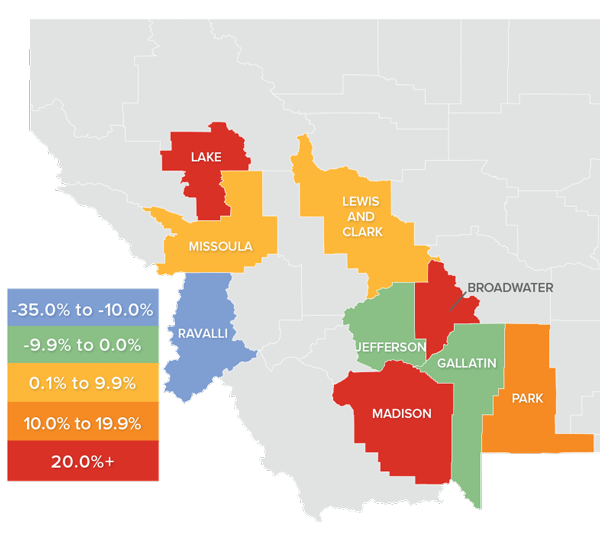
  • Even though the region saw home prices drop, there were several counties that experienced significant price growth. Prices jumped in Ravalli and Lake counties, and solid gains were also seen in Missoula and Broadwater counties.
  • The takeaway from this data is that prices continue to rise but not all markets are created equal.


DAYS ON MARKET

  • The average number of days it took to sell a home rose four days compared to the third quarter of 2018.
  • Homes sold fastest in Gallatin County and slowest in Lake County. Four counties — Missoula, Lewis & Clark, Jefferson, and Madison — saw days on market drop compared to the same period a year ago.
  • During the third quarter of 2019, it took an average of 118 days to sell a home in the region.
  • While days on market rose modestly in third-quarter, this is likely only a seasonal issue.


CONCLUSIONS

This speedometer reflects the state of the region’s real estate market using housing inventory, price gains, home sales, interest rates, and larger economic factors.

For the third quarter of 2019, I have moved the needle a little more in favor of buyers, but it’s still a sellers’ market. Mortgage rates remain at very attractive levels and home price growth has slowed somewhat. That said, the number of homes for sale is still very low and this might lead some buyers to wait until next spring when they hope there will be more choice.


ABOUT MATTHEW GARDNER

As Chief Economist for Windermere Real Estate, Matthew Gardner is responsible for analyzing and interpreting economic data and its impact on the real estate market on both a local and national level. Matthew has over 30 years of professional experience both in the U.S. and U.K.

In addition to his day-to-day responsibilities, Matthew sits on the Washington State Governors Council of Economic Advisors; chairs the Board of Trustees at the Washington Center for Real Estate Research at the University of Washington; and is an Advisory Board Member at the Runstad Center for Real Estate Studies at the University of Washington where he also lectures in real estate economics.