Market News March 29, 2021

3/29/2021 Housing and Economic Update from Matthew Gardner

This video is the latest in our Monday with Matthew series with Windermere Chief Economist Matthew Gardner. Each month, he analyzes the most up-to-date U.S. housing data to keep you well-informed about what’s going on in the real estate market. 


Hello there. I am Windermere Real Estates Chief Economist, Matthew Gardner, and welcome to the March episode of Mondays with Matthew.

Well, we have lots to talk about this month so let’s get straight to it and, first off, let’s take a look at the February existing home sales numbers.
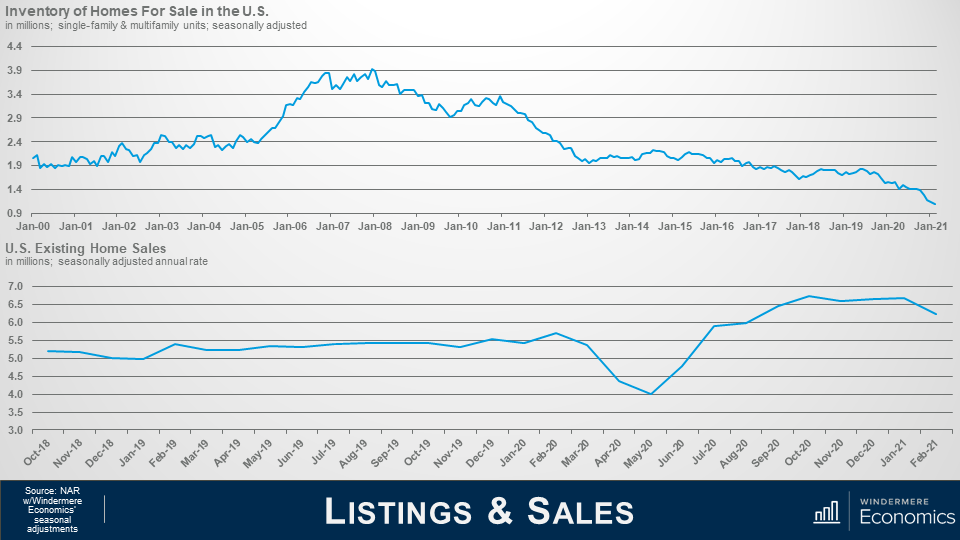
 

Two line charts are stacked on top of each other, the top shows the inventory of homes for sale in the US comparing the month of January for the last 21 years. There' a large peak from 2006 to 2011, whild January 2021 is a record low. The bottom line chart shows the U.S. Existing Home Sales in millions from October 2018 to February 2021, showing a dip with the lowest point in May 2020, but an increase that is higher than the normal of before May 2020.

Listings and Sales. Source: NAR with Windermere Economics Seasonal Adjustments


As you can see in the top chart, the number of homes for sale was measured at just over 1 million units.  This is a woefully low number and one that we haven’t seen since NAR started to gather data on listing inventory.

And the bottom chart shows home sales and they fell by 6.6% month-over-month in February to a seasonally adjusted annual rate of 6.22 million units but they were still 9.1% higher than a year ago.

Why the drop? Well, I am putting the blame squarely on the shoulders of home sellers who – quite frankly – simply aren’t selling!
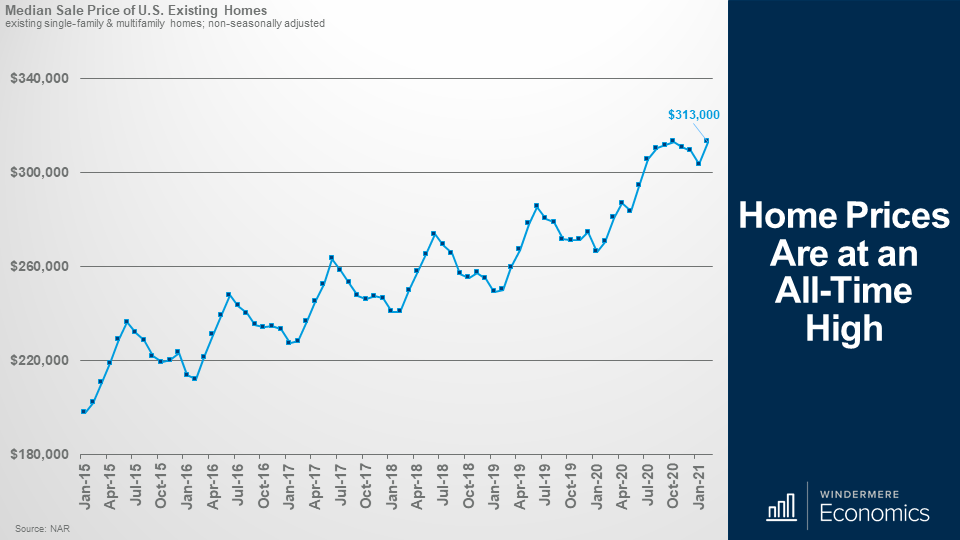
 

Line chart showing the Media Sale Price of U.S. Existing Homes showing January 2021 at a peak of $313,000, the same as the last peak in October 2021 which was record breaking at the time.

Home Prices are at an All-Time High


And looking at sale prices, they ticked higher in February to a median of $313,000, and that matches the all-time high seen last October and is 15.8% higher than we saw a year ago. This is the fastest annual pace of price growth seen since August of 2005, but I have to add that the number is a little deceiving as it was skewed higher by significant growth at the upper end of the market with sales above $750,000 accounting for close to 10% of all sales in February and sales above $1M up by a whopping 81% when compared to a year ago.

The numbers also showed that homes took an average of just 20 days to turn pending, another record, and 74% of homes sold in less than one month.

Individual investors or second-home buyers purchased 17% of all homes sold in February, and that’s up from 15% in January and matches the share seen a year ago

Now, as we move through the year, there are a couple of things worth noting.

We all know that the market is tight, but I still expect total sales this year to come in at around 6.3 million units – this is lower than my forecast from the start of the year but would still represent an 11.6% increase over 2020.
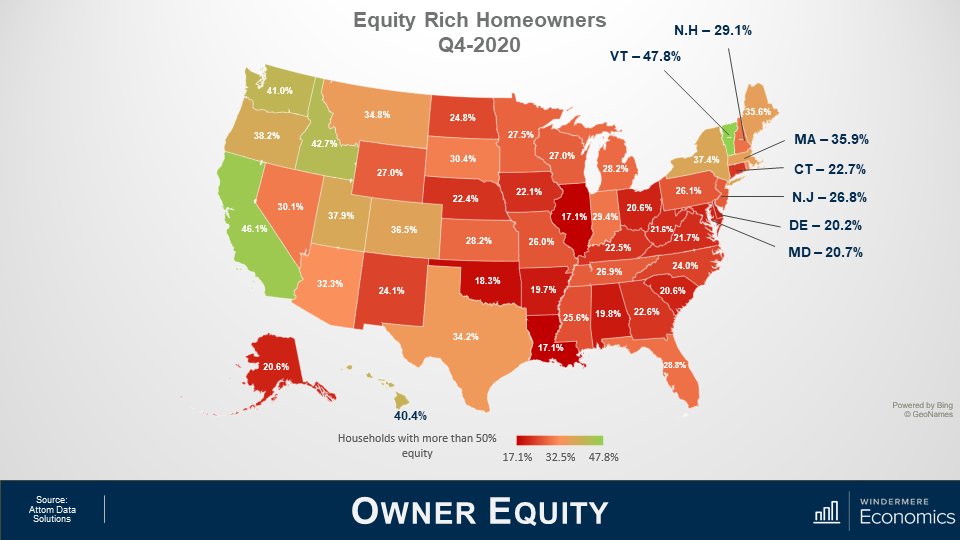
 

Heat map of the United States of America showing the Equity Rich Homeowner rates in the 4th quarter 2020. The colors represent households with more than 50% equity in the state, with red showing 17.1%, salmon shows 32.5% and green represents 47.8% of the population.

Owner Equity.


Although these are not numbers from NAR, I did want to share with you some different data that does relate directly to the increase in sale prices that we have just discussed.

With the significant upswing in sale prices that we have seen over the past 8 or so years, over 30% of all homeowners in America currently have more than 50% equity in their homes and this is a massive figure.

But across the country, there are significant variances as you can see here.

The largest share of homeowners who are equity rich live in Vermont and California but many west coast markets are not far behind with significant owner equity seen in WA, OR, ID, UT, & CO.

These really are very impressive numbers.
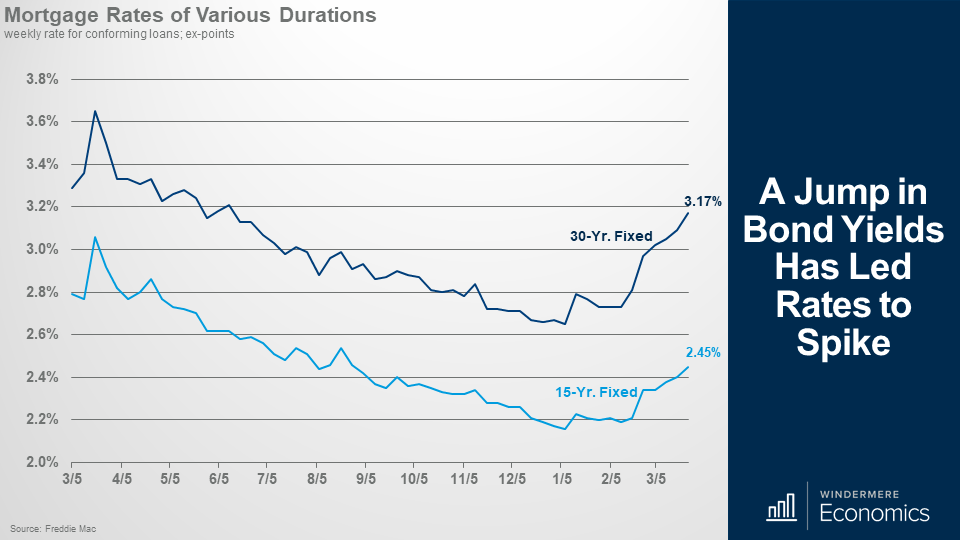
 

Two lines on the same graph show the weekly rate for Mortgage Rates of Variation Durations. The top line, a navy blue, shows the 30 year fixed, and light blue line below is the 15 year fixed mortgage. Each line follows a similar pattern peaking in March 2020, with a slow dip until January 2021, which the most recent date hitting 3.17% for 30-year fixed rated, and 15 year fixed rates hitting 2.45%.

A Jump In Bond Yields Has Led to Rates to Spike


It’s time to take a look at mortgage rates as a lot has been going on in that space too since we last talked.

This chart shows the average weekly rate for 15 and 30-year conforming mortgages and, as you can see, rates started to jump in early February and I find it very unlikely that they will drop back down at any time soon.

I am sorry, folks, but the days of 30-year rates starting with a 2 handle well they are now firmly in the rearview mirror.

So what has caused this spike?

Well, it’s very simple. COVID-19 case counts are dropping; the distribution of a vaccine is going remarkably well. As I speak, over 130 million doses have been given and over 46.4 million people are now fully vaccinated against COVID-19.

But there is a fear that that – with the country starting to reopen – we will see a significant boost in economic activity which, in concert with the latest round of stimulus payments, has generated rumblings from some economists who are now looking to see inflation to take off.

And as much as its great news that we are seeing a better than expected rollout of the vaccine, which will lead to faster economic growth in the second half of the year, the potential for inflation to rise is now elevated and this has caused a move out of bonds – specifically 10-year treasuries,  which means that the interest rate for these bonds has to rise and the interest rate on 10-year paper directly impacts mortgage rates – specifically the rate on the ever-popular 30-year mortgage.

But before everyone starts getting panicked about this, look at it this way.
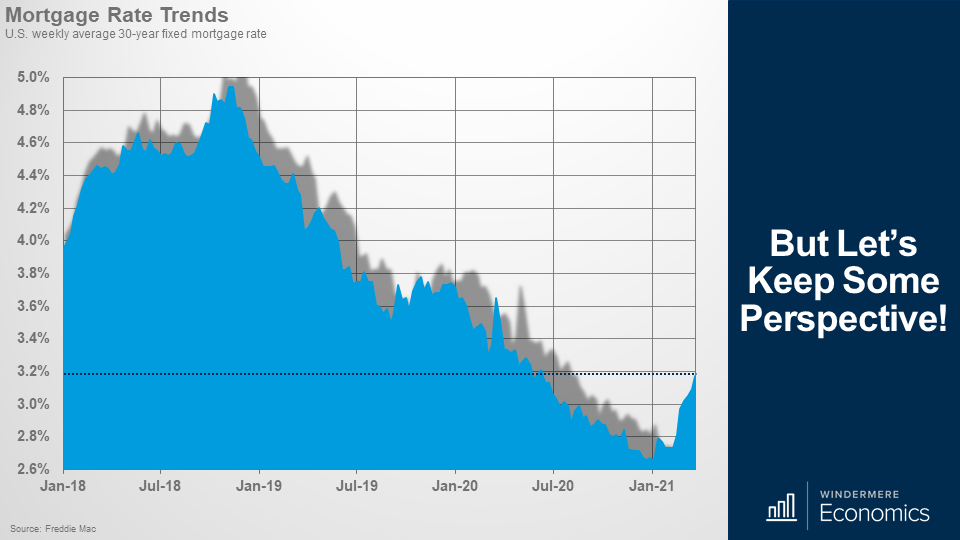
 

Shadow line graph showing the weekly average 30-year fixed mortgage rate trends. The graph shows a peak in January 2019, a fall off until the summer 2019, then another increase in the winter 2020, and a steady decrease since then until January 2021 where there's a sharp increase again.

But Let’s Keep Some Perspective!


Even at 3.17%, rates remain remarkably low. Yes, the current rate was last seen in June of 2020, but it is still well below the long-term average.

But, that said, and given the upward move in Treasury yields, I have had to rerun my forecast models for mortgage rates, and here is where I see rates trending this year.
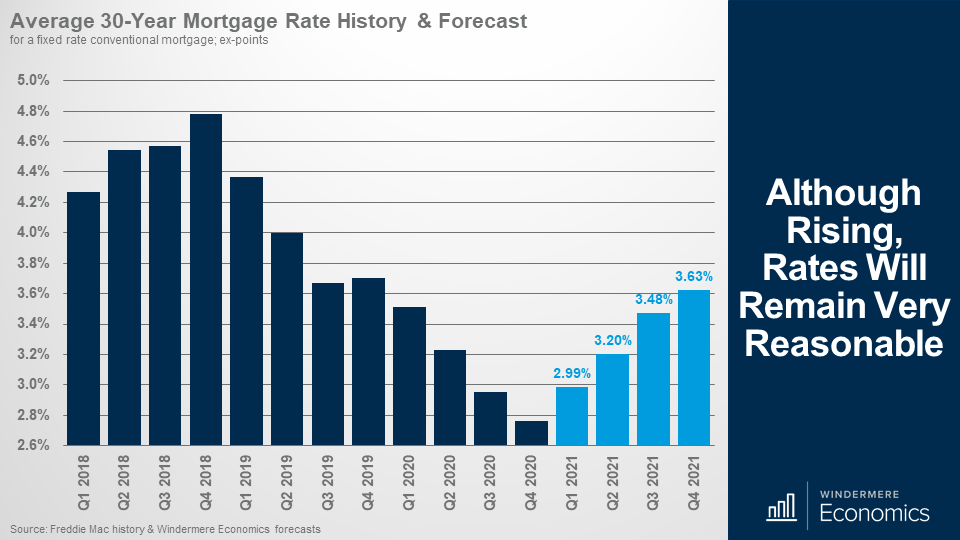
 

Bar graph of the average 30-year fixed rate mortgage rate history and Matthew Gardner's forecast. The Navy blue bars from Quarter 1 2018 to quarter 4 2020 show an increase, peaking in q4 2018, and decreasing until the low in q4 2020 at 2.7%. Matthew's forecast for the next 4 quarters in light blue predicts 2.99% in q1 2021, 3.2% in q2 2021, 3.48% in q3 2021, and 3.63% in q4 2021.

Although rising, rates will remain very reasonable


I expect that we will see rates rise to an average of 3.6% by the 4th quarter of 2021 and, looking farther out, we will likely break back above 4% in early to mid-2022.

Now, I could actually be a little optimistic if – and it’s a big if – 10-year bond yields rise faster than I am forecasting but, for now, I don’t see that happening unless, of course, inflation really does take off but, again, I don’t see that.

That said, I am looking for a spike in inflation in the next few months as we feel more comfortable going out again and we start to spend our money in a more normal manner, but I believe that inflation will level off and not get out of control. However, if it does, then more bond buyers will head further out along the yield curve and buy longer duration treasuries to counter inflation, which will mean that the interest rates on 10-year treasuries will have to rise to attract buyers and this, of course, will lead mortgage rates higher.
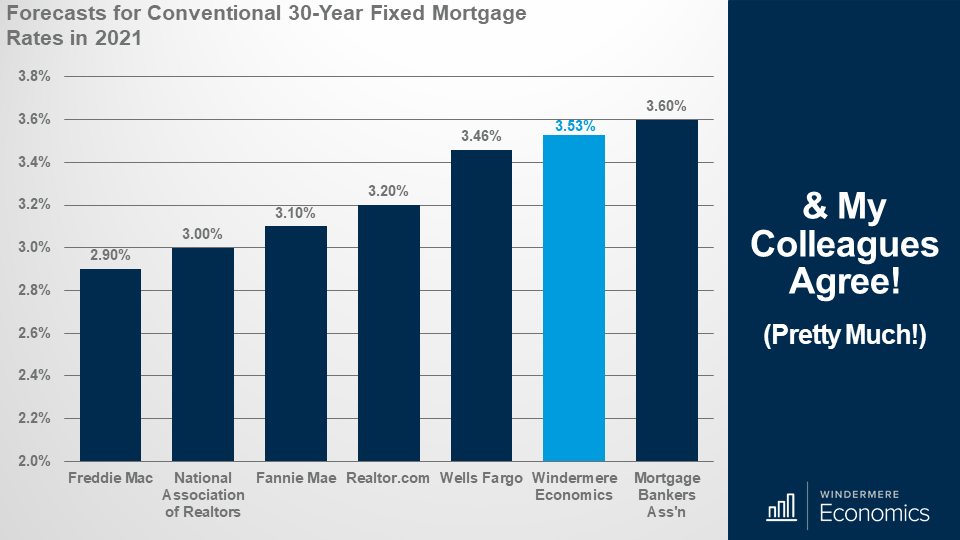
 

Bar graph showing the forecasts for conventional 30-year fixed mortgage rates in 2021 from other sources with Windermere Economic's forecast in the upper end at 3.53%. Mortgage Banker's Association forecasts 3.6%, Wells Fargo predict 3.46% and Freddie Mac is the lowest with 2.8%.

And my colleagues agree!


And just in case you don’t believe me, here is my forecast for the average rate in 2021 rates alongside some of my fellow economists, and, as you can see, other than Freddie Mac, we are in a fairly tight range.

I would add that the NAR and Freddie forecasts are a month or so old, so I would not be surprised to see them revise their forecast upward at some point.
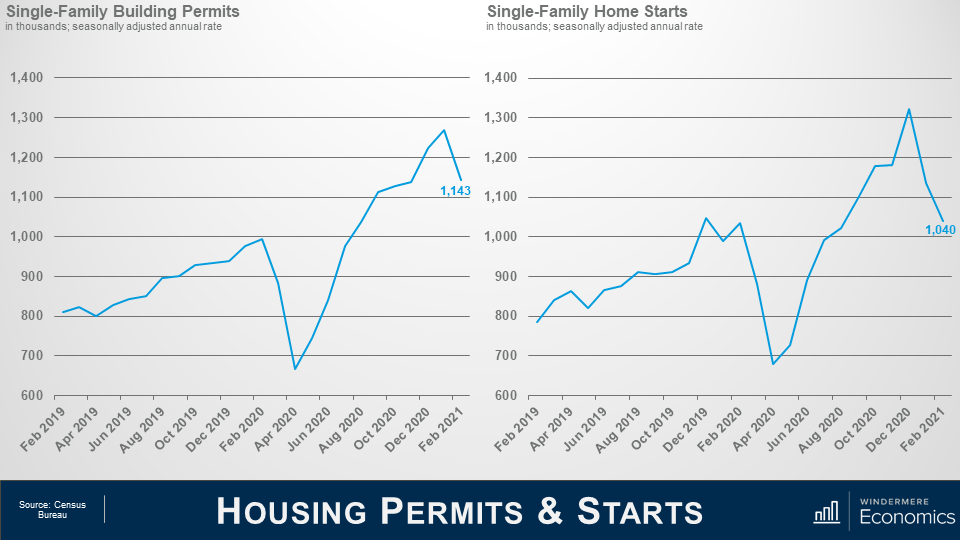
 

Two line graphs side by side showing Housing Permits and Starts. On the left, the line graph show the single-family building permits in the thousands, with a v-shaped recovery with a low below 700 in April 2020 and a peak in February 2021, with a small dip for the current number at 1,143. On the right, the single-family home starts char shows a similar pattern, with the current number at 1,040 after a spike in the fall 2020 above 1,300.

Housing Permits & Starts


Moving on to the new home market – both permits and starts pulled back in February with starts down by 8.5% on the month and single-family permits down by 10%.

So, what was going on? Well, despite strength in buyer traffic and lack of existing inventory, builders are slowing some production of single-family homes as lumber and other material costs continue to rise.

And shortages of lumber and other building materials, including appliances, are also putting future construction at risk.

While single-family starts for the first two months of the year are 6.4% higher than the first two months of 2020, there has been a 36% year-over-year increase in single-family homes permitted but not yet started as some projects have been put on pause because of the cost and availability of materials to build homes.
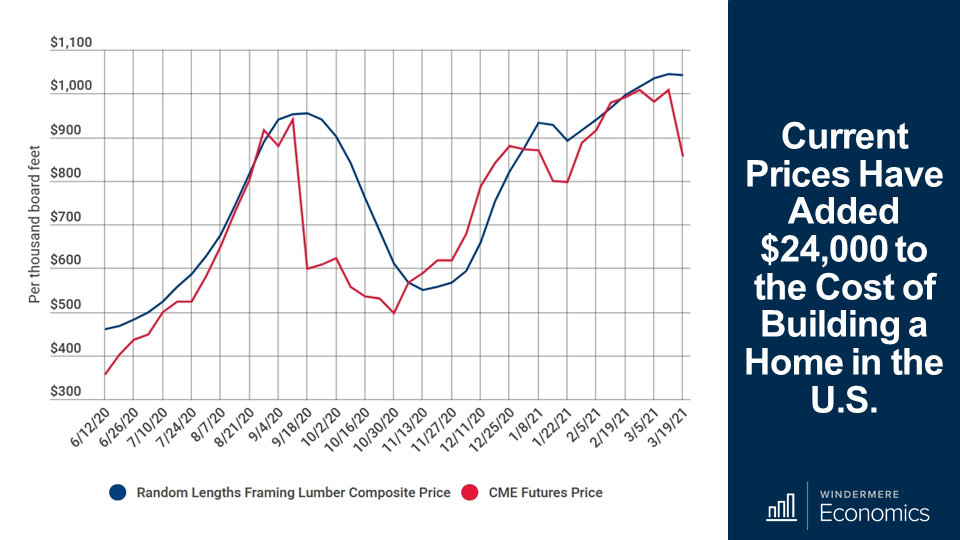
 

Double line graph showing data about the current prices and costs of building a houe. The blue line represents the random lengths framing lumber composite price and the red line show the CME futures price. These two lines follow a similar pattern with a peak in September 2020 to a dip in November 2020, and back on the rise again, reaching a peak in March 2021.

Current prices have added $24,000 to the cost of building a home in the U.S.


And to give you some perspective about the direction of lumber prices, they have skyrocketed more than 180% since last spring and this price spike has caused the price of an average new single-family home to increase by more than $24,000 since April of last year.

This chart provides an overview of the U.S. framing lumber pricing market and it’s not pretty.

But you can also see that the futures price has been dropping which may mean that we are getting closer to the end of the massive increases in lumber prices that builders have been facing.  Time will tell.
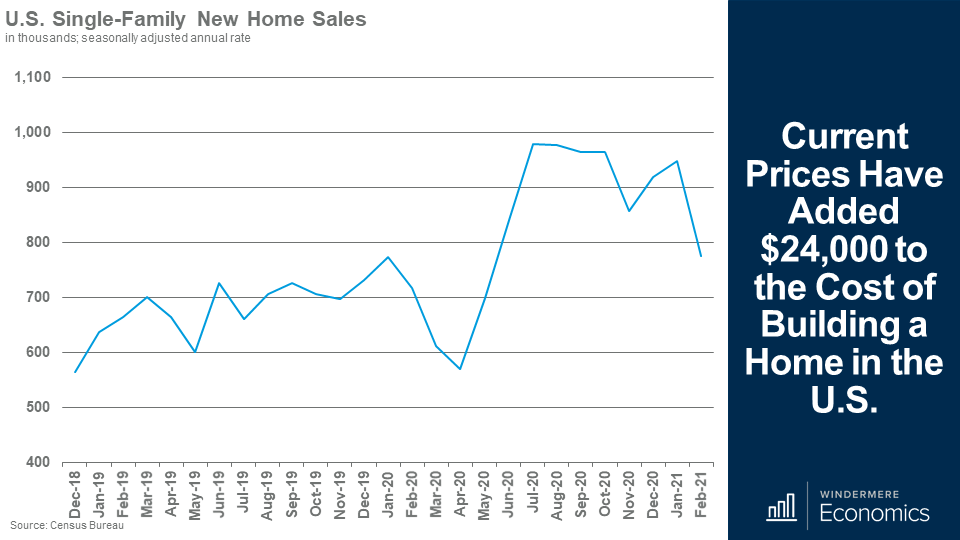
 

Line chart showing the single-family ne home sales from December 2018 to February 2021. There is a low point in April 2020 which steadily increased quickly plateauing just under 1,000 in July 2020 until it varies in December ad through the winter.

U.S. Single-Family New Home Sales in thousands, seasonally adjusted annual rate.


And on the sales side of the equation, after a slight rebound in December and January, the slowing of the pace of new home sales continued in February as a combination of affordability challenges, more costly materials, and storm effects which, in concert with each other led purchases of new homes to drop by 18% to a seasonally adjusted annual rate of 775,000 units.

But I would add that the February sales rate was 8% higher than we saw a year ago, and there is still demand which is being supported by still relatively low-interest rates, but more from solid demand in lower-density markets like the suburbs and exurbs.

Inventory levels did rise slightly with 312,000 new homes for sale, but that was 4.6% lower than a year ago.

The median sales price came in at $349,400, up 5.3% from a year ago.

And finally, I recently read a fascinating analysis that the NAHB put out which in essence, suggested that the recent rise in mortgage interest rates over the past two months has priced more than 1.3 million households out of the market for a median-priced new home.

In fact, the study found that just a $1,000 increase in the U.S. median new home price would push 153,967 households out of the market.
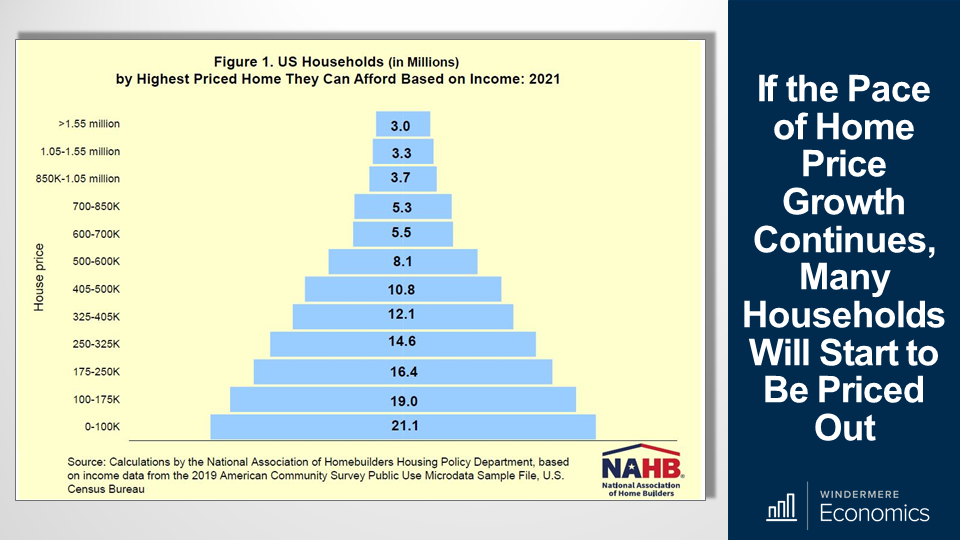
 

Pyramid bar char shows the U.S. households in millions by the highest price home they can afford based on income in 2021. The lowest house price, between 0 and 100k has 21.1 million households who can afford that, while only 3 million households can afford a home that's more than $1.55 million. The largest dips between groups are between 500-600k and 600-700k going from 8.1 million to 5.5 million households. Another big jump comes from 700-850k homes at 5.3 million households being able to afford that to 850k-1.05 million at 3.7 million households being able to afford that.

If the Pace of Home Price Growth Continues, Many Households Will Start to Be Priced Out


So, looking at it this way, the NAHB created the affordability pyramid you see here which shows that as the price of a new home increases, the number of households in each tier that are able to afford it decreases. All very logical.

About 21.1 million households are estimated to have the income needed to buy homes priced below $100,000 and they are shown on the bottom step of the pyramid.

And of the remaining 101.8 million households who can afford a home priced at $100,000, 19 million can only afford to pay a top price of somewhere between $100,000 and $175,000 and they are shown on the next step and, naturally, this trend continues up the pyramid of house prices with each step representing a maximum affordable price range and the number of households who qualify.

Although it’s certainly possible to find households at the high end of the market, there are a lot more households at the low end where affordability is a very major concern – 71.1 million households in America could not afford to buy a median-priced new home. That’s almost 58% of all households in the country.

The bottom line is that increased development costs can, and likely will, price these households out of the market for a new home, and with the cost of existing homes also rising rapidly, for more and more households, reaching the American dream of homeownership is getting harder and harder.

I am sorry – I really didn’t mean to end on a low note – but the facts are the facts. We need more housing supply and we need home price growth to slow. Of course, price growth will slow if my mortgage rate forecasts are accurate but it might already be too late of many who would like to buy a home.

So, there you have it. My take on the January housing-related data releases.

As always, if you have any questions or comments about the numbers we have looked at today, feel free to reach out. I would love to hear from you.

In the meantime, thank you for watching, stay safe out there, and I look forward to visiting with you again, next month.

Bye now.
Living March 26, 2021

5 Tips For Maintaining Your Property

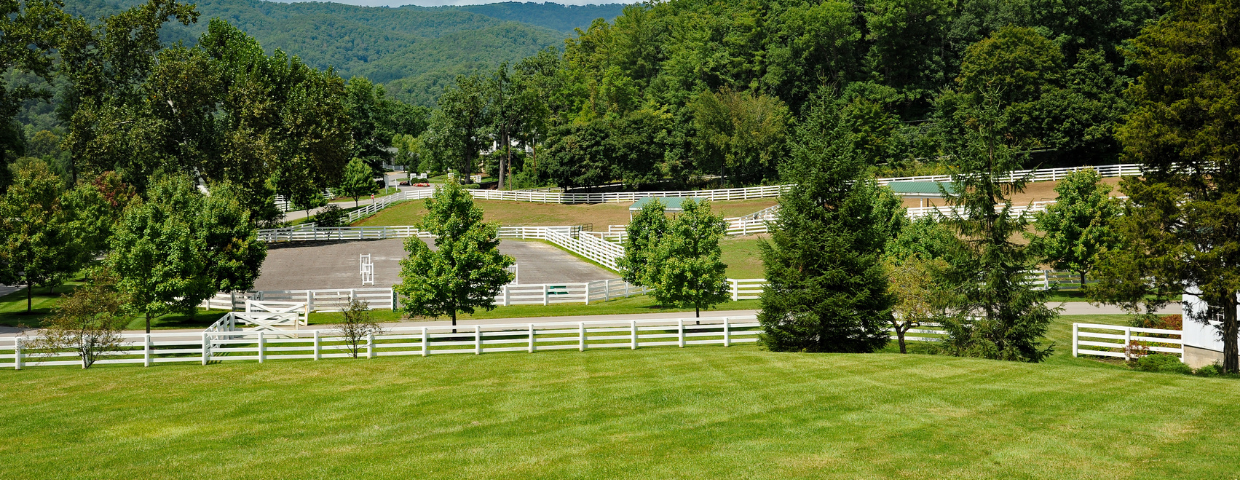
Owning an equestrian property can be an amazing asset, but it also requires a lot of hard work. With some attention and care, you can keep your property well-maintained and functioning smoothly. Here are some tips to help you maintain your equestrian property to the highest standard.

5 Tips For Maintaining Your Property

1. Investing in the Right Materials & Equipment

One of the smartest things you can do with your equestrian property from the beginning is to invest in high-quality materials and equipment. You don’t want to make maintaining your land any more difficult than it needs to be, which is why you should acquire tools that make the job easier, while giving your land the quality care it needs. This also means investing in high-quality materials for your horses and their quarters. Flooring, fencing, and bedding are all important to maintaining your horse’s health. These investments will extend the longevity of your indoor and outdoor structures, creating an environment where your animals can live comfortably.

Items to consider:

  • Tractors, bailing and mowing equipment
  • Stall floor mats
  • Paddock and turnout panels and gates
  • Arena sand
  • Horse grooming supplies such as a wash station, vacuum, sheers and brushes
  • Hay feeders and automatic/heated waterers

2. Fix the Small Things

With equestrian properties it’s best to fix a problem, no matter how big or small, as soon as it presents itself. Addressing any issue quickly will go a long way in keeping your stable in peak condition and your horses happy, healthy, and safe. A broken fence or leaning post can easily be pushed down, allowing a horse to roam without supervision or boundaries. Something as small as an exposed nail could lead to an injury of your animals or others.

3. Create a Cleaning Schedule

When you own a large plot of land the responsibilities add up. The more acreage, the greater the chance for a mess. It’s important to make sure your barns and stalls are regularly cleaned for the health and safety of your horses. Keeping those areas moisture-free is also critical for quality horse barn maintenance. A dirty horse stall often attracts unwanted insects, and an unkempt stall could bring disease and bacteria into your barn. Horses may experience thrush and other respiratory issues if their sensitive lungs breathe in ammonia from urine-soaked bedding.

4. Maintain Good Ventilation

Horses need access to fresh air. It’s important to maintain good ventilation in their stalls, keeping open passages for your horses so the air can cycle through the space. Consistent air flow will also help regulate and maintain temperatures as they change throughout the season. Without good ventilation, your horses are at risk for highly contagious illnesses like pneumonia.

5. Don’t Be Afraid to Ask for Help

Maintaining your equestrian property is not easy! There is absolutely nothing wrong with looking to outside help to make sure every task gets completed. Even something as simple as a gardener or another employee that would assist you with more specific needs like caring for horses. You can often look to youth or others in the community who would enjoy trading horseback riding with simple chores and caretaking duties. Bringing in some help makes it that much easier to stay on top of your tasks and allow you to enjoy your property at the same time.

Buying March 24, 2021

Working with a Buyer’s Agent

What is a Buyer’s Agent?

A typical real estate transaction involves a buyer’s agent representing the buyer and a listing agent representing the seller. A buyer’s agent helps the buyer identify potential homes to pursue, advises them on negotiations, and helps navigate any hurdles during the buying process. Once they are under contract, the buyer’s agent will work to close the sale, monitoring all the key dates and deadlines along the way. Once the transaction is complete, buyer’s agents split the commission of the sale with the listing agent.

Advantages of Working with a Buyer’s Agent

Find the Right Home

A buyer’s agent not only possess expert knowledge of local market conditions, but they also have access to tools that will help their clients see the widest array of available homes, and eventually, find the right home. By exploring the Multiple Listing Service (MLS), they can access the vastest network of available listings, and receive up-to-date alerts on open houses. They are usually the first to know when a home hits the market and are sometimes aware of homes that are scheduled to list in the near term.  Buyer’s agents can advise their clients on how a home’s outstanding repairs and improvements could affect their decision to purchase, whether the home is in need of an inspection, and discuss the necessity of a home warranty.

To get an idea of which homes you can afford, use our free Home Monthly Payment Calculator by clicking the button below. With current rates based on national averages and customizable mortgage terms, you can experiment with different values to get an estimate of your monthly payment for any listing price. By using the Home Monthly Payment Calculator, you’ll be better informed when working with your agent to find the right home.

Save Time

Buying a home takes time, but a buyer’s agent will help streamline the buying process. This includes paying close attention to their client’s budget and preferences in order to focus their home search to only those listings that match their needs. Buyers can then decide which homes they would like to view in-person and their agent will contact the corresponding listing agent to set up showings. Buyer’s agents are founts of knowledge, able to provide or track down information a buyer may not be able to readily access on their own. Additionally, they are connected to a network of professionals and can produce references for mortgage brokers, real estate attorneys, inspectors, and more as needed.

Making an Offer

Once you’re ready to make an offer on a home, the importance of working with a buyer’s agent kicks into high gear. There are many different elements that impact an offer’s success, and this is where a good buyer’s agent’s specialty lies. Through their expertise, they can help their clients craft a more competitive offer and negotiate as needed. Sometimes the most competitive offers are not just about the price. Offers can win when a buyer’s agent has researched the seller’s needs and pulled together an offer that speaks to those needs. Any advantage buyers can gain to make their offer stand out will strengthen their case. This is especially important in competitive markets when multiple competing offers are on the table.

Throughout the process of making an offer on a home, a buyer’s agent is there to answer any questions that may arise and pore over the details so that nothing goes unnoticed. This is critical since sellers will likely toss aside any offers that come in with missing documents, errors in the contract, and other inconsistencies. When buying a home, buyers often fear that they will miss something during the buying process, that they are going to pay too much, that there will be something wrong with the house after they buy it, or that they’ll lose the home to another buyer. Buyer’s agents help to alleviate these stresses and make sure the buying process runs smoothly.


When determining which agent to work with, it’s important to ask questions to gain an understanding of their expertise, see their personality, and get a gauge of how well they understand what you’re looking for in a home. If you would like some help connecting with an agent, you can get started here:

Selling March 22, 2021

The Risks of FSBO

Selling a home is a complex process that requires patience, knowledge of the market, and a deep understanding of the financial processes. And that’s just the beginning. Accordingly, many homeowners trust in a professional to sell their home by working with a real estate agent. Despite the expertise an agent brings to the table, some homeowners choose to go it alone, bearing the responsibility of a successful home sale on their own shoulders. If you’re thinking about selling “For Sale by Owner”, or FSBO, know that there are certain risks and obstacles that can easily cause your home selling journey to veer off course.

The Risks of FSBO 

Real estate agents are professionals who possess a vast knowledge of both the industry at large and local market conditions acquired through years of training, certifications, and working with clients. For FSBO sellers, the complexities of the home selling process can easily illuminate a lack of experience and leave them feeling unsure of how to continue, or worse, situations may arise where proceeding incorrectly could jeopardize the transaction. This lack of expertise could lead to incorrectly pricing your home, which will attract the wrong buyers. An accurately priced home requires market knowledge and an objective approach to the home’s value, which can be tough for homeowners. The more time an overpriced home spends on the market, the more likely the price will have to be lowered. A home with a lowered price that has been on the market for some time is less appealing to buyers than an accurately priced new listing. An underpriced home could leave significant money on the table for the seller.

A common motivating factor for wanting to sell FSBO is that, in the case of a successful sale, the seller avoids paying commission to an agent. However, what that commission ultimately pays for is a vast skill set that is specifically trained to get you the most money for your home. Agents not only have access to all kinds of information on local market conditions, trends in the real estate market, and data on comparable homes in your area, they are also connected to a network of potential buyers and have the marketing know-how for appealing to them and any others in your market. To attempt to approach this same level of visibility while selling FSBO means incurring additional expenses like ad placement, signage, hiring a photographer, and more.

Selling a home takes up a great deal of time. FSBO sellers can expect to stage the home, host showings and tours, answer phone calls from buyers, interview home inspectors, and coordinate open houses, all while gathering data on the local market—and that’s all before any negotiations or paperwork. When an offer comes through, FSBO sellers must dive into the extensive documentation required for the mortgage, title transfer, and any other legalese involved in the transaction. It’s like having another job that you may simply not have time for, whereas a real estate agent’s job is to dedicate their time, energy, and experience to the successful sale of your home.


All these factors make selling FSBO a risky proposition. Mistakes in the selling process can lead to both financial and legal implications, but part of a real estate agent’s expertise is knowing how and when these dangers can arise and navigating them properly. If you’re looking to sell your home, we’re happy to connect you with an agent here:

Design March 17, 2021

Timeless Home Design

When decorating and designing, homeowners often strive for a home that may incorporate vintage and modern elements but remains timeless at its core. Fortunately, certain design principles and elements have stood the test the time and can help you curate the home you desire. Here is your guide to understanding how you can design a home that looks and feels timeless.

Principles of Timeless Home Design

Balance

When designing a space in your home, balance is a key concept to delivering a timeless ambiance. Achieved through a proportionate arrangement of objects and colors, balance will help create a logical pattern in your home that pleases the eye. Experiment with symmetry in your home to build balance. This doesn’t mean that there needs to be two of every object, rather in every space you should utilize the objects and color schemes present to create symmetry.

Focal Point

Imagine a living room without a couch or mantle, or a dining room without a dining table. These images are confusing because we simply don’t know where to focus our attention. A core principle of timeless design is that space should have a focal point to give order to the room. Focal points don’t always have to be derived from a built-in feature of the home, you can create one with furniture, artwork, or some other form of eye-catching décor.

Scale and Proportion

Scale and proportion are two fundamental concepts of interior design and are key to creating a timeless décor. Simply put, proportion refers to the relationship of items and colors, while scale refers to their relationship with the room. For example, if a room in your home has high ceilings, this allows for taller furniture and artwork, while the most spacious rooms in your house are the best home for large décor pieces and furnishings. Proper usage of scale and proportion also means leaving some space between items to let the room breathe, so to speak.

Colors and Patterns

For a timeless look and feel, choose more classic color and pattern schemes. Basketweave is a traditional pattern that helps to create symmetry. Stripes are always in style and can help to reinforce clean lines. Stick to neutral paint colors on your walls as they give you the flexibility to add décor without overwhelming the room. Combinations of off-whites, beiges, grays, and earthy tones will deliver that timeless feel you’re looking for.

Natural Elements

There’s nothing more timeless than nature. Materials like wood, stone, and marble have been a cornerstone of design since antiquity. Whether you utilize these materials in your home as furniture, accent pieces, or focal points, they will help create a trend-free, organic environment in any room.

Living March 15, 2021

How to Prevent Water Damage to Your Home

Water is constantly coursing through your home, flowing in and out of drain pipes, sinks, tubs, and showers. Numerous systems in our homes are dependent upon water, but the minute it runs rampant it begins to cause damage. The consequences of water damage run the gamut, from rotted drywall and mold growth to serious structural issues. The following guide will help you understand what you can do to prevent water damage in your home.

How to Prevent Water Damage

Leaks

Leaks soften wood, which invites all sorts of unwanted activity from termites, while simultaneously creating a perfect habitat for mold and mildew growth. To prevent leaks, keep your drains healthy by frequently cleaning out your drain strainers and refraining from dumping grease down your drains. Check to make sure none of your drains are leaking and if need be, repair or replace your p-traps. Drips, dark stains around your pipes, and discoloration on your ceilings and walls are all strong indicators that a leak has sprung. If you notice an inexplicable spike in your water bill, this is also a sign of a potential leak. By identifying these signs, you can begin repairs right away and stop the water damage in its tracks.

Gutter Drainage

A home with weak gutter drainage is an open invitation for water damage to occur. Cleaning your gutters routinely is the best way to prevent them from clogging, which helps to avoid damage to your siding and foundation. Make sure your downspouts expel the gutter water away from your house parallel to the ground. Take a trip to the hardware store for downspout extensions and elbows to make sure that water won’t build up around your home’s foundation, especially if you live in a rainy climate.

Sump Pump

Your sump pump can be your saving grace should a water emergency occur. Sump pumps move excess groundwater away from your home, preventing it from infiltrating your basement or crawl space. They are connected to the Ground Fault Circuit Interrupter (GFCI) electrical outlet, which protects it from electrical shorts. There are two ways to test your sump pump. The first is by pouring in enough water to raise the float. If it’s working properly, the pump should activate and begin removing water from its pit. The other method is to unplug the pump’s power and plug it back in. If it does not turn on, it requires repair or replacement.

More

There are some additional steps you can take to prevent water damage to your home. Inspect your roof to identify any damaged shingles or cracks. While you’re up on the roof, take a look at your chimney. Repair any cracked or broken bricks and consider a chimney cap if you don’t already have one in place.


Water damage can be harmful to your home and your finances. Even the smallest leak can snowball into larger problems if neglected. By following the steps to prevent water damage, you’ll know if your home needs repairs before it’s too late. For more advice on preventing damage to your home, read our guides to wildfire and winter storm prevention.

Selling March 12, 2021

The Benefits of a Pre-Listing Inspection

Pre-listing inspections can help sellers better understand the condition of their home before putting it on the market. They can also strengthen a home’s appeal to potential buyers and help to streamline the offer process, which is especially important in competitive markets. However, pre-listing inspections can also open sellers up to added liability. Talk to your Windermere agent to understand if conducting a pre-listing inspection is right for your home.

What is a Home Inspection?

Conducted by a licensed home inspector, a home inspection is a detailed review of the condition of a home and property. Inspectors examine everything from a home’s electrical work and sewage to its heating and cooling systems, searching for any evidence of damage or structural issues that may affect its value. By having your home inspected before you sell, you’ll have the chance to discover whether it needs any repairs or upgrades.

Pre-Listing Inspections

Pre-listing inspections not only help identify repairs, but they can also make the selling process more efficient. A pre-listing inspection discloses a home’s condition to buyers up front and gives them confidence that the seller is being transparent about any possible issues. This can save significant time for both buyers and sellers, especially in competitive markets where there are multiple offers on the table.

Something for sellers to keep in mind is that if a home in a competitive market does not provide a pre-inspection report, buyers may be hesitant to make an offer knowing the time it takes to perform an inspection and the fact that they are likely competing against several other buyers who are willing to waive this step.

The Benefits of a Pre-Listing Inspection

Home inspections give a good baseline of your home’s condition. The information gathered during this process is exactly the kind of in-depth knowledge that buyers want to know when considering placing an offer on a home.

Since buyers will know right away what repairs are needed, they can factor them into their initial offer, as opposed to discovering them during the inspection contingency and getting entangled in negotiations. Being forthcoming about your home also reduces the chances of an offer falling through and the buyer walking away.

An added benefit of a pre-listing inspection is that it helps your real estate agent more accurately price the home and enables them to market it with the knowledge that everything is being presented in the most transparent way possible.


If you have any questions about home inspections or any of the steps in the selling process, we’re happy to connect you with a Windermere agent here: 

Buying March 8, 2021

Relocating for Remote Work

As the ubiquity of working from home continues, many homeowners are making the decision to move. Whether the motivation for relocating is to lower the cost of living, to be closer to family, or simply a fresh start, there are various factors to keep in mind when relocating for remote work.

Before You Relocate

Before you make the jump to a new life in a new place, making time for some strategic planning will help ensure your relocation goes as smoothly as possible. A logical first step is to consider the financial impact of your move. Depending on your company’s policy, there may be adjustments to your pay when you relocate. If this is the case, factor in your pay change as you form your relocation budget. Research the cost of living in your new hometown to understand how a compensation adjustment may affect your home search and your lifestyle once you move.

If you are moving out of state, relocating could affect your benefits and your taxes as well. There’s a chance that your employer’s health insurance plan does not offer coverage in the state you’re moving to. Talk to your employer to discuss your options. Before moving out-of-state, find out whether the two states have a reciprocal tax agreement, especially if you’re moving between states that have differing income tax regulations.

Your New Home for Remote Work

Working remote has given homeowners the freedom to choose their desired location, unbound by a work commute, especially if their company has indicated that there are no clear signs of returning to in-person work anytime soon. Knowing your desired work environment will help to tailor your home search. If you’re looking for peace and quiet while you work, explore listings in rural areas. If the hubbub of city life is your idea of a comforting backdrop, direct your attention to metropolitan areas.

For the remote worker, it’s more important than ever that your home accommodates your working needs. As many homeowners have experienced throughout the pandemic, you spend a great deal of time in your home office, so finding the home with the best workspace for you should be a priority. If you desire a private area where you can focus, a home with an open floor plan may not be the best choice. Instead, you may want to look for homes with a separate bonus room or extra bedroom.

Once you’ve moved into your new home, it’s time to put together your home office. Whether your previous home office was a professionally curated environment or a makeshift workspace in the corner of a room, a new home means a fresh start for your remote work. Like many homeowners, by now you’ve likely got a solid grasp on what your ideal home office looks like. Keep those elements alive when you relocate and enjoy productive workdays in your new home.

Buying March 5, 2021

What to Consider Before Buying an Equestrian Property

Buying a horse property is a very different experience from a conventional home purchase. The first and most important step is to work with an experienced equestrian specialist, but there are some additional items you should also consider before buying.

Location, Location, Location

When looking at equestrian properties, one of the most important things to consider is location. You want to make sure the property is near resources you will need like feed and tack stores, local vets, and more. You should also consider everyday needs, such as groceries, gas, shopping, and community amenities.

Knowing Your Needs

Having a clear vision of your specific needs is a very important step when buying an equestrian property. For example,  a casual rider doesn’t require the same capability and organization as a professional equestrian, and similarly, a professional will often need a horse property with strict specifications.

Property Features and Facilities

Something to consider is the soil type on the land you’re looking at. There are 12 different soil types and some of the best for horses are sandy, loamy, organic soils. Not only is this the best option for your animals, but these characteristics will also impact the quality of grasses for pasture growth. Whether you decide to pasture or hay feed, ensure there is adequate hay storage, especially for winter months when, depending on what part of the country you live in, grass may not be as ample.

Other important features to consider:

  • Does it have indoor stalls?
  • Does it have multiple fenced pastures for rotating your livestock? This will ensure the ultimate health of your pasture and the grass that is produced.
  • Are riding trails nearby or will you have to trailer to get to trails?
  • Is there an indoor or outdoor arena? These are important for training, breaking, and even veterinary care, at times.
  • Does it have a secure tack room that rodents cannot penetrate?

Accessibility

Accessibility is another important factor to consider. This includes the convenience of your land but also important resources like water. Each horse will drink approximately 5-10 gallons of water per day; therefore, readily available potable water is vital. The accessibility of your horse property is crucial for bringing in vets, food supplies, and getting around quickly in emergencies. The navigation around your property should be easy to swiftly get from the home to the barn or other facilities. Suitable access to the barn with wide turnaround driveways is essential, which may include grading an additional access road.

Flexibility is Key!

The more specific your property criteria, the more challenging it may be to check everything off your wish list. While it’s important to know what you want from the property, it’s equally important to be open minded and realize that the property may require some extra work to meet all your needs.

Design March 3, 2021

What Is a Craftsman Home?

The Craftsman home has a distinct look and definitive features, whose origins date back to nineteenth-century Britain. Their popularity can be attributed to the simple ideas behind their design and their focus on functional living.

Types of Craftsman Homes

Craftsman Bungalow

For many people, the type of Craftsman home that immediately comes to mind is the Craftsman Bungalow. Bungalows are of modest size, with a covered porch and tapered columns supporting a low-pitched roof. Often, you’ll see these homes with double gable roofs, where the front porch will extend beyond the house. Bungalows are typically one or one-and-a-half stories.

Four Square Craftsman

The Four Square Craftsman is a larger, two-story version of the Bungalow, meant for bigger families. Accordingly, their construction saw a significant increase as soldiers returned from World War I. Their name comes from their design of four rooms on the first and second floors, one in each corner.

Prairie Craftsman

The Prairie Craftsman style can be traced back to renowned American architect Frank Lloyd Wright. Known for their low profile and powerful horizontal lines, Prairie Craftsman homes typically have an open floor plan and harmonize with their surrounding landscape.

Mission Revival

Borrowing greatly from the style of the Prairie Craftsman, the Spanish influences of the Mission Revival make it a unique Craftsman home. Typical features include a stucco exterior, arches, and open interior spaces with terracotta detailing. If someone points out a house as a “Spanish Bungalow,” you’re looking at a Mission Revival Craftsman.


Characteristics of Craftsman homes

Exterior

Highly identifiable, Craftsman homes share many commonalities, but seemingly, no two are identical. A covered porch with tapered columns is the first indicator you’re looking at a Craftsman. The roofs are low-pitched with overhanging eaves, giving way to exposed rafters underneath. It’s common for the windows to be double-paned, while the front doors will typically contain their panes in the upper section.

Interior

Known for their open floor plans, ample seating, and plenty of built-in shelving, the inside of a Craftsman home is a comfortable place to be. Reflecting the hard-working nature of their style, you’ll find plenty of handcrafted woodwork, stonemasonry, and brickwork throughout the interior. Fireplaces are often the central feature of Craftsman living rooms.


Now that you know a bit more about the Craftsman home and how to identify it, look for examples of these characteristics in your neighborhood. Due to the widespread popularity of the Craftsman style, chances are you won’t have to look too far.