Buying July 20, 2022

How to Win a Bidding War When Buying a House

In a seller’s market, many buyers are competing for a limited number of homes. This creates fierce competition amongst buyers and ideal selling conditions for sellers. Sellers will commonly receive multiple offers for their home, often over their original asking price. As the offers stack up, bidding wars will ensue, since only one buyer can ultimately win.

So, how can a buyer rise to the top in these highly competitive situations? First and foremost, it’s important to work closely with your agent to discuss your strategy when buying in a seller’s market. If you find yourself in a bidding war, the following methods may help you secure the home you’re after.

How to Win a Bidding War When Buying a House

Get Pre-Approved for a Loan

Not only is getting pre-approved for a mortgage an important step early on in the buying process, but it’s also a prerequisite for having your offer considered in a bidding war. Without pre-approval, your offer is likely to fall to the bottom of the stack of offers the seller is considering if not tossed aside entirely. Pre-approval gives you credibility as a buyer. It shows that, should your offer be accepted, you have the necessary financing in place to successfully purchase the home. This assurance is key to sellers prioritizing your offer. Pre-approval also helps to speed up the closing process, allowing you to move swiftly through mortgage approval and onto other steps to finalize the transaction, such as the home appraisal and home inspection.

Put More Money Down or Pay Cash

Putting more money down on your offer is one way to differentiate yourself during a bidding war. This may be just what sellers are looking for to put one offer over the top of the others. If you’re able to make an all-cash offer—meaning you have the funds available to purchase the house in a liquid account—you stand to seriously strengthen your candidacy. Because an all-cash buyer can make the purchase without having to go through the process of securing a home loan, it streamlines the buying process, reduces risk, and may persuade the seller to select their offer.

Be Flexible About the Inspection and Your Contingencies

In highly competitive markets, buyers are more likely to waive contingencies to sweeten their offer. So, if you find yourself in a bidding war, you may have to consider doing so to keep up with your competition. If you’re buying and selling a home at the same time, know that making an offer contingent upon the sale of your current home—what is known as a “sale contingency”—won’t be as appealing to sellers during a bidding war, since other buyers will likely be waiving contingencies left and right.

When it comes to the inspection, being lenient can give you a leg up on your fellow bidding war buyers, but it can open you up to added risk as well. Waiving the inspection requirement entirely is an even riskier proposition, as you could end up purchasing a home that needs serious repairs that may not be evident at first glance. When forming your offer strategy with your agent, take time to discuss how you’re willing to modify your inspection requirements.

 

A woman signs a real estate contract on her coffee table at home

Image Source: Getty Images – Image Credit: inta_photos


Escalation Clause

Imagine an auction where multiple buyers are going back and forth, upping each other’s offers. The auctioneer accepts each new price, only for it to be surpassed by the next offer that comes flying in seconds later. This is the essence of an escalation clause in real estate. This clause states that if the seller gets a higher offer, the buyer will raise theirs. The specifics of this clause will spell out how much the buyer is willing to go over the higher bid, as well as their price limit. Including an escalation clause in your offer shows you’re willing to participate in the bidding war, so it’s important to understand what you’re signing up for beforehand. In highly competitive markets, escalation clauses can lead to homes selling for significantly higher than their listing price.

Closing Date Flexibility

Showing that you’re flexible when it comes to the closing date may help put your offer over the top. Remember that the best offer for a seller isn’t just about the price; it’s about which offer removes risk and aligns with their goals. For example, let’s say the seller is in a pinch trying to find a new home. If another buyer’s offer comes in higher than yours, but they are rigid when it comes to the closing date and you’re willing to give the seller more time to find their new home, the seller very well may choose your offer, simply because it works better for them.

Appraisal Gap Guarantee

Sometimes there can be a gap between a home’s appraised value and its purchase price. Many real estate contracts will contain an appraisal contingency, which states that the buyer can back out of the contract. In these situations, an appraisal gap guarantee may be helpful in making your offer stand out. Including an appraisal gap guarantee means that, if there is a gap between the appraised value and the price of the home, the buyer will cover the difference.


For more information on understanding competitive markets and what they mean for both buyers and sellers, read our blog on seller’s markets:

What is a Seller’s Market?


Featured Image Source: Getty Images – Image Credit: aldomurillo

Living July 18, 2022

9 Summer DIY Projects

When home-project lists pile up, it can leave some homeowners feeling overwhelmed by their to-dos. One helpful strategy is to prioritize your projects by season. The following list of simple and cost-effective summer projects will help make the most of your summer at home while preparing for the seasons ahead.

9 Summer DIY Projects

1. Organize a Garage/Yard Sale

No summer project list would be complete without a task to sift through your home’s clutter and organize a garage or yard sale. While you’re compiling items to be sold, identify which items can be donated to declutter your home most effectively.

2. Upgrade Your Front Porch

 Your home’s front porch can make a lasting impression. Make a statement with a boldly colored front door, look for stylish house numbers, and add classic front porch elements like a sitting bench or swing for ultimate comfort.

3. Fix Up Your Fence

Whether your fence needs a simple wash, a new sealant or stain, or structural repair, summer is high time to get this work done and extend the life of your fence. Power washers are a helpful tool in getting your fence clean before re-staining. Let the fence dry for one to two days before applying the stain.

4. Build a Firewood Shed

It’s best to prepare for winter ahead of time. In summer, conditions are perfect to build a firewood shed to keep your firewood dry throughout the fall and winter. Build a simple enclosure with an open front. This lets air pass through easily, drying the wood quickly.

5. Repaint Kitchen Cabinets

A fitting summer project in the kitchen, repainting your cabinets brings new life into the space without the hefty price tag of a full-scale renovation. For a complete refresh, repaint the hardware too, or replace them to match the new cabinet color. These Simple Kitchen Makeover Ideas can make a noticeable difference in the heart of your home.


Father and son build a firewood shed in the backyard

Image Source: Getty Images – Image Credit: JulPo


6. Exterior Painting

Giving the outside of your home a fresh coat of paint does wonders for its curb appeal. Summer is a great time to get outside and paint, as the chances for rain are lower than other seasons. Although an exterior paint job is DIY-eligible, it can be a time-consuming task that some homeowners may not have the bandwidth to complete. If you need to hire a professional to handle the exterior repainting, consider focusing your DIY painting efforts elsewhere (trim, fencing, indoors).

7. Build a Fire Pit

A new fire pit may be just what your backyard needs to maximize your summer at home. Common fire pit materials include brick, stone, and cinder blocks. Outline your fire pit before you start digging. Once the hole is dug six to eight inches deep, fill in the hole with gravel until it is level with the ground. Choose your materials, fix the stones into the ground, compact them together, and enjoy nights by the fire under the stars. Check for local digging regulations and burn bans.

8. Install a Window Air Conditioner

Depending on your local climate, the hottest time of year is either already here or fast approaching. Install a window AC unit to enjoy the time you spend indoors comfortably. Installation is typically a two-person job, so be sure to have help ready when it comes time to install.

9. Insulate Your Basement/Crawl Space

Although not the most glamorous of all summer projects, taking time to insulate your basement or crawl space during summer will pay off come winter. Because it may take multiple trips to properly install the insulation, the summer weather makes for more ideal conditions to accomplish the task.


For more helpful info on home improvement DIY projects you can accomplish this summer, check out these 5 Design Projects to Improve Your Backyard.


Featured Image Source: Getty Images – Image Credit: sanjeri

More July 15, 2022

Windermere Foundation Surpasses $1.5 Million Raised in 2022

After setting a goal to reach $50 million in total donations in honor of Windermere’s 50th anniversary, the Windermere Foundation is getting closer to reaching that goal thanks to the $1.5 million that has been raised so far this year. After ending last year with a grand total of over $46 million in donations, that leaves roughly $2.5 million to hit our goal by the end of 2022. Here are some recent examples of how our offices have been raising money and helping low-income and homeless families in their communities via the Windermere Foundation.

Windermere Wedgwood

The Windermere Wedgwood office was inspired to support Lutheran Community Services—a local response organization helping refugees to find stability in the Pacific Northwest—after learning that they needed help raising money to support incoming families of Afghan refugees. After discussing the situation with Windermere Foundation Representatives from the Northgate, Sand Point, Madison Park, Eastlake, and Ballard offices, they got to work spreading the news and gathering donations. Support poured in, and when a check for $15,125 was presented to LCS, there were tears of joy.

Windermere Coast Offices

For the past ten years, the Windermere Coast offices of Gearhart and Cannon Beach, Oregon have participated in the Autism Society of Oregon – Clatsop Chapter’s 5k race/fundraising event “Color the Coast for Autism” as a way to support families with children on the autism spectrum. This year not only did the offices participate and donate $1,000, but they placed well in the race, too! Agent Katy Walstra Smith came in first place for the 5k relay, with two other agents placing inside the top 20.


Agents from the Windermere Oregon Coast Offices and reps from the Autism Society of Oregon Clatsop County Chapter hold up a donation check for one thousand dollars

Pictured L to R: Dennis O’Reilly, Cynthia O’Reilly, Katy Walstra Smith, Pam Ackley, Tobi Rates, and Brandi Lindstrom – Image Source: Pam Ackley


Windermere West Campus

Observed in April, Sexual Assault Awareness Month (SAAM) is an annual campaign to raise public awareness about sexual assault and educate communities and individuals on how to prevent sexual violence. Windermere West Campus of Federal Way, Washington directed their recent Windermere Foundation efforts toward supporting the King County Sexual Assault Resource Center by donating $1,500 to support the center’s family service programs.

Windermere Bozeman-Downtown

The Windermere Bozeman-Downtown office continues to support and spread goodwill throughout the Bozeman community. In April, they hosted a Windermere Week of Giving for five local organizations that resulted in $1,000 donations to each.

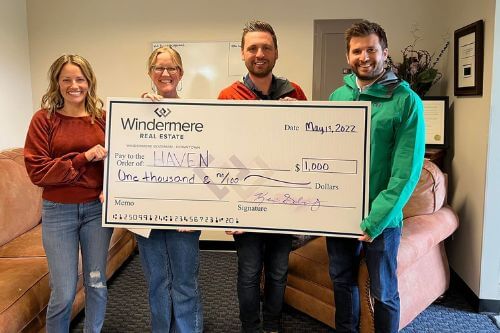
Their donation to Thrive will go toward hiring mentors for two children for an entire school year. The funds allocated to Eagle Mount paid for some of the production costs for their largest annual fundraiser, which the Bozeman staff helped put on during Community Service Day 2022. Their donation to Haven will be used to provide resources to victims of domestic and/or sexual abuse. Family Promise plans to use the funds to support families experiencing homelessness in Gallatin County. And the donations to HRDC will go toward the establishment of a new facility to provide resources and solutions to people experiencing poverty in the area.


Three agents from Windermere Bozeman and two reps from Eagle Mount hold up a donation check for one thousand dollars

Pictured L to R: Aidan Young, Kelly Martin, Mike Stem, Andrew Flakker, Natalie McDonald – Image Source: Natalie McDonald


Three agents from Windermere Bozeman and a rep from Haven hold up a donation check for one thousand dollars

Pictured L to R: Kim Stevens, Erica Coyle, Kevin Schwartz, Bobby Goodman


Windermere Mercer Island 

Every year, the Windermere Mercer Island office hosts a shredding event which draws crowds of clients and community members alike. This year, they hired a local shredding company to bring a truck to the office parking lot and invited the community to safely and securely shred their old documents while getting a chance to meet some of their fellow community members. The event also served as a platform to collect donations for and raise awareness about the Windermere Foundation’s 50 in 50 campaign.

Windermere Walla Walla

In May, Windermere Walla Walla held a cartoon-themed bowling night to raise money for the local YWCA, the Christian Aid Center, and Children’s Home Society. Agents, staff, and community members came dressed as cartoon characters of all kinds, which made for a colorful and lively scene at the local bowling alley. All in all, Walla Walla collected a whopping $10,000 to support the YWCA’s resources for local women in need, the Children’s Home Society’s child and family counseling, and the Christian Aid Center’s efforts to provide emergency shelter for the Walla Walla homeless population. 


Two adult men dressed as cartoon characters for a bowling fundraiser event

From left: Casey Waddell & Toby Swank


To learn more about the Windermere Foundation, visit windermerefoundation.com. To help support programs in your community, click the donate button below.

content_Donate_button.jpg

Selling July 13, 2022

High ROI Remodeling Projects to Increase Home Value


This blog post contains excerpts of the “Remodeling 2022 Cost vs. Value Report” (costvsvalue.com).1


As you prepare to sell your home, one of the major considerations you may face is whether to remodel, and if so, how to allocate your remodeling budget. Remodeling can help differentiate your home from competing listings in your area, but this competitive advantage comes at a price.

The following information provides insight on which remodeling projects deliver high ROI. To maximize the value of your remodel, talk to your agent about what buyers in your area are looking for and align your efforts accordingly.

High ROI Remodeling Projects to Increase Home Value

It’s no secret that buyers want to see a home with curb appeal and attractive interior spaces. But as a seller, you’ll only have so much budget to work with and you want to get the most return on your investment. As laid out below, here are the five highest ROI remodeling projects nationwide as found in the Remodeling 2022 Cost vs. Value Report (www.costvsvalue.com).1


Remodeling Project

Cost of Remodeling Project (2022)

Resale Value of Remodeling Project (2022)

ROI

Garage Door Replacement

$4,041

$3,769

93.3%

Manufactured Stone Veneer

$11,066

$10,109

91.4%

Minor Kitchen Remodel (Midrange)

$28,279

$20,125

71.2%

Siding Replacement (Fiber – Cement)

$22,093

$15,090

68.3%

Window Replacement (Vinyl)

$20,482

$13,822

67.5%


This data shows that for a given remodeling project a higher expenditure doesn’t necessarily equate to higher ROI. It’s interesting to note that only one indoor project—the minor kitchen remodel—placed in the Cost vs. Value Report’s top five.

Four of the Cost vs. Value Report’s bottom six entries are upscale remodeling projects, all with roughly a 50% average return on investment. The conclusion to be drawn here is that remodels of this magnitude are expensive and should be considered carefully before you greenlight them. The upside to these projects, though, is that they have a much higher resale value than a simple fresh coat of paint or a change in décor. If you and your agent identify a logical upscale remodel with serious resale potential whose costs you can handle, it can help you get the best price for your home.

So, does this mean you should replace your garage door before selling your home bar none? Not necessarily. Again, your remodeling priority list should target the areas of your home that need attention while aligning with local buyer interest. Your agent can provide guidance on what competing listings in your area are offering and refer you to trusted remodeling contractors in your area.


Remodeled contemporary kitchen with white cabinets and hardwood floors

Image Source: Getty Images – Image Credit: YinYang


Budget-Friendly ROI Home Projects

Though smaller scale home makeovers don’t have the value-adding power of larger remodeling projects, they can still make a difference when selling your home.

Instead of an upscale kitchen remodel, you can focus more on making minor improvements in several areas. For example, repainting or refinishing your cabinets, swapping out your drawer pulls and hardware, and installing new appliances can make your kitchen feel brand new with a smaller budget. When remodeling your bathroom, tasks like refinishing your tub, installing new lighting, and a new backsplash can make a strong impression on buyers.

For more information on budget-friendly home makeovers with ROI potential, check out our quick guides to upgrading your bathrooms, bedrooms, home office, and kitchen.


  1. © 2022 Zonda Media, a Delaware Corporation. Complete data from the Remodeling 2022 Cost vs. Value Report can be downloaded free at costvsvalue.com.
Design July 11, 2022

What is Mid-Century Modern Architecture?

The mid-century modern movement’s impact on design reaches far and wide. Whether it’s graphic design, architecture, interior design, product development or elsewhere, we see traces of its influence in countless aspects of everyday life today. Mid-century modern homes are known for their signature look and stylistic appeal. Here’s a short guide to understanding the characteristics behind mid-century modern architecture.

Mid-Century Modern Design

Yes, mid-century modern interior design and mid-century modern architecture are two separate things. The interior design style emphasizes clean lines and minimal decoration, the use of natural elements as accents, and a base of neutral colors for decorating. MCM interior design can exist in any type of home regardless of its architectural style, and is often a popular source of inspiration for decorators fond of vintage elements and popular mid-century furniture pieces such as credenzas, teak desks, Eames chairs, etc.

What is Mid-Century Modern Architecture?

Mid-century modern architecture is the exterior counterpart of its interior design branch. Fueled by a massive need for suburban homes throughout the Unites States in the post-World War II era, the stage was set for mid-century modern’s introduction to the masses. Some of the greatest minds in modern architectural history helped develop and proliferate its presence in society, including Ludwig Mies van der Rohe and Frank Lloyd Wright. Though you’ll find unique variations within mid-century modern, there are certain tenets of the architectural style.

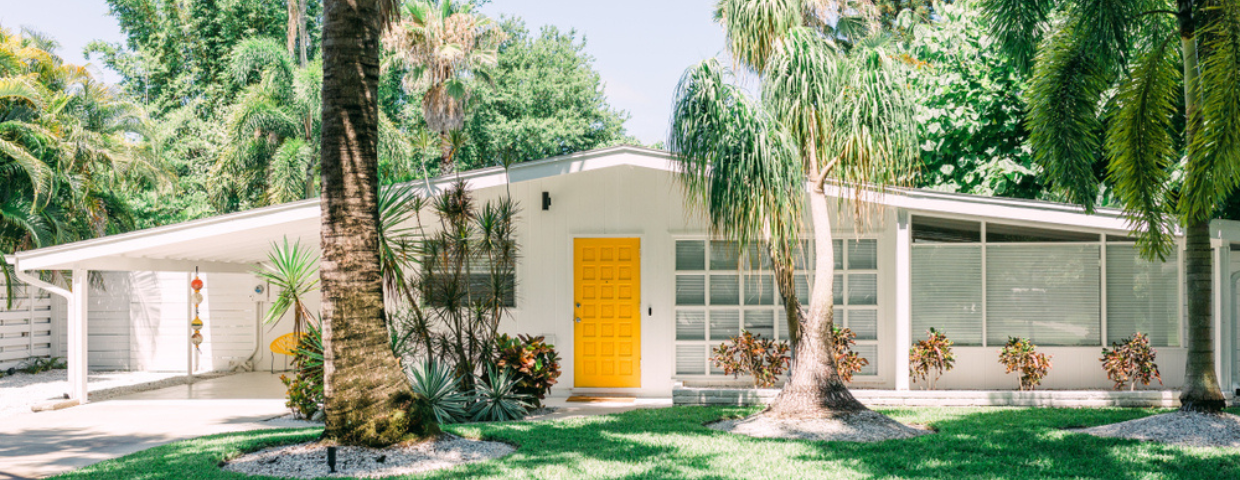
  • Mid-century modern homes have flat roofs with straight lines. This clean geometric approach in roof design is part of a larger philosophical ideal that these homes should blend in with their outdoor environments, thereby working in harmony with nature.
  • Glass is used heavily, and floor-to-ceiling windows are a common feature, especially in the living room.
  • The minimalist approach to exterior design is showcased in the easy access to outdoor spaces and the fact that mid-century modern homes are often one-story buildings.
  • The open spaces created by this architectural style allow for intentional decorating and the use of color splashes to bring energy into them. Mid-century modern interiors often incorporate vibrant, warm colors on top of a calmer, neutral foundation.


For more information on home design, read our guide to industrial design:

What is Industrial Design?

Buying July 8, 2022

The Difference Between a Real Estate Agent and a Mortgage Broker

Throughout the course of buying a home, you’ll work with a variety of professionals, all with specific training to help you through each stage of the process. With such a cast of specialists around you, it’s helpful to know everyone’s responsibilities and which questions to ask whom. One important distinction to be made is the difference between your real estate agent and your mortgage broker. The following information is a guide to understanding where they differ and how each of them helps you to buy a home.

Real Estate Agent vs. Mortgage Broker

Both real estate agents and mortgage brokers are licensed professionals who play a pivotal role in the home buying process by bringing parties together to get a deal done. However, that’s about where the similarities end.

Real Estate Agent

Your real estate agent will represent you throughout the buying process. Their access to the Multiple Listing Service (MLS) allows them to search the widest network of available homes to find the ones that match your budget and criteria. They’ll also receive alerts on open houses and are usually the first to know when new listings hit the market.

Once you’ve identified a home you’d like to pursue, they’ll assist you in putting together your offer, negotiating with the listing agent representing the seller, and guide you through the counteroffer process (should there be one). Once the seller accepts your offer, your agent will help you negotiate any final repair requests found in the home inspection and assist you through closing until you’ve received the keys to your new home.

The point is: your agent will be with you throughout your home buying journey, from start to finish. They are an invaluable resource for local market knowledge and real estate expertise. Though they will not execute the financial aspects of a home purchase for you, (that’s where your mortgage broker comes in), they can recommend trusted lenders with whom you can apply for and secure a home loan.

For more information on working with an agent, visit our Home Buying Guide:


Mortgage Broker

Mortgage brokers work on the financial side of a real estate transaction, representing buyers to find them favorable mortgage terms when shopping for a home loan. They connect borrowers to lenders by researching the various fees and rates associated with obtaining a mortgage, accessing the buyer’s financial creditworthiness, and coordinating paperwork. Mortgage brokers are not responsible for loaning any money. Once they’ve found the right lender and loan product for their client, they hand the baton to the lender, who will then disburse the funds at the appropriate time.

Working with a mortgage broker can save you time and money. In some cases, they may be able to get the lender to waive certain fees and are experts at finding the best deal for their clients among a vast array of loans and lenders. Mortgage brokers are instrumental in getting your financing for your home purchase secured and provide guidance on which loan products may work best for you.

For more on the financial aspects of a home purchase, read the following:


Two women discussing the terms of a mortgage application

Image Source: Getty Images – Image Credit: kate_sept2004


Questions to Ask Your Real Estate Agent and Mortgage Broker

Now that you know a bit more about the respective responsibilities of real estate agents and mortgage brokers, here are a few common questions to ask when conducting interviews: 

Real Estate Agent

Mortgage Broker

  • How do you help buyers to make their offer stand out?
  • What is the required down payment for this loan?
  • What’s the difference between fixed-rate and adjustable-rate mortgages?
  • How many clients are you working with currently?
  • Which costs are attached to this loan?
  • What is the best way to contact you?
  • How high does my credit score need to be?
  • How long have you been an agent in the local market?
  • What is the interest rate for this loan?
  • Do you represent both buyers and sellers?
  • Do you have recommendations for mortgage brokers, home inspectors, etc.?
  • Is there a prepayment penalty?


To connect with an experienced, local Windermere agent, click the button below:

Living July 6, 2022

Lead Paint: Tips for Testing and Removal

In the past, lead paint was commonly used to paint homes. Its durability and resistance to moisture were its greatest assets, but it was only a matter of time until health officials discovered its poisonous properties, and in 1978 it was officially banned. Lead paint causes a variety of health issues and is especially harmful to children, so those living in homes built during the lead paint era should be aware of its dangers, how to detect it, and how to go about removing it safely.

Testing for Lead Paint

You won’t know whether lead paint exists in your home unless you test for it. There are a variety of do-it-yourself testing kits available, but their results may vary and can sometimes be prone to false positives, depending on the active testing agent. Given the variability with DIY testing, it may be best to hire a professional to test for lead paint in your home—both for accuracy and peace of mind. You can also choose to send a paint sample into a lab for testing.

Dealing with Lead Paint

If you discover lead paint in your home but it is still intact, encapsulation may solve the problem without having to remove it. Encapsulation is the process of painting over the areas where lead paint exists using a special coating that seals in the lead paint layer underneath. This is often the more affordable way of dealing with lead paint, but the coating may wear off over time, leaving you back at square one.

If you’re thinking about selling your home, the presence of lead paint is a necessary disclosure. Know that buyers generally view a home with lead paint as unfavorable, given its serious health risks and dangers. If you’re thinking about remodeling, testing for lead paint is a wise first step before you start knocking down walls or ripping through sheetrock.

Removing Lead Paint

The more your paint is cracked, chipped, or damaged in any way, the riskier it is. Any signs of deterioration in a lead paint-based home should be dealt with by removing it as soon as possible.

Removing lead paint on your own is generally not advised. It requires specific training and materials, as well as many preventative measures including creating a sealed exit, wearing protective clothing, properly covering the various surfaces in your home, and proper execution of removal to ensure you’ve vanquished all the lead—just to name a few. 

Like any other home improvement project, it’s best to consult lead paint removal professionals in your local area and compare their quotes before making your choice. Before the pros come, you can prepare by clearing away any paint chips that have fallen, thoroughly cleaning the surfaces in your home, and encouraging your household and guests to refrain from touching those surfaces. 

For more information on preventing damage to your home, read our guide to dealing with mold.

How to Prevent and Deal with Mold

Selling June 29, 2022

Preparing to Sell Your Home: A Complete Checklist

Getting your home ready to sell can feel like a circus act. Without the right organization, juggling the countless moving parts involved in this stage of the selling process can take its toll. This is the perfect opportunity to create a checklist to keep yourself on track and within your budget. The following information will illuminate the key responsibilities you face as a homeowner as you prepare to hit the market.

We’ve included a comprehensive checklist below of the common tasks required to get your home ready to sell. It is also available as an interactive web page and downloadable pdf here: Get Ready to Sell Checklist


Preparing to Sell Your Home: Working with an Agent

Before you start working on the house itself, it’s best to get the ball rolling on the strategic aspects of selling a home. Working with a real estate agent is the best way to get your home sold for the best price in a timely manner.

A listing agent will represent you throughout the selling process to determine the value of your home, coordinate open houses, market the property, and negotiate with buyers to reach a deal. In the early stages of your discussions with your agent, they will conduct a Comparative Market Analysis (CMA) to see what price your home could fetch on the market, accounting for various factors that influence home prices such as seasonality and local market conditions. Based on the findings of your agent’s CMA, you can discuss whether remodeling fits into your go-to-market strategy, and your agent can provide intel on which remodeling projects could deliver significant ROI based on buying trends, your location, and what comparable listings in your market are offering.

Home value estimation tools can help you get an idea of what your home is worth to facilitate your conversations with your agent. Use our free Home Worth Calculator by clicking the button below: 


A middle-aged man and woman sit down with their real estate agent.

Image Source: Getty Images – Image Credit: FG Trade


Preparing to Sell Your Home: A Complete Checklist

Once you’ve found an agent, you’re ready to get your home in tip-top selling shape. The following checklist is available as a free downloadable PDF here:

Get Ready to Sell Checklist – PDF

Exterior

This list of value-adding curb appeal projects will help to form buyers’ first impressions of your home and make your ever-important exterior listing photos stand out amongst the competition. 

  • Remove peeling and chipped paint; replace with a fresh coat
  • Fix loose trim and fencing
  • Clear gutters and downspouts
  • Make sure there is good exterior lighting and all walkway lights and front-door lanterns work
  • Clean and repair the roof as needed
  • Clear garage of clutter and tidy shelves
  • Inspect chimney for cracks and damage

Yard

  • Mow and trim grass; re-seed and fertilize where necessary
  • Prune all overgrown trees and shrubs
  • Weed flowers beds
  • Remove or replace dead or diseased plants, shrubs, and trees
  • Clean grease and oil stains from driveway

Decks/Patios

  • Paint or stain worn areas on wood decks
  • Remove grass growing in concrete cracks; sweep off debris from shrubs and trees
  • Clean all deck rails and make sure they’re secure; replace missing slats or posts
  • Clean outdoor furniture

Front Door

  • Polish or stain worn areas on wood decks
  • Add a fresh coat of paint to get rid of nicks
  • Clean the glass on the storm door; make certain the screen is secure
  • Make sure the doorbell operates properly and there are no squeaks when the door opens and closes

Windows

  • Clean all windows inside and out
  • If needed, add a fresh coat of paint to the window trims and sills
  • Make sure all windows open and close easily
  • Replace cracked windowpanes and those with broken seals
  • Make sure window screens are clean and secure; replace any screens with holes or tears

Front Entry

  • Clean entryway floors and area rugs
  • Downsize clutter in the entry and entry closet to give the appearance of spaciousness
  • Double-check entry lighting to make sure it works

Interior

Not only will these interior projects get your house sparkling clean, but they’re also preparatory steps for staging your home and hosting open houses.

General Interior Cleaning

  • Clean all floors, carpets, walls, and trim
  • Replace burned-out light bulbs
  • Empty trash
  • Remove family photos, valuables, and prescription drugs
  • Tidy up clutter

Kitchen

  • Fix dripping faucets
  • Organize pantry and cupboards so they appear clean, neat, and spacious
  • Make sure the refrigerator and freezer are defrosted and free of odors
  • Clean the oven and cook top thoroughly
  • Set the table

Living/Family/Dining Rooms

  • Give rooms a fresh coat of paint as needed
  • Repair cracks and holes in ceiling and walls
  • Make sure all wallpaper is secure
  • Repaint any woodwork that is worn or chipped
  • Clean or replace draperies and blinds; open them to maximize light
  • Make sure draperies and blinds open and close
  • Steam-clean carpets
  • Clean rugs and wood flooring, and remove any stains or odors
  • Position the furniture to showcase the size and space of the room
  • Remove and replace any attached items, such as chandeliers and draperies, that you wish to move with you
  • Put away toys and hobby supplies; remove extra magazines and books from tables

Bathrooms

  • Make sure sinks, tubs, showers, and countertops are clean and free of stains
  • Repair any leaky faucets
  • Remove grout and soap stains from tile
  • Replace any missing or cracked tiles or grout
  • Make sure all joints are caulked
  • Make sure all fixtures, including heat lamps and exhaust fans are operating
  • Install a new shower curtain and buy matching towels
  • Store all supplies, such as toilet paper, shampoo bottles and cleansers, out of sight

Bedrooms

  • Repair cracks in ceiling and walls
  • Apply a fresh coat of paint if necessary
  • Make sure all wallpaper is secure
  • Clean draperies and blinds; open them to maximize light
  • Put away toys, clothes, and clutter
  • Neatly make up the beds

Basement

  • Check for water penetration or dampness; call for professional repairs if necessary
  • Get rid of musty odors
  • Clean furnace, hot water heater, and drains
  • Make sure light fixtures work
  • Arrange storage area in a neat and organized manner
  • Make sure stairway handrail is secure

Tidy Extras

  • Use air fresheners or bake treats to make the house smell good
  • Plant flowers to brighten the walkway and enrich the entry
  • Remove any indoor houseplants that are brown or losing their leaves
  • Remove all “fixer” cars, campers, and boats from the property
  • Discard the clutter of magazines on the coffee and end tables
  • Tidy and declutter all closets
  • Hide or get rid of worn-out throw pillows
  • Store pet supplies
  • At night, turn on the porch light and outdoor lighting
  • Put away toys and hobby supplies; remove extra magazines and books from tables


For more information on preparing to sell your home, helpful hints on the rest of the selling process, tips on working with an agent, moving checklists, and more, visit our Home Selling Guide:

Market News June 27, 2022

The Growing Housing Affordability Problem


This video is the latest in our Monday with Matthew series with Windermere Chief Economist Matthew Gardner. Each month, he analyzes the most up-to-date U.S. housing data to keep you well-informed about what’s going on in the real estate market. 


Hello there, I’m Windermere’s Chief Economist Matthew Gardner and welcome to this month’s episode of Monday with Matthew.

If you’ve listened to me at all over the past several years, you’ll know that I am pretty passionate about one subject: housing affordability. And, given the significant price growth that we’ve seen over the past decade, as well as the recent spike in mortgage rates, I wanted to talk a little bit about what might be done to address this very serious issue.

The Growing Housing Affordability Problem

Now, when we think about housing affordability and how it might be solved, a lot of people get tied up in the minutiae when, quite frankly, it really isn’t that hard a problem to solve. You see, there’s one very simple way to address this: to build more housing units. But, as easy as that may sound, there are a lot of obstacles that are holding new supply back. But before I get to that, I want to share some data with you that might help to demonstrate how serious an issue we all face.

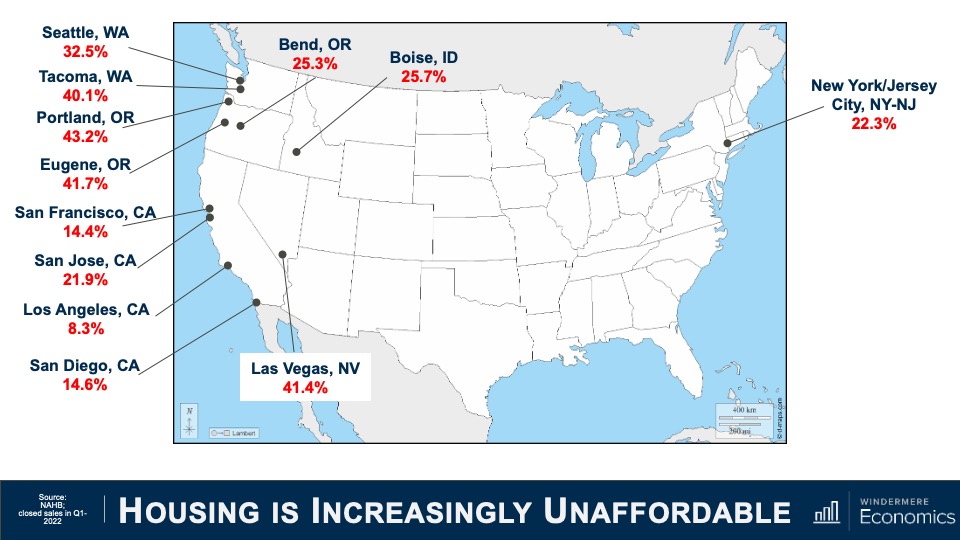
Every quarter, the National Association of Homebuilders puts out its affordability numbers for metro areas across the country. An analysis of sales and incomes allows them to show the number of homes—both new and existing—sold in a quarter that were affordable to households making median income.

Housing is Increasingly Unaffordable

Here you will see numbers from just a few of the 240 metropolitan areas across the country and the share of sales in the first quarter of this year that were “technically” affordable. I think you’ll agree that it’s eye opening.

A map of the United States showing the percentage of homes sold last quarter that were affordable to households making median income in select markets. 32.5% of new and existing homes sold in Seattle were affordable to household making median income, 40.1% in Tacoma, Washington, 43.2% in Portland, Oregon, 41.7% in Eugene, Oregon, 14.4% in San Francisco. 21.9% in San Jose, California, 8.3% in Los Angeles, 14.6% in San Diego, 41.4% in Las Vegas, 25.4% in Bend, Oregon, 25.7% in Boise, and 22.3% in the New York/Jersey City area.


Although I am only showing you a few of the U.S. markets I will tell you that the ten least affordable US housing markets were all in California. The Golden State is also home to 21 of the top 25 least affordable markets in the country. But what you might also find interesting is that our primary cities aren’t the only ones that are suffering from affordability issues, with markets like Bend, Oregon; Boise, Idaho; and even Las Vegas, Nevada becoming increasingly unaffordable for a lot of households.

And it’s worth mentioning that that 48 of the 69 markets where less than half of the homes sold were affordable were in states that have at some point in the past implemented comprehensive planning and growth management legislation. And when governments mandate where homes can and cannot be built, one thing happens: it pushes land prices higher which makes new homes more expensive and limits the amount of new supply that builders are able to provide. So, what can be done?

Well, I will start out by saying that states who have implemented growth management plans, which they generally did to slow or stop suburban sprawl, remain disinclined to move these boundaries, and that means it becomes paramount to not look further out but to concentrate within the urban growth boundaries and decide whether it’s time to think about removing single-family zoning altogether.

This is a fascinating thought, but I must add that I am not suggesting that we do away with single-family homes. Absolutely not! What I am thinking about is the ability for a market to decide what makes the most sense. In order to do so, single-family zones need to allow for the development of denser housing, but also allow the market to decide what’s best. Areas that have implemented such change has given rise to a movement in order to address what is being referred to as “missing middle housing.” For those of you who are unfamiliar with this term let me try and explain.

Missing Middle Housing

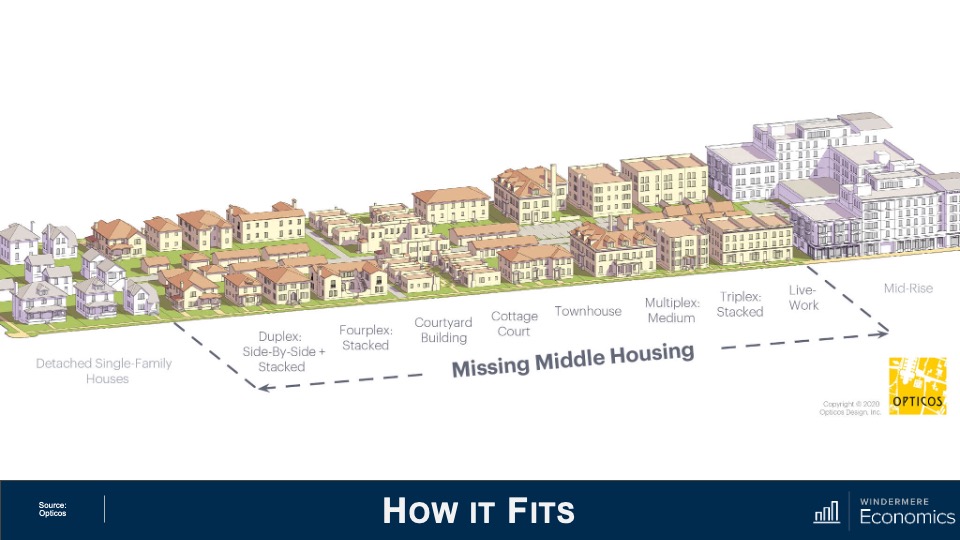
A depiction of different housing types from Optico Design Inc. that illuminates the "missing middle" housing types that were common prior to World War II but are now far less common and, therefore, "missing". The housing types in the "missing middle" include duplexes, fourplexes, courtyard buildings, cottage corts, townhouses, medium-sized multiplexers, stacked triplexes, and live-work buildings. The housing types outside of the "missing middle" include detached single-family houses and mid-rise apartment buildings.


This is a great image courtesy of Opticos, a team of urban designers, architects, and strategists who are passionate about adding sorely needed housing options.

They came up with the term “missing middle” as it describes housing types that were actually very common prior to World War II where duplexes, row-homes, and courtyard apartments were in high demand. Unfortunately, however, they are now far less common and, therefore, “missing.”

And the key function of this type of housing is to meet the rising demand for walkable neighborhoods, respond to changing demographics, and provide housing at different price points. You see, rather than focusing on the number of units in a structure—think high rise apartments or condominiums—this type of housing emphasizes scale and heights that are appropriate for and sympathetic to single-family or transitional neighborhoods.

The Decline of Missing Middle Housing Construction

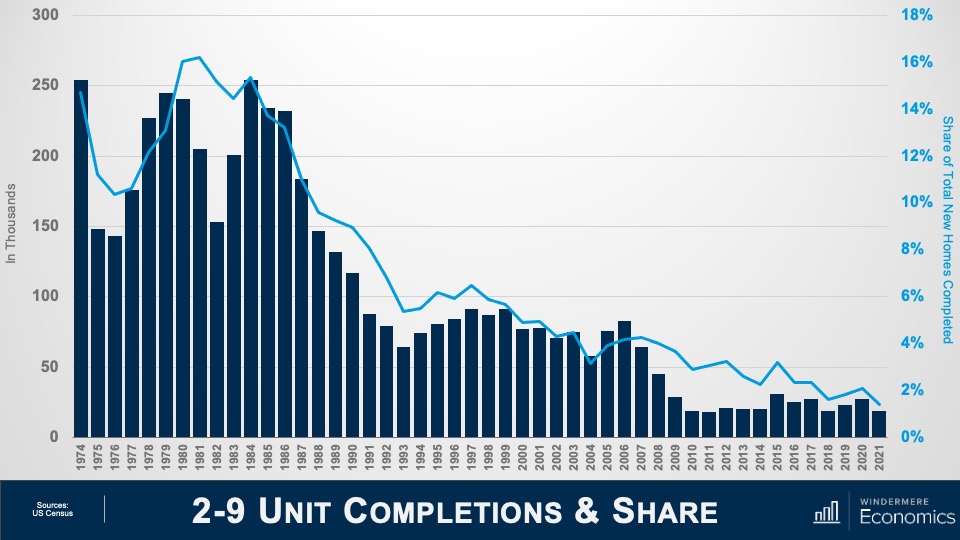
A bar chart showing the number of duplexes to 8-unit buildings built over roughly the past half-century dating back to 1974. The years 1974 through 2021 appear on the x-axis and the number of completed units built appears in thousands on the y-axis, ranging from 0 to 300. On the z-axis, the chart shows what percentage of total new homes completed the y-axis values for that year accounted for. The z-axis ranges from 0% to 18%. The highest values in the chart are 1974 and 1984, when roughly 250,000 units were completed, which was roughly 15% of the total new homes completed that year. The chart gradually declines from the mid-1980s to present day. Since 2007, there hasn't been a single year where over 50,000 units were completed.


And to show you how supply of these types of units has changed, this chart shows the number of duplexes to eight-unit buildings built over the past almost half-century and you can clearly see that up until the late 1980s they were being built in decent numbers, but the 1990s saw a significant shift toward traditional single-family home ownership and builders followed the demand and this type of product started to become scarcer.

Almost 16% of total new homes built in America in the early 1980s were of this style, but that number has now shrunk to just 1.4%—or a paltry 19,000 units.

But I see demand for these housing types growing as we move forward and that buyers or renters, young and old, will be attracted as it will meet their requirements not only in regards to the type of home they would want to live in but, more importantly, it can be built cheaper than traditional single-family housing and therefore it will be more affordable.

But although this sounds like it’s a remarkably simple solution that can solve all our woes, in reality it’s not that easy for two very specific reasons. The first is that many markets are already essentially built out, meaning that in order to develop this type of product, a builder would have to purchase a number of existing homes and raze them in order to rebuild. But given current home values, it’s very hard for a builder to be able to make such a proposal financially.

And the second issue is that current residents within these “transition” areas—which have been developed as traditional single-family neighborhood—simply don’t want to see change. But is this type of product bad? Here are some examples.

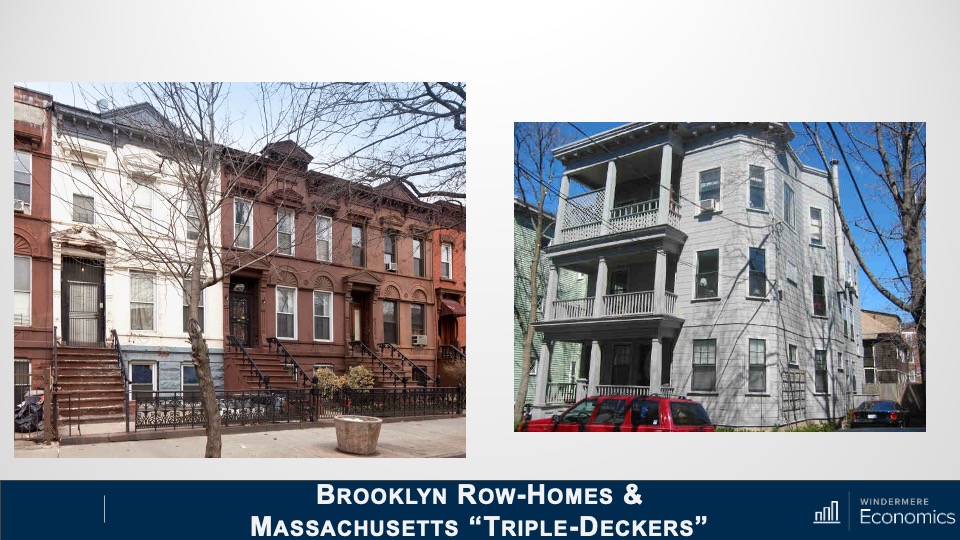
This shows row-homes in Brooklyn on the left and traditional “triple-deckers” in Massachusetts on the right:

A side-by-side look at two different types of East Coast building types: the horizontal Brooklyn Row-Homes and the more vertically constructed Massachusetts "Triple Deckers."


This is a bungalow court project in California:


An interconnected building of California "Bungalow Courts" with low-pitched roofs and small porches, all connected by a winding sidewalk.


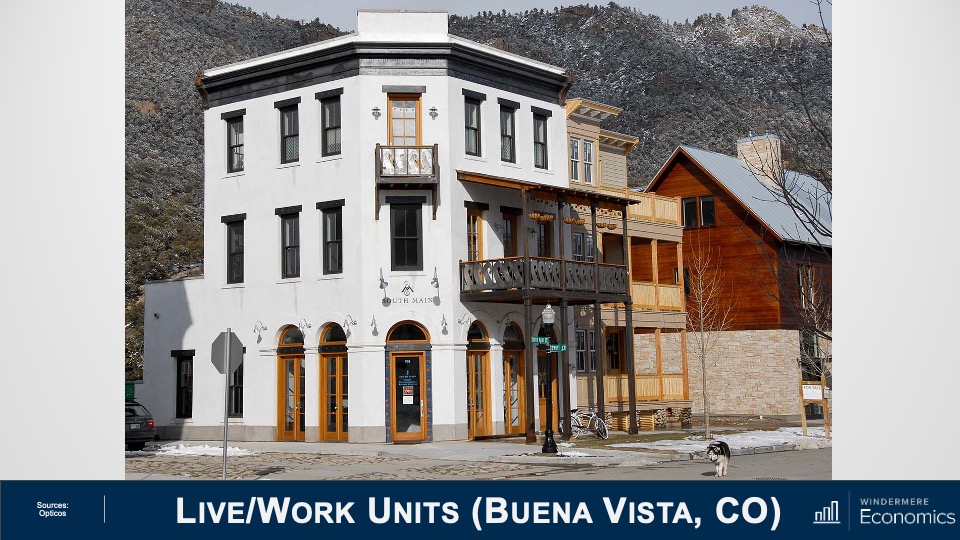
Here are some Live/Work Units in Colorado:


A white live/work unit in Buena Vista, Colorado with a second-story patio built onto the right side of the building.


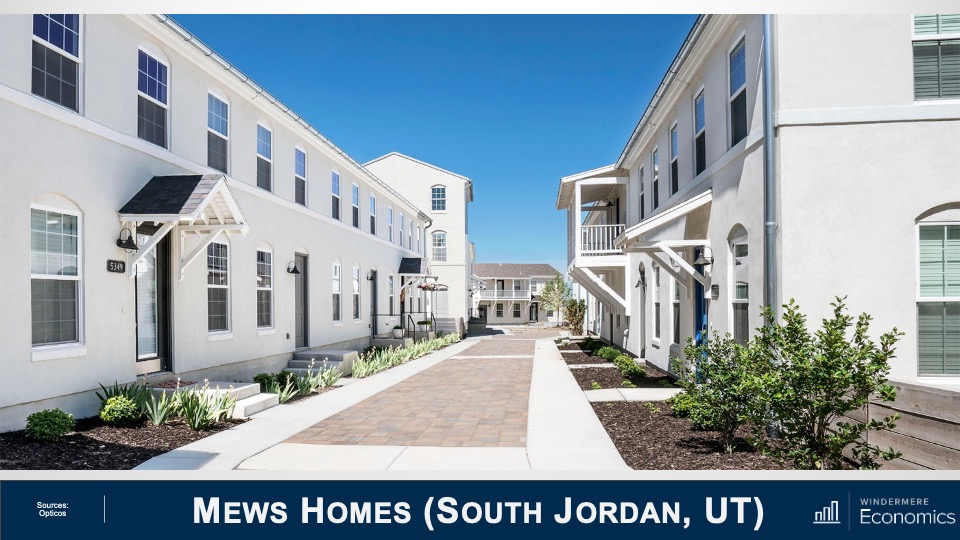
These are some amazing mews homes in Utah:


A community of Mews Homes in South Jordan, Utah painted white with arched windows and small eaves hanging above the doorsteps.


And finally, a new terrace housing project that will be built in Washington DC:


A drawing of Terrace Housing in Washington DC showing facades with many windows lined side-by-side on a city street.


Don’t get me wrong, I’m sure that some of you who simply aren’t inspired by this type of architecture, and that is understandable. But can we simply stick with the status-quo? I don’t think so. And some state legislators have already implemented significant zoning amendments in order to try and encourage this type of development.

Back in 2018, Minneapolis was the first city to allow this type of development inside single-family zoned areas. This was followed by Oregon State in 2019. Senate Bill 9 was signed by Governor Newsom of California last year which made it legal for property owners to subdivide lots into two parcels and turn single-family homes into duplexes, effectively legalizing fourplexes on land previously reserved for single-family homes. So, we are starting to see some change.

This is a good start but as I mentioned earlier in areas that are already built out, even this type of forward-thinking legislation will not be the panacea that some want. But I’m not giving up hope.

Addressing the “missing middle housing” would allow for homes of all shapes and sizes, for people of all incomes including workers who are essential to our economy and community. Here I am talking about our teachers, firefighters, administrative assistants, childcare providers, and nurses—just to name a few!

There are currently 45 million Americans aged between 25 and 34 and most aspire to homeownership. However, the massive price growth which, by the way, many of us have benefitted from over the past several years, has simply put a “starter home” out of their reach.

I will leave you with one last statistic. Over 28% of American households today are made up of a single people living alone, and it is anticipated that up to 85% of all U.S. households will not include children by the year 2025. Finally, by 2030, one in five Americans will be over the age of 65.

Are we going to meet the needs of the country’s changing demographic going forward? I certainly hope so, but it will take a lot of work for us to get there. As always, if you have any questions or comments about this particular topic, please do reach out to me but, in the meantime, stay safe out there and I look forward to visiting with you all again next month.

Bye now.

More June 24, 2022

Windermere Participates in 38th Annual Community Service Day

Windermere offices close for business every year in June to participate in Community Service Day, an annual tradition since 1984 where our agents, staff, and franchise owners spend the day volunteering in their communities. We’ve gathered a handful of stories to share a glimpse of what Community Service Day 2022 looked like around our network.

Windermere Real Estate Professionals – Boise, ID

With inflation soaring, the Windermere Real Estate Professionals office in Boise, Idaho identified a food drive as a way to make a positive impact in their community for this year’s Community Service Day. Partnering with the Windermere Boise Valley office, they ran a food drive for two weeks, resulting in 520 pounds of food donations to the Idaho Food Bank. Seven staff members participated in food delivery and volunteered at the food bank to package 2,100 pounds of pinto beans to be distributed out into the community. For every one dollar raised, the Idaho Food Bank was able to provide four meals for community families in need.

A group of Windermere agents from the Boise, Idaho office stand by a food bank sign.

Pictured back row from left to right: Linda Evans, Lindsey Olson, Jason Smith, Mindi McCallister – Bottom row left to right: Tina Perry, Denise Hapner, Marissa Musgrave – Image Source: Lindsey Olson


Windermere Portland-Lloyd Tower NE – Portland, OR

The Windermere Lloyd Tower office showed up in strong numbers for a city-wide cleaning project in Portland, Oregon. Working with SOLVE, a local organization dedicated to the restoration and preservation of Oregon’s environment through the mobilization of volunteers, they made their way through the city picking up trash and clearing debris.

A group of Windermere agents and staff from the Lloyd Tower office outside their office door.

Pictured: Daniel Fagan, Claudia Pinedo, Ahna Austin, Josh Velasquez, Melissa George, Regina Cameli, Tyler King, Lori Bennett, Carmel Siler, Beth Kellan, Rob McElroy, Jeanine R. Dixon, Doug Meyer, Scarlet Eikrem, Cynthia Chase, Megan Barrett, Katie Bennett, Sean Kelly, Desireé Moore, Darren? + last signature – Image Source: Susie Hunt Moran


Windermere Northwest Living – Vancouver, WA

Windermere Northwest Living in Vancouver, WA has close ties to local Fruit Valley Elementary, a school whose foundation they have donated food to in the past. The office held a food drive to support students in need facing food insecurity, gathering over $3,000 in food donations. For the first time since 2019, the students were able to receive the donations in person. Windermere Northwest Living followed up the food drive with a donation to the school’s foundation from their brokers, staff, and clients totaling $12,000.

A group of Windermere agents and staff from Northwest Living in Vancouver, WA hold up a check for $12,000.

Pictured: Nataliya Thomas, Lynn Posselt, Sue Wolfe, Tyneil Thompson, Connie Bovee, Dayna Freitag, Karen Cleveland, John Blind, Dean Lane, Halle Sessions, Lauren Cooper, Hollie Sessions, Barbara Corigliano, Gretchen Finn, Steph Tornaw, Chad Sessions, Mike Lamb, Libby Murphy Benz, Gerry Dowdy-Latshaw


Windermere Northern Colorado – Fort Collins, CO

Deeply involved in supporting the housing needs of their community, Windermere Northern Colorado found the perfect partner for their Community Service Day efforts in Neighbor to Neighbor, an organization providing sustainable housing, supportive services, and education to Larimer County, CO locals. A group of agents and staff gathered to build handicap-accessible raised garden beds to support the residents’ gardening and sustainable food practices.

A group of agents and staff from Windermere Northern Colorado working on a project during Community Service Day 2022.

Pictured left to right: Paul Hunter, Pete Jordan, Brandon Bidwell – In background: Heather Patel and son – Image Source: Windermere Northern Colorado / Fort Collins


Windermere Lake Oswego – Lake Oswego, OR

The COVID-19 pandemic has put added pressure on households already experiencing domestic violence; a truth that is not lost on the Windermere Lake Oswego office. Accordingly, they sought to support local women and children facing these issues by partnering with Clackamas Women’s Services, an Oregon City-based organization providing critical services to domestic and sexual abuse survivors and their families. Members of the Lake Oswego office spent the day volunteering at a soon-to-open CWS shelter that will support survivors in their program and provide them a safe place to stay. Windermere agents and staff donated food and toiletries, sorted donations, cleaned windows, and swept floors to get the shelter ready to open its doors.

A group of agents and staff from Windermere Lake Oswego at a playground on Community Service Day 2022.

Pictured left to right: Sandy Fogle, Patty Black, Bill Futrell, Sandi Sheets, Alexis Halmy, Alta Strayhan, Kerri Miller, Natalie Jackson, Linda Crumb, Laurie Bornstein, Christi Kraus, Dennis Kelly – Image Source: Christi Kraus


Windermere Northwest Living – Longview, WA

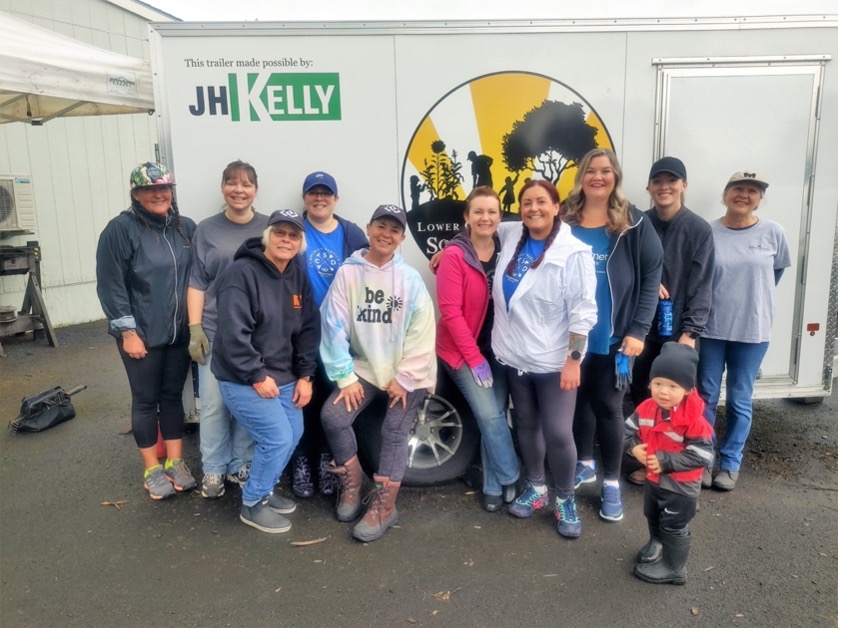
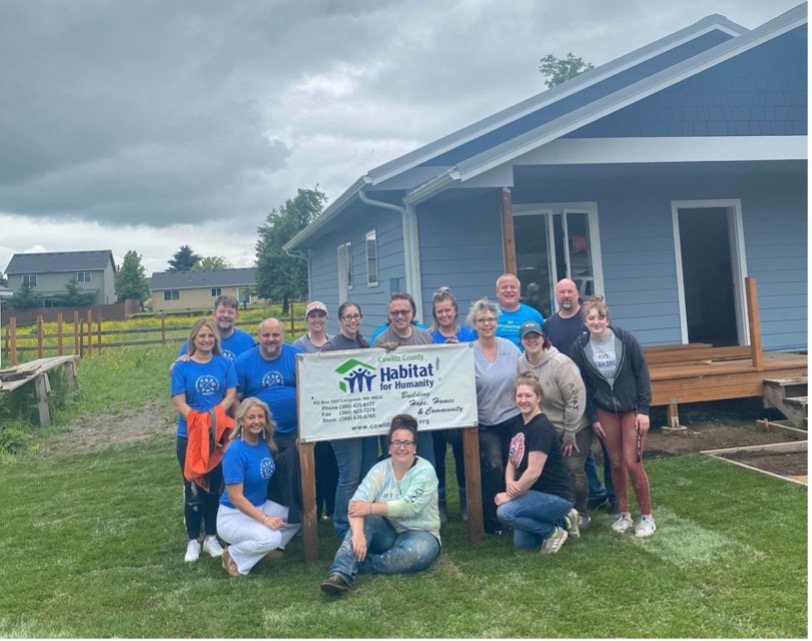
Windermere Northwest Living in Longview, WA focused their community service efforts on two local organizations—Lower Columbia School Gardens and Habitat for Humanity—with a variety of gardening and planting projects. Agents and staff divided into two groups: one group pulled weeds, pruned trees, and prepared garden beds for Lower Columbia students’ classes, while the other laid sod, built a deck, and laid flooring for the Habitat for Humanity project. 

A group of agents and staff from Windermere Longview outside on Community Service Day 2022.

Pictured left to right: Kellie McIvor, Vicki Sturm, Tami Cheatley, Tara Lundin, Kari Gott, Sherry Bjorhu, Kayla Duckworth, Nicole Graichen, Kaylie Kingsley, Baby Jack Kingsley, and Jayme King – Image Source: Kari Gott

A group of agents and staff from Windermere Longview outside on Community Service Day 2022.

Pictured left to right: Hollie Sessions, Chad Sessions, Halle Sessions, Bobby Lundin, Amanda Kurtti, Amelia Glassett, Tim Glassett, Shelby Alred, Barbara Stephenson, Kevin Campbell, Megan Rogers, Abby Davis, Chad Earhart, Lilly Cress – Image Source: Kari Gott


Windermere Bozeman – Bozeman, MT

Over in Montana, the Windermere Bozeman-Downtown office was hard at work supporting Eagle Mount, an organization that provides recreational opportunities for people with disabilities and young people with cancer. Agents and staff helped Eagle Mount set up for “The Western Rendezvous,” the organization’s largest annual fundraiser consisting of live and silent auctions. The Windermere volunteers set up tables and chairs and hung decorations in preparation for a successful event.

A group of Windermere agents from the Bozeman-Downtown office volunteering during Community Service Day 2022.

Pictured: Dina Emmert, Kim Stevens, Mike Stem, Amy Swanson, Joe DePew, Bobby Goodman, Kevin Schwartz