We recently travelled to Washington, D.C. for an event that brought together family-run business owners from all around the country. It’s probably one of the best conferences we’ve attended in recent years because the subject matter was so relevant to both our day-to-day business, as well as our long-term planning.
One fact we were surprised to learn is that family-owned businesses employ 62 percent of the workforce in the U.S. Family-owned businesses also generate 75 percent of all new jobs. But perhaps our favorite statistic was the one that pointed out that a whopping 95 percent of family businesses engage in some form of philanthropy.
That last statistic really got us thinking about family businesses and the important role they play in supporting local communities. Don’t get us wrong; large corporations unarguably do their part to better the world, but family business owners have a special connection to their communities – often dating back multiple generations. In many cases, the growth and livelihood of those family businesses has relied largely on the support of their local community, so giving back is the natural thing to do.
That’s why one of Windermere’s guiding principles is to help those in need in the communities where we have offices. Over the years, those efforts have grown to represent more than 25 million dollars in donations to support low-income and homeless families. In addition to this, every year for the past 29 years, Windermere offices have closed their doors for one day to take on neighborhood-enhancing projects.
This year’s Community Service Day took place on Friday, June 21. Windermere agents from Mukilteo to Missoula donated more than 55,000 hours of service to local projects at senior citizens centers, public parks and schools, low-income housing developments, and emergency shelters, among others. We’re incredibly grateful for the generosity of our agents, who have proven time and time again that service to others is not something you do, it is who you are.
After attending the conference in Washington, D.C. and learning more about the critical role family businesses play in the U.S., we have renewed enthusiasm for who we are, what we’re about, and where we’re going. But one constant that will never change is our continued commitment to supporting our local communities and those therein who need it most.
On Friday, June 21, Windermere offices in Washington, Oregon, Idaho, Montana, Hawaii, and Utah will be closed for a very special reason. Since 1984, Windermere has dedicated the third Friday of June to our annual Community Service Day*. On that day, you will find our team doing a variety of projects, including cleaning, landscaping, and painting at local senior citizens centers, facilities for homeless children and adults, public parks and schools, low income housing, and emergency shelters, among others.
This year we are going to do even more! For each office that posts a Community Service Day photograph or video on the Windermere Real Estate Facebook page, (www.facebook.com/WindermereRealEstate) the Windermere Foundation will donate $100 dollars to that office’s Foundation fund, to benefit low-income and homeless families. We encourage you to “like” our Facebook page, follow the Community Service Day projects, as well as your favorite Community Service Day photos. The office with the most photo/video “likes” and comments will receive a $1,000 donation for the Windermere Foundation charity of their choice. The contest will end Tuesday, July 2.
*Windermere’s Southwest offices hold their Community Service Day in October
Windermere Office Projects for June 21, 2013
CSD Projects 2013
Office
Organization
Project
Hawaii
Maui
The Maui Farm
Painting the playground equipment, working in the organic garden, and cleaning the clubhouse.
Idaho
Boise
CATCH Program
Diaper Drive leading up to the project day, project is cleaning the home. The father is trying to work and the mother is on bed-rest for her current pregnancy and need help getting the home ready for the new baby.
Moscow
Sojourners alliance
Working outside in community gardens.
Montana
Helena
The Family Promise of Helena Day Center
Landscaping and building gates.
Missoula
Saint Patrick’s House
Painting, and landscaping, building a new set of steps for their entry, and refinishing one of the more dated guest rooms.
Ronan
Boys and Girls Club
Partnering with the Boys and Girls club to sponsor an outdoor concert for the community & fundraiser for BGC programs.
Oregon
Cannon Beach
Camp Kiwonilong in Warrenton
Building improvements and landscaping.
Johnson
Clay Street Table of St. Stephen’s Episcopal Church
Cleaning up and organizing the food pantry.
Lake Oswego
Youth Villages-Christie Care
Paiting the decks surrounding the pool area, landscaping.
Lloyd Tower
St. Andrew’s Nativity School
gardening and cleaning
Medford, Ashland, and Jacksonville
Hearts with a Mission (Non-profit teen shelter), Youth for Christ (works with teens), and City Life Project (a new non-profit organization just getting underway)
Framing, landscaping, painting, building shelves
Moreland
Boys & Girls Club
Cleaning up and organizing the center, which includes painting, yard work, and cleaning play areas.
Portland Heights
Children’s Book Bank
Cleaning books that will be packaged to send home with children over the summer.
Portland- NE
McCoy Academy
Painting, installing flooring, general organizing and gardening.
Portland- North
Astor School & St. Johns Traffic Island
Painting office spaces and clearing weeds
Portland- Raleigh Hills
Legacy Hopewell House Hospice Facility
Weeding, sweeping, planting lots of annuals to brighten the garden beds and the spirits of those who work, visit or are patients at Hopewell House.
Portland- Sunset Corridor & Hillsboro
Barnes Elementary School
Clean and spruce up grounds around Barnes Elementary School and their community garden, repaint and restore playground map.
Redmond
Redmond Family Access Network
3rd Annual Windermere Garage Sale to benefit the Redmond Family Access Network.
Salem
YWCA Community Outreach Shelter
Painting interior of shelter with light cheerful colors for families “in transition”.
Sandy
Oregon Department of Transportation’s Adopt-A-Highway Program
Picking up trash along Highway 26 through downtown Sandy, Oregon.
St. Helens
Habitat for Humanity
Painting the outside of the building.
West Linn
West Linn Adult Community Center
Landscaping.
Utah
Foothill Office, Union Park Office, Park City & Coalville Offices
Building a temporary log bridge, weeding, raking, brush clearing, pressure washing & sign installation.
Kirkland- Central
KITH (Kirkland Interfaith Transitions in Housing)
Two locations: tear down a fence that needs to go, weed, power wash, raking, landscaping, etc.
Lynnwood
The Red Barn Community Farm
Weeding, planting, building, painting for Food Bank crops.
Mercer Island
City of Mercer Island
Park restoration at Mercerdale Park. Landscaping, weeding & installing bark
Monroe
Take the Next Step/ a homeless, low-income, drop-in/info/service center
Prepping Next Step’s 2 story building for painting, yard work, cleaning, misc. tasks
Mukilteo
Mukilteo Food Bank
Community “Out-Reach” Event to area businesses and grocery stores for “food” donations for the Mukilteo Food Bank. We will have donation receptacles at multiple locations and our volunteers at the major grocery stores the day of the event.
Northgate
Northgate Elementary School
Landscaping & painting.
Northshore
Northshore Senior Center Bothell
Landscaping, painting, and cleaning.
Ocean Shores
North Bay Park
Cleaning the playground equipment, pressure washing the facilities building in preparation for painting, and cleaning the covered picnic area.
Pullman
Chamber of Commerce
Cleaning up the grounds around a rock wall and in front of the chamber.
Puyallup
Old Soldier’s Home in Orting
Landscaping, painting and flower planting.
Renton
City of Renton at Kiwanis Park
Improving and beautifying the park by weeding, spreading wood chips and bark, pruning and planting new materials.
San Juan/ Friday Harbor
Mullis Street Senior Center
Enhance and beautify the landscaping and building exterior.
Seattle- Greenlake
Green Lake Community Center
Center & grounds improvement.
Seattle- Greenwood
Boys and Girls Club of North Seattle
Painting the teen room
Seattle- Magnolia
Discovery Park
Working with the Parks Adopt an Area program, reclaiming natural habitat, removing invasive plants and mulching indigenous plants and trees.
Seattle- Mount Baker
Cheasty Green Space
Park Clean Up
Seattle- Property Management
Hopelink
Canned food drive to help with Hopelinks End Summer Hunger campaign. “help provide low-income families with food for kids who receive free and reduced-fee breakfasts and lunches during the school year
Seattle- Queen Anne
Discovery Park
Working with the Parks Adopt an Area program, reclaiming natural habitat, removing invasive plants and mulching indigenous plants and trees.
Seattle- Relocation Services
Noel House
Cooking and serving breakfast for the ladies in transitional housing.
Working with the Parks Adopt an Area program, reclaiming natural habitat, removing invasive plants and mulching indigenous plants and trees.
Seattle-Wedgwood
Solid Ground
The 45 Brokers and staff of Wedgwood will be painting interior walls, cleaning up exterior spaces, upgrading both play areas and walkways, and weeding and applying mulch.
Spokane
Hearth Homes – Transitional Housing/Counseling/Education for Homeless
Painting, landscaping, installing cedar and chain link fencing, creating concrete pathways, building a sunroom, tearing down a garage, re-siding a storage shed, resurfacing a parking lot,
remodeling a room into a computer workstation, installing a new stackable washer/dryer
Tri-Cities- Kennewick
Benton Franklin Humane Society
Building gazebos, landscaping, building agility toys, laying pavers and building a pen w/UGS & Sod.
Vancouver Mill Plain and Officer’s Row
Fruit Valley Food Drive
Hosting a food drive, filling backpacks with food and taking the backpacks to local schools and hand them out to low-income students so they have food to eat with their families over the weekend.
Walla Walla
City of Walla Walla & YWCA
Re-stain downtown benches, Weed downtown tree wells, Clean trash cans on Main Street, Special project for the YWCA Family Shelter
Washington Property Management South
Watson Manor
Painting, cleaning & yard care
West Seattle
The Green Seattle Parntership: Me-Kwa-Mooks Park
Mulch planted areas and remove invasive species.
Whidbey Island – Freeland and Langley
Good Cheer Food Bank & Donation Center at Bayview
Working in the Good Cheer Garden where food is grown for distribution in the Food Bank, and in the food bank itself: stocking shelves and repackaging bulk food items, the donation center sorting clothes and donations for sale in the thrift store, and on various maintenance projects around the building and grounds.
Windermere Professional Partners (Tacoma- North, Professional Partners & Tacoma- University Place, Tcoma Property Management)
Emergency Food Network
Repack bulk fresh, frozen and dry food into smaller family size portions for hungry families and individuals in need.
Windermere Property Management / Lori Gill & Associates
Camp Korey
Cleaning, gardening, weeding, organizing, and arts/crafts projects in preparation for their summer campers.
Woodinville
Woodinville Family Preschool
Staining fences and play structures and planting flowers.
First impressions are extraordinarily powerful, and your house is no exception. When others approach it for the first time, does it strike them as clean, inviting and well maintained? In real estate, these all-important qualities are known as “curb appeal.” If you plan to put your home on the market, or simply want it to look its best, here are some ideas that will ensure your home makes a positive first impression.
Clean, clean, clean
Start by cleaning and tidying your driveway, walkway, front yard, and front porch. Pressure washing can make concrete and aggregate surfaces look like new; pressure washers are also ideal for cleaning stains from gutters and removing moss from patios and decks.
In your yard, keep the grass neatly trimmed, and edge your paths and walkways for a meticulously groomed look. Keep the beds weed-free, and trim trees and bushes as needed. Remove and replace any dead or struggling plants. If you are selling your home, it’s a smart investment to have a professional gardener make things picture-perfect, and then you can maintain the look yourself.
On your front porch, remove any cobwebs and sweep away all traces of dirt, leaves and pet hair. Clean your light fixtures and bulbs, and be sure your windows are sparkling clean. Wipe down your front door and polish your door hardware.
Repair and update
Fix or replace loose latticework, gently tap down nail heads that have worked loose from your siding or decks, and ensure that downspouts are attached and secure. It might make sense to replace and outdated front door, or at least five it a fresh coat of paint and update the handle and kick plate. If your exterior light fixtures were fashionable 25 years ago, they’re undoubtedly out of date now. Visit a home-improvement store and choose something more contemporary.
If your exterior paint is in good shape, light pressure washing will make it look almost new, and a fresh coat of pain on just the trim and shutters can provide a quick facelift. On the other hand, shabby paint dramatically devalues a home. If repainting is necessary, use a mainstream color that fits in with your neighborhood.
Keep it simple, clean and classic
If your home is on the market, be ruthless with clutter. Remove anything that distracts from the home itself, including children’s toys, bicycles, garden hoses and tools. You want your home to appeal to as many people as possible. When potential buyers step onto your property, they need to be able to imagine it as their own.
Create a welcoming entry
Your front porch and/or entryway provide an opportunity to make visitors feel comfortable and welcome. Beautiful pots overflowing with flowers appeal to everyone, and a trickling water feature can create a serene atmosphere. And if there’s room, a small table and chairs on the front porch are very inviting. Finally, if your doormat has worn out its welcome, it’s time to purchase a new one.
Get a fresh point of view
It can be surprisingly difficult to view your home objectively and to see it as others do. One helpful trick is to shoot photos or video; for most people, this technique helps them see their home from a fresh perspective. By all means, ask your agent for a professional opinion. He or she can give you a checklist of recommended tasks that will strengthen your home’s curb appeal.
There’s only one chance to make a first impression
Curb appeal is more important than you might imagine. We’ve seen buyers make a snap judgment before they step out of the car. If it’s a negative first impression, that’s hard to overcome no matter how nice the home is inside. One the other hand, when a home is charming and cleaned and cared for on the outside, buyers can be so positively affected that once they’re inside, they are less critical of an outdated kitchen or a small bathroom. Strong curb appeal can help cement a positive opinion.
If you have questions about getting your home ready to sell, or are looking for an agent in your area we have professionals that can help you. Contact us here.
Since 1993, the Windermere Real Estate North, Inc. office in Lynnwood, Washington has been building on its commitment to providing the opportunity for homeless kids to attend summer camp. Through a partnership with YMCA Camping Services, a department of the YMCA of Greater Seattle, and funding through the Windermere Foundation, the office has provided monies for camp scholarships for youth ages seven through seventeen to attend overnight summer camp at either Camp Orkila on Orcas Island, or Camp Colman on the Key Peninsula. Over the years, scholarships have been extended to include financially distressed families as well. Without this funding, this once-in-a-lifetime opportunity simply would not exist for many deserving kids.
The YMCA in-resident summer camp programs run anywhere from eight to twenty-one days. There are traditional sessions for younger kids, involving round-the-clock fun, mentorship, outdoor activities, positive leadership and amazing personal growth. There are also incredibly successful teen leadership development programs specifically developed to help teens build strong positive bonds amongst themselves and their leaders, to build good solid character through core values-based programming, and to build friendships for life—all while having a tremendous amount of fun!
“This scholarship program is near and dear to our hearts,” said Windermere designated broker and owner, Lena Maul. Many years ago, their office began a family-oriented, office retreat weekend to YMCA Camp Orkila. The idea was to create the opportunity for their office brokers and their families to spend a weekend together, be involved in the onsite program, and to experience the actual program they support. “This has created a personal connection to the actual facility, its leadership staff, and to its programming,” said Maul. “Experiencing and understanding the focus of our donations has become critical in the ongoing commitment.” The retreat has become an annual event.
Agent donations to the Windermere Foundation are used to fund the camp scholarships. Throughout the years, over $110,000 has been pledged, raised, and donated by the brokers in the Windermere Real Estate North, Inc. office to provide this wonderful opportunity. This year, over $8,000 has been raised to once again continue supporting camper scholarships.
This scholarship program is near and dear to our hearts,” said Windermere designated broker and owner, Lena Maul. Many years ago, their office began a family-oriented, office retreat weekend to YMCA Camp Orkila. The idea was to create the opportunity for their office brokers and their families to spend a weekend together, be involved in the onsite program, and to experience the actual program they support. “This has created a personal connection to the actual facility, its leadership staff, and to its programming,” said Maul. “Experiencing and understanding the focus of our donations has become critical in the ongoing commitment.” The retreat has become an annual event.
Agent donations to the Windermere Foundation are used to fund the camp scholarships. Throughout the years, over $110,000 has been pledged, raised, and donated by the brokers in the Windermere Real Estate North, Inc. office to provide this wonderful opportunity. This year, over $8,000 has been raised to once again continue supporting camper scholarships.
Q: I am interested in buying an FHA short sale. I’ve heard they can be tough. Do you have any advice? Travis in Renton, WA
A: My advice can be summed up in two words: Buyer beware. In a non-FHA short sale, the lender’s approval process can be quite lengthy. With an FHA loan, the federal government is the investor, and the wheels of government move very slowly. It’s not unusual to wait 9 to 12 months for a decision on an FHA short sale offer. It’s a rare buyer that has that level of patience and flexibility. There are also a number of stipulations that the FHA imposes on short sale purchases:
The home must be owner-occupied.
The buyer’s closing cost credit cannot exceed 1% of the purchase price.
The second lien holder is only allowed to receive $1500. As a result, if there is a second lien the chances that the deal will close are very slim.
All that said, if you love the house and are willing to accept all the criteria – and the property only has one mortgage – go ahead and proceed. Just be ready to be patient.
Martin Goldberg is a Windermere broker in Bellevue, WA and co-founder of Washington Property Solutions, a short sales negotiating company. Since 2003 he has helped more than 900 homeowners sell their homes. A Bellevue native, Martin graduated with honors from the University of Washington Law School and is a Certified Distressed Property Expert. He loves to travel and has visited 49 of the 50 states. You can learn more about Martin here or at www.washortsales.com.
Q: I've done a short sale. How long before I will be able to buy another home? Mike in Kirkland, WA
A: One of the biggest advantages in doing a short sale instead of foreclosure is the shorter waiting period before you are able to purchase a home in the future. For example, in certain circumstances one can be current on their payments and still do a short sale. And if a homeowner is current on their mortgage through a short sale, they can qualify for an FHA loan afterwards without any waiting period. The same option is not available following a foreclosure.
There are a number of variables that determine the length of the waiting period before you can purchase a home after a short sale, including the homeowner’s credit rating, extenuating circumstances and the guidelines of the lender you are working with.
While the timeline will vary according to each individual’s situation, here are some general guidelines on the waiting period for a loan after a short sale:
FHA loan after a short sale
No waiting period if homeowner was current on mortgage when short sale closed
3 year wait if homeowner was in default at closing
Less than 3 year wait if the homeowner has re-established good credit and can show extenuating circumstances
Fannie Mae loan after a short sale
2 year wait if the homeowner puts 20% down
4 year wait if the homeowner puts between 10% to 20% down
7 year wait if the homeowner puts less than 10% down
2 year wait if the homeowner can show extenuating circumstances and puts more than 10% down
Freddie Mac loan after a short sale
4 year wait before being able to get a loan
2 year wait if the homeowner can show extenuating circumstances
Every homeowner’s situation is different, so we always recommend that you speak with a real estate attorney who can offer advice on the legal and tax implications for your individual circumstances.
Martin Goldberg is a Windermere broker in Bellevue, WA and co-founder of Washington Property Solutions, a short sales negotiating company. Since 2003 he has helped more than 900 homeowners sell their homes. A Bellevue native, Martin graduated with honors from the University of Washington Law School and is a Certified Distressed Property Expert. He loves to travel and has visited 49 of the 50 states. You can learn more about Martin here or at www.washortsales.com.
Rising home prices have been in the news. The upside: It’s a solid sign of a recovering economy. The downside: It is creating unrealistic optimism among underwater homeowners, causing many of them to think, “I’ll just hold off on a short sale and see what happens.” That decision could be a very costly mistake for homeowners. Here’s why.
1) While home prices are rising in some areas, they’re not rising fast enough.
Projections for home prices in many areas of the country for 2013 indicate an increase. But it’s a moderate increase. And there are just as many areas that are expected to see flat or decreased values through 2013. The result? Underwater homes will remain underwater for years.
2) Banks are moving more quickly on foreclosure.
In the past, homeowners often had the luxury of time. Lenders caught unprepared for the onslaught of distressed properties often took nine months or more to begin foreclosure proceedings. That is no longer the case. With systems and resources now in place, the foreclosure process now is moving quickly. And as soon as a homeowner receives a Notice of Default from the lender, their options are limited. While a short sale may still be an option, it’s a race against the clock. If the homeowner can’t execute a short sale in time, they face foreclosure. When they go to buy a home again in a few years, homeowners will have fewer options after a foreclosure vs a short sale.
3) Waiting too long may cost homeowners thousands of dollars in taxes.
The extension prevents many homeowners who go through a short sale from being taxed on the amount of their mortgage debt that has been forgiven. Normally, debt that has been forgiven by a lender counts as taxable income.
If a homeowner wants to make sure their debt forgiveness is not counted as taxable income, their short sale must close by December 31, 2013. That means they need to get their house on the market now.
Richard Eastern is a Windermere broker in Bellevue, WA and co-founder of Washington Property Solutions, a short sales negotiating company. Since 2003 he has helped more than 900 homeowners sell their homes. A Bellevue native and a University of Washington grad, Richard is an avid sports fan and a devoted Little League and basketball coach. You can learn more about Richard here or at www.washortsales.com.
Q: I'm thinking about making an offer on a short sale. What questions should my agent and I ask the listing agent to make sure the transaction goes smoothly?
Fiona in Mill Creek, WA
A: Short sales are complicated transactions even for those highly experienced in short sale negotiation. Properties that are represented by agents with little or no short sale experience can cause considerable headaches to buyers. Here are a few questions you can ask to determine whether you want to move forward with an offer.
Who are the lien holders?
The amount of time it takes to process a short sale varies greatly from lender to lender. The listing agent should be able to tell you who the lien holders are, and the average number of days the lenders take for closing. This will help you decide whether the lender timeline matches your timeline.
Who is negotiating the sale? How many short sales have they closed? Do they have experience working with the seller’s lien holders?
Real estate agents, attorneys and mortgage brokers are the only individuals that can legally negotiate a short sale. If the negotiator is a real estate agent, they must be listing or co-listing the property – they cannot legally negotiate the sale unless they are part of the listing agreement.
Because of the complexity and ever-changing nature of short sales, you want to make sure the negotiator is highly experienced. That means they’ve closed a minimum of 100 short sales and have worked with a broad range of lenders, including the seller’s lien holders.
Are there any additional costs to negotiate the sale? If yes, who pays those costs?
If the negotiator is a real estate agent, negotiating the short sale is part of the service that they provide when they list or co-list the property. There is no additional fee to anyone.
Attorneys typically charge a fee of 1-2% of the purchase price to negotiate a short sale. The lender may be willing to pay their fee, but more and more often they’re not. The seller typically is undergoing economic hardship and doesn’t have the funds. That leaves the listing agent, buyer or buyer’s agent to pick up the attorney’s fee. Before you make an offer make sure you have in writing who is responsible for the negotiating cost.
Is there someone dedicated specifically to follow up with the lender? How often do they follow up?
For a short sale to progress smoothly it is essential that the negotiator has a system to follow up regularly with all the various lender departments that are involved with the short sale. The negotiator can never assume that just because they have sent the correct paperwork, the lender is moving forward on the sale. We call lenders daily to make sure the right people have the right information to close the sale in the shortest possible time.
Martin Goldberg is a Windermere broker in Bellevue, WA and co-founder of Washington Property Solutions, a short sales negotiating company. Since 2003 he has helped more than 900 homeowners sell their homes. A Bellevue native, Martin graduated with honors from the University of Washington Law School and is a Certified Distressed Property Expert. He loves to travel and has visited 49 of the 50 states. You can learn more about Martin here or at www.washortsales.com.
Financial setbacks like the loss of a job or large medical bills can make it tough to make ends meet. If you find yourself behind on your mortgage payments, it helps to be proactive. It's also good to know that federal and local agencies, even banks, are working to help those who are behind on their mortgages from going into foreclosure.
If you are behind on your mortgage, here are 5 steps you can take.
1) Call your lender as soon as possible.
As uncomfortable as that call can be, the problem will not go away by avoiding your lender. If you are having trouble making your payments, the sooner you contact your lender, the more options you will have. Some homeowners postpone communicating with their lender for so long, that foreclosure becomes the only option. Don't let that happen to you.
2) Talk to a housing counselor.
The U.S. Department of Housing and Urban Development (HUD) has a list of approved nonprofit housing counselors, who will provide free counseling for homeowners who are behind on their mortgages. They'll go over options and suggest next steps. Call HUD at 888-995-4673 or visit the HUD site to find a counselor in your area.
3) See if you can lower your mortgage payment.
You might be able to refinance or do a loan modification to make your monthly payment more affordable. There are a number of programs available depending on your circumstances. A HUD housing counselor or your lender can help you explore your options.
4) Find out if you qualify for a short sale.
A short sale is an alternative to foreclosure when a homeowner needs to sell and can no longer afford to make mortgage payments. The lender agrees to accept less than the amount owed to pay off a loan, rather than going forward with a lengthy and costly foreclosure process.
Although every homeowner’s situation is unique, the basic criteria for qualifying for a short sale are:
You need to sell your home.
You owe more on your mortgage than your home is worth.
You have a personal financial hardship that will prevent you from making future payments. (Examples of hardship include loss of job, divorce, death of a spouse and medical emergency or illness.)
In most instances, a short sale makes more sense than foreclosure. In general, when you want to obtain a loan to purchase a property in the future, more opportunities will be available to you if you do a short sale. Find out more about how short sales work.
5) See if you qualify for cash incentives tied to a short sale.
Several programs offer cash incentives to homeowners to do a short sale in order to avoid foreclosure.
The federal government's Home Affordable Foreclosure Alternatives (HAFA) program might provide $3,000 in relocation assistance to homeowners who do short sales.
Lenders, including Chase and Bank of America, have paid significant cash incentives to encourage sellers to do a short sale and avoid foreclosure. In the past few months, we have had homeowners receive checks from their lender at closing in amounts that range up to $35,000. And these large incentives are not restricted to owners of high-end properties. The owner of a short sale property that recently sold for $164,000 received a check for $25,000. The checks are given for relocation assistance and can be used however the homeowner sees fit. There are no restrictions.
It’s important to note that the seller incentive is determined by the investor, so not every lender is paying incentives. However, if you are considering a short sale, it’s a good time to find out if you qualify.
Richard Eastern is a Windermere broker in Bellevue, WA and co-founder of Washington Property Solutions, a short sales negotiating company. Since 2003 he has helped more than 700 homeowners sell their homes. A Bellevue native and a University of Washington grad, Richard is an avid sports fan and a devoted Little League and basketball coach. You can learn more about Richard here or at www.washortsales.com.
Windermere Real Estate is proud to partner with Gardner Economics on this analysis of the Oregon and Southwest Washington real estate market. This report is designed to offer insight into the realities of the housing market. Numbers alone do not always give an accurate picture of local economic conditions; therefore our goal is to provide an explanation of what the statistics mean and how they impact the Oregon and Southwest Washington housing economy. We hope that this information may assist you with making an informed real estate decision. For further information about the real estate market in your area, please contact your Windermere agent.
Regional Economics
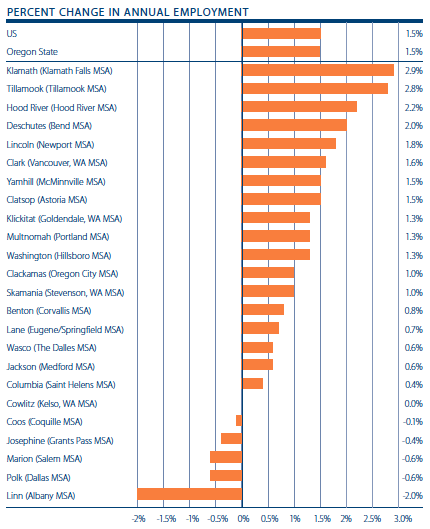
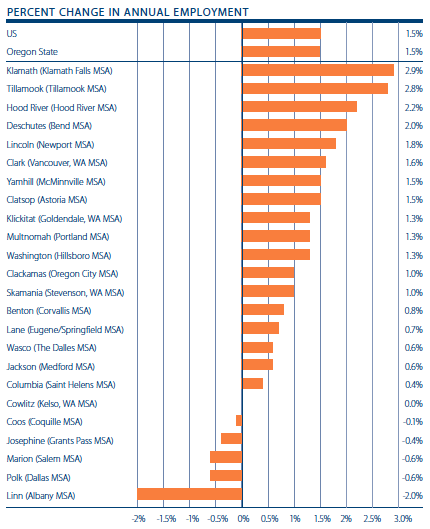
On an annualized basis, the Oregon counties covered in this report increased employment by 0.92 percent, or approximately 15,590 jobs, a further—albeit modest—improvement from the 0.8 percent annual growth that was discussed in our last report. On a year-over-year basis, 19 counties saw their employment base expand and five saw employment contract.
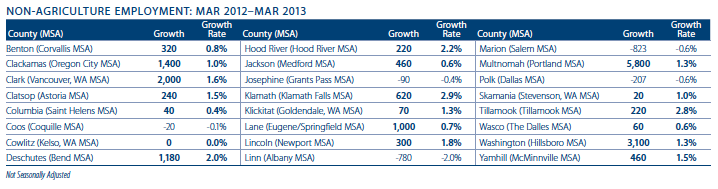
Employment growth was most pronounced in Klamath County (+2.9%). This was followed by Tillamook (+2.8%), Hood River (+2.2%) and Deschutes (+2.0%) Counties. Unsurprisingly, on an absolute basis, Multnomah County continued to contribute the largest increase in jobs with 5,800 additional positions over the past 12-month period. This was followed by Washington (3,100) and Clark (2,000) Counties.
On the negative side, job losses totaled 1,920 spread across five counties. Losses were most pronounced in Marion County, but the numbers were down by just 823 jobs. This was followed by Linn (-780) and Polk (-207) Counties. Losses in Josephine and Coos Counties were measured at 110 jobs combined.
It is pointless to compare the current employment situation to that seen at the end of the year, as the data is not seasonally adjusted and, therefore, the decline in overall employment in almost every county between December of 2012 and March of 2013 was not a surprise. However, the number of jobs lost was. Employment shrank by almost 20,000 in the time period and I will be watching very carefully to see that this was just a function of seasonality and nothing to be concerned about.
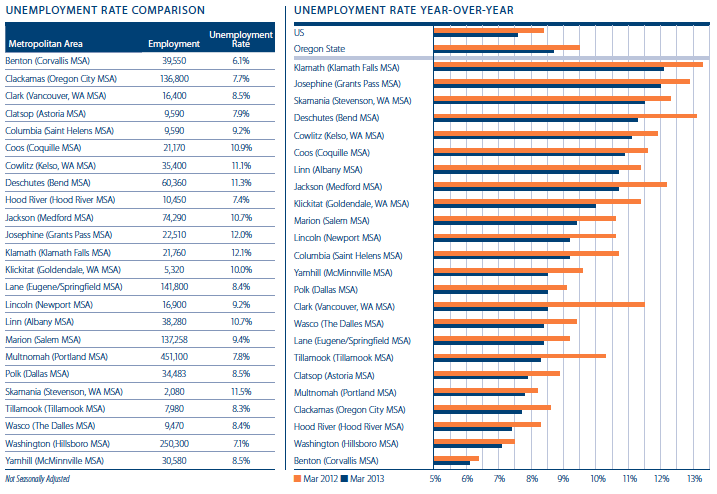
Continuing a trend that started in 2012, when compared to a year ago, the unemployment rate shrank in every county that was analyzed. This is positive and continues to suggest that the market is improving in a fundamental way.
The greatest improvement was seen in Clark County, where the unemployment rate dropped by a substantial three percent to 8.5 percent. This was followed by Tillamook (-2.0%) and Deschutes (-1.8%) Counties. The smallest improvements were seen in Benton (-0.3%), as well as Washington and Multnomah Counties, which both saw their unemployment rates reduce by 0.4 percent.
As much as this may sound like a broken record—having made this statement in previous reports—it remains true that the Oregon economy is stuck in low gear. Expansion remains well below its potential. I cannot, therefore, raise the grade from the “C-” that I gave it at the end of 2012.
I believe that the job market will continue to grow, but at a pace that is lackluster.
Regional Real Estate
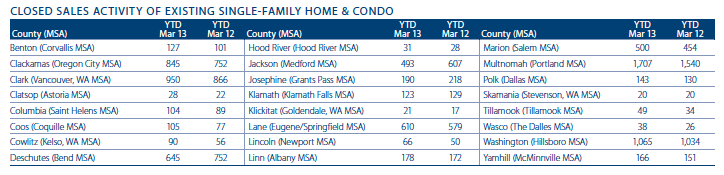
In the first quarter of 2013, the region reported 8,167 units of resale housing—a modest improvement of three percent from the same period in 2012.
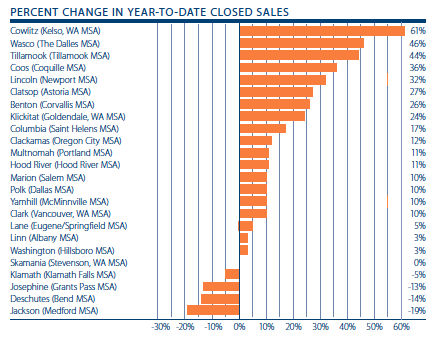
In 2012, the greatest growth in housing sales was seen in Cowlitz County (+61%), Wasco County (+46%), Tillamook County (+44%), Coos County (+36%) and Lincoln County (+32%). There were four counties that saw sales volumes drop when compared to Q1 2012. The most pronounced decline was seen in Jackson County, where sales dropped by 19 percent. This was followed by Deschutes (-14%), Josephine (-13%) and Klamath (-5%) Counties. As to whether this is a function of lack of supply, or lack of demand, is uncertain, but the drop was a fairly modest 255 units.
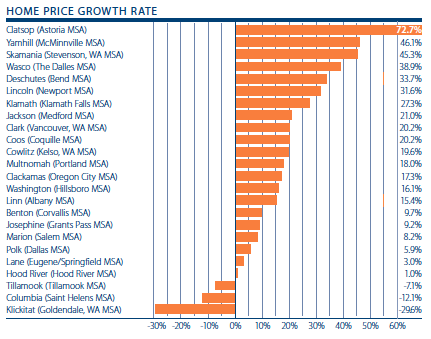
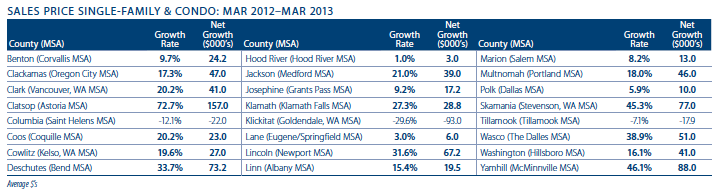
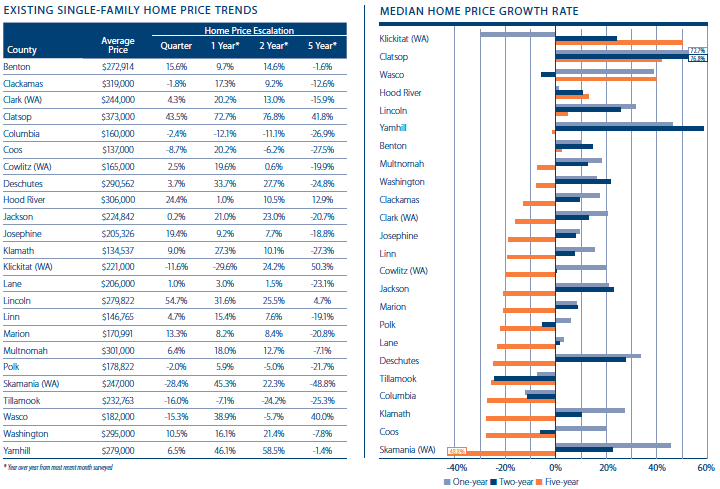
When we turn our attention to home prices, it is very pleasing to see that 21 of the markets analyzed registered year-over-year price increases (up from 15 in the last report), with just three showing declines in values from a year ago. In aggregate, the markets surveyed saw values increase by 17.9 percent over the same period in 2012.
Other than the dramatic 72.7 percent growth in the very small Clatsop County market, 15 other counties registered double-digit gains in price between March 2012 and March 2013. When compared to prices seen in the last quarter of 2012, 16 counties saw prices rise (up from 13 in our last report) and eight saw sale prices drop.
As we look at longer term trends, I continue to be pleased to see prices generally trending higher. When compared to the same period in 2012, there are now 19 counties that have seen prices rise – up from 14 in our last report. When compared to March of 2008, there are now five counties where sales prices are higher.
I am giving the market a “C+” grade for the first quarter of 2013, up from a “C” at the end of 2012. Without a doubt, inventory constraints are affecting the market, but sales and prices are still higher.
Conclusion
In 2012, Oregon’s economic performance was very similar to both 2010 and 2011. In each case there were some cautious hopes for stronger growth and more jobs as momentum was building near the end of the previous year. However, each time the regional economy has encountered headwinds that slowed growth near mid-year. The usual suspects have been flare-ups in the ongoing European recession and sovereign debt crisis, weak housing-related industries, and cuts at all levels of government. The end result in each of the past three years has been slow, lackluster growth.
As 2013 opens up, unfortunately, there is little hope that Oregon will see much immediate improvement in economic growth. Federal government cutbacks and tax increases are weighing on the economy, and the pipeline of future orders has slowed among many local manufacturing industries.
That said, and despite the weak near-term outlook, I believe that the stage is set for stronger growth going forward, should the economy manage to successfully navigate the next few months. The primary reason for optimism is the strength of balance sheets for businesses and consumers alike. With financing costs low and corporate profits high, a great deal of spending and investment stands to be unleashed as soon as some of the uncertainty that is obscuring the near-term outlook is cleared away. Although household net worth is not back to pre-recession levels, it has been growing strongly. Home prices are rising once more, and stock markets have regained all of their recessionary losses.
Looking at the housing market, I am modestly pleased with its progress so far. Rising prices and slightly higher interest rates have been a catalyst to get would-be buyers off the fence and in search of a new home.
However, we are in dire need of inventory. As I mentioned in my last report, if there are not substantial increases in listings, there will be some buyers who will become disenchanted either with the lack of choice in the market, or with the desire not to get into bidding wars on homes that actually are for sale. This remains a mid-term concern.
About Matthew Gardner
Mr. Gardner is a land use economist and principal with Gardner Economics and is considered by many to be one of the foremost real estate analysts in the Pacific Northwest.
In addition to managing his consulting practice, Mr. Gardner chairs the Board of Trustees at the Washington Center for Real Estate Research at the University of Washington; sits on the Urban Land Institutes Technical Assistance Panel; is an Advisory Board Member for the Runstad Center for Real Estate Studies at the University of Washington and is the Editor of the Washington State University’s Central Puget Sound Real Estate Research Report.
He is also the retained economist for the Master Builders Association of King & Snohomish Counties. He has twenty-five years of professional experience in the U.K. and U.S.
He has appeared on CNN, NBC and NPR news services to discuss real estate issues, and is regularly cited in the Wall Street Journal and all local media.

 Facebook
 X
X
 Pinterest
 Copy Link












 About Matthew Gardner