Selling May 21, 2013

Short Sale FAQs: Understanding the Short Sale Process

What Is A Short Sale?

A short sale is the sale of a property for less than what the owner still owes on the mortgage. A short sale is an alternative to foreclosure when a homeowner needs to sell and can no longer afford to make their mortgage payments. The lender agrees to accept less than the amount owed to pay off a loan now rather than taking the property back by foreclosure and trying to sell it later. Lenders agree to a short sale because they believe it will net them more money than going forward with a lengthy and costly foreclosure process.

Can Any Real Estate Agent Effectively Handle My Short Sale?

No. A short sale is a very complicated real estate transaction and one that has very important implications for you. More than any other type of residential real estate transaction, a short sale should be handled only by a real estate broker who has substantial experience with the short sale process , and a strong track-record of success in negotiating short sales for their clients. You wouldn’t have your family doctor perform heart surgery. And, you shouldn’t expect any real estate broker to be qualified to handle this highly complex real estate transaction for you.

Why Should I Choose A Short Sale Over Foreclosure?

Whether you should do a short sale or let your property go to foreclosure depends on several factors. In most instances, a short sale makes more sense than foreclosure. In general, when you want to obtain a loan to purchase a property in the future, more opportunities will be available to you if you do a short sale. And, contrary to popular belief, you can be current on your payments and still do a short sale. In fact, if you are current on your mortgage through a short sale, you can qualify for an FHA loan afterwards without any waiting periods. The same option will not be available following a foreclosure.

While doing a short sale will negatively affect your credit, there are many benefits to choosing a short sale over foreclosure. With a short sale, you are in control of the sale, not the bank. You may sleep better at night knowing who is buying your home, and you can spare yourself the social stigma of foreclosure.

Every homeowner’s situation is different, so we always recommend that you speak with a real estate attorney that can advise you on the legal and tax implications for your circumstances.

How Do I Know If I Qualify For A Short Sale?

If you owe more than your house is worth and can’t afford your mortgage payments, you may qualify for a short sale. Every situation is unique, but in general the basic criteria for qualifying for a short sale are:

  • You need to sell your home.
  • You owe more on your mortgage than your home is worth.
  • You have a personal financial hardship that will prevent you from making future payments. (Examples of hardship include loss of job, divorce, death of a spouse and medical emergency or illness.)

When calculating if your house is worth less than the amount owed on the loan, you should deduct out what you would pay in real estate commissions, closing costs, and state excise taxes to sell your home.

Will I Get Any Money From The Sale?

Unless specifically authorized through a federally-sanctioned program such as HAFA, when a lender approves a short sale, they typically require that the borrower (seller) not receive any money from the sale of the property since the lender is going to take a loss on the loan.

How Long Does A Short Sale Take?

The short sale process is complicated and time-consuming. It can take several weeks, or even months, to get a short sale approved. Many lenders have several layers of management, insurers, and investors that will have to be satisfied before a short sale is approved. As a homeowner, it is important to be patient during this long process. It is also critical that you work with a short sale negotiator who is familiar with the various requirements of individual lenders to ensure that the process moves as quickly as possible.

Is There Enough Time To Do A Short Sale Before A Foreclosure?

Maybe, maybe not. Just starting a short sale will not automatically stop a foreclosure. However, many times a lender can be convinced to postpone the foreclosure to let a short sale negotiation take place. So, while there are no guarantees, it does not hurt to try.

Does A Short Sale Always Work?

No, there is no guarantee that this will work. Once you fall behind on your loan, the lender can proceed to foreclosure if they choose to. But typically, lenders prefer not to foreclose and, if effectively presented with smart alternatives, they will often agree to a short sale rather than foreclose. If a short sale is attempted but doesn’t work, your house will likely go to foreclosure.

I Have More Than One Mortgage On My House. Can I Still Do A Short Sale?

Yes. Each mortgage can be negotiated individually. However, multiple mortgages make a short sale more complicated and time-consuming. Not only do you need the cooperation of the first lender, the second mortgage holder needs to agree to a short sale as well.

What Is A Release?

A lender may offer to “release” its security interest against the property in exchange for less than the total amount of the note. A release will allow the property to be sold without paying off the obligations of the note. However, the note is not satisfied. The advantage of a release is it allows the property to be sold and helps you avoid a foreclosure. The disadvantage is the remaining debt on the property (sometimes called a deficiency) still exists. You are still liable for the note. In other words, you still owe the money. In reality, it’s not likely that the lender will pursue the deficiency unless you have other significant assets. Furthermore, if you don’t attempt a short sale and the property goes to foreclosure, you can be liable for the full amount of remaining debt on any additional mortgages beyond your first mortgage.

What Is A Satisfaction?

A lender may agree to accept less than it is owed as complete and total satisfaction of the debt and release its lien against the property. Your note and obligation to the lender are satisfied for less than you owe. When the property is sold, the debt is paid off completely. Sometimes short sale negotiations are successful in obtaining complete satisfaction. Sometimes all that can be obtained is a release.

Are There Tax Consequences?

When a lender cancels, or forgives, your debt, the tax laws may consider the forgiven debt as taxable income. If a lender agrees to a satisfaction, the Mortgage Forgiveness Debt Relief Act of 2007 provides that debt forgiveness of up to $2 million is not considered taxable income if:

  • The house has been used as your principal place of residence for at least two of the previous five years.
  • The debt has been used to buy, build, or make substantial improvements to the home.

Home equity loans where the money was not used to buy, build, or improve the home do not qualify for the exclusion. Neither do mortgages for second homes or rental properties. The law has been extended to include debt forgiven through 2013.

There are additional tax considerations to keep in mind. A debt cancellation will affect your property’s cost basis. Insolvency or bankruptcy may also alleviate some of the tax burdens of a debt cancellation resulting from a short sale. You should always confirm tax matters with your tax professional.

Can I Keep The House Through A Short Sale?

The purpose of a short sale is to get the property sold, so you do not keep the house. Just as in a normal sale, you will be moving, typically when the sale closes. Some sellers choose to move before the house closes. You will not be allowed to remain in the house. If your intention is to remain in your house, you should consider other options besides a short sale.

Download a copy of Short Sale Frequently Asked Questions [PDF].

 

Richard Eastern is a Windermere broker in Bellevue, WA and co-founder of Washington Property Solutions, a short sales negotiating company. Since 2003 he has helped more than 900 homeowners sell their homes. A Bellevue native and a University of Washington grad, Richard is an avid sports fan and a devoted Little League and basketball coach. You can learn more about Richard here or at www.washortsales.com.
Market News May 16, 2013

The Gardner Report: Western Washington, First Quarter 2013, Volume XXI


Windermere Real Estate is proud to partner with Gardner Economics on this analysis of the Western Washington real estate market. This report is designed to offer insight into the realities of the housing market. Numbers alone do not always give an accurate picture of local economic conditions; therefore our goal is to provide an explanation of what the statistics mean and how they impact the Western Washington housing economy. We hope that this information may assist you with making an informed real estate decision. For further information about the real estate market in your area, please contact your Windermere agent.

Regional Economics

Generally speaking, I see steady improvement in the regional economy, which is pleasing. Employment growth is evident in a vast majority of the counties analyzed in this report, and unemployment rates continue to improve.

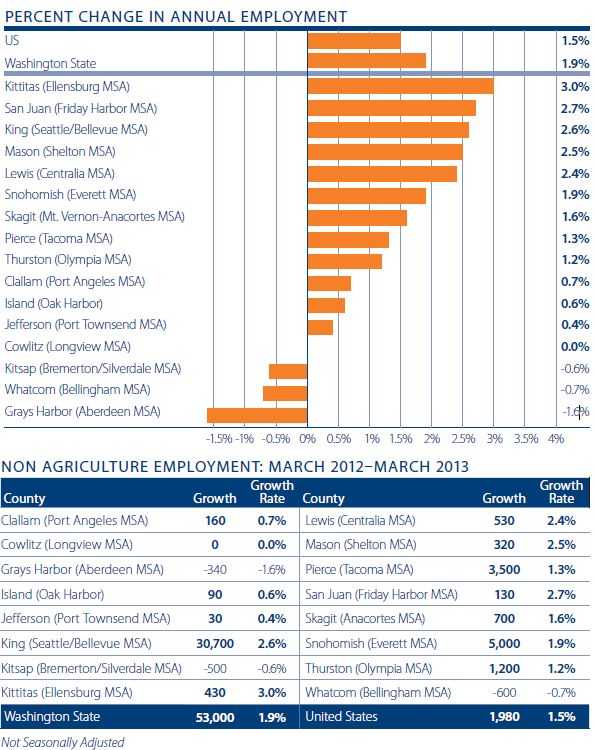
Repeating the numbers from the fourth quarter of the 2012 report, there were just three counties that saw total employment drop over the past 12-month period and the remaining 13 counties added a total of 41,350 new jobs. The growth was measured at a respectable 1.9 percent.

The figures still look quite good, but the rate of improvement—on an annualized basis—has started to slow. I would note that the region did lose 13,520 jobs between the end of 2012 and March of 2013. I am not, however, concerned as this was due to the State re-benchmarking its data.

Year-over-year, Kittitas County (+14.2%) grew at the fastest rate—it is a small county, but the service industry continues to expand. This was followed by San Juan (+2.7%), King (+2.6%), Mason (+2.5%), and Lewis (+2.4%) Counties. Job losses were modest, with Grays Harbor (-1.6%), Whatcom (-0.7%), and Kitsap (-0.6%) Counties suffering job losses; total employment in these counties contracted by 1,440 jobs.

Attention remains focused on the central Puget Sound region which includes King, Snohomish, and Pierce Counties. Between them, they accounted for a remarkable 94 percent of total job gains.

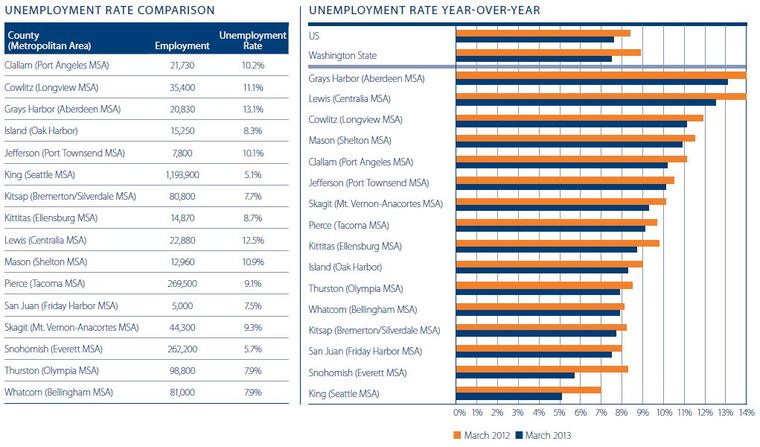
The unemployment situation continues to improve, with all counties demonstrating lower unemployment rates than seen a year ago. The greatest improvement was seen in Snohomish County, where the rate dropped from 8.3 percent to 5.7 percent. This was followed by King County, whose rate dropped by 1.9 percent; Lewis County saw a 1.5 percent drop, and Kittitas County saw an unemployment rate that was 1.1 percent below that seen a year ago.

The data suggests that we are an economy that continues to grow, but at a more cautious rate. Whether this is a function of the expiration of the tax credits that were implemented at the start of the year, the ongoing sequester, or just businesses remaining cautious, is uncertain. However, as a result, I am dropping the grade from a “B+” to a “B” for this quarter.

Improvement in the job market is being wholly driven by the private sector— the first time that this has happened in the history of this country. It is quite possible that the lack of direction coming from the other Washington has started to affect hiring decisions in our state. Our growth has slowed, but I do not yet feel the need to become concerned over this.

Regional Real Estate

The Samuel Taylor Coleridge quote, “Water, water everywhere, nor any drop to drink”, from the poem “The Rime of the Ancient Mariner”, is somewhat apt when looking at our regional real estate market. Buyers are driving through neighborhoods looking for homes, but the choices are scant.

Without a doubt, there are far more buyers than sellers in the market right now—and this is becoming an issue. That said, the region registered 11,349 home sales in the first quarter of 2013—an increase of 9.7 percent over the same quarter in 2012. Inasmuch as this is certainly positive, buyers are complaining not only about lack of choice, but also that intense bidding for homes that are on the market may be the precursor to another housing bubble.

Although I can sympathize with buyers, I do not believe that we are entering another bubble, but rather that the market has regained its confidence.

As noted in our last report, all but one county exhibited improving sales velocities in the first quarter when compared to the first three months of 2012. Grays Harbor County still remains the laggard, but this is wholly due to its size.

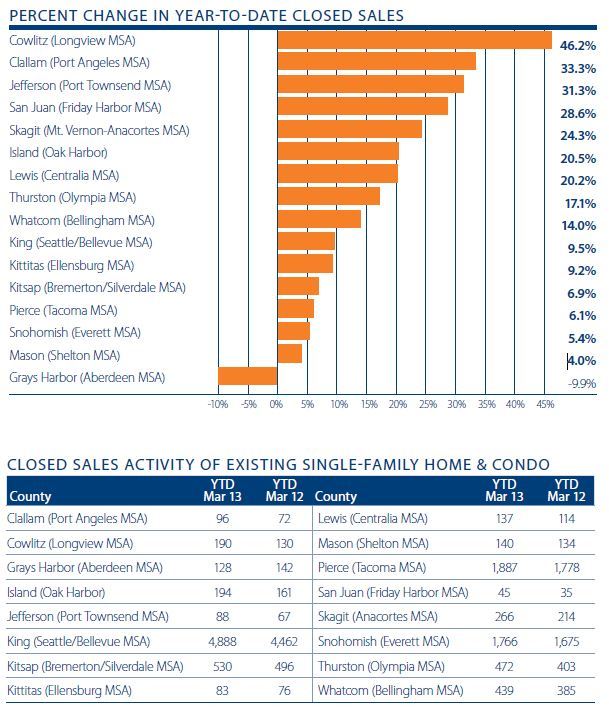
Fifteen counties saw improving sales in the first quarter when compared to the same period in 2012, with growth ranging from 4.5 percent (Mason County) to over 46 percent (Cowlitz County).

Is this rate of growth sustainable in 2013? That, without a doubt, is a crucial question. I believe that the lack of inventory is a function of two distinct situations. Firstly, banks are still slow in getting distressed inventory to market. I hope that this will improve as they dedicate more assets to the situation. Secondly, there are still a large number of homeowners who wish to sell, but are marginally underwater on their homes. These people cannot refinance at more preferential rates and would, therefore, like to sell but are not in a position to write a check out to the bank at closing. They are waiting for the proverbial “tide” to come in and raise the value of their homes sufficiently so that they can get out from underneath it.

This is an interesting market with well-positioned, well-located homes flying out the door. The new construction community has not stepped up production to handle the excess demand and the onus is still on the resale market. In aggregate, listings did grow in March but not to a level necessary to satisfy the market. Improvement in late spring and early summer will be crucial if we are to continue this solid increase in sales.

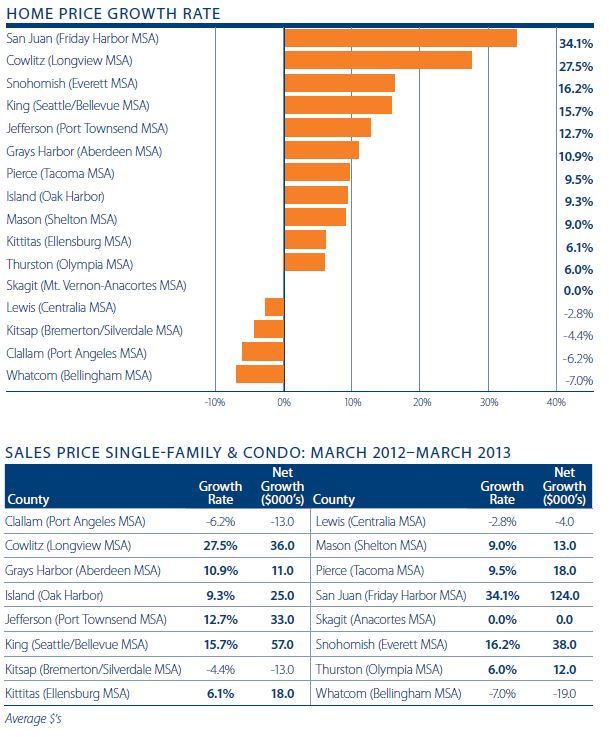
As shown in the chart to the right, 11 counties saw the average sales prices at levels above that seen a year ago, one county saw no growth, and four counties saw prices below that seen in March of 2012. In aggregate, the weighted average price of transacted homes in the counties analyzed was 12.4 percent higher at the end of the first quarter of 2013 than in March of 2012.

Of the counties that saw appreciation, the most pronounced gains were seen in the volatile San Juan County, where prices have risen by 34.1 percent. Significant additional gains were seen in Cowlitz (+27.5%), Snohomish (+16.2%), King (+15.7), Jefferson (+12.7%), and Grays Harbor (+10.9%) Counties. Declines were limited to Whatcom (-7.0%), Clallam (-6.2%), Kitsap (-4.4%), and Lewis (-2.8%) Counties.

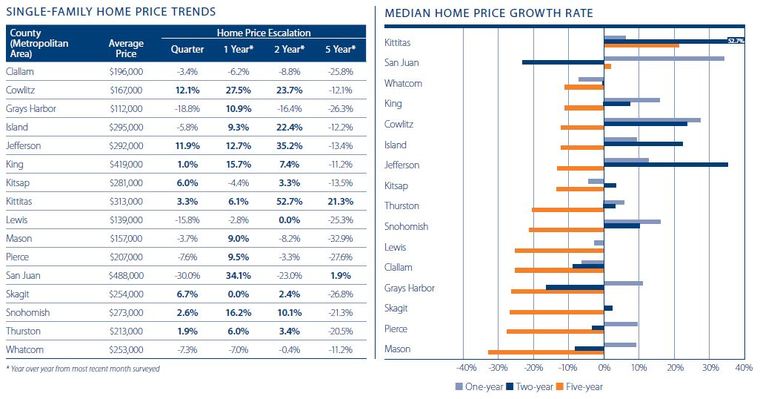
Short-term trends, however, do not explain the bigger picture. If we are to look at a longer timeframe, it is clear to me that we are a market that has not only stabilized but is recovering nicely. Home price escalation over the past two years can be seen in nine of the 16 counties analyzed. Remembering that in mid-2010 the First Time Homebuyer Tax Credit (which artificially inflated, albeit temporarily, home prices) expired, it is good to see that we have now exceeded those prices in many areas. Additionally, there are now two counties where sale prices are higher than in the dark days of early 2008.

Interest rates for a 30-year fixed mortgage are 0.38 percent lower now than they were a year ago, but have been headed higher since December— surely another factor in getting buyers into the market. I believe that we will not retest the lows seen in November of last year, but rather we will see modestly increasing rates as we move through the year. This should not negatively impact prices but may actually function to get even more buyers into the market.

Mortgages are now available, but the required down payments and credit scores are still higher than I would like to see. I anticipate that we will see some further, appropriate, easing by banks and this lends credence to the likelihood of additional increases in prices as we move through the year.

The record appears to be stuck relative to my grade for housing. I have been stuck at a “C” grade for the past two quarters and I am afraid that I cannot change this yet.

Conclusions

Economic growth in our region continues, but at a more moderated rate. Is this a sign of a slowdown in the economy, or are we returning to a more moderated pace of improvement? I believe that we are taking a bit of a breather, but that as consumers start to become more comfortable with their own financial situations—whether this be driven by their job situation, improvement in the equity markets or improving home values—they will start to consume goods and services at a faster pace, which will lead to additional employment growth.

Some are getting concerned that the market appears to be demonstrating signs of “froth”. It is my opinion that rising home prices, in concert with modestly rising interest rates, have pushed many would-be buyers off the fence and in search of a new home. This has stimulated demand well beyond the level of home supply. As such, prices have jumped.

I do not see this as a bubble in the making. Underwriting is still stringent, with high credit scores and down payments required. Additionally, appraisers remain appropriately cautious, which is sure to temper the likelihood of a new housing bubble.

Competition is certainly rife! Not only between buyers looking for their own use, but also speculators with pockets of cash, looking for an alternative investment vehicle. I do understand buyers’ frustrations at the moment, but I believe the healing process that is underway in the housing market, while somewhat painful, will settle down eventually.

I still believe that home values will continue to appreciate in 2013 and we should see more homes for sale as prices rise to a point that frees up future sellers.

About Matthew Gardner

Mr. Gardner is a land use economist and principal with Gardner Economics and is considered by many to be one of the foremost real estate analysts in the Pacific Northwest.

In addition to managing his consulting practice, Mr. Gardner chairs the Board of Trustees at the Washington Center for Real Estate Research at the University of Washington; sits on the Urban Land Institutes Technical Assistance Panel; is an Advisory Board Member for the Runstad Center for Real Estate Studies at the University of Washington and is the Editor of the Washington State University’s Central Puget Sound Real Estate Research Report.

He is also the retained economist for the Master Builders Association of King & Snohomish Counties. He has twenty-five years of professional experience in the U.K. and U.S.

He has appeared on CNN, NBC and NPR news services to discuss real estate issues, and is regularly cited in the Wall Street Journal and all local media.

More May 15, 2013

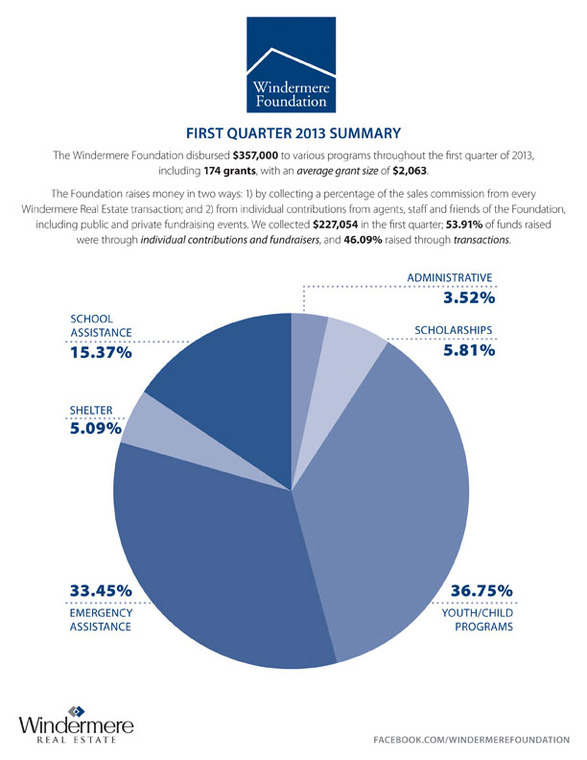
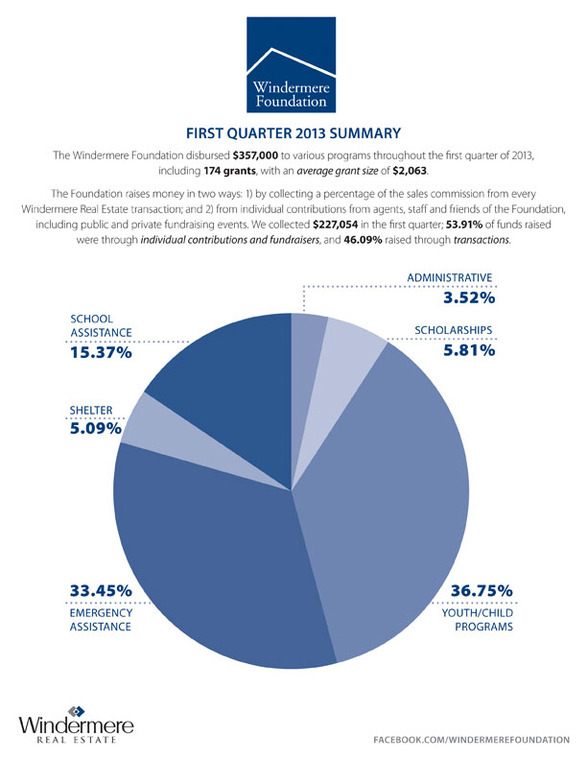
Windermere Foundation First Quarter 2013 Summary

Buying May 14, 2013

Buying your home: A step-by-step approach


There is a lot to consider when you decide to buy a home, especially if it is your first. How much home you can afford? What kind of loan should you choose? Which neighborhoods are both affordable and a good investment? These are just a few of the questions you’ll be asking yourself. But with an experienced agent to help you, you’ll get the guidance you need to come up with the right answers−and a home you love.

First things first

Before you start shopping, you need to find out how much home you can afford to buy. Your agent can refer you to a loan officer who will help you determine how much of a down payment you can manage, as well as the monthly payment, taxes and insurance costs. Your lender can then prequalify you for a dollar amount, which can help you focus your search. You can also get a quick, rough estimate of monthly mortgage costs at Windermere.com; there’s a mortgage rate calculator on every listing detail page.

Create a wish list

Once you know your price range, talk to your agent about the home features you need and the ones you would prefer. The former might include number of bedrooms or suitable space for a home office, while the latter might include hardwood floors or a pantry. By clearly communicating your needs and preferences, you can help you agent narrow down the selection and avoid wasting your time.

Check out a few neighborhoods

Be sure to talk to your agent about what you’re looking for in a neighborhood. Are property values your highest priority? Great schools? A short commute? Small-town atmosphere? Big-city amenities? Your agent will try to narrow down the affordable neighborhoods that fit your criteria. Then you can either explore them with your agent or get a sense of each neighborhood on your own.

Shop for a loan

There are many different loan programs to choose from. You’ll want to find one that offers you the best terms for your current situation and future plans. Your agent can give you the names of several mortgage specialists who can review your options with you and help you determine which loan is the most advantageous. Once you’re approved for a loan, sellers will consider you a more attractive prospective buyer.

Make an offer

You’ve finally found the right house in the right neighborhood. It fits your practical needs, has potential and just feels right. So how do you ensure that you keep the price as affordable as possible without running the risk of losing it? Your agent has the expertise to help you make the right offer. He or she knows what comparable houses are selling for, how long they’ve been on the market, and whether or not the asking price for the home you want is fair. Your agent can also offer excellent advice when it comes to making a counteroffer.

Seal the deal

Once you’ve found the home you want and your offer has been accepted, you give the seller an earnest-money deposit. Your agent draws up a purchase and sale agreement; it’s the contract that outlines the details of the property transfer from the seller to you. This contract is typically contingent on the home passing a structural inspection and you obtaining approval for financing.

The inspection lets you know if the house has any major issues and how well it has been maintained. Remember, no house is perfect. If the inspection uncovers some problems, your agent can help you determine whether to ask the seller to handle or pay for the repairs or to renegotiate the price of the home.

When the inspection is concluded and any loose ends resolved, you “close” on the home. Closing is when you and the seller sign all the papers, you pay your share of the settlement fees, and the documents are recorded. Your agent will be a happy to answer any questions throughout this complex process.

Home at last

When you buy a home, you get more than just a place to live. You get the satisfaction of having a place that is truly yours, one that reflects your style and provides a comfortable setting for you and your family. Buying a home also gives you a substantial annual tax deduction and a way to build wealth over the years.

If you have questions about the buying or selling process, or are looking for an agent in your area, we have professionals that can help you. Contact us here.


More May 2, 2013

27th Annual Windermere Cup

Original artwork by Tony Taj

This year, we are excited to welcome Cornell University and Dartmouth College to the 27th annual Windermere Cup on Saturday, May 4, 2013.

Historically, the Windermere Cup is part of the Seattle Yacht Club’s Opening Day of Boating Season celebration on Seattle’s Montlake Cut. Since 1987, Windermere has sponsored the main race between the University of Washington and world-class teams from around the world.   

The event is free for families around the region. Spectators line the shore of the Montlake Cut and a log boom flanking the course in Lake Washington. New this year, shore guests can visit food tents, including Ivar’s Salmon House, Dante’s Inferno Dogs, and Veraci wood-fired Pizza. Bike messengers will be distributing free Windermere Cup flags and programs before the races. If you are looking for special gear to commemorate the race, you will find Windermere Cup items at one of the four Husky Team Store locations on store.

Leading up to the Windermere Cup festivities, the Windermere Foundation is hosting 60 fourth and fifth grade students from Madrona Elementary at the University of Washington Shell House for a half-day fieldtrip and fitness education. Athletes from UW, Cornell, and Dartmouth will mentor groups of students on health, fitness, and training. Students will get a chance to row in the UW boats, visit with athletes, tour the campus, and take home souvenirs.

A delayed broadcast of the event will be featured on May 12 at 3:00 PM PST on the PAC12 Network.

You can follow the whole week of events on our Facebook page.

We hope to see you at the Windermere Cup on Opening Day!

Living April 25, 2013

Follow the Direction in Which the House Is Growing

When you first move into your new home, it is likely you will have a list of items you must change right away, to fit your design and practical needs.  As far as your landscaping goes, I recommend that you maintain what you have for at least one full year—the entire growing cycle of everything in your lot.  This way you may avoid chopper/whacker/digger remorse: “Oh, I wish I’d known that was a flowering syringa (lilac) and not just a weedy-stick-y looking thing.”  Additionally, if you begin planting right away, you won’t really know your micro-areas and could well be pulling dead, stick-like plants, shrubs, trees which you only recently purchased. It takes a bit of self-control to avoid that initial “clean-up” and planting frenzy, but you may thank yourself eternally if you can hold off.

During that first year of restraint, watch the pattern of the sun across your lot/land, learn the irrigation system or lack thereof, note shady, sunny, dry, wet, windy, catbox, and understory areas. Note the neighbors’ yards, and see what works and doesn’t, and what you like and don’t.  If you are so inclined, keep a gardener’s notebook with your observations..  Decide what you want your lot to be, and what fits into your lifestyle. Whether you are a retired, full-time master gardener, or an organic gardener, or you “just wanna bbq and kick-back”, there are landscapes to fit your ideal. Developing a plan for all of your “yard-rooms”, as 20th century British gardener Gertrude Jekyll named the various areas of the yard, is a comprehensive approach.  Where do the kids play? Where are the garbage/recycle bins stashed?

Think about traffic patterns—where do you want paths, seating areas, and garden beds. Also consider “hardscape”: walls, fences, garden structures, screening from neighbors, and parking areas.

A well-planned landscape enhances the value of your home and lets you extend the walls of your home from lot line to lot line.

Patricia Allene Atkins is a Certified Residential Specialist (CRS) with a passion for plants in Eugene, Oregon.



More April 18, 2013

Windermere Foundation Quarterly Report

Greetings from the Windermere Foundation,

Thanks to you and the wonderful support the Windermere Foundation has received so far this year, we have disbursed $357,000 to qualifying social service organizations dedicated to providing services to low-income and homeless families throughout the Western U.S.

Our amazing agents, brokers, staff and owners, along with public supporters, continue to contribute generously to the Foundation, making these disbursements possible.

Wellspring Family Services shared a letter of thanks for the support they recently received from three Seattle offices: Capitol Hill, Eastlake, and West Seattle.

“No child should be homeless. And all children should have what they need to thrive.

That sounds so obvious, doesn’t it? But at Wellspring Family Services we see many children who don’t know where they will sleep tonight. Children who have never experienced the routine of bath and bed time; never invited a school friend home to play because they have no home. Children being robbed of their childhood.

It brings me great joy to know that this path can be changed and will change for 700 children in our community this year. Thanks to you, they will have a home.

Your support affirms the work we are doing and will benefit our entire community today and for generations to come.”

-Wellspring Family Services


RAVES:

“I would like to make a plug for two of our Property Managers, Jennifer Shepperd and Cassie Walker Johnson.

Within this past year, they both attended an event hosted by Youthcare in downtown Seattle to learn about the organization’s mission and the types of people that they serve to assist. They heard some heartbreaking stories about the situations that these kids are in, and felt compelled to help make a difference. Throughout 2012, these two agents of ours have spearheaded the effort to donate thousands of our Foundation dollars to Youthcare, coordinate a clothing drive, and this holiday season our brokerage will be granting the gift wishes of 10 Youthcare children.”

Cory Brewer, Operations Manager

Windermere Property Management/Lori Gill & Associates


Cary Perkins’ middle name is “FOUNDATION”. Being unique and uber enthusiastic is just the way Cary is, and it shows in her support and creativity when it comes to the Foundation. She is always looking for the next way to raise some money…ideas just seem to bubble inside her. 

Cary found a new level of participation for the Johnson office when she became our rep. Many agents are involved in community activities and she has inspired them to think, ‘Oh, can we get that to benefit the Foundation…’

The fun factor is never far from the top of the list in the projects, fundraising, or auctions she puts together. She truly is an inspiration and the money the Johnson office has raised during her tenure speaks volumes about her dedication.”

-Lynne Murphy, Managing Principal Broker

Windermere Cronin Caplan Realty Group, Inc.


Please remember to read the Windermere Blog for more in-depth stories about what offices are doing throughout the year. Facebook is also a great resource for upcoming events, and shorter posts about office involvement in the community.

Thank you!

Best,

Christine Wood


Blog: http://foundation.windermere.com/

Facebook: https://www.facebook.com/windermerefoundation

YouTube: http://www.youtube.com/WindermereRealEstate

Buying April 18, 2013

April 20th and 21st: Nationwide Open House Weekend


This weekend, April 20 and 21, thousands of REALTORS® from around the country will be holding open houses as a part of the Nationwide Open House Weekend event, sponsored by the National Association of REALTORS® (NAR).

This event is intended to provide buyers with an ideal, low-pressure opportunity to tour homes that are currently for sale. Even with the vast changes technology has brought to real estate, open houses are still considered an important part of the home search process. In fact, according to the National Association of REALTORS 2012 Profile of Home Buyers and Sellers, 45 percent of all buyers use open houses as a source in their home search.   

For those who plan to tour open houses this weekend, here are some tips to help you get started:

Make a plan:

Pick a neighborhood or a route you are interested in and map out your open houses to make your day efficient. If you are planning on having lunch, pick a local restaurant to get a feel for the neighborhood.

Explore:

Walk around the neighborhood and familiarize yourself with the local amenities. If you are considering moving to the area, this will help you get a feel for it.

Dress for success:

Wear comfortable and casual clothes while house hunting. Also, consider wearing shoes that are easy to slip on and off when requested.

To find homes that are participating in this weekend’s Nationwide Open House event, contact your real estate agent, or a local Windermere Real Estate office. You can also find upcoming open houses at Windermere.com/Search

More April 9, 2013

Words for Windermere


During the months of February and March, we asked Windermere Owners, Agents, and Facebook followers to share the words that come to mind when they think about Windermere. We were pleasantly surprised by the consistency across all three groups and decided to create a word map with the results.
 
Total responses from each group:
 
·         Owners – 33 responses
·         Agents – 103 responses
·         Facebook – 32 responses
 
Top words by audience:
 
·         Owners: professional, quality, integrity
·         Agents: professional, integrity, service
·         Facebook: quality, professional, integrity
Thank you to everyone who participated in this fun and interesting study. We always value and appreciate your feedback.
Buying April 4, 2013

Social Connections: See how you are Connected to a Windermere Agent


Have you ever posted a question on your Facebook page to find useful information from your friends? Such as a local gym recommendation, a restaurant review, or a resource for children’s birthday parties?

Social media has become increasingly important to how we connect with friends, colleagues, family, and others in our social sphere. With this in mind, Windermere has adopted a new program called SocialBios, a social media application that helps us see how we are all connected through social networks like Facebook, Twitter, LinkedIn, etc. SocialBios turns a basic office webpage on Windermere.com into a social hub, so you can see how you are connected to agents in our network through friends and family online.
 
Research continues to tell us what we already know: most people who are looking to buy or sell a home rely on recommendations from friends or family to find a real estate agent. SocialBios helps you find an agent through these trusted contacts, connect with them, and potentially buy or sell a home through them.

This program is still new, but more offices will be joining throughout the year. You can find profiles for the following offices on Windermere.com/agents or through the following offices profile pages:


Office

URL


FEDERAL WAY

http://socialbios.com/SouthSound

ALDERWOOD

http://socialbios.com/Alderwood

TRI-CITIES RICHLAND

http://socialbios.com/windermeregroupone

BELLEVUE SOUTH

http://socialbios.com/windermererealestate-bellevuesouth

SEATTLE-SAND POINT

http://socialbios.com/Wedgwood

PORT ORCHARD

http://www.socialbios.com/PortOrchard

SERVICES-MOUNTAIN WEST

http://socialbios.com/ServicesMW

ASHLAND

http://socialbios.com/vanvleet

SERVICES – OREGON & SW WASHINGTON

http://socialbios.com/oregonservices

YELM

http://www.socialbios.com/windermereyelm

KINGSTON

www.socialbios.com/kingston

BRANCH SUPPORT- EAST

http://socialbios.com/eastbranchsupport

SEATTLE-NORTHLAKE

http://socialbios.com/Northlake

SEATTLE-GREEN LAKE

http://socialbios.com/seattle_greenlake

CORVALLIS

http://socialbios.com/windermere_Willamette_Valley

WHIDBEY ISLAND- LANGLEY

http://www.socialbios.com/WhidbeyIslandLangley

YAKIMA

http://socialbios.com/WindermereYakima

SEATTLE-WALL STREET

http://socialbios.com/WindermereWallSt

SPOKANE-NORTH

http://www.socialbios.com/WindermereNorthSpokane

AUBURN- LAKELAND HILLS

http://www.socialbios.com/lakelandhills

EVERETT SOUTH

http://socialbios.com/EverettSouth

SEATTLE-QUEEN ANNE

https://www.facebook.com/WindermereQA

VASHON ISLAND

http://www.socialbios.com/Vashon

MEDFORD

http://socialbios.com/vanvleet

SEATTLE-GREENWOOD

http://www.socialbios.com/WindermereGreenwood

GIG HARBOR

http://www.socialbios.com/GigHarbor

BELLEVUE COMMONS

http://socialbios.com/BellevueCommons

SEATTLE-WEDGWOOD

http://socialbios.com/wwindermere

SILVERDALE

http://socialbios.com/Silverdale

SEATTLE-NORTHWEST

http://socialbios.com/WindermereNorthwest

MERCER ISLAND

http://socialbios.com/Mercer_Island

SHORELINE

www.socialbios.com/WindermereShoreline


We value your feedback, please feel free to post questions in the comments or email us directly at friend (at) Windermere (dot) com.