Buying August 12, 2013

Commute getting you down? Try “Search by Drive Time” on Windermere.com

Traffic. It’s a constant in many of our daily lives. All it takes to trip up your regular commute is an accident, inclement weather, or road work. And the more inconvenient the commute, the bigger the hit to your quality of life. That would explain why nearly three-fourths of home buyers rate convenience to work as a critical factor in their home purchase decision.1 But “convenience” means different things to different people. For some, walking to work is the definition of convenience. For others, it’s a maximum of a 15 minute drive time between work and home. And in some larger cities, anything under 45 minutes is considered convenient. 

Starting today, buyers who put a lot of value on how much time they spend commuting in their car have a new, innovative way to search for homes on Windermere.com. Powered by INRIX, Windermere is the first real estate company in the nation to offer “Search by Drive Time”, giving buyers the ability to view all homes for sale within a specific drive time of a frequented destination, such as work or school.  

Do you work in downtown Seattle and are willing to drive for up to 30 minutes, but need to arrive by 9:00 AM? Do you work in Portland, only want to spend a max of 20 minutes driving, and need to get there by 7:30 AM? Do you want to live within a 15 minute drive of your kids’ school which starts at 8:25 AM?

Done, done, and done.

Now, when searching for homes on Windermere.com, you can enter your work address (or school, etc.), the maximum amount of time you want to spend driving, and your preferred arrival time. Then, plug in your price parameters, numbers of bedrooms, bathrooms, etc., and Windermere.com will show you homes for sale that not only fit your price and physical specifications, but preferred drive time to work, as well.

OB Jacobi, the president of Windermere Real Estate, and someone with a serious passion for technology, feels strongly that “Search by Drive Time” is going to revolutionize how buyers search for homes – especially in high-traffic, metropolitan areas.

He was recently quoted as saying the following:

“We already know that commute times are a critical factor for 73 percent of home buyers, and now with Windermere’s Search by Drive Time, buyers can filter their search results based upon drive time criteria, just as you would for price, number of bedrooms, and other important attributes. It just makes perfect sense for a large population of home buyers.”

In March, Windermere launched phase one of INRIX Drive Time by attaching a drive time calculator to every home for sale on Windermere.com.2 The addition of Search by Drive Time takes this capability even further by enabling buyers to use commute time to define their search criteria alongside price, square footage, bedrooms, bathrooms, etc.

What is INRIX?

INRIX provides Windermere with the in-depth traffic data needed to power our Search by Drive Time technology. It also happens to be one of the fastest growing big data technology companies in the world. INRIX leverages big data analytics to reduce the toll traffic takes on people, places, the environment, and the economy. INRIX Drive Time information is sourced from the INRIX Traffic Intelligence Platform, which analyzes (literally) billions of real-time data points from a unique combination of sources, including road sensors and real-time traffic speeds that have been crowd-sourced from millions of GPS-equipped vehicles and devices.

Unlike traffic sources that only provide travel times based on speed limits and distance, INRIX Drive Time accounts for common traffic-impacting factors, such as time of day, day of the week, season, local holidays, special events, current and forecasted weather, accidents, and road construction.3

Have you ever tried driving into the city when there are multiple sporting events, a concert, and an accident on the freeway, while it’s raining cats and dogs? Unfortunately, it happens, but thankfully INRIX is always one step ahead, taking all of those details (and more) into account and spitting out up to the minute information so you can avoid a serious headache of a commute. It’s this same depth of information that enables INRIX and Windermere to provide buyers with highly accurate search results based on Drive Time information.

So, what does this mean for you? It means that if you’re a home buyer and you care about the amount of time you spend in your car commuting every day, finding the home that best fits you and your life, just got a lot easier. 

Check out our new Search by Drive Time feature for yourself by going to www.Windermere.com and selecting the "INRIX Drive Time Search" option from the main search panel in the center of the page. 


1 National Association of REALTORS® Profile of Home Buyers and Sellers 2012

2Drive time information is not currently available in Mexico.

3 INRIX real-time traffic information has been found accurate within 3 mph of actual traffic speeds under all driving conditions, 24 hours a day, 7 days a week. Source: I-95 Coalition Validation of INRIX Data: Two Year Summary Report, September 2010


Shelley Rossi is responsible for all internal and external communications for Windermere Real Estate. Shelley helps direct company messaging through public relations, social media, advertising, and marketing communications. She also oversees the flow of information to the company’s network of 300 offices. Shelley has a deep understanding of the residential real estate industry and how PR can be used to leverage company branding and messaging.

Selling August 9, 2013

Windermere Launches Customized Program Focused On Supporting Growing Senior Population

Two years ago, the oldest members of the Baby Boomer generation turned 65, and over the next 18 years, 79 million more will do the same. These seniors are projected to move out of an estimated 11.3 million housing units through 2020 creating what is known in the real estate industry as the “silver tsunami”. These generational trends have inspired the creation of Windermere Senior Transitions; a new program made up of Windermere agents who are specially trained to understand the unique needs of clients aged 65 and older.

The Windermere Senior Transitions program focuses exclusively on helping seniors through the transition of downsizing from their existing residence into a smaller home, condominium, or an assisted living facility or retirement community. This process can be very complicated and emotional for many seniors and requires the support of someone who is trained to navigate this transition. These home owners often have needs that extend far beyond a traditional real estate transaction and may require assistance with finding resources for everything from healthcare and legal services to financial planning, estate sales, and downsizing services.

Mary Benz, Director of Sales and Marketing at Chateau Retirement Communities in Seattle believes that the agents who are a part of Windermere’s Senior Transitions program “Provide a critical need for seniors facing the overwhelming task of downsizing and making a move that marks a milestone for them. These dedicated agents have received additional certification to work with the senior population and have reached out to form relationships with various agencies involved in all aspects of downsizing and moving.” 

There are several criteria agents must meet in order to become a certified Windermere Senior Transitions Specialist, including completion of an internal training course entitled “Intro to Senior Transitions”. They must also earn the national Senior Real Estate Specialist designation (SRES) which certifies that agents have demonstrated the necessary knowledge and expertise to counsel seniors through major financial and lifestyle transitions in relocating, refinancing, or selling the family home. In addition to this, agents must close a minimum of three “senior” transactions on an annual basis, as well as sign the Windermere Senior Transitions “Standards of Practice” contract which requires agents to abide by a strict code of ethics specific to senior-aged clientele.

For more information, please visit the Windermere Senior Transitions website: www.windermereseniortranstions.com.


Market News August 7, 2013

Western Washington | second quarter 2013, Volume XXII

Windermere Real Estate is proud to partner with Gardner Economics on this analysis of the Western Washington real estate market. This report is designed to offer insight into the realities of the housing market. Numbers alone do not always give an accurate picture of local economic conditions; therefore our goal is to provide an explanation of what the statistics mean and how they impact the Western Washington housing economy. We hope that this information may assist you with making an informed real estate decision. For further information about the real estate market in your area, please contact your Windermere agent.

Regional economics

It is becoming apparent that economic growth in Washington State, although certainly continuing to expand, is starting to exhibit growing pains.

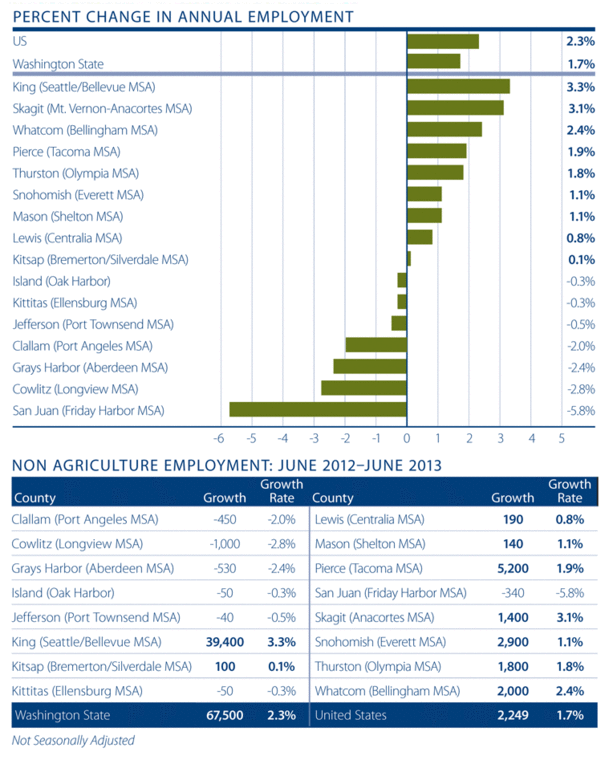
As far as total employment is concerned, the numbers appear to be robust with the market area adding 50,670 new positions over the past 12 months. I should also note that the market added 46,250 in the past quarter, but this is not surprising as county level data is not adjusted for seasonality.

Total employment growth over the past year was seen in all but seven counties. I am not too concerned about the markets that shrank as they were, in general, very small declines in equally small counties.

Unsurprisingly, year-over-year, King County (+3.3%) grew at the fastest rate. This was followed by Skagit (+3.1%), due to a jump in hospitality employment that I attribute to the pending reopening of the Semiahmoo Resort. Whatcom (+2.4%), Pierce (+1.9%), and Thurston (+1.8%) Counties rounded out the other top performing counties.

As mentioned previously, job losses were generally modest, with San Juan (-5.8%), Cowlitz (-2.8%) Grays Harbor (-2.4%), and Clallam (-2.0%) Counties suffering the greatest percentage losses. In aggregate, the areas that saw a reduction in employment lost a total of 2,460 jobs. We would note, however, that no counties saw losses between the end of the first quarter and the end of the second quarter of this year.

In terms of absolute numbers, it was not surprising to see the primary central Puget Sound region leading the way in terms of total growth. The tri-county market added 47,500 jobs over the past 12 months, including 36,700 jobs in second quarter, suggesting growth rates of 2.75 percent and 2.11 percent respectively.

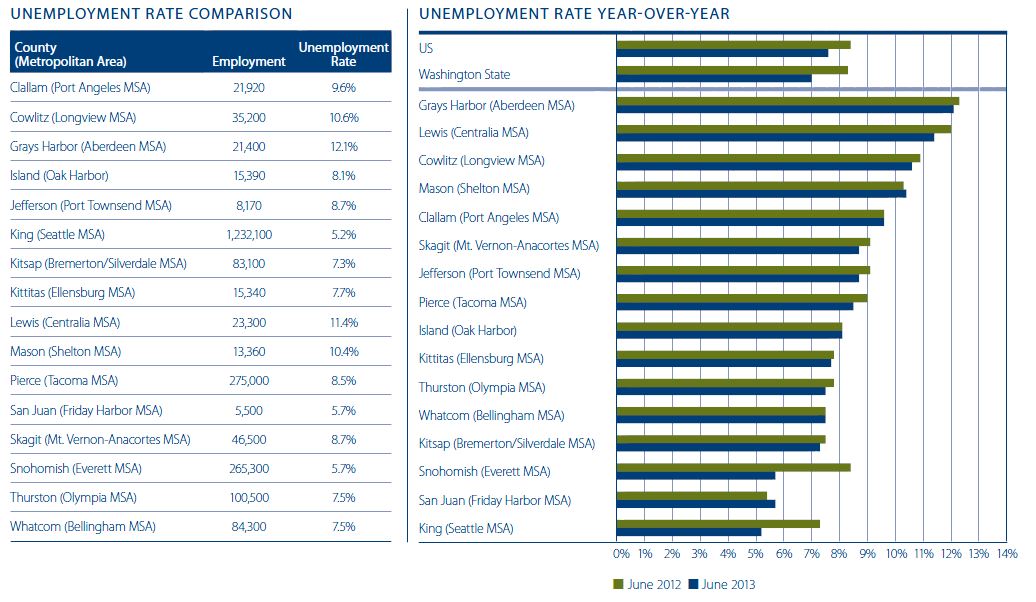
I did mention earlier that I saw some growing pains in our region, and this is clearly reflected in the unemployment rates. Five counties saw their unemployment rates rise between the end of the second quarter of 2012 and the end of the current quarter.

The reason for this is that, as the economy continues to grow, more people will start to look for work, and the unemployment rate is calculated based upon the number of people actively looking for work. With that in mind, do not be surprised to see improvement in the unemployment rate start to slow—specifically in the more urban counties. In June, 14,900 more people started to look for work, and over 23,000 are now seeking employment that were not a year ago. This is certain to have an effect on the unemployment rates this summer.

Our economy continues to expand at a reasonable pace, with the total market growing by 2.3 percent, matching that of the state and above the U.S. rate of 1.7 percent. As such, I am pushing the grade back up from a “B” to a “B+” for this quarter.

Regional Real Estate

We have been looking for balance within the real estate market for several years now. During the crash, there were clearly far more sellers than buyers, but when we found the bottom of the market and prices started to rise, the tables were turned with considerably more buyers than sellers. In as much as we are still far from truly finding the market equilibrium that we have all been waiting for, I am pleased to announce that we are getting closer.

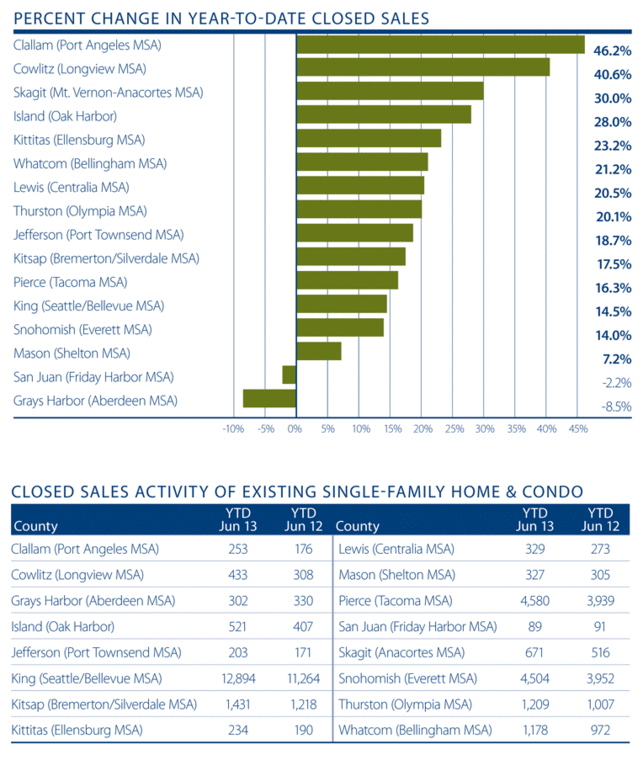
The region contained within this report reported 19,158 sales in the first half of 2013—a 16 percent improvement over the same period in 2012, and a remarkable 51 percent improvement over the first quarter of 2013.

All but two counties saw sales improve in the first half of the year compared to the first half of 2012, with only modest declines in San Juan and Grays Harbor Counties. When comparing sales volumes between the first and second quarters of this year, not only did every county other than San Juan see the number of transactions improve, but there were also some remarkable spikes.

In Kittitas County, for example, sales grew by 82 percent between first and second quarters. All the counties analyzed experienced double-digit sales growth, apart from the volatile San Juan County where sales dropped by two percent.

This is very positive but does not address the issue of supply.

I was pleased to see a long-awaited improvement to inventory levels. Within the area encompassed in this analysis, current listings were measured at 19,185. This is still down by 11.6 percent from the same period in 2012, but it is up by over 29 percent from the end of the first quarter, and up by 8.4 percent over May’s total listings.

The number of homes for sale grew the most in Kittitas County, where listing inventory was 50 percent above that seen at the end of the first quarter. This was followed by Jefferson (+47%), Clallam (+42%), King, and Snohomish Counties, which each expanded their listing inventory by 41 percent. As compared to May of 2013, listings increased the most in Snohomish County (+15%), followed by Clallam (+14%), King (+11%) and Jefferson (+10%) Counties.

That said, I would note that total listing activity is still down by 49 percent over June 2008. In as much as I doubt that we will see that type of activity in the foreseeable future, we are getting back to levels of inventory that were seen in the earlier part of the last decade.

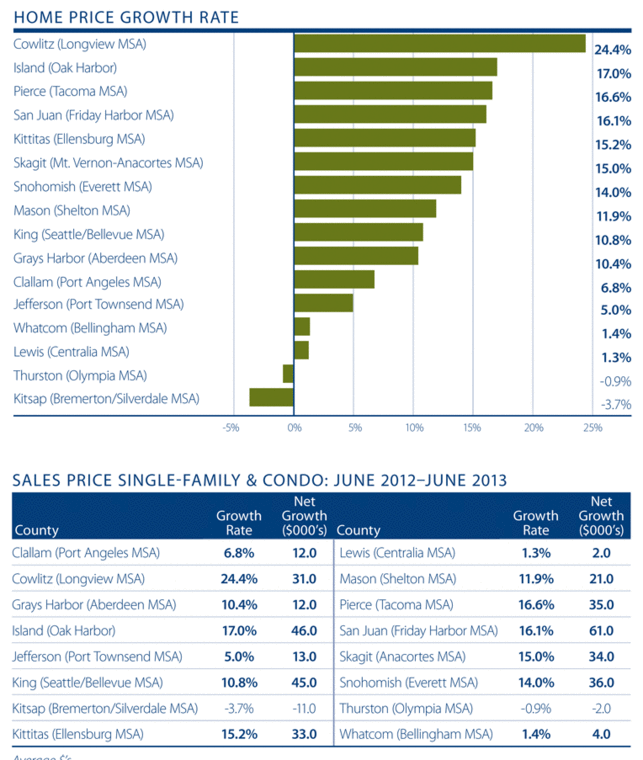
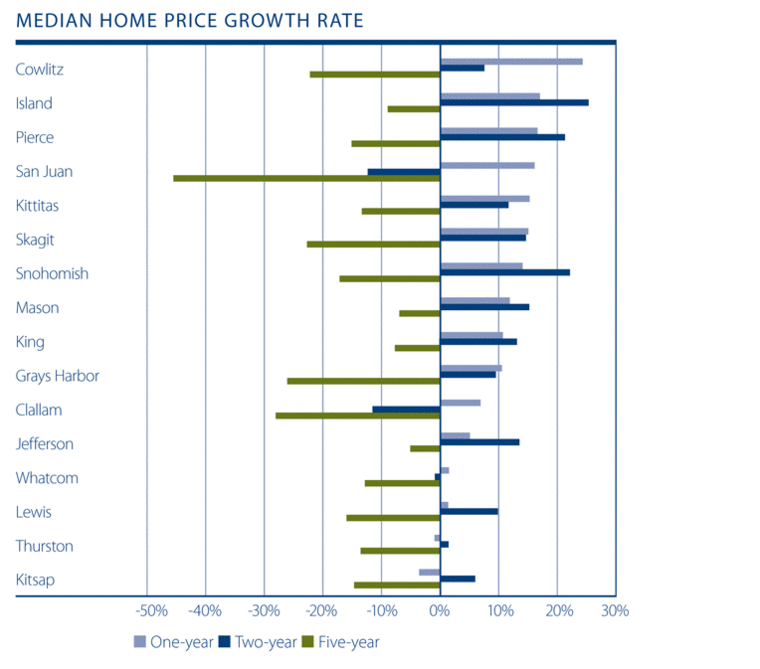
As shown in the chart to the right, 14 counties saw an increase in average sales prices as compared to a year ago, with just two exhibiting prices below that seen in June of 2012. In aggregate, home prices in the counties analyzed were 10.2 percent higher at the end of the second quarter of 2013 than seen a year previously.

Of the counties that saw appreciation, the most pronounced gains were in Cowlitz County, where prices rose by 24.4 percent. Significant additional gains were seen in Island (+17%), Pierce (+16.6%), San Juan (+16.1%), Kittitas (+15.2%), and Skagit (+15%) Counties. Declines were limited to Kitsap (-3.7%) and Thurston (-0.9%) Counties.

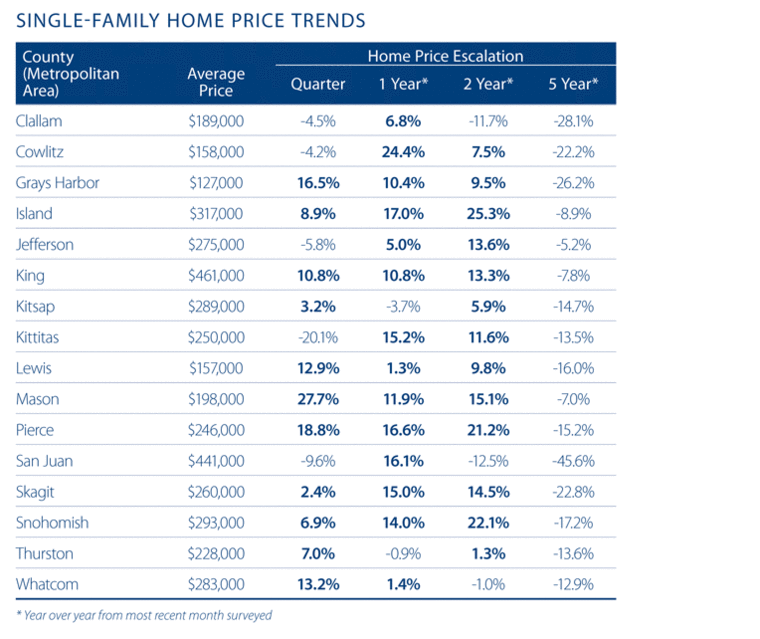
When we look at the entire second quarter, the average sales price for the region grew by 11.4 percent. The greatest quarterly improvement was seen in Mason County, where prices rose by 28 percent. In total, eleven counties saw sale price growth in the quarter with five seeing a decline.

As we look along a more extensive timeline, we note that all but three counties saw sale prices in June at levels higher than those seen two years ago. Clearly this is encouraging. We are still at prices that are below those from June of 2008, but I believe that we are likely to see some counties exceed values seen five years ago in the not-too-distant future.

Interest rates spiked in June, following comments made by the chairman of the Federal Reserve, who suggested that the economy is improving and that the committee is considering tapering the purchase of both treasuries and mortgage-backed securities. This took the market somewhat by surprise and led to a very rapid increase in rates.

The effect of this is still unclear and rates have pulled back modestly since

the peak seen in early July. What is clear, however, is that this move has motivated many would-be buyers that were thinking of getting into the market to get off the fence and into the hunt! This is putting increasing demand on the market and, I believe, should lead anyone thinking of listing their home for sale to seriously consider marketing earlier than later. Rates are highly unlikely to go down and, ultimately, purchasing power will decline if they rise more rapidly.

I am upping the housing market’s grade from a “C” to a “C+”. We still need substantially more listings in our market but, all in all, we are heading in the right direction.

Conclusions

Our economy continues to expand at a rate that exceeds the U.S. rate, as well as that of three-quarters of the country.

If there is some news that is not quite so positive, it is that we are seeing job gains in industry sectors that are not particularly high-paying. This can have a negative effect on consumer spending and slow our overall growth.

That said, gains are gains! The increase in the unemployment rate is not something to get worried over. In fact, to some degree, it should be lauded. More people deciding to look for work is certainly indicative of an improving business environment.

As far as the housing market is concerned, improvement is steady, but at the risk of sounding like a broken record, we need more inventory. I also stand by my earlier statement that those considering selling their home may be well advised to get going sooner than later. Waiting for prices to rise further may be a folly in an environment where interest rates are increasing. It is also interesting to note that every one percent increase in interest rates drops purchasing power by 10 percent. Food for thought!

In all, I remain pleased with our progress to date. As I think about the last five years that this report has been in existence, I am reminded of the times when it was very hard to find any positive news to report. Times have certainly changed and I remain optimistic that I will continue to be able to discuss positive news as we move forward.

Matthew Gardner

Mr. Gardner is a land use economist and principal with Gardner Economics and is considered by many to be one of the foremost real estate analysts in the Pacific Northwest.

In addition to managing his consulting practice, Mr. Gardner chairs the Board of Trustees at the Washington Center for Real Estate Research at the University of Washington; sits on the Urban Land Institutes Technical Assistance Panel; is an Advisory Board Member for the Runstad Center for Real Estate Studies at the University of Washington; and is the Editor of the Washington State University’s Central Puget Sound Real Estate Research Report.

He is also the retained economist for the Master Builders Association of King & Snohomish Counties. He has twenty-five years of professional experience in the U.K. and U.S.

He has appeared on CNN , NBC and NPR news services to discuss real estate issues, and is regularly cited in the Wall Street Journal and all local media.

More August 1, 2013

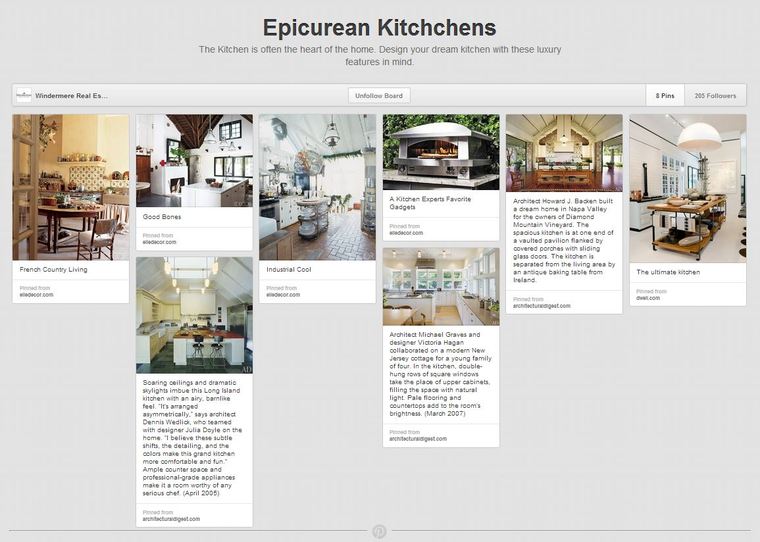
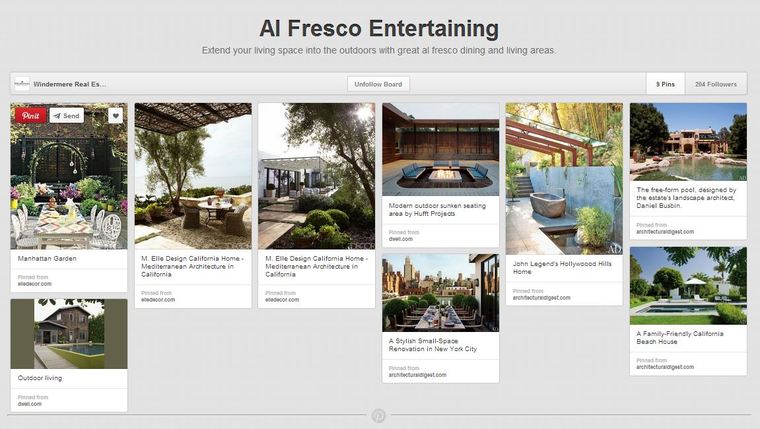
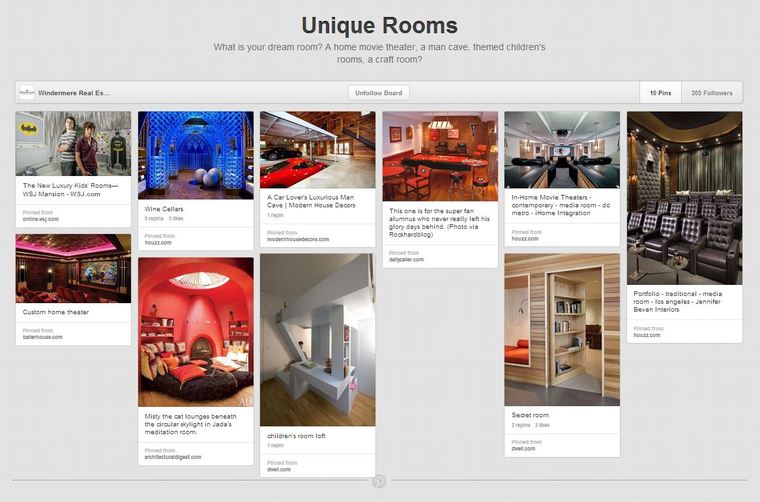
Modern and Luxury Style “Look Books” on Pinterest

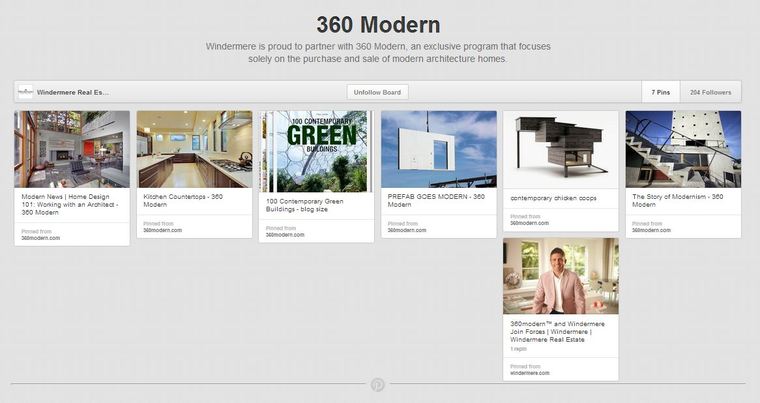
Over the past year, we have really enjoyed using Pinterest to organize some of our favorite real estate and home design resources. Because of increased demand we are expanding some of our “boards” to include more modern and luxury home features. For more than a decade, Windermere’s Premier Properties™ program has addressed the unique needs of our luxury market clientele. Our extensive network of luxury home experts have earned a reputation for providing exceptional service to discerning clients interested in buying or selling homes in some of the Western United States’ finest neighborhoods.

We want to share with your some of our favorite home inspirations. Follow us at Pinterest.com/WindermereRE.

Introducing our new Modern and luxury style “look book” boards:


More July 31, 2013

Windermere Foundation Quarterly Report

Greetings from the Windermere Foundation,

Because of you and the generous support the Windermere Foundation has received so far this year, we disbursed over $578,000 to qualifying social service organizations dedicated to serving low-income and homeless families throughout the Western U.S.

Many offices choose to donate funds to their local public schools, helping to ensure students have their most basic needs met so that they may succeed in school. The following is an inspiring testimonial from one of the school program administrators.

“…As I look back over the years of our partnership, I see the evidence that your support has produced. Children, who might never have had the opportunity otherwise, went to summer camps. Families on the verge of eviction have received the help they needed to stay in their homes or move into apartments. Homeless children have been able to spend secure nights, off the streets. And, in addition, you have helped families keep their lights on and water running. There are so many ways you have ministered to our children and families over the years, that my humble thank you seems inadequate.

Truly, on behalf of others, you have thrown your pebble into the pond; who knows where the ripples of your generosity will end in the lives of those you have helped.”

– Program Manager, FSWP

Seattle Public Schools


Many offices also donated funds to their local Boys and Girls Club. The mission of the Club programs and services is to promote and enhance the development of boys and girls by instilling a sense of competence, usefulness, belonging, and influence. More than $32,000 was donated to local Boys and Girls Clubs by offices in California, Hawaii, Montana, and Washington.

Thank you for your continued support of the Windermere Foundation. Your generosity is truly making a difference in the lives of many families in our local communities.

Best,

Christine Wood


Facebook: https://www.facebook.com/windermerefoundation

YouTube: http://www.youtube.com/WindermereRealEstate


Buying July 25, 2013

Looking to Mexico for Retirement, Resort, and Second-Home Choices

When discussing the idea of 10,000 Baby Boomers reaching retirement age every single day, I am often asked the question, “How many of these 76 million Americans will actually invest in a second-home or retirement home in Mexico?”

Fact:  Mexico is currently the number one foreign retirement destination for North Americans.

During the next two decades, as many as four million people from outside of Mexico are expected to purchase and own real estate in Mexico. And the number of foreigners who currently own property in Mexico is expected to triple.

How is this possible? A better question is, “How is this not possible?”

The second-home and retirement destinations in Mexico are located on some the most livable real estate on earth. Retiring Boomers, as well as savvy investors looking for appreciation and perhaps income from a second-home, know that Mexico is a smart choice. With a thriving middle-class, Mexico’s economy has been enjoying the strongest GDP growth in all of the Americas, surpassing the U.S. and Brazil in recent years.

Fact: Mexico’s strong economy and stable government has changed the immigration equation such that more workers and their families are currently entering Mexico than are leaving.

Informed Boomers planning for an active and comfortable lifestyle know that Mexico offers security and safety, accessibility, a warm and nurturing climate, quality health-care services, and a family-oriented culture deeply rooted in a rich history. The menu of retirement and second-home choices include waterfront and marina properties with modern amenities, signature golf course developments with inspiring views, beach clubs and spas, green sustainability, restaurants, numerous outdoor activities, and historical sights. Mexico offers condominium developments from simple to spectacular (including a variety of fractional ownership options), and single-family homes in every price range, size, and location.

Tom Kelly, the long-time syndicated Seattle business writer, talk show host, and author of numerous books and articles on Mexico real estate, states the following in his recent book Bargains Beyond the Border, “In Mexico, you will discover not only high-quality health care but also an impressive standard of living. And, property taxes, which seem to rise annually in the States, are often less than 10 percent of a U.S. home.”

He goes on to write, “According to (a) recent study by the National Association of REALTORS®, consumers are making ‘a lifestyle choice’ and turning to second homes sooner in their lives. That finding affirms what we know about Baby Boomers: they are prime candidates for retirement and second-home purchases who define themselves by personal experiences and adventure. Interestingly, they are now joined by their children – the proud members of the Gen-X and Gen-Y generations – who view practical experiences as paramount in their lives.”

Kelly’s book then recommends its “Top 10 Places to Live and Invest in Mexico”, starting with La Paz, the 500 year old capital city of Baja California Sur, located on a picturesque bay on the Sea of Cortez, and named after its discoverer. He stresses the safety and investment opportunity in this thriving city of 225,000 residents, “which is the capital of Baja California Sur and the center of government, commerce, education, health care, and environmental research for the entire region.” Kelly adds that, “The streets of La Paz are clean, and unlike many popular Mexican resorts, there are no condo hustlers at the La Paz Airport, or high-rise developments along the malecon.”

Known as the “City of Peace”, La Paz has a rich history, a high standard of living, and an easygoing lifestyle. And as Kelly points out, La Paz is “one of the few places in the world where the desert literally collides with the sea.” He cites the 5-Star Costa Baja Resort (www.costabajaresort.com) as the perfect example of what La Paz has to offer retirees and second-home owners.

Located five minutes north of the town’s malecon, or seaside strand, the 500-acre Costa Baja Resort combines beachfront homes, condominiums, villas, and single family homes with a world-class marina, Beach Club and Spa, spectacular Gary Player Signature golf course, shops, and health clinic – and at relatively affordable prices. Kelly says that retirees and investors are attracted to the Costa Baja setting for golf and lifestyle amenities, as well as its protected marina and access to some of the best beaches, fishing, diving, and eco-tourism on the planet.

Fact:  foreign owners in Baja California currently benefit from the Fideicomiso, a 50-year renewable and transferable Bank Trust which allows irrevocable and absolute ownership rights to property in Mexico.

The Fideicomiso also simplifies and protects the ownership rights of all of the beneficiaries and their heirs and designees. To understand and appreciate the safety and benefits of owning property in Mexico it’s important to work with a REALTOR® Member of AMPI (Mexican Association of Real Estate Professionals).

For more information about buying or selling real estate in Mexico, please contact Jay at 877-909-2226 or at JayWest@Windermere.com.


Jay West, CIPS  e-PRO  RSPS  TRC, is the Owner/Broker of Windermere Los Cabos. With more than 40 years in business, Jay has extensive experience serving international clientele seeking residential and resort real estate opportunities in both the U.S. and Mexico. Jay has lived in Mexico since 1994 and is a Bi-National REALTOR®. 

More July 22, 2013

360modern™ and Windermere Join Forces


It goes without saying that modern architecture is known for its simplicity of form and absence of excess. In other words, it is the antithesis of cookie-cutter design. When you combine this with the Pacific Northwest aesthetic, the result is something quite unique – and beautiful. The result of which defines the 360modern™ brand.

But, before I go into whom and what is 360modern™, I should start with my wife and business partner, Heidi. Heidi’s design aesthetic was heavily influenced by her grandparents who had a penchant for Danish furniture and artwork. Upon moving to Seattle after college, Heidi was immediately drawn to the city’s design influences which were largely shaped by the area’s Scandinavian founders. Her love of the real estate and design industries ultimately persuaded her to get into real estate sales in 2000.

Also a native of the Pacific Northwest, I have been building homes since I was 22 years old. I’ve always had an affinity for modern craftsmanship because I was taught that when it’s done right, it’s timeless. Perhaps that’s why I have always appreciated the architectural styles of local modernist legends, such as Paul Hayden Kirk, Fred Bassetti, and Paul Thiry.

Not long after Heidi and I married, we decided that we wanted to combine our passions for real estate, architecture, and modern home design. The result of that passion would eventually bring us to 360modern™.

360modern™ is an exclusive marketing program that focuses solely on the purchase and sale of Modern homes. It is our belief that the unique characteristics of Modern architecture requires specialized marketing to target buyers who are actively searching for Modern homes. Qualifying homes are also featured on the www.360modern.com website, providing enhanced online exposure that is unique to the 360modern™ program.

Founded in 2002, the 360modern™ brand has been a pioneer for modern marketing. We’re immensely proud of how far it has come over the past 11 years, but we always knew it could be more – and that’s why we decided to partner with Windermere Real Estate.

As the largest regional real estate company in the Western U.S., and the largest real estate company in the Puget Sound region, we felt strongly that Windermere would make a worthy partner for 360modern™. Windermere’s commitment to marketing and technology were obvious draws, but it was their entrepreneurial spirit that really got our attention. We were pleasantly surprised by their passion for supporting and growing new business and that’s what ultimately sealed the fate of our partnership.

Modern design means many different things to many different people. For some it’s all about open spaces, clean lines, and minimalist design. For me, Heidi, and our team, it’s about this and more. With the support of Windermere, our goal is to become the ultimate source for modern lifestyles by serving the unique needs of those who are passionate about all things modern.

We’re invested in building the modern community through our involvement with architects, non-profits, historical groups, modern furniture and art purveyors. We invite you to join us by visiting our newly redesigned 360modern™ website. There you can view modern homes for sale, meet our team, and connect with our partners in the modern community. Our goal is to grow beyond the Seattle area, so stay tuned for updates in the coming months. And if you have any feedback or suggestions, please don’t hesitate to contact us.


Rick Ward is CEO of 360modern. He lives in the Seattle neighborhood of Magnolia with his wife and business partner Heidi and their two sons. In addition to managing 360modern, Rick and his business partner Kelly Byrne build compelling architecturally modern homes with their company Next Century Modern. If Rick has any spare time, he enjoys golf, skiing and travel – sometimes all at the same time.  



Buying July 19, 2013

How to Choose the Right Home

As the market starts heating up and real estate becomes a popular dinner party topic again, it’s easy to get so caught up in the fever of searching and offers that we forget why we were buying a home in the first place. When you’re hearing about “inventory shortages” and “bidding wars” it’s important not to fall into the trap of settling, buying for the wrong reasons, or even overspending.

When is the “Right Time to Buy”?

I constantly see information out there telling buyers and sellers that it is the “right time” or the “wrong time” to buy or sell a home. Of course you should take things like rising interest rates or rising or falling prices into consideration, but the most important thing to ask yourself is, “Is it the right time for me?”  Are you ready to stay in one place for a while? Are you feeling like your employment position is stable? How about your relationship? If you’re barely making ends meet with a job you hate and your relationship with your partner is on the rocks, it’s probably not the time to buy, no matter what interest rates are doing. Having enough money to comfortably afford your home is more important than buying when everyone else is.

What are your values?

Why do you want to buy a house, anyways? Do you imagine yourself spending your weekends working in your yard every weekend? Is your idea of fun tearing apart a bathroom and putting it back together piece by piece? Or are you more interested in a lifestyle, living close to your work and walking to the grocery store?  If you love going out with your friends or traveling for long periods, buying a house with extensive landscaping or an endless list of things needing to be remodeled and upgraded is probably not a good fit. Know what kind of life you want to live in your home BEFORE you find a place, and stay true to that as you search.

Find a REALTOR who gets you.

When you’re looking for an agent to help you find a home, keep looking till you find someone you like and trust. Buying a home can be hugely stressful, and being able to have open and honest conversations with an agent who gets you will make the whole process much easier.

Everyone is happy that the real estate market is in recovery and buying a house is an amazing experience. Just make sure you know what you want your home to be FOR YOU and stay true to your own personal American Dream.

Marguerite Giguere is a buyers agent specializing in Downtown Tacoma. She blogs regularly at GetRealTacoma.com.

More July 10, 2013

Community Service Day Facebook Photo Challenge

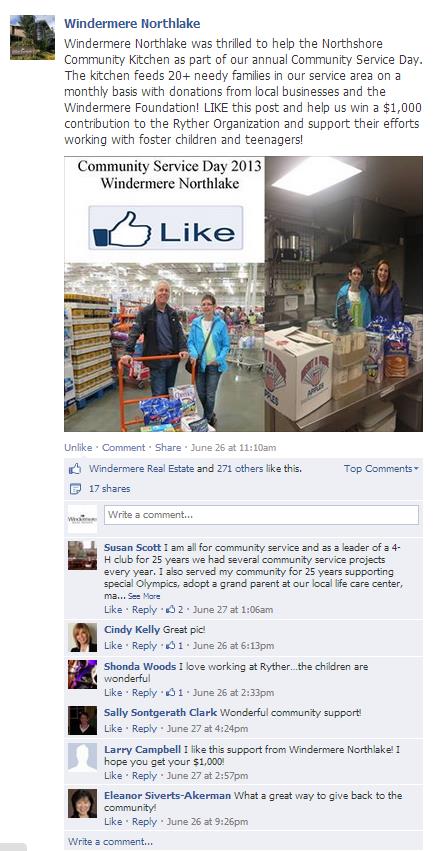
On June 21, Windermere offices in Washington, Oregon, Idaho, Montana, Hawaii, and Utah all took a day off from selling homes to help make a difference in their local communities.  Our offices were challenged to share photos and videos from their community service day event on the Windermere Real Estate Facebook page in turn for a $100 donation to the Windermere Foundation charity of their choice.

To add some competition to this challenge, we offered a $1,000 charitable contribution to the office with the most Facebook “likes” and comments. So, who won? With 272 “likes” and six comments, the winner was Windermere’s Seattle-Northlake office! Another winner was their charity of choice, Ryther Child and Teen Mental Health & Addiction Treatment Center, who will receive a donation of $1,000 from the Windermere Foundation.

You can see more Community Service Day photos on the Windermere Real Estate Facebook page at www.facebook.com/windermererealestate. Thanks to the entire Windermere team for making this year’s Community Service Day such a huge success!

Selling June 26, 2013

Should I Move or Remodel?

There are a number of things that can trigger the decision to remodel or move to a new home. Perhaps you have outgrown your current space, you might be tired of struggling with ancient plumbing or wiring systems, or maybe your home just feels out of date. The question is: Should you stay or should you go? Choosing whether to remodel or move involves looking at a number of factors. Here are some things to consider when making your decision.


Five reasons to move:

1. Your current location just isn’t working.

Unruly neighbors, a miserable commute, or a less-than-desirable school district—these are factors you cannot change. If your current location is detracting from your overall quality of life, it’s time to consider moving. If you’re just ready for a change, that’s a good reason, too. Some people are simply tired of their old homes and want to move on.

2. Your home is already one of the nicest in the neighborhood.

Regardless of the improvements you might make, location largely limits the amount of money you can get for your home when you sell. A general rule of thumb for remodeling is to make sure that you don’t over-improve your home for the neighborhood. If your property is already the most valuable house on the block, additional upgrades usually won’t pay off in return on investment at selling time.

3. There is a good chance you will move soon anyway.

If your likelihood of moving in the next two years is high, remodeling probably isn’t your best choice. There’s no reason to go through the hassle and expense of remodeling and not be able to enjoy it. It may be better to move now to get the house you want.

4. You need to make too many improvements to meet your needs.

This is particularly an issue with growing families. What was cozy for a young couple may be totally inadequate when you add small children. Increasing the space to make your home workable may cost more than moving to another house. In addition, lot size, building codes, and neighborhood covenants may restrict what you can do. Once you’ve outlined the remodeling upgrades that you’d like, a real estate agent can help you determine what kind of home you could buy for the same investment.

5. You don’t like remodeling.

Remodeling is disruptive. It may be the inconvenience of loosing the use of a bathroom for a week, or it can mean moving out altogether for a couple of months. Remodeling also requires making a lot of decisions. You have to be able to visualize new walls and floor plans, decide how large you want windows to be, and where to situate doors. Then there is choosing from hundreds of flooring, countertop, and fixture options. Some people love this. If you’re not one of them, it is probably easier to buy a house that has the features you want already in place.


Five reasons to remodel:

1. You love your neighborhood.

You can walk to the park, you have lots of close friends nearby, and the guy at the espresso stand knows you by name. There are features of a neighborhood, whether it’s tree-lined streets or annual community celebrations, that you just can’t re-create somewhere else. If you love where you live, that’s a good reason to stay.

2. You like your current home’s floor plan.

The general layout of your home either works for you or it doesn’t. If you enjoy the configuration and overall feeling of your current home, there’s a good chance it can be turned into a dream home. The combination of special features you really value, such as morning sun or a special view, may be hard to replicate in a new home.

3. You’ve got a great yard.

Yards in older neighborhoods often have features you cannot find in newer developments, including large lots, mature trees, and established landscaping. Even if you find a new home with a large lot, it takes considerable time and expense to create a fully landscaped yard.

4. You can get exactly the home you want.

Remodeling allows you to create a home tailored exactly to your lifestyle. You have control over the look and feel of everything, from the color of the walls to the finish on the cabinets. Consider also that most people who buy a new home spend up to 30 percent of the value of their new house fixing it up the way they want.

5. It may make better financial sense.

In some cases, remodeling might be cheaper than selling. A contractor can give you an estimate of what it would cost to make the improvements you’re considering. A real estate agent can give you prices of comparable homes with those same features. But remember that while remodeling projects add to the value of your home, most don’t fully recover their costs when you sell.


Remodel or move checklist:

Here are some questions to ask when deciding whether to move or remodel.

1.      How much money can you afford to spend?

2.      How long do you plan to live in your current home?

3.      How do you feel about your current location?

4.      Do you like the general floor plan of your current house?

5.      Will the remodeling you’re considering offer a good return on investment?

6.      Can you get more house for the money in another location that you like?

7.      Are you willing to live in your house during a remodeling project?

8.      If not, do you have the resources to live elsewhere while you’re remodeling?


If you have questions about whether remodeling or selling is a wise investment, or are looking for an agent in your area, we have professionals that can help you. Contact us here.