Market News April 30, 2018

Colorado Real Estate Market Update


The following analysis of the Metro Denver & Northern Colorado real estate market is provided by Windermere Real Estate Chief Economist Matthew Gardner. We hope that this information may assist you with making better-informed real estate decisions. For further information about the housing market in your area, please don’t hesitate to contact me.


ECONOMIC OVERVIEW

It’s good news for the state of Colorado, which saw annual employment grow in all of the metropolitan markets included in this report. The state added 63,400 non-agricultural jobs over the past 12 months, an impressive growth rate of 2.4%. Colorado has been adding an average of 5,300 new jobs per month for the past year, and I anticipate that this growth rate will continue through the balance of 2018.

In February, the unemployment rate in Colorado was 3.0%—a level that has held steady for the past six months. Unemployment has dropped in all the markets contained in this report, with the lowest reported rates in Fort Collins and Denver, where 3.1% of the labor force was actively looking for work. The highest unemployment rate was in Grand Junction, which came in at 4.6%.


HOME SALES ACTIVITY

  • In the first quarter of 2018, there were 11,173 home sales—a drop of 5.6% when compared to the first quarter of 2017.
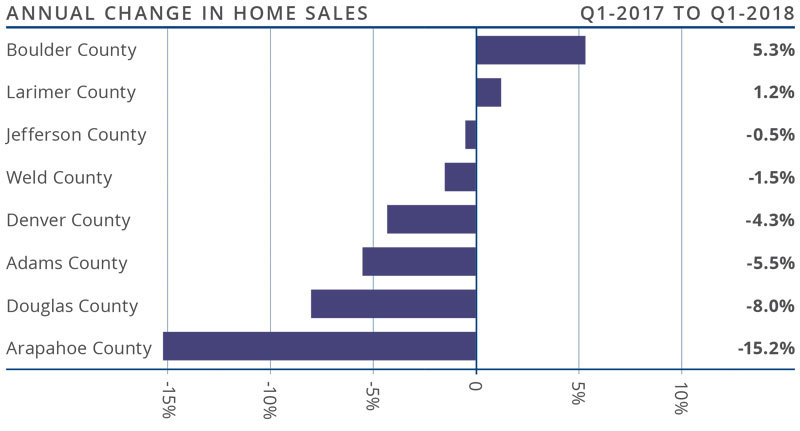
  • With an increase of 5.3%, home sales rose the fastest in Boulder County, as compared to first quarter of last year. There was also a modest sales increase of 1.2% in Larimer County. Sales fell in all the other counties contained within this report.
  • Home sales continue to slow due to low inventory levels, which were down 5.7% compared to a year ago.
  • The takeaway here is that sales growth continues to stagnate due to the lack of homes for sale.


HOME PRICES

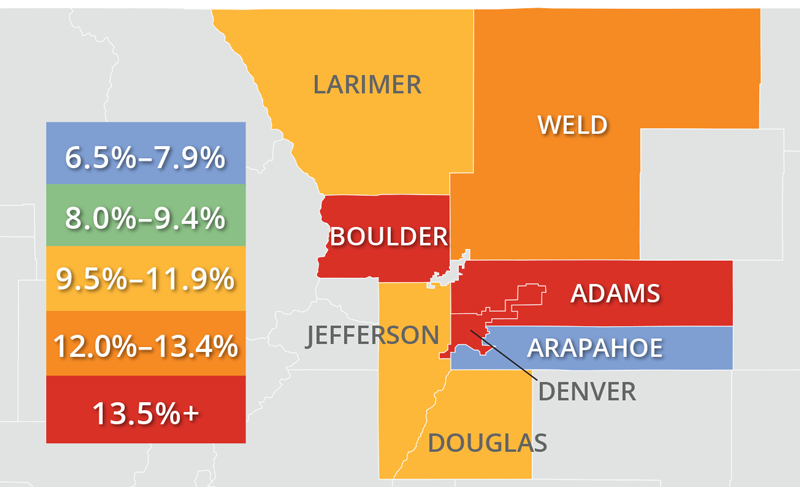
  • Strong economic growth, combined with limited inventory, continued to push prices higher. The average home price in the markets covered by this report was up by 11.7% year-over-year to $448,687.
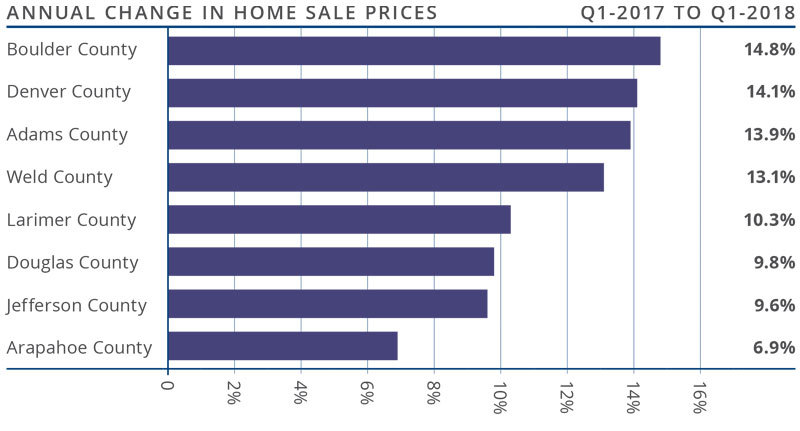
  • Arapahoe County saw slower appreciation in home values, but the trend is still positiveand above its long-term average.
  • Appreciation was strongest in Boulder County, which saw prices rise 14.8%. Almost all other counties in this report experienced solid gains.
  • The ongoing imbalance between supply and demand persists and home prices continue to appreciate at above-average rates.


DAYS ON MARKET

  • The average number of days it took to sell a home dropped by three days when compared to the first quarter of 2017.
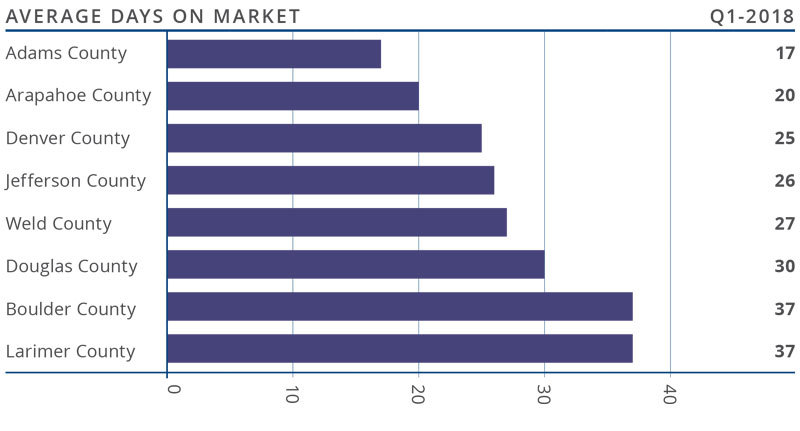
  • Homes in all but two counties contained in this report took less than a month to sell. Adams County continues to stand out where it took an average of just 17 days to sell a home.
  • During the first quarter, it took an average of 27 days to sell a home. That rate is down 2 days from the fourth quarter of 2017.
  • Housing demand remains strong and would-be buyers should expect to see stiff competition for well-positioned, well-priced homes.


CONCLUSIONS
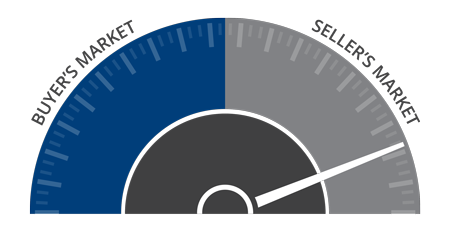
This speedometer reflects the state of the region’s housing market using housing inventory, price gains, home sales, interest rates, and larger economic factors. In the first quarter of 2018, I have left the needle where it was in the fourth quarter of last year. Even as interest rates trend higher, it appears as if demand will continue to outweigh supply. As we head into the spring months, I had hoped to see an increase in the number of homes for sale, but so far that has not happened. As a result, the housing market continues to heavily favor sellers.


Matthew Gardner is the Chief Economist for Windermere Real Estate, specializing in residential market analysis, commercial/industrial market analysis, financial analysis, and land use and regional economics. He is the former Principal of Gardner Economics, and has more than 30 years of professional experience both in the U.S. and U.K.
Market News April 27, 2018

Nevada Real Estate Market Update


The following analysis of the greater Las Vegas, Nevada real estate market is provided by Windermere Real Estate Chief Economist Matthew Gardner. We hope that this information may assist you with making better-informed real estate decisions. For further information about the housing market in your area, please don’t hesitate to contact me. 


ECONOMIC OVERVIEW

Employment in the Las Vegas metropolitan area maintained the same growth rate as the final quarter of 2017, with year-over-year employment up by 2.7%. Over the past 12 months, the area has added 26,300 new jobs. This job creation has led the seasonally adjusted unemployment rate to measure 5.1%. This is the same rate as a year ago due to growth in the civilian labor force.

As the region nears full employment, I expect wages to continue rising at above-average rates, which should result in further increases in home prices as we move through 2018. 


HOME SALES ACTIVITY

  • A total of 7,955 homes sold in the first quarter of 2018—a modest 0.3% increase over the same period a year ago. With an increase of just 1.0% in pending sales, I expect there to be slightly more closings in the second quarter of this year.
  • While total closings slowed relative to the final quarter of 2017, I believe this is due to the increase in mortgage rates that started last fall, which likely pulled some sales forward as buyers bought earlier to lock in better rates. 
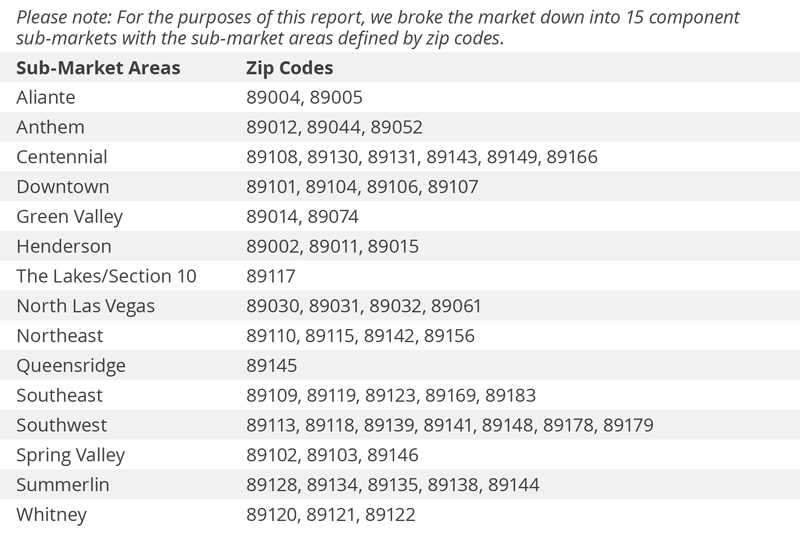
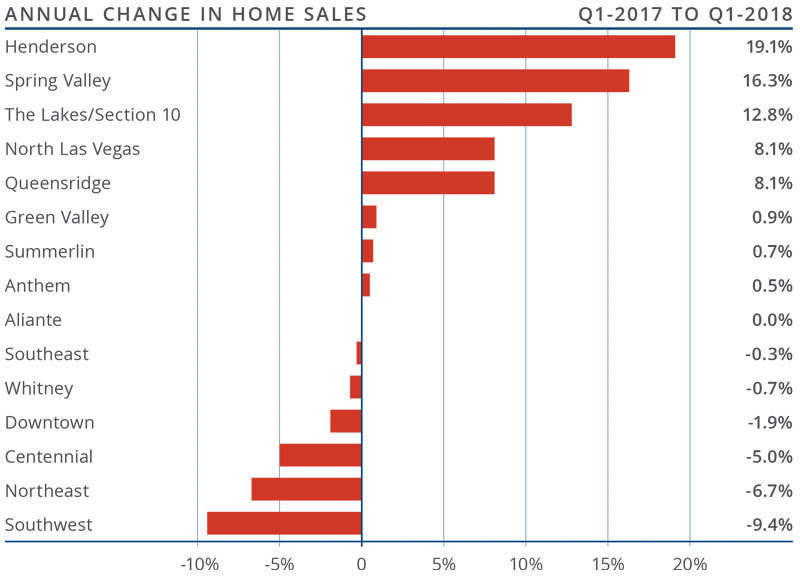
  • Sales rose substantially in the Henderson and Spring Valley sub-markets, where transactions were up by 19.1% and 16.3%, respectively. Several other sub-markets saw positive sales growth, but total closings were down by 2.0% compared to the fourth quarter of 2017.
  • Inventory levels remain remarkably low, with 32.5% fewer homes for sale than in the same period in 2017. Unfortunately, there was not a bump in new listings in early 2018, furthering the imbalance between supply and demand. 


HOME PRICES

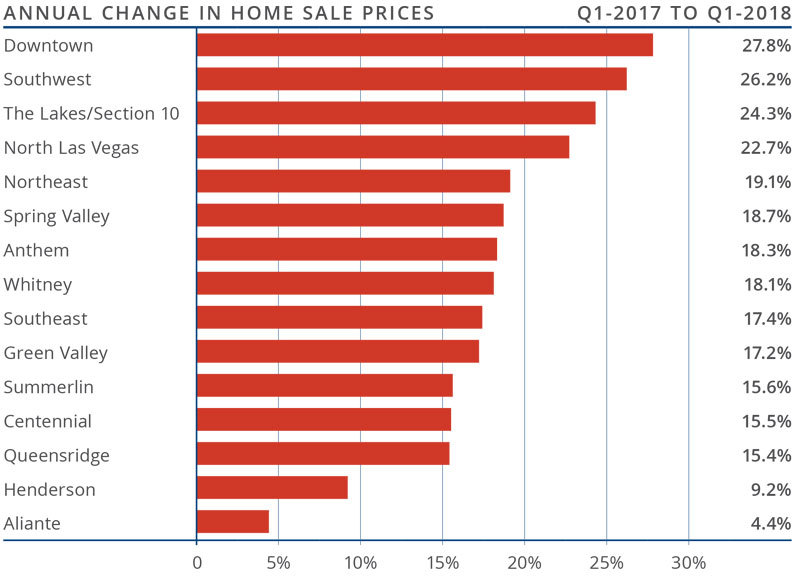
  • Home prices in the area have risen by 18.4% year-over-year to an average of $291,386.
  • Notably, only two neighborhoods saw annual price growth of less than 10 percent.
  • Prices rose by double-digits in all sub-markets except two when compared to the first quarter of 2017. The strongest growth was in the relatively affordable Downtown sub-market, where prices were up by 27.8%.
  • I predict that above-average price growth in the greater Las Vegas market will continue through the balance of this year. Strong job growth—in concert with limited inventory and favorable borrowing rates—continues to drive demand for housing. 


DAYS ON MARKET

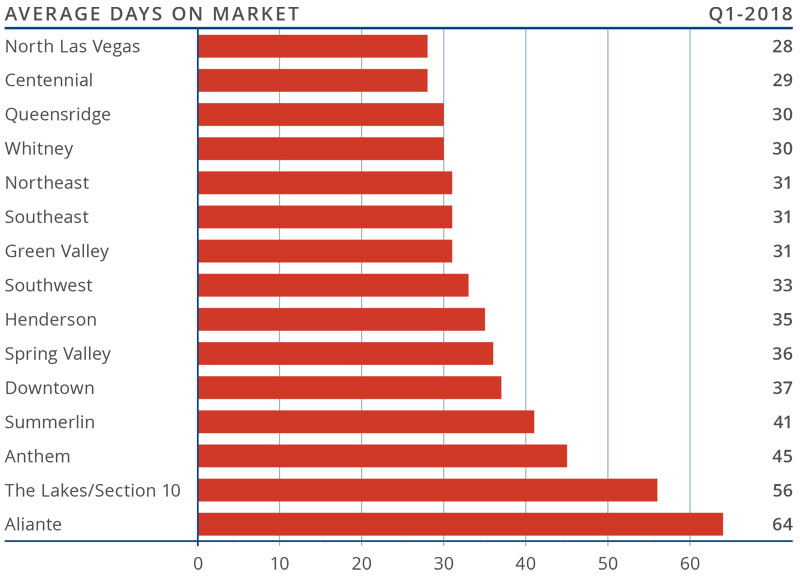
  • The average time it took to sell a home in the region dropped by 12 days compared to the first quarter of 2017.
  • The length of time it took to sell a home dropped in all but one of the sub-markets compared to a year ago. The exception was the Lakes/Section 10 sub-market.
  • The greatest drop in days-on-market was in the Whitney sub-market, which fell by 18 days when compared to the same quarter in 2017. Homes in this area sold in 30 days on average. 
  • It took an average of just 37 days to sell a home in the first quarter. 


CONCLUSIONS

The speedometer reflects the state of the region’s housing market using housing inventory, price gains, home sales, interest rates, and larger economic factors. Employment growth in Clark County is still very buoyant. This, combined with low inventory levels and competitive interest rates, will continue to push home prices higher. Given these factors, I have moved the speedometer a little further in favor of sellers. 


Mr. Gardner is the Chief Economist for Windermere Real Estate, specializing in residential market analysis, commercial/industrial market analysis, financial analysis, and land use and regional economics. He is the former Principal of Gardner Economics, and has more than 30 years of professional experience both in the U.S. and U.K. 
Market News April 26, 2018

Southern California Real Estate Market Update


The following analysis of the Southern California real estate market is provided by Windermere Real Estate Chief Economist Matthew Gardner. We hope that this information may assist you with making better-informed real estate decisions. For further information about the housing market in your area, please don’t hesitate to contact me. 


ECONOMIC OVERVIEW

The counties covered by this report—Los Angeles, San Diego, San Bernardino, Orange, and Riverside—added 164,100 new jobs between February 2017 and February 2018. As a result, the unemployment rate dropped from 4.8% to 4.1%. Employment growth in Southern California continued to pick up a bit as 2018 started, and I anticipate this will continue as we move through the year.  


HOME SALES ACTIVITY


  • There were 38,712 home sales in the first quarter of 2018. This was 5.7% lower than the same period in 2017 and 14.6% lower than the final quarter of 2017.
  • The number of homes for sale continues to run well below the levels seen a year ago (-8.0%), and was 2.7% lower than in the final quarter of 2017.
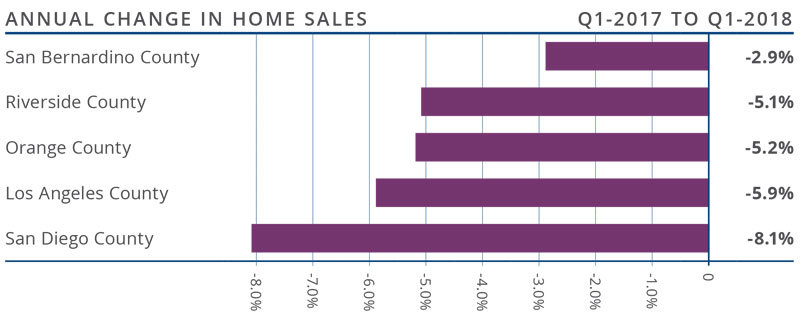
  • Home sales dropped across the board. The most pronounced decline was in San Diego County, which fell by 8.1%. As stated in last quarter’s report, this drop can be attributed to woefully low levels of inventory.
  • There was an average of 28,835 active listings in the first quarter—well below what is needed to get to a balanced market. 


HOME PRICES

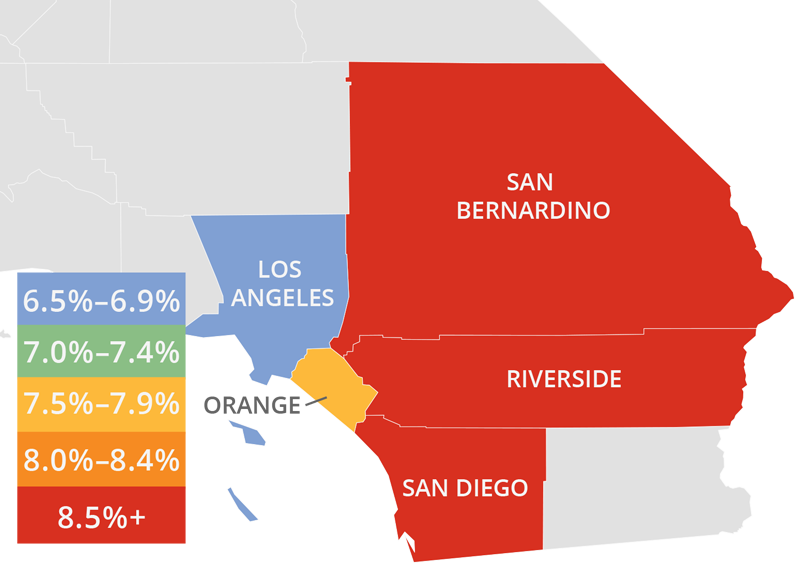
  • Year-over-year, average prices in the region rose by 7.5% and were 1.1% higher than in the fourth quarter of 2017.
  • Affordability is an ongoing issue and one that, in concert with limited inventory, continues to push home prices higher. New construction activity is still constrained and this puts further upward pressure on prices. Though California is looking at legislation to free up inventory, as well as to add more housing units via Senate Bill 827 and adjustments to Prop. 13, I still believe that prices will continue to rise at above-average rates for the foreseeable future.
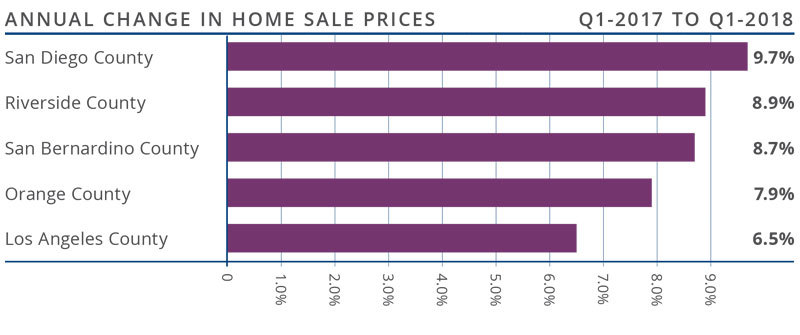
  • San Diego County had the greatest annual appreciation in home values (+9.7%) but there were solid price increases across the rest of the region as well.
  • Pending home sales dropped by 0.3% compared to the first quarter of 2017, which indicates that closings in the second quarter of this year are likely to only see modest increases. Demand for homes in 2018 will remain positive but, with limited inventory, demand is likely to still outstrip supply. 


DAYS ON MARKET


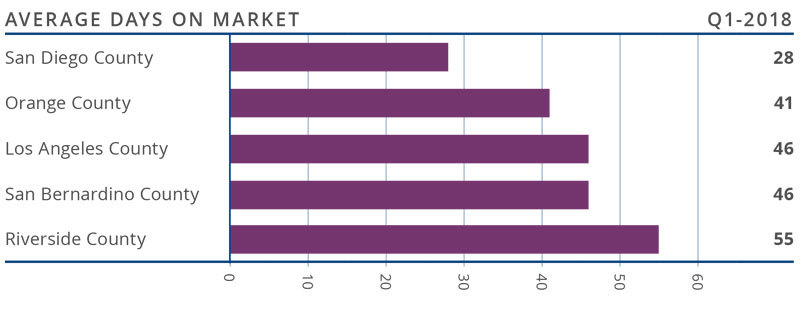
  • The average time it took to sell a home in the region was 43 days. This is a drop of 13 days compared to the first quarter of 2017, and matches the final quarter of 2017.
  • Homes in San Diego County continue to sell at a faster rate than other markets in the region. In the first quarter, it took an average of just 28 days to sell a home, which is 5 fewer days than a year ago.
  • The biggest drop in the number of days it took to sell a home was in San Bernardino County, where it took 16 fewer days compared to the same period last year.
  • All five counties saw a drop in the amount of time it took to sell a home compared to the first quarter of 2017. 


CONCLUSIONS


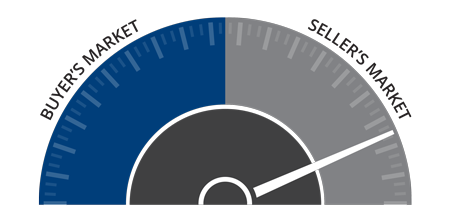
The speedometer reflects the state of the region’s housing market using housing inventory, price gains, home sales, interest rates, and larger economic factors. 

The Southern California economy continues to expand, which magnifies demand for all housing types. Mortgage rates—although rising—are still very favorable when compared to historic averages, and low inventory continues to drive prices higher. The number of homes for sale in the region is still well below the levels needed for a balanced market. Given all of these factors, I have moved the needle a little more in favor of sellers. 


Mr. Gardner is the Chief Economist for Windermere Real Estate, specializing in residential market analysis, commercial/industrial market analysis, financial analysis, and land use and regional economics. He is the former Principal of Gardner Economics, and has more than 30 years of professional experience both in the U.S. and U.K. 
Buying April 25, 2018

10 Key Qualities to Look for When Selecting an Agent

Buying a home is one of the most significant financial and emotional purchases of a person’s life. That’s why it is so important to find an agent that can not only help you navigate the home search process but one who can also answer your questions and represent your needs from start to finish. Most importantly, your agent should care about your happiness and ensuring that you find the home that best fits your needs.

Here are some qualities to consider when selecting a real estate agent:

  1. Likable. More than likely, you will be spending a lot of time with your agent, so look for someone that you enjoy interacting with.
  2. Trustworthy. One of the best ways to find an agent who you feel you can trust is to ask friends and family for a referral. Another way to do this is to interview different agents and ask for client references.
  3. Effective listener. While your agent can’t read your mind, they should be able to make educated recommendations and offer advice by listening closely to your needs. Make sure you talk to your agent about your priorities, what types of features appeal to you, as well as any factors that could be deal breakers. This will arm your agent with everything they need to help find you the perfect home.
  4. Qualified and experienced. Make sure your agent has the qualifications and experience to meet your specific needs. For example, some agents have more experience with short sales, while others might be experts on certain neighborhoods or types of housing.  Your agent should also be fully trained in contract law and negotiations.
  5. Knowledgeable. A great agent is someone who is out in the neighborhoods, exploring communities, visiting listings, performing marketing analyses, and collecting all the information that you need to make an informed, confident decision about your real estate needs.
  6. Honest. Your agent should be upfront and honest with you about every aspect of your home search process – even if it involves delivering bad news. The best real estate agents are more concerned about finding the right home for their clients, not just the home that brings in the fastest commission check.
  7. Local. Every community is different and all real estate is local, so it’s important to find someone who really knows the local market and can provide you with whatever information you need to familiarize yourself with a particular area.
  8. Connected. A well-connected agent will have relationships with lenders, inspectors, appraisers, contractors, and any other service provider you might need during your home search.
  9. Straightforward. You want an agent who will work hard to help you find the best home, but you also want someone who will be straightforward with you about the process, the market reality, and what is realistic for you.
  10. Committed. Your agent should be in it for the long haul, meaning that they’re looking out for your best interests every step of the way, no matter how long the process takes. The best way to find an agent with these qualities is by asking around. In all likelihood, someone within your circle of friends or family will have experiences to share and professionals to recommend. You can also search for agents based on area, so you know you’re getting someone who is knowledgeable about the neighborhood(s) you’re interested in. Click here to learn more about the buying process.
Market News April 25, 2018

Western Washington Real Estate Market Update


The following analysis of the Western Washington real estate market is provided by Windermere Real Estate Chief Economist Matthew Gardner. We hope that this information may assist you with making better-informed real estate decisions. For further information about the housing market in your area, please don’t hesitate to contact me. 


ECONOMIC OVERVIEW

The Washington State economy added 96,900 new jobs over the past 12 months, representing an annual growth rate of 2.9%—still solidly above the national rate of 1.5%. Most of the employment gains were in the private sector, which rose by 3.4%. The public sector saw a more modest increase of 1.6%.

The strongest growth was in the Education & Health Services and Retail sectors, which added 17,300 and 16,700 jobs, respectively. The Construction sector added 10,900 new positions over the past 12 months.

Even with solid increases in jobs, the state unemployment rate held steady at 4.7%—a figure that has not moved since September of last year.

I expect the Washington State economy to continue adding jobs in 2018, but not at the same rate as last year given that we are nearing full employment. That said, we will still outperform the nation as a whole when it comes to job creation. 


HOME SALES ACTIVITY

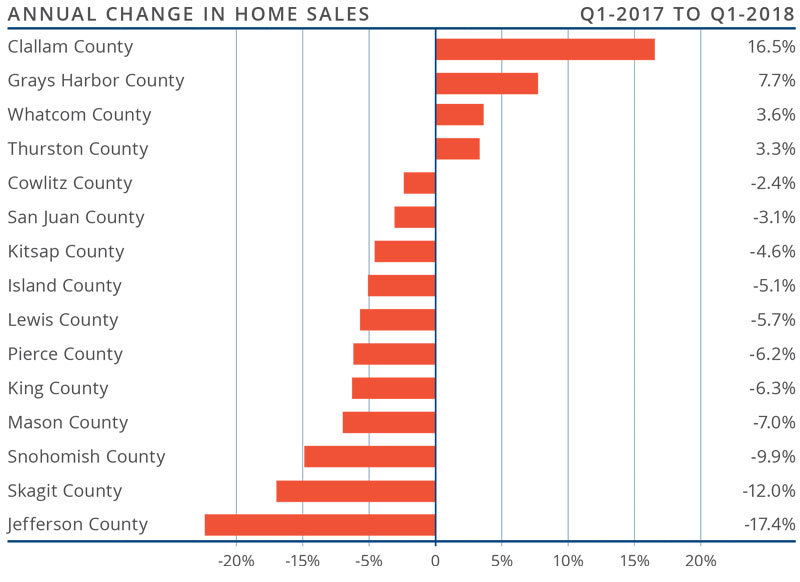
  • There were 14,961 home sales during the first quarter of 2018. This is a drop of 5.4% over the same period in 2017.
  • Clallam County saw sales rise the fastest relative to the first quarter of 2017, with an increase of 16.5%. In most of the other markets, the lack of available homes for sale slowed the number of closings during this period.
  • Listing inventory in the quarter was down by 17.6% when compared to the first quarter of 2017, but pending home sales rose by 2.6% over the same period, suggesting that closings in the second quarter should be fairly robust.
  • The takeaway from this data is that the lack of supply continues to put a damper on sales. I also believe that the rise in interest rates in the final quarter of 2017 likely pulled sales forward, leading to a drop in sales in the first quarter of 2018. 


HOME PRICES

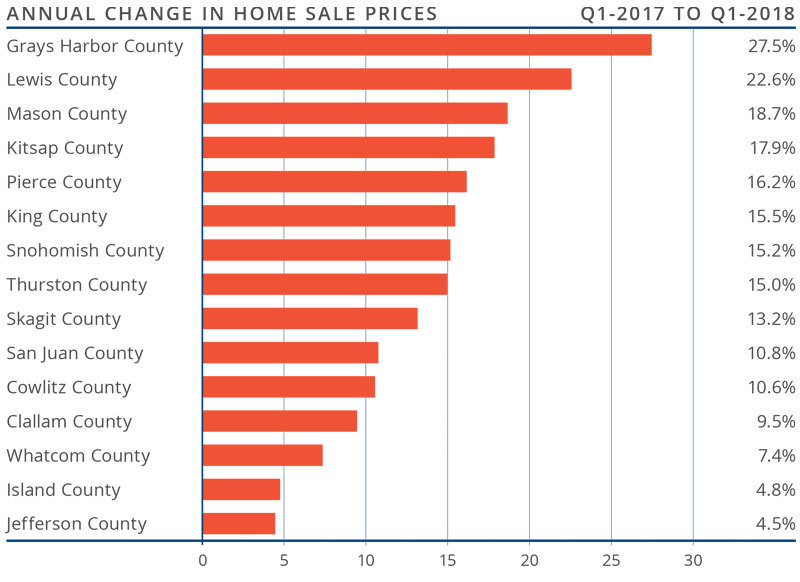
  • With ongoing limited inventory, it’s not surprising that the growth in home prices continues to trend well above the long-term average. Year-over-year, average prices rose 14.4% to $468,312.
  • Economic vitality in the region is leading to robust housing demand that far exceeds supply. Given the relative lack of new construction homes— something that is unlikely to change any time soon—there will continue to be pressure on the resale market. As a result, home prices will continue to rise at above-average rates in the coming year.
  • When compared to the same period a year ago, price growth was strongest in Grays Harbor County at 27.5%. Ten additional counties experienced double-digit price growth.
  • Mortgage rates continued to rise during first quarter, and are expected to increase modestly in the coming months. By the end of the year, interest rates will likely land around 4.9%, which should take some of the steam out of price growth. This is actually a good thing and should help address the challenges we face with housing affordability—especially in markets near the major job centers. 


DAYS ON MARKET

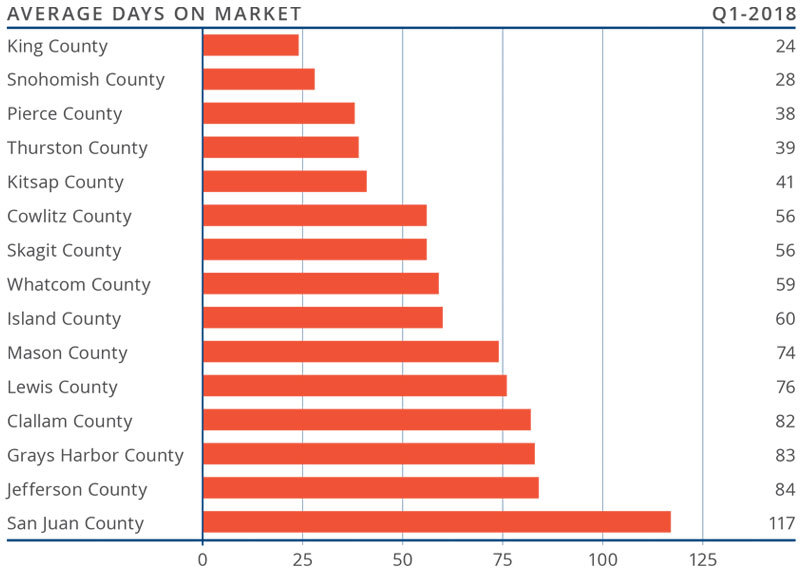
  • The average number of days it took to sell a home dropped by seven days when compared to the same quarter of 2017. 
  • King County continues to be the tightest market in Western Washington, with homes taking an average of 24 days to sell. Every county in the region saw the length of time it took to sell a home either drop or remain essentially static relative to the same period a year ago. 
  • In looking at the entire region, it took an average of 61 days to sell a home in the first quarter of this year. This is down from 68 days in the first quarter of 2017 but up by eleven days when compared to the fourth quarter of 2017. 
  • Anyone expecting to see a rapid rise in the number of homes for sale in 2018 will likely be disappointed. New construction permit activity—a leading indicator—remains well below historic levels and this will continue to put increasing pressure on the resale home market. 


CONCLUSIONS

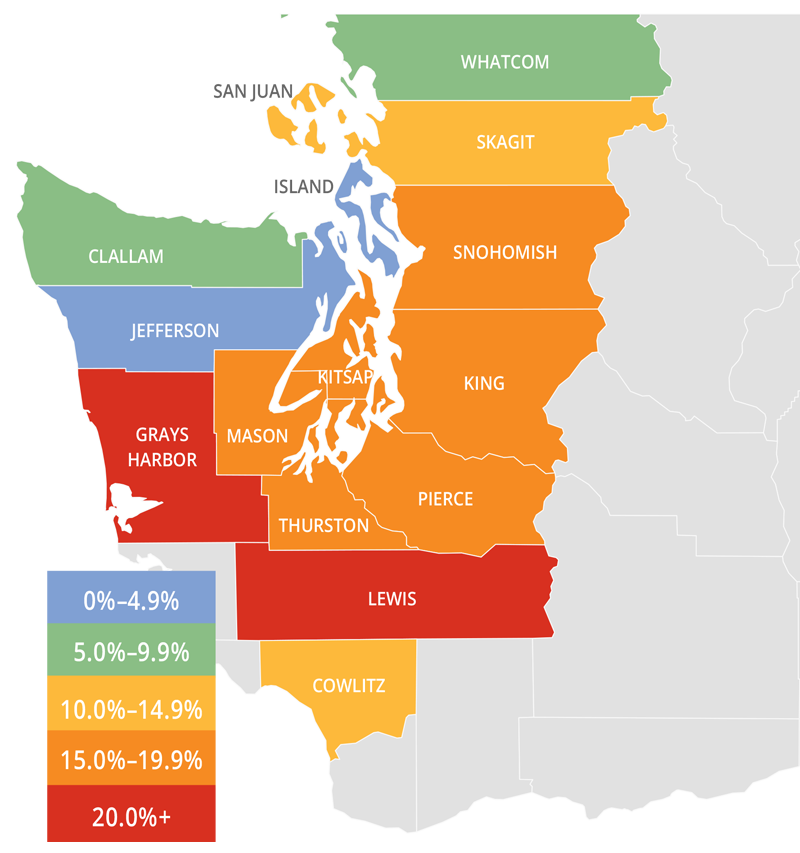
This speedometer reflects the state of the region’s housing market using housing inventory, price gains, home sales, interest rates, and larger economic factors. For the first quarter of 2018, I have left the needle at the same point as fourth quarter of last year. Price growth remains strong even as sales activity slowed. All things being equal, 2018 is setting itself up to be another very good year for sellers but, unfortunately, not for buyers who will still see stiff competition for the limited number of available homes for sale. 


Mr. Gardner is the Chief Economist for Windermere Real Estate, specializing in residential market analysis, commercial/industrial market analysis, financial analysis, and land use and regional economics. He is the former Principal of Gardner Economics, and has more than 30 years of professional experience both in the U.S. and U.K. 


More April 23, 2018

Windermere Foundation Nears $36 Million in Total Donations Raised!


Thanks to the generosity of Windermere agents and the community, the Windermere Foundation collected over $330,000 in donations during the first quarter of 2018. Individual contributions and fundraisers accounted for 58 percent of the donations, while 42 percent came from donations through Windermere agent commissions. So far, we have raised a total of $35,869,961 in donations since 1989 when the Windermere Foundation was started.

 

Each Windermere office has its own Windermere Foundation fund account that they use to make donations to organizations in their local communities. In the first quarter of 2018, a total of $521,916 was disbursed to non-profit organizations dedicated to providing services to low-income and homeless families throughout the Western U.S.


One organization that has been the recipient of Windermere Foundation funds is Youthnet, serving Skagit, Whatcom, Snohomish, Island, and San Juan Counties in Washington State. Youthnet provides caring and supportive educational and social services to youth and families to help them attain a productive and successful life.


The Windermere Real Estate/Skagit Valley office in Mount Vernon, Washington has donated a total of $1,500 to Youthnet since 2015. Their support has continued to make a difference to the children, youth, and families served.


Donations have helped Youthnet support clients like Tracey and Tom, who are struggling to care for their three young children because of their inability to find and keep jobs due to mental health issues. Support from donors such as Windermere allows Tracey and Tom to receive resources, parenting support, and guidance to keep Sarah, Suzie and Jimmy well-cared-for.  Funding also helps clients like Jennifer, who is finishing high school this year and thinking about going to college. She would be the first one in her family to achieve this goal.


Generous donations to the Windermere Foundation over the years have enabled Windermere offices to continue to support local non-profits like Youthnet. If you’d like to help support programs in your community, please click on the Donate button.


To learn more about the Windermere Foundation, visit http://www.windermere.com/foundation.

Design April 18, 2018

Why You Should Stay Put and Improve the Home You Have

In "Staying Put," architect and writer Duo Dickinson has assembled a terrific and practical guide to help us make real improvements to our homes. Dickinson, an advocate of well-designed and affordable homes for all, has specialized in residential design for more than three decades.

This is not your typical architect's book about design. There's no obscure language nor design-for-design's-sake ideas. It is a practical, down-to-earth guide that walks anyone through the rational process of how to remodel your house to get the home you want, from how to think about your house and overcoming hurdles to a list of "Duo's Do's and Don'ts" for the homeowner. Along the way, there's plenty of nice before-and-after photos to help explain the points. Do read the book. You'll be glad you did.


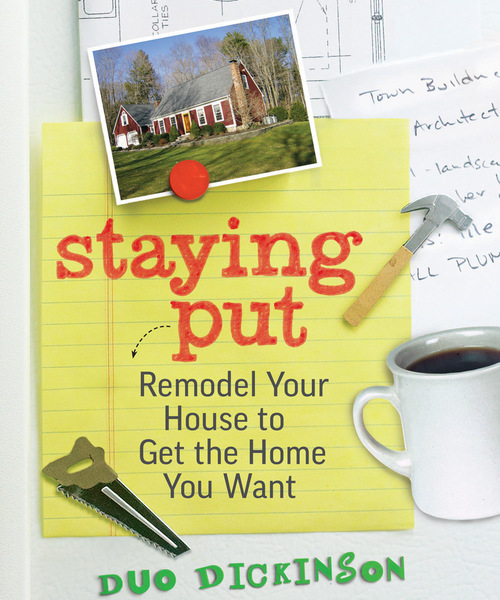
The Taunton Press Inc, original photo on Houzz


The cover says it all. The ubiquitous photo of a gorgeous, award-winning home that's beyond most of us is replaced with images of a saw, cup of morning joe and a to-do list.

Are you staying put yourself? Read on for 8 of Dickinson's suggestions.


Mick Hales, original photo on Houzz


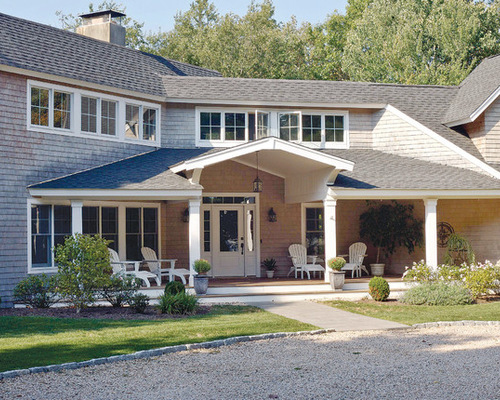
Consider the compass points. The tips and illustrated examples are wonderfully straightforward. For example, we see a house that gets overheated, the siding degrades and the front door bakes in the sun because it all faces south.

Dickinson's common-sense advice: Rework the front of the house with a new wide porch that shades the front door and some smaller, yet well-sized windows to create a lot more curb appeal while reducing maintenance and energy consumption. It's a triple win: more beauty and comfort with less cost.

Avoid gutters. Statements such as "gutters and leaders are devout to be avoided" may sound like heresy to many but certainly are the truth. Proving his point, Dickinson illustrates how a properly-built roof overhang can shed all the water it must without the complications, such as ice dams, caused by gutters.

Embrace small moves. Dickinson provides a wealth of simple solutions illustrated with before-and-after photos. He shows how to use small moves for big dividends, such as taking out a wall between a kitchen and a hallway to make room for more kitchen storage.


Mick Hales, original photo on Houzz


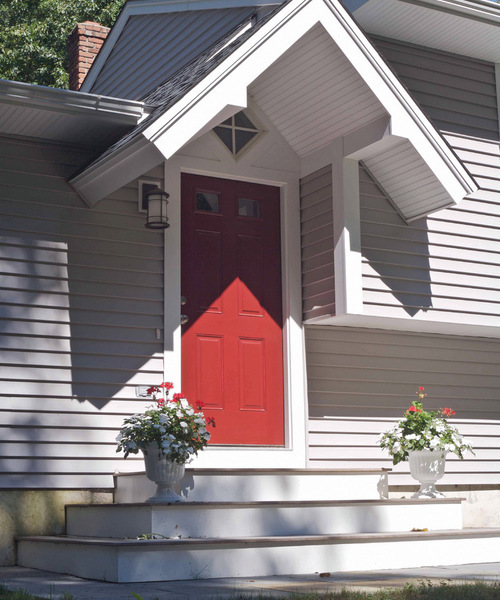
Enhance curb appeal. The book offers solutions to common problems with a particular style, such as how to improve and enhance an entrance into a split-level home.

Open up to the outside. Dickinson provides some excellent examples of how we can use modern windows and doors to strengthen the connection between inside and outside. Our homes, says Dickinson, no longer need be "later-day caves."

Find your home. Learning more about the style of the house you have will help you avoid obstacles in remodeling and recognize the best opportunities for improving your particular home.


Mick Hales, original photo on Houzz


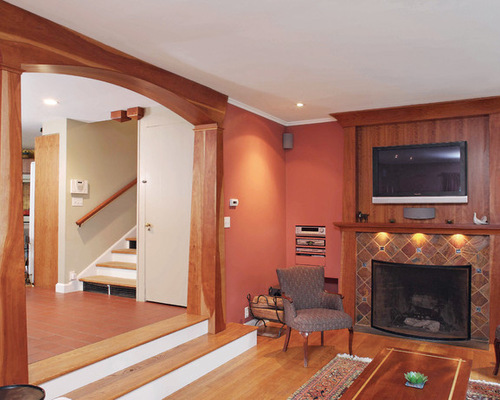
Open up the inside. Snippets of advice sprinkled throughout the book are like refreshing raindrops that clear the cobwebs away. One such snippet: "If you walk through a room to get to a room, something is wrong." You know — it's when that new great room gets added to a modest house, and the result is some kind of dyslexic creature that's really two houses rather than one.

So rather than even building an addition, Dickinson suggests you make the most of what you already have. In this example, widening the opening between rooms strengthens this room's connection with the rest of the home, increasing its utility and spaciousness.


The Taunton Press Inc, original photo on Houzz


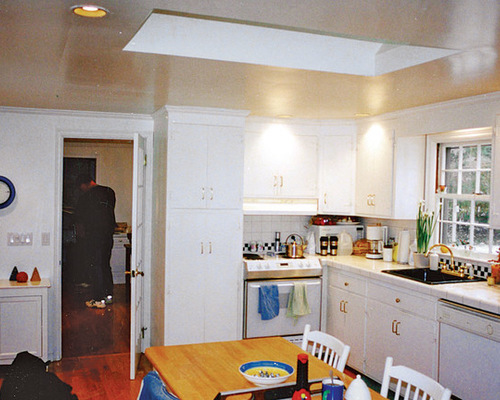
Work with what you've got (before): Keeping the kitchen size the same while vaulting the ceiling dramatically increases the overall spaciousness of the room, as you'll see in the next photo.


Mick Hales, original photo on Houzz


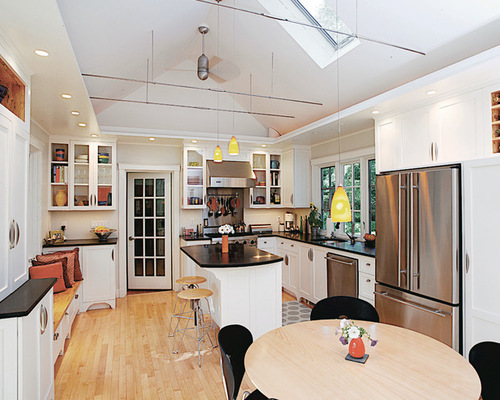
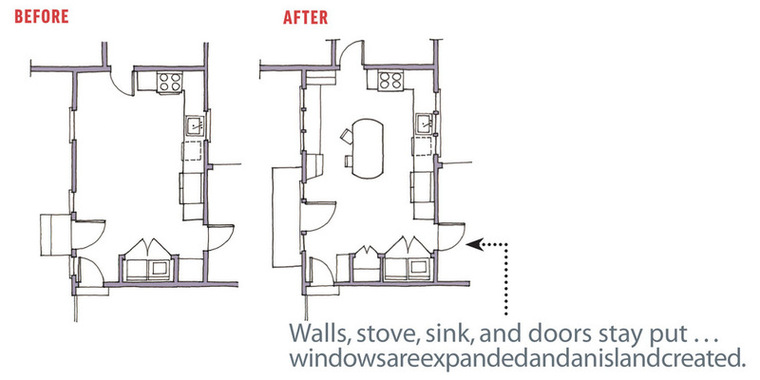
Work with what you've got (after): Walls, doors, appliances and even the skylight and kitchen sink were all left where they were. This all avoided costly plumbing, electrical and mechanical work and rework.


The Taunton Press Inc, original photo on Houzz


Working with what you've got (plans): Dickinson has included before-and-after floor plans for many of the examples. These plans help provide that much more context, allowing the reader to better understand what they may be able to do with the home they already have.

Market News April 16, 2018

How to Get Back to a Balanced Housing Market

Design April 11, 2018

Why Not White Marble?


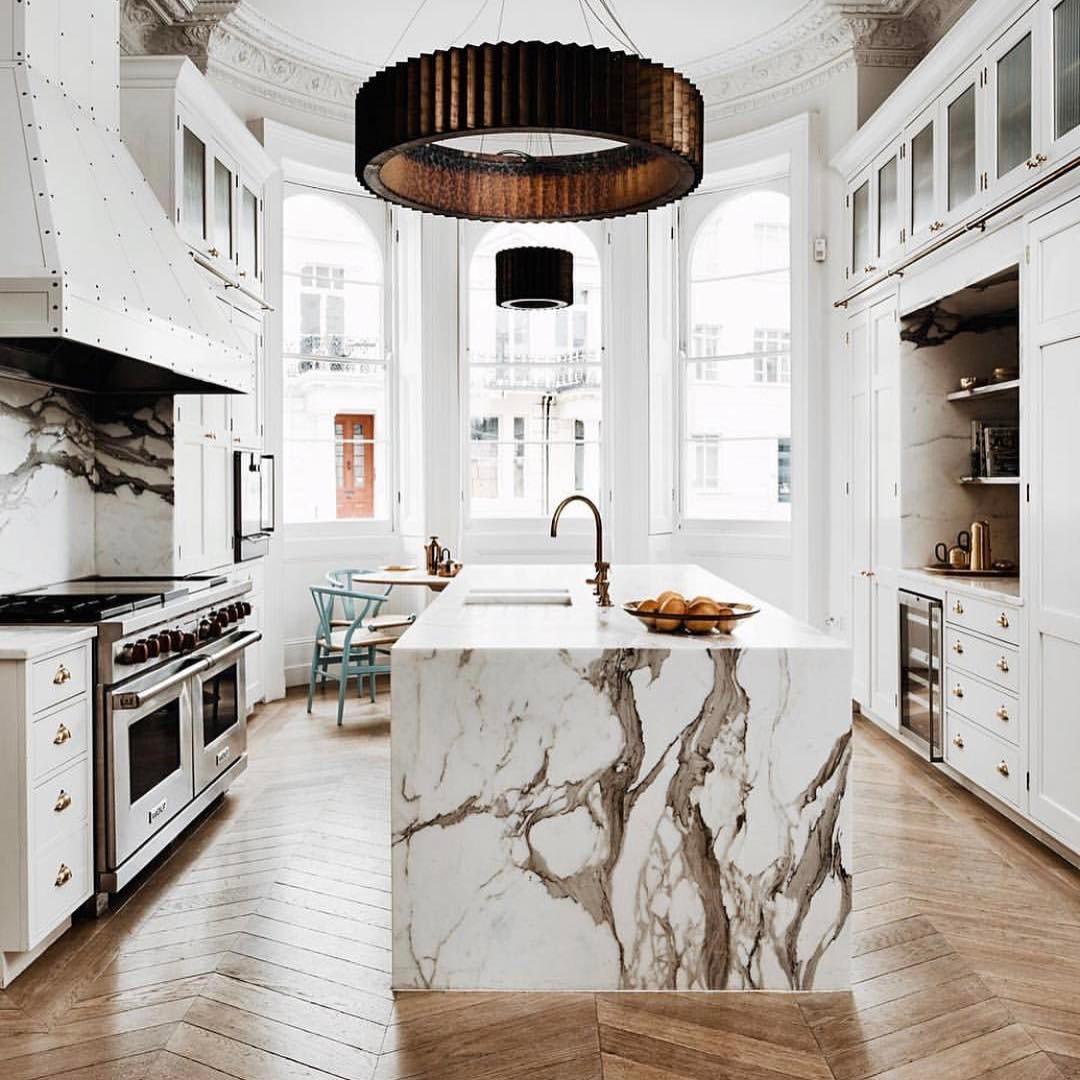
Are you thinking about replacing your kitchen or bathroom countertops? The choices are endless; tile, granite, soapstone, wood, or maybe marble? White marble often gets a bad rap because it’s a more porous metamorphic stone than most (which means it’s prone to stains and scratches), but we beg to differ, and here’s why.


White marble is as timeless as it is modern. Adding white marble to your kitchen or bathrooms is like bringing home flowers for your significant other; always a good idea. It looks great on kitchen counters, but also just about anywhere in your bathrooms, from the floor to the shower walls.  Adding white marble countertops to a dressing vanity in bedrooms is also a great way to incorporate it throughout your house.


After you’ve made the decision to install white marble into your home, you’ll need to decide on a finish. Honing gives a matte finish, whereas polishing creates a shiny, reflective surface. If you want to reduce etching, choose a honed finish instead of a polish. If you don’t mind some added etching, then polished white marble is as stunning as it sounds.


How do you keep your marble happy? Make sure to apply a seal prior to using it. To reduce staining, wipe away spills immediately, and only use a neutral detergent to clean your marble. These simple things will keep your white marble in shipshape condition.


When it comes to your marble, it’s more like you than you think. Marble goes through good times and bad times and some scars fade better than others. It will never be perfect, but in the end, we think you’ll love it—imperfections and all.


Check out white marble looks we love on Pinterest.


Design April 2, 2018

Home Decor Through The Decades


As we celebrate our 45th anniversary here at Windermere, we’re feeling a bit nostalgic. The fundamentals of helping our clients buy and sell homes haven’t changed much over the past 45 years, but the way we decorate our homes sure has. Let’s take a trip down memory lane and explore interior design trends from the past four decades—the good (farmhouse sinks), the bad (macramé owls), and the ill-advised (carpeted bathrooms!).


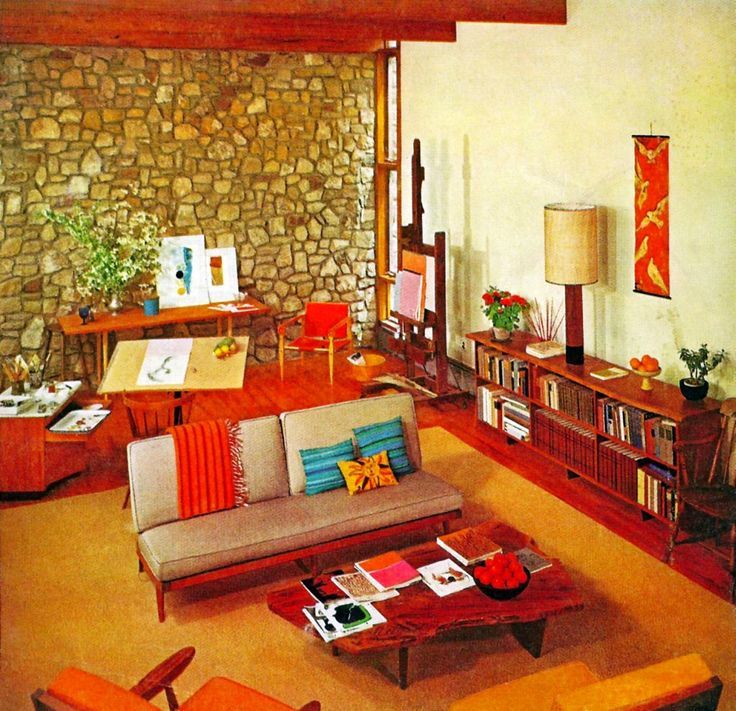
1970s

Inspired by the hippie movement, interior design in the 1970s centered around bringing the outdoors inside. Wood paneling could be found in bedrooms and basements alike, and wood accents adorned appliances in the kitchen.

Earth tones dominated throughout the house. If your refrigerator wasn’t avocado or burnt sienna and your shag carpet wasn’t harvest gold, you were not keeping up with the times.


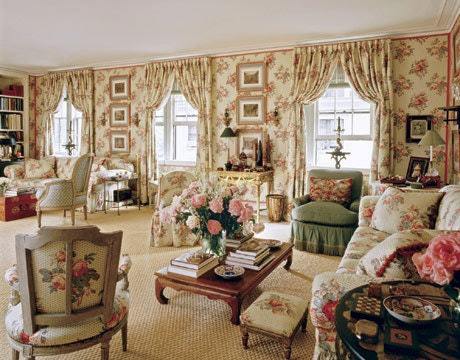
1980s

In the 1980s, we wanted to make homes as cozy as possible, which for a lot of folks meant chintz, Laura Ashley–inspired florals, and tons of pastels.

The “country” look gained huge popularity during this decade as well. Even high-rise city apartments were filled with objects that seemed more at home on a ranch in Texas, including bleached cow skulls and weathered-wood dining tables and chairs.


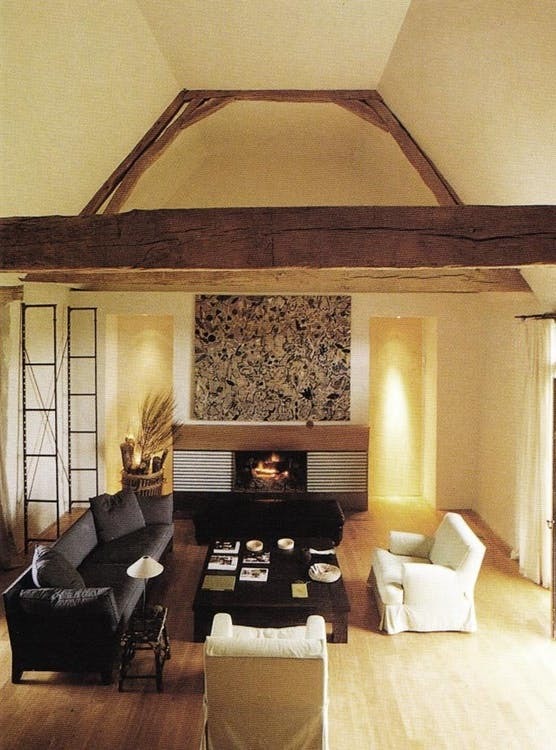
1990s

Perhaps as a reaction to the excess of the decade before, the 1990s saw a rise in Japanese-inspired minimalism. Sparsely furnished rooms with rock gardens, clean lines, and simple colors were all the rage.

On the opposite end of that spectrum was the shabby chic craze. Distressed furniture, soft colors, and oversized textiles combined to create this look.

Texturized walls were also a big hit. Wall paper and paint brushes were out, and sponges became the way to get the chicest look for your home.


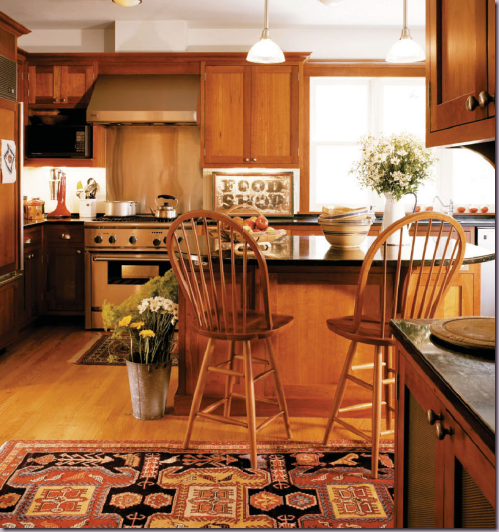
2000s

It’s hard to believe, but we’re nearly a decade out from the early aughts. And that perspective makes it easier to spot trends that felt of-the-moment only a few years ago but are waning in popularity today. One example is Tuscan-style kitchens. It seemed every new home—especially homes on the upper end of the market—included a kitchen with stone tiles, granite countertops, hanging vines, and beige and tan tones.

Another popular item from the early 2000s that is now facing a bit of a backlash is mason jars. Once a staple of homes looking to incorporate a rustic feel, mason jars are now so common in decorating both homes and restaurants that they no longer feel special or nostalgic.


Today

Trends are always evolving, but if you’re looking for some cutting-edge interior design ideas for 2018, here are a couple to consider.

Embrace super saturated colors, especially warmer tones like yellow and red. These bold hues no longer need to be saved for accent pieces like pillows or lamps. Larger pieces of furniture and entire walls make a bigger splash.

Incorporate geometric patterns. There’s really no wrong way to get on board with this trend. Whether your couch features large circles, you add patterned backsplash in your kitchen, or you cover your ceiling with octagonal wallpaper, geometric shapes will help your home feel fresh.