Market News May 1, 2023

Q1 2023 Southern California Real Estate Market Update

The following analysis of select counties of the Southern California real estate market is provided by Windermere Real Estate Chief Economist Matthew Gardner. We hope that this information may assist you with making better-informed real estate decisions. For further information about the housing market in your area, please don’t hesitate to contact your Windermere Real Estate agent.


Regional Economic Overview

Following annual revisions to the data, the Southern California market added only 194,000 jobs in 2022, which was far fewer than the over 676,000 added in 2021. The first two months of data for 2023 showed a net loss of 14,800 jobs. Because the data is not adjusted for seasonality, I am not overly concerned by this decline, but I will be watching as we move through the spring to see if declining job growth is becoming pervasive. Total employment in the counties covered by this report is still 266,400 jobs shy of the pre-pandemic peak. Los Angeles County continues to have the largest shortfall of jobs (-260,000), followed by Orange County (-37,100). Job levels in San Diego County match their pre-pandemic peak, while employment levels in the Riverside and San Bernardino markets are each higher by more than 15,000 jobs. The region’s unemployment rate in February was 4.6%, down from 5% at the same time in 2022. The lowest jobless rates were in Orange County (3.4%) and San Diego County (3.7%). The highest was in Los Angeles County, where 5.3% of the workforce was without a job.

Southern California Home Sales

In the first quarter of 2023, 27,577 homes sold, which is down 34.8% from the first quarter of 2022 and is 5.2% lower than in the final quarter of 2022.

Pending home sales, which are an indicator of future closings, were 25.4% higher than in the fourth quarter, suggesting that sales activity in the second quarter of this year may pick up.

On a percentage basis, sales fell the most in San Bernardino County, but all markets pulled back significantly. Compared to the fourth quarter, sales were higher in Riverside County (+7.1%) but fell across the balance of the market.

The drop in sales can mainly be attributed to a lack of inventory: the number of homes for sale was down 27.6% from the final quarter of 2022. Additionally, mortgage rates rose by more than a full percentage point in February, which likely also impacted sales.

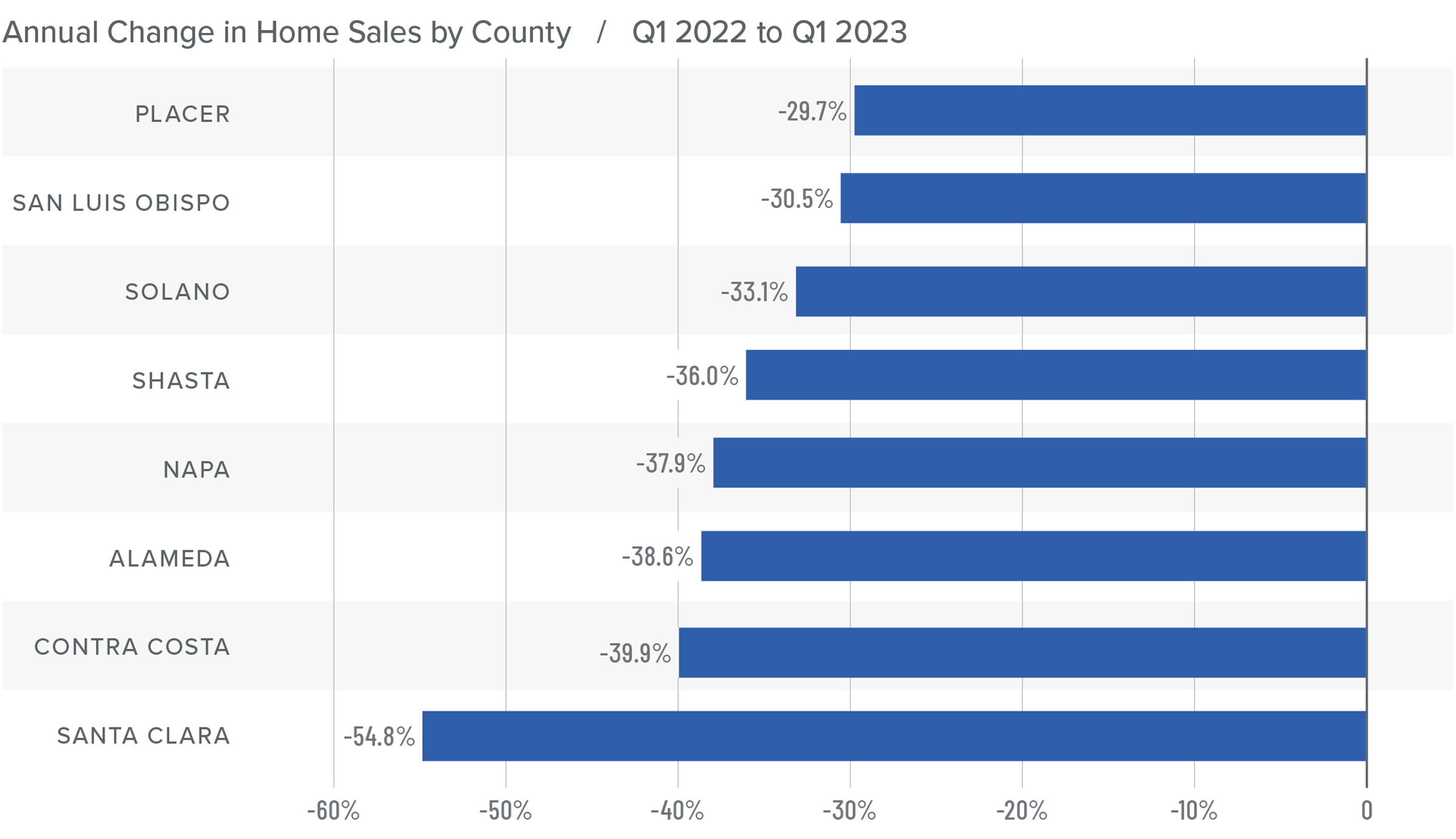
A bar graph showing the annual change in home sales for various counties in Southern California from Q1 2022 to Q1 2023. All counties have a negative percentage year-over-year change. Here are the totals: San Diego at -31.5%, Orange at -32.7%, Los Angeles -34.9%, Riverside -35.4%, and San Bernardino -39.5%.

Southern California Home Prices

Compared to the same period last year, home prices fell 2.5%. However, prices were 1.9% higher than in the fourth quarter of 2022.

Affordability remains a significant issue, which has been exacerbated by elevated financing costs. That said, median listing prices in the quarter are up in every market other than San Bernardino, which suggests that home sellers may be starting to think that the worst of the price correction is behind them.

Year over year, prices fell across the region but rose in all markets compared to the final quarter of 2022. Of note is that price growth was very solid in San Diego, Riverside, and Orange counties.

While I expect mortgage rates to start stabilizing as we move toward summer, I think there will be some additional downward pressure on home prices. That said, things should start to turn around again in the second half of the year with a return to rising home prices.

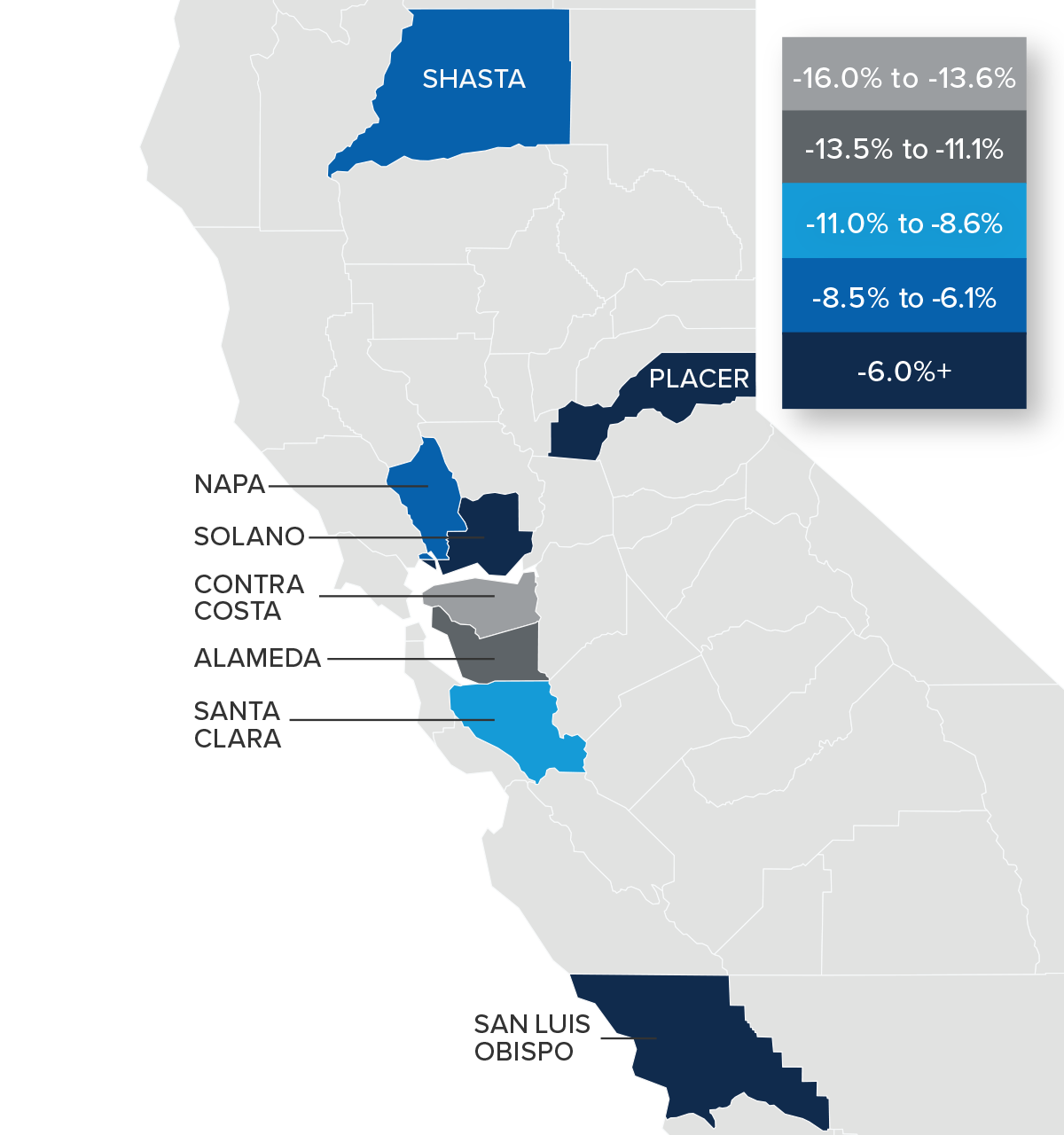
A map showing the real estate home prices percentage changes for various counties in Southern California. Different colors correspond to different tiers of percentage change. Orange County has a percentage change in the -6% to -5.1% range, Riverside is in the -5% to -4.1% change range, San Diego in the -4% to -3.1% change range, and Los Angeles and San Bernardino are in the 2%+ change range.

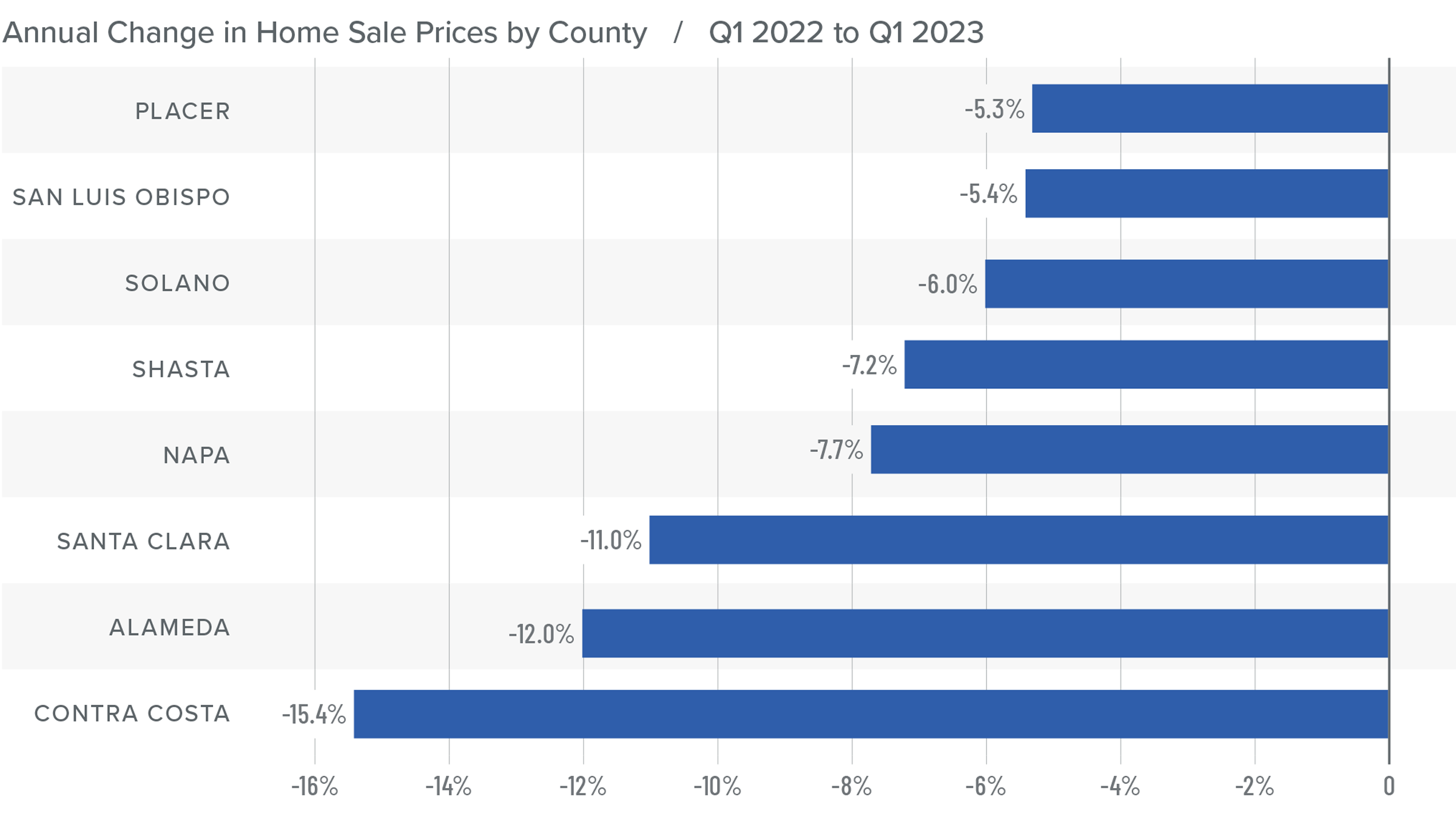
A bar graph showing the annual change in home sale prices for various counties in Southern California from Q1 2022 to Q1 2023. All counties have a negative percentage year-over-year change. Here are the totals: San Bernardino at -0.9%, Los Angeles at -1.6%, San Diego -3.5%, Riverside -5%, and Orange -5.7%.

Mortgage Rates

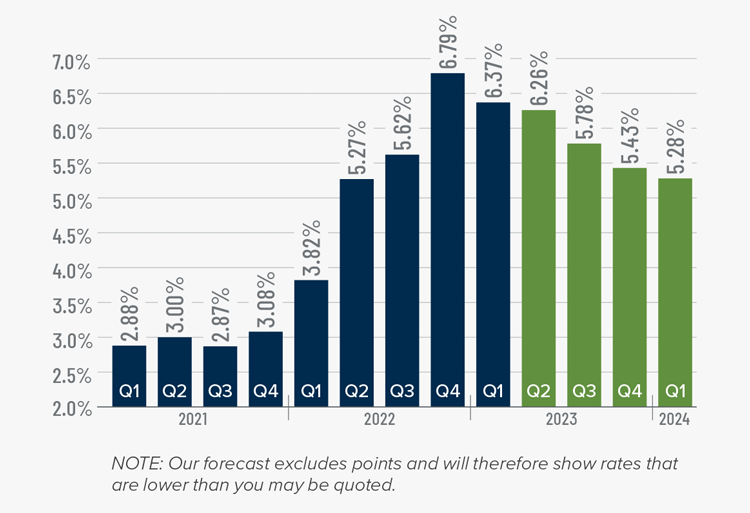
Rates in the first quarter of 2023 were far less volatile than last year, even with the brief but significant impact of early March’s banking crisis. It appears that buyers are jumping in when rates dip, which was the case in mid-January and again in early February.

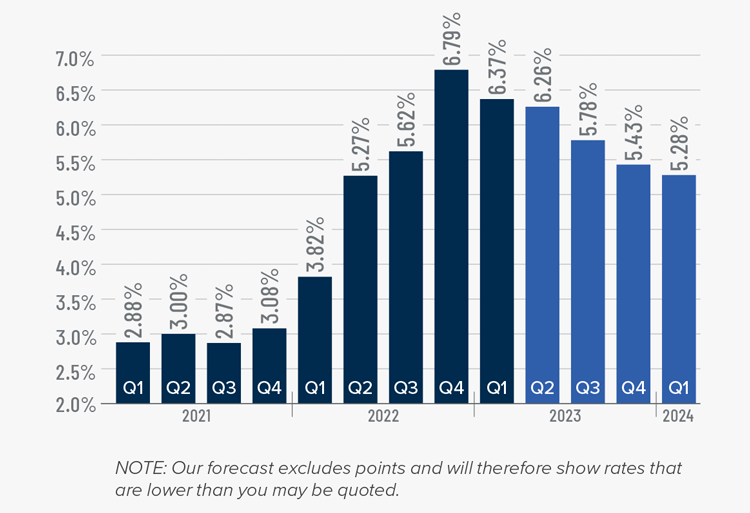
Even with the March Consumer Price Index report showing inflation slowing, I still expect the Federal Reserve to raise short-term rates one more time following their May meeting before pausing rate increases. This should be the catalyst that allows mortgage rates to start trending lower at a more consistent pace than we have seen so far this year. My current forecast is that rates will continue to move lower with occasional spikes, and that they will hold below 6% in the second half of this year.

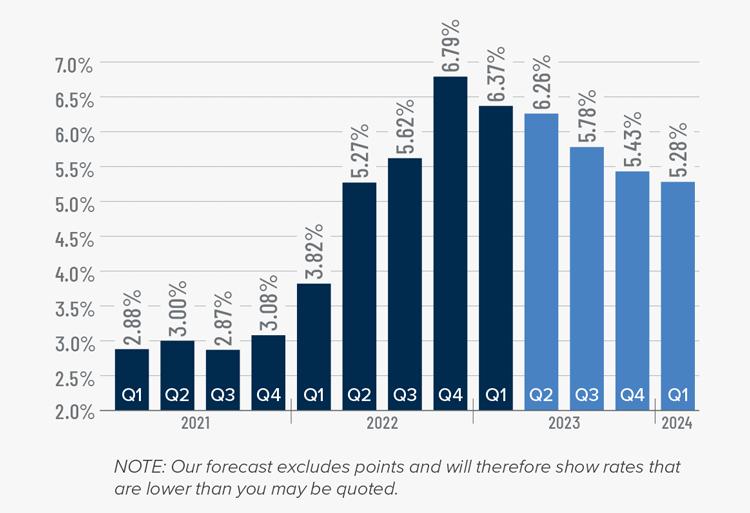
A bar graph showing the mortgage rates from Q1 2021 to the present, as well as Matthew Gardner's forecasted mortgage rates through Q1 2024. After the 6.79% figure in Q4 2022 and 6.37% in Q1 2023, he forecasts mortgage rates dipping to 6.26% in Q2 2023, 5.78% in Q3 2023, 5.43% in Q4 2023, and 5.28% in Q1 2024.

Southern California Days on Market

In the first quarter of 2023, the average time it took to sell a home in the region was 45 days, which is 24 more than in the first quarter of 2022 and 9 more days than in the fourth quarter of last year.

Market time also rose in all counties covered by this report compared to the fourth quarter of 2022.

Homes in San Diego County continue to sell at a faster rate than other markets in the region, but all counties saw market time increase from a year ago.

Higher mortgage rates and lower affordability still have some buyers sidelined. I expect to see increased activity once buyers become confident that mortgage rates have stabilized and that housing values have found a bottom.

A bar graph showing the average days on market for homes in various counties in Southern California for Q1 2023. San Diego County has the lowest DOM at 34, followed by Orange at 42, Los Angeles at 43, and San Bernardino and Riverside at 54.

Conclusions

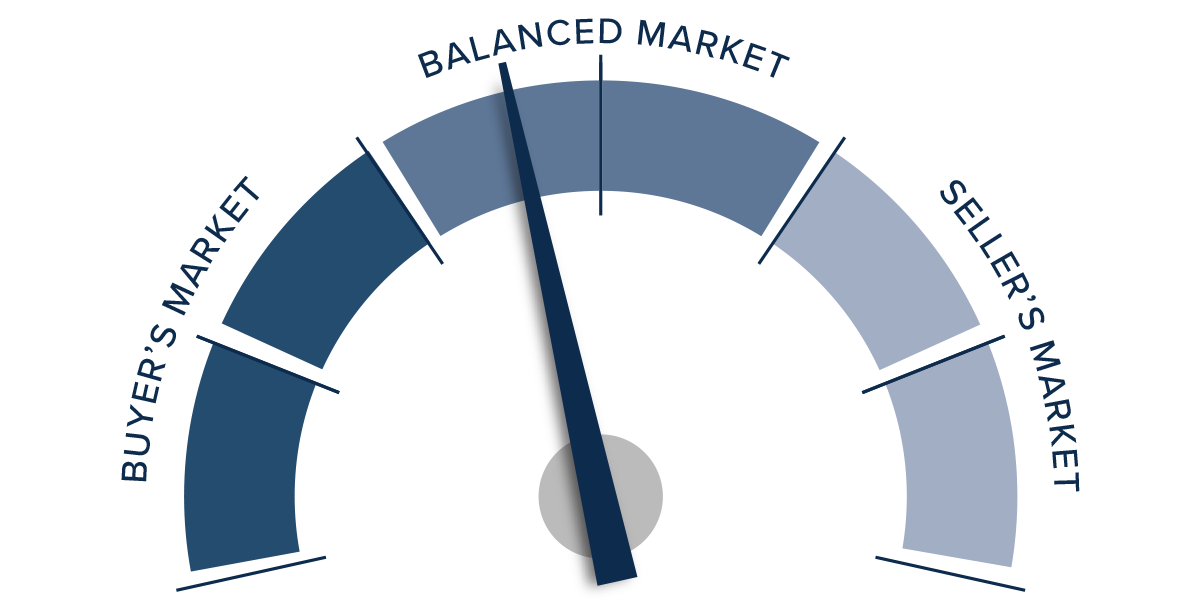
This speedometer reflects the state of the region’s real estate market using housing inventory, price gains, home sales, interest rates, and larger economic factors.

The Southern California housing market is still trying to find its footing. Mortgage rates are not only still at elevated levels, but they are also moving erratically depending on events in the broader economy (e.g. inflation, bank failures, etc.) Although sellers seem to be more confident, buyers are remaining cautious, which suggests that the market recovery will take more time.

A speedometer graph indicating a balanced market in Southern California in Q1 2023.

Lower inventory levels, higher pending sales, higher listing and sale prices, and an improving absorption rate all favor sellers. However, the market is not completely in their favor. As such, I have left the needle in the “balanced” section of the speedometer. I have tilted it slightly toward home sellers though as there continues to be strong demand for appropriately priced, well-located, and well-appointed homes.

About Matthew Gardner

Matthew Gardner - Chief Economist for Windermere Real Estate

As Chief Economist for Windermere Real Estate, Matthew Gardner is responsible for analyzing and interpreting economic data and its impact on the real estate market on both a local and national level. Matthew has over 30 years of professional experience both in the U.S. and U.K.

In addition to his day-to-day responsibilities, Matthew sits on the Washington State Governors Council of Economic Advisors; chairs the Board of Trustees at the Washington Center for Real Estate Research at the University of Washington; and is an Advisory Board Member at the Runstad Center for Real Estate Studies at the University of Washington where he also lectures in real estate economics.


Market News April 28, 2023

Q1 2023 Central and Southern Oregon Real Estate Market Update

The following analysis of select counties of the Central and Southern Oregon real estate market is provided by Windermere Real Estate Chief Economist Matthew Gardner. We hope that this information may assist you with making better-informed real estate decisions. For further information about the housing market in your area, please don’t hesitate to contact your Windermere Real Estate agent.


Regional Economic Overview

The Central and Southern Oregon counties covered by this report continue to add jobs at a decent pace. Employment levels are now 3,860 higher than before the pandemic. The Medford metro area continues to lag, but the area is short by just 760 jobs. The only other county that has not recovered all the jobs lost due to COVID is Jefferson County, though it is only short by 20 jobs. The unemployment rate across the region was 5.3%. This is up from 4.5% in the first quarter of 2022, as the number of unemployed people has been rising. By county, the lowest jobless rate was in Bend (4.4%) and the highest was in Klamath County, where 6.6% of the labor force is still without a job.

Central and Southern Oregon Home Sales

In the first quarter of 2023, 1,344 homes sold, representing a drop of 44% compared to the same period in 2022. Sales were 24.1% lower than in the fourth quarter of last year.

Compared to the fourth quarter of 2022, sales fell in all counties except Crook County, where sales rose 8.3%.

Sales fell across the board compared to the first quarter of 2022, with significant declines in all markets.

Declining sales can mostly be attributed to lower inventory levels, uncertainty regarding the direction of mortgage rates, and lower affordability.

A bar graph showing the annual change in home sales for various counties in Central and Southern Oregon from Q1 2022 to Q1 2023. All counties have a negative percentage year-over-year change. Here are the totals: Crook at -32.3%, Josephine at -34.9%, Deschutes -42.9%, Jackson -47.2%, Klamath -48.2%, and Jefferson -60.3%.

Central and Southern Oregon Home Prices

The average home price in the region fell 5% year over year to $549,850. Prices were down .3% compared to the fourth quarter of 2022.

Compared to the final quarter of 2022, home prices rose in Crook and Jackson counties, but fell in the rest of the market areas.

Home prices rose in three counties year over year, while they fell in three. The Bend market area experienced a significant decline.

Median listing prices rose in Crook, Deschutes, Jackson, and Klamath counties, but fell in the other two counties compared to the fourth quarter of 2022. It appears the overall market has not found equilibrium yet.

A map showing the real estate home prices percentage changes for various counties in Central and Southern Oregon. Different colors correspond to different tiers of percentage change. Deschutes and Josephine Counties have a percentage change in the -10% to -4.6% range, Jackson is in the -4.5% to -0.9% change range, Klamath and Jefferson are in the 1% to 6.4% change range, and Crook County is in the 12%+ change range.

A bar graph showing the annual change in home sale prices for various counties in Central and Southern Oregon from Q1 2022 to Q1 2023. Crook County tops the list at 17%, followed by Klamath at 5.2%, Jefferson at 1.1%, Jackson at -2.3%, Josephine at -8.2%, and Deschutes at -10%.

Mortgage Rates

Rates in the first quarter of 2023 were far less volatile than last year, even with the brief but significant impact of early March’s banking crisis. It appears that buyers are jumping in when rates dip, which was the case in mid-January and again in early February.

Even with the March Consumer Price Index report showing inflation slowing, I still expect the Federal Reserve to raise short-term rates one more time following their May meeting before pausing rate increases. This should be the catalyst that allows mortgage rates to start trending lower at a more consistent pace than we have seen so far this year. My current forecast is that rates will continue to move lower with occasional spikes, and that they will hold below 6% in the second half of this year.

A bar graph showing the mortgage rates from Q1 2021 to the present, as well as Matthew Gardner's forecasted mortgage rates through Q1 2024. After the 6.79% figure in Q4 2022 and 6.37% in Q1 2023, he forecasts mortgage rates dipping to 6.26% in Q2 2023, 5.78% in Q3 2023, 5.43% in Q4 2023, and 5.28% in Q1 2024.

Central and Southern Oregon Days on Market

The average time it took to sell a home in the region rose 29 days compared to the same quarter in 2022. It took 17 more days for a home to go under contract compared to the final quarter of 2022.

The average time it took to sell a home in the first quarter of 2023 was 69 days.

Market time rose in all counties compared to the first quarter of 2022. It took more time for homes to sell in all counties other than Jefferson compared to the fourth quarter of 2022.

Buyers are being far more selective and continue to take their time making an offer on a home.

A bar graph showing the average days on market for homes in various counties in Central and Southern Oregon for Q1 2023. Deschutes County has the lowest DOM at 57, followed by Jefferson and Jackson at 61, Klamath at 62, Crook at 84, and Josephine at 90.

Conclusions

This speedometer reflects the state of the region’s real estate market using housing inventory, price gains, home sales, interest rates, and larger economic factors.

Lower sales, longer market time, and lower listing and home sale prices tell me that buyers currently have the upper hand. As such, sellers have had to adjust to market conditions they haven’t seen in several years. That said, prices have pulled back a fair amount over the past two quarters. If mortgage rates approach the 6% level in the late spring/early summer months, it’s quite possible that the housing market will stabilize and home prices will start to rise again.

A speedometer graph indicating a buyer's market, leaning toward a balanced market in Central and Southern Oregon in Q1 2023.

Given all the data contained in this report, I have decided that the market now favors home buyers. However, as I mention above, if stability is found, the needle will certainly move back toward sellers.

About Matthew Gardner

Matthew Gardner - Chief Economist for Windermere Real Estate

As Chief Economist for Windermere Real Estate, Matthew Gardner is responsible for analyzing and interpreting economic data and its impact on the real estate market on both a local and national level. Matthew has over 30 years of professional experience both in the U.S. and U.K.

In addition to his day-to-day responsibilities, Matthew sits on the Washington State Governors Council of Economic Advisors; chairs the Board of Trustees at the Washington Center for Real Estate Research at the University of Washington; and is an Advisory Board Member at the Runstad Center for Real Estate Studies at the University of Washington where he also lectures in real estate economics.

Market News April 28, 2023

Q1 2023 Northwest Oregon and Southwest Washington Real Estate Market Update

The following analysis of select counties of the Northwest Oregon and Southwest Washington real estate market is provided by Windermere Real Estate Chief Economist Matthew Gardner. We hope that this information may assist you with making better-informed real estate decisions. For further information about the housing market in your area, please don’t hesitate to contact your Windermere Real Estate agent.


Regional Economic Overview

Employment in the Oregon counties covered by this report continues to expand, though the pace of growth has started to slow. As it stands, employment levels are still down by 23,600 from the 2020 pre-COVID peak, with Multnomah County accounting for almost 22,000 of the jobs that have yet to return. That said, the unemployment rate in the region was a respectable 4.2%, matching the level we saw at the same time last year. Unfortunately, the jobless rate is low because of a declining workforce, not from employment growth. In Southwest Washington, the pace of job gains is also slowing. However, the area has recovered all the jobs lost during the pandemic and added almost 17,000 more. Unemployment was 5.9%—a level we have not seen since early 2021—as the labor force has been growing at quite a rapid rate.

Northwest Oregon and Southwest Washington Home Sales

In the first quarter of 2023, 6,751 homes sold, which was a drop of 34.7% from the same period in 2022 and down 18.8% from the fourth quarter of 2022.

I believe the biggest issue is supply. The spring market appears to not only have come late (starting in March) but has also been far less robust than normal.

Sales fell across the board compared to both the first quarter of 2022 and the final quarter of 2022.

Though the lack of inventory cannot be attributed to just one factor, it could be because homeowners do not want to lose the historically low interest rate on their current mortgage. If this is the case, the market may be supply-starved for quite some time.

A bar graph showing the annual change in home sales for various counties in Northwest Oregon and Southwest Washington from Q1 2022 to Q1 2023. All counties have a negative percentage year-over-year change. Here are the totals: Skamania at -4.3%, Klickitat at -10.2%, Linn -24.5%, Cowlitz -25.4%, Polk -26.1%, Wasco -29.4%, Lincoln -29.7%, Lane -30.1%, Hood River -32.1%, Columbia -32.3%, Washington -32.6%, Marion -34.1%, Clatsop -34.3%, Benton -35.4%, Multnomah -36.5%, Clark -38.5%, Clackamas -38.7%, and Yamhill -42%.

Northwest Oregon and Southwest Washington Home Prices

The average home sale price in the region fell 5.2% year over year and was down 3.1% compared to the fourth quarter of 2022.

Compared to the final quarter of 2022, home prices fell in nine counties but rose in the other nine. Hood River and Skamania counties had double-digit price growth over the prior quarter, but these are very small markets and are prone to significant swings.

All but seven counties saw average home prices fall compared to a year ago. In the markets where prices rose, the pace of growth was generally slower than has been the case for a number of years.

Half of the counties in this report saw listing prices rise, while the other half saw them fall. This is a little counterintuitive given the lack of inventory, but it may be that prices in some markets simply rose too much in recent years and that affordability is still a hindrance.

A map showing the real estate home prices percentage changes for various counties in Northwest Oregon and Southwest Washington. Different colors correspond to different tiers of percentage change. Columbia County has a percentage change in the -16% to -11.5% range, Clackamas and Multnomah counties are in the -11.4% to -6.9% change range, Cowlitz, Clark, Wasco, Washington, and Lane are in the -6.8% to -2.3% change range, and Marion, Skamania, Hood River, and Klickitat counties are in the 2.4%+ change range.

A bar graph showing the annual change in home sale prices for various counties in Northwest Oregon and Southwest Washington from Q1 2022 to Q1 2023. Skamania County tops the list at 38.2%, followed by Klickitat at 7.3%, Marion at 4.6%, Hood River at 4.5%, Benton at 1.5%, Yamhill at 1.1%, Clatsop at 0.8%, Linn at -1.3%, Lincoln at -1.8%, Polk at -2.1%, Lane at -2.5%, Cowlitz at -3%, Clark at -3.5%, Washington at -3.8%, Wasco at -5.1%, Multnomah at -7.4%, Clackamas at -9.6%, and finally Columbia at -15.8%.

Mortgage Rates

Rates in the first quarter of 2023 were far less volatile than last year, even with the brief but significant impact of early March’s banking crisis. It appears that buyers are jumping in when rates dip, which was the case in mid-January and again in early February.

Even with the March Consumer Price Index report showing inflation slowing, I still expect the Federal Reserve to raise short-term rates one more time following their May meeting before pausing rate increases. This should be the catalyst that allows mortgage rates to start trending lower at a more consistent pace than we have seen so far this year. My current forecast is that rates will continue to move lower with occasional spikes, and that they will hold below 6% in the second half of this year.

A bar graph showing the mortgage rates from Q1 2021 to the present, as well as Matthew Gardner's forecasted mortgage rates through Q1 2024. After the 6.79% figure in Q4 2022 and 6.37% in Q1 2023, he forecasts mortgage rates dipping to 6.26% in Q2 2023, 5.78% in Q3 2023, 5.43% in Q4 2023, and 5.28% in Q1 2024.

Northwest Oregon and Southwest Washington Days on Market

The average time it took to sell a home in the region rose 22 days compared to the same period in 2022. It took 14 more days for a home to go under contract compared to the final quarter of 2022.

The average time it took to sell a home in the first quarter of 2023 was 70 days.

With the exception of Benton, all of the counties in this report saw the length of time it took for a home to go under contract rise compared to the first quarter of 2022. Compared to the fourth quarter of 2022, market time fell in Benton, Clatsop, and Lincoln counties.

Unlike the fourth quarter of 2022, when longer market time suggested that additional supply was giving buyers more choices, it’s likely that uncertainty about the housing market held some buyers back in the first quarter of 2023.

A bar graph showing the average days on market for homes in various counties in Northwest Oregon and Southwest Washington for Q1 2023. Washington County has the lowest DOM at 40, followed by Lane at 45, Clark at 46, Clackamas at 47, Yamhill at 49, Multnomah at 51, Skamania at 54, Cowlitz at 58, Hood River at 61, Columbia at 66, Wasco at 79, Lincoln at 85, Benton at 92, Marion at 93, Clatsop at 94, Linn at 96, Klickitat at 98, and Polk at 104.

Conclusions

This speedometer reflects the state of the region’s real estate market using housing inventory, price gains, home sales, interest rates, and larger economic factors.

Mortgage rates in the first quarter were lower than at the end of 2022, which generally favors buyers. Additionally, falling listing and home sale prices are also creating favorable conditions for buyers. The data suggests that buyers have a slight advantage in many, but not all, markets in the region.

A speedometer graph indicating a buyer's market, leaning toward a balanced market in Northwest Oregon and Southwest Washington in Q1 2023.

As a result, for the first time in over a decade, I am giving them a slight advantage over home sellers. That said, I can easily see it returning more toward sellers as we approach the summer. Only time will tell.

About Matthew Gardner

Matthew Gardner - Chief Economist for Windermere Real Estate

As Chief Economist for Windermere Real Estate, Matthew Gardner is responsible for analyzing and interpreting economic data and its impact on the real estate market on both a local and national level. Matthew has over 30 years of professional experience both in the U.S. and U.K.

In addition to his day-to-day responsibilities, Matthew sits on the Washington State Governors Council of Economic Advisors; chairs the Board of Trustees at the Washington Center for Real Estate Research at the University of Washington; and is an Advisory Board Member at the Runstad Center for Real Estate Studies at the University of Washington where he also lectures in real estate economics.

Market News April 27, 2023

Q1 2023 Western Washington Real Estate Market Update

The following analysis of select counties of the Western Washington real estate market is provided by Windermere Real Estate Chief Economist Matthew Gardner. We hope that this information may assist you with making better-informed real estate decisions. For further information about the housing market in your area, please don’t hesitate to contact your Windermere Real Estate agent.


Regional Economic Overview

The pace of employment growth in Western Washington continues to slow. The region added only 90,340 new jobs over the past 12 months. That said, the annual pace of employment growth was a respectable 3.6%. Three counties have not recovered completely from their pandemic job losses: Whatcom, Skagit, and Snohomish. However they are short by just under 10,000 jobs, which should be recovered by this fall. Regionally, the unemployment rate in February was 4.1%, which was marginally above the 3.8% level of a year ago. The employment outlook has improved modestly, with the likelihood of a recession in 2023 down to about 50%. That said, I expect the pace of job growth to continue to slow as businesses remain concerned about a contraction in consumer spending, as well as facing tighter credit conditions following recent bank failures.

Western Washington Home Sales

In the first quarter of the year, 10,335 homes sold. This was down 30.9% from the same period in 2022 and 18.9% lower than in the fourth quarter of 2022.

Lower sales activity was more a function of the limited number of homes for sale than anything else. Listing activity in the first quarter of 2023 was down 43% from the final quarter of 2022.

Home sales fell across the board compared to the same quarter of last year and were lower in every county compared to the final quarter of 2022.

Pending sales rose in all but three counties compared to the fourth quarter of 2022. This suggests that sales in the second quarter of the year may tick higher. That said, the region is in dire need of more inventory.

A bar graph showing the annual change in home sales for various counties in Western Washington from Q1 2022 to Q1 2023. All counties have a negative percentage year-over-year change. Here are the totals: San Juan at -7.8%, Island at -21.9%, Skagit -23.6%, Kitsap -26.6%, Mason -28.2%, Lewis -29.3%, Pierce -29.7%, King -31.7%, Whatcom -32%, Snohomish -32.4%, Clallam and Grays Harbor -32.7%, Thurston -36%, and Jefferson -36.9%.

Western Washington Home Prices

Home prices fell an average of 6.9% compared to the first quarter of 2022 and were 1.3% lower than in the fourth quarter of 2022. The average home sale price in the first quarter of 2023 was $692,866.

Compared to the fourth quarter of 2022, prices were higher in Kitsap, Skagit, Lewis, San Juan, and Whatcom counties.

Even though prices fell in the region, five counties saw sale prices rise very modestly from the first quarter of 2023.

It’s worth noting that median listing prices rose in all but two markets compared to the previous quarter. This suggests that sellers are getting a little more comfortable with the market. If listing prices continue to rise, one can surmise that home prices will follow suit.

A map showing the real estate home prices percentage changes for various counties in Western Washington. Different colors correspond to different tiers of percentage change. Grays Harbor and Snohomish Counties have a percentage change in the -12.7% to -9.5% range, Clallam, Jefferson, Island, and King counties are in the -9.4% to -6.2% change range, Whatcom, Mason, Thurston, and Pierce are in the -2.8% to 0.4% change range, and Lewis, San Juan, and Skagit counties are in the 0.5%+ change range.

A bar graph showing the annual change in home sale prices for various counties in Western Washington from Q1 2022 to Q1 2023. San Juan County tops the list at 1.2%, followed by Skagit and Lewis at 1.1%, Kitsap at 0.5%, Whatcom at 0.4%, Thurston at 1.1%, Pierce at -2.3%, Mason at -2.4%, Clallam at -7.3%, Island at -8.4%, King at -8.6%, Jefferson at -9%, Grays Harbor at -10.1%, and finally Snohomish at -12.7%.

Mortgage Rates

Rates in the first quarter of 2023 were far less volatile than last year, even with the brief but significant impact of early March’s banking crisis. It appears that buyers are jumping in when rates dip, which was the case in mid-January and again in early February.

Even with the March Consumer Price Index report showing inflation slowing, I still expect the Federal Reserve to raise short-term rates one more time following their May meeting before pausing rate increases. This should be the catalyst that allows mortgage rates to start trending lower at a more consistent pace than we have seen so far this year. My current forecast is that rates will continue to move lower with occasional spikes, and that they will hold below 6% in the second half of this year.

A bar graph showing the mortgage rates from Q1 2021 to the present, as well as Matthew Gardner's forecasted mortgage rates through Q1 2024. After the 6.79% figure in Q4 2022 and 6.37% in Q1 2023, he forecasts mortgage rates dipping to 6.26% in Q2 2023, 5.78% in Q3 2023, 5.43% in Q4 2023, and 5.28% in Q1 2024.

Western Washington Days on Market

It took an average of 56 days for a home to sell in the first quarter of this year. This was 32 more days than in the same quarter of 2022 and 16 days more than in the fourth quarter of last year.

King County remains the tightest market in Western Washington, with homes taking an average of 41 days to sell. Homes in San Juan County took the longest time to sell.

Market time rose in all counties contained in this report compared to the same period in 2022 and compared to the fourth quarter.

The greatest increase in market time compared to a year ago was in Grays Harbor County, where it took an average of 41 more days for homes to sell. Grays Harbor County also saw the greatest increase in market time compared to the final quarter of 2022 (from 46 to 76 days).

A bar graph showing the average days on market for homes in various counties in Western Washington for Q1 2023. King County has the lowest DOM at 41, followed by Snohomish at 42, Kitsap at 46, Pierce and Island at 49, Thurston at 50, Jefferson and Skagit at 51, Whatcom at 54, Mason at 57, Clallam at 66, Lewis at 68, Grays Harbor at 76, and San Juan at 89.

Conclusions

This speedometer reflects the state of the region’s real estate market using housing inventory, price gains, home sales, interest rates, and larger economic factors.

Although the regional economy is still expanding, it continues to show signs of slowing. With the probability of a national recession this year now fifty-fifty, I do not see any reason for buyers to lose confidence in their housing decisions based purely on economic factors. Sellers appear to be a little more confident in the market as demonstrated by rising listing prices. Periods of lower mortgage rates and the lack of homes for sale are both likely contributors to this. Whatever the case may be, I am not seeing any signs of panic in the market.

A speedometer graph indicating a balanced market, leaning toward a seller's market in Western Washington in Q1 2023.

Even in the face of higher financing costs, low inventory levels support home values, and the data suggests that the worst of the price declines are now behind us. The region had fewer sales, modestly lower prices, and higher average days on market, all of which favor home buyers. However, lower inventory levels, higher pending sales, higher listing prices, and a higher absorption rate of homes that are for sale favor sellers. As such, I am moving the needle towards a balanced market, but one that ever so slightly favors sellers.

About Matthew Gardner

Matthew Gardner - Chief Economist for Windermere Real Estate

As Chief Economist for Windermere Real Estate, Matthew Gardner is responsible for analyzing and interpreting economic data and its impact on the real estate market on both a local and national level. Matthew has over 30 years of professional experience both in the U.S. and U.K.

In addition to his day-to-day responsibilities, Matthew sits on the Washington State Governors Council of Economic Advisors; chairs the Board of Trustees at the Washington Center for Real Estate Research at the University of Washington; and is an Advisory Board Member at the Runstad Center for Real Estate Studies at the University of Washington where he also lectures in real estate economics.

Buying April 26, 2023

Buying a Fixer-Upper

For some home buyers, a fixer-upper is their idea of a dream home. However, the process of buying a fixer-upper comes with additional responsibilities compared to properties in better condition or new construction homes. Preparing for the process comes down to creating a remodeling plan, knowing what to look for when searching for listings, and understanding what financing options are available.

Planning for a Fixer-Upper

Fixer-uppers require a future-oriented mindset. Knowing the magnitude of the projects you and your household are willing to take on will help to form your budget and your expectations as time goes on. With some basic cost analysis for any given project, you’ll have to decide whether it’s worth it to buy the materials yourself and do it DIY or hire a professional. When testing the waters for professional remodeling, get specific quotes so you can compare costs between contractors. Understand that in addition to the down payment and closing fees, the costs involved in a fixer-upper purchase have the potential to go over-budget easily. Familiarize yourself with permitting in your area to understand how to navigate any legal roadblocks in the renovation process and to better assess your timeline for your home improvement projects. 

Searching For a Fixer-Upper

  • Location: Whether you are purchasing a fixer-upper with plans to sell it, rent it out, or live in it, consider its location before purchasing. If you’re planning on selling or renting, location is one of the most important factors in making a return on your investment. And if you’re planning to live in your fixer-upper, keep in mind that location will be a large part of your experience in the home. If you’re looking to sell eventually, talk to your agent to identify high ROI remodeling projects that will pique buyer interest in your area.
  • Scope of Renovation: If you are looking for a smaller scale renovation, look for listings that require cosmetic projects like new interior and exterior paint, fresh carpeting and flooring, appliance upgrades, and basic landscaping maintenance. More expensive and involved projects include re-roofing, replacing plumbing and sewer lines, replacing HVAC systems, and full-scale room remodels.
  • Inspections: Beyond a standard home inspection, which covers components of the home like its plumbing and foundation, consider specialized inspections for pests, roof certifications, and engineering reports. This will help differentiate between the property’s minor flaws and critical problems, further informing your decision when it comes time to prepare an offer.


The interior of a fixer-upper house with ripped out kitchen cabinets, drywall, and flooring. The kitchen is being completely gutted and remodeled.

Image Source: Getty Images – Image Credit: Lisa5201

Financing Options

You’ll be looking at different types of mortgages when buying a fixer-upper, but keep in mind that renovation loans specifically allow buyers to finance the home and the improvements to the property together. Extra consultations, inspections, and appraisals are often required in the loan process, but they help guide the work and resulting home value. Talk with your lender about which option is best for you.

  • FHA 203(k): The Federal Housing Administration’s (FHA) 203(k) loans can be used for most projects in the process of fixing up a home. In comparison to conventional mortgages, they may accept lower incomes and credit scores for qualified borrowers. 
  • VA renovation loan: With this loan, the home improvement costs are combined into the loan amount for the home purchase. Contractors employed in any renovations must be VA-approved and appraisers involved in the appraisal process must be VA-certified.
  • HomeStyle Loan – Fannie Mae: The HomeStyle Renovation Loan can be used by buyers purchasing a fixer-upper, or by homeowners refinancing their homes to cover the improvements. This loan also allows for luxury projects, such as pools and landscaping.
  • CHOICERenovation Loan – Freddie Mac: This renovation mortgage is guaranteed through Freddie Mac, allowing projects that bolster a home’s ability to withstand natural disasters or repair damage caused by a past disaster. 

If you’re interested in buying a fixer-upper, connect with a local Windermere agent to help you understand the process and to discuss what makes the most sense for you.


­­­­­­Featured Image Source: Shutterstock – Image Credit: K.M. Williamson

Market News April 24, 2023

Mortgage Rate Predictions and Misconceptions

The Federal Reserve Bank of New York just released their 2023 Housing Survey, which shows how the U.S. population feels about the housing market. Windermere Chief Economist Matthew Gardner digs into the mortgage rate predictions, showing how demographics played a role in the results.

This video on mortgage rate predictions is the latest in our Monday with Matthew series with Windermere Chief Economist Matthew Gardner. Each month, he analyzes the most up-to-date U.S. housing data to keep you well-informed about what’s going on in the real estate market.


Mortgage Rate Predictions

Hello there! I’m Windermere Real Estate’s Chief Economist Matthew Gardner. This month we’re going to take a look at the latest SCE Housing Survey, which gives us a really detailed look at consumers’ psyche in regard to the housing market.

I’ve always been fascinated by surveys, as they frequently give me insights that I simply don’t get from just looking at raw data and, as luck would have it, the New York Fed just released its 2023 Consumer Expectations Housing Survey. Now, this particular survey has always given me some great and often surprising insights as to how the U.S. population views the overall housing market. We certainly don’t have time to cover all of the questions that the survey poses, but there was one section I wanted to share with you today as it really resonated with me, and it relates to mortgage rates.

Will mortgage rates continue to rise?

A double line graph showing mortgage rate predictions. Specifically, it shows the average interest rates for 30-year fixed-rate mortgages from 2014 to 2023 and ends with the predicted values by U.S. households as captured in the Federal Reserve Bank of New York in their 2023 Housing Survey. People think the rate will be 8.8% three years from now and 8.4% one year from now.


The first question asked was where they expected mortgage rates to be one year from now. And as you see here that, on average, households expected rates to rise all the way up to 8.4%. Although some may see this as extreme, you can see that in the 2022 survey respondents predicted rates would hit 6.7%, almost exactly where they were at the beginning of this March.

And when asked where they thought rates would be three years from now, on average, households expected to see them climb to 8.8%. Now, that’s a rate we haven’t seen since early 1995!

Well, I’m not sure about you, but I was very surprised by these results as they counter just about every analyst’s expectation regarding where rates will be over the next few years. In fact, myself and every economist I know believes that rates will slowly pull back as we move through this year. I haven’t seen a single forecast suggesting that mortgage rates will rise to a level this country hasn’t seen in decades.

But as they say, the devil’s in the details. When I dug deeper into the numbers, it became very clear to me that demographics played a pretty big part in guiding people’s answers. Let me explain.

1-Year Mortgage Rate Expectations by Education

A double line graph showing mortgage rate predictions. Specifically, it shows the average interest rates for 30-year fixed-rate mortgages from 2014 to 2023 and ends with the predicted values by U.S. households separated by educational level completed as captured in the Federal Reserve Bank of New York in their 2023 Housing Survey. In the light blue line, respondents with a GED or less think the rate will be 9.4% in one year. In the dark blue line, respondents with a Bachelors degree think the rate will be 6.7% one year from now.


Here the data is broken down by educational achievement. You can see that survey respondents who didn’t have a college degree thought that mortgage rates would rise to 9.4% within a year. But college graduates were far more optimistic, and they expected rates to be in the high 6’s.

3-Year Mortgage Rate Expectations by Education

A double line graph showing mortgage rate predictions. Specifically, it shows the average interest rates for 30-year fixed-rate mortgages from 2014 to 2023 and ends with the predicted values by U.S. households separated by educational level completed as captured in the Federal Reserve Bank of New York in their 2023 Housing Survey. In the light blue line, respondents with a GED or less think the rate will be 10.1% in three years. In the dark blue line, respondents with a Bachelors degree think the rate will be 6.4% three years from now.


And when asked to look three years out, respondents without degrees expected rates to break above 10%. While college graduates saw them pulling back a little from their one-year expectations of 6.7%, down to 6.4%.

Now we are going to look at the survey results broken down by housing tenure.

1-Year Mortgage Rate Expectations by Tenure

A double line graph showing mortgage rate predictions. Specifically, it shows the average interest rates for 30-year fixed-rate mortgages from 2014 to 2023 and ends with the predicted values by U.S. households separated by housing status as captured in the Federal Reserve Bank of New York in their 2023 Housing Survey. In the light blue line, renter household respondents think the rate will be 10.9% in one year. In the dark blue line, homeowner household respondents think the rate will be 7.3% one year from now.


And here you see that renters expect mortgage rates to be at almost 11% within a year. And homeowners also saw them rising, but only up to 7.3%. 

3-Year Mortgage Rate Expectations by Tenure

A double line graph showing mortgage rate predictions. Specifically, it shows the average interest rates for 30-year fixed-rate mortgages from 2014 to 2023 and ends with the predicted values by U.S. households separated by housing status as captured in the Federal Reserve Bank of New York in their 2023 Housing Survey. In the light blue line, renter household respondents think the rate will be 12.1% in three years. In the dark blue line, homeowner household respondents think the rate will be 7.4% three years from now.


And over the next three years, renters expected rates to break above 12%. That’s a level not seen since the fall of 1985. But homeowners expected to see rates at a somewhat more modest 7.4%.

So, what does this tell us? I see two things.

Firstly, the rapid increase in mortgage rates that we all saw starting in early 2022 has a lot of people believing that we will see rates continuing to rise, sometimes at a very fast pace, over the next few years. I mean, if it happened before, why can’t it happen again? And this mindset leads me to my second point, which is that it’s very clear that a lot of would-be home buyers just don’t understand how mortgage rates are calculated.

The bottom line here is that I see a potential buyer pool out there that needs educating and that can give an opportunity to brokers to discuss how rates are set and where the market is expecting to see them going forward.

This may alleviate the concerns that many households have who may be thinking that they will never be able to afford to buy a home because of where they expect borrowing costs to be in the future. Education is everything, don’t you agree?

As always, I’d love to get your thoughts on this topic so please comment below! Until next month, take care and I will see you all soon. Bye now.

To see the latest housing data for your area, visit our quarterly Market Updates page.


About Matthew Gardner

As Chief Economist for Windermere Real Estate, Matthew Gardner is responsible for analyzing and interpreting economic data and its impact on the real estate market on both a local and national level. Matthew has over 30 years of professional experience both in the U.S. and U.K.

In addition to his day-to-day responsibilities, Matthew sits on the Washington State Governors Council of Economic Advisors; chairs the Board of Trustees at the Washington Center for Real Estate Research at the University of Washington; and is an Advisory Board Member at the Runstad Center for Real Estate Studies at the University of Washington where he also lectures in real estate economics.

More April 21, 2023

Windermere Foundation Continues Tradition of Supporting Local Schools & Children

A portion of every commission a Windermere agent earns is donated to the Windermere Foundation and distributed to non-profit organizations that provide support to low-income and homeless families. But it doesn’t stop there, many offices also host fundraisers so they can make a larger impact in their community, or they’ll volunteer their time. Here are a few recent stories about how members of the Windermere network went above and beyond, making a positive impact for children and families in their area.


Pictured above: A group of agents and staff from Windermere Utah volunteering in a warehouse putting together donation kits for local organization Granite Education. Pictured: Back Row L-R: Alice Ray, Brittney Hudalla, Lana Ames, Brendon Drury, Abbey Drummond, Sarah McNamara, Cathy Sneyd, Taylor Peterson – Front Row L-R: Mimi Sinclair, Amy Dobbs, Hillary Walker, Andi Walker

Windermere Kettle Falls

The Windermere Kettle Falls office has a specific process for helping local children in need during the colder months of the year. This process has been refined over 30 years of working directly with representatives within the Kettle Falls School District to donate through their Secret Santa program. Every year, they obtain a list of students in need from administration ranging from kindergarten to 12th grade. Each student is interviewed by a teacher and asked what they would like for Christmas. Kettle Falls agents and staff wrap items and deliver them to each student, leaving it up to the school and parents if the children will open their gift on the spot or wait until Christmas. The difference these items make in these students’ lives is evident in their joy and near disbelief when opening each gift. This year, the Kettle Falls office donated $908 through Secret Santa Christmas, plus another $50 in Walmart supplies. Way to go, Kettle Falls!

Windermere Salt Lake and Park City

The Windermere network has a long tradition of providing food supplies to community members who need it, and the Windermere Salt Lake City and Park City offices continued this tradition in February. After an agent identified the Granite Education Foundation as a candidate for their giving, the Windermere offices rallied to partner with the organization and make a positive impact for kids in the community. The offices rounded up $5,000 in donations to boost the organization’s support of local schoolchildren in need and a team of volunteers spent a day creating take-home food packs for students on free or reduced lunch programs.


A group of agents and staff from Windermere Utah volunteering in a warehouse. They are putting together donation kits for a local organization Granite Education.

Pictured: Front: Lana Ames & Brendon Drury – Back: Brittney Hudalla, Alice Ray, and Andi Walker


A group of agents and staff from Windermere Utah volunteering in a warehouse. They are putting together donation kits for a local organization Granite Education.

Left side front to back: Taylor Peterson, Cathy Sneyd, Abbey Drummond, Sara McNamara – Right side front to back: Amy Dobbs, Ani Walker, Alice Ray, Brendon Drury, Lana Ames – Front: Mimi Sinclair


Windermere West Seattle

The Windermere West Metro office in West Seattle wanted to do something special for local school kids participating in an after-school arts program. A West Metro agent knows the folks at White Center Elementary School well and made the connection to the Windermere Foundation reps at the office to discuss how they could help. Shortly thereafter, they donated $2,000 to the school program to purchase supplies. They received the following letter of gratitude from the school’s PTA in response to the donation:

A big thank you for your generous grant to the White Center Heights PTSA! Your funds will make a huge difference in our kids after-school programing. Our after-school art class is volunteer-taught by five middle-schoolers who come from Cascade Middle School, Summit Atlas, and Denny Middle School, and this will be one program which will directly benefit from the Foundation funds to help with supplies for their art program. Thank you for supporting our kids! 

To learn more about the Windermere Foundation, visit windermerefoundation.com. To help support programs in your community, click the donate button below.

content_Donate_button.jpg


­­­­Featured Image Source: Windermere Utah

Selling April 19, 2023

How to Improve Your Curb Appeal

When it comes time to sell your home, first impressions are crucial. Improving your curb appeal helps to make the most of a buyer’s first glance and sets the stage for their interest in purchasing your home. Working with your agent to identify projects that boost your curb appeal will go a long way towards selling your home quickly and for the best price.

What’s your home worth?

Before you hit the market, it’s helpful to get a home value estimate. Nothing can replace the professional knowledge and local expertise of a real estate agent, but automated valuation models (AVMs) can be a helpful first step in determining home value. Windermere’s Home Worth Calculator evaluates your property and the surrounding market to give you an idea of how much it’s worth. Try it here:


How to Improve Your Curb Appeal

As you prepare to sell your home, you’ll likely have a list of remodeling projects on your to-do list. Accordingly, it’s easy to get focused on your home’s interior and forget about the exterior. Turn your attention to the great outdoors with simple projects like these.

Landscaping

  • Lawn: A healthy, well-tended lawn goes a long way towards improving your curb appeal. Clean up all weeds, leaves, and debris, and consistently water your lawn to give it that fresh green look. If you live in an arid climate, consider grass alternatives like artificial turf for the best lawn aesthetic. A well-tended yard will make your home look even more impressive when you start hosting open houses.
  • Plant Colorfully: Adding colorful variety to your front yard will grab buyers’ attention. Align smaller plants like ground cover and flowers neatly within your flower beds, aiming for symmetry when possible. Use larger plants and trees to frame in your entryway or walkup. If your front yard doesn’t have flower beds, try adding hanging planters or window boxes. Because you’ll be competing against nearby listings, it’s landscaping projects like these that can make all the difference in your listing photos.
  • Lighting: Landscape lighting boosts your curb appeal during nighttime, accentuates your shrubbery, and adds a welcoming touch for potential buyers, lighting the way to your door.


A wide shot from the street of a home with great curb appeal. It is a single-family home in a suburban neighborhood with brown siding, large windows, stone masonry, and thick green grass in the front yard.

Image Source: Getty Images – Image Credit: PC Photography


Porch Curb Appeal Tips

Your front porch sets the stage for all your home has to offer. Improvements here will play a significant role in how comfortable potential buyers feel about the property and how inspired they are to explore the inside of the house.

  • Door: Your front door is an opportunity to make a tasteful statement. Look at bold color choices that are within or slightly stretch your home’s exterior color palette. Take time to prepare the surface for a fresh coat of paint to make the color pop as much as possible and try stylish doorknob options that accentuate the aesthetic to give your door some added flair.
  • House Numbers: New and stylish house numbers are an easy, eye-catching addition to how your home is perceived by buyers. Look for styles that match with your exterior color palette and any exterior lighting fixtures.
  • Go for Comfort: Incorporating classic front porch elements like a porch swing, sitting bench, and other outdoor furniture gives a welcoming aura to your home’s entry and creates a sense of comfort for prospective buyers.
  • Shutters: Windows are the gateway to the inside of your home. Shutters of delicate fabric will bring elegance to your front porch, while wooden shutters deliver a grounded, cozy vibe.

Other Curb Appeal Projects

Miscellaneous projects like these should be on your home selling checklist, too. Though they may not offer the return potential of other home projects, they help to solidify how buyers will feel after visiting your home or seeing it online.

  • Quick Maintenance: Small chores and minor fixes like cleaning gutters, repairing chipped paint, and cleaning windows are important for buyers with a detailed eye.
  • Staining: Instead of completely replacing your fence or garage door, look into applying a fresh stain. This brings a refreshed look and is much cheaper than a full renovation or replacement. But if these features need to be replaced, doing so could help to boost home value. Replacing a garage door, for example, is consistently near the top of the highest ROI home remodeling projects for sellers.
  • Power Wash: Power washing your walkways and driveways makes a significant difference in curb appeal. If buying a power washer is outside your budget, explore rental options from hardware stores in your area.

Get a step-by-step breakdown of how to prepare your home for sale, including a checklist, selling resources and more here:


­­­­­­Featured Image Source: Getty Images – Image Credit: ucpage

Living April 17, 2023

Managing Your Investment Property: DIY vs Hiring a Professional

Owning real estate is an efficient and productive addition to your investment portfolio. For an investment property that you don’t plan to live in, whether it’s your second home or you’ve done this a few times before, you’re faced with decisions about how to best use that investment for your goals.

Some investors will remodel their new property and sell it for a return. Others will use it for their vacation home, rent it to other vacationers, or both! But if your goal is to earn income over the long term from this property, you’re likely asking yourself, now what?

Renting to long-term tenants is a great strategy to build your wealth, but it is by no means a passive endeavor. From finding tenants, to managing the property, to finding new tenants again, you’ll need to weigh your options of taking on all the responsibilities or hiring a professional property manager. Managing your own rental takes time, money, and organization that can get in the way of life’s other responsibilities. Between accounting, adhering to local laws and regulations, property maintenance, and creating procedures for working with tenants, your plate will be full. If these responsibilities are too much to handle, the commission charged by a property management company may be a welcomed expense.

Your Local Landlord Tenant Laws and Regulations

The laws and regulations for rental properties differs across states, counties, and cities. Some locations are more regulated than others and whoever manages the property will need to be an expert in each.

If you decide to do it yourself, you’ll need to make sure you’re aware of the responsibilities and requirements for landlords in leasing, property maintenance, and payments. Check your local government’s website for more information and consider joining a local landlord association who provides support and updates for its members. To avoid getting into legal trouble, you’ll want to make sure your procedures are within the law, including how you tour and ask tenants to apply. It’s also recommended that you have a lawyer review your lease contract before accepting tenant applications.

Most professional property managers are aware and practiced in the local laws and regulations. They will also likely have a lease template that has been reviewed by lawyers, so they know it’s legal and enforceable. When talking with your local Windermere Property Management office, be sure to ask them about their processes for following the local laws, including their leasing procedures.

Investment Property: Managing the Money

Another important consideration is how you’ll manage the monies for your investment property. You’ll need to manage the security deposit, any fees you plan to charge, a way to take the monthly rent payment, and a savings account for property maintenance.

If you plan to manage the unit yourself, you’ll need to set up bank accounts in accordance with the local laws and keep track of the accounting for tax season. You’ll also want to make it easy for your tenants to pay rent. Check to see if your bank offers some form of ACH that you can set up or inquire about where tenants can send checks for deposit.

Professional management companies will have an accountant who manages the funds and tracks the income and expenses for property owners. You’ll likely set up a deposit and withdrawal agreement to make it easy to get your monthly check and pay any invoices. You can imagine the amount of time this saves!

When interviewing with a property manager, ask them where they hold deposits and their systems for rent payments. Oftentimes they’ll have software that makes it easy for tenants to pay online and track the monies they receive from tenants. Be sure to understand how you get paid as well and when you can expect those payments to be made each month.


A young heterosexual Hispanic couple shake hands with their property manager in the open kitchen area of their modern investment home. The kitchen has black cabinets and stainless-steel appliances. The ceiling is hardwood and there is a band of windows around the unit just below it.

Image Source: Getty Images – Image Credit: Hispanolistic


Moving In Tenants and Investment Property Maintenance

The beginning of a tenancy can set the tone for the rest of the lease. Build trust and respect with your tenants from day one; be upfront with your expectations for communication, especially about maintenance issues. It all starts with a move-in condition report.

A move-in condition report is a detailed document that notes the state of the property before the tenants have lived in it so that you can compare that to its condition when they move out. This helps you understand what damage, if any, is the tenant’s responsibility and what comes out of your pocket.

If you plan to manage the property yourself, you’ll want to find resources online or from your local landlord association about the best practices for move-in to make sure you don’t miss anything important as you inspect the exterior and interior of your rental property with the tenants.

Professional property managers have a wide range of services, which means even if you don’t hire one to handle every aspect of the rental, they may offer support with move-in. Their experience and knowledge will come in handy, along with their tried and tested procedures, leaving less to chance when the tenants move out.

Maintaining the property will differ for each investor depending on the condition of the home, the appliances, and your local laws that outline responsibilities for all parties involved. In some cases, you may never hear from a tenant about an issue or request, while other cases will require more hands-on work.

As a landlord, it’s a good practice to have a list of vendors you trust to handle common issues and emergencies. You also have the option to do the handiwork yourself if you are nearby and equipped to do so. Be sure your tenants know and understand how you’ll handle maintenance requests and work with them to schedule appointments.

Property managers usually already have a list of preferred vendors who they have worked with before. They will likely have someone at the ready for a wide range of issues which comes in handy, especially in the wake of large incidents that can book up the service providers in the area.  

When interviewing professionals, be sure to ask them about their experience with moving tenants in, and their procedure and vendor list for maintenance requests. You’ll also want to know how they’ll communicate with you and manage payment for the invoices. 

Which One Is Right For You?

After taking these factors into consideration, it’s up to you to determine what makes the most sense for your needs and lifestyle. If you feel comfortable managing your investment property and you know you have the time and ability to handle maintenance requests in a timely manner (especially emergencies), then being a landlord is right for you.

However, if you prefer to be more hands off and use the property for passive income with less effort on your part, hiring a professional for a commission might be worth it.

Windermere Property Management


­­­­­­­Featured Image Source: Getty Images – Image Credit: Giselleflissak

Buying April 12, 2023

10 Important People in the Home Buying Process

It takes a village to purchase a home. Though it’s ultimately you who is paying for the property, successfully purchasing a home is a result of several people’s contributions. It helps to know who these individuals are, how they responsibilities pertain to your home purchase, and when you’ll encounter them during your journey. Here are ten important people to keep in mind during the process of buying a home.

10 Important People in the Home Buying Process

1. Real Estate Agent

You’ll be represented by a buyer’s agent throughout the home buying process. Their access to resources and their specialized knowledge will help you find the home you’re looking for and make an offer to the seller. They will be by your side from day one, through closing and beyond. When searching for a real estate agent, ask questions to gain an understanding of their professional expertise as well as their personality. You’ll be working closely together throughout the process, so it’s important to identify someone who is compatible.

2. Mortgage Lender

You need financing to buy a home. Mortgage lenders offer different home loans to match what buyers can afford and what homes they’re looking to purchase. After identifying which lender you’d like to work with, a helpful first step is to get pre-approved for a mortgage by submitting financial information for their review. This helps to speed up the home buying process and solidifies your offer by demonstrating that you’re ready to buy.

3. Mortgage Broker

Your mortgage broker will work with you to find favorable mortgage terms for your home loan. Whereas your real estate agent works with you to find a home and communicates with the seller on your behalf, your mortgage broker works on the financial side of the transaction. Once you’ve chosen the right loan product, they’ll hand things off to the lender.

4. Underwriter

Another key player in the mortgage process is the underwriter. Underwriters review mortgage applications, looking at credit history to assess your ability to pay your loan. A mortgage loan doesn’t get the green light without an underwriter’s approval; if they find any issues, they’ll either deny the loan or require the applicant to provide more information before deciding.

5. Home Inspector

The home inspection is key to the home buying process. It gives you a chance to get a thorough examination of the home to discover which repairs need addressing, if any. The findings of the home inspector’s report will set the table for continued negotiations with the seller and their agent. Buyers will often include a home inspection contingency in their offer to allow for renegotiation or canceling the contract entirely.


A Caucasian man home inspector works during the home buying process. He shines a flashlight at plumbing pipes in the basement.

Image Source: Getty Images – Image Credit: Jupiter Images


6. Home Appraiser

A professional appraiser will determine a home’s appraised value, which ensures that the lender is loaning the correct amount of money. Home appraisers are third parties to real estate transactions; they have no vested interest in either side of the deal. The home’s square footage, features, and condition all factor into their assessment. If there’s a discrepancy between a home’s appraised value and the loan amount, you and the seller will go back into negotiations.

7. Seller

It takes two to tango. The seller is your counterpart in the home buying process, and they want to sell their home for the best price to the right buyer. Accordingly, you’ll work with your agent on how to make an offer that’s most appealing to the seller. This looks different for each real estate transaction. For example, if you find yourself in a bidding war, the seller may value offers that show flexibility toward the inspection and contingencies. Talk to your agent for more information.

8. Listing Agent

The listing agent represents the seller. Your agent will work with them to iron out the details of your offer and move the deal along toward completion. After the home inspection, the listing agent will also be the main point of contact for any repair requests.

9. Title Company

Before the home is officially yours, a title company will conduct a search of the property’s history and public records to make sure its title is in good legal standing. Titles and deeds have very specific language that makes the transfer of ownership official. Title companies will make sure that everything in these documents is properly recorded during the closing process.

10. Homeowners Insurance Company

Once you’ve purchased a home, you need to protect it. Homeowners insurance policies cover your home, your belongings, injury, or property damage to others, and living expenses if you are temporarily displaced from your home due to an insured disaster. The coverage you’ll need will depend on your home’s location and condition, but what’s most important is that you’re fully protected as a homeowner.

For more information on the home buying process, connect with a local Windermere agent:


­­­­­­Featured Image Source: Getty Images – Image Credit: grandriver