LivingSelling September 27, 2017

Getting Organized Is Good for Your Home and Your Health


For the last nine years, the HomeGain National Home Improvement Survey has been asking real estate professionals across the country the same question: What are the top 10 things a homeowner can do to get their home ready to sell?


And every year, the number one answer is: clean and de-clutter. In the latest survey, 99 percent of the real estate professionals queried ranked this task the most important. What’s more, they estimated that, for every dollar spent on the task, the homeowner would receive a whopping 403 percent return on their investment.


De-cluttering delivers big benefits to those who are not selling their homes, too. Studies show that living in a cluttered house is mentally stressful for the occupants and often leads to weight gain and other health problems.


So why do so many of us put off this important task? It’s hard work. It takes time. It’s physical. It’s emotional. And there are lots of decisions to make about what goes where, what gets tossed, and more. Worst of all, thinking about it makes it seem like an even bigger project than it really is—which is why experts say the best way to get started is to simply jump in.


The easy way to get started

The toughest part of getting organized is getting started. It’s too easy to say, “I’ll go through that closet later.” “I’ll get rid of those boxes later.” “I’ll donate those clothes later.”


Instead, replace “later” with “now.”


Grab a couple cardboard boxes and spend 90 minutes right now organizing one part of one room (a desk in your study, for example). Once you see that it’s not nearly as tough as you imagine, and actually feels satisfying and freeing, you’ll become energized and ready to take on even bigger organizing tasks tomorrow.


Here are some tips to keep you on track:


  • Tackle one room at a time.


  • Start with the easy stuff. Rounding up the things you know you want to toss, recycle, sell, or store.


  • Finish the task you start. Don’t pull everything out of a closet, for example, and then stop for the day, leaving the mess for later. Finish organizing the closet.


  • Get the whole family involved (these are important life lessons to pass along to your children).


  • Let phone calls and other disruptions wait until you’re done for the day.


Deciding what to keep

Once you make your way through the things you know you don’t want any more (broken appliances, unused gifts, outdated electronics, store returns, etc.), then it’s time to focus on the items that are useful, but don’t get used very often. Experts suggest two strategies. Choose the one that works best for you, or try using them in combination:


  • The 12-month test – If you haven’t used the item in the last year, get rid of it.


  • The cardboard box drill – Put items you’re not sure about in a cardboard box and set it aside. Whatever gets pulled out and used over the next two months can stay. The things that don’t get rescued should be sent packing.


How to handle keepsakes

Now for the toughest decision of all: What to do with those trophies, mementos, greeting cards, photos, kids’ art projects—and all the other things that trigger strong memories and emotional reactions.


First, go through these things and make sure they’re still things you want to keep. Some items may now remind you of a time—or a person—you want to forget.


Spend no more than 30 seconds reviewing each item. If you allow yourself to start wandering down memory lane, your organizing work will come to a screeching halt.


Take photos of items that are bulky or hard to store—especially the kids’ artwork, which tends to fall apart over time, anyway. Once you’ve captured the item in a photo, let the original go.


If there are keepsakes you inherited from your parents or relatives that hold no sentimental value for you, it’s time to say goodbye.


Stop saving so many things for your children. No matter what they say now, your kids will most likely only be interested in a few key mementos when they’re older. Designate a single memento box for each child.


Other people’s belongings

You should not be storing anything that doesn’t belong to you and/or the other current members of your household. Give back things you’ve borrowed. Get rid of the belongings of ex-spouses, ex-boyfriends, and ex-roommates. Get tough with your adult children; your days of providing a roof for their belongings are over.


Working with a professional

A professional organizer can teach you the tricks of the trade, help you make tough decisions about what to keep and what to let go, and consult with you about the best storage systems. Hiring a professional is also a good idea if you’re having trouble getting started or sticking with it. Expect to pay around $50 to $90 per hour for this kind of help.


Some final words of advice

While you’re getting organized, do not allow yourself to buy any non-necessities. Groceries, yes. But say no to clothes, toys, electronics, sporting goods, and other feel-good purchases.


When you’re done organizing, a good rule of thumb is that for every new item brought into the house, an old one has to leave.


More September 20, 2017

New Home Construction

BuyingSelling September 18, 2017

I’m Ready To Downsize But How Do I Start?

By June Griffiths


Are you thinking about downsizing but don’t know how to make the tricky transition work? How do you buy a new place before you sell your current home?


You are not alone as many home owners have the same concerns. They want to embrace a new lifestyle, take advantage of our ever-increasing values, and lock in a smaller home or condo in an area that they covet.


Below are some creative solutions that may help you make your dreams come true too. Keep in mind that everyone’s financial profile is different. One option might not work for you while another one will. It might even be a combination of a few of these.


Here are a few ideas:

HELOC – Home Equity Line of Credit. If you have enough equity in your current home, you may be able to get a HELOC to get a down payment for a conventional loan or to buy the new property outright.


Bridge Loan – These loans can bridge the gap between buying and selling. You can typically borrow up to 65% of the equity in your home with a maximum loan of $500,000.


Margin Loan – most individuals can borrow up to 50% of the balance in their liquid investment accounts (retirement accounts cannot be used). These loans are generally cheaper than a bridge loan and have no major tax implications.


IRA Rollover – Most retirement funds allow a 60 day rollover of funds. It’s very important to know that these funds must be replaced into the retirement account within 60 days or you may incur significant penalties and taxes.


Making a move, whether you are buying a larger home or downsizing out of your now empty nest, is a big decision. You’ll want the best professionals to help you. Ask your real estate agent to put you in touch with a lender who will help evaluate your financial situation and customize the best options for you.


June Griffiths is a Managing Broker in the Windermere Issaquah office and has worked in real estate since 1989. She can be contacted at june@windermere.com.

More September 13, 2017

Angels In The Cockpit


The following article appears in the August issue of Alaska Airline’s inflight magazine, Alaska Beyond, and features Windermere CEO, Geoff Wood, who currently serves as the Chairman of the Board of Angel Flight West, an organization whose volunteer pilots fly families in need of vital medical treatment.


Volunteer effort flies thousands of patients in need—for free

As Geoff Wood recalls his most memorable mission with Angel Flight West, he thinks back 10 years, to one of his first flights for the nonprofit that coordinates private pilots, in their own aircraft, to transport people in need. Wood, CEO of Windermere Services Company, volunteered to fly a Spokane man home from Seattle, where his daughter had undergone a bone-marrow transplant. The father was obviously upset about leaving his daughter behind. When their flight arrived in Spokane, Wood was scheduled to return to Seattle with a grandmother and her granddaughter, who was in need of medical treatment. Wood dropped off the father, picked up his new passengers and was taxiing his Cessna back to the runway when the tower asked him to return to the terminal. The father had received a call: His daughter had taken a turn for the worse, and he needed to get back to Seattle.


“Fortunately, I was able to get all three passengers back to Seattle, where they needed to be,” Wood says.


He recalls an old slang term among pilots called the $100 hamburger. Private pilots often look for an excuse to get out and fly, even if it means just flying to another airport, having something to eat, and flying home. In 1983, a small group of pilots in Santa Monica, California, figured there ought to be more to those excursions, some way to make good use of their airplanes and their expertise—like helping families in need. Thus began Angel Flight West.


The fledgling organization—initially known as the American Medical Support Flight Team—flew 15 missions that first year. Today Wood is board chair of an organization that oversees a network of more than 1,400 pilots across 13 western states. These pilots donate their aircraft, piloting skills and all flying costs to help families receive vital treatment that might otherwise be inaccessible because of financial, medical or geographic limitations. Last year, AFW flew 4,113 missions: flying passengers to specialty medical centers; transporting blood to critically ill patients; flying special-needs kids to summer camps; and many more humani­tarian missions. The effort involves more than 2,500 volunteers—not only the pilots, but people who work with hospitals and treatment centers, and who coordinate flights, provide ground transportation and assist pilots on missions—they’re called “Earth Angels.”


Among AFW’s largest supporting partners is Alaska Airlines, which handles most of the Alaska in-state transportation needs, as well as flights for AFW recipients who need to travel to the Lower 48. Alaska donates $500,000 each year in travel credit to AFW. In-kind contributions have totaled more than $8 million since the relationship began in 2003, and AFW is the airline’s single-largest corporate gift recipient.


“Alaska’s values of being caring and kindhearted really come to life when our airplanes and talented professionals are put into service in support of those who need a helping hand,” says Joe Sprague, senior vice president of external relations at Alaska, and a former AFW board member. “Our founders in Alaska used to do mercy flights to remote villages. Alaska’s involvement with Angel Flight West keeps that tradition alive in the 21st century.”


The process starts when a patient in need reaches out to AFW at angelflightwest.org. Once a request is validated, the mission is posted to the pilot base through emails, texts and AFW’s online portal. Pilots accept the routes they’d like to fly and then coordinate the logistics. There is never a charge for passengers. Pilots can fly as many missions as they want: AFW recently honored Seattle area pilot Bob Schaper for his 1,000th mission.


And there is no shortage of pilots. Wood notes a recent listing for a boy who needed to fly from San Juan Island in Washington to Seattle several times a week following brain surgery. Every flight leg was filled the first day of the posting.


By Paul Frichtl, Alaska Beyond

More September 8, 2017

Welcome to the New Windermere Living Experience

If you regularly receive Windermere Living magazine, you might notice something a little different about this issue. That’s because we’ve given the magazine a total redesign to better reflect Windermere’s passion for community, connection, and inspired living.

Within the pages of this magazine you will find carefully curated editorial which we hope will give our readers an element of surprise and delight. Our goal is to write about people and places that bring a community to life.

In this issue, we celebrate the magic of Sun Valley, Idaho. A longtime favorite of Hollywood’s A-list and outdoor mavericks, the town of Ketchum and its community of inspired locals make this alpine escape a winter must. Additionally, we’ll take you behind the scenes with celebrity designer Jonathan Adler, who reveals his picks for cozy, chic living spaces. And don’t miss our new Destination GPS, which spotlights Windermere’s vibrant markets throughout the West.

And of course, the homes. Pages upon pages of beautiful homes in all shapes, sizes, prices, and neighborhoods all over the West Coast.

You need not be in the market for a home to enjoy Windermere Living; you just need an appreciation for real estate and elevated living. We hope you like it.

More September 6, 2017

How to Get Back to a Balanced Housing Market

More August 30, 2017

What You Should Know About Load Codes for Your Home Project

Anyone who has built, designed or remodeled a home has heard the term “built to code” and people saying, “The code requires it to be like that.” And when we hear things like this, we tend to think we’re getting a house designed and built to the highest standard.

But that’s not necessarily so. What the building codes do is establish an absolute minimum standard. This minimum may not be what you need in your home. You could, in fact, easily have needs that require the design and construction of your home to exceed code.


Load Codes 1: Wanda Ely Architect Inc, original photo on Houzz


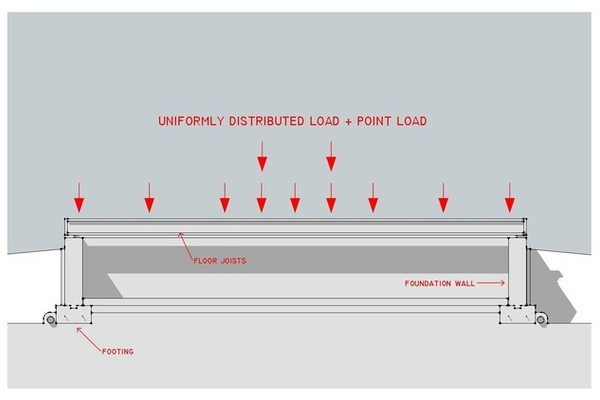
This is especially the case when it comes to structural items. While the code mandates that structural systems be designed to support certain minimum loads, and to do so within certain tolerances, these minimums and tolerances may not be what you actually need. Who wants to live in a house where the floors are so bouncy that you feel like you’re walking on a trampoline? And what happens when you decide to move a water bed into the bedroom next to that stack of heavy books you cherish? Will you need to have your floor joists doubled up under that big soaking tub you are planning?

It’s wise to think about particular situations like this and look at the code mandates as a starting place, not the finish.


Load Codes 2: Bud Dietrich AIA, original photo on Houzz


Weight Loads

Building codes establish many project requirements, not the least of which is the project’s structure. This holds true no matter what material the house will be built of. And a key to designing a structural system is to determine what loads, or weights, will be imposed.

So we first have to look at what the house will be made of (wood, concrete, steel, masonry etc.) to determine the dead load — the weight of materials used in the permanent construction of the house. Note that it doesn’t include items like furniture, people, toys, books, television sets etc. and will vary only a little bit over the lifetime of the house.

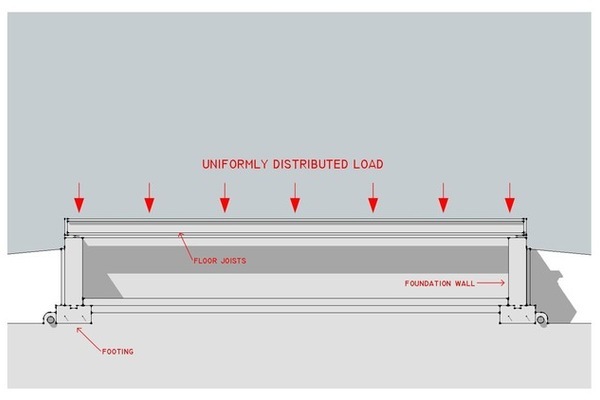
Next we use the governing building code to determine what the minimum live load — the impact of movable objects such as furniture and people — will be. For example, per code, the main living areas of a house have to be able to accommodate a uniform live load of 40 pounds per square foot. Bedrooms have a code requirement of 30 pounds per square foot, and roof structures have a varying live load, depending on climate (more snow equals more weight) and roof pitch (steeper roofs will shed snow faster).


Load Codes 3: Bud Dietrich AIA, original photo on Houzz


But the code-mandated uniform loading may not accommodate all of your furniture and books, that large cast iron soaking tub, your water bed etc. So you’ll want to identify any items that this code-mandated requirement won’t accommodate and design the structure accordingly. Otherwise, the extra weight of these items can cause the structure to fail.

When we say a structure has failed, we don’t necessarily mean the house has collapsed. Failure can simply mean a part of the structure has failed so there’s too much deflection. This will result in uneven floors, gaps between walls and floors, and so on.


Load Codes 4: Bud Dietrich AIA, original photo on Houzz


Deflection

Deflection is the distance that a structural member (say, a floor joist) will bend when a load is placed on it. The greater the distance, the more the deflection and the less level the floor.

In addition to holding up a certain load, a structure has to stay rigid and keep its shape. But that’s nearly impossible, as any structure will start to deflect the moment any load is placed on it.

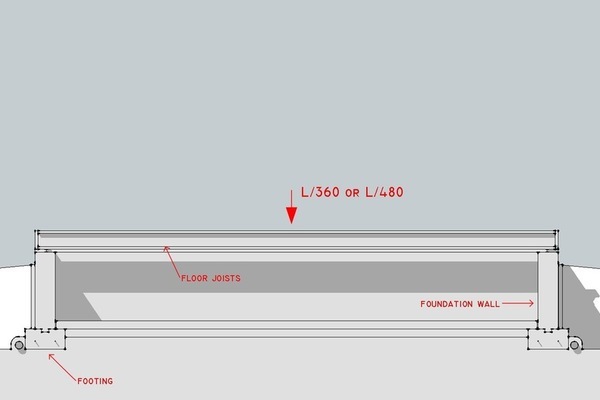
The code requires that this deflection be limited to L/360, where L is the length of the unsupported span. This means that for a floor structure that spans 18 feet (not uncommon in newer homes with open floor plans), the maximum allowable deflection is 0.6 inches.

In other words, a floor can sag more than a half inch and still be deemed OK. So some architects and engineers will use L/480 to calculate the allowable deflection. For an 18-foot span, using L/480 would limit the amount of deflection to 0.45 inches.

While the difference between 0.6 and 0.45 inches may seem insignificant, it really isn’t when it comes to a floor structure that gets walked on all the time.


Load Codes 5: LDa Architecture & Interiors, original photo on Houzz


If you’re designing or remodeling a house, have a conversation with your architect and builder about what you plan to put into your home and how the structure will accommodate it.


By Bud Dietrich AIA, Houzz

Market News August 29, 2017

Housing Supply is an Issue that Will Not Improve Any Time Soon and Here’s Why


There are two common concerns about the housing market that one hears from both consumers and real estate professionals alike. First, they question whether or not we are on the brink of another housing bubble, and second, they want to know why there aren’t more homes for sale.

I don’t plan on addressing the concern regarding a housing bubble in this article except to say that we are not currently in “bubble” territory, although affordability does concern me immensely. Today I would like to concentrate on the second question about the lack of homes for sale.

According to the National Association of REALTORS®, there were 1.96 million homes for sale in the United States in May 2017. When adjusted for seasonality, this falls to just below 1.9 million which is essentially the same level we saw back in 2000.

Now consider that the country has added over 21 million new households during that same time period, and you can see why this is so troubling. It is worth noting that many of these new households did move into rental properties, but this still leaves the U.S. with a substantial housing shortfall, which explains why demand for homes is so high.

With the shortage of homes for sale, you would normally expect builders to meet this pent-up demand with new construction housing but, unfortunately, this has not been the case. In fact, new single-family housing starts are running at about 800,000 (annualized), and I believe we need starts to come in at over 1 million to satisfy demand – especially as older Millennials start to create households of their own and begin thinking about buying instead of renting.

We therefore have a quandary. Trust in the housing market has clearly returned, but there are not enough homes to meet the demand of buyers, and when a buyer does find a home, they are met with very stiff competition, which is driving prices increasingly higher.

So why are we in this position and how do we get out of it?

In reality, there is no single reason for the situation we are in today. Rather it is a number of factors that, when combined, suggest to me that the market will not return to equilibrium any time soon.

The first reason for the shortfall is purely demographic. As “Boomers” age, they are not following the trends of previous generations. Many are staying in the workforce far longer than their predecessors, and, as they are postponing retirement, they do not feel compelled to downsize. In fact, almost two-thirds of Boomers plan to age in place and not move even after retirement. Without this anticipated supply of homes from downsizing Boomers, there aren’t enough homes for move-up buyers, which in turn limits the supply of homes for first-time buyers.

Secondly, as a nation we just aren’t moving as often as we used to. When I analyze mobility, it is clear that people no longer have to relocate as frequently to find a job that matches their skill set. There has been a tangible drop in geographic specificity of occupations. Where we used to move to find work, this is no longer as prevalent, which means we are moving with less frequency.

Thirdly, as mentioned earlier, builders aren’t building as many homes as they could. This is essentially due to three factors: land supply/regulation, labor, and materials. The costs related to building a home have risen rapidly since the Great Recession, and this is holding many builders back from building to their potential. Furthermore, in order to justify the additional costs, many of the homes that are being built are larger and more expensive, and this is no help for the first-time buyer who simply can’t afford a new construction price tag.

Fourthly, while the general consensus is that home prices have recovered from the major correction that was seen following the recession, this is actually not the case in some markets. In fact, there are 32 U.S. metro areas where home prices are still more than 15 percent below the pre-recession peak. As equity levels remain low, or non-existent, in these markets, many would-be sellers are waiting until they have sufficient equity in their homes before putting them on the market.

And there is still one more issue that is certain to become a major factor over the next few years: interest rates.

Imagine, if you will, the country a few years from now when interest rates have normalized to levels somewhere around 6 percent. Now consider potential home sellers who are happily locked in at a mortgage rate of about 4 percent who are considering their options. Will they sell and lose the historically low rate that they currently have? Remember that for every 1 percent increase in rates, buyers can afford 10 percent less house. If they don’t HAVE to sell, their thoughts may lead to remodeling rather than moving. I think that this is a very reasonable hypothesis which could lead us to see low inventory levels for a lot longer than many think.

With little assistance from the new home market, I believe we will suffer from low inventory levels until well into 2018.

Our best hope for a more balanced market lies with builders, so hopefully they’ll be allowed to do what they do best – build more homes.

Market News August 28, 2017

Housing Supply is an Issue that Will Not Improve Any Time Soon and Here’s Why


There are two common concerns about the housing market that one hears from both consumers and real estate professionals alike. First, they question whether or not we are on the brink of another housing bubble, and second, they want to know why there aren’t more homes for sale.

I don’t plan on addressing the concern regarding a housing bubble in this article except to say that we are not currently in “bubble” territory, although affordability does concern me immensely. Today I would like to concentrate on the second question about the lack of homes for sale.

According to the National Association of REALTORS®, there were 1.96 million homes for sale in the United States in May 2017. When adjusted for seasonality, this falls to just below 1.9 million which is essentially the same level we saw back in 2000.

Now consider that the country has added over 21 million new households during that same time period, and you can see why this is so troubling. It is worth noting that many of these new households did move into rental properties, but this still leaves the U.S. with a substantial housing shortfall, which explains why demand for homes is so high.

With the shortage of homes for sale, you would normally expect builders to meet this pent-up demand with new construction housing but, unfortunately, this has not been the case. In fact, new single-family housing starts are running at about 800,000 (annualized), and I believe we need starts to come in at over 1 million to satisfy demand – especially as older Millennials start to create households of their own and begin thinking about buying instead of renting.

We therefore have a quandary. Trust in the housing market has clearly returned, but there are not enough homes to meet the demand of buyers, and when a buyer does find a home, they are met with very stiff competition, which is driving prices increasingly higher.

So why are we in this position and how do we get out of it?

In reality, there is no single reason for the situation we are in today. Rather it is a number of factors that, when combined, suggest to me that the market will not return to equilibrium any time soon.

The first reason for the shortfall is purely demographic. As “Boomers” age, they are not following the trends of previous generations. Many are staying in the workforce far longer than their predecessors, and, as they are postponing retirement, they do not feel compelled to downsize. In fact, almost two-thirds of Boomers plan to age in place and not move even after retirement. Without this anticipated supply of homes from downsizing Boomers, there aren’t enough homes for move-up buyers, which in turn limits the supply of homes for first-time buyers.

Secondly, as a nation we just aren’t moving as often as we used to. When I analyze mobility, it is clear that people no longer have to relocate as frequently to find a job that matches their skill set. There has been a tangible drop in geographic specificity of occupations. Where we used to move to find work, this is no longer as prevalent, which means we are moving with less frequency.

Thirdly, as mentioned earlier, builders aren’t building as many homes as they could. This is essentially due to three factors: land supply/regulation, labor, and materials. The costs related to building a home have risen rapidly since the Great Recession, and this is holding many builders back from building to their potential. Furthermore, in order to justify the additional costs, many of the homes that are being built are larger and more expensive, and this is no help for the first-time buyer who simply can’t afford a new construction price tag.

Fourthly, while the general consensus is that home prices have recovered from the major correction that was seen following the recession, this is actually not the case in some markets. In fact, there are 32 U.S. metro areas where home prices are still more than 15 percent below the pre-recession peak. As equity levels remain low, or non-existent, in these markets, many would-be sellers are waiting until they have sufficient equity in their homes before putting them on the market.

And there is still one more issue that is certain to become a major factor over the next few years: interest rates.

Imagine, if you will, the country a few years from now when interest rates have normalized to levels somewhere around 6 percent. Now consider potential home sellers who are happily locked in at a mortgage rate of about 4 percent who are considering their options. Will they sell and lose the historically low rate that they currently have? Remember that for every 1 percent increase in rates, buyers can afford 10 percent less house. If they don’t HAVE to sell, their thoughts may lead to remodeling rather than moving. I think that this is a very reasonable hypothesis which could lead us to see low inventory levels for a lot longer than many think.

With little assistance from the new home market, I believe we will suffer from low inventory levels until well into 2018.

Our best hope for a more balanced market lies with builders, so hopefully they’ll be allowed to do what they do best – build more homes.

More August 25, 2017

How Homeownership Impacts the U.S. Economy