Market News July 27, 2017

Nevada Real Estate Market Update


ECONOMIC OVERVIEW

Employment growth in the Las Vegas metropolitan area slowed down—albeit very modestly—as the market entered the summer, with an annual employment growth of 2.9%. That said, the market has added 27,300 new jobs over the past 12 months. With this growth in employment, the unemployment rate remained at 4.8%, which is marginally above the statewide level of 4.7%. Las Vegas continues to approach full employment but the market, like many others across the country, has yet to see robust wage growth. However, I do believe wages will start to rise as the labor market continues to tighten through the rest of the year.


HOME SALES ACTIVITY

  • A total of 11,256 homes sold in the second quarter, which was an increase of 8.9% over the same period a year ago. Sales were a substantial 30.5% higher than last quarter.
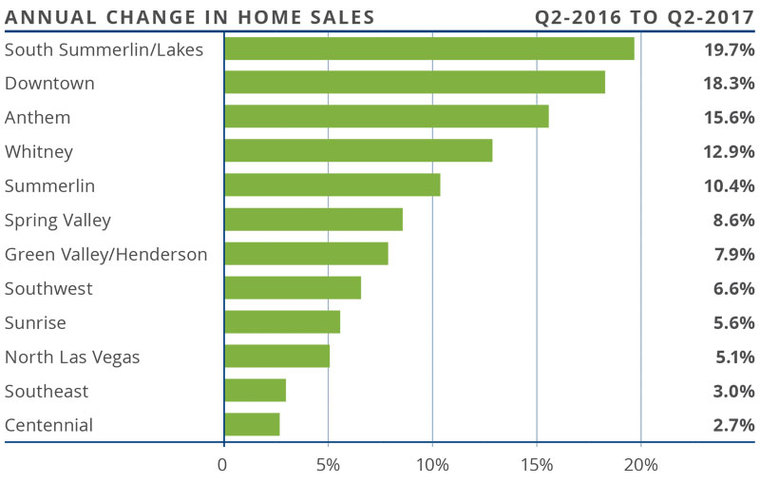
  • Home sales were not as strong in the Centennial and Southeast Las Vegas sub-markets, but this is due to low inventory levels rather than a decrease in demand.
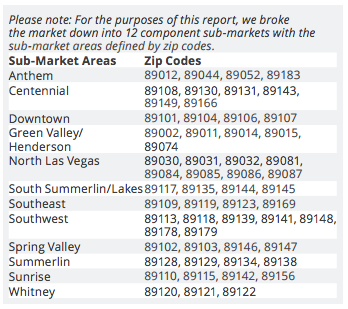
  • There were substantial increases in home sales in a majority of the submarkets within this report, but the fastest rate was in the South Summerlin/ Lakes area, which saw an annual increase of 19.7%.
  • Inventory levels remain remarkably low with 35.1% fewer homes for sale than the same period in 2016 and 11.5% below the level seen in the first quarter. Unfortunately, we failed to see any rise in listings in the spring.
 

HOME PRICES

  • Home prices in the area have risen by 10.4% year-over-year, to an average of $260,535, and are 6.3% higher than first quarter.
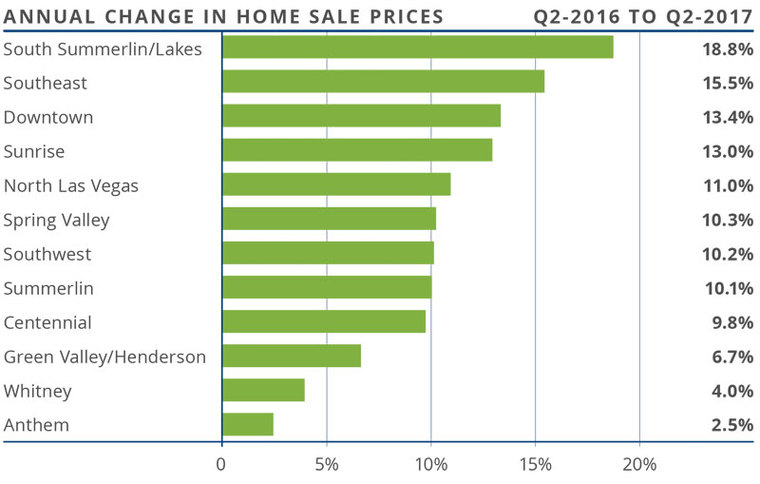
  • The relatively affordable downtown sub-market saw a substantial price increase of 13.4% to $164,000. Double-digit gains were also seen in the Sunrise, North Las Vegas, Spring Valley, Southwest Las Vegas, and Summerlin neighborhoods.
  • Prices rose in all sub-markets when compared to the second quarter of 2016, with the strongest growth seen in the South Summerlin/Lakes and Southeast Las Vegas sub-markets, which saw prices up by 18.8% and 15.5% respectively.
  • I anticipate that we will continue to see above-average price growth in the greater Las Vegas market, as job growth continues and inventory levels remain constrained.
 

DAYS ON MARKET

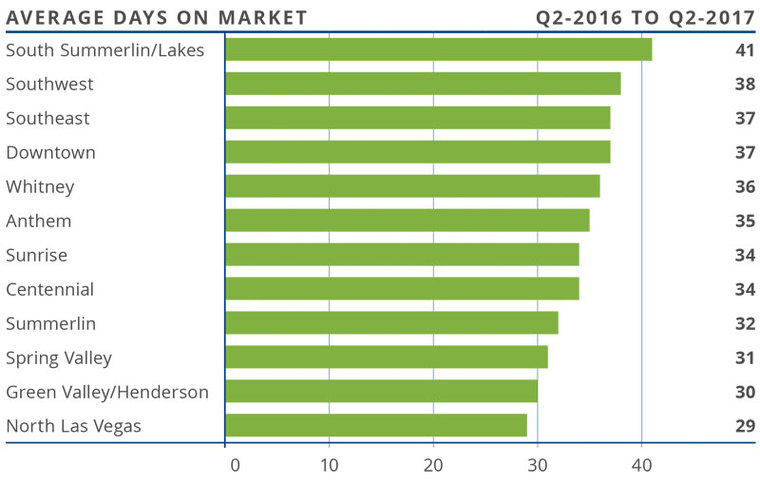
  • The average time it took to sell a home in the region dropped by 18 days when compared to the second quarter of 2016.
  • It took an average of just 35 days to sell a home in the second quarter—a substantial 12 fewer days than in the first quarter.
  • The length of time it took to sell a home dropped in all the Las Vegas sub-markets when compared to a year ago.
  • The greatest drop in days-on-market was in the downtown sub-market, which dropped by 27 days when compared to the same quarter in 2016.
 

CONCLUSIONS
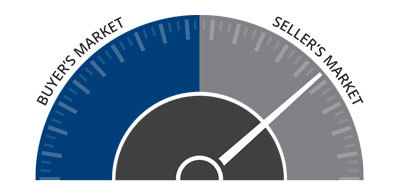
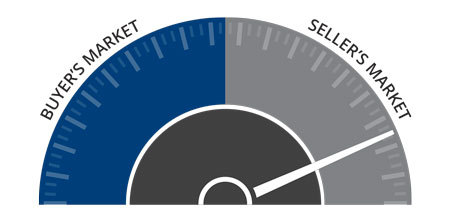
The speedometer reflects the state of the region’s housing market using housing inventory, price gains, home sales, interest rates, and larger economic factors.

Employment growth in Clark County, although slightly less robust than seen in the first quarter, is still gaining ground. This, in concert with low inventory levels and still-competitive mortgage rates, will lead to continued above-average price growth.

Given these factors, I have moved the speedometer a little farther in favor of sellers.



Matthew Gardner is the Chief Economist for Windermere Real Estate, specializing in residential market analysis, commercial/industrial market analysis, financial analysis, and land use and regional economics. He is the former Principal of Gardner Economics, and has over 25 years of professional experience both in the U.S. and U.K.


If you are in the market to buy or sell, we can connect you with an experienced agent here.

Market News July 26, 2017

Western Washington Real Estate Market Update


ECONOMIC OVERVIEW

The Washington State economy has been expanding at a rapid pace but we are seeing a slowdown as the state grows closer to full employment. Given the solid growth, I would expect to see income growth move markedly higher, though this has yet to materialize. I anticipate that we will see faster income growth in the second half of the year. I still believe that the state will add around 70,000 jobs in 2017.

Washington State, as well as the markets that make up Western Washington, continue to see unemployment fall. The latest state-wide report now shows a rate of 4.5%—the lowest rate since data started to be collected in 1976.

I believe that growth in the state will continue to outperform the U.S. as a whole and, with such robust expansion, I would not be surprised to see more people relocate here as they see Washington as a market that offers substantial opportunity.


HOME SALES ACTIVITY

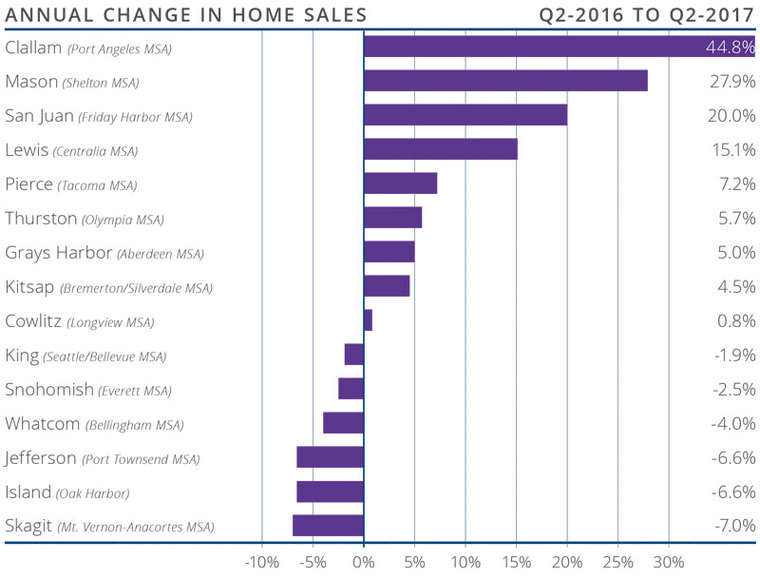
  • There were 23,349 home sales during the second quarter of 2017. This is an increase of 1.1% from the same period in 2016.
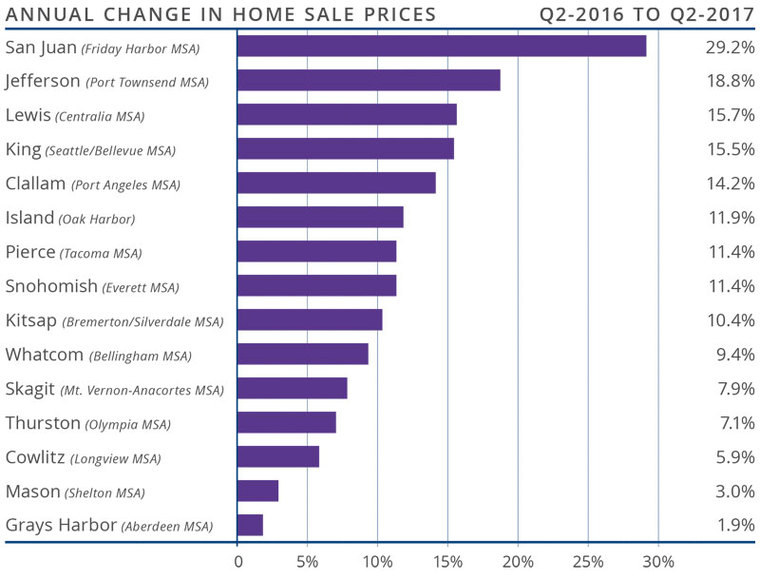
  • Clallam County maintains its position as number one for sales growth over the past 12 months. Double-digit gains in sales were seen in just three other counties, which is a sharp drop from prior reports. I attribute this to inventory constraints rather than any tangible drop in demand. The only modest decline in sales last quarter was seen in Grays Harbor County.
  • The number of homes for sale, unfortunately, showed no improvement, with an average of just 9,279 listings in the quarter, a decline of 20.4% from the second quarter of 2016. Pending sales rose by 3.6% relative to the same quarter a year ago.
  • The key takeaway from this data is that it is unlikely we will see a significant increase in the number of homes for sale for the rest of 2017.


HOME PRICES

  • Along with the expanding economy, home prices continue to rise at very robust rates. Year-over-year, average prices rose 14.9%. The region’s average sales price is now $470,187.
  • Price growth in Western Washington continues to impress as competition for the limited number of homes for sale remains very strong. With little easing in supply, we anticipate that prices will continue to rise at above long-term averages.
  • When compared to the same period a year ago, price growth was most pronounced in San Juan County where sale prices were 29.2% higher than second quarter of 2016. Eight additional counties experienced double-digit price growth.
  • The specter of rising interest rates failed to materialize last quarter, but this actually functioned to get more would-be buyers off the fence and into the market. This led to even more demand which translated into rising home prices.


DAYS ON MARKET

  • The average number of days it took to sell a home in the quarter dropped by 18 days when compared to the same quarter of 2016.
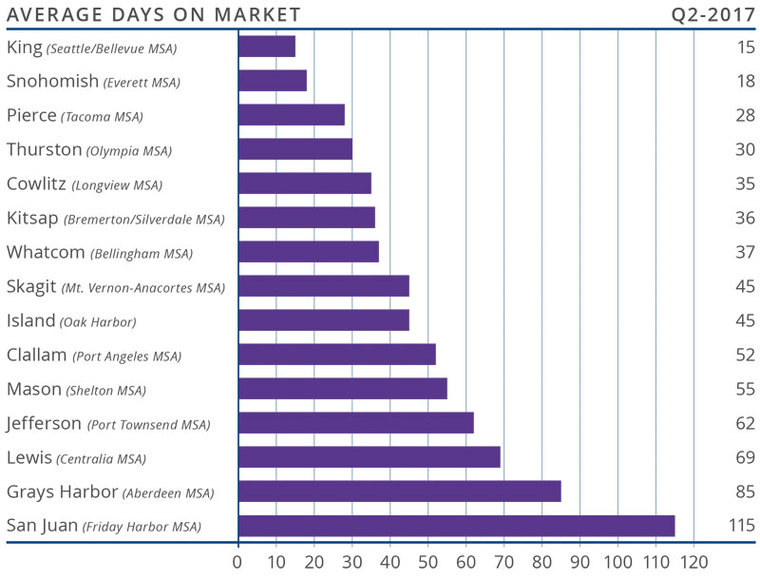
  • King County remains the tightest market; homes, on average, sold in a remarkable 15 days. Every county in this report saw the length of time it took to sell a home drop from the same period a year ago.
  • Last quarter, it took an average of 48 days to sell a home. This is down from the 66 days it took in the second quarter of 2016.
  • Given the marked lack of inventory, I would not be surprised to see the length of time it takes to sell a home drop further before the end of the year.

CONCLUSIONS

This speedometer reflects the state of the region’s housing market using housing inventory, price gains, home sales, interest rates, and larger economic factors. For the second quarter of 2017, I moved the needle a little more in favor of sellers. To define the Western Washington market as “tight” is somewhat of an understatement.

Inventory is short and buyers are plentiful.

Something must give, but unless we see builders delivering substantially more units than they have been, it will remain staunchly a sellers’ market for the balance of the year.

Furthermore, increasing mortgage rates have failed to materialize and, with employment and income growth on the rise, the regional housing market will continue to be very robust.

Matthew Gardner is the Chief Economist for Windermere Real Estate, specializing in residential market analysis, commercial/industrial market analysis, financial analysis, and land use and regional economics. He is the former Principal of Gardner Economics, and has over 25 years of professional experience both in the U.S. and U.K.


If you are in the market to buy or sell, we can connect you with an experienced agent here.
 

Buying July 25, 2017

Why Owning a Home is Such a Smart Investment


After succumbing to the “Great Recession” ten years ago, the stock market has made a comeback. So, does that mean you should forget about buying a new house and invest in stocks instead? The answer to that question, say experts, depends on your investing savvy, your financial discipline, your age, and your current financial situation.

The first question you need to ask yourself is, “Am I disciplined enough to invest in stocks?” According to two professors who recently studied 30 years of personal-finance performance, you need to be someone with exceptional financial discipline if you want to earn real money in the stock market. Or, you could simply buy a house.

When you buy real estate, the down payment and monthly mortgage payments force you to set aside a significant amount of your earnings on a regular basis. It’s automatic. But if you can’t summon the same discipline to invest that same amount of money in the stock market on an equally regular basis, then stocks are probably going to be a losing proposition, according to the professors’ study.

“We find that if people don't invest all the money, actually about 90% of the time, you're better off buying real estate," says Professor Eli Beracha, co-author of the study.


Other issues that make stock investing risky

Investing guru James Altucher wrote a column in The Wall St. Journal titled, “8 Reasons You Stink at Trading Stocks.” In it, he argues that most non-professionals don’t have the investing savvy required to be successful in the stock market. Here are a few telling excerpts:

  • “Nine out of 10 people think they are above-average drivers. Nine out of 10 people think they are above-average investors. Both are mathematically impossible.”
  • “Most people sell at the bottom and buy at the top—the opposite of what you want to do as an investor—because they let emotions get in the way of patience and strategy.”
  • “It’s really hard to own stocks. It’s not just picking a stock and watching it go up 1,000%. It’s buying it and sometimes watching it go down 80% before it ends up rising 20% above your purchase price. It’s waiting. It’s patience. Psychology is at least 80% of the game. And knowing when to sell? Even harder.”


Age matters

When you’re young, many financial advisors encourage investing in things like individual stocks. With a long career ahead, you have time to wait for any bad investments to turn around before you may really need the money. But once you’re a little older, with a family, and starting to focus on your financial future, that’s when advisers recommend you buy things like real estate—a conservative investment with a long history of stable, predictable earnings.


The type of loan you choose also makes a difference

If you want to both own a home and invest in stocks, consider a 30-year home loan, which will significantly reduce your monthly payments and leave you with extra money for playing the market. (Just remember the tradeoff: You’ll end up paying thousands of dollars more in interest over the life of the loan.)

If you don’t have a burning desire to play the stock market, choose a 15-year home loan. You’ll pay less interest over the life of the loan, you’ll build equity faster, and, obviously, you’ll be mortgage-free 15 years sooner.


The tax advantages of owning real estate

As a homeowner, you’re entitled to a bevy of tax benefits you don’t get as a stock investor. You can deduct your mortgage interest and property taxes from your annual tax return. Plus, depending on your circumstances, you could also get a deduction or credit for any home-office expenses, moving expenses, capital gains, any “points” used to lower your interest rate, and more.


One caveat: investing in real estate takes time

No matter what some of those reality TV programs show, buying a home should not be viewed as a get-rich-quick scheme. But if you think you’re ready to put down roots for as long as seven years, chances are very good that any home you purchase will appreciate significantly during that time (even if the economy runs into some bumps along the way).


The non-financial benefits

Of course, not all of the benefits of owning a home are financial. For most Americans, their home is a source of tremendous pride, comfort, security and freedom. Most of us also use our homes to showcase our personality, through paint colors, furnishings, landscaping, yard signs, holiday decorations and so much more.

Yes, the stock market is on an upswing currently (depending on the week), but if you want an investment with a long-term track record of consistent returns—plus tax breaks and a variety of personal perks—you may want to buy a home instead.


If you have questions about the buying or selling process, or are looking for an experienced agent in your area, connect with us  here.

More July 20, 2017

Why aren’t homebuilders building more homes?

This article originally appeared on Inman.com 


Housing markets all across the U.S. are suffering from serious shortages of homes for sale, and this isn’t expected to change in the foreseeable future.

When I think about inventory levels and the fact that demand is clearly outstripping supply, it makes me question why homebuilders aren’t stepping up to the plate to meet all this pent-up demand.

Interestingly enough, there are several obstacles holding builders back that I think are worthy of further discussion.

According to my calculations, since 2008, builders have started construction of new single-family homes at an average annual rate of about 594,000 units per year. For context, the average annual rate of new-home starts between 1963 and 2007 was over 1.1 million, so we have been behind the ball for some time now.

Although new-home starts have now risen to 835,000 units from the historic low of 353,000 units that we saw in 2009, we are still well below the level that meets demand given new household formations.

Since 2009, new housing supply has consistently fallen short of new housing demand. The shortfall was the largest in 2011 at 465,000 housing units, and cumulatively through 2015, the total shortfall was 2.2 million housing units.


Currently, I estimate that the amount of housing supply necessary to just keep pace with demand is probably around 1.1 million housing units a year; however, housing completions as of May were running at an annual rate of just 817,000 — far below what is needed.

So why is this? The simple answer is that it is very expensive to build a new home.

The expense of building a new home can be essentially broken down into three components: land, labor and materials.

Land

Let’s start with land, which is expensive, and it is very expensive in markets where land availability is scarce (either because of unique topography or political limitations — or both).

This is further exacerbated in markets where the economy is growing rapidly and attracting more new residents.

Another hindrance is the cost of obtaining a building permit, which is remarkably high, thanks to government regulations, and can account for almost 25 percent of the final price of a new single-family home.


Labor

The second thing to consider is labor. As the housing market was entering the Great Recession, many construction workers were laid off and have not subsequently returned.

In fact, my calculations indicate there are currently over 200,000 job openings in the construction industry, and this lack of supply combined with high demand for labor, has led to rising labor costs.


Material costs

Finally, material costs. The cost of homebuilding materials have risen by almost 5 percent due to high demand and low supply. Everything from the copper used in wiring to the lumber used for framing, continues to escalate at fairly rapid rates.

All of this combined makes it very expensive to build homes — especially affordable homes.

In fact, the National Association of Homebuilders stated back in 2015 that it is difficult to build a home anywhere in America for less than $300,000. Then take into account that only 4 percent of all new homes sold in 2016 were priced below $150,000, and in the Western U.S., just 6 percent were priced below $200,000.

Conditions are particularly tight at the more affordable end of the market, clearly reflecting the fact that fewer entry-level homes are being built.

Between 2004 and 2016, completions of smaller single-family homes (under 1,800 square feet) fell from nearly 500,000 units to only 136,000. Similarly, the number of townhouses built in 2016 (98,000) was less than half the number started in 2005.

It is clear that we need more housing solutions to address the shortages out there, but it won’t be easy.

From a builder’s perspective, they cannot change material costs, nor can they force workers into the construction industry.

However, what they can do, and what needs to be done, is try and shift government policy to better address permit fees, hookup fees, impact fees and the like. If these costs could be lowered, I believe that many builders would have the ability to ramp-up activity in a fairly dramatic fashion.

Given how important increasing the supply of new homes is to the long-term health of the market, I hope that the efforts being undertaken at the national level by the NAHB, and the local level by various homebuilder associations, start to see positive results in the near future.

For the sake of our housing market, we need to make it easier for builders to do what they do best: build homes.


More July 19, 2017

#YourStoryIsOurStory: Taking the Time to Make the Right Move

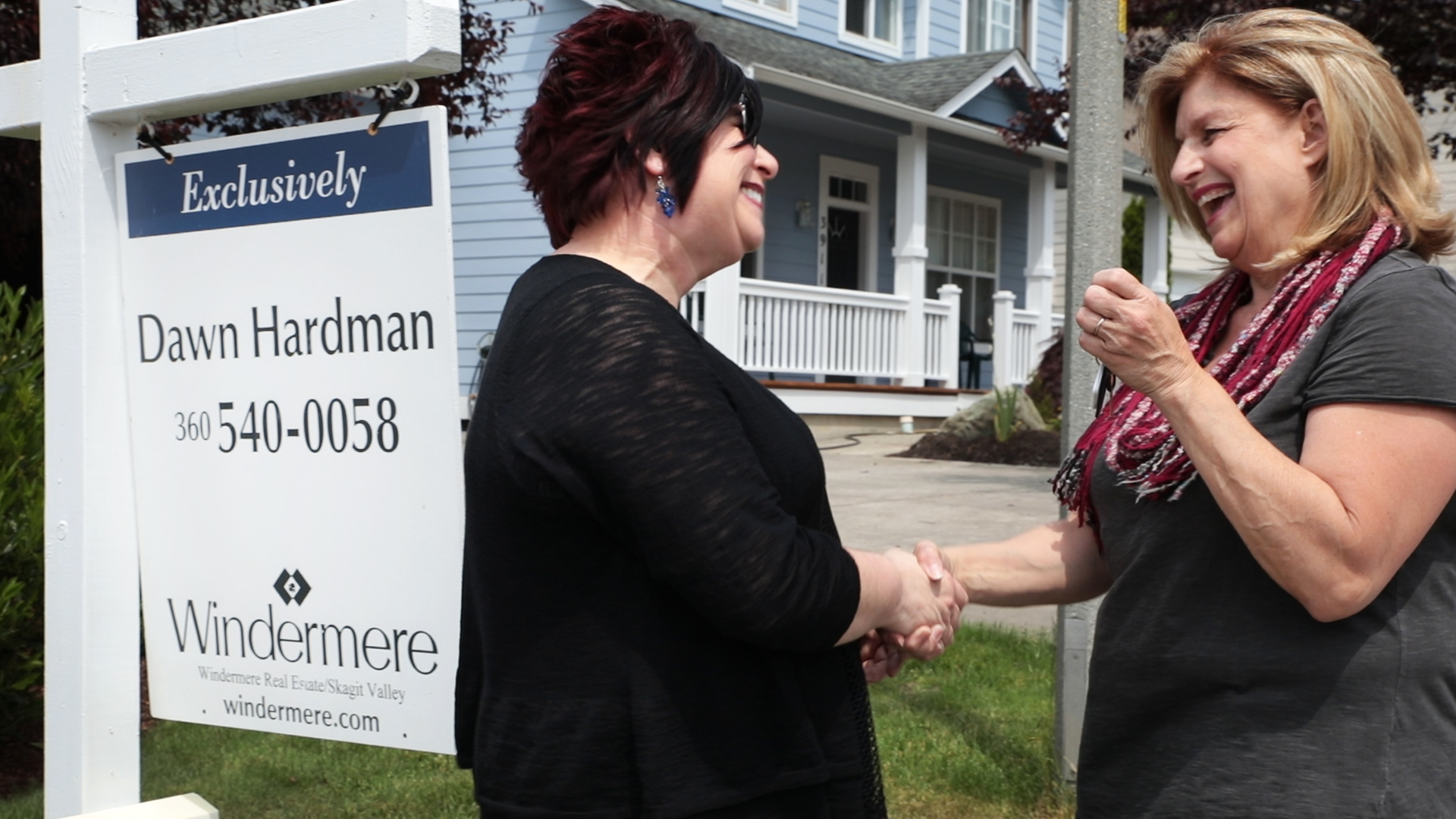
When Gordy was offered a promotion, he and his wife Linda would need to relocate and give up their custom home. It wouldn't be easy, but lucky for them, they found Windermere Real Estate agent, Dawn Hardman. Over the course of a year, Dawn and Linda spent a lot of time together. Dawn took on the role of host to her new clients, touring dozens of homes, and teaching them everything she knew about Skagit County, Washington, so when they finally made their move, they could do so confidently. 

When another unexpected move came up, Linda and Gordy called on Dawn to help them sell their home. In short notice, over a holiday weekend, Dawn made sure their open house was a success with her creative ideas and personal touch.

It rarely takes a full year to find a dream home, but Dawn is glad she had a chance to spend so much time with Linda and Gordy. In doing so, she helped them get familiarized with a new area, while also learning more about the place she loves and calls home. 


Throughout the year we will be posting some of our favorite #YourStoryIsOurStory videos, photos, and blog posts. Please take a minute to share your experiences, and follow #YourStoryIsOurStory on our blogFacebookTwitterInstagramYouTube, and Pinterest pages.

More July 17, 2017

Windermere Foundation Has Donated Nearly $1,000,000 This Year!

Thanks to the generosity of Windermere agents and the community, the Windermere Foundation collected over $903,500 in donations through the second quarter of 2017. This is an increase of 10 percent compared to this time last year! Individual contributions and fundraisers accounted for 62 percent of the donations, while 38 percent came from donations through Windermere agent commissions. So far, we have raised a total of $34,009,527 in donations since 1989.


Each Windermere office has its own Windermere Foundation fund account that they use to make donations to organizations in their communities. Year to date, a total of $979,486 has been disbursed to non-profit organizations dedicated to providing services to low-income and homeless families throughout the Western U.S.


One organization that has been the recipient of Windermere Foundation funds is the League of United Latin American Citizens (LULAC) National Scholarship Fund. LULAC has considered education its number one priority since it was established in 1929. The scholarship fund was established in 1975 to provide scholarships to help Hispanic youth in underserved communities make the dream of college enrollment a reality. Former recipients of LNSF scholarships are now leaders in fields of business, science, government, and education.  A rigorous selection process assures the expectation that future recipients will demonstrate the same level of excellence.


Last year, the Windermere office in Salinas, CA supported LULAC’s scholarship fund with a $1,000 donation, and will be making this donation annually. Christopher Barrera, Realtor and President of LULAC Salinas Council #2055, says “I am proud to be associated with such a great organization like Windermere Valley Properties in Salinas, and it’ll be an honor to present a check to LULAC on behalf of Windermere and the Windermere Foundation.” Each year, the LULAC Salinas Council holds a Black & White Ball to raise money for the scholarship fund. Monies raised are matched by LULAC national. There were 14 scholarships awarded in 2016. Thanks to the $15,000 raised through their event, matching funds from LULAC national, and a donation from the Windermere Foundation, they will be awarding 39 scholarships at a presentation ceremony on July 29 in Old Town Salinas.


Generous donations to the Windermere Foundation over the years have enabled Windermere offices to continue to support local non-profits like LULAC. If you’d like to help support programs for low-income and homeless families in your community, please click on the Donate button.


To learn more about the Windermere Foundation, visit http://www.windermere.com/foundation.

BuyingLivingSelling July 14, 2017

How an Investment in Green Technology Can Pay off for Today’s Homeowner


Studies continue to show that real estate buyers are willing to pay a substantial premium for homes that feature highly efficient, environmentally friendly “green energy” technology.

While the added value depends on the location of the home, its age, and whether it’s certified or not, three separate studies all found that newly constructed, Energy Star- or LEED-certified homes typically sell for about nine percent more than comparable, non-certified new homes. Plus, one of those studies discovered that existing homes retrofitted with green technologies, and certified as such, can command a whopping 30-percent sales-price boost.

Options include technologies that you may already be very familiar with, as well as some new breakthroughs that may surprise you:


Fuel cells

Fuel cells may soon offer an all-new source of electricity that would allow you to completely disconnect your home from all other sources of electricity. About the size of a dishwasher, a fuel cell connects to your home’s natural gas line and electrochemically converts methane to electricity. One unit would pack more than enough energy to power your whole home.

Past fuel cells have been far too expensive and unreliable. But Redbox Power Systems, a company that’s planning to launch its first fuel cell later this year, is using new materials, claims they’ll be able to cut the purchase price by 90 percent, and predicts the associated electricity-bill savings will allow homeowners to pay off that purchase price in just two years’ time.


Wind turbine

A wind turbine (essentially a propeller spinning atop an 80- to 100-foot pole) collects kinetic energy from the wind and converts it to electricity for your home. And according to the Department of Energy, a small version can slash your electrical bill by 50 to 90 percent.

But before you get too excited, you need to know that the zoning laws in most urban areas don’t allow wind turbines. They’re too tall. The best prospects for this technology are homes located on at least an acre of land, well outside the city limits.


Cool roof

Cool roofs keep the houses they’re covering as much as 50 to 60 degrees cooler by reflecting the heat of the sun away from the interior, allowing the occupants to stay cooler and save on air-conditioning costs. The most common form is metal roofing. Other options include roof membranes and reflective asphalt shingles.


Green roof

Another way to keep the interior of your house cooler—and save on air-conditioning costs—is to replace your traditional roof with a layer of vegetation (typically hardy groundcovers). This is more expensive than a cool roof and requires regular maintenance, but young, environmentally conscious home owners are very attracted to the concept.


Hybrid heating

Combining a heat pump with a standard furnace to create what’s known as a “hybrid heating system” can save you somewhere between 15 and 35 percent on your heating and cooling bills.

Unlike a gas or oil furnace, a heat pump doesn’t use any fuel. Instead, the coils inside the unit absorb whatever heat exists naturally in the outside air, and distributes it via the same ductwork used by your furnace. When the outside air temperature gets too cold for the heat pump to work, the system switches over to your traditional furnace.


Geothermal heating

Geothermal heating units are like heat pumps, except instead of absorbing heat from the outside air, they absorb the heat in the soil next to your house via coils buried in the ground. The coils can be buried horizontally or, if you don’t have a wide enough yard, they can be buried vertically. While the installation price of a geothermal system can be several times that of a hybrid, air-sourced system, the cost savings on your energy bills can cover the installation costs in five to 10 years.


Solar power

Solar panels capture light energy from the sun and convert it directly into electricity. For decades, you may have seen these panels sitting on sunny rooftops all across America. But it’s only recently that this energy-saving option has become truly affordable.

In 2010, installing a solar system on a typical mid-sized house would have set the homeowner back $30,000. But today, that price has been slashed to an average of just $19,000. Plus, some companies are now offering to rent solar panels to homeowners (the company retains ownership of the panels and sells the homeowner access to the power at roughly 10 to 15 percent less than they would pay their local utility).


Solar water heaters

Rooftop solar panels can also be used to heat your home’s water. The Environmental Protection Agency estimates that the average homeowner who makes this switch should see their water bills shrink by 50 to 80 percent.


Tax credits/rebates

Many of the innovative solutions summarized above come with big price tags attached. However, federal, state and local rebates/tax credits can often slash those expenses by as much as 50 percent. So before ruling any of these ideas out, take some time to see which incentives you may qualify for at dsireusa.org and the “tax incentives” pages at Energy.gov.


Regardless of which option you choose, these technologies will not only help to conserve valuable resources and reduce your monthly utility expenses, but also add resale value that you can leverage whenever you decide it’s time to sell and move on to a new home.


Selling July 10, 2017

Selling Your Home: The Impact of Staging


How can you make your home more attractive to potential buyers? The answer is with some “home staging”. According to the Wall Street Journal, implementing some basic interior design techniques can not only speed up the sale of your home but also increase your final selling price.

It all comes down to highlighting your home's strengths, downplaying its weaknesses, and making it more appealing to the largest pool of prospective buyers. Staging an empty house is also important to help buyers visualize how the spaces would be used, and to give the home warmth and character.


Cohesiveness Is Key

Make the inside match the outside. For example, if the exterior architectural style of your house is Victorian or Craftsman Bungalow, the interior should be primarily outfitted with furniture styles from essentially the same era. Prospective buyers who like the exterior style of your home are going to expect something similar when they step inside. If the two styles don’t agree or at least complement each other, there is likely going to be an immediate disconnect for the buyer. Contact your agent to help determine the architectural style of your home and what makes it unique.

There is always room for flexibility. Not all your furnishings need to match, and even the primary furnishings do not need to be an exact match to the architectural style of your home. To create cohesion, you simply need to reflect the overall look-and-feel of the exterior.


The Role of Personal Expression

Every home is a personal expression of its owner. But when you become a seller, you’ll want to deemphasize much of the décor that makes a place uniquely yours and instead look for ways to make it appeal to your target market. Keep in mind, your target market is made up of the group of people most likely to be interested in a home like yours—which is something your agent can help you determine.


Your Goal: Neutralize and Brighten

Since personal style differs from person to person, a good strategy to sell your home is to “neutralize” the design of your interior. A truly neutral interior design allows people touring the house to easily imagine their own belongings in the space—and to envision how some simple changes would make it uniquely their own.

In short, you want to downplay your own personal expression, while making it easy for others to mentally project their own sense of style on the space. Ideas include:

  • Paint over any bold wall colors with something more neutral, like a light beige, a warm gray, or a soft brown. The old advice used to be, “paint everything white,” but often that creates too sterile of an environment, while dark colors can make a room look small, even a bit dirty. Muted tones and soft colors work best.
  • Consider removing wallpaper if it’s a bold or busy design.
  • Replace heavy, dark curtains with neutral-colored shear versions; this will soften the hard edges around windows while letting in lots of natural light.
  • Turn on lamps, and if necessary, install lighting fixtures to brighten any dark spaces—especially the entry area.
  • Make sure everything is extremely clean. You may even want to hire professionals to give your home a thorough deep clean. Remember, the kitchen and bathrooms are by far the two most important rooms in a house when selling, so ongoing maintenance is important.


The Importance of De-Cluttering

Above all, make sure every room—including closets and the garage—is clutter-free. Family photos, personal memorabilia, and collectibles should be boxed up. Closets, shelves, and other storage areas should be mostly empty. Work benches should be free of tools and projects. Clear the kitchen counters, store non-necessary cookware, and remove all those magnets from the refrigerator door.

The same goes for furniture. If removing a chair, a lamp, a table, or other furnishings will make a particular space look larger or more inviting, then by all means do it.

You don’t want your home to appear cold, un-loved, or unlived-in, but you do want to remove distractions and provide prospective buyers with a blank canvas of sorts. Plus, de-cluttering your home now will make it that much easier to pack when it comes time to move.


Where to Start

Contact your agent for advice on how to most effectively stage your home or for a recommendation on a professional stager. While the simple interior design techniques outlined above may seem more like common sense than marketing magic, you’d be surprised at how many homeowners routinely overlook them. And the results are clear: staging your house to make it more appealing to your target buyer is often all it takes to speed the sale and boost the price.


More July 7, 2017

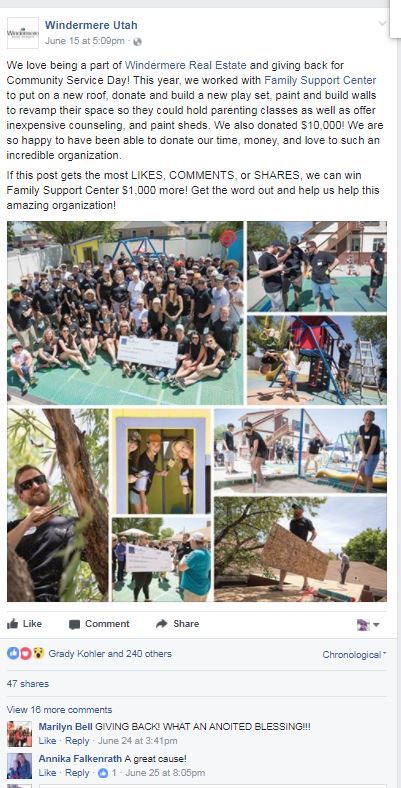
Announcing the Winner of the 2017 Windermere Real Estate Community Service Day Photo Contest!

On Friday, June 9, Windermere offices across the states of Washington, Oregon, Idaho, Montana, Hawaii, Alaska, Utah, California, Colorado, Nevada, and Arizona, all took a day off from selling homes to help make a difference in their local communities.

We challenged our offices to share their community service day photos on Windermere’s Facebook page, in order to participate in our fifth-annual voter-driven photo contest. Many of our offices shared photos, and in turn, they each received a $100 donation to the Windermere Foundation charity of their choice.

To add some competition to this challenge, we offered an additional $1,000 charitable contribution to the office with the most votes on their photo. So, who won?

With a total of 259 votes, the winner of the CSD photo contest is Windermere Utah!


Thank you to all of our Windermere offices and agents who spent the day giving back to local organizations, community centers, and public spaces throughout the Western U.S.


More July 6, 2017

Get the Perfect Outdoor Shower for Summer


Showering often feels like more of an obligation than a pleasure — especially if you exercise and have to take more than one a day. Which might explain the burgeoning popularity of outdoor showers. “You’re showering outside in the elements, and there’s something about that that intrigues people,” says Phil Regan, principal designer at Hutker Architects.

Outdoor showers have become so popular, Regan can’t remember a time he did a house without one. (Of course, that might have something to do with the fact that his office is in Martha’s Vineyard, an upscale resort island off the coast of Massachusetts.) But even if you’re not a block from the beach (or the nearest neighbor), outdoor showers can shake up your routine and make you feel closer to nature.


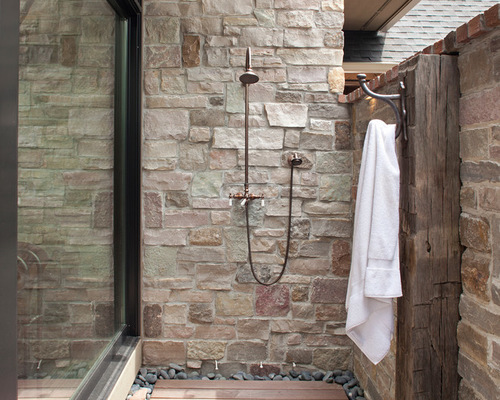
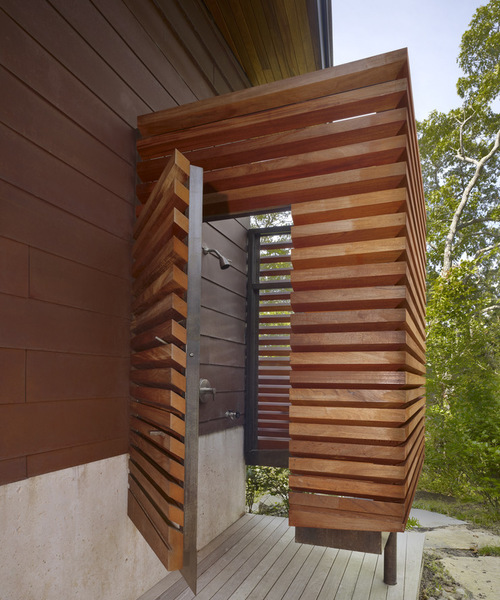
Outdoor Shower 1: John Kraemer & Sons, original photo on Houzz


Project: Add an outdoor shower.

Why: An outdoor shower makes a mundane ritual much more appealing, allowing you to savor fresh air, sky, birdsong and possibly even a view while you bathe. It’s especially handy for rinsing off before or after a dip in the pool, a trip to the beach or a grubby day of gardening. Many homeowners use them for bathing their dogs.


Related: Give Wildlife Shelter From the Summer Sun With a Birdhouse


“It’s a pretty sybaritic experience, but not everyone is going to be comfortable with that,” acknowledges architect Julie Campbell of CTA Design Builders in Seattle.


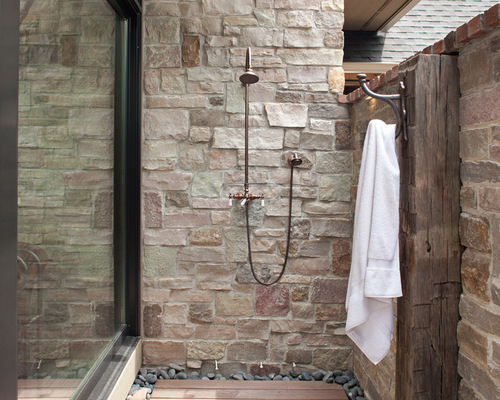
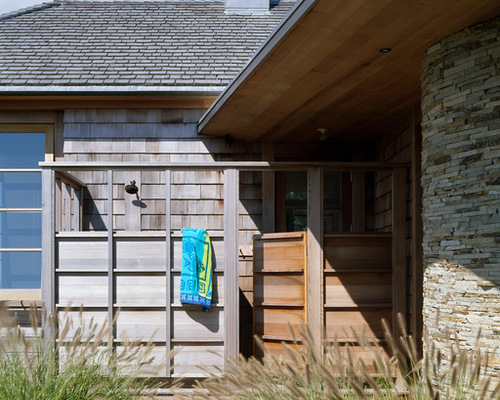
Outdoor Shower 2: brianvandenbrink.com, original photo on Houzz


Who to hire: Outdoor showers require excavation, slab work, plumbing and alterations to the existing walls of the home, so don’t just hire a plumber — go with a general contractor who has experience building outdoor showers. Without that, “you’re probably going to make a bunch of simple mistakes,” says Regan, whose firm designed the shower tower shown here.


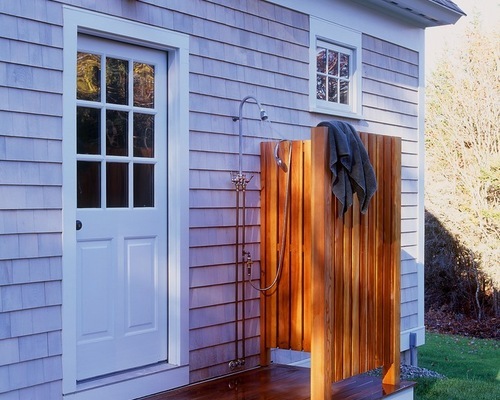
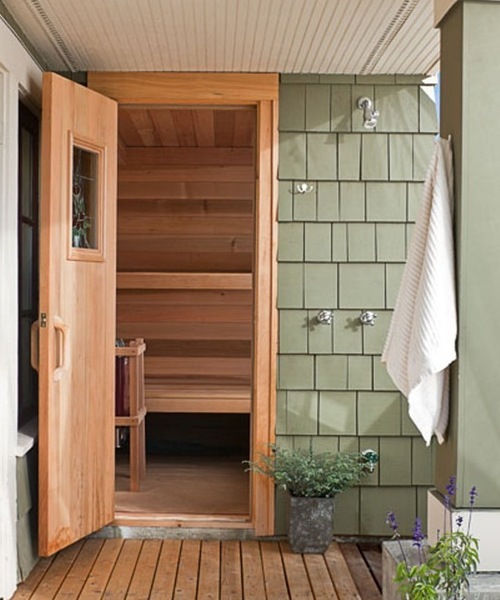
Outdoor Shower 3: John Cole Architect, original photo on Houzz


Cost range: A simple shower with hot and cold running water, like this one, can cost less than $1,000 to install. A moderate setup with a fancier enclosure can run anywhere from $1,000 to $4,000. And a more elaborate shower can cost $4,000 to $8,000 or more.


Related: Shower Stalls For a Luxe Experience


Typical project length: A simple installation can be done in two weeks; allow six to eight weeks for more complex projects.


Outdoor Shower 4: Charles Rose Architects Inc, original photo on Houzz


Permit: You’ll probably need a plumbing permit. Whether you’ll need a building permit depends on the design, cost and complexity of the project and the rules in your municipality. Many jurisdictions don’t even allow outdoor showers, so do your homework first.

Best time to do this project: Anytime the ground is not frozen.


Outdoor Shower 5: Hutker Architects, original photo on Houzz


First step: The most important thing to consider when planning an outdoor shower is the location. You want it to be somewhere that gets direct sun, not only because it makes the act of showering more pleasant, but because it’ll keep the shower walls and floor drier — and that’s critical to preventing rot and scum. For that same reason, don’t place the shower under a roof overhang or tree (which could also cause debris to accumulate on the shower floor).

The other big consideration is privacy. Locate the shower away from probing eyes or add an enclosure that assures privacy (but maintains air circulation). If your house is two stories or is flanked by windows that could look down onto the shower, consider a louvered roof that prevents views in but still allows views out.

“If you want to experience the outdoors, you want to find a way to create privacy that doesn’t take away from that experience you’re looking for,” says Campbell.


Outdoor Shower 6: CTA Design Builders Inc, original photo on Houzz


Considerations: If the shower abuts your exterior, that siding will get pelted with more water than it was designed to withstand, so go with a material like cedar, mahogany or teak and add a waterproof membrane underneath to guard against water infiltration. To avoid siding problems, locate the shower away from the house.

If you live in a climate that gets cold, be sure to locate the water shutoff valve inside the house, and have the pipes blown out at the end of the season to avoid any water freezing in the pipes.

The shower needs to drain into either the home’s graywater system or a French drain, consisting of a large pit filled with several feet of gravel that filters the water as it returns to the soil. (Expect to replace the gravel every five or six years.) Needless to say, you want to direct the drainage away from the foundation and basement, and if you plan to use soap in the shower, away from plants as well.

If possible, situate the shower to take advantage of the site’s attributes, such as views or rock outcrops. “If there are natural amenities as part of the site, that’s all the more fun you can have with it,” says Regan.


Related: Use Creeping Juniper as a Great Ground Cover Plant


By Fred Albert, Houzz