BuyingSelling February 24, 2025

Is Downsizing Right for You? Here’s How to Decide

Choosing to downsize is more than just moving into a smaller space, it’s about curating a simpler lifestyle that fits your current needs. Whether you’re retiring, looking for an eco-friendly, low-maintenance home, or wanting a fresh start after your children have moved away, downsizing might be the best option for you. Before making the move, here’s everything to consider.

Why Downsizing Could Be the Right Choice

Increased Cash Flow & More Financial Flexibility

Downsizing can offer significant financial benefits, starting with a smaller mortgage, which frees up extra cash for other needs or desires. Home insurance costs also tend to be lower, as the size of the home typically influences insurance premiums. Downsizing to less square footage can also lower property tax bills. Finally, a smaller home also leads to decreased utility bills, as the cost of heating and cooling a smaller home requires less energy expenditure.

More Time, Less Maintenance & Stress

Bigger homes call for more maintenance. Downsizing can help cut down time spent on household chores such as cleaning and vacuuming, which will give you more hours to do something more enjoyable. Homeowners who have successfully downsized often feel happier because they are no longer overwhelmed by the demands of a larger home. Less responsibility, less housework, increased cash flow, and flexibility equals reduced stress.

A Greener Lifestyle

After downsizing, homeowners commonly buy less since they don’t necessarily have the room for it. Reduced consumption not only leads to a more minimalist lifestyle but also cuts down on waste. Less waste plus less energy expended to heat and cool the space means a smaller environmental footprint and keeps your home green.

What You Might Miss When Downsizing

While moving into a smaller space has benefits, there are trade-offs to consider. A smaller home means less storage space, meaning you’ll need to give away or donate furniture, books, kitchen supplies, and other belongings that may not fit. Less space and fewer rooms can also make the home feel cramped, especially if you’re a long-term homeowner used to larger square footage.

Remote work may also become more challenging in a downsized home. Finding a quiet, dedicated workspace can be difficult, and close quarters may make it harder to stay productive. Additionally, hosting overnight guests or bigger holiday dinners might be out of the question for a smaller home. Adjusting to a downsized lifestyle can take time for those accustomed to more space, requiring new habits and a fresh approach.

Questions to Ask Before Making the Move

Before downsizing, it’s crucial to reflect on how less space in your home will impact your lifestyle. Think about your attachment to your current home’s size. Do you need extra rooms for guests or a second bathroom for convenience? Will moving into a smaller home feel too much like a step backward? Or will it bring the sense of freedom and simplicity you’ve been looking for? Ask yourself these important questions to ensure you’re making the right choice:

  • What are my must-haves in a smaller home? Think about what you might miss from a more spacious home, or factors like location, accessibility, and storage solutions.
  • How will my daily routine change? Consider how a smaller space might impact your hobbies, work setup, or ability to entertain.
  • Does this move align with my long-term plans? Imagine the next 5, 10, or even 20 years, and start to question if a smaller home meets your future needs.
  • How much will it cost to downsize? Factor in moving expenses, costs associated with selling, new furniture purchases, and the amount it will cost to store or sell belongings you no longer have space for.
  • What will I do with sentimental or bulky items? Consider whether you’ll keep, donate, sell, or store them, and how much space you’re willing to dedicate to cherished belongings.

If you believe downsizing is the right option and are ready for the next step, you’re probably asking yourself, “Should I sell first or buy first?” When you’re prepared to discuss your options, connect with a Windermere agent by clicking the button below.


Market NewsMore February 19, 2025

Housing & Economic Update: What to Know About Inventory, Inflation & Interest Rates

This is the latest in a series of videos with Windermere Principal Economist Jeff Tucker where he delivers the key economic numbers to follow to keep you well-informed about what’s going on in the real estate market.


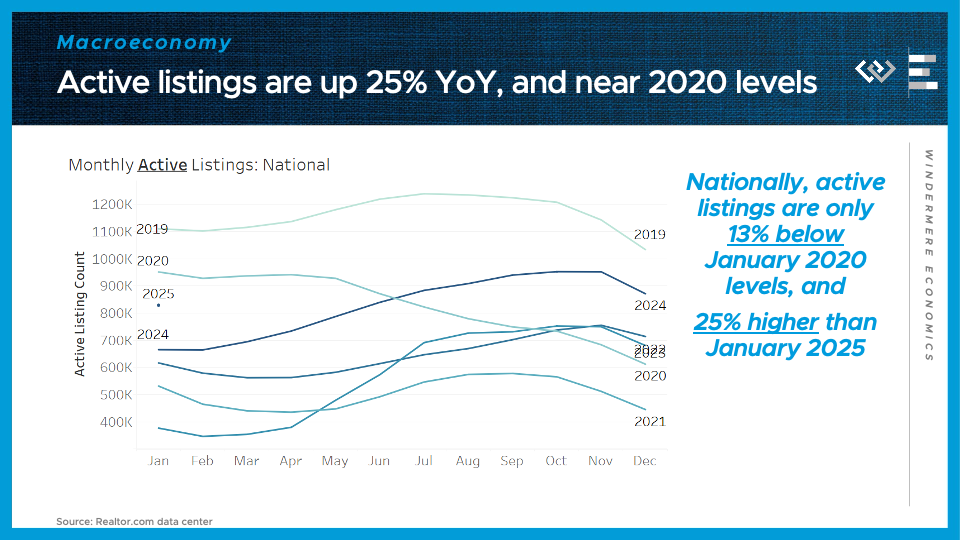
We now have over a full month of data to see how 2025 is shaping up, and I wanted to focus today on one of my favorite leading indicators: inventory. So the first number to know this week:

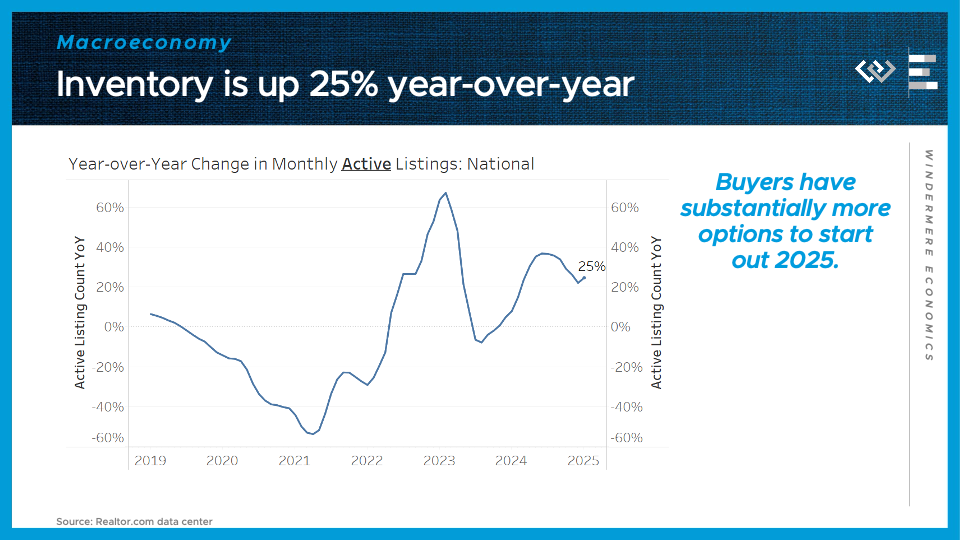
25%

That’s how many more active listings there were this January compared to January 2024. For a sense of scale, it was about 829,000 active listings this year, compared to only about 666,000 active listings last year. And in fact we are now only 13% below January 2020 levels, on the eve of the pandemic. That’s a huge milestone the housing market is approaching, after really being defined by low inventory for the last few years.

Now, there’s a ton of data in this graph which makes it a little hard to read, so I’ll try highlighting a couple sections at a time:

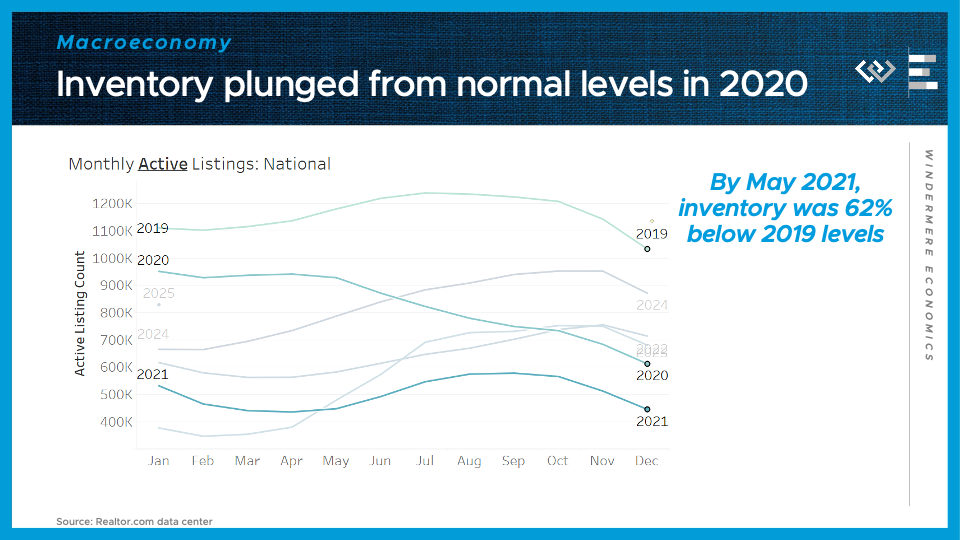
Here’s what happened early in the pandemic: inventory plunged, first because sellers weren’t even sure about selling in the early pandemic, and then because demand actually took off, fueled in part by lower interest rates as well as booming demand for more space and maybe the chance to work from home. So ultimately just over a year later, by May 2021, for instance, we had 62% fewer active listings than in May of 2019. That helped fuel some extraordinary price appreciation and really frenzied competition in the market, for about a year.

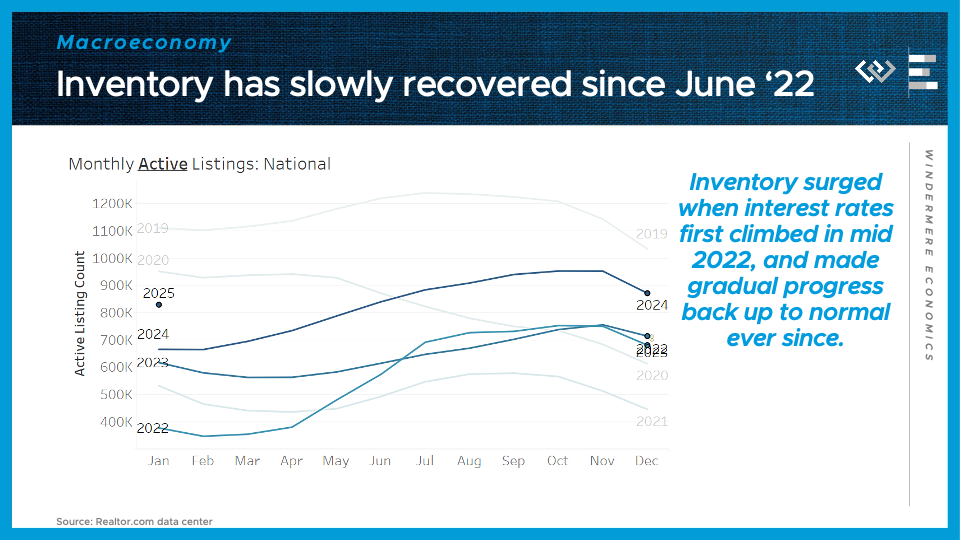
Then in mid-2022, interest rates shot up from record lows of around 3%, above pre-pandemic levels, to the highest in a generation, which helped put the brakes on homebuyer demand for a while, which has slowly helped inventory build back up toward normal levels, and that’s almost where we are today.

Now what does higher inventory really mean: It should restore some balance to the market between buyers and sellers, putting a damper on home price appreciation; helping homes sell a little slower on average; and giving buyers more variety of choices and a little more negotiating power. All of that means the market is shaping up to be a little friendlier for buyers this spring.

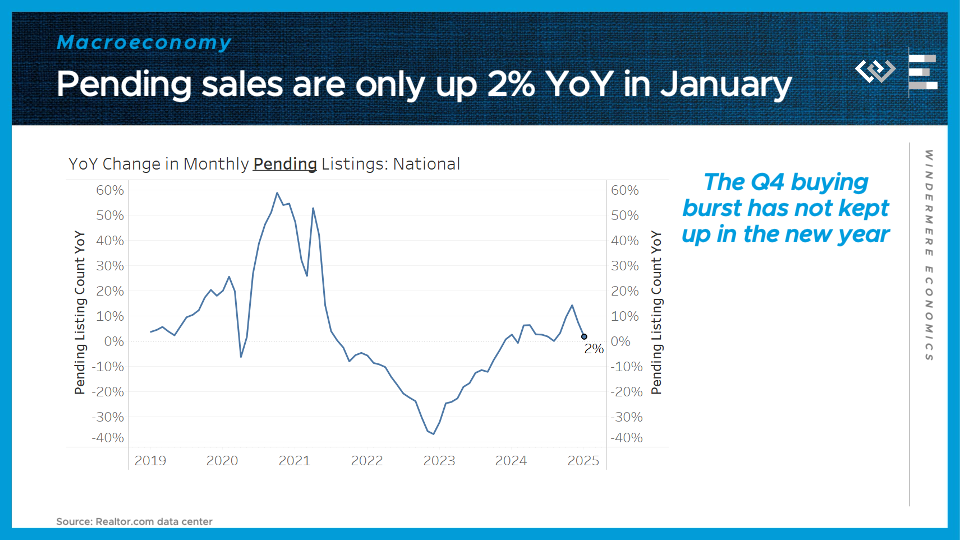
Pending sales have risen just 2% from the same time last year, showing that the home-purchase surge in Q4 of 2024 has not really continued into the new year. That surge was driven by lower interest rates, so it’s perhaps not surprising to see it peter out now that interest rates are back up around 7%. The second number to know this week:

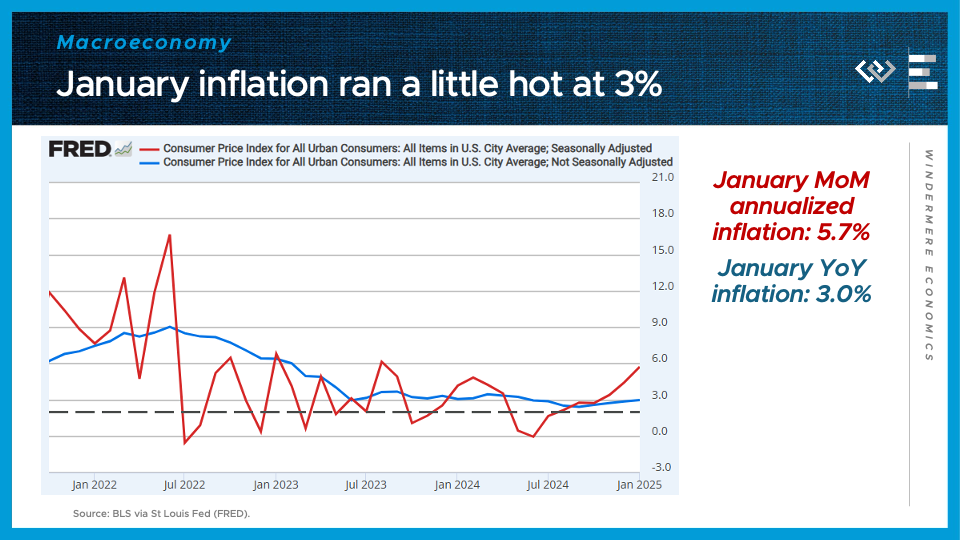
3%

That’s the inflation rate in January, as measured by the year-over-year change in the Consumer Price Index. As a reminder the Fed is aiming for inflation of just 2%, so this figure is still running a little too hot. This is just one data point, but stubborn inflation is one reason why the Federal Reserve did NOT opt to cut their short-term interest rate at their most recent meeting.

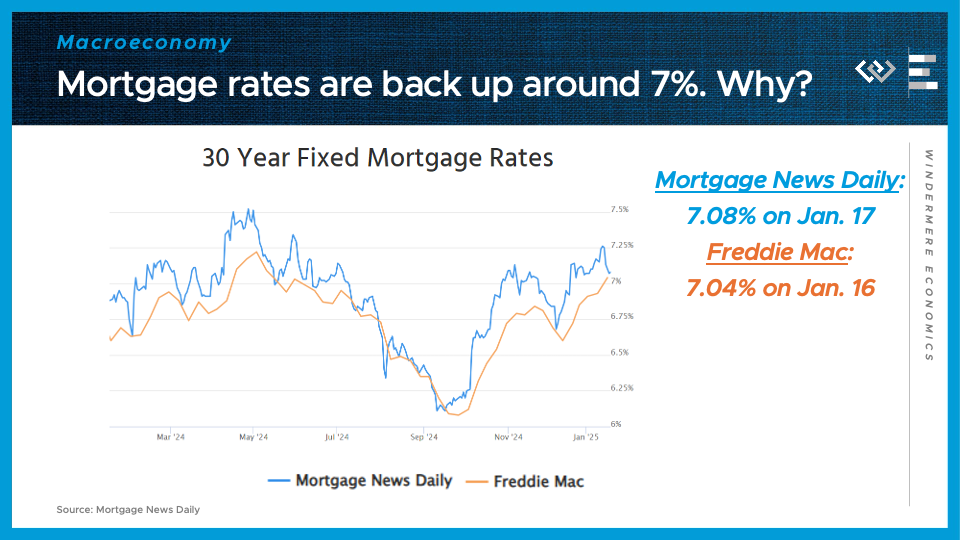
Speaking of interest rates, our last number to know this week: a little less than 7%. That’s where interest rates have moved recently, giving a little bit of relief to homebuyers, but still probably feeling a bit high for many folks. I think some gradual further declines are possible, but certainly not guaranteed, and really big declines seem especially unlikely any time soon.

Selling February 17, 2025

Making the Most of a Home Inspection

A home inspection can be a useful tool for buyers, sellers, and anyone looking to protect their investment and get the greatest possible value from their home.

Identifying Issues Early

When you’re selling a house, a pre-sale inspection can be incredibly beneficial. By identifying any potential problems your house may have, an inspection can give you an opportunity to address them before your first prospective buyer arrives. A pre-listing inspection can give you an edge as a seller, particularly in a competitive market. Potential buyers are likely to find the kind of detailed information an inspection provides reassuring—and are encouraged to give your home a closer look.

When Should You Get a Home Inspection?

Beyond routine maintenance and pre-sale inspections, there are several circumstances in which a home inspection could greatly benefit a homeowner. Here are a few simple questions to ask yourself to determine if an inspection makes sense:

  • Was your home inspected when you bought it? If not, consider scheduling one, even if the home was new at the time of construction.
  • Are you an older homeowner looking to make upgrades to stay in your home? If you are, it makes sense to hire a professional who can inspect difficult-to-reach areas and point out maintenance of safety issues.
  • Are you buying a home that’s under construction? You may want to hire an inspector early on and schedule phased inspections to protect your interest and ensure that the quality of construction meets your expectations.
  • Do you have a baby on the way or small children? An inspection can alert you to any potential safety issues that could possibly affect a growing family, such as mold, lead, or structural problems. If mold or lead is present, be sure to rely on technicians or labs with specialized training in dealing with these conditions.

What Home Inspections Do Not Cover

For a variety of reasons, some homes will require special inspections that are not covered by a typical home inspection. A specialty inspection might include a sewer scope, septic system, geotechnical conditions (for homes perched on steep slopes or where there are concerns regarding soil stability) or underground oil storage tank. If you have any questions about whether your home needs a specialty inspection, talk to your real estate agent.

Choosing a Professional

If you decide to hire a home inspector, be sure they’re licensed in your state. They should be able to provide you with their license number, which you can use to verify their status with the appropriate government agency. It’s also helpful to ask for recommendations from friends and family members. Even among licensed and qualified home inspectors, there can be a difference in experience, knowledge, performance and communication skills, so learn what you can before you hire a home inspector to ensure that you get the detailed inspection that you want.

Understanding Your Home Inspection Report

Once the inspection is complete, you’ll receive a detailed report covering any issues found. Focus on major concerns like structural and electrical and consult your inspector or a specialist if anything is unclear. You can ask your inspector to walk you through the report and help prepare you for the next steps.

What to Ask Your Home Inspector

When hiring a professional inspector, ask these important questions to make sure they are qualified and the right fit for the job.

  • What does your inspection cover? Insist that you get this information in writing. Then make sure that it’s in compliance with state requirements and includes the items you want to be inspected.
  • How long have you been in the business? Ask for referrals, especially with newer inspectors.
  • Are you experienced in residential inspections? Residential inspection in a unique discipline with specific challenges, so it’s important to make sure the inspector is experienced in this area.
  • Do you make repairs or make improvements based on inspection? Some states and/or professional associations allow the inspector to perform repair work on problems uncovered in an inspection. If you’re considering engaging your inspector to do repairs, be sure to get referrals.
  • How long will the inspection take? A typical single-family dwelling takes two to three hours.
  • How much will it cost? Costs can vary depending upon a variety of things, such as the square footage, age, and foundation of the house.
  • Can I be there for the inspection? Will you go over the inspection report with me? This could be a valuable learning opportunity. If your inspector refuses, this should raise a red flag.
  • Are you a member of a professional home inspector association? What other credentials do you hold? Ask to see their membership ID; it provides some assurance.
  • Do you keep your skills up to date through continuing education?An inspector’s interest in continuing education shows a genuine commitment to performing at the highest level. It’s especially important in older homes or homes with unique elements.
Buying February 10, 2025

Finding Your New Home in Four Steps

Whether you’re a first-time home buyer or a seasoned homeowner looking for a new space, navigating the real estate market can feel confusing and overwhelming without the proper guidance and tools. But with some preparation and a solid game plan, you’ll be unlocking the door to your dream property faster than you can say, “Welcome home!”

These five steps will help you find a home that fits your budget and is suitable for your future needs. By taking the time to plan and work through each step, you can minimize potential headaches and enjoy a smoother, more rewarding home-buying experience.

Step 1: Talk to An Agent

Even if buying a home is just an idea in the back of your mind, your first move should be connecting with a licensed real estate agent. They’ll give you up-to-the-minute insights on real estate market trends, mortgage industry shifts, and what to expect at every stage of your journey. More than just a guide, a great agent will also connect you with trusted lenders, inspectors, and other professionals.

Buying a home is one of the most significant financial and emotional purchases a person will make. That’s why finding a credible agent who understands the home search process and takes the time to listen to your needs, answer your questions, and advocate for your best interests is so important. As you start your search, consider these 10 qualities to look for in a real estate agent to help you find the right fit.

Step 2: Set Your Budget

It may not be the most exciting part of the home-buying journey, but reviewing your finances upfront and understanding what you can afford will save you time and stress down the road. And with 2025’s mortgage rates and affordability challenges, understanding your budget is more important than ever. Your real estate agent can connect you with a reputable mortgage advisor who will help you determine how much you can borrow and explore financing options.

A mortgage advisor will also help you assess different loan options, down payment requirements, and potential programs and tools that could make homeownership more affordable. Once you have a solid budget in place, you can focus your search on homes that truly fit your needs, giving you a better shot at securing the right home in a competitive market.

Step 3: Envision Your Future

A general rule of thumb when purchasing a home is that the investment typically takes about five years to start paying off financially. That’s why choosing a home that meets your current needs and aligns with your future needs is essential. Think about what life might look like in the next five to ten years—will you need more space for a growing family or pets? Do future hybrid work opportunities make walkability, public transportation, or a home office more important? Consider factors like schools, outdoor spaces, and community amenities that align with your evolving lifestyle.

Once you have a clear vision, share these details with your real estate agent. They’ll help you identify homes that offer the flexibility and functionality to grow with you, ensuring your next home is the right fit for today and the future.

Step 4: Research Neighborhoods and Communities

Another critical step in finding the right home is researching and exploring the neighborhoods and communities that align with your lifestyle. Consider factors important to you, like local schools, dining and shopping, outdoor recreation, and community culture. It’s also worth looking into crime rates, insurance costs, potential future developments, or even risk zones such as flood zones, as these can impact both your living experience and long-term investment. A holistic approach to your home search will ensure you love your house and the life you build around it.

Step 5: Visualize Your Ideal Home

Once you’ve narrowed your search, it’s time to dream a little—but stay realistic. Make a list of the features that matter most, dividing them into “must-haves” and “really wants.” You can use visualization tools like mood boards or apps like Pinterest to bring your vision to life. When you’ve outlined your priorities, share them with your agent and stay flexible—you may find the perfect balance of practicality and potential in an unexpected place.

Bonus Tips: Keep Your Finger on the Pulse of the Real Estate Market

Real estate is always changing, and staying informed can give you a competitive edge. Follow local market reports, real estate websites, and social media platforms, and keep in touch with your agent for the latest insights on pricing trends, inventory, and new listings.

For more tips and a step-by-step guide to buying a home, visit our “Buyer Basics” page or to connect with an experienced Windermere agent, get started here:


LivingMoreWindermere February 3, 2025

Windermere Partners with Esterre to Reimagine Second Home Ownership

As more and more people desire an escape from everyday life, the appeal of second home ownership has grown stronger. But when the dream of owning a vacation home meets the reality of maintenance, expenses, and logistics, many buyers begin to question whether the rewards outweigh the challenges. Esterre, in partnership with Windermere Real Estate, is changing the narrative by introducing a fresh, innovative approach to second homeownership that redefines what’s possible. Here’s all you need to know about this exciting new partnership.

The Challenges of Owning a Vacation Home

Beyond the upfront purchase of a vacation home, the ongoing costs of maintenance, landscaping, and furnishing can quickly add up, making the experience feel less like a relaxing retreat and more like managing a second job. On top of that, many owners find themselves traveling less and tied to their vacation homes to make the most of their investment. While the idea of having a dedicated getaway is appealing, it can limit the freedom to explore new destinations and create diverse experiences. These common hurdles have left many wondering if there’s a more flexible, hassle-free way to enjoy the benefits of second home ownership.

Meet Esterre

Esterre, founded in Seattle in partnership with Windermere in 2024, is redefining what it means to own a second home. By introducing a fresh approach to second homeownership, Esterre enables individuals to have an equal equity ownership in a portfolio of carefully curated properties in some of Washington State’s most desirable destinations. This model eliminates the headaches and stress of maintenance, furnishing, landscaping, cleaning, and financial management, offering owners a seamless, stress-free experience. Each home in the portfolio is thoughtfully designed and fully managed, allowing owners to simply enjoy their time away.

How Windermere and Esterre Are Simplifying Second Home Ownership

Windermere’s collaboration with Esterre marks an exciting step forward in the real estate world. Combining Windermere’s trusted expertise with Esterre’s innovative concept, this partnership offers a flexible, transparent, and economically sensible solution to traditional vacation home ownership challenges. For a fraction of the cost of purchasing a single vacation home, buyers gain equity in a portfolio of high-end properties across Washington State’s most scenic destinations, including Snoqualmie Summit, San Juan Island, Whidbey Island, Fidalgo Island, and the Olympic Peninsula, with more locations to come. These homes, all within a 2- to 3-hour drive from Seattle, are thoughtfully chosen to provide guests with various environments and experiences. Owners can enjoy over a month of annual access to these luxurious properties, with unlimited short notice stays available within 5 days of booking. And, unlike traditional timeshares, Esterre also incorporates a built-in exit strategy, selling the portfolio after 12 years and distributing the proceeds to owners.

Whether it’s a serene island retreat or a mountain escape, this partnership creates a unique opportunity for agents to connect with clients who dream of owning a second home but are deterred by the high costs and responsibilities. Together, Windermere and Esterre are opening doors to a more accessible, flexible, and memorable way to explore Washington State and build lasting memories.

Discover more at esterre-wa.com.

DesignMore January 29, 2025

Pantone 2025 Color of the Year: Infusing Mocha Mousse into Your Home

Another year, another reason to repaint. Pantone, the global authority on color, has announced its 2025 Color of the Year, “Mocha Mousse.” And as this year’s interior design trends lean towards more earthy tones, this creamy, rich brown is set to be everywhere—from your morning coffee to your neighbor’s curtains. Whether aiming to create a relaxing and warm sanctuary or add a refined accent to your home, Mocha Mousse is the perfect color to set the mood. Check out these creative and stylish ways to introduce this timeless color into your home and elevate your atmosphere.

Pantone Color of the Year: Mocha Mousse

PANTONE 17-1230 Mocha Mousse is a warm, muted brown with creamy undertones inspired by the decadent qualities of chocolate mousse and coffee. Chosen for its perfect balance of richness and warmth, Pantone describes Mocha Mousse as reflecting our collective desire for comfort, indulgence, and connection. Its smooth and inviting tones combine sophistication with coziness, making it a versatile neutral color that can enhance any space.

How to Use Mocha Mousse in Your Home

Mocha Mousse follows the latest interior design trends that embrace earthy, neutral tones. From minimalist to eclectic, it pairs beautifully with various styles, materials, and color palettes, ideal for any room needing a warm hug. Whether used on accent walls, in textiles like throw pillows and drapes, or through smaller décor details, Mocha Mousse infuses spaces with elegance and a soothing ambiance.

Harmonizing Mocha Mousse with Complementary Color Pairings

Mocha Mousse isn’t just a color—it’s a mood setter, harmoniously blending with many design styles and color schemes. Pantone’s color enthusiasts created five unique palettes featuring the versatile hue, each designed to evoke a different mood. These palettes included a serene, airy combination of soft neutrals in “Relaxed Elegance,” calming, nature-inspired tones like willow green in “Floral Pathways,” and vibrant, exotic contrasts in “Uniquely Balanced.”

Using their expertly curated color stories and suggested harmonies, you can easily integrate the delicious 2025-color Mocha Mousse into your home’s existing color palette. For instance, it compliments warm tones like deep reds, pinks, or soft oranges, adding depth without overwhelming the space. If you have cooler shades like blues and greens, Mocha Mousse will balance these tones, creating a more grounded space. For a more subtle touch, you can also pair it with natural wood tones, light grays, or delicate creams to enhance its elegance. If you want to explore more color options that fit your style, check out these 11 Ways to Uncover Your Personal Color Palette.

Using Mocha Mousse with Interior Design Trends of 2025

Earthy, neutral tones are here to stay in 2025, and Mocha Mousse is leading the charge with its grounding, warm appeal. With brown furniture also remaining a strong trend, this hue can complement rich wood and leather pieces, adding comfort and sophistication. It beautifully blends with natural materials like stone, wood, and ceramics, enhancing modern, rustic, and bohemian interiors, along with many others. Similarly, Mocha Mousse pairs well with metals and verdigris, which have become increasingly popular.

Mocha Mousse naturally complements the curvier lines, soft shapes, and rounded furniture pieces that are defining 2025. It can be easily into spaces with arched doorways and rounded furniture to create a polished, inviting environment. You can also embrace it with the comeback of wallpaper, upholstered walls, and drapery, whether in subtle patterns or rich textures like suede and velvet, bringing more dimension to the room.

With Mocha Mousse as your foundation, you’ll effortlessly embrace this year’s design trends, creating a space that is timeless, warm, and sophisticated.

Market News January 21, 2025

Housing & Economic Update: What’s Going on With Mortgage Rates?

This is the latest in a series of videos with Windermere Principal Economist Jeff Tucker where he delivers the key economic numbers to follow to keep you well-informed about what’s going on in the real estate market.


This week the numbers to know are all about mortgage rates and the factors that have pushed them back up over the last few months.

7%

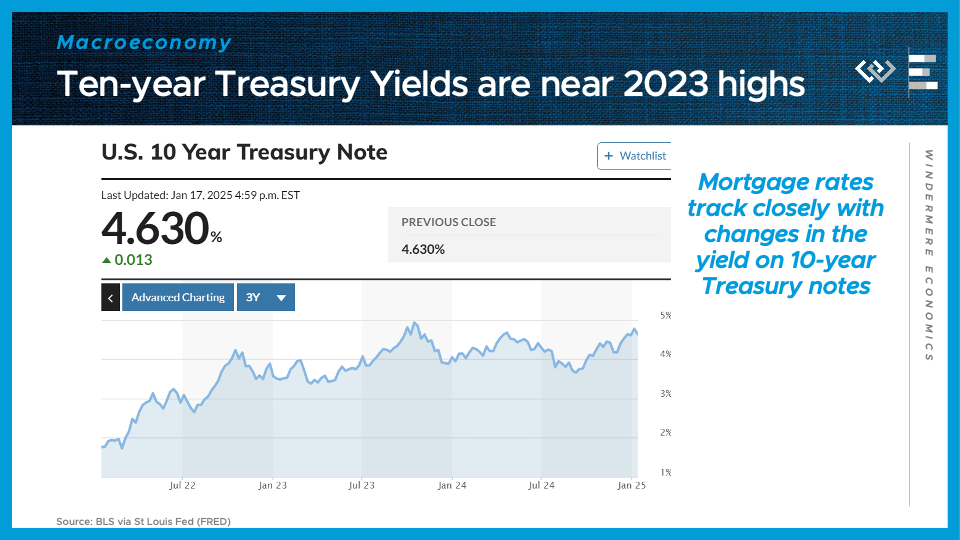
That’s around the typical interest rate on a 30-year fixed rate mortgage right now, according to both Freddie Mac and Mortgage News Daily. That’s also almost a full point higher than it was just 4 months ago, in mid-September. I should add that the daily data have been very volatile lately, with rates jumping up and down by 10 or 15 basis points. But in the bigger picture, this is the first time since last May that Freddie Mac’s weekly survey showed rates above 7%.For the proximate cause of the higher mortgage rates we can look at our 2nd number to know right now:

4.63%

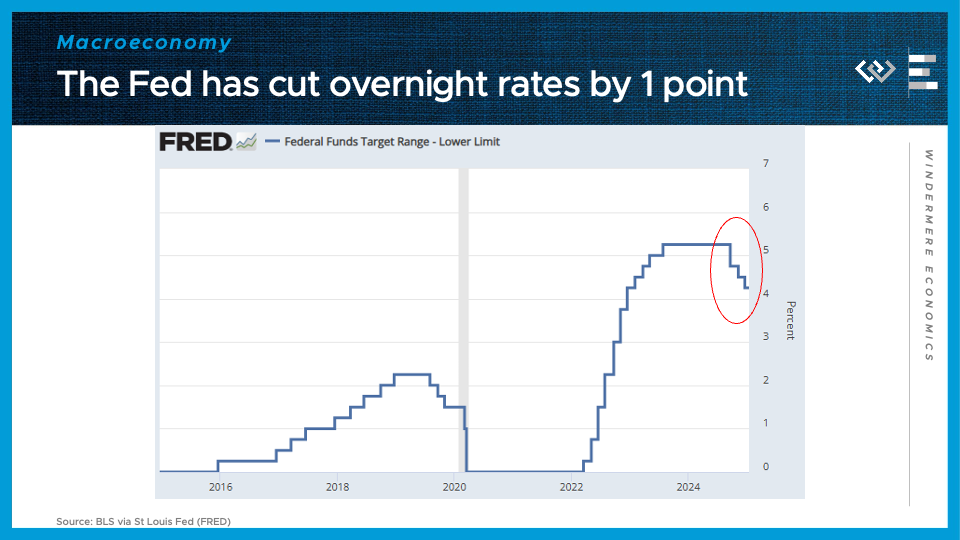
This is the latest 10-year Treasury yield as of January 17. Mortgage rates tend to track closely with this key benchmark long-term yield, plus a spread of a little more than 2 points. There is a bit of a puzzle here, though: the Federal Reserve has been cutting the Federal Funds Rate, an ultra-short term overnight interest rate. They started with a supersized half-point cut in September and then two more quarter-point cuts.

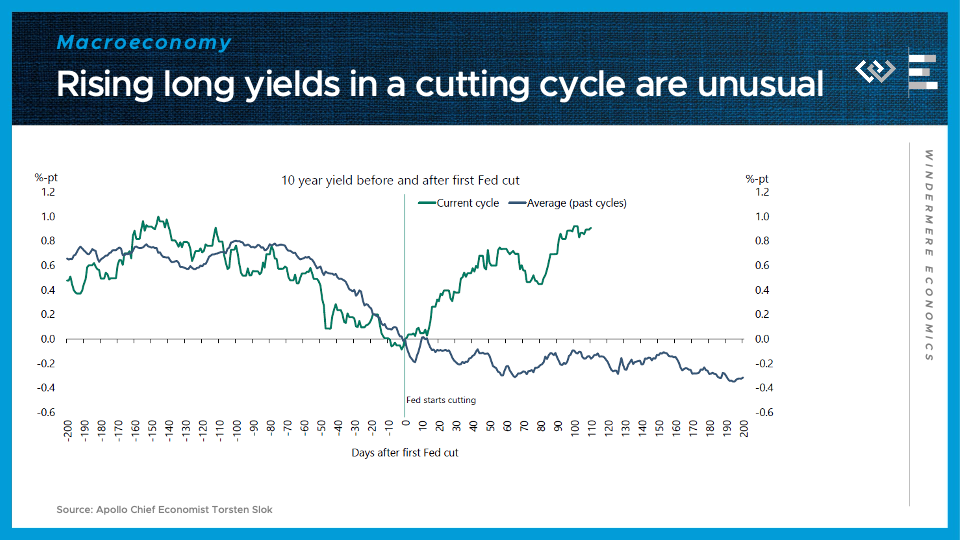
As Torsten Slok, Chief Economist at Apollo Global Management, recently flagged in this chart, historically, 10-year Treasury yields tend to continue declining modestly after the Fed has begun cutting the short-term rate. But this time is sharply different – instead, those long-term rates have more than backtracked all the downward progress they made over the summer. The short answer for why they’ve moved back up is that the outlooks for 3 factors have climbed recently: real economic growth, inflation, and borrowing.

For economic growth, our next number to know is

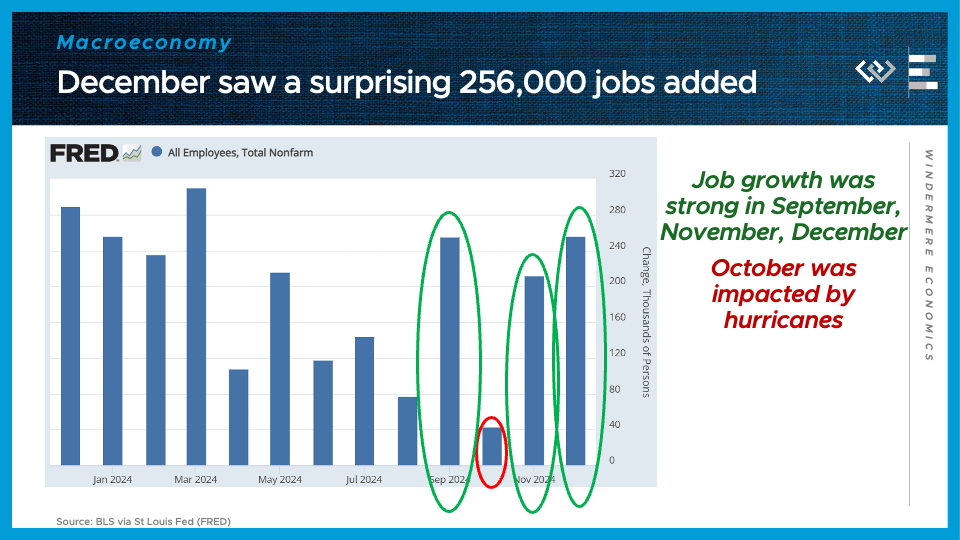
256,000

That’s the surprisingly large number of new payroll jobs added in December, according to the latest jobs report from the Bureau of Labor Statistics. Aside from October’s hurricane-impacted report, that makes three surprisingly strong months of job gains to close out 2024.
For inflation, our final numbers to know are:

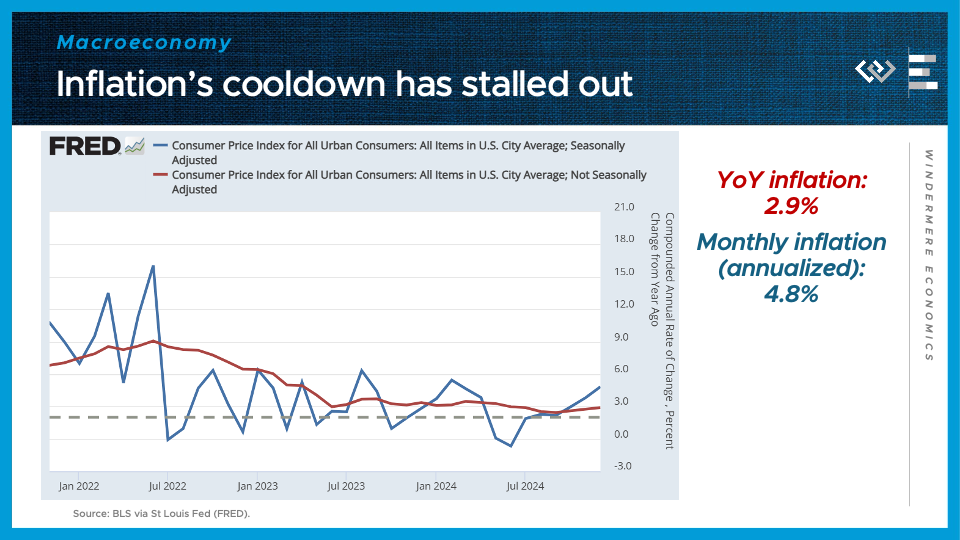
2.9% and 4.8%

Those are the year-over-year inflation rate of the consumer price index, and the latest monthly growth rate compounded out to an annualized rate. Both are running hotter than the Fed’s target of 2%. Combined with the surprisingly resilient labor market, these data are tamping down investors’ expectations for further rate cuts by the Fed – all of which is helping to feed into those higher Treasury yields and therefore higher mortgage rates.

Market NewsMore January 7, 2025

Local Look: Western Washington Housing Update 1/7/25

Hi. I’m Jeff Tucker, principal economist at Windermere Real Estate, and this is a Local Look at the December 2024 data from the Northwest MLS.


After two very strong months of data covering October and November, we got one last month of strong closed sales data in December, but a slowdown in pending sales growth suggests we shouldn’t expect a boom in closings to start out the New Year.

Here are the four key metrics I watch to track supply and demand in the market: closed and pending sales, which tell us a lot about demand; and listings – new and active – which tell us a lot about supply.

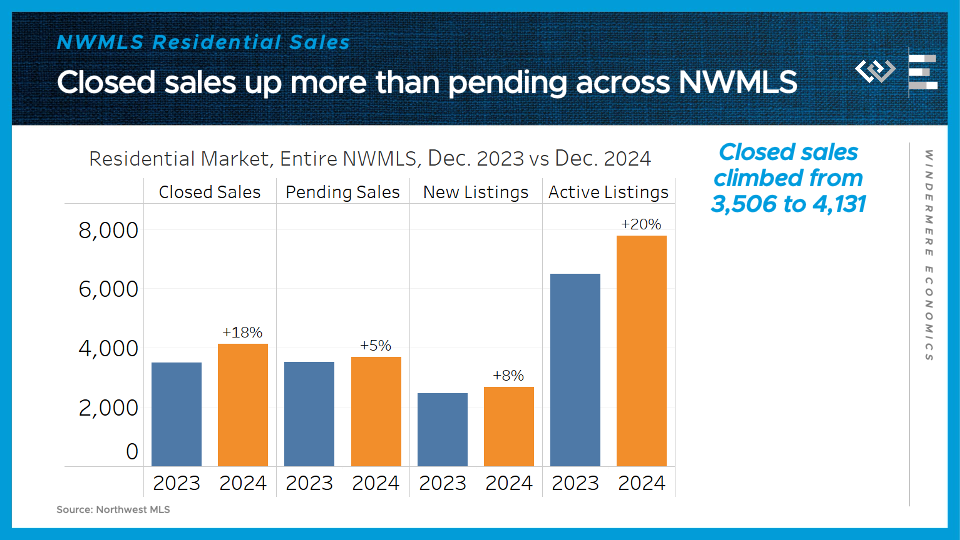
Closed sales of single-family homes climbed 18% year-over-year, from about 3500 to over 4100. Pending sales, which will mostly close in January, only climbed 5% from the same month last year.

On the supply side, about 8% more new listings hit the market this December compared to last one, while the level of inventory in the reservoir was 20% higher at the end of 2024 than at the end of 2023. Of course this is a quiet time of the year in the market, so we should expect all these measures of listings to pick up soon.

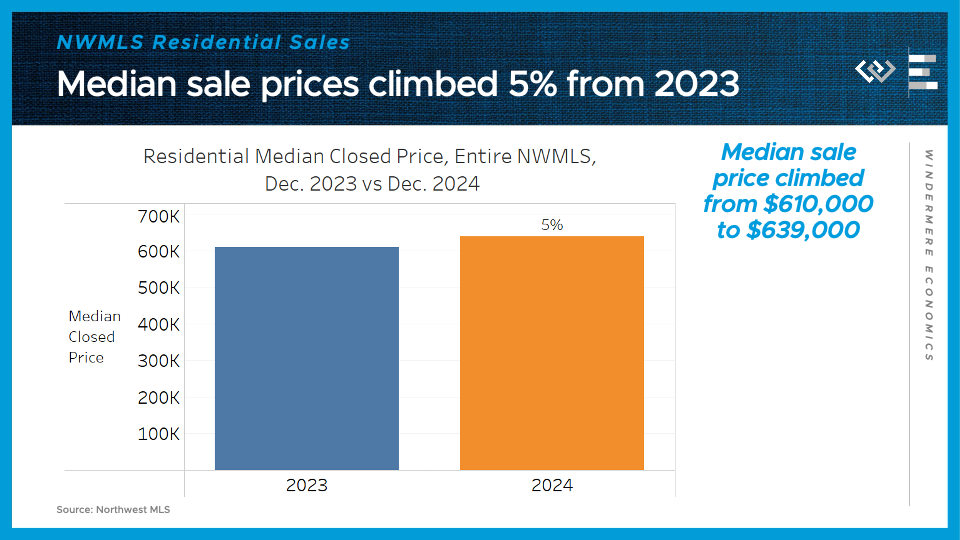
The final key metric to check in on: the median price for those closed single-family home sales climbed about 5% year-over year, from $610,000 to $639,000. That’s a bit of a cooldown from price growth in the previous couple of months, and it’s pretty similar to the pace I’m projecting for 2024.

Putting it all together, this looks like a market that had a surge of demand after the Fed began to cut rates in September, but where that demand bump is cooling off now that mortgage rates have stubbornly rebounded to nearly 7%.

Now I’ll dig into the three counties that comprise the Seattle metropolitan area, where we saw similar trends play out.

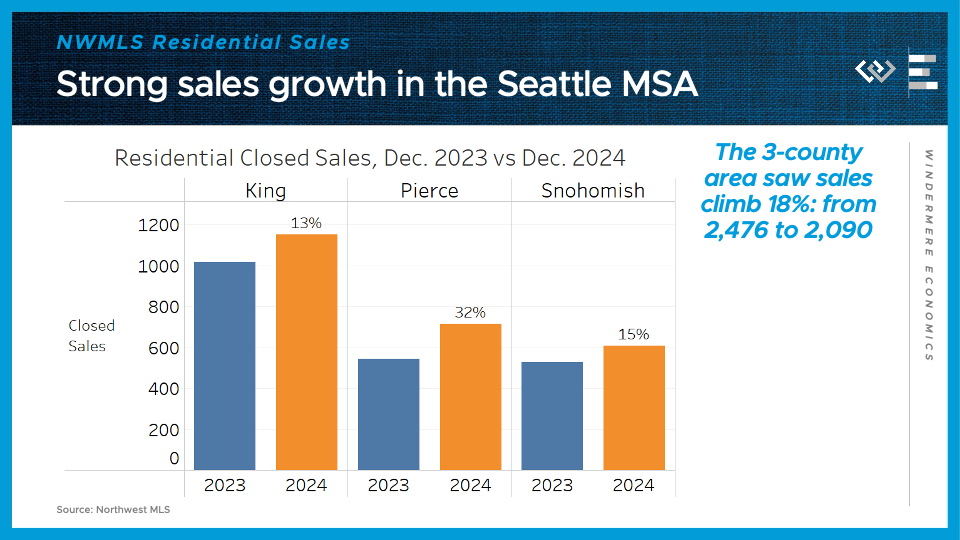
Residential closed sales climbed 13 percent year over year here in King County, which includes Seattle and Bellevue; a whopping 32% down in Pierce County, including Tacoma, and 15% up in Snohomish County, including Everett. So for the 3-county metropolitan area as a whole, that’s a gain of 18% from the same month last year. November, by comparison, saw a 30% increase for the whole MSA, so the sales gains are clearly decelerating.

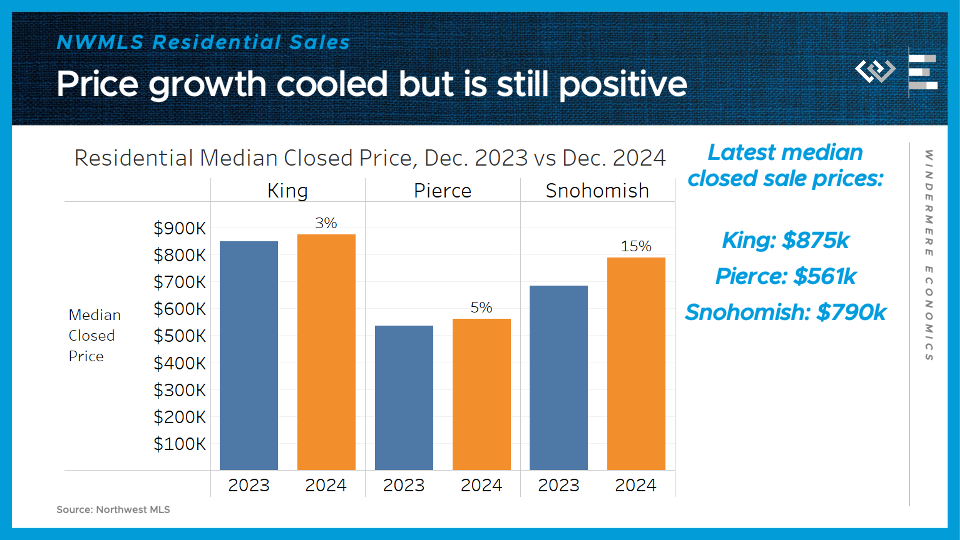
The median sale price climbed modestly: just 3% from last year in King County and 5% in Pierce County, but a whopping 15% in Snohomish. This statistic can get noisy when the sample size is small, like in December, so I think we won’t have a clear view of Snohomish price trends for another couple of months.

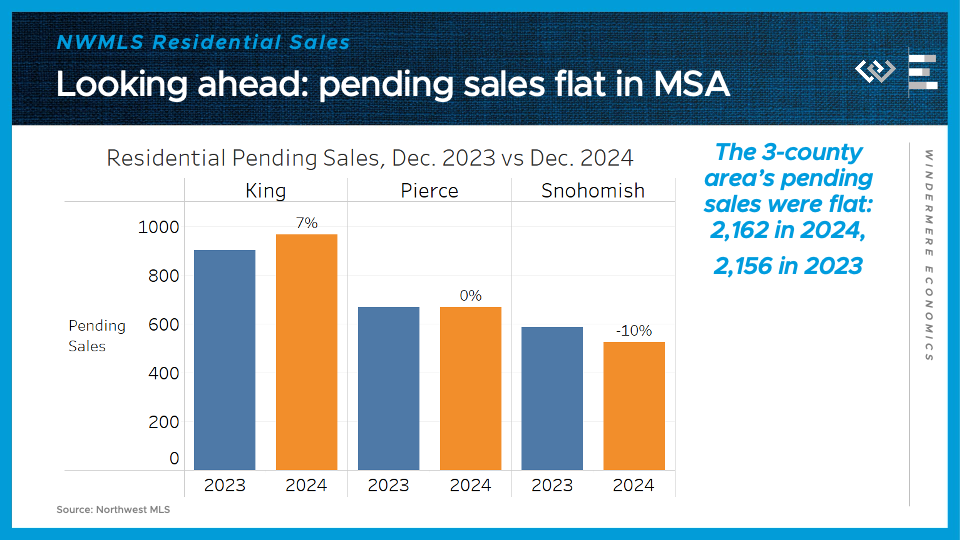
Looking ahead, there was a pretty different picture for pending sales in each of these counties: up 7% in King, flat year-over-year in Pierce, and down 10% in Snohomish. Again, sales in December are so thin that random noise can look like big changes, so I wouldn’t read too much into that data point for Snohomish County, but the broad picture for the 3-county area is that pending sales were essentially flat year-over-year in December.

On the supply side, the 3-county metro area had about 22% more active listings to end the year than there were at the end of 2023. That could give buyers more options as they start their house hunt in Q1, and could help keep price growth in check. But the biggest factor behind supply and demand this spring will be the number of new listings that come out of the woodwork, which will only start to come into focus in the months ahead.

ArchitectureDesign January 6, 2025

What is Prefab Architecture?

Short for “prefabricated,” prefab architecture refers to a type of construction where building components are manufactured off-site and then transported and assembled at the construction site. In recent years, prefab architecture has transformed how homes are built and designed, gaining popularity due to its efficiency, cost-effectiveness, and sustainability. In this post, we’ll explore the various types of prefab architecture, examine its pros and cons, and help you determine whether it fits your lifestyle, wants, and needs.

What is Prefab Architecture?

Prefab architecture is any structure built using components made off-site and then brought to a lot for assembly. Due to increasing appeal, prefab homes now come in various sizes, styles, and distinct forms to suit a range of needs and preferences. They can range from small backyard bungalows or guest houses to larger, multi-story, single-family homes, and the best part, they can be highly customizable. Some of the most common types of prefab construction include kit homes, modular homes, and panelized homes, each with its own set of benefits.

Kit Homes

A kit home is a prefabricated home that comes in pre-cut materials and is delivered to a property with instructions for building. They are smaller and more straightforward structures, often chosen by those who prefer a DIY approach. These homes are also typically more affordable and customizable.

Modular Homes

Similarly, modular homes are prefabricated homes made up of sections, known as modules, also made in a factory or off-site and then transported to the construction site. Unlike kit homes, modular homes must be assembled on a permanent foundation. Due to the pre-built sections, modular homes tend to be quicker to assemble and require the least amount of on-site work.

Panelized Homes

Panelized homes are another popular method of prefab architecture. Instead of building entire sections or modules, this technique involves constructing individual panels—including walls, floors, and roofs—in a factory. Compared to modular homes, panelized homes offer much more flexibility and customization in design and layout during the building process.

Pros and Cons of Prefab Architecture

Prefab architecture offers many benefits that make it an appealing choice for many people. The primary advantages include reduced costs, faster construction times, and a smaller environmental footprint with excellent energy efficiency. This is due to the controlled factory environment where the building components are made, minimizing waste, optimizing materials, and reducing on-site interferences like weather delays or unexpected construction challenges. Additionally, prefab homes often come with high-quality construction standards and can be highly customizable to fit different styles and preferences.

However, there are still some downsides and drawbacks to consider when thinking about investing in a prefab home. Land costs, transportation fees, utilities setup, and the need for permits can make for higher upfront expenses than expected. Additionally, some locations have stricter zoning laws and building regulations that may prevent or limit where prefab homes can be placed.

Is Prefab Right for You?

Prefab architecture combines affordability and sustainability, offering an innovative solution for those seeking a modern and efficient living space. So, whether you’re looking to downsize or embrace a more eco-friendly lifestyle, a prefab home could be the ideal choice for your next home.

Market NewsWestern Washington Real Estate Market Update December 11, 2024

Local Look: Western Washington Housing Update 12/11/24

Hi. I’m Jeff Tucker, principal economist at Windermere Real Estate, and this is a Local Look at the November 2024 data from the Northwest MLS.


After a blockbuster October report, this was another very strong month for the Washington housing market, especially for sales of single-family homes, and that’s the data I’ll be digging into today.

Here are the four key metrics I watch to track supply and demand in the market: closed and pending sales, which tell us a lot about demand; and listings – new and active – which tell us a lot about supply.

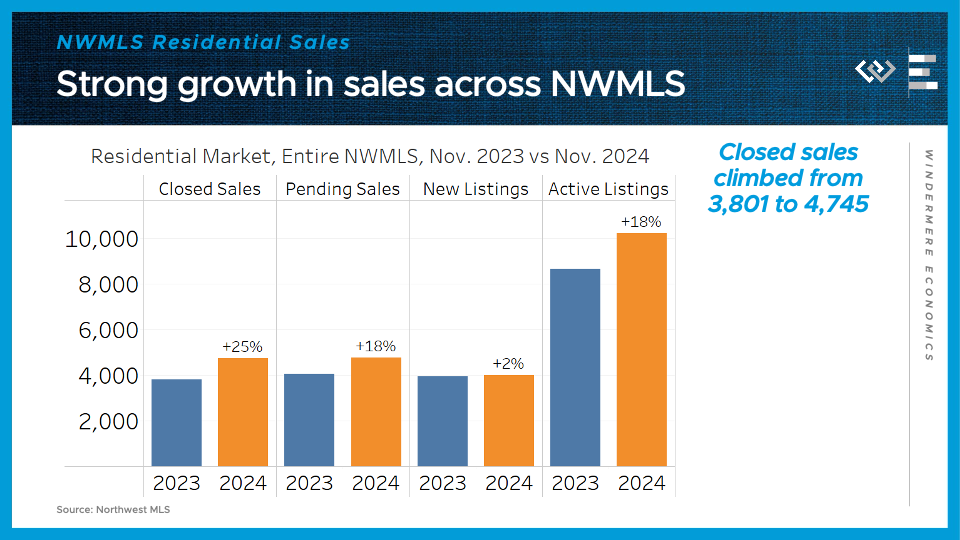
Closed sales of single-family homes climbed 25% year-over-year, from about 3800 to over 4700. Pending sales, which will mostly close in December, climbed a little less from last year, by 18%.

On the supply side, I think of listings as the reservoir of options for buyers to choose from: New listings, which represent the flow of new supply, were up only 2% in November, while the level of inventory in the reservoir was 18% higher than a year ago. Those are both more modest increases than we saw in October, which is a reassuring sign that the market isn’t headed for a glut.

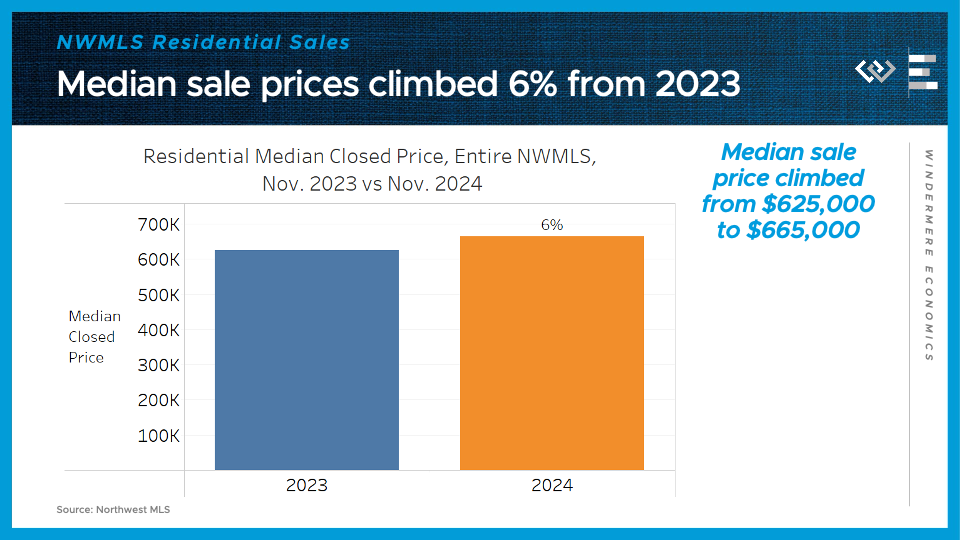
The final key metric to check in on: the median price for those closed single-family home sales climbed about 6% year-over year, from $625,000 to $665,000. That’s slightly lower than last month, which is normal for this time of year, and indicates that price growth is not accelerating in an unusual way. That’s important because affordability is still a key concern for the sustainability of the market throughout Washington.

The strength of closed sales, as well as sustained growth in pending sales, suggests to me that October wasn’t just a flash in the pan, of buyers jumping in because the Fed cut interest rates. Rather, I think that home sales are normalizing after staying extremely depressed for much of the last two years.

Now I’ll dig into the three counties that comprise the Seattle metropolitan area, where we saw similar trends play out.

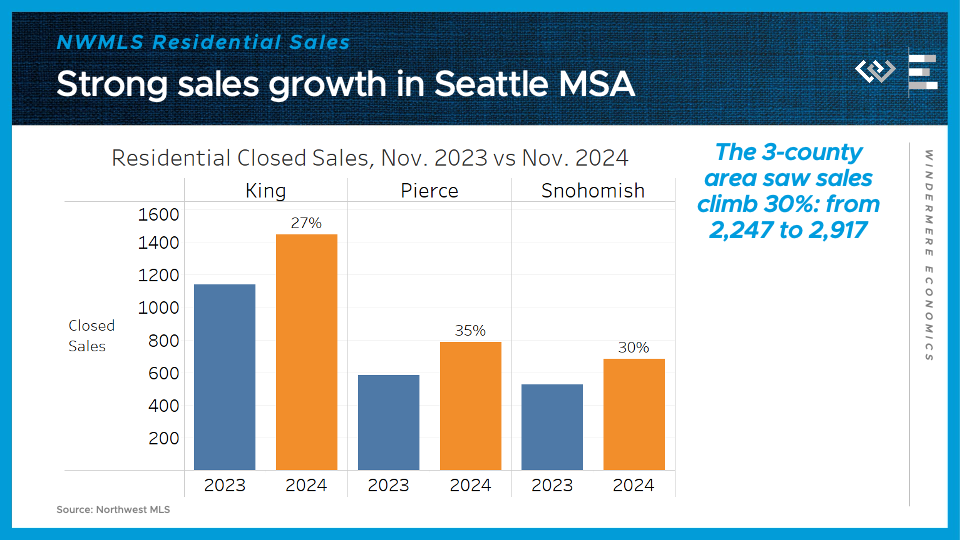
Residential closed sales jumped 27 percent year over year here in King County, which includes Seattle and Bellevue; a whopping 35% down in Pierce County, including Tacoma, and 30% up in Snohomish County, including Everett. So for the 3-county metropolitan area as a whole, that’s a gain of 30% from the same month last year.

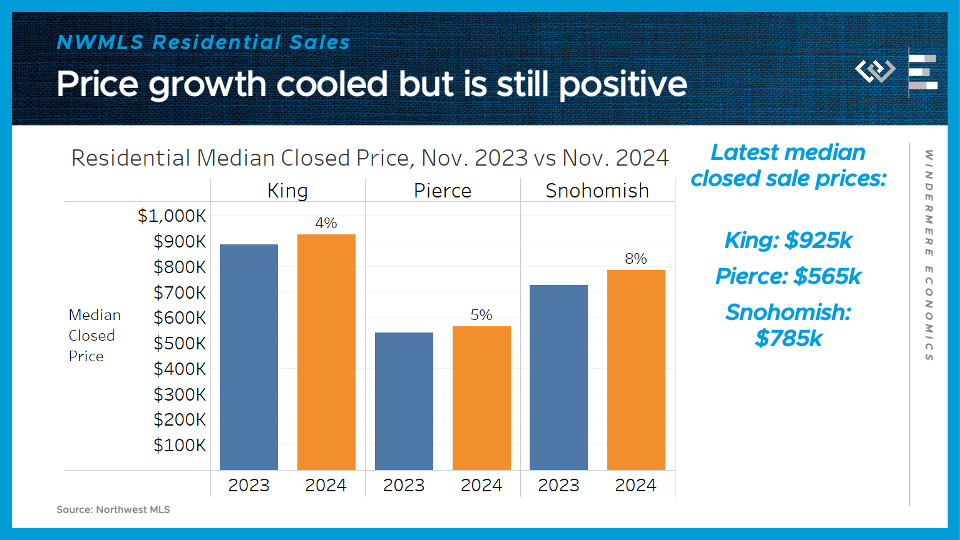
The median sale price for those closed sales climbed a little less than last month, when it was closer to 10% annual gains. In November, closed prices climbed 4% in King County, up to $925,000; 5% in Pierce County, up to $565,000; and 8% in Snohomish County, up to $785,000.

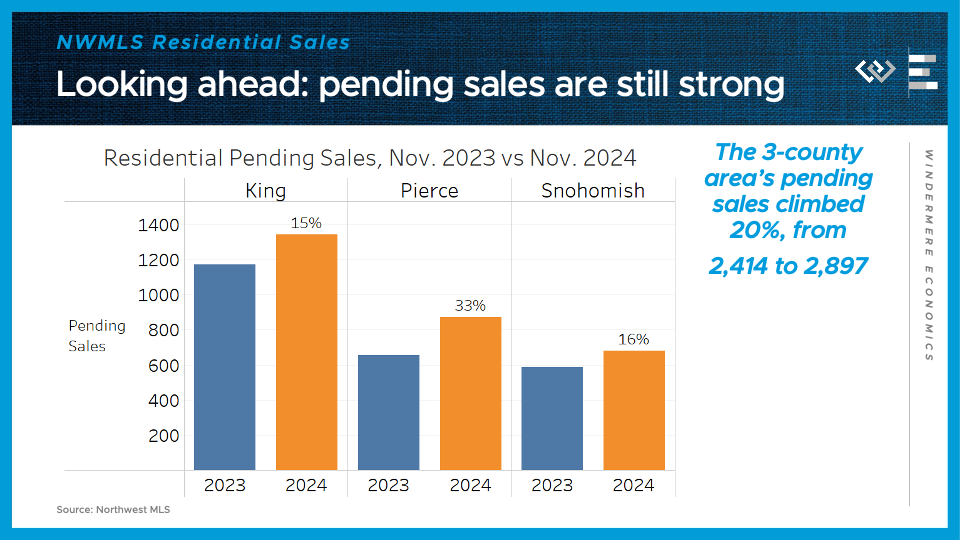
Looking ahead, each of these counties had solid, but somewhat lower annual growth in pending sales than they did in closed sales: 15% for King County; 33% in Pierce, and 16% in Snohomish County.

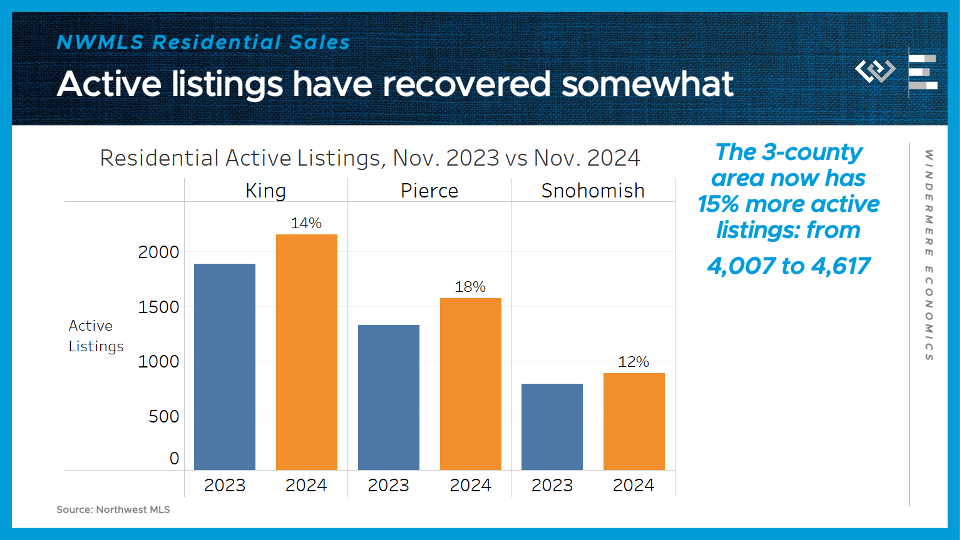
After all those sales, there’s still been a healthy increase in the active inventory of homes available to buy across the metro area, with about 14% more than last year in King County; 18% more in Pierce, and 12% more in Snohomish County, for an overall metro-wide increase of 15%. That’s substantially less than the increase in October, when the 3-county area had 26% more active listings than the year before.

All in all this was another encouraging report showing a much more active market than at the same time last year all around Washington, and it’s good evidence that buyers haven’t just rushed back into hibernation even though mortgage rates rebounded a bit last month.