In the past, lead paint was commonly used to paint homes. Its durability and resistance to moisture were its greatest assets, but it was only a matter of time until health officials discovered its poisonous properties, and in 1978 it was officially banned. Lead paint causes a variety of health issues and is especially harmful to children, so those living in homes built during the lead paint era should be aware of its dangers, how to detect it, and how to go about removing it safely.
Testing for Lead Paint
You won’t know whether lead paint exists in your home unless you test for it. There are a variety of do-it-yourself testing kits available, but their results may vary and can sometimes be prone to false positives, depending on the active testing agent. Given the variability with DIY testing, it may be best to hire a professional to test for lead paint in your home—both for accuracy and peace of mind. You can also choose to send a paint sample into a lab for testing.
Dealing with Lead Paint
If you discover lead paint in your home but it is still intact, encapsulation may solve the problem without having to remove it. Encapsulation is the process of painting over the areas where lead paint exists using a special coating that seals in the lead paint layer underneath. This is often the more affordable way of dealing with lead paint, but the coating may wear off over time, leaving you back at square one.
If you’re thinking about selling your home, the presence of lead paint is a necessary disclosure. Know that buyers generally view a home with lead paint as unfavorable, given its serious health risks and dangers. If you’re thinking about remodeling, testing for lead paint is a wise first step before you start knocking down walls or ripping through sheetrock.
Removing Lead Paint
The more your paint is cracked, chipped, or damaged in any way, the riskier it is. Any signs of deterioration in a lead paint-based home should be dealt with by removing it as soon as possible.
Removing lead paint on your own is generally not advised. It requires specific training and materials, as well as many preventative measures including creating a sealed exit, wearing protective clothing, properly covering the various surfaces in your home, and proper execution of removal to ensure you’ve vanquished all the lead—just to name a few.
Like any other home improvement project, it’s best to consult lead paint removal professionals in your local area and compare their quotes before making your choice. Before the pros come, you can prepare by clearing away any paint chips that have fallen, thoroughly cleaning the surfaces in your home, and encouraging your household and guests to refrain from touching those surfaces.
For more information on preventing damage to your home, read our guide to dealing with mold.
Getting your home ready to sell can feel like a circus act. Without the right organization, juggling the countless moving parts involved in this stage of the selling process can take its toll. This is the perfect opportunity to create a checklist to keep yourself on track and within your budget. The following information will illuminate the key responsibilities you face as a homeowner as you prepare to hit the market.
We’ve included a comprehensive checklist below of the common tasks required to get your home ready to sell. It is also available as an interactive web page and downloadable pdf here: Get Ready to Sell Checklist
Preparing to Sell Your Home: Working with an Agent
Before you start working on the house itself, it’s best to get the ball rolling on the strategic aspects of selling a home. Working with a real estate agent is the best way to get your home sold for the best price in a timely manner.
A listing agent will represent you throughout the selling process to determine the value of your home, coordinate open houses, market the property, and negotiate with buyers to reach a deal. In the early stages of your discussions with your agent, they will conduct a Comparative Market Analysis (CMA) to see what price your home could fetch on the market, accounting for various factors that influence home prices such as seasonality and local market conditions. Based on the findings of your agent’s CMA, you can discuss whether remodeling fits into your go-to-market strategy, and your agent can provide intel on which remodeling projects could deliver significant ROI based on buying trends, your location, and what comparable listings in your market are offering.
Home value estimation tools can help you get an idea of what your home is worth to facilitate your conversations with your agent. Use our free Home Worth Calculator by clicking the button below:
Once you’ve found an agent, you’re ready to get your home in tip-top selling shape. The following checklist is available as a free downloadable PDF here:
This list of value-adding curb appeal projects will help to form buyers’ first impressions of your home and make your ever-important exterior listing photos stand out amongst the competition.
Remove peeling and chipped paint; replace with a fresh coat
Fix loose trim and fencing
Clear gutters and downspouts
Make sure there is good exterior lighting and all walkway lights and front-door lanterns work
Clean and repair the roof as needed
Clear garage of clutter and tidy shelves
Inspect chimney for cracks and damage
Yard
Mow and trim grass; re-seed and fertilize where necessary
Prune all overgrown trees and shrubs
Weed flowers beds
Remove or replace dead or diseased plants, shrubs, and trees
Clean grease and oil stains from driveway
Decks/Patios
Paint or stain worn areas on wood decks
Remove grass growing in concrete cracks; sweep off debris from shrubs and trees
Clean all deck rails and make sure they’re secure; replace missing slats or posts
Clean outdoor furniture
Front Door
Polish or stain worn areas on wood decks
Add a fresh coat of paint to get rid of nicks
Clean the glass on the storm door; make certain the screen is secure
Make sure the doorbell operates properly and there are no squeaks when the door opens and closes
Windows
Clean all windows inside and out
If needed, add a fresh coat of paint to the window trims and sills
Make sure all windows open and close easily
Replace cracked windowpanes and those with broken seals
Make sure window screens are clean and secure; replace any screens with holes or tears
Front Entry
Clean entryway floors and area rugs
Downsize clutter in the entry and entry closet to give the appearance of spaciousness
Double-check entry lighting to make sure it works
Interior
Not only will these interior projects get your house sparkling clean, but they’re also preparatory steps for staging your home and hosting open houses.
General Interior Cleaning
Clean all floors, carpets, walls, and trim
Replace burned-out light bulbs
Empty trash
Remove family photos, valuables, and prescription drugs
Tidy up clutter
Kitchen
Fix dripping faucets
Organize pantry and cupboards so they appear clean, neat, and spacious
Make sure the refrigerator and freezer are defrosted and free of odors
Clean the oven and cook top thoroughly
Set the table
Living/Family/Dining Rooms
Give rooms a fresh coat of paint as needed
Repair cracks and holes in ceiling and walls
Make sure all wallpaper is secure
Repaint any woodwork that is worn or chipped
Clean or replace draperies and blinds; open them to maximize light
Make sure draperies and blinds open and close
Steam-clean carpets
Clean rugs and wood flooring, and remove any stains or odors
Position the furniture to showcase the size and space of the room
Remove and replace any attached items, such as chandeliers and draperies, that you wish to move with you
Put away toys and hobby supplies; remove extra magazines and books from tables
Bathrooms
Make sure sinks, tubs, showers, and countertops are clean and free of stains
Repair any leaky faucets
Remove grout and soap stains from tile
Replace any missing or cracked tiles or grout
Make sure all joints are caulked
Make sure all fixtures, including heat lamps and exhaust fans are operating
Install a new shower curtain and buy matching towels
Store all supplies, such as toilet paper, shampoo bottles and cleansers, out of sight
Bedrooms
Repair cracks in ceiling and walls
Apply a fresh coat of paint if necessary
Make sure all wallpaper is secure
Clean draperies and blinds; open them to maximize light
Put away toys, clothes, and clutter
Neatly make up the beds
Basement
Check for water penetration or dampness; call for professional repairs if necessary
Get rid of musty odors
Clean furnace, hot water heater, and drains
Make sure light fixtures work
Arrange storage area in a neat and organized manner
Make sure stairway handrail is secure
Tidy Extras
Use air fresheners or bake treats to make the house smell good
Plant flowers to brighten the walkway and enrich the entry
Remove any indoor houseplants that are brown or losing their leaves
Remove all “fixer” cars, campers, and boats from the property
Discard the clutter of magazines on the coffee and end tables
Tidy and declutter all closets
Hide or get rid of worn-out throw pillows
Store pet supplies
At night, turn on the porch light and outdoor lighting
Put away toys and hobby supplies; remove extra magazines and books from tables
For more information on preparing to sell your home, helpful hints on the rest of the selling process, tips on working with an agent, moving checklists, and more, visit our Home Selling Guide:
This video is the latest in our Monday with Matthew series with Windermere Chief Economist Matthew Gardner. Each month, he analyzes the most up-to-date U.S. housing data to keep you well-informed about what’s going on in the real estate market.
Hello there, I’m Windermere’s Chief Economist Matthew Gardner and welcome to this month’s episode of Monday with Matthew.
If you’ve listened to me at all over the past several years, you’ll know that I am pretty passionate about one subject: housing affordability. And, given the significant price growth that we’ve seen over the past decade, as well as the recent spike in mortgage rates, I wanted to talk a little bit about what might be done to address this very serious issue.
The Growing Housing Affordability Problem
Now, when we think about housing affordability and how it might be solved, a lot of people get tied up in the minutiae when, quite frankly, it really isn’t that hard a problem to solve. You see, there’s one very simple way to address this: to build more housing units. But, as easy as that may sound, there are a lot of obstacles that are holding new supply back. But before I get to that, I want to share some data with you that might help to demonstrate how serious an issue we all face.
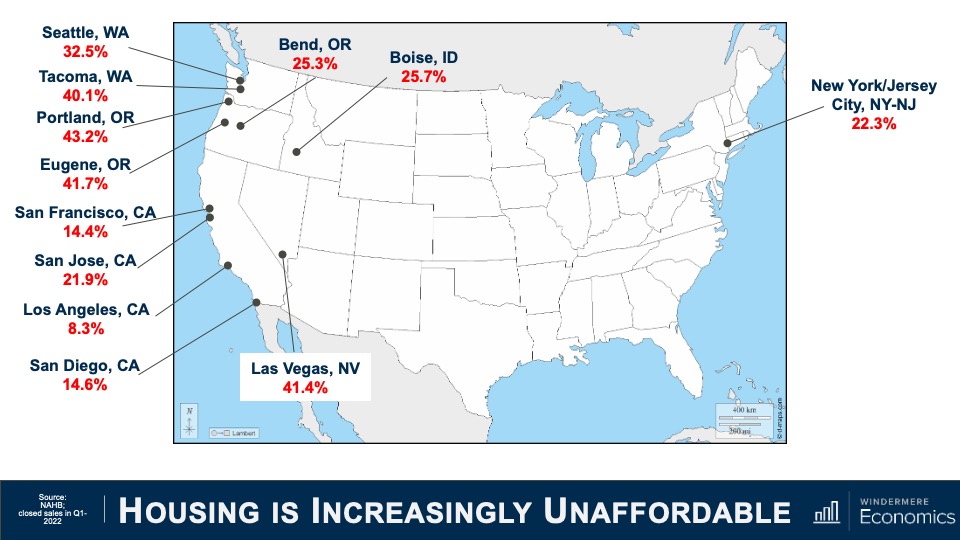
Every quarter, the National Association of Homebuilders puts out its affordability numbers for metro areas across the country. An analysis of sales and incomes allows them to show the number of homes—both new and existing—sold in a quarter that were affordable to households making median income.
Housing is Increasingly Unaffordable
Here you will see numbers from just a few of the 240 metropolitan areas across the country and the share of sales in the first quarter of this year that were “technically” affordable. I think you’ll agree that it’s eye opening.
Although I am only showing you a few of the U.S. markets I will tell you that the ten least affordable US housing markets were all in California. The Golden State is also home to 21 of the top 25 least affordable markets in the country. But what you might also find interesting is that our primary cities aren’t the only ones that are suffering from affordability issues, with markets like Bend, Oregon; Boise, Idaho; and even Las Vegas, Nevada becoming increasingly unaffordable for a lot of households.
And it’s worth mentioning that that 48 of the 69 markets where less than half of the homes sold were affordable were in states that have at some point in the past implemented comprehensive planning and growth management legislation. And when governments mandate where homes can and cannot be built, one thing happens: it pushes land prices higher which makes new homes more expensive and limits the amount of new supply that builders are able to provide. So, what can be done?
Well, I will start out by saying that states who have implemented growth management plans, which they generally did to slow or stop suburban sprawl, remain disinclined to move these boundaries, and that means it becomes paramount to not look further out but to concentrate within the urban growth boundaries and decide whether it’s time to think about removing single-family zoning altogether.
This is a fascinating thought, but I must add that I am not suggesting that we do away with single-family homes. Absolutely not! What I am thinking about is the ability for a market to decide what makes the most sense. In order to do so, single-family zones need to allow for the development of denser housing, but also allow the market to decide what’s best. Areas that have implemented such change has given rise to a movement in order to address what is being referred to as “missing middle housing.” For those of you who are unfamiliar with this term let me try and explain.
Missing Middle Housing
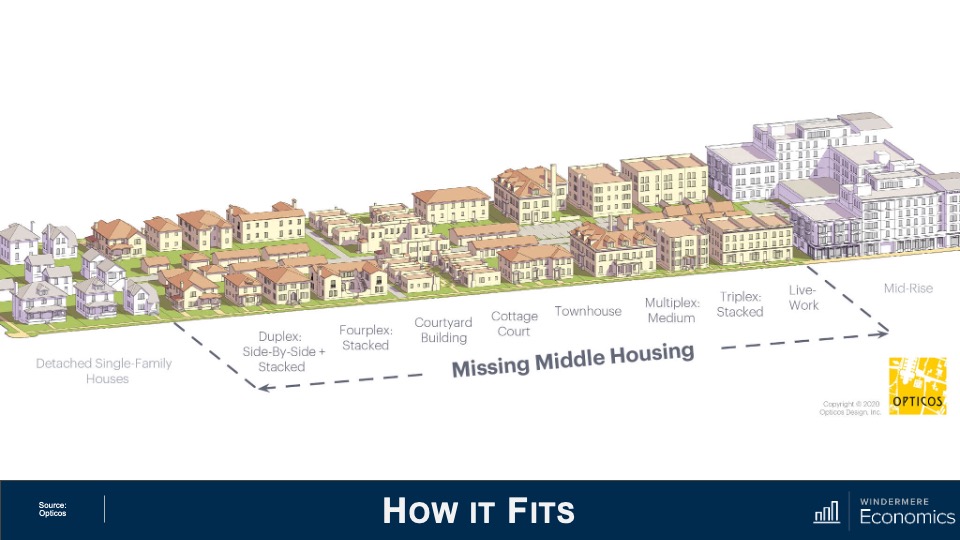
This is a great image courtesy of Opticos, a team of urban designers, architects, and strategists who are passionate about adding sorely needed housing options.
They came up with the term “missing middle” as it describes housing types that were actually very common prior to World War II where duplexes, row-homes, and courtyard apartments were in high demand. Unfortunately, however, they are now far less common and, therefore, “missing.”
And the key function of this type of housing is to meet the rising demand for walkable neighborhoods, respond to changing demographics, and provide housing at different price points. You see, rather than focusing on the number of units in a structure—think high rise apartments or condominiums—this type of housing emphasizes scale and heights that are appropriate for and sympathetic to single-family or transitional neighborhoods.
The Decline of Missing Middle Housing Construction
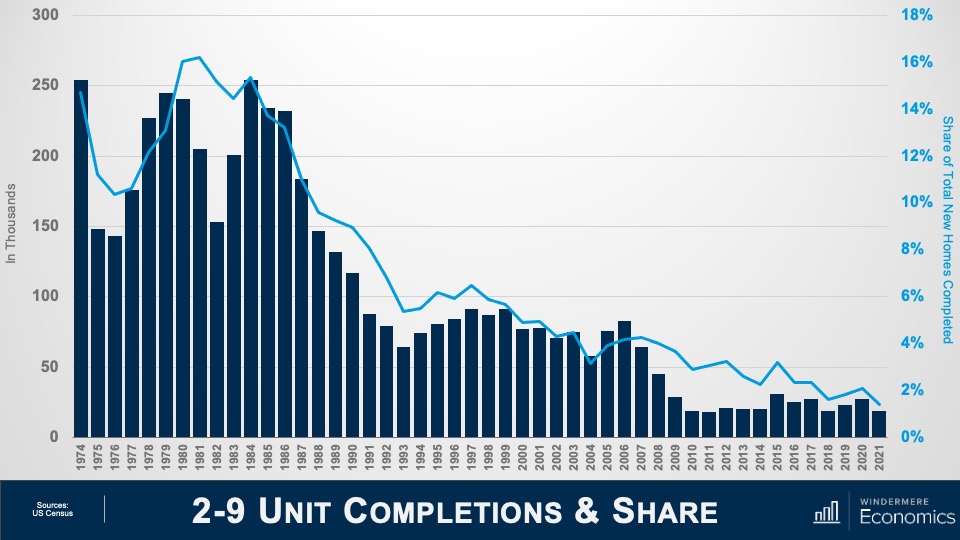
And to show you how supply of these types of units has changed, this chart shows the number of duplexes to eight-unit buildings built over the past almost half-century and you can clearly see that up until the late 1980s they were being built in decent numbers, but the 1990s saw a significant shift toward traditional single-family home ownership and builders followed the demand and this type of product started to become scarcer.
Almost 16% of total new homes built in America in the early 1980s were of this style, but that number has now shrunk to just 1.4%—or a paltry 19,000 units.
But I see demand for these housing types growing as we move forward and that buyers or renters, young and old, will be attracted as it will meet their requirements not only in regards to the type of home they would want to live in but, more importantly, it can be built cheaper than traditional single-family housing and therefore it will be more affordable.
But although this sounds like it’s a remarkably simple solution that can solve all our woes, in reality it’s not that easy for two very specific reasons. The first is that many markets are already essentially built out, meaning that in order to develop this type of product, a builder would have to purchase a number of existing homes and raze them in order to rebuild. But given current home values, it’s very hard for a builder to be able to make such a proposal financially.
And the second issue is that current residents within these “transition” areas—which have been developed as traditional single-family neighborhood—simply don’t want to see change. But is this type of product bad? Here are some examples.
This shows row-homes in Brooklyn on the left and traditional “triple-deckers” in Massachusetts on the right:
This is a bungalow court project in California:
Here are some Live/Work Units in Colorado:
These are some amazing mews homes in Utah:
And finally, a new terrace housing project that will be built in Washington DC:
Don’t get me wrong, I’m sure that some of you who simply aren’t inspired by this type of architecture, and that is understandable. But can we simply stick with the status-quo? I don’t think so. And some state legislators have already implemented significant zoning amendments in order to try and encourage this type of development.
Back in 2018, Minneapolis was the first city to allow this type of development inside single-family zoned areas. This was followed by Oregon State in 2019. Senate Bill 9 was signed by Governor Newsom of California last year which made it legal for property owners to subdivide lots into two parcels and turn single-family homes into duplexes, effectively legalizing fourplexes on land previously reserved for single-family homes. So, we are starting to see some change.
This is a good start but as I mentioned earlier in areas that are already built out, even this type of forward-thinking legislation will not be the panacea that some want. But I’m not giving up hope.
Addressing the “missing middle housing” would allow for homes of all shapes and sizes, for people of all incomes including workers who are essential to our economy and community. Here I am talking about our teachers, firefighters, administrative assistants, childcare providers, and nurses—just to name a few!
There are currently 45 million Americans aged between 25 and 34 and most aspire to homeownership. However, the massive price growth which, by the way, many of us have benefitted from over the past several years, has simply put a “starter home” out of their reach.
I will leave you with one last statistic. Over 28% of American households today are made up of a single people living alone, and it is anticipated that up to 85% of all U.S. households will not include children by the year 2025. Finally, by 2030, one in five Americans will be over the age of 65.
Are we going to meet the needs of the country’s changing demographic going forward? I certainly hope so, but it will take a lot of work for us to get there. As always, if you have any questions or comments about this particular topic, please do reach out to me but, in the meantime, stay safe out there and I look forward to visiting with you all again next month.
Windermere offices close for business every year in June to participate in Community Service Day,an annual tradition since 1984 where our agents, staff, and franchise owners spend the day volunteering in their communities. We’ve gathered a handful of stories to share a glimpse of what Community Service Day 2022 looked like around our network.
Windermere Real Estate Professionals – Boise, ID
With inflation soaring, the Windermere Real Estate Professionals office in Boise, Idaho identified a food drive as a way to make a positive impact in their community for this year’s Community Service Day. Partnering with the Windermere Boise Valley office, they ran a food drive for two weeks, resulting in 520 pounds of food donations to the Idaho Food Bank. Seven staff members participated in food delivery and volunteered at the food bank to package 2,100 pounds of pinto beans to be distributed out into the community. For every one dollar raised, the Idaho Food Bank was able to provide four meals for community families in need.
Pictured back row from left to right: Linda Evans, Lindsey Olson, Jason Smith, Mindi McCallister – Bottom row left to right: Tina Perry, Denise Hapner, Marissa Musgrave – Image Source: Lindsey Olson
Windermere Portland-Lloyd Tower NE – Portland, OR
The Windermere Lloyd Tower office showed up in strong numbers for a city-wide cleaning project in Portland, Oregon. Working with SOLVE, a local organization dedicated to the restoration and preservation of Oregon’s environment through the mobilization of volunteers, they made their way through the city picking up trash and clearing debris.
Pictured: Daniel Fagan, Claudia Pinedo, Ahna Austin, Josh Velasquez, Melissa George, Regina Cameli, Tyler King, Lori Bennett, Carmel Siler, Beth Kellan, Rob McElroy, Jeanine R. Dixon, Doug Meyer, Scarlet Eikrem, Cynthia Chase, Megan Barrett, Katie Bennett, Sean Kelly, Desireé Moore, Darren? + last signature – Image Source: Susie Hunt Moran
Windermere Northwest Living – Vancouver, WA
Windermere Northwest Living in Vancouver, WA has close ties to local Fruit Valley Elementary, a school whose foundation they have donated food to in the past. The office held a food drive to support students in need facing food insecurity, gathering over $3,000 in food donations. For the first time since 2019, the students were able to receive the donations in person. Windermere Northwest Living followed up the food drive with a donation to the school’s foundation from their brokers, staff, and clients totaling $12,000.
Pictured: Nataliya Thomas, Lynn Posselt, Sue Wolfe, Tyneil Thompson, Connie Bovee, Dayna Freitag, Karen Cleveland, John Blind, Dean Lane, Halle Sessions, Lauren Cooper, Hollie Sessions, Barbara Corigliano, Gretchen Finn, Steph Tornaw, Chad Sessions, Mike Lamb, Libby Murphy Benz, Gerry Dowdy-Latshaw
Windermere Northern Colorado – Fort Collins, CO
Deeply involved in supporting the housing needs of their community, Windermere Northern Colorado found the perfect partner for their Community Service Day efforts in Neighbor to Neighbor, an organization providing sustainable housing, supportive services, and education to Larimer County, CO locals. A group of agents and staff gathered to build handicap-accessible raised garden beds to support the residents’ gardening and sustainable food practices.
Pictured left to right: Paul Hunter, Pete Jordan, Brandon Bidwell – In background: Heather Patel and son – Image Source: Windermere Northern Colorado / Fort Collins
Windermere Lake Oswego – Lake Oswego, OR
The COVID-19 pandemic has put added pressure on households already experiencing domestic violence; a truth that is not lost on the Windermere Lake Oswego office. Accordingly, they sought to support local women and children facing these issues by partnering with Clackamas Women’s Services, an Oregon City-based organization providing critical services to domestic and sexual abuse survivors and their families. Members of the Lake Oswego office spent the day volunteering at a soon-to-open CWS shelter that will support survivors in their program and provide them a safe place to stay. Windermere agents and staff donated food and toiletries, sorted donations, cleaned windows, and swept floors to get the shelter ready to open its doors.
Pictured left to right: Sandy Fogle, Patty Black, Bill Futrell, Sandi Sheets, Alexis Halmy, Alta Strayhan, Kerri Miller, Natalie Jackson, Linda Crumb, Laurie Bornstein, Christi Kraus, Dennis Kelly – Image Source: Christi Kraus
Windermere Northwest Living – Longview, WA
Windermere Northwest Living in Longview, WA focused their community service efforts on two local organizations—Lower Columbia School Gardens and Habitat for Humanity—with a variety of gardening and planting projects. Agents and staff divided into two groups: one group pulled weeds, pruned trees, and prepared garden beds for Lower Columbia students’ classes, while the other laid sod, built a deck, and laid flooring for the Habitat for Humanity project.
Pictured left to right: Kellie McIvor, Vicki Sturm, Tami Cheatley, Tara Lundin, Kari Gott, Sherry Bjorhu, Kayla Duckworth, Nicole Graichen, Kaylie Kingsley, Baby Jack Kingsley, and Jayme King – Image Source: Kari Gott
Pictured left to right: Hollie Sessions, Chad Sessions, Halle Sessions, Bobby Lundin, Amanda Kurtti, Amelia Glassett, Tim Glassett, Shelby Alred, Barbara Stephenson, Kevin Campbell, Megan Rogers, Abby Davis, Chad Earhart, Lilly Cress – Image Source: Kari Gott
Windermere Bozeman – Bozeman, MT
Over in Montana, the Windermere Bozeman-Downtown office was hard at work supporting Eagle Mount, an organization that provides recreational opportunities for people with disabilities and young people with cancer. Agents and staff helped Eagle Mount set up for “The Western Rendezvous,” the organization’s largest annual fundraiser consisting of live and silent auctions. The Windermere volunteers set up tables and chairs and hung decorations in preparation for a successful event.
Pictured: Dina Emmert, Kim Stevens, Mike Stem, Amy Swanson, Joe DePew, Bobby Goodman, Kevin Schwartz
Making an offer on a house feels like a reason to celebrate. You’ve applied for financing, worked with your agent to search for available listings, put in time attending open houses, and have found the place you’re ready to call home. However, celebrating at this stage in the buying process could leave you heartbroken if your offer isn’t accepted.
So, what happens after you make an offer on a house? Revealing what goes on behind the curtain in this critical stage of the buying process will help you understand what to expect next. First, let’s take a look at the three ways a seller can respond to your offer.
What Happens After Making an Offer on a House?
The seller rejects your offer:
If a seller rejects your offer, your agent may be able to relay information from the listing agent as to why it was insufficient. This can serve as a learning opportunity for the next time you prepare an offer.
The seller makes a counteroffer:
Counteroffers can make buying a home feel like a chess match. This is an indication that your offer has piqued the seller’s interest. Once you receive a counteroffer, it’s a matter of ironing out the finer details to reach a deal. Sellers will typically request alterations like a higher price, a modification to your contingencies, or an adjustment of closing dates.
You can accept or reject the counteroffer or come back with a counteroffer of your own, which may continue for multiple rounds until the two parties reach an agreement. Prepare for counteroffers ahead of time with your agent by discussing your price limit, how much you’re willing to budge on your contingencies, your flexibility around closing dates, etc.
The seller accepts your offer:
The smoothest result after submitting your offer is the seller accepting it, but that doesn’t mean you’ve crossed the finish line yet. Once the seller formally accepts your offer, you’ll be “under contract,” meaning both parties have agreed to move forward with the deal. Before closing, any contingencies attached to the offer must be met.
This explains why you’ll occasionally see properties listed as “under contract.” It means the seller has accepted an offer and there’s a good chance the deal will go through, but because the sale is not yet final, the property is technically not off the table. Other interested buyers will make backup offers in case the first offer falls through.
After your offer has been accepted, you’re officially in the homestretch of the buying process. Once the purchase agreement is signed, it becomes legally binding. Backing out of a real estate transaction has varying consequences, depending on the timing of the withdrawal and its level of compliance with the attached contingencies. Learn more here:
If you intend to move forward with your purchase, finalizing the deal is a matter of completing the following steps before you can claim your new home:
The Home Buying Process: Closing
Next, you’ll deposit your earnest money in an escrow account. This deposit of funds lets the seller know you’re serious about closing on the home. In return, the seller agrees to take the home off the market. When the sale closes, the money goes toward the down payment or closing costs.
The timeline for inspections during the closing process vary state to state. Getting the home inspected allows you to ask the seller that certain repairs be made, request seller concessions, and renegotiate your offer. If you included an inspection contingency in your contract, you could walk away from the deal with your earnest money if you decide the property’s issues are too much to handle.
Contact your mortgage lender to relay the final details of the purchase so you can go about securing financing. Getting pre-approved early on helps to streamline this part of the closing process.
A title search will generate a report for you and your lender detailing the history of the home you’re buying to ensure there are no legal barriers against purchasing it.
Now you’re ready to close! Several legal documents are prepared, leading to the transfer of ownership from seller to buyer. You’ll also pay closing costs at this time. Once closing is finalized and the funds in escrow have been distributed, the home is yours!
For helpful information on the buying process from start to finish, tips on working with an agent, moving checklists, and more, visit our home buying guide:
Written by: Samantha Enos – Vice President of Diversity, Equity, and Inclusion, Windermere Real Estate
Since our company committed to affecting change with regards to diversity, equity, and inclusion (DEI) nearly two years ago, we’ve established several initiatives that have helped us move the needle toward making Windermere a more diverse organization and homeownership more equitable. Guided by our four DEI pillars—community, home ownership, leadership, and culture—we remain focused on finding paths to address discrimination, racism, and inequity within the real estate industry.
Some of our DEI efforts over the past two years:
Hired a VP of DEI who is charged with advancing Windermere’s DEI efforts, as well as supporting Windermere offices with their DEI strategies, planning, and programs
Developed a committee of Windermere agents, staff, and owners to discuss Windermere’s efforts and to provide input on the direction of our DEI strategies
Conducted ongoing DEI training for the Windermere leadership team, as well as for franchise owners and managers
Engaged with state and local REALTOR® associations to audit our developing DEI training and educational opportunities offered to agents through our Professional Development department
Produced instructional documents to educate homeowners on the history of racially restrictive language in property deeds and how to strike/remove such language from their chain of title
Launched a “Race + Real Estate” playlist on the Windermere Spotify channel that offers a selection of podcasts that explore how members of marginalized communities have historically been denied access to homeownership
Sam Smith “Hi Neighbor” Homeownership Fund
Launched in early 2022 through our partnership with non-profit lender HomeSight, the Sam Smith “Hi Neighbor” Homeownership Fund is designed to help low-to-moderate-income home buyers who have been historically underserved by traditional lenders. Through donations from the Windermere Foundation, U.S. Bank, and JP Morgan Chase, the Sam Smith fund is helping to reduce barriers to homeownership by funding loan products for Black/African American first-time home buyers in Washington State.
We have formed a Board of Directors made up of six agents to help manage the program and drive fundraising. As of May 2022, the Sam Smith fund has raised over $127,000 for first-time home buyers, including a personal donation of $50,000 from the Jacobi family to help seed the fund, with over $58,000 raised this year alone. We are actively seeking partnerships with down payment assistance programs in other states to expand our efforts.
Aspire Internship
Formed in partnership with the University of Washington College of Built Environments in July 2021, the inaugural Aspire Internship program produced eight interns, all of whom completed the program and received a $5,000 scholarship. We’ve already seen real-world impact stemming from Aspire, with one of the group project proposals contributing to the creation of an agent scholarship program (see WIN below), and in the hiring of an Aspire alumnus at a Windermere office in Seattle. The program is expanding in summer 2022, with nearly double the number of students participating.
WIN Scholarship Program
The WIN Scholarship Program was created after recognizing the need to build and support a diverse community of new agents. The program provides up to $2,500 for qualified new hires to be used for training, educational purposes, and relieving the financial burden of the startup costs involved with becoming a real estate agent. The program has made an impact outside of Windermere, as well. Using the WIN Scholarship as a model, Washington REALTORS® has established a pilot program in which they will sponsor one year of REALTOR® member dues, six months’ worth of MLS fees, and $400 worth of training for qualified BIPOC (Black, Indigenous, People of Color) agents.
DEI Resources
For more information on our commitment to diversity, equity, and inclusion, updates on our company initiatives, and further resources on the history of housing discrimination and its impact on our communities, visit windermere.com/dei.
Samantha Enos currently serves on the Seattle-King County REALTORS® Board of Directors, is a member of the National Association of REALTORS® Mentorship program, and was recently appointed as the Chairperson of the Seattle-King County REALTORS® DEI committee. She also volunteers on the Juanita High School DEI committee.
Homeowners are always seeking ways to breathe new life into the spaces in their homes. Using nature to achieve this transformation is beneficial in several ways. Planting an herb garden not only helps to make your kitchen feel fresh and sustainable, but it can make your food taste better, too. Here are some tips for getting your herb garden started.
How to Plant an Herb Garden
Like other indoor plants, the key to properly supporting your herb garden is to cultivate fertile growing conditions. Herbs love sun, so you’ll want to position your plants in an area where they have access to sunlight. If sunlight is hard to come by in your local climate, consider investing in a grow light. Even if space is limited, the following locations can be a fitting home for your herb garden:
Container Garden
Container gardens give you the flexibility to move your herbs around the house. This can be especially helpful if you get inconsistent or spotty sunlight.
There are various options when choosing materials for your containers. Terra cotta, plastic, and ceramic planters all have their respective advantages, but what’s most important is that you pair the herbs with a container whose size is conducive to its growth and has proper drainage holes.
Hanging Garden
A hanging garden is a stylish way to incorporate nature into your home. To properly set up your hanging garden, you’ll need adequate wall space. Again, prioritize access to sunlight and easy accessibility. Vertical bookshelves can make for a simple, multifunctional hanging garden, while other DIY options can help to spruce up your kitchen. Whichever route you choose, consider using lightweight materials. A mobile hanging garden can come in handy when doing chores and rearranging the house.
Window Box Garden
Box gardens are a fixture of landscaping and gardening design and can help to improve your home’s curb appeal. Once they’re filled with soil, plants, and water, window boxes can be much heavier than you’d expect, so sturdy woods that don’t rot easily—cedar, mahogany, redwood, etc.—are popular material choices. As always, proper drainage is important when crafting your window box garden. If you’re building your window box yourself, drill the proper drainage holes before assembly. Add a layer of landscaping fabric along the bottom to prevent soil from leaking.
After you’ve decided where you’ll set up your garden, there’s the question of which herbs to grow. The following herbs are perfectly suited for a beginner gardener’s touch and happen to be culinary staples.
Basil: Fresh basil is a game changer. Sow basil seeds around twelve inches apart to allow them to reach their full potential. This herb will take your homemade pizzas to the next level, kick your pesto recipe up a notch, and provide the perfect garnish for countless other dishes.
Thyme: Rich soil fused with organic matter will create ideal growing conditions for thyme. This herb loves the sun, so making sure it gets plenty of sunlight will maximize its flavor. Thyme pairs perfectly with roasted and slow-cooked dishes, adding a perfect layer of warmth and depth.
Cilantro: Make taco night unforgettable with fresh cilantro. With enough heat, cilantro plants will grow quickly and are known to self-sow for multiple rounds. To clear up confusion, cilantro and coriander come from the same plant. “Cilantro” refers to the leaves, while “coriander” is the name for the plant’s seeds, which are often ground up when used in cooking.
Mint: Potting mint is key to keeping it well maintained. Without a proper container, it will run wild. There are many varieties of mint, ranging from classics like spearmint and peppermint to exotic strands such as chocolate and cinnamon mint.
Parsley: Parsley takes its sweet time to germinate, so consider buying plants rather than seeds to speed up the growing process. Countless recipes lean on the fresh taste of parsley, so you can’t go wrong dedicating a decent amount of real estate in your herb garden to it.
Oregano: Oregano thrives in sunny conditions. To maximize growth, plant its seeds some time in spring when the soil is warm. A staple of Italian cooking, having fresh oregano in your herb garden will give your pizza and pasta recipes an extra kick.
Chives: Known for their grass-like look, chives are closely related to onions but have their own distinct taste. Sow their seeds in spring and water regularly to keep their soil moist. Chives are a flavorful alternate for onions or scallions, while their bright green color makes them a perfect garnish for soups, salads, and sauces.
Homeowners can often reach a financial fork in the road when they must decide to either refinance their existing mortgage or sell their home. Each route has its respective advantages depending on your financial health, the mortgage rate market, and the future needs of your household.
Refinancing vs. Selling
When working to ease the financial burden of your existing mortgage, you have two options: refinance or sell. Refinancing your home allows you to renegotiate the terms of your loan and lower your monthly mortgage payment, while selling has the potential to put enough cash in your pocket to pay off your mortgage entirely. So, how do you decide between the two? Understanding a bit more about each option can help you determine which is best for you.
Refinancing Your Home
There are a few reasons why homeowners will typically refinance their mortgage, the most common of which being falling interest rates. Lower interest rates, after a reassessment of your mortgage, equate to lower monthly mortgage payments and significant savings over the life of the loan. If your finances have improved since you initially secured your mortgage—for example, your debt-to-income ratio has improved, or you’ve bumped up your credit score—you may be able to lock in a better rate with your lender.
Refinancing your home could also put cash in your pocket. “Cash-out refinancing” allows you to accept a mortgage for more than your principal balance and use the extra money at your discretion. Typically, homeowners will use such funds for large expenses, such as a major renovation or home improvement project.
Homeowners with Adjustable-Rate Mortgages (ARMs) will often refinance and switch to a Fixed-Rate Mortgage due to fluctuations in interest rates, locking in an established rate for the remainder of the loan term.
Refinancing in order to change the length of the loan can be beneficial as well. By switching from a 30-year mortgage to a 15-year mortgage, you could save a considerable amount of money on interest over the life of the loan. If you’re looking to lower your monthly mortgage payment, you could lengthen the loan term. For example, if you’ve been paying off your 30-year mortgage for ten years but are struggling to keep up, refinancing could lower your monthly payment. However, doing so means you’ll be paying for an additional ten years’ worth of interest.
Keep in mind that refinancing your home involves getting a new mortgage, so you’ll have to go through the qualification process again. Assess your financial health and equity before you apply. Once you’re ready to move forward, your Windermere agent can recommend a few trusted lenders or mortgage brokers to provide you with a quote.
Alternatively, you can sell your home. Your agent will conduct a Comparative Market Analysis (CMA) to determine the value of your home, accounting for the various factors that influence home prices including seasonality, location, market conditions, and your home’s features.
Although you stand to receive a lump sum of cash, selling your home comes with its own set of costs. Paying for repairs, home inspections, staging expenses, agent commissions, not to mention buying or renting your next home. This can add up, so it’s important to budget properly. Selling your home also means you’ll be uprooting the life you and your household have established there, so it’s important to have a plan for your next steps before the “For Sale” sign goes in the ground.
For more information on the selling process, connect with an experienced, local Windermere agent today:
There’s a first time for everything. As a first-time home buyer, navigating the uncharted territory of the home buying process can be challenging to say the least. Although every home purchase is unique, there are certain knowns that can help you manage your expectations. Once you’re ready to buy, knowing a bit more about how to approach the market will have you well on your way to getting the keys to your first home.
Managing Expectations as a First-Time Home Buyer
Local Real Estate Market Conditions
Your local housing market conditions will loom large in the buying process. In a competitive market (i.e. a seller’s market), prices are being driven up by demand, sellers have the leverage during negotiations, and it may take a long time to find the right home. In such a market, you can expect to compete against multiple buyers where everyone is trying to sweeten their offer to make it stand out. This usually takes the form of waived contingencies, escalation clauses, and all-cash offers. Buying in a competitive market is challenging for any buyer, let alone a first-time home buyer. Having greater buying power and getting pre-approved for a mortgage are two key paths to bolstering your financial standing and improving your chances of submitting a winning offer.
Though finding the right home is never a cakewalk, the conditions of a buyer’s market will be in your favor. In such market conditions, sellers are competing for the attention of a limited pool of buyers and are more flexible during negotiations. With less competition around you, you can afford to be more patient and selective when pursuing available listings.
It’s easy to fall in love with a home based on its listing photos, but one look at the price tag can break the spell. By knowing which homes are in your budget, you’ll be able to focus your time and effort on listings that are financially feasible. And remember, there are a myriad of costs to buying a home beyond the listing price to include in your budget.
To get an idea of what you can afford, use our free Home Monthly Payment Calculator by clicking the button below. With current rates based on national averages and customizable mortgage terms, you can experiment with different values to get an estimate of your monthly payment for any home price. By using the Home Monthly Payment Calculator, you can make a well-informed estimation of whether it’s the right time to buy.
First-Time Home Buyer Tips: Working with Your Agent
Fortunately, you don’t have to take on the home buying process on your own. A buyer’s agent will help to manage your expectations from start to finish by helping you look for homes, make an offer, negotiate with the seller and their agent on your behalf, and provide clarity on the closing process. Beyond their ability to get down to brass tacks and help you purchase a home, your agent will be there to answer your questions, validate your emotions, and connect you to their network of helpful resources.
To begin the process of buying your first home, connect with an experienced, local Windermere agent today:
“Cutting the cord” can mean something different in every household. For some, it’s a complete abandonment of cable TV and the fees that come with it, while in another household it may be a mix of cable- and subscription-based programming. Regardless of where you are in the spectrum, it’s worth it to audit your household’s TV usage and reassess what package deal delivers the most value. Here are some tips to help you make the transition.
5 Tips for Cutting the Cord: Switching from Cable to Subscription TV
1. Budget for Subscription TV
Start by taking a deep dive into your cable or satellite bill. By breaking down the costs of your contract with your cable company, you’ll get a baseline of what you can afford as you begin to select your subscriptions.
Identify the terms of your contract, whether you’re locked in until a future date, and when the contract terminates so that you can plan the logistics of your transition smoothly. Your cable company may charge an early termination fee for contracts that are broken before the specified date.
2. Prioritize Your Favorite Content
Choosing from the seemingly infinite selection of channels and apps can be overwhelming. When compiling your subscriptions, start by analyzing your viewing habits to determine your most necessary outlets. Whether it’s news, sports, classic movies, new movies, children’s programming, or certain prestige TV shows, choose your must-haves first and fill in your remaining subscriptions around them.
Remember that switching from cable means you’ll have to piece together the channels you previously had access to across a collection of apps and services. This often means that you’ll miss out on seeing certain shows live, but you’ll have unlimited access to a given program’s library of recorded content.
3. The Importance of High-Speed Internet
To truly enjoy your streaming services, you’ll need a strong internet connection. In general, an internet speed of least 25 Mbps (megabits per second) is recommended for streaming multiple channels and apps. As you add more devices and services, something closer to and upwards of 50 Mbps will give you a quality viewing experience.
As you shop around for the right internet service, make comparisons between different providers’ prices, download speeds, and data limits. By cross-referencing these three criteria, you’ll be able to identify which internet package is right for you. Read the fine print regarding data usage. Certain agreements may have extra fees that kick in once a certain amount of data has been surpassed. This could get expensive, especially if there are multiple people in your household watching TV frequently.
4. Purchase Your Hardware
There are a bevy of hardware options for streaming TV, including popular devices from Roku, Google, Amazon, and Apple. These devices typically come either with a remote or with an app that allows you to control your TV from your smartphone. If you prefer less hardware, a smart TV may be the way to go. Smart TVs have many of these streaming services built in and available to download. You may also continue to rent a cable box from your cable company to save on your contract costs. This could be helpful if your cable provider offers a bundling package of TV and Internet subscriptions.
5. Invest in Quality Screens
At the end of the day, your viewing experience is only as good as your screens. Investing in high-quality products will be worth it in the long run. One of the greatest benefits of streaming apps and services is their flexibility, allowing you to watch from multiple screens in multiple locations. Accordingly, it’s not just your TV that matters, but any other devices you plan on watching from, including tablets and smartphones. Fortunately, smart TVs have continued to grow in popularity and are now widely available, meaning you’ll have plenty of options to choose from at whatever price point is affordable to you and your household.
For more information on how to leverage technology in your home, read our short guide to Home Security and Safety.

 Facebook
 X
X
 Pinterest
 Copy Link