Living January 17, 2011

Making your house a home (Home resolutions, part II)

Your home is a reflection of your tastes, your lifestyle and your ambition, and many of us are regularly transforming our homes one way or another to fit our adjusting needs. Whether it is refreshing a room to fit your style, reorganizing a closet to accommodate the holiday excess, going green to save the planet and a couple of bucks or a complete renovation of your kitchen- homes take maintenance. Some projects come about on a whim, but if you have any plans to make your nest nestier here are some ideas for not getting too overwhelmed by the process- no matter how large or small the changes you want to make:

Get Organized: Whether it is your closets, books, pantry or your entire basement identifying the problem is the first step. Once you know where to focus your energy think about the purpose your space should fulfill, what you want it to look like and how you can keep it organized for the long-term. Sometimes getting organized is a matter of doing a little bit every day, or it is finding the right storage solution. Once you know what the problem is you can identify your steps, timeline and budget. Ultimately, getting rid of the clutter and holding onto items you love the most and use will keep your spaces easy to manage year round.

Do a little every day: Everyone has a different method to managing home madness; some have a weekly cleaning routine, some focus room by room others pile everything in the closet until they have to deal with it. If you have a goal of getting rid of old possessions and clutter, remodeling your home office or keeping your home cleaner spend five to thirty minutes a day working to achieve your goal. Here is a good idea for keeping your home clean by doing a little every day, rather than spending your weekend playing catch up.

Beautification/ Gardening: This year my big goal is to finally start our edible garden, but I have been overwhelmed by all the steps- from finding the right containers for the garden, deciding what to plant, when to start the starts, etc. Each region has different gardening challenges; the plants that thrive in Seattle are different than Spokane or San Diego so if you are planning on a garden make sure you familiarize yourself with local resources that will give you advice specific to your area. If you have any landscaping projects, keep in mind advance planning is paramount to making this affordable, timely and sustainable. If you are planning on putting your house on the market eventually, make beautification a priority and plan your exterior in a way that will increase the curb appeal of your home in the future.

Home Improvement Projects: If you have an ongoing list of home improvement projects, make sure you have the right tools in your toolbox and prioritize and plan. You don’t want to spend every weekend working on dripping faucets so create a routine. When looking at the year ahead, think about seasonality of the projects. It is important to know when to ask for help from a professional in order to have repairs done right in the first place to avoid putting yourself at risk or the safety of your home.

Go Green: If your resolution this year is to save money and the planet by reducing your carbon footprint there are projects you can do large and small. Start with an energy audit, that way you know where your energy is actually being used- you may be surprised. Easy fixes start with replacing light bulbs with CFLs and buying energy cords that limit vampire appliances to use energy when they aren’t in use. If you are replacing your old appliances with newer energy efficient models, make sure you check into recycling programs in your area. Go here for more green resolution ideas.

Renovations: Whether you are doing the renovations yourself or working with a contractor, projects of scale are never easy. Make sure you plan for the inconvenience of going without a kitchen as well as the details of putting your new kitchen in place. Also, before investing in a renovation, make sure you will get a return on your investment when you resell.  If you are looking to increase the value and marketability of your home check out this list before you start tearing down walls.

This is the second post in our four-part home resolution series. Find the first article on how to identify and plan for your new year’s goals here.




BuyingLivingSelling January 14, 2011

Practical resolutions: preparing for the best in 2011 (Part I)

The transition from the holidays and 2010 is behind us now, and we are well into the first month of the new year. Once 2011 officially started, I believe I heard a collective sigh of relief echoing throughout the following days.  2010 was a good year, much better than we had anticipated it being–for most of us anyway. 2011 feels like a beacon of light, illuminating the path to an auspicious year ahead; a new year, a new decade and what seems to be the worst is behind us.

For some people the New Year is just a party or another day, for others it is a time of reflection and resolutions, and for others it is a benchmark–a way to remember annual projects. I am not really a resolutions person myself; I figure if I do not make it, I cannot break it. I do, however, remind myself to up the ante on what I should be doing anyway and to plan for goals and projects ahead.

The hard part is sticking to the plan after the luster of the New Year starts to fade. For the rest of January we will be offering resources on making and keeping home resolutions, whether you want to update your current home, start saving and shopping for your first house or sell the home you have. Here are some tips to get you started making your home resolutions:

Resolutions 101

Everyone’s list of things to accomplish in the upcoming year is different, but one thing is pretty universal: most of us are too ambitious for our own good. The best thing to do is make reasonable goals for yourself and work towards accomplishing them one at a time. So be realistic. You may not renovate your entire home, but in all likelihood you can finish your kitchen remodel.  You may start the year with plenty of momentum; just remember to pace yourself when it comes to big goals–it’s a marathon, not a sprint.  Here are some tips to keep your goals in check:

Set a goal: I find it useful to create a bucket list of all the things I want to do and prioritize the most important, most time consuming and most expensive. Your goals and what you do to accomplish them will differ whether you are making your home more your style, saving to buy or preparing to sell. From this list you can prioritize the goals in order by urgency, seasonality, and difficulty. If you cannot fit all your projects in this year, move them to the rolling 2012 bucket list.

Make a budget: Do your research and make an informed budget. If you are looking to renovate, you will want to make a plan, check resources and make an informed budget. If you are looking to save up for your down payment on a home, you will want to assess how much you need to have saved in order to have enough to put down, and create a budget plan. Creating a budget is a great way to keep your finances in check and keep your projects as affordable as possible.

Set benchmarks: If you have a big goal, breaking it up into smaller bites is the best way to stay motivated. If you can do a little bit every week to keep your home clean and tackle an organization project, you are more likely to sustain the momentum than if you attempt a complete overhaul. Also, there’s one great thing about goal setting, budget making and project planning: the more you practice, the better you become!

Stay motivated: Your resolutions may already be going by the wayside now that we are caught back up in life-as-always. It may help to write out your resolutions in a central place–a document on your computer desktop, a list on your fridge, or benchmark reminders in your mobile calendar. The key is to keep your resolutions at the top of your mind so you can work towards them a little bit every day/week. For more advice on how to keep your momentum, go here.

The new year offers the chance of renewed energy to accomplish the goals from past years and start fresh projects. This is the first post in a four-blog series about setting home resolutions, come back to see more information on making your existing home more personal, and buying and selling your home in 2011.

More January 10, 2011

January Perspective: Home

A wise family member has always said you should plan to keep a house for at least seven years to ensure a good return on your investment. But owning a home is much more than a financial investment. It’s about family, about belonging, about security. Your home is your sanctuary. Especially during this time of uncertainty, it is comforting to come home every day.

During this most recent holiday season, our home was a gathering place for friends and family. Holiday gifts were the very least of it. Rather, it was about the gift of truly feeling at home: a crowd in the kitchen, a full guest room, kids in sleeping bags in the family room, extra shoes in the front entryway, board-game marathons at the dining room table, commotion, clutter and chaos. Memories being made.

Over the years we’ve painted and repainted, remodeled and replanted – all to satisfy our desire to make our home “just right.” It will never be perfect, but it will always reflect who we are, and provide a sense of belonging and well-being.

Beyond improving our own home, we’ve also made an investment in our neighborhood. We have neighbors who have become good friends – and remained so even after some have moved away. We take pride in our community, and we do what we can to make it vibrant and safe, and a welcoming place for everyone.

Now that the holiday decorations are down, only the memories remain. But our home will continue to be a gathering place throughout the year, for occasions big and small, special and ordinary. Making memories is a year-round thing.

As we start this new year, we’re looking ahead with hope and optimism. There will be challenges for sure – what they’ll be we can’t even imagine. But we are sustained by the idea that whatever’s going on, we can go home. And the emotional value of that is priceless.

Happy New Year!

From

OB Jacobi, President, Windermere Real Estate

Geoff Wood, CEO, Windermere Services

Jill Jacobi Wood, President, Windermere Services

Market News December 22, 2010

Thoughts for 2011

As we approach the end of 2010, I like to pause and reflect on the events of the year relative to both the economy as a whole, and the real estate markets in particular.

Of course, the year is not quite over but, as this will be my last post in 2010 I thought it would be good to look back at the year that is rapidly disappearing in the rear view mirror, and also to ponder what 2011 may bring.

The U.S. economy has a very big influence on a great number of things; from jobs, housing, savings and general sense of well being. .  There is no question the last few years have been tough on many people. The economy has been improving over the past few months, and we should see continued improvement over the next year.    If you are considering selling your home or making a purchase, you may find the following economic indicators  helpful to your planning.

  1. GDP – The Gross Domestic Product represents the value of goods and services that are created inside the U.S.  The third quarter of this year saw our economy expand by 2.5 percent annually – below the 3 percent that is indicative of solid expansion. I anticipate that, firstly, we will not drop back into recession in 2011, but that growth will remain under par for the first half of the year.  However, the quantitative easing that is currently underway will start to have an effect in the second half of the year, and we will likely end 2011 at an expansion rate of 2.8 percent. The GDP is an indicator of standard of living.  As this increases, people will generally have more money to spend and enhanced peace of mind.
  2. Employment – From peak employment of 137.9 million in December 2007, to a trough of 129.6 million two years later, this country lost 8.4 million non agricultural jobs.  Since that time, we have recovered somewhat but are still shy by 7.4 million positions.  Unemployment remains stubbornly high (9.8 percent in November) and finding work is far from easy.  I believe that next year will see the overall unemployment rate drop, but the improvement will be slow; if we end the year at around 8.5 percent I will be happy.  Businesses are still wary of hiring until they see tangible signs of improvement and, even when they do, I don’t anticipate they will head off on a big hiring spree.  Layoffs will continue to decline and virtually peter out by the end of 2011.    As unemployment rates slowly drop, homeowners will be more solvent, easing fears of foreclosure and increasing confidence in the market place.
  3. Real Estate – The real estate market has certainly showed that not all markets are created equal.  Modeling price changes across the country is no easy task – forecasting the effects of loan modifications alone throws calculations into a tailspin – but I expect that the hardest hit markets (Phoenix, Las Vegas, etc. have likely bottomed.  Other markets (such as Houston) have some way to go yet.  I am looking for an additional 5 percent decline across the U.S. before I will call a bottom for home prices. We will likely see this by the third quarter of 2011.
  4. Consumer Confidence – There has been a marked improvement in consumer confidence in recent months.  A better 2011 is clearly showing up in the numbers. With a better outlook on the horizon and incremental improvements all around, we are all starting to feel better about the recovery and we will see this reflected in the market place.
  5. Inflation – There are two things that are required to be in place for inflation to take foot– wage growth and a stable employment situation– and we have neither.  I am not concerned at all over inflation in the short-term and believe that core inflation will stay below 1 percent in 2011.  With inflation and interest rates closely tied, minimal inflation will be beneficial to home buyers and will keep the cost of home improvements from becoming prohibitive.  That said, it is likely that the Fed’s asset purchase program will expire in June.
  6. Interest Rates – This has been a bit of a touchy subject in recent weeks as rates have been rising despite the Federal Reserve’s decision to continue to buy treasuries – which should have allowed rates to remain very low.  Why is this?  Believe it or not, it’s because investors are seeing too many positive signs in the economy and are leaving the relative safety of treasuries for the greater yields found in the equity markets. I think that we will see some stability in rates early in the year and that they will not head drastically higher.  That being said, rates will trend higher in 2011.  This will play into the housing markets for the obvious reasons.

So there we have it!  I believe that the light at the end of the tunnel is, in fact, the end of the tunnel and not a train heading my direction!  Economic recoveries, and certainly recoveries in real estate, are not all created equal and our current situation is certainly not as dire as it has been, but neither are we out of the woods yet.  I am, as ever, hopeful that the U.S. will show resilience and that better days are, indeed, ahead.

What are your reflections on 2010? What are you most looking forward to in 2011?

Best wishes for the holidays and here’s looking forward to a healthy and happy 2011!

By Matthew Gardner

More December 21, 2010

There are secret Santas amongst us…

I recently read this great story about the Kansas City Secret Santa. Every year for twenty-six years, an anonymous man dressed in red or a Santa disguise would hand out $100 bills to people in need of help. His identity was disclosed in 2006, shortly before he died of cancer. People all over the world, inspired by his story, are now are carrying on the tradition of benevolent Santa. This story made me think about the amazing stories we hear every day at the Windermere Foundation.

We hear stories of families in tremendous need, stories of people’s willingness to give, and the joy and surprise of receiving support when other doors have closed. We hear stories that are heart-wrenching, awe-inspiring, hopeful and chill-inducing. There are Secret Santas amongst us; we have seen a few at work.  We are indebted and inspired by the people we work with and their great capacity for giving. We feel pretty lucky to do what we do, and we’re grateful for all the Windermere agents that make the Foundation possible.

Families in need come to the Foundation through various means. Some families are referred to us directly through social service agencies; some receive support through organizations with which our offices partner as a part of their commitment to community; and sometimes we hear about a family going through so much and we reach out ourselves. The particular story I want to share with you must have been kismet.

Christine Wood, our Foundation director, received an email from a friend last week — a forward from a local teacher she knew who was the kindergarten instructor to the younger of two sisters. The teacher had become concerned about her young student missing so much school, and upon inquiry she found out the older of the two sisters has been going through a grueling four rounds of chemotherapy over the last seven months.

Their mother, who generally cleans houses to support her two young daughters, has lost her steady job in order to ensure her oldest daughter can make it through treatments at Children’s Hospital. She is a single mother and has few resources to support her daughters, and as a result of their circumstances they are homeless.

They have tried every route of support, but have slipped through the cracks of various social services — likely due to the increased need of services as well as reduced resources. The family has moved several times and has had temporary housing with friends and Ronald McDonald House; but they are primarily living out of their car. Due to this instability, the youngest daughter has had to move schools three times.

In October the older sister, Lizeth, was featured on a KOMO news special when her Grandmother fulfilled her wish by coming to visit from Mexico. Lizeth has a very rare form of Leukemia. She received a bone marrow transplant this week, increasing her chance of survival; however the prognosis is still not great.

This family’s need for support is large. The immediate needs have been a working car and money for rent and basic needs. Early this week, we contacted one of our own secret Santas, who has consistently opened their heart to Foundation causes and provided when we couldn’t.  As luck would have it, they recently acquired a new car and were preparing to sell their lightly used car THAT DAY.  Within two days, we were able to deliver a new car to this wonderful family in need.

This was a tremendous and inspiring gift from one of our own agents, and one outside the scope of what most of us can give. But support at any level can make a tremendous difference for needy families, and we are truly grateful to all of the secret Santas who have reached out to help. If you too are interested in helping this family, donations can be made at Key Bank under the Lizeth Gonzalez Fund or through the Windermere Foundation (please indicate that you would like your donation designated for the Lizeth Gonzalez fund). Our goal is to ensure this family has the financial support they need, as well as some holiday cheer.

Of course, this is just one of many heart-wrenching stories of need, and just a few of the countless ways in which help is given throughout the year. For example, many Windermere offices participate in an annual adopt-a-family program, purchasing gifts, groceries, basic-need items and more for families going through hard times. We are grateful for all the generous support our offices, agents and neighbors provide for our communities.

Stories like these truly give us a sense of hope. Particularly this time of year, we are inspired by the secret Santas amongst us.

Thank you for your support of the Windermere Foundation! Have a wonderful Holiday and a Happy New Year.

More December 20, 2010

December Perspective: Looking ahead

In December of 1900, The Ladies Home Journal published an article titled “What May Happen in the Next Hundred Years.”  It is fascinating.  The author, John Elfreth Watkins, interviewed the “wisest and most careful men in our greatest institutions” and arrived at 29 predictions they felt would happen by 2001.

One of their predictions was titled “Man Will See Around the World.” It read, in part:
“Persons and things of all kinds will be brought within focus of cameras connected electrically with screens at opposite ends of circuits, thousands of miles at a span.”

To me that sounds like the Internet.

It is December again, and beyond all of the holiday festivities it is also prediction season.  It’s that time of year when prognosticators everywhere wax eloquent on what might happen next year and beyond.  Looking back, history is full of predictions from silly to bizarre, and from incredibly wrong to amazingly correct.

Of course, the economy is continually predicted to implode, explode, crash and skyrocket — sometimes in the same year.  In early 1929, a Yale economics professor said, “Stocks have reached a permanently high plateau.” Oops.

Then there was William Thomsen, who was the Royal Society President in the late 1890s. He hit the prediction trifecta: “Radio has no future.” “X-Rays are clearly a hoax.” “The aeroplane is scientifically impossible.”

So history has proven that it’s a tricky business to predict anything. Yet much has been written this year about the housing industry and its demise. As someone who works in this industry, I do not believe the naysayers.  In fact, I have history on my side.

As this year winds down and we look ahead, I think about the famous Kierkagaard quote:  “Life must be understood backwards; but… it must be lived forward.”  Predictions will always be just that. But if you study history, you can usually find data that will help you understand the future.

After all, history does repeat itself.

Living December 14, 2010

Getting Through the Holidaze

Perhaps it is just me, but I don’t remember the distance between Halloween and mid-December ever being so short. I am shocked Chanukah has come and gone and Christmas is nearly here. Consensus seems to be that the year has flown past.  In an effort to enjoy the holidays, spend quality time with friends and family and stay ahead of the stress, we have compiled a list (with the help of some great resources) of some good ways to “keep calm and carry on” through the New Year.

Plan ahead: I just said the holidays are already upon us, and now I recommend planning ahead? Typically I start much earlier, but two weeks IS ahead this year. The same principles apply for two months vs. two weeks, it just means you have to be more efficient to get it all done (and go shopping in stores rather than online).

Now that we are past the denial stage, it is the time to make lists. Figure out the most important things that you must do in order to survive the holidays (top gifts, top traditions, the most urgent items– including parties and house guests). If you must compartmentalize, have multiple lists: one for groceries, one for gifts, one for household chores, etc. Prioritize your lists; if it isn’t on the top of the list, it is an incidental, meaning you will not be crushed if it doesn’t turn out exactly like you planned.

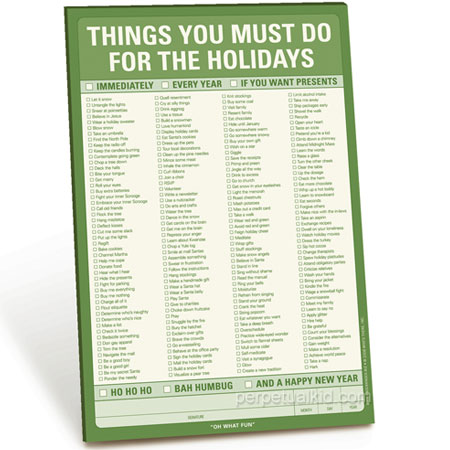
The more you plan ahead and pre-prepare, the easier everything will be in the moment (at least that is my philosophy).holiday to do list Go shopping ahead, wrap presents early as you get them (label the package so you don’t forget what is for whom), prepare spaces for houseguests, and purchase non-perishable essentials in advance. When it comes to holiday meal preparation, prep what you can ahead of time, make and freeze when possible, cut vegetables and store in bags, and commission help from hostages/willing houseguests. If you have some tough-to-entertain members of your tribe, have activities ready. The boy scouts have a great motto for this: be prepared.

Create a space for yourself: The holidays are stressful, with outsized expectations, financial concerns, and close proximity to people you love, admire and at times loathe. Making space for yourself can help decrease your stress. If you are home-bound for the holiday, create a room of your own. In our house we each have our own space to which we can retreat, and over the holidays that’s where we hide and wrap our gifts, make a mess, close the door and listen to music, or whatever else we need to prepare for and escape from the holiday. Having a solitary space to read a book or take a nap undisturbed is sanctuary in the midst of madness. Our spaces will be upended once family arrives for the four-day weekend celebration, but it is still important to create a space to get away–even if it means retreating to your bedroom or taking a walk.

Be prepared for surprises: Sometimes the best laid plans… go awry. What if someone shows up unexpectedly with a gift in hand? What if the power goes out on your Christmas dinner? What if, what if, what if… Something is bound to go differently than you expect it.

If you aren’t born with a laissez-faire attitude, have a backup. And hopefully you are less stressed because you planned ahead. Keep some extra gifts wrapped and accessible for unexpected visitors or last-minute hostess gifts, such as bottles of wine in a gift bag, candles, or other universal gifts. If you are worried about storms, have supplies ready and a plan in mind. Make sure you are stocked with easy-to-snack food (also helpful for last-minute guests, cook-free meals for power outages), fill your propane tank for a BBQ meal (don’t use indoors) or keep a list of local restaurants open for Christmas dinner. Have games on hand that don’t require electricity or internet (our family favorites are Apples to Apples, Texas Hold ‘em & Scrabble).

Just think of the worst that could happen and prepare for it. The worst likely will not happen, but just being prepared can decrease stress. And if something less than the worst happens you can rest assured, because you are ready for it. If worst than the worst case scenario happens, think about what a great story it will be in the years to come…

Keep it clean: Whether you are hosting a party or housing guests for the holidays, clutter is distracting and unnecessary. Schedule time to do a deep clean on your home prior to guests arriving, weeks in advance if need be. Go through junk mail, newspapers, magazines, cabinets and clutter-prone sections of the house, throw the garbage out and put the stuff where it belongs. If you need a catch-all bin for easy removal (or easy stashing in a closet), it’s time to figure out the solutions. Here are some great tips for daily de-cluttering.

Go through your closets and thin out the coats and blankets. Consider giving gently worn items to local charities such as Coats for Kids or, if you live in Southern Washington or Western Oregon, contact your local Windermere office for drop off information.  Toss out what you don’t need now to avoid post-holiday overload.

Get into the spirit: Congratulate yourself on a job well done and enjoy the holiday season! Studies show that holiday traditions actually relieve stress, so if you don’t have one you particularly enjoy start your own! If you have children, include them in the process, whether it is planning a day-long activity, making a new cookie recipe, creating decorative crafts, or having a movie marathon. There is no point to all the running around, spending money and cleaning house unless you actually get to enjoy yourself. So grab some eggnog and relax.

nationallampoonxmas

If all else fails let go: I always have higher expectations for what I can accomplish, the people I will get to see, and the memories I will create, and it can be disappointing when I don’t meet my goals. Sometimes Christmas Cards turn into New Year cards (or Valentine cards in the worst years). Unless the Grinch makes an appearance or your family vacation turns toward the National Lampoon variety, count your blessings or start a new tradition and book a trip to Hawaii for next year!

Tell us what makes your holiday special. What are your tips for a stress-reduced holiday? Best traditions past and present? Favorite recipes, games, craft projects?

More December 10, 2010

What You Need To Know About Buying a Bank Owned Home

Recently, news about how to purchase a real-estate owned (REO/bank owned) home, foreclosure property or short sale is everywhere. Bank owned homes are sold directly from the lender after the foreclosure process is complete, and while you may save quite a bit of money by choosing to go for this type of home, it is not without trials and tribulations. The process of purchasing a home directly from a lender can be long and arduous, but could very well be worth it in the end.
If you have your sights on a particular home or are looking to find a deal on your first, working directly with the lender may be your only option. Purchasing a bank owned home is not for the faint of heart, here are some tips for negotiating the REO process:

1. Be prepared: The condition of bank owned properties is usually poor and hard to show. Past owners may have left angry and left the home in bad condition with foul smells, missing appliances, wires taken from breakers, gas fireplaces gone, even bathrooms without toilets and sinks.

2. Understand the costs: Maintenance or repairs may be necessary, since these homes have been vacant for an unknown period of time–sometimes months or years. Keep in mind, when they were occupied the owners could have been under a financial hardship, preventing them from doing regular seasonal care or repairs when needed. Remember as well that the bank is trying to sell the house immediately, so you will receive a financial break in the price rather than a willingness to negotiate on the maintenance and repair issues.

3. Accept the unknown: In traditional real estate transactions, homeowners fill out Form 17 regarding important information about the history of the house. A bank owned home is either exempt or marked with “I don’t know” throughout the document. Not having the accuracy of this 5 page disclosure form could leave you with a lot of unanswered questions on the history of the home.

4. Know what is non-negotiable: The pricing on the house may not get much lower. Some of these properties can be "a dream come true" if you get them at an amazing price, or they could be your worst nightmare. Do your due diligence researching any property, and conduct all necessary inspections to safeguard yourself. Some major repairs may be negotiable, but will likely not reduce the home price.

5. Make a clean offer: The higher the price you can offer, the better. Include your earnest money, keep contingencies to a minimum, and suggest a reasonable closing date. The simpler your offer is, the higher chance you have of the bank accepting your offer or countering in a reasonable time period.

6. Be patient: Consult with a professional who handles bank owned home purchases to help you negotiate the pathway to homeownership. The process of purchasing a bank owned, foreclosed or short-sale home is typically longer than a typical real estate sale.

What do you want to know about purchasing bank owned, foreclosure and short-sale properties?

Buying December 7, 2010

Does the Home of Your Dreams Really Exist?

Agent: “So, what kind of a house are you looking for?”


Client: “Anything with 3 bedrooms and a couple baths. Oh, and a big yard would be cool, too.”


Agent: “I know of several that we can show you.”


Client: “Just pick three that you think I’ll like, and I’ll buy one of them.”


If only it were that easy. When you ask yourself to visualize the home of your dreams, what comes to mind? Certainly not a nondescript 3 bedroom, two bath home. It’s much more likely that your vision could include features like maple flooring, granite countertops, 6-panel doors, built-in speakers, or access to 220-electricity in the garage for a workshop. Everyone has their own custom needs and desires.

You’re allowed to be picky. Realistic is imperative, but picky is fine, too. If you’re holding out for diamond insets in the shower tile grout or solid gold door knobs, I’m afraid disappoint awaits you. Think about the most important things a home will represent to you. Do you work from home? Do you entertain large groups regularly? Do you enjoy yard work or do-it-yourself projects? Each family has their own needs, so your definition of the perfect home will be very different from even your closest friends or family members.

Not only does each family have their own needs, but each family member might have their own needs. Pets come into the picture, too. Is high-enough speed internet readily available? Is there a wall that will fit your 60” High-Def 3D TV? Will the family room have enough space that you can compete at Wii™ or Kinect™ without breaking lamps? Will the huge trees that are cooling in summer make the home darker than you like in the winter? Can you bike or run the neighborhood streets? Are you concerned about how your energy consumption will affect the environment? You’re encouraged to list all the things that are important to you.

Once you’ve made your list, prioritize it according to what is important. Figure out what’s a must-have and what would be nice, but not necessary. It might take looking at a few homes to figure out what you want versus what you need. You may love the idea of having Spanish copper sinks throughout the house, but if there were no houses on the market that had them, would you resign yourself to renting indefinitely? On the other hand, you may be working from home and need fantastic data transmission capability. You probably wouldn’t want to look in a rural area that still uses dial up, but promises to have high speed internet cables in the future.

Your agent will learn from your prioritized list, and they should be able to help you find that perfect house. Be brutally honest with yourself, think 10 years into the future, and share your desires freely with those that can help you. You may not find the house that’s 100% of what you wanted, but something very close to the home of your dreams is probably out there.

What are the “deal killers”? What are the most important features on your list?

EricJohnsonHeadShotBy Eric Johnson, Director of Education

Johnson has several years experience as a real estate agent and real estate instructor, as well as experience in construction project management, digital media/publishing and insurance. He has a bachelor’s degree in anthropology from University of Colorado.

More November 24, 2010

Inspired Gratitude

Tomorrow is Thanksgiving and it is a great time to spend with friends, family, pets, or volunteering. Everyone has different traditions over the holidays, shaped by beliefs, family, location and other factors, but gratitude and thankfulness typically run through the season. Now is also the time to be inspired by what you are thankful for: a nice place to live, food on the table, time with loved ones and more.

Here at Windermere we are grateful for the people we collaborate with every day; we are very fortunate to work with great people, homeowners, buyers, and a highly diverse group of agents.  We are equally happy to have had the chance to help people sell their homes to move to the next stage of their lives or help others purchase their first or upgraded home.  We are optimistic about the upcoming year.

We are also so fortunate to have the Windermere Foundation- supported by every transaction. Windermere offices were able to support hundreds low-income families across every region we work to keep their lights on, have food on their table and warm coats on their backs. We are thankful for the vibrant communities in which we work and live. Thank you!

Thanksgiving also marks the beginning of the holiday season. What are your holiday traditions? What are you thankful for?