Living April 27, 2012

Increase your living space—and your home’s value

Cooking and dining alfresco is arguably the single greatest thing about warm weather in spring and summer, but most backyard barbeques involve a million trips to and from the kitchen. As such, one of the hottest trends in new home construction is outdoor kitchens. Outdoor kitchens typically feature a comfortable eating area with a combination of cabinets, sinks, warming drawers, prep counters, ranges, and refrigerators—all within arm’s reach of the grill. Outdoor kitchens provide a natural gathering spot for friends and family and can add to the value of your home.



How elaborate your outdoor kitchen should be depends on how often you plan to use it. Some people enjoying dining outdoors every evening, while others reserve it for special occasions and social gatherings. Regardless of the frequency of use, you need to use materials that do well in all kinds of weather. Stone sinks, stainless steel cabinets, and slate countertops will withstand the Seattle rain, as well as the months that pass between barbeque seasons. Many outdoor kitchens also feature pergolas or other roof structures to shield guests from sun and rain. Something else to consider is adding an outdoor gas heater or fireplace, which will extend the amount of time you can use your outdoor kitchen into the fall and winter months.

In addition to the convenience of having all your grilling accoutrements within a handy distance, a well-built outdoor kitchen also adds to the value of your home. And you don’t have to have a new home to reap the benefits. With the right space and backyard layout, owners of existing homes can easily add-on an outdoor kitchen area. When adding an outdoor kitchen to an existing home, power, gas, and water lines often have to be extended from the home, so be sure to hire a qualified contractor to do the work for you. By extending your living space outside, you have essentially increased the square footage of your home. In many cases the increase in your home’s value will equal or even sometimes exceed the cost of the project itself.

The benefits of an outdoor kitchen area and living space are many. And with the convenience of having your drinks, condiments, meat, and cooking space all in one easy-to-reach place, you can spend the precious summer moments right where you should—outside with friends and family.

What features would you include in an outdoor kitchen?

More April 20, 2012

Home Warranties Provide Buyers and Sellers With A Peace Of Mind

If you are a homeowner, you probably know all-too-well how costly home repairs can be. And, thanks to Murphy’s Law, appliance break-downs seem to happen at the worst possible time—like when you are selling your home. For this reason, it is in the best interest of all home sellers to consider purchasing a home warranty.

A home warranty offers many advantages to the home seller, the least of which is a peace of mind that your major home appliances are covered in the event of a break down. Most home warranties cover both parts and labor of your home’s most vital systems and major appliances. This protects the home seller from potentially large, unexpected repair bills and also allows the buyer to purchase the home with more confidence. Additionally, a home warranty is usually for the term of at least one year, so any unforeseen repairs/replacements are also covered well after the home has been sold. A home warranty also provides a competitive edge over those homes without warranties because it communicates confidence to buyers. This can add up to a faster selling period, resulting in a more convenient process for all involved.

A home is probably the single largest investment you’ll ever make, so the last thing you want as a home seller or buyer, are unexpected home repairs/replacements. Major appliance replacement can cost you several thousand dollars, and during the process of a home sale/purchase, your budget doesn’t often allow for costly expenses. A home warranty is designed to protect you from these types of expenditures. Furthermore, it is convenient for home sellers because a home warranty offers after-sale liability. While an inspection may find many faults that are covered by a home warranty, it cannot account for latent problems that are beyond an inspection’s scope, or problems that occur down the road. In most cases, a home warranty will cover these expenses, alleviating potential financial burdens for the seller once they have sold the home.

When considering a home warranty, it’s important to ask the right questions. Warranties vary from one company to the next and there are also many different types of coverage available. Your Realtor should be able to help you with this process. First and foremost, you should identify which components of the home will be covered by the warranty. It’s also important to attain annual costs and the charge for service calls. You will want to ask what the total dollar limit is on the warranty and what the limits are for the individual items that are covered. Many home sellers purchase home warranties, which are then passed along to the homebuyer when they move into the home. As a homebuyer, you may want to look into whether or not the coverage can be renewed once the warranty has expired.

According to American Home Shield, one of the largest home warranty companies in the nation, the average home warranty customer uses their warranty plan 2.3 times. Furthermore, the number of home warranties is increasing with every year because homeowners are becoming more informed of their benefits. Eventually home warranties will become commonplace, as buyers and sellers realize the advantages they offer. Ultimately, what it comes down to is that a home warranty is a very simple, cost-effective way to purchase a peace of mind for both homebuyers and sellers alike.

Living April 12, 2012

Simple Ways To Conserve Energy In Your Home

With the increased emphasis on global warming in recent years, combined with rising energy costs, more and more people are asking what they can do to make their homes more energy efficient. Energy conservation can be as simple as closing your curtains at night, changing a light bulb, turning down your thermostat, or closing the fireplace damper. Many of the most inexpensive solutions quickly pay for themselves in conservation, which you ultimately benefit from when you get your power bill.

One of the biggest ways you can conserve energy is to take advantage of “off-peak” hours. This is a step that everyone can take because it simply involves shifting your power use of major appliances, such as washing machines, dryers, and dishwashers. Puget Sound Energy recommends using these appliances outside of peak hours—peak hours are between 6am-10am and 5pm-9pm. Studies show that by shifting a portion of your energy use, consumers can significantly lower wholesale electricity prices, which saves everyone money in the long run.

Another way you can save energy is by washing your clothes in cold water and only running full loads. When using the dryer, toss in a couple of dry towels with your clothes to help speed up the drying process. It’s also important to clean the lint trap in your dryer after every load and make sure the dryer hose and vent are clear.

There are several steps you can follow to reduce your home’s demand on heating during the winter months. Conventional measures, such as setting back your thermostat, are effective at reducing energy consumption. It is recommended that you keep your thermostat set between 65 and 72 degrees during the winter months. Keep in mind that by simply lowering your thermostat one degree, your furnace will use seven percent less energy overall. It’s also important to clean your furnace filter frequently—doing so will enable your heating system to run more efficiently and cost-effectively.

It’s estimated that lighting accounts for 10 percent of your overall home energy bill, so another way you can conserve is by using energy-saving fluorescent light bulbs, known as CFL light bulbs. CFLs use approximately one-quarter of the energy of equivalent incandescent bulbs, they give off warm, indirect light, and they last ten times longer than average light bulbs. When shopping for CFLs, look for those with the Energy Star label on them—this ensures that you’re purchasing a product that has been approved by the U.S. Environmental Protection Agency (EPA) and the U.S. Department of Energy (DOE).

For more information about energy conservation, please visit www.energystar.org.

Market News March 30, 2012

Real Estate Investors May Be Indicator Of Recovery

I have often found that following a prolonged decline, residential real estate investors tend to re-enter the housing market ahead of buyers who are looking for a home for their own use. This is because investors are generally less concerned with timing the bottom of a market perfectly and more focused on the longer term financial benefits. And because these investors often pay cash for their investments, I tend to track markets where the percentage of cash buyers is on the rise, as it is likely an indication that the rest of the home buyer population will soon follow.

I’m currently seeing this trend in Washington State, as well as parts of Oregon, which leads me to believe that these markets may have finally turned a corner. Investors now appear to be prepared to make their move based upon the belief that prices are bottoming, and their cash is better invested in real estate than money market accounts, where it might actually be losing money given the current rate of inflation. There is also evidence to suggest that interest rates will not trend any lower. In fact, if the economy improves at a faster rate than forecasted by the Federal Reserve, rates are likely to tick up more quickly than is currently predicted, and this will likely spur on buyer activity.

Further indicators of this trend is that many mainstream buyers, who have been sitting on the sidelines in the belief that neither home prices nor interest rates are expected to rise, now seem willing to jump in. Unfortunately, the woefully low supply of new homes coming on the market is giving those buyers few options and creating stiff competition in many areas. In fact, we’re now hearing about multiple offers and bidding wars – something we haven’t seen in several years.

In as much as we would all like to think that we can “time the real estate market”, quite frankly, nobody can. If the investors are moving in, there is a fairly good chance that the market has reached (or is reaching) its lows and that may be the signal for reluctant home buyers to think about getting off the fence.

Selling March 22, 2012

Major Changes Coming to Home Affordable Foreclosure Alternatives Program (HAFA)

The Federal Government’s Home Affordable Foreclosure Alternatives (HAFA) Program went into effect on April 5, 2010 and is designed to provide incentives for borrowers to do a short sale (or a deed in lieu) in order to avoid foreclosure.  HAFA assists eligible homeowners in quickly implementing short sales by providing financial incentives to participating lenders.

As of June 1, there will be significant changes to the HAFA program. The updates will allow a homeowner to remain current on their mortgage, qualify for HAFA, and go through a short sale with less of an impact on their credit.

The major changes include:

▪ The deadline for submitting for HAFA eligibility will be extended a full year, from December 31, 2012 to December 31, 2013.

▪ The removal of occupancy requirements: HAFA until now has required homeowners to have lived in the property within the last 12 months. This requirement is being removed.

▪ The $3,000 relocation incentive will be limited to properties occupied by an owner at the time of the short sale.

▪ Mortgage payments will be allowed to exceed 31% of the homeowner’s gross monthly income. The effect of this will be to allow a homeowner to remain current on her mortgage and still qualify, minimizing the overall potential impact to her credit, and certainly shortening the waiting period to purchase in the future.

▪ Junior lienholders may receive up to a maximum of $8,500, up from $6,000 previously (these are incentives to junior lienholders).

▪ There are also new mandates regarding what the lender can state on the borrower’s credit report that, reportedly, will lessen the impact on the borrower’s credit rating.

What questions do you have about the HAFA changes?

Richard Eastern is a Windermere agent in Bellevue and co-founder of Washington Property Solutions, a short sales negotiating company. Since 2003 he has helped more than 600 homeowners sell their homes.  A Bellevue native and a UW grad, Richard is an avid sports fan and a devoted Little League and basketball coach. You can learn more about Richard here or at www.washortsales.com.

More March 19, 2012

Together, we are making a difference

According to the latest national census, more than 46.2 million  people in the United States live in poverty. For the past 23 years, the Windermere Foundation has been dedicated to helping these low-income and homeless families, but in these tough times, the organizations and families we support need more help.

Helping families find homes is not just what we do as real estate agents; it is a larger part of our passion for supporting our communities. So, every time you buy or sell a home with the help of a Windermere agent, a portion of the commission is donated to the Windermere Foundation to help low-income and homeless families.

On behalf of those you help, thank you for choosing Windermere.

Selling March 15, 2012

Pricing your home to sell

When it comes time to sell a home, most people want the property to sell quickly for the highest possible return. Setting the correct listing price is the most important step in reaching this goal. Price a property too low and it might sell quickly, but you could pocket less profit. Set it too high and you run the risk of pricing yourself out of the market.

Why overpricing a home is risky

Some sellers want to list their home at an inflated value, believing that they can always lower the price down the road if needed. But this can be a risky strategy. New listings generally get the greatest exposure in the first two-to-four weeks on the market, so setting a realistic price from day one is critical. If a home is priced too high, your strongest pool of prospective buyers is eliminated because they think it’s out of their price range.  Conversely, buyers who can afford it will compare it to other homes that have been fairly priced and decide that they can get more home for their money elsewhere.

Once it has been decided to reduce the price, you’ve unnecessarily lost time and money. Your strongest prospective buyers may have found another home, while the over-inflated price could result in a negative impression amongst agents and buyers who are still in the market. Not to mention, reengaging buyers after those first critical few weeks can be very challenging. As the saying goes, “time is money”; so the longer a home is on the market, the lower the selling price will likely be in relation to the initial listing price.

Setting a home price too high has other costs

When a home languishes on the market, the seller loses in a number of ways. Each month the home goes unsold is another month of costs to the owner in mortgage payments, taxes, and maintenance—expenses that are not recovered when the home is sold. Furthermore, until the house is sold, the owner is on hold and can’t move forward with whatever plans prompted the decision to sell. If the seller is still living in the home, it can also be fatiguing to keep the property in ready-to-show condition month after month.

How to set the right price for a home

It’s not easy to be objective about your own home. That’s why it’s best to have a real estate professional work with you to set a reasonable price. According to a study done by the National Association of REALTORS®, homes that were sold using a real estate agent netted an average of $25,000 more than those without agent representation.

There are a number of factors that your agent will consider when determining a sales price for your home. Here’s a quick overview.

  • Comparable sales. One of the best guides to pricing your home is knowing what recent buyers were willing to pay for similar homes in your area. So, one of the first things your agent will do is prepare a Comparative Market Analysis (CMA). A CMA is a written analysis of houses in the community that are currently for sale, homes that have recently sold, and homes that were offered for sale but did not sell. While no two homes are identical, the report highlights only homes that most resemble yours. The CMA will include details about these properties, such as the number of bedrooms and baths, square footage, noteworthy amenities—and the listing price and sale price. The report will also include the Days on Market (DOM) for each property, which is the number of days it took to sell the home once it was listed. The CMA helps determine a price range that will be appropriate for your home.
  • Unique property features. Since no two homes are exactly alike, looking at comparable sales is just one part of the equation. Many properties have distinctive features that add to their overall value when it comes to pricing. The importance buyers place on different features can vary by region, but examples might include a particularly pleasing view, artisan-quality interior detailing, outdoor entertaining space, or exceptional landscaping.
  • Current market conditions. The real estate market is constantly fluctuating, and those cycles have a direct impact on pricing. Here are some of the market conditions an agent may consider when evaluating how to price a home:

    • Are home prices trending up or down?
    • How quickly are homes selling?
    • Is the inventory of homes on the market tight or plentiful?
    • Are interest rates attractive?
    • How is the overall economy performing? Is the local job market strong or in decline?

Other factors that can impact pricing include the condition of the home, seasonal influences (i.e. summer versus winter), condition of surrounding neighborhood, local amenities, and how quickly the seller needs to move.


There are a lot of factors that go into setting a home’s sales price, but it’s by far the most critical step in the overall selling process. The best course of action is to look to your real estate agent for guidance; they have the experience and market knowledge that will help you achieve your goals and reach a desired outcome that best fits your individual needs.

Selling March 9, 2012

How to Create a More Beautiful and “Sale” Ready Home

When you love your home but want to make some changes, how do you know where to begin? As a real estate broker and advisor to my clients, I am often asked what improvement projects are most worthwhile or where money is best invested.

In today’s market, I am consistently seeing that buyers are looking for the “cream puff” listings. They want a home that is well maintained, “move in” ready, priced well, and in a good location. No surprise there, right?

As I work with clients, whether they are preparing to move now or just looking to improve their home for their own enjoyment, I find a few things that consistently show rewards in the end.

Beginning with maintenance items such as roofing, siding, paint (both interior and exterior), windows, and a couple secret weapons that are often overlooked, which offer a huge impact and are more reasonably priced than you may think, are new garage doors and outdoor fixtures. Remember you never get a second chance to make a first impression!

Outdoor living areas have become all the rage by giving the homeowner an opportunity to add additional entertaining space to their home. The options here are endless depending on your budget and amount of space you have to work with, but this can be a great way to improve the function and finish of your home.

Take a minute to ask yourself, where do I spend most of my time in my home? Kitchen, kitchen, kitchen! We all love to eat and hang out in the kitchen. As a result, improvements here are always a good place to start.

RGN_2


Owner’s bedroom suites and bathrooms are also very popular areas for improvement.  The range of options for these areas is vast based again on size and budget.

Consider replacing hard surfaces, base and trim, fixtures, and doors. Think outside the box and ask an expert for help choosing something that might set your home apart. Why use the same six-panel door that everyone has? Change it up a bit. Starting with the solid bones using neutral tones and embellishing with accessories to add a splash of color and your own flair is always a winner!

RGN_3


The more open, clean, and well maintained your home is, the greater your return on your investment will be. Buyers in today’s market have access to an abundance of information and have a good eye for short cuts. Work done just to “flip” a home will be called out very quickly! Always ask a professional for advice. You will find your favorite contractor or real estate professional will be more than happy to spend some time helping you make educated decisions that will meet your needs and show long term return.

RGN_4By Aimee Shriner

Windermere Real Estate/Northeast Inc.

Kirkland, WA

Orignially posted on RGN Construction's blog.

All photos are from www.rgncon.com

Living March 2, 2012

Childproofing: Protect Your Family and Your Home from Potential Hazards

When you think of your home, it likely conjures up feelings of safety, shelter, and comfort. However, accidental injuries in the home are one of the leading causes of harm to children 14 and younger. By taking certain precautions, many of these accidents can be prevented.

While supervision is the best way to keep your children safe at home, you can’t watch them every second. Childproofing, to whatever degree you are comfortable, will go a long way toward keeping your littlest loved ones safe and healthy at home.

Here are some tips to get you started.

Many accidents happen with or around water.

If you have children at home, it’s advisable to adjust your water heater to no higher than 120 degrees to prevent scalding. Furthermore, you should never leave a small child unattended in a bath tub, even for a few seconds. And be sure to safely secure doors that lead to swimming pools and hot tubs, including pet doors. When cooking or boiling water, turn pot handles in, or better yet use the back burners, to prevent little hands from pulling them off the stove.

Household chemicals can be very harmful to children.

It’s important not to keep poisonous materials under the sink, even if you have a cabinet guard in place. Keep dangerous chemicals up high and in a room that isn’t accessible to your little ones. Seemingly innocuous medicines can also be dangerous. Make sure your medicine cabinet is out of sight, mind, and reach.

Use safety latches and gates.

It’s advisable that you use safety latches on drawers, cabinets, toilets, and windows, as well as place covers on all electrical outlets. Gate off stairways and entrances to rooms, such as garages, that contain dangerous or fragile objects.

Secure furniture and other objects.

Heavy furniture, electronics, and lamps must be secured to prevent a child from pulling them over. Bookshelves and entertainment centers often come with devices that attach them to walls so that a climbing child won’t topple the furniture. The end-caps on door stoppers can be a choking hazard, so it’s advisable to remove them. Place plastic bumpers on sharp corners or edges of coffee tables, entertainment centers, and other furniture to prevent cuts and bruises.

Install a carbon monoxide detector.

The U.S. Consumer Product Safety Commission (CPSC) recommends that consumers purchase and install carbon monoxide detectors in addition to smoke alarms. Be sure to test both devices regularly and replace batteries as needed. The American Red Cross advises families to learn first aid and CPR, and to devise an emergency evacuation plan for fires and earthquakes.

Emergency contact info.

Last, but not least, in case an emergency does happen, always keep numbers for your child’s doctor, your work and cell, and other emergency contact info in an easily found place, preferably near the phone.

Accidents can and will happen, but by following a few small steps you can have peace of mind knowing that you’ve done everything you can to protect your family from harm in your home.

More February 24, 2012

Coming Home To Tax Benefits

As you file your 2011 taxes, this is a good time to think about how you can make the most of certain tax benefits now or in your future. For example, if you became a homeowner last year, you are now eligible to take advantage of one of the smartest ways to reduce your taxes.


You can deduct your mortgage interest payments: Typically, the biggest tax advantage of home ownership is that you can deduct the interest you pay on your mortgage. That means the mortgage interest you paid during 2011 can be deducted on your 2011 tax return. As long as your mortgage loan amount is lower than the price of your home and is less than $1.1 million, it’s usually deductible unless you’re in a particularly high tax bracket.

In the early years of owning a home your mortgage payment is mostly interest, so the amount you deduct can really add up. But remember: to take advantage of this tax benefit, you must file IRS Form 1040 (Schedule A) and itemize your deductions.


Your property taxes are deductible, too: In addition to deducting your mortgage interest, you can deduct the property taxes you pay for both a first home and a vacation home. If your property taxes are held in an escrow account, be sure to deduct only the amount that has actually been paid out. Also, if you receive a local tax refund (from the state or county, for example), you’ll need to subtract the amount of the refund from your deduction.

When you buy your house, if your closing date is not on the first day of the month, you may have to pay pro-rated property taxes in addition to prepaying your mortgage interest. If you do, the extra taxes and interest are tax-deductible.

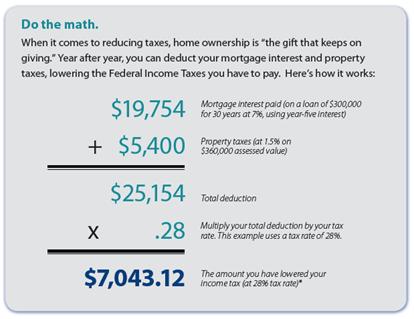
Do the math: When it comes to reducing taxes, home ownership is “the gift that keeps on giving.” Year after year, you can deduct your mortgage interest and property taxes, lowering the Federal Income Taxes you have to pay. Here’s how it works:

Essential tax-time documents: Whether you complete your taxes on your own or go to a CPA, make sure you have what you need to maximize your real-estate tax benefits.


IRS Publication 530 (2011)

From the U.S. Government, this is essential tax information for homeowners. This includes 2011 changes and upcoming changes in 2012.

1098 Form

Issued by your lender, this form shows you the mortgage interest and real estate taxes you paid in a given tax year; both are tax-deductible.

IRS Form 1040

If you want to qualify for home-mortgage interest and real-estate tax deductions, you must itemize your deductions on IRS Form 1040 (Schedule A).

HUD1 Settlement Statement

This form indicates the “points” you or your seller paid when you purchased your home; sometimes you can deduct the full amount in the year you bought your house. You can even deduct the points your seller paid, if they don’t deduct them.

A few pointers on “points”

Known by a variety of names, including origination fees, loan discounts and broker discounts, points are the money you pay your lender as part of your closing costs. A point is equal to 1% of your mortgage. You can deduct the points for the year in which you pay them if your mortgage loan is for the house you live in most of the time. In order to qualify as a deduction, the amount you pay in points must be less than the amount of your down payment. So let’s say you make a down payment of $25,000; if you pay $24,999 or less in points to your lender, you can deduct it.

Sometimes the seller pays the points; you can deduct them, too, so long as your seller doesn’t. The points must be clearly shown in your HUD1 Settlement Statement.

Home Affordable Modification Program (HAMP)

If you benefit from Pay-for-Performance Success Payments, the payments are not taxable under HAMP.


Record of home improvements

Be sure to keep accurate records of any home improvements you make. Though not deductible, these costs are added to the value of your house when your capital gains are calculated. If you live in your house for at least two of the last five years and decide to sell, any profit you make up to $500,000 ($250,000 if you’re single) is yours—tax-free.

Moving expense records

If you moved for a new job, or because your employer changed location, you may be able to deduct some of your moving expenses.

Finance your home improvements the tax-deductible way

When you take out a first or second mortgage to buy a home, build one, or improve it, whether that means updating your kitchen, adding a new roof or undertaking an extensive remodel, the IRS calls that mortgage “home acquisition debt”—and it’s a great way to gain tax benefits while upgrading your home.

For most homeowners, the interest you pay on home acquisition debt is tax-deductible on loans up to $1 million for married couples filing jointly and $500,000 each for couples filing singly.

If you’d like to know more about the tax benefits that you, as a homeowner, are eligible for, visit www.irs.gov or consult a certified public accountant.