It’s tough being a first time home buyer, especially in a fiercely competitive market like Seattle where multiple offers are the norm. Windermere clients Haley and Yash experienced this first hand when they started shopping for a home. With the help of their agent Elsa Nunes-Ueno, they found and fell in love with “the little blue house”. It had everything they were looking for, including the potential for them to fix it up and make it their own. But other bidders and a steep price increase threatened to get in their way. Just when it seemed that all hope was lost, Elsa went to bat for her clients and came up with a creative approach to make Haley and Yash’s dream of the little blue house a reality.
Constructing or remodeling a home is a complex, expensive endeavor. Ideally, everything goes as planned, and when the dust clears, the homeowner can settle in and enjoy the new home — and never think about the building process again.
But what happens when, nine months after the owner moves in, the floor develops a crack, the dishwasher begins to leak or the shower water won’t run hot? Or when these things happen three years later? It’s time to refer to an all-important piece of the contract: the warranty.
The purpose of a warranty is to protect both the homeowner and the builder — homeowners from shoddy work with no recourse; builders from being liable for projects for the rest of their lives.
A warranty may be included in a contract, or it may not be since it’s not required. There is no standard length of time for one. Rather, a warranty is a negotiable portion of the overall agreement (contract) between a homeowner and a contractor.
The laws that relate to warranties are somewhat vague and vary by state, so the advantage of having one as part of the contract is that everything can be clearly spelled out. However, by agreeing to a particular warranty without understanding its finer points, owners may inadvertently limit the protections they would have otherwise had under the law.
“A warranty describes the problems and remedies for which the builder will be responsible after completion of the project, as well as the duration of the warranty and the mechanism for addressing disputes,” says David Jaffe, vice president of legal advocacy at the National Association of Home Builders.
At least in the ideal case.
Janet Paik – Houzz
The Law Governing Warranties
Before homeowners agree to a particular warranty as part of their contract, it’s important to understand what protections they already have under the law. In the U.S., we have a legal concept of an implied warranty — which is a warranty that does not have to be spelled out in the contract but is simply understood to exist thanks to the law. There are two important implied warranties when it comes to home construction.
The first is the implied warranty of good workmanship, which is the reasonable expectation that a home will be built in a workmanlike manner. The second is the implied warranty of habitability, which is the reasonable expectation that the home will be safe to inhabit.
The implied warranties, however, have limits in the form of statutes of limitation and statutes of repose, which essentially are time clocks that determine for how long a homeowner may sue a contractor.
Statutes of limitation in each state dictate how long an owner can invoke various types of legal claims — for example, a breach of contract claim.
Statutes of repose apply specifically to construction projects, and set the time for which builders and designers are liable for their product. These also vary by state. In California, the statute of repose is four years for most defects, but 10 years for latent defects (those that aren’t observable right away, such as a faulty foundation). In Georgia, the statute of repose is eight years for all claims related to design or construction of the building.
Finally, most states also have a right to repair law, which means that before homeowners can sue a contractor, they need to notify the contractor of the problem and give him or her a chance to come see it and repair it.
To find out what the laws are in your state, simply do an online search for “statute of repose” and “right to repair” in your state.
Janet Paik – Houzz
The One-Year Warranty
The key thing to understand about warranties is that many builders offer their own warranty in lieu of the implied warranty. Additionally, many contracts specify that homeowners are giving up their rights to the implied warranty by agreeing to the builder’s express warranty. Also, builders will “often try to shorten statutes of limitation and statutes of repose. Some states allow you to do that. Others don’t,” says Anthony Lehman, an Atlanta attorney who advises homeowners.
Though there is no industry-wide standard, many residential contractors have adopted a one-year warranty for their contracts. The practice likely trickled down from commercial construction, where a callback warranty is typical. A callback warranty means that within one year, a building owner has the right to call back the contractor and expect him or her to repair work, Lehman says.
The downside for homeowners who agree to a one-year warranty is that they likely trade away their right to the implied warranty, and they may also agree to limit the time they have to discover a defect and sue. Obviously, this is a plus for builders because it limits their risk.
But there is no real reason a homeowner has to accept a one-year warranty simply because that’s the builder’s first offer. “It’s a negotiated point, and people can negotiate warranties that are broader — and they often do,” says Robert C. Procter, outside general counsel for the Wisconsin Builders Association. “If you don’t ask for more, you won’t get more.”
Janet Paik – Houzz
Pros and Cons of a Builder’s Warranty
Though a one-year warranty may seem like a poor deal for a homeowner, a contract with details spelled out does provide an upside: some degree of clarity in the process. Ideally, a warranty includes not only the time period that the warranty covers, but also the standards by which various materials will be evaluated, and the steps to follow when a problem arises.
In a minority of states, the legislature has codified what a warranty is and how long it lasts for a variety of materials, Jaffe says. They are California, Connecticut, Indiana, Louisiana, Maine, Maryland, Minnesota, Mississippi, New Jersey, New York, Pennsylvania, Texas and Virginia. If you live in one of these states, you can refer to the state-set standards.
If you do not, one option is to refer to the NAHB’s publication Residential Construction Performance Guidelines. “It’s broken down by categories within the home: foundations, exterior, interior, roofing, plumbing,” Jaffe says. “If there’s an issue that comes up, you look in this publication, and it tells you what the observation is — what’s the problem.” The guide then spells out what the corrective measure — if any — should be.
If you decide to use this guide as the standards by which problems will be judged, be sure you read it first and are comfortable with its terms. Sometimes having the terms spelled out is simpler than relying on the implied warranty because the implied warranty is so vague.
“The implied warranty doesn’t have a fixed time; it’s a reasonable period of time,” says Jaffe, of the NAHB. “If you’re a homeowner, and you call your builder up in year five and say, ‘There’s a crack here, and I think you should come out and fix it because it’s a defect,’ well, at that point, it may or may not be related to something that the builder did or didn’t do. Is it a defect? Who is going to make that determination? What is the fix? Who is responsible for it?”
Relying on the implied warranty means that these sorts of questions would need to be resolved in court if the parties aren’t willing to, or can’t, come to an agreement on their own. Open for debate is whether an item is a warranty item, and for how long it’s covered. Having these issues determined in court can be an expensive, time-consuming headache for everyone involved.
Still, some attorneys say owners might be better off with the implied warranty than giving up their rights for a limited one provided by the builder. “You build a house, and you expect it to be there for a long time. The buildings in Europe have been there a long time. The pyramids have been there a long time. The question is how long is it reasonable for you to expect it to last,” says Susan Linden McGreevy, an attorney in Kansas City, Kansas, who specializes in commercial real estate work. “If it has to get before a jury, the contractor has lost already. What I mean is, the jury will always find in favor of a homeowner — unless they’re a real flake.”
TruexCullins Architecture – Houzz
Going Beyond Warranties
Despite all this talk of legalities, there is an important caveat: Many good builders will continue to be helpful even after their express warranty has passed. Anne Higuera, co-owner of Ventana Construction in Seattle, provides a one-year warranty to her clients. Nonetheless, Ventana has made repairs and fixes even years after the one-year warranty expired. Higuera says the company does so because the builders want good relationships with their customers, and because they feel as though it’s the right thing to do. “Warranty issues come up very rarely if you do things well in the first place,” Higuera says. “Just finding a contractor who does the right thing on the front end helps you avoid issues with warranty.”
More Ways to Protect Yourself
So what should homeowners do if a builder is offering only a one-year warranty? One option is to negotiate for a longer period of time. “You might want to say, ‘I’ll take a one-year warranty for everything except latent defects,’” McGreevey says. (Reminder: Those are the kind that take a long time to discover, such as foundation problems.)
Another option owners have is to ask builders about insurance products. Many builders offer products with an extended warranty — as long as 10 years — that are backed by insurance companies. These are typically paid for by the builder, with the cost passed on to the homeowner.
Third, homeowners would be wise to consult an attorney to make sure that they’re not giving up rights unknowingly. Given that owners are spending thousands to hundreds of thousands of dollars on construction, paying for five to 10 hours of an attorney’s time (at $300 per hour, $1,500 to $3,000) to ensure that the contract is sound is probably a good investment. “Would you buy a car for $50,000 and not read any of the financing information?” says Lehman, the Atlanta attorney. “And then people do that for a home construction project.”
Finally, the most important thing is for both contractors and owners to screen each other carefully. “Ninety-eight percent of the homeowner-builder relationships, when there’s a disagreement, most parties reach a reasonable conclusion, even if they’re not 100 percent happy,” says Procter, the Wisconsin attorney. “The contracts matter more when someone is not being reasonable.”
By Erin Carlyle, Houzz
Featured Image Source: Getty Images – Image Credit: sturti
Getting your children prepared to go back to school is stressful enough. We all want to make sure that they are adequately prepared for the upcoming year. Now imagine that you also have to worry about how you’re going to pay for new clothing, shoes and school supplies—it can be quite overwhelming! Many parents just aren’t able to afford all of the back-to-school necessities.
Fortunately, there are community and school programs available that can help with that need. And at Windermere, we are proud to support a number of those organizations that help provide backpacks, school supplies, shoes, clothing, haircuts, and other back-to-school-related needs, through donations from the Windermere Foundation.
These are just a few examples of how our Windermere offices are helping children in their communities get a good start to the new school year.
The Windermere/Coeur d’Alene Realty, Inc. offices supplied backpacks full of school supplies for the KIDS Camp summer school program offered by the Coeur d’Alene School District at Fernan Elementary School. This program serves second and third grade students that have been behind grade level and are recommended by their teachers to attend camp. These classes give them a boost to catch up, and in most cases, get ahead! When Windermere first started supporting the program, there were only 12 kids. This year the number has grown to 57.At the end of the camp, each student receives a new backpack full of school supplies complements of the Windermere Foundation.
“It’s a wonderful program that we have been involved with for the last four years,” said Midge Smock, Windermere Foundation representative, Coeur d’Alene Realty, Inc. “The first two years we had agents adopt a backpack. This year, all supplies were purchased in bulk and agents sponsored a full backpack. These kids will be ready for school in the fall.”
The Windermere Mount Baker office has been assisting with the Seattle/King County Coalition on Homelessness’s Project Cool back to school supply drive for the last four years. Each summer, the office holds a supply drive and then spends a morning organizing the backpacks for children that are experiencing homelessness. This year approximately 20 Windermere agents volunteered on July 9 to help organize and stuff the backpacks with supplies. These backpacks were then distributed to children in need through various social service organizations and homeless shelters.
The Windermere Seattle-Northgate, Seattle-Sand Point and Seattle-Wedgwoodoffices have been working with 10 elementary schools in their neighborhoods. With the help of principals, advisors, counselors and teachers, 236 children have been identified to be in need of backpacks and school supplies. Supplies include composition notebooks, reams of copy paper and wide rule paper, erasers, colored pencils, crayons, rulers, 3-ring binders, and much more. Supplies will be purchased through grants from the Windermere Foundation, assembled by Windermere brokers, and delivered to the specified schools.
The Windermere Bellevue Commons office is holding a backpack/school supply drive from July 26 through August 15 to support Congregations for Kids, which helps students who qualify for free and reduced lunch in the Bellevue School District. Over 25 agents will help with the effort. Last year, 1,525 students benefitted from their assistance.
The Windermere Las Vegas-Summerlinoffice is participating in the Communities In Schools (CIS) “Fill the Bus” back-to-school drive. This event will benefit over 58,000 students in 55 schools statewide that CIS of Nevada serves. This is the second year the office has participated. Last year they helped to fill five school buses with backpacks, uniforms and school supplies for all ages. This year they are hosting a collection drive at their office through August 11, and will bring their collected items to the drop off site on August 12.
A number of Windermere offices throughout our network will be collecting shoes August 1-8 for children in need as part of the Windermere Kicks for Kids shoe drive. Each office selects a local non-profit to receive the donated shoes. One participating office is Windermere Mercer Island which is collecting shoes for Mary’s Place, a homeless shelter for women and children in Seattle, WA. For the past three years, brokers from the Mercer Island office have participated in a back-to-school event at Mary’s Place, where children are paired with volunteers to select a pair of shoes and backpack for school.
If you’d like to help children in need in your community during the school year, or throughout the year, please consider donating to the Windermere Foundation. For the past 27 years, the Windermere Foundation has donated a portion of the proceeds from every home purchased or sold towards supporting low-income and families in our communities. And generous donations from our Windermere owners, agents, staff, and the community continue to make Windermere Foundation grants possible.
Tell your friends and families to clear their weekend schedules throughout the entire summer—your house is the place to be for fun all season long.
If you sloughed through winter with visions of making your house the hangout spot of the summer, you’ll want to bookmark this page. We’re outlining the gadgets you’ll need on hand to turn your home into a modern entertaining destination!
1. Keyless Door Lock
No one wants to be kept inside on door duty when the party is in the backyard. Give trusted guests the freedom to enter on their own by installing a keyless door lock. By swapping a traditional key entry with one of the many keyless touchpad lock options, not only will you avoid always rummaging around the house itself searching for the keyring, you’ll also be able to create temporary codes to give to guests that unlock the front door. While they can come right in and enjoy the party, you won’t have to forfeit any sense of security, since those access codes can later be changed once the party’s over.
2. Smart Thermostat and Energy Monitor
You know the drill. When temperatures go soaring, the air conditioner plummets. However, there’s a better way to keep your home’s climate comfortable than constantly blasting cold air. Instead, opt for a smart thermostat that learns the heating and cooling patterns of your home and adjusts energy usage accordingly.
Install something like the Nest Learning Thermostat and you’ll not only get a better idea of how you’re currently using energy at home and how that affects your bills every month, but you’ll also have the option to control your cooling system with a smartphone app. Picture this: you ran out to the store for one more item before friends arrive, and you realize you didn’t turn on the air conditioning. Before you hop into the car, open the Nest app and tell it how cool you’d like the house to be by the time you return home.
3. Water-Resistant Bluetooth Speakers
While you’re hanging outside and listening to music, splashes and spills will happen, we can guarantee that. What can’t be guaranteed is whether the music will stop because of these splashes. Keep the tunes playing by arming your festivities with water-resistant speakers that won’t fritz out with the smallest splash. Plus, most portable speakers have Bluetooth connectivity, so you’ll be able to keep the smartphone or tablet you’re streaming music through with you up to 30 feet before interfering with the connection range.
4. Party-Ready Lighting System
As the sun dips in the sky for the night, you have the perfect opportunity to showcase one of our favorite smart home gadgets—colorful and very intelligent lights! Creating ambient lighting does not involve black lights or scarves thrown over lamps anymore. The electronics brand Philips has made itself the leader in colorful solutions for relaxing at home that can also be synced across Wi-Fi systems. The Philips Hue family of products offers everything from movie theater-style light strips—how great would those look along window panes?—to long-lasting LED light bulbs that can be controlled via smartphone app and programmed to nearly infinite color combinations. Keep the party humming well into the night by getting creative with smart lighting’s endless color palette.
5. Smartphone-Controlled Irrigation and Watering System
In between traveling the world, splashing in the pool and catching up on a long list of reading material, the last thing you want to check off your to-do list in the hot summer months is tending to your garden. However, you don’t want all your hard work to turn into weeds or dry up from neglect.
To keep the yard looking in tip-top shape whatever your hosting or travel schedule may be, install a smart irrigation system in the backyard. Devices like the Rachio Iro Intelligent Irrigation Controller allows you to control your sprinkler system via its smartphone app. You could be in another state enjoying a friend’s backyard party and still turn your sprinklers on or off with a few taps of your phone. Look for other types of smart gardening sensors, specifically ones that can be inserted right into the soil, which will alert you when it’s time for a water refresh on the plant.
6. Security Camera
Of course, we’re going to have to add a touch of practicality to your gadget arsenal. With all those people streaming in and out of your house through a variety of entrances, accidents may happen and a door can be mistakenly left open. Create some peace of mind without helicoptering around the doors or your guests by installing a security camera on the exterior or interior of the house.
Choose a smart security camera option with Wi-Fi viewing to keep an eye on what’s happening in your house from the convenience of an app on your smartphone, tablet, or computer browser. Indoor camera options are ideal for homes that have small children or pets that you may want to check in on from another room or when away for the day. Opt for an outdoor camera when it’s a crime deterrent you’re after or if there’s a pool or other item you’d like to monitor on your property.
Stock up on these tech gadgets and you’ll be ready to party all summer long.
Kelly Schwarze is a tech geek who writes about the latest gadgets and also provides tips on how to use them. She especially likes to give advice on how the new smart home technology and Security can be used to improve your live. To see a large selection of security cameras, Kelly mentions in this article, visit The Home Depot.
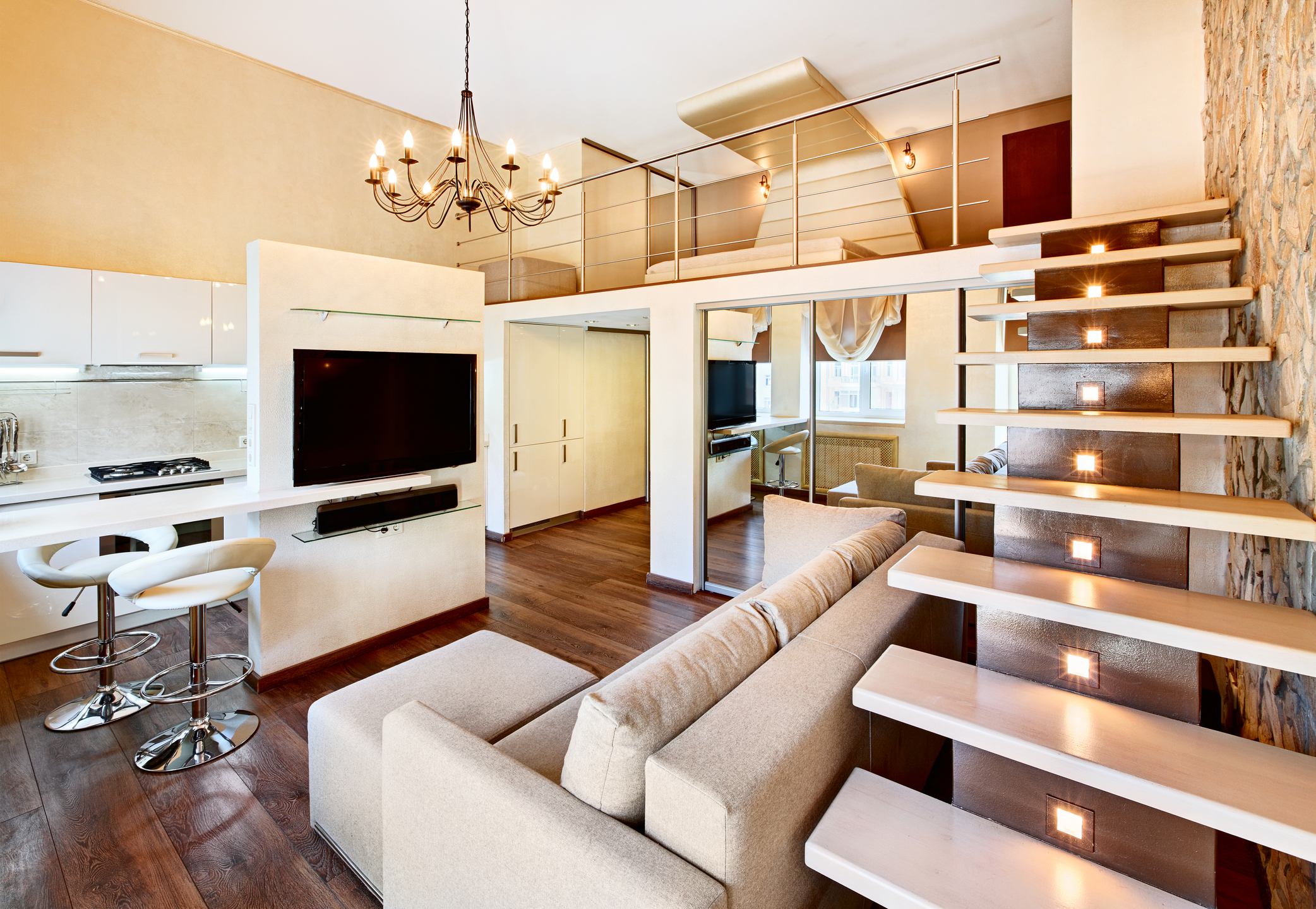
Suburban homes—with their large spaces, big yards, and separate bedrooms for every child—will always be popular with families, especially families of four or more. But there’s also a contingent today that’s eager to live in a dense urban setting: a high-rise condominium in the downtown core, a small home in an urban neighborhood, a small apartment, or even a shared housing arrangement. For those people, designing, furnishing, and organizing these living spaces will require a very different approach.
Urban living spaces are usually much smaller than suburban homes, which means, if you use traditional furnishing and space-planning techniques, you’re bound to be frustrated by the outcome. But with a little planning and creativity, you can create a fully functional space that belies its size.
Small-space planning ideas
Start with the biggest, most important piece in each room (the sofa, the dining room table, the bathroom sink, etc.), then plan the rest of the space around that item.
Focus on the needs of those who will be living in the home full-time. Leave any accommodations for guests until later.
Work to make every space multifunctional (e.g., a kitchen island that can also be used for eating; a home office that can also function as a TV room and/or guest room).
Look for any opportunity to increase the amount of sunlight. Install glass doors and skylights, and leave windows unobstructed.
The fewer walls separating spaces, the more open and spacious it will appear.
Traditional staircases are an inefficient use of space. If you’re designing from the ground up, consider a spiral staircase instead.
Light paint colors (especially white) will make a room look more spacious. The combination of light walls with a dark floor will magnify the effect even more. Consider painting one wall a contrasting color to create a stylish focal point.
Furnishing solutions for small spaces
Your furnishings should be small mobile and, when possible, stackable. That way, spaces can be quickly reorganized to suit different situations.
Furnishings that blend with the colors of your walls or floors (or are transparent) will make the space appear less cluttered. To add personality and warmth, accentuate with colorful throw pillows and rich fabrics.
If you keep most furnishings against the walls, traffic flow will be improved, and it will make rooms feel larger.
Furnishings that hang from the walls or have legs will also create the illusion of more space.
In many cases, bench seating is better than individual chairs, because benches can accommodate more people and can be used as side tables when no one is sitting on them.
Instead of a coffee table, consider small side tables. Instead of a full-size sofa, try a three-seat version, or even a love seat (just two cushions).
A large, wall-mounted mirror will make the space appear larger.
An open-sided bookshelf can do double-duty as an interesting room divider. Leaving it half empty will allow natural light to shine through.
A table on wheels is good for the kitchen. Use it as an island in the center of the kitchen or roll it to the side and use is as a side counter.
Consider using an under-counter refrigerator, together with an under-counter freezer, instead of one large, freestanding unit.
In small spaces, there is no room for furnishings you don’t love. If something isn’t getting used much, or if you don’t really care for it, get rid of it.
Organizing small spaces
The best furnishings are those that include storage space (a dining room table with drawers; an ottoman with a hollow interior; a bed that sits on a storage unit).
Bookshelves and other wall-storage systems should be thin and as tall as possible to maximize storage while minimizing the amount of floor space used.
Storage pieces with doors keep small rooms from looking cluttered and unkempt. Even glass doors can help achieve this effect.
Remove food goods from their air-filled boxes and bags and store them in space-saving, stackable containers.
Store larger things (like a vacuum cleaner, electronics, etc.) behind a free-standing decorative screen.
A professionally designed closet storage system can double, and even triple, the space for your clothes. Removing the door(s) to the closet will ease access.
Wall-mounted hooks are ideal for coats and much more. Pot racks are great for freeing up valuable cabinet storage space in the kitchen.
Many people think you need to sacrifice in order to live in a small space. But with these suggestions, you can simply adapt and enjoy your home to the fullest.
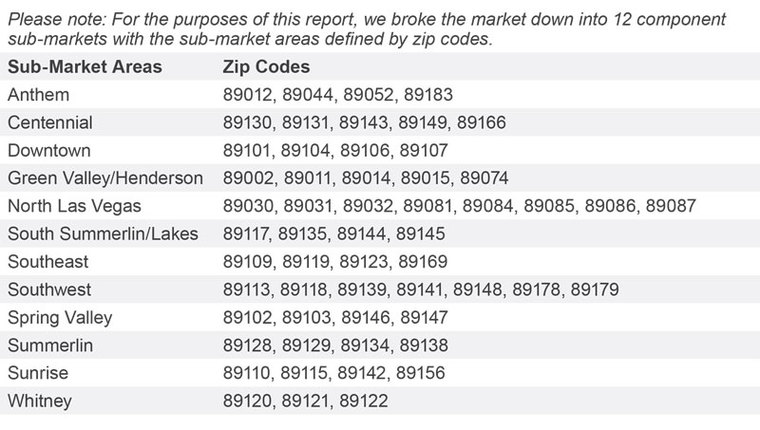
Job recovery in the Las Vegas metropolitan area took a bit of a pause during second quarter. May employment was down by 200 jobs from the prior month, but still 21,300 higher than seen a year ago. This matches the annual pace of 21,300 jobs seen at the end of last year, but is below the average annual rate of 32,700 for the whole of 2015. It is too early to suggest that this “slowdown” will be ongoing, but I will be keeping a close eye on the numbers through
the summer months.
The local unemployment rate rose from 6.1% to 6.4% between April and May, but it’s important to keep in mind that this data is not seasonally adjusted. (Seasonal adjustments remove the influences of predictable seasonal patterns to show how unemployment changes from month to month.) The employment rate has been fluctuating quite frenetically over the past
few months, but I believe that Las Vegas is still trending in the right direction, especially considering that there were substantial additions to the workforce during the spring.
HOME SALES ACTIVITY
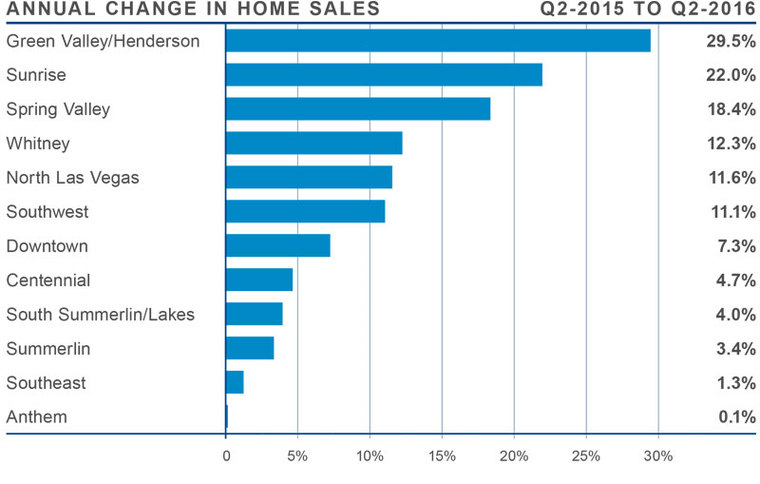
■ There were 9,717 home sales last quarter, which is an annual increase of 9.7%.
■ Sub-markets where sales activity was slow were limited to the Southeast and Anthem areas, but the declines were very modest.
■ The fastest rate of growth in sales came in the Green Valley/Henderson sub-market, which saw home sales rise by 29.5% over the past year.
■ Inventory levels remain a major issue with the number of homes for sale 3.9% lower than a year ago, and 9.4% lower than in the first quarter of the year. There were four areas where the number of homes for sale increased, led by the Southwest sub-market which saw listings increase by 7%.
HOME PRICES
■ Average prices in the region rose by 3.8% year-over-year to $230,500.
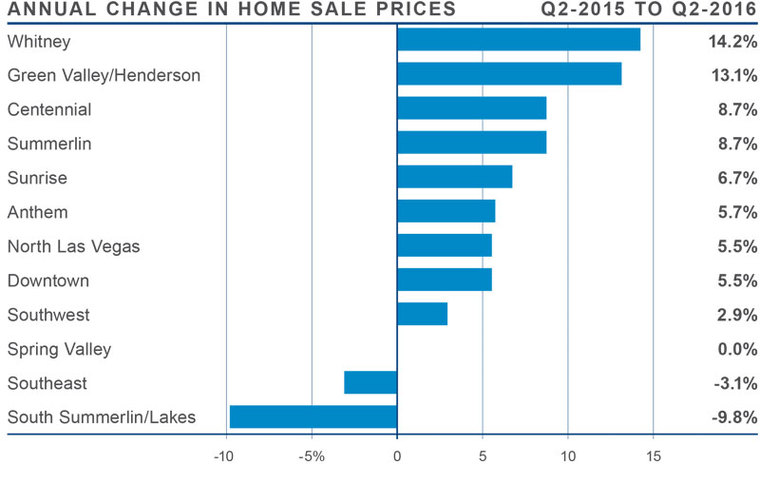
■ The Whitney sub-market saw the strongest annual growth with home prices rising by 14.2% to $174,333.
■ All but three sub-markets saw prices rise compared to the second quarter of 2015, and two sub-markets registered double-digit percentage gains.
■ Prices fell in the South Summerlin/Lakes and Southeast sub-markets, but I don’t believe that one declining quarter is enough to suggest that this trend will continue.
DAYS ON MARKET
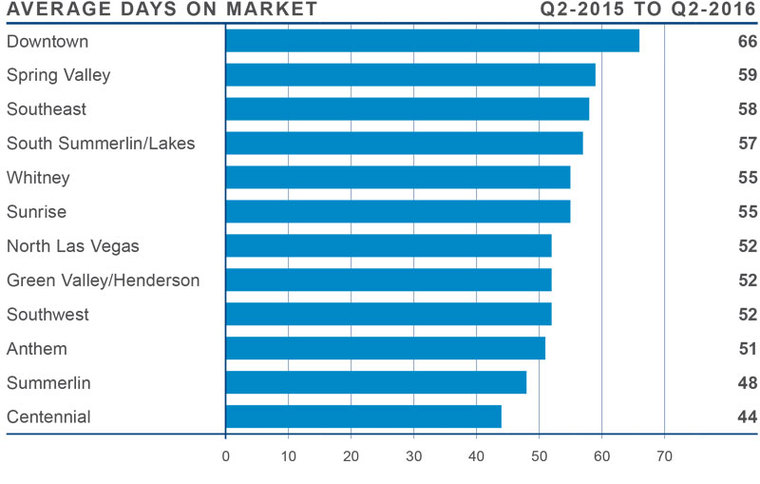
■ The average number of days it took to sell a home in the region dropped by nine days when compared to the second quarter of 2015.
■ The average time it took to sell a home in the region was 53 days.
■ The South Summerlin/Lakes sub-market was the only market where the number of days on market did not drop but it did not increase either!
■ The greatest drop in days-on-market was seen in the Sunrise sub-market, which dropped by
16 days.
CONCLUSIONS
The speedometer reflects the state of the region’s housing market using housing inventory, price gains, sales velocities, interest rates and larger economics factors.
The Southern Nevada economy continues to grow, but the pace has slowed. This is not a cause for concern at the moment, but I will be watching the data through the summer to better understand the reasons for the current slowdown.
Inventory levels are not what I would hope for, and it is clear that more choice in homes for sale will lead to a more balanced market. Home prices are still rising, but at a reasonable pace. Because of this, I am leaving the speedometer in the same position as last month—still in favor of sellers.
Matthew Gardner is the Chief Economist for Windermere Real Estate, specializing in residential market analysis, commercial/industrial market analysis, financial analysis, and land use and regional economics. He is the former Principal of Gardner Economics, and has over 25 years of professional experience both in the U.S. and U.K.
Over the past 12 months, the Southern California markets covered by this report added 122,800 new jobs, and the total number of people claiming unemployment insurance dropped by almost 204,000. With these changes, the unemployment rate has dropped by two percentage points from 6.3% to 4.3%.
The regional economy appears to be performing quite well and I expect this trend to continue for the foreseeable future.
HOME SALES ACTIVITY
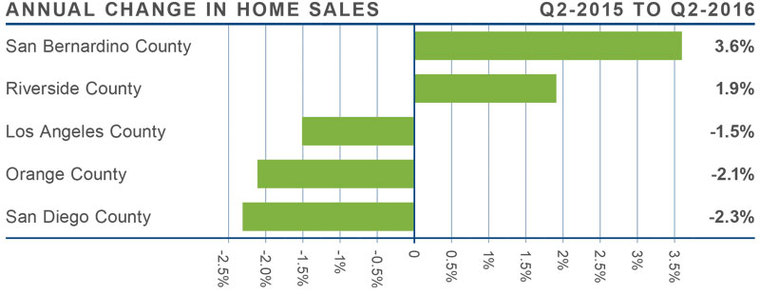
There were a total of 54,216 home sales in second quarter of 2016. This was 0.6% lower than seen during the same period in 2015, which I attribute to the 3.3% decline in the number of homes for sale.
The decline in the number of home sales in most markets was primarily due to lower inventory levels, but this was not the case in Orange County where listings were modestly higher.
Home sales were a mixed bag with higher sales reported in San Bernardino and Riverside Counties, but lower in LA, Orange and San Diego Counties.
Total listings are still well below levels that are expected in balanced markets.
HOME PRICES
Compared to second quarter of 2015, average prices in the region rose by 3.9% to $618,042. We continue to see a slowdown in price growth, which can be attributed to affordability as well as supply issues.
LA County and Orange County are almost at parity with each other price-wise. The average home price last quarter was $774,000 in LA County and $772,000 in Orange County.
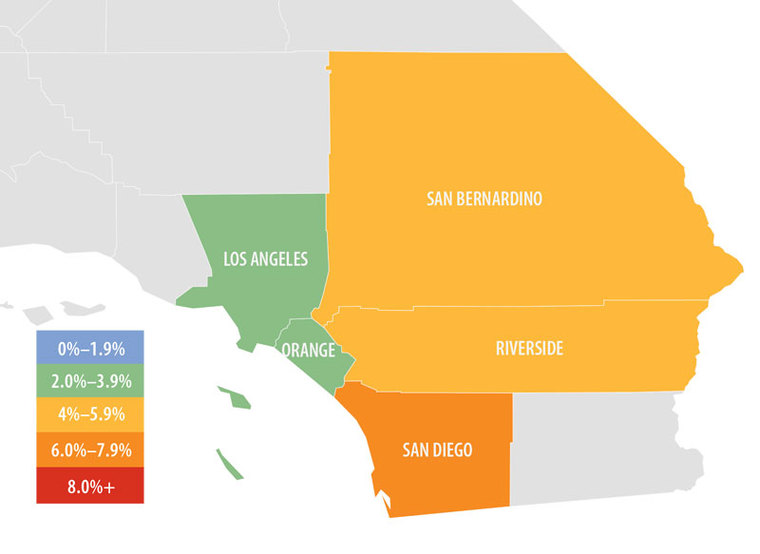
San Diego County saw the greatest appreciation in home values (+6.9%) to $617,000. This was followed by San Bernardino County, where the average price rose 5% to $323,300.
Both LA County and Orange County saw prices jump between the first and second quarters of this year, with prices 7.5% higher in LA County and 8.8% higher in Orange County.
DAYS ON MARKET
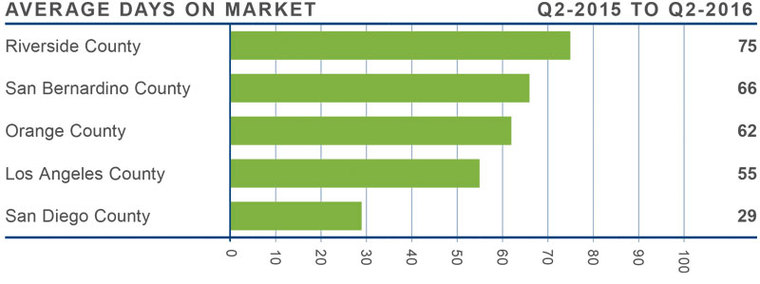
The average time it took to sell a home in the region was 58 days. This is a drop of three days when compared to the second quarter of 2015.
The decline in days on market remains a function of low inventory, as well as price. The drop in the time it takes to sell a home is moderating, primarily due to escalating home values which are stretching buyers’ budgets.
Homes in San Diego County continue to sell at a faster rate than the other markets in the region. In the second quarter, it took an average of 29 days to sell a home, which is seven days less than seen a year ago.
Four of five counties saw a drop in the amount of time it took to sell a home between the second quarter of 2015 and the second quarter of 2016. The only exception was in San Bernardino County, where the time it takes to sell a home remained at 66 days.
CONCLUSIONS
The speedometer reflects the state of the region’s housing market using housing inventory, price gains, sales velocities, interest rates and larger economics factors. The expansion of the economy in the Southern California region continues to taper, but for good reason. The area is getting close to reaching “full employment”, which naturally leads to a subsequent slowdown in employment growth.
The demand for housing continues, but affordability is starting to act as an anchor in some markets. That said, if inventory levels start to grow, some of the pressure will ease and we should head towards a more balanced market.
Interest rates remain competitive, and price growth has shown some signs of slowing, which favors buyers; however, inventory constraints persist and, for that reason, the market still clearly favors sellers.
Matthew Gardner is the Chief Economist for Windermere Real Estate, specializing in residential market analysis, commercial/industrial market analysis, financial analysis, and land use and regional economics. He is the former Principal of Gardner Economics, and has over 25 years of professional experience both in the U.S. and U.K.
As a whole, Oregon’s labor market remains stronger than it has been in decades. Job growth in the second quarter was somewhat muted, but this is nothing to be concerned about. Businesses have expanded to pre-recession levels, so at this point hiring tends to be cyclical rather than expansionary.
The state has essentially reached what is defined as “full employment”, at which point growth rates tend to naturally slow. This explains why the state’s unemployment rate has remained steady at 4.5% for the past three months—a level that has not been seen in over 40 years.
HOME SALES ACTIVITY
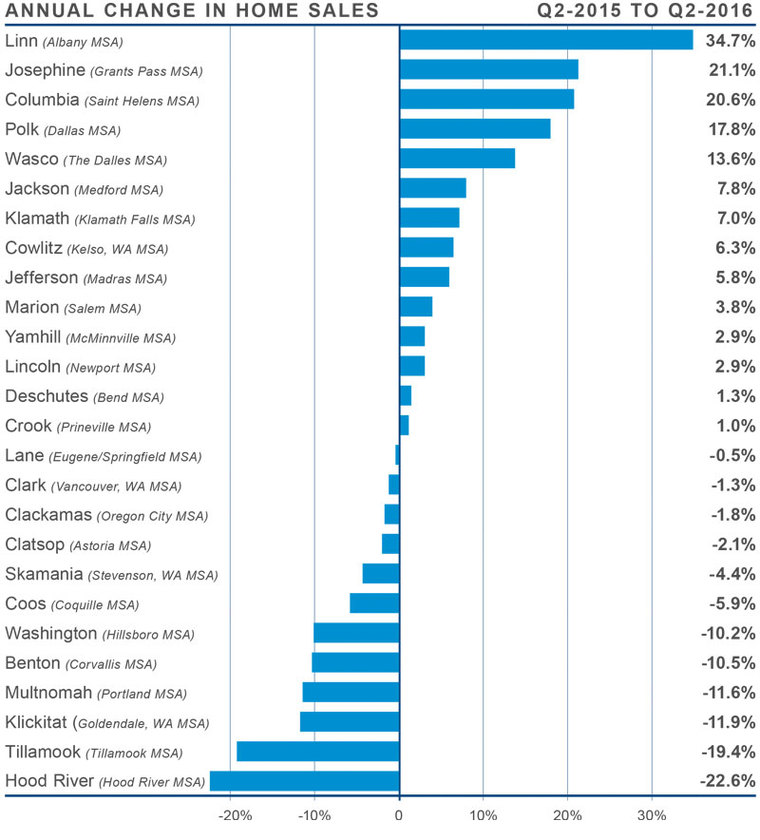
Home sales fell by 2.3% when compared to the second quarter of 2015, with a total of 17,509 transactions.
Sales rose at the fastest rate in Linn, Josephine, Columbia, Polk, and Wasco Counties. The greatest declines were seen in Hood River, Tillamook, Klickitat, Multnomah, and Benton Counties.
Although overall sales activity was somewhat slower, there were still 14 out of 26 counties that saw home sales increase over the same period in 2015. However, a majority of these counties are small, which means a few sales can result in major swings. As such, I believe the major reason for the slowing in sales is the lack of inventory rather than lack of demand.
Home sales are a product of supply, and that is what’s missing from the equation. When we start to see more listing activity—which I hope will be later on this year—an increase in sales will surely follow.
HOME PRICES
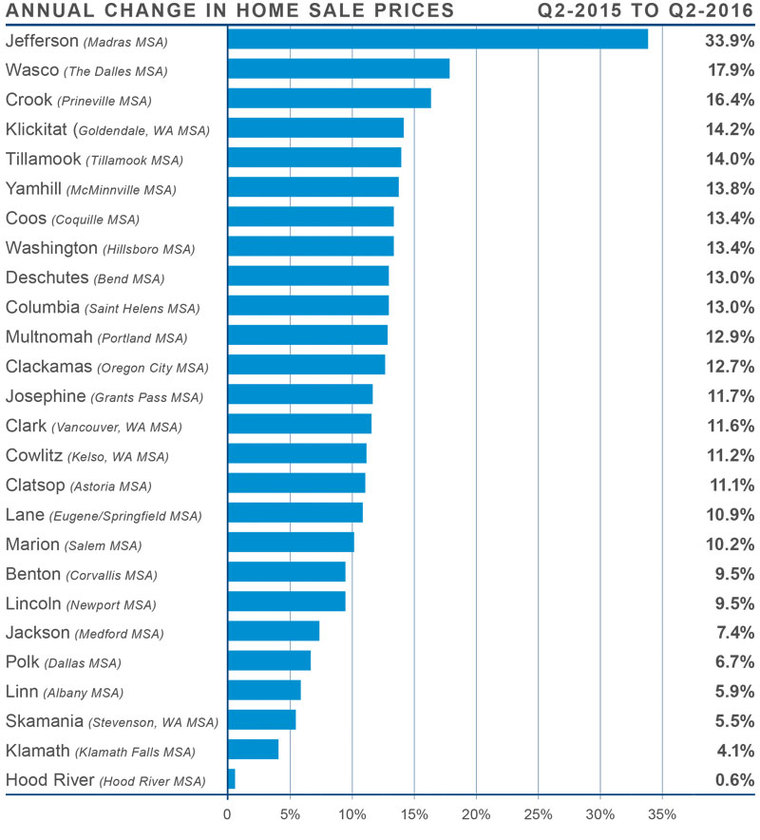
Average prices in the region rose by 10.5% year-over-year to $336,882. This is up from the annual rate of 9.1% seen in the first quarter of the year. It is clear that supply constraints continue to push prices higher, and this rate of appreciation is one of the highest in the nation.
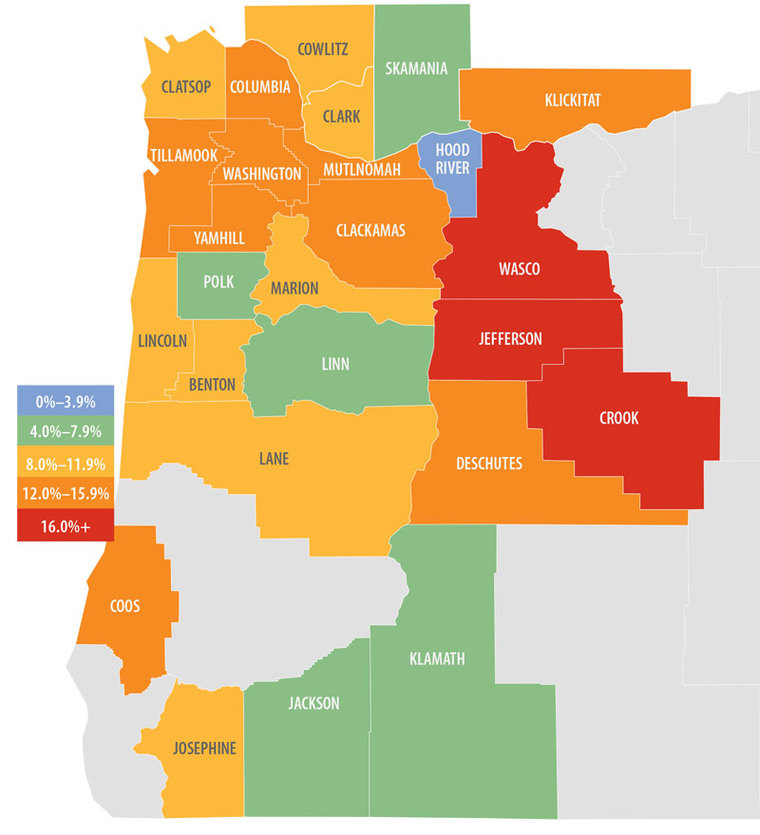
When compared to the second quarter of 2015, Jefferson County took over as the market with the greatest price growth, with homes selling for 34% above that seen a year ago.
All counties saw prices rise compared to the second quarter of 2015, and all but eight saw double-digit percentage gains. The only “underperformer”—if it can be termed as such—was the very small Hood River County where prices rose by 0.6%.
The rapid price growth that is being seen in the region so far this year cannot be sustained. That said, I see little reason to believe that any slowdown will occur in the near-term.
DAYS ON MARKET
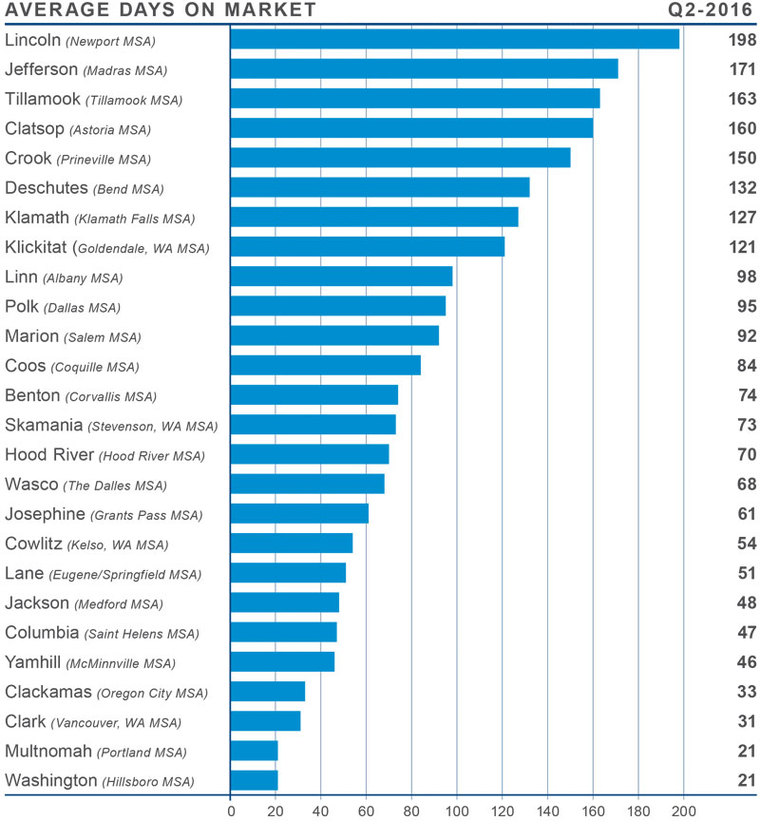
The average time it took to sell a home last quarter was 88 days.
The average number of days it took to sell a home dropped by 16 days when compared to a year ago.
Crook County was the only area where the average time it took to sell a home rose, but given the fact that it is a small market (104 sales this quarter), the increase is clearly nominal.
The fastest sales pace was again seen in Washington and Multnomah Counties, which reported an average of just 21 days to sell homes.
CONCLUSIONS
The speedometer reflects the state of the region’s housing market using housing inventory, price gains, sales velocities, interest rates and larger economics factors. Growth in the Oregon economy remains well above average and is unlikely to slow down in the foreseeable future. As real estate relies heavily on economic growth, this continues to bode well for the Oregon housing market.
Listing activity is still well below levels that I would like to see, and this continues to push up home prices. Interest rates remain at near historically low levels and are not likely to increase to any great degree in the near-term. This allows buyers to borrow more, and adds additional upward pressure on home prices.
As such, I have moved the needle even more in favor of sellers.
Matthew Gardner is the Chief Economist for Windermere Real Estate, specializing in residential market analysis, commercial/industrial market analysis, financial analysis, and land use and regional economics. He is the former Principal of Gardner Economics, and has over 25 years of professional experience both in the U.S. and U.K.
Washington State continues to see strong employment growth, outpacing national numbers with an annual rate of more than 3%. Interestingly enough, despite these substantial job gains, the unemployment rate remains stubbornly high at 5.8%. However, I’m not overly concerned about this because it’s largely due to a growing labor force rather than a declining job market. This means that those who are unemployed who had previously stopped looking for work are now resurrecting their job searches because they have confidence in the economy.
I expect to see a modest drop in the unemployment rate through the balance of the year, and believe we will continue to outperform the nation as a whole with above-average job gains.
HOME SALES ACTIVITY
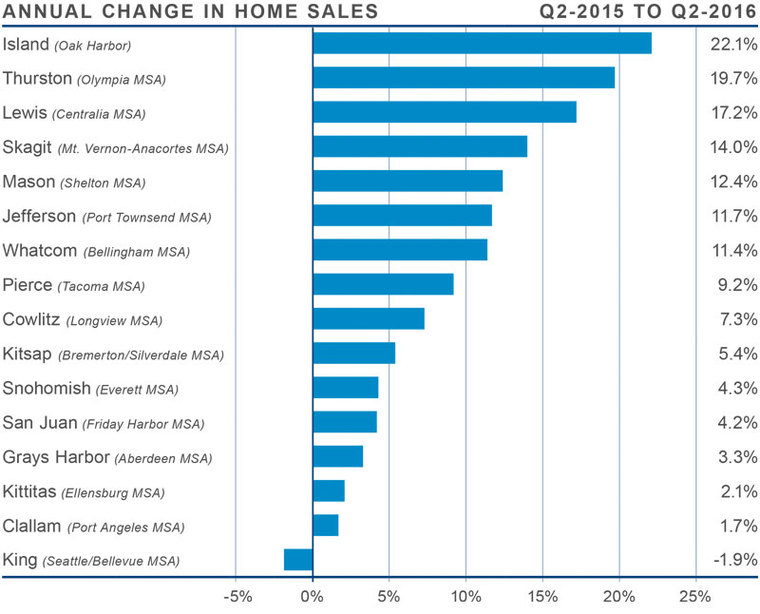
There were 22,721 home sales during the second quarter of 2016, up by 4.4% from the same period in 2015. We finally saw a much-needed increase in listings, which rose by 30.1% between first and second quarter. This increase in the number of homes for sale led to an increase in sales, which rose by 4.4% when compared to the same period in 2015.
Island County saw sales grow at the fastest rate over the past 12 months, with sales up by 22.1%. This is a small county which is subject to wild swings, so I take the data at face value. That said, the larger Thurston County saw sales up by an equally impressive 19.7%. Most interesting is that King County saw sales fall modestly compared to the same time period in 2015. Price—and supply—are clearly an issue in the most populous county in our state.
Overall listing activity was down by 21.8% compared to the second quarter of 2015, but the good news is that the supply side deficit is actually getting a little less than we have seen over the past few years. The total number of homes for sale was 30.1% higher than seen at the end of the first quarter. While much of this can be attributed to seasonality, it is still nice to see!
The region is experiencing positive job growth, and with it, migration to Washington State is running at a very brisk pace. Given these factors—in addition to our lack of new home construction—it is not surprising to see demand substantially usurping supply. As I look forward, I believe inventory levels will continue to rise modestly, but it will remain a solidly seller’s market for the rest of the year.
HOME PRICES
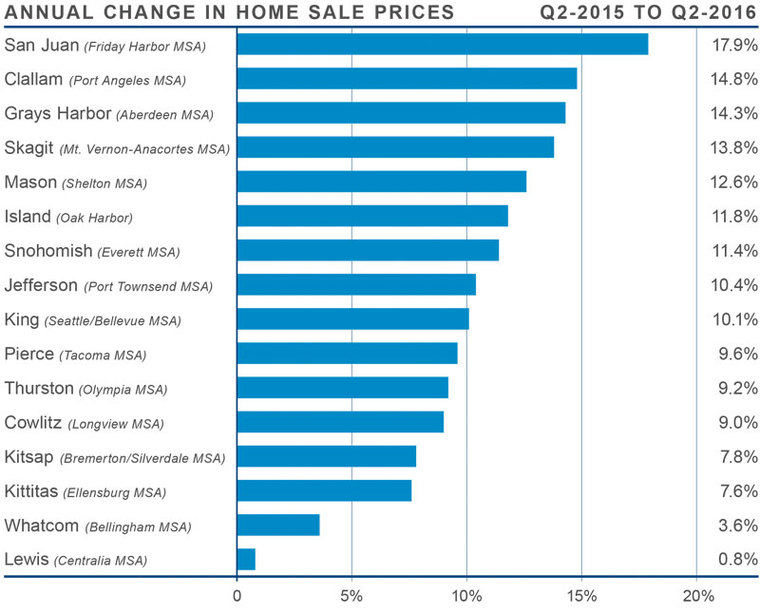
With demand still exceeding supply, we should not be surprised to see average sale prices continuing to rise, as is certainly the case in our region. Home prices rose by 8.1% between the second quarter of 2015 and the second quarter of this year. This is down from the annual rate of 10.1% that we showed in our last report, but the rate is still far higher than the historic average of 4%.
Regular readers of this report will remember that there were several counties where average sale prices in the first quarter were actually lower than seen a year before. I suggested that seasonality was to blame and that was indeed the case, with all counties in this report now showing annualized price gains.
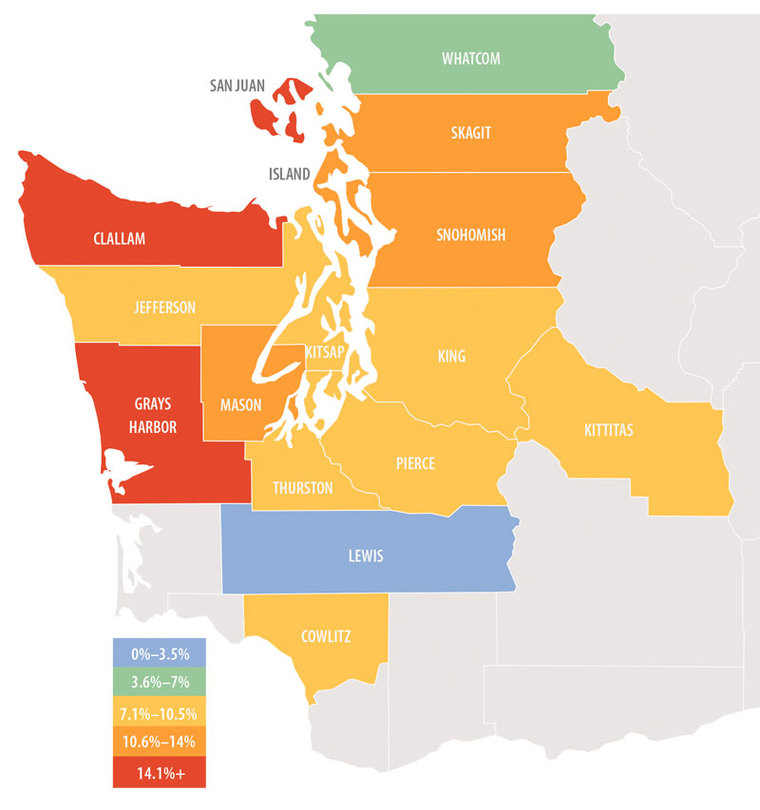
When compared to the second quarter of 2015, price growth was most pronounced in San Juan County and, in total, there were nine counties where annual price growth exceeded 10%.
The prevailing supply/demand imbalance continues to push prices higher, and persistently low interest rates are just adding fuel to the flames. If rates stay at current levels, it is unlikely that we will see much in the way of slowing appreciation for the rest of the year.
DAYS ON MARKET
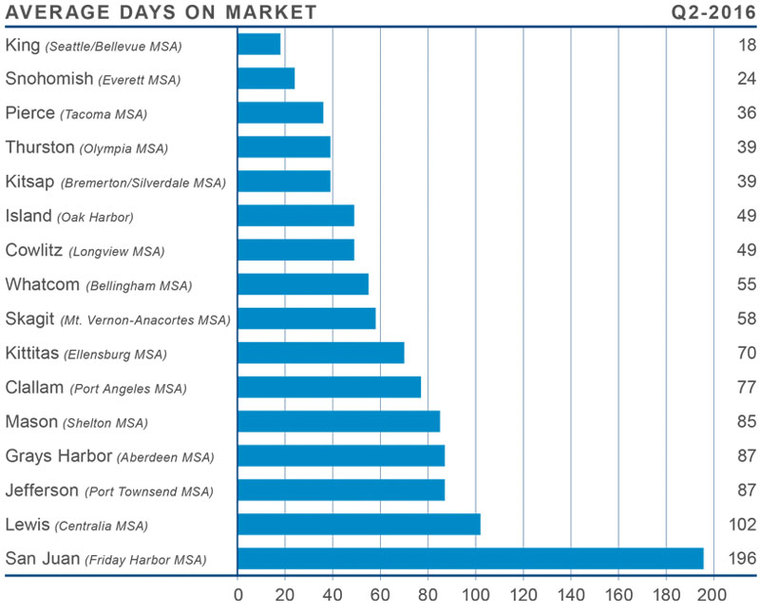
The average number of days it took to sell a home dropped by 17 days when compared to the second quarter of 2015.
It took an average of 67 days to sell a home in the second quarter of this year—down from both the 86 days it took to sell a home in the first quarter of this year, and from the 84 days that it took to sell a home in the second quarter of 2015.
The only market where the length of time it took to sell a home rose was in the notoriously fickle San Juan County, where it rose by 30 days to 196 days. In the rest of the region, the average decrease in the time it took to sell a home between the second quarter of 2015 and the second quarter of 2016 was 20 days.
Snohomish County has joined King County as a market that takes less than a month to sell a home. At 18 days, King County is unarguably the hottest market in the region, but sales are slowing due to the lack of inventory. This imbalance is unsustainable over the long term.
CONCLUSIONS
This speedometer reflects the state of the region’s housing market using housing inventory, price gains, sales velocities, interest rates, and larger economics factors. For the second quarter of 2016, I am leaving the needle in the same position as last quarter. Inventory levels have improved, albeit modestly, and price growth has slowed very slightly. However, this is offset by a jump in pending sales, a slightly higher number of closed sales, and a drop in interest rates. As such, the region remains staunchly a seller’s market.
Matthew Gardner is the Chief Economist for Windermere Real Estate, specializing in residential market analysis, commercial/industrial market analysis, financial analysis, and land use and regional economics. He is the former Principal of Gardner Economics, and has over 25 years of professional experience both in the U.S. and U.K.
Feeling ho-hum about classic hardwood floors? Here are six alternative floor solutions that can give any room in your house a fresh sense of personality, whether you’re starting from scratch or looking for an inexpensive DIY update.
1. Rubber. Often associated with commercial interiors, industrial rubber flooring can also be a sleek and smart solution for homes. Rubber is comfortable to stand on, easy to clean and durable enough to take on plenty of mess and abuse — great for an entry, a mudroom or a laundry room. From a style perspective, it gives a room a hint of an industrial edge, but in warm muted tones that still create an inviting air.
In a kitchen, a rubber floor is a chef’s dream, as it cushions the feet while the cook is standing to reduce fatigue. Plus, the textural surface reduces slipping hazards from spills and is very child-friendly.
Want a rubber floor with a less industrial vibe? Choose sheets or tiles of rubber with a flat surface dyed to various hues that draw from the tones in stone tile. You wouldn’t guess this floor is rubber by looking at it, but your feet would be able to tell.
Cost: Rubber flooring can be extremely inexpensive but, in general, quality materials start at $12 per square foot. Anything below that would probably be of a quality that wouldn’t look appropriate inside a home.
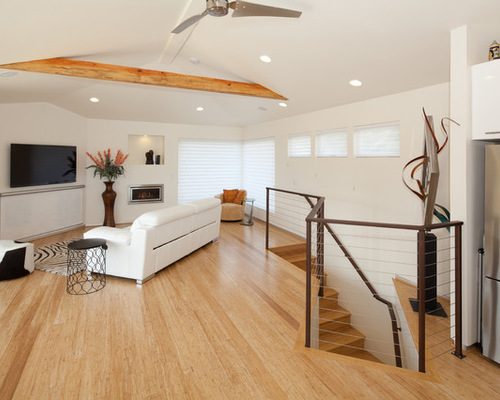
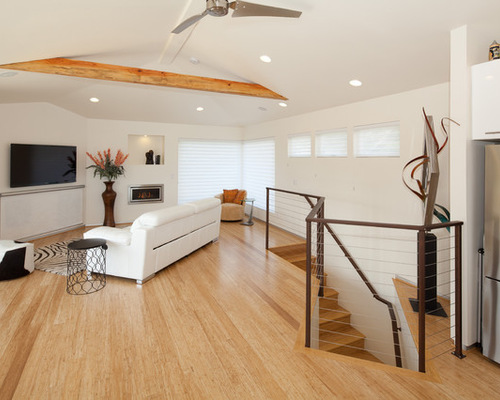
2. Bamboo. Bamboo flooring is similar to wood flooring in many ways, but it imparts a Zen flair that can add a sense of peace to a room. And it is typically more moisture-resistant and hard-wearing than wood.
It should be noted that not every bamboo product is equally environmentally conscious. For one thing, shipping products from overseas can quickly make up for any carbon-footprint cost saved during production. However, if you are looking for a durable natural floor that’s sustainably grown, bamboo is a great option to consider.
It’s also worth noting that bamboo flooring can come in quite a variety of styles. A higher-contrast grain and stain can create an exotic look, for an effect that is playful and energetic rather than soft and tranquil.
If you love the look of walnut or zebrawood, bamboo can recreate that vibe with a stronger surface, and without cutting down any rare trees.
Keep in mind that the stains and adhesives involved in bamboo flooring can off-gas with an unpleasant odor, so those who are sensitive to chemicals may want to avoid the space immediately following an installation, or look at traditional hardwoods instead.
Cost: Bamboo is generally comparable in price to hardwoods, running about $2 to $8 per square foot.
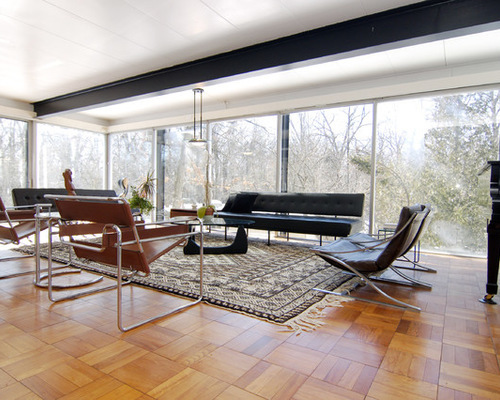
3. Parquet. Everything old is new again, and while some homeowners (and many renters) are wishing away their parquet floors, others are installing them anew. These patterned wood floors add a sense of life and richness to a home, bringing visual interest and a sense of dynamic energy that typical straight-laid planks can’t match.
Installing wood in a parquet pattern also gives a lot more character to inexpensive local woods that might not have an exciting grain. For a patient DIYer, a parquet floor gives a high-fashion look with a much lower price tag than some other choices.
To give a classic block parquet layout a modern twist, use an oversized pattern in squares 12 inches or bigger. And, yes, a warm honey or orange tinted stain is back as well, especially mixed with classic modern furnishings in deep rich tones like chocolate, ruddy tan or espresso or crisp, airy whites.
Cost: Installation fees may be a bit higher than for straight-laid flooring, but the material cost can be as low as a few dollars per square foot.
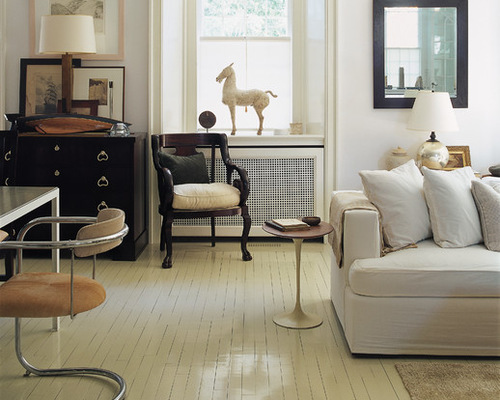
4. Painted. Think painted wood floors are only for cottages? As with walls, painting a floor can create as many different moods and effects as there are colors of paint. And if you choose a paint in a durable finish, it will hold up just as well as your wall paint does.
For a contemporary interior, consider a painted floor in a simple, natural hue like a muted beige or an off-white, and mix it with anything from antiques to midcentury classics or hip, trendy pieces.
You can kick up the style of a painted floor another notch by creating patterned effects that echo stone inlays, without that thousands-of-dollars investment. With a little painter’s tape and patience, this can be another great DIY approach to getting high style at home without ripping out your existing wood.
For those who do prefer a relaxed cottage air, a muted color adds a lot of charm, much like an accent wall, only underfoot. Try pale blue for a semi-neutral that will work with neutrals or other colors without clashing.
Cost: Paint and a top coat will cost a few dollars per square foot, and can be applied to existing flooring (with some good sanding and prep) or to inexpensive wood planks for a new installation.
5. Concrete. Concrete floors may sound like the domain of cold, minimalist works of architecture, but they can actually come in many forms to suit various tastes and personalities. Like wood, concrete can be stained (or tinted), allowing the material to feel quite warm and human in a way that beautifully suits transitional or traditional spaces.
Why choose concrete? Well, you can imagine that if the material can handle the wear and tear in an auto factory or warehouse, it can easily handle pets, children and sharp heels.
For an added seal and a gloss effect, concrete is sometimes finished with a coat of resin. This gallery-like look typically comes with a gallery price tag, but for those who enjoy a modern atmosphere with a perfect polish, this look is definitely photoshoot-ready.
It should be noted that concrete does not retain heat well, and thus can be chilly without a heated floor system, but extremely cozy with one installed.
Cost: With heated floors and a sleek finish, the cost can definitely add up. Your budget could range from $2 to $20 per square foot and beyond.
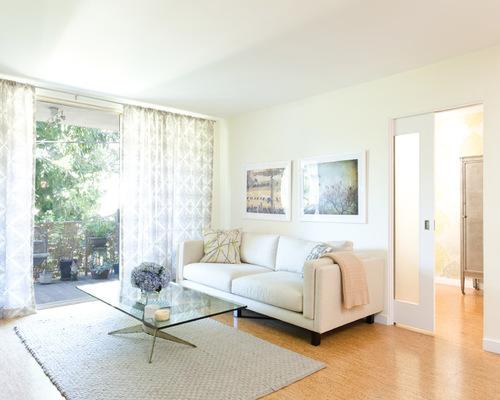
6. Cork. Cork flooring, like bamboo, can be developed very sustainably, making many cork products a smart choice for those hoping to reduce their environmental impact.
In the case of cork, the finish is very important to determining how water-resistant the product will be. However, cork has natural springiness that makes it feel extra comfortable (a little like rubber) and makes it resistant to dents and dings. Plus, it has a unique visual texture that’s a little like wood’s but with a twist, for a very livable sense of flair.
Cork works beautifully for sleek modern spaces or contemporary ones, as it has a natural softness that gives it a friendly vibe. If you’re considering using carpet in some rooms and wood in others, consider cork for the entire home, and get the best of both worlds along with a sense of harmony.
Cost: Cork ranges from $3 to $8 per square foot, but keep in mind that some products may require an additional sealant to hold up to moisture and possible stains.

 Facebook
 X
X
 Pinterest
 Copy Link




 The
The  A number of Windermere offices throughout our network will be collecting shoes August 1-8 for children in need as part of the Windermere Kicks for Kids shoe drive. Each office selects a local non-profit to receive the donated shoes. One participating office is



 Matthew Gardner is the Chief Economist for



 CONCLUSIONS
 CONCLUSIONS
 Matthew Gardner is the Chief Economist for