Selling April 29, 2019

Follow Our Sellers Checklist To Stay Safe While Selling Your Home

Staying organized while uprooting your life and moving from one home to another can feel impossible. Not only are you trying to get the best financial return on your investment, but you might also be working on a tight deadline. There’s also the pressure to keep your home clean and organized at all times for prospective buyers. However, one thing you can be sure of when selling your home is that there will be strangers entering your space, so it’s important for you and your agent to take certain safety precautions. Like so many things in life, they can feel more manageable once written down, so we made this handy checklist.

  • Go through your medicine cabinets and remove all prescription medications.
  • Remove or lock up precious belongings and personal information. You will want to store your jewelry, family heirlooms, and personal/financial information in a secure location to keep them from getting misplaced or stolen.
  • Remove family photos. We recommend removing your family photos during the staging process so potential buyers can see themselves living in the home. It’s also a good way to protect your privacy.
  • Check your windows and doors for secure closings before and after showings. If someone is looking to get back into your home following a showing or an open house, they will look for weak locks or they might unlock a window or door.
  • Consider extra security measures such as an alarm system or other monitoring tools like cameras.
  • Don’t show your own home! If someone you don’t know walks up to your home asking for a showing, don’t let them in. You want to have an agent present to show your home at all times. Agents should have screening precautions to keep you and them safe from potential danger.

Talk to your agent about the following safety precautions: 

  • Do a walk-through with your agent to make sure you have identified everything that needs to be removed or secured, such as medications, belongings, and photos.
  • Go over your agent’s screening process:
    • Phone screening prior to showing the home
    • Process for identifying and qualifying buyers for showings
    • Their personal safety during showings and open houses
  • Lockboxes to secure your keys for showings should be up to date. Electronic lockboxes actually track who has had access to your home.
  • Work with your agent on an open house checklist:
    • Do they collect contact information of everyone entering the home?
    • Do they work with a partner to ensure their personal safety?
  • Go through your home’s entrances and exits and share important household information so your agent can advise how to secure your property while it’s on the market.

Market News April 29, 2019

Southern California Real Estate Market Update


The following analysis of the Southern California real estate market is provided by Windermere Real Estate Chief Economist Matthew Gardner. We hope that this information may assist you with making better-informed real estate decisions. For further information about the housing market in your area, please don’t hesitate to contact your Windermere agent. 


ECONOMIC OVERVIEW

The counties covered by this report — Los Angeles, San Diego, San Bernardino, Orange, and Riverside — added 165,000 new jobs between February 2018 and February 2019. This represents an annual growth rate of 1.7%. In the same timeframe, the unemployment rate dropped from 4.4% to 3.9%. Employment growth in Southern California picked up a little in the late winter. Los Angeles County led the way, adding 96,500 new jobs. My 2019 forecast for employment in Southern California is for continued growth at around 1.5%.


HOME SALES

  • There were 34,142 home sales in the first quarter of 2019. This was a drop of 12.4% from the same period in 2018 and 13.9% lower than the final quarter of last year
  • Pending home sales (an indicator of future closings) were just 2.8% lower than during the same period a year ago, but down 18% compared to the fourth quarter of 2018. This suggests that second-quarter sales are likely to disappoint.
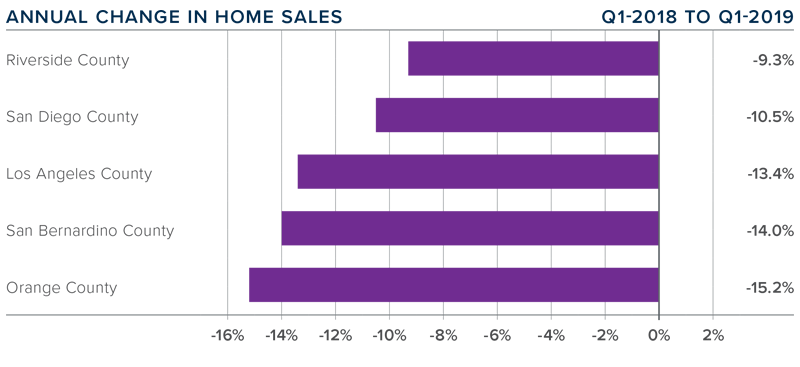
  • Home sales dropped across the board, but the most noticeable decline was again in Orange County, which fell by 15.2%. This drop is probably temporary and was more than likely driven by the 49% increase in inventory and high home prices. The smallest drop was in the more affordable Riverside County.
  • There was an average of 37,641 active listings in the first quarter — up 30.5% from a year ago.


HOME PRICES

  • Year-over-year, average prices in the region rose a very modest .3% and were 2.4% lower than in the fourth quarter of 2018.
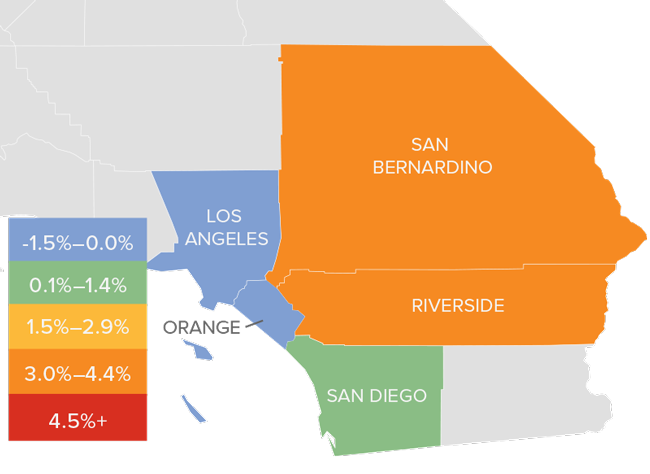
  • Affordability remains an issue in most of the Southern California counties contained in this report, which, in concert with growing inventory, will likely continue to limit home price growth.
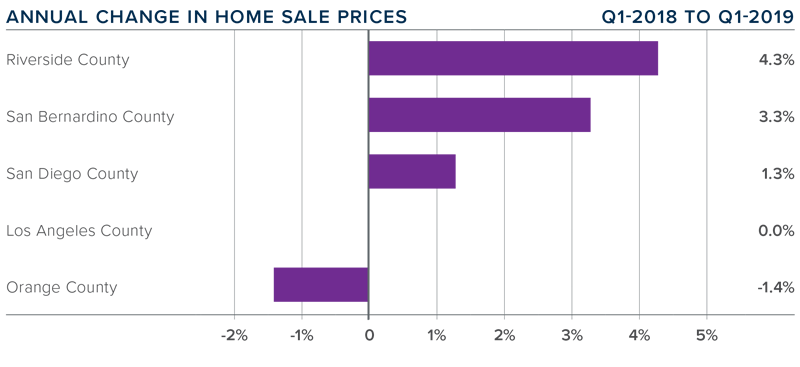
  • Price growth was varied. Riverside County showed the greatest annual appreciation (+4.3%). Average home prices dropped 1.4% in Orange County.
  • On a year-over-year basis, I expect to see home prices continue to rise through 2019, but the rate of growth will be more modest than the market has seen in several years.


DAYS ON MARKET

  • The average time it took to sell a home in the region was 53 days. This is a 10-day increase compared to the first quarter of 2018, and eight days more than in the fourth quarter of 2018.
  • All markets saw an increase in the time it took to sell a house in the first quarter of this year compared to both the first and fourth quarters of 2018.
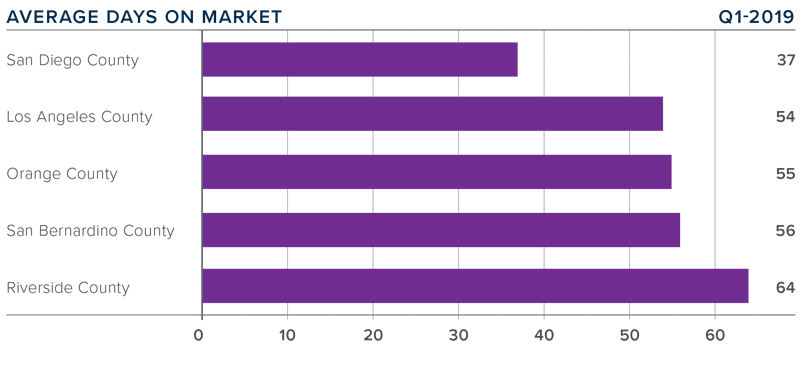
  • Homes in San Diego County continue to sell at a faster rate than other markets in the region. In the first quarter, it took an average of 37 days to sell a home, which is eight days more than it took a year ago.
  • Market time is increasing, which may concern some; however, it is simply a move back to normal averages.


CONCLUSIONS

The speedometer reflects the state of the region’s real estate market using housing inventory, price gains, home sales, interest rates, and larger economic factors.

The Southern California economy saw a bit of a boost in early 2019, which is good news. But rising inventory levels and low affordability in many markets will lead to slower price growth. Affordability remains a significant issue and I will be watching proposed legislation, such as Senate Bill 50, to see whether there is enough interest in addressing this obstacle to home ownership.

Rising inventories and slower price growth has led me to move the needle a little further toward buyers.


As Chief Economist for Windermere Real Estate, Matthew Gardner is responsible for analyzing and interpreting economic data and its impact on the real estate market on both a local and national level. Matthew has over 30 years of professional experience both in the U.S. and U.K.

In addition to his day-to-day responsibilities, Matthew sits on the Washington State Governors Council of Economic Advisors; chairs the Board of Trustees at the Washington Center for Real Estate Research at the University of Washington; and is an Advisory Board Member at the Runstad Center for Real Estate Studies at the University of Washington where he also lectures in real estate economics.

Market News April 25, 2019

Western Washington Real Estate Market Update


The following analysis of the Western Washington real estate market is provided by Windermere Real Estate Chief Economist Matthew Gardner. We hope that this information may assist you with making better-informed real estate decisions. For further information about the housing market in your area, please don’t hesitate to contact your Windermere agent.


ECONOMIC OVERVIEW

Washington State employment slowed to an annual growth rate of 1.7% — a level not seen since 2012 — and continues a trend of slowing that started in the summer of 2018. I was a little surprised to see such a significant drop in employment growth, but it may be due to the state re-benchmarking their data (which they do annually). As such, I am not overly concerned about the lower-than-expected numbers but will be watching to see if this trend continues as we move through the spring months. The state unemployment rate was 4.5%, marginally below the 4.6% level a year ago.

My latest economic forecast suggests that statewide job growth in 2019 will be positive but is expected to slow. We should see an additional 84,000 new jobs, which would be a year-over-year increase of 2.2%.


HOME SALES

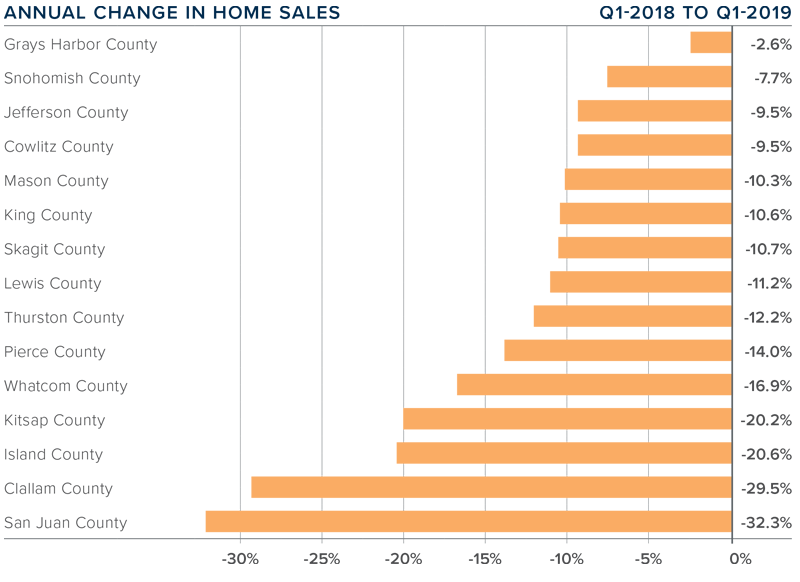
  • There were 13,292 home sales during the first quarter of 2019. Year-over-year, sales were down 12.3% and were 23.4% lower than the fourth quarter of 2018.​
  • It is quite likely that part of the slowdown can be attributed to the very poor weather in February. That said, anecdotal information from our brokers suggests that March was a very active month and I expect to see sales rise again through the spring selling season. Notably, pending home sales were only off by 3.5% from the first quarter of 2018.​
  • All counties contained in this report saw sales drop when compared to a year ago. The greatest drops were in the relatively small counties of San Juan, Clallam, Island, and Kitsap.​
  • The decline in interest rates during the first two months of the quarter nudged many home buyers off the fence. I believe this will cause a significant bump in sales activity in the second quarter numbers.


HOME PRICES

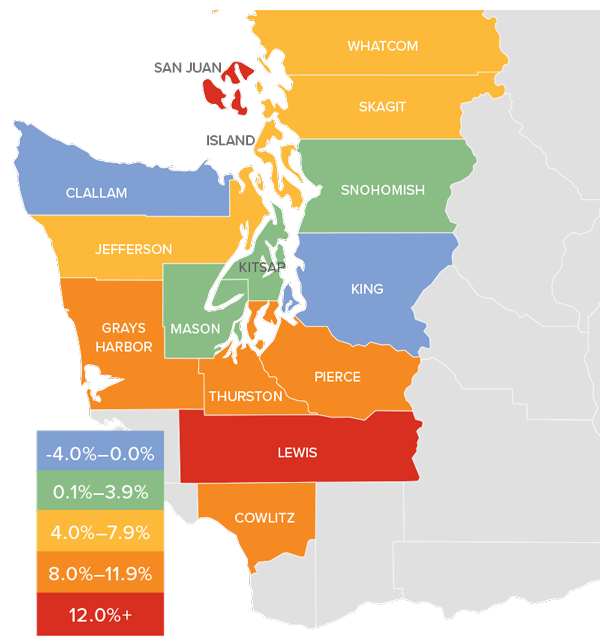
  • In combination with the factors discussed earlier, the 40% increase in listings has caused home price growth to taper to a year-over-year increase of 3.3%.
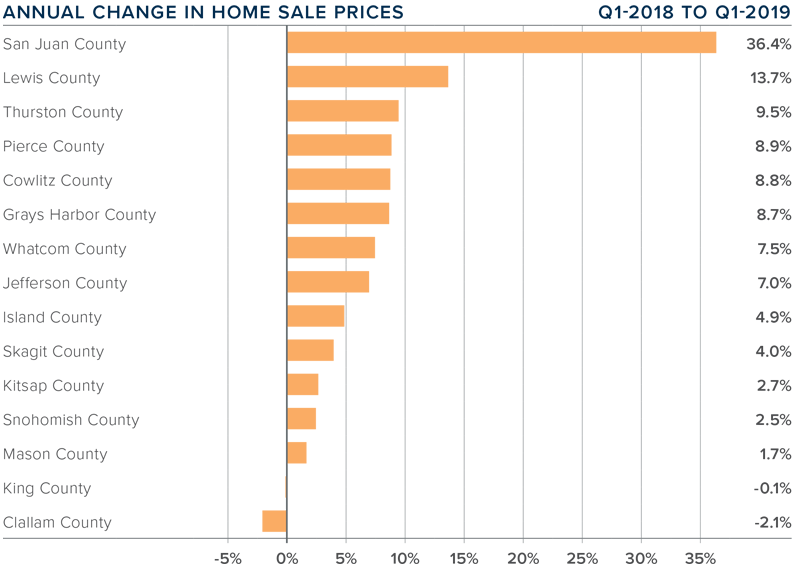
  • Home prices were higher in every county except Clallam. While the growth of prices is slowing, the strong local economy, combined with lower interest rates, will cause home prices to continue rising through 2019.
  • When compared to the same period a year ago, price growth was strongest in San Juan County, where home prices were up 36.4%. Only one other county experienced a double-digit price increase.
  • As I have said for quite some time now, there must always be a relationship between incomes and home prices, and many areas around Western Washington are testing this ceiling. That said, the region’s economy continues to perform well and incomes are rising, which, in concert with low interest rates, will allow prices to continue to rise but at a significantly slower pace.


DAYS ON MARKET

  • The average number of days it took to sell a home matched the same quarter of 2018.
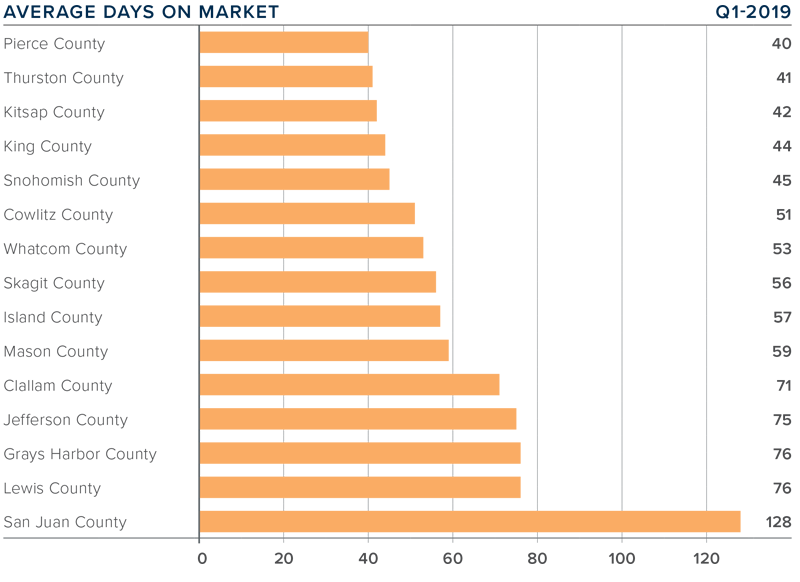
  • Pierce County was the tightest market in Western Washington, with homes taking an average of 40 days to sell. There were seven counties that saw the length of time it took to sell a home drop compared to the same period a year ago. Market time rose in seven counties and one was unchanged.
  • Across the entire region, it took an average of 61 days to sell a home in the first quarter of 2019. This matches the level seen a year ago but is up by 10 days when compared to the fourth quarter of 2018.
  • In the last two Gardner Reports, I suggested that we should be prepared for days-on-market to increase, and that is now occurring. Given projected increases in inventory, this trend will continue, but this is typical of a regional market that is moving back toward balance.


CONCLUSIONS

This speedometer reflects the state of the region’s real estate market using housing inventory, price gains, home sales, interest rates, and larger economic factors. I am again moving the needle toward buyers as price growth moderates and listing inventory continues to rise.


I do not see any clouds on the horizon that suggest we will see a downturn in sales activity in 2019. That said, this will be the year we move closer to balance. Buyers who were sidelined by the significant increase in listings in the second half of 2018 are starting to get off the fence as mortgage rates drop. I foresee a buoyant spring market ahead.


As Chief Economist for Windermere Real Estate, Matthew Gardner is responsible for analyzing and interpreting economic data and its impact on the real estate market on both a local and national level. Matthew has over 30 years of professional experience both in the U.S. and U.K.

In addition to his day-to-day responsibilities, Matthew sits on the Washington State Governors Council of Economic Advisors; chairs the Board of Trustees at the Washington Center for Real Estate Research at the University of Washington; and is an Advisory Board Member at the Runstad Center for Real Estate Studies at the University of Washington where he also lectures in real estate economics.

More April 24, 2019

Caring for our Communities through the Windermere Foundation


Windermere offices have been busy this year raising money for the Windermere Foundation which provides funding to support low-income and homeless families throughout the Western U.S. Last quarter alone, the Windermere Foundation collected over $308,236 in donations, bringing our total to $38,314,364 raised since 1989 when the Windermere Foundation first started.


Each Windermere office has its own Windermere Foundation fund account that they use to make donations to organizations in their local communities. These accounts are funded by donations from owners, agents, staff, and the community, and from donations through Windermere agent commissions. The Windermere Hillsboro office in Oregon, and Windermere Coeur d’Alene Realty in Idaho, are two great examples of how our offices go above and beyond to support their local communities.


Windermere Hillsboro

Earlier this year, the Windermere Hillsboro office donated $1,500 to the Hillsboro School District’s McKinney-Vento program, a program which ensures that students who face housing instability and hardship have access to public education, despite the lack of a fixed living environment or a supervising parent or guardian. There are 20,000 students in the district and more than 400 of those students face housing instability. Every school district in Oregon has at least one designated McKinney-Vento Liaison. The Hillsboro School District has a team of three that works tirelessly to support each student and their families with rental and utilities assistance. If there is housing stability at home, then those students are more likely to stay in school.


The Windermere Hillsboro office also made a $5,000 donation to Community Action, whose mission is to lead the way to eliminate conditions of poverty and create opportunities for people and communities to thrive. The donation will go towards programs that help approximately 26,000 individuals and families: Energy Assistance, Early Childhood Development, Family Development, and Housing Stability.


Windermere/Coeur d’Alene Realty

In March, Windermere/Coeur d’Alene Realty, which has offices in Coeur d’Alene, Post Falls, and Hayden, was recognized as the Best Real Estate Office by The Business Journal of North Idaho in their “Best of 2019” awards. This is the ninth year-in-a-row that they have received this honor. The brokerage was also named Idaho’s Brightest Star for their philanthropy and community involvement. Through the Windermere Foundation, they have given back nearly one million dollars to local charities and humanitarian agencies in Kootenai County, and more than 11,000 warm winter boots to local children in need.


Thanks to our agents, offices, and everyone who supports the Windermere Foundation, we have been able to make a difference in the lives of many families in our local communities. This year we celebrate the Windermere Foundation’s 30th anniversary with a renewed year-long focus on giving back, doing more, and providing service to the communities that have made us who we are.


Our goal for 2019 is to raise over $40 million in total donations. If you’d like to help us reach this goal, or learn more about the Windermere Foundation, please visit WindermereFoundation.com.


Design April 22, 2019

Blinds or Curtains? Or Both? Top Things to Consider When Choosing Your Window Style

Some rooms just need blinds, other rooms just need curtains, and then some rooms look best with both. But how do you decide which rooms need what? There are a number of factors to consider when you’re picking window treatments for rooms in your house, from price to insulation to style to orientation within the room.

Price

Adding a combination of blinds and curtains on your windows may seem like the best idea for almost any room in your home. But that can get pricey. Basically, you’re doubling up the cost of the treatments for each window. So when you’re deciding on a budget for your treatments, be methodical. Guest bedrooms, laundry rooms, bathrooms, or any uncommon, informal areas in your home are good candidates for either blinds or curtains, not both—you likely don’t spend much time in these spaces, they don’t need to be the most styled part of your home and/or they don’t require a high level of privacy. Save the money on these areas and choose a treatment that gets the job done. On the other hand, living areas, formal dining rooms, and master bedrooms are places where a combination of both can add ultimate style, privacy, and temperature comfort, and it could be worth the money to invest in these high-impact areas.

Insulation

Sunlight can be a blessing and a curse for your home. It can fill living areas with wonderful natural light. It can liven up dining areas or kitchens. But, harsh sunlight can also heat up a room late in the afternoon, it can fade furniture, or it can wake you up too early on the weekends. When it comes to blocking out the sun, faux wood blinds and heavier curtains should be considered. Wood blinds or faux wood blinds block out a great deal of sun, but not all of it. If you want complete darkness to grab a few more winks on weekends, add some curtains over the binds to double up the sun defense. Consider the positioning of the windows throughout the house and protect the windows and rooms that bear the brunt of the sun, while making it easy for natural light to shine through when you want it.

When it comes to curtains and shades, there are a number of sun-blocking options. Cellular shades filter out the sunlight while still letting enough natural light into the room. Roman shades, sheer shades, and curtain fabrics all have different thicknesses, which block out different levels of UV rays and sunlight. If your living room faces west, you will certainly want some thicker shades to block out that evening sunshine and keep the temperature in the room manageable.

Style

Just about any style under the sun is available when it comes to choosing window treatments. Gone are the days when curtains were the only way to add style, warmth, and luxury to a room. Many options in shades and blinds can achieve the same effect.

Whichever you choose, you want the window treatments to accent the furniture in your room, not vice versa. For example, if your furniture is heavily patterned, choosing solid colors for blinds and curtains is the way to go. If your furniture is solid, light patterns and designs could accentuate certain colors or themes in the room. Keep theme and tone in mind: You wouldn’t choose earthy bamboo shades for a room with a sleek, industrial vibe, or beachy plantation shutters for a room with a modern artsy feel.

Choosing the proper window treatments for each room in your home comes down to a handful of factors. Don’t break the bank or overspend where you don’t need it, make sure you know where the sun is most intrusive in what rooms, and go with a style that fits the vibe of your home. Blinds and curtains can complete the look of a room, and make it feel like home.

Living April 15, 2019

Beyond Alexa – Other Smart Appliances You Can Use In Your Home


The nation’s largest home-building company, Lennar, now integrates Amazon’s “Alexa” smart speaker system as a function in new homes they construct. In the United States alone there are reportedly at least 39 million privately owned smart speakers, and the growth seems likely to only continue. With an eye to the future, we decided to shine a light on a few other “smart” products that can help enhance your home.

Smart Doorbells

  • While the iconic heavy door-knocker of 19thcentury Victorian may hold its appeal, high-tech doorbells are an increasingly popular option.
  • The Amazon-owned Ring Doorbell is the pace-setter for this rapidly growing industry, allowing for remote monitoring of your home via video, two-way talking functionality, and WiFi-connectivity to allow homeowners to keep tabs on their property no matter how far they roam.
  • If you’d like to go elsewhere, the market is flush with alternate options. SkyBell’s ringer allows for free cloud storage of video, while the Zmodo Greet Smart model allows for easy installation using your previous doorbell’s hardware, and comes at a price over $100 under most of the notable options.

Smart Refrigerators

  • Much has been said of the lamentations regarding the loss in popularity of the family dinner around the table. If your family is drawn to their phones when it’s time to get meals going, a smart refrigerator may be the trick to centering things around the kitchen and dining room again.
  • The brands may be familiar but the appliances are all-new. GE, Kenmore, Samsung, and Whirlpool are just a few household names involved in the exciting world of smart appliances.
  • The options are wide-ranging in functionality – from Alexa-connected Kenmore smart fridges to Samsung’s full home command center, you can control temperatures in the fridge and in your home, play music and videos, and even pull up recipes on-screen to help your tech-savvy family follow along step-by-step.

Smart Energy Monitors

  • Most people like doing things that are energy-efficient, but when it’s financially challenging it’s tough to make that choice. The best products, then, are those that check both boxes.
  • Energy monitors like those from Sense, CURB, and Neurio offer the ability to connect into your appliances and circuit board, monitoring energy usage from your smartphone.
  • How often are you likely to check your appliances unless they suddenly break down? With these monitors, not only can you maintain appropriate energy usage, you can identify issues before they become disasters.
Living April 1, 2019

Childproofing: Protect Your Family and Your Home from Potential Hazards

When you think of your home, it likely conjures up feelings of safety, shelter, and comfort. However, accidental injuries in the home are one of the leading causes of harm to children 14 and younger. By taking certain precautions, many of these accidents can be prevented.

While supervision is the best way to keep your children safe at home, you can’t watch them every second. Childproofing, to whatever degree you are comfortable, will go a long way toward keeping your littlest loved ones safe and healthy at home.

Here are some tips to get you started.

Many accidents happen with or around water.

If you have children at home, it’s advisable to adjust your water heater to no higher than 120 degrees to prevent scalding. Furthermore, you should never leave a small child unattended in a bath tub, even for a few seconds. And be sure to safely secure doors that lead to swimming pools and hot tubs, including pet doors. When cooking or boiling water, turn pot handles in, or better yet use the back burners, to prevent little hands from pulling them off the stove.

Household chemicals can be very harmful to children.

It’s important not to keep poisonous materials under the sink, even if you have a cabinet guard in place. Keep dangerous chemicals up high and in a room that isn’t accessible to your little ones. Seemingly innocuous medicines can also be dangerous. Make sure your medicine cabinet is out of sight, mind, and reach.

Use safety latches and gates.

It’s advisable that you use safety latches on drawers, cabinets, toilets, and windows, as well as place covers on all electrical outlets. Gate off stairways and entrances to rooms, such as garages, that contain dangerous or fragile objects.

Secure furniture and other objects.

Heavy furniture, electronics, and lamps must be secured to prevent a child from pulling them over. Bookshelves and entertainment centers often come with devices that attach them to walls so that a climbing child won’t topple the furniture. The end-caps on door stoppers can be a choking hazard, so it’s advisable to remove them. Place plastic bumpers on sharp corners or edges of coffee tables, entertainment centers, and other furniture to prevent cuts and bruises.

Install a carbon monoxide detector.

The U.S. Consumer Product Safety Commission (CPSC) recommends that consumers purchase and install carbon monoxide detectors in addition to smoke alarms. Be sure to test both devices regularly and replace batteries as needed. The American Red Cross advises families to learn first aid and CPR, and to devise an emergency evacuation plan for fires and earthquakes.

Emergency contact info.

Last, but not least, in case an emergency does happen, always keep numbers for your child’s doctor, your work and cell, and other emergency contact info in an easily found place, preferably near the phone.

Accidents can and will happen, but by following a few small steps you can have peace of mind knowing that you’ve done everything you can to protect your family from harm in your home.

More March 21, 2019

Windermere Launches “All in, for you” Branding Campaign


Windermere Real Estate has officially launched a new branding campaign on the heels of the company’s brand refresh that was completed in 2018. The “All in, for you” campaign is the next step in bringing the refreshed Windermere brand to life by amplifying the company’s unique “why”.


Told, in part, through stories generated by actual Windermere agents, the “All in, for you” campaign sets out to illustrate Windermere’s unique culture, and what has drawn both agents and clients to it for nearly 50 years.

https://www.youtube.com/watch?v=EVNo5NhLQi4

“We’re lucky to have a brand with such a rich legacy, but we have to continue to innovate and press forward,” said Windermere president, OB Jacobi. “The brand refresh that we did last year was part one of Windermere’s brand story; part two is about bringing our stories to life and showing our clients how we’re ‘all in’, for them.”


Development of the “All in, for you” campaign was led by Windermere Vice President of Marketing, Julie Dey, and Portland, OR-based global design firm, Ziba Design, whose clients include companies, such as FedEx, P&G, Adidas, REI, and Intel. Ziba started the year-long process by conducting interviews and holding focus groups with Windermere agents, franchise owners, and staff. They also interviewed past buyers and sellers to better understand the experience of working with a Windermere agent.


“We needed to speak directly with consumers to understand what people want, where real estate is headed, and the differentiated value that Windermere agents provide,” said Rob Wees, Creative Director at Ziba, adding, “Real estate is an infrequent, emotional, and complicated process. And every experience is so different.”


 

“In an era of technology and convenience, we wanted to show the public the real value of working with a Windermere agent—one that shows how compassion, expertise, advocacy and an over-commitment to service can help people through an incredibly important moment in their lives,” said Wees.


Components of the “All in, for you” campaign include TV, print, digital marketing, out-of-home advertising, and partnerships with key media companies to create unique content opportunities. To kick-off the campaign, TV ads will begin running March 21 in the Seattle market.


“While some real estate companies are telling what is essentially a technology story about ones and zeroes, our story is more about connecting humans with their dreams. And it’s a story we can’t wait to tell,” said Dey.

https://www.youtube.com/watch?v=BEfSY5DrYJU

Living March 18, 2019

Here’s Your Spring Maintenance Checklist

Now that spring has sprung, let’s clear the cobwebs and get your home ready! Here is our quick guide to spring home maintenance:

Inspection top to bottom: Now that the weather is temperate you will want to check on how your home weathered the winter. Check the roof for leaks, the gutters for damage, and the siding for cracks. You will also want to inspect your basement or foundation for any shifts. Make repairs now to prevent further damage.

Clean out the gutters: April showers bring May flowers… so clear out the gutters to keep rain from pooling on your roof or near your foundation.

Pest control: Spring is mating season for eight-legged critters, so sweep out cobwebs, clear debris, and check the nooks and crannies. If you live in an area prone to dangerous species like brown recluse or black widows, you may want to contact your local pest control, but otherwise, household spiders do help eliminate other bugs.

HVAC system: If you have an air conditioner now is the time to check to make sure it is ready before summer gets here and everyone else is clamoring for maintenance. Now is a good time to check your home air filters and replace or upgrade to keep allergens at bay.

Clear the clutter: Do a sweep around the house and get rid of junk that you don’t use! Take a little time each week to tackle a room. Closets, playrooms, and basements can be especially daunting, but getting rid of old stuff and refreshing your space will go a long way!

Deep clean: On a nice day open the windows, dust, wipe, scrub, and clean. You will get a nice workout and your home will look and feel so fresh after a winter of being cooped up.

Update your décor: Add a splash of color to your home with small embellishments. Add a colorful vase, a lighter throw for your sofa, pretty pastel pillows, or spring-time candles, to upgrade your living space.

Take it outdoors: Let your throw rugs, curtains, and other tapestries air our outside. Shake off the dust, spot clean what you can and let everything bask in the sun for an afternoon.

Don’t forget the back yard: It may not be time to start up the grill, yet, but you can get started on your outdoor entertaining checklist. Check your lawn, and if you have some spare spots start filling in with seed. Check your outdoor plants, prune, plant bulbs, start to replenish the soil for your garden, and mow, so you are ready to start when the season allows.

Speaking of the grill – if you have a gas grill you will want to pull this out and perform a maintenance check. Clean everything up and check to make sure all the gas lines are clear, as these can get clogged after sitting idle all winter. Make sure the grill is clear of spiders too, as they can build webs in the tubes, causing damage to your grill. You can start to bring out your garden furniture too, or clean it up if you left it covered outside all winter. Because before you know it, it’ll be barbeque season!

More March 11, 2019

Destination Living – The Allure of Los Cabos

When people dream of paradise, many envision palm trees, stunning sunsets, and long days filled with endless possibilities. In Cabo San Lucas, those dreams are an everyday reality. From pristine beaches to world-class dining and golf courses, there’s no limit to the options for entertainment and relaxation. In an effort to highlight the possibilities of destination living, today we’re shining a light on what Los Cabos has to offer.


While Los Cabos refers to an entire municipality on the southern tip of Baja California in Mexico, the Cabo that springs to mind for most people is Cabo San Lucas. The resort town has established itself as a paradise for those desiring any number of luxuries, but it can also prove more affordable than many other second-home destinations. Both the initial investment and the cost of living can vary, but more often than not, your dollar (or peso) will go further in Los Cabos. Many who seek out a home in this region are pursuing a second home, a retirement locale, or an investment opportunity. Los Cabos provides possibilities for all comers.


The quintessential Cabo San Lucas experience is one of luxury and opportunity. Providing homes that allow residents to utilize the resources around them is paramount in Los Cabos. An example of this is the newly-constructed Rancho San Lucas community which is privy to numerous resort-style activities and amenities. Nearby are several scenic hikes with stunning ocean views await, while on the waterfront snorkelers and scuba divers can be found year-round. Golfers have long flocked to Los Cabos, and the newly constructed Greg Norman-designed 18-hole course coming within the community will be a perpetual draw. Tennis courts and nearby access to the extravagant Grand Solmar at Rancho San Lucas are just a few of the other luxuries at residents’ fingertips.


Cabo San Lucas is well-outfitted to serve full-time residents and seasonal visitors alike. It offers a safe, relaxing destination for those looking to own a slice of their own tropical haven south of the border. Learn more about the Los Cabos housing market and the opportunities it provides for destination living.