More April 28, 2025

UW to Host New Zealand and Indiana at the 39th Annual Windermere Cup

On Saturday, May 3, the Windermere Cup will make its highly anticipated return to the Montlake Cut for its 39th year, bringing with it all the speed, pageantry, and community spirit Seattle has come to love.

The Windermere Cup began in 1987 when Windermere Real Estate founder John Jacobi partnered with the University of Washington and the Seattle Yacht Club to expand the crew races held annually on the Opening Day of Boating Season. The vision was simple but bold: bring the best rowing talent in the world to compete against UW’s elite program—and spotlight the Montlake Cut as a premier international racing venue.

39 years later, the Windermere Cup remains a cornerstone of Seattle’s Opening Day festivities—welcoming top international crews, celebrating the strength of community, and honoring a long-standing partnership between Windermere, UW, and the Seattle Yacht Club.

Windermere Cup 2025

Returning champions and first-time challengers come together at this year’s Windermere Cup, as the University of Washington welcomes the New Zealand National Team and Indiana University to the Montlake Cut.

Making their long-awaited return to the Cut, the New Zealand National Team brings their men’s and women’s crews back to Seattle for the first time in a decade. With past appearances in 1989, 1999, and 2015, New Zealand has a strong history at the Windermere Cup, including a first-place finish by the men’s crew in their last outing. Ten years later, they’re back—faster, stronger, and ready to take on the Huskies once again.

Making their Montlake debut is Indiana University, whose women’s crew will compete in the Windermere Cup for the first time this year. A rising force in collegiate rowing, the Hoosiers continue the tradition of bringing top NCAA programs to the Cut to face off against the University of Washington—one of the most dominant teams in the sport.

As always, the Windermere Cup is free and open to the public, with thousands of spectators lining both sides of the Montlake Cut to cheer on the athletes. Races begin at 10:15 AM, with the featured Windermere Cup races at 11:30 AM and 11:45 AM. The Opening Day Boat Parade, put on by the Seattle Yacht Club, begins promptly at noon, signaled by the ceremonial raising of the Montlake Bridge and a traditional cannon blast. An awards ceremony will follow at 12:30 PM on the north side of the Cut.

Race-day festivities on the shore include food vendors, a build-a-boat station, a bouncy house, a photo booth, and a chance to meet the inspiring team behind Pink Ribbon Row organization.

Kick Off the Weekend with Windermere’s Party on the Cut!

The celebration kicks off the night before with the seventh annual Party on the Cut, taking place Friday, May 2, from 6:00 to 10:00 PM at the NE corner of Montlake Cut near the UW Waterfront Activity Center. This 21+ event features food trucks, yard games, a beer tent, and live music from Queen Mother and Nite Wave. Attendees will also get a sneak peek of Saturday’s action with the Twilight Sprints, a short-course race through the Cut featuring the Windermere Cup competitors.

Tickets can be purchased here for $35 or at the door for $45, and all proceeds will benefit the Windermere Foundation and Seattle JazzED, a local nonprofit making music education more accessible for Seattle-area youth.

For more information and a full schedule of events, visit windermerecup.com and follow Windermere Cup on Instagram,  Facebook, and Twitter.

See you on the Cut!

LuxuryMoreProperty Management April 21, 2025

The Benefits of Shared Second Home Ownership

The idea of owning a second home is a dream for many—but the reality often comes with high costs, logistical hurdles, and much more upkeep than expected. And as home prices continue to climb and travel habits shift, buyers are starting to ask: is there a better way?

In partnership with Windermere, Esterre offers a fresh new answer to that question with an innovative shared second home ownership model, allowing buyers to co-own a thoughtfully curated portfolio of vacation homes—without taking on the full-time costs, upkeep, or responsibilities of owning a second home on their own.

Understanding A Shared Ownership Model

Shared, or fractional, ownership is quickly emerging as a practical and flexible alternative to second homeownership—one that makes vacation homes more attainable without the stress of going it alone. It’s a concept that’s been around for years, but today’s models offer a more refined, accessible experience. So, what does shared ownership really mean, and how does it work?

Shared ownership allows multiple buyers to co-own a home, splitting both the costs and the responsibilities. Each owner typically holds a defined share of the property, with usage and expectations outlined in a clear agreement. While different models exist, many shared ownership opportunities offer real estate equity, meaning owners can benefit from long-term use as well as a potential share in the home’s value over time. When applied to vacation homes, shared ownership presents a more accessible way to enjoy meaningful time away—without the full-time costs or commitment of owning a second property outright.

Below are some key benefits of shared ownership.

Benefits of Shared Ownership

  • Lower upfront cost compared to buying a whole property.
  • Shared responsibility for maintenance and property management.
  • More efficient use of the home throughout the year. Greater flexibility in travel and vacation options.
  • Real equity, with the potential for long-term financial return.
  • Accessible entry point into luxury vacation real estate.

How Esterre is Reimagining Shared Ownership

Esterre is bringing a fresh take to the shared ownership space. Unlike traditional timeshares or fractional ownership models, Esterre offers co-ownership in a curated portfolio of fully managed, high-end vacation homes across Washington State. Each property is thoughtfully chosen for its location, design, and year-round appeal. Rather than being tied to a single home, owners hold real equity in the entire portfolio and benefit from a growing collection of properties as new homes are added. With access to over a month of stays annually at any home in the portfolio, owners can enjoy variety and flexibility without sacrificing comfort or quality.

Esterre also simplifies the process from start to finish. Maintenance, furnishing, landscaping, and cleaning are all handled on your behalf so you can focus on enjoying your time away. A standout feature of Esterre’s model is its built-in 12-year exit strategy. When the time comes, the homes are sold, and the proceeds are divided among the owners, with 20% of the appreciated value going to Esterre. It’s a modern approach to second homeownership—designed to offer ease, flexibility, and a clear path forward.

Discover more at esterre-wa.com.

Market News April 16, 2025

Numbers To Know 4/16/25: Let’s Talk Tariffs

This is the latest in a series of videos with Windermere Principal Economist Jeff Tucker where he delivers the key economic numbers to follow to keep you well-informed about what’s going on in the real estate market.

Our first number this week is all about the elephant in the room:

Tariffs

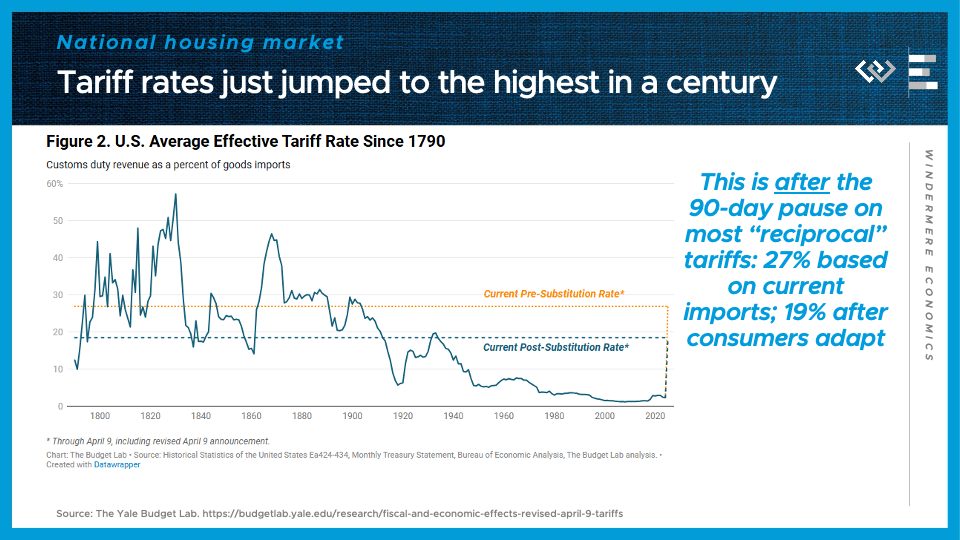
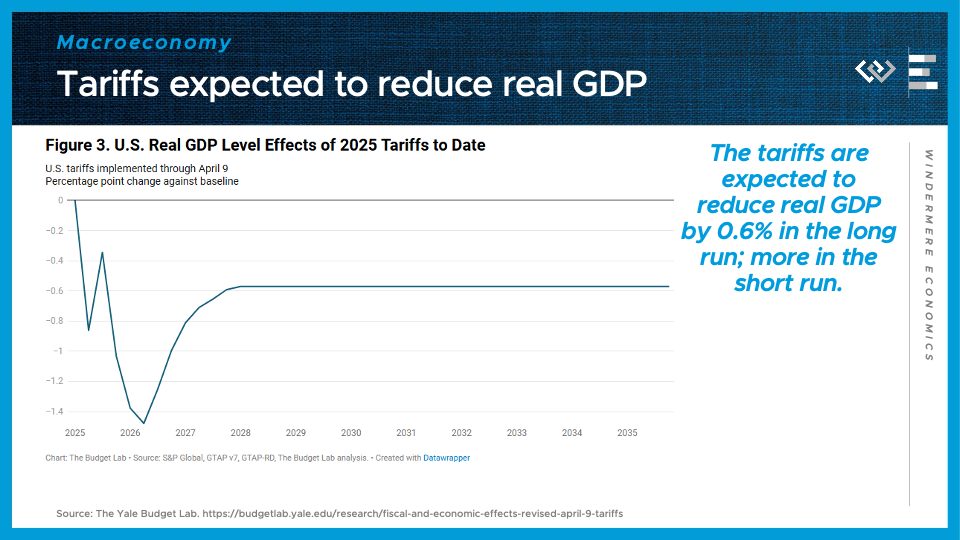
President Trump’s new tariff schedule announced so far in April will raise the average effective tariff rate on imports by a factor of TEN, from 2.6% to 27% — the highest since 1903. And that’s including the 90-day pause for some of the higher reciprocal tariffs. The Yale Budget Lab computed that based on the mix of imports we have been buying. They also estimated, on this chart, that after Americans start substituting away from highly-tariffed sources like China, the post-substitution rate might fall as low as 18.5 percent. That would be the highest since 1933, when trade was shrinking during the Great Depression.

What effect will this have? For one, it will reduce real GDP in the U.S. One estimate has it reducing real GDP growth in 2025 by 1.1 percentage points, and a permanent reduction of 0.6%.

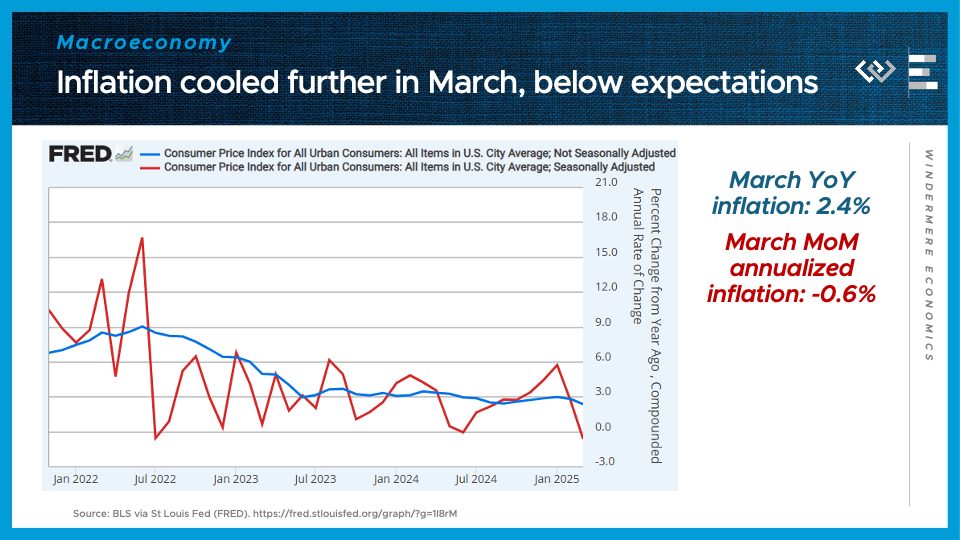
So far, the effects of tariffs haven’t shown up in much hard economic data. The March CPI inflation report, for instance, showed inflation came in below expectations, with a surprising month-over-month decline in the price level, and a cooldown in the year-over-year growth rate to 2.4%. That’s important because it helps give the Fed permission to cut rates later this year, if they start to see the job market slow down.

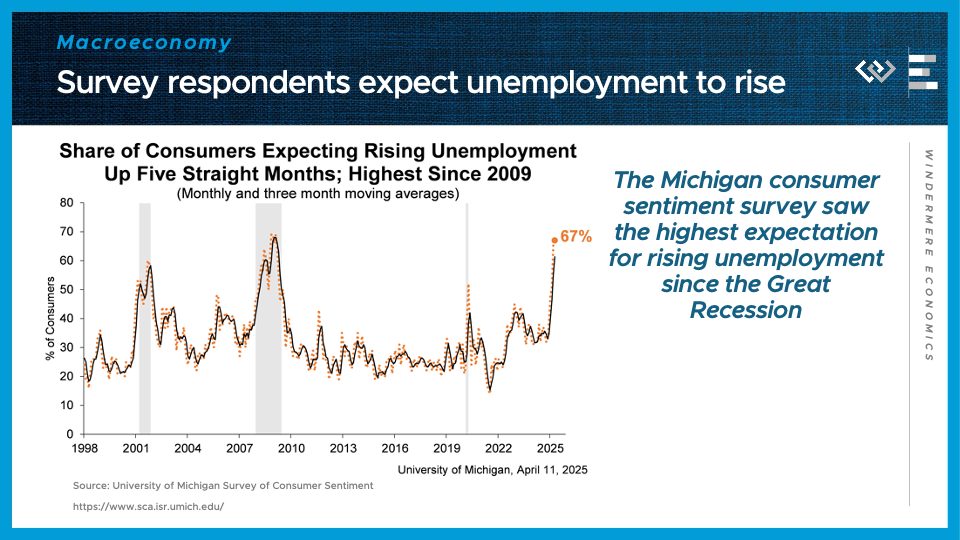
One place where the data is rapidly turning south is forward-looking indicators and especially in sentiment surveys, like the Michigan Consumer Sentiment Survey, whose respondents are the gloomiest about future unemployment that they’ve been since 2009.

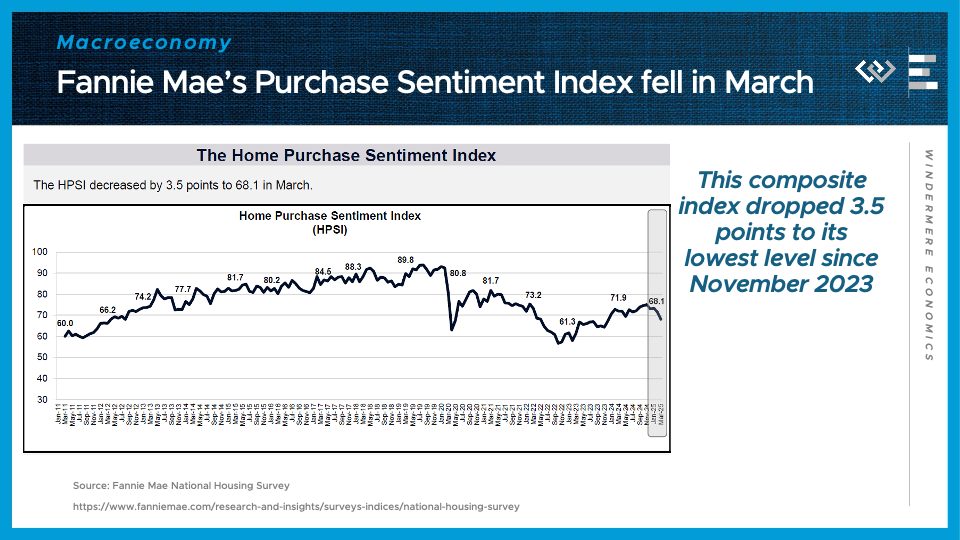
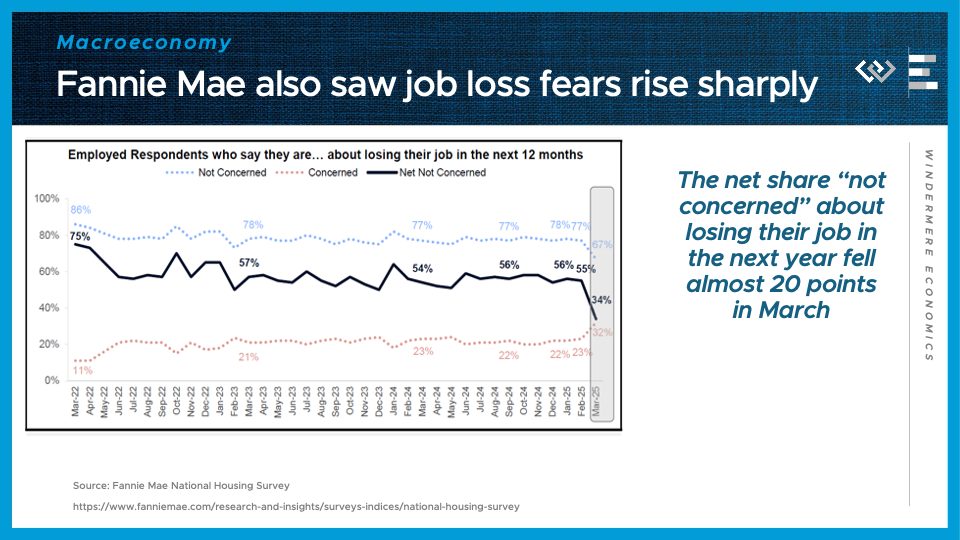
And in the housing market, the Fannie Mae Home Purchase Sentiment Index fell in March to its lowest level in about a year and a half.

The main factor driving that decline was a sharp increase in respondents’ fears of job loss in the next 12 months. Unlike the Michigan chart a minute ago, this is respondents’s fears of losing their own job. That is likely to cause some would-be home buyers and sellers to hunker down and maybe press “Pause” on buying or selling until their outlook brightens up.

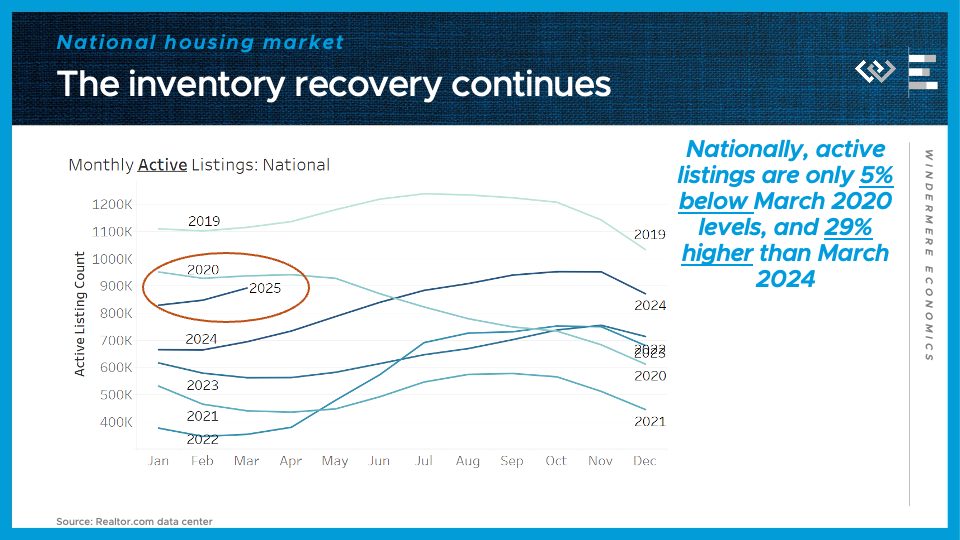
Speaking of the housing market: Data for March continue to show a relatively balanced spring market. Active inventory is only 5% below March 2020 levels, on the eve of the pandemic, and up 29% from last year.

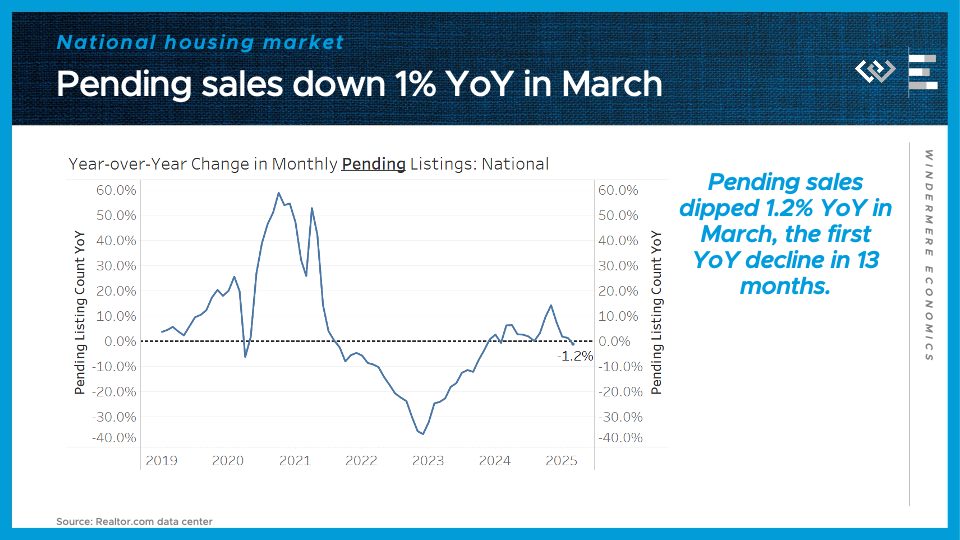
Pending sales are down about 1% from last March. So before any tariff impact, we are seeing just a tiny decline in sales activity.

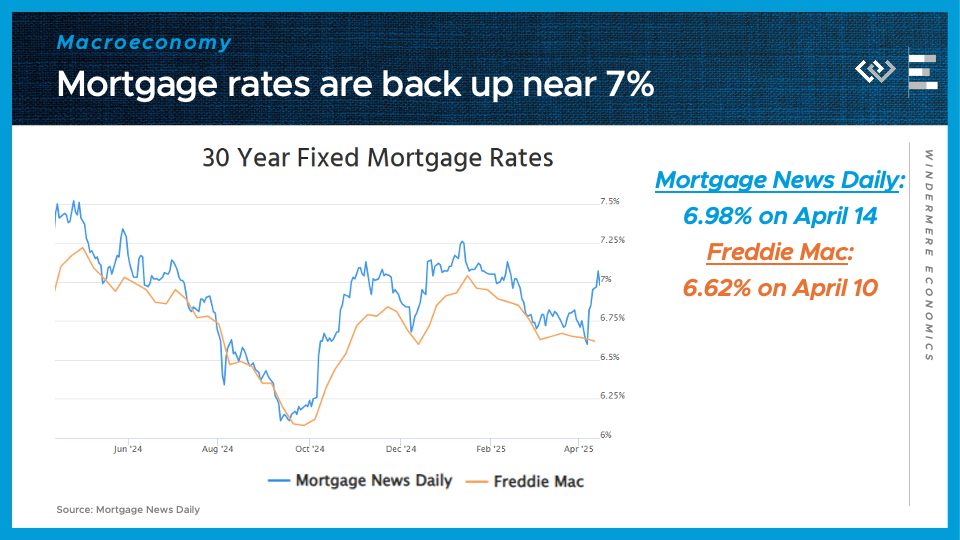
Finally, I’ll end by checking in with the USUAL elephant in the room: mortgage rates, which are back up around 7%. The financial market turmoil in response to the tariff news briefly pushed interest rates down, but then mortgages got carried along with a surprising upswing in US bond yields. That may settle back down in the coming weeks, but uncertainty really remains the watchword for economic data this year.

Buying April 14, 2025

When is the Best Time to Buy a House?

There’s a factor of the home buying process that can often be the catalyst for everything that follows. That factor is timing. Much of the dialogue—rightfully so—around buying a home is focused on the “what.” However, it’s often the case that the “when” is just as important.

So, when is the best time to buy a house? The answer is simple: the best time to buy is the right time for you. Fortunately, knowing when the time is right isn’t some sixth sense; it’s much more concrete. It’s a matter of understanding local market conditions, your financial situation, the status of mortgage rates, and how those factors fit in with your lifestyle changes and your motive for moving.

When is the Best Time to Buy a House?

With so much subjectivity in the decision-making process, it can be helpful to look at cold, hard facts to determine whether it’s the right time to buy. Although every real estate transaction is different, your local market conditions will give you a good sense of how to approach the housing market. There are two basic categories: a buyer’s market and a seller’s market. In short, the characteristics of a buyer’s market—high inventory, fewer buyers, lower competition—favors buyers, and the characteristics of a seller’s market—low inventory, many buyers, high competition—favors sellers. You may be in a position where you’re able to wait for favorable buying conditions, or you may be thrust into a highly competitive market due to external factors pushing the agenda of your move, such as a career change or starting a family. Regardless of the market conditions you face as a buyer, work with a buyer’s agent is critical to efficiently navigate your local housing market and prepare a winning offer when the time comes.

Which homes can you afford?

Your financial situation also looms large when deciding whether it’s the right time to buy a house. Before you start looking for homes, assess your buying power. Having greater buying power will show the seller that you’re fully capable of purchasing the home and may vault your offer over others.

To get an idea of what you can afford, use our free Home Monthly Payment Calculator by clicking the button below. With current rates based on national averages and customizable mortgage terms, you can experiment with different values to get an estimate of your monthly payment for any listing price. Using the Home Monthly Payment Calculator, you can make a well-informed estimation of whether it’s the right time to buy.


The Home Buying Process

Moving often goes hand in hand with lifestyle changes. As you’re preparing to buy a house, you may be juggling an employment change, the birth of a child, or any combination of other life-altering events. Buying a home takes time, and although an agent will streamline the buying process, it will inevitably impact your day-to-day schedule. Here’s a quick glance at the steps in the home-buying process.

  1. Find the right agent
  2. Get pre-approved for a mortgage
  3. Search for homes
  4. Attend open houses and showings
  5. Make an offer and negotiate
  6. Put down earnest money
  7. Appraisal/Inspection
  8. Closing process
  9. Move into your new home

For helpful resources on the home buying process from start to finish, visit our website:

Buyer Basics – Your Guide to Buying a Home

Seasonality

You’ve undoubtedly heard the age-old real estate maxims about buying in different seasons and how to use the calendar to your advantage to score a good deal on your next home. There’s an element of truth to these sayings, but the best way to grasp the effects of seasonality in your area is to work with an experienced local real estate agent. Their expertise and access to data and tools will be your ultimate resource in tailoring your buying strategy to your local housing market. Connect with an experienced Windermere agent to begin your home-buying journey:

MoreWestern Washington Real Estate Market Update April 9, 2025

A Wolf in Sheep’s Clothing

I have had the privilege of being part of this amazing industry for most of my life; but there was a time when residential real estate was synonymous with marginalizing people by using “secretive” policies, such as redlining, racial steering, and other forms of manipulation and discrimination.  

In the late 1960s, Fair Housing Act legislation brought these practices to light, and we have come a long way since what were clearly the “bad old days” of real estate—a time when elitism ruled the day.  

While we clearly have a very long way to go, our industry has made great efforts to move towards fairness and transparency, and I am proud of the fact that my dad, John Jacobi – founder of Windermere Real Estate – and his fellow real estate leaders in the Seattle area, were instrumental in helping to eliminate such tactics by cooperating with each other to share real time listing information.  In fact, our region was the first in the country to do so via the Northwest Multiple Listing Service.

Yet now, at a time of great transition in our industry, one brokerage is advocating to transport us back by decades—all for their interests, and their interests only. Under the guise of ‘seller choice,’ Compass has begun building a private network where it controls both buyer and seller. If there was ever a policy that was a “wolf in sheep’s clothing”, a private listing network is exactly that. 

Secrecy brought our industry to a low point when only a select number of brokerages and their agents controlled the inventory and, in the process, managed to avoid transparency. Transparency creates accountability as business is conducted in the open. In a private listing network like Compass is building, you lack accountability – exponentially increasing the opportunities for mishandling and abuse. If one is wealthy and has influence, they can get themselves to the front of the line. It returns us to a caste system of real estate, where a small, elite group have privileges while everyone else is on the outside looking in.   

I am not implying that there aren’t sellers who need or want to keep their homes from being publicly marketed. There are absolutely instances when that is a necessity, but rules are already firmly in place to do so. For example, in the Northwest Multiple Listing Service*, you can list a home without revealing the seller or their address; sellers control how their home is marketed and can even opt not to have signage or a lockbox. In this instance, if a buyer is interested, their agent must work with the seller’s agent to schedule a private showing.  

Even the National Association of Realtors (NAR), which has plenty of issues of its own, has given its MLS’s the ability to choose when to ultimately list a home. 

However, to make a private listing network the norm is beyond a terrible idea. Private listing networks only support the brokerage that controls the listing, and the seller is at the brokerage’s mercy to market the property. This scenario also removes relevant information that buyers rely on to make informed decisions, forcing them to drive blindly through the process. Furthermore, sellers lose valuable time because no one else is being given the opportunity to look at their home, and the buyers will have little access to – or information about – the true available inventory. And the claims by Compass that homes sell for more in their private network? It’s all smoke and mirrors as study after study has shown.  

Recognizing resistance to such a self-serving idea, Compass is threatening any MLS or brokerage that stands in its way. Again, under the guise of ‘seller choice,’ this company is working to bully the industry and bend everyone to its will. And the reason behind it is simple: money and control. Make no mistake, that’s all this is about.   

Private listing networks create a “them and us” situation within the home-buying and home-selling world – something our industry has fought hard to eliminate. Think about the consequences of limiting access to inventory through just one organization. They are, quite frankly, terrifying. 

Like an old-fashioned schoolyard bully, Compass has decided that the most effective way to address its damaged bottom line is through intimidation. It is terribly sad that one company’s blind ambition is working to set our industry back decades. 

In short, there is nothing noble about what Compass is trying to do to the residential real estate industry. This will benefit them, and them only, hurting everyone else. 

*The Northwest Multiple Listing Service (NWMLS) operates separately from the National Association of Realtors (NAR). 

Market NewsWestern Washington Real Estate Market Update April 7, 2025

Local Look: Western Washington Housing Update 4/7/25

Hi. I’m Jeff Tucker, principal economist at Windermere Real Estate, and this is a Local Look at the March 2025 data from the Northwest MLS.

Our local real estate roller coaster turned back up in March, after a couple soft months to start the year. Pending sales actually climbed YoY in March, around Washington and especially the Puget Sound region, as buyers seemed to respond to the decline in mortgage rates over the month. This is still not a red-hot spring selling season but it’s not exactly a buyer’s market either.

Here are the four key metrics I watch to track supply and demand in the market: closed and pending sales, which tell us a lot about demand; and listings – new and active – which tell us a lot about supply.

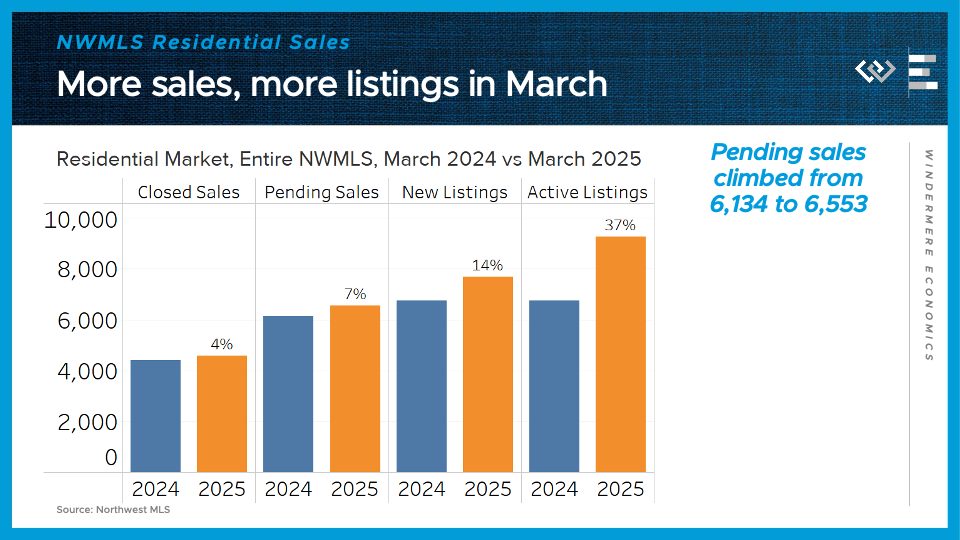
Across the Northwest MLS, closed sales of single-family homes grew 4% in March from their year-ago levels, after flatlining in February. Pending sales, which are more of a real-time demand indicator, climbed 7% from last year. That’s a strong reversal from February’s dip in pending sales.

On the supply side, about 14% more new listings hit the market this March, and the tally of active listings ended the month 37% higher than March 2024’s inventory.  Buyers are seeing a lot more options than they had last spring.

The final key metric to check in on: the median price for those closed single-family home sales climbed just 2% year-over year in March, from about $655,000 to $666,000. That’s another month of decelerating price growth after Q4 was particularly hot.

Putting it all together, we’ve got more supply meeting more demand this spring – more buyers are finding a match; sales are picking up; but all that inventory has kept a lid on price growth.

Now I’ll dig into the four counties encompassing the greater Seattle area, which mostly had similar trends to Washington as a whole.

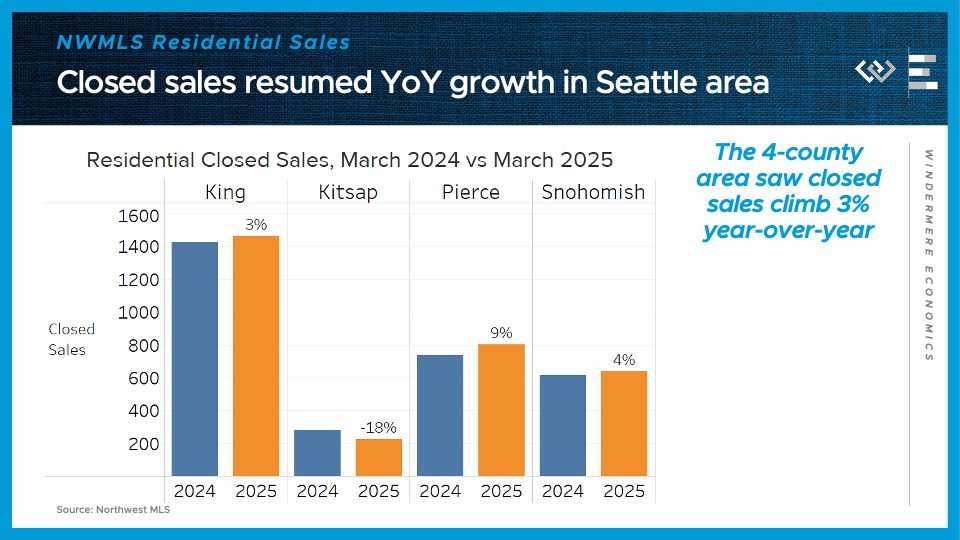
Residential closed sales climbed 3% year over year here in King County, and for the whole 4-county region; they dropped 18% in Kitsap County; climbed 9% in Pierce County, including Tacoma; and rose 4% in Snohomish County, including Everett. Not huge growth but it is a turnaround from February, when sales fell slightly from year-ago levels.

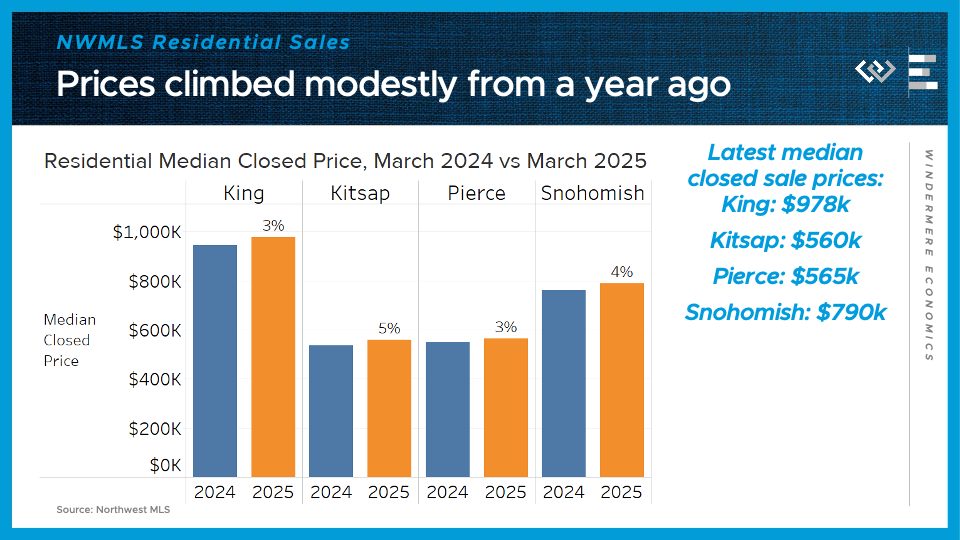
The median sale price climbed between 3 and 5%, locally: 3% change from last year in King County and Pierce County, up 5% in Kitsap County, and up 4% in Snohomish County.

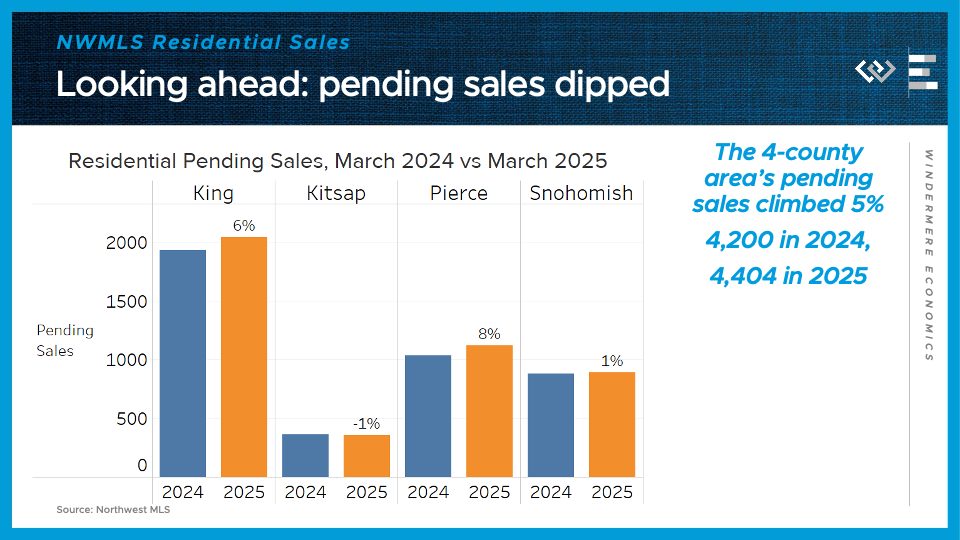
Looking ahead, pending sales climbed more than closed sales: up 6% in King, down 1% in Kitsap, up 8% in Pierce, and up 1% in Snohomish County. Altogether that makes 5% growth across the 4 counties, which should support further growth in closings in April. That’s the biggest piece of evidence I see that buyers are coming back to the market this spring.

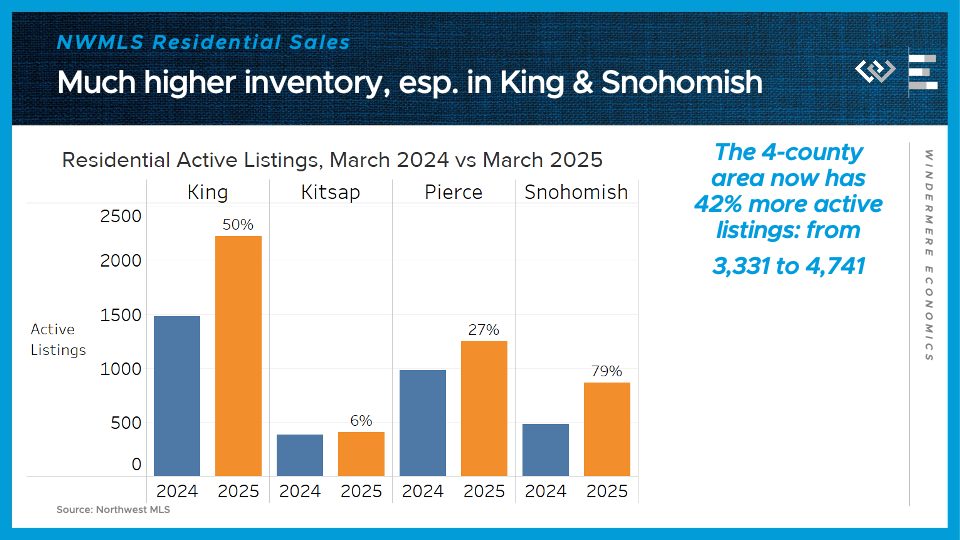
On the supply side, the 4-county greater Seattle area had about 42% more active listings at the end of March than the same time last year. The inventory growth is especially dramatic in King and Snohomish Counties, where listings are up 50% and 79% respectively.

So while there’s more purchase activity, these inventory gains are helping to keep it a pretty balanced market. Barring any big negative shocks, I’m expecting stronger year-over-year sales growth in April and May, because last year mortgage rates spiked upward starting in mid-April, which sent buyers back into hibernation. This spring, interest rates are declining modestly, which is the silver lining of a diminished outlook for economic growth.

ArchitectureDesign March 27, 2025

The Art of Pacific Lodge Architecture

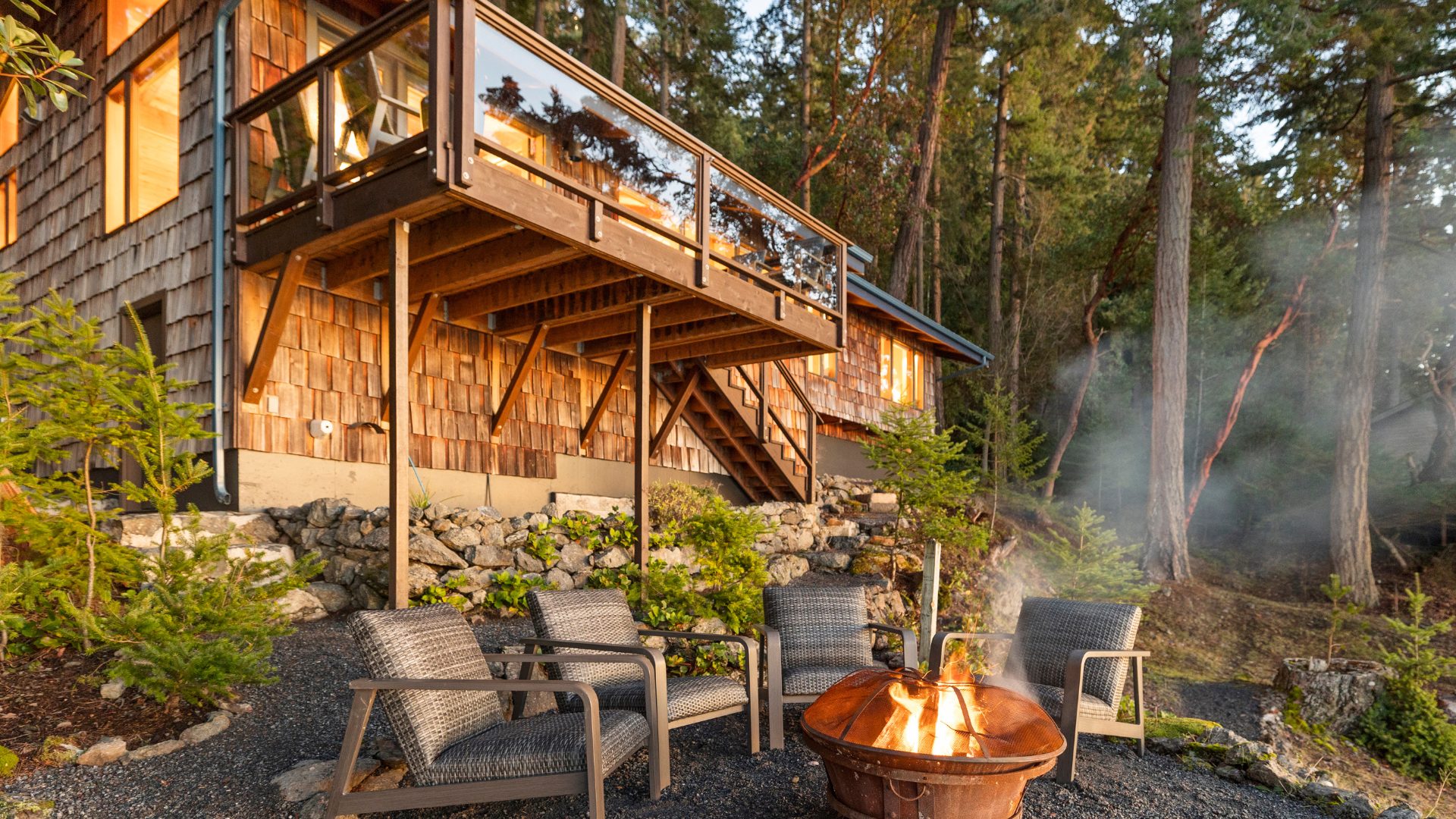
The Pacific Northwest is known for its lush forests, rugged coastline, and stunning mountain ranges. Naturally, architects and designers in the region draw from this unique environment, combining indigenous design principles with earlier frontier styles to create what we now know as Pacific Lodge architecture.

From its defining features to its deep regional roots, here’s everything you need to know about the Pacific Lodge home style and how it embodies the spirit of the PNW.

What is Pacific Lodge Architecture?

Drawing inspiration from mountain lodges, traditional log cabins, and the naturally sourced materials abundant in the region, Pacific Lodge architecture reflects a sense of warmth and connection to the land. Reclaimed wood, exposed beams, and stone are often emphasized to create spaces that feel both grounded and inviting, while expansive windows that frame the surrounding landscape allow natural light to pour in, blurring the boundary between indoors and out. The combination of rugged materials and thoughtful design results in homes that are both cozy and grand, seamlessly blending comfort, craftsmanship, natural beauty, and enduring charm.

Key Features of Pacific Lodge Homes

Exposed Wood Construction

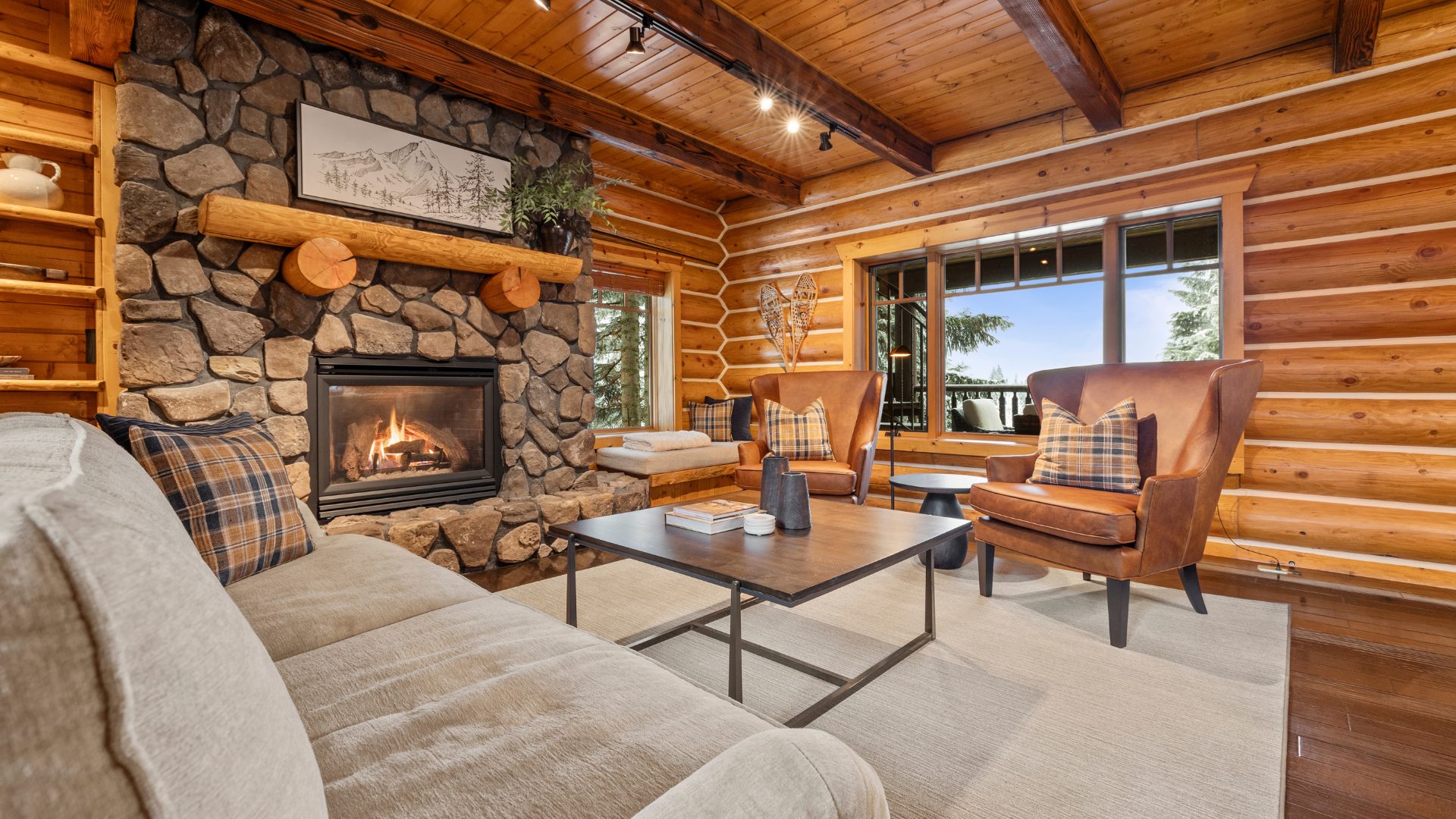
Exposed wood construction is one of the defining elements of the Pacific Lodge home style. Signature woods found in the area, like Cedar, Douglas fir, and Western Larch, are commonly used to generate openness and enhance the home’s natural aesthetic. Vaulted ceilings, soaring trusses, and large-scale exposed beams showcase these wooden elements, giving the home an inviting yet dramatic feel. These features celebrate the region’s timber-rich heritage and foster harmony between the home and its surrounding environment.

Expansive Living Spaces

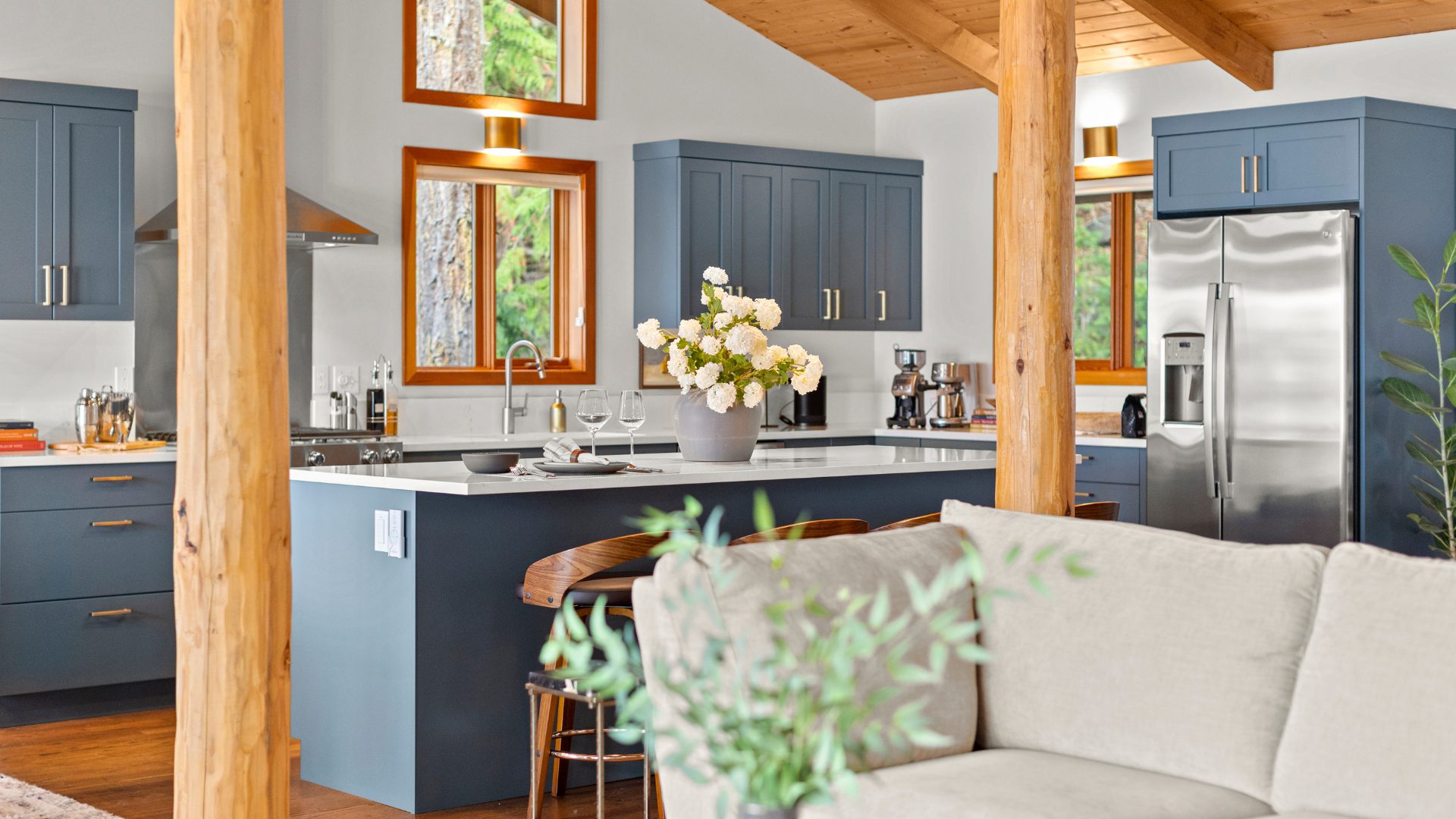
Complementing the warmth and openness created by exposed wood, expansive living spaces are another essential feature of Pacific Lodge architecture. Open floor plans, high ceilings, and grand rooms characterize the Pacific Lodge home, along with common areas that are thoughtfully designed to flow seamlessly into each other, creating inviting spaces ideal for gathering. The broad nature of these rooms highlights natural light, further enhancing the warm and welcoming atmosphere.

Large Windows

Pacific Lodge architecture prominently features large windows, such as picture windows and floor-to-ceiling glass, making the living spaces feel even more expansive and connected to the outdoors. Given the region’s frequent rain and cloudy skies, maximizing light is especially valuable, and oversized windows help to enhance brightness throughout the home. These large windows not only frame beautiful exterior views but also blend indoor and outdoor spaces.

Warm & Inviting Interiors

The warm and inviting interiors complement Pacific Lodge homes’ distinctive charm by bringing all these elements together. Inside, you’ll find a thoughtful blend of cozy furnishings, earthy tones, and richly textured materials. Sizeable stone fireplaces, leather seating, and more wood finishes provide a comfortable backdrop, while natural textiles like wool throws, woven rugs, and iron accents reinforce the home’s rustic yet elegant appeal. Deep forest greens, rich burgundies, and warm amber hues are often incorporated to add depth and complement the home’s natural feel.

Market NewsMore March 18, 2025

Housing & Economic Update: What to Know About Inventory, Inflation & Interest Rates

This is the latest in a series of videos with Windermere Principal Economist Jeff Tucker where he delivers the key economic numbers to follow to keep you well-informed about what’s going on in the real estate market.

The data coming in from the housing market so far this year are painting a picture of an early spring buying season that is a little friendlier for buyers. The first number to know this week:

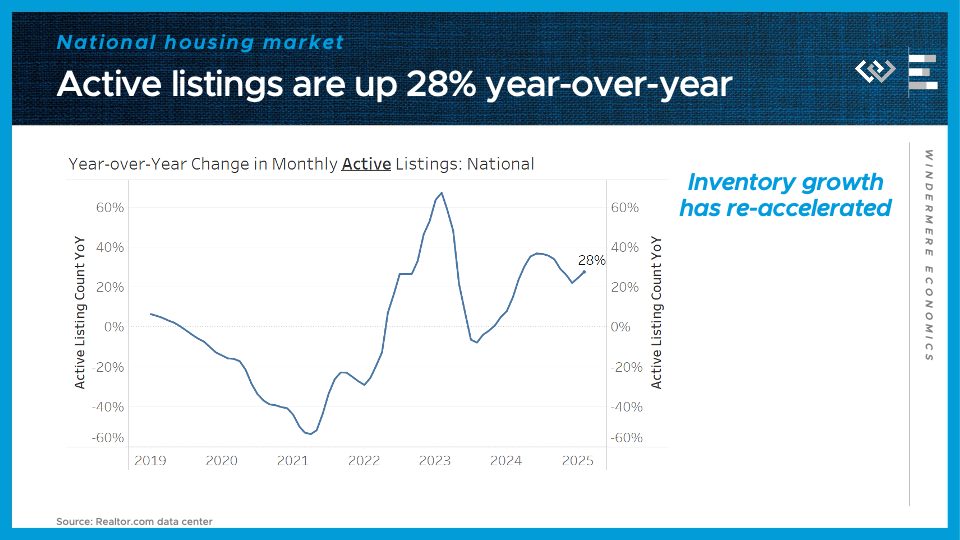
28%

That’s how many more active listings there were this February compared to February 2024. This chart of the year-over-year change really shows how that growth had been slowing late last year but is picking up again so far in 2025. That’s mainly because buyers have taken their foot off the gas, in the face of higher mortgage rates in the new year.

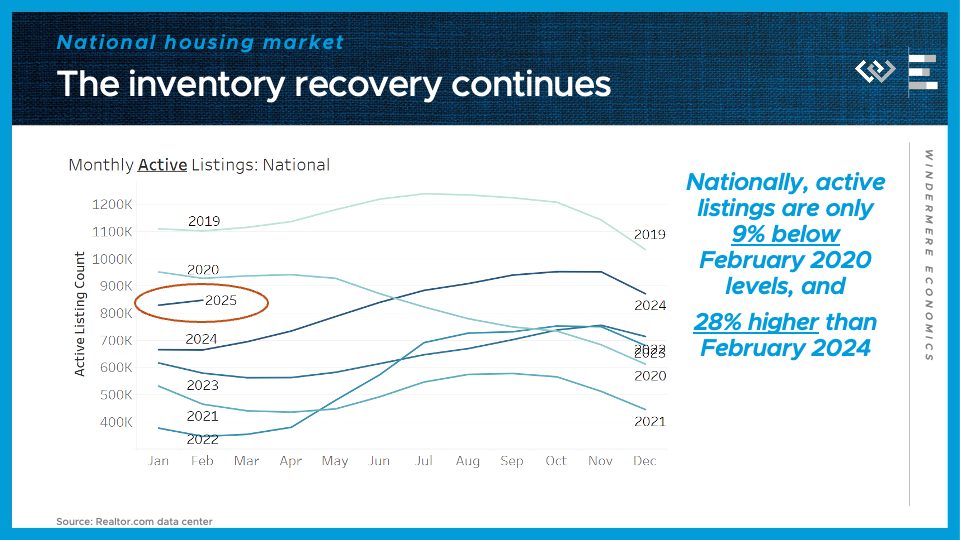
Here’s how that inventory trend shapes up against the last several years.

We are now only 9% below February 2020 levels, before the pandemic helped trigger a multi-year shortage of inventory. So for the buyers who are shopping this spring, they’ll see the most options they’ve seen in 5 years. That should keep a lid on home price appreciation this spring, and force sellers to be a bit more conservative on their asking prices. The next number to know is:

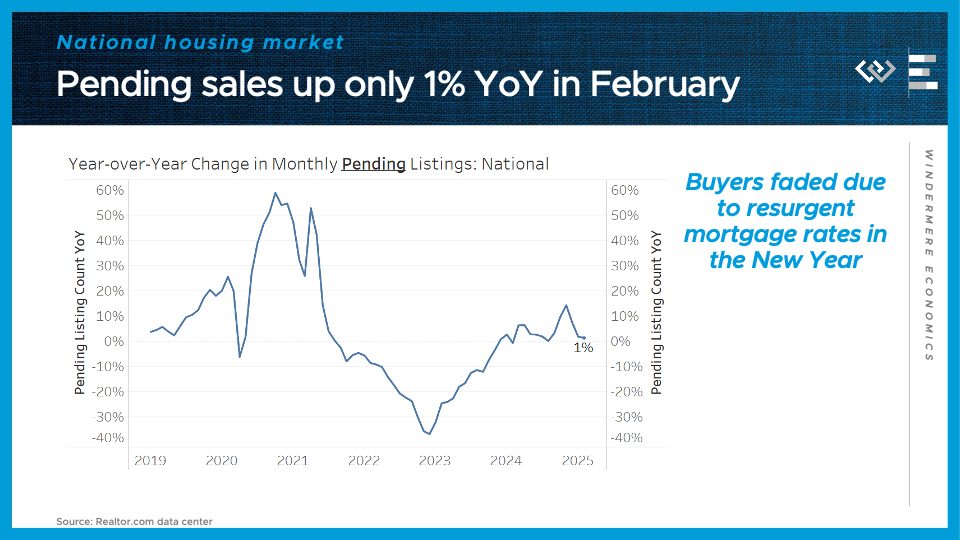
1%

Pending sales are up only 1% from the same time last year, confirming that the late-2024 surge of buyer demand is over. For buyers shopping right now that should mean less competition from other buyers to worry about. The next number to know this week:

2.8%

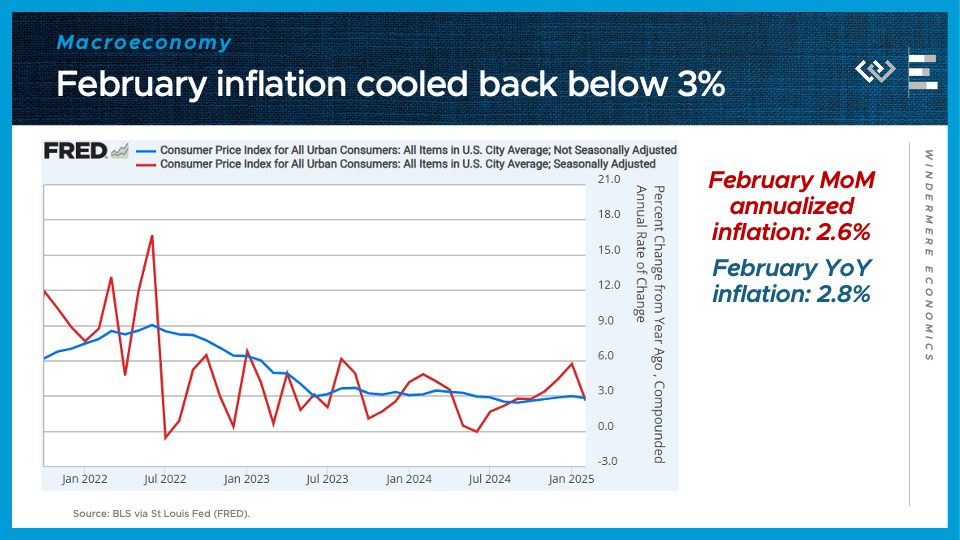
That’s the inflation rate in February, as measured by the year-over-year change in the Consumer Price Index. That’s a welcome cooldown from 3.0% in January, and you can also see the annualized pace of monthly gains, in red here, cooled way down to 2.6%. This is a step in the right direction but there’s growing uncertainty about whether the disinflation in the price of goods will continue, especially as tariffs begin to kick in. That’s one reason the Federal Reserve is still holding steady on any further rate cuts for now. Speaking of interest rates, our last number to know this week:

About 6 and 3/4%

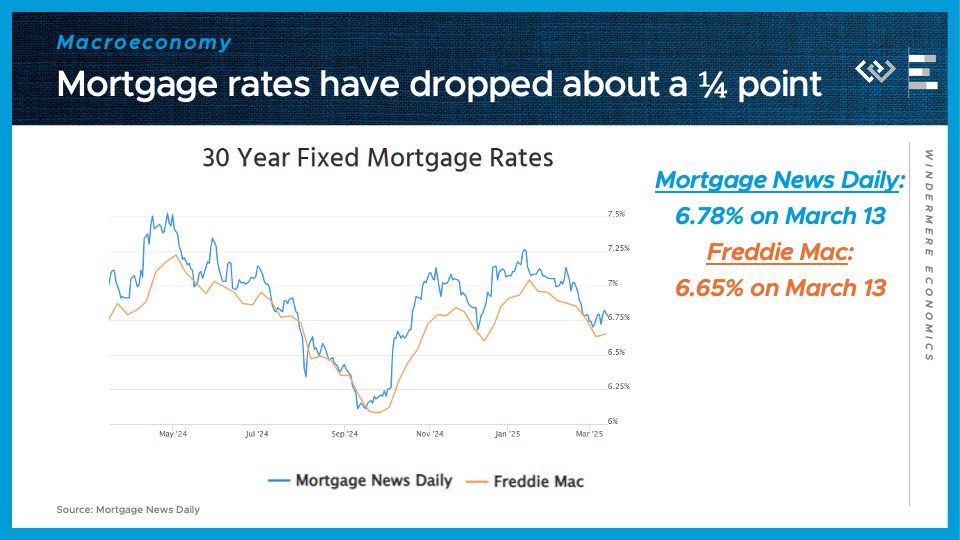
That’s where 30-year mortgage rates have hovered, as of mid-March, which is about a quarter point below their recent peak at the start of the year. Combined with more inventory, that makes a recipe for pretty good shopping conditions for buyers, as we enter the heart of the spring homebuying season.

Market NewsMoreWestern Washington Real Estate Market Update March 6, 2025

Local Look: Western Washington Housing Update 3/6/25

Hi. I’m Jeff Tucker, principal economist at Windermere Real Estate, and this is a Local Look at the February 2025 data from the Northwest MLS.


Hi. I’m Jeff Tucker, principal economist at Windermere Real Estate, and this is a Local Look at the February 2025 data from the Northwest MLS.

After an impressive Q4, and a decent start to the year in January, this February saw buyer activity – and listing activity – slow down a bit relative to last year. I think the rise in mortgage rates back to around 7% this winter has finally cooled off some of the buyer enthusiasm we saw in Q4.

Here are the four key metrics I watch to track supply and demand in the market: closed and pending sales, which tell us a lot about demand; and listings – new and active – which tell us a lot about supply.

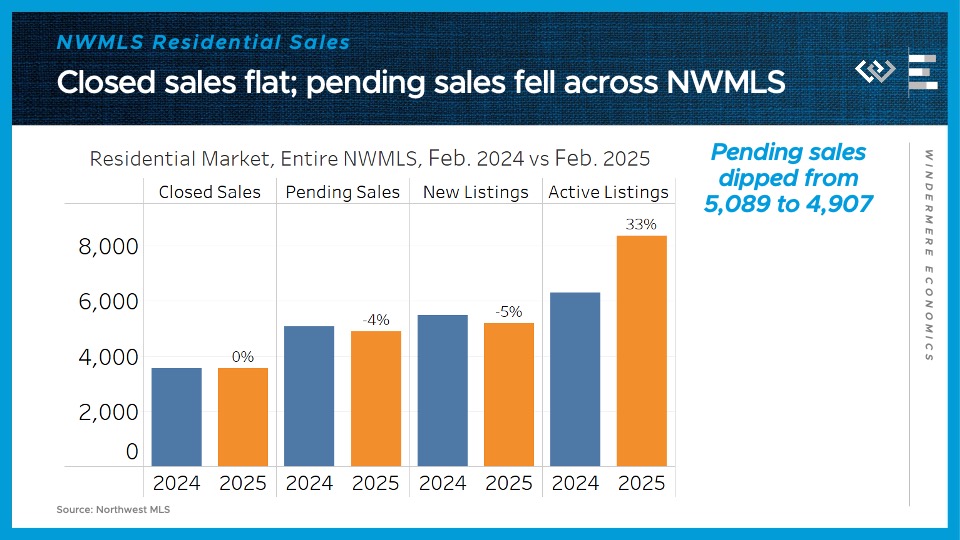
Across the Northwest MLS, closed sales of single-family homes were almost exactly flat year-over-year, at 3,550 vs last year’s 3,553. Pending sales, which will mostly close in March, dropped 4% from the same month last year. One extenuating circumstance was we had 1 less business day this February, since last year was a leap year, but this is still looking like a cooler market in terms of demand than we saw in Q4.

On the supply side, about 5% fewer new listings hit the market this February compared to last year’s, while the pool of active listings in the reservoir ended the month 33% higher than February 2024’s inventory.

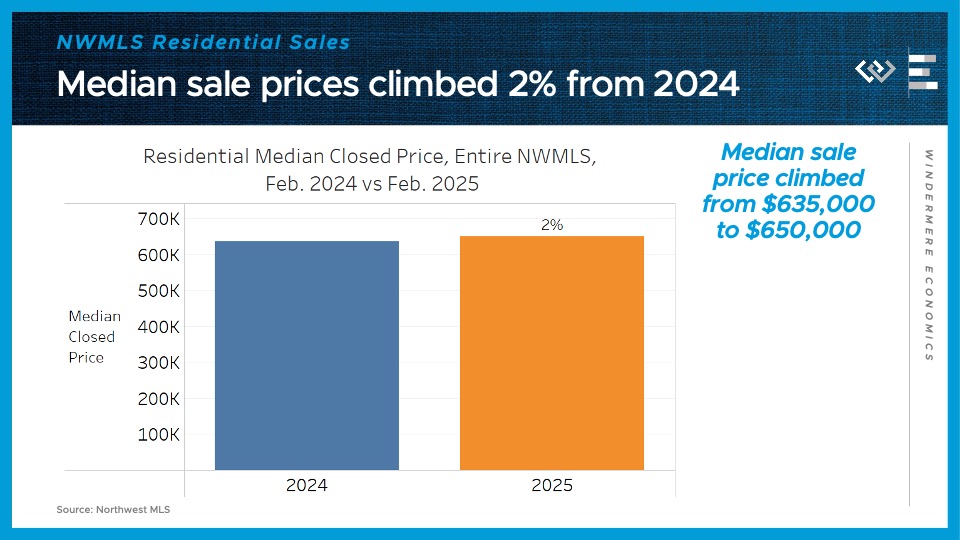
The final key metric to check in on: the median price for those closed single-family home sales climbed just 2% year-over year in February, from about $635,000 to $650,000. That represents a further cooldown from median price growth we’d seen in Q4, and it seems to indicate that the higher levels of inventory are putting some competitive pressure on sellers, preventing prices from rising too much.

Putting it all together, this looks like a market where the normal seasonal upswing in sales and prices has begun, but the year-over-year comparisons are looking a lot cooler than they were throughout Q4 and into January. I think that cooldown was mostly due to interest rates rebounding this winter, which discouraged buyers, so looking ahead, if we see the recent dip in interest rates in late February and early March actually stick, I could see some of that heat coming back into the market right as we hit the spring buying season.

Now I’ll dig into the four counties encompassing the greater Seattle area, where a similar cooldown played out in February.

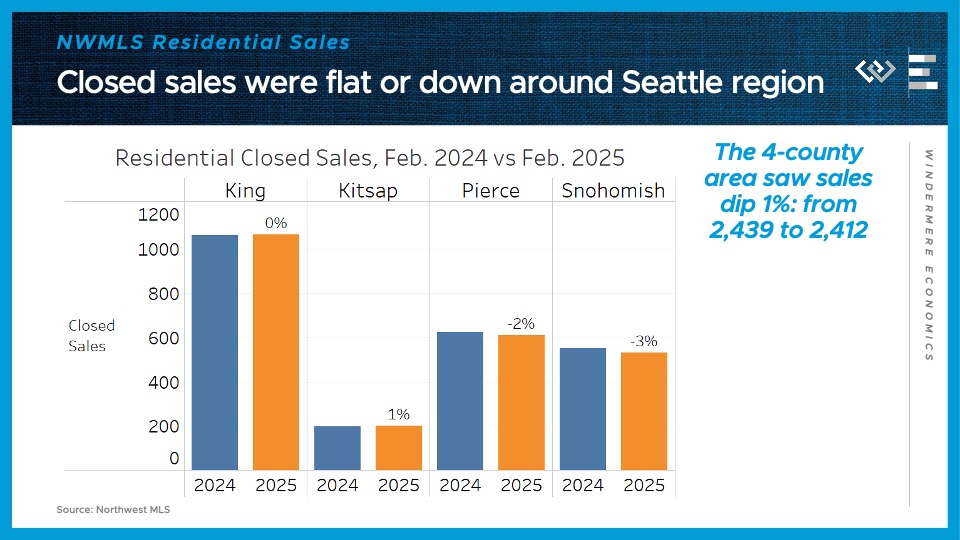
Residential closed sales were flat year over year here in King County; inched up 1% across the Sound in Kitsap County; dipped 2% in Pierce County, including Tacoma; and fell 3% in Snohomish County, including Everett. So for the 4-county region as a whole, that’s a dip of 1% from the same month last year. Not bad but it is a slowdown after 6% growth in January.

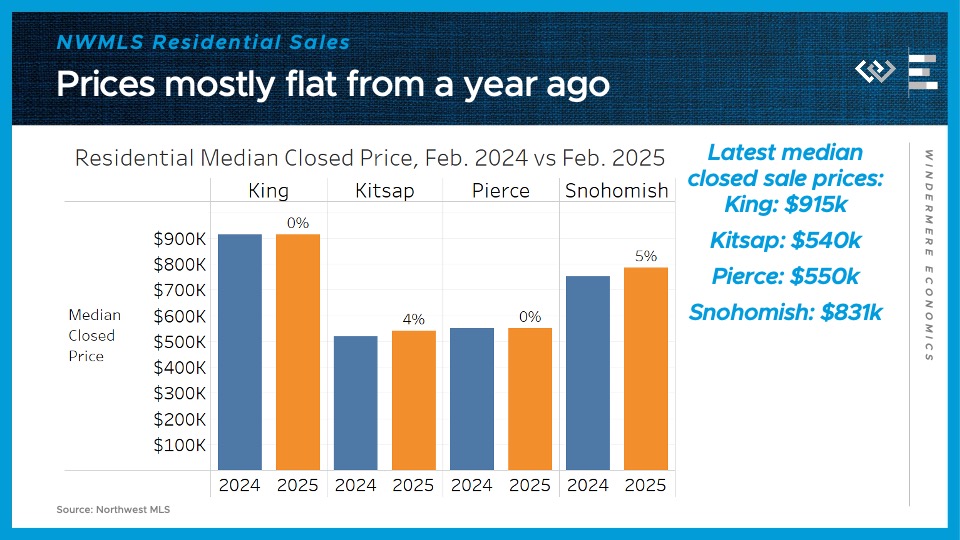
The median sale price was mostly flat, locally: 0% change from last year in King County and Snohomish County, up 4% in Kitsap County, and up 5% in Pierce County.

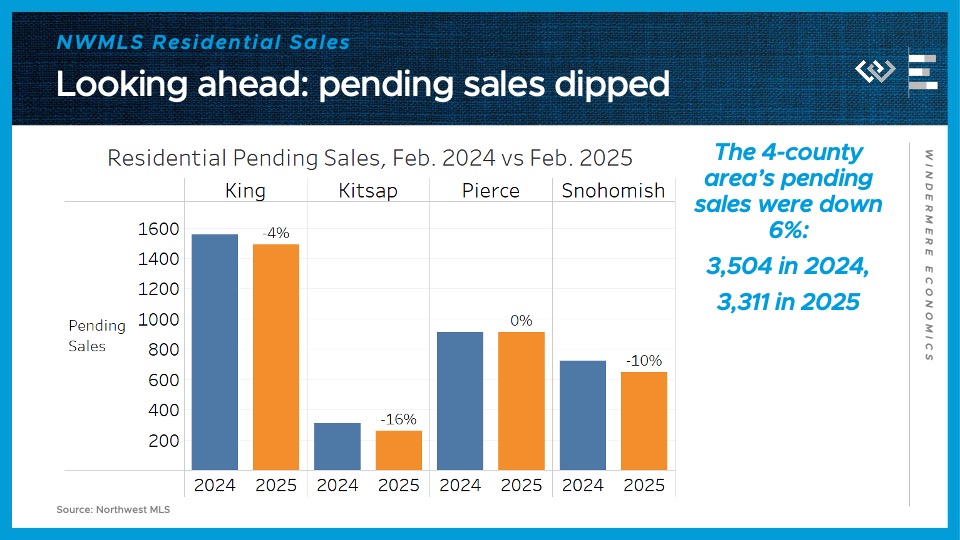
Looking ahead, pending sales were flat or down locally: down 4% in King, down 16% in Kitsap, flat in Pierce, and down 10% in Snohomish County. Altogether that makes a 6% decline across the 4 counties, suggesting we’ll see closings continue to fall year-over-year in March.

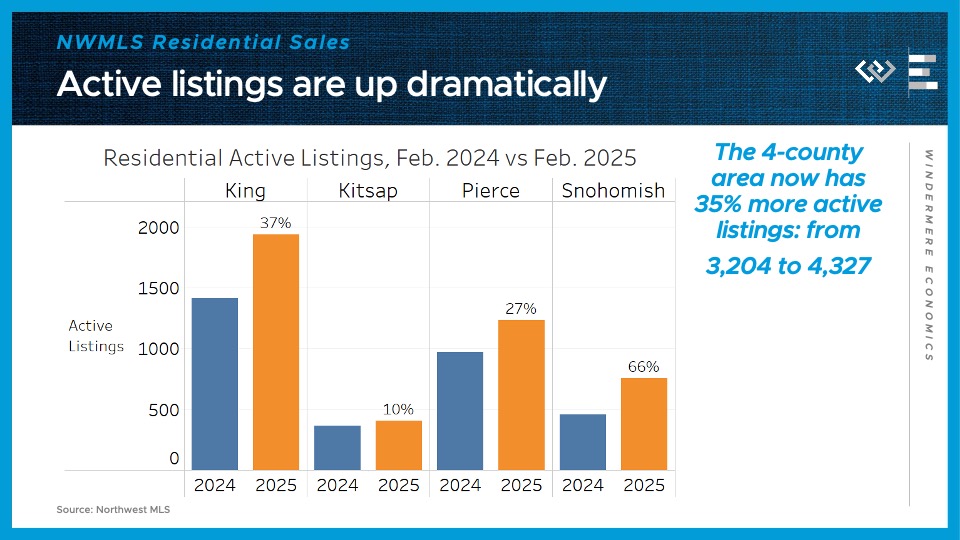
On the supply side, the 4-county greater Seattle area had about 35% more active listings at the end of February than the same time last year. That inventory growth comes in spite of a 7% decline across the region in the flow of new listings this February. Again, that was potentially impacted by the slightly shorter month, but it does suggest that sellers haven’t been flocking to list their homes in greater numbers yet this year. It could also be due to sellers jumping the gun on listing: year to date, new listings are up 8%, thanks to very impressive new listings in January. Now I’ll be curious to see if the recent dip in rates can help re-start the listing pipeline locally.

BuyingSelling March 3, 2025

The Biggest Home Buying and Selling Mistakes (and How to Avoid Them)

There’s nothing more exciting, rewarding, and fulfilling than buying or selling a home. However, it’s a complex transaction, and there are several steps along the path that can confuse even the most seasoned buyers and sellers. How can you avoid potential selling pitfalls and common buying mistakes? Look to your real estate agent for advice and keep the following guidelines in mind.

Common Buying Mistakes

#1 Review Your Credit Reports Ahead of Time

Review your credit report a few months before you begin searching for homes. You’ll have time to ensure the facts are correct and be able to dispute mistakes before your mortgage lender checks your credit. Get a copy of your credit report from Experian, Equifax, and TransUnion. Why all three? Because, if the scores differ, the bank will typically use the lowest one. Alert the credit bureaus if you see any mistakes, fix any problems you discover, and don’t apply for any new credit until after your home loan closes.

#2 Get Pre-Approved for a Mortgage

Before getting serious about your hunt for a new house, you’ll want to choose a lender and get pre-approved for a mortgage (not just pre-qualified—which is a cursory review of your finances—but pre-approved for a loan of a specific amount). Pre-approval lets sellers know you’re serious. Most importantly, pre-approval will help you determine exactly how much you can comfortably afford to spend.

#3 Know What You Want

You and your real estate agent should both be clear about the house you want to buy. Put it in writing. First, make a list of all the features and amenities you really want. Then, number each item and prioritize them. Now, divide the list into must-haves and nice-to-haves.

#4 Account for Hidden Costs

In addition to the purchase price of the home, there are additional costs you need to take into consideration, such as closing costs, appraisal fees, and escrow fees. Once you find a prospective home, you’ll want to:

  • Get estimates for any repairs or remodeling it may need
  • Estimate how much it will cost to maintain (gas, electricity, utilities, etc.)
  • Determine how much you’ll pay in taxes monthly and/or annually.
  • Learn whether there are any Homeowners Association (HOA) fees associated with the property.

#5 Get a Home Inspection

Buying a home is emotionally charged—which can make it difficult for buyers to see the house for what it truly is. That’s why you need impartial third parties who can help you logically analyze the condition of the property. Your agent is there to advise you, but you also need a home inspector to assess any hidden flaws, structural damage, or faulty systems.

#6 Research the Neighborhood and Location

When house hunting, it’s easy to get caught up in the details of the home itself—bedrooms, bathrooms, and amenities—while overlooking the subtleties of the surrounding neighborhood. Take time to explore the area at different times of the day, research school options, check crime reports, and visit nearby parks, shops, and restaurants. A great home in the wrong location can quickly become the wrong home.

Common Selling Mistakes

#1 Avoid Getting Too Emotional About the Sale

Once you decide to sell your house, it’s time to strip out the emotion and look at it as a commodity in a business transaction. If you start reminiscing about all the good times you had and the hard work you invested, it will only make it that much harder to price, prepare, and market the home successfully.

#2 Make Repairs or Price Accordingly

Homes with deferred maintenance and repair issues can take far longer to sell and can be subject to last-minute sale cancellations. These homes also often sell for less than their legitimate market value. If you simply can’t afford to address critical issues, be prepared to work with your agent to price and market your home accordingly.

#3 Don’t Overprice Your Home

Getting top dollar is the dream of every seller. But it’s essential that you let the market dictate that price, not your emotions or financial situation. Allow your agent to research and prepare a market analysis that factors in the value of similar homes in the area and trust those results. Overpricing your home often spells trouble and can leave significant money on the table.

#4 Use High Quality Photos

Most prospective buyers today search for homes online first. To make a good first impression, you need a wealth of high-quality photos showcasing your home and surrounding grounds. In today’s market, buyers also expect virtual home tours, drone photography, and 3d walkthroughs to get a more immersive look at the home before scheduling an in-person visit. Investing in these visual tools can help your home stand out in a competitive market and attract buyers faster. It’s also critical that you stage your home to generate maximum buyer interest.
The process of buying or selling a home can have plenty of twists and turns, but with some wise decision-making, you can avoid the most common mistakes and pitfalls. Lean on your agent for guidance throughout the process. Connect with a local Windermere agent to begin your buying or selling journey: