Market News May 18, 2012

The Gardner Report: First Quarter, Volume XVII (Oregon & Southwest Washington)

Windermere Real Estate is proud to partner with Gardner Economics on this analysis of the Oregon and Southwest Washington real estate market. This report is designed to offer insight into the realities of the housing market. Numbers alone do not always give an accurate picture of local economic conditions; therefore our goal is to provide an explanation of what the statistics mean and how they impact the Oregon and Southwest Washington housing economy. We hope that this information may assist you with making an informed real estate decision. For further information about the real estate market in your area, please contact your Windermere agent.

Regional Economics

For regular readers of this report, it must be starting to feel as if you are stuck in the movie “Groundhog Day” when reading my commentary on the Oregon and Southwest Washington economy. As I review Gardner Reports from prior quarters, I note terms such as “painfully slow recovery” and “tepid growth” used with monotonous repetitiveness. Unfortunately, inasmuch as I would like to be the bearer of better news on the economy and job growth in the region, we are not quite there yet.

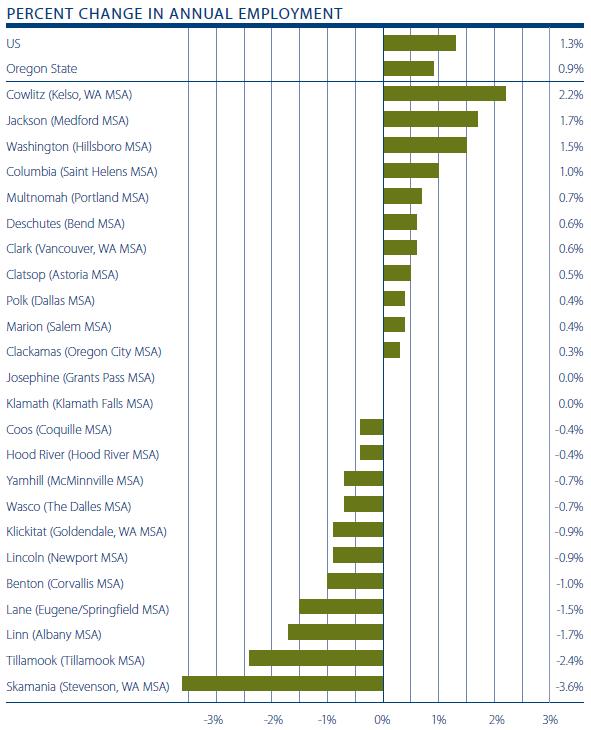
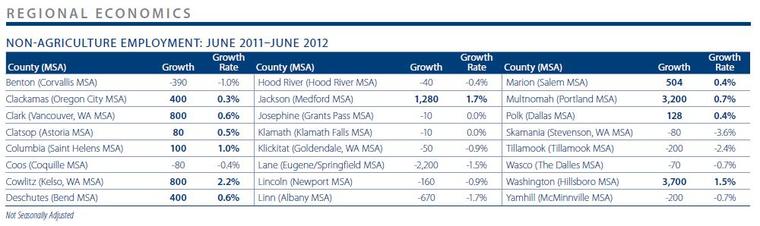
The current employment situation shows that the counties covered by this report grew by 10,272 jobs over the past 12-month period, or a 0.59% growth rate. Although still higher than the state’s overall growth rate of 0.3%, it remains below the U.S. rate of 1.5%. Additionally, it appears as if hiring in the first quarter of this year was actually negative—a trend that I hope is just temporary.

Fifteen of the 24 counties covered in this report did see job growth over the past 12-month period. These were led by Klickitat (+2.4%), Clark and Skamania (+1.8%), Hood River and Clatsop (+1.6%), Deschutes (+1.5%), Washington (+1.4%), and Multnomah (+1.1%) Counties. The number of counties growing year-over-year matched my last report.

On the negative side, job losses were most profound in Linn County (-2.3%), followed by Lane County (-1.1%). Additionally, Benton, Polk, and Marion counties all saw a one percent decline.

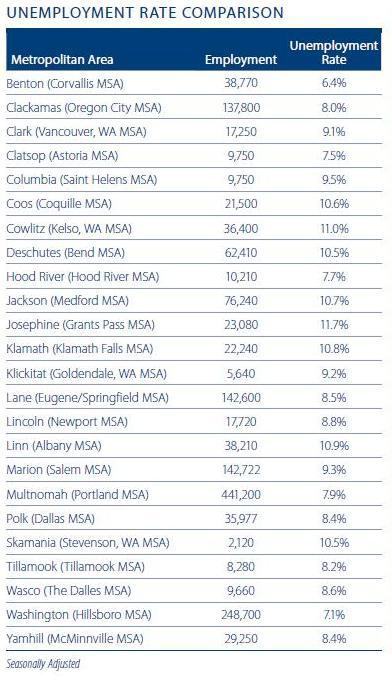
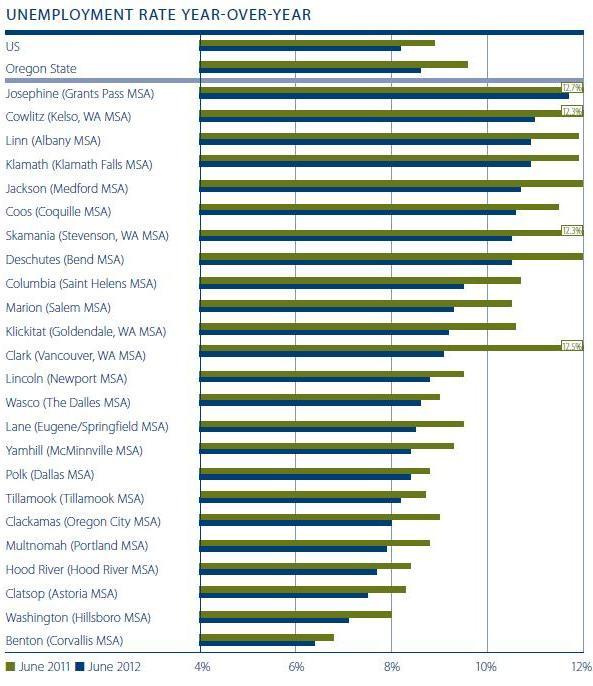
As I mentioned previously, quarterly growth was concerning, with 17 counties losing jobs between the end of 2011 and March of 2012. This drop in unemployment is due in no small part to the decline in the labor force participation rate, which suggests that there are fewer people actively looking for work. As such, I am giving the employment situation a grade of “D”, down from “C-” in the last quarter. The increase in jobs that I had anticipated this spring has not yet appeared, but I will be keeping a close eye on the employment situation and hope to have a better report this summer.

Regional Real Estate

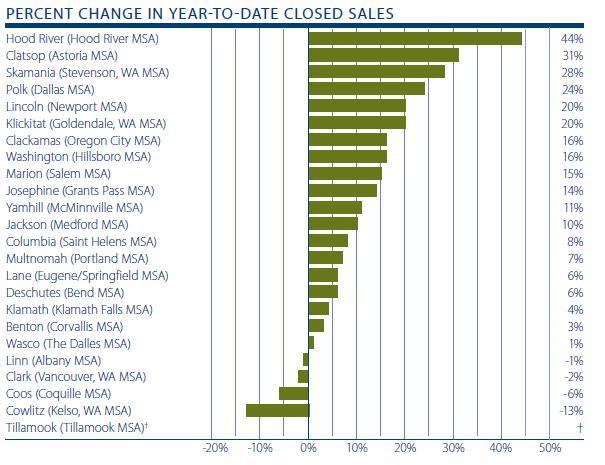
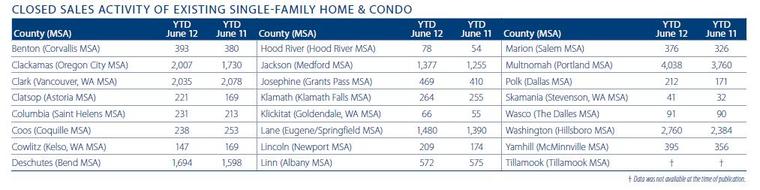
Overall, home sales in the markets covered by this report continued to increase this spring with 7,871 transactions occurring—an increase of five percent from the 7,495 transactions seen in the first quarter of 2011. Year-over-year we note that 11 counties saw an increase in sales, nine did not meet last year’s figures, and three counties saw an identical number of transactions in 2011 as compared to the previous year.

Seventeen counties registered an increase in sales activity over the first quarter of 2011 with just six seeing declines. In the areas that saw a drop in activity, I was most surprised to see the Bend and Hood River markets included, as most of the larger markets have improved over the past year. Smaller markets, such as Lincoln, Benton, and Coos Counties have fewer homes and are, therefore, historically prone to wild fluctuations.

It appears as if the larger markets are now starting to suffer from a lack of available inventory which is having an adverse effect on sales. This is not unique to Oregon (it has already become an issue in Washington State, too) and I will be interested to see if this issue becomes more prevalent as we move into the peak buying season.

Of the markets that saw an increase in sales, the greatest growth was seen in Skamania County where sales were up by 50 percent—that said, the absolute rise was from just 16 to 24 units. Other notable increases in sales occurred in Polk (+38%), Marion (+33%), Columbia (+23%), and Washington (+18%) Counties.

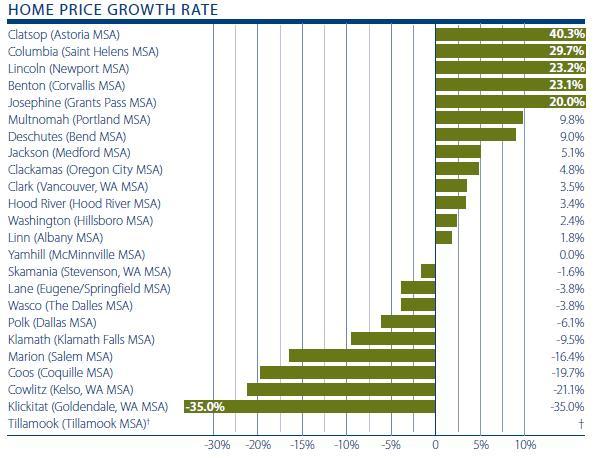
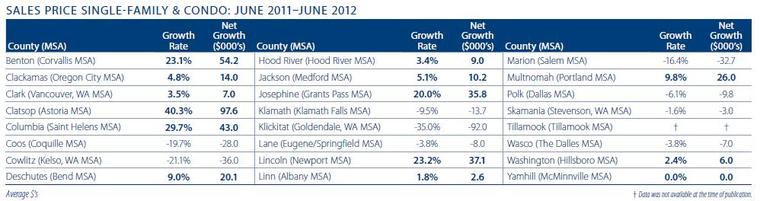
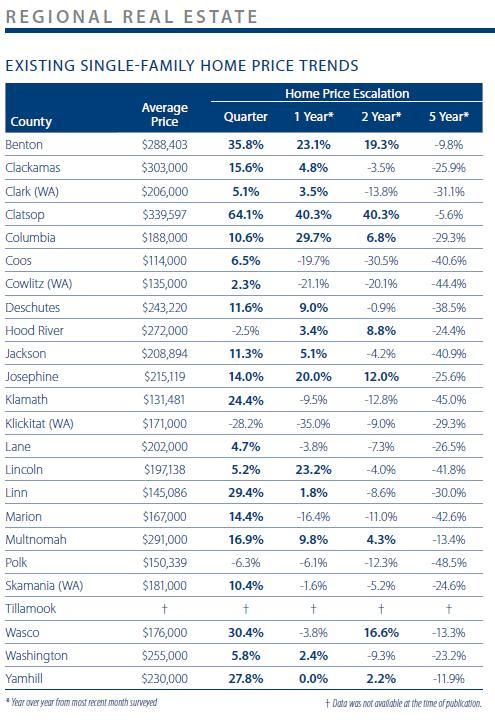
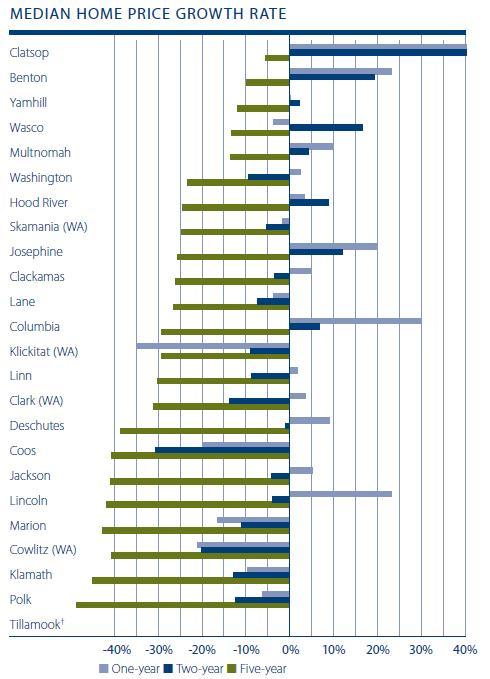
From a value standpoint, nine counties registered year-over-year price increases with 14 showing declines in values from a year ago. In aggregate, the markets surveyed saw values decline by 3.9% over the same period in 2011.

Other than the substantial 55.6% growth in the small Klickitat County area, the other eight counties registered increases in value ranging from 0.4% to 5.1%. The greatest declines in value came in Wasco (-39.5%), Coos (-22.5%), Marion (-18.5%), and Skamania (-14.1%) Counties.

I was interested to see that 10 counties exhibited price growth over the previous quarter, as opposed to nine that saw quarterly appreciation in our last report. That said, the number of counties that have demonstrated higher prices as compared to two years ago, dropped from five to two.

Overall, I give the real estate market a “D” grade this quarter.

Conclusion

The Oregon and Southwest Washington economy and its real estate markets still appear to be in stasis. As I stated in last quarter’s report, they remain, to a degree, reliant on each other and improvement in one will likely lead to improvement in the other.

Employment growth remains slow in the aftermath of the housing crisis since households are spending cautiously, banks are lending cautiously, and businesses are investing cautiously. Along with all the other states in the U.S., weakness persists in the public sector as well as all real-estate-related industries.

The number of workers suffering from long-term unemployment, which is defined as a span of more than a month or two, remains far higher than anything we have seen since the Great Depression. This is true both in Oregon and in most other U.S. states. As our resources sit idle they become less competitive, and the damage done by the recession becomes more permanent. The problem of long-term unemployment is most severe across much of rural Oregon, where many communities have yet to share in the recovery.

As stated previously, I remain concerned about the lack of inventory in all market areas and that this lack of choice may discourage buyers from entering the market. Overall, the housing market has yet to find any real direction, but the increase in pending sales could be an encouraging sign of things to come.

About Matthew Gardner

Mr. Gardner is a land use economist and principal with Gardner Economics and is considered by many to be one of the foremost real estate analysts in the Pacific Northwest.

In addition to managing his consulting practice, Mr. Gardner is a member of the Pacific Real Estate Institute; chairs the Board of Trustees for the Washington State Center for Real Estate Research; the Urban Land Institutes Technical Assistance Panel; and represents the Master Builders Association as an in-house economist.

He has appeared on CNN, NBC and NPR news services to discuss real estate issues, and is regularly cited in the Wall Street Journal and all local media.
Market News May 11, 2012

The Gardner Report: First Quarter, Volume XVII (Western Washington)

Windermere Real Estate is proud to partner with Gardner Economics on this analysis of the Western Washington real estate market. This report is designed to offer insight into the realities of the housing market. Numbers alone do not always give an accurate picture of local economic conditions; therefore our goal is to provide an explanation of what the statistics mean and how they impact the Western Washington housing economy. We hope that this information may assist you with making an informed real estate decision. For further information about the real estate market in your area, please contact your Windermere agent.

Regional Economics

The theme that appears to be most appropriate for this issue of the Gardner Report is “location.” As I pore through the data that is presented here, it is quite clear that after falling off the proverbial economic precipice in 2008, we have come out of the free fall and are starting up the long road to recovery on both the job front as well as in our real estate markets.

Between March of 2011 and March of 2012, the markets considered in this report added a very impressive 54,230 jobs—a 2.58 percent growth rate, which far exceeds that of Washington State as a whole, or even the United States average. As the charts to the right indicate, nine counties expanded their employment base with just seven shrinking. When I compare this to our last report where just six counties expanded while ten contracted, it is clearly a better picture.

Drawing on the aforementioned “location” theme, all markets are not created equal, and this is demonstrated by the employment growth figures, with major employment centers seeing the greatest increase in growth. When looking at year-over-year growth, Snohomish County (+4.6%) continues to lead the way followed by King (+3.2%) and Whatcom (+2.4%) Counties. Job losses were most profound in San Juan County (-2.8%), followed by Kittitas County (-2.3%), Grays Harbor County (-1.5%), and Cowlitz County (-1.4%).

For perspective, over the past 12 months, the region added 56,460 jobs in nine counties while losing 2,230 jobs in the remaining seven.

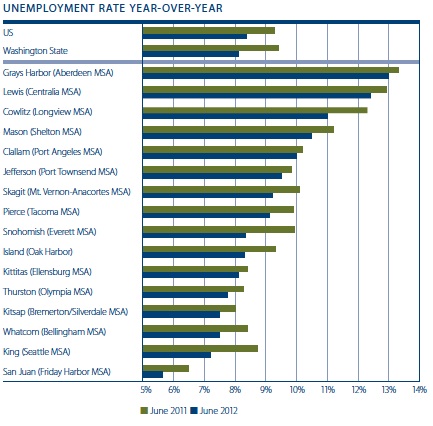
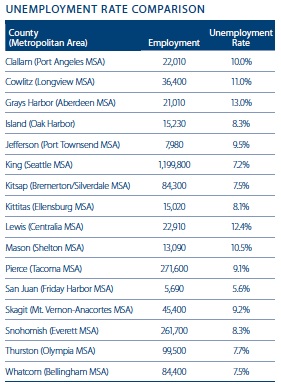
From an unemployment rate perspective, the improvement has been quite remarkable with all but one county (Grays Harbor) showing improvement over the past 12 months.

I glanced back on some old reports recently and shuddered at some of the numbers. In 2008, our region lost 27,370 jobs and in 2011 we grew by 24,350. This latest report shows that our growth rate is substantial when compared to a year ago, however I cannot see this rate of growth being sustained at its current pace. As a result, I am going to give the current employment situation a “B-” grade, up a notch from the last quarter, but at a level that it will likely stay for a while. My expectations for 2012 are still positive, but we may be disappointed by the speed at which we create new jobs as we enter the summer.

Regional Real Estate

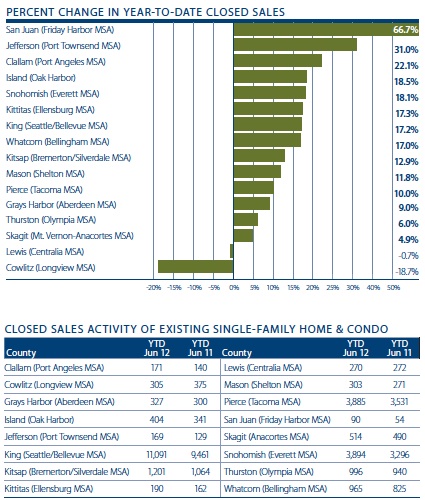
Our market reported 10,136 sales of existing homes in the first quarter of this year—an impressive increase of 13.7 percent from the first quarter of 2011. The most pronounced gains were seen in Mason (+27.5%), San Juan (+25%), Snohomish (+17.9%), Pierce (+17.3%), and King (+15%) Counties.

Declines in sales were found in just three counties—Cowlitz, Lewis, and Skagit—but most were were extremely small and, as such, not any real cause for concern.

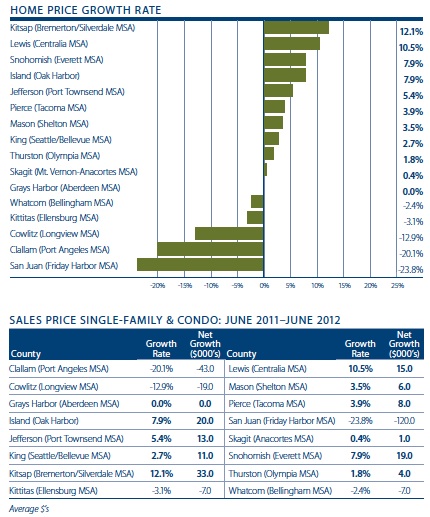
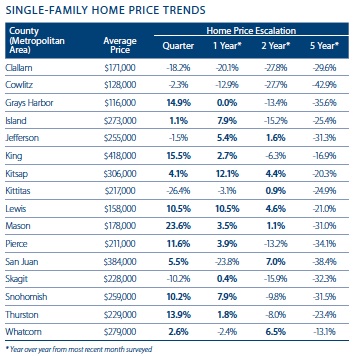
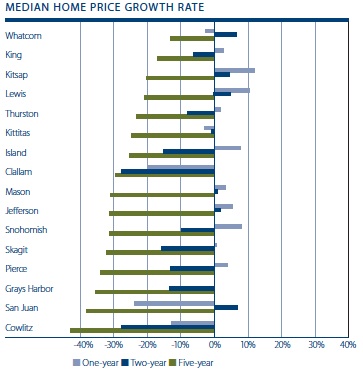
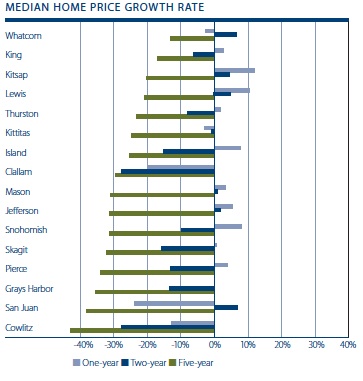
As can be seen in the chart to the right, there were seven counties where home prices were at levels above those seen a year ago, and nine where prices were lower. In aggregate, home prices in the counties analyzed were 4.5 percent lower than in March of 2011, but there is a big disclaimer here. If we exclude the highly volatile San Juan County, home prices actually rose by 2.9 percent year-over-year.

Of the counties that saw the most appreciation, the most pronounced price gains were seen in Kittitas (+46.3%), Jefferson (+19.9%), and Island (+12.4%) Counties. The greatest declines were seen in the previously mentioned San Juan County (-42.6%), followed by Grays Harbor (-26.9%), Mason (-13.5%), and Pierce (-11.7%) Counties.

As I dig into the data, it is clear that distressed sales still comprise a substantial piece of the market, which is functioning to hold down price growth as sales of these homes are almost always below market value. Getting through this inventory is a process, and it can be a painful one. That said, it is an important part of any recovery. We know that the percentage of “all cash” sales are far higher than we have ever seen, which indicates to me that investors are now buying, and this will likely help in depleting this inventory.

Movements in the real estate market are now best described as “local.” The recovery in prices will not be equal across our region, rather areas that are closer to employment centers, as well as those that did not see egregious increases in value back in the heyday, will likely see their markets improving the fastest.

I am raising the housing market grade marginally to a “C” this quarter. Improving stability in prices is occurring at a faster rate than I had anticipated, but as I have stated previously, further improvement in the grade will be very dependent on whether we see an increasing supply of homes for sale. So far, the spring season has not replenished the market with new listings, as is typical for this time of year, and inventory levels remain at levels not seen in several years.

Conclusion

The national, regional, and local economies fell off a cliff in 2008 and into an abyss that was deeper than any seen since the Great Depression. Since that time we have clawed our way forward and are making solid progress, but there is still a long way to go.

I believe that our own state is likely to see its job recovery occur earlier than that of the United States as a whole, which is a function of our exposure to the Asian markets more than anything else. We are not out of the woods yet, but the forecast is a positive one.

Our real estate markets are also in the throes of an about-face, but some areas are faring better than others. Bank owned and short sales are still high, but the number of non-distressed houses for sale is at a level that is worrisome. Choices are not what many buyers are expecting to see, which may put a further damper on select markets.

Overall, I am still looking to 2012 as the year that we emerge from the recession and, in our own inimitable Washingtonian manner, stride forward in the belief that the way ahead is a good one. (After all, who else wears shorts when it’s 50 degrees outside?)

About Matthew Gardner

Mr. Gardner is a land use economist and principal with Gardner Economics and is considered by many to be one of the foremost real estate analysts in the Pacific Northwest.

In addition to managing his consulting practice, Mr. Gardner is a member of the Pacific Real Estate Institute; chairs the Board of Trustees for the Washington State Center for Real Estate Research; the Urban Land Institutes Technical Assistance Panel; and represents the Master Builders Association as an in-house economist.

He has appeared on CNN, NBC and NPR news services to discuss real estate issues, and is regularly cited in the Wall Street Journal and all local media.
More May 1, 2012

Spring Perspectives: Technology

A few months ago, Windermere launched a new, refreshed version of our website. It was long overdue and we still have a ways to go, but getting to this point involved countless hours of discussions about how technology impacts real estate and everyday life. Through this process, we decided that many of us treat technology almost like a family member (albeit one that can feel entirely too co-dependent in some respects). It’s an easy pattern to fall into given how much technology has made our lives easier. We’re no longer forced to send letters through mail, schedule vacations through travel agents, shop in stores, or wait for photos to be developed. Technology has made it possible for us to do just about anything from behind the screen of a computer, iPad, or smart phone.

So, this got us thinking, we’ve certainly gained a lot through technology, but in the process has anything been lost? We actually miss getting letters the old fashioned way (thank you notes via email just aren’t the same). Booking travel online certainly has its conveniences, but let’s face it, now we do all the work. Shopping online is interactive and low-pressure, but until technology can tell you whether or not those jeans make you look fat, we’re still going to need department stores.

Our goal at Windermere is to bring you the best of both worlds. We hope our new website makes it easier for you to see what’s for sale and what sold six months ago, check out nearby restaurants and shops, review school data, chat with your agent, and post your favorites on Facebook. But even with all of that, we’re proud to be in a business that still relies upon the one thing that technology can’t replace: personal relationships. It’s the lifeblood of the real estate business and why clients entrust their agents with what is one of the biggest financial decisions they will ever make.

For the most part, technology has done more good than harm: it has reconnected us with old friends, allowed us to go to school online, and encouraged us to exercise. If technology continues to impact our lives at the same rate that it has in recent years, who knows where we’ll be in the next decade. Only time will tell, but in the meantime, we believe personal relationships are here to stay.

Living April 27, 2012

Increase your living space—and your home’s value

Cooking and dining alfresco is arguably the single greatest thing about warm weather in spring and summer, but most backyard barbeques involve a million trips to and from the kitchen. As such, one of the hottest trends in new home construction is outdoor kitchens. Outdoor kitchens typically feature a comfortable eating area with a combination of cabinets, sinks, warming drawers, prep counters, ranges, and refrigerators—all within arm’s reach of the grill. Outdoor kitchens provide a natural gathering spot for friends and family and can add to the value of your home.

How elaborate your outdoor kitchen should be depends on how often you plan to use it. Some people enjoying dining outdoors every evening, while others reserve it for special occasions and social gatherings. Regardless of the frequency of use, you need to use materials that do well in all kinds of weather. Stone sinks, stainless steel cabinets, and slate countertops will withstand the Seattle rain, as well as the months that pass between barbeque seasons. Many outdoor kitchens also feature pergolas or other roof structures to shield guests from sun and rain. Something else to consider is adding an outdoor gas heater or fireplace, which will extend the amount of time you can use your outdoor kitchen into the fall and winter months.

In addition to the convenience of having all your grilling accoutrements within a handy distance, a well-built outdoor kitchen also adds to the value of your home. And you don’t have to have a new home to reap the benefits. With the right space and backyard layout, owners of existing homes can easily add-on an outdoor kitchen area. When adding an outdoor kitchen to an existing home, power, gas, and water lines often have to be extended from the home, so be sure to hire a qualified contractor to do the work for you. By extending your living space outside, you have essentially increased the square footage of your home. In many cases the increase in your home’s value will equal or even sometimes exceed the cost of the project itself.

The benefits of an outdoor kitchen area and living space are many. And with the convenience of having your drinks, condiments, meat, and cooking space all in one easy-to-reach place, you can spend the precious summer moments right where you should—outside with friends and family.

What features would you include in an outdoor kitchen?

More April 20, 2012

Home Warranties Provide Buyers and Sellers With A Peace Of Mind

If you are a homeowner, you probably know all-too-well how costly home repairs can be. And, thanks to Murphy’s Law, appliance break-downs seem to happen at the worst possible time—like when you are selling your home. For this reason, it is in the best interest of all home sellers to consider purchasing a home warranty.

A home warranty offers many advantages to the home seller, the least of which is a peace of mind that your major home appliances are covered in the event of a break down. Most home warranties cover both parts and labor of your home’s most vital systems and major appliances. This protects the home seller from potentially large, unexpected repair bills and also allows the buyer to purchase the home with more confidence. Additionally, a home warranty is usually for the term of at least one year, so any unforeseen repairs/replacements are also covered well after the home has been sold. A home warranty also provides a competitive edge over those homes without warranties because it communicates confidence to buyers. This can add up to a faster selling period, resulting in a more convenient process for all involved.

A home is probably the single largest investment you’ll ever make, so the last thing you want as a home seller or buyer, are unexpected home repairs/replacements. Major appliance replacement can cost you several thousand dollars, and during the process of a home sale/purchase, your budget doesn’t often allow for costly expenses. A home warranty is designed to protect you from these types of expenditures. Furthermore, it is convenient for home sellers because a home warranty offers after-sale liability. While an inspection may find many faults that are covered by a home warranty, it cannot account for latent problems that are beyond an inspection’s scope, or problems that occur down the road. In most cases, a home warranty will cover these expenses, alleviating potential financial burdens for the seller once they have sold the home.

When considering a home warranty, it’s important to ask the right questions. Warranties vary from one company to the next and there are also many different types of coverage available. Your Realtor should be able to help you with this process. First and foremost, you should identify which components of the home will be covered by the warranty. It’s also important to attain annual costs and the charge for service calls. You will want to ask what the total dollar limit is on the warranty and what the limits are for the individual items that are covered. Many home sellers purchase home warranties, which are then passed along to the homebuyer when they move into the home. As a homebuyer, you may want to look into whether or not the coverage can be renewed once the warranty has expired.

According to American Home Shield, one of the largest home warranty companies in the nation, the average home warranty customer uses their warranty plan 2.3 times. Furthermore, the number of home warranties is increasing with every year because homeowners are becoming more informed of their benefits. Eventually home warranties will become commonplace, as buyers and sellers realize the advantages they offer. Ultimately, what it comes down to is that a home warranty is a very simple, cost-effective way to purchase a peace of mind for both homebuyers and sellers alike.

Living April 12, 2012

Simple Ways To Conserve Energy In Your Home

With the increased emphasis on global warming in recent years, combined with rising energy costs, more and more people are asking what they can do to make their homes more energy efficient. Energy conservation can be as simple as closing your curtains at night, changing a light bulb, turning down your thermostat, or closing the fireplace damper. Many of the most inexpensive solutions quickly pay for themselves in conservation, which you ultimately benefit from when you get your power bill.

One of the biggest ways you can conserve energy is to take advantage of “off-peak” hours. This is a step that everyone can take because it simply involves shifting your power use of major appliances, such as washing machines, dryers, and dishwashers. Puget Sound Energy recommends using these appliances outside of peak hours—peak hours are between 6am-10am and 5pm-9pm. Studies show that by shifting a portion of your energy use, consumers can significantly lower wholesale electricity prices, which saves everyone money in the long run.

Another way you can save energy is by washing your clothes in cold water and only running full loads. When using the dryer, toss in a couple of dry towels with your clothes to help speed up the drying process. It’s also important to clean the lint trap in your dryer after every load and make sure the dryer hose and vent are clear.

There are several steps you can follow to reduce your home’s demand on heating during the winter months. Conventional measures, such as setting back your thermostat, are effective at reducing energy consumption. It is recommended that you keep your thermostat set between 65 and 72 degrees during the winter months. Keep in mind that by simply lowering your thermostat one degree, your furnace will use seven percent less energy overall. It’s also important to clean your furnace filter frequently—doing so will enable your heating system to run more efficiently and cost-effectively.

It’s estimated that lighting accounts for 10 percent of your overall home energy bill, so another way you can conserve is by using energy-saving fluorescent light bulbs, known as CFL light bulbs. CFLs use approximately one-quarter of the energy of equivalent incandescent bulbs, they give off warm, indirect light, and they last ten times longer than average light bulbs. When shopping for CFLs, look for those with the Energy Star label on them—this ensures that you’re purchasing a product that has been approved by the U.S. Environmental Protection Agency (EPA) and the U.S. Department of Energy (DOE).

For more information about energy conservation, please visit www.energystar.org.

Market News March 30, 2012

Real Estate Investors May Be Indicator Of Recovery

I have often found that following a prolonged decline, residential real estate investors tend to re-enter the housing market ahead of buyers who are looking for a home for their own use. This is because investors are generally less concerned with timing the bottom of a market perfectly and more focused on the longer term financial benefits. And because these investors often pay cash for their investments, I tend to track markets where the percentage of cash buyers is on the rise, as it is likely an indication that the rest of the home buyer population will soon follow.

I’m currently seeing this trend in Washington State, as well as parts of Oregon, which leads me to believe that these markets may have finally turned a corner. Investors now appear to be prepared to make their move based upon the belief that prices are bottoming, and their cash is better invested in real estate than money market accounts, where it might actually be losing money given the current rate of inflation. There is also evidence to suggest that interest rates will not trend any lower. In fact, if the economy improves at a faster rate than forecasted by the Federal Reserve, rates are likely to tick up more quickly than is currently predicted, and this will likely spur on buyer activity.

Further indicators of this trend is that many mainstream buyers, who have been sitting on the sidelines in the belief that neither home prices nor interest rates are expected to rise, now seem willing to jump in. Unfortunately, the woefully low supply of new homes coming on the market is giving those buyers few options and creating stiff competition in many areas. In fact, we’re now hearing about multiple offers and bidding wars – something we haven’t seen in several years.

In as much as we would all like to think that we can “time the real estate market”, quite frankly, nobody can. If the investors are moving in, there is a fairly good chance that the market has reached (or is reaching) its lows and that may be the signal for reluctant home buyers to think about getting off the fence.

Selling March 22, 2012

Major Changes Coming to Home Affordable Foreclosure Alternatives Program (HAFA)

The Federal Government’s Home Affordable Foreclosure Alternatives (HAFA) Program went into effect on April 5, 2010 and is designed to provide incentives for borrowers to do a short sale (or a deed in lieu) in order to avoid foreclosure.  HAFA assists eligible homeowners in quickly implementing short sales by providing financial incentives to participating lenders.

As of June 1, there will be significant changes to the HAFA program. The updates will allow a homeowner to remain current on their mortgage, qualify for HAFA, and go through a short sale with less of an impact on their credit.

The major changes include:

▪ The deadline for submitting for HAFA eligibility will be extended a full year, from December 31, 2012 to December 31, 2013.

▪ The removal of occupancy requirements: HAFA until now has required homeowners to have lived in the property within the last 12 months. This requirement is being removed.

▪ The $3,000 relocation incentive will be limited to properties occupied by an owner at the time of the short sale.

▪ Mortgage payments will be allowed to exceed 31% of the homeowner’s gross monthly income. The effect of this will be to allow a homeowner to remain current on her mortgage and still qualify, minimizing the overall potential impact to her credit, and certainly shortening the waiting period to purchase in the future.

▪ Junior lienholders may receive up to a maximum of $8,500, up from $6,000 previously (these are incentives to junior lienholders).

▪ There are also new mandates regarding what the lender can state on the borrower’s credit report that, reportedly, will lessen the impact on the borrower’s credit rating.

What questions do you have about the HAFA changes?

Richard Eastern is a Windermere agent in Bellevue and co-founder of Washington Property Solutions, a short sales negotiating company. Since 2003 he has helped more than 600 homeowners sell their homes.  A Bellevue native and a UW grad, Richard is an avid sports fan and a devoted Little League and basketball coach. You can learn more about Richard here or at www.washortsales.com.

More March 19, 2012

Together, we are making a difference

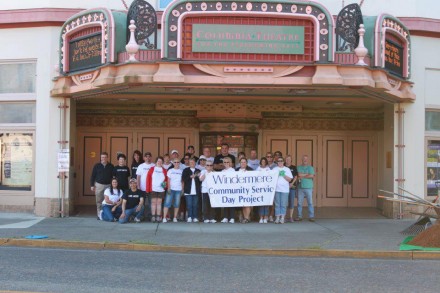
According to the latest national census, more than 46.2 million  people in the United States live in poverty. For the past 23 years, the Windermere Foundation has been dedicated to helping these low-income and homeless families, but in these tough times, the organizations and families we support need more help.

Helping families find homes is not just what we do as real estate agents; it is a larger part of our passion for supporting our communities. So, every time you buy or sell a home with the help of a Windermere agent, a portion of the commission is donated to the Windermere Foundation to help low-income and homeless families.

On behalf of those you help, thank you for choosing Windermere.

Selling March 15, 2012

Pricing your home to sell

When it comes time to sell a home, most people want the property to sell quickly for the highest possible return. Setting the correct listing price is the most important step in reaching this goal. Price a property too low and it might sell quickly, but you could pocket less profit. Set it too high and you run the risk of pricing yourself out of the market.

Why overpricing a home is risky

Some sellers want to list their home at an inflated value, believing that they can always lower the price down the road if needed. But this can be a risky strategy. New listings generally get the greatest exposure in the first two-to-four weeks on the market, so setting a realistic price from day one is critical. If a home is priced too high, your strongest pool of prospective buyers is eliminated because they think it’s out of their price range.  Conversely, buyers who can afford it will compare it to other homes that have been fairly priced and decide that they can get more home for their money elsewhere.

Once it has been decided to reduce the price, you’ve unnecessarily lost time and money. Your strongest prospective buyers may have found another home, while the over-inflated price could result in a negative impression amongst agents and buyers who are still in the market. Not to mention, reengaging buyers after those first critical few weeks can be very challenging. As the saying goes, “time is money”; so the longer a home is on the market, the lower the selling price will likely be in relation to the initial listing price.

Setting a home price too high has other costs

When a home languishes on the market, the seller loses in a number of ways. Each month the home goes unsold is another month of costs to the owner in mortgage payments, taxes, and maintenance—expenses that are not recovered when the home is sold. Furthermore, until the house is sold, the owner is on hold and can’t move forward with whatever plans prompted the decision to sell. If the seller is still living in the home, it can also be fatiguing to keep the property in ready-to-show condition month after month.

How to set the right price for a home

It’s not easy to be objective about your own home. That’s why it’s best to have a real estate professional work with you to set a reasonable price. According to a study done by the National Association of REALTORS®, homes that were sold using a real estate agent netted an average of $25,000 more than those without agent representation.

There are a number of factors that your agent will consider when determining a sales price for your home. Here’s a quick overview.

  • Comparable sales. One of the best guides to pricing your home is knowing what recent buyers were willing to pay for similar homes in your area. So, one of the first things your agent will do is prepare a Comparative Market Analysis (CMA). A CMA is a written analysis of houses in the community that are currently for sale, homes that have recently sold, and homes that were offered for sale but did not sell. While no two homes are identical, the report highlights only homes that most resemble yours. The CMA will include details about these properties, such as the number of bedrooms and baths, square footage, noteworthy amenities—and the listing price and sale price. The report will also include the Days on Market (DOM) for each property, which is the number of days it took to sell the home once it was listed. The CMA helps determine a price range that will be appropriate for your home.
  • Unique property features. Since no two homes are exactly alike, looking at comparable sales is just one part of the equation. Many properties have distinctive features that add to their overall value when it comes to pricing. The importance buyers place on different features can vary by region, but examples might include a particularly pleasing view, artisan-quality interior detailing, outdoor entertaining space, or exceptional landscaping.
  • Current market conditions. The real estate market is constantly fluctuating, and those cycles have a direct impact on pricing. Here are some of the market conditions an agent may consider when evaluating how to price a home:

    • Are home prices trending up or down?
    • How quickly are homes selling?
    • Is the inventory of homes on the market tight or plentiful?
    • Are interest rates attractive?
    • How is the overall economy performing? Is the local job market strong or in decline?

Other factors that can impact pricing include the condition of the home, seasonal influences (i.e. summer versus winter), condition of surrounding neighborhood, local amenities, and how quickly the seller needs to move.


There are a lot of factors that go into setting a home’s sales price, but it’s by far the most critical step in the overall selling process. The best course of action is to look to your real estate agent for guidance; they have the experience and market knowledge that will help you achieve your goals and reach a desired outcome that best fits your individual needs.