Facebook
 X
X
 Pinterest
 Copy Link
Q3 2021 Big Island of Hawaii Real Estate Market Update

The following analysis of the Big Island real estate market is provided by Windermere Real Estate Chief Economist Matthew Gardner. We hope that this information may assist you with making better-informed real estate decisions. For further information about the housing market in your area, please don’t hesitate to contact your Windermere Real Estate agent.
Regional Economic Overview
Job recovery on the Big Island remains stalled, with employment levels down 100 jobs from the end of the second quarter, but still up 4,823 versus a year ago. This is likely a function of the governor’s announcement discouraging tourists from visiting as COVID-19 cases in the state started to rise again. At the end of the third quarter, Hawaii County had recovered 6,574 of the more than 17,000 jobs that were lost due to COVID-19. With employment levels still down more than 10,600 from the pre-pandemic peak, there is much work to be done. New COVID-19 cases have started to slow, which may allow for more robust job growth in the final quarter of this year, but we likely will not see a full job recovery until 2022 at the earliest. The unemployment rate on the Big Island remained elevated in September, with 6.3% of the workforce still without jobs, but this is still considerably better than the 22% rate in April of last year. The state unemployment rate was 6.6% in September, down from 7.7% at the end of the second quarter.
big island of hawaii Home Sales
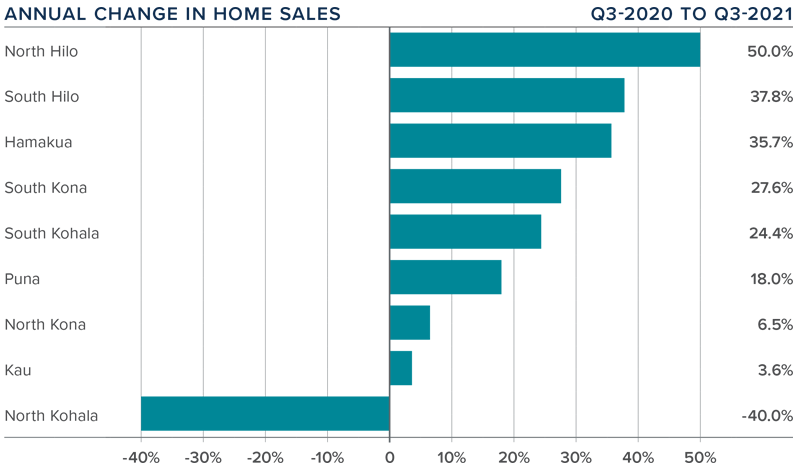
❱ In the third quarter, 1,037 homes were sold on the Big Island. This was an increase of 15.7% from the same quarter a year ago, but 12.8% lower than in the second quarter of this year.
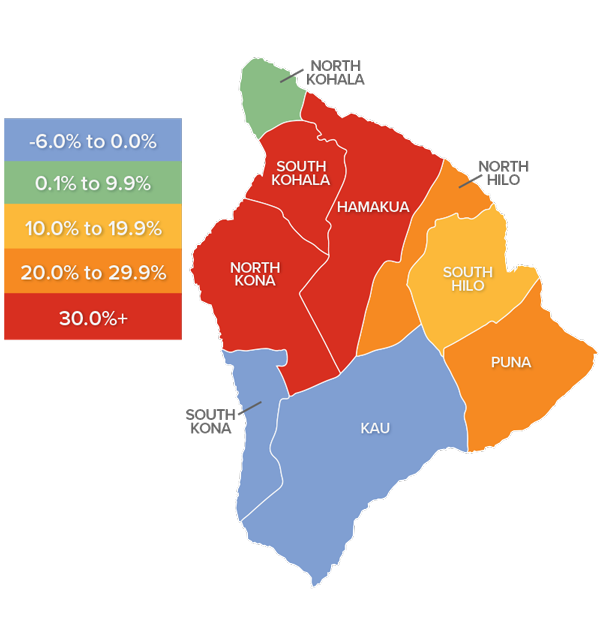
❱ Year-over-year, sales rose in all areas other than North Kohala, but this is a very small area that can see significant swings. Also of note was that six of the remaining eight markets saw sales rise by double digits compared to a year ago. When comparing second and third quarters, sales rose in all areas other than North and South Kohala, North Kona, and Kau.
❱ It’s noteworthy that sales pulled back even as the number of homes rose. The average number of homes on the market in the third quarter was 3.2% higher than in the second quarter, suggesting that some of the heat may be coming off the market.
❱ Pending home sales fell 13.9% compared to the second quarter of the year, which may lead total sales to drop modestly in the final quarter of the year.
big island of hawaii Home Prices
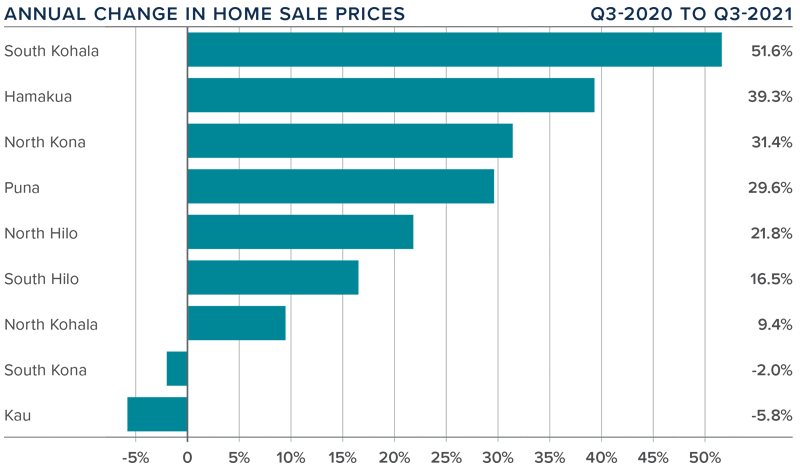
❱ The average home price on the Island rose a solid 29.1% year over year to $810,810, but prices fell 8.4% compared to the second quarter of 2021.
❱ Versus the second quarter, sale prices were up in Puna, South Hilo, Hamakua, and South Kohala but lower in all the other areas.
❱ Prices rose by double digits in six of the market areas covered by this report but fell in South Kona and Kau.
❱ I mentioned in the second quarter Gardner Report that I was seeing price growth showing some signs of strain, which appears to have been an accurate statement.
Days on Market
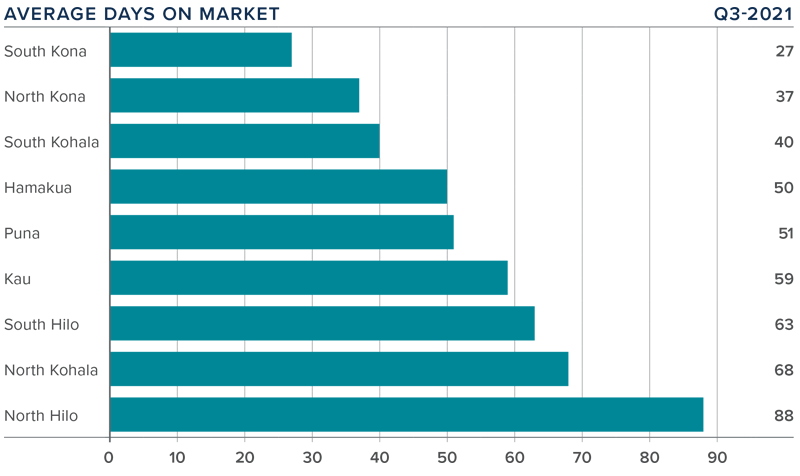
❱ The average time it took to sell a home on the Big Island dropped 52 days compared to the third quarter of 2020.
❱ The amount of time it took to sell a home dropped across the board compared to a year ago.
❱ It took an average of 54 days to sell a home, with the fastest sales occurring in South Kona and the slowest in North Hilo.
❱ It took 24 fewer days to sell a home in the third quarter of 2021 than it did in the second, with all markets showing market time dropping.
Conclusions
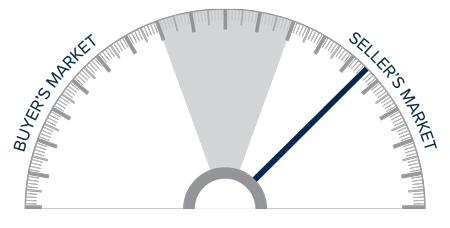
This speedometer reflects the state of the region’s real estate market using housing inventory, price gains, home sales, interest rates, and larger economic factors.
The number of homes for sale ticked higher, while both sales and prices ticked lower—all of which favor home buyers. That said, market time dropped, and interest rates remain very low, which favors home sellers. If inventory levels continue to trend higher, this may further impact prices and make the market more competitive for sellers. As such, I have moved the needle a little more toward buyers but overall, it remains a seller’s market.
About Matthew Gardner

As Chief Economist for Windermere Real Estate, Matthew Gardner is responsible for analyzing and interpreting economic data and its impact on the real estate market on both a local and national level. Matthew has over 30 years of professional experience both in the U.S. and U.K.
In addition to his day-to-day responsibilities, Matthew sits on the Washington State Governors Council of Economic Advisors; chairs the Board of Trustees at the Washington Center for Real Estate Research at the University of Washington; and is an Advisory Board Member at the Runstad Center for Real Estate Studies at the University of Washington where he also lectures in real estate economics.
Q2 2021 Big Island of Hawaii Real Estate Market Update

The following analysis of the Big Island real estate market is provided by Windermere Real Estate Chief Economist Matthew Gardner. We hope that this information may assist you with making better-informed real estate decisions. For further information about the housing market in your area, please don’t hesitate to contact your Windermere Real Estate agent.
Regional Economic Overview
The recovery in jobs on the Big Island has been, shall we say, frenetic. After the return of 7,000 jobs in the final quarter of 2020 and 1,000 jobs in the first quarter of 2021, total employment dropped by 650 jobs in the second quarter. The Island’s economy remains fragile. As of early July, travel restrictions have been relaxed for some fully vaccinated travelers. Hopefully this will bring more visitors, which will certainly help the labor market. As of the end of the second quarter, Hawaii County has recovered 12,100 of the 21,850 jobs lost due to COVID-19. There is a long way to go, and the pace of improvement may face additional headwinds with the rise of the Delta and Lambda variants of COVID-19. Only time will tell. Even with the slow return of jobs, the county’s unemployment rate in June was 7.9%, down from 8.5% in March and well below the 13.8% level of a year ago. The state unemployment rate was 7.7% in June, down from 9.1% in March.
big island of hawaii Home Sales
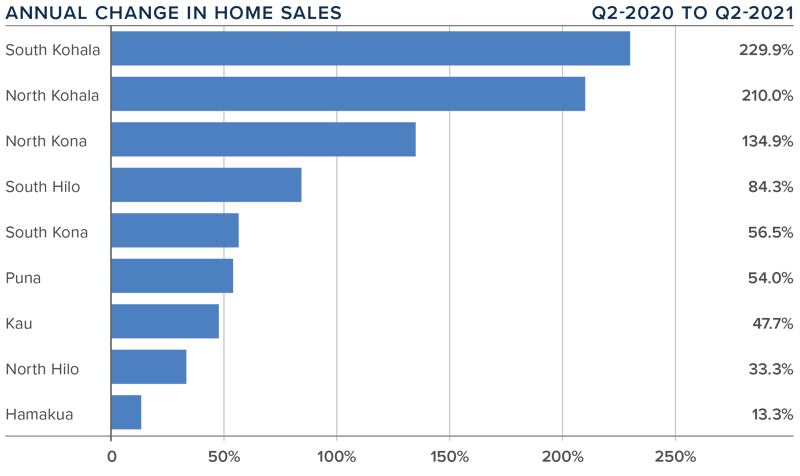
❱ In the second quarter, 1,189 homes were sold on the Big Island, more than doubling the number of sales that occurred a year ago, and 7.1% higher than in the first quarter of the year.
❱ Sales were higher across the board compared to a year ago, with the number of transactions more than doubling in three markets. Compared to the first quarter of 2021, sales rose in all areas other than Puna, North Kohala, and South Kona, but the drop in sales in these markets was minimal.
❱ The growth in sales came even though inventory levels were 32% lower than in the first quarter, suggesting that homes are selling very quickly.
❱ Pending home sales fell 7.7% compared to the first quarter of the year. This is likely a function of low supply levels and may lead total sales to drop modestly in the third quarter.
big island of hawaii Home Prices
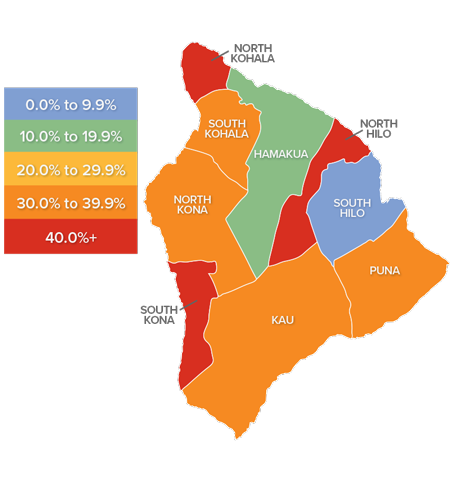
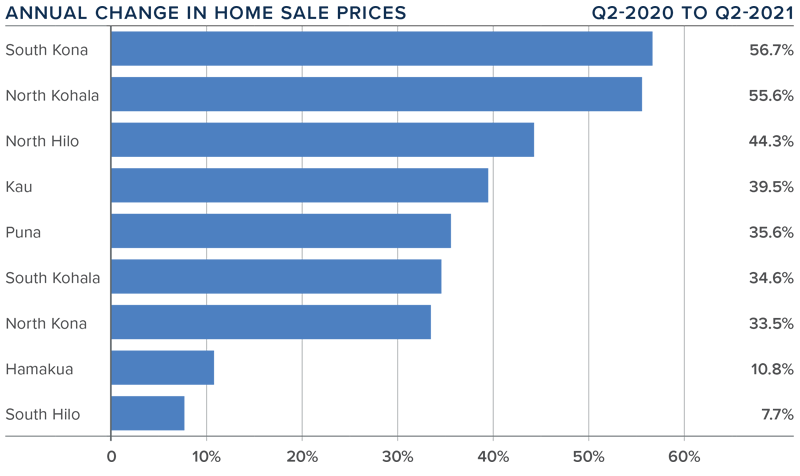
❱ The average home price on the Big Island rose by a very impressive 54.4% year over year to $884,759, but prices only managed to increase by a modest .7% from the first quarter.
❱ Home prices were up in five markets compared to the first quarter, but were lower in North and South Hilo, Hamakua, and North Kona.
❱ Year-over-year, prices rose by double-digits in all but one market, with significant growth in South Kona, North Kohala, and North Hilo.
❱ I would say that the housing market is performing as well as can be expected given current circumstances. The Big Island remains supply starved, but despite this, price growth appears to be strained.
Days on Market
❱ The average time it took to sell a home on the Big Island dropped 14 days compared to the second quarter of 2020.
❱ The amount of time it took to sell a home dropped in all but two markets, with North Kohala remaining unchanged and Hamakua rising by 27 days.
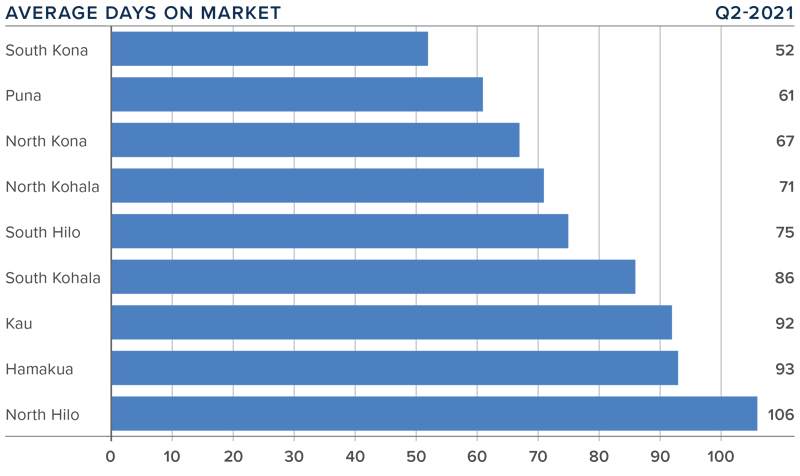
❱ In the second quarter, it took an average of 78 days to sell a home, with the fastest sales occurring in South Kona and slowest in North Hilo.
❱ Due to the drop in available inventory, it took 58 fewer days to sell a home in the second quarter of 2021 than in the first.
Conclusions
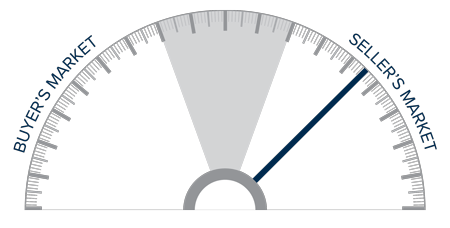
This speedometer reflects the state of the region’s real estate market using housing inventory, price gains, home sales, interest rates, and larger economic factors.
Without a doubt, supply levels are not meeting the very strong demand. The modest uptick in mortgage rates in the first quarter was not maintained and rates have lowered again, which undoubtedly has influenced rising demand.
Even with the economic recovery stalling—and COVID-19 cases spiking again—the housing market is still on solid footing. I would be very surprised to see a significant uptick in the number of homes for sale in the coming months, which will clearly favor home sellers. Given these factors, I am moving the needle more in their favor.
About Matthew Gardner
As Chief Economist for Windermere Real Estate, Matthew Gardner is responsible for analyzing and interpreting economic data and its impact on the real estate market on both a local and national level. Matthew has over 30 years of professional experience both in the U.S. and U.K.
In addition to his day-to-day responsibilities, Matthew sits on the Washington State Governors Council of Economic Advisors; chairs the Board of Trustees at the Washington Center for Real Estate Research at the University of Washington; and is an Advisory Board Member at the Runstad Center for Real Estate Studies at the University of Washington where he also lectures in real estate economics.
Q1 2021 Big Island of Hawaii Real Estate Market Update

The following analysis of the Big Island real estate market is provided by Windermere Real Estate Chief Economist Matthew Gardner. We hope that this information may assist you with making better-informed real estate decisions. For further information about the housing market in your area, please don’t hesitate to contact your Windermere Real Estate agent.
Regional Economic Overview
The Big Island saw a significant number of jobs return in the fall of 2020, but the momentum did not continue through the new year. In the first quarter, only 900 jobs returned—compared to the 7,500 jobs that returned in the fourth quarter. Clearly the economy remains in a fragile position and the area is anxiously waiting for tourists to return in greater numbers. The growth in the final quarter of 2020 was a result of relaxed travel restrictions, but rising infection rates on the mainland have led to more restrictions, which has likely impacted the number of jobs returning. Although the pace of job recovery has stalled, it’s worth noting that the island has recovered 12,650 of the 21,850 jobs that were lost due to the pandemic. The island’s unemployment rate remains elevated. It was 8.4% in March, down from 9.2% at the end of 2020. The state unemployment rate was 9% in March, down from 10.3% in December. All of the islands continue to suffer from slow economic growth due to the pandemic, but I remain hopeful that jobs will return, and the pace of recovery will pick up speed in the second half of the year.
big island of hawaii Home Sales
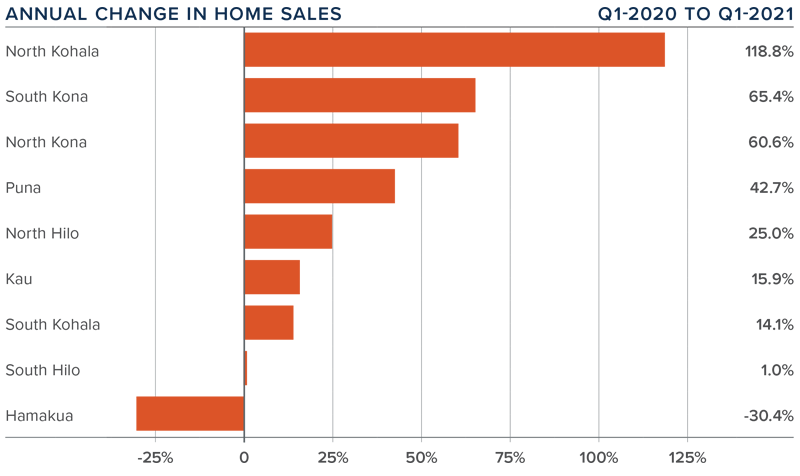
❱ In the first quarter of 2021, 1,110 homes sold on the Big Island, an increase of 35.5% compared to the first quarter of 2020, and 2.5% higher than in the final quarter of last year.
❱ Sales were higher in all markets other than Hamakua, where they dropped more than 30%. Sales in North Kohala more than doubled and several other areas saw significant increases in sales activity.
❱ The growth in sales came even with inventory levels 53.3% lower than a year ago and down 31.7% compared to last quarter.
❱ Pending home sales rose 15.9% compared to the final quarter of 2020, suggesting that closings in the second quarter will show further growth.
big island of hawaii Home Prices
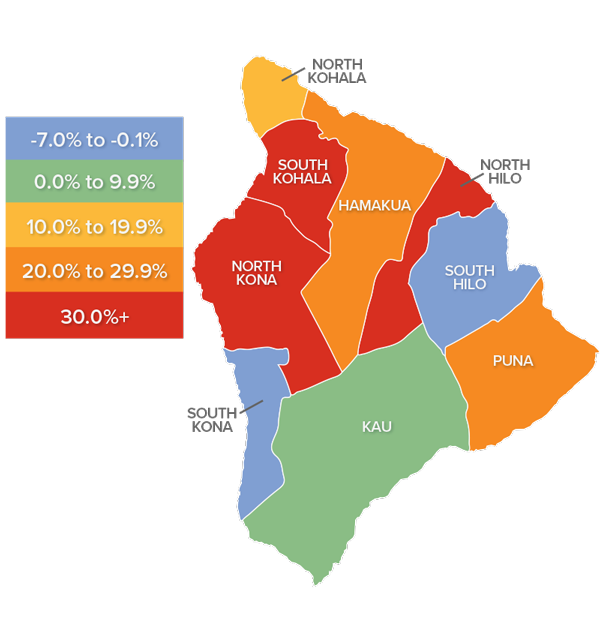
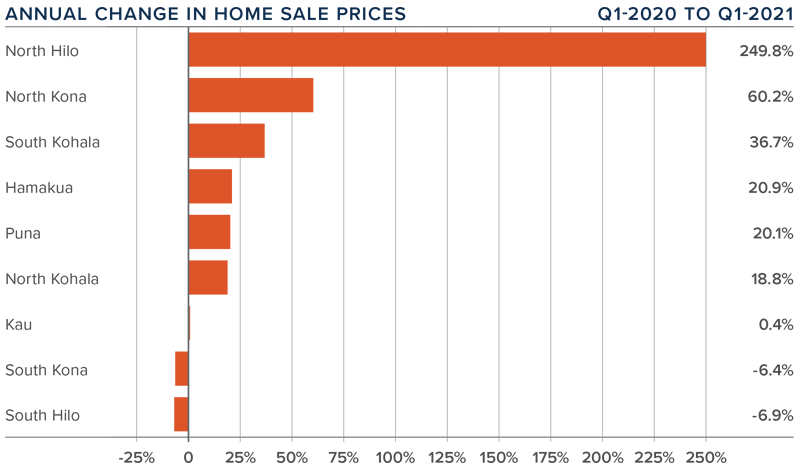
❱ The average home price on the island rose by a very impressive 41.7% year over year to $878,267. Prices were also 13.2% higher compared to the fourth quarter of 2020.
❱ Sale prices were lower in two markets compared to a year ago, but I do not see this as a trend that will continue.
❱ The substantial increase in prices was driven by significant price growth in North Hilo, where the average sale price rose from $248,000 to $866,000. Six additional markets saw prices increase by double-digits.
❱ After the events of 2020, the housing market—if not the job market—continues to recover admirably.
Days on Market
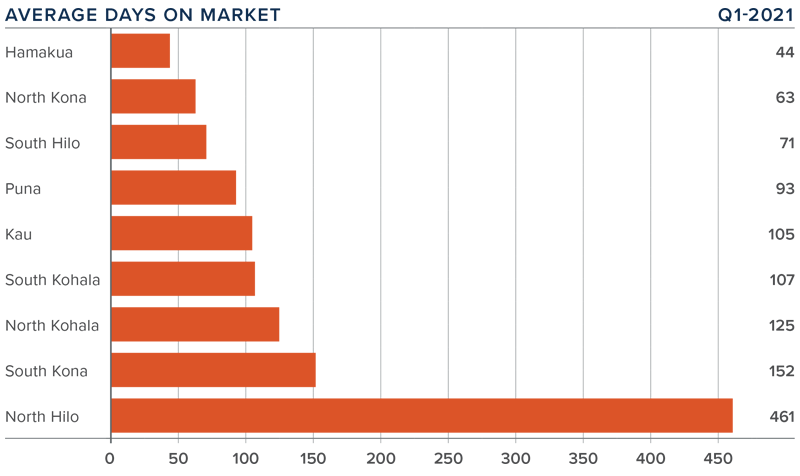
❱ The average time it took to sell a home on the Big Island rose 26 days compared to the first quarter of 2020.
❱ The amount of time it took to sell a home dropped in North Kohala, North Kona, Puna, South Hilo, Hamakua, and Kau, but rose in the other three markets.
❱ In the quarter, it took an average of 136 days to sell a home, with the fastest sales occurring in Hamakua and the slowest in North Hilo.
❱ It took 34 more days to sell a home in the first quarter of 2021 than in the prior quarter.
Conclusions

This speedometer reflects the state of the region’s real estate market using housing inventory, price gains, home sales, interest rates, and larger economic factors.
The Big Island housing market is unusual given rising sales and prices but longer days on market. As vaccines are more broadly distributed on the mainland—and in other countries that favor Hawaii real estate—I expect we will see more demand, which, in concert with persistently low levels of inventory, will favor home sellers.
The fundamentals of the market are solid, and even though mortgage rates have ticked higher, sellers continue to have the upper hand. Given these factors, I am moving the needle more in their favor.
About Matthew Gardner
As Chief Economist for Windermere Real Estate, Matthew Gardner is responsible for analyzing and interpreting economic data and its impact on the real estate market on both a local and national level. Matthew has over 30 years of professional experience both in the U.S. and U.K.
In addition to his day-to-day responsibilities, Matthew sits on the Washington State Governors Council of Economic Advisors; chairs the Board of Trustees at the Washington Center for Real Estate Research at the University of Washington; and is an Advisory Board Member at the Runstad Center for Real Estate Studies at the University of Washington where he also lectures in real estate economics.
Q4 2020 Big Island of Hawaii Real Estate Market Update

The following analysis of the Big Island real estate market is provided by Windermere Real Estate Chief Economist Matthew Gardner. We hope that this information may assist you with making better-informed real estate decisions. For further information about the housing market in your area, please don’t hesitate to contact your Windermere agent.
Regional Economic Overview
The impact of COVID-19 on the Big Island’s economy remains significant. That said, jobs started to return after the spike in new infections in September. The latest available employment data (November) showed that the labor market has recovered 14,650 of the jobs that were shed and that employment is now only 6,850 jobs lower than in February of 2020. The unemployment rate on the Island continues to improve but still stands at 9.8%. For perspective, the rate in November of 2019 was only 3.3%. All of the islands continue to suffer from slow economic growth, but I remain hopeful that jobs will continue to return—assuming new infection rates do not go up again.
big island of hawaii Home Sales
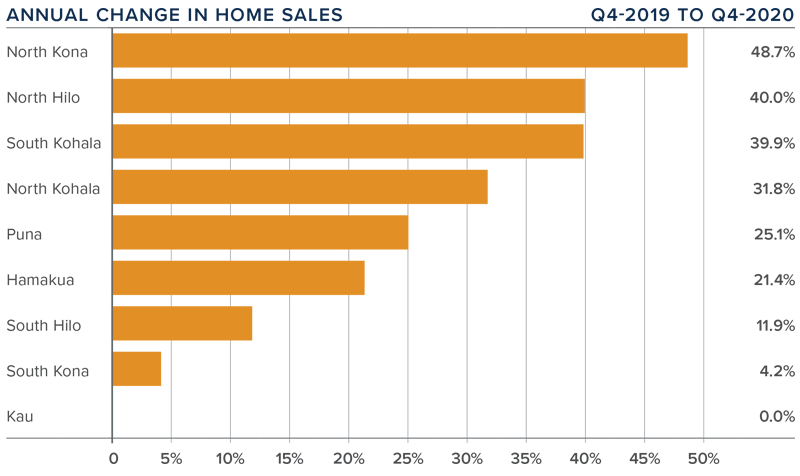
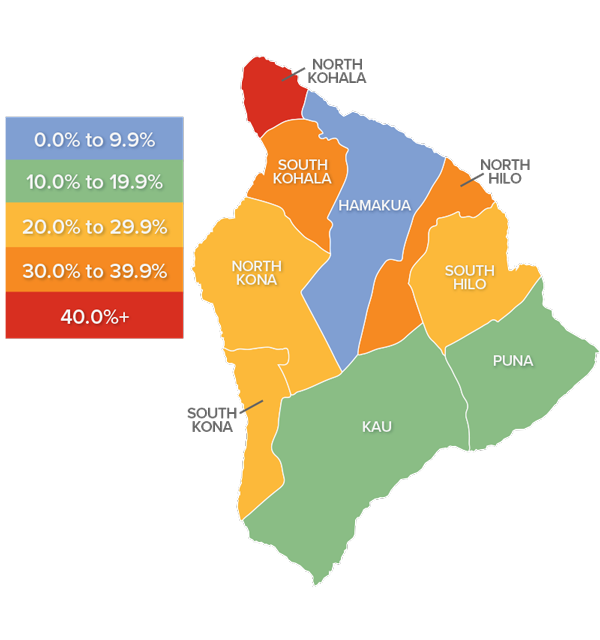
❱ In the fourth quarter of 2020, 1,083 homes sold on the Big Island. This was an increase of 30.5% compared to the final quarter of 2019 and a significant 21.7% higher than in the third quarter of 2020.
❱ Sales were static in Kau but higher in all other markets. North Kona and North Hilo saw significant increases in sales. All but two markets saw sales rise by double digits.
❱ The growth in sales came even though inventory levels were 33.5% lower year-over-year. The average number of homes for sale in the quarter was also down 14.4% from the third quarter of 2020.
❱ Pending home sales fell .9% compared to the third quarter of 2020, but this can most easily be attributed to a lack of supply of homes to buy—not a lack of demand.
big island of hawaii Home Prices
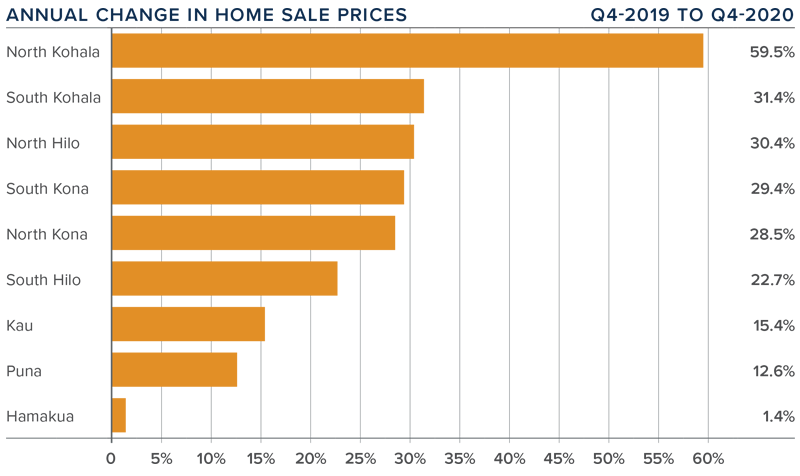
❱ The average home price on the Island rose an impressive 33.9% year-over-year to $775,902. Prices were also 23.2% higher than in the third quarter of 2020.
❱ Affordability continues to be an issue, but competitive mortgage rates and the desire for vacation homes kept demand from mainland buyers very robust.
❱ The substantial increase in average sale prices was driven by significant price growth in North and South Kohala, but all markets except Hamakua saw double-digit price growth compared to a year ago.
❱ Given the events of 2020, the housing market has recovered very admirably.
Days on Market
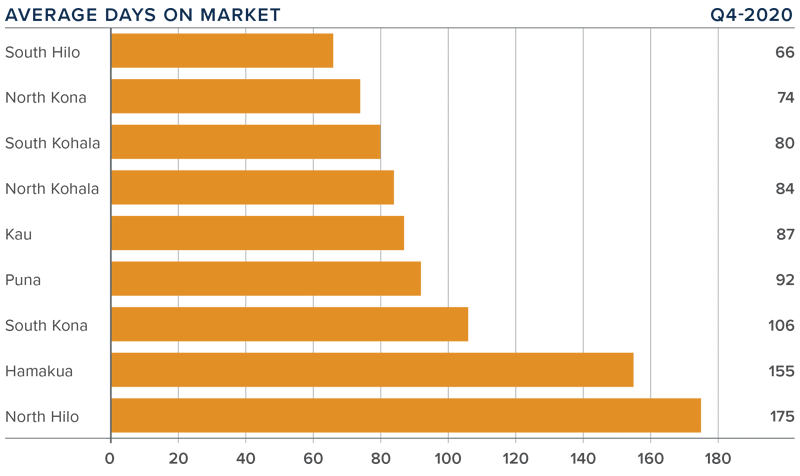
❱ The average time it took to sell a home on the Big Island dropped one day compared to the final quarter of 2019.
❱ The amount of time it took to sell a home dropped in North & South Kohala, North Kona, Kau, and South Hilo, but rose in the other four markets.
❱ It took an average of 102 days to sell a home in the fourth quarter, with the fastest sales occurring in South Hilo and the slowest in North Hilo.
❱ It took four fewer days to sell a home in the fourth quarter of 2020 than in the third.
Conclusions
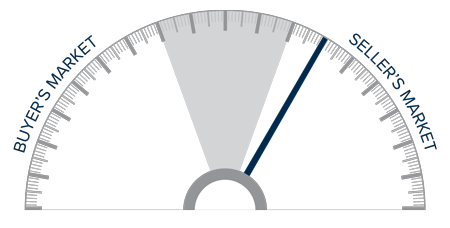
This speedometer reflects the state of the region’s real estate market using housing inventory, price gains, home sales, interest rates, and larger economic factors.
Even though the economy and job market are still suffering from the fallout of COVID-19, the housing market is recovering nicely.
Demand appears to be in place, but buyers who want to get into the market are still finding limited choices, which has allowed prices to continue to rise at very significant rates. Even though I anticipate mortgage rates will not drop much further, demand is likely to continue to be strong. Therefore, I am moving the needle back a bit more in favor of home sellers.
About Matthew Gardner
As Chief Economist for Windermere Real Estate, Matthew Gardner is responsible for analyzing and interpreting economic data and its impact on the real estate market on both a local and national level. Matthew has over 30 years of professional experience both in the U.S. and U.K.
In addition to his day-to-day responsibilities, Matthew sits on the Washington State Governors Council of Economic Advisors; chairs the Board of Trustees at the Washington Center for Real Estate Research at the University of Washington; and is an Advisory Board Member at the Runstad Center for Real Estate Studies at the University of Washington where he also lectures in real estate economics.
Big Island of Hawaii Real Estate Market Update

The following analysis of the Big Island real estate market is provided by Windermere Real Estate Chief Economist Matthew Gardner. We hope that this information may assist you with making better-informed real estate decisions. For further information about the housing market in your area, please don’t hesitate to contact your Windermere agent.
ECONOMIC OVERVIEW
COVID-19 continues to significantly impact employment on the Big Island, causing the loss of 13,000 jobs between February and September. That said, although it really is no consolation, employment has risen by 900 jobs from the low in May. The mandatory 14-day self-quarantine proclamation introduced by Governor Inge has been replaced with a pre-travel testing option. Hopefully, this will lead to increased tourism, which is the backbone of the Big Island’s economy. The unemployment rate on the island hit a high of 23.4% in April. It has dropped to the current rate of 13.6%, which is still quite high. I would also note that the rate would have been higher had the island not seen a significant reduction in the labor force. All of the Hawaiian Islands are suffering, but a bottom in employment has been reached. That said, it will be a long slog to get back to the employment levels of early spring.
HOME SALES
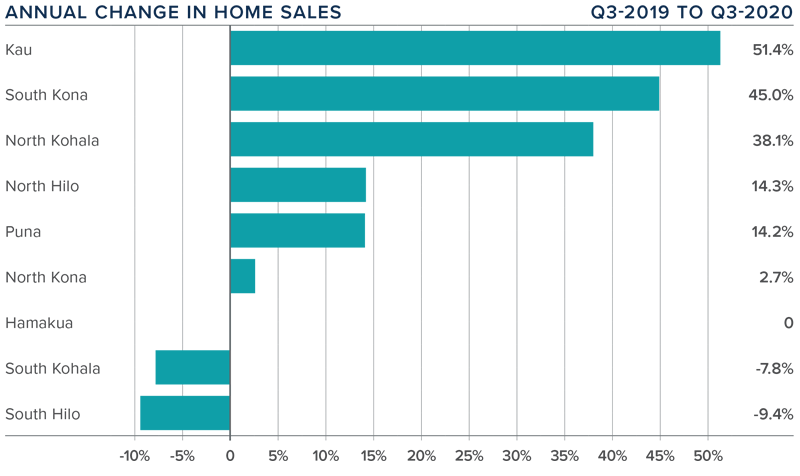
❱ In the third quarter of 2020, 890 homes sold on the Big Island, an increase of 6.7% compared to the third quarter of 2019, and a significant 52.9% higher than in the second quarter of 2020.
❱ Sales were higher in six markets, were static on one, and fell in two. Kau, South Kona, and North Kohala all saw significant increases in sales and the markets where sales were lower only experienced small losses on an absolute basis.
❱ The growth in sales came even as inventory levels dropped 24.2% from a year ago. The average number of homes for sale in the quarter was also down 15.7% from the second quarter of 2020.
❱ Pending home sales jumped 49.3% from the second quarter, suggesting that closed sales will be positive in the final quarter of the year.
HOME PRICES
❱ The average home price on the island rose an impressive 8.1% year over year to $629,751. Prices were also 8.8% higher than in the second quarter of 2020.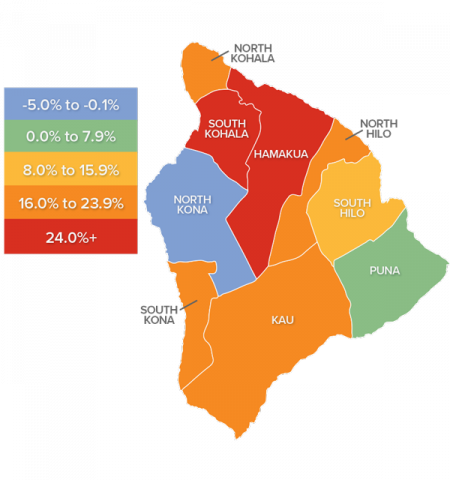
❱ Affordability remains an issue, but there appears to be demand from locals as well as mainlanders. Buyers have dipped their toes back into the market. This is likely due to very competitive mortgage rates, as well as people seeking out alternatives to traditional hotel or rental home vacations and choosing to buy instead.
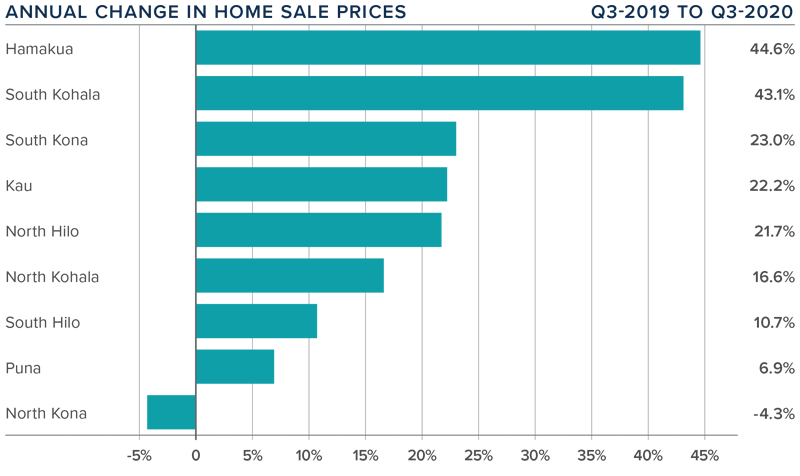
❱ Prices rose in every market other than North Kona. Appreciation was strongest in the Hamakua market area. In areas that saw market growth, all but one of them experienced double-digit increases.
❱ The market has improved, and I am hopeful this will continue with the easing of travel restrictions.
DAYS ON MARKET
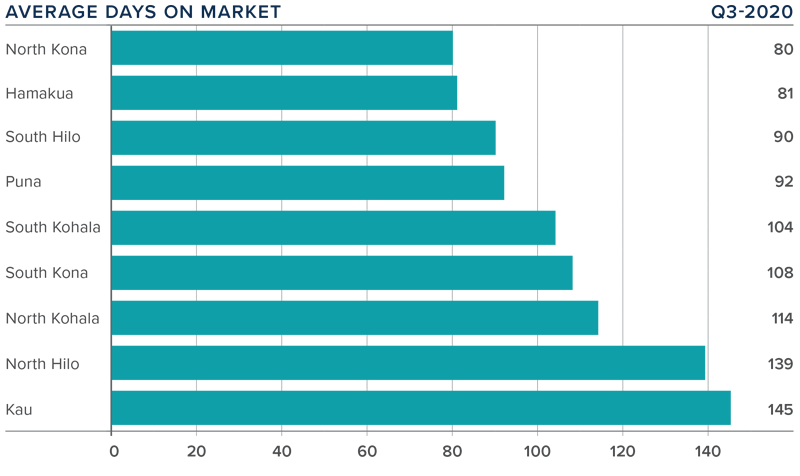
❱ The average time it took to sell a home on the Big Island dropped eight days compared to the third quarter of 2019.
❱ The amount of time it took to sell a home dropped in North Hilo, North Kohala, and Kau, but rose in all other markets.
❱ In the third quarter, it took an average of 106 days to sell a home. Homes sold fastest in North Kona and slowest in Kau.
❱ It took 14 fewer days to sell a home in the third quarter than in the second quarter of this year.
CONCLUSIONS
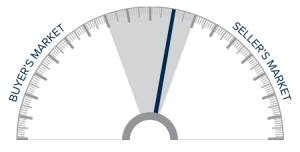 This speedometer reflects the state of the region’s real estate market using housing inventory, price gains, home sales, interest rates, and larger economic factors.
Unsurprisingly, the island is still impacted by the influence of COVID-19. Demand has improved and I remain hopeful that lowered travel restrictions will allow Island sales to continue to improve.
Increased demand and a low supply of homes for sale has allowed prices to rise at a very decent pace. As such, I am moving the needle back a little more in favor of home sellers.
ABOUT MATTHEW GARDNER
 As Chief Economist for Windermere Real Estate, Matthew Gardner is responsible for analyzing and interpreting economic data and its impact on the real estate market on both a local and national level. Matthew has over 30 years of professional experience both in the U.S. and U.K.
In addition to his day-to-day responsibilities, Matthew sits on the Washington State Governors Council of Economic Advisors; chairs the Board of Trustees at the Washington Center for Real Estate Research at the University of Washington; and is an Advisory Board Member at the Runstad Center for Real Estate Studies at the University of Washington where he also lectures in real estate economics.
Big Island of Hawaii Real Estate Market Update

The following analysis of the Big Island real estate market is provided by Windermere Real Estate Chief Economist Matthew Gardner. We hope that this information may assist you with making better-informed real estate decisions. For further information about the housing market in your area, please don’t hesitate to contact your Windermere agent.
Big Island of Hawaii Real Estate Market Update

The following analysis of the Big Island real estate market is provided by Windermere Real Estate Chief Economist Matthew Gardner. We hope that this information may assist you with making better-informed real estate decisions. For further information about the housing market in your area, please don’t hesitate to contact your Windermere agent.
Big Island of Hawaii Real Estate Market Update

The following analysis of the Big Island real estate market is provided by Windermere Real Estate Chief Economist Matthew Gardner. We hope that this information may assist you with making better-informed real estate decisions. For further information about the housing market in your area, please don’t hesitate to contact your Windermere agent.
Big Island of Hawaii Real Estate Market Update

The following analysis of the Big Island real estate market is provided by Windermere Real Estate Chief Economist Matthew Gardner. We hope that this information may assist you with making better-informed real estate decisions. For further information about the housing market in your area, please don’t hesitate to contact your Windermere agent.
Big Island of Hawaii Real Estate Market Update

The following analysis of the Big Island real estate market is provided by Windermere Real Estate Chief Economist Matthew Gardner. We hope that this information may assist you with making better-informed real estate decisions. For further information about the housing market in your area, please don’t hesitate to contact your Windermere agent.