Market News April 17, 2020

Western Washington Real Estate Market Update


The following analysis of the Western Washington real estate market is provided by Windermere Real Estate Chief Economist, Matthew Gardner. We hope that this information may assist you with making better-informed real estate decisions. For further information about the housing market in your area, please don’t hesitate to contact your Windermere agent.


A MESSAGE FROM MATTHEW GARDNER

Needless to say, any discussion about the U.S. economy, state economy, or housing markets in the first quarter of this year is almost meaningless given events surrounding the COVID-19 virus.

Although you will see below data regarding housing activity in the region, many markets came close to halting transactions in March and many remain in some level of paralysis. As such, drawing conclusions from the data is almost a futile effort. I would say, though, it is my belief that the national and state housing markets were in good shape before the virus hit and will be in good shape again, once we come out on the other side. In a similar fashion, I anticipate the national and regional economies will start to thaw, and that many of the jobs lost will return with relative speed. Of course, all of these statements are wholly dependent on the country seeing a peak in new infections in the relatively near future. I stand by my contention that the housing market will survive the current economic crisis and it is likely we will resume a more normalized pattern of home sales in the second half of the year.


HOME SALES

  • There were 13,378 home sales during the first quarter of 2020, a drop of only 0.2% from the same period in 2019, but 27% lower than in the final quarter of 2019.
  • The number of homes for sale was 32% lower than a year ago and was also 32% lower than in the fourth quarter of 2019.
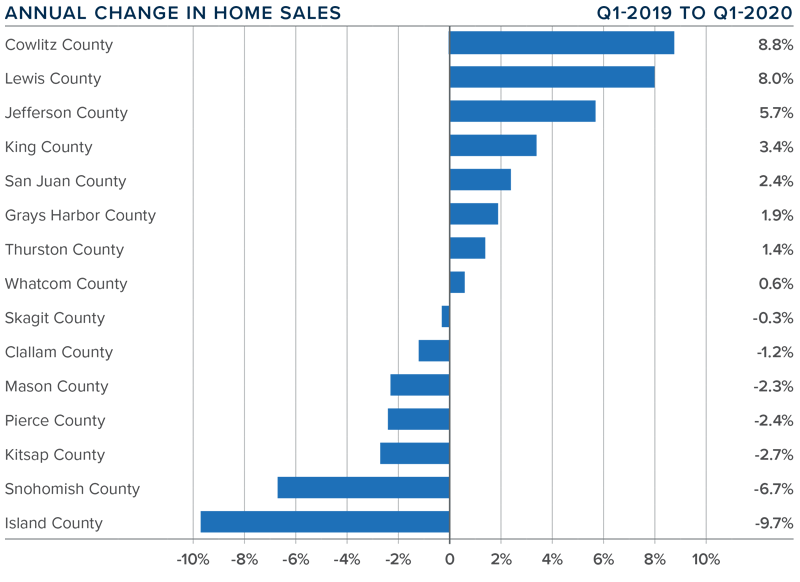
  • When compared to the first quarter of 2019 sales rose in eight counties and dropped in seven. The greatest growth was in Cowlitz and Lewis counties. The largest declines were in Island and Snohomish counties.
  • Pending sales — a good gauge of future closings — rose 0.7% compared to the final quarter of 2019. We can be assured that closed sales in the second quarter of this year will be lower due to COVID-19.


HOME PRICES
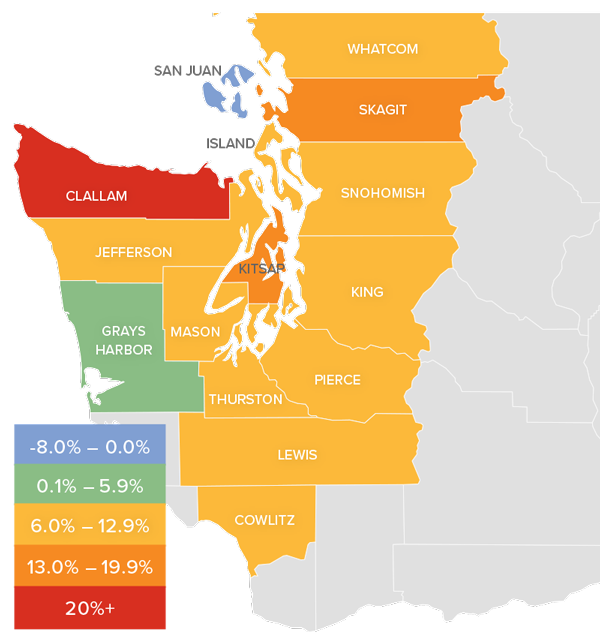
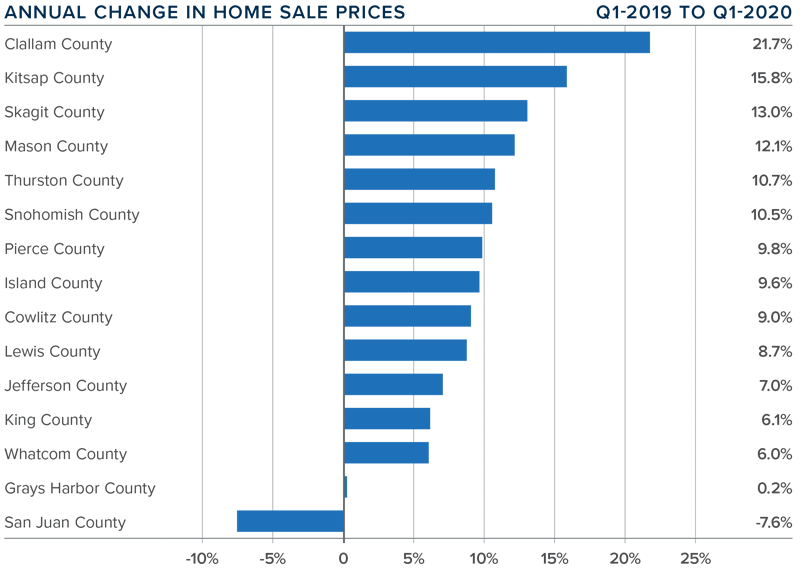
  • Home-price growth in Western Washington rose compared to a year ago, with average prices up 8.7%. The average sale price in Western Washington was $524,392, and prices were 0.4% higher than in the fourth quarter of 2019.
  • Home prices were higher in every county except San Juan, which is prone to significant swings in average sale prices because of its size.
  • When compared to the same period a year ago, price growth was strongest in Clallam County, where home prices were up 21.7%. Double-digit price increases were also seen in Kitsap, Skagit, Mason, Thurston, and Snohomish counties.
  • Affordability issues remain and, even given the current uncertain environment, I believe it is highly unlikely we will see any form of downward price pressures once the region reopens.


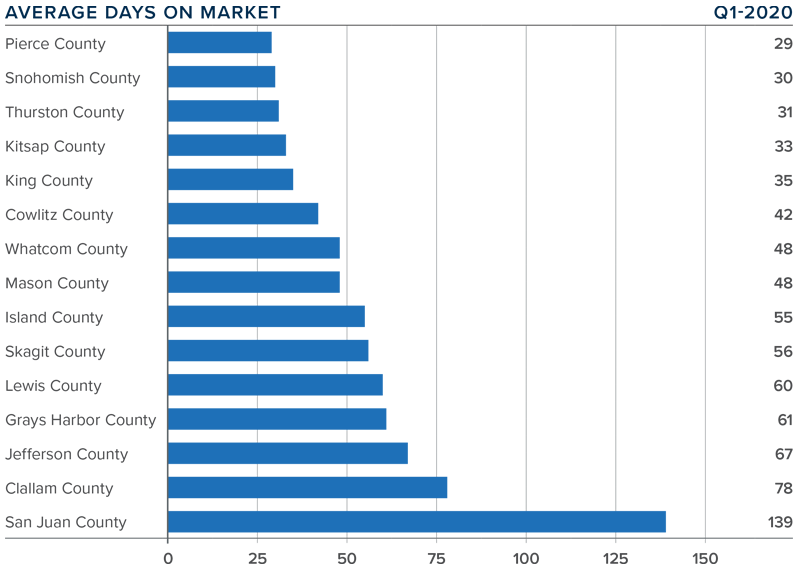
DAYS ON MARKET

  • The average number of days it took to sell a home in the first quarter of this year dropped seven days compared to the first quarter of 2019.
  • Pierce County was the tightest market in Western Washington, with homes taking an average of only 29 days to sell. All but two counties — San Juan and Clallam — saw the length of time it took to sell a home drop compared to the same period a year ago.
  • Across the entire region, it took an average of 54 days to sell a home in the first quarter of the year — up 8 days compared to the fourth quarter of 2019.
  • Market time remains below the long-term average across the region. This is likely to change, albeit temporarily, in the second quarter due to COVID-19.


CONCLUSIONS

This speedometer reflects the state of the region’s real estate market using housing inventory, price gains, home sales, interest rates, and larger economic factors.

Given the current economic environment, I have decided to freeze the needle in place until we see a restart in the economy. Once we have resumed “normal” economic activity, there will be a period of adjustment with regard to housing. Therefore, it is appropriate to wait until later in the year to offer my opinions about any quantitative impact the pandemic will have on the housing market.


ABOUT MATTHEW GARDNER

As Chief Economist for Windermere Real Estate, Matthew Gardner is responsible for analyzing and interpreting economic data and its impact on the real estate market on both a local and national level. Matthew has over 30 years of professional experience both in the U.S. and U.K.

In addition to his day-to-day responsibilities, Matthew sits on the Washington State Governors Council of Economic Advisors; chairs the Board of Trustees at the Washington Center for Real Estate Research at the University of Washington; and is an Advisory Board Member at the Runstad Center for Real Estate Studies at the University of Washington where he also lectures in real estate economics.


Buying April 15, 2020

Saving to Buy A Home During COVID-19

Image Source: Canva


The COVID-19 pandemic is changing the way people plan for their future. For those saving to buy a home, the landscape may seem daunting. However, this new world of social distancing and stay at home orders is an opportunity to rethink your spending and saving plans. Keeping the following suggestions for your budget and finances in mind can help make your dream of buying a home a reality.


Rethink your budget:

If there have been changes to your income amid COVID-19, adapting your budget is a logical and necessary step. If your income has gone unchanged, certain tweaks to your budget can yield significant savings. Knowing the leisure portion of your normal expenditure has been removed for the time being is a great starting point for reassessing your spending.


  • Begin with your income and assets
  • Determine your household’s new baseline and arrange your new budget accordingly
  • Divide your budget expenses out into Fixed and Variable 
  • Adjust for changes in essential costs—Housing, Utilities, Insurance, Food
  • Put into savings what normally would have been your leisure spending money


As the stay-at-home lifestyle continues, take a look at your unnecessary costs for such things as memberships, subscriptions, and online shopping. Reach out to the subscription organizations and see if they are offering any options to delay your membership until a later date.


  • Categorize all active memberships as Cancel, Adjust, or Keep
  • For live entertainment, research how far out the venues have postponed shows
  • Adjust your online shopping needs for your current lifestyle
  • Reassess the must-haves of your new stay-at-home daily life


Review your finances:

If you’re planning on buying a home in the near future, you are likely already on your financial planning journey. With added uncertainty around COVID-19’s effective timeline, the more information you can gather, the better. In these unprecedented times, flexible solutions are being provided to customers. Exploring what options your banks and issuers are offering will keep you informed and prepared while keeping your finances in order.


Contact your credit card issuer to see if they are offering any of the following options to customers:

  • Payment deferral or forbearance
  • Flexible fee policies
  • Lowering your monthly payment or interest rate temporarily
  • Forgiveness or relief from late fees


Following the steps outlined above can go a long way towards helping you save for a home. As your finances are impacted by the COVID-19 pandemic, take time to adjust accordingly. Continuing to gather information and developing a strategy will help you steer your eventual home purchase in the right direction through these uncertain times.


If you'd like to talk with an agent about your home buying options, we are ready to connect you to a pro here. 

Market News April 13, 2020

Matthew Gardner Weekly COVID-19 Housing & Economic Update: 4/13/20

Living April 8, 2020

Your Guide to Spring Cleaning


Image Source: Canva


Many of us have found ourselves spending much of our time indoors as of late, and as spring blooms in the sunlight, you might be noticing that it’s time to treat your home to a little TLC. When it comes to wellness, your health and the health of your home go hand in hand. Here are some tips to guide you through your spring cleaning this year.  


First clean, then disinfect​

​​​​​​​General cleaning rids your home’s surfaces of contaminants, but disinfecting targets pathogens. A combination of the two before—as well as after—your spring cleaning will have your home in peak health. When disinfecting, target high-touch surfaces such as doorknobs, countertops, and faucets. 


Devices like your computer, phone and tablets are worthy of disinfecting as well, since they are high-touch surfaces that we carry around constantly. Avoid cleaners heavy in toxins and chemicals, which spread throughout your home. Look for plant- and mineral-based ingredients and natural solvents.  


  • Work top-to-bottom
    • ​​Working from ceiling to walls to counters to floors guides dust and debris downwards and prevents any re-cleaning of the same areas.   


  • Ceiling 
    • Being the season when allergies kick up, a quality dusting can be even more important for your health. Curtains, blinds, carpets and ceiling fans all collect dust easily; being thorough in these areas will pay off in the long run. Don’t forget the corners where cobwebs collect. 


  • Walls & Windows
    • Consider giving your walls a cleanse with a damp towel, especially in the kitchen near your oven and coffee maker. Cleaning your windows helps bring in more natural light and is the key to getting the most out of your home’s view. 


  • Floors 
    • All floors need a good cleanse, but different materials require different cleaning methods. With laminate and vinyl flooring, dry mopping will do the trick. Sealed wood floors can take mopping, but waxed floors can’t—they require sweeping or vacuuming instead.


Declutter

Decluttering can be a daunting task. But with more time at home, we have more time to conquer this task day by day. Divide the rooms up by how much time they will take to declutter. Rooms like the kitchen and playroom will likely take longer than the living room or bathroom.   


  • Separate the unnecessary or underused items into two categories: Donate and Storage. Gather your donated items—whether they’re going to thrift stores, local shelters, or charity—so they can be distributed out in one trip. 


  • When it comes to storage, consider which items are likely to be taken out more often, like tools or seasonal items. Put them away last so they are easy to access. Hopefully this exercise, done year after year, will cut your storage stockpile down to what is essential. 


Go for multipurpose

  • Minimalism is a space-saving movement that has picked up momentum in recent years. Even if you aren’t looking to downsize, incorporating multifunctionality into your home can bring an added dimension to your spring cleaning.


  • ​Common multipurpose features include lofted beds with below storage, using a corner desk to create an office nook, and folding tables to transform a dining room to a dinner party with ease.
Market News April 6, 2020

Matthew Gardner Weekly COVID-19 Housing & Economic Update: 4/6/2020

More April 2, 2020

Staying Connected Through COVID-19. All In, For You.

More April 1, 2020

All In, For Community Amid COVID-19

Image Source: Shutterstock


Over the past few weeks, as the effects of COVID-19 have spread to everywhere Windermere has offices, we have seen an outpouring of support from our agents and offices in their local communities, embodying what it means to be All In, For You. 


The Bellevue, WA-based Windermere Real Estate East Inc. offices have been all in for their community in recent weeks by organizing “Feed the Front Lines.” This effort has raised upwards of $9,000, with many members volunteering their time to help pick-up and deliver much-needed meals to the medical professionals at a local hospital. So far, they have scheduled six shifts of lunch and dinner deliveries, totaling 415 meals. They have reached out further into the community, collecting donations for local small businesses that have been forced to close.


A flyer for “Feed the Front Lines”


Windermere agent Chris Gaines—based in Boise, Idaho with the Windermere Powerhouse Group—was inspired to deliver food and other necessities to the elderly in his neighborhood. Chris and his family spent the day visiting local grocery stores and gathering supplies to make care packages. After divvying everything up, they safely delivered the care packages to neighbors, who were sincerely grateful. “It was clear by the excitement of some of them that we were the first to have visited since all of this began,” said Chris of his neighbors.


Chris’s daughters delivering supplies to a neighbor


In other cities where Windermere operates, such as Palm Springs, agents are volunteering to buy and deliver groceries for the local elderly population who are currently unable to leave home due to the threat of COVID-19.


On Maui, the local Windermere office is routing Windermere Foundation donations to a local food bank. On top of that, they will provide that same food bank with a donation from each closed home sale over the next 60 days. Agents on Maui are also volunteering to prepare grab-and-go breakfast and lunch meals for kids at the Kihei Charter School.


The team in Maui, HI


In Nevada, the mother-son team of Reba St. Clair & Devone Donley are providing delivery services free of charge to their neighbors throughout the Lake Las Vegas area. They are picking up prescriptions and performing food deliveries, making themselves a dependable resource to their community.


Reba & Devone’s community flyer


The Seattle-area offices that make up Windermere Wall Street recently donated $2,000 to Refugee Artisan Initiative (RAI) to aid in the supply of personal protective equipment (PPE), such as surgical masks. RAI’s mission is to transform the lives of refugee and immigrant women by providing sustainable work in sewing and handcrafting goods.


As our agents and offices have proven time and time again, together we can make a difference. We will continue to share these uplifting stories of support for our communities through the COVID-19 pandemic.


All In, For Community. All In, For You.

Market News March 30, 2020

Matthew Gardner Weekly COVID-19 Housing & Economic Update: 3/30/2020

More March 26, 2020

What Does It Mean to Be All In?

What does it mean to be “All in”?

At Windermere, it means our agents love what they do, acting beyond themselves, and being there when it counts. During these uncertain times, we want you to know that our agents are more focused than ever on taking care of their clients and helping them move their dreams forward.


Market News March 23, 2020

Matthew Gardner Weekly COVID-19 Housing & Economic Update: 3/23/2020