Market News December 22, 2010

Thoughts for 2011

As we approach the end of 2010, I like to pause and reflect on the events of the year relative to both the economy as a whole, and the real estate markets in particular.

Of course, the year is not quite over but, as this will be my last post in 2010 I thought it would be good to look back at the year that is rapidly disappearing in the rear view mirror, and also to ponder what 2011 may bring.

The U.S. economy has a very big influence on a great number of things; from jobs, housing, savings and general sense of well being. .  There is no question the last few years have been tough on many people. The economy has been improving over the past few months, and we should see continued improvement over the next year.    If you are considering selling your home or making a purchase, you may find the following economic indicators  helpful to your planning.

  1. GDP – The Gross Domestic Product represents the value of goods and services that are created inside the U.S.  The third quarter of this year saw our economy expand by 2.5 percent annually – below the 3 percent that is indicative of solid expansion. I anticipate that, firstly, we will not drop back into recession in 2011, but that growth will remain under par for the first half of the year.  However, the quantitative easing that is currently underway will start to have an effect in the second half of the year, and we will likely end 2011 at an expansion rate of 2.8 percent. The GDP is an indicator of standard of living.  As this increases, people will generally have more money to spend and enhanced peace of mind.
  2. Employment – From peak employment of 137.9 million in December 2007, to a trough of 129.6 million two years later, this country lost 8.4 million non agricultural jobs.  Since that time, we have recovered somewhat but are still shy by 7.4 million positions.  Unemployment remains stubbornly high (9.8 percent in November) and finding work is far from easy.  I believe that next year will see the overall unemployment rate drop, but the improvement will be slow; if we end the year at around 8.5 percent I will be happy.  Businesses are still wary of hiring until they see tangible signs of improvement and, even when they do, I don’t anticipate they will head off on a big hiring spree.  Layoffs will continue to decline and virtually peter out by the end of 2011.    As unemployment rates slowly drop, homeowners will be more solvent, easing fears of foreclosure and increasing confidence in the market place.
  3. Real Estate – The real estate market has certainly showed that not all markets are created equal.  Modeling price changes across the country is no easy task – forecasting the effects of loan modifications alone throws calculations into a tailspin – but I expect that the hardest hit markets (Phoenix, Las Vegas, etc. have likely bottomed.  Other markets (such as Houston) have some way to go yet.  I am looking for an additional 5 percent decline across the U.S. before I will call a bottom for home prices. We will likely see this by the third quarter of 2011.
  4. Consumer Confidence – There has been a marked improvement in consumer confidence in recent months.  A better 2011 is clearly showing up in the numbers. With a better outlook on the horizon and incremental improvements all around, we are all starting to feel better about the recovery and we will see this reflected in the market place.
  5. Inflation – There are two things that are required to be in place for inflation to take foot– wage growth and a stable employment situation– and we have neither.  I am not concerned at all over inflation in the short-term and believe that core inflation will stay below 1 percent in 2011.  With inflation and interest rates closely tied, minimal inflation will be beneficial to home buyers and will keep the cost of home improvements from becoming prohibitive.  That said, it is likely that the Fed’s asset purchase program will expire in June.
  6. Interest Rates – This has been a bit of a touchy subject in recent weeks as rates have been rising despite the Federal Reserve’s decision to continue to buy treasuries – which should have allowed rates to remain very low.  Why is this?  Believe it or not, it’s because investors are seeing too many positive signs in the economy and are leaving the relative safety of treasuries for the greater yields found in the equity markets. I think that we will see some stability in rates early in the year and that they will not head drastically higher.  That being said, rates will trend higher in 2011.  This will play into the housing markets for the obvious reasons.

So there we have it!  I believe that the light at the end of the tunnel is, in fact, the end of the tunnel and not a train heading my direction!  Economic recoveries, and certainly recoveries in real estate, are not all created equal and our current situation is certainly not as dire as it has been, but neither are we out of the woods yet.  I am, as ever, hopeful that the U.S. will show resilience and that better days are, indeed, ahead.

What are your reflections on 2010? What are you most looking forward to in 2011?

Best wishes for the holidays and here’s looking forward to a healthy and happy 2011!

By Matthew Gardner

More December 21, 2010

There are secret Santas amongst us…

I recently read this great story about the Kansas City Secret Santa. Every year for twenty-six years, an anonymous man dressed in red or a Santa disguise would hand out $100 bills to people in need of help. His identity was disclosed in 2006, shortly before he died of cancer. People all over the world, inspired by his story, are now are carrying on the tradition of benevolent Santa. This story made me think about the amazing stories we hear every day at the Windermere Foundation.

We hear stories of families in tremendous need, stories of people’s willingness to give, and the joy and surprise of receiving support when other doors have closed. We hear stories that are heart-wrenching, awe-inspiring, hopeful and chill-inducing. There are Secret Santas amongst us; we have seen a few at work.  We are indebted and inspired by the people we work with and their great capacity for giving. We feel pretty lucky to do what we do, and we’re grateful for all the Windermere agents that make the Foundation possible.

Families in need come to the Foundation through various means. Some families are referred to us directly through social service agencies; some receive support through organizations with which our offices partner as a part of their commitment to community; and sometimes we hear about a family going through so much and we reach out ourselves. The particular story I want to share with you must have been kismet.

Christine Wood, our Foundation director, received an email from a friend last week — a forward from a local teacher she knew who was the kindergarten instructor to the younger of two sisters. The teacher had become concerned about her young student missing so much school, and upon inquiry she found out the older of the two sisters has been going through a grueling four rounds of chemotherapy over the last seven months.

Their mother, who generally cleans houses to support her two young daughters, has lost her steady job in order to ensure her oldest daughter can make it through treatments at Children’s Hospital. She is a single mother and has few resources to support her daughters, and as a result of their circumstances they are homeless.

They have tried every route of support, but have slipped through the cracks of various social services — likely due to the increased need of services as well as reduced resources. The family has moved several times and has had temporary housing with friends and Ronald McDonald House; but they are primarily living out of their car. Due to this instability, the youngest daughter has had to move schools three times.

In October the older sister, Lizeth, was featured on a KOMO news special when her Grandmother fulfilled her wish by coming to visit from Mexico. Lizeth has a very rare form of Leukemia. She received a bone marrow transplant this week, increasing her chance of survival; however the prognosis is still not great.

This family’s need for support is large. The immediate needs have been a working car and money for rent and basic needs. Early this week, we contacted one of our own secret Santas, who has consistently opened their heart to Foundation causes and provided when we couldn’t.  As luck would have it, they recently acquired a new car and were preparing to sell their lightly used car THAT DAY.  Within two days, we were able to deliver a new car to this wonderful family in need.

This was a tremendous and inspiring gift from one of our own agents, and one outside the scope of what most of us can give. But support at any level can make a tremendous difference for needy families, and we are truly grateful to all of the secret Santas who have reached out to help. If you too are interested in helping this family, donations can be made at Key Bank under the Lizeth Gonzalez Fund or through the Windermere Foundation (please indicate that you would like your donation designated for the Lizeth Gonzalez fund). Our goal is to ensure this family has the financial support they need, as well as some holiday cheer.

Of course, this is just one of many heart-wrenching stories of need, and just a few of the countless ways in which help is given throughout the year. For example, many Windermere offices participate in an annual adopt-a-family program, purchasing gifts, groceries, basic-need items and more for families going through hard times. We are grateful for all the generous support our offices, agents and neighbors provide for our communities.

Stories like these truly give us a sense of hope. Particularly this time of year, we are inspired by the secret Santas amongst us.

Thank you for your support of the Windermere Foundation! Have a wonderful Holiday and a Happy New Year.

More December 20, 2010

December Perspective: Looking ahead

In December of 1900, The Ladies Home Journal published an article titled “What May Happen in the Next Hundred Years.”  It is fascinating.  The author, John Elfreth Watkins, interviewed the “wisest and most careful men in our greatest institutions” and arrived at 29 predictions they felt would happen by 2001.

One of their predictions was titled “Man Will See Around the World.” It read, in part:
“Persons and things of all kinds will be brought within focus of cameras connected electrically with screens at opposite ends of circuits, thousands of miles at a span.”

To me that sounds like the Internet.

It is December again, and beyond all of the holiday festivities it is also prediction season.  It’s that time of year when prognosticators everywhere wax eloquent on what might happen next year and beyond.  Looking back, history is full of predictions from silly to bizarre, and from incredibly wrong to amazingly correct.

Of course, the economy is continually predicted to implode, explode, crash and skyrocket — sometimes in the same year.  In early 1929, a Yale economics professor said, “Stocks have reached a permanently high plateau.” Oops.

Then there was William Thomsen, who was the Royal Society President in the late 1890s. He hit the prediction trifecta: “Radio has no future.” “X-Rays are clearly a hoax.” “The aeroplane is scientifically impossible.”

So history has proven that it’s a tricky business to predict anything. Yet much has been written this year about the housing industry and its demise. As someone who works in this industry, I do not believe the naysayers.  In fact, I have history on my side.

As this year winds down and we look ahead, I think about the famous Kierkagaard quote:  “Life must be understood backwards; but… it must be lived forward.”  Predictions will always be just that. But if you study history, you can usually find data that will help you understand the future.

After all, history does repeat itself.

Living December 14, 2010

Getting Through the Holidaze

Perhaps it is just me, but I don’t remember the distance between Halloween and mid-December ever being so short. I am shocked Chanukah has come and gone and Christmas is nearly here. Consensus seems to be that the year has flown past.  In an effort to enjoy the holidays, spend quality time with friends and family and stay ahead of the stress, we have compiled a list (with the help of some great resources) of some good ways to “keep calm and carry on” through the New Year.

Plan ahead: I just said the holidays are already upon us, and now I recommend planning ahead? Typically I start much earlier, but two weeks IS ahead this year. The same principles apply for two months vs. two weeks, it just means you have to be more efficient to get it all done (and go shopping in stores rather than online).

Now that we are past the denial stage, it is the time to make lists. Figure out the most important things that you must do in order to survive the holidays (top gifts, top traditions, the most urgent items– including parties and house guests). If you must compartmentalize, have multiple lists: one for groceries, one for gifts, one for household chores, etc. Prioritize your lists; if it isn’t on the top of the list, it is an incidental, meaning you will not be crushed if it doesn’t turn out exactly like you planned.

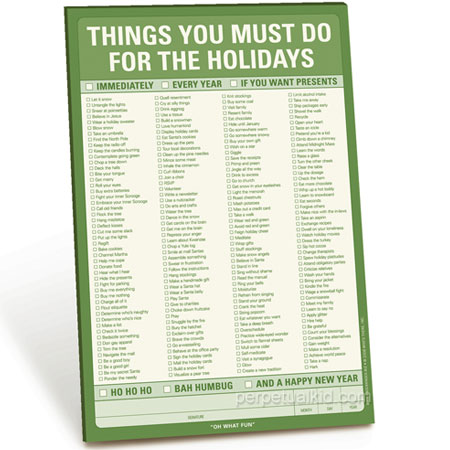
The more you plan ahead and pre-prepare, the easier everything will be in the moment (at least that is my philosophy).holiday to do list Go shopping ahead, wrap presents early as you get them (label the package so you don’t forget what is for whom), prepare spaces for houseguests, and purchase non-perishable essentials in advance. When it comes to holiday meal preparation, prep what you can ahead of time, make and freeze when possible, cut vegetables and store in bags, and commission help from hostages/willing houseguests. If you have some tough-to-entertain members of your tribe, have activities ready. The boy scouts have a great motto for this: be prepared.

Create a space for yourself: The holidays are stressful, with outsized expectations, financial concerns, and close proximity to people you love, admire and at times loathe. Making space for yourself can help decrease your stress. If you are home-bound for the holiday, create a room of your own. In our house we each have our own space to which we can retreat, and over the holidays that’s where we hide and wrap our gifts, make a mess, close the door and listen to music, or whatever else we need to prepare for and escape from the holiday. Having a solitary space to read a book or take a nap undisturbed is sanctuary in the midst of madness. Our spaces will be upended once family arrives for the four-day weekend celebration, but it is still important to create a space to get away–even if it means retreating to your bedroom or taking a walk.

Be prepared for surprises: Sometimes the best laid plans… go awry. What if someone shows up unexpectedly with a gift in hand? What if the power goes out on your Christmas dinner? What if, what if, what if… Something is bound to go differently than you expect it.

If you aren’t born with a laissez-faire attitude, have a backup. And hopefully you are less stressed because you planned ahead. Keep some extra gifts wrapped and accessible for unexpected visitors or last-minute hostess gifts, such as bottles of wine in a gift bag, candles, or other universal gifts. If you are worried about storms, have supplies ready and a plan in mind. Make sure you are stocked with easy-to-snack food (also helpful for last-minute guests, cook-free meals for power outages), fill your propane tank for a BBQ meal (don’t use indoors) or keep a list of local restaurants open for Christmas dinner. Have games on hand that don’t require electricity or internet (our family favorites are Apples to Apples, Texas Hold ‘em & Scrabble).

Just think of the worst that could happen and prepare for it. The worst likely will not happen, but just being prepared can decrease stress. And if something less than the worst happens you can rest assured, because you are ready for it. If worst than the worst case scenario happens, think about what a great story it will be in the years to come…

Keep it clean: Whether you are hosting a party or housing guests for the holidays, clutter is distracting and unnecessary. Schedule time to do a deep clean on your home prior to guests arriving, weeks in advance if need be. Go through junk mail, newspapers, magazines, cabinets and clutter-prone sections of the house, throw the garbage out and put the stuff where it belongs. If you need a catch-all bin for easy removal (or easy stashing in a closet), it’s time to figure out the solutions. Here are some great tips for daily de-cluttering.

Go through your closets and thin out the coats and blankets. Consider giving gently worn items to local charities such as Coats for Kids or, if you live in Southern Washington or Western Oregon, contact your local Windermere office for drop off information.  Toss out what you don’t need now to avoid post-holiday overload.

Get into the spirit: Congratulate yourself on a job well done and enjoy the holiday season! Studies show that holiday traditions actually relieve stress, so if you don’t have one you particularly enjoy start your own! If you have children, include them in the process, whether it is planning a day-long activity, making a new cookie recipe, creating decorative crafts, or having a movie marathon. There is no point to all the running around, spending money and cleaning house unless you actually get to enjoy yourself. So grab some eggnog and relax.

nationallampoonxmas

If all else fails let go: I always have higher expectations for what I can accomplish, the people I will get to see, and the memories I will create, and it can be disappointing when I don’t meet my goals. Sometimes Christmas Cards turn into New Year cards (or Valentine cards in the worst years). Unless the Grinch makes an appearance or your family vacation turns toward the National Lampoon variety, count your blessings or start a new tradition and book a trip to Hawaii for next year!

Tell us what makes your holiday special. What are your tips for a stress-reduced holiday? Best traditions past and present? Favorite recipes, games, craft projects?

More December 10, 2010

What You Need To Know About Buying a Bank Owned Home

Recently, news about how to purchase a real-estate owned (REO/bank owned) home, foreclosure property or short sale is everywhere. Bank owned homes are sold directly from the lender after the foreclosure process is complete, and while you may save quite a bit of money by choosing to go for this type of home, it is not without trials and tribulations. The process of purchasing a home directly from a lender can be long and arduous, but could very well be worth it in the end.
If you have your sights on a particular home or are looking to find a deal on your first, working directly with the lender may be your only option. Purchasing a bank owned home is not for the faint of heart, here are some tips for negotiating the REO process:

1. Be prepared: The condition of bank owned properties is usually poor and hard to show. Past owners may have left angry and left the home in bad condition with foul smells, missing appliances, wires taken from breakers, gas fireplaces gone, even bathrooms without toilets and sinks.

2. Understand the costs: Maintenance or repairs may be necessary, since these homes have been vacant for an unknown period of time–sometimes months or years. Keep in mind, when they were occupied the owners could have been under a financial hardship, preventing them from doing regular seasonal care or repairs when needed. Remember as well that the bank is trying to sell the house immediately, so you will receive a financial break in the price rather than a willingness to negotiate on the maintenance and repair issues.

3. Accept the unknown: In traditional real estate transactions, homeowners fill out Form 17 regarding important information about the history of the house. A bank owned home is either exempt or marked with “I don’t know” throughout the document. Not having the accuracy of this 5 page disclosure form could leave you with a lot of unanswered questions on the history of the home.

4. Know what is non-negotiable: The pricing on the house may not get much lower. Some of these properties can be "a dream come true" if you get them at an amazing price, or they could be your worst nightmare. Do your due diligence researching any property, and conduct all necessary inspections to safeguard yourself. Some major repairs may be negotiable, but will likely not reduce the home price.

5. Make a clean offer: The higher the price you can offer, the better. Include your earnest money, keep contingencies to a minimum, and suggest a reasonable closing date. The simpler your offer is, the higher chance you have of the bank accepting your offer or countering in a reasonable time period.

6. Be patient: Consult with a professional who handles bank owned home purchases to help you negotiate the pathway to homeownership. The process of purchasing a bank owned, foreclosed or short-sale home is typically longer than a typical real estate sale.

What do you want to know about purchasing bank owned, foreclosure and short-sale properties?

Buying December 7, 2010

Does the Home of Your Dreams Really Exist?

Agent: “So, what kind of a house are you looking for?”


Client: “Anything with 3 bedrooms and a couple baths. Oh, and a big yard would be cool, too.”


Agent: “I know of several that we can show you.”


Client: “Just pick three that you think I’ll like, and I’ll buy one of them.”


If only it were that easy. When you ask yourself to visualize the home of your dreams, what comes to mind? Certainly not a nondescript 3 bedroom, two bath home. It’s much more likely that your vision could include features like maple flooring, granite countertops, 6-panel doors, built-in speakers, or access to 220-electricity in the garage for a workshop. Everyone has their own custom needs and desires.

You’re allowed to be picky. Realistic is imperative, but picky is fine, too. If you’re holding out for diamond insets in the shower tile grout or solid gold door knobs, I’m afraid disappoint awaits you. Think about the most important things a home will represent to you. Do you work from home? Do you entertain large groups regularly? Do you enjoy yard work or do-it-yourself projects? Each family has their own needs, so your definition of the perfect home will be very different from even your closest friends or family members.

Not only does each family have their own needs, but each family member might have their own needs. Pets come into the picture, too. Is high-enough speed internet readily available? Is there a wall that will fit your 60” High-Def 3D TV? Will the family room have enough space that you can compete at Wii™ or Kinect™ without breaking lamps? Will the huge trees that are cooling in summer make the home darker than you like in the winter? Can you bike or run the neighborhood streets? Are you concerned about how your energy consumption will affect the environment? You’re encouraged to list all the things that are important to you.

Once you’ve made your list, prioritize it according to what is important. Figure out what’s a must-have and what would be nice, but not necessary. It might take looking at a few homes to figure out what you want versus what you need. You may love the idea of having Spanish copper sinks throughout the house, but if there were no houses on the market that had them, would you resign yourself to renting indefinitely? On the other hand, you may be working from home and need fantastic data transmission capability. You probably wouldn’t want to look in a rural area that still uses dial up, but promises to have high speed internet cables in the future.

Your agent will learn from your prioritized list, and they should be able to help you find that perfect house. Be brutally honest with yourself, think 10 years into the future, and share your desires freely with those that can help you. You may not find the house that’s 100% of what you wanted, but something very close to the home of your dreams is probably out there.

What are the “deal killers”? What are the most important features on your list?

EricJohnsonHeadShotBy Eric Johnson, Director of Education

Johnson has several years experience as a real estate agent and real estate instructor, as well as experience in construction project management, digital media/publishing and insurance. He has a bachelor’s degree in anthropology from University of Colorado.

More November 24, 2010

Inspired Gratitude

Tomorrow is Thanksgiving and it is a great time to spend with friends, family, pets, or volunteering. Everyone has different traditions over the holidays, shaped by beliefs, family, location and other factors, but gratitude and thankfulness typically run through the season. Now is also the time to be inspired by what you are thankful for: a nice place to live, food on the table, time with loved ones and more.

Here at Windermere we are grateful for the people we collaborate with every day; we are very fortunate to work with great people, homeowners, buyers, and a highly diverse group of agents.  We are equally happy to have had the chance to help people sell their homes to move to the next stage of their lives or help others purchase their first or upgraded home.  We are optimistic about the upcoming year.

We are also so fortunate to have the Windermere Foundation- supported by every transaction. Windermere offices were able to support hundreds low-income families across every region we work to keep their lights on, have food on their table and warm coats on their backs. We are thankful for the vibrant communities in which we work and live. Thank you!

Thanksgiving also marks the beginning of the holiday season. What are your holiday traditions? What are you thankful for?

More November 19, 2010

Upcoming office events for charity and Foundation fundraising

The holidays are a busy time of year for most charities supporting low-income and homeless families. If you are looking to find some good ways to give back, join our Windermere offices by adopting a family in need, attending one of these great fundraisers, or dropping off food or warm coats and blankets at a participating office.

Join the Windermere, Cronin & Caplan Group in Portland November 18th through 20th for food, libations and holiday shopping. The Windermere offices will be hosting ten local artists and a percentage of all sales will go to the Windermere Foundation.

Thursday November 18th 12:00 pm – 7:00 pm

Friday November 19th 10:00 am – 7:00 pm

Saturday November 20th 10:00 am – 4:00 pm

733 NW 20th Ave Portland, OR 97209

Corner of NW 20th Ave/Johnson

For Info Call 503-220-1144

Bring your old appliances, electronics, computers and cell phones to the Windermere Bellevue South office on Sunday November 21st for this free recycling event.  All the proceeds from the recycled materials will go to benefit local homeless shelters and food banks. For more information go here: http://www.facebook.com/event.php?eid=103568669711065.

Windermere Coeur D’Alene is collecting donations of turkeys and other Thanksgiving fixings this week for the Community Action Partnership food bank through next week.

The Windermere Seattle-Queen Anne office is collecting non-perishable food items for Northwest Harvest through November 22nd.

Windermere North will be volunteering at Christmas House on December 16th for the fourth year in a row. Christmas house is a great organization that provides gifts for low-income parents to select for their children for free.  If you are interested in participating with the Windermere team contact Claudette Meyer at 425-776-1119.

Windermere North will also be adopting families for the holidays. This Windermere Team has a longstanding relationship with Deaconess Children’s Services, serving Snohomish families. This year the office adopted 21 individuals comprising 7 families. Agents will all be shopping for individuals on their list. The office will also provide food certificates for all families.

If you are in the Oregon or Sothern Washington go here to find one of the thirty-six Windermere offices collecting coats and blankets for various charitable organizations. Offices will be collecting warm items for low-income and homeless families through December 17th.

If you have any questions regarding your local Windermere office contact friend@windermere.com

Selling November 16, 2010

Considering becoming a landlord? How to evaluate whether to rent or sell your property

Over the last few years, we have seen an increase in homeowners choosing to become landlords rather than placing their homes on the market.  In deciding whether or not becoming a Landlord is right for you, there are a number of factors to consider, but primarily they fall into the following three categories:  Financial Analysis, Risk and Goals.

The financial analysis is probably the easiest of the three to assess.  You will need to assess if you can afford to rent your house. If you consider the likely rental rate, vacancy rate, maintenance, advertising and management costs, you can arrive at a budget.  It is important both to be reasonably correct in your assumptions and to have enough reserves to cover cash-flow needs if you’re wrong.  The vacancy rate will be determined by the price at which you market the property.  Price too high and you’re either vacant or accepting applicants that, for some reason, couldn’t compete for more competitively priced homes.  Price too low and you don’t achieve the revenue you should.  If you want to try for the higher end of an expected range, understand that the cost may be a vacant month.  It is difficult to make up for a vacant month.

Consider the other costs renting out your property could accrue. If you have a landscaped or large yard, you will likely need to hire a yard crew to manage the grounds. Other costs could increase when you rent your home, such as homeowner’s insurance and taxes on your property. Also, depending on tenant turn-over, you may need to paint and deal with maintenance issues more regularly. Renting your home is a decision you need to make with all the financial information in front of you.  You can find more information about the hidden costs of renting here.

If your analysis points to some negative cash-flow, that doesn’t necessarily mean that renting is the wrong option.  That answer needs to be weighed against the pros and cons of alternatives (i.e., selling at the price that would actually sell), and some economic guesswork about what the future holds in terms of appreciation, inflation, etc. to arrive at an expectation of how long the cash drain would exist.

Risk is a bit harder to assess.  Broadly though, it’s crucial to understand that if you decide to lease out a home, you are going into business, and every business venture has risks.  The more you know, the better you can mitigate those risks.  One of the most obvious ways of mitigating the risk is to hire a management company.  By hiring professionals, you decrease your risk and time spent managing the property (and tenants) yourself.  However, this increases the cost.  So, as you reduce your risk of litigation, you increase your risk of negative cash-flow, and vice versa… it’s a balancing act, and the risk cannot be eliminated; just managed and minimized.

In considering Goals, what do you hope to achieve by renting your property? Are you planning on moving back into your home after a period of time? Will your property investment be a part of your long-term financial planning? Are you relocating or just hoping to wait to sell? These are all great reasons to consider renting your home.

Keep in mind that renting your family home can be emotional.  Many homeowners LOVE the unique feel of their homes.  It is where their children were raised, and they care more about preserving that feel than maximizing revenue.  That’s OK, but it needs to be acknowledged and considered when establishing a correct price and preparing a cash flow analysis.  Some owners are so attached to their homes that it may be better for them to “tear off the band-aid quickly” and sell.  The alternative of slowly watching over the years as the property becomes an investment instead of a home to them may prove to be more painful than any financial benefit can offset.

In the process of considering your financial situation, the risks associated with becoming a landlord, and the goals you hope to achieve with the rental of your property, – ask yourself these questions.  Before reaching a conclusion, it’s also a good idea to familiarize yourself with the landlord-tenant-law specific to your state (and in some cases, separate relevant ordinances in the city and/or county that your property lies within) and to do some market research (i.e. tour other available similar rentals to see if your financial assumptions are in line with the reality of the competition across the street).  If you are overwhelmed by this process, or will be living out of the region, seek counsel with a property management professional.  Gaining experience the hard way can be costly.

J. Michael Wilson is the dedicated broker at Windermere Property Management Seattle, and has 17 years of experience managing properties in the Seattle region.

More November 12, 2010

Divorce, Custody, and Employee Mobility

Divorce, child custody and relocation are all difficult topics however, knowing the facts will help you make the decisions that are right for you and your family. Below you will find an excerpt from an article recently published in Mobility Magazine by Windermere’s own Peggy Scott, GRI, CRP, GMS. She is the relocation director and designated broker for Windermere Relocation and Referral Services, Seattle, WA. You can read the article in its entirety here: http://bit.ly/9PrKxL


“As society becomes increasingly mobile, so does the frequency with which global mobility professionals encounter relocation cases involving child custody. Scott defines custody, discusses its effects on mobility, and offers a case study demonstrating how divorce affects the relocation process.”


While the divorce rate varies greatly in each country of the world, affecting the lives of men and women, those with children be affected the greatest. No family law generates more concern, strife, and emotional turmoil than child custody and visitation matters. Every court around the nation will advocate for the best interest of the children involved in divorce.

Developing an amicable parenting plan or agreement for the interests of the children is the best solution to establishing custody of a child. The best interest of the child is served by a parenting arrangement that best maintains a child’s emotional growth, health and stability, and physical care. According to Washington state law, the best interest of the child ordinarily is served when the existing pattern of interaction between a parent and child is altered only to the extent necessitated by the changed relationship of the parents.

If the parents cannot reach an agreement concerning the custody and parenting plan for the child, then the court may establish either sole or mutual decision-making authority as well as residential provisions. The parenting plan or agreement needs to support, in detail, the child’s best interest in the areas of school, physical care, traveling expenses, individual parental authority, and residence options and rules. All divorce cases involving child custody, whither uncontested or contested, must include a parenting plan or custody order (either by agreement or ordered after trial) that is adopted by the courts.

To read the rest go here: http://bit.ly/9PrKxL