I’m sure it comes as no surprise when I tell you that over 90 percent of home purchases in the U.S. involve an internet search at some point during the process. As a real estate company owner, this tells me that we better have a pretty compelling website. Research also shows that 73 percent of home buyers consider commute times a key factor when deciding where to live. What this tells me is that part of making Windermere.com compelling is giving the customer what they want – which in this case is information about how long it takes to drive between home and work during peak commute times.
That’s how we landed on INRIX Drive Time™ technology.
I’m excited to announce the release of a new home-buying feature on Windermere.com that takes the guess work out of one of most important factors when considering a new home: “How long will it take me to drive to and from work?” You don’t have to guess at the number of bedrooms, bathrooms, year built, or school district, so why should your drive time be any different? It was this approach that led us to integrating actual drive time technology into Windermere.com.
Leveraging data from INRIX, the leading international provider of traffic information and driver services, our goal is to help home buyers know how long a commute they can realistically expect in traffic between their work and any home for sale on Windermere.com*. I know what you’re thinking: can’t I already get this information on most real estate websites through Walk Score or Google Maps?
Nope. Windermere is the first.
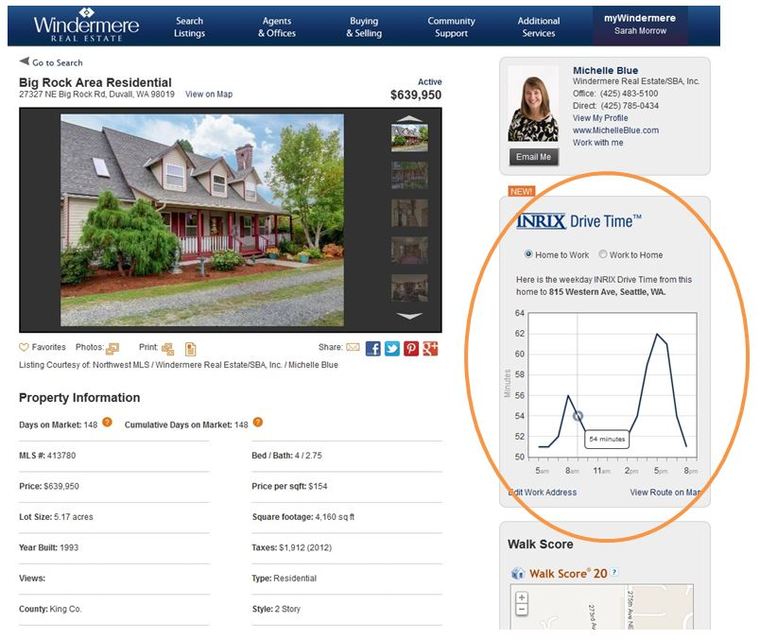
INRIX Drive Time goes well beyond other real estate websites that simply provide distance to work in miles or travel times based on traveling the speed limit. Windermere’s new tool provides drive times based on real-time traffic information sourced from actual drivers. It takes into account every traffic factor, including traffic congestion, road construction, accidents, holidays, weather, events, police activity, and historical traffic patterns. This information is updated every minute, then analyzed and compiled into a historical database that is updated every 90 days, ensuring home buyers have access to the most complete traffic data available.
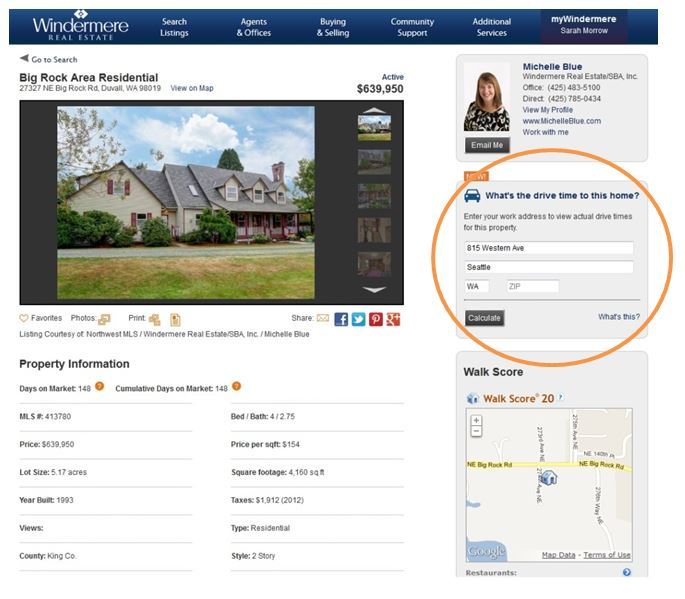
To determine drive times using this new feature, home buyers simply enter their work address into a field directly on the property detail page on Windermere.com.
The tool automatically generates an INRIX Drive Time to and from work and a graph that shows how it varies by different departure times throughout the day.
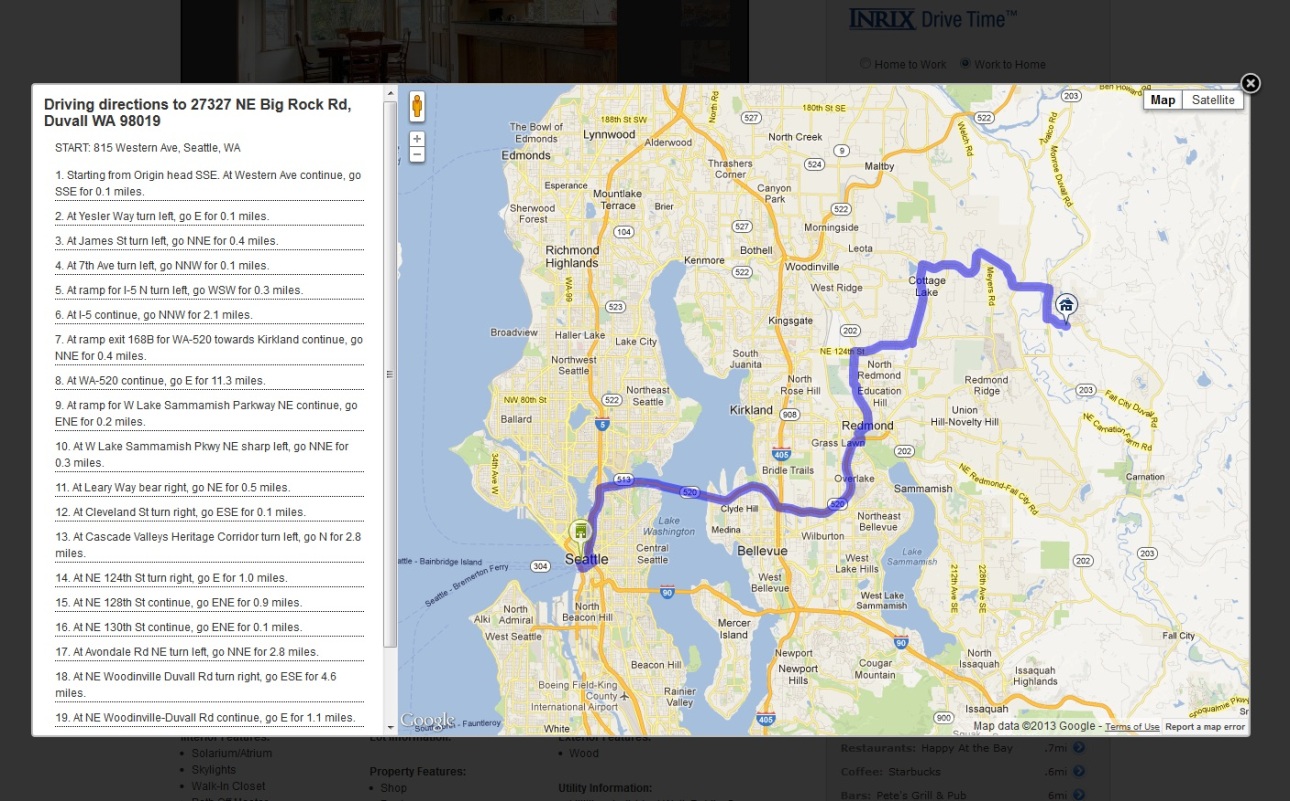
Since INRIX helps us calculate the shortest route based on shortest drive time, not distance, it often suggests a route that commuters may not have contemplated themselves. We then provide the details of the route on a map.
Bryan Mistele, the CEO of INRIX, probably sums it up best:
“Nobody likes sitting in traffic, and although traffic problems won’t disappear overnight, smart applications of traffic data can help drivers not only save time on their existing commute but help them through the process of deciding on the purchase of a new home. Using INRIX Drive Time, Windermere will be able to better inform its agents and serve clients by arming them with information to help making the home-buying process easier.”
Thanks, Bryan, couldn’t have said it better myself.
To test drive the new INRIX Drive Time tool, simply go to any property detail page on Windermere.com.
Builders of new homes frequently discover new ways to differentiate their new construction from existing houses, hoping to capture the attention of potential customers by delighting and surprising them.
The more successful builders therefore develop keen skills in observing emerging social trends, incorporating features, finishes, and floor plans that fulfill the needs of new buyer groups in ways that are often clever, unexpected and relevant.
Here are several current home design innovations that provide us glimpses into ways our culture is changing:
1. Made-to-Order Homes: Many of us have grown accustomed to the convenience of shopping for—and customizing—household products online. Home builders are capitalizing on this trend, developing websites that make it easy for buyers to configure their home online. One builder has assimilated over 70 systems and manufacturer products like plumbing, electronics, HVAC, security, and more into a “core wall.” This allows the rest of the home design to be adjusted based on family needs. Warren Buffet’s recent purchase of Clayton Homes, the nations’ largest modular builder, indicates that online home ordering will be a growing trend.
2. Universal Design: Every day, 10,000 Americans turn 65. Homebuilders have found that both older and younger homeowners want “universal design,” homes that better fit the needs of people across the widest range of ability and ages. Examples of universal design: Entries without steps and showers without thresholds. Electrical outlets are now being incorporated into light switches at eye-level, permitting homeowners to more easily plug in appliances like vacuum cleaners without bending down to the floor.
3. Activated Ceilings: The current generation of first time homebuyers is the first in history who grew up looking down—an unintended consequence of the popularity of handheld mobile electronic devices. This creates strain on the eyes, neck and shoulders which can result in a variety of vision, spine, and other health issues. Designers are addressing this by incorporating more dramatic visual features into home ceilings. By giving us reason to widen our range of vision, the hope is that overall health will be improved.
4.Fast House Nation: Many of us are now adjusting to an increased rate of change—rather than accumulating stuff, we crave more diverse life experiences. So, new homes are being delivered with inexpensive opportunities for self-expression and customization. Chalkboard paint is increasingly used as a wall color, permitting artistic expression for children (of all ages). New senior housing communities are incorporating parking spaces for food trucks near the entrance, bringing fresh and varying culinary experiences to residents.
5. Big Small Houses: We are requiring less space that does more for us. In fact, the National Association of Homebuilders expects the average size of a new home in 2015 will be 2,152 square feet, a 10% drop in size from 2010. Living rooms, dining rooms, home offices, and entry foyers are all on the endangered spaces list. Private, single-purpose rooms (like master bedrooms and bathrooms) are now expected to incorporate multiple and shared uses, such as coffee bars or exercise equipment. Wi-Fi networks and mobile tablet devices have rendered dedicated dens unnecessary. Look for “great rooms” to take center stage, incorporating the functions traditionally demanded of multiple smaller rooms.
6.Waning of the Book: As more readers gravitate to space-saving e-readers like the Kindle, printed books are becoming less common. As a result, bookcases are giving way to “collector” cases for displaying personal treasures like collectibles, antiques, family heirlooms, or natural artifacts such as gems or shells.
7. Families, Extended: Home markets serving international buyers often incorporate a greater number of culturally appropriate features. More buyers today wouldn’t think of living without extended family, and expect household spaces to be more purposefully designed for shared living. As a consequence, new homes are being built with multiple master suites. What some may have characterized as a “granny flat” in the past is positioned prominently in these new floor plans, reflecting the elevated social status and esteem of elder parents. Some designs, like home builder Lennar’s “NextGen,” are “homes within homes,” complete with eat-in kitchenettes and living rooms. Primary kitchens may incorporate isolated cook areas serviced by high-powered fans, to keep food aromas out of the living spaces of the home.
Windermere Real Estate is proud to partner with Gardner Economics on this analysis of the Oregon and Southwest Washington real estate market. This report is designed to offer insight into the realities of the housing market. Numbers alone do not always give an accurate picture of local economic conditions; therefore our goal is to provide an explanation of what the statistics mean and how they impact the Oregon and Southwest Washington housing economy. We hope that this information may assist you with making an informed real estate decision. For further information about the real estate market in your area, please contact your Windermere agent.
Regional Economics
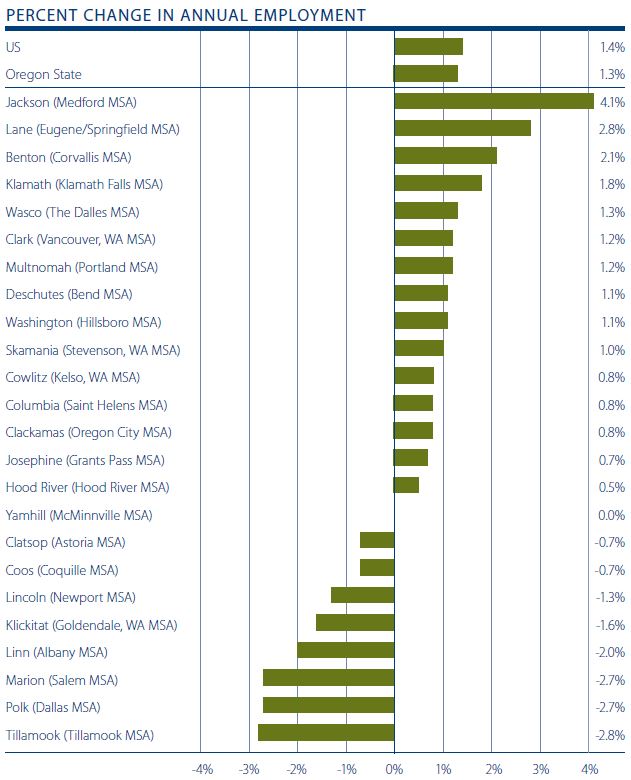
On a year-over-year basis, the Oregon counties covered by this report increased employment by 0.8%, or approximately 14,000 jobs—a modest improvement from the 0.75% annual growth that was discussed in our last report. On a year-over-year basis, 16 counties saw their employment base expand and just eight saw employment contract.
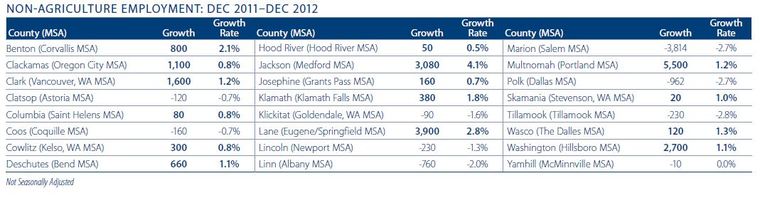
The greatest increases in employment came in Jackson County (+4.1%). This was followed by Lane (+2.8%), Benton (+2.1%), and Klamath (+1.8%) Counties. On an absolute basis, Multnomah County maintained the largest increase with 5,500 additional jobs. This was followed by Lane County (3,900) and Jackson County, where employment grew by 3,080 positions.
On the negative side, job losses totaled 6,376 jobs spread across nine counties. By far the greatest losses were seen in Marion County, down 3,814 jobs. This was followed by Polk (-962) and Linn (-760) Counties. Losses in other counties measured less than 230 jobs each.
When we compare the data to that seen at the end of the third quarter, it is apparent that the state is stuck in somewhat of a rut, with both the third and fourth quarters showing job losses in 12 counties. That said, the market did add just under 8,000 payroll jobs in the fourth quarter of the year.
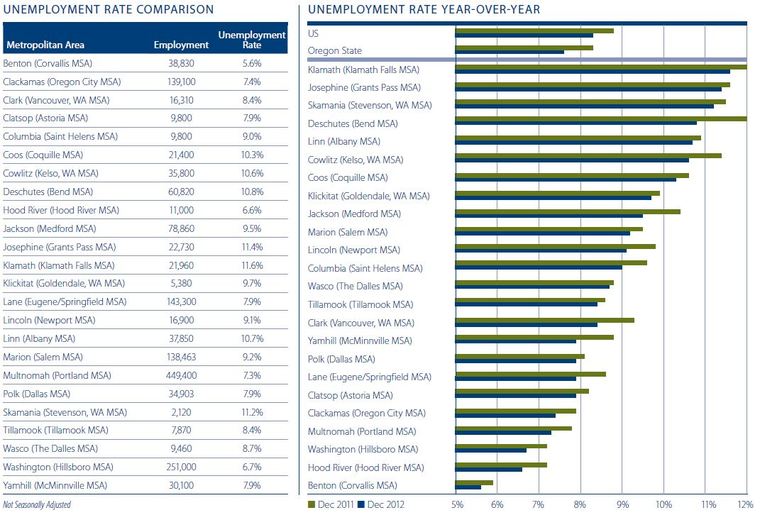
Inasmuch as the unemployment rate at the end of 2012 was better across the board from that seen at the end of 2011, the last quarter of the year saw a drastic turnabout in the unemployment rate in all but one of the counties surveyed. In every county but Benton, the unemployment rate rose between September and the end of the year.
This is concerning as the labor force contracted in all counties other than Lane. It is one thing to see the unemployment rate rise as more people start to look for work, but to see it increase with fewer people looking for jobs is a worrying situation. I hope that it is temporary, but I will be keeping a close eye on these figures as we enter the spring.
It appears to me as if the Oregon economy is stuck in low gear. It is expanding, but at a rate that is well below its potential. As such, I am maintaining the “C-” grade this quarter that I gave it in the third quarter. At some point the job market has to gather steam, I am just not convinced that now is the time.
Regional Real Estate
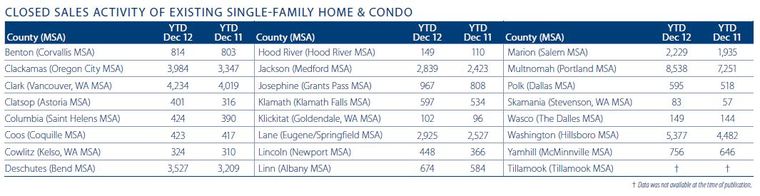
In the fourth quarter of 2012, the region sold 9,758 units of resale housing. Total 2012 sales amounted to 39,745 units, 13% more than were sold in 2011.
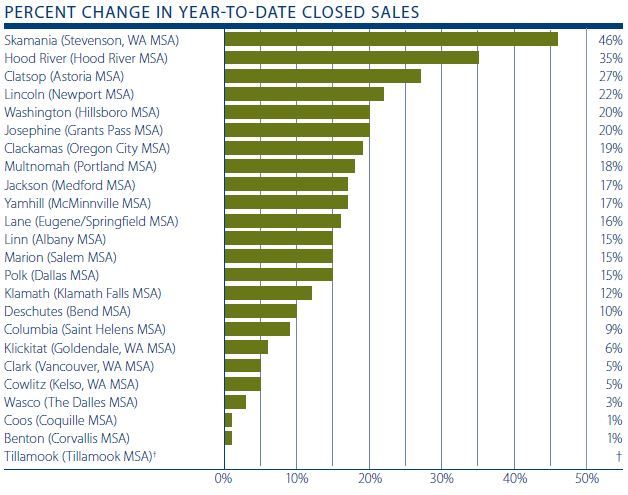
In 2012, the greatest growth in transactions was seen in Skamania County (+46%), Hood River County (+35%), Clatsop County (+27%), and Lincoln County (+22%). It was very pleasing to see that no markets saw sales volumes drop between 2011 and 2012.
Home sales continued to perform well in the fourth quarter, but quarterly sales shrank by 16% from the level seen in Q3. This is not a surprise, as seasonal fluctuations influence the figures. Additionally, I would contend that the worryingly low levels of homes for sale also contributed to the drop in sales.
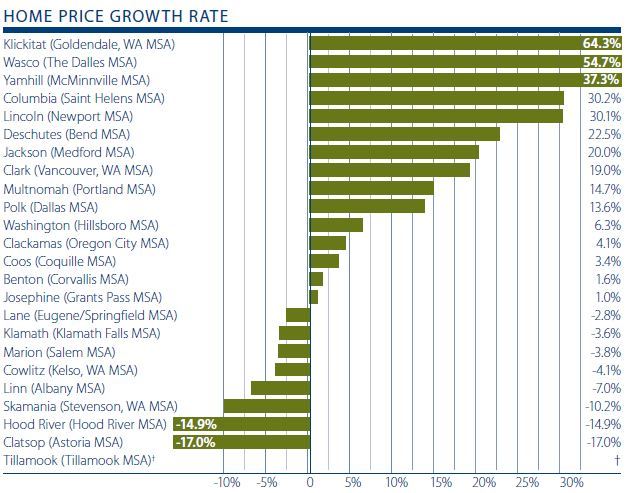
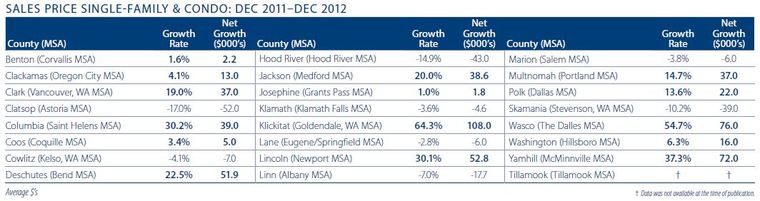
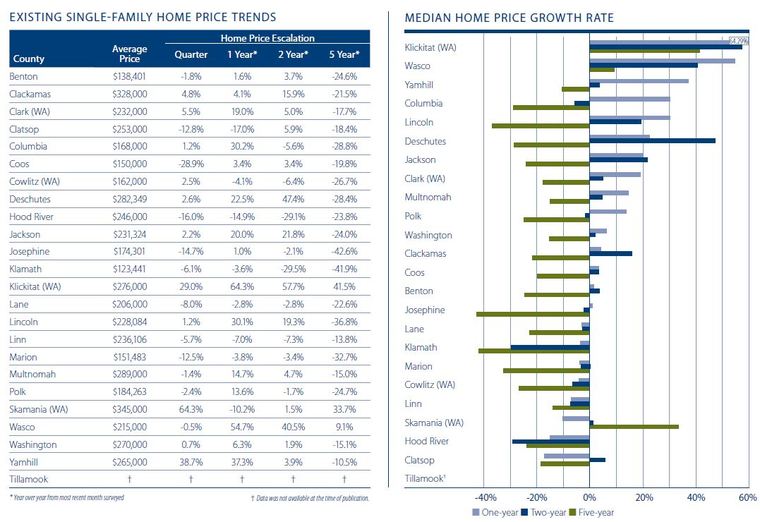
When we look at home prices, 15 of the markets analyzed registered year-over-year price increases (down from 16 in the third quarter) with just eight showing declines in values from a year ago. In aggregate, the markets surveyed saw values increase by 11.2% over the same period in 2011.
Other than the substantial 63% growth in the small Klickitat County market, ten other counties registered double-digit gains from December, 2011. When compared to prices seen in the third quarter of the year, 13 counties are higher, one was unchanged, and nine declined in value.
I was happy to see that there are 14 counties where prices are now higher than we saw two years ago. This is quite an achievement, as 2010 saw the market artificially buoyed by the Homebuyer Tax Credit. More surprising is that three counties saw home prices higher than at the end of 2007.
A “C” grade is appropriate here. It has remained static for three quarters now, but the lack of inventory appears to be having a negative effect on values. I want to see more homes for sale before I consider giving a better grade.
Conclusions
There are plenty of metaphors that I could use to describe the Oregon job market, such as “weak,” “sluggish,” or “slow” but, in all honesty, a better word is actually “average.” Certainly, the job growth that was seen in 2012 has hardly put a major dent in the number of jobs lost through the recession, but the economy has been improving.
I believe that the lackluster growth that has been seen is a function of two distinct, but related, issues. The first is that the Federal government is starting to realize that it cannot expand in the manner that it has been. Because of this, employment in government services has not been positive. This is particularly interesting as, from a historic perspective, job growth following recessions has traditionally been led by government hiring. As such, it has fallen on the private sector to pick up the slack and add to their payrolls.
Private industry has, so far, been doing its best to answer the call to arms, but industry looks to the government for some kind of assurances that we will not fall back into recession. The current issues revolving around fiscal cliffs, debt ceilings, and sequesters are not giving businesses the assurance that they so badly need. Until the outlook on a national basis is clearer, we cannot expect private firms to increase their hiring and, as such, improvement in the employment situation in Oregon, and in most of the rest of the country, is likely to be lackluster.
The housing market in the state remains on a more solid footing with steady improvement seen pretty much across the board. Interest rates remain at or near historic lows which, when viewed in concert with the stability in home values, has acted as a catalyst and allowed many would-be buyers to get off the fence.
This is, indeed, positive but I fear that the lack of homes for sale—unless we see a dramatic turnaround in the spring—will leave buyers disenchanted. Along with many others, my fingers are crossed that we will see improvement in listing activity soon. It is sorely needed.
About Matthew Gardner
Mr. Gardner is a land use economist and principal with Gardner Economics and is considered by many to be one of the foremost real estate analysts in the Pacific Northwest.
In addition to managing his consulting practice, Mr. Gardner is a member of the Pacific Real Estate Institute; chairs the Board of Trustees for the Washington State Center for Real Estate Research; the Urban Land Institutes Technical Assistance Panel; and represents the Master Builders Association as an in-house economist.
He has appeared on CNN, NBC and NPR news services to discuss real estate issues, and is regularly cited in the Wall Street Journal and all local media.
On March 3, the Windermere Foundation and the YMCA will participate in the annual Husky Hoops free-throw fundraiser.
Since 2006, the Windermere Foundation has partnered with the YMCA to create Windermere Kids: a tuition-assistance and volunteer program that provides low-income children with quality after-school enrichment programs and the all-important summer camp experience.
The Windermere Foundation has dedicated over 1.2 million dollars to this important cause—helping hundreds of kids through our first network-wide program. This unique partnership provides the YMCA with much-needed funds, as well as support from Windermere agents, who volunteer their time to assist with the summer camps and other kids’ activities.
On Sunday, four YMCA youth will all have a chance to raise funds for the University Family YMCA. The Foundation will donate $100 for each free-throw made during the half-time special (with a minimum $1,000 donation).
Windermere Real Estate is proud to partner with Gardner Economics on this analysis of the Western Washington real estate market. This report is designed to offer insight into the realities of the housing market. Numbers alone do not always give an accurate picture of local economic conditions; therefore our goal is to provide an explanation of what the statistics mean and how they impact the Western Washington housing economy. We hope that this information may assist you with making an informed real estate decision. For further information about the real estate market in your area, please contact your Windermere agent.
Regional economics
One of the best-known lines in George Orwell’s famous book Animal Farm was the statement that, “All animals are equal, but some animals are more equal than others.” The same can pretty much be said about the counties contained within this report when it comes to economic growth.
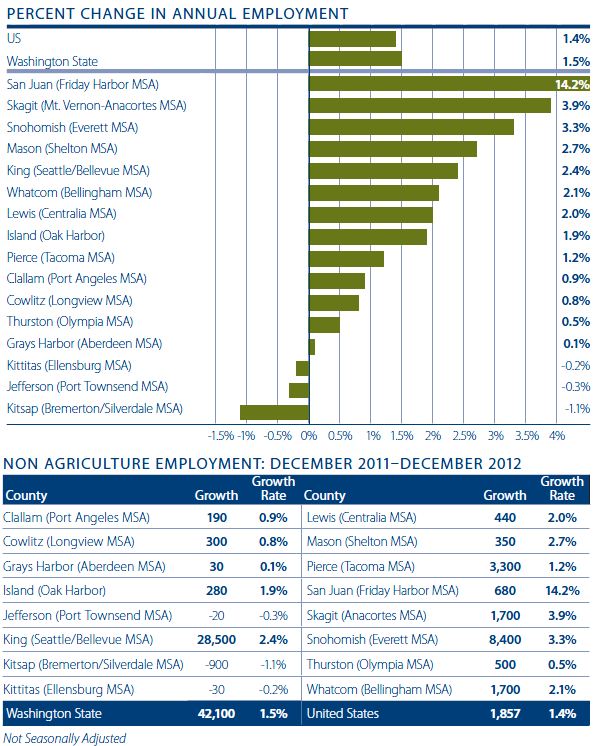
With the exception of just three counties, all of the areas considered within this report showed job growth in 2012. In aggregate, the 16 counties added a total of 45,420 new jobs, measuring at a healthy 2.1%.
On an annual basis, the figures look quite good. The drop in employment that was seen between the second and third quarters has since turned around, with the market adding 5,290 new jobs.
However, when looking closely at the data, it is clear there are some counties that are experiencing a majority of the job growth and others that, although still expanding, are not faring as well as I would have hoped.
Year-over-year, San Juan County (+14.2%) grew at the greatest rate—it is a small county but its service industry appears to be reviving quite nicely. This was followed by Skagit (3.9%), Snohomish (+3.3%), Mason (+2.7%), and King (+2.4%) Counties. Job losses were modest, and included Kitsap (-1.1%), Jefferson (-0.3%), and Kittitas (-0.2%) Counties. Total employment in these three counties contracted by just 950 jobs.
Unsurprisingly, the majority of jobs gained in the market occurred in the central Puget Sound region that encompasses King, Snohomish, and Pierce Counties. Between them, they accounted for 89% of total job gains.
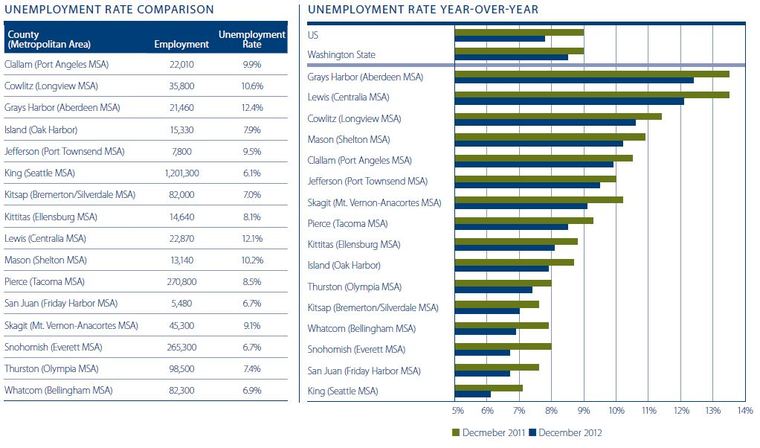
When we look at the unemployment rate across the region, all the counties reviewed saw rates drop from a year ago. Several counties did see their unemployment rates rise between the third and fourth quarters, but this was mainly due to increases in the labor force and not a cause for concern.
The latest data is positive and a turnaround from the third quarter, when I suggested that employment growth appeared to be losing some steam. As a result, I am going to give the economy a “B+” grade—up from the “B” I gave it in the third quarter.
Inasmuch as the economy appears to be on a stable footing, there are still headwinds. Many, including myself, had hoped that the confirmation of a new president would be enough to stimulate the economy and signal a faster expansion in jobs. Unfortunately however, fiscal cliffs, debt ceilings, and sequesters continue to act as anchors on our economic potential. I remain hopeful that we will get through these issues, but until we do, our economic vitality may well be muted.
Regional real estate
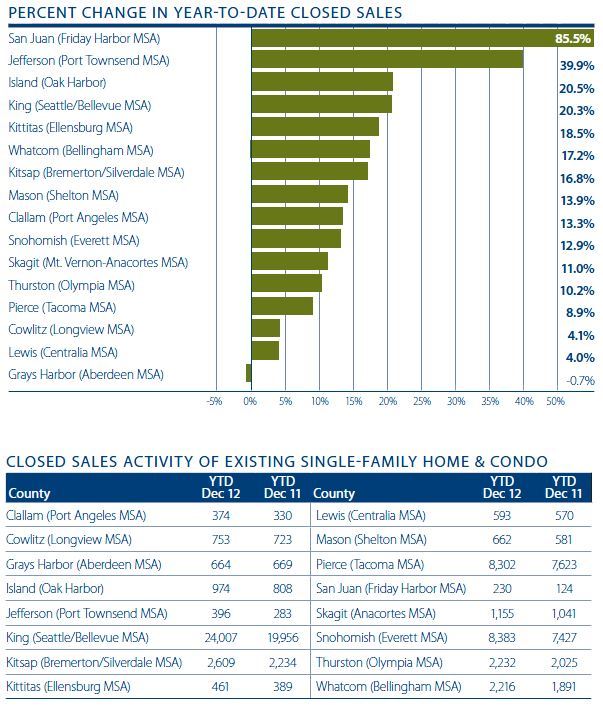
The market registered 40,270 transactions of resale housing units in 2012— an impressive increase of 15.7% over the number of transactions seen in 2011. In the fourth quarter, there were close to 13,740 transactions completed, which is also a very impressive figure.
With a clear level of optimism in the market, all but one county exhibited improved home sales in 2012 when compared to the previous year.
The solitary county where there were fewer sales recorded, Grays Harbor, remains an anomaly; the area is small and the decline in sales was measured at just five units.
Of the fifteen counties that saw higher sales, a full 80% reported doubledigit improvements in transactional volumes in 2012 when compared to 2011. The greatest increases were seen in the notoriously volatile San Juan County, where the market sold 106 more units in 2012 than in the prior year.
The area did see a slowdown in sales in the fourth quarter, but that is not surprising as we always see a seasonal slowdown at this time of year. That said, a contraction of just 11% in total sales between the third and fourth quarters is not bad at all.
Regular readers will be aware that through 2012 I have been waiting for an increase in the number of homes for sale. Unfortunately, my wishes have not been granted. There have also been many who have been waiting for a veritable tidal wave of foreclosed homes to flood the market and that, too, has not occurred.
I believe that we will see more bank-owned units come to market in 2013, but not at a level that is likely to negatively impact home prices in our area. In fact, I welcome any additions to the available stock as it is clear to me that there are more buyers than sellers in our region.
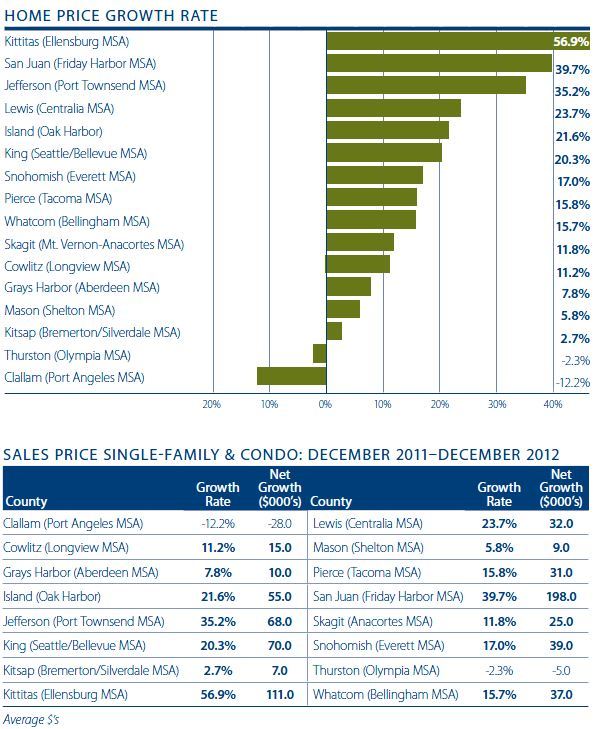
As is shown in the chart, 14 counties saw the average sales prices at levels above that seen a year ago—up one from my last report. In aggregate, the average price of homes sold in the counties analyzed was 19% higher at the end of 2012 than in December of 2011. I should note that the area saw home values reduce by 1.4% between the end of the September and the end of the year, likely due to seasonality as well as the lack of inventory in the marketplace.
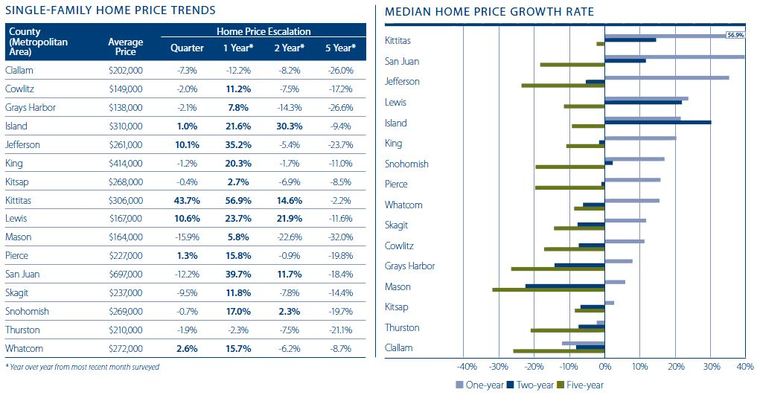
Of the counties that saw appreciation, the most pronounced gains were seen in Kittitas (+56.9%), San Juan (+39.7%), Jefferson (+35.2), and Lewis (+23.7%). I am not surprised by this, as they are all markets that are fairly modest in size and, therefore, subject to some wild fluctuations. The declines that were seen were limited to Clallam (12.2%) and Thurston (-2.3%) Counties. The fairly substantial drop in values in Clallam County was again a function of small market size.
I continue to be pleased to see that several counties are now exhibiting sales prices that are above those seen two years ago. As was discussed in my last report, this is important, as the early summer of 2010 represented the end of the First Time Homebuyer Tax Credit that functioned to artificially (but temporarily) increase home prices. While we’re not close to seeing the prices that were achieved during the peak of the market five years ago, it is clear to me that the trend is clearly upward and I anticipate this to continue as we enter 2013.
As stated previously, I do worry about the lack of homes for sale. If we do not see a fairly dramatic increase in inventory, I fear that the market will be forced to give some of its recent gains back— albeit temporarily. Because of this fact, and regardless of the solid price growth that we are witnessing, I am still unable to raise my grade above the “C” that I gave it last quarter.
Conclusions
I remain in somewhat befuddled awe when I think of the resiliency of the United States economy and how we, as a nation, are emerging from this recession bruised but, for the better part, intact. Inasmuch as the government has tried, hopefully unwittingly, to hinder our growth with various budgetary issues and the like, we are doing our best to adapt to our environment and grow the economy.
I started out this piece with a quote from George Orwell which inferred that our job recovery, although occurring across the geographic board, will be unequal. I certainly expect that the power centers that accommodate a majority of our businesses in the state will expand at a faster rate than counties that are more removed. That said, the overall picture is a positive one and I expect that 2013 will be another year in which our regional economy outperforms the nation as a whole.
From a real estate standpoint, it is clear that we are now well removed from the days when home prices were hemorrhaging. Home values have stabilized and a recovery in values is underway. The credit markets have thawed and getting a mortgage is easier now than it has been since the housing “bubble” exploded. Interest rates remain at historic lows, and although I believe that they will rise in 2013, the increase should be modest.
The outlook is getting clearer. Home values will appreciate in 2013, but not all markets are created equal and some will fare better than others.
About Matthew Gardner
Mr. Gardner is a land use economist and principal with Gardner Economics and is considered by many to be one of the foremost real estate analysts in the Pacific Northwest.
In addition to managing his consulting practice, Mr. Gardner is a member of the Pacific Real Estate Institute; chairs the Board of Trustees for the Washington State Center for Real Estate Research; the Urban Land Institutes Technical Assistance Panel; and represents the Master Builders Association as an in-house economist.
He has appeared on CNN, NBC and NPR news services to discuss real estate issues, and is regularly cited in the Wall Street Journal and all local media.
Rarely does a day go by that I don’t get asked if this is a good time to buy and/or sell a home. Some people might think that my response is always an emphatic “YES!” because I work in real estate. But in truth, there is no right or wrong answer. Every person’s circumstances are unique, so in some cases the answer might be yes, but for others it might make more sense to wait. Allow me to explain.
The good news is that we’re finally coming out of the housing slump of the past five-plus years. Housing is a major driving factor of the U.S. economy, so regardless of whether or not one owns a home, a stronger housing market is good for everyone. For some would-be home sellers, this positive momentum, combined with a rise in home prices and buyer activity, is enough to compel them to list their home. And right now the statistics appear to be on their side.
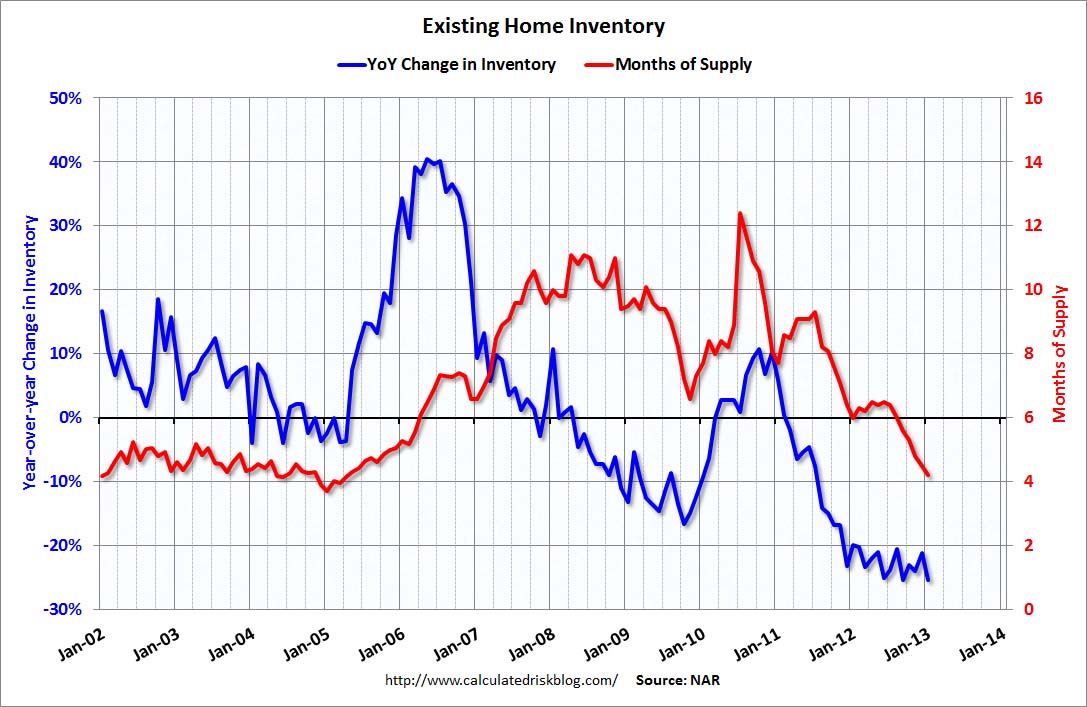
According to the most recent findings from the National Association of REALTORS®, total housing inventory has fallen for the past several months, settling at just under two million existing homes on the market that are available to buyers. This represents about a four-month-supply of homes throughout the U.S. This is the lowest housing supply the nation has seen since May of 2005 – during the peak of the housing boom.
“Months supply” basically means that if existing homes were to continue selling at the current rate, the inventory of homes would be sold by that many months. A “normal” market usually has around six months of supply; therefore lower numbers mean a shortage of inventory. If demand is greater than supply, this often leads to competition amongst buyers – and rising prices – as we’ve seen in many markets throughout the Western U.S.
Here are the current inventory levels in key markets along the West Coast, all of which fall below six months of supply and report strong competition among buyers.
· Seattle: 1.4 months
· Portland: 4.2 months
· San Francisco: 1.8 months
· Las Vegas: 3.8 months
· Palm Springs: 2.5 months
The following graph demonstrates the downward trend in the overall U.S. month’s supply of homes which is currently at about 4.4 months:
So what does this mean for buyers and sellers? It means as long as inventory levels remain low, competition amongst buyers will remain high, and home prices should continue to steadily rise – albeit at a healthy rate – not like what we saw during the housing boom. As evidence of this, in the recent Home Price Expectation Survey, 105 leading housing analysts called for a 3.1 percent increase in home values by the end of 2013. And in a recent report by the National Association of REALTORS®, median home prices last quarter showed the strongest year-over-year increase in seven years.
Another thing that buyers and sellers need to keep their eye on is interest rates and their impact on affordability. Interest rates have been at such historical lows for so long that it’s easy to take them for granted. But the truth is that several lending institutions, including Freddie Mac and the Mortgage Bankers Association, project that interest rates will rise from 3.4 to 4.4 percent by the end of 2013. A full point increase can have a significant impact on the amount of your mortgage over the long term.
I’ll explain:
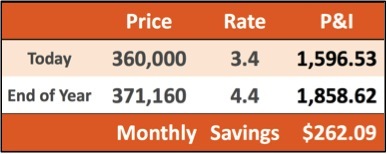
Assuming a 30-year-mortgage at a 3.4 percent interest rate, a home valued at $360,000 in today’s market would have a monthly payment of $1,596.53. If prices rise by 3.1 percent and interest rates rise to 4.4 percent, as both have been predicted to do in the coming year, that same home would be worth $371,160 and have a monthly payment of $1,858.62 (see chart below). This is a difference of $262.09 per month – $3,145.08 annually – and $94,352.40 over the life of the loan. That’s not chump change.
With these types of projections, one might wonder why there isn’t a flood of homes coming on the market. The biggest concern I hear from many would-be sellers is that they’re going to lose money because their home is worth less today than when they bought it. A valid concern, to be sure, but not necessarily the case for many folks. Remember, you’re buying and selling in the same market conditions, so if your home has lost value in recent years, it is highly likely that the next home you buy has as well.
I recently spoke to a friend of mine who wanted to sell but was afraid of losing money. He bought his Seattle-area home back in 2002 for $275,000. Over the next five years the market boomed and by 2007 his home was worth about $430,000. During that time, homes in many areas around Seattle appreciated by over 55 percent. Then the housing market crashed – and with it so did home prices. In my friend’s mind he lost $155,000 and now he thinks he should wait to sell until he can gain all that loss back.
Today, my friend’s home is worth about $327,000 – a gain of $52,000 over what he paid in 2002. If experts are right about an annual gain of three percent in the coming years, he will have to wait 10 years before his home is worth what it was during the peak of the market in 2007. My advice to him? If it’s the right time to move and you can afford to do it, go for it, but don’t base your decision on numbers that were the result of an artificially inflated market.
It goes without saying that nobody wants to sell at the bottom of the market, yet at the same time, everybody wants to buy at the bottom. Obviously these two scenarios can’t exist at the same time, but I hope the information in this blog shows there are definitely opportunities to be had by both buyers and sellers that are worth considering.
As president of Windermere Real Estate, OB Jacobi brings a second generation of leadership to the company that his father founded in 1972. For more information, please visit www.windermere.com.
In March, Windermere real estate agents will be answering your questions about home design on the Windermere Blog and Facebook page. What do you want to know about getting your home ready to sell, designing your new space, home remodeling, architecture, and gardening?
Happy 2013 – hope this New Year is off to a great start! We have many stories (and raves!) to share with you about how your support of the Windermere Foundation translated into meaningful and necessary help for so many struggling families in 2012. Collectively, we raised an impressive $1,359,032. This is up 13% from 2011. And for the thirteenth consecutive year, over-and-above contributions have exceeded transaction fee income, with 35 percent coming from transaction fee revenue, and over-and-above revenue at 65 percent. But, equally astonishing is how much has been raised since 1989. We’ve reached an impressive milestone with over 25 million dollars raised, allowing us to help thousands of low-income and homeless families with the most basic of needs.
New to our newsletter is a rave section. We asked many of you to send us a rave about someone going above and beyond in your office and have received a great response. Please keep them coming as we will continue to share these in our Quarterly Foundation Reports.
Please remember to read our blog posts as they include more in-depth stories about what offices are doing throughout the year. Facebook is also a great resource for upcoming events, and shorter posts about our offices’ involvement in their local communities.
RAVE:
“Sharon Harriss has been an active member of the Snohomish County Realtor Food Drive for many years. She is our “number one” cheerleader and Chairman for the event. She is so encouraging to all and is so humble making sure all the credit goes to the individual office team leaders. Peter Paterno, SCCAR President elect and a Windermere Broker, said, Sharon is so committed to this cause and enthusiastic, we simply wouldn’t have a successful food drive without her.”
-Meribeth Hutchings, Lake Stevens
Cronin and Caplan Realty Groupdonated $114,000 to 35 organizations in 2012. Following is a quote from one of our Foundation Reps describing what it means to give back.
“2012 was a year of hardship for many families. I smile when I think about how we bought eye glasses for a little boy that had none; that we helped a mother in need with rent money; that some children whose families are without resources will take a
backpack full of food home for the weekend. A favorite quote by Arthur Ashe
captures all of this, ‘From what we get, we can make a living: what we give, however, makes a life.’”
—Teri Beatty, Portland Heights Foundation Representative
Windermere Real Estate Company donates a holiday party to Sibling House, a foster care organization.
Every year, Sibling House sponsors a holiday party where foster children and their caregivers get together to celebrate the season. Sibling House creates a store where foster parents can shop for food, clothing, and toys for the children in their care.
RAVE:
Marcy Farris has served as a Board Member for the Nevada Windermere Foundation Committee and Community Service Day Committee for five years. Marcy has helped at the Las Vegas Mission Soup Kitchen serving dinners to homeless men and women; she leads our Windermere Wednesday’s after school program at our YMCA adopted school, Twin Lakes Elementary, helping students with homework and playing games; and every year Marcy helps stuff Christmas Stockings for the Blue Star Mothers, an organization of Mothers with daughters in the Military.
Marcy is so passionate about helping the homeless that she randomly sports brown bag night. She invites her friends over, they make peanut butter and jelly sandwiches, and with a piece of fruit creates a brown bag lunch! Then they all jump in the car and drive the streets of Las Vegas randomly giving a brown bag lunch to homeless men, women and children they find on the streets. Marcy also does this with blankets and jackets. Marcy calls upon her friends and says “It’s time, I need all your extra blankets and jackets!” She collects them, and again, Marcy and her friends jump in the car and drive the streets where they feel the most needed individuals are that could use a blanket or a jacket.
We would like to send in our RAVE for Marcy Farris, as she is truly a “giver” to human kind, helping those in need, giving of herself on her own time! Marcy is making a difference to our homeless here in the Las Vegas Valley and an inspiration for all to follow!
-Deb Shields, Las Vegas – Henderson
RAVE:
“Karen Hayes is a long time Foundation Rep for the Windermere Northwest office. Karen has found a groove as the rep and over the years has found creative ways to involve the entire office, such as “Pig Dollars”, which are collected at every office meeting. We deposit dollar bills or IOUs in gratitude for recent events or for good karma, but this is no little amount of work in dealing with the bookkeeping alone. Karen works very hard, but makes it look incredibly easy and fun.”
BIG Thank You!
Thank you to all of the offices who held fundraisers to benefit the Windermere Foundation in 2012. I realize they are a lot of work, so please know your efforts are appreciated not only by the Foundation, but by the families and children who benefit from your hard work.
As always, thank you for your continuing support of the Windermere Foundation. Many low-income families are receiving basic necessities because of your commitment to helping others.
The baby boomer generation, which is currently estimated to be aged between 48 and 67 years old, comprises almost one-third of the nation’s population. The demand that this lucrative segment of the population has on housing is causing homebuilders to rethink how they design homes. In fact, the National Association of Home Builders (NAHB) has a 50+ Housing Council which focuses entirely on the housing needs of aging baby boomers.
A study commissioned by the NAHB suggests that baby boomers and older homebuyers want a maintenance-free lifestyle that frees them up to travel, socialize, and pursue other activities. Perhaps this is why real estate professionals report an increase in the number of baby boomers who are interested in condominiums and townhomes. There is also growing popularity for luxury units because they appeal to empty-nester baby boomers who no longer want the maintenance of a single family home, but don’t want to scale back on certain features and amenities either.
Homes that are specifically designed for aging clientele often incorporate what is known as “universal design” which allows anyone to function within the home, whether it’s children, an elderly person, or someone who is wheelchair bound. Universal design compensates for a reduced range of motion that often times comes with aging homeowners. For example, electrical switches and thermostats should be placed no higher than 48 inches above the floor and outlets no more than 27 inches—this puts them within the reach of virtually anyone. Likewise, the use of Lazy Susans, rolling carts under counters, pull-out shelves, and height-adjustable shelves make items more accessible. The height of counter tops must be within reach of all household members sitting or standing. Other features might include installing fold down benches in the shower, dual handrails, and raised toilets to compensate for decreased balance and coordination.
Universal design compensates for reduced strength by adjusting tension to assist with opening/closing windows and doors. Installing C or D shaped loop handles on drawers and cabinets and using easy gliding hardware for drawers also assists weaker individuals. Berms, ramps, and wider doorways with lower thresholds help with mobility and agility. Single-story homes also offer increased accessibility for aging homeowners—in fact, builders say that 75 percent of the homes they build for the 50+ market are single story.
The end goal for organizations like the NAHB’s 50+ Housing Council is to encourage the construction of more homes that can be adjusted over time to homeowners’ needs, so that they can live comfortably, safely, and independently as they age.
In many parts of the country it is still too early to start thinking about gardening. After a chilly winter, adding some green to your home’s interior may be just what the doctor (or decorator) ordered. Consider an indoor garden to liven up your home with color and clean air. There are many ways to introduce houseplants into your home décor, from edible to ornamental. Here are some tips to get you started:
Cultivate herbs or fungi on your windowsill.
Create or find an indoor greenhouse:
Or maximize your space with a hydroponic tower:
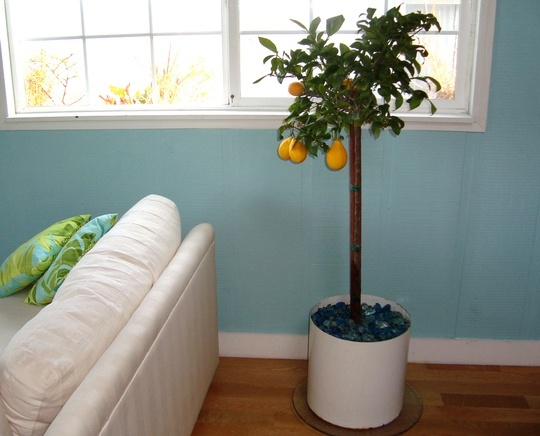
Plant a lemon tree, or a whole orchard:
Make a statement with a hanging garden:
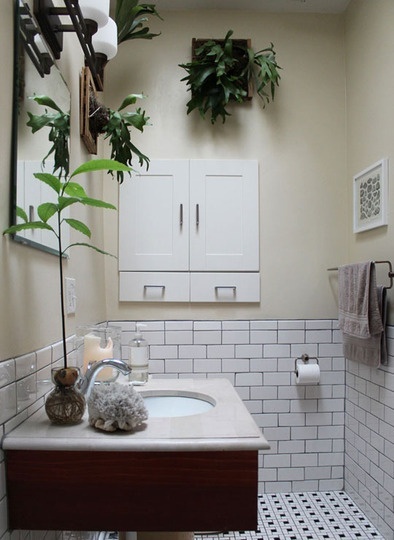
Keep your houseplants in unexpected rooms:
If you have young children or pets, you will want to consider the toxicity of some of your plant choices.
Indoor plants have their benefits, including cleaning the air you breathe. Some plants are more effective at recycling the CO2 in your home than others.
We’d love to hear your tips for adding indoor plants and gardens.

 Facebook
 X
X
 Pinterest
 Copy Link

 About Matthew Gardner


 As president of Windermere Real Estate, OB Jacobi brings a second generation of leadership to the company that his father founded in 1972. For more information, please visit