Q: I am interested in buying an FHA short sale. I’ve heard they can be tough. Do you have any advice? Travis in Renton, WA
A: My advice can be summed up in two words: Buyer beware. In a non-FHA short sale, the lender’s approval process can be quite lengthy. With an FHA loan, the federal government is the investor, and the wheels of government move very slowly. It’s not unusual to wait 9 to 12 months for a decision on an FHA short sale offer. It’s a rare buyer that has that level of patience and flexibility. There are also a number of stipulations that the FHA imposes on short sale purchases:
The home must be owner-occupied.
The buyer’s closing cost credit cannot exceed 1% of the purchase price.
The second lien holder is only allowed to receive $1500. As a result, if there is a second lien the chances that the deal will close are very slim.
All that said, if you love the house and are willing to accept all the criteria – and the property only has one mortgage – go ahead and proceed. Just be ready to be patient.
Martin Goldberg is a Windermere broker in Bellevue, WA and co-founder of Washington Property Solutions, a short sales negotiating company. Since 2003 he has helped more than 900 homeowners sell their homes. A Bellevue native, Martin graduated with honors from the University of Washington Law School and is a Certified Distressed Property Expert. He loves to travel and has visited 49 of the 50 states. You can learn more about Martin here or at www.washortsales.com.
Q: I've done a short sale. How long before I will be able to buy another home? Mike in Kirkland, WA
A: One of the biggest advantages in doing a short sale instead of foreclosure is the shorter waiting period before you are able to purchase a home in the future. For example, in certain circumstances one can be current on their payments and still do a short sale. And if a homeowner is current on their mortgage through a short sale, they can qualify for an FHA loan afterwards without any waiting period. The same option is not available following a foreclosure.
There are a number of variables that determine the length of the waiting period before you can purchase a home after a short sale, including the homeowner’s credit rating, extenuating circumstances and the guidelines of the lender you are working with.
While the timeline will vary according to each individual’s situation, here are some general guidelines on the waiting period for a loan after a short sale:
FHA loan after a short sale
No waiting period if homeowner was current on mortgage when short sale closed
3 year wait if homeowner was in default at closing
Less than 3 year wait if the homeowner has re-established good credit and can show extenuating circumstances
Fannie Mae loan after a short sale
2 year wait if the homeowner puts 20% down
4 year wait if the homeowner puts between 10% to 20% down
7 year wait if the homeowner puts less than 10% down
2 year wait if the homeowner can show extenuating circumstances and puts more than 10% down
Freddie Mac loan after a short sale
4 year wait before being able to get a loan
2 year wait if the homeowner can show extenuating circumstances
Every homeowner’s situation is different, so we always recommend that you speak with a real estate attorney who can offer advice on the legal and tax implications for your individual circumstances.
Martin Goldberg is a Windermere broker in Bellevue, WA and co-founder of Washington Property Solutions, a short sales negotiating company. Since 2003 he has helped more than 900 homeowners sell their homes. A Bellevue native, Martin graduated with honors from the University of Washington Law School and is a Certified Distressed Property Expert. He loves to travel and has visited 49 of the 50 states. You can learn more about Martin here or at www.washortsales.com.
Rising home prices have been in the news. The upside: It’s a solid sign of a recovering economy. The downside: It is creating unrealistic optimism among underwater homeowners, causing many of them to think, “I’ll just hold off on a short sale and see what happens.” That decision could be a very costly mistake for homeowners. Here’s why.
1) While home prices are rising in some areas, they’re not rising fast enough.
Projections for home prices in many areas of the country for 2013 indicate an increase. But it’s a moderate increase. And there are just as many areas that are expected to see flat or decreased values through 2013. The result? Underwater homes will remain underwater for years.
2) Banks are moving more quickly on foreclosure.
In the past, homeowners often had the luxury of time. Lenders caught unprepared for the onslaught of distressed properties often took nine months or more to begin foreclosure proceedings. That is no longer the case. With systems and resources now in place, the foreclosure process now is moving quickly. And as soon as a homeowner receives a Notice of Default from the lender, their options are limited. While a short sale may still be an option, it’s a race against the clock. If the homeowner can’t execute a short sale in time, they face foreclosure. When they go to buy a home again in a few years, homeowners will have fewer options after a foreclosure vs a short sale.
3) Waiting too long may cost homeowners thousands of dollars in taxes.
The extension prevents many homeowners who go through a short sale from being taxed on the amount of their mortgage debt that has been forgiven. Normally, debt that has been forgiven by a lender counts as taxable income.
If a homeowner wants to make sure their debt forgiveness is not counted as taxable income, their short sale must close by December 31, 2013. That means they need to get their house on the market now.
Richard Eastern is a Windermere broker in Bellevue, WA and co-founder of Washington Property Solutions, a short sales negotiating company. Since 2003 he has helped more than 900 homeowners sell their homes. A Bellevue native and a University of Washington grad, Richard is an avid sports fan and a devoted Little League and basketball coach. You can learn more about Richard here or at www.washortsales.com.
Q: I'm thinking about making an offer on a short sale. What questions should my agent and I ask the listing agent to make sure the transaction goes smoothly?
Fiona in Mill Creek, WA
A: Short sales are complicated transactions even for those highly experienced in short sale negotiation. Properties that are represented by agents with little or no short sale experience can cause considerable headaches to buyers. Here are a few questions you can ask to determine whether you want to move forward with an offer.
Who are the lien holders?
The amount of time it takes to process a short sale varies greatly from lender to lender. The listing agent should be able to tell you who the lien holders are, and the average number of days the lenders take for closing. This will help you decide whether the lender timeline matches your timeline.
Who is negotiating the sale? How many short sales have they closed? Do they have experience working with the seller’s lien holders?
Real estate agents, attorneys and mortgage brokers are the only individuals that can legally negotiate a short sale. If the negotiator is a real estate agent, they must be listing or co-listing the property – they cannot legally negotiate the sale unless they are part of the listing agreement.
Because of the complexity and ever-changing nature of short sales, you want to make sure the negotiator is highly experienced. That means they’ve closed a minimum of 100 short sales and have worked with a broad range of lenders, including the seller’s lien holders.
Are there any additional costs to negotiate the sale? If yes, who pays those costs?
If the negotiator is a real estate agent, negotiating the short sale is part of the service that they provide when they list or co-list the property. There is no additional fee to anyone.
Attorneys typically charge a fee of 1-2% of the purchase price to negotiate a short sale. The lender may be willing to pay their fee, but more and more often they’re not. The seller typically is undergoing economic hardship and doesn’t have the funds. That leaves the listing agent, buyer or buyer’s agent to pick up the attorney’s fee. Before you make an offer make sure you have in writing who is responsible for the negotiating cost.
Is there someone dedicated specifically to follow up with the lender? How often do they follow up?
For a short sale to progress smoothly it is essential that the negotiator has a system to follow up regularly with all the various lender departments that are involved with the short sale. The negotiator can never assume that just because they have sent the correct paperwork, the lender is moving forward on the sale. We call lenders daily to make sure the right people have the right information to close the sale in the shortest possible time.
Martin Goldberg is a Windermere broker in Bellevue, WA and co-founder of Washington Property Solutions, a short sales negotiating company. Since 2003 he has helped more than 900 homeowners sell their homes. A Bellevue native, Martin graduated with honors from the University of Washington Law School and is a Certified Distressed Property Expert. He loves to travel and has visited 49 of the 50 states. You can learn more about Martin here or at www.washortsales.com.
Financial setbacks like the loss of a job or large medical bills can make it tough to make ends meet. If you find yourself behind on your mortgage payments, it helps to be proactive. It's also good to know that federal and local agencies, even banks, are working to help those who are behind on their mortgages from going into foreclosure.
If you are behind on your mortgage, here are 5 steps you can take.
1) Call your lender as soon as possible.
As uncomfortable as that call can be, the problem will not go away by avoiding your lender. If you are having trouble making your payments, the sooner you contact your lender, the more options you will have. Some homeowners postpone communicating with their lender for so long, that foreclosure becomes the only option. Don't let that happen to you.
2) Talk to a housing counselor.
The U.S. Department of Housing and Urban Development (HUD) has a list of approved nonprofit housing counselors, who will provide free counseling for homeowners who are behind on their mortgages. They'll go over options and suggest next steps. Call HUD at 888-995-4673 or visit the HUD site to find a counselor in your area.
3) See if you can lower your mortgage payment.
You might be able to refinance or do a loan modification to make your monthly payment more affordable. There are a number of programs available depending on your circumstances. A HUD housing counselor or your lender can help you explore your options.
4) Find out if you qualify for a short sale.
A short sale is an alternative to foreclosure when a homeowner needs to sell and can no longer afford to make mortgage payments. The lender agrees to accept less than the amount owed to pay off a loan, rather than going forward with a lengthy and costly foreclosure process.
Although every homeowner’s situation is unique, the basic criteria for qualifying for a short sale are:
You need to sell your home.
You owe more on your mortgage than your home is worth.
You have a personal financial hardship that will prevent you from making future payments. (Examples of hardship include loss of job, divorce, death of a spouse and medical emergency or illness.)
In most instances, a short sale makes more sense than foreclosure. In general, when you want to obtain a loan to purchase a property in the future, more opportunities will be available to you if you do a short sale. Find out more about how short sales work.
5) See if you qualify for cash incentives tied to a short sale.
Several programs offer cash incentives to homeowners to do a short sale in order to avoid foreclosure.
The federal government's Home Affordable Foreclosure Alternatives (HAFA) program might provide $3,000 in relocation assistance to homeowners who do short sales.
Lenders, including Chase and Bank of America, have paid significant cash incentives to encourage sellers to do a short sale and avoid foreclosure. In the past few months, we have had homeowners receive checks from their lender at closing in amounts that range up to $35,000. And these large incentives are not restricted to owners of high-end properties. The owner of a short sale property that recently sold for $164,000 received a check for $25,000. The checks are given for relocation assistance and can be used however the homeowner sees fit. There are no restrictions.
It’s important to note that the seller incentive is determined by the investor, so not every lender is paying incentives. However, if you are considering a short sale, it’s a good time to find out if you qualify.
Richard Eastern is a Windermere broker in Bellevue, WA and co-founder of Washington Property Solutions, a short sales negotiating company. Since 2003 he has helped more than 700 homeowners sell their homes. A Bellevue native and a University of Washington grad, Richard is an avid sports fan and a devoted Little League and basketball coach. You can learn more about Richard here or at www.washortsales.com.
Windermere Real Estate is proud to partner with Gardner Economics on this analysis of the Oregon and Southwest Washington real estate market. This report is designed to offer insight into the realities of the housing market. Numbers alone do not always give an accurate picture of local economic conditions; therefore our goal is to provide an explanation of what the statistics mean and how they impact the Oregon and Southwest Washington housing economy. We hope that this information may assist you with making an informed real estate decision. For further information about the real estate market in your area, please contact your Windermere agent.
Regional Economics
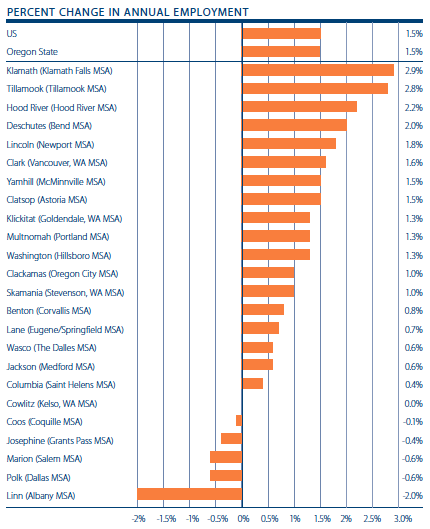
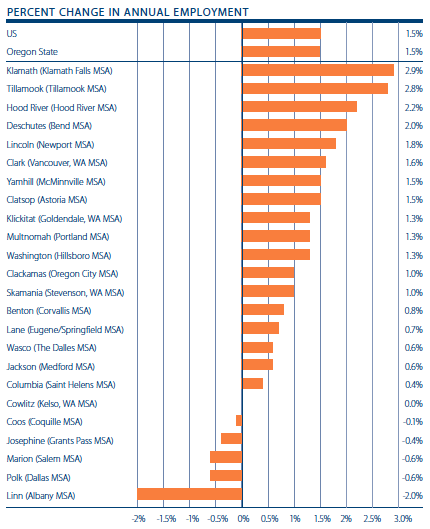
On an annualized basis, the Oregon counties covered in this report increased employment by 0.92 percent, or approximately 15,590 jobs, a further—albeit modest—improvement from the 0.8 percent annual growth that was discussed in our last report. On a year-over-year basis, 19 counties saw their employment base expand and five saw employment contract.
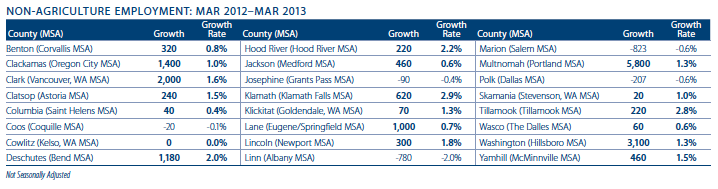
Employment growth was most pronounced in Klamath County (+2.9%). This was followed by Tillamook (+2.8%), Hood River (+2.2%) and Deschutes (+2.0%) Counties. Unsurprisingly, on an absolute basis, Multnomah County continued to contribute the largest increase in jobs with 5,800 additional positions over the past 12-month period. This was followed by Washington (3,100) and Clark (2,000) Counties.
On the negative side, job losses totaled 1,920 spread across five counties. Losses were most pronounced in Marion County, but the numbers were down by just 823 jobs. This was followed by Linn (-780) and Polk (-207) Counties. Losses in Josephine and Coos Counties were measured at 110 jobs combined.
It is pointless to compare the current employment situation to that seen at the end of the year, as the data is not seasonally adjusted and, therefore, the decline in overall employment in almost every county between December of 2012 and March of 2013 was not a surprise. However, the number of jobs lost was. Employment shrank by almost 20,000 in the time period and I will be watching very carefully to see that this was just a function of seasonality and nothing to be concerned about.
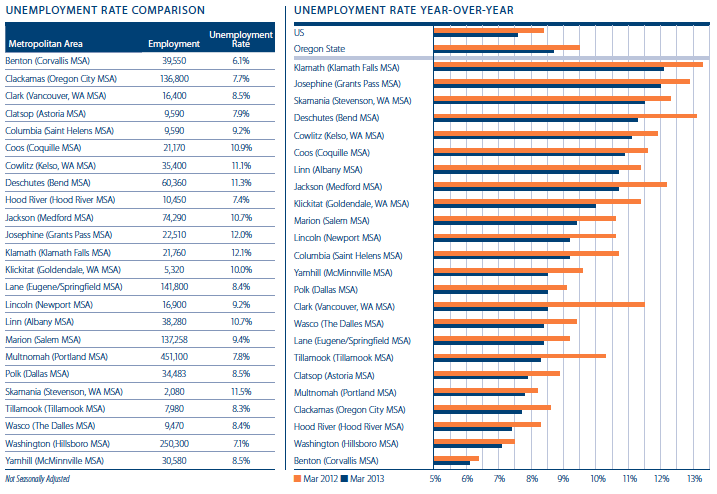
Continuing a trend that started in 2012, when compared to a year ago, the unemployment rate shrank in every county that was analyzed. This is positive and continues to suggest that the market is improving in a fundamental way.
The greatest improvement was seen in Clark County, where the unemployment rate dropped by a substantial three percent to 8.5 percent. This was followed by Tillamook (-2.0%) and Deschutes (-1.8%) Counties. The smallest improvements were seen in Benton (-0.3%), as well as Washington and Multnomah Counties, which both saw their unemployment rates reduce by 0.4 percent.
As much as this may sound like a broken record—having made this statement in previous reports—it remains true that the Oregon economy is stuck in low gear. Expansion remains well below its potential. I cannot, therefore, raise the grade from the “C-” that I gave it at the end of 2012.
I believe that the job market will continue to grow, but at a pace that is lackluster.
Regional Real Estate
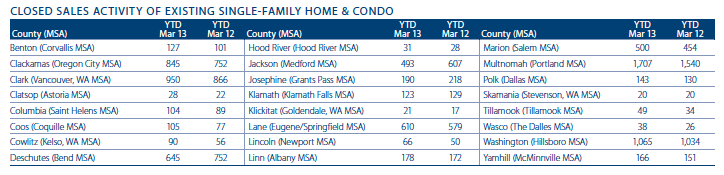
In the first quarter of 2013, the region reported 8,167 units of resale housing—a modest improvement of three percent from the same period in 2012.
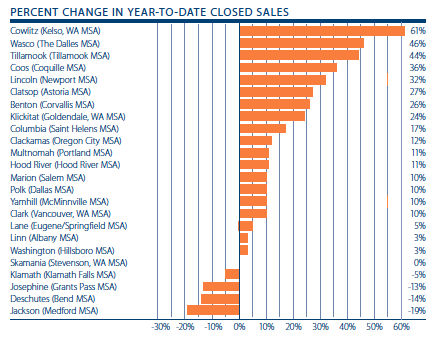
In 2012, the greatest growth in housing sales was seen in Cowlitz County (+61%), Wasco County (+46%), Tillamook County (+44%), Coos County (+36%) and Lincoln County (+32%). There were four counties that saw sales volumes drop when compared to Q1 2012. The most pronounced decline was seen in Jackson County, where sales dropped by 19 percent. This was followed by Deschutes (-14%), Josephine (-13%) and Klamath (-5%) Counties. As to whether this is a function of lack of supply, or lack of demand, is uncertain, but the drop was a fairly modest 255 units.
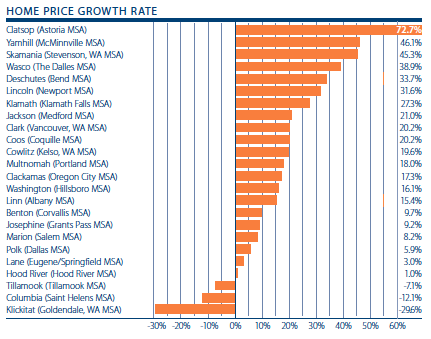
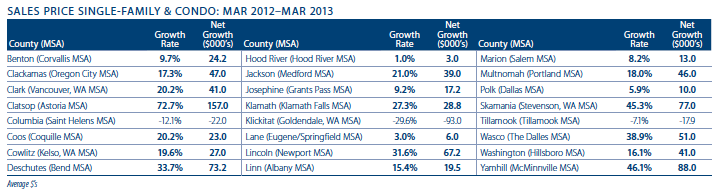
When we turn our attention to home prices, it is very pleasing to see that 21 of the markets analyzed registered year-over-year price increases (up from 15 in the last report), with just three showing declines in values from a year ago. In aggregate, the markets surveyed saw values increase by 17.9 percent over the same period in 2012.
Other than the dramatic 72.7 percent growth in the very small Clatsop County market, 15 other counties registered double-digit gains in price between March 2012 and March 2013. When compared to prices seen in the last quarter of 2012, 16 counties saw prices rise (up from 13 in our last report) and eight saw sale prices drop.
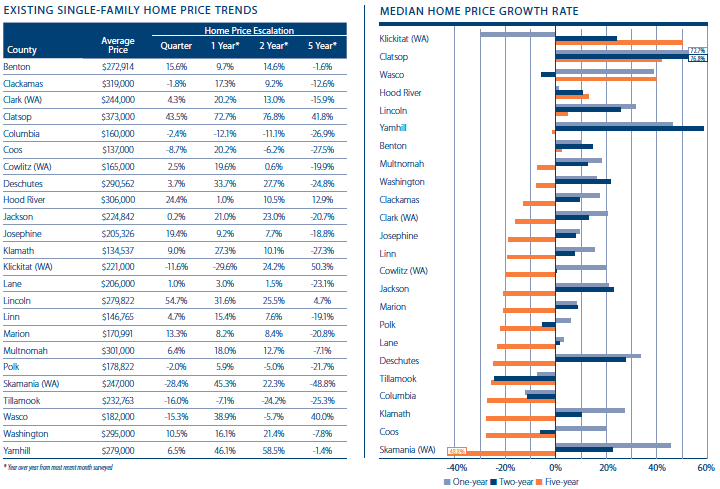
As we look at longer term trends, I continue to be pleased to see prices generally trending higher. When compared to the same period in 2012, there are now 19 counties that have seen prices rise – up from 14 in our last report. When compared to March of 2008, there are now five counties where sales prices are higher.
I am giving the market a “C+” grade for the first quarter of 2013, up from a “C” at the end of 2012. Without a doubt, inventory constraints are affecting the market, but sales and prices are still higher.
Conclusion
In 2012, Oregon’s economic performance was very similar to both 2010 and 2011. In each case there were some cautious hopes for stronger growth and more jobs as momentum was building near the end of the previous year. However, each time the regional economy has encountered headwinds that slowed growth near mid-year. The usual suspects have been flare-ups in the ongoing European recession and sovereign debt crisis, weak housing-related industries, and cuts at all levels of government. The end result in each of the past three years has been slow, lackluster growth.
As 2013 opens up, unfortunately, there is little hope that Oregon will see much immediate improvement in economic growth. Federal government cutbacks and tax increases are weighing on the economy, and the pipeline of future orders has slowed among many local manufacturing industries.
That said, and despite the weak near-term outlook, I believe that the stage is set for stronger growth going forward, should the economy manage to successfully navigate the next few months. The primary reason for optimism is the strength of balance sheets for businesses and consumers alike. With financing costs low and corporate profits high, a great deal of spending and investment stands to be unleashed as soon as some of the uncertainty that is obscuring the near-term outlook is cleared away. Although household net worth is not back to pre-recession levels, it has been growing strongly. Home prices are rising once more, and stock markets have regained all of their recessionary losses.
Looking at the housing market, I am modestly pleased with its progress so far. Rising prices and slightly higher interest rates have been a catalyst to get would-be buyers off the fence and in search of a new home.
However, we are in dire need of inventory. As I mentioned in my last report, if there are not substantial increases in listings, there will be some buyers who will become disenchanted either with the lack of choice in the market, or with the desire not to get into bidding wars on homes that actually are for sale. This remains a mid-term concern.
About Matthew Gardner
Mr. Gardner is a land use economist and principal with Gardner Economics and is considered by many to be one of the foremost real estate analysts in the Pacific Northwest.
In addition to managing his consulting practice, Mr. Gardner chairs the Board of Trustees at the Washington Center for Real Estate Research at the University of Washington; sits on the Urban Land Institutes Technical Assistance Panel; is an Advisory Board Member for the Runstad Center for Real Estate Studies at the University of Washington and is the Editor of the Washington State University’s Central Puget Sound Real Estate Research Report.
He is also the retained economist for the Master Builders Association of King & Snohomish Counties. He has twenty-five years of professional experience in the U.K. and U.S.
He has appeared on CNN, NBC and NPR news services to discuss real estate issues, and is regularly cited in the Wall Street Journal and all local media.
A short sale is the sale of a property for less than what the owner still owes on the mortgage. A short sale is an alternative to foreclosure when a homeowner needs to sell and can no longer afford to make their mortgage payments. The lender agrees to accept less than the amount owed to pay off a loan now rather than taking the property back by foreclosure and trying to sell it later. Lenders agree to a short sale because they believe it will net them more money than going forward with a lengthy and costly foreclosure process.
Can Any Real Estate Agent Effectively Handle My Short Sale?
No. A short sale is a very complicated real estate transaction and one that has very important implications for you. More than any other type of residential real estate transaction, a short sale should be handled only by a real estate broker who has substantial experience with the short sale process , and a strong track-record of success in negotiating short sales for their clients. You wouldn’t have your family doctor perform heart surgery. And, you shouldn’t expect any real estate broker to be qualified to handle this highly complex real estate transaction for you.
Why Should I Choose A Short Sale Over Foreclosure?
Whether you should do a short sale or let your property go to foreclosure depends on several factors. In most instances, a short sale makes more sense than foreclosure. In general, when you want to obtain a loan to purchase a property in the future, more opportunities will be available to you if you do a short sale. And, contrary to popular belief, you can be current on your payments and still do a short sale. In fact, if you are current on your mortgage through a short sale, you can qualify for an FHA loan afterwards without any waiting periods. The same option will not be available following a foreclosure.
While doing a short sale will negatively affect your credit, there are many benefits to choosing a short sale over foreclosure. With a short sale, you are in control of the sale, not the bank. You may sleep better at night knowing who is buying your home, and you can spare yourself the social stigma of foreclosure.
Every homeowner’s situation is different, so we always recommend that you speak with a real estate attorney that can advise you on the legal and tax implications for your circumstances.
How Do I Know If I Qualify For A Short Sale?
If you owe more than your house is worth and can’t afford your mortgage payments, you may qualify for a short sale. Every situation is unique, but in general the basic criteria for qualifying for a short sale are:
You need to sell your home.
You owe more on your mortgage than your home is worth.
You have a personal financial hardship that will prevent you from making future payments. (Examples of hardship include loss of job, divorce, death of a spouse and medical emergency or illness.)
When calculating if your house is worth less than the amount owed on the loan, you should deduct out what you would pay in real estate commissions, closing costs, and state excise taxes to sell your home.
Will I Get Any Money From The Sale?
Unless specifically authorized through a federally-sanctioned program such as HAFA, when a lender approves a short sale, they typically require that the borrower (seller) not receive any money from the sale of the property since the lender is going to take a loss on the loan.
How Long Does A Short Sale Take?
The short sale process is complicated and time-consuming. It can take several weeks, or even months, to get a short sale approved. Many lenders have several layers of management, insurers, and investors that will have to be satisfied before a short sale is approved. As a homeowner, it is important to be patient during this long process. It is also critical that you work with a short sale negotiator who is familiar with the various requirements of individual lenders to ensure that the process moves as quickly as possible.
Is There Enough Time To Do A Short Sale Before A Foreclosure?
Maybe, maybe not. Just starting a short sale will not automatically stop a foreclosure. However, many times a lender can be convinced to postpone the foreclosure to let a short sale negotiation take place. So, while there are no guarantees, it does not hurt to try.
Does A Short Sale Always Work?
No, there is no guarantee that this will work. Once you fall behind on your loan, the lender can proceed to foreclosure if they choose to. But typically, lenders prefer not to foreclose and, if effectively presented with smart alternatives, they will often agree to a short sale rather than foreclose. If a short sale is attempted but doesn’t work, your house will likely go to foreclosure.
I Have More Than One Mortgage On My House. Can I Still Do A Short Sale?
Yes. Each mortgage can be negotiated individually. However, multiple mortgages make a short sale more complicated and time-consuming. Not only do you need the cooperation of the first lender, the second mortgage holder needs to agree to a short sale as well.
What Is A Release?
A lender may offer to “release” its security interest against the property in exchange for less than the total amount of the note. A release will allow the property to be sold without paying off the obligations of the note. However, the note is not satisfied. The advantage of a release is it allows the property to be sold and helps you avoid a foreclosure. The disadvantage is the remaining debt on the property (sometimes called a deficiency) still exists. You are still liable for the note. In other words, you still owe the money. In reality, it’s not likely that the lender will pursue the deficiency unless you have other significant assets. Furthermore, if you don’t attempt a short sale and the property goes to foreclosure, you can be liable for the full amount of remaining debt on any additional mortgages beyond your first mortgage.
What Is A Satisfaction?
A lender may agree to accept less than it is owed as complete and total satisfaction of the debt and release its lien against the property. Your note and obligation to the lender are satisfied for less than you owe. When the property is sold, the debt is paid off completely. Sometimes short sale negotiations are successful in obtaining complete satisfaction. Sometimes all that can be obtained is a release.
Are There Tax Consequences?
When a lender cancels, or forgives, your debt, the tax laws may consider the forgiven debt as taxable income. If a lender agrees to a satisfaction, the Mortgage Forgiveness Debt Relief Act of 2007 provides that debt forgiveness of up to $2 million is not considered taxable income if:
The house has been used as your principal place of residence for at least two of the previous five years.
The debt has been used to buy, build, or make substantial improvements to the home.
Home equity loans where the money was not used to buy, build, or improve the home do not qualify for the exclusion. Neither do mortgages for second homes or rental properties. The law has been extended to include debt forgiven through 2013.
There are additional tax considerations to keep in mind. A debt cancellation will affect your property’s cost basis. Insolvency or bankruptcy may also alleviate some of the tax burdens of a debt cancellation resulting from a short sale. You should always confirm tax matters with your tax professional.
Can I Keep The House Through A Short Sale?
The purpose of a short sale is to get the property sold, so you do not keep the house. Just as in a normal sale, you will be moving, typically when the sale closes. Some sellers choose to move before the house closes. You will not be allowed to remain in the house. If your intention is to remain in your house, you should consider other options besides a short sale.
Richard Eastern is a Windermere broker in Bellevue, WA and co-founder of Washington Property Solutions, a short sales negotiating company. Since 2003 he has helped more than 900 homeowners sell their homes. A Bellevue native and a University of Washington grad, Richard is an avid sports fan and a devoted Little League and basketball coach. You can learn more about Richard here or at www.washortsales.com.
Windermere Real Estate is proud to partner with Gardner Economics on this analysis of the Western Washington real estate market. This report is designed to offer insight into the realities of the housing market. Numbers alone do not always give an accurate picture of local economic conditions; therefore our goal is to provide an explanation of what the statistics mean and how they impact the Western Washington housing economy. We hope that this information may assist you with making an informed real estate decision. For further information about the real estate market in your area, please contact your Windermere agent.
Regional Economics
Generally speaking, I see steady improvement in the regional economy, which is pleasing. Employment growth is evident in a vast majority of the counties analyzed in this report, and unemployment rates continue to improve.
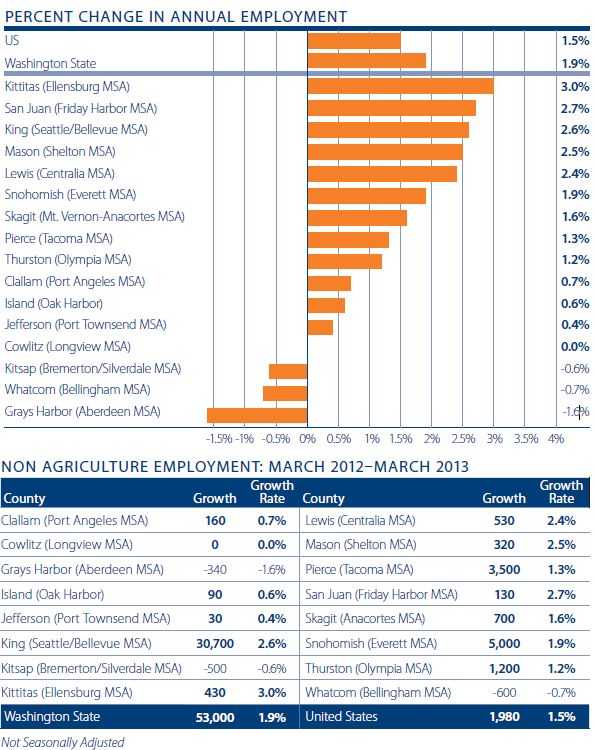
Repeating the numbers from the fourth quarter of the 2012 report, there were just three counties that saw total employment drop over the past 12-month period and the remaining 13 counties added a total of 41,350 new jobs. The growth was measured at a respectable 1.9 percent.
The figures still look quite good, but the rate of improvement—on an annualized basis—has started to slow. I would note that the region did lose 13,520 jobs between the end of 2012 and March of 2013. I am not, however, concerned as this was due to the State re-benchmarking its data.
Year-over-year, Kittitas County (+14.2%) grew at the fastest rate—it is a small county, but the service industry continues to expand. This was followed by San Juan (+2.7%), King (+2.6%), Mason (+2.5%), and Lewis (+2.4%) Counties. Job losses were modest, with Grays Harbor (-1.6%), Whatcom (-0.7%), and Kitsap (-0.6%) Counties suffering job losses; total employment in these counties contracted by 1,440 jobs.
Attention remains focused on the central Puget Sound region which includes King, Snohomish, and Pierce Counties. Between them, they accounted for a remarkable 94 percent of total job gains.
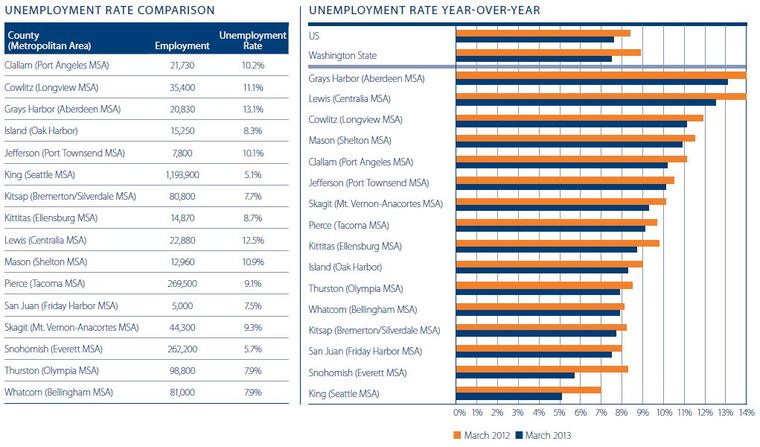
The unemployment situation continues to improve, with all counties demonstrating lower unemployment rates than seen a year ago. The greatest improvement was seen in Snohomish County, where the rate dropped from 8.3 percent to 5.7 percent. This was followed by King County, whose rate dropped by 1.9 percent; Lewis County saw a 1.5 percent drop, and Kittitas County saw an unemployment rate that was 1.1 percent below that seen a year ago.
The data suggests that we are an economy that continues to grow, but at a more cautious rate. Whether this is a function of the expiration of the tax credits that were implemented at the start of the year, the ongoing sequester, or just businesses remaining cautious, is uncertain. However, as a result, I am dropping the grade from a “B+” to a “B” for this quarter.
Improvement in the job market is being wholly driven by the private sector— the first time that this has happened in the history of this country. It is quite possible that the lack of direction coming from the other Washington has started to affect hiring decisions in our state. Our growth has slowed, but I do not yet feel the need to become concerned over this.
Regional Real Estate
The Samuel Taylor Coleridge quote, “Water, water everywhere, nor any drop to drink”, from the poem “The Rime of the Ancient Mariner”, is somewhat apt when looking at our regional real estate market. Buyers are driving through neighborhoods looking for homes, but the choices are scant.
Without a doubt, there are far more buyers than sellers in the market right now—and this is becoming an issue. That said, the region registered 11,349 home sales in the first quarter of 2013—an increase of 9.7 percent over the same quarter in 2012. Inasmuch as this is certainly positive, buyers are complaining not only about lack of choice, but also that intense bidding for homes that are on the market may be the precursor to another housing bubble.
Although I can sympathize with buyers, I do not believe that we are entering another bubble, but rather that the market has regained its confidence.
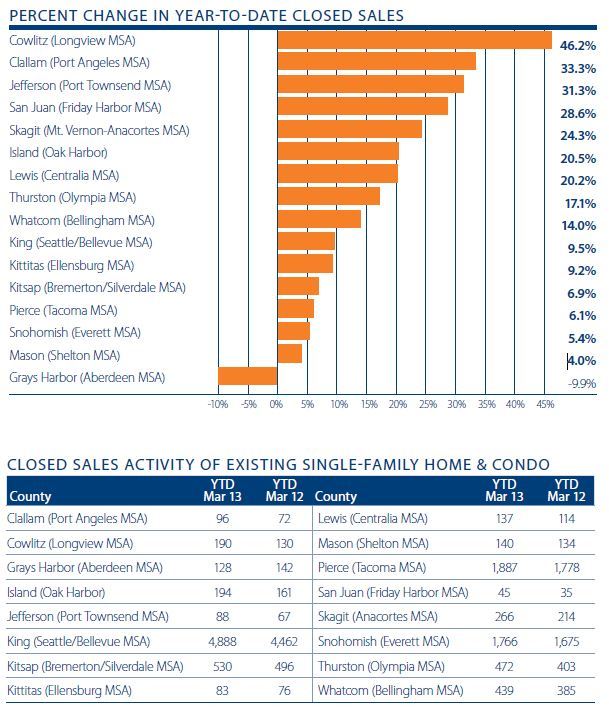
As noted in our last report, all but one county exhibited improving sales velocities in the first quarter when compared to the first three months of 2012. Grays Harbor County still remains the laggard, but this is wholly due to its size.
Fifteen counties saw improving sales in the first quarter when compared to the same period in 2012, with growth ranging from 4.5 percent (Mason County) to over 46 percent (Cowlitz County).
Is this rate of growth sustainable in 2013? That, without a doubt, is a crucial question. I believe that the lack of inventory is a function of two distinct situations. Firstly, banks are still slow in getting distressed inventory to market. I hope that this will improve as they dedicate more assets to the situation. Secondly, there are still a large number of homeowners who wish to sell, but are marginally underwater on their homes. These people cannot refinance at more preferential rates and would, therefore, like to sell but are not in a position to write a check out to the bank at closing. They are waiting for the proverbial “tide” to come in and raise the value of their homes sufficiently so that they can get out from underneath it.
This is an interesting market with well-positioned, well-located homes flying out the door. The new construction community has not stepped up production to handle the excess demand and the onus is still on the resale market. In aggregate, listings did grow in March but not to a level necessary to satisfy the market. Improvement in late spring and early summer will be crucial if we are to continue this solid increase in sales.
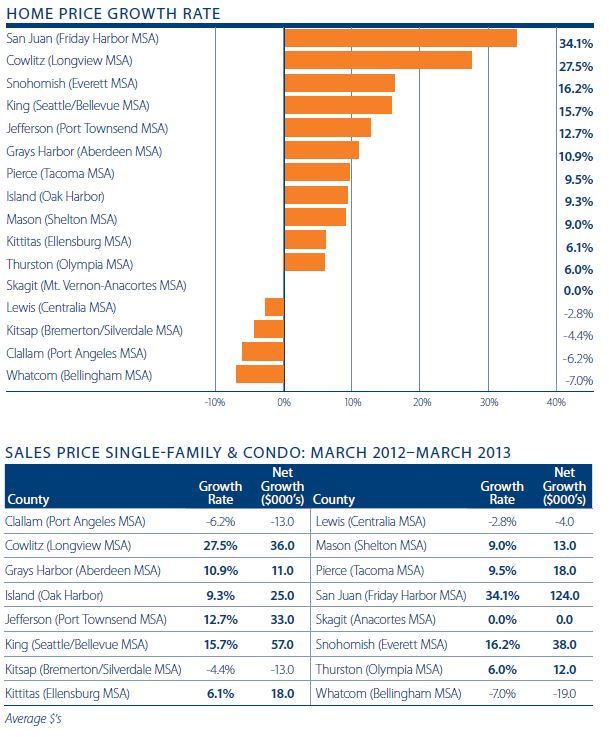
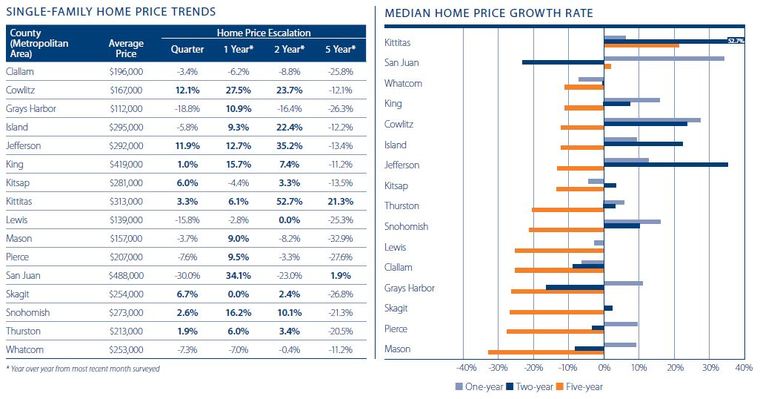
As shown in the chart to the right, 11 counties saw the average sales prices at levels above that seen a year ago, one county saw no growth, and four counties saw prices below that seen in March of 2012. In aggregate, the weighted average price of transacted homes in the counties analyzed was 12.4 percent higher at the end of the first quarter of 2013 than in March of 2012.
Of the counties that saw appreciation, the most pronounced gains were seen in the volatile San Juan County, where prices have risen by 34.1 percent. Significant additional gains were seen in Cowlitz (+27.5%), Snohomish (+16.2%), King (+15.7), Jefferson (+12.7%), and Grays Harbor (+10.9%) Counties. Declines were limited to Whatcom (-7.0%), Clallam (-6.2%), Kitsap (-4.4%), and Lewis (-2.8%) Counties.
Short-term trends, however, do not explain the bigger picture. If we are to look at a longer timeframe, it is clear to me that we are a market that has not only stabilized but is recovering nicely. Home price escalation over the past two years can be seen in nine of the 16 counties analyzed. Remembering that in mid-2010 the First Time Homebuyer Tax Credit (which artificially inflated, albeit temporarily, home prices) expired, it is good to see that we have now exceeded those prices in many areas. Additionally, there are now two counties where sale prices are higher than in the dark days of early 2008.
Interest rates for a 30-year fixed mortgage are 0.38 percent lower now than they were a year ago, but have been headed higher since December— surely another factor in getting buyers into the market. I believe that we will not retest the lows seen in November of last year, but rather we will see modestly increasing rates as we move through the year. This should not negatively impact prices but may actually function to get even more buyers into the market.
Mortgages are now available, but the required down payments and credit scores are still higher than I would like to see. I anticipate that we will see some further, appropriate, easing by banks and this lends credence to the likelihood of additional increases in prices as we move through the year.
The record appears to be stuck relative to my grade for housing. I have been stuck at a “C” grade for the past two quarters and I am afraid that I cannot change this yet.
Conclusions
Economic growth in our region continues, but at a more moderated rate. Is this a sign of a slowdown in the economy, or are we returning to a more moderated pace of improvement? I believe that we are taking a bit of a breather, but that as consumers start to become more comfortable with their own financial situations—whether this be driven by their job situation, improvement in the equity markets or improving home values—they will start to consume goods and services at a faster pace, which will lead to additional employment growth.
Some are getting concerned that the market appears to be demonstrating signs of “froth”. It is my opinion that rising home prices, in concert with modestly rising interest rates, have pushed many would-be buyers off the fence and in search of a new home. This has stimulated demand well beyond the level of home supply. As such, prices have jumped.
I do not see this as a bubble in the making. Underwriting is still stringent, with high credit scores and down payments required. Additionally, appraisers remain appropriately cautious, which is sure to temper the likelihood of a new housing bubble.
Competition is certainly rife! Not only between buyers looking for their own use, but also speculators with pockets of cash, looking for an alternative investment vehicle. I do understand buyers’ frustrations at the moment, but I believe the healing process that is underway in the housing market, while somewhat painful, will settle down eventually.
I still believe that home values will continue to appreciate in 2013 and we should see more homes for sale as prices rise to a point that frees up future sellers.
About Matthew Gardner
Mr. Gardner is a land use economist and principal with Gardner Economics and is considered by many to be one of the foremost real estate analysts in the Pacific Northwest.
In addition to managing his consulting practice, Mr. Gardner chairs the Board of Trustees at the Washington Center for Real Estate Research at the University of Washington; sits on the Urban Land Institutes Technical Assistance Panel; is an Advisory Board Member for the Runstad Center for Real Estate Studies at the University of Washington and is the Editor of the Washington State University’s Central Puget Sound Real Estate Research Report.
He is also the retained economist for the Master Builders Association of King & Snohomish Counties. He has twenty-five years of professional experience in the U.K. and U.S.
He has appeared on CNN, NBC and NPR news services to discuss real estate issues, and is regularly cited in the Wall Street Journal and all local media.
There is a lot to consider when you decide to buy a home, especially if it is your first. How much home you can afford? What kind of loan should you choose? Which neighborhoods are both affordable and a good investment? These are just a few of the questions you’ll be asking yourself. But with an experienced agent to help you, you’ll get the guidance you need to come up with the right answers−and a home you love.
First things first
Before you start shopping, you need to find out how much home you can afford to buy. Your agent can refer you to a loan officer who will help you determine how much of a down payment you can manage, as well as the monthly payment, taxes and insurance costs. Your lender can then prequalify you for a dollar amount, which can help you focus your search. You can also get a quick, rough estimate of monthly mortgage costs at Windermere.com; there’s a mortgage rate calculator on every listing detail page.
Create a wish list
Once you know your price range, talk to your agent about the home features you need and the ones you would prefer. The former might include number of bedrooms or suitable space for a home office, while the latter might include hardwood floors or a pantry. By clearly communicating your needs and preferences, you can help you agent narrow down the selection and avoid wasting your time.
Check out a few neighborhoods
Be sure to talk to your agent about what you’re looking for in a neighborhood. Are property values your highest priority? Great schools? A short commute? Small-town atmosphere? Big-city amenities? Your agent will try to narrow down the affordable neighborhoods that fit your criteria. Then you can either explore them with your agent or get a sense of each neighborhood on your own.
Shop for a loan
There are many different loan programs to choose from. You’ll want to find one that offers you the best terms for your current situation and future plans. Your agent can give you the names of several mortgage specialists who can review your options with you and help you determine which loan is the most advantageous. Once you’re approved for a loan, sellers will consider you a more attractive prospective buyer.
Make an offer
You’ve finally found the right house in the right neighborhood. It fits your practical needs, has potential and just feels right. So how do you ensure that you keep the price as affordable as possible without running the risk of losing it? Your agent has the expertise to help you make the right offer. He or she knows what comparable houses are selling for, how long they’ve been on the market, and whether or not the asking price for the home you want is fair. Your agent can also offer excellent advice when it comes to making a counteroffer.
Seal the deal
Once you’ve found the home you want and your offer has been accepted, you give the seller an earnest-money deposit. Your agent draws up a purchase and sale agreement; it’s the contract that outlines the details of the property transfer from the seller to you. This contract is typically contingent on the home passing a structural inspection and you obtaining approval for financing.
The inspection lets you know if the house has any major issues and how well it has been maintained. Remember, no house is perfect. If the inspection uncovers some problems, your agent can help you determine whether to ask the seller to handle or pay for the repairs or to renegotiate the price of the home.
When the inspection is concluded and any loose ends resolved, you “close” on the home. Closing is when you and the seller sign all the papers, you pay your share of the settlement fees, and the documents are recorded. Your agent will be a happy to answer any questions throughout this complex process.
Home at last
When you buy a home, you get more than just a place to live. You get the satisfaction of having a place that is truly yours, one that reflects your style and provides a comfortable setting for you and your family. Buying a home also gives you a substantial annual tax deduction and a way to build wealth over the years.
If you have questions about the buying or selling process, or are looking for an agent in your area, we have professionals that can help you. Contact us here.

 Facebook
 X
X
 Pinterest
 Copy Link





 About Matthew Gardner
 Richard Eastern is a Windermere broker in Bellevue, WA and co-founder of